💥Join UPSC 2027,2028 Mentorship (August Batch) + XFactor Notes & Microthemes PDF

Subject: Federal System

  • What are Autonomous District Councils (ADC)?

    Why in the News?

    Mizoram Governor has imposed Governor’s Rule in the Chakma Autonomous District Council (CADC) due to prolonged political instability and repeated leadership changes.

    About Autonomous District Councils (ADCs):

    • Basis: They are local self-governing institutions established under the Sixth Schedule of the Indian Constitution.
    • Coverage: ADCs are constituted in tribal areas of the northeastern states—Assam, Meghalaya, Tripura, and Mizoram (ATM2) [Sixth Schedule] 
    • Purpose: These councils aim to provide autonomy to tribal communities to preserve their culture, customs, and govern their local affairs.
    • Notification: Each tribal area notified under the Sixth Schedule is declared an autonomous district, governed by its respective ADC.
    • Objective: The primary objectives of ADCs are to promote tribal self-governance, ensure local development, and protect tribal identity and rights.

    Note: The Constitution provides for the reservation of seats in Panchayats for STs.

    Key Features of ADCs

    • Legal Status: ADCs are formed through constitutional provisions under the Sixth Schedule and are not governed by state laws.
    • Council Composition: Each ADC comprises up to 30 members, of which 26 are elected by adult suffrage and 4 are nominated by the Governor.
    • Tenure: The tenure of an ADC is 5 years from the date of its constitution.
    • Scope of Authority: ADCs have legislative, executive, and limited judicial powers specific to the needs of tribal communities.
    • Applicability of Laws: State and Central laws do not automatically apply in ADC areas unless explicitly extended by the Governor.

    Powers and Functions of ADCs:

    • Law-Making Powers: ADCs can enact laws on land management, agriculture, and forest use (excluding reserved forests).
    • Customary Regulations: They can regulate inheritance, marriage, divorce, and social customs, and appoint traditional chiefs and headmen.
    • Local Administration: It oversee services such as primary education, dispensaries, roads, markets, and fisheries.
    • Judicial Functions: Councils can establish village courts to try civil and criminal cases involving tribal members, with sentencing powers up to five years.
    • Regulation of Trade: They may regulate money lending and trade by non-tribals, subject to Governor’s approval.
    • Revenue Sources: It can levy taxes on professions, trades, animals, vehicles, markets, ferries, and public infrastructure like roads and schools.

    Autonomy and Limitations:

    • Degree of Autonomy: ADCs enjoy substantial legislative and administrative autonomy within their territorial jurisdiction.
    • Non-Applicability of General Laws: Parliamentary and State laws apply only when directed by the Governor, ensuring self-rule.
    • Governor’s Oversight: Despite autonomy, the Governor retains discretionary powers and can approve, modify, or annul council decisions.
    • Financial Constraints: ADCs often face limited revenue generation, which restricts their developmental effectiveness.
    • Administrative Challenges: Operational issues include leadership instability, shortage of trained personnel, and state-level interference in council functions.
    [UPSC 2015] The provisions in Fifth Schedule and Sixth Schedule in the Constitution of India are made in order to:Options: (a) protect the interests of Scheduled Tribes * (b) determine the boundaries between States (c) determine the powers, authority and responsibilities of Panchayats (d) protect the interests of all border States
  • ‘Consider Aadhaar, EPIC, ration card as proof ’

    Why in the News?

    Recently, the Supreme Court of India has intervened in the ongoing Special Intensive Revision (SIR) of electoral rolls in Bihar, urging the Election Commission (EC) to consider documents like Aadhaar, EPIC, and ration cards as valid identity proof.

    Why did the SC question Aadhaar’s exclusion from voter ID documents?

    • Widespread Use for Identity Verification: The Court noted that Aadhaar is one of the most widely used and accepted documents for establishing identity in India. It questioned why Aadhaar, considered essential for obtaining various official documents, was excluded while documents like caste certificates were included.
    • Relevance to Identity, Not Citizenship: The Court emphasized that the Special Intensive Revision (SIR) process is about verifying identity, not citizenship. Since Aadhaar serves that purpose effectively, its exclusion lacked justification.
    • Non-Exclusivity of Document List: The Court highlighted that the Election Commission’s list of 11 acceptable documents was not exhaustive, and in the interest of justice, Aadhaar, EPIC, and ration cards should also be considered valid for voter registration.

    What issues surround the timing and conduct of the SIR in Bihar?

    • Short and Rigid Timelines: The Supreme Court noted that the 30-day deadlines for citizens to verify and submit documents were too short, raising concerns about procedural fairness.
    • Unclear Classification of SIR: The Court observed that the Bihar SIR was neither “summary” nor “special” as defined under Section 21 of the Representation of the People Act, 1950, making the exercise appear legally ambiguous.

    Why is Aadhaar controversial in proving voter citizenship?

    • Not a Proof of Citizenship: The Aadhaar Act clearly states that Aadhaar is meant for identity verification, not citizenship confirmation. It can be issued to non-citizens who are residents, which makes it unreliable as evidence for voting eligibility.
    • Risk of Inclusion Errors: Using Aadhaar may result in non-citizens being wrongly enrolled as voters due to data inaccuracies or misuse, thereby compromising the integrity of the electoral rolls.
    • High Dependence Among Marginalised Groups: In regions like Bihar, 87% of people have Aadhaar, but few possess documents like passports or matriculation certificates. If Aadhaar is excluded, vulnerable citizens risk disenfranchisement, raising concerns about equity and access.

    What are the issues related to the Adhaar Card and NPR in India? 

    • Overlap of Purpose and Confusion on Citizenship: While Aadhaar is officially a tool for identity verification and welfare delivery, and NPR is for creating a register of residents, their perceived linkage with citizenship screening (especially post-CAA debate) has led to widespread fear and confusion. Eg: During the 2020 NPR update, several states (e.g., West Bengal, Kerala) halted implementation, citing concerns over its potential use for citizenship determination.
    • Privacy and Data Security Concerns: Both Aadhaar and NPR involve massive collection of personal data, but the legal and technological safeguards for privacy and misuse remain inadequate. Aadhaar has faced leaks, while NPR has been criticised for seeking sensitive demographic data without clear purpose. Eg: In 2018, UIDAI acknowledged multiple cases where Aadhaar data was accessible through public domains or appswithout authorisation.
    • Exclusion due to Documentation Gaps: Aadhaar and NPR can inadvertently exclude individuals lacking proper documentation—especially the poor, migrants, or marginalised groups—from public services or the voter list. Eg: Reports from Jharkhand revealed cases where lack of Aadhaar linkage led to denial of PDS rations, contributing to hunger-related deaths.

    Way forward: 

    • Strengthen Legal Safeguards and Clarity: Enact clear legislative guidelines to distinguish the roles of Aadhaar, NPR, and citizenship documentation, ensuring they are not misused for exclusionary practices. A robust data protection law must accompany these measures.
    • Promote Inclusion and Transparency: Ensure all government identity and registration drives are conducted with public awareness, grievance redressal mechanisms, and opt-out provisions for vulnerable groups, to prevent exclusion and build trust in institutions.

    Mains PYQ:

    [UPSC 2014] Two parallel run schemes of the Government viz. the Adhaar Card and NPR, one as voluntary and the other as compulsory, have led to debates at national levels and also litigations. On merits, discuss whether or not both schemes need run concurrently. Analyse the potential of the schemes to achieve developmental benefits and equitable growth.

    Linkage: This PYQ directly relates to the essence of the statement “Consider Aadhaar, EPIC, ration card as proof” by focusing on the Aadhaar Card and the debates and implications surrounding its use as a governmental tool.

  • What are Zonal Councils?

    Why in the News?

    Union Home Minister recently highlighted that 83% of issues discussed in Zonal Council meetings have been resolved, reaffirming their role as effective platforms for intergovernmental cooperation.

    What are Zonal Councils?

    • Establishment: They are statutory bodies established under the States Reorganisation Act, 1956; they are not constitutional bodies.
    • Purpose: Their main goal is to promote cooperation and coordination among states, union territories, and the central government.
    • Basis for Zoning: Zones were drawn based on natural divisions, cultural and linguistic affinity, river systems, and security needs.
    • Zonal Division: India is divided into five zones—Northern, Central, Eastern, Western, and Southern—with a separate Zonal Council for each:
      1. Northern Zonal Council: Haryana, Himachal Pradesh, Jammu & Kashmir, Punjab, Rajasthan, Delhi, Chandigarh
      2. Central Zonal Council: Chhattisgarh, Uttarakhand, Uttar Pradesh, Madhya Pradesh
      3. Eastern Zonal Council: Bihar, Jharkhand, Odisha, West Bengal
      4. Western Zonal Council: Goa, Gujarat, Maharashtra, Dadra & Nagar Haveli, Daman & Diu
      5. Southern Zonal Council: Andhra Pradesh, Karnataka, Kerala, Tamil Nadu, Puducherry

    Note: 

    • North-Eastern Council (NEC) (separate body): Assam, Arunachal Pradesh, Manipur, Tripura, Mizoram, Meghalaya, Nagaland, Sikkim (added in 2002)
    • The union territories of Andaman and Nicobar Islands and Lakshadweep are NOT members of any of the Zonal Councils. However, they are presently special invitees to the Southern Zonal Council.

    Composition and Structure of Zonal Councils:

    • Chairperson: Each Zonal Council is chaired by the Union Home Minister.
    • State Representation: The Chief Ministers of all states in the respective zone are members of the Council.
    • Additional Members: Each state nominates two additional ministers; administrators of union territories also participate.
    • Vice-Chairperson Role: The role of Vice-Chairperson rotates annually among the Chief Ministers.
    • Standing Committees: These are formed with Chief Secretaries of states and meet ahead of full sessions to finalize the agenda.

    Functions and Responsibilities:

    • Cooperation & Consensus: Promote interstate and Centre-state cooperation through dialogue and consensus-building.
    • Key Issues Addressed: Economic and social planning, Border disputes, Inter-state transport, Linguistic minority concerns etc.
    • Advisory Role: While the councils’ recommendations are advisory, they play a vital role in dispute resolution and coordinated policy formulation.

    Recent Developments and Significance:

    • Leadership in NEC: In 2018, the Union Home Minister became the Chairperson of the North Eastern Council, signaling a push for broader integration.
    • Revitalization under Modi Government: Zonal Councils have evolved into dynamic, action-oriented platforms rather than passive advisory bodies.
    • Strengthening Federalism: These councils now actively contribute to cooperative federalism, resolve disputes, and accelerate regional development.
    • Efficacy in Implementation: With 83% of agenda issues resolved, Zonal Councils demonstrate increasing political will and effectiveness in addressing regional challenges.
    [UPSC 2013] Which of the following bodies is/are not mentioned in the Indian Constitution?

    1. National Development Council 2. Planning Commission 3. Zonal Councils

    Select the correct answer using the codes given below.

    Options: (a) 1 and 2 only (b) 2 only (c) 1 and 3 only (d) 1, 2 and 3


  • [9th July 2025] The Hindu Op-ed: The dark signs of restricted or selective franchise

    PYQ Relevance:

    [UPSC 2024] Examine the need for electoral reforms as suggest ed by various committees with particular reference to “one na tion-one election” principle.

    Linkage: The article talks about the “Special Intensive Revision (SIR) of electoral rolls in Bihar,” initiated on June 24, 2025, after a gap of over 20 years. This SIR is described as a “complete reconstruction of the electoral rolls” based on document submission which is directly related electoral reforms given in question.  


    Mentor’s Comment:  The Election Commission of India (ECI) has launched a Special Intensive Revision (SIR) of the electoral rolls in Bihar, just months before the upcoming State Assembly elections in 2025. The process has drawn widespread criticism for being sudden, opaque, and document-heavy, potentially disenfranchising lakhs of eligible voters, particularly migrants, Muslims, and the poor. It is now being challenged in the Supreme Court for violating fundamental rights such as the right to vote, equality, and dignity. The issue has national implications, as similar exercises are reportedly planned in other states.

    Today’s editorial analyses the issues related to Special Intensive Revision (SIR) of the electoral rolls in Bihar. This topic is important for  GS Paper II (Polity and Governance) in the UPSC mains exam.

    _

    Let’s learn!

    Why in the News?

    Recently, the Election Commission of India (ECI) started a Special Intensive Revision (SIR) of the voter list in Bihar, just a few months before the 2025 State Assembly elections.

    What is Special Intensive Revision (SIR)?

    Special Intensive Revision (SIR) is a process carried out by the Election Commission of India (ECI) to update and verify the electoral rolls (voter lists) more thoroughly than usual.

    Key Features of SIR:

    • Not a routine update: Unlike regular annual revisions, SIR involves a more detailed and document-heavy verification process.
    • Document verification: Voters are required to submit proof of citizenship (like birth certificates, land documents, or school records), especially if they are not listed in older rolls (e.g., from 2003).
    • Purpose: Officially, it aims to: Remove duplicate or deceased voters, Identify ineligible entries, and Add newly eligible voters.

    Why is the Bihar Special Intensive Revision (SIR) seen as a threat to electoral democracy?

    • Sudden and Opaque Implementation: The SIR was launched abruptly in June 2025 with minimal public awareness and a tight deadline of July 31, offering little time for a state with high migration and low documentation. Eg: Migrants working outside Bihar during monsoon may be excluded due to inability to submit documents on time.
    • Document-Heavy Verification Process: Common documents like Aadhaar or voter ID are not accepted. Instead, hard-to-obtain papers like birth certificates, land records, or matriculation certificates are required, placing a disproportionate burden on poor, rural populations.  
    • Creation of a Two-Tier Citizenship: The process presumes voters not on the 2003 rolls are “suspect” citizens until proven otherwise, undermining the principle of universal adult franchise and equal voting rights. Eg: Like in Assam’s NRC, the burden of proof shifts to individuals, potentially creating a permanent class of disenfranchised citizens.
    • Violation of Natural Justice: Requiring voters to prove citizenship reverses the principle of “innocent until proven guilty” and treats individuals as suspect citizens unless they can prove otherwise. Eg: In the Bihar SIR process, those not on the 2003 voter list must submit rarely available documents like birth certificates or land records, making many vulnerable to arbitrary exclusion.

    How does the Bihar SIR compare with Assam’s NRC exercise?

    Aspect Bihar SIR (2025) Assam NRC (2013–2019)
    1. Suddenness vs. Supervised Process Launched suddenly with only one-month deadline, causing logistical challenges. Conducted over six years, supervised by Supreme Court, with phased rollout.
    2. Legal Oversight No direct judicial monitoring; raises concerns about transparency and accountability. Directly monitored by the Supreme Court, ensuring legal safeguards.
    3. Scale and Timeframe Targets 50 million voters in just one monsoon month, with floods and migration. Covered 33 million applicants in multiple phases over years.
    4. Document Requirements Demands rare documents (birth/matriculation/land records); common IDs not accepted. Required legacy documents, but provided assistance centres and lists.
    5. Purpose and Outcome Ostensibly for voter list update, but risks becoming a citizenship test, causing mass disenfranchisement. Explicitly aimed at identifying illegal immigrants; excluded 19 lakh people.

    What constitutional principles are at stake in the current voter verification drive?

    • Universal Adult Franchise: Article 326 guarantees every Indian citizen above 18 the right to vote without discrimination. The demand for rare documents like land titles or educational certificates risks excluding poor and illiterate citizens.
    • Equality Before Law (Article 14): The selective burden of proof imposed on new or undocumented voters violates the principle of equal treatment. It creates two classes of citizens — one presumed to be voters and another forced to prove eligibility.
    • Presumption of Innocence (Principle of Natural Justice): The shift of burden from the state to the citizen undermines the principle that individuals are “innocent until proven guilty.”

    Who are the vulnerable groups most affected by the SIR process?

    • Migrant Workers: The Special Intensive Revision (SIR) disproportionately affects migrant workers who are often away from their home constituencies during the verification period, especially in July, a peak seasonal migration month.
    • Poor and Illiterate Citizens: Those from economically weaker sections, particularly in rural areas, often lack the official documents such as birth certificates, matriculation degrees, or land records now required for voter verification. Their reliance on documents like Aadhaar, ration cards, or job cards, which the ECI currently does not accept, puts them at risk of disenfranchisement.
    • Women (especially Elderly or Homemakers): Many women, especially widows, elderly, or those confined to domestic roles, are not listed on ownership documents and may lack the required identity proofs.
    • Scheduled Castes and Scheduled Tribes (SCs/STs): Historically marginalised communities such as SCs and STs face greater hurdles due to their geographic isolation, poor access to services, and lower literacy levels, making it harder to furnish the required documentation to prove citizenship or residence.
    • Urban Slum Dwellers and Informal Settlers: Migrants living in slums or unauthorised colonies in cities often lack registered addresses, utility bills, or tenancy documents. This makes it difficult to verify their voter eligibility either in their native village or in the urban location, risking double exclusion from electoral rolls.

    Way forward: 

    • Ensure Inclusive and Transparent Voter Verification Process: Extend the verification timeline, especially in high-migration and flood-prone regions like Bihar. Accept commonly held identity documents such as Aadhaar, voter ID, and ration cards as valid proof. This would reduce arbitrary exclusions and uphold the principle of universal franchise.
    • Protect Vulnerable Groups through Targeted Support: Launch doorstep assistance, mobile camps, and helplines in rural, tribal, and urban slum areas to help citizens gather documents and complete verification. Special provisions should be made for migrants, women, SC/STs, and informal workers, ensuring no one is disenfranchised due to procedural hurdles.
  • [5th July 2025] The Hindu Op-ed: Two Democracies and the Echoes of Tyranny

    PYQ Relevance:

    [UPSC 2024] What changes has the Union Government recently introduced in the domain of Centre-State relations? Suggest measures to be adopted to build the trust between the Centre and the States and for strengthening federalism.

    Linkage:  The articles discusses how India’s democratic backsliding occurred partly due to the exploitation of constitutional weaknesses and how “the deeper damage to political culture, to institutions, to the idea that constitutionalism alone can protect democracy remains” after the Emergency.


    Mentor’s Comment:  On U.S. Independence Day, reflections by Judge J. Michael Luttig and a look back at India’s 1975 Emergency give a strong warning about how democracy can be weakened from within. It compares how Indira Gandhi misused the Constitution in India to how leaders like Donald Trump show signs of authoritarianism in America. It highlights that freedom and rights can be lost not by war, but by twisting laws and failing institutions. The Emergency period still feels relevant today, as many democracies around the world face similar dangers. It’s a reminder that constant vigilance is the price of liberty.

    Today’s editorial analyses the  1975 Emergency and its impact in India. This topic is important for GS Paper II (Indian Polity) in the UPSC mains exam.

    _

    Let’s learn!

    Why in the News?

    The same problems that caused the Emergency in India are now putting the U.S. at risk. The lesson is that tyranny grows when important institutions stop doing their job.

    What Constitutional gaps enabled the 1975 Emergency’s misuse?

    • Vague Grounds for Proclaiming Emergency (Article 352): The term “internal disturbance” (before it was amended to “armed rebellion” by the 44th Amendment) was undefined, allowing the government to declare an Emergency without sufficient justification.
    • Lack of Judicial Safeguards: The judiciary, including the Supreme Court, failed to protect fundamental rights. In the ADM Jabalpur case (1976), the Court ruled that even the right to life could be suspended, revealing a serious weakness in judicial independence and constitutional checks.
    • Absence of Parliamentary Oversight Mechanisms: There was no mandatory review or time limit for an Emergency once proclaimed. Parliament was not empowered to effectively question or revoke the declaration, enabling prolonged executive overreach.
    • Preventive Detention Laws without Safeguards: Laws like the Maintenance of Internal Security Act (MISA) allowed for the detention of individuals without trial, and the suspension of habeas corpus, giving the executive near-total control over personal freedoms.

    How did the Emergency weaken democratic institutions in India?

    • Suppressing the Free Press: The government imposed pre-censorship on newspapers like The Indian Express and The Statesman, curbing freedom of the press. Journalists were jailed, and dissenting voices silenced, eroding media independence.
    • Paralysing the Legislature and Bureaucracy: Parliament became a rubber stamp, passing ordinances and amendments without real debate. Civil servants and ministers followed orders unquestioningly, prioritising loyalty over legality, thereby hollowing out institutional integrity.

    Why is India’s Emergency relevant to the current global democratic decline?

    • Authoritarianism through Legal Means: The 1975 Emergency showed how laws can be manipulated to suspend rights and suppress dissent without military coups. Today, similar tactics are used globally — leaders use legal loopholes and executive decrees to weaken democratic norms (e.g., Hungary’s rule-by-decree during the COVID-19 pandemic).
    • Erosion of Institutional Independence: During the Emergency, judiciary, media, and civil services failed to resist executive overreach. This institutional submission mirrors current trends in several democracies where checks and balances are compromised under pressure (e.g., judiciary weakening in Turkey and political pressure on U.S. law enforcement).
    • Cult of Personality and Centralised Power: Indira Gandhi’s consolidation of power and her son’s parallel command structure resemble modern populist leadershipsthat centralise authority, undermine opposition, and control narratives (e.g., executive overreach in Brazil, Philippines, or even Russia).

    What ethical duties do institutions hold in resisting authoritarianism?

    • Upholding Constitutional Values: Institutions like the judiciary, legislature, and civil services must prioritise the Constitution over political loyalty, ensuring that democratic principles, civil liberties, and rule of law are never compromised.
    • Maintaining Institutional Independence: Institutions have a duty to remain independent and impartial, resisting pressure from the executive or ruling parties. This includes protecting dissent, enabling checks and balances, and avoiding complicity in authoritarian overreach.
    • Defending Public Trust and Accountability: Ethical responsibility requires institutions to serve the public interest, not individual leaders. They must ensure transparency, fairness, and accountability, especially during crises when democratic norms are most vulnerable.

    How can citizens safeguard democracy from internal threats?

    • Active Civic Participation: Citizens must engage in democratic processes such as voting, peaceful protest, and public discourse to hold leaders accountable. Eg: Mass movements like India’s JP Movement in the 1970s or the U.S. Civil Rights Movement helped restore democratic accountability.
    • Demanding Transparency and Accountability: Citizens should question government actions, demand answers through RTI, media, and civil society platforms, and resist normalisation of unconstitutional acts. Eg: Public pressure during India’s anti-corruption movement (2011) led to the Lokpal Act.
    • Promoting Constitutional Literacy and Vigilance: A well-informed public is less likely to fall for authoritarian rhetoric. Citizens must educate themselves about constitutional rights and duties, enabling them to recognize and resist erosion of democratic norms.

    Way forward: 

    • Strengthen Institutional Independence: Ensure autonomy of key democratic institutions like the judiciary, election commission, and media through legal safeguards and transparent appointments to resist political influence.
    • Promote Constitutional Literacy and Civic Engagement: Launch nationwide awareness campaigns and integrate constitutional values into education to empower citizens to uphold democratic principles and resist authoritarianism.
  • Registered Unrecognized Political Parties

    Why in the News?

    The Election Commission of India (ECI) has initiated the process to delist some Registered Unrecognized Political Parties (RUPPs) that have not contested a single election since 2019 and whose offices are untraceable.

    About Registered Unrecognized Political Parties (RUPPs):

    • Definition: RUPPs are political parties that are registered with the Election Commission of India (ECI) but have not yet qualified as State or National Parties.
    • Electoral Status: These parties may be newly registered, may have contested elections but underperformed, or may have never contested at all.
    • Privileges:
      • Eligibility for election symbols under specific conditions.
      • Tax exemptions for donations under Section 13A of the Income Tax Act, 1961.
      • The ability to participate in elections under the Election Symbols (Reservation and Allotment) Order, 1968.

    How are Political Parties Registered?

    • Legal Basis: Registration is governed by Section 29A of the Representation of the People Act, 1951.
    • Requirements: Parties must submit an application with their constitution or memorandum to the ECI.
    • Declarations: The party must affirm adherence to the Constitution and commit to socialism, secularism, democracy, and national unity.
    • Benefits: Once registered, the party can contest elections, seek a common symbol, and receive legal financial support.

    Criteria for Recognition as a Political Party:

    • For State Party Recognition: A party must:
      • Win 6% of valid votes and 2 Assembly seats, or
      • Win 3% of Assembly seats or at least 3 seats, or
      • Win 1 Lok Sabha seat and 6% of valid votes in a general election from the state.
    • For National Party Recognition: A party must:
      • Be recognized as a State Party in 4 states, or
      • Win 2% of Lok Sabha seats (11 seats) from at least 3 states, or
      • Poll 6% of valid votes in 4 states and win 4 Lok Sabha seats.
    • Advantages of Recognition: Recognized parties get reserved symbols, broadcast time, campaign benefits, and can appoint more star campaigners.
    [UPSC 2001] Consider the following statements regarding the political parties in India:

    1. The Representation of the People Act, 1951 provides for the registration of political parties.

    2. Registration of political parties is carried out by the Election Commission.

    3. A national level political party is one which is recognised in four or more States.

    4. During the 1999 general elections, there were six National and 48 State level parties recognised by the Election Commission.

    Options: (a) I, II and IV (b) I and III (c) II and IV (d) I, II, III and IV*


  • A lofty concept, a Governor and unwanted controversy

    Why in the News?

    A big controversy has started in Kerala after the Governor put up a picture of ‘Bharat Mata’ in an official room at the Raj Bhavan, leading to a clash between the Governor and the elected state government.

    What is the origin and evolution of the Bharat Mata image?

    • Origin in literary and artistic nationalism: The concept of Bharat Mata originated in the late 19th century through Bankim Chandra Chattopadhyay’s novel Anandamath, which introduced the idea of Banga Mata (Mother Bengal). Later, Abanindranath Tagore painted a four-armed woman resembling a Hindu goddess in 1905, which was popularised by Sister Nivedita as Bharat Mata.
    • Evolution into a political symbol: During the Indian freedom movement, Bharat Mata evolved into a powerful emotional symbol representing the nation’s collective identity. While the slogan ‘Bharat Mata ki Jai’ became widespread, no specific image was officially adopted. Post-independence, the concept remained cultural but was not recognised in any constitutional or legal form.

    What is the Governor’s role in relation to decisions of the elected state government?

    • Constitutional Head: The Governor is the nominal head of the state and must act based on the aid and advice of the Council of Ministers, as per Article 163 of the Constitution. For instance, decisions on official functions, such as placing portraits or symbols, must follow government directions.
    • No Independent Decision-Making Power: Dr. B.R. Ambedkar clarified in the Constituent Assembly that the Governor has “no functions which he can discharge by himself.” In the Kerala case, the Governor unilaterally placing the Bharat Mata picture at state events goes against this principle.
    • Bound by Constitutional Protocols: The Supreme Court has held in multiple judgments (e.g., Nabam Rebia case, 2016) that the Governor cannot act at his discretion in routine matters. Thus, any deviation from official protocol, such as conducting ceremonies with unauthorised symbols, breaches constitutional norms.

    How does the Bharat Mata image controversy highlight tension between constitutional norms and cultural nationalism?

    • Lack of Constitutional Recognition: The image of Bharat Mata is not recognised by the Constitution like the national flag, emblem, or anthem. Including it in official state functions challenges the principle of secularism and constitutional symbolism, which mandates state neutrality in public symbolism.
    • Political and Ideological Association: The specific depiction used by the Governor—a woman in saffron with a lion—is commonly linked to“right-wing outfits”, making it a cultural nationalist representation rather than a universally accepted national symbol. Its use in state ceremonies risks the blurring of state and ideological lines.
    • Violation of Democratic Protocol: The elected state government objected to the image’s presence, arguing that no unilateral decision can override collective democratic authority. This reflects the friction between constitutional propriety and the personal or ideological preferences of a constitutional functionary.

    Can the Governor act independently in this case?

    • No. The Constitution does not permit the Governor to act unilaterally in official matters. Any display of symbols or portraits during official functions must have the State government’s approval. The Governor’s conduct must adhere to constitutional discipline, not personal or ideological preferences.

    How should officials balance personal beliefs with constitutional values? (Way forward)

    • Adhere to constitutional obligations over personal ideology – Public officials must act in line with constitutional principles like secularism, equality, and neutrality while performing official duties. For instance, a Governor should follow government protocol during official functions rather than promoting symbols not recognised by the Constitution.
    • Separate personal practices from public conduct – While officials are free to hold personal beliefs, they must not impose them in public institutions or state functions. Eg An officer may privately revere a religious symbol but should avoid displaying it in a government office to maintain inclusivity.

    Mains PYQ:

    [UPSC 2022] Are tolerance, assimilation and pluralism the key elements in the making of an Indian form of secularism? Justify your answer.

    Linkage: The controversy surrounding the display of a specific picture of Bharat Mata highlights a tension with the “strong secular core” and “inclusive” nature of Indian nationalism. This question explores the principles of Indian secularism, which are central to understanding the debate over how such a concept should be represented and integrated into official functions in a diverse society.

  • Banakacherla Project Dispute

    Why in the News?

    A fresh political and inter-state water dispute has erupted between Telangana and Andhra Pradesh over the proposed Banakacherla Reservoir Project.

    Banakacherla Project Dispute

    About the Banakacherla Project:

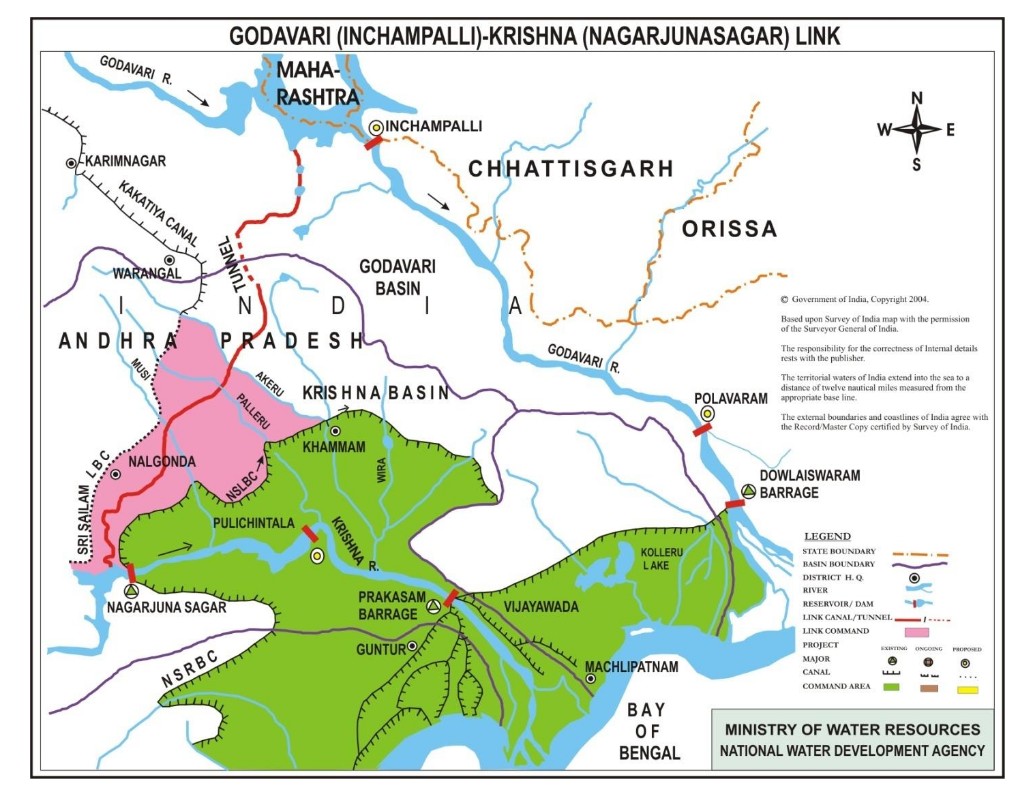
    • About: Also known as the Godavari-Banakacherla or Polavaram-Banakacherla Link Project, it is an ambitious interlinking plan proposed by the Andhra Pradesh government.
    • Objective: It aims to divert surplus Godavari River water via the Polavaram Project, through the Krishna basin, to reach the Banakacherla regulator in Kurnool district.
    • Reservoirs: The project involves construction of a new Bollapalli reservoir in Guntur district, enhancement of canal capacities (e.g., Polavaram canal from 17,500 to 38,000 cusecs), and a network of lift stations and tunnels through the Nallamala forest.
    • Water Pathway: It begins at Polavaram dam, moves to Bollapalli, and ends at Banakacherla, integrating Godavari, Krishna, and Penna River basins.

    Tap to read more about the Interstate River Water Disputes Act, 1956.

    Issues with the Project:

    • Violation of the AP Reorganisation Act (2014): Telangana claims that Andhra’s project infringes upon legal frameworks laid out during the bifurcation of the state.
    • Lack of Clearances: Telangana argues the project has not received mandatory approvals from:
      • Apex Council (Krishna River Management Board and Godavari River Management Board).
      • Central Water Commission (CWC).
    • Water Sharing: Telangana cites the Godavari Water Disputes Tribunal, which allocated 968 TMC to Telangana and 518 TMC to Andhra but did not quantify surplus water, making the legality of Andhra’s claim ambiguous.
    • Political Sensitivity: Water-sharing has historically been central to Telangana’s statehood movement; any diversion is seen as a betrayal of regional interests.
    • Ecological Concerns: The tunnel under the Nallamala forest may have environmental repercussions that have not been assessed or cleared.
    [UPSC 2012] Which of the following are included in the original jurisdiction of the Supreme Court? 1. A dispute between the Government of India and one or more States 2. A dispute regarding elections to either House of the Parliament or that of Legislature of a State 3. A dispute between the Government of India and a Union Territory 4. A dispute between two or more States

    Select the correct answer using the code given below:

    Options: (a) 1 and 2 only (b) 2 and 3 only (c) 1 and 4 only* (d) 3 and 4 only


  • 50 Years of National Emergency

    Why in the News?

    On June 26, 2025, India marks the 50th anniversary of the Emergency, imposed in 1975 by then Prime Minister Indira Gandhi.

    What is National Emergency? (Article 352)

    • Definition: A national emergency is a constitutional provision under Article 352 of the Indian Constitution.
    • Grounds for Proclamation: It can be proclaimed by the President of India when the security of India or any part of it is threatened by:
      • War
      • External Aggression
      • Armed Rebellion
      • (Earlier also included “internal disturbance”, removed via the 44th Amendment, 1978)

    Grounds of Proclamation: Evolution

    • Original Provision (1950): Allowed Emergency for “internal disturbance”, which was vague and broad.
    • 38th Amendment Act (1975): Made the President’s satisfaction final and beyond judicial scrutiny.
    • 44th Amendment Act (1978):
      • Replaced “internal disturbance” with “armed rebellion” to curb misuse.
      • Restored judicial review of the President’s decision.

    Process of Proclamation

    • Initiation: The Union Cabinet (not just the PM) must send a written recommendation to the President.
    • Anticipatory Power: The proclamation can be issued before the actual occurrence of war, aggression, or rebellion.
    • Parliamentary Approval:
      • Must be ratified by both Houses within 1 month.
      • Requires a special majority:
        • Majority of the total membership.
        • Two-thirds of members present and voting.
      • Valid for 6 months; can be extended indefinitely with fresh approvals every 6 months.

    Territorial Application

    • Original Scope: Applied to the entire nation.
    • 42nd Amendment Act (1976): Permitted partial emergencies limited to specific states or territories.

    Judicial Review:

    • Before 1975: Emergency proclamations could be challenged in courts.
    • After the 38th Amendment: Made proclamations immune to judicial review.
    • Post-44th Amendment: Judicial review restored.
    • Minerva Mills Case (1980): SC ruled that Emergency can be struck down if based on mala fide, irrelevant, or absurd grounds.

    Revocation of National Emergency:

    • Duration: Can continue indefinitely with periodic 6-month renewals.
    • Revocation: The President can revoke anytime without Parliamentary approval.
    • Lok Sabha Oversight:
      • If 1/10th of Lok Sabha members give written notice, the Speaker/President must convene a session within 14 days.
      • Disapproval motion can pass with a simple majority.

    Historical Precedents:

    India has witnessed 3 National Emergencies:

    • 1962–1968: Due to war with China (external aggression).
    • 1971–1977: Triggered by war with Pakistan, later extended on grounds of internal disturbance.
    • 1975–1977: Declared on June 25, 1975, for internal disturbances—widely seen as misuse of power.

    Implications of Imposition of National Emergency:

    1. Centre-State Relations:
    • Executive Control: The centre gains dominant powers over state governments.
    • Legislative Powers:
      • Parliament can legislate on State List subjects.
      • President can issue ordinances on State subjects.
      • Such laws remain valid for 6 months after Emergency ends.
    • Financial Control:
      • President can alter financial distribution between Centre and states.
      • Reduced grants or tax transfers can continue till end of financial year after Emergency is lifted.
    1. Legislature:
    • Lok Sabha:
      • Under Article 83(2), its term can be extended by one year at a time.
      • Cannot continue beyond 6 months after Emergency ends.
    • State Assemblies: Term can be similarly extended with the same limitation.
    1. Fundamental Rights:
    • Article 358 – Automatic Suspension:
      • Article 19 is automatically suspended, only when Emergency is due to war or external aggression.
      • Applies nationwide, regardless of where Emergency is declared.
    • Article 359 – Presidential Order:
      • President can suspend court enforcement of specified Fundamental Rights.
      • Does not apply to Articles 20 and 21.
      • Can be regional or nationwide, covering all or selected rights.
    1. Judiciary:
    • 38th Amendment: Shielded Emergency from judicial scrutiny.
    • 44th Amendment: Restored court oversight.
    • Minerva Mills Judgment: Upheld that proclamations can be invalidated if mala fide or irrational.
    [2022] Which of the following is/are the exclusive power(s) of Lok Sabha?

    1. To ratify the declaration of Emergency

    2. To pass a motion of no-confidence against the Council of Ministers

    3. To impeach the President of India

    Select the correct answer using the code given below:

    (a) 1 and 2 (b) 2 only * (c) 1 and 3 (d) 3 only