💥Join UPSC 2027,2028 Mentorship (August Batch) + XFactor Notes & Microthemes PDF

Subject: Federal System

  • Appointment of Vice Chancellors by Governor

    Why in the News?

    A recent controversy arose in Kerala, where the Governor (ex-officio Chancellor of State Universities) urged the Supreme Court to exclude the Chief Minister from the process of selecting Vice-Chancellors (VCs).

    Who is the Vice-Chancellor?

    • Position: Serves as Principal Academic and Executive Officer of the university.
    • Functions: Bridges executive and academic wings; ensures compliance with Acts, Statutes, and Regulations.
    • Authority: Chairs key bodies such as the Executive Council, Academic Council, Finance Committee, and Selection Committees.
    • Qualities Emphasized: Historical commissions (Radhakrishnan 1948, Kothari 1964–66, Gnanam 1990, Ramlal Parikh 1993) stressed academic excellence, administrative skill, integrity, and vision.
    • Significance: Maintains quality, relevance, and reform in higher education.

    About the Role of Governor and President in Universities:

    1. State Universities:
      1. Chancellor’s Position: The Governor is ex-officio Chancellor, functioning independently of the State Cabinet in university matters.
      2. VC Appointment: As per UGC Regulations, 2018, the Chancellor appoints Vice-Chancellors from a panel recommended by a Search-cum-Selection Committee.
      3. Legal Supremacy: In conflicts between UGC regulations and State laws, UGC norms prevail under Article 254 of the Constitution.
    2. Central Universities:
      1. Visitor Role: The President of India is the Visitor under the Central Universities Act, 2009.
      2. Chancellor: A ceremonial head, appointed by the President.
      3. VC Appointment: The President selects from a panel suggested by a Search Committee and can demand a fresh panel if unsatisfied.
      4. Oversight Powers: The President can authorize inspections and inquiries into universities.
    [UPSC 2014] Which of the following are the discretionary powers given to the Governor of a State?

    1. Sending a report to the President of India for imposing the President’s rule

    2. Appointing the Ministers

    3. Reserving certain bills passed by the State Legislature for consideration of the President of India

    4. Making the rules to conduct the business of the State Government

    Select the correct answer using the code given below:

    Options: (a) a) 1 and 2 only (b) b) 1 and 3 only (c) c) 2, 3 and 4 only (d) d) 1, 2, 3 and 4


  • The importance of India’s federal design

    Introduction

    India’s federal design is unique, balancing a strong Union with an inclusive representation of States. The abrogation of Article 370 and the downgrading of Jammu and Kashmir into a Union Territory in 2019 raised critical constitutional and political debates. The Supreme Court’s December 2023 ruling upheld the abrogation but directed restoration of statehood. While elections were held in October 2024, the absence of progress on restoring statehood highlights a sharp tension between constitutional intent and political practice. The issue has become a litmus test of Indian federalism, bringing into focus the balance between unity, diversity, and democratic representation.

    The Demand for Restoration of Statehood to Jammu and Kashmir

    1. Supreme Court Intervention: Recently, the Court sought a detailed response from the Centre on the timeline for restoring statehood to J&K.
    2. Sharp Contrast: While elections were held in 2024, statehood has not been restored, despite the Court’s explicit direction.
    3. Federal Implications: Critics argue that prolonged delay undermines federalism, part of the Constitution’s basic structure, and weakens democratic rights of J&K’s citizens.
    4. Striking Point: For the first time, a full-fledged State was downgraded into a Union Territory, setting a precedent that challenges constitutional norms.

    Constitutional Processes for the Creation of States

    1. Admission: Admission of new States requires an organised political unit; e.g., J&K’s Instrument of Accession (1947).
    2. Establishment: Territory can be acquired under international law, as in the case of Goa and Sikkim.
    3. Formation: Article 3 empowers Parliament to reorganise existing States by altering boundaries, names, or creating new ones.

    India’s Federal Design and Its Unique Character

    1. Union of States: Article 1 describes India as a Union of States, signifying indivisibility while denying the right of secession.
    2. Composite Culture: The dual identity of India and Bharat reflects political unity and cultural plurality.
    3. Unitary Tilt: The word Union ensures a strong Centre, but representation of States through the Rajya Sabha balances federalism.
    4. Basic Structure Doctrine: Federalism is recognised as part of the Basic Structure, making it inviolable.

    Constitutional Imperatives for Restoring Statehood

    1. Violation of Federal Features: The Union can reorganise States but cannot permanently strip a State into a Union Territory.
    2. Supreme Court’s Directive: In December 2023, the Court mandated restoration of statehood along with Assembly elections.
    3. Representation at the Centre: Permanent representation of States in the Rajya Sabha is essential to sustain India’s federalism.
    4. Erosion of Trust: Prolonged delay risks alienating citizens and eroding India’s image as a welfare-oriented union.

    The Road Ahead for Jammu and Kashmir

    1. Elections Held: A 90-member Assembly election was conducted in October 2024.
    2. Centre’s Silence: No concrete roadmap has been shared for restoring statehood, despite judicial directions.
    3. Critics’ Argument: Restoring statehood would empower the elected government, reducing the powers of the Lieutenant Governor, which the Union may be reluctant to cede.
    4. Constitutional Morality: Failure to restore statehood risks weakening the principle of cooperative federalism.

    Conclusion

    The demand for restoration of J&K’s statehood is not a mere political debate but a constitutional necessity. India’s federal design hinges upon the delicate balance between a strong Union and empowered States. If the Union delays restoration indefinitely, it risks setting a precedent that erodes the sanctity of federalism and weakens democratic representation. Upholding statehood is thus not only about J&K but about preserving the essence of India’s constitutional federation.

    PYQ Relevance

    [UPSC 2014] Though the federal principle is dominant in our Constitution and that principle is one of its basic features, but it is equally true that federalism under the Indian Constitution leans in favour of a strong Centre, a feature that militates against the concept of strong federalism. Discuss.

    Linkage: The recent controversy over the restoration of statehood to Jammu & Kashmir directly exemplifies the asymmetry in India’s federal design. While federalism is a part of the Basic Structure, the downgrading of a full-fledged State into a Union Territory shows the unitary tilt of the Constitution. The Supreme Court’s directive to restore statehood reflects the tension between a strong Centre ensuring unity and the need to preserve the spirit of cooperative federalism, echoing the very debate raised in the 2014 question.

  • Cooperatives at crossroads

    Introduction

    The National Cooperative Policy, 2025 has triggered a sharp Centre–State tussle, with Kerala at the forefront of resistance. Beyond a policy dispute, it reflects deeper tensions around cooperative federalism, involving constitutional authority, political stakes, and nearly ₹3 lakh crore in deposits, making the issue both high-stakes and nationally significant.

    The Current Tussle between Centre and Kerala

    1. Policy provokes backlash: Kerala describes the National Cooperative Policy as “unconstitutional”, asserting that it violates the State’s exclusive authority over cooperatives.
    2. Political dimension: The Left Democratic Front (LDF) government accuses the BJP of attempting to capture Kerala’s cooperative network for political consolidation.
    3. Financial stakes: Kerala’s cooperatives manage deposits worth ₹2.94 lakh crore, making them critical financial entities in the State’s economy.

    The Contentious Nature of the National Cooperative Policy

    1. Federalism at stake: Cooperative societies are a State List subject, yet the Centre is asserting influence, reviving concerns first raised during the Multi-State Cooperative Societies (Amendment) Act, 2023.
    2. Kerala’s historical legacy: Cooperative institutions date back to early 20th century Travancore, Cochin, and Malabar, and evolved through the Kerala Cooperative Societies Act, 1969, making them central to socio-economic life.
    3. Grassroots importance: Primary Agricultural Cooperative Societies (PACS) serve as the credit backbone of Kerala’s rural economy.

    Kerala’s Political and Institutional Response

    1. Political opposition: State Cooperation Minister V.N. Vasavan termed the policy “harmful to cooperatives.”
    2. Organised resistance: The Kerala Primary Agricultural Cooperative Society association passed a resolution against the policy.
    3. Workers’ unions’ concerns: The Kerala Cooperative Employees Union (KCEU) alleged that the Centre seeks to hand over the cooperative sector to corporates.

    Existing Challenges in the Cooperative Sector

    1. Credibility crisis: Several cooperative banks face embezzlement scandals and non-refund of depositors’ money.
    2. Case in point: The Karuvannur Service Cooperative Bank scam in Thrissur dented public confidence and put the State government on the defensive.
    3. State reforms: In 2023, Kerala amended its Cooperative Societies Act to plug loopholes and strengthen safeguards.

    Structural Reforms in Kerala’s Cooperative System

    1. Bank consolidation: Merging of district cooperative banks into the Kerala State Cooperative Bank (Kerala Bank) reduced the traditional three-tier credit structure into a two-tier system.
    2. Policy rationale: Streamlining was aimed at improving efficiency and financial stability in the sector.

    Future Trajectory of Kerala’s Cooperatives

    1. New crossroads: Accelerated urbanisation, youth aspirations, and sectoral shifts in energy, shipping, technology, and health present opportunities for cooperative diversification.
    2. Future trajectory: The ability of cooperatives to adapt and modernise will shape Kerala’s economic resilience in the coming decades.

    Conclusion

    Kerala’s cooperative movement, historically a pillar of rural credit and grassroots empowerment, stands at a critical juncture. The National Cooperative Policy, 2025, while framed in the language of reform, has exposed fault lines in India’s federal structure and deepened Centre–State tensions. For Kerala, the challenge lies in balancing its rich cooperative legacy with the demands of modernisation and transparency. For the Union, respecting constitutional boundaries while ensuring financial discipline will be key to sustaining trust in the cooperative model.

    Value Addition

    Overview of the National Cooperative Policy 2025

    The National Cooperative Policy, 2025—officially unveiled on July 24, 2025 —replaces the 2002 framework with a visionary 20-year roadmap (2025–2045) centered on “Sahkar se

    Policy Goals:

    • Tripling cooperative sector’s GDP contribution by 2034 through expanded outreach and growth-boosting measures
    • Establish one cooperative unit in every village, and set up 5 model cooperative villages per tehsil, with active creation of 2 lakh new multipurpose PACS by 2026
    • Bring 50 crore more people into the fold, increasing cooperative membership and societal participation

    Core Pillars of the Policy: Outlined across six strategic pillars designed to transform cooperatives:

    • Strengthening Foundations
    • Promoting Vibrancy
    • Preparing Cooperatives for the Future (e.g., digitalisation)
    • Enhancing Inclusivity & Reach
    • Expanding into Emerging Sectors
    • Engaging the Younger Generation

    Institutional and Structural Measures:

    • Legal & governance revamp: Updated model bye‐laws, regular review mechanisms (every 10 years), and cluster-based monitoring systems for accountability and responsiveness
    • Tribhuvan Cooperative University: A first-of-its-kind cooperative education hub aimed at professionalising the sector and reducing nepotism
    • National Cooperative Exports Limited (NCEL): To enhance global market integration for cooperatives, especially in staples like wheat and rice
    • Leveraging existing schemes: Integration with programs like DIDF, PMMSY, NPDD to establish infrastructure and functional PACS

    Sectoral Diversification & Modernisation:

    • New sectors for cooperatives: Including green energy, insurance, tourism, taxi services (“Sahkar Taxi”), Jan Aushadhi Kendras, LPG outlets, CSCs, and more
    • Model Cooperative Villages: Combining dairy, fisheries, floriculture, agri-services, and focused inclusion of women and tribal groups as excellence center

    Why It Matters:

    • Policy Revitalisation: First major overhaul in 23 years, indicating the renewed importance given to cooperatives by the government
    • Aligning with National Vision: Anchored in the larger goal of Viksit Bharat 2047, positioning cooperatives as engines of inclusive, rural-led development
    • Digital and Professional Transformation: Emphasises tech adoption, capacity building, and modern governance—crucial in restoring public trust and efficiency
    • Inclusivity at Core: Explicit focus on increasing participation of women, Dalits, Adivasis, and youth—building on the ethos of cooperative empowerment
    • Decentralized Growth Strategy: Village and tehsil-level expansion ensures economic decentralisation and rural integration—a critical tool for grassroots development

    PYQ Relevance

    [UPSC 2014] “In the villages itself no form of credit organisation will be suitable except the cooperative society.” – All India Rural Credit Survey. Discuss this statement in the background of agricultural finance in India. What constraints and challenges do financial institutions supplying agricultural finance face? How can technology be used to better reach and serve rural clients?”

    Linkage: The 2014 question emphasised cooperatives as the most suitable form of rural credit, highlighting their role in agricultural finance. The Kerala–Centre tussle over the 2025 policy shows how this very grassroots credit system, with PACS and cooperative banks at its core, remains vital yet contested. Thus, the article provides a contemporary case study of both the potential and challenges of cooperatives in India’s agricultural and financial landscape.

  • About 30% of MPs and MLAs face serious criminal cases

    Introduction

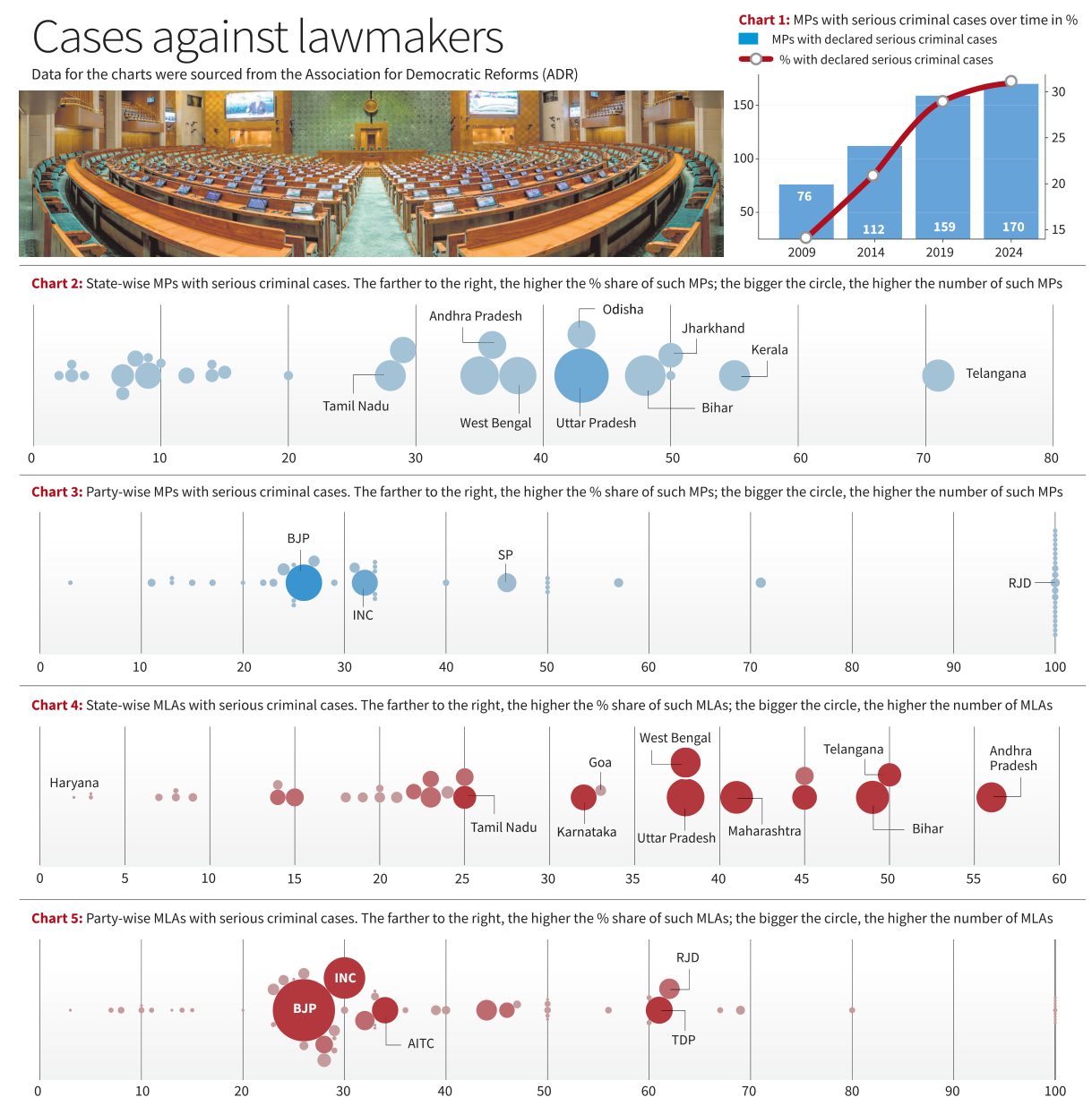
    The intertwining of crime and politics is not new in India, but the recent figures are deeply concerning. An analysis of elected representatives reveals that 31% of MPs and 29% of MLAs across India have declared serious criminal charges against them. More strikingly, in the Lok Sabha, this share has more than doubled from 14% in 2009 to 31% in 2024. Such data points underscore a disturbing trend where democratic institutions are increasingly being captured by individuals with questionable integrity.

    About 30% of MPs and MLAs face serious criminal cases

    The Scale of Criminalisation in Indian Politics

    • MPs with serious charges: 31% in 2024, compared to 14% in 2009.
    • MLAs with serious charges: 29% nationwide, amounting to more than 1,200 legislators.
    • Definition of serious crimes: Offences with punishments of 5+ years, or non-bailable in nature.

    State-wise Picture of the Crisis

    • Telangana: Highest share of MPs with serious cases (71%).
    • Bihar: Second-highest share of MPs (48%).
    • Uttar Pradesh: Highest absolute number of MPs (34) and MLAs (154 or 38%).
    • Andhra Pradesh: Highest share of MLAs with serious cases (56%), followed by Telangana (50%).

    Political Party-Wise Trends

    • BJP: Largest absolute number—63 MPs (26%) and 436 MLAs (26%).
    • Congress: 32 MPs (32%) and 194 MLAs (30%).
    • RJD: 100% of its 4 MPs, and 62% of MLAs face serious cases.
    • TDP: 61% of MLAs facing serious charges.

    Criminalisation of politics as a Democratic Crisis

    1. Undermines Rule of Law: Representatives sworn to make laws are themselves accused of violating them.
    2. Erodes Public Trust: Citizens lose faith in democratic institutions.
    3. Policy Capture Risk: Legislators with criminal backgrounds may promote laws benefiting vested interests.
    4. Vicious Cycle: Money, muscle power, and electoral compulsions perpetuate the entry of tainted candidates.

    Constitutional and Legal Context

    • Representation of People’s Act, 1951: Currently disqualifies convicted representatives but not those with pending cases.

    Judicial Interventions:

    1. Lily Thomas vs Union of India (2013): Immediate disqualification upon conviction.
    2. Public Interest Foundation vs Union of India (2018): Urged political parties to disclose candidate criminal records widely.

    Conclusion

    The latest data underscores that criminalisation in politics is not just persisting but worsening, with more than one in four lawmakers facing serious charges. Unless systemic reforms, ranging from fast-track courts to stricter disqualification laws, are implemented, India risks democratic backsliding. For a healthy democracy, the moral legitimacy of legislatures must be restored.

    Value Addition

    Issues with Criminalisation in Politics

    • Erosion of Democratic Legitimacy: Lawmakers accused of breaking the law undermine the moral authority of Parliament/Assemblies.
    • Weakening of Rule of Law: Offenders often manipulate investigations, delay trials, and escape accountability.
    • Policy Capture & Corruption: Legislators may pass laws or influence contracts to protect vested interests.
    • Distortion of Electoral Choices: Voters are forced to choose between tainted candidates, limiting free and fair choice.
    • Loss of Public Trust: Citizens lose faith in governance when crime and politics merge.
    • Security Threats: Nexus of politics and crime leads to rise in muscle power, intimidation, and weakens internal security.

    Why do Parties Field Candidates With Criminal Background?

    • Money Power: Candidates with criminal networks bring enormous funds to finance expensive elections.
    • Muscle Power: They help in mobilising voters, intimidating opponents, and managing booths in certain constituencies.
    • Winnability Factor: Studies show voters often overlook criminal charges if the candidate is influential, caste-backed, or delivers local patronage.
    • Weak Legal Framework: Only convicted representatives are barred; those with pending cases can contest. With trials dragging on for years, many continue to fight elections.
    • Vote-Bank Politics: Parties use “strongmen” with community backing to secure caste/religion-based votes.

    Way Forward with Committee Reports, Judgments & Reforms

    Committee Recommendations

    • Vohra Committee (1993): Flagged deep nexus between crime, politics, and bureaucracy.
    • Law Commission 170th Report (1999): Recommended disqualification of candidates once charges are framed in heinous offences.
    • Law Commission 244th Report (2014): Suggested immediate disqualification in cases with charges punishable by 5 years or more, and where charges are framed by a court.
    • Election Commission of India (ECI) Recommendations: Ban on candidates facing heinous charges; fast-track courts to decide political cases within a year.

    Judicial Interventions

    • Lily Thomas vs Union of India (2013): MPs/MLAs disqualified immediately upon conviction (earlier they could continue for 3 months pending appeal).
    • Public Interest Foundation vs Union of India (2018): Directed political parties to publicise candidate criminal records widely (website, media, papers).

    Suggested Reforms

    • Fast-track Courts: To ensure cases against politicians are resolved within strict timelines.
    • Stricter Disqualification Norms: Disqualify candidates at the stage of framing of charges (with safeguards against false cases).
    • Political Party Accountability: Legal provisions to penalise parties giving tickets to tainted candidates.
    • State Funding of Elections: Reduce dependence on money/muscle power.
    • Voter Awareness: Encourage citizens to reject candidates with serious charges through awareness campaigns.

    PYQ Relevance

    [UPSC GS II] There is a need for simplification of procedure for disqualification of persons found guilty of corrupt practices under the Representation of Peoples Act.” Comment

    Linkage: The issue of disqualification under the Representation of People’s Act (RPA), 1951 is central to tackling criminalisation of politics. Recent data showing over 30% MPs/MLAs facing serious criminal charges highlights the inadequacy of current provisions that act only after conviction. Simplifying and strengthening disqualification procedures, as urged by committees and the Supreme Court, is vital to restore public trust in democracy.

  • [22nd August 2025] The Hindu Op-ed: Poll integrity and self-sabotage, parties and the ECI

    PYQ Relevance

    [UPSC 2019] On what grounds a people’s representative can be disqualified under the Representation of People Act, 1951? Also mention the remedies available to such person against his disqualification.

    Linkage: The Representation of People Act, 1951 provides the legal foundation for ensuring free and fair elections, including grounds for disqualification such as corrupt practices, electoral offences, and irregularities. The issue of flawed electoral rolls and voter fraud, as highlighted in this article, connects directly with the broader framework of the RPA. While the Act prescribes remedies against wrongful disqualification, its effectiveness depends heavily on accurate voter lists, active oversight by parties, and neutrality of the ECI. Thus, the credibility of electoral rolls is not only an administrative concern but also a legal and constitutional safeguard under the RPA, 1951.

    Mentor’s comments

    India’s democracy depends not just on strong institutions but also on the integrity of political actors. The ongoing debate around flawed electoral rolls, the role of the Election Commission of India (ECI), and political parties’ complicity exposes serious challenges. This article unpacks how poll integrity is being compromised and how both parties and the ECI are shaping voter trust.

    Introduction

    Electoral rolls are the backbone of free and fair elections, yet duplicate entries, ghost names, and ineligible voters continue to mar them. These flaws enable impersonation and multiple voting, weakening public faith in the system. While the ECI faces criticism, political parties too are responsible for neglecting local structures and prioritising short-term electoral wins.

    The contrast is sharp: In the 1990s under T.N. Seshan, the ECI was hailed as a global model of electoral probity. Today, suspicion surrounds the institution, raising doubts about whether both the ECI and political parties are failing in their constitutional roles.

    The Fall of the Election Commission’s Credibility

    1. From Trust to Suspicion: Once among India’s most trusted institutions, the ECI’s opacity and lack of accountability now fuel mistrust.
    2. Contrast with the Past: T.N. Seshan’s tenure saw strict enforcement of the Model Code of Conduct, monitoring of expenses, and the EPIC system to curb bogus voting.
    3. Present Decline: Instead of fixing flawed rolls, the ECI made inspections harder, deepening suspicion over its neutrality.

    How Political Parties Weakened Themselves

    1. Shift from Ground to Tech: Local campaigns with house visits and meetings are being replaced by social media, phone calls, AI tools, creating an illusion of connection.
    2. Reliance on Consultants: Campaign strategy and candidate selection now rest with professional consultants, centralising power and weakening grassroots.
    3. Neglect of Local Cadres: Once the backbone of political parties, local workers are sidelined, leaving little vigilance against electoral fraud.

    The Booth Level Agent System and Its Vulnerabilities

    1. Role of BLAs: Booth Level Agents (BLAs) are meant to be the vital link between voters, parties, and the ECI by verifying draft rolls.
    2. Safeguards in Place: Rules cap BLAs at 10 applications a day; exceeding 30 requires personal verification by officers.
    3. Failures in Practice: Cases like Mahadevapura (Karnataka) reveal inactive BLAs, manipulations, and possible bias, showing safeguards are poorly enforced.

    Opportunities for Political Redemption

    1. Reviving Local Units: The crisis is a chance for parties to strengthen grassroots structures, not just depend on consultants.
    2. Kerala’s Example: Parties there are now diligently flagging duplicate voters and multiple IDs during local elections.
    3. Historical Warning: Weak grassroots units once undermined land reforms post-Independence; neglect today risks hollowing out democracy again.

    The Deeper Democratic Implications

    1. Beyond Elections: Roll revisions, though routine, are crucial to maintaining democratic fairness.
    2. Erosion of Trust: Prioritising short-term electoral gains over constitutional values leaves institutions hollow.
    3. Democracy at Risk: Weak local organisations and complicit institutions together may end up surrendering democracy itself.

    Conclusion

    The integrity of India’s democracy depends not just on robust institutions but also on vigilant political participation at the grassroots. The ECI must reclaim its credibility by ensuring transparency, while political parties must revive their local cadres to safeguard electoral rolls. Without these corrective steps, the erosion of trust may reach a tipping point where democracy is hollowed out from within.

    Value Addition

    T.N. Seshan’s Reforms in the 1990s

    1. Strict Enforcement of MCC – First CEC to rigorously implement the Model Code of Conduct (MCC), curbing misuse of official machinery.
    2. Curbing Electoral Malpractices – Took action against bribery, muscle power, and use of religion/caste in campaigns.
    3. Electoral Photo Identity Card (EPIC) – Introduced voter ID cards to check bogus voting.
    4. Monitoring Poll Expenditure – Set strict limits on candidate expenses and ensured scrutiny of accounts.
    5. Independent Authority of ECI – Asserted autonomy of the Election Commission, making it a powerful guardian of free and fair elections.
    6. Public Trust Restored – Citizen surveys during the 1990s ranked ECI among the most credible institutions.

    Why it matters: T.N. Seshan’s tenure is often cited as the “gold standard” of electoral probity, offering a benchmark against which today’s decline in trust and credibility is judged.

    Mapping Microthemes

    1. GS Paper II (Polity & Governance): Electoral integrity, role of ECI, political accountability.
    2. GS Paper I (History & Society): Weakening of grassroots political movements.
    3. GS Paper III (Technology): Impact of AI-driven campaigns and professional consultants.
    4. GS Paper IV (Ethics): Institutional neutrality, self-restraint, erosion of trust.
  • Should SC sit powerless as Governors block Bills: CJI 

    Introduction 

    The Supreme Court recently questioned whether it should remain passive when Governors indefinitely withhold assent to Bills, stalling elected legislatures. This issue, highlighted by Tamil Nadu’s Bills pending for four years, raises fundamental questions about judicial review, federalism, and democratic accountability.

    Why in the News

    Tamil Nadu’s unprecedented case of Bills pending for years has brought the Governor’s discretionary powers under sharp scrutiny. The Supreme Court’s April 8 judgment imposing time limits on Governors is now contested by the Union as judicial overreach, sparking a crucial debate on separation of powers.

    Why does the role of Governors come under scrutiny

    1. Governor’s Inaction: Governors, appointed by the Union, are integral to State legislatures, yet their indefinite withholding of Bills undermines State autonomy.
    2. Tamil Nadu Example: Crucial Bills remained pending for nearly four years without reasons being communicated, sparking judicial concern.
    3. Democratic Will Thwarted: Prolonged silence from Governors makes elected legislatures ineffective.

    How has the Supreme Court responded

    1. CJI’s Question: Should the Court suspend its role as custodian of the Constitution while Governors block Bills indefinitely?
    2. Judicial Review Precedent: The Court has struck down even constitutional amendments (e.g., 42nd Amendment) that sought to limit judicial review.
    3. Concern of Vacuum: Justice P.S. Narasimha highlighted the risk of Bills hanging in limbo without timelines.

    What is the Union Government’s stand

    1. Encroachment Argument: Solicitor-General Tushar Mehta argued the Court’s April 8 order intruded into law-making, undermining Governors and the President.
    2. Political Resolution: Inaction, according to the Union, should be resolved politically, not judicially.
    3. Governor’s Unique Role: Unlike statutory authorities, Governors hold sui generis constitutional status, not bound by timelines.

    Why is the tussle between judiciary and executive significant

    1. Separation of Powers: Union argues judiciary must not micro-manage executive discretion.
    2. Checks and Balances: CJI asserted that unchecked gubernatorial delay undermines democracy, and the Court cannot abdicate review.
    3. Democratic Accountability: Legislators face people every five years; Governors do not. Hence judicial review is necessary.

    What are the implications for federalism

    1. Centre–State Tensions: Delays fuel mistrust between States and the Union.
    2. Judicial Intervention: Without court oversight, States may face legislative logjams.
    3. Limited Litigation: Union argues only “two or three States” have complained, but the principle has pan-India significance.

    Way Forward: A structured framework for assent is necessary to prevent legislative paralysis. The Supreme Court’s suggested timelines strike a balance between constitutional discretion and democratic accountability. Moving ahead, three steps are essential:

    1. Codifying Timelines: Parliament may consider amending the law or issuing guidelines to institutionalise clear deadlines.
    2. Ensuring Accountability: Governors must act on the aid and advice of the Council of Ministers, barring exceptional constitutional reasons.
    3. Judicial Oversight as Safeguard: Courts should step in only when gubernatorial inaction undermines constitutional morality, keeping political disputes largely within the legislative sphere.

    Conclusion

    Unchecked gubernatorial inaction risks turning elected assemblies powerless. While the Union calls for political remedies, the Court stresses its duty as constitutional guardian. The outcome will redefine the balance between State autonomy, judicial review, and the Governor’s role in India’s federal framework.

    Value Addition

    Timeline for Governor’s action on bills

    While the Constitution of India doesn’t explicitly state a timeline, the Supreme Court has addressed the issue of delays in Governor’s assent, particularly in the context of recent conflicts between Governors and state governments.

    Based on a recent Supreme Court ruling (April 2025) and subsequent discussions, here’s a breakdown of the suggested timelines for the Governor’s actions on a Bill under Article 200 of the Constitution:

    1. Granting Assent, Withholding Assent (with advice of Council of Ministers), or Reserving for President’s Consideration: The Governor must act on the bill within a maximum of one month.
    2. Withholding Assent (against advice of Council of Ministers): The Governor should return the bill to the legislature with reasons for reconsideration within three months.
    3. Reserving for President’s Consideration (against advice of Council of Ministers): The Governor must reserve the bill within three months.
    4. Reconsideration by the Legislature: If the Governor returns a non-Money Bill for reconsideration, the legislature must reconsider it, and if it’s passed again (with or without amendments), the Governor is then bound to give assent within one month.

    PYQ Relevance

    [UPSC 2022] Discuss the essential conditions for exercise of the legislative powers by the Governor. Discuss the legality of re-promulgation of ordinances by the Governor without placing them before the Legislature.


    Linkage: This issue links directly with the 2022 UPSC question as both highlight the constitutional checks on the Governor’s legislative powers. The re-promulgation of ordinances without legislative approval undermines democratic accountability. Hence, examining Governor’s ordinance powers is central to debates on federalism and executive overreach.
  • [21st August 2025] The Hindu Op-ed: India’s democracy is failing the migrant citizen

    PYQ Relevance

    [UPSC 2022] Discuss the role of the Election Commission of India in the light of the evolution of the Model Code of Conduct.”

    Linkage: Just as the Model Code of Conduct (MCC) evolved as a tool by the Election Commission of India (ECI) to ensure free and fair elections in a changing political landscape, the present crisis of migrant disenfranchisement in Bihar shows the need for the ECI to evolve its mechanisms to safeguard inclusivity similarly. The deletion of 3.5 million migrant voters highlights that electoral integrity today is not only about regulating political behaviour (through MCC) but also about ensuring universal participation by adapting to realities of circular migration, dual belonging, and portable identities. Strengthening ECI’s role in creating mobile and flexible voter registration systems, like Kerala’s migration surveys or cross-State verification, would be a natural extension of its democratic mandate.

    Mentor’s Comment

    The article highlights a silent but serious crisis unfolding in Bihar, where nearly 3.5 million voters, largely migrants, have been deleted from electoral rolls due to the Special Intensive Revision (SIR). This not only exposes flaws in India’s electoral infrastructure but also deepens the democratic deficit in migrant-heavy States. For UPSC aspirants, this issue links to democracy, citizenship, federalism, migration, and social justice, making it highly relevant for GS 2 (Polity & Governance) and GS 1 (Society).

    Introduction

    In a democracy of 1.4 billion citizens, every vote matters. Yet, millions of India’s migrant workers are quietly being left out of the democratic process. In Bihar, where migration is both an economic lifeline and a survival strategy, the recent mass deletion of 3.5 million voters (4.4% of the total electoral roll) raises critical questions about representation, inclusivity, and the design of India’s electoral system. The crisis is not an isolated administrative lapse but a systemic failure rooted in an outdated model of citizenship tied to permanent residence, ignoring the realities of circular and seasonal migration.

    The disenfranchisement of Bihar’s migrants in the news

    1. Mass deletion: Nearly 3.5 million voters were deleted under the Special Intensive Revision (SIR).
    2. Reason given: “Permanently migrated”, migrants absent during house-to-house verification.
    3. Permanent loss of rights: These voters cannot vote either in host States (where they work) or in home States (where their names are deleted).
    4. Democratic rupture: Bihar’s voter turnout is already low, 53.2% in the last four Assembly elections, compared to 66.4% in Gujarat and 70.7% in Karnataka.
    5. Scale of migration: 7 million annual outflow from Bihar, of which 4.8 million migrate seasonally. Around 2.7 million return during October–November festivals, yet many will be unable to vote this year.

    Electoral system and the migrant challenge in India

    1. Sedentary citizen model: Voter registration tied to proof of residence and in-person verification.
    2. Documentation barriers: Migrants often live in rented rooms, construction sites, or slums with no accepted address proof.
    3. Regionalism & exclusion: Migrants in host States are seen as “outsiders” with fears of electoral influence discouraging registration.
    4. Dual belonging demonised: Migrants contribute economically in host States but are denied political identity both at origin and destination.

    Studies revealing migrant exclusion in electoral participation

    1. TISS Study (2015):Inclusive Elections in India” (funded by ECI) confirmed marginalisation of migrants.
    2. Triple burden: Administrative barriers, digital illiteracy, social exclusion.
    3. Correlation: Higher migration = Lower voter turnout in source States.
    4. Mobile data estimates: 7 million circular migrants annually from Bihar, proving large-scale exclusion.

    Welfare exclusions and the migrant voting crisis

    • One Nation One Ration Card Scheme (2019):
      1. Limited uptake: only 3.3 lakh households from Bihar availed portability by May 2025.
      2. Barriers: Dual residency, bureaucratic hurdles, fear of losing entitlements.
      3. Parallel with voter IDs: migrants keep origin-based documents for security.
    • Cross-border complexities: Along the 1,751 km India-Nepal border, traditional “roti-beti” ties now face exclusion due to restrictive documentation, disproportionately affecting women.

    Reforms to safeguard migrant voting rights

    1. Portable voter identity: Mobile, flexible, and portable voter ID system.
    2. Cross-verification model: Coordination between origin and destination States to prevent disenfranchisement.
    3. Local bodies’ role: Panchayats and civil society to aid migrant re-registration.
    4. Kerala model of migration surveys: Replicate in high-migration States like Bihar and UP.
    5. Immediate halt to blanket deletions: Safeguard against the “largest silent voter purge in post-Independence India.”

    Conclusion

    Migrants embody India’s paradox, economic backbone but political invisibility. The deletion of millions of voters from Bihar is not just an administrative failure; it is a systemic denial of democratic rights. If India’s electoral infrastructure does not adapt to the realities of migration, democracy risks leaving behind its most hard-working and vulnerable citizens. Ensuring portable electoral rights is not charity, it is the essence of a living democracy.

    Value Addition

    Constitutional and Legal Angle

    • Article 326: Provides for universal adult suffrage — any exclusion of migrant workers undermines this fundamental principle.
    • Representation of People Act, 1950 & 1951: While they govern electoral rolls and voting procedures, they are silent on portable voting rights for internal migrants.
    • Supreme Court in PUCL vs Union of India (2003): Declared the right to vote as part of freedom of expression under Article 19(1)(a). Denial to migrants raises constitutional concerns.

    Scale of the Problem – National Context

    • Census 2011: 45.6 crore internal migrants in India (37% of the population).
    • Economic Survey 2017: ~9 million people migrate annually for work, education, or marriage.
    • Migrants form a huge electoral constituency, yet remain politically invisible.

    Policy/Election Commission (EC) Initiatives Beyond Bihar

    • EC’s Remote Voting Machine (RVM) Proposal, 2023: Aimed to allow migrants to vote from remote locations, but postponed after opposition from political parties.
    • E-EPIC (Electronic Voter Photo ID Card), 2021: Step toward portability but lacks full integration across States.

    Comparative Global Insights

    • Philippines: Overseas absentee voting law enables migrants abroad to vote in national elections.
    • Mexico: Postal voting rights for citizens abroad.
    • South Africa: Mobile registration and voting stations in migrant-dense areas.
    • India lags in creating portable political rights for its massive migrant population.

    Democratic & Governance Implications

    • Political alienation → weakens democratic legitimacy in migrant-heavy States (Bihar, UP, Odisha).
    • Rise of sub-nationalism → exclusion in host States deepens identity politics.
    • Urban governance: Migrants in cities are tax contributors (indirectly via consumption) but lack political representation → urban policies ignore their needs.

    Ethical & Social Justice Dimension

    • Ambedkar’s warning: “Political democracy cannot last unless… social democracy is its foundation.” Excluding the poor migrants fractures this balance.
    • Gandhian perspective: True Swaraj is when “the last man” (Antyodaya principle) participates in democracy — migrant exclusion violates this ethic.

    Mapping Microthemes

    • GS Paper I (Society): Migration, regionalism, exclusion of vulnerable groups.
    • GS Paper II (Polity & Governance): Electoral reforms, federal coordination, democratic rights.
    • GS Paper III (Economy): Migration as economic survival strategy.
    • GS Paper IV (Ethics): Justice, fairness, and democratic inclusivity.
  • Office of the Chief Election Commissioner (CEC)

    Why in the News?

    The Opposition (INDI Alliance bloc) is considering moving a motion of removal of the Chief Election Commissioner (CEC) in Parliament.

    About Election Commission of India (ECI):

    • Establishment: Permanent constitutional body set up on 25 January 1950 (National Voters Day).
    • Constitutional Basis: Articles 324–329, Part XV of the Constitution.
    • Mandate: Conducts elections to Lok Sabha, Rajya Sabha, State Legislative Assemblies, and the offices of President and Vice President.
    • Structure: Since 1993, functions as a three-member body with Chief Election Commissioner (CEC) and two Election Commissioners.
    • Status of CEC: Same salary, status, and perks as a judge of the Supreme Court of India.

    Appointment to ECI:

    • Law: Chief Election Commissioner and Other Election Commissioners (Appointment, Conditions of Service and Term of Office) Act, 2023 (replaced 1991 Act).
    • Appointing Authority: President of India.
    • Selection Committee: Prime Minister (Chairperson), Leader of Opposition in Lok Sabha, and a Union Cabinet Minister nominated by the Prime Minister.
    • Eligibility: Must have served as a Secretary-level officer in Government of India with proven integrity and election management experience.
    • Tenure: 6 years or until 65 years of age, whichever is earlier.

    Removal:

    • CEC: Removed like a Supreme Court judge (Article 324(5)) on grounds of proved misbehaviour or incapacity. Requires a motion passed by two-thirds majority in both Houses of Parliament and Presidential order.
    • Other Election Commissioners: Removed only on recommendation of the Chief Election Commissioner.
    [UPSC 2012] Consider the following statements with reference to India:

    1. The Chief Election Commissioner and other Election Commissioners enjoy equal powers but receive unequal salaries

    2. The Chief Election Commissioner is entitled to the same salary as in provided to a judge of the Supreme Court

    3. The Chief Election Commissioner shall not be removed from his office except in like manner and on like grounds as a judge of the Supreme Court

    4. The term of office of the Election Commissioner is five years from the date he assumes his office or till the day he attains the age of 62 years, whichever is earlier

    Which of these statements are correct?

    Options: (a) 1 and 2 (b) 2 and 3* (c) 1 and 4 (d) 2 and 4


  • The Constitution (130th Amendment) Bill, 2025

    Why in the News?

    The Union Home Minister is set to introduce three bills in the Lok Sabha to provide legal framework for removal of the Prime Minister, Union Ministers, Chief Ministers and Ministers in States and UTs who are “arrested and detained in custody on account of serious criminal charges.”

    Which are the three Bills?

    1. 130th Constitutional Amendment Bill, 2025 (discussed below)
    2. Jammu and Kashmir Reorganisation (Amendment) Bill, 2025 – Provides clarity on removal of CM and Ministers in J&K.
    3. Government of Union Territories (Amendment) Bill, 2025 – Defines similar provisions for Puducherry and other UTs.

    About the 130th Constitutional Amendment Bill, 2025:

    • Scope: Applies to Prime Minister, Chief Ministers, and Ministers at Union, State, and Union Territory levels.
    • Grounds for Removal: Arrest and detention for 30 consecutive days for an offense punishable by five years or more.
    • Reappointment: Possible after release from custody.
    • Objective: Prevent prolonged tenure of arrested leaders in office (e.g., recent case involving Delhi CM Arvind Kejriwal).

    Amendments proposed to the following Articles:

    Current Provision Limitation Changes Proposed
    Article 75 (Union – PM & Union Ministers) PM appointed by President; Ministers appointed on PM’s advice. They hold office during the pleasure of the President. Removal is political (loss of confidence, resignation, dismissal). No explicit mechanism to remove PM/Ministers if detained/arrested for long periods. New provision: If PM or any Union Minister is detained in custody for 30 consecutive days for a serious offense (≥5 years punishment), they must resign by 31st day or automatically cease to hold office. They may be reappointed after release.
    Article 164 (States – CM & State Ministers) CM appointed by Governor; Ministers appointed on CM’s advice. They hold office during the pleasure of the Governor. Council of Ministers collectively responsible to State Assembly. No clear rule for automatic removal if CM/Ministers remain in custody. Similar to Union level: If CM or Minister is detained in custody for 30 consecutive days under serious charges (≥5 years punishment), they automatically lose office. Reappointment allowed after release.
    Article 239AA (Union Territory of Delhi – CM & Ministers) Special status for Delhi (NCT). CM and Council of Ministers aid & advise LG. They hold office as per political responsibility to the Assembly. No explicit provision for automatic removal on detention. A new Section 5A to be inserted: CM/Ministers of NCT of Delhi cease office if detained for 30 days under serious charges (≥5 years). Reappointment possible after release.

    Rationale and Significance:

    • At present, the Constitution has no provision for automatic removal of ministers in custody.
    • Bill ensures that office bearers uphold public trust and do not undermine governance during detention.
    • The statement of objects emphasized that elected representatives must rise above political interests and maintain conduct beyond suspicion.
    • Promotes integrity of democracy by aligning ministerial positions with constitutional morality and accountability.
    [UPSC 2020] Consider the following statements:

    1. According to the Constitution of India, a person who is eligible to vote can be made a minister in a State for six months even if he/she is not a member of the Legislature of that State.

    2. According to the Representation of People Act, 1951, a person convicted of a criminal offence and sentenced to imprisonment for five years is permanently disqualified from contesting an election even after his release from prison.

    Options: (a) 1 only (b) 2 only (c) Both 1 and 2 (d) Neither 1 nor 2*


  • When can Courts order a Recount of Votes?

    Why in the News?

    The Supreme Court for the very first time has recounted EVM votes on its premises and overturned a Haryana sarpanch election result.

    Legal Framework for Challenging Election Results:

    • Parliamentary, Assembly, State Council elections: Validity can be challenged by filing an election petition in the High Court of the state where the election was held.
    • Local government elections: Petitions must be filed at district-level civil courts.
    • Eligibility to file: Only a candidate or elector related to the election can file.
    • Timeframe: Petition must be filed within 45 days of result declaration.
    • Petition requirements:
      • Must contain concise statement of material facts.
      • Allegations of “corrupt practices” must include names of individuals, dates, and locations.
    • Judicial Approach:
      • SC considers corrupt practices as quasi-criminal, requiring high standard of proof.
      • Vague or ambiguous petitions are dismissed.
    • Legal Basis:
      • Representation of the People Act, 1951.
      • State Panchayat Raj Acts.

    Grounds for Invalidating an Election:

    Courts can void an election on:

    • Bribery or undue influence, e.g., hiding criminal antecedents or promoting enmity.
    • Candidate disqualified/unqualified on the election date.
    • Improper rejection of nomination paper.
    • Improper acceptance of nomination or improper reception/rejection of votes, if shown to materially affect results.
    • Non-compliance with Constitution or election laws/rules, if it materially impacted the outcome.

    When can Courts order Recount of Votes?

    • A recount is a possible judicial remedy but not granted lightly.
    • Seen as affecting vote secrecy, which is vital to free and fair elections.
    • Courts order recounts only if:
      • Petitioner presents specific material facts.
      • Evidence shows a prima facie case of probable counting error.
      • Recount is deemed necessary for justice.
    • Normally conducted at election location.
    • Exception: Panipat case, where SC recounted votes in its own premises.

    Can Courts declare a new Winner?

    • Rare, but courts can declare a new winner if:
      • Evidence shows petitioner (or another candidate) actually had majority of valid votes.
      • Or petitioner proves they would have won but for votes gained through corrupt practices.
    • Requires concrete, quantifiable evidence of tainted votes.
    • Example: In Feb 2024 Chandigarh mayoral election, SC declared a new winner after:
      • Presiding officer wrongly invalidated 8 paper ballots.
      • All votes had been cast for the losing candidate.
      • SC restored them as valid, making the losing candidate the winner.
    [UPSC 2004] Consider the following tasks:

    1. Superintendence, direction and conduct of free and fair elections.

    2. Preparation of electoral rolls for all elections to the Parliament, State Legislatures and the Office of the President and the Vice-President.

    3. Giving recognition to political parties and allotting election symbols to political parties and individuals contesting the election.

    4. Proclamation of final verdict in the case of election disputes.

    Which of the above are the functions of the Election Commission of India?

    Options: (a) 1, 2 and 3* (b) 2, 3 and 4 (c) 1 and 3 (d) 1, 2 and 4