A seven-member high-level committee was constituted under the chairmanship of K. Radhakrishnan, former ISRO Chairman, by the Ministry of Education to reform the National Testing Agency (NTA).
About National Testing Agency (NTA)
NTA is a premier, specialist, autonomous and self-sustained testing organization to conducts entrance examinations for admission/fellowship in higher educational institutions.
It was established in 2017 with a grant amount of Rs.25 crore from the Union Government.
NTA is responsible for conducting exams such as:
Joint Entrance Examination – Main (JEE Main)
National Eligibility cum Entrance Test-Undergraduate (NEET-UG) as well as NEET PG
National Eligibility Test (NET)
Common Management Admission Test (CMAT)
Graduate Pharmacy Aptitude Test (GPAT).
The NTA is chaired by an eminent educationist who will be appointed by the Ministry of Education.
There will be a Board of Governors comprising members from user institutions.
National Testing Agency (NTA) Under Scrutiny
The NTA has been criticized after the NEET paper leak controversy and the subsequent scrapping of exams like UGC-NET due to “lack of integrity”.
The committee aims to establish a robust process for conducting various entrance examinations end to end.
NTA Reform Panel: Committee Composition
Committee Head: K. Radhakrishnan, former Chairman of ISRO and Chairman of the Board of Governors at IIT-Kanpur.
Two-Month Timeline: The committee aims to meet ten times over the next two months to develop comprehensive recommendations.
Key Issues and Focus Areas:
Data Security Protocol: Develop a manual to fix a data security protocol to prevent question paper leaks.
Printing and Process Integrity: Review processes for printing question papers, onboarding printers, and training staff to minimize external participation.
Organisational Restructuring: Consider adding a data security vertical in the NTA organogram and implementing transparent processes, requiring organizational restructuring.
Examination Investigation and Security:
Root Cause Analysis: The committee will investigate the initial cause of question paper leaks to identify and plug gaps.
Modes of Examination: Examine different modes of conducting examinations:
JEE (Mains) and JEE (Advanced) are computer-based tests.
NEET-UG is conducted in pen-paper Optical Mark Recognition (OMR) mode.
Challenges faced by NTA
Infrastructure Limitations: Currently, India lacks the infrastructure to conduct computer-based tests online for more than three lakh students simultaneously.
Large-Scale Exams: NEET-UG involves up to 24 lakh students appearing in pen and paper OMR mode at once.
Conclusion
The reforms are critical to restoring the integrity of entrance examinations in India, ensuring secure and fair testing processes.
The committee’s recommendations will play a pivotal role in shaping the future operations of the NTA and entrance examination protocols.
Back2Basic: University Grants Commission (UGC)
Details
Establishment
Came into existence on 28th December, 1953.
Became a statutory organization by an Act of Parliament in 1956.
Legislation
The UGC Act, 1956.
Nodal Ministry
Ministry of Human Resource Development (now Ministry of Education).
Responsibilities
Providing funds to universities and colleges.
Coordination, determination, and maintenance of standards of teaching, examination, and research in institutions of higher education.
Mandate
Promoting and coordinating university education.
Determining and maintaining standards of teaching, examination, and research in universities.
Framing regulations on minimum standards of education.
Monitoring developments in collegiate and university education.
Disbursing grants to universities and colleges.
Serving as a link between the Union and state governments and institutions of higher learning.
Advising Central and State governments on measures necessary for the improvement of university education.
Unique Distinction
Only grant-giving agency in India with the dual role of funding and maintaining standards in higher education institutions.
Functions
Promoting and coordinating university education.
Determining and maintaining standards of teaching, examination, and research in universities.
Framing regulations on minimum standards of education.
Monitoring developments in collegiate and university education.
Disbursing grants to universities and colleges.
Serving as a link between the Union and state governments and institutions of higher learning.
Advising Central and State governments on measures necessary for the improvement of university education.
Link Role
Acts as a vital link between Union and State governments and institutions of higher learning.
Advisory Role
Advises the Central and State governments on necessary measures for the improvement of university education.
Q. The Indian Constitution has provisions for holding joint sessions of the two houses of the Parliament. Enumerate the occasions when this would normally happen and also the occasions when it cannot, with reasons thereof. (UPSC IAS/2017)
Q. Do Department-related Parliamentary Standing Committees keep the administration on its toes and inspire reverence for parliamentary control? Evaluate the working of such committees with suitable examples. (UPSC IAS/2021)
Mentors comment: The Lok Sabha, the lower house of India’s Parliament, conducts sessions three times a year: Budget, Monsoon, and Winter. These sessions involve deliberations on legislation, budget discussions, and policy debates. The Budget Session, held between February and May, is crucial for financial legislation. The Monsoon Session, usually in July and August, focuses on legislative business and discussions. The Winter Session, in November and December, addresses pending bills and other urgent matters. These sessions are vital for the democratic functioning of India, ensuring accountability and transparency in governance, and providing a platform for addressing national issues and public concerns.
Let’s learn!
Why in the News?
The 18th Lok Sabha’s inaugural session has begun with oath-taking of the MPs.There are high expectations for improved deliberations and functioning due to the changed political dynamics created by the Coalition government.
Inaugural Points of Friction
Statue Relocation: The Congress objected to the relocation of Mahatma Gandhi and B.R. Ambedkar statues to ‘Prerna Sthal’ without due process.
Pro Tem Speaker Appointment: The appointment of BJP’s Bhartruhari Mahtab as pro tem Speaker ignored the convention of appointing the senior-most member.
Responses: Speaker Om Birla and Parliamentary Affairs Minister Kiren Rijiju addressed these concerns publicly, emphasising adherence to tradition and procedure.
18th Lok Sabha: Powered by Coalition Dynamics
Coalition Government: After a decade, India has a coalition government headed by the single-largest party’s leader.
Dependency on Allies: The current government relies on crucial support from regional allies, Janata Dal (United) and Telugu Desam Party.
Contrast with Previous Government: Unlike the previous NDA government (2014-24), the BJP now lacks a comfortable majority, making coalition dynamics more significant.
Larger Role of Numerically StrongerOpposition
Checks and Balances: The 2024 election results emphasise the need for a stronger Opposition to provide checks and balances.
Larger Voice: The combined Opposition strength is slightly over 230 members, while the governing coalition has over 300 members.
Implications: This shift indicates potential for greater government accommodation of Opposition concerns and more balanced parliamentary debates.
How does this impact Parliamentary Functioning and oversight?
Previous Complaints: During the last decade, the BJP’s majority often limited the Opposition’s space in Parliament.
Issues of Contention: Examples include the non-acceptance of adjournment notices and insufficient discussion on significant issues such as the border situation with China.
Legislative Productivity: The government’s focus on legislative productivity sometimes bypassed adequate scrutiny and debate, causing friction with the Opposition.
Ensuring greaterParliamentary Efficiency
Role of Parliamentary Committees
Diminished Oversight: The role of parliamentary committees in scrutinising legislation has diminished over time.
Committee Benefits: Committees allow non-partisan examination and fine-tuning of proposed legislation, enhancing legislative quality.
Case Study: The controversial farm laws were passed without committee scrutiny, leading to widespread protests and their eventual withdrawal.
Rules and Conventions in Parliament
Parliamentary Rules: Both Houses have distinct Rules of Procedure and Conduct that guide their functioning.
Time-Honoured Conventions: Rajya Sabha allows members to seek clarifications on suo motu statements by Ministers, a unique practice.
Question Hour: This practice holds the government accountable through detailed questioning of Ministers, reflecting their grasp of subjects and their accountability to Parliament.
Speaker and Deputy Speaker Elections
Speaker Election: The first significant test will be electing the Speaker, with the governing coalition holding an advantage due to its numerical strength.
Deputy Speaker Election: The Deputy Speaker position, vacant during the 17th Lok Sabha, is expected to go to the Opposition, citing tradition and convention.
Historical Context: Exceptions exist, such as the AIADMK’s M. Thambidurai being elected Deputy Speaker in 1985 and 2014, reflecting the importance of tradition in parliamentary roles.
The President’s Address and Motion of Thanks
President’s Address: The address outlines the government’s policies and programmes for the coming year.
The motion of Thanks: The ensuing debate provides the Opposition an opportunity to scrutinize and debate government policies comprehensively.
Omnibus Resolution: The Motion of Thanks debate allows broad discussions, helping to highlight and analyze various national issues.
Way Forward
Governing Coalition’s Role: The coalition must take all opinions into account, ensuring inclusive decision-making.
Opposition’s Strategy: The Opposition needs to effectively use parliamentary tools to hold the government accountable.
Civility in Debate: Maintaining civility in debates is crucial for productive parliamentary functioning and fostering a constructive legislative environment.
Q The concept of cooperative federalism has been increasingly emphasised in recent years. Highlight the drawbacks in the existing structure and the extent to which cooperative federalism would answer the shortcomings. (UPSC IAS/2015) Q How far do you think cooperation, competition and confrontation have shaped the nature of federation in India? Cite some recent examples to validate your answer. (UPSC IAS/2020)
Mentors’ comment: Federalism is crucial as it balances power between national and regional governments, fostering a diverse and inclusive governance structure. It allows regions to address local needs effectively while maintaining national unity. By promoting cooperation and accommodating diversity, federalism enhances democratic participation, prevents centralization of power, and ensures more equitable resource distribution, supporting overall stability and development.
Let’s learn_ _
Why in the news?
On June 4, 2024, the BJP fell short of a Lok Sabha majority, relying on regional partners. This coalition governance could curb the BJP’s dominance and revitalize India’s federal structure, damaged over the past decade.
Undermine the Federalism in last decade before the 2024 election
Centralisation of Power: Under the current administration, there has been a significant shift towards centralising power at the expense of state autonomy, moving away from the principle of cooperative federalism.
Use of Investigative Agencies: Regulatory and investigative agencies like the Enforcement Directorate, Central Bureau of Investigation, and Income-Tax agencies have been used to clamp down on political opponents from regional parties, thereby undermining state authority and autonomy.
Imposition of Hindi: Efforts to impose Hindi on non-Hindi speaking southern states have been part of a broader strategy to homogenize the nation, disregarding the linguistic and cultural diversity of states.
Unilateral Decision-Making: Key decisions, such as imposing a nationwide lockdown during the COVID-19 pandemic, were made unilaterally by the central government without consulting the states, exemplifying a top-down approach.
Fiscal Manipulation: The financial autonomy of states has been undermined by the central government through mechanisms like levying cesses on various items, which are not shared with states, disrupting the balance of fiscal federalism.
The concerns of the Southern States
Financial Disparity: Southern states recognize the necessity of correcting regional imbalances but are concerned about disproportionate financial allocations favoring less-performing northern states. For example, Uttar Pradesh received ₹25,069 crore in tax devolution, more than the combined total for all five southern states.
Potential Political Disenfranchisement: There is anxiety over the potential political dominance of northern states like Uttar Pradesh and Bihar, particularly concerning the upcoming delimitation exercise. These states, with their larger populations, could outweigh the southern states’ influence in the Lok Sabha.
Measures to resolve the concerns of southern States
Need for Equitable Redistribution: Southern leaders emphasise the importance of equitable redistribution and representation, advocating for a balanced approach that does not financially persecute the high-performing southern states.
Coordination Among Southern Leaders: Southern chief ministers are likely to collaborate to address the threat of political disenfranchisement, recognising that their collective interests are at stake in maintaining a fair federal structure.
Why Need to Revive the Inter-State Council?
Potential for Effective Deliberation: Although the Council has the potential to be a formidable forum for decision-making and dispute resolution, it has become ineffective under the control of the Ministry of Home Affairs.
Independent Arena for Coordination: Reviving the Council would provide an independent space for consultation, decision-making, and dispute resolution, ensuring better coordination between states and various governmental departments on issues affecting states.
Accommodating Diversity: In a diverse country like India, fostering a sense of common belonging while respecting the developmental differences among states is crucial. The Council can help in creating policies that are inclusive and considerate of these differences.
Preventing Fragmentation: Ensuring that all states feel that their common nationhood is beneficial helps in maintaining national unity. Without proper forums for dialogue, regional, religious, and linguistic tensions could escalate.
Addressing Inequitable Power Dynamics: The statement “We have more people, so we will have more money and power” threatens to disrupt the delicate balance of federalism. The Council can help address these power imbalances and promote equitable development across all states.
Conclusion: To strengthen India’s federalism, revitalizing the Inter-State Council is crucial, ensuring it operates independently for effective consultation and decision-making. Equitable fiscal practices, respect for state autonomy, and promotion of cultural diversity will foster cooperative governance and prevent centralization, thereby balancing regional needs with national unity.
Bihar Chief Minister Nitish Kumar has renewed the State’s persistent call for special category status from the Centre, which would boost the State’s share of tax revenues from the Central government.
How does the ‘Special Category’ Status benefit the states like Bihar?
Increased Central Funds: States with special category status receive a higher share of central funds for government schemes, typically 90% from the Centre, compared to 60%-80% for other states.
Tax-Related Concessions: These states enjoy various tax concessions that can attract investments and boost economic development.
Financial Aid for Development: The additional funds can be used to address developmental gaps, improve infrastructure, and support welfare programs.
Criteria for Special Category status:
Geographic Disadvantages: States with challenging terrains such as hilly or difficult terrain.
Low Population Density or High Tribal Population: States with a considerable proportion of tribal population or low population density.
Economic and Social Backwardness: States that are economically and socially disadvantaged.
Strategic Location: States that share international borders or have strategic significance.
Why has Bihar’s demand been a long-standing issue?
Economic Backwardness: Bihar has one of the lowest per capita incomes in India and lags behind in several human development indicators.
Fiscal Challenges: The bifurcation of the state leading to the formation of Jharkhand, frequent natural disasters, and insufficient water resources for irrigation have adversely affected Bihar’s fiscal situation.
Political Reiteration: Successive Bihar governments have continuously demanded special status to help the state’s development.
What are the political implications of granting ‘Special Status’ to Bihar?
Increased Bargaining Power: Granting special status could enhance Bihar’s political leverage with the central government, especially in coalition politics.
Precedent for Other States: Granting special status to Bihar could lead to similar demands from other states, potentially creating financial burdens for the Centre.
Electoral Promises and Alliances: Political parties may use the promise of special status as an electoral tool to gain or maintain power, as seen with the Congress party’s manifesto promise in 2024.
Centre-State Relations: The decision could impact the dynamics of center-state financial relations and influence the federal structure of revenue distribution in India.
Conclusion: The Central government should establish a transparent and well-defined framework for granting special category status, taking into account various economic, geographic, and social parameters. This framework should be periodically reviewed to ensure it remains relevant and fair to all states.
Mains PYQ:
Q To what extent is Article 370 of the Indian Constitution, bearing marginal note “Temporary provision with respect to the State of Jammu and Kashmir”, temporary? Discuss the future prospects of this provision in the context of Indian polity. (UPSC IAS/2016)
President Droupadi Murmu administered oaths to the Central Council of Ministers (CoM) of the new NDA government, comprising a larger team compared to the previous term.
The Council includes 30 cabinet ministers, five Ministers of State (Independent Charge), and 36 Ministers of State, with the Prime Minister leading the team.
About Central Council of Ministers
The Central CoM is a crucial part of India’s governance system.
Members: It consists of the Prime Minister (Head), Cabinet Ministers, Ministers of State, and Deputy Ministers.
History:
Portfolio System: The system of the CoM finds its roots in the Indian Councils Act of 1861, introduced by Lord Canning going parallel with the British Parliamentary System.
Constitutional Provisions
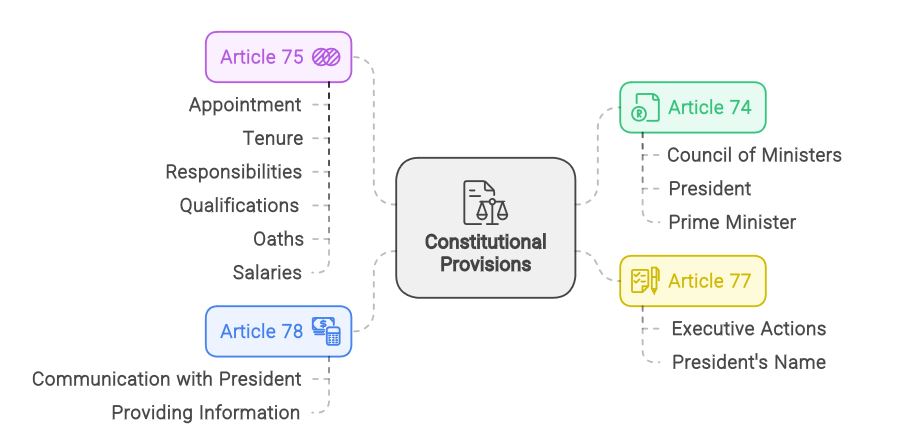
Articles 74 to 78 in Part V of the Indian Constitution broadly deal with the Central Council of Ministers.
Union Executive: The Union Executive encompasses the President, Vice-President, Prime Minister, Union Council of Ministers, and Attorney General of India, collectively responsible for the country’s administration.
Role of the Prime Minister
The Prime Minister is the head of the Central Council of Ministers, exercising executive authority and decision-making powers on key policy issues and unallocated portfolios.
Responsibilities: Prime Minister Modi oversees critical ministries such as Personnel, Public Grievances, Pensions, Department of Atomic Energy, and Department of Space, while also leading government bodies like the Cabinet Secretariat and NITI Aayog.
Functions and Duties of CoM
1. Policy Formulation and Implementation:
Formulating Policies: The Council of Ministers, particularly the Cabinet, is tasked with formulating policies crucial for the nation’s development and welfare.
Policy Coordination: It ensures coordination among various government departments and agencies for effective policy implementation.
2. Executive Functions:
Real Executive Authority: The Council of Ministers acts as the real executive authority, exercising executive powers on behalf of the President.
Administration: It oversees the day-to-day administration of the country, ensuring the smooth functioning of government affairs.
Emergency Powers: During emergencies, the Council of Ministers advises the President on the exercise of emergency powers and crisis management.
3. Legislative Functions:
Bills and Legislation: Ministers actively participate in the legislative process by introducing bills, piloting them through Parliament, and ensuring their passage.
Policy Advocacy: They advocate for government policies and bills in Parliament, engaging in debates and discussions to garner support.
Budgetary Process: The Council of Ministers prepares and presents the annual budget, guiding fiscal policies and financial allocations.
4. Financial Management:
Budget Preparation: It plays a significant role in preparing the national budget, and outlining revenue and expenditure plans for the fiscal year.
Financial Administration: The Council oversees financial administration, ensuring compliance with budgetary provisions and efficient resource utilization.
Taxation and Fiscal Policy: Ministers propose taxation measures and formulate fiscal policies to promote economic growth and stability.
Who are the Cabinet Ministers?
The Cabinet Ministers are senior members of the Central Council of Ministers who head key government departments or ministries.
Typically, Cabinet Ministers are appointed by the Prime Minister and are part of the Cabinet, which is the core decision-making body in the government.
Each Cabinet Minister typically manages a specific portfolio aligned with the government’s priorities and responsibilities.
Examples: Minister of Finance, Minister of Home Affairs, Minister of Defence, Minister of External Affairs, Minister of Health, Minister of Education, and others.
The term ‘Cabinet’ was inserted in Art. 352 of the Constitution by the 44th Amendment Act 1978.
It did not find a place in the original text of the Constitution.
Difference between Ministers of State (Independent Charge) and Ministers of State:
Ministers of State (Independent Charge)
Ministers of State
Authority
Have independent portfolios
Assist Cabinet Ministers
Reporting Structure
Directly report to PM/President
Report to and assist Cabinet Ministers
Accountability
Fully responsible for their departments
Assist Cabinet Ministers in tasks
Protocol Status
Equivalent to Cabinet Ministers in status
Lower protocol status
Attendance in Cabinet Meetings
May attend if their portfolios are discussed
Not regular attendees
PYQ:
[2013] Consider the following statements:
The Council of Ministers in the Centre shall be collectively responsible to the Parliament.
The Union Ministers shall hold the office at the pleasure of the President of India.
The Prime Minister shall communicate to the President about the proposals for legislation.
Which of the statements given above is/are correct?
(a) 1 only
(b) 2 and 3 only
(c) 1 and 3 only
(d) 1, 2 and 3
[2007] Assertion (A): The Council of Ministers in the Union of India is collectively responsible both to the Lok Sabha and Rajya Sabha.
Reason (R): The Members of both the Lok Sabha and the Rajya Sabha are eligible to be the Ministers of the Union Government.
Choose the correct Code:
(a) Both A are R are true and R is the correct explanation of A
(b) Both A and R are true but R is not a correct explanation of A
With the completion of the 2024 Lok Sabha elections, the demand for Special Category Status to Andhra Pradesh is again gaining attention.
Why is the demand for special status for Andhra Pradesh back in the political limelight?
Unfulfilled Promise: Despite assurances by the previous Prime Minister and BJP leaders, the Special Category Status (SCS) promised to Andhra Pradesh post bifurcation remained unfulfilled.
Economic Struggles: Andhra Pradesh faces revenue deficits and escalating debts post-bifurcation, hampering its development projects and infrastructure initiatives.
Dependency on Central Aid: With the need for funding for critical projects like Amaravati’s development and ongoing revenue deficits, Andhra Pradesh seeks central assistance for its economic stability and growth.
Five factors stood as the qualifying benchmark for the granting of SCS
States that comprise a majority tribal population, low density of population, hilly States and close to international borders, have socio-economic and industrial backwardness and lack adequate State finances.
At present, the States that have the SCS include Arunachal Pradesh, Assam, Himachal Pradesh, Jammu and Kashmir, Manipur, Meghalaya, Mizoram, Nagaland, Sikkim, Tripura, and Uttarakhand.
Why did Chandrababu Naidu, back in 2018, settle for a special package?
Pressure from Opposition: Facing criticism and a strong opposition campaign over the unmet promise of SCS, Naidu, then allied with the NDA, agreed to a Special Package (SP) as an alternative.
Naidu’s decision to accept the SP was influenced by political considerations that included maintaining stability within the NDA alliance and counter-opposition attacks.
Is the State qualified to be granted Special Status?
Debatable Qualification: Andhra Pradesh’s eligibility for SCS is contested, with some arguing it doesn’t meet the criteria outlined for special status, including socio-economic and geographical disadvantages.
Previous Annulment: The 14th Finance Commission equated SCS with general category status and annulled it for new states, citing increased tax devolution and revenue deficit grants as alternatives.
What did the 14th Finance Commission state?
On Alternative Grants: Instead of SCS, the commission increased tax devolution to states and introduced revenue deficit grants to address fiscal disparities, providing Andhra Pradesh with financial assistance.
Scope for Review: While the 14th Finance Commission did not explicitly rule out SCS, it left the decision to the Union Government, suggesting a potential review by subsequent finance commissions and policy bodies.
Way forward:
Comprehensive Economic Reform: Implement structural reforms to boost economic growth, reduce fiscal deficits, and attract investments, ensuring sustainable development beyond dependency on special status or central aid.
Targeted Development Projects: Prioritize funding for infrastructure projects based on critical needs and potential economic returns, focusing on sectors like agriculture, manufacturing, and technology to drive growth and employment.
Mains PYQ:
Q The political and administrative reorganization of states and territories has been a continuous ongoing process since the mid-nineteenth century. Discuss with examples. (UPSC IAS/2022)
The pivotal role of the Speaker in parliamentary democracy is underscored as both the TDP and JD(U), crucial allies within the NDA, compete for the position, highlighting its significance.
Constitutional Mandate:
Speaker and Deputy Speaker are elected as per Article 93 of the Constitution, with the Speaker chosen by a simple majority.
The speaker’s term ends with the House dissolution and no-confidence motion can be moved against the Speaker.
No specific qualifications for the Speaker, who is distinct from other members.
Powers of the Speaker
Conducting the House: The Speaker decides House conduct and government business, ensuring adherence to rules, crucial for opposition participation. There are Rules and Procedure for the functioning of the House, but the Speaker has vast powers in ensuring these Rules are followed, and in choosing procedures.
Questions & Records: The Speaker holds authority over determining the validity of queries raised by members and overseeing the publication of House proceedings. The Speaker possesses the power to remove, wholly or partially, statements deemed unparliamentary.
Voice Votes, Division: The speaker can push bills through by voice vote or division, crucial for the legislative process.
As per the Rules of Procedure and Conduct of Business in Lok Sabha, if the Speaker thinks that is “unnecessarily claimed”, simply ask the members who are for ‘Aye’ and those for ‘No’ respectively to rise in their places and decide.
No-Confidence Motion: A pivotal moment where the Speaker’s neutrality significantly affects the Opposition is during the presentation of a motion of no-confidence against the government.
In 2018, when notices for a no-confidence motion were submitted by the YSRCP and TDP, Speaker Sumitra Mahajan postponed the House multiple times before acknowledging the motion and conducting the vote.
Casting Vote: As per Article 100 of the Constitution, pertaining to voting in the Houses, the Chairperson of the Rajya Sabha or the Speaker of the Lok Sabha, or any individual acting in such a capacity, “shall refrain from voting initially but must cast a deciding vote in the event of a tie.”
His Removal:
Motion: A member of the Lok Sabha gives a written notice for the removal of the Speaker, citing specific grounds such as misconduct or inability to perform duties.
Support: The motion needs support from at least 50 members to be admitted for discussion in the House.
Resolution: Once admitted, the House discusses the motion. If the majority of members present and voting support the motion, a resolution for the Speaker’s removal is passed.
Note: During the process of removal of the Lok Sabha Speaker in India, the Speaker typically remains present and presides over the proceedings until the resolution for their removal is passed. The Speaker maintains their role in overseeing the House’s functioning unless and until the majority of members vote in favor of the motion to remove them. Once the resolution is passed and approved by the President, the Speaker ceases to hold office and their duties are formally relinquished.
Disqualification of Members
Power of the Speaker: The Speaker of the House holds the authority to disqualify legislators who defect from their party, as per the provisions of the Tenth Schedule.
Introduction of the Anti-Defection Law: The Tenth Schedule, also known as the anti-defection law, was incorporated into the Constitution in 1985 through the Fifty-Second (Amendment) Act.
Judicial Review: The Supreme Court, in the landmark case of Kihoto Hollohan versus Zachillhu in 1992, upheld the power vested in the Speaker to decide on defection cases. It ruled that only the final order of the Speaker is subject to judicial review.
Impact on Government Stability: Defections can change the numerical strength of political parties in the House, potentially destabilizing governments if members defect in significant numbers. Timely action by the Speaker in disqualifying defective members is crucial to maintaining the integrity of the Tenth Schedule and ensuring that governments retain their majority.
Supreme Court Directives: The Supreme Court has issued directives emphasizing the need for Speakers to expedite disqualification proceedings. For instance, in 2020, it ruled that Speakers must decide on disqualification pleas within three months, except in exceptional circumstances.
Impact on Government Formation: Delays in deciding disqualification petitions can have significant political ramifications, as seen in cases where governments have collapsed due to prolonged delays in addressing defection issues.
Case Example: In 2023, the Supreme Court directed the Maharashtra Assembly Speaker to expedite disqualification proceedings against members of factions within the Shiv Sena party. Prolonged delays in these proceedings contributed to the collapse of the government led by Uddhav Thackeray.
Conclusion: The Speaker holds significant powers in conducting the House, ensuring adherence to rules, deciding on crucial matters like no-confidence motions, and maintaining political stability through the judicious application of these powers.
Mains PYQ:
Q ‘Once a Speaker, Always a Speaker’! Do you think this practice should be adopted to impart objectivity to the office of the Speaker of Lok Sabha? What could be its implications for the robust functioning of parliamentary business in India? (UPSC IAS/2020)
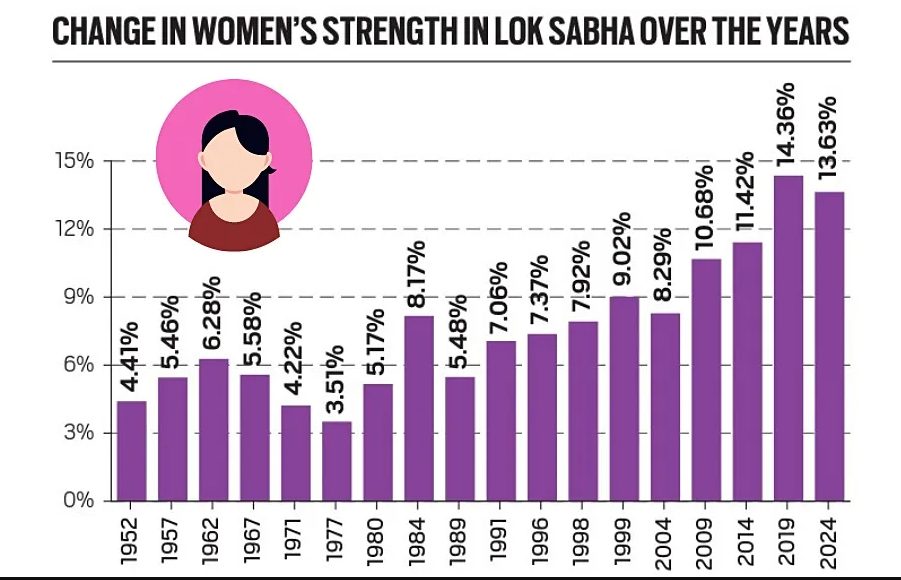
Over time, there has been a general inclination towards enhancing women’s representation in the Lok Sabha. However, the advancement has been gradual and inconsistent.
Women in Lok Sabha 2024 (PRS data):
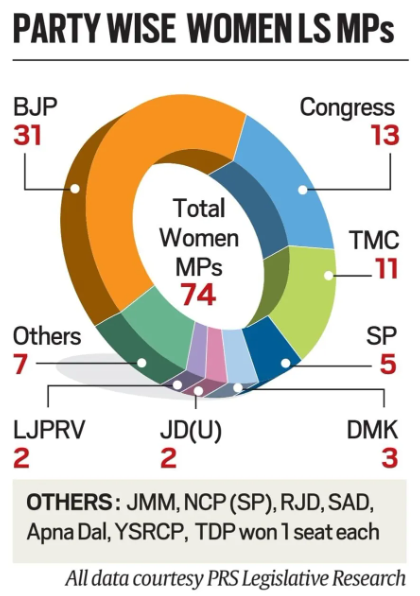
Number of Women MPs: India has elected 74 women MPs to the Lok Sabha in 2024, which is four fewer than in 2019.
Percentage of Representation: Women MPs make up just 13.63% of the elected strength of the Lower House.
Party-wise Distribution: Women MPs come from 14 different parties, with the BJP leading with 31 women MPs, followed by the Congress with 13.
Different Demographic Observations:
Trend in Representation: Over the years, there has been a slow and non-linear increase in women’s representation in the Lok Sabha.
Historical Trends: Women’s representation started at 4.41% in 1952 and peaked at 14.36% in 2019.
New Faces: Out of the 74 women MPs elected, 43 are first-time MPs, indicating a higher percentage of newcomers compared to the overall House.
Younger Representation: The average age of women MPs is 50 years, younger than the overall House age of 56 years.
Comparison with Other Countries:
International Comparison: India lags behind several countries in terms of women’s representation, with countries like South Africa, the UK, and the US having higher percentages of women MPs.
Global Rankings: Women make up 46% of MPs in South Africa, 35% in the UK, and 29% in the US.
What Needs to Be Done?
Increase in Representation: There is a need for greater efforts to increase women’s representation in the Lok Sabha to achieve gender parity.
Policy Measures: Implementation of policy measures such as reserving seats for women in the Lok Sabha could help improve representation.
Encouraging Participation: Encouraging more women to enter politics and providing support for their political careers can contribute to greater representation.
Education and Awareness: Promoting education and awareness about the importance of gender equality in politics is essential for fostering a more inclusive political environment.
Mains PYQ:
Q What are the continued challenges for Women in India against time and space? (UPSC IAS/2019)
Q To what extent, in your opinion, has the decentralisation of power in India changed the governance landscape at the grassroots? (UPSC IAS/2022)
Q How far do you think cooperation, competition and confrontation have shaped the nature of federation in India? Cite some recent examples to validate your answer.(UPSC IAS/2020)
Mentor’s comment: The 18th Indian general election signals a potential end to a cycle despite no change in power. The Bharatiya Janata Party’s loss of majority could catalyze a re-democratization process. Over a decade, India witnessed political and economic power concentrating, sidelining institutions and exacerbating inequalities. A shift in power dynamics and narratives may lead to significant changes, but their realization remains uncertain.
Let’s learn
Why in the news?
The election’s conclusion may signal a transition, yet the revival of India’s democracy rests on the involvement of pivotal actors, such as civil society.
10 Years of Modi Government: A Critical Analysis
Concentration of Power: For 10 years, India has experienced de-democratisation, with political and economic power concentrated in a few hands.
Bypassing Institutions: Top state officials made decisions, bypassing Parliament and federalism.
Economic Dominance: A few business cronies accessed resources and dominated the economy.
Increasing Inequalities: Inequalities increased, but the poor supported a pro-rich government due to identity politics and communal polarisation, overshadowing social issues.
Expected Changes
Power Dynamics: Significant changes are anticipated in power dynamics and narratives due to the new balance of power.
Partial Realization: However, these changes might not fully materialize.
No Shift, But a Tilt
Dominant Party: The BJP remains the dominant party, though Narendra Modi must now engage in coalition politics.
Institutional Empowerment: The weakening of Modi’s authority may empower institutions, including the Election Commission of India, the judiciary, and the media, to resist the government’s use of restrictive laws.
Revitalised Federalism: Federalism might be revitalised due to the need for support from state parties like the Telugu Desam Party (TDP) and Janata Dal (United) (JD(U)).
Narrative Shifts
Counter to National-Populism: Mr. Modi’s national-populist claim of embodying the nation might be countered by an agenda prioritising social equality.
Social Justice Focus: The Congress, Samajwadi Party, Rashtriya Janata Dal, and others are mobilising supporters on social issues, including the caste census, to promote social justice.
Opposition’s Rise to Popularity: Rahul Gandhi’s Bharat Jodo Yatra and Bharat Jodo Nyay Yatra have made him a popular leader, defending the Constitution and building a coalition of parties under the INDIA bloc.
Different Scenarios within the NDA Alliance
Bihar’s Caste Census: Nitish Kumar might push the National Democratic Alliance to emulate Bihar’s caste census initiative.
Coalition Politics: The TDP, JD(U), and others may promote their agendas, leading to different scenarios:
Modus Vivendi: A modus vivendi based on concessions from the Modi government to accommodate demands from TDP, JD(U), and others.
Worst-Case Scenario: A worst-case scenario where TDP and JD(U) make demands affecting BJP’s power-sharing or support base, possibly shifting alliances and causing the government to fall.
Potential Crisis
Scenario Development: The second scenario might unfold over months or years, especially if the Modi government weakens due to electoral setbacks.
Opposition Unity: The Opposition might solidify its unity, mobilize in the streets, and recruit more partners. Mayawati might revive the Bahujan Samaj Party in the new political context.
Future of the Ruling Alliance
Coalition Management: Modi may struggle to keep the NDA together if partners demand too much or if he fails to manage coalition tensions.
Leadership Change: The Sangh Parivar might replace Modi with someone like Nitin Gadkari, supported by the Rashtriya Swayamsevak Sangh (RSS).
Resistance to Power Loss: Modi and Amit Shah are unlikely to relinquish power easily, using various techniques to maintain their positions.
Role of Civil Society
Crucial Role: Civil society will play a crucial role in rejuvenating India’s democracy.
Beyond State-Level Change: A mere change of guard at the state level won’t suffice for re-democratisation or countering the dense network of RSS-related vigilantes.
Way Forward
Strengthening Institutions: It’s crucial to bolster democratic institutions like the judiciary, Election Commission, and media to ensure checks and balances.
Promoting Federalism: Federalism should be revitalized by empowering state governments and ensuring equitable distribution of resources.
Inclusive Politics: Political parties must prioritize inclusive policies addressing social and economic inequalities, fostering unity beyond identity politics.
Civil Society Engagement: Encourage active participation of civil society in monitoring government actions, advocating for transparency, and promoting accountability.
Legal Reforms: Implement legal reforms to safeguard democratic processes and protect civil liberties, ensuring fair and transparent elections.
Coalition Dynamics: Effective management of coalition dynamics is essential to maintain stability and address regional aspirations within a federal framework.
Conclusion
India’s democratic resilience will be tested in the coming years as it navigates the challenges of coalition politics, institutional empowerment, and societal inclusiveness.
The interplay between political centralisation and resistance will shape the future path of India’s democracy, emphasizing the need for continuous engagement, reform, and accountability.
Over 200,000 votes were cast for NOTA in the Indore Lok Sabha constituency. Let’s explore the reasons behind the introduction of this option and what occurs if, in an improbable scenario, NOTA garners more votes than all other candidates.
Back2Basics: NOTA in Indian Elections
NOTA, which stands for None of The Above, is an electoral choice where voters can express their disapproval of all the candidates in a voting system.
In the 2013 PUCL v. Union of India case, the Supreme Court mandated the use of NOTA in direct elections for the Lok Sabha and State Assemblies.
The ruling specified that in such elections, voters should have the option to select to indicate their dissatisfaction with all candidates or political parties listed on the ballot.
The NOTA option was first used in the 2013 legislative assembly elections held in four states—Chhattisgarh, Mizoram, Rajasthan, and Madhya Pradesh, and the union territory of Delhi.
Impact of NOTA Receiving the Highest Number of Votes in a Particular Constituency
1. Legal Consequence:
Current Status: NOTA has no legal consequence; the candidate with the highest votes after NOTA wins the election.
Indore Case: Shankar Lalwani won with a massive margin over NOTA, which received the highest number of votes ever recorded for NOTA in any constituency.
Possible Change: There are ongoing discussions and petitions urging that elections be declared null and void if NOTA receives the highest number of votes.
2. Future Considerations:
Petition by Shiv Khera: Calls for the ECI to frame guidelines to declare elections null and void if NOTA receives the majority vote and to debar candidates who receive fewer votes than NOTA for five years.
Judicial Stand
2013 Judgment: The Supreme Court ruled that the right to secrecy in voting includes those who choose not to vote, mandating the introduction of the NOTA option.
Rationale: The Court emphasised that secrecy is an essential feature of free and fair elections, supported by the introduction of EVMs to maintain voter anonymity.
Current Deliberations:
New Petition (2024): The Supreme Court is considering a petition to make elections null and void if NOTA gets the highest votes, with additional consequences for candidates.
State-Level Precedents: Some states and union territories (e.g., Maharashtra, Haryana, Delhi) have declared NOTA as a “Fictional Electoral Candidate” for local elections, mandating fresh elections if NOTA receives the majority vote.
Way forward:
Null and Void Clause: Introduce a clause in the Representation of the People Act to declare elections null and void if NOTA receives the highest number of votes.
Debarment of Candidates: Amend the law to debar candidates who receive fewer votes than NOTA from contesting elections for a specified period (e.g., five years).
Mains PYQ:
Q Discuss the procedures to decide the disputes arising out of the election of a Member of the Parliament or State Legislature under The Representation of the People Act, 1951. What are the grounds on which the election of any returned candidate may be declared void? What remedy is available to the aggrieved party against the decision? Refer to the case laws. (UPSC IAS/2022)
![[24th June 2024] The Hindu Op-ed: Parliament’s Changed Bench Strength Spells More Hope](https://www.civilsdaily.com/wp-content/uploads/2024/06/24-June-1568x882.jpg)
![[15th June 2024] The Hindu Op-ed: Reimagining Indian federalism](https://www.civilsdaily.com/wp-content/uploads/2024/06/15-June-1568x882.jpg)
![[6th June 2024] The Hindu Op-ed: The roads to India’s re-democratisation, the challenge](https://www.civilsdaily.com/wp-content/uploads/2024/06/6-June-1568x882.jpg)