💥Join UPSC 2027,2028 Mentorship (August Batch) + XFactor Notes & Microthemes PDF

Subject: Federal System

  • Rajya Sabha Elections

    Why in the News?

    Results of the latest round of Rajya Sabha elections are out.

    Elections to the Rajya Sabha: 

    Details
    Election Method
    • Members are elected indirectly by the elected members of the State Legislative Assemblies and the electoral college for UTs (Delhi and Pondicherry).
    • Using the proportional representation system via the Single Transferable Vote (STV) method and Open Ballot.
    Composition Total Members: Up to 250 members, with 238 elected and 12 nominated by the President for their contributions to art, literature, science, and social services.
    Current Strength: 245 members (233 elected, 12 nominated).
    Voting Requirements for Candidates Candidates must be proposed by at least 10 members of the State Assembly or 10% of the party’s strength in the Assembly.
    Voting Process Single Transferable Vote: Voters rank candidates based on preference. Votes are transferable if a preferred candidate is eliminated or achieves the quota.
    Open Ballot System: Employed to facilitate transparency in the voting process.
    Election Procedure Quota System: To win, a candidate must obtain a quota of votes calculated as [Total Votes / (Number of Vacancies + 1)] + 1.
    Powers and Functions Legislative Powers: Can introduce and pass bills except Money Bills.
    Special Powers: Can pass resolutions to create all-India services, make laws on state list subjects under certain conditions, and approve proclamations of emergency.
    Sessions
    • 3 regular sessions each year: the Budget session, Monsoon session, and Winter session.
    • Special sessions can be convened as required.
    Tenure
    • A permanent body that is not subject to dissolution;
    • One-third of its members retire every two years.
    Chairmanship
    • Vice President of India serves as the ex-officio Chairman of the Rajya Sabha.
    • House also elects a Deputy Chairman from among its members.
    Eligibility for Membership Candidates must be Indian citizens, at least 30 years old, and comply with other conditions set by the Constitution.
    Disqualification Criteria Members can be disqualified for defection, certain criminal convictions, or if declared bankrupt, among other reasons.
    Special Features Nominated Members: Up to 12 members can be nominated by the President.
    No dissolution: Unlike the Lok Sabha, the Rajya Sabha cannot be dissolved but operates as a continuous body.
    Key Sessions and Administrative Details First Sitting: Conducted on May 13, 1952.
    Secretary General: Acts as the chief executive officer and the administrative head of the Rajya Sabha Secretariat.


    PYQ:

    [2013] Consider the following statements:

    1. The Chairman and the Deputy Chairman of the Rajya Sabha are not the members of that House.
    2. While the nominated members of the two Houses of the Parliament have no voting right in the presidential election, they have the right to vote in the election of the Vice President.

    Which of the statements given above is/are correct?

    (a) 1 only

    (b) 2 only

    (c) Both 1 and 2

    (d) Neither 1 nor 2

  •  Many questions about ‘one nation, one election’   

    Why in the News?

    In an Independence Day speech, the Prime Minister renewed his push for simultaneous elections, targeting implementation by the 2029 polls.

    Pros and Cons of Simultaneous Elections in India:

    Pros

    Cons

    1. Cost Reduction: It can decrease the deployment of resources such as EVMs, security personnel, and election management teams to only one time in 5 years.
    2. Continuity in Governance: Simultaneous elections can prevent the frequent imposition of the Model Code of Conduct, which disrupts government development activities and decision-making processes.
    3. Reduced Election Fatigue: Voters, political parties, and the administration could benefit from reduced election fatigue, allowing them to focus more on governance and development.
    4. Uniformity in Policy Implementation: Central and state governments can work in sync on policy implementation without the hindrance of upcoming elections in various states.
    1. Constitutional Challenges: The implementation of simultaneous elections would require significant amendments to the Constitution, particularly Articles 83, 85, 172, and 174, which deal with the duration of legislative bodies.
    2. Federalism Concerns: Opponents argue that simultaneous elections could undermine the federal structure of India, marginalizing regional parties and giving dominance to national parties.
    3. Voter Disengagement: The synchronization of elections might lead to voter disengagement due to the overwhelming nature of combined elections, where national issues may overshadow regional ones.

    Key Recommendations of High-Level Committee

    The High-Level Committee on Simultaneous Elections, chaired by former President Ram Nath Kovind, has made several significant recommendations aimed at synchronizing elections for the Lok Sabha, state assemblies, and local bodies in India.

    1. Amendment to Article 82A: Allow the President to set an ‘Appointed Date’ for starting simultaneous elections to Lok Sabha and Legislative Assemblies
    2. Term Synchronization: States with elections between June 2024 and May 2029 would have their terms end with the 18th Lok Sabha, enabling the first simultaneous elections in 2029
    3. Premature Dissolution Measures: Fresh elections only for the remaining term until the next simultaneous elections in case of early dissolution of Parliament or state Assembly
    4. Synchronization of Local Body Elections: Parliament to pass legislation to align municipalities and panchayats elections with General Elections within 100 days
    5. Single Electoral Roll: The committee advocates for a single electoral roll applicable to all tiers of government, which would require an amendment to Article 325. This aims to reduce redundancy and duplication in voter registration.
    6. Logistical Arrangements: ECI to provide detailed logistical and expenditure plans for simultaneous elections in coordination with SECs.

    Way forward: 

    • Constitutional and Legal Reforms: Begin with phased constitutional amendments and legal reforms to address the challenges of synchronization while ensuring that the federal structure and democratic principles are preserved.
    • Pilot Implementation: Consider piloting simultaneous elections in a few states with synchronized local body elections to assess feasibility, logistical challenges, and public response before scaling up to the national level by 2029.

    Mains question for practice:

    Q Discuss the feasibility and implications of implementing simultaneous elections in India by 2029, as recently proposed by the Prime Minister. 15M 

    Mains PYQs

    ‘Simultaneous election to the Lok Sabha and the State Assemblies will limit the amount of time and money spent in electioneering but it will reduce the government’s accountability to the people’ Discuss. (UPSC CSE 2017)

  • An overview of governance in Delhi

    Why in the News?

    The Supreme Court ruled that Delhi’s LG can independently nominate 10 aldermen to the MCD which escalates tensions between the Union, Delhi, and local governments.

    How did the Delhi government evolve?

    • At the commencement of the Constitution in 1950, Delhi was classified as a Part C State.
    • Following the state reorganisation in 1956, it became a Union Territory governed by an administrator.
    • The Municipal Corporation of Delhi (MCD) was established in 1958, and a limited local government was introduced in 1966.
    • Based on the Balakrishnan Committee’s recommendations in 1989, the 69th Constitutional Amendment in 1991 created a Legislative Assembly and council of ministers for the NCT of Delhi. 
    • However, the Union government retained control over public order, police, and land, excluding these subjects from the Delhi government’s jurisdiction.

    Why is there constant tension and friction between the Union government and the Delhi government?  

    • Legal Disputes: Legal battles have escalated tensions, particularly following Supreme Court judgments that have altered the balance of power between the elected Delhi government and the Lieutenant Governor (LG). For instance, recent rulings have clarified the LG’s powers, allowing for unilateral actions that bypass the council of ministers.
    • Control Over Key Areas: The Union government retains control over critical areas such as police, public order, and land, which limits the Delhi government’s autonomy.
    • Administrative Confusion: The presence of multiple layers of governance, including the MCD and other local bodies, complicates accountability and governance, leading to blame-shifting during crises, such as the recent incidents of electrocution and flooding.
    •  Budgetary Conflict: The Delhi State Government has accused the Central Government of underfunding the MCD, leading to poor civic services, while the Central Government has argued that the State Government is not providing adequate support.
    • Division and Unification of MCD: In 2012, the MCD was trifurcated into three separate entities by the Congress-led state government, a move seen as an attempt to decentralize power. However, in 2022, the BJP-led Central Government passed a law to reunify the MCD, citing administrative efficiency, but the move was perceived by the Delhi State Government as an effort to centralize control.

    What did the 1989 Balakrishnan committee recommend?  

    1. On Union Territory Status: The Balakrishnan Committee recommended that Delhi must remain a Union Territory rather than achieving full statehood.
    2. On Governance Structure: The committee proposed a governance model that included an Administrator exercising powers based on the advice of the Council of Ministers, ensuring a balance of power while maintaining central oversight.
    3. On Representation and Accountability: The committee emphasized the need for a more effective representative democratic system to safeguard the rights of Delhi’s growing population.

    How has the Municipal Corporation of Delhi been involved in the power tussle? 

    • Multiple Authorities: The MCD operates under the Union government’s control, adding complexity to the governance structure in Delhi. For example in public services and urban management.
    • Electoral Conflicts: The MCD’s elected representatives have often been caught in the crossfire of political disputes between the Union and Delhi governments, leading to inefficiencies and a lack of coherent governance. The recent tragedies in the city have highlighted the consequences of this blame-shifting.

    Way Forward:

    • Revisiting Governance Structure: A constitutional amendment could be considered to delineate the powers of the central government and the Delhi government more clearly. For instance, the area of New Delhi (50-100 square kilometres) could be under central control, while the rest could be governed by the Delhi Assembly.
    • Implementation of triple chain accountability: Implementing the spirit of the Supreme Court’s 2023 judgment, which emphasized a triple chain of accountability, could help restore balance and ensure that all layers of government are accountable to the people.
    • Promoting Consensus-Based Governance: Encouraging dialogue and consensus between the different layers of government could help mitigate conflicts and foster a more cooperative governance environment.

    Mains PYQ: 

    Q Whether the Supreme Court Judgement (July 2018) can settle the political tussle between the Lt. Governor and elected government of Delhi? Examine.(2018)

  • Elephant in Civil Servant’s room           

    Why in the news?

    The government’s recent decision to lift the ban on government employees participating in RSS activities threatens to undermine the remnants of a free and fair bureaucracy.

    Whether or not civil servants are banned from joining RSS 

    • Lifting the Ban: The Central government has lifted a 58-year ban on government servants joining the Rashtriya Swayamsevak Sangh (RSS). This ban was originally imposed in 1966 due to concerns about the organization’s political activities.
    • Government Justification: The government stated that the activities of the RSS are no longer deemed incompatible with civil service conduct rules, suggesting that the organization has been wrongly categorized as a banned entity.
    • Judicial Commentary: The Madhya Pradesh High Court remarked that it took nearly five decades for the government to recognize its mistake in banning civil servants from joining the RSS, indicating a shift in perception regarding the organization.
    • Political Reactions: The decision has sparked controversy, with opposition parties criticizing it as a threat to India’s secular fabric and accusing the government of politicizing the civil service. Critics argue that the RSS’s ideology conflicts with the principles of a secular state.
    • Support from RSS: The RSS welcomed the decision, asserting that it strengthens India’s democratic system and has historically contributed to national unity and social service.

    The idea of Constitutional Democracy

    • Constitutional democracy is a system of government that combines the principles of democracy with a constitution that limits the powers of the state and protects the rights of citizens.
    • The people are the ultimate source of power, and the government derives its authority from their consent. The constitution places restrictions on the government’s actions and establishes the structure of the government.
    • There is a separation of powers between the legislature, executive, and judiciary, with each acting as a check on the others. The rule of law applies equally to all citizens and the government itself.
    • Minority rights are protected, and the will of the majority is balanced against the rights of individuals and minority groups. Constitutional democracy guarantees some rights to everyone, irrespective of their status as a minority or majority.
    • The origins of constitutional democracy can be traced back to Enlightenment ideas of natural rights, social contract theory, and the separation of powers. The United States Constitution, adopted in 1787, was a pioneering example of a written constitution establishing a federal system of government with a separation of powers

    RSS Ideology vs Constitutional Democracy

    • Conflict of Ideologies: The lifting of the ban raises questions about the relationship between the RSS’s ideology and the constitutional framework of India. The RSS promotes a vision of a Hindu nation, which may conflict with the secular and pluralistic ideals enshrined in the Constitution.
    • Constitutional Morality: The Constitution aims to create a society that respects diverse religions and cultures, contrasting with the RSS’s focus on a singular religious identity. This juxtaposition presents challenges to the commitment of civil servants to uphold constitutional values.
    • Historical background of the Constitution: The Constitution was designed to restructure Indian society post-independence, ensuring inclusivity and rejecting the idea of a state aligned with a single religious community. The RSS’s ideology, which criticizes the post-1947 restructuring, poses a fundamental challenge to this vision.
    • Democratic Challenges: The existence of non-democratic and exclusionary ideas within a democratic framework complicates governance. The rise of Hindutva politics, which emphasizes majoritarianism and exclusion, threatens the principles of constitutional democracy.
    • Need for Reinforcement: To counter the influence of ideologies that contradict constitutional morality, there is a pressing need to reinvigorate the commitment to constitutional democracy among civil servants and the broader public.

    Conclusion: To uphold constitutional democracy, it is crucial to reinforce the commitment to secularism, inclusivity, and the rule of law among civil servants and the broader public amidst ideological challenges.

    Mains PYQ: 

    Q To enhance the quality of democracy in India the Election Commission of India has proposed electoral reforms in 2016. What are the suggested reforms and how far are they significant to make democracy successful? (2017)

  • ECI’s technical SOP for EVM verification is out: why verify and how? 

    Why in the News?

    The ECI released a technical Standard Operating Procedure (SOP) on July 16 for verifying burnt memory in EVMs and VVPATs, following an April Supreme Court verdict.

    What is the Burnt Memory of EVM?

    • “Burnt memory” in Electronic Voting Machines (EVMs) refers to the firmware or software program permanently written onto the microcontroller’s memory during the manufacturing process.
    • This memory controls the EVM’s operations, and “burnt” implies it is fixed and cannot be altered or reprogrammed easily.

    What was the case before the Supreme Court, and what did it order?  

    Case Before the Supreme Court:

    • The Supreme Court was hearing a challenge to the reliability of Electronic Voting Machines (EVMs). The judgment was delivered on April 26, 2024, during the Lok Sabha election.
    • The Supreme Court upheld the EVM-VVPAT system and rejected the plea for a return to paper ballots and for 100% counting of VVPAT slips.
    • The court directed the Election Commission of India (ECI) to allow second and third-placed candidates to seek verification of burnt memories of EVMs and VVPATs of up to 5% of machines in an Assembly constituency or an Assembly segment of a Lok Sabha constituency.

    Court’s Orders:

    • The burnt memory/microcontroller in 5% of the EVMs (control unit, ballot unit, and VVPAT) per assembly constituency/assembly segment of a parliamentary constituency shall be checked and verified for tampering or modification.
    • Candidates who are at Sl. No. 2 or Sl. No. 3 behind the highest polled candidate can request verification in writing.
    • Candidates or their representatives have the option to be present during the verification process. Requests for verification must be made within seven days of the declaration of the result.
    • The actual cost or expenses for the verification will be notified by the ECI, and the candidate requesting the verification will bear the expenses. These expenses will be refunded if tampering is found.

    What is the process to be followed for the verification of EVMs and VVPATs? 

    Technical SOP by ECI:

    • Mock Poll: A mock poll of up to 1,400 votes per machine will be conducted in the presence of candidates or their representatives.
    • Result Comparison: If the results of the machines and VVPAT slips match, it will be concluded that the burnt memory or microcontrollers have not been tampered with.
    • Selection of Machines: Candidates can select the polling stations, EVMs, BUs, CUs, and VVPATs they want checked.
    • Verification Team: Trained engineers from the EVM manufacturers, Bharat Electronics Ltd (BEL) and Electronics Corporation of India Ltd (ECIL) will perform the checks.
    • Technical Methods: Various technical methods will be used to verify the fidelity of firmware burnt into a microcontroller through a public process.

    When will this process of checking start?

    • Preliminary Step: Verification will commence after it is confirmed by the High Courts of the respective states that no Election Petitions have been filed regarding the constituencies in question.
    • Election Petitions: Petitions challenging the election outcome can be filed within 45 days of the results being declared. Since the results were announced on June 4, petitions can be filed until July 19.
    • Applications Received: Eleven applications cover 118 polling stations or sets of EVMs and VVPATs. Applications have been received from candidates from BJP, Congress, DMDK, and YSRCP.

    Way forward: 

    • Enhanced Transparency and Confidence: Conduct regular and public verification processes of EVMs and VVPATs with involvement from political parties and independent observers to build public trust and confidence in the electoral system.
    • Technological Upgradation and Training: Invest in upgrading EVM technology and provide comprehensive training for election officials and engineers to ensure efficient and accurate verification and operation of voting machines.
  • On the Jurisdiction of the CBI         

    Why in the News? 

    The Supreme Court upheld the West Bengal government’s suit, which accuses the Union government of “Constitutional overreach” by using the Central Bureau of Investigation (CBI) to register and investigate cases in the state, despite the state’s withdrawal of general consent on November 16, 2018.

    Background

    • In November 2018, the West Bengal government withdrew its “general consent” that allowed the CBI to conduct investigations within the state.
    • However, the CBI continued to register FIRs and conduct investigations in West Bengal, leading the state government to file an original suit in the Supreme Court under Article 131 of the Constitution.
    • The suit accused the Union government of “constitutional overreach” by allowing the CBI to operate in West Bengal despite the withdrawal of general consent.

    Key highlights of the verdict: 

    • Solicitor-General Tushar Mehta argued the CBI’s independence from the Union government, but the Supreme Court pointed to the DSPE Act’s provisions.
    • It highlighted the Act’s requirement for Central government control over CBI’s establishment and administration, except for cases under the Prevention of Corruption Act, which the CVC oversees.

    Is the CBI an Independent Agency or Under Union Government Control?

    • The Supreme Court ruled that the Central Bureau of Investigation (CBI) is not entirely independent. 
      • The CBI is constituted, administered, and has its powers extended under the Delhi Special Police Establishment (DSPE) Act, 1946.
    • The central government exercises superintendence over the CBI, particularly for offenses other than those under the Prevention of Corruption Act, where the Central Vigilance Commission has superintendence.
      • Therefore, the Union government is vitally concerned with the CBI’s functions and operations.

    Does the CBI Need the State’s Permission to Carry Out Investigations in Its Territory?

    • The CBI derives its powers from the DSPE Act, of 1946.
      • According to Section 6 of this Act, the CBI requires the state government’s consent to extend its investigation beyond the Union Territories.
    • The Supreme Court has ruled that although the CBI is under the administrative control and superintendence of the Union government, this does not negate the requirement of state consent for investigations as per the DSPE Act.
    • There are two types of consent – General consent and Specific consent.
      • When a state gives general consent, the CBI does not need to seek permission for every case.
      • However, if the general consent is withdrawn, the CBI needs to seek specific case-by-case consent from the state.
    • Several opposition-ruled states have withdrawn their general consent for CBI investigations, which has hampered the CBI’s ability to freely investigate cases of corruption involving central government employees in those states.
      • The states that have withdrawn are- Mizoram, West Bengal, Andhra Pradesh, Chhattisgarh, and then states of Punjab, Maharashtra, Rajasthan, Kerala, and Jharkhand (2020).
      • Telangana, Tamil Nadu, and Meghalaya withdrew general consent in 2022.
    • However, the withdrawal of general consent does not affect pending CBI investigations or cases where a court has ordered a CBI probe. The CBI can also approach a local court to obtain a search warrant to conduct investigations in states that have withdrawn consent.

    Note: In total, 10 states have withdrawn general consent to the CBI as of 2022. This has significantly limited the CBI’s ability to freely investigate cases in these states without seeking prior permission.

    Way Forward: 

    • Strengthening Federal Cooperation: Establish a clear institutional framework that promotes cooperation and coordination between the central and state governments regarding CBI investigations.
    • Legal and Administrative Reforms: Consider amending the DSPE Act to provide more clarity on the roles and powers of the CBI and the requirements for state consent.

    Jurisdictional Overview and Federal Character:

    The CBI operates within the context of India’s federal structure, which grants states certain powers and autonomy. The need for state consent limits the CBI’s jurisdiction, as it cannot conduct investigations in states without their general consent.

    Powers and Jurisdiction of CBI

    • Offenses against Central Government Employees: The CBI has jurisdiction to investigate crimes committed against employees of the central government, such as bribery, corruption, or misconduct cases involving central government officials.
    • Interstate and International Cases: The CBI can investigate cases that have inter-state or international ramifications, including organized crime, terrorism, human trafficking, money laundering, and other offenses that require a nationwide or global perspective.
    • Specific Offences Listed in the Delhi Special Police Establishment Act: The CBI can investigate offenses specified in the Delhi Special Police Establishment Act, including offences under the Prevention of Corruption Act, crimes related to the violation of certain central laws, and cases referred to the CBI by the courts or the central government.

    Mains PYQ: 

    Q The jurisdiction of the Central Bureau of Investigation (CBI) regarding lodging an FIR and conducting probe within a particular State is being questioned by various States. However, the power of the States to withhold consent to the CBI is not absolute. Explain with special reference to the federal character of India. (UPSC IAS/2021)

  • On expunction powers in Parliament   

    Why in the News? 

    The 18th Lok Sabha’s special session featured intense debates on the ‘Motion of Thanks’ to the President’s address, culminating in disputes over expunged remarks by Opposition leaders.

    What are expunged remarks?

    Expunged remarks in Parliament refer to the words deemed defamatory, indecent, or unparliamentary by the presiding officer and are deleted from the official record.

    What is a ‘Motion of Thanks’?

    • A Motion of Thanks is moved in the Lok Sabha and the Rajya Sabha after the President’s address (Article 87) by an MP of the ruling party, following which it is debated in both the Houses.
    • It is a customary practice, adopted from the British Parliament. The Indian Constitution does not provide for any such motion, except direction that each House shall discuss the matters contained in the address.
    • In most cases, three days are set aside for a discussion of the Motion of Thanks and the members are at liberty to speak on any matter of national or international importance and other issues.

    Why did the Opposition engage in a war of words with the government over expunging certain remarks?

    • The expunging of critical remarks escalated tensions between the Opposition and the government, leading to a verbal clash during the parliamentary session.
    • There were concerns about transparency in the expunction process, with accusations of biased decisions by the presiding officers.
      • The opposition alleged that there were different standards for expunging remarks made by their leaders compared to those made by ruling party members.
      • Opposition members argued that their remarks critical of the Prime Minister and the ruling party were unfairly expunged, infringing on their Parliamentary Privilege of Free speech.

    What is the process for ‘expunging remarks’ in Parliament?

    • Presiding Officer’s Discretion: Under Rule 261 in Rajya Sabha and Rules 380 and 381 in Lok Sabha, the Chairman or Speaker can order expunction if words are deemed defamatory, indecent, unparliamentary, or undignified.
      • If objectionable words are used, the Chair may request their withdrawal; if not complied with, the words are expunged immediately.
    • Recording Changes: Expunged portions are marked with asterisks and a footnote explaining that they were expunged as ordered by the Chair.
    • Publication Restrictions: Media are provided with a list of expunged words/phrases and are prohibited from publishing them to avoid a breach of parliamentary privilege.

    Can a member of the Lok Sabha direct a remark against a Minister?

    • Parliamentary Privilege: Members of Parliament (MPs) have the privilege of ‘Freedom of Speech and Expression’ within the House.
      • This includes the right to question the conduct, policies, or actions of Ministers during parliamentary debates without fear of legal repercussions.
    • Procedural Requirements: According to parliamentary rules (Rule 353 in Lok Sabha), if an MP wishes to make an allegation against a Minister, they are required to provide advance notice.
      • This notice allows the Minister in question to prepare a response or provide facts to address the allegation during the debate.
    • Government Accountability: MPs play a crucial role in holding the government accountable to Parliament and the public. Allegations made against Ministers are part of this oversight function, ensuring transparency and accountability in governance.
      • However, these allegations must be made in adherence to parliamentary decorum and procedural rules to maintain fairness and order in debates.

    What do the various rules state?

    • Rajya Sabha (Rule 261): Allows the Chairman to expunge defamatory, indecent, unparliamentary, or undignified words from proceedings.
    • Lok Sabha (Rules 380 and 381): Similar provisions for the Speaker to expunge objectionable remarks from parliamentary records.
    • Scope of Expunction: Rules also cover situations where remarks are detrimental to the national interest, offensive to dignitaries, or likely to affect religious or communal sensitivities.
    • Digital Age Challenges: Despite expunction, digital recordings and social media can perpetuate expunged remarks, challenging the effectiveness of traditional expunction practices.

    Way forward: 

    • Enhanced Monitoring and Control: Implement advanced monitoring tools that can detect and automatically blur or mute expunged remarks in live broadcasts and recordings of parliamentary proceedings. This can help prevent the inadvertent spread of expunged content on digital platforms.
    • Public Awareness and Education: Encourage responsible reporting and sharing practices to uphold the integrity of expunctions in parliamentary records.

    Mains PYQ: 

    Q ‘Once a Speaker, Always a Speaker’! Do you think this practice should be adopted to impart objectivity to the office of the Speaker of Lok Sabha? What could be its implications for the robust functioning of parliamentary business in India? (UPSC IAS/2020)


  • New criminal laws in effect; amendments soon

    bns

    Why in the news? 

    Despite objections from the Opposition-ruled States, three new criminal laws took effect nationwide. Union officials emphasized States’ autonomy to amend certain provisions of the Bharatiya Nagrik Suraksha Sanhita (BNSS)

    New Laws Introduced:

    • Bharatiya Nagrik Suraksha Sanhita (BNSS) replaces the Code of Criminal Procedure (CrPC).
    • Bharatiya Nyaya Sanhita (BNS) replaces the Indian Penal Code, 1860.
    • Bharatiya Sakshya (BS) replaces the Indian Evidence Act, 1872.

    Procedural and Evidence Reforms:

    • Cognisable Offences: From July 1, cognisable offences will be registered under Section 173 of BNSS instead of Section 154 of CrPC.
    • Audio-Video Recording: Mandatory audio-video recording of search and seizure operations and compulsory forensic examinations for offences with punishments of seven years or more, with electronic submission of evidence to the court.

    Some provisions of the Bharatiya Nagrik Suraksha Sanhita (BNSS) that replace the Code of Criminal Procedure (Cr.PC.)

    • Procedure for Arrest and Custody: BNSS prescribes new procedures and conditions for arrest, including bail provisions and custody arrangements.
    • Evidence Handling: Mandatory audio-video recording of search and seizure operations in all criminal cases, ensuring transparency and accountability. Compulsory forensic examinations in cases where the offence attracts a punishment of seven years or more.
    • Electronic Submission: All recordings and forensic evidence must be submitted electronically to the court without delay, enhancing efficiency and reducing paperwork.

    About handholding and electronic evidence

    • Training and Support: The Union government has provided comprehensive training and hand-holding for all States to facilitate the transition to the new criminal justice system under BNSS, BNS, and BS.
    • Crime and Criminal Tracking Network Systems (CCTNS): Upgrades to CCTNS enable the filing of e-FIRs and zero FIRs, allowing for remote registration of complaints without the need to visit a police station. CCTNS software has been modified to support FIR registrations in languages other than English and Hindi, ensuring accessibility across linguistic barriers.
    • eSakshya Mobile Application: Under testing, the eSakshya app assists police in recording crime scenes, search operations, and gathering evidence. It facilitates the secure uploading of recorded data to a cloud-based platform hosted by the National Informatics Centre, ensuring data integrity and accessibility.
    • State-Level Preparations: States like Delhi have developed specific applications, such as e-pramaan, to aid in the recording of crime scenes and the generation of digital certificates under the new laws. Some states have distributed necessary equipment like tablets and mobile devices to police stations to ensure compliance with recording and evidence collection requirements.
    • Forensic Capability Timeline: While the BNSS mandates forensic examinations for offences punishable by over seven years imprisonment, states have been given until June 2029 to enhance their forensic capabilities. This includes training police officials in proper evidence collection methods and the use of available resources until full upgrades are completed.

    Way Forward: 

    • Continued Collaboration and Feedback Mechanism: Establish a structured feedback mechanism between the Union government and States to address implementation challenges and refine the new criminal laws, ensuring effective collaboration.
    • Enhanced Public Awareness and Training: Conduct extensive public awareness campaigns and provide ongoing training sessions for law enforcement personnel on the use of new technologies and procedures introduced under BNSS, BNS, and BS.
  • What is the Justice Reddy Commission, against which KCR has moved Telangana High Court?

    Why in the news? 

    On June 27, the Telangana High Court postponed the hearing on a petition filed by Bharat Rashtra Samiti (BRS) president and former Telangana Chief Minister K Chandrashekar Rao. The petition sought to halt all future proceedings of the Justice (retired) L Narasimha Reddy Commission until Friday.

    What is the Narasimha Reddy Commission?

    • Formation: Appointed by the Congress government of Chief Minister A Revanth Reddy in March 2024.
    • Purpose: To investigate Power Purchase Agreements (PPAs) made with Chhattisgarh in 2014-15 and construction of power projects at Yadadri and Bhadradri. Allegations of irregularities in the Kaleshwaram irrigation project.

    What is Power Purchase Agreements (PPAs)? 

    • Power Purchase Agreements (PPAs) are long-term contracts between electricity producers (such as power plants) and purchasers (such as utilities, governments, or large industrial consumers).
    • These agreements stipulate the terms under which electricity is to be generated, delivered, and sold over a specified period.

    What has the Commission done on the PPAs so far?

    • Notice Issued: On June 11, the Commission issued a notice to K Chandrashekar Rao (KCR) requesting a response by June 15 regarding the PPAs made during his tenure (2014-2023).
    • KCR’s Response: KCR accused the Commission of bias and political motivation, requesting Justice Reddy to recuse himself.
    • Legal Action: Anticipating a personal summons, KCR filed a petition in the Telangana High Court seeking a stay on all proceedings of the Commission.
    • Energy Minister Notice: G Jagdish Reddy, Energy Minister in KCR’s Cabinet, was also issued a notice to appear before the Commission to provide a statement regarding the PPAs.

    Allegations Regarding the Power Plants

    • Irregularities in Construction: The Narasimha Reddy Commission is investigating allegations of irregularities in the construction of the Bhadradri Thermal Power Plant at Manuguru and the Yadadri Thermal Power Plant at Damaracherla.Both projects were executed by the Telangana State Power Generation Corporation (TG GENCO).
    • Specific Concerns: The focus is on potential discrepancies and irregularities during the construction process, which may involve issues related to project execution, costs, and adherence to regulatory norms.

    Way forward: 

    • Fair and Transparent Investigation: The Narasimha Reddy Commission should ensure a fair and transparent investigation into the allegations concerning Power Purchase Agreements (PPAs) and the construction of power projects.
    • Collaboration and Accountability: Stakeholders, including former government officials and current authorities involved in the projects under scrutiny, should cooperate fully with the Commission.
  • What is the role of the Lok Sabha Leader of Opposition?

    Why in the news? 

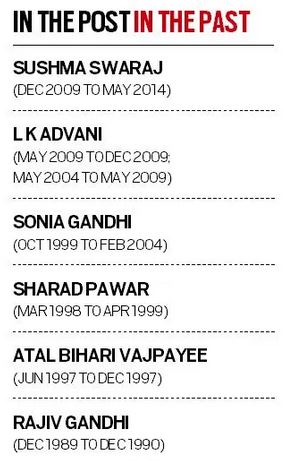
    For a decade, the Leader of Opposition in Lok Sabha remained vacant due to the absence of any party meeting the customary threshold of one-tenth of the House’s strength, now filled by Rae Bareli MP Rahul Gandhi.

    Leader of Opposition in the past:


    Who can serve as Leader of Opposition in Lok Sabha and Rajya Sabha?

    • Legal Definition: According to The Salary and Allowances of Leaders of Opposition in Parliament Act, 1977, the Leader of the Opposition is a member of the Lok Sabha or Rajya Sabha who leads the largest party in opposition to the government, recognised by the Speaker (Lok Sabha) or Chairman (Rajya Sabha).
    • Needed Strength: The leader must lead the party with the greatest numerical strength among the opposition parties in the respective House.
    • Recognition: The Speaker (Lok Sabha) or Chairman (Rajya Sabha) is mandated to recognize the leader of the largest opposition party as the Leader of the Opposition, irrespective of the party having a minimum threshold of 10% seats in the House.

    Significance of the positions and its significant role in Indian Political Democracy

    • Voice of the Opposition: The Leader of the Opposition serves as the primary spokesperson for the opposition in the House, articulating their views, criticisms, and alternative policies to those of the government.
    • Role in Committees: The Leader of Opposition plays a crucial role in high-powered committees responsible for appointments to key posts like the Director of CBI, Central Vigilance Commissioner, and others. This ensures a bipartisan approach in crucial appointments.
    • Ceremonial Role: The Leader of Opposition enjoys ceremonial privileges such as sitting in the front row during important occasions like the President’s Address to Parliament, symbolizing their role as a significant political figure.
    • Constitutional Checks and Balances: By providing an institutionalized position for the opposition, the Leader of Opposition ensures checks and balances on the ruling party’s power, fostering democratic accountability and oversight.
    • Precedence and Protocol: In the order of precedence, the Leader of Opposition ranks alongside Union Cabinet Ministers and other senior officials, reflecting their role in the functioning of the parliamentary democracy.

    Conclusion: The Leader of Opposition in Lok Sabha and Rajya Sabha, recognized per the 1977 Act, leads the largest opposition party, ensuring a vital role in governance oversight, committee appointments, and parliamentary protocol, crucial for democratic checks and balances.

    Mains PYQ: 

    Q The Indian Constitution has provisions for holding joint sessions of the two houses of the Parliament. Enumerate the occasions when this would normally happen and also the occasions when it cannot, with reasons thereof. (UPSC IAS/2017)