💥Join UPSC 2027,2028 Mentorship (July Batch) + XFactor Notes & Microthemes PDF

Subject: Fundamental Rights,DPSP

1. History + Evolution
2. Features
3. Amendments
4. Basic Structure

  • Secularism is a core part of the Constitution: SC

    Why in the News?

    On Monday, October 21, 2024, the Supreme Court affirmed that secularism is an integral and fundamental component of the Basic Structure of the Constitution.

    Is Secularism an Unamendable Part of the Indian Constitution?

    • Part of the Basic Structure: The Supreme Court has consistently held that secularism is an essential and indelible part of the Basic Structure of the Indian Constitution. This means that even though the Preamble was amended in 1976 to include the word “secular,” the principles of secularism were considered inherent in the Constitution from the start.
    • Kesavananda Bharati Case (1973): The landmark judgment established the “Basic Structure Doctrine,” which states that certain fundamental features of the Constitution cannot be altered or destroyed through amendments. Secularism, along with democracy, rule of law, and judicial review, was deemed a part of this unamendable structure.
    • Equality and Fraternity: The right to equality (Article 14) and the emphasis on fraternity in the Constitution have been interpreted by the judiciary to embody secularism as a core value, ensuring the protection of all religions and the principle of state neutrality in religious matters.
    • Indira Gandhi’s 42nd Amendment (1976): The amendment officially added the term “secular” to the Preamble, though the court’s view is that secularism was always implicitly present in the spirit of the Constitution.

    How Does Indian Secularism Differ from Western Models?

    • Equal Respect for All Religions (Sarva Dharma Sambhava): Indian secularism emphasizes the equal respect and treatment of all religions, rather than the strict separation of religion and state seen in Western secular models.
    • State Intervention for Social Reform: Unlike Western secularism, where religion is often seen as a strictly private affair, Indian secularism allows the state to engage with religious institutions to reform practices that may be discriminatory or harmful (e.g., abolition of untouchability or regulation of religious endowments).

    What Implications Do Challenges to Secularism Have for Indian Democracy?

    • Erosion of Minority Rights: The rise of majoritarian politics, fueled by Hindu nationalism, threatens minority rights and equality before the law, with accusations of fostering an environment where attacks on minorities are tolerated.
    • Centralization of Power: The concentration of power has weakened institutional autonomy, curtailed civil liberties, and marginalized minority voices, impacting the democratic principles of secularism and dissent.
    • Impact on Governance and International Relations: Religious considerations in policymaking can result in discriminatory practices, harm India’s international reputation regarding human rights, and attract global criticism.

    Way forward: 

    • Strengthen Legal Safeguards: Reinforce constitutional provisions that protect secularism by ensuring strict enforcement of anti-discrimination laws and promoting inclusive policies that uphold the principles of equality, fraternity, and state neutrality in religious matters.
    • Promote Civic Education on Secularism: Increase public awareness and education about the significance of secularism in India’s constitutional framework to foster social harmony and counter identity-based politics, reinforcing the values of pluralism and unity in diversity.
  • Minority Institutions

    Why in the News?

    • The Supreme Court stated that laws regulating institutions run by religious or linguistic minorities do not inherently violate the principle of secularism.
      • The CJI made this observation while hearing a challenge to the Allahabad High Court’s decision to strike down the Uttar Pradesh Board of Madrasa Education Act, 2004.

    Why do we need to discuss this?

    • The 2004 Act regulated madrasas in Uttar Pradesh, and the High Court concluded that it violated secular principles.
    • It had ordered the transfer of madrasa students to regular schools, which affected nearly 17 lakh students across 16,000 madrasas in the state.
      • Petitioners pointed out that the High Court believed that madrasas violated Article 28 of the Constitution, which prohibits religious instruction in institutions fully funded by the State.

    Key Observations made by the SC:

    • A law regulating a minority institution does not, by itself, violate secularism.
    • The CJI referred to the Hindu Religious Endowments and Charitable Institutions Act, which regulates the administration of religious institutions in many states, from Maharashtra to Tamil Nadu.
    • The CJI emphasized that the State has the right to legislate to improve the quality of education in government-aided minority-run institutions.
    • He noted that children attending madrasas need a broad-based education to learn essential subjects required to lead a proper life and become worthy citizens.

    About Minority Educational Institutions in India:

    Details
    Constitutional Provision Article 30(1) of the Constitution of India grants linguistic and religious minorities the right to establish and administer educational institutions of their choice.
    Legislative Framework National Commission for Minority Educational Institutions Act, 2004 safeguards the educational rights of minorities as per Article 30(1).
    Definition A “Minority Educational Institution” is defined as a college or institution established or maintained by a person or group from amongst the minorities (Section 2(g) of the Act).
    Judicial Precedent In T.M.A. Pai Foundation vs. State of Karnataka (2002), the Supreme Court ruled that minority status is determined by state demographics, not national population.
    Rights of Minority Institutions Article 29 protects the interests of minorities by allowing them to conserve their distinct language, script, or culture.

    • Minority institutions do not have an absolute right to appoint staff;
    • This was upheld in the context of the West Bengal Madrasah Service Commission Act, 2008.
    Recognized Minority Communities Muslims, Sikhs, Christians, Buddhists, Jains, and Zoroastrians (Parsis) are recognized as minority communities under the National Commission for Minorities Act of 1992.
    Significance Minority educational institutions play a crucial role in preserving the cultural and linguistic heritage of minority communities while providing access to education.


    PYQ:

    [2011] In India, if a religious sect/community is given the status of a national minority, what special advantages it is entitled to?

    1. It can establish and administer exclusive educational institutions.

    2. The President of India automatically nominates a representative of the community to Lok Sabha.

    3. It can derive benefits from the Prime Minister’s 15-Point Programme.

    Which of the statements given above is/are correct?

    (a) 1 only

    (b) 2 and 3 only

    (c) 1 and 3 only

    (d) 1, 2 and 3

  • SC upholds Section 6A of Citizenship Act as valid

    Why in the News?

    On October 17, 2024, political parties widely welcomed the Supreme Court’s decision upholding Section 6A of the Citizenship Act, addressing citizenship under the Assam Accord.

    What is Section 6A?

    • Section 6A of the Citizenship Act, added in 1985, grants citizenship to immigrants in Assam who entered between January 1, 1966, and March 25, 1971, under the Assam Accord provisions.

    What are the implications of upholding Section 6A for citizenship in Assam?

    • Legal Recognition of the Assam Accord: The verdict reinforces the Assam Accord’s legal status, acknowledging the cut-off date of March 25, 1971, for granting citizenship to immigrants. This solidifies the Accord’s role as a foundational legal document addressing the state’s citizenship issues.
    • Clarifying Citizenship Status: The ruling provides legal clarity on the citizenship status of individuals who entered Assam between January 1, 1966, and March 25, 1971. They are granted citizenship if they comply with specific conditions, while those arriving post-1971 are deemed illegal immigrants.
    • Impact on the NRC Process: The decision may influence the National Register of Citizens (NRC) process in Assam by determining who is eligible for inclusion. The cut-off date could guide the verification of citizenship claims, potentially affecting those at risk of being declared stateless.

    How does this ruling interact with existing immigration laws and policies?

    • Consistency with the Foreigners Act: The ruling aligns with existing immigration policies under the Foreigners Act, where illegal immigrants are identified and potentially deported.
    • Implications for Deportation and Detection: The verdict mandates continued efforts to detect and deport illegal immigrants who arrived post-March 25, 1971.
      • This may intensify identification and deportation processes, requiring robust legal and administrative mechanisms.
    • Role in NRC and Citizenship Amendment Act (CAA) Debate: The ruling interacts with ongoing discussions about the CAA, which grants citizenship to non-Muslim migrants from neighboring countries who entered before December 31, 2014.

    What are the broader constitutional implications of this decision?

    • Federalism and Regional Autonomy: The judgment upholds Assam’s unique historical and cultural context, recognizing the state’s special legal provisions under the Assam Accord.
    • Right to Equality and Non-discrimination: By validating different cut-off dates for citizenship determination in Assam compared to the rest of India, the ruling raises questions about equal treatment and the uniformity of laws across the country.
    • Judicial Endorsement of Accord-based Legislation: The ruling sets a precedent for upholding legislation based on historical accords or regional agreements.

    Way forward: 

    • Full Implementation of the Assam Accord: Ensure the complete execution of all clauses of the Accord, including detecting, deleting, and deporting illegal immigrants, while providing support to those recognized as citizens to integrate smoothly into society.
    • Strengthen Legal and Administrative Frameworks: Enhance the infrastructure for the NRC process, deportation mechanisms, and border management to maintain consistency in immigration policies, while addressing humanitarian concerns for affected individuals.
  • Article 142 of the Indian Constitution

    Why in the News?

    The Supreme Court declined a PIL seeking directions under Article 142 to include sexual offences against men, trans-persons, and animals in the Bharatiya Nyaya Sanhita (BNS), which replaced the Indian Penal Code (IPC).

    Supreme Court’s Observations:

    • The petitioner argued that the new BNS omitted Section 377 of the IPC, which previously criminalized ‘unnatural sex’ and carnal intercourse involving a man, woman, or animal.
    • In the Navtej Singh Johar v. Union of India (2018) case, the Supreme Court struck down Section 377 to the extent that it criminalized consensual sexual acts between adults.
    • Non-consensual homosexual acts remained punishable under this provision.
    • The BNS does not include provisions criminalizing sexual offences against men, trans persons, and animals.
    • During the hearing, the bench comprising CJI DY Chandrachud and Justices JB Pardiwala and Manoj Misra stated that:
      • The Court cannot direct Parliament to create or reintroduce an offence.
      • The creation of offences falls within the parliamentary domain, not under the court’s jurisdiction, even with Article 142.

    About Article 142:

    Details
    Definition • Grants discretionary power to the Supreme Court to pass orders or decrees necessary for complete justice in matters before it.
    • Allows the court to act beyond the limits of statutory law if required.
    Purpose • Ensures justice is delivered in cases where regular laws may not provide adequate remedies.
    • Aims to empower the Supreme Court to address extraordinary situations effectively.
    Key Clauses Article 142(1): Allows the Supreme Court to pass enforceable orders across India for doing complete justice.
    Article 142(2): Empowers the court to secure attendance, discovery of documents, or punishment for contempt.
    Notable Cases Bhopal Gas Tragedy (1989): Supreme Court awarded $470 million compensation, bypassing limitations of ordinary law.
    Ayodhya Case (2019): Directed the formation of a trust for Ram Mandir construction.• Liquor Sale Ban (2016): Imposed a 500-metre ban on liquor shops along highways using Article 142, extending it beyond central government orders.
    Constructive Application • Invoked for environmental protection, such as in the Taj Mahal cleanup.
    Justice for undertrials by addressing systemic delays in the judicial process.
    Controversies • Accusations of judicial overreach in certain cases, where actions have seemingly breached the separation of powers principle.
    Supreme Court Bar Association v. Union of India: Clarified that Article 142 should supplement, not replace the law.
    Impact on Governance • Empowers the Supreme Court with a tool for upholding justice, but raises debates over checks and balances in a democratic system.


    PYQ:

    [2019] With reference to the Constitution of India, prohibitions or limitations or provisions contained in ordinary laws cannot act as prohibitions or limitations on the constitutional powers under Article 142. It could mean which one of the following?

    (a) The decisions taken by the Election Commission of India while discharging its duties cannot be challenged in any court of law.

    (b) The Supreme Court of India is not constrained in the exercise of its powers by laws made by the Parliament.

    (c) In the event of grave financial crisis in the country, the President of India can declare Financial Emergency without the counsel from the Cabinet.

    (d) State Legislatures cannot make laws on certain matters without the concurrence of Union Legislature.

  • What special status is Ladakh seeking?

    Why in the News?

    Climate activist Sonam Wangchuk was detained at the Delhi border on Monday night while leading a group of protesters seeking to petition the Central government for Ladakh’s inclusion in the Sixth Schedule of the Constitution, along with other demands for greater autonomy for the region.

    What is Asymmetrical federalism?

    • Asymmetrical federalism refers to a system where some regions or states within a country have more autonomy or special provisions than others. This contrasts with symmetrical federalism, where all states or regions have equal powers.
    • Example in India: The Indian Constitution follows asymmetrical federalism, where certain regions like those under the Fifth and Sixth Schedules or specific northeastern states have special provisions and greater autonomy compared to other states.

    Which are the other States seeking constitutional safeguards?

    • Ladakh: The Union Territory of Ladakh has seen increasing demands for inclusion in the Sixth Schedule of the Constitution to safeguard its indigenous culture and provide greater autonomy.
    • Arunachal Pradesh: The state has passed a resolution seeking inclusion in the Sixth Schedule to grant more autonomy to its tribal populations.
    • Manipur: The Hill Area Committee in Manipur has also demanded inclusion in the Sixth Schedule for its tribal areas, particularly the ‘Hill areas’.

    Do the Fifth and Sixth schedules grant areas under them more autonomy?

    • Fifth Schedule: Grants special protections to ‘scheduled areas’ in 10 states. These areas are governed by Tribes Advisory Councils (TACs) and Governors, who have the power to regulate land transfers, businesses, and the applicability of laws.
    • Sixth Schedule: Provides greater autonomy to ‘tribal areas’ in four northeastern states (Assam, Meghalaya, Mizoram, and Tripura) through Autonomous District Councils (ADCs).
      • ADCs have more legislative, executive, and financial powers, including the ability to regulate land use, social customs, and taxation.

    Why did the British create provisions for ‘excluded’ and ‘partially excluded’ areas?

    • British Policy of Isolation: To avoid unrest and rebellion among the tribal populations, the British adopted a policy of ‘isolation’ by creating ‘excluded’ and ‘partially excluded’ areas in tribal regions under the Government of India Act, 1935.
    • Excluded Areas: These were mostly in the northeastern hilly regions, where the Governor had the authority to legislate.
    • Partially Excluded Areas: These included tribal regions in Central and Eastern India, where laws from central and provincial legislatures were applicable but with modifications, ensuring minimal interference with tribal customs and governance.

    Conclusion:  The government should initiate meaningful consultations with local stakeholders in regions like Ladakh, Arunachal Pradesh, and Manipur to address concerns about cultural preservation and autonomy, ensuring that any constitutional reforms reflect the aspirations of the indigenous populations.

  • [2nd October 2024] The Hindu Op-ed: The Waqf Bill 2024 is one that needs review

    PYQ Relevance:

    Q). “The diverse nature of India as a multi-religious and multi-ethnic society is not immune to the impact of radicalism which is seen in her neighborhood? Discuss along with strategies to be adopted to counter this environment. (UPSC CSE 2014)

    Q). What are the challenges to our cultural practices in the name of Secularism? (UPSC CSE 2019)

    Q). Customs and traditions suppress reason leading to obscurantism. Do you agree? (UPSC CSE 2020)

    Q). Are tolerance, assimilation, and pluralism the key elements in the making of an Indian form of secularism? Justify your answer. (UPSC CSE 2022)

    Mentor’s Comment:  Sometimes, the religious sentiments among the public infringes the very particulates of the secular governance. The Waqf (Amendment) Bill 2024 has also sparked same controversy in India, particularly among the Muslim community and various political leaders. Critics argue that the bill threatens the autonomy of Waqf properties, which are religious endowments, by increasing government control and including non-Muslim members in Waqf boards.

    However, the Joint Parliamentary Committee (JPC) reviewing the bill received an overwhelming response from the public, with conflicting reports on the number of suggestions submitted that ranged from 1.25 crore to 5 crore, which prompted some government officials to question the legitimacy of this feedback. In today’s editorial, we will have a look at more extra edges that we need to consider while drafting this new law for the Waqf Boards all over India.

    _

    Let’s learn!

    Why in the News?

    The Waqf (Amendment) Bill 2024 has sparked significant controversy in India, particularly among the Muslim community and various political leaders.

    • The Fundamental Rights enshrined in Part III of the Constitution, prohibits the state from enacting laws that infringe religious rights, declaring any such laws void.
    • However, this freedom is subject to considerations of public order, morality, and health, allowing for state intervention only when necessary to maintain societal harmony.
    What does the Indian Constitution say about Religious freedom?

    • Article 26 guarantees every religious denomination the right to manage its affairs, including the establishment of religious institutions and the ownership of property.
    •  Also, as in Article 13(2), the state is forbidden to make any law that takes away or abridges the rights conferred by this Part, declaring that any law made in contravention of this clause shall be void.

    What are the criticisms faced by the Waqf Bill 2024?

    • Potential Misuse of the Power: The bill proposes 44 amendments to the existing Waqf Act of 1995, including the replacement of Waqf tribunals with District Collectors for property disputes. The opponents labeled this as a politically motivated move to weaken the Muslim community.
    • Threatens the Religious Autonomy: The Religious Endowments Act, of 1863 says that the ‘members of the said committee shall be appointed from among persons professing the religion for religious establishments”. Secondly, the UP’s Sri Kashi Vishwanath Temple Act, 1983 provides that no non-Hindu is eligible to be a member of its management at any level.
      • However, the Minority Affairs Ministry has proposed through the Waqf Bill 2024 that two member seats each in the Central Waqf Council and all the State Waqf Boards be reserved for ‘non-Muslims’.
      • The All India Muslim Personal Law Board (AIMPLB) and other organizations have mobilized against the bill, claiming it undermines constitutional rights and could exacerbate communal tensions
    • Lack of Consultation: The Justice Rajinder Sachar Committee spent 18 months gathering data to draft the Waqf (Amendment) Act 2013, which strengthened the Waqf law in India. Unlike previous committees, the current Ministry did not engage with key stakeholders such as the Central Waqf Council or Muslim organizations before drafting the bill.

    Why the reconstitution of CWC is necessary?

    The Ministry is urged to quickly reconstitute the Central Waqf Council (CWC) according to existing waqf laws to oversee data collection from states. For two years, it needs to monitor state Waqf Boards and manage waqf properties closely that have been hindered so far. The reasons are as follows:

    • Membership Changes: The 2024 Bill proposes reducing Muslim membership in the CWC and State Waqf Boards from 100% to less than 50%, raising concerns about community representation.
    • Legal Concerns: The Bill aims to remove the requirement for CWC officials to be Muslim, contradicting constitutional rights related to religious management.
    • Women’s Representation: Confusion exists over the proposal for female representation in the CWC, which was already established in a previous amendment.
    • Re-registration Requirement: Existing waqfs must re-register under a new government-controlled portal, risking legal rights for those who fail to comply.
    • Removal of Donor’s Will: The Bill proposes discontinuing the mandatory implementation of the donor’s will, compromising existing waqf governance.

    Way Forward: The Waqf (Amendment) Bill 2024 represents a significant shift in the governance and management of Waqf properties in India. As the Bill undergoes review, stakeholders must ensure that it balances the need for reform with the preservation of community rights and interests, fostering a system that genuinely serves its intended religious and charitable purposes.

    https://www.thehindu.com/opinion/lead/the-waqf-bill-2024-is-one-that-needs-review/article68706813.ece
  • Special Gram Sabhas on Gandhi Jayanti

    Why in the News?

    The Ministry of Panchayati Raj is organizing special Gram Sabhas across 750 Gram Panchayats on 2nd October 2024, marking Gandhi Jayanti.

    Vision to Achieve Gram Swaraj Through People’s Participation

    • These special Gram Sabhas will embody Mahatma Gandhi’s vision of Gram Swaraj—a vision of self-reliant villages driven by people’s participation in decision-making.
    • It emphasizes community-led governance, where elders, women, and youth collaborate to develop Gram Panchayat Development Plans (GPDP).

    Lal Bahadur Shastri’s Legacy

    • The event also coincides with the birth anniversary of Lal Bahadur Shastri, India’s second Prime Minister.
    • Shastri championed the values of simplicity, self-reliance, and community development.
    • Shastri’s slogan, “Jai Jawan, Jai Kisan,” emphasized the strength of India’s rural economy and its farmers, making his vision a key component of this grassroots initiative.

    About Gram Sabha

    Details
    Role and Significance • Centerpiece of the Panchayati Raj system
    • Responsible for village development and local governance
    Constitutional Provision • Defined under Article 243(b) of the Indian Constitution
    Primary body in the Panchayati Raj system
    • A permanent body
    Members • Individuals above 18 years of age
    • Must be residing in the village
    • Listed in the electoral rolls
    Meetings • Must meet 2 to 4 times annually as per State Panchayat Raj Acts
    • Common meeting dates:
    1. Republic Day (26th Jan)
    2. Labour Day (1st May)
    3. Independence Day (15th Aug)
    4. Gandhi Jayanti (2nd Oct)
    • Panchayats may choose other dates for meetings
    Organizing Body • Organized by the Panchayat Secretary (Gram Sevak)
    • Done with approval of the Sarpanch
    Conditions for Convening 10% of members or 50 people (whichever is greater) can request a meeting
    • A written request must be submitted 5 days prior to the meeting
    Decision-Making Process • All decisions of the Panchayat require the approval and validation of the Gram Sabha
    Purpose Discuss local governance and development issues
    • Make need-based plans for the village


    PYQ:

    [2012] In the areas covered under the Panchayat (Extension to the Scheduled Areas) Act, 1996, what is the role/power of Gram Sabha?

    1. Gram Sabha has the power to prevent alienation of land in the Scheduled Areas.
    2. Gram Sabha has the ownership of minor forest produce.
    3. Recommendation of Gram Sabha is required for granting prospecting licence or mining lease for any mineral in the Scheduled Areas.

    Which of the statements given above is/are correct?

    (a) 1 only

    (b) 1 and 2 only

    (c) 2 and 3 only

    (d) 1, 2 and 3

  • Who is an Overseas Citizen of India (OCI)?

    Why in the News?

    Following complaints from Overseas Citizen of India (OCI) card holders about being reclassified as “foreigners,” the Ministry of External Affairs clarified, that no changes have been made to the rules governing OCI status.

    About Overseas Citizen of India (OCI)

    Details
    About
    • OCI scheme, introduced in August 2005, allows Persons of Indian Origin (PIOs) who were citizens of India after January 26, 1950 or were eligible for Indian citizenship on that date, to register for OCI status.
    • Serves as a form of dual citizenship for the Indian diaspora.
    • The Ministry of Home Affairs defines an OCI.
    OCI Card Benefits OCI cardholders receive a multiple-entry, life-long visa to visit India and are exempt from registering with local authorities for extended stays.
    Population (as of 2023) USA: 16.8 lakh > UK: 9.34 lakh > Australia: 4.94 lakh> Canada: 4.18 lakh
    Recent Rules (2021 Notification)
    • OCI card holders need permission to visit protected, restricted, or prohibited areas.
    • Special permits are also required for activities such as conducting research, undertaking missionary or journalistic work, and visiting areas like Jammu & Kashmir.
    OCI vs NRI Rights Under the Foreign Exchange Management Act (FEMA) 2003, OCI card holders are now on par with foreign nationals regarding economic, financial, and educational rights, reversing earlier parity with NRIs.
    Significant Changes to OCI Rules
    • 2005: Lifelong visas and exemption from FRRO registration
    • 2007: Parity with NRIs for inter-country adoption and domestic airfare
    • 2009: Parity with NRIs for entry fees to monuments and professions like doctors and architects
    Eligibility Restrictions
    • Individuals with parents or grandparents from Pakistan or Bangladesh cannot apply for an OCI card.
    • Foreign military personnel (retired or active) are also not eligible.
    Spouse Eligibility Spouses of Indian citizens or OCI card holders, whose marriage has been registered for at least two years, can apply for an OCI card.
    OCI Card Restrictions
    • OCI card holders cannot vote, hold constitutional positions, or be elected as a members of Parliament or Legislative Assembly.
    • They are also restricted from holding government employment in India.


    PYQ:

    [2021] With reference to India, consider the following statements: (2021)

    1. There is only one citizenship and one domicile.
    2. A citizen by birth only can become the Head of State.
    3. A foreigner once granted citizenship cannot be deprived of it under any circumstances.

    Which of the statements given above is/are correct?

    (a) 1 only
    (b) 2 only
    (c) 1 and 3
    (d) 2 and 3

  • Bombay HC strikes down amended IT rules

    Why in the News?

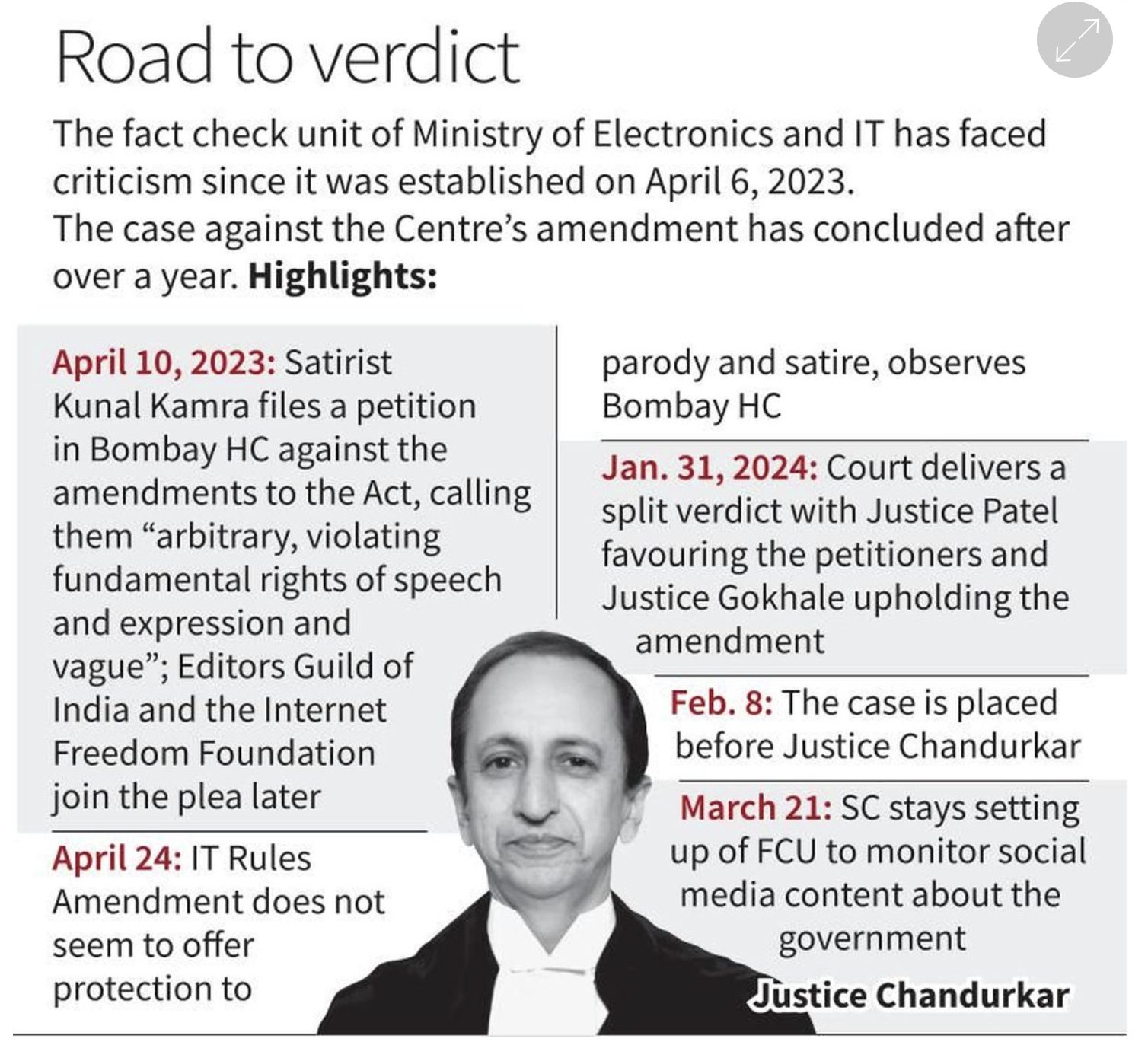
    The Bombay High Court on Friday struck down the amended IT Rules, 2023, which allowed the Centre to establish a fact-check unit for monitoring government-related misinformation.

    Background of the Case

    • In April 2023, the Ministry of Electronics and IT (MEiTY) amended the Information Technology (IT) Rules, 2021, to establish a Fact Check Unit (FCU) aimed at identifying “fake, false, and misleading” information about the Central government on social media platforms.

    Reason Behind the Strike Down

    • Violation of Fundamental Right: Justice Chandurkar struck down the amended IT Rules 2023 on grounds that they violated Articles 14 (right to equality), 19 (freedom of speech and expression), and 19(1)(g) (freedom to practice any profession) of the Constitution.
    • Lack of clear defination: The terms “fake, false and misleading” were deemed vague due to the absence of clear definitions, leading to potential misuse and a chilling effect on intermediaries’ operations.
      • The ruling emphasized that the lack of clarity in the rules could lead to arbitrary censorship by the government, undermining democratic principles.

    What are the IT Rules 2023?

    • The Information Technology (Intermediary Guidelines and Digital Media Ethics Code) Amendment Rules, 2023 empower the government to mandate social media platforms like Facebook, Twitter, Instagram, and YouTube to remove content deemed “fake, false or misleading” regarding government affairs.
    • The Fact Check Unit (FCU) was designated as the authority to identify such content. If intermediaries failed to comply with its directives, they risked losing their safe harbour status under Section 79 of the IT Act, 2000.

    The implications of FCU: 

    • Potential censorship of political discourse and criticism.
    • Increased pressure on social media platforms to comply with government directives.
    • A risk of undermining independent journalism and fact-checking efforts by civil society organizations.

    Way forward: 

    • Clear Definitions and Safeguards: Introduce precise definitions for terms like “fake, false, and misleading” and establish an independent oversight mechanism to prevent arbitrary censorship, ensuring the protection of free speech and democratic values.
    • Strengthen Accountability: Encourage collaboration between the government, civil society, and tech platforms to create transparent and accountable fact-checking processes while protecting intermediaries’ safe harbour status and upholding freedom of expression.
  • Section 2 of the Indian Flag Code (2002)

    Why in the News?

    The Bihar Police arrested some miscreants for waving India’s national flag with distorted Ashok Chakra/Dhammachakra.

    Significance of Ashok Chakra:

    • Symbolism: Represents righteousness, justice, and the path of virtue, urging citizens to uphold moral values.
    • Legacy of Dhamma: Reflects Emperor Ashoka’s principles of peace, non-violence, and welfare, after his embrace of Buddhism.
    • Compassion for all: Derived from the Dhammachakra, it represents the Buddhist philosophy of ethical living and compassion.
    • Unity and Progress: The circular design symbolizes unity and continuous development, emphasizing national harmony and forward movement.

    About Flag Code of India, 2002:

    Details
    Objective To regulate the display, usage, and respect for the Indian National Flag by citizens, organizations, and the government.
    Basisi Article 51 ‘A’ contained in Part IV A i.e. Fundamental Duties asks: To abide by the constitution and respect its ideals and institutions, the National Flag and the National Anthem in clause (a).
    Structure The Flag Code is divided into three parts:

    1. Part I: General provisions related to the display of the national flag by all.
    2. Part II: Display of the flag by government bodies.
    3. Part III: Display of the flag by public, private organizations, and educational institutions.
    Material of Flag
    • The national flag should be made of hand-spun and hand-woven wool, cotton, silk, or khadi bunting.
    • However, polyester and machine-made flags were allowed under amendments in 2021.
    Prohibitions (Section 2.2)
    • Not be used as a drapery, costume, or uniform.
    • Not be used for commercial purposes or as a receptacle.
    Display Guidelines (Section 2.1)
    • Must be hoisted respectfully, always ensuring that the saffron band is on top when displayed vertically.
    • Should never touch the ground or be used as decoration.
    Amendments In 2022, rules were amended to allow the national flag to be flown both during the day and night, as long as it is hoisted in a dignified manner.
    Penalties Disrespect or misuse of the national flag is punishable under the Prevention of Insults to National Honour Act, 1971.


    PYQ:

    [2008] What is the number of spokes in the Dharmachakra in the National Flag of India?

    (a) 16

    (b) 18

    (c) 22

    (d) 24