As many as 50 Opposition MPs have reportedly signed a resolution to bring a no-confidence motion against Vice-President (Rajya Sabha Chairman) Jagdeep Dhankhar.
No-Confidence Motionagainst Vice President of India
Details
Provision
Article 67(b) of the Indian Constitution
Who Can Initiate
Can only be introduced in the Rajya Sabha, not the Lok Sabha.
Notice Requirement
At least 14 days’ advance notice must be given before moving the resolution.
Voting in Rajya Sabha
Requires an effective majority (majority of all members present and voting) in the Rajya Sabha.
Voting in Lok Sabha
Requires a simple majority (more than 50% of members present and voting) in the Lok Sabha.
Grounds for Removal
Constitution does not specify any grounds or justifications for the removal of the Vice President.
Temporary Vacancy
If the Vice President is removed -> Deputy Chairman of the Rajya Sabha assumes the role of Chairman.
Historical Context
No Vice President has ever been removed under this Article in Indian parliamentary history.
PYQ:
[2013] Consider the following statements:
1. The Chairman and the Deputy Chairman of the Rajya Sabha are not the members of that House.
2. While the nominated members of the two Houses of the Parliament have no voting right in the
Presidential election, they have the right to vote in the election of the Vice President.
Which of the statements given above is/are correct?
The opposition has submitted a notice in the Rajya Sabha to initiate privilege proceedings against Union Education Minister.
It is alleged that the Minister ‘misled’ the House regarding the issue of the Preamble to the Constitution being ‘dropped’ from certain NCERT textbooks.
What is a Privilege Motion?
Details
What is it?
A formal notice by an MP when rights or privileges of Parliament or its members are breached.
Parliamentary privilege refers to the right and immunity enjoyed by legislatures (Article 105).
Who can move such motion?
Any Member of Parliament (MP) from Lok Sabha or Rajya Sabha.
Governing Rules
Lok Sabha Rule book: Rule 222, Chapter 20
Rajya Sabha Rule book: Rule 187, Chapter 16
Procedure
Requires consent from Speaker/Chairperson;
Notice must concern a recent incident needing House intervention.
Role of Speaker/Chairperson
First level of scrutiny;
Can decide on the motion or refer it to the Privileges Committee.
Privileges Committee
Lok Sabha: 15 members, nominated by Speaker
Rajya Sabha: 10 members, headed by Deputy Chairperson
Outcome
Committee submits a report;
House may debate and pass a resolution based on the report.
Historical Example
1978: Privilege motion against Indira Gandhi, leading to her expulsion from the Lok Sabha.
Legal Implications
If a breach of privilege is established, the Parliament has the authority to impose penalties.
These can range from a reprimand to expulsion from the House, depending on the severity of the breach.
PYQ:
[2014] Consider the following statements regarding a No-Confidence Motion in India:
1. There is no mention of a No-Confidence Motion in the Constitution of India.
2. A Motion of No-Confidence can be introduced in the Lok Sabha only.
Which of the statements given above is/are correct?
The UP Assembly’s amendments to its regressive ‘Anti-conversion’ law appear aimed at facilitating misuse, with over 400 cases registered since the original 2021 law.
What is UP’s ‘Anti-conversion’ law?
Uttar Pradesh’s “Anti-conversion” law, officially known as the Uttar Pradesh Prohibition of Unlawful Conversion of Religion Act, 2021, prohibits religious conversion through unlawful means such as misrepresentation, force, undue influence, coercion, allurement, or fraudulent means.
Why was the Original 2021 Anti-Conversion Law Amended by UP?
Increased Stringency: The amendments aim to make the original law more stringent, responding to claims of rising cases of forced conversions and the alleged involvement of foreign and anti-national elements in demographic changes.
Response to Public Discontent: The government cited the need to enhance penalties and legal measures to prevent unlawful conversions, particularly concerning vulnerable groups such as minors and women.
Legitimacy of Complaints: The amendment allows third parties to file complaints about alleged unlawful conversions, expanding the scope of the law and potentially increasing its application against inter-faith marriages.
What are Its concerning features?
Harsh Penalties: The amended law introduces severe penalties, including imprisonment of up to 20 years or life for targeting minors, women, or certain communities through coercion or force.
Bail Conditions: The law imposes stringent bail conditions that make it difficult for accused individuals to secure bail, requiring public prosecutor consent and a presumption of guilt.
Third-Party Complaints: The provision allowing anyone to file complaints against alleged conversions opens the door for misuse by communal organizations and individuals with vested interests, potentially targeting inter-faith couples.
What does it state about bail conditions and ‘foreign funding’?
Bail conditions: The amended law states that an accused individual cannot be granted bail unless the public prosecutor has the opportunity to oppose it, and there is reason to believe the accused is not guilty and unlikely to repeat the offence.
Foreign funding: The law prescribes stiff penalties for receiving funds from foreign organizations for unlawful conversion, with fines and imprisonment aimed at deterring financial support for conversion activities.
How is it different from other states?
Comparison with Other States: While several states like Odisha and Madhya Pradesh have anti-conversion laws, Uttar Pradesh’s amendments are notably harsher, including provisions for life imprisonment, which are not present in other states.
Bail and Proof Burden: Other states may not impose such severe bail conditions or the reverse burden of proof required in Uttar Pradesh, making it easier for accused individuals in those states to secure bail.
Scope of Complaints: In many states, only aggrieved individuals or their close relatives can file complaints, whereas Uttar Pradesh’s amendments allow for broader third-party complaints, increasing the potential for misuse.
Way forward:
Promote Awareness of Rights: Implement comprehensive public awareness campaigns to educate citizens about their legal rights concerning religious conversion and inter-faith marriages.
Legal and Constitutional Review: Stakeholders, including civil society organizations and legal experts, should actively pursue legal challenges against the amended law in the Supreme Court of India.
Numerous examples in recent time exist in the history of Parliament and State Assemblies where MPs or MLAs have defected from their party.
These activities often led to the frequent falling of governments.
What is Anti-Defection Law?
The 52nd Constitutional Amendment introduced the anti-defection law through the Tenth Schedule in 1985.
It aimed at tackling political defections destabilizing governments, especially after the 1967 general elections.
According to this Schedule, a member of the State Legislature or the House of Parliament who voluntarily resigns from their political party or abstains from voting in the House contrary to the party’s instruction may be removed from the House.
This voting instruction is issued by the party whip, a member of the parliamentary party nominated by the political party in the House.
Process of Disqualification under Anti-Defection Law
Petition:
Any member of the House can initiate the process by filing a petition/complaint with the Speaker (Lok Sabha) or Chairman (Rajya Sabha) alleging defection by another member.
The Presiding Officer CANNOT initiate disqualification proceedings suo moto and can only act upon a formal complaint.
Deciding Authority:
The Speaker of Lok Sabha, the Chairman of Rajya Sabha, or the State Legislative Assembly decides disqualification petitions under the anti-defection law.
Timeframe:
The law does not specify a strict timeline for the decision, which has led to criticism due to potential delays.
Judicial Review:
The decision can be challenged in courts, ensuring a system of checks and balances.
The landmark judgment in Kihoto Hollohan vs. Zachillhu and Others (1992) upheld the constitutionality of the anti-defection law and affirmed that decisions regarding disqualification are subject to judicial review.
Exceptions:
No disqualification if 1/3rd members of the legislature party split to form a separate group (provision DELETED by the 91st Amendment in 2003).
Mergers of political parties are allowed when 2/3rd of the members of a legislative party agree to merge with another party.
Three-Test Formula of the Supreme Court:
The Supreme Court in Sadiq Ali versus Election Commission of India (1971) laid down the three-test formula for recognizing the original political party:
Test of Aims and Objectives of the party.
Test of Party Constitution, which reflects inner-party democracy.
Test of Majority in the legislative and organizational wings.
Limitations of the Anti-Defection Law
Dictatorship of Party: The law has been criticized for undermining democratic principles by restricting legislators’ freedom of speech and making them more accountable to party leaders than their constituents.
Limited Political Choice: The law discriminates against independent members, disqualifying them immediately if they join a political party, while nominated members have a six-month grace period.
Partial Law: The law needs a more precise timeline for resolving defection cases. It allows large-group defections, fostering opportunistic mergers and “horse-trading”, destabilizing the political system.
Promotes Defection: It fails to address root causes like intra-party democracy, corruption, and electoral malpractices.
Recommendations on Reforming the Law
Dinesh Goswami Committee (1990):
Disqualification should be limited to cases of voluntarily giving up membership or voting/abstention contrary to the party direction only in specific motions.
Decision on disqualification should be made by the President or Governor based on the advice of the Election Commission.
Law Commission of India (2015):
Proposed shifting the power to decide disqualification petitions from the Presiding Officer to the President or Governor based on the advice of the Election Commission.
Supreme Court in K. M. Singh v. Speaker of Manipur (2020):
Recommended transferring the Speaker’s decision-making authority over disqualification petitions to an independent tribunal presided over by judges.
Committee Led by Rahul Narwekar:
Announced by Lok Sabha Speaker Om Birla to review the nation’s anti-defection law.
PYQ:
[2022] With reference to anti-defection law in India, consider the following statements:
The law specifies that a nominated legislator cannot join any political party within six months of being appointed to the House.
The law does not provide any time-frame within which the presiding officer has to decide a defection case.
Which of the statements given above is/are correct?
(a) 1 only
(b) 2 only
(c) Both 1 and 2
(d) Neither 1 nor 2
[2013] The role of individual MPs (Members of Parliament) has diminished over the years and as a result healthy constructive debates on policy issues are not usually witnessed. How far can this be attributed to the anti-defection law, which was legislated but with a different intention?
The Prime Minister recalled the Parliament’s 5-year-old decision to abrogate Articles 370 and 35(A), calling it a watershed moment.
About Articles 370 and 35(A) of the Indian Constitution
[1] Article 370:
Description
Provision
Grants special autonomous status to the state of Jammu and Kashmir.
Nature
Initially intended as a temporary provision, subject to eventual change or abrogation.
Powers of State
Allowed J&K to have its own Constitution and autonomyover internal matters except defense, foreign affairs, finance, and communications.
Presidential Order
President of India could extend or modify the application of Indian laws to J&K with the concurrence of the state government.
Autonomy Details
Provides a degree of autonomy to the state and permits the state to give some special privileges to its “permanent residents”.
Emergency Provisions
Emergency provisions are not applicable to the state on the grounds of “internal disturbance” without the concurrence of the State.
State Boundaries
Name and boundaries of the State cannot be alteredwithout the consent of its legislature.
Separate Institutions
State has its own constitution, a separate flag, and a separate penal code (Ranbir Penal Code).
Assembly Duration
Duration of the state’s Assembly is 6 years, unlike five in the rest of India.
Parliamentary Jurisdiction
Indian Parliament can pass laws regarding J&K in the matters of defense, external affairs, and communication only.
Any other law formed by Union will only be applicable in J&K by presidential order if it concurs with the state assembly.
Abolishment Condition
President may, by public notification, declare that this Article shall cease to be operative but only on the recommendation of the Constituent Assembly of the State.
Abolishment
In August 5, 2019, through a Presidential Order and a resolution passed by the Indian Parliament.
Impact of Abrogation
J&K’s special status was revoked.
It was reorganized into two Union Territories: Jammu and Kashmir, and Ladakh.
[2] Article 35A:
Description
Provision
Empowers the J&K legislature to define permanent residents of the state and provide them with special rights and privileges.
Insertion
Added to the Constitution through a Presidential Order in 1954.
Permanent Residents
Defined by the state as those who were state subjects on May 14, 1954, or have been residents for 10 years, and lawfully acquired immovable property.
Special Rights
Permanent residents were given exclusive rights to employment under the state government, acquisition of immovable property in the state, and scholarships.
Constitutionality Debate
Debated on the grounds that it was not added via an amendment procedure.
Criticism
Criticized for being discriminatory and creating a sense of separation from the rest of India.
Revocation
Along with Article 370, Article 35A was effectively nullified on August 5, 2019.
PYQ:
[2016] To what extent is Article 370 of the Indian Constitution, bearing marginal note “Temporary provision with respect to the State of Jammu and Kashmir”, temporary? Discuss The future prospects of this provision in the context of Indian polity.
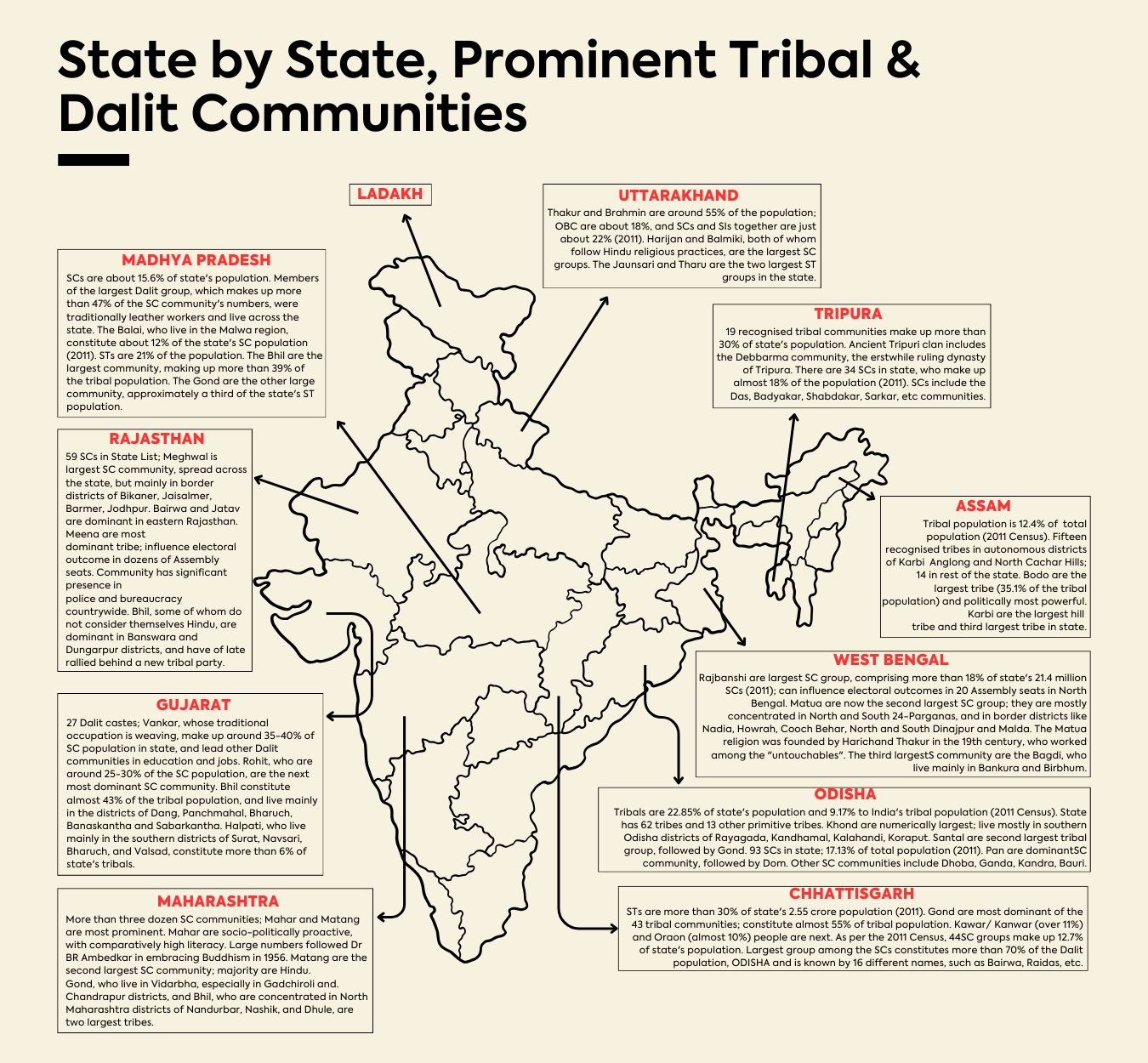
A seven-judge Bench of the Supreme Court has ruled that States can subdivide Scheduled Castes (SC) into groups to allocate sub-quotas within the Dalit reservation.
Will the Weaker Among Dalits Get Representation from Further Sub-Classification?
The Supreme Court’s ruling allows states to create sub-classifications within the SC category, which is expected to enable states to earmark sub-quotas for the most marginalized sections of Dalits.
This decision aims to ensure better representation for weaker groups within the SC community who have historically been underrepresented and have not benefitted adequately from existing reservations.
The ruling emphasizes that treating SC communities as a homogeneous group undermines the objective of reservations, as there are significant differences in advancement and discrimination among various SC communities.
Why Did the Supreme Court Overrule a Five-Judge Decision of 2004?
The 2004 judgment in E.V. Chinnaiah vs. State of Andhra Pradesh held that SCs constitute a single homogeneous class and that any sub-classification was unconstitutional, as it violated Article 341, which empowers the President to notify the list of SCs.
The recent seven-judge Bench, led by Chief Justice D.Y. Chandrachud, found this ruling to be incorrect, stating that SC communities are not homogeneous and that there are inter se differences among them.
The majority opinion argued that the act of notifying a list of SCs does not create a uniform class, and sub-classification is permissible based on “intelligible differentia” and should have a rational nexus to the purpose of doing it.
What are the views on Creamy layer exclusion?
The concept of the creamy layer, which excludes more advanced members of a community from benefiting from affirmative action, is currently applicable only to Other Backward Classes (OBCs) and has not been extended to Dalit communities.
Justice B.R. Gavai, in a separate opinion, emphasized the need to identify and exclude the more advanced among SCs from affirmative action benefits, arguing that treating all members equally disregards the principle of equality.
The opinions regarding creamy layer exclusion do not constitute a directive for the government to implement this concept for SCs, as the issue was not directly addressed in the current case.
Do the Judges’ Opinions on this Constitute a Direction to the Government?
The judges’ opinions on sub-classification and creamy layer exclusion provide a legal framework for states to follow but do not serve as a direct mandate for the government to implement changes.
The ruling establishes that states have the authority to sub-classify SCs for the purpose of extending reservation benefits, but the specific implementation details and parameters for creamy layer exclusion remain open for further consideration and do not compel immediate action from the government.
Way forward:
Implementation Framework for Sub-Classification: The government should establish a comprehensive framework that outlines the criteria and process for sub-classification of SCs.
Addressing Creamy Layer Exclusion: The government should consider developing specific criteria for identifying the “creamy layer” within SCs, similar to the criteria used for OBCs.
Q1 The Indian Constitution has provisions for holding joint sessions of the two houses of the Parliament. Enumerate the occasions when this would normally happen and also the occasions when it cannot, with reasons thereof. (UPSC IAS/2017)
Q2 Rajya Sabha has been transformed from a ‘useless stepney tyre’ to the most useful supporting organ in the past few decades. Highlight the factors as well as the areas in which this transformation could be visible. (UPSC IAS/2020)
Note4Students:
Prelims: Money Bill
Mains: Issues related to Money Bill
Mentor comments: In the coming weeks, a seven-judge Bench of the Supreme Court of India will address key questions regarding the definition and scope of a Money Bill. The ruling will impact numerous legislations passed recently without Rajya Sabha approval. The case, stemming from the November 2019 Rojer Mathew vs. South Indian Bank Ltd. verdict, challenges the Finance Act, 2017. This Act, certified as a Money Bill, made extensive changes to 26 tribunals’ authority and jurisdiction, including their abolition, merger, and the imposition of new qualifications and service conditions.
Let’s learn!
__
Why in the News?
The Supreme Court’s ruling will impact legislation passed without the Rajya Sabha’s approval and influence the state of India’s federal structure.
Articles and definitions: •Article 109: Allows Money Bills to become law with only the Lok Sabha’s approval; Rajya Sabha can only make recommendations, which are not binding. •Article 110(1): Defines a Money Bill, listing subjects such as taxation, borrowing, and appropriation from the Consolidated Fund of India. A Bill must address only these subjects to be deemed a Money Bill. •Article 110(3): Grants the Speaker of the Lok Sabha the final authority to determine if a proposed legislation is a Money Bill.
A colourable exercise of power:
This term refers to actions taken by a legislative body that, while appearing to be within their authority, actually circumvent constitutional limits or principles.
In the context of the Finance Act, 2017, the petitioners argue that the Act’s provisions extend beyond the permissible scope of a Money Bill, thereby constituting a subterfuge to bypass the Rajya Sabha.
Arguments Against the Finance Act, 2017
The Finance Act, 2017, included extensive amendments affecting the terms of office, qualifications, and regulatory powers of tribunals. These changes were seen as far-reaching and not merely incidental to financial matters, which should be the sole concern of a Money Bill as defined in Article 110(1) of the Constitution.
The Act conferred significant powers to the executive to regulate tribunals through delegated legislation. This delegation was criticized as granting unbridled authority, undermining the independence of the judiciary.
The petitioners contended that the Act perverted the Constitution’s plain language, aiming to defeat its fundamental principles, particularly the separation of powers and the independence of the judiciary.
Judicial Precedents and Constraints
K.S. Puttaswamy Case: The majority in the Rojer Mathew case felt constrained by the precedent set in K.S. Puttaswamy vs. Union of India, where the Supreme Court upheld the classification of the Aadhaar Act as a Money Bill. The majority opinion noted that the Puttaswamy case did not adequately clarify the implications of the word “only” in Article 110(1), which is crucial for determining the legitimacy of a Money Bill.
Need for Clear Standards: The lack of bright-line rules regarding the Speaker’s certification of a Bill as a Money Bill has led to ambiguity. The Rojer Mathew case emphasizes the necessity for a definitive interpretation of what constitutes a Money Bill to prevent future misuse of this classification.
Implications of the Rojer Mathew Case
Potential for Future Challenges: The outcome of the Rojer Mathew case could have significant implications for the classification of future legislation as Money Bills, particularly regarding the balance of power between the Lok Sabha and Rajya Sabha.
Broader Legislative Impact: If the seven-judge Bench decides to interpret the term “only” in a manner that restricts the scope of Money Bills, it could limit the legislative powers exercised through this route, thereby reinforcing constitutional safeguards against the misuse of legislative authority.
Role of Rajya SabhaFederal Backbone:
•Justice D.Y. Chandrachud emphasized that the Rajya Sabha is an “indispensable constitutive unit of the federal backbone of the Constitution.” It represents the interests of states and ensures their voices are heard in the legislative process. •Representation of Pluralism: The Rajya Sabha acts as a mirror to the pluralistic nature of Indian society, reflecting diverse regional and cultural interests that may not be adequately represented in the Lok Sabha.
Checks and Balances •Preventing Authoritarianism: The Rajya Sabha serves as a check on the Lok Sabha, especially when the ruling party has a significant majority. It can prevent hasty or ill-considered legislation driven by populist sentiment. •Deliberative Role: As a deliberative body, the Rajya Sabha provides a platform for thorough debate on major issues, allowing for a more measured approach to law-making compared to the often fast-paced decisions of the Lok Sabha.
Legislative Review • The Rajya Sabha is designed to review and re-evaluate legislation passed by the Lok Sabha, ensuring that laws are carefully considered and that potential flaws are addressed before enactment. • It acts as a guardian of the rights of states, promoting decentralization and ensuring that state interests are adequately represented in national legislation.
Representation of Vulnerable Sections •Inclusivity: The Rajya Sabha allows for representing marginalized and minority groups, providing them a voice in the legislative process. This is particularly important for women, and religious, ethnic, and linguistic minorities who may struggle to gain representation in the Lok Sabha. • The President nominates members to the Rajya Sabha for their expertise in various fields, ensuring that diverse perspectives are included in legislative discussions.
Way forward:
Clarification of Money Bill Criteria: The Supreme Court should provide a clear and definitive interpretation of Article 110, particularly the implications of the term “only” in defining what constitutes a Money Bill.
Strengthening the Role of the Rajya Sabha: The Court’s ruling should reinforce the importance of the Rajya Sabha as a critical component of India’s federal structure.
However, the seven-judge Bench, led by Chief Justice of India (CJI) D.Y. Chandrachud, emphasized that this must be grounded on “quantifiable and demonstrable data” rather than political motivations.
Why sub-classification is necessary?
Addressing Inequality Within SCs: The Supreme Court ruling emphasizes that SCs are not a homogeneous group. Instead, there are significant disparities in socio-economic and educational status among different castes within the SC category.
Sub-classification allows for the identification of those who are more disadvantaged and ensures that benefits are equitably distributed among them.
Equitable Distribution of Benefits: States have argued that despite existing reservations, certain castes remain grossly underrepresented compared to others.
Sub-classification aims to create separate quotas for these underrepresented groups within the SC quota, thereby promoting fairness and equity in the distribution of affirmative action benefits.
Legal Precedent and Historical Evidence: The majority opinion of the Supreme Court referenced historical and empirical evidence indicating that specific castes within the SCs face greater oppression and discrimination.
Judicial Oversight: The ruling stipulates that any sub-classification must be based on “quantifiable and demonstrable data” regarding levels of backwardness and representation, ensuring that the process is transparent and justifiable.
What does the creamy layer principle say?
Exclusion of the Creamy Layer: The creamy layer principle refers to the exclusion of the more affluent and advanced members within a backward class from receiving reservation benefits. This principle is currently applied to Other Backward Classes (OBCs) but has been suggested for implementation within SCs and STs as well.
Achieving True Equality: Justice B.R. Gavai, in his concurring opinion, emphasized the need for states to identify and exclude the creamy layer among SCs and STs to ensure that affirmative action benefits reach those who are genuinely disadvantaged.
Historical reason: The creamy layer principle has been upheld in various Supreme Court judgments (Indra Sawhney judgment in 1992), which have recognized that certain individuals within reserved categories may have advanced socio-economic status and should not benefit from reservations intended for the disadvantaged.
Way forward:
Data Collection and Analysis: States should prioritize the collection of comprehensive and quantifiable data on the socio-economic status of different castes within the SC and ST categories.
Policy Framework for Creamy Layer Exclusion: States should develop clear policies to identify and exclude the creamy layer within SCs and STs from reservation benefits.
Last week, the Supreme Court agreed to hear a case that could define the scope of the “Right to be Forgotten” referred to in European privacy law as the “Right to Erasure” in India.
What is the ‘Right to be Forgotten’?
The right to be forgotten allows individuals to remove or de-index their personal information from the internet if it infringes on their right to privacy. It is based on the principle that personal data should be removed when it is outdated, irrelevant, or no longer necessary.
Affirmed by the Court of Justice of the European Union (CJEU) in the “Google Spain case” (2014), which ruled that search engines must remove data if it is inadequate, irrelevant, or excessive in light of the time elapsed.
Under the EU’s General Data Protection Regulation (GDPR),Article 17 describes the right to erasure, reflecting the concept of informational self-determination.
How is this ‘Right’ interpreted in India?
Absence of Statutory Framework: India lacks specific legislation explicitly addressing the right to be forgotten.
Judicial Interpretation: The 2017 Supreme Court ruling in Justice K.S. Puttaswamy v. Union of Indiarecognized the right to privacy as a fundamental right. Justice S.K. Kaul’s concurring opinion suggested that the right to be forgotten involves removing personal data that is no longer necessary or relevant.
Judicial Guidelines: Justice Kaul outlined valid justifications for overriding this right, including freedom of expression, legal compliance, public interest, and research purposes.
How have Courts ruled on the Issue?
Rajagopal vs. State of Tamil Nadu (1994): The Supreme Court recognized a “right to be let alone” but differentiated it from public records, including court decisions. Once something becomes public, privacy rights are diminished.
Dharamraj Bhanushankar Dave vs. State of Gujarat (2017): Gujarat HC refused to remove details of an acquittal, asserting that court orders should remain public.
The Registrar General (2017): Karnataka HC protected the name of a petitioner in a sensitive annulment case, aligning with trends in Western jurisdictions.
Delhi HC (2021): Extended the right to be forgotten to criminal cases, allowing details of an acquittal to be removed from search results to protect the petitioner’s career prospects.
Orissa HC (2020): Noted the need for a broader debate on the right to be forgotten, particularly concerning “revenge porn” and online content.
Way forward:
Legislative Framework Development: India should consider drafting comprehensive legislation that explicitly addresses the right to be forgotten, aligning with international standards while balancing privacy, freedom of expression, and public interest.
Judicial and Policy Clarity: The Supreme Court’s upcoming ruling should aim to establish a clear legal precedent on the right to be forgotten, ensuring consistency across lower courts and aligning with global practices.
Mains PYQ:
Q Examine the scope of Fundamental Rights in the light of the latest judgement of the Supreme Court on the Right to Privacy. (2017)
President Droupadi Murmu has appointed six new Governors and reshuffled three others.
New appointments:
Name
New Position
Om Mathur
Governor of Sikkim
K. Kailashnathan
Lieutenant Governor of Puducherry
Santosh Kumar Gangwar
Governor of Jharkhand
Jishnu Dev Varma
Governor of Telangana
Ramen Deka
Governor of Chhattisgarh
C.H. Vijayashankar
Governor of Meghalaya
Haribhau Kisanrao Bagde
Governor of Rajasthan
About the Office of Governor and his/her Appointment
Details
Role
Constitutional head of a state, similar to the President at the central level.
Exists in states, while lieutenant governors and administrators are in union territories.
Independent constitutional office, not subordinate to Central government.
Articles
Articles 153 to 167 in Part VI of the Constitution deal with the state executive
Part of State Executive
Consists of the Governor, Chief Minister, Council of Ministers, and Advocate General
Borrowed Office
From the Government of India Act of 1935.
Canadian model adopted: Governor appointed by President by warrant under his hand and seal.
Dual Role
Chief executive Head of the States (nominal).
Agent of the central government.
Qualifications
Constitutional: Citizen of India, 35+ years old.
Conventional: Outsider to the state, President consults the Chief Minister.
Oath
Administered by the Chief Justice of the state High Court (or senior-most judge available)
Swears to execute office faithfully, preserve the Constitution, and serve the people
Term of Office
No fixed term, holds office for 5 years subject to President’s pleasure
Eligible for reappointment.
Can be transferred or hold office beyond term until successor assumes charge
Removal
Can resign by addressing the President
Can be removed by the President at any time without specified grounds
Chief Justice of state high court may temporarily discharge functions in contingencies
Additional Functions
Acts on advice of Chief Minister and Council of Ministers
Holds executive power, legislative power (to some extent), and discretionary power
Functions as Chancellor of state universities, where applicable
Reforms stipulated by Sarkaria Commission (1988)
Governor should be appointed by the President after consulting the Chief Minister.
Should be a person of eminence, not belonging to the state.
Should not be removed before term completion except in rare circumstances.
Act as a bridge between the center and state.
Exercise discretionary powers judiciously.
PYQ:
[2013] Which one of the following statements is correct?
(a) In India, the same person cannot be appointed as Governor for two or more States at the same time
(b) The Judges of the High Court in India are appointed by the Governor of the State just as the Judges of the Supreme Court are appointed by the President
(c) No procedure has been laid down in the Constitution of India for the removal of a Governor from his/her post
(d) In the case of a Union Territory having a legislative setup, the Chief Minister is appointed by the Lt. Governor on the basis of majority support.
![[2nd August 2024] The Hindu Op-ed: A verdict on the Money Bill that India awaits](https://www.civilsdaily.com/wp-content/uploads/2024/08/2-Aug-1568x882.jpg)