💥Join UPSC 2027,2028 Mentorship (July Batch) + XFactor Notes & Microthemes PDF

Subject: Fundamental Rights,DPSP

1. History + Evolution
2. Features
3. Amendments
4. Basic Structure

  • The perils of domicile-based preferential policies

    The Haryana government is considering a Bill that provides for 75 per cent reservation to the residents of the state. This article discusses the challenge such policies poses.

    Domicile-based preferential policies on rise

    • The Haryana government’s State Employment of Local Candidates Bill 2020 reserves 75 per cent of new jobs in private establishments for Haryana residents.
    • Andhra Pradesh has mandated 75 per cent reservation for locals.
    • Karnataka is considering reserving all blue-collar jobs for locals.
    • Madhya Pradesh has announced that public employment in the state be reserved for state residents.

    Constitutionality of such policies

    • The Constitution prohibits discrimination based on place of birth.
    • The right to move freely in the country and reside and settle in any part of it, the right to carry out any trade or profession, are all established rights.
    • Article 16(3) does, in principle, enable Parliament [ not state legislature] to provide for domicile-based preferential treatment in public employment.

    Judicial scrutiny

    • The constitutionality of domicile-based employment preferences (unlike preferences in education) has never been frontally tested.
    • But almost all the existing case law that impinges on the matter clearly indicates such laws are unconstitutional.
    • In Pradeep Jain vs Union of India, the court had indicated this direction; in Kailash Chandra Sharma vs State of Rajasthan, the court had warned against parochialism.
    • The Andhra Pradesh Bill is sub judice in the high court.

    Issues with the policies

    • The Supreme Court will hopefully rule on the constitutionality of the  Haryana government’s Bill.
    • But the Bill has ramifications beyond constitutionality.
    • First, because this kind of constitutional cynicism is now not an exception but has become a contagion.
    • Second, even if the Bill is struck down, such a high wire act is meant to fuel the flames of localism.
    • Third, the Bill now exposes the bad faith of political parties on private sector reservation more generally.
    • Fourth, these bills will open up a new form of competitive ethnic politics.
    • It is odd that a state like Haryana which has benefitted from being part of a cosmopolitan zone like NCR should unilaterally impose reservations.
    • Fifth, there is patent class discrimination: If you are rich, privileged or highly skilled, there are no entry barriers in accessing any labour market.
    • But we shall put entry barriers on lower skilled migrants; our own internal version of an H-1B visa.
    • The greatest damage the Bill does is to increase the discretionary power of the state, almost taking us back to a license permit raj, where companies will have to bargain, or worse, bribe the state for exemptions.
    • This is the antithesis of regulatory reform.

    Consider the question “There have been growing tendencies among the states to pursue domicile-based preferential policies. What are the issues related to such policies?”

    Conclusion

    But the fact that states feel the need to enact these bills is an indictment of the economy as a whole: They suggest a pessimism about both education and job creation. So we have returned to a world of zero sum thinking.
  • Haryana’s new Job Quota Rule

    The Haryana government has notified a new law that requires 75% of private-sector jobs in the state, up to a specified salary slab, reserved for a local candidate.

    Haryana’s move has renewed the debate on whether the government force should private companies to adopt its reservation policy in jobs. While constitutional guarantees for reservation have been limited to public employment, attempts to extend it to private sector are not new either.

    Haryana Quota Rule

    • The Haryana State Employment of Local Candidates Bill, 2020 requires private companies to set aside for domiciles 75% of jobs up to a monthly salary of Rs 50,000 or as may be notified by the government.
    • The law is applicable to all companies, societies, trusts, limited liability partnership firms, partnership firms and any person employing 10 or more persons.

    Other states with such laws

    • In July 2019, the Andhra Pradesh government had passed a similar law, which was challenged in court.
    • The Andhra Pradesh High Court had made a prima facie observation that the move might be unconstitutional, but the challenge is yet to be heard on merits.

    What are the legal issues in such laws?

    Two big legal questions come up.

    (1) Question of domicile reservation

    • While domicile quotas in education are fairly common, courts have been reluctant in expanding this to public employment.
    • Last year, the MP government decided to reserve all government jobs for “children of the state”, raising questions relating to the fundamental right to equality of citizens.

    (2) Right to Equality

    • The second question, which is more contentious, is the issue of forcing the private sector to comply with reservations in employment.
    • For mandating reservation in public employment, the state draws its power from Article 16(4) of the Constitution.
    • It says that the right to equality in public employment does not prevent the state from “making any provision for the reservation of appointments or posts in favour of any backward class of citizens which is not adequately represented in the services under the State.
    • The Constitution has no manifest provision for private employment from which the state draws the power to make laws mandating reservation.

    Rationale in bringing such laws

    Providing reservation in public employment is one of the many ways through which the state endeavours to ensure equal opportunity for all citizens.

    • With public sector jobs constituting only a minuscule proportion of all jobs, legislators have talked about extending the legal protections to the private sector.
    • They aim to really achieve the constitutional mandate of equality for all citizens.
    • One argument often made in favour of reservation for private jobs is that private industries use public infrastructure in many ways.
    • A similar argument was made in requiring private schools to comply with the Right to Education Act, which the Supreme Court also upheld.

    Global precedences

    • Affirmative action is adopted in many countries in the context of race and gender.
    • In the US, there is no statutory requirement for employers to have quotas.
    • Courts can order monetary damages and injunctive relief, including “such affirmative action as may be appropriate”, for victims of discrimination.
    • The Employment Equity Act in Canada also protects minority groups, especially aboriginals from discrimination in federally regulated industries, even in the private sector.

    Talk to senior mentors from Civilsdaily: Fill Samanvaya form for IAS 2021 and IAS 2022. We’ll call you within 24 hours for a detailed in-depth discussion.

    Civilsdaily Samanvaya 1-On-1 Mentorship Form

    Field will not be visible to web visitor

  • Freedom in the World Report, 2021

    Freedom in the World 2020: A Leaderless Struggle for Democracy

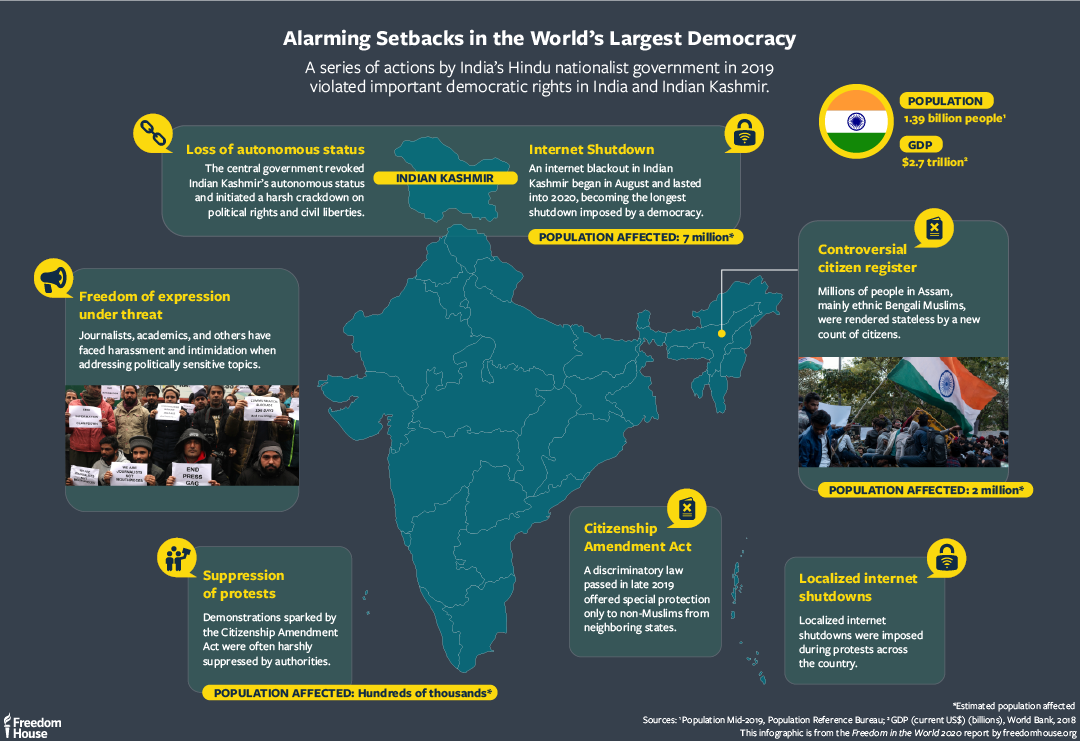
    US-based human rights watchdog Freedom House has accused the present government of driving India toward authoritarianism with a lockdown scapegoating of minorities and a crackdown on critics, and downgraded India’s status from ‘Free’ to ‘Partly Free’, in its annual report.

    Freedom in the World Report

    • It is Freedom House’s flagship annual report, assessing the condition of political rights and civil liberties around the world.
    • It is composed of numerical ratings and supporting descriptive texts for 195 countries and 15 territories.
    • The report has been published since 1973, allowing Freedom House to track global trends in freedom over more than 40 years.
    • Freedom House, which is largely funded through U.S. government grants, has been tracking the course of democracy since 1941.

    What did the report say?

    Political and civil rights

    • India’s freedom score, calculated using indicators of political rights and civil liberties, dropped four points to 67 this year, pulling the country down into the ‘Partly Free’ category.
    • India appears to have abandoned its potential to serve as a global democratic leader, elevating narrow nationalist interests at the expense of its founding values of inclusion and equal rights for all.

    Reference to Kashmir

    • In a year when social media censorship has been hotly seated, while the government shut down Internet connectivity in Kashmir as well as on Delhi’s borders, India’s Internet freedom score dropped to just 51.

    Crackdown on protesters

    • Last year, the government intensified its crackdown on protesters opposed to a discriminatory citizenship law and arrested dozens of journalists who aired criticism of the official pandemic response.

    Judicial Independence

    • It noted that judicial independence had also come under strain.
    • It pointed to the case of a Delhi HC judge who was transferred immediately after reprimanding the police for taking no action during riots in the capital that leftover 50 people dead.

    Religious freedom

    • Minorities were disproportionately blamed for the spread of the virus and faced attacks by vigilante mobs.
    • Uttar Pradesh’s law prohibiting forced religious conversion through interfaith marriage was also listed as a concern.

    Rising Authoritarianism

    • Rather than serving as a champion of democratic practice and a counterweight to authoritarian influence from countries such as China, the government is tragically driving India itself toward authoritarianism, the report stated.
  • structural issues with legislatures in Union Territories

    There are structural flaws in the provisions of the composition of legislature and the relationship between the council of ministers and the Administrator in the UTs.

    Pattern in the resignations of MLAs

    • Recently, the resignations of MLAs from the Puducherry Assembly led to the fall of government there.
    • The same had happened in 2019 in Karnataka.
    • Resigning from the membership of the House is every member’s right.
    • But according to Article 190 of the Constitution, the resignation should be voluntary or genuine.
    • If the Speaker has information to the contrary, he or she is not obliged to accept the resignation.
    • But there is by now a familiar pattern to the resignations of Members of the Legislative Assembly.
    • Such resignations invariably lead to the fall of the government.

    Purpose of providing legislature to UTs

    • The Constitution-makers/ Parliament provided a legislature and Council of Ministers to some of the UTs to fulfil the democratic aspirations of the people of these territories.
    • There was a realisation that the administration of these territories directly by the President through the administrators under Article 239 does not meet the democratic aspirations of the people.
    • The creation of a legislature and a Council of Ministers is logical and in consonance with the policy of the state to promote democracy.

    Structural issues with legislature in UTs

    1) Nomination of members and issues with it

    • A closer look at the relevant provisions in the Constitution reveals that this professed aim has often been sought to be defeated by the Union.
    • Article 239A was originally brought in, in 1962, to enable Parliament to create legislatures for the UTs.
    • A legislature without a Council of Ministers or a Council of Ministers without a legislature is a conceptual absurdity.
    • Similarly, a legislature that is partly elected and partly nominated is another absurdity.
    • The issue of nomination of members to the Puducherry Assembly had raised a huge controversy.
    • The Government of Union Territories Act provides for a 33-member House for Puducherry of whom three are to be nominated by the Central government.
    • So, when the Union government nominated three BJP members to the Assembly without consulting the government, it was challenged in the court.
    • Finally, the Supreme Court (K. Lakshminarayanan v. Union of India, 2019) held that the Union government is not required to consult the State government for nominating members to the Assembly and the nominated members have the same right to vote as the elected members.
    • There is provision for nomination of members to the Rajya Sabha [Article 80 (i)(a)].
    • But clause (3) of the Article specifies the fields from which they will be nominated.
    • But in the case of nomination to the Puducherry Assembly, no such qualification is laid down either in Article 239A or the Government of Union Territories Act.
    • This leaves the field open for the Union government to nominate anyone irrespective of whether he or she is suitable.
    •  As things stand, the law invites arbitrariness in dealing with the nomination of members to the UT legislature.

    2) Administrator’s powers

    • The administrator has the right to disagree with the decisions of the Council of Ministers and then refer them to the President for a final decision.
    • The President decides on the advice of the Union government.
    • So, in effect, it is the Union government which finally determines the disputed issue.
    • Although in NCT of Delhi v. Union of India (2019), the Constitution Bench of the Supreme Court had said that the administrator should not misuse this power.
    • The bench also said that the Administrator should use it after all methods have failed to reconcile the differences between him/her and the Council of Ministers.
    • As a matter of fact, such conflicts between the administrator, who is the nominee of the President, and the elected government is inherent in the constitutional arrangement created for the UTs.

    Consider the question “The conflicts between the administrator, who is the nominee of the President and the elected government is inherent in the constitutional arrangement created for the UTs. Comment.”

    Conclusion

    Experience shows that the UTs having legislatures with ultimate control vested in the central administrator are not workable. So far as the conspiratorial resignation by legislators to bring down their own government is concerned, the political class will have to get the better of the predatory instincts of political parties through constitutional or other means.

  • President’s Rule in Puducherry

    The Union Cabinet has approved a proposal by the Home Ministry to dissolve the Puducherry Assembly and impose President’s Rule in the Union Territory.

    Try this question from CSP 2017:

    Q.Which of the following is not necessarily the consequences of the proclamation of the President’s Rule in a State?

    1. Dissolution of the State Legislative Assembly
    2. Removal of the Council of Ministers in the State
    3. Dissolution of the local bodies

    Select the correct answer using the code given below

    (a) 1 & 2 only

    (b) 1 & 3 only

    (c) 2 & 3 only

    (d) 1, 2 & 3

    What is President’s Rule?

    • President’s rule is the suspension of state government and imposition of direct central government rule in a state.
    • This is achieved through the invocation of Article 356 of the Constitution by the President on the advice of the Union Council of Ministers.
    • Under Article 356, this move can be taken “(1) If the President, on receipt of the report from the Governor of the State or otherwise, is satisfied that a situation has arisen in which the government of the State cannot be carried on in accordance with the provisions of this Constitution…”

    How long President’s Rule can last?

    • A proclamation of President’s Rule can be revoked through a subsequent proclamation in case the leader of a party produces letters of support from a majority of members of the Assembly and stakes his claim to form a government.
    • The revocation does not need the approval of Parliament.
    • Any proclamation under Article 356 —which stands for six months — has to be approved by both Houses in the Parliament session following it.
    • This six-month time-frame can be extended in phases, up to three years.

    Conditions for Prez Rule

    • Where after general elections to the assembly, no party secures a majority, that is, Hung Assembly.
    • Where the party having a majority in the assembly declines to form a ministry and the governor cannot find a coalition ministry commanding a majority in the assembly.
    • Where a ministry resigns after its defeat in the assembly and no other party is willing or able to form a ministry commanding a majority in the assembly.
    • Where a constitutional direction of the Central government is disregarded by the state government.
    • Internal subversion where, for example, a government is deliberately acting against the Constitution and the law or is fomenting a violent revolt.
    • Physical breakdown where the government willfully refuses to discharge its constitutional obligations endangering the security of the state.

    Notable judgements: The S.R. Bommai Case

    Bommai v. Union of India (1994) was a landmark judgment of the Supreme Court of India, where the Court discussed at length provisions of Article 356 of the Constitution of India and related issues.

    • The judgement attempted to curb blatant misuse of Article 356 of the Constitution of India, which allowed the President’s rule to be imposed over state governments.
    • Article 356 (1) has been deliberately drafted in a narrow language by the Founding Fathers so that political parties in the Centre does not misuse it to subvert federalism, it had noted.
    • The President has to be convinced of or should have sufficient proof of information with regard to or has to be free from doubt or uncertainty about the state of things indicating that the situation in question has arisen.
    • The court had stated that although the sufficiency or otherwise of the material cannot be questioned, the legitimacy of inference drawn from such material is “certainly open to judicial review”.

    What was its verdict?

    • The judgment had explained that in a multi-party political system, chances are high that the political parties in the Centre and the State concerned may not be the same.
    • Article 356 cannot be used for the purpose of political one-upmanship by the Centre.
    • Hence there is a need to confine the exercise of power under Article 356[1] strictly to the situation mentioned therein which is a condition precedent to the said exercise,” the court had said.

    Fouling factors

    The imposition of President’s Rule in a state would be improper under the following situations:

    • Where a ministry resigns or is dismissed on losing majority support in the assembly and the governor recommends imposition of President’s Rule without probing the possibility of forming an alternative ministry.
    • Where the governor recommends imposition of President’s Rule without allowing the ministry to prove its majority on the floor of the Assembly.
    • Maladministration in the state or allegations of corruption against the ministry or stringent financial exigencies of the state.
    • Where the state government is not given prior warning to rectify itself except in case of extreme urgency leading to disastrous consequences.
    • Where the power is used to sort out intra-party problems of the ruling party.

    Back2Basics: Puducherry

    • Puducherry is a union territory formed out of four territories of former French India, namely Pondichéry (Pondicherry; now Puducherry), Karikal (Karaikal), Mahé and Yanaon (Yanam), excluding Chandannagar.
    • It is named after the largest district, Puducherry.
    • The areas of Puducherry district and Karaikal district are bound by the state of Tamil Nadu, while Yanam district and Mahé district are enclosed by the states of Andhra Pradesh and Kerala, respectively.
    • It is entitled by a special constitutional amendment act of 1962 to have an elected legislative assembly and a cabinet of ministers, thereby conveying partial statehood similar to the UT of Delhi.
    • It is administered by a Lieutenant Governor.
  • Fifteenth Finance Commission has increased proportion of grants conditional on reforms

    The article highlights the crucial recommendations made by the 15th Finance Commission and also explains the importance of conditions for grants from the Centre to push the state for reforms.

    Crucial recommendations by 15th Finance Commission

    • The Fifteenth Finance Commission’s report for the period 2021-22 to 2025-26 outlines some crucial recommendations for state governments.
    • These recommendations cover tax devolution, grants from the Centre, and the guidelines for the borrowings that they are permitted to incur over the medium-term.
    • The commission has recommended that 41 per cent of the government’s divisible pool of taxes be transferred to state governments.

    Horizontal devolution formula

    • The horizontal devolution formula specifies each state’s share in the overall pie.
    • The 15th FC was required to use the states’ population as per the 2011 Census — a highly contentious change.
    • It has also introduced a demographic performance criterion.
    • Additionally, it has also introduced a new criterion –tax effort.
    • Tax effort is measured by the ratio of the three-year average of per-capita own tax revenues and per-capita gross state domestic product (GSDP).
    • The net result of the change in criteria is that the share of 10 states in the divisible pool has declined.
    • Karnataka is the biggest loser, while Maharashtra is the biggest gainer.

    Grants from the Centre conditioned on reforms in states

    • Another major set of the commission’s recommendations pertain to grants from the Centre.
    • In a major shift, the 15th FC has sharply increased the proportion of grants whose receipt is conditional on specified reforms being undertaken.
    • 57 per cent of the 15th FC-recommended grants accepted so far by the GoI are conditional, relative to just 17 per cent for the 14th FC (including J&K).

    What are the conditions

    1) Setting up of State Finance Commission (SFC) and applicability of SFC’s recommendations for 5 years only

    • Constitution requires state governments to set up State Finance Commissions (SFC).
    • The 15th FC has asserted that the mandate of any given SFC is intended to be applicable only for five years.
    • It revealed that only 15 states have set up their fifth or sixth SFCs, whereas several states have not moved beyond their second or third SFC.
    • Accordingly, a staggering 84 per cent of the Rs 4.4 trillion grants for local bodies recommended by the 15th FC are conditional on the states setting up SFCs for the coming five-year period, and acting on their recommendations by March 2024.

    2) Availability of online accounts

    • Another entry-level condition for availing grants by rural and urban local bodies pertains to the timely availability of their accounts online from 2021-22 onwards.

    3) Notiflying floor rate for property tax

    • For the receipt of grants by the urban bodies, states are required to notify a floor rate for property tax by 2021-22, and demonstrate consistent year-wise improvement from 2022-23 onwards.
    • This will complement the conditions set previously by SEBI for ULBs to become eligible to raise municipal bonds.

    Changes in limit on net borrowings of state governments

    • The commission has recommended that the normal limit for net borrowings of state governments be fixed at 4 per cent of GSDP in 2021-22.
    • This will ease to 3.5 per cent by 2022-23, thereafter reverting to the erstwhile 3 per cent limit till 2025-26.
    • The additional borrowing space of 0.5 per cent of GSDP for states is conditional on the completion of power sector reforms.

    Prospect of huge gaps in states’ revenue in the future

    • The states’ fiscal arithmetic will alter in 2022-23 with the GST compensation set to cease at the end of June 2022 as things stand today.
    • The ensuing drop in grants, combined with the tapering of the front-loaded revenue deficit grants is likely to leave a big gap in some states’ revenues.

    Consider the question “What are the conditions laid down by the 15th Finance Commission on the states for the central grants? How these conditions could benefit the states?”

    Conclusion

    The question is whether this revenue gaps will force the states to move on both the power sector reforms, which have proven challenging in the past, and the municipal reforms, so that their resource availability may be enhanced.

  • No role in State’s quota decisions: Centre tells SC

    The Centre has told the Supreme Court that it has no role in the choices made by the Tamil Nadu government with regard to the provision of reservation for specific castes or communities in state government jobs and admissions.

    Reservation being an all-time contested issue is a less inevitable topic for mains. However, we can expect some of the thought triggering questions such as – “Reservation is hardly capable of striking a balance between social inclusion and merit. Critically comment. (250 W)”

    OR

    Essay topic like- “Meritocracy is unrealized without an egalitarian society” are ready to raid your mind.

    Issue over 69%

    • The Centre was responding to a petition challenging the constitutionality of the Tamil Nadu Backward Classes, SCs and STs Act of 1993, which provides 69% reservation in the State.
    • The petitioner contends that the TN has acted “outside its competence” by identifying and classifying socially and educationally backward classes (SEBCs).
    • It is too far in excess of the 50% limit on quota laid down by a nine-judge Bench of the Supreme Court in its judgment in the Indira Sawhney Case (1992).

    Indira Sawhney Case

    In the famous Mandal case (Indra Sawhney Case, 1992), the scope and extent of Article 16(4), which provides for reservation of jobs in favour of backward classes, has been examined thoroughly by the Supreme Court.

    • Though the Court has rejected the additional reservation of 10% for poorer sections of higher castes, it upheld the constitutional validity of a 27% reservation for the OBCs with certain conditions.
    • The advanced sections among the OBCs (the creamy layer) should be excluded from the list of beneficiaries of reservation.
    • No reservation in promotions; reservation should be confined to initial appointments only. Any existing reservation in promotions can continue for five years only (i.e., upto 1997).
    • The total reserved quota should not exceed 50% except in some extraordinary situations. This rule should be applied every year.
    • The ‘carry forward rule’ in case of unfilled (backlog) vacancies is valid. But it should not violate the 50% rule.

    What did the Centre say in the TN case?

    • The inclusion or exclusion of any caste/community in the State List of SEBCs is the subject matter of the State government, and the Government of India has no role in the matter.
    • It referred to the Constitution (102nd Amendment) Act of 2018, which details the difference in the procedure for inclusion or exclusion of castes and communities in the State List for SEBCs and the Central List.

    Identifying SEBC

    • The power to identify and specify SEBCs lies with Parliament only with reference to the Central List.
    • The State governments may have separate State Lists of SEBCs for providing reservation for recruitment to State services or admissions in State government educational institutions.
    • Under the newly-inserted Article 342A of the 102nd Amendment Act of 2018, the President notifies the SEBCs in a State after consultation with the Governor.
    • The castes or communities included in such State Lists may differ from those included in the Central List.

    A case for TN

    The senior advocate appearing for Tamil Nadu said the State’s case should be heard separately. The filed affidavit said:

    • India is an amalgam of States with varied population, size, history, culture and social fabric.
    • The circumstances and facts prevailing in Tamil Nadu are not the same or similar to those in any other State.
    • Tamil Nadu is a pioneer in the implementation of reservation in public employment and education. The policy of reservation has been in practice since 1921 in this State.
    • Factual variations contributing to the grant of reservation need to be reckoned with differently for different States while deciding the question on its validity.
    • The State argued that its law was protected under the Ninth Schedule of the Constitution from judicial review.
    • Section 4 of the 1993 Act provides 30% reservation to the Backward Classes, 20% for the Most Backward Classes and de-notified communities, 18% for the SCs and 1% for the STs.
  • 15th Finance Commission could catalyse accountability, effective governance at grassroots

    The article explains the innovative approach adopted by the Fifteenth Finance Commission in devolution of funds.

    Steep hike in grants

    • Local governments are the closest to the people at the grassroots level. 
    • They provide critical civic amenities such as roads, water and sanitation, and primary education and health.
    • With this in view, the Fifteenth Finance Commission (FFC) has recommended grants of Rs 4,36,361 crore from the Union government to local governments for 2021-26.
    • This is an increase of 52 per cent over the corresponding grant of Rs 2,87,436 crore by its predecessor for 2015-20.

    Innovation in recommendations

    1) Scaling of capacities in municipalities

    • The Commission has recommended Rs 8,000 crore as performance-based grants for incubation of new cities and Rs 450 crore for shared municipal services.
    • This is designed to foster innovations in urban governance to transform our cities with speed and scale.
    • There is an urgent need for synergistically combined area-based development to spur economic growth and job creation, and decongesting through the development of satellite townships.
    • Separately, the massive scaling of capacities in municipalities, particularly the 4,000-odd smaller ones, cannot be done by building capacities in each one of them, but through institutional and technological innovations, without compromising their autonomy.
    • The shared municipal services model, with mobile internet, maps, platform thinking, and outsourced services all taken together, can help us fast-track the creation of municipal capacities at scale.
    • This is one of the innovations in the FFC recommendations.

    2) Allocation covers all three tiers of panchayats

    • Of grants for all local governments with 90 per cent weightage on population and 10 per cent on area remains unchanged from the Fourteenth Finance Commission.
    • For panchayats, the FFC allocations cover all the three tiers — village, block, and district — as well as the Excluded Areas in a state exempted from the purview of Part IX and Part IX-A of the Constitution.
    • Funds to all three can improve functional coordination and facilitate the creation of assets collectively across smaller jurisdictions.
    • This is the second new aspect of the FFC recommendations.

    3) Focus on metropolitan governance

    • The FFC calls for a focus on urban agglomerations (UAs) that include urban local bodies, census towns and outgrowths.
    • In 2011, out of the total urban population of 377 million, 61 per cent lived in UAs.
    • The FFC has emphasised the need to focus on the complex challenges of air quality, drinking water supply, sanitation, and solid waste management in the million-plus UAs and cities.
    • Thus, for 2021-26, there is a Million-plus Challenge Fund of Rs 38,196 crore that can be accessed by million-plus cities only through adequate improvements in their air quality and meeting service level benchmarks for drinking water supply, sanitation, and solid waste management.
    • This focus on metropolitan governance through substantive but 100 per cent outcome-based grants is the third innovation.
    • For ULBs other than the million-plus category, the total grants are Rs 82,859 crore.
    • The grants to local governments, both urban (less than a million category) and rural, contain a mix of basic, tied as well as performance grants.

    4) Entry-level conditions

    • The efficiency, smooth functioning and accountability of local bodies have been plagued by:
    • (i) lack of readily accessible and timely audited accounts,
    • (ii) absence of timely recommendations of State Finance Commissions and suitable actions thereon,
    • (iii) inadequate mobilisation of property tax revenues (especially in ULBs).
    • Finance Commissions in the past have drawn pointed attention to these issues, but with limited success.
    • These entry-level conditions for availing any grants and their applicability to all local governments is the fourth innovation.

    Consider the question “Examine the innovative approach adopted by the Fifteenth Finance Commission for the devolution of funds to panchayats and municipal bodies.”

    Conclusion

    Hopefully, over the next five years, through a partnership among the Union, states, and local governments, in the spirit of cooperative federalism, these recommendations and innovations will catalyse progress in the accountability and effectiveness of local governments in India.


  • What is a Money Bill?

    In a pre-emptive move, the opposition has written to Lok Sabha Speaker, urging him not to bypass the Rajya Sabha by declaring key Bills as “money bills”.

    What is a Money Bill?

    • A money bill is defined by Article 110 of the Constitution, as a draft law that contains only provisions that deal with all or any of the matters listed therein.
    • These comprise a set of seven features, broadly including items such as-
    1. Imposition, abolition, remission, alteration or regulation of any tax
    2. Regulation of the borrowing of money by the GOI
    3. Custody of the Consolidated Fund of India (CFI) or the Contingency Fund of India, the payment of money into or the withdrawal of money from any such fund
    4. Appropriation of money out of the CFI
    5. Declaration of any expenditure charged on the CFI or increasing the amount of any such expenditure
    6. Receipt of money on account of the CFI or the public account of India or the custody or issue of such money, or the audit of the accounts of the Union or of a state
    7. Any matter incidental to any of the matters specified above.

    Who controls such bills?

    • In the event proposed legislation contains other features, ones that are not merely incidental to the items specifically outlined, such a draft law cannot be classified as a money bill.
    • Article 110 further clarifies that in cases where a dispute arises over whether a bill is a money bill or not, the Lok Sabha Speaker’s decision on the issue shall be considered final.

    What surrounds the ‘Money Bill’ controversy?

    • While all Money Bills are Financial Bills, all Financial Bills are not Money Bills.
    • For example, the Finance Bill which only contains provisions related to tax proposals would be a Money Bill.
    • However, a Bill that contains some provisions related to taxation or expenditure, but also covers other matters would be considered a Financial Bill.
    • Again, the procedure for the passage of the two bills varies significantly. The Rajya Sabha (where the ruling party might not have the majority) has no power to reject or amend a Money Bill.
    • However, a Financial Bill must be passed by both Houses of Parliament.
    • The Speaker (nonetheless, a member of the ruling party) certifies a Bill as a Money Bill, and the Speaker’s decision is final.
    • Also, the Constitution states that parliamentary proceedings, as well as officers responsible for the conduct of business (such as the Speaker), may not be questioned by any Court.

    Back2Basics:

    What is Finance Bill?

  • In difficult times, Fifteenth Finance Commission rose to the challenge

    The article analyses the various recommendations of the Fifteenth Finance Commission and their impact.

    Unique challenges

    • Many new and unique demands were placed on the 15th Finance Commission.
    • The major challenge being addressing the issue of the 2011 population census evoking a sharp response from the southern states.
    • Other issues include the non-lapsable defence fund and the use of certain parameters for performance incentives.
    • The Commission was also required to perform the task of assessing and projecting the fiscal roadmap for the Union and state amid an uncertain domestic environment due to shortfall in the GST collection, further accentuated in the year 2020 by the global pandemic.

    Key recommendations

    The Commission, in its final report, recommended vertical devolution at 41 per cent, adjusting 1 per cent for the erstwhile state of Jammu and Kashmir.

    1) Horizontal distribution

    • For horizontal distribution, the commission has tried to harmonise the principles of expenditure needs, equity and performance.
    • This is achieved by the introduction of efficiency criteria of tax and fiscal efforts and by assigning 12.5 per cent weight to demographic performance.
    • Consideration of demographic performance will help in resolving the demographic debate and incentivising states in moving towards the replacement rate of population growth.

    2) Principles governing grant-in-aid

    • Grants are important as they are more directly targeted and equalise the standards of basic social services to some extent.
    • The Commission has recommended a total grant of Rs 10,33,062 crore during 2021-26.
    • Grant is broadly characterised into: (a) revenue deficit grants (b) grants for local governments (c) grants for disaster management (d) sector-specific grants and (e) state-specific grants.
    • Many of these grants are linked with performance-based criteria, thereby promoting principles of transparency, accountability, and leading to better monitoring of expenditures.
    • However, the Commission was asked to examine whether revenue deficit grants should be provided at all to the states.
    • Some states stressed that revenue deficit grants have serious disincentives for tax efforts and prudence in expenditure and, hence, these should be discontinued.
    • Fiscally stressed states of Kerala, West Bengal and Punjab are regular recipients of these grants due to high debt legacy.

    3) Conditional grants to local bodies

    • This Commission’s grant for local government is different from that of its predecessors for the set of entry-level conditions:
    • (a) Constitution of State Finance Commissions.
    • (b) Timely auditing and online availability of accounts for rural local bodies coupled with
    • (c) Notifying consistent growth rate for property tax revenue for urban local bodies.
    • Secondly, the recommendations are in alignment with the national programmes of Swachch Bharat Mission and Jal Jeewan Mission.

    4) Incubation of new cities and urban grants

    • It is for the first time that a Finance Commission has recommended Rs 8,000 crore to states for incubation of new cities, granting Rs 1,000 crore each for eight new cities.
    • The focus of urban grants for million-plus cities is improvement in air quality and meeting the service level benchmark of solid waste management and sanitation.

    5) Grants for health and setting up of disaster mitigation fund

    • The commission recommended channelising the health grant of Rs 70,051 crore through local bodies, addressing the gaps in primary health infrastructure.
    • The Commission’s recommendation for setting up the state and national level Disaster Risk Mitigation Fund (SDRMF), in line with the provisions of the Disaster Management Act, is both well-timed and necessary.
    • For the first time, the Finance Commission has introduced a 10-25 per cent graded cost-sharing basis by the states for the NDRF and NDMF which has not been appreciated by the states.

    6) Non-lapsable fund for defence

    • The Commission has recommended setting up of a dedicated non-lapsable fund, the Modernisation Fund for Defence and Internal Security (MFDIS).
    • Objective of the fund is to bridge the gap between projected budgetary requirements and budget allocation for defence and internal security and to provide greater predictability for enabling critical defence capital expenditure.
    • The fund will have four specific sources: (a) Transfers from the Consolidated Fund of India, (b) disinvestment proceeds of DPSEs, (c) proceeds from the monetisation of surplus defence land and (d) proceeds of receipts from defence land likely to be transferred to state governments and for public projects in the future.
    • The total indicative size of the proposed MFDIS over the period 2021-26 is Rs 2,38,354 crore.
    • The Union government has accepted this recommendation in principle.

    Consider the question “Examine the various principles on which the Fifteenth Finance Commission based the horizontal distribution of states share.”

    Conclusion

    The report starts with the famous quote of Mahatma Gandhi: “The future depends on what we do in the present”. It would be interesting to see the impact of these overarching and revolutionary recommendations in the times ahead.