💥Mains Ready By December. Smash Mains & Smash PYQ Admissions Open

Subject: Global Groupings and Conventions

Important International institutions, agencies and fora- their structure, mandate.

  • Third United Nations Conference on Landlocked Developing Countries (LLDC3)

    Why in the News?

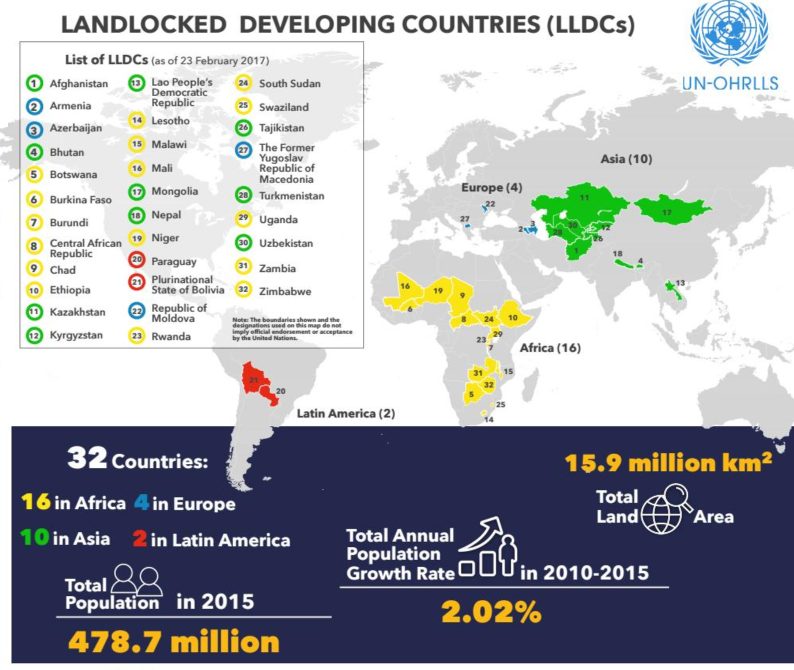
    The 3rd UN Conference on Landlocked Developing Countries (LLDC3) in Awaza, Turkmenistan, adopted the Awaza Declaration to boost investment, address challenges, and promote sustainable growth in 32 landlocked nations.

    Third United Nations Conference on Landlocked Developing Countries (LLDC3)

    About Landlocked Developing Countries (LLDCs):

    • Overview: 32 UN-recognized countries with no direct access to the sea, collectively home to over 600 million people.
    • List of LLDCs:
      1. Africa: Botswana, Burkina Faso, Burundi, Central African Republic, Chad, Eswatini, Ethiopia, Lesotho, Malawi, Mali, Niger, Rwanda, South Sudan, Uganda, Zambia, Zimbabwe.
      2. Asia: Afghanistan, Bhutan, Kazakhstan, Kyrgyzstan, Lao People’s Democratic Republic, Mongolia, Nepal, Tajikistan, Turkmenistan, Uzbekistan.
      3. Europe: Armenia, Azerbaijan, North Macedonia, Moldova, Serbia.
      4. South America: Bolivia, Paraguay.
    • Challenges:
      • Dependence on transit countries for global market access.
      • Higher trade and transport costs (often twice those of coastal countries).
      • Limited connectivity, slower growth, and vulnerability to climate impacts.
    • Past Conferences:
      • 2003 (Almaty) – Almaty Programme of Action.
      • 2014 (Vienna) – Vienna Programme of Action (2014–2024).
      • 2025 (Awaza) – Awaza Programme of Action (2024–2034).

    Structure and Functioning:

    • LLDC Conferences: Held every 10 years to review progress and set a new action framework.
    • Awaza Programme of Action (2024–2034) – Priority Areas:
      • Structural transformation, science, technology, and innovation.
      • Trade facilitation and regional integration.
      • Transit, transport, and connectivity.
      • Climate resilience and adaptation.
      • Monitoring and implementation.
    • Stakeholder Participation:
      • UN member states, transit countries, donor agencies, NGOs, private sector, and academia.
    • Mechanisms:
      • UN-wide monitoring framework covering 323 initiatives.
      • Partnerships for infrastructure and digital connectivity.
      • Climate Negotiating Group under UNFCCC for LLDC-specific challenges.
    [UPSC 2013] Which one of the following countries is landlocked?

    Options:  (a) Bolivia* (b) Peru (c) Suriname (d) Uruguay


  • Soured relations: The higher U.S. tariffs place India at a relative disadvantage

    Why in the News?

    The 25% tariff plus penalty imposed by U.S. President Donald Trump on Indian imports has brought renewed attention to the strain in India-U.S. trade relations.

    Why did the U.S. impose a 25% tariff on Indian imports?

    • High Tariff and Non-Tariff Barriers by India: The U.S. accused India of maintaining high import duties and regulatory restrictions that limited American market access. Eg: Trump repeatedly criticized India’s high tariffs on U.S. goods like motorcycles and dairy products.
    • Geopolitical Frustration Over India-Russia Ties: India’s continued energy and defense cooperation with Russia, despite U.S. pressure, triggered punitive action. Eg: Trump expressed displeasure at India’s oil imports from Russia, linking them to trade penalties.
    • Failure to Reach a Mini-Trade Deal: Repeated delays and stalemates in talks over a limited trade agreement led to frustration in the U.S.

    What stalled the India-U.S. mini-trade deal?

    • India’s Reluctance to Lower Tariffs: India resisted U.S. demands to reduce import duties, especially in agriculture and dairy, to protect domestic interests. Eg: India declined to open its dairy sector to U.S. exporters, citing religious and cultural concerns over feed practices involving animal blood, which conflict with Indian dietary norms.
    • Unclear Negotiation Timelines: The deal lacked a defined timeline, and momentum stalled due to shifting priorities on both sides. Eg: U.S. Trade Representative Jamieson Greer stated the deal needed “some more negotiations,” while India stopped referencing the mini-deal, signaling disengagement.

    How do India’s farm and dairy policies hinder trade talks?

    • Protection of Domestic Farmers: India maintains high tariffs and import restrictions to shield small and marginal farmers from foreign competition. Eg: India imposes import duties of up to 100% on dairy products, making it difficult for U.S. exporters to access the Indian market.
    • Cultural and Religious Sensitivities: Indian regulations emphasise vegetarian feed practices, which clash with Western livestock farming methods. Eg: India rejected U.S. dairy imports because American cows are often fed blood meal, violating Hindu dietary norms.
    • Subsidy and MSP System: India’s Minimum Support Price (MSP) and subsidy policies create a non-level playing field, raising concerns about fairness among trade partners. Eg: The U.S. has objected to India’s public stockholding of food grains, which they claim distorts global agricultural trade.

    How do India-Russia ties affect India-U.S. trade relations?

    • Strategic Autonomy in Foreign Policy: India maintains a non-aligned stance, continuing strong ties with Russia, especially in defence and energy sectors, despite Western pressure. Eg: India’s purchase of the S-400 missile system from Russia triggered U.S. concerns under the CAATSA sanctions regime.
    • Energy Trade with Russia: India increased crude oil imports from Russia due to discounted prices amid the Ukraine conflict, which contradicts U.S.-led sanctions. Eg: In 2023, Russia became one of India’s top oil suppliers, raising questions in Washington about India’s commitment to Western-led efforts.

    How can India balance sovereignty with export interests? (Way forward)

    • Assert Strategic Autonomy while Building Economic Alliances: India must uphold its sovereign right to choose partners (e.g., Russia) while diversifying export markets and enhancing trade ties with nations like the U.S., EU, ASEAN, to reduce dependency and mitigate tariff risks.
    • Pursue Issue-Based Bilateral Negotiations: India can engage in sector-specific negotiations that safeguard sensitive areas (like agriculture) while offering market access in others (like pharmaceuticals or services), thereby balancing domestic priorities with global trade expectations.

    Mains PYQ:

    [UPSC 2018] How would the recent phenomena of protectionism and currency manipulations in world trade affect macroeconomic stability of India?

    Linkage: The article is directly related to impact of “protectionism” on India’s macroeconomic stability. The “25% tariff ‘plus penalty’ on imports of Indian goods” by the U.S. is a clear example of protectionist measures in world trade. The article explicitly states that these tariffs place India at a “relative disadvantage”, directly relating to the “soured relations” and potential impact on India’s economic stability.

  • ‘Pact for the Future’ Agreement

    Why in the News?

    India has renewed its call for time-bound reforms of the UN Security Council and reaffirmed support for the ‘Pact for the Future’ to strengthen global cooperation.

    About the ‘Pact for the Future’ Agreement:

    • Origin: Adopted at the UN Summit of the Future (September 2024).
    • Purpose: To reinvigorate multilateralism and strengthen global cooperation on contemporary and emerging challenges.
    • Scope: Comprises 56 commitments spanning development, peace, digital governance, and institutional reforms.
    • Annexes:
      1. Global Digital Compact: Sets frameworks for AI, digital access, and rights.
      2. Declaration on Future Generations: Mainstreams long-term thinking in policymaking.
    • Inclusivity: Drafted through multi-year negotiations involving member states, civil society, and global institutions.
    • Implementation and Review Mechanism:
      • Implementation through intergovernmental processes led by relevant UN agencies.
      • First formal review at the 83rd UNGA (2028) at the Head of State/Government level.
      • Monitoring via national/international accountability frameworks.

    Notable Features and Challenges:

    • Historic Significance:
      • One of the broadest international agreements in scope.
      • Embodies a “new multilateralism” for adapting the UN to modern realities.
    • Controversies:
      • Not unanimously adopted – Russia, Iran, and others objected to elements they found insufficient or overambitious.
    • Criticisms:
      • Lacks detailed mechanisms for enforcement and implementation.
      • Disagreements persist on UNSC reform, disarmament timelines, and climate financing.
  • BRICS Rio Declaration, 2025

    Why in the News?

    Gathering in Rio de Janeiro on July 6–7, leaders of Brazil, Russia, India, China, and South Africa adopted the BRICS Rio Declaration 2025 — marking a decisive shift in the bloc’s evolution.

    Back2Basics: BRICS

    • BRICS represents a coalition of nations committed to fostering economic growth, development cooperation, and global governance reform.
    • The first summit in 2009 featured the founding countries of Brazil, Russia, India, and China, where they adopted the acronym BRIC and formed an informal diplomatic club.
    • BRICS focuses on collaboration across 3 key pillars:
      1. Political and Security Cooperation: Ensuring peace, global stability, and governance reform.
      2. Economic and Financial Cooperation: Promoting trade, investment, and economic resilience.
      3. Cultural and People-to-People Cooperation: Enhancing mutual understanding and societal linkages.
    • Present Members of BRICS
      • Original Members: Brazil, Russia, India, China, and South Africa.
      • Recent Additions: Indonesia, Egypt, Ethiopia, Iran, and the UAE.

    About the Rio Declaration (2025):

    • Overview: Adopted at the XVII BRICS Summit in Rio de Janeiro (July 6–7, 2025), the Rio Declaration reflects BRICS’s push for a more inclusive and multipolar global order.
    • Call for reform: It calls for reforms in global institutions like the UN Security Council, IMF, and World Bank to give a greater voice to the Global South.
    • Focus: It emphasized sovereign equality, sustainable development, digital cooperation, and solidarity among emerging economies.
    • Expansion: BRICS welcomed Thailand as a full member and acknowledged 10 new partner countries, including Belarus, Nigeria, Cuba, and Vietnam, signalling broader representation.

    Key Highlights of the Declaration:

    • Global Reform Push: Demands reform of UN, IMF, Bretton Woods institutions for fairer representation of emerging economies.
    • Climate Finance: Endorses Brazil’s Tropical Forests Forever Facility and calls on developed nations to fund just transitions.
    • AI Governance: Supports a global framework aligned with national rules and UN Charter principles.
    • Health Equity: Launched BRICS Partnership on Socially Determined Diseases to address poverty-linked health disparities.
    • Economic Sovereignty: Push for local currency trade, non-dollar payment systems, and strengthening the New Development Bank.
    • Security Commitment: Zero tolerance for terrorism, including cross-border support and financing.
    • Digital Inclusion: Focus on women’s digital access, AI cooperation, and green technologies.
    • India’s Role: Led initiatives on science collaboration, digital public goods, and proposed reforms for 2026 BRICS leadership.
    [UPSC 2015] The ‘Fortaleza Declaration’, recently in the news, is related to the affairs of:

    Options: (a) ASEAN (b) BRICS* (c) OECD (d) WTO


  • [2nd July 2025] The Hindu Op-ed: A triangular dynamic in South Asia’s power politics

    PYQ Relevance:

    [UPSC 2015] Terrorist activities and mutual distrust have clouded India-Pakistan relations. To what extent the use of soft power like sports and cultural exchanges could help generate goodwill between the two countries? Discuss with suitable examples.

    Linkage: This question directly linked with the central issue of “mutual distrust” and “terrorist activities” between India and Pakistan, which are explicit drivers of the complex “triangular relationship”. The article mentions India’s diplomatic campaign to isolate Pakistan globally and impose accountability on the state apparatus enabling terrorist groups.


    Mentor’s Comment:  The renewed ties between the Trump-led U.S. government and Pakistan’s military, seen in events like the high-profile lunch with Field Marshal Asim Munir and the return of military aid, show a clear shift in America’s approach to South Asia. This change, similar to the Cold War era, could weaken the strong U.S.-India partnership built on shared concerns over terrorism and China. At the same time, India has moved away from its earlier cautious approach, as shown by Operation Sindoor, raising the risk of conflict on two fronts against both Pakistan and China. As the U.S. balances between long-term strategy and short-term deals, the power dynamics in South Asia are being reshaped.

    Today’s editorial analyse the renewed ties between the Trump-led U.S. government and Pakistan’s military. This topic is important for GS Paper II (International Relations) in the UPSC mains exam.

    _

    Let’s learn!

    Why in the News?

    In the complicated power politics of South Asia, the relationship between the United States, India, and Pakistan tells an important story.

    What drives the recent shift in U.S.-Pakistan relations?

    • Transactional Diplomacy Over Strategic Values: The U.S., particularly under the Trump administration, has adopted a deal-based approach rather than value-based alliances. Eg: Authorisation of $397 million for Pakistan’s F-16 fleet for “counter-terrorism” signals a shift towards immediate tactical gains rather than long-term strategic alignment with India.
    • Pakistan’s Geostrategic Leverage: Pakistan’s location at the crossroads of Afghanistan, Iran, and China enhances its strategic utility for U.S. regional interests, especially amid tensions in West Asia. Eg: Trump’s praise of Pakistan’s role in understanding Iran and his meeting with “Field Marshal” Asim Munir show a willingness to engage Pakistan despite its terror-linked image.

    How is it affecting U.S.-India strategic relations?

    • Erosion of Strategic Trust: India-U.S. partnership, built over counterterrorism cooperation and convergence on China, is being undermined by the U.S.’s renewed engagement with Pakistan. Eg: Trump’s claim of mediating a ceasefire between India and Pakistan contradicted India’s “no third-party” policy, leading to diplomatic discomfort.
    • Increased Strategic Caution in India: India’s concern over U.S.-Pakistan proximity may lead it to recalibrate its own foreign policy posture, especially in South Asia and the Indo-Pacific. It may reduce India’s reliance on U.S. support in regional disputes, focusing instead on self-reliant deterrence and regional alliances.
    • Undermining of U.S.-India Indo-Pacific Vision: The Quad framework and Indo-Pacific cooperation, key pillars of U.S.-India ties, risk losing momentum due to America’s distracted diplomacy in South Asia.

    What is the significance of India’s “new normal” doctrine in South Asia?

    • Departure from Strategic Restraint: India’s “new normal” reflects a proactive military and diplomatic posture against cross-border terrorism, moving away from its earlier defensive doctrine. Eg: In response to the Pahalgam terror attack, India launched Operation Sindoor, signaling its intent to punish provocations decisively.
    • Global Isolation of State-Sponsored Terrorism: The doctrine aims to internationally isolate Pakistan by linking terror acts to state support, thereby shifting global opinion and increasing diplomatic pressure.
      Eg: India’s efforts in UN forums to designate Pakistan-based terror groups under sanctions align with this approach.
    • Regional Deterrence and Strategic Signaling: It serves as a deterrent by altering Pakistan’s cost-benefit calculation of supporting non-state actors, while also sending a message to China amid a two-front threat perception. Eg: Statements by PM of India calling the ceasefire a “pause, not peace” indicate sustained pressure on both Pakistan and its backer, China.

    Who gains or loses from the U.S.’s ambivalent role in India-Pakistan dynamics?

    • Pakistan Gains Strategic Leverage: The U.S.’s ambiguity allows Pakistan to portray itself as a valuable security partner, especially in the context of Afghanistan, Iran, and regional logistics.
    • India Faces Diplomatic Setbacks: U.S. engagement with Pakistan undermines India’s strategic trust in the U.S., weakening its position on issues like cross-border terrorism and Kashmir 
    • The U.S. Risks Losing Credibility: By oscillating between idealism and transactionalism, the U.S. dilutes its reliability as a consistent global partner, particularly in the Indo-Pacific strategy. Eg: India’s growing ties with Russia and Iran, and its push for strategic autonomy, partly stem from concerns over U.S. inconsistency.

    Way forward: 

    • Strengthen India-U.S. Strategic Dialogue: India should deepen institutional-level engagement with the U.S. to reaffirm mutual interests in the Indo-Pacific, counterterrorism, and technology partnerships, reducing the influence of personality-driven shifts.
    • Pursue Regional Strategic Autonomy: India must continue to build bilateral and multilateral ties with like-minded countries (e.g., France, Japan, UAE) to diversify strategic options and reduce overdependence on U.S. foreign policy swings.
  • ‘At Sea Observer’ Mission by QUAD

    Why in the News?

    The Coast Guards of India, Japan, the United States, and Australia have initiated the first-ever ‘QUAD At Sea Ship Observer Mission’.

    About “At Sea Ship Observer Mission”:

    • Overview: The ‘At Sea Ship Observer Mission’ is the first cross-embarkation initiative by the Coast Guards of India, Japan, the U.S., and Australia.
    • Origin and Vision: It was conceptualised under the Wilmington Declaration (2024) to boost interoperability and maritime domain awareness in the Indo-Pacific.
    • Participation: Officers from all QUAD countries, including women officers.
    • Joint Training Operations: The mission enables joint SOP drills, search and rescue (SAR), patrolling, and promotes gender inclusion in maritime diplomacy.
    • India’s Alignment: India’s role complements initiatives like SAGAR, the MAHASAGAR Doctrine, and the Indo-Pacific Oceans Initiative (IPOI).
    • QUAD Summit Linkage: It operationalises decisions from the 6th QUAD Leaders’ Summit held in Wilmington, USA.
    • Future Vision: Sets groundwork for a ‘QUAD Coast Guard Handshake’, enhancing trust, resilience, and standardised operations in the Indo-Pacific.
    • Regional Impact: Aims to improve emergency response, coordination, and domain awareness among QUAD Coast Guards.

    What is QUAD (Quadrilateral Security Dialogue)?

    • Members: QUAD is a strategic dialogue between India, Australia, Japan, and the United States, focused on Indo-Pacific peace and stability.
    • Nature of Alliance: Though not a formal alliance, it reflects a strong consensus on open sea lanes, supply chains, and tech partnerships.
    • Objectives: It promotes a Free and Rules-Based Order, countering coercive actions in the region.
    • Formation History: Originated post-2004 tsunami, formally proposed in 2007 by Japan’s PM Shinzo Abe.
    • Dormancy and Revival: Went dormant after Australia’s 2008 withdrawal but was revived in 2017 amid concerns over China’s assertiveness.
    • Expanded Focus Areas: Beyond security, QUAD now includes cooperation in health, infrastructure, cybersecurity, emerging tech, and climate change.
    • Joint Activities: The group holds military drills, high-level dialogues, and supports regional capacity-building.
    • QUAD-Plus Engagements: Also engages countries like South Korea, Vietnam, and New Zealand, signalling future expansion.


    [UPSC 2016] With reference to the ‘Trans-Pacific Partnership’, consider the following statements: (2016)  1. It is an agreement among all the Pacific Rim countries except China and Russia.  2.It is a strategic alliance for the purpose of maritime security only.

    Which of the statements given above is/are correct?

    Options:  (a) 1 only (b) 2 only  (c) Both 1 and 2  (d) Neither 1 nor 2*


  • In news: International Olympic Committee (IOC)

    Why in the News?

    Kirsty Coventry, aged 41, has become the first African and the first woman to head the International Olympic Committee (IOC).

    Also in news:

    The IOC has paused the selection process for future Olympic Games hosts, impacting India’s bid for the 2036 Olympics.

    About the International Olympic Committee (IOC)

    • Overview: It is a non-governmental international organisation established in 1894, and is headquartered in Lausanne, Switzerland.
    • Functions: It sets the rules and framework for the Olympic Games, including deciding on host cities and event structures.
    • Membership: IOC members must be proficient in French or English and be citizens or residents of countries with a National Olympic Committee (NOC).
    • Jurisdiction: The IOC acts as the final authority on matters related to the Olympic Games and the Olympic movement.
    • Indian and the IOC:
      • The Indian Olympic Association (IOA) has been recognized by the IOC since 1927.
      • It is responsible for selecting and sending Indian athletes to the Olympics and other major international competitions.
  • Nuclear Non-Proliferation Treaty (NPT)

    Why in the News?

    Amid intensifying war with Israel, Iran’s Parliament began drafting a Bill to exit the Nuclear Non-Proliferation Treaty (NPT).

    About Nuclear Non-Proliferation Treaty (NPT):

    • Overview: It is a global agreement aimed at preventing the spread of nuclear weapons, promoting peaceful nuclear energy, and advancing nuclear disarmament.
    • Enforcement: It was opened for signature on June 12, 1968, and came into force on March 5, 1970.
    • Nature of the Treaty: It is the only binding international treaty that requires NWS to pursue disarmament.
    • Categorization of States: The treaty distinguishes between Nuclear Weapon States (NWS) and Non-Nuclear Weapon States (Non-NWS).
    • Key Features:
      • Definition of NWS: Countries that had tested nuclear weapons before January 1, 1967 (US, UK, France, Russia, China).
      • Obligations: NNWS agree not to manufacture or acquire nuclear weapons; NWS pledge not to transfer nuclear weapons or assist non-NWS in acquiring them.
      • Peaceful Use Clause: All parties are allowed to develop nuclear energy for peaceful purposes, under IAEA safeguards.
      • Monitoring Agency: The International Atomic Energy Agency (IAEA) verifies compliance through inspections and reporting.
      • Withdrawal Clause: Article 10 allows a country to withdraw with 3 months’ notice if national interests are jeopardized.

    India and NPT:

    • India is NOT a signatory to the NPT and has consistently refused to join, calling it discriminatory.
    • India argues that the treaty legitimizes nuclear weapons in the hands of five countries while denying them to others.
    • India conducted its first nuclear test in 1974 (Smiling Buddha) and maintains a “No First Use” policy.
    • Despite being outside the NPT, India is regarded as a responsible nuclear power and adheres to non-proliferation norms.

    Non-members of NPT, Countries Planning to Leave:

    • Non-signatories:
      • India and Pakistan have never signed the treaty, but both possess nuclear weapons.
      • Israel is also a non-signatory and maintains strategic ambiguity about its nuclear weapons.
      • South Sudan remains a non-signatory without known nuclear ambitions.
    • Countries that withdrew or are planning to:
      • North Korea signed in 1985, withdrew in 2003, and went on to develop nuclear weapons.
      • Iran, though a signatory since 1970, has recently threatened to withdraw, citing IAEA censure and security concerns linked to its tensions with Israel.
      • If Iran leaves, it would end IAEA inspections and raise fears of a nuclear arms race in the Middle East.
    [UPSC 2018] What is/are the consequence/consequences of a country becoming the member of the ‘Nuclear Suppliers Group’?

    1. It will have access to the latest and most efficient nuclear technologies.

    2. It automatically becomes a member of “The Treaty on the Non-Proliferation of Nuclear Weapons (NPT)”. Which of the statements given above is/are correct?

    Options: (a) 1 only* (b) 2 only (c) Both 1 and 2 (d) Neither 1 nor 2


  • 5 things to look out for in this year’s G7 Summit in Canada

    Why in the News?

    The 2025 G7 Summit in Alberta, Canada, is getting worldwide attention because Donald Trump has returned to the scene.

    It’s happening at a time when global tensions are high, especially due to the rising conflict between Israel and Iran and the ongoing war in Ukraine.

    What are the main issues discussed at the 2025 G7 Summit in Canada?

    • Escalating Iran–Israel Conflict and Nuclear Talks: Negotiations to curb Iran’s nuclear programme and manage fallout from Israel’s June 13 strikes dominated early sessions. Eg: G7 leaders debated sanctions and diplomatic channels to prevent wider Middle-East war.
    • Ongoing Russia–Ukraine War: Securing long-term military and financial aid for Ukraine remained central, with President Zelenskyy briefing leaders. Eg: Canada and Europe proposed a fresh aid package, while the U.S. stance under Trump stayed cautious.
    • Global Trade Frictions and Tariff Disputes: Rising U.S. tariffs on steel, aluminium and fentanyl-linked goods—and partners’ countermeasures—featured prominently. Eg: Canada pushed for a zero-tariff pact on steel and autos in bilateral talks with the U.S.
    • Climate Action, Wildfire Response and Critical Minerals: Leaders issued short joint statements on wildfires, decarbonisation and securing critical mineral supply chains for clean tech. Eg: Australia and Canada showcased joint plans to boost lithium and nickel output for EV batteries.

    Why is Trump’s presence seen as influential at the summit?

    • Disruptive Diplomatic Style and Past Precedents: Trump’s unpredictable behaviour, seen at the 2018 Quebec G7, influences how leaders prepare for negotiations and outcomes. Eg: In 2018, he left early, refused to sign the joint communique, and insulted then-PM Justin Trudeau.
    • Tariff Impositions and Nationalist Policies: His administration’s new tariffs on G7 allies and aggressive trade policies create friction within the bloc. Eg: He imposed fentanyl-related tariffs on Canada and Mexico, accusing them of failing on illegal immigration control.
    • Polarising Political Rhetoric: His controversial remarks, such as suggesting Canada become the 51st U.S. state, fuel tensions and affect domestic politics in host nations. Eg: These comments weakened Conservative candidate Pierre Poilievre’s campaign and contributed to Mark Carney’s election win.

    What is the impact of the Middle East and Russia-Ukraine conflicts on the G7 agenda?

    • Shift in Strategic Focus and Urgency: The escalating Iran-Israel tensions redirected attention from economic to security and defense cooperation among G7 nations. Eg: After Israel’s strike on Iran’s nuclear facilities, leaders emphasized the need to restrict Iran’s nuclear ambitionsand prevent wider conflict.
    • Unity and Division within the G7: The Russia-Ukraine war exposed divergent views, especially with Trump’s reluctance to support Ukraine, contrasting with NATO allies’ continued backing. Eg: Trump labelled Zelenskyy “ungrateful”, while Canada and Europe reaffirmed their military and diplomatic support to Ukraine.
    • Broader Global Message of Deterrence: The inclusion of both conflicts on the agenda highlighted the G7’s role as a global security actor committed to international law and sovereignty. Eg: Ukrainian President Zelenskyy’s invitation was intended to signal G7’s continued resolve against Russian aggression.

    Why is India’s invitation to the G7 significant despite strained Canada-India ties?

    • Rebuilding Diplomatic Channels: The invitation marked a thaw in strained relations following the diplomatic row over the Hardeep Singh Nijjar killing allegations. Eg: Canadian PM Mark Carney personally invited PM Narendra Modi, indicating a willingness to resume dialoguedespite unresolved tensions.
    • Acknowledgment of India’s Global Role: India’s presence reflected its growing influence in global governance, especially on issues like climate change, trade, and geopolitics. Eg: Including India alongside other key non-member nations like Brazil and South Africa affirmed its importance to G7 strategic objectives.

    Way forward: 

    • ​​Institutionalise High-Level Dialogue: Establish regular diplomatic and law enforcement exchanges between India and Canada to address mutual concerns and rebuild trust while keeping sensitive issues separate from broader strategic cooperation.
    • Strengthen Multilateral Collaboration: Leverage platforms like the G7, G20, and UN to deepen cooperation on global challenges such as climate change, critical minerals, and digital governance, showcasing shared interests beyond bilateral disputes.

    Mains PYQ:

    [UPSC 2023] What are the ways in which oil pollution affects the marine ecosystem? In what way is oil pollution particularly harmful for a country like India?

    Linkage: Maritime Accident Response” explicitly talks about the “oil spills” as one of the three major peacetime maritime accidents that the Indian coast needs protection against. It also states that oil is a “more severe fire hazard” than hazardous cargo, especially in the context of gas-carrying merchant ships. This question directly addresses the environmental and national impact of oil pollution, which is a significant aspect of maritime accidents and firefighting efforts.

  • India participates in 2nd Session of IALA Council

    Why in the News?

    India is serving as a Vice President to the 2nd Session of the International Organization for Marine Aids to Navigation (and Lighthouse Activities) (IALA) Council held in Nice, France.

    About IALA:

    • Overview: It is the global authority headquartered near Paris, France, responsible for standardizing and harmonizing marine aids to navigation (AtoN), including lighthouses, buoys, and electronic navigation systems.
    • Establishment: IALA was founded in 1957 as a non-governmental organization and officially became an intergovernmental organization (IGO) on August 22, 2024, following ratification by 34 countries.
    • Mission: Its mission is to ensure safe, efficient, and environmentally sustainable maritime navigation by promoting uniform standards, modern technology, and global cooperation.
    • Relevance: IALA plays a crucial role in reducing maritime accidents, protecting marine environments, and supporting developing nations through training and technical assistance.

    Structure and Features:

    • Membership: The organization consists of 80+ member countries, along with commercial maritime companies, training institutions, and scientific bodies.
    • General Assembly: The supreme decision-making body, which meets every four years to define broad policies and strategic direction.
    • Council: The executive body composed of 24 elected members, meeting twice annually to oversee day-to-day governance and technical progress.
    • Technical Committees: Specialized groups focused on areas such as digital navigation technologies, marine engineering, Vessel Traffic Services (VTS), and sustainable navigation systems.
    • Key Innovations:
      • Maritime Buoyage System: Unified over 30 local buoyage systems into two global regions (Region A and Region B).
      • Pioneered technologies like Differential GPS (DGPS), Automatic Identification Systems (AIS), VHF Data Exchange System (VDES), and e-navigation frameworks.
    • Global Partnerships: IALA works closely with international bodies like the IMO (International Maritime Organization), IHO (International Hydrographic Organization), and ITU (International Telecommunication Union).

    India and IALA:

    • Founding Member: India is a founding member of IALA and has been a Council member since 1980, represented by the Directorate General of Lighthouses and Lightships (DGLL).
    • Infrastructure Contributions: India has implemented Integrated Vessel Traffic Services (VTS) across 12 major ports, enhancing navigational safety and efficiency.
    • Upcoming Hosting: India will host the 3rd IALA General Assembly in December 2025 and the IALA Conference in 2027, both scheduled to take place in Mumbai.
    [UPSC 2017] Consider the following in respect of the Indian Ocean Naval Symposium (IONS):

    1. Inaugural IONS was held in India in 2015 under the chairmanship of the Indian Navy.

    2. IONS is a voluntary initiative that seeks to increase maritime co-operation among navies of the littoral states of the Indian Ocean Region.

    Which of the above statements is/are correct?

    (a) 1 only (b) 2 only* (c) Both 1 and 2 (d) Neither 1 nor 2