💥Mains Ready By December. Smash Mains & Smash PYQ Admissions Open

Subject: Global Groupings and Conventions

Important International institutions, agencies and fora- their structure, mandate.

  • QUAD

    New Delhi will host an official-level meeting of the Quad grouping with the US, Japan and Australia next week, the first such “senior officers meeting” (SOM) to be held since the recent escalation of tensions over the Taiwan Strait.

    Quadrilateral Security Dialogue: A Backgrounder

    Quadrilateral Security Dialogue or the Quad is an informal strategic forum between the United States, Japan, India and Australia that is maintained by semi-regular summits, information exchanges and military drills between member countries.

    • The US, Japan, India and Australia came together in the aftermath of the 2004 Indian Ocean tsunami to assist the devastated countries.
    • Later, officials of the four countries met in 2007 “to look at issues of common interest.” During an India visit, then Japanese PM Shinzo Abe unveiled the idea of “the Confluence of the Two Seas” that gave birth to the concept of the Indo-Pacific.
    • A decade later officials of the four countries met in the Philippines in 2017 to talk about an aggressively rising China.
    • In 2019, the foreign ministers of the Quad countries met in Washington for the first time.
    • In November, the Quad nations came together to participate in a two-phase joint military exercise, Malabar 2020, in the Bay of Bengal and in the Arabian Sea.

    Now it is increasingly viewed as ‘Asian NATO’.

    Focus on Indo-Pacific: For the China-wary world

    • The latest meeting of Quad comes at a time when all four countries have either trade or security disputes with China.
    • Despite not explicitly mentioning China, Quad has been openly supporting a “free and fair” Indo-Pacific which is seen as a clear message to Beijing that it needs to curb its assertive behaviour.
    • The optics were hard to miss when India, the US, Japan and Australia joined their navies for the mega Malabar military exercise late last year, an activity which raised alarm in Beijing.
    • This posturing by the Quad nations sent a strong signal to China.

    (1) US vs China

    • USA had followed a policy to contain China’s increasing influence in East Asia. Therefore, USA sees the coalition as an opportunity to regain its influence in the Indo-Pacific region.
    • The US has described China, along with Russia, as a strategic rival in its National Security Strategy, National Defence Strategy and the Pentagon’s report on Indo-Pacific Strategy.
    • Both are navigating intense disagreements over trade and human rights in Tibet, Hong Kong and the western Xinjiang region, as well as the coronavirus pandemic and increasing Chinese assertiveness in the South China Sea.

    (2) Australia vs China

    • Australia is concerned about China’s growing interest in its land, infrastructure and politics, and influence on its universities.
    • Ties have been on a downward spiral since 2018 when Australia, accusing China of meddling in its domestic affairs, passed a new law against foreign interference and espionage.
    • It also barred Huawei from building the country’s 5G mobile network, among the first countries to do so, citing national security.
    •  The atmosphere worsened when  PM Scott Morrison’s government called for an international inquiry into the origins of the coronavirus that causes Covid-19.

    (3) Japan vs. China

    • Tensions between Japan and China over the Senkaku/Diaoyu Islands dispute have recently increased.
    • China has relentlessly continued attempts to unilaterally change the status quo by coercion in the sea area around the Senkaku Islands.
    • The more salient indicator is the number of Chinese patrols inside the territorial sea of the islands, which Japan sees as an explicit violation of its territorial sovereignty.

    (4) India vs. Quad

    • India’s strained relations with China needs no explanation. The year long border dispute is the testimony.
    • The Quad summit is taking place in the backdrop of an ongoing military disengagement between India and China following their months-long border standoff in eastern Ladakh.
    • China is increasing its footprint in our neighborhood through its Belt and Road policy and political coercion following the debt trap are some of the increasing concerns other than economic imbalance.

    Opportunities unveiled for India

    India’s engagement with the Quad goes back to China’s expanding footprint in South Asia and the Indian Ocean Region over the last few years. India can reap some benefits as discussed below:

     (1) Checkmating the Chinese

    • The maritime sphere is wide open to India to undertake coalition building, rule sets, and other forms of strategic exploration than compared to land borders.
    • The maritime space is more important to China than engaging in land grab attempts in the Himalayas. A huge chunk of Chinese trade happens via the Indian oceanic routes that pass through maritime chokepoints.

    (2) Channelizing geo-politics

    • There is a growing great power interest in the maritime sphere, especially with the arrival of the concept of ‘Indo-Pacific’. For instance, many European countries have recently released their Indo-Pacific strategies.
    • The most recent was for France to send its warship in the international waters of the South China Sea.

    (3) Maritime domain for India

    • Above is the backdrop against which one must see the progressive evolution of Exercise “Malabar”,
    • In the beginning, it was a bilateral event involving just the Indian and US navies. It became tri-lateral with the inclusion of Japan in 2015.
    • And now it has transformed into a four-cornered naval drill that will also include Australia.

    (4) Check on China’s India Ocean Ambitions

    • The Quad has a valuable role to play as a check on China’s Indian Ocean ambitions.
    • India must develop ingrained habits of interoperable cooperation with its Quad partners.
    • This interoperable cooperation could pre-emptively dissuade China from mounting a naval challenge in its backyard.

    (5) Eccentricity in South Asia

    • With India, located right at the centre of the Indo-Pacific geopolitical imagination can realize the vision of a ‘broader Asia’ that can extend its influence away from geographical boundaries.
    • Further, India with Quad countries can check the imperialist policies of China in the Indian Ocean region and ensure Security and growth for all in the region.

    Issues with Quad

    (1) Structural problems

    • The Quad has a core structural problem as its objective pivots around the U.S.
    • The Quad riles China as a hostile grouping, but hardly serves the security interests of its members.
    • Despite rhetoric relating to the promotion of a ‘rules-based’ world order, the Quad neither shares a strategic vision nor is it animated by a shared agenda.

     (2) Nature of alliance

    • Alliances involve written commitments to come to the defence of the other against a third party.
    • Despite the potential for cooperation, the Quad remains a mechanism without a defined strategic mission.

    (3) Economic alliance not feasible

    • Quad is neither a military alliance nor an economic partnership.
    • Its intention to counter China in the rare-earth sector is logical given the dominant role the country plays in supplying more than half of the world’s such key materials.
    • But, for a country like India, the lack of relevant technologies and talent pool could obstruct its progress in building up a supply chain from scratch.

     (4) Overt emphasis on Maritime domain

    • The entire focus on the Indo-Pacific makes the Quad a maritime, rather than a land-based grouping, raising questions whether the cooperation extends to the Asia-Pacific and Eurasian regions.
    • India’s core concerns with China are primarily undemarcated borders and trade deficit.

     (5) Lack of existence of Indo-Pacific system

    • There has never been Indo-Pacific system ever since the rise of the port-based kingdoms of Indochina in the first half of the second millennium.
    • There were two Asian systems — an Indian Ocean system and an East Asian system — with intricate sub-regional balances.
    • The effort by a U.S. to artificially manufacture to combine the Indo and the Pacific into a unitary system is unlikely to succeed.

    (6) Indian borders can go more vulnerable

    • A lesson for India is China’s long-held and strategic interest in parts of Jammu and Kashmir.
    • It is wrongly argued that it is Pakistan that is the issue in J&K.
    • China undoubtedly is as big an issue but has quietly hidden behind Pakistan’s cover.

    Challenges: China will retaliate

    (1) China’s assertiveness

    • China claims that it has historical ownership over nearly the entire region of South China Sea, which gives it the right to manufacture islands.
    • However, the International Court of Arbitration rejected the claim in 2016.
    • Since then, the incidences of Chinese transgression has only increased making China more assertive for its interest.

    (2) Preying small nations

    • The ASEAN countries have a well-knit relationship with China. So are other SAARC countries have fallen prey to Chinese debt traps.
    • The Regional Cooperation Economic Partnership (RCEP) is a recent example of China’s increasing influence over ASEAN nations to which Australia is even a forerunner.

    (3) Chinese monopoly

    • Considering the economic might of China and the dependence of Quad nations like Japan and Australia on China, the Quad nations cannot afford to have strained relations with it in the long run.
    • India too, is still very heavily dependent on Chinese exports.

    Way Forward

    • Need for a clearer vision: It is important for members of the Quad not to be reactive. It is also important to exhibit openness, and ensure that all talk of a ‘Free and Open Indo-Pacific’ is more than just a mere slogan.
    • Consensus for a common objective: The Quad nations need to better explain the Indo-Pacific Vision in an overarching framework with the objective of advancing everyone’s economic and security interests.
    • Setting an agenda: This will reassure the littoral States that the Quad will be a factor for regional benefit, and a far cry from Chinese allegations that it is some sort of a military alliance. Future meetings can be an opportunity to define the idea and chart a future path.
    • Expanding Quad: India has many other partners in the Indo-Pacific; therefore India should pitch for countries like Indonesia, Singapore to be invited to join in the future. There is also a vital need to economically expand the Quad.


    UPSC 2023 countdown has begun! Get your personal guidance plan now! (Click here)

  • G20 presidency opportunities for India’s growth and prosperity

    G20 Context

    • India’s presidency of the G20 grouping next year arguably the sole remaining effective forum for global governance presents an enormous opportunity to accelerate sustainable growth within India, in the emerging world, and beyond.

    About G20

    • Formed in 1999, the G20 is an international forum of the governments and central bank governors from 20 major economies.

    Features

    • Collectively, the G20 economies account for around 85 percent of the Gross World Product (GWP), 80 percent of world trade.
    • To tackle the problems or the address issues that plague the world, the heads of governments of the G20 nations periodically participate in summits.
    • In addition to it, the group also hosts separate meetings of the finance ministers and foreign ministers.

    Objectives

    • Stability: The Group was formed with an aim of studying, reviewing, and promoting high-level discussion of policy issues pertaining to the promotion of international financial stability.
    • Fiscal responsibilities: The forum aims to pre-empt balance of payments problems and turmoil on financial markets by improved coordination of monetary, fiscal, and financial policies.
    • Universal Support: The forum seeks to address issues that go beyond the responsibilities of any one organisation.

    G20Is India ready for G20 leadership?

    • At some levels, India is ready.
    • Indian business and industry is becoming a noteworthy competitor globally.
    • The country’s domestic economy is starting to pick up, thanks to structural economic reforms.
    • The central government is economically stronger, and the states are starting to learn about economic independence, making them more aligned with their global counterparts.

    Punchline

    It is said that “those who hold the pen, write the rules”.

    The time has come for India to both hold the pen and write the rules for a more equitable global economics and governance.

    Issues and Challenges

    • India need to have a clear global financial agenda.
    • The country should also have the capacity to lead the G20 year intellectually, financially, managerially and administratively.
    • Geopolitically, India is more internationally engaged but less so geoeconomically.
    • Its narrow focus is on the World Bank, IMF, WTO and foreign investment issues.
    • But India has much to contribute on issues like reconfiguration of global financial regulations, design of a new framework for trade in services and the digital economy and establishing better cross-border standards for transparency in financial flows.
    • To make its G20 year a success, India has to address organisational challenges, where the country has an infrastructure, management and intellectual gap.

    G20What could India bring to the table?

    • Mediation: Firstly, it remains pertinent for the world that escalating tensions between Russia and Ukraine come to a halt. Maintaining its balanced stance, India needs to neutralise this situation by introducing peace talks between the two nations.
    • Open trade: It’s about time for India to raise its voice in support of a transparent New Economic Order and building a prosperous and just world. Unreasonable bans on certain commodities from various countries limits commerce between states when trade liberty exists.
    • Collaboration around science and technology: The global agenda has been tilted towards investment, whereas science and technology are the driving force for economic diversification, sustainably urbanising the world, and ushering the hydrogen economy and new crop varieties as the answer to both human well-being and global climate change.
    • Redefining digital access as universal service: Harnessing the potential of the digital-information-technology revolution requires redefining digital access as a “universal service” that goes beyond physical connectivity to sharing specific opportunities available.

    Conclusion

    • India’s presidency must leave the grouping with the agility and energy to respond to new realities, and it must create a future-ready multilateralism through a novel and robust institutional architecture.

    Mains question

    Q. It is said that “those who hold the pen, write the rules”. The time has come for India to both hold the pen and write the rules for a more equitable global economics and governance. Discuss in the context of India’s presidency of G20 summit with challenges and opportunities ahead.


    UPSC 2023 countdown has begun! Get your personal guidance plan now! (Click here)

  • Russia blocks agreement on Nuclear Non-proliferation Treaty (NPT)

    Russia has blocked the agreement on the final document of a four-week review of the Nuclear Non-proliferation Treaty (NPT).

    Why in news?

    • The NPT review conference is supposed to be held every five years but was delayed because of the COVID-19 pandemic.
    • This marked the second failure of its 191 state parties to produce an outcome document.
    • The last review conference in 2015 ended without an agreement because of serious differences over establishing a Middle East zone free of weapons of mass destruction.

    About Nuclear Non-proliferation Treaty (NPT)

    • Between 1965 and 1968, the treaty was negotiated by the Eighteen Nation Committee on Disarmament, a United Nations-sponsored organization based in Geneva, Switzerland.
    • Opened for signature in 1968, the treaty entered into force in 1970.
    • The NPT is an international treaty whose objective is
    1. To prevent the spread of nuclear weapons and weapons technology
    2. To promote cooperation in the peaceful uses of nuclear energy and
    3. To further the goal of achieving nuclear disarmament and general and complete disarmament
    • The treaty defines nuclear-weapon states as those that have built and tested a nuclear explosive device before 1 January 1967; these are the United States (1945), Russia (1949), the United Kingdom (1952), France (1960), and China (1964).

    Non-members of the treaty

    • Four UN member states have never accepted the NPT, three of which possess or are thought to possess nuclear weapons: India, Israel, and Pakistan.
    • In addition, South Sudan, founded in 2011, has not joined.

    Issues in Nuclear Disarmament

    • Notion of Nuclear ‘Haves’ and ‘Have-Nots’: The proponents of disarmaments are themselves nuclear armed countries thus creating a nuclear monopoly.
    • Concept of Peaceful Nuclear Explosion (PNE): conducted for non-military purposes such as mining.

    Why didn’t India join NPT?

    • India is one of the only five countries that either did not sign the NPT or signed but withdrew, thus becoming part of a list that includes Pakistan, Israel, North Korea, and South Sudan.
    • India always considered the NPT as discriminatory and had refused to sign it.
    • India maintains that they are selectively applicable to the non-nuclear powers and legitimised the monopoly of the five nuclear weapons powers.

    India’s commitment for de-nuclearization

    India has always batted for a universal commitment and an agreed global and non-discriminatory multilateral framework.

    • It has outlined a working paper on Nuclear Disarmament submitted to the UN General Assembly in 2006.
    • India participated in the Nuclear Security Summit process and has regularly participated in the International Conferences on Nuclear Security organised by the International Atomic Energy Agency (IAEA).
    • India is also a member of the Nuclear Security Contact Group (but has signed off the Nuclear Non-Proliferation Treaty (NPT)).
    • India has expressed its readiness to support the commencement of negotiations on a Fissile Material Cut-off Treaty (FMCT).
    • India couldn’t join the Comprehensive Nuclear-Test-Ban Treaty (CTBT) due to several concerns raised by India.
    • India has piloted an annual UNGA Resolution on “Measures to Prevent Terrorists from Acquiring Weapons of Mass Destruction” since 2002, which is adopted by consensus.

    Way forward

    • India has actively supported and contributed to the strengthening of the global nuclear security architecture.
    • There is a need for the international community to pay closer attention to the illicit proliferation of networks of nuclear weapons, their delivery systems, components and relevant technologies.
    • India hopes that the international community will continue to work towards realising our collective aspiration for a nuclear weapon-free world.


    UPSC 2023 countdown has begun! Get your personal guidance plan now! (Click here)

  • Indian team deliberating on Ocean Diversity Pact

    A delegation from India and other member countries of the UN are in New York to deliberate on a one-of-its-kind agreement to conserve marine biodiversity in the high seas, namely the oceans that extend beyond countries’ territorial waters.

    What is the news?

    • The agreement follows a resolution by the UN General Assembly.
    • The pact is expected to be the final in a series set in motion since 2018 to draft an international legally binding instrument under the 1982 United Nations Convention on the Law of the Sea (UNCLOS).

    Why need Ocean Diversity Pact?

    (1) Deciding on rights of explorers

    • A key aspect of the agreement is deciding on the rights of companies that undertake exploration for biological resources in the high seas.
    • It is under discussion if companies have absolute rights on any discovery or extraction in these regions or should they share their gains, in terms of intellectual property and royalties with an UN-prescribed body.

    (2) Regulation for exotic items

    • The focus of mining activity in the sea has been for gas hydrates, precious metals and other fossil fuel
    • However, with advances in biotechnology and genetic engineering, several companies see potential in exotic microbes and other organisms — several of them undiscovered — that abide in the deep ocean and could be used for drugs and vaccines.

    (3) ‘Blue Economy’ policy of India

    • The Union Cabinet approved a ‘Blue Economy’ policy for India, a nearly ₹4,000-crore programme spread over five years.
    • This among other things will develop a manned submersible vessel as well as work on bio-prospecting of deep-sea flora and fauna including microbes.
    • Studies on sustainable utilisation of deep sea bio-resources will be the main focus.

    What is UNCLOS?

    • UNCLOS is sometimes referred to as the Law of the Sea Convention or the Law of the Sea treaty.
    • It came into operation and became effective from 16th November 1982.
    • It defines the rights and responsibilities of nations with respect to their use of the world’s oceans, establishing guidelines for businesses, the environment, and the management of marine natural resources.
    • It has created three new institutions on the international scene :
    1. International Tribunal for the Law of the Sea,
    2. International Seabed Authority
    3. Commission on the Limits of the Continental Shelf

    Note: UNCLOS does not deal with matters of territorial disputes or to resolve issues of sovereignty, as that field is governed by rules of customary international law on the acquisition and loss of territory.

    Major conventions:

    There had been three major conferences of UNCLOS:

    1. UNCLOS I: It resulted in the successful implementation of various conventions regarding Territorial Sea and Contiguous Zones, Continental Shelf, High Seas, Fishing Rights.
    2. UNCLOS II: No agreement was reached over breadth of territorial waters.
    3. UNCLOS III: It introduced a number of provisions. The most significant issues covered were setting limits, navigation, archipelagic status and transit regimes, exclusive economic zones (EEZs), continental shelf jurisdiction, deep seabed mining, the exploitation regime, protection of the marine environment, scientific research, and settlement of disputes.

    The convention set the limit of various areas, measured from a carefully defined baseline.

    These terminologies are as follows:

    (1) Baseline

    • The convention set the limit of various areas, measured from a carefully defined baseline.
    • Normally, a sea baseline follows the low-water line, but when the coastline is deeply indented, has fringing islands or is highly unstable, straight baselines may be used.

    (2) Internal waters

    • It covers all water and waterways on the landward side of the baseline.
    • The coastal state is free to set laws, regulate use, and use any resource. Foreign vessels have no right of passage within internal waters.
    • A vessel in the high seas assumes jurisdiction under the internal laws of its flag State.

    (3) Territorial waters

    • Out to 12 nautical miles (22 km, 14 miles) from the baseline, the coastal state is free to set laws, regulate use, and use any resource.
    • Vessels were given the Right of Innocent Passage through any territorial waters.
    • “Innocent passage” is defined by the convention as passing through waters in an expeditious and continuous manner, which is not “prejudicial to the peace, good order or the security” of the coastal state.
    • Fishing, polluting, weapons practice, and spying are not “innocent”, and submarines and other underwater vehicles are required to navigate on the surface and to show their flag.
    • Nations can also temporarily suspend innocent passage in specific areas of their territorial seas, if doing so is essential for the protection of their security.

    (4) Archipelagic waters

    • The convention set the definition of “Archipelagic States”, which also defines how the state can draw its territorial borders.
    • All waters inside this baseline are designated “Archipelagic Waters”.
    • The state has sovereignty over these waters mostly to the extent it has over internal waters, but subject to existing rights including traditional fishing rights of immediately adjacent states.
    • Foreign vessels have right of innocent passage through archipelagic waters, but archipelagic states may limit innocent passage to designated sea lanes.

    (5) Contiguous zone

    • Beyond the 12-nautical-mile (22 km) limit, there is a further 12 nautical miles (22 km) from the territorial sea baseline limit, the contiguous zone.
    • Here a state can continue to enforce laws in four specific areas (customs, taxation, immigration, and pollution) if the infringement started or is about to occur within the state’s territory or territorial waters.
    • This makes the contiguous zone a hot pursuit area.

    (6) Exclusive economic zones (EEZs)

    • These extend 200 nm from the baseline.
    • Within this area, the coastal nation has sole exploitation rights over all natural resources.
    • In casual use, the term may include the territorial sea and even the continental shelf.

    (7) Continental shelf

    • The continental shelf is defined as the natural prolongation of the land territory to the continental margin’s outer edge, or 200 nautical miles (370 km) from the coastal state’s baseline, whichever is greater.

    India and UNCLOS

    • As a State party to the UNCLOS, India promoted utmost respect for the UNCLOS, which established the international legal order of the seas and oceans.
    • India also supported freedom of navigation and overflight, and unimpeded commerce based on the principles of international law, reflected notably in the UNCLOS 1982.
    • India is committed to safeguarding maritime interests and strengthening security in the Indian Ocean Region (IOR) to ensure a favorable and positive maritime environment.


    UPSC 2023 countdown has begun! Get your personal guidance plan now! (Click here)

  • A new global vision for G20

    Context

    While India has taken a clear view of the role of the G20, there is concern that the agenda, themes and focus areas which India will set for 2023 lack vision.

    What is G-20?

    • Formed in 1999, the G20 is an international forum of the governments and central bank governors from 20 major economies.
    • Collectively, the G20 economies account for around 85 percent of the Gross World Product (GWP), 80 percent of world trade.
    • To tackle the problems or address issues that plague the world, the heads of governments of the G20 nations periodically participate in summits.
    • In addition to it, the group also hosts separate meetings of the finance ministers and foreign ministers.
    • The G20 has no permanent staff of its own and its chairmanship rotates annually between nations divided into regional groupings.

    Significance of G20 in shaping global order

    • The G20 plays an important role in shaping and strengthening global architecture and governance on all major international economic issues.
    • It recognises that global prosperity is interdependent and economic opportunities and challenges are interlinked.
    • The challenge is to craft new approaches to overcome the acute global discord.

    Why we need new model of cooperation

    • Multilateral commitments are faltering: Governance in a world that is steadily becoming more equal needs institutional innovation.
    • This is because the role of the United Nations and the World Trade Organization in securing cooperation between donor and recipient country groups is losing centrality.
    •  There are now three socio-economic systems — the G7, China-Russia, and India and the others — and they will jointly set the global agenda.
    • Strategic competition: Ukraine conflict, rival finance, the expanding influence of the trade and value chains dominated by the U.S. and China, and the reluctance of developing countries to take sides in the strategic competition as they have a real choice requires fresh thinking.
    • Preventing the clash of ideas through reorientation: The primary role of the G20, which accounts for 95% of the world’s patents, 85% of global GDP, 75% of international trade and 65% of the world population, needs to be reoriented to prevent a clash of ideas to the detriment of the global good.
    • The solution lies in a new conceptual model seeking agreement on an agenda limited to principles rather than long negotiated anodyne text.

    What should be on agenda when India hosts G20 in 2023

    1] Underlining the need for new framework

    • Redefining common concerns: First, the presumed equality that we are all in the same boat, recognised in the case of climate change, needs to be expanded to other areas with a global impact redefining ‘common concerns’.
    • Second, emerging economies are no longer to be considered the source of problems needing external solutions but source of solutions to shared problems.
    • Third, the BRICS provides an appropriate model for governance institutions suitable for the 21st century where a narrow group of states dominated by one power will not shape the agenda.
    • Ensuring adequate food, housing, education, health, water and sanitation and work for all should guide international cooperation.
    • Principles of common but differentiated responsibilities for improving the quality of life of all households can guide deliberations in other fora on problems that seem intractable in multilateralism based on trade and aid.

    2] Collaboration around science and technology

    •  The global agenda has been tilted towards investment, whereas science and technology are the driving force for economic diversification, sustainably urbanising the world, and ushering the hydrogen economy and new crop varieties as the answer to both human well-being and global climate change.
    •  A forum to exchange experiences on societal benefits and growth as complementary goals would lead to fresh thinking on employment and environment.

    3] Redefining digital access as universal service

    • Harnessing the potential of the digital-information-technology revolution requires redefining digital access as a “universal service” that goes beyond physical connectivity to sharing specific opportunities available.
    • For global society to reap the fruits of the new set of network technologies, open access software should be offered for more cost-effective service delivery options, good governance and sustainable development.

    4] Collaboration in space technology

    • Space is the next frontier for finding solutions to problems of natural resource management ranging from climate change-related natural disasters, supporting agricultural innovation to urban and infrastructure planning.
    • Analysing Earth observation data will require regional and international collaboration through existing centres which have massive computing capacities, machine learning and artificial intelligence.

    5] Collaboration in health sector

    • Public health has to learn from the COVID-19 fiasco with infectious diseases representing a market failure.
    • A major global challenge is the rapidly growing antimicrobial resistance which needs new antibiotics and collaboration between existing biotechnology facilities.

    6]  Avoiding strategic competition

    • Overriding priority to development suggests avoiding strategic competition.
    • Countries in the region will support building on the 1971 UNGA Declaration designating for all time the Indian Ocean as a zone of peace and non-extension into the region of rivalries and conflicts that are foreign to it.

    7] Reviving Global Financial Transaction Tax

    •  A Global Financial Transaction Tax, considered by the G20 in 2011, needs to be revived to be paid to a Green Technology Fund for Least Developed Countries.

    Conclusion

    Given the significance of G20 for the global order it should lead the way in formulating the new framework based on collaboration in areas such as science and technology, innovation and away from aid and trade.

    UPSC 2023 countdown has begun! Get your personal guidance plan now! (Click here)

  • MEA lashes OIC for remark on Kashmir

    Context: India has said the statement by the Organisation for Islamic Cooperation on Jammu and Kashmir “reeked of bigotry”.

    What did the MEA say?

    • The Ministry of External Affairs said the Saudi Arabia -based OIC continued to issue statements on J&K at the behest of a serial violator of human rights and notorious promoter of terrorism, indicating Pakistan.

    What is OIC?

    • The OIC — formerly Organisation of the Islamic Conference — is the world’s second-largest inter-governmental organization after the UN, with a membership of 57 states.
    • The OIC’s stated objective is “to safeguard and protect the interests of the Muslim world in the spirit of promoting international peace and harmony among various people of the world”.
    • OIC has reserved membership for Muslim-majority countries. Russia, Thailand, and a couple of other small countries have Observer status.

    India and OIC

    • At the 45th session of the Foreign Ministers’ Summit in 2018, Bangladesh suggested that India, where more than 10% of the world’s Muslims live, should be given Observer status.
    • In 1969, India was dis-invited from the Conference of Islamic Countries in Rabat, Morocco at Pakistan’s behest.
    • Then Agriculture Minister Fakhruddin Ali Ahmed was dis-invited upon arrival in Morocco after Pakistan President Yahya Khan lobbied against Indian participation.

    Recent developments

    • In 2019, India made its maiden appearance at the OIC Foreign Ministers’ meeting in Abu Dhabi, as a “guest of honor”.
    • This first-time invitation was seen as a diplomatic victory for New Delhi, especially at a time of heightened tensions with Pakistan following the Pulwama attack.
    • Pakistan had opposed the invitation to Swaraj and it boycotted the plenary after the UAE turned down its demand to rescind the invitation.

    What is the OIC’s stand on Kashmir?

    • It has been generally supportive of Pakistan’s stand on Kashmir and has issued statements criticizing India.
    • Last year, after India revoked Article 370 in Kashmir, Pakistan lobbied with the OIC for their condemnation of the move.
    • To Pakistan’s surprise, Saudi Arabia and the UAE — both top leaders among the Muslim countries — issued nuanced statements, and were not as harshly critical of New Delhi as Islamabad had hoped.
    • Since then, Islamabad has tried to rouse sentiments among the Islamic countries, but only a handful of them — Turkey and Malaysia — publicly criticized India.

    How has India been responding?

    • India has consistently underlined that J&K is an integral part of India and is a matter strictly internal to India.
    • The strength with which India has made this assertion has varied slightly at times, but never the core message.
    • It has maintained its “consistent and well-known” stand that the OIC had no locus standi.
    • This time, India went a step ahead and said the grouping continues to allow itself to be used by a certain country “which has a record on religious tolerance, radicalism, and persecution of minorities”.

    OIC members and India

    • Individually, India has good relations with almost all member nations. Ties with the UAE and Saudi Arabia, especially, have looked up significantly in recent years.
    • The OIC includes two of India’s close neighbors, Bangladesh and Maldives.
    • Indian diplomats say both countries privately admit they do not want to complicate their bilateral ties with India on Kashmir but play along with OIC.

    Way ahead

    • India now sees the duality of the OIC as untenable, since many of these countries have good bilateral ties and convey to India to ignore OIC statements.
    • But these countries sign off on the joint statements which are largely drafted by Pakistan.
    • India feels it important to challenge the double-speak since Pakistan’s campaign and currency on the Kashmir issue has hardly any takers in the international community.


    UPSC 2023 countdown has begun! Get your personal guidance plan now! (Click here)

  • India and Minerals Security Partnership (MSP)

    India is aspiring to join the 11-member US-led partnership for critical mineral supply chains called ‘Minerals Security Partnership (MSP)’.

    Why in news?

    • A group of western nations are cooperating to develop alternatives to China to ensure key industrial supplies.
    • This is a part of a global ‘China-plus-one’ strategy adopted post pandemic that caused massive supply-chain disruptions.
    • India is not part of this arrangement but New Delhi is working through diplomatic channels to fetch an entry.

    What is the Minerals Security Partnership (MSP)?

    • The US and 10 partners — Australia, Canada, Finland, France, Germany, Japan, the Republic of Korea (South Korea), Sweden, the United Kingdom, and the European Commission — have come together to form the MSP.
    • The new grouping is aimed at catalysing investment from governments and the private sector to develop strategic opportunities.
    • Demand for critical minerals, which are essential for clean energy and other technologies, is projected to expand significantly in the coming decades.
    • The MSP will help catalyse investment from governments and the private sector for strategic opportunities — across the full value chain — that adhere to the highest environmental, social, and governance standards.

    Focus of MSP

    • The new grouping could focus on the supply chains of minerals such as Cobalt, Nickel, Lithium, and also the 17 ‘rare earth’ minerals.
    • The alliance is seen as primarily focused on evolving an alternative to China, which has created processing infrastructure in rare earth minerals and has acquired mines in Africa for elements such as Cobalt.

    What are Rare Earth Elements?

    • The 17 rare earth elements (REE) include the 15 Lanthanides (atomic numbers 57 — which is Lanthanum — to 71 in the periodic table) plus Scandium (atomic number 21) and Yttrium (39).
    • REEs are classified as light RE elements (LREE) and heavy RE elements (HREE).
    • Some REEs are available in India — such as Lanthanum, Cerium, Neodymium, Praseodymium and Samarium, etc.
    • Others such as Dysprosium, Terbium, and Europium, which are classified as HREEs, are not available in Indian deposits in extractable quantities.

    Why are these minerals important?

    • Minerals like Cobalt, Nickel, and Lithium are required for batteries used in electric vehicles.
    • REEs are an essential — although often tiny — component of more than 200 consumer products, including mobile phones, computer hard drives, electric and hybrid vehicles, semiconductors etc.

    Where does India stand?

    • There is a dependence on countries such as China for HREEs, which is one of the leading producers of REEs, with an estimated 70 per cent share of the global production.
    • India is seen as a late mover in attempts to enter the lithium value chain, coming at a time when EVs are predicted to be a sector ripe for disruption.
    • The year 2022 is likely to be an inflection point for battery technology — with several potential improvements to the Li-ion technology.
    • India has an ambitious plan to convert a large percentage of its transport to electric, and would require these minerals.
    • According to the plan, 80 per cent of the country’s two- and three-wheeler fleet, 40 per cent of buses, and 30 to 70 per cent of cars will be EVs by 2030.

    What is India’s major concern at this moment?

    • If India is not able to explore and produce these minerals, it will have to depend on a handful of countries, including China, to power its energy transition plans to electric vehicles.
    • That will be similar to our dependence on a few countries for oil.

    Why was India excluded?

    • Industry watchers say that the reason India would not have found a place in the MSP grouping is that the country does not bring any expertise to the table.
    • In the group, countries like Australia and Canada have reserves and also the technology to extract them, and countries like Japan have the technology to process REEs.


    UPSC 2023 countdown has begun! Get your personal guidance plan now! (Click here)

  • India’s role in UN Peacekeeping Missions

    Two BSF personnel recently got martyrdom who were part of the UN Peacekeeping Mission in the Democratic Republic of the Congo (DRC).

    Why in news?

    • A total 175 Indian peacekeepers have so far died while serving with the United Nations.
    • India has lost more peacekeepers than any other UN Member State.

    What is United Nations Peacekeeping?

    • UN Peacekeeping helps countries navigate the difficult path from conflict to peace.
    • UN peacekeepers are often referred to as Blue Berets or Blue Helmets because of their light blue berets or helmets) can include soldiers, police officers, and civilian personnel.

    UNPKF in operation

    • Since 1948, UN Peacekeepers have undertaken 71 Field Missions.
    • There are approximately 81,820 personnel serving on 13 peace operations led by UNDPO, in four continents currently.
    • This represents a nine-fold increase since 1999.
    • A total of 119 countries have contributed military and police personnel to UN peacekeeping.
    • Currently, 72,930 of those serving are troops and military observers, and about 8,890 are police personnel.

    India’s contribution to UN Peacekeeping

    • India has a long history of service in UN Peacekeeping, having contributed more personnel than any other country.
    • To date, more than 2,53,000 Indians have served in 49 of the 71 UN Peacekeeping missions established around the world since 1948.
    • Currently, there are around 5,500 troops and police from India who have been deployed to UN Peacekeeping missions, the fifth highest amongst troop-contributing countries.
    • India has also provided and continues to provide, eminent Force Commanders for UN Missions.
    • India is the fifth largest troop contributor (TCC) with 5,323 personnel deployed in 8 out of 13 active UN Peacekeeping Missions, of which 166 are police personnel.

    History of India’s contribution

    • India’s contribution to UN Peacekeeping began with its participation in the UN operation in Korea in the 1950s.
    • This is where India’s mediatory role in resolving the stalemate over prisoners of war in Korea led to the signing of the armistice that ended the Korean War.
    • India chaired the five-member Neutral Nations Repatriation Commission, while the Indian Custodian Force supervised the process of interviews and repatriation that followed.
    • The UN entrusted the Indian armed forces with subsequent peace missions in the Middle East, Cyprus, and the Congo (since 1971, Zaire).
    • India also served as Chair of the three international commissions for supervision and control for Vietnam, Cambodia, and Laos established by the 1954 Geneva Accords on Indochina.

    Role of women in Indian Peacekeeping

    • India has been sending women personnel on UN Peacekeeping Missions.
    • In 2007, India became the first country to deploy an all-women contingent to a UN Peacekeeping Mission.
    • The Formed Police Unit in Liberia provided 24-hour guard duty and conducted night patrols in the capital Monrovia, and helped to build the capacity of the Liberian police.
    • These women officers not only played a role in restoring security in the West African nation but also contributed to an increase in the number of women in Liberia’s security sector.

    Medical care as part of India’s Missions

    • In addition to their security role, the members of the Indian Formed Police Unit also organized medical camps for Liberians, many of whom have limited access to health care services.
    • Medical care is among the many services Indian Peacekeepers provide to the communities in which they serve on behalf of the Organization.
    • They also perform specialized tasks such as veterinary support and engineering services.

    India’s views on UN Peacekeeping

    • India is of the view that the international community must grasp the rapid changes that are underway in the nature and role of contemporary peacekeeping operations.
    • The Security Council’s mandates to UN Peacekeeping operations need to be rooted in ground realities, and co-related with the resources provided for the peacekeeping operation.
    • It is critical that troop and police contributing countries should be fully involved at all stages and in all aspects of mission planning.
    • There should be greater financial and human resources for peace-building in post-conflict societies, where UNPKOs have been mandated, according to officials.


    UPSC 2023 countdown has begun! Get your personal guidance plan now! (Click here)

  • Ex-NITI Aayog CEO Amitabh Kant is new G-20 Sherpa

    Former NITI Aayog CEO Amitabh Kant has been picked as India’s new Sherpa for the G-20.

    Who is a Sherpa (in IR context)?

    • A Sherpa is the personal representative of a head of state or government who prepares an international summit, particularly the annual G7 and G20 summits.
    • Between the G7 summits, there are multiple Sherpa conferences where possible agreements are laid out.
    • This reduces the amount of time and resources required at the negotiations of the heads of state at the final summit.
    • The name Sherpa—without further context—refers to Sherpa for the G7 summit, but the designation can be extended to different regular conferences where the participation of the head of state is required.
    • The Sherpa is generally quite influential, although they do not have the authority to make a final decision about any given agreement.

    Etymology

    • The name is derived from the Sherpa people, a Nepalese ethnic group, who serve as guides and porters in the Himalayas, a reference to the fact that the sherpa clears the way for a head of state at a major summit.
    • They are Tibetan Buddhists of the Nyingmapa sect, and have drawn much of their religious tradition from the Rongphu monastery, located at 16,000 feet on the north side of Mount Everest.

    About G20

    • Formed in 1999, the G20 is an international forum of the governments and central bank governors from 20 major economies.
    • Collectively, the G20 economies account for around 85 percent of the Gross World Product (GWP), 80 percent of world trade.
    • To tackle the problems or address issues that plague the world, the heads of governments of the G20 nations periodically participate in summits.
    • In addition to it, the group also hosts separate meetings of the finance ministers and foreign ministers.
    • The G20 has no permanent staff of its own and its chairmanship rotates annually between nations divided into regional groupings.

    Aims and objectives

    • The Group was formed with the aim of studying, reviewing, and promoting high-level discussion of policy issues pertaining to the promotion of international financial stability.
    • The forum aims to pre-empt the balance of payments problems and turmoil on financial markets by improved coordination of monetary, fiscal, and financial policies.
    • It seeks to address issues that go beyond the responsibilities of any one organization.

    Members of G20

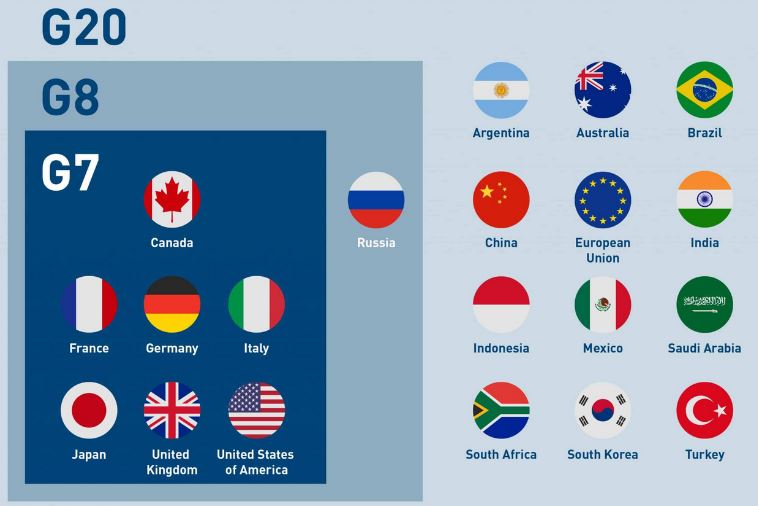
    The members of the G20 consist of 19 individual countries plus the European Union (EU).

    • The 19 member countries of the forum are Argentina, Australia, Brazil, Canada, China, France, Germany, India, Indonesia, Italy, Japan, Mexico, Russia, Saudi Arabia, South Africa, South Korea, Turkey, United Kingdom and the United States.
    • The European Union is represented by the European Commission and by the European Central Bank.

    Its significance

    • G20 is a major international grouping that brings together 19 of the world’s major economies and the European Union.
    • Its members account for more than 80% of global GDP, 75% of trade and 60% of population.

    India and G20

    • India has been a member of the G20 since its inception in 1999.


    UPSC 2023 countdown has begun! Get your personal guidance plan now! (Click here)

  • G-20 summit expected to be in Delhi

    India is expected to host the G-20 summit in Delhi, while a number of States, including Jammu and Kashmir and north-eastern States, have been asked to suggest venues for about 100 “preparatory” meetings.

    Why in news?

    • The clarifications came in response to questions being raised over reports in the media about the possibility of holding the summit itself in Jammu and Kashmir.
    • Pakistan had issued a strong protest last week, sent formal demarches to Foreign Ministries in G-20 member-states, asking them not to attend such meetings.
    • Pakistan (alone) believes J&K is internationally recognised disputed territory.

    Why such move?

    • The participation of the delegates from G-20 countries will be a major boost to the efforts of the Centre to project the situation in J&K as normal.
    • This is especially after J&K’s special constitutional position was ended in 2019.

    What is G-20?

    • Formed in 1999, the G20 is an international forum of the governments and central bank governors from 20 major economies.
    • Collectively, the G20 economies account for around 85 percent of the Gross World Product (GWP), 80 percent of world trade.
    • To tackle the problems or address issues that plague the world, the heads of governments of the G20 nations periodically participate in summits.
    • In addition to it, the group also hosts separate meetings of the finance ministers and foreign ministers.
    • The G20 has no permanent staff of its own and its chairmanship rotates annually between nations divided into regional groupings.

    Aims and objectives

    • The Group was formed with the aim of studying, reviewing, and promoting high-level discussion of policy issues pertaining to the promotion of international financial stability.
    • The forum aims to pre-empt the balance of payments problems and turmoil on financial markets by improved coordination of monetary, fiscal, and financial policies.
    • It seeks to address issues that go beyond the responsibilities of any one organization.

    Members of G20

    The members of the G20 consist of 19 individual countries plus the European Union (EU).

    • The 19 member countries of the forum are Argentina, Australia, Brazil, Canada, China, France, Germany, India, Indonesia, Italy, Japan, Mexico, Russia, Saudi Arabia, South Africa, South Korea, Turkey, United Kingdom and the United States.
    • The European Union is represented by the European Commission and by the European Central Bank.

    Its significance

    • G20 is a major international grouping that brings together 19 of the world’s major economies and the European Union.
    • Its members account for more than 80% of global GDP, 75% of trade and 60% of population.

    India and G20

    • India has been a member of the G20 since its inception in 1999.


    UPSC 2023 countdown has begun! Get your personal guidance plan now! (Click here)