💥Mains Ready By December. Smash Mains & Smash PYQ Admissions Open

Subject: Global Groupings and Conventions

Important International institutions, agencies and fora- their structure, mandate.

  • Turkey backs Sweden and Finland’s NATO bid

    Turkey has agreed to support Finland and Sweden joining the NATO military alliance after weeks of angering partners by insisting it would veto the Scandinavian countries’ accession.

    What is NATO?

    • NATO is a military alliance established by the North Atlantic Treaty (also called the Washington Treaty) of April 4, 1949.
    • It sought to create a counterweight to Soviet armies stationed in Central and Eastern Europe after World War II.
    • Its original members were Belgium, Canada, Denmark, France, Iceland, Italy, Luxembourg, the Netherlands, Norway, Portugal, the United Kingdom, and the United States.
    • NATO has spread a web of partners, namely Egypt, Israel, Sweden, Austria, Switzerland and Finland.

    Expansion of NATO: Transforming Europe

    • The war in Ukraine has already changed the geopolitics of Europe and the world.
    • The admission of Finland and Sweden to NATO would bring about a transformation in the continent’s security map by giving NATO a contiguous long frontier in western Russia.
    • Finland and Russia share a 1,300-km border — and doubling it from the present 1,200 km, parts of it in northern Norway, Latvia and Estonia, and Poland and Lithuania.
    • In addition, Sweden’s island of Gotland in the middle of the Baltic Sea would give NATO a strategic advantage.
    • Furthermore, when Sweden and Finland join NATO, the Baltic Sea — Russia’s gateway to the North Sea and the Atlantic Ocean — would be ringed entirely by NATO members.

    Why Nordic countries are willing to join NATO?

    • Although the debate over joining NATO was ongoing in both countries for nearly three decades, Russia’s annexation of Crimea pushed both towards NATO’s “open door” policy.
    • Still, there was little political consensus in either country, especially in Sweden where the Social Democrats have long been against the idea.
    • However, February 24 changed everything the date on which Russia invaded Ukraine.

    A knee jerk reaction?

    • If Putin’s invasion of Ukraine was meant to deter NATO’s eastward expansion, the war has had the opposite effect.
    • If admitted, Sweden and Finland will become its 31st and 32nd members.

    Russian response

    • Back in March, Russia had evoked a threatening response to take retaliatory measures by stationing its nuclear and hypersonic weapons close to the Baltic Sea.
    • Russia denounced the problems with Finland and Sweden but the NATO’s expansion at the expense of these countries does not pose a direct threat to us.
    • But the expansion of military infrastructure into this territory will certainly provoke their response, warned Mr Putin.
    • Sweden had already said it would not allow NATO bases or nuclear weapons on its territory.

    Hurdles for Finland, Sweden

    • At the moment the main obstacle to their applications in Turkey, a member since 1952 and which has NATO’s second-largest army after the US.
    • Turkish president Erdogan has objected to their applications on the ground that the two countries had provided safe haven to the leaders of the Kurdish group PKK.
    • Many Kurdish and other exiles have found refuge in Sweden over the past decades.
    • PKK is an armed movement fighting for a separate Kurdistan, comprising Kurdish areas in Turkey, Iraq, Iran and Syria.
    • Neither of these countries have a clear, open attitude towards terrorist organisation.

    What could Turkey gain?

    • Turkey is expected to seek to negotiate a compromise deal to seek action on Kurdish groups.
    • Erdogan could also seek to use Sweden and Finland’s membership to wrest concessions from the United States and other allies.
    • Turkey wants to return to the US-led F-35 fighter jet program — a project it was kicked out of following its purchase of Russian S-400 missile defense systems.
    • Alternatively, Turkey is looking to purchase a new batch of F-16 fighter jets and upgrade its existing fleet.

    How does this affect Turkey’s image in the West?

    • Turkey is reinforcing an image that is blocking the alliance’s expansion for its own profit.
    • It also risks damaging the credit it had earned by supplying Ukraine with the Bayraktar TB2 armed drones that became an effective weapon against Russian forces.

    Is Turkey trying to appease Russia?

    • Turkey has built close relations with both Russia and Ukraine and has been trying to balance its ties with both.
    • It has refused to join sanctions against Russia — while supporting Ukraine with the drones that helped deny Russia air superiority.


    UPSC 2023 countdown has begun! Get your personal guidance plan now! (Click here)
  • Partners in the Blue Pacific (PBP) Initiative

    To reinforce its Indo-Pacific strategy, the US – along with Australia, New Zealand, UK and Japan – announced a new Partners in Blue Pacific (PBP) initiative.

    What is Partners in the Blue Pacific (PBP) initiative?

    • The PBP is a five-nation “informal mechanism” to support Pacific islands and to boost diplomatic, economic ties in the region.
    • It speaks of enhancing “prosperity, resilience, and security” in the Pacific through closer cooperation.
    • It simply means that through the PBP, these counties — together and individually — will direct more resources here to counter China’s aggressive outreach.
    • The initiative members have also declared that they will “elevate Pacific regionalism”, and forge stronger ties with the Pacific Islands Forum.
    • The areas where PBP aims to enhance cooperation include “climate crisis, connectivity and transportation, maritime security and protection, health, prosperity, and education”.

    How is China trying to transform its ties in the Pacific?

    • As China signed a security pact with Solomon Islands in April, the deal flagged serious concerns about the Chinese military getting a base in the southern Pacific.
    • This is very close to the US island territory of Guam, and right next to Australia and New Zealand.
    • The deal, which boosted Beijing’s quest to dominate crucial shipping lanes criss-crossing the region, rattled the US and its allies.
    • It also triggered urgent moves to counter China’s growing Pacific ambition amid a power vacuum fuelled by apparent lack of US attention.

    What is being done by the US and its allies to counter China?

    • Before launching the PBP this month, the US and its partners started the Indo-Pacific Economic Framework for Prosperity (IPEF).
    • Away from the Pacific, the G7 on Monday (June 27) announced a plan — Partnership for Global Infrastructure and Investment (PGII) — to rival China’s BRI.
    • It promises to raise $600 billion to fund development projects in low and middle-income countries.


    UPSC 2023 countdown has begun! Get your personal guidance plan now! (Click here)

  • G-20

    The Jammu and Kashmir administration has constituted a committee to coordinate with the delegates of G-20 countries scheduled to participate in a meeting to be held in the Union Territory (UT) next year.

    Why such move?

    • The participation of the delegates from G-20 countries will be a major boost to the efforts of the Centre to project the situation in J&K as normal.
    • This is especially after J&K’s special constitutional position was ended in 2019.

    What is G-20?

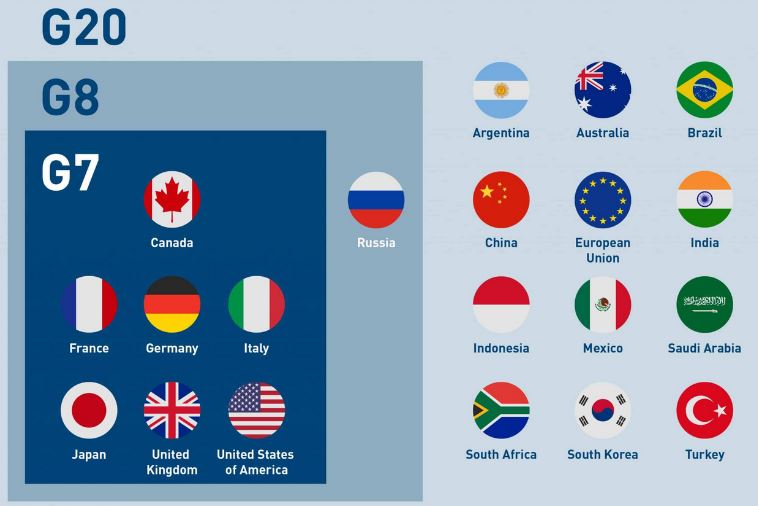
    • Formed in 1999, the G20 is an international forum of the governments and central bank governors from 20 major economies.
    • Collectively, the G20 economies account for around 85 percent of the Gross World Product (GWP), 80 percent of world trade.
    • To tackle the problems or address issues that plague the world, the heads of governments of the G20 nations periodically participate in summits.
    • In addition to it, the group also hosts separate meetings of the finance ministers and foreign ministers.
    • The G20 has no permanent staff of its own and its chairmanship rotates annually between nations divided into regional groupings.

    Aims and objectives

    • The Group was formed with the aim of studying, reviewing, and promoting high-level discussion of policy issues pertaining to the promotion of international financial stability.
    • The forum aims to pre-empt the balance of payments problems and turmoil on financial markets by improved coordination of monetary, fiscal, and financial policies.
    • It seeks to address issues that go beyond the responsibilities of any one organization.

    Members of G20

    The members of the G20 consist of 19 individual countries plus the European Union (EU).

    • The 19 member countries of the forum are Argentina, Australia, Brazil, Canada, China, France, Germany, India, Indonesia, Italy, Japan, Mexico, Russia, Saudi Arabia, South Africa, South Korea, Turkey, United Kingdom and the United States.
    • The European Union is represented by the European Commission and by the European Central Bank.

    Its significance

    • G20 is a major international grouping that brings together 19 of the world’s major economies and the European Union.
    • Its members account for more than 80% of global GDP, 75% of trade and 60% of population.

    India and G20

    • India has been a member of the G20 since its inception in 1999.


    UPSC 2023 countdown has begun! Get your personal guidance plan now! (Click here)

  • PM to attend G-7 summit in Germany

    PM Modi will fly to the Germany as a special invitee to the meeting of G-7 countries.

    Group of 7

    • The G-7 or ‘Group of Seven’ includes Canada, France, Germany, Italy, Japan, the United Kingdom, and the United States.
    • It is an intergovernmental organisation that was formed in 1975 by the top economies of the time as an informal forum to discuss pressing world issues.
    • Initially, it was formed as an effort by the US and its allies to discuss economic issues.
    • The G-7 forum now discusses several challenges such as oil prices and many pressing issues such as financial crises, terrorism, arms control, and drug trafficking.
    • It does not have a formal constitution or a fixed headquarters. The decisions taken by leaders during annual summits are non-binding.
    • Canada joined the group in 1976, and the European Union began attending in 1977.

    Evolution of the G-7

    • When it started in 1975—with six members, Canada joining a year later—it represented about 70% of the world economy.
    • And it was a cosy club for tackling issues such as the response to oil shocks.
    • Now it accounts for about 40% of global GDP.
    • Since the global financial crisis of 2007-09 it has sometimes been overshadowed by the broader G20.
    • The G-7 became the G-8 in 1997 when Russia was invited to join.

    Why was Russia expelled?

    • The G-7 was known as the ‘G-8’ for several years after the original seven were joined by Russia in 1997.
    • The Group returned to being called G-7 after Russia was expelled as a member in 2014 following the latter’s annexation of the Crimea region of Ukraine.
    • Since his election in 2016, President Trump has suggested on several occasions that Russia be added again, given what he described as Moscow’s global strategic importance.

    Why in news now?

    • New Delhi is preparing for more pressure from the G-7 countries.
    • These countries (Canada, France, Germany, Italy, Japan, the UK, the US and the EU) have unitedly imposed sanctions on Russia since it invaded Ukraine.
    • They want India to cooperate in restricting its purchase of Russian oil, not circumvent the sanctions by using a rupee-rouble mechanism.
    • It also wants India to lift the ban on the export of wheat.

    Relevance of G7 for India

    • India will get more voice, more influence and more power by entering the G7.
    • After UN Security Council (UNSC), this is the most influential grouping.
    • If the group is expanded it will collectively address certain humongous issues in the global order.
    • Diplomatically, a seat at the high table could help New Delhi further its security and foreign policy interests, especially at the nuclear club and UNSC reforms.
    • It will further protect its interests in the Indian Ocean.

    Challenges for India’s entry

    • The decision to expand the grouping cannot be taken by the US alone.
    • There needs to be a consensus.
    • However, a special invitation to India is no mean achievement.


    UPSC 2023 countdown has begun! Get your personal guidance plan now! (Click here)

  • China to host BRICS Virtual Summit

    Chinese President Xi Jinping will host a virtual summit of the leaders of the BRICS countries. PM Modi is expected to join.

    Why in news?

    • China is keen for the grouping to explore expansion and include new developing country members.
    • Under the “BRICS Plus” format, the forthcoming summit is also expected to be attended by leaders of invited emerging countries.

    What is BRICS?

    • BRICS is an acronym for the grouping of the world’s leading emerging economies, namely Brazil, Russia, India, China and South Africa.
    • The BRICS Leaders’ Summit has convened annually. It does not exist in form of an organization, but it is an annual summit between the supreme leaders of five nations.

    Its inception

    • On November 30, 2001, Jim O’Neill, a British economist who was then chairman of Goldman Sachs Asset Management, coined the term ‘BRIC’ to describe the four emerging economies of Brazil, Russia, India, and China.
    • He made a case for BRIC on the basis of econometric analyses projecting that the four economies would individually and collectively occupy far greater economic space and become among the world’s largest economies in the next 50 years or so.

    How it has formed?

    • The grouping was formalized during the first meeting of BRIC Foreign Ministers on the margins of the UNGA in New York in September 2006.
    • The first BRIC Summit took place in 2009 in the Russian Federation and focused on issues such as reform of the global financial architecture.

    Who are the members?

    • South Africa was invited to join BRIC in December 2010, after which the group adopted the acronym BRICS. South Africa subsequently attended the Third BRICS Summit in Sanya, China, in March 2011.
    • The Chairmanship of the forum is rotated annually among the members, in accordance with the acronym B-R-I-C-S.
    • The importance of BRICS is self-evident: It represents 42% of the world’s population, 30% of the land area, 24% of global GDP and 16% of international trade.
    • The five BRICS countries are also members of G-20.

    Also read

    [Burning Issue] BRICS and its relevance in today’s world


    Back2Basics: BRICS Plus

    • The BRICS outreach to Africa began at the last summit hosted by South Africa, in 2013. It has picked up momentum now but African leaders want more.
    • They need big loans from the New Development Bank (NDB) for their infrastructure projects.
    • China introduced the “BRICS Plus” format at the Xiamen summit last year by inviting a few countries from different regions.
    • South Africa emulated it, arranging the attendance of top-level representation of five nations of its choice: Argentina, Jamaica, Turkey, Indonesia and Egypt.
    • The precise role of “BRICS Plus” countries will take time to evolve but an immediate benefit is the immense opportunities it provides for networking among leaders.


    UPSC 2023 countdown has begun! Get your personal guidance plan now! (Click here)

  • What is the I2U2 Initiative?

    The US administration has named the new grouping as “I2U2” — “I” for India and Israel and “U” for the US and UAE. This was earlier referred as West Asian Quad.

    What is the news?

    • US President Joe Biden will host a virtual summit with PM Modi, Israel PM Naftali Bennett and UAE President Mohammed bin Zayed Al Nahyan during his visit to West Asia from July 13 to 16.

    I2U2 Initiative

    • Following the Abraham Accords between Israel and the UAE, I2U2 was founded in October 2021 to address marine security, infrastructure, and transportation challenges in the region.
    • It was known as the ‘International Forum for Economic Cooperation’at the time.
    • At that time, UAE had referred to the new grouping as the ‘West Asian Quad’.

    What makes this deal outstanding?

    • UAE forming sharing desk with Israel is no easy deal. Arab sentiments against Israel and their proposition for Anti-Semitism are well known.

    Significance of the initiative

    • I2U2 seeks to empower the partners and encourages them to collaborate more closely, resulting in a more stable region.
    • India is seen as a large consumer market as well as a large producer of high-tech and highly sought-after items in the United States.
    • This has led India to enhance its relationship with Israel without jeopardising its ties with the UAE and other Arab states.

    Back2Basics: Abraham Accords

    • The Israel–UAE normalization agreement is officially called the Abraham Accords Peace Agreement.
    • It was initially agreed to in a joint statement by the United States, Israel and the United Arab Emirates (UAE) on August 13, 2020.
    • The UAE thus became the third Arab country, after Egypt in 1979 and Jordan in 1994, to agree to formally normalize its relationship with Israel as well as the first Persian Gulf country to do so.
    • Concurrently, Israel agreed to suspend plans for annexing parts of the West Bank. The agreement normalized what had long been informal but robust foreign relations between the two countries.


    UPSC 2023 countdown has begun! Get your personal guidance plan now! (Click here)

  • Indo-Pacific Economic Framework for Prosperity (IPEF)

    India has signalled its readiness to be part of a new economic initiative led Indo-Pacific Economic Framework for Prosperity (IPEF) by the US for the region.

    What is IPEF?

    • The grouping, which includes seven out of 10 members of the Association of South East Asian Nations (ASEAN), all four Quad countries, and New Zealand, represents about 40% of global GDP.
    • The negotiations for the IPEF are expected to centre around four main pillars, including trade, supply chain resiliency, clean energy and decarbonisation, and taxes and anti-corruption measures.
    • Countries would have to sign up to all of the components within a module, but do not have to participate in all modules.
    • The “fair and resilient trade” module will be led by the US Trade Representative and include digital, labor, and environment issues, with some binding commitments.
    • The IPEF seeks to strengthen economic partnership amongst participating countries with the objective of enhancing resilience, sustainability, inclusiveness, economic growth, fairness, and competitiveness in the Indo-Pacific region.

    Features of IPEF

    • US officials made it clear that the IPEF would not be a “free trade agreement”, nor are countries expected to discuss reducing tariffs or increasing market access.
    • The IPEF will not include market access commitments such as lowering tariff barriers,
    • In that sense, the IPEF would not seek to replace the 11-nation CPTPP (Trans-Pacific Partnership) that the US quit in 2017, or the RCEP, which China, and all of the other IPEF countries (minus the US) are a part of.
    • Three ASEAN countries considered closer to China — Myanmar, Cambodia and Laos — are not members of the IPEF.

    Four pillars of IPEF

    1. Trade that will include digital economy and emerging technology, labour commitments, the environment, trade facilitation, transparency and good regulatory practices, and corporate accountability, standards on cross-border data flows and data localisations;
    2. Supply chain resiliency to develop “a first-of-its-kind supply chain agreement” that would anticipate and prevent disruptions;
    3. Clean energy and decarbonisation that will include agreements on “high-ambition commitments” such as renewable energy targets, carbon removal purchasing commitments, energy efficiency standards, and new measures to combat methane emissions; and
    4. Tax and anti-corruption, with commitments to enact and enforce “effective tax, anti-money laundering, anti-bribery schemes in line with [American] values”.

    Reasons for creation of IPEF

    • The IPEF is also seen as a means by which the US is trying to regain credibility in the region after former President Donald Trump pulled out of the Trans Pacific Partnership TPP).
    • Since then, there has been concern over the absence of a credible US economic and trade strategy to counter China’s economic influence in the region.
    • China is an influential member of the TPP, and has sought membership of its successor agreement Comprehensive and Progressive Agreement on Trans Pacific Partnership.
    • It is also in the 14-member Regional Comprehensive Economic Partnership, of which the US is not a member (India withdrew from RCEP).
    • The Biden Administration is projecting IPEF as the new US vehicle for re-engagement with East Asia and South East Asia.


    UPSC 2023 countdown has begun! Get your personal guidance plan now! (Click here)

  • Illegal fishing by China in the Indo-Pacific

    In order to check China’s illegal fishing in the Indo-Pacific region, the Quadrilateral Security Alliance (Quad) has planned to launch a satellite-based surveillance initiative.

    What is the news?

    • The leaders of Quad are reported to be getting ready to unveil a maritime surveillance initiative to protect exclusive economic zones in the Indo-Pacific against environmental damage.

    How will the proposed maritime surveillance system work?

    • The initiative will use satellite technology to connect existing surveillance centres in India, Singapore and the Pacific.
    • This will help establish a tracking system to combat illegal, unregulated and unprotected (IUU) fishing.
    • The satellite-enabled dragnet will track IUU fishing activities from the Indian Ocean and South-east Asia to the South Pacific.
    • The idea is to monitor illicit fishing vessels that have their AIS (automatic identification system) transponders turned off to evade tracking.
    • The move by the Quad security group is also seen to be aimed at reducing the small Pacific island nations’ growing reliance on China.

    Why is illegal fishing seen as such a big threat?

    • The unregulated plunder of global fishing stock poses a grave threat to the livelihood and food security of millions of people.
    • Globally, fish provide about 3.3 billion people with 20% of their average animal protein intake.
    • According to an FAO report, around 60 million people are engaged in the sector of fisheries and aquaculture.
    • While the economic loss from illegal fishing has been difficult to precisely quantify, some estimates peg it around USD 20 billion annually.

    Threats posed by IUU Fishing

    • Illegal fishing has now replaced piracy as a global maritime threat.
    • In the Indo-Pacific region, like elsewhere, the collapse of fisheries can destabilise coastal nations.
    • It poses a much bigger security risk, as it can fuel human trafficking, drug crime and terror recruiting.

    Why is China in the dock?

    • The 2021 IUU Fishing Index, which maps 152 coastal countries, ranked China as the worst offender.
    • China is considered responsible for 80% to 95% illegal fishing in the region after having overfished its own waters.
    • It, in fact, is known to incentivise illegal fishing with generous subsidies to meet its growing domestic demand.

    China and distant-water fishing (DWF)

    • China’s DWF fleet has almost 17,000 vessels and is the largest in the world.
    • Vessel ownership is highly fragmented among many small companies and the fleet includes vessels registered in other jurisdictions.

    Issues with Chinese IUU Fishing

    • Chinese are often accused of pillaging ocean wealth with great sophistication and with little regard for maritime boundaries.
    • China also uses them to project strategic influence and to bully fishing vessels from weaker nations.
    • China uses destructive practises such as bottom trawling and forced, bonded and slave labour and trafficked crew, alongside the widespread abuse of migrant crewmembers.


    UPSC 2023 countdown has begun! Get your personal guidance plan now! (Click here)

  • NATO Expansion & Russia

    After nearly three months of debate within the two countries, Finland and Sweden have formally applied for membership of the North Atlantic Treaty Organization (NATO).

    What is NATO?

    • NATO is a military alliance established by the North Atlantic Treaty (also called the Washington Treaty) of April 4, 1949.
    • It sought to create a counterweight to Soviet armies stationed in Central and Eastern Europe after World War II.
    • Its original members were Belgium, Canada, Denmark, France, Iceland, Italy, Luxembourg, the Netherlands, Norway, Portugal, the United Kingdom, and the United States.
    • NATO has spread a web of partners, namely Egypt, Israel, Sweden, Austria, Switzerland and Finland.

    Expansion of NATO: Transforming Europe

    • The war in Ukraine has already changed the geopolitics of Europe and the world.
    • The admission of Finland and Sweden to NATO would bring about a transformation in the continent’s security map by giving NATO a contiguous long frontier in western Russia.
    • Finland and Russia share a 1,300-km border — and doubling it from the present 1,200 km, parts of it in northern Norway, Latvia and Estonia, and Poland and Lithuania.
    • In addition, Sweden’s island of Gotland in the middle of the Baltic Sea would give NATO a strategic advantage.
    • Furthermore, when Sweden and Finland join NATO, the Baltic Sea — Russia’s gateway to the North Sea and the Atlantic Ocean — would be ringed entirely by NATO members.

    Why Nordic countries are willing to join NATO?

    • Although the debate over joining NATO was ongoing in both countries for nearly three decades, Russia’s annexation of Crimea pushed both towards NATO’s “open door” policy.
    • Still, there was little political consensus in either country, especially in Sweden where the Social Democrats have long been against the idea.
    • However, February 24 changed everything the date on which Russia invaded Ukraine.

    A knee jerk reaction?

    • If Putin’s invasion of Ukraine was meant to deter NATO’s eastward expansion, the war has had the opposite effect.
    • If admitted, Sweden and Finland will become its 31st and 32nd members.

    Russian response

    • Back in March, Russia had evoked a threatening response to take retaliatory measures by stationing its nuclear and hypersonic weapons close to the Baltic Sea.
    • Russia denounced the problems with Finland and Sweden but the NATO’s expansion at the expense of these countries does not pose a direct threat to us.
    • But the expansion of military infrastructure into this territory will certainly provoke their response, warned Mr Putin.
    • Sweden had already said it would not allow NATO bases or nuclear weapons on its territory.

    Hurdles for Finland, Sweden

    • At the moment the main obstacle to their applications in Turkey, a member since 1952 and which has NATO’s second-largest army after the US.
    • Turkish president Erdogan has objected to their applications on the ground that the two countries had provided safe haven to the leaders of the Kurdish group PKK.
    • Many Kurdish and other exiles have found refuge in Sweden over the past decades.
    • PKK is an armed movement fighting for a separate Kurdistan, comprising Kurdish areas in Turkey, Iraq, Iran and Syria.
    • Neither of these countries have a clear, open attitude towards terrorist organisation.

    What could Turkey gain?

    • Turkey is expected to seek to negotiate a compromise deal to seek action on Kurdish groups.
    • Erdogan could also seek to use Sweden and Finland’s membership to wrest concessions from the United States and other allies.
    • Turkey wants to return to the US-led F-35 fighter jet program — a project it was kicked out of following its purchase of Russian S-400 missile defense systems.
    • Alternatively, Turkey is looking to purchase a new batch of F-16 fighter jets and upgrade its existing fleet.

    How does this affect Turkey’s image in the West?

    • Turkey is reinforcing an image that is blocking the alliance’s expansion for its own profit.
    • It also risks damaging the credit it had earned by supplying Ukraine with the Bayraktar TB2 armed drones that became an effective weapon against Russian forces.

    Is Turkey trying to appease Russia?

    • Turkey has built close relations with both Russia and Ukraine and has been trying to balance its ties with both.
    • It has refused to join sanctions against Russia — while supporting Ukraine with the drones that helped deny Russia air superiority.


    UPSC 2023 countdown has begun! Get your personal guidance plan now! (Click here)

  • Countries will have to ‘justify’ Veto Votes at UN

    The 193 members of the United Nations General Assembly adopted by consensus a resolution requiring the five permanent members of the Security Council to justify their use of the veto.

    Why such move?

    • The push for reform was driven by Russia’s invasion of Ukraine.
    • The measure is intended to make veto-holders United States, China, Russia, France and Britain “pay a higher political price” when they use the veto to strike down a Security Council resolution.
    • For years Russia (and the US) has used its veto power to block UNSC resolutions — which, unlike General Assembly resolutions, are enforceable under international law.

    What is the Veto Power at the UN?

    • The UN Security Council veto power is the power of the five permanent members of the UN Security Council to veto any “substantive” resolution.
    • They also happen to be the nuclear-weapon states (NWS) under the terms of the Treaty on the Non-Proliferation of Nuclear Weapons (NPT).
    • However, a permanent member’s abstention or absence does not prevent a draft resolution from being adopted.
    • This veto power does not apply to “procedural” votes, as determined by the permanent members themselves.
    • A permanent member can also block the selection of a Secretary-General, although a formal veto is unnecessary since the vote is taken behind closed doors.

    Issues with Veto Power

    • The veto power is controversial. Supporters regard it as a promoter of international stability, a check against military interventions, and a critical safeguard against US domination.
    • Critics say that the veto is the most undemocratic element of the UN, as well as the main cause of inaction on war crimes and crimes against humanity.
    • It effectively prevents UN action against the permanent members and their allies.

    Back2Basics: United Nations Security Council

    • The UNSC is one of the six principal organs of the United Nations and is charged with the maintenance of international peace and security.
    • Its powers include the establishment of peacekeeping operations, the establishment of international sanctions, and the authorization of military action through Security Council resolutions.
    • It is the only UN body with the authority to issue binding resolutions to member states.
    • The Security Council consists of fifteen members. Russia, the United Kingdom, France, China, and the United States—serve as the body’s five permanent members.
    • These permanent members can veto any substantive Security Council resolution, including those on the admission of new member states or candidates for Secretary-General.
    • The Security Council also has 10 non-permanent members, elected on a regional basis to serve two-year terms. The body’s presidency rotates monthly among its members.

    Also read

    Explained: India at United Nations Security Council

    UPSC 2023 countdown has begun! Get your personal guidance plan now! (Click here)