💥Mains Ready By December. Smash Mains & Smash PYQ Admissions Open

Subject: Global Groupings and Conventions

Important International institutions, agencies and fora- their structure, mandate.

  • What is EDISON Alliance?

    The World Economic Forum (WEF) has announced the launch of an Essential Digital Infrastructure and Services Network (EDISON) Alliance.

    The peculiarity of name ‘EDISON Alliance’ creates a hotspot here for prelims.  UPSC may either crate confusion over purpose or parent organization. The alliance is yet to take shape completely; hence there is an ambiguity over its members.

    EDISON Alliance

    • Geneva-based World Economic Forum (WEF), which describes itself as an international organization for public-private partnership, will serve as the secretariat and platform for the EDISON Alliance.
    • A wider group of ‘Champions Leaders’ will advise and support the Alliance, the WEF said while announcing the launch.
    • Alliance aims to work towards ensuring global and equitable access to the digital economy.
    • Its prime goal is to ensure an unprecedented level of cross-sectoral collaboration between the technology industry and other critical sectors of the economy, according to the WEF.

    Why need such an alliance?

    • Access to digital technologies has enabled many to work, learn and live during the COVID-19 pandemic.
    • However, the pandemic has exposed and exacerbated existing gaps and inequalities in almost half of the global population.
    • Some 3.6 billion people, remain offline and broadband services are too expensive for 50 percent of the population in developed countries, the WEF said.
    • This hampers access to health, education, and economic inclusion.
  • What is the G20 Common Framework?

    Chad has become the first country to officially request a debt restructuring under a new common framework “G20 Common Framework” introduced by China and other Group of 20 countries last year with the help of the Paris Club.

    What is G20 Common Framework?

    • G20 Common Framework is the Common Framework for Debt Treatments beyond the Debt Service Suspension Initiative (DSSI).
    • It was announced in November 2020 to deal with the issue of unsustainable debts faced by various countries as an impact of COVID-19.

    What is the news?

    • This official request of Chad for debt restructuring under the G20 common framework was notified by the International Monetary Fund (IMF).
    • The creditors will now soon begin discussions on the first test of the new framework.
    • The creditors will also ask China and other private-sector creditors to participate as agreed last year.
    • A new four-year programme of Chad worth about $560 million under the Extended Credit and Extended Fund facilities was announced by IMF.
    • Chad is under high debt like many other African countries.

    Significance of the move

    • This is the first time that a country has requested debt restructuring under the framework and the investors will now look at how the framework can work.
    • Participation in China is also a question. Last year, G20 Common Framework brought non-members of the Paris Club- India, China, and Turkey to join the framework.

    Back2Basics: Paris Club

    • Paris Club is a club or group of officials from major creditor countries.
    • It was established in the year 1956.
    • It aims to find sustainable solutions to the difficulties faced by debtor countries in payments.


  • Pursuing national interests, at the UN high table

    The article highlights India’s challenges at the UNSC in its 2 year stint.

    India’s agenda at the UNSC

    • India’s two-year non-permanent stint at the UNSC should be viewed as a once-in-a-decade opportunity to clearly identify and pursue its national interests regionally and globally.
    • India’s entry into the UNSC coincides with the emergence of a new world order.
    • Under new world order, there is systemic uncertainty, little care for global commons, absence of global leadership, the steady division of the world into rival blocs, pursuit of narrow national interests.
    • Efforts by Biden administration in the United States may go on to ameliorate some of the harsh impact of this global order.
    • The UNSC has also reached a point wherein its very relevance is in serious doubt.
    • India too is no longer an ardent believer in the fantastical claims about a perfect world at harmony with itself, nor is it a timid observer in global geopolitics.
    • India’s pursuit of its interests at the UNSC should, therefore, reflect its material and geopolitical limitations, and its energies should be focused on a clearly identified agenda.

    Factors determining India’s agenda at the UNSC

    1) Rivalry with China

    • India’s tenure at the UNSC comes in the wake of its growing military rivalry with China.
    • China’s opposition to having India chair the Counter-Terrorism Committee (CTC) in 2022 was a precursor to the things to come ahead.
    • The next two years will be key to ensure checking further Chinese incursions along the Line of Actual Control and building up enough infrastructure and mobilising sufficient forces in the forward areas.

    2) Relations with Russia

    • Greater Indian alignment with the West at the UNSC, an unavoidable outcome, could, however, widen the growing gulf between Russia and India.
    • It might not be possible for India to sit on the fence anymore.
    • Fence sitting would bring more harm than goodwill in an international system where battlelines are sharpening by the day.

    3) Terrorism issue

    • Terror is likely to be a major focus for India at the UNSC.
    • External Affairs Minister’s statement at the UNSC Ministerial Meeting on the 20th Anniversary of Security Council Resolution 1373 and the establishment of the Counter Terrorism Committee has set the stage for New Delhi’s approach on the issue.
    • India recently assumed the chair of the Taliban sanctions committee which assumes significance given the fast-moving developments in Afghanistan.
    • India must formulate its policy towards terrorism with far more diplomatic finesse and political nuance especially given that it is chairing the Taliban sanctions committee while courting the very same Taliban.

    4) Coalition of like-minded states and setting the agenda for next decade

    • India should use the forum and its engagement there to build coalitions among like-minded states and set out its priorities for the next decade — from climate change to non-proliferation.
    • India should use its bargaining power at the UNSC to pursue its national interests in other forums and domains as well.
    • India’s UNSC strategy should involve shaping the narrative and global policy engagement vis-à-vis — the Indo-Pacific.
    • Given India’s centrality in the Indo-Pacific region and the growing global interest in the concept, New Delhi would do well to take it upon itself to shape the narrative around it.
    • In doing so, it should, through the UNSC and other means, court Moscow once again and assuage its concerns about the Indo-Pacific.

    Way forward

    • India’s pursuit of its national interest at UNSC must also be tempered by the sobering fact that the UNSC is unlikely to admit new members any time soon, if ever at all.
    • A glance at the recent debates on UNSC reforms and the state of the international system today should tell us that bending over backwards to please the big five to gain entry into the UNSC will not make a difference.

    Consider the question “What agenda should India pursue at the UNSC in its two year non-permanent stint? What are the challenges in pursuing such agenda?”

    Conclusion

    India must focus its energies on what it can achieve during the short period that it would be in the UNSC rather than what it wishes happened.

  • Intergovernmental Negotiations (IGN) at UNSC

    Seeking urgent reform of the United Nations Security Council (UNSC), India has highlighted the failure of the Intergovernmental Negotiations (IGN) since 13 years of its establishment.

    Note various countries in the various groups.

    What is the news?

    • India, along with Brazil, Japan and Germany are pressing for urgent reform of the UNSC and for a permanent seat in the reformed 15-member top organ of the world body.
    • India has said that the UNSC is finding itself unable to act effectively to address increasingly complex issues of international peace and security.
    • The UNSC lacks inclusivity of those who need to be members of the powerful organ of the world body.

    What is IGN?

    • The Intergovernmental Negotiations framework or IGN is a group of nation-states working within the United Nations to further reform of the UNSC.
    • The IGN is composed of several different international organizations, namely:
    1. African Union (55 member states)
    2. G4 nations (Brazil, Germany, India and Japan)
    3. Uniting for Consensus Group (UfC), also known as the “Coffee Club” (it aims to counter the bids for permanent seats proposed by G4 nations, includes Pakistan, Turkey, Canada, Spain and Italy)
    4. L69 Group of Developing Countries ( it includes developing countries from Africa, Latin America and the Caribbean, Asia and the Pacific)
    5. Arab League (six members: Egypt, Iraq, Jordan, Lebanon, Saudi Arabia, and Syria) and
    6. Caribbean Community ( a group of 15 member countries called CARICOM)
  • UK invites India to attend G7 Summit

    The United Kingdom has invited PM Modi to attend the G7 summit that is scheduled to be held in June.

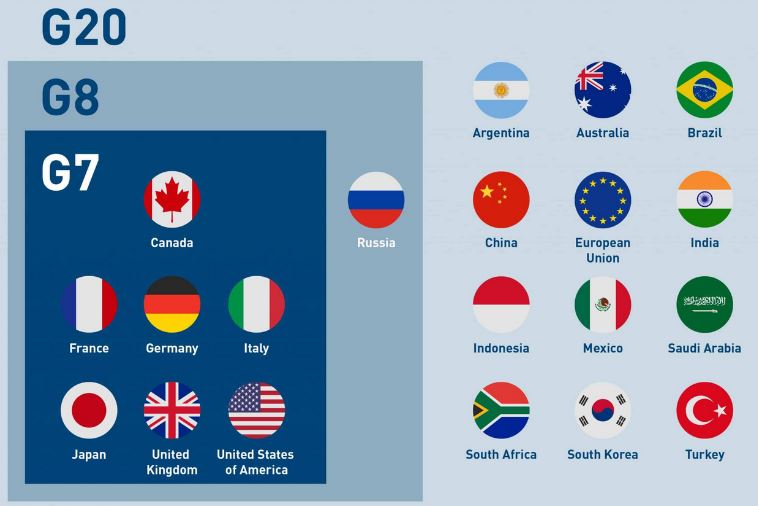
    Note the members of G7 and G20. UPSC may puzzle you asking which G20 nation isn’t a member of G7.

    G7 Countries

    • The G-7 or ‘Group of Seven’ includes Canada, France, Germany, Italy, Japan, the United Kingdom, and the United States.
    • It is an intergovernmental organisation that was formed in 1975 by the top economies of the time as an informal forum to discuss pressing world issues.
    • Initially, it was formed as an effort by the US and its allies to discuss economic issues.
    • The G-7 forum now discusses several challenges such as oil prices and many pressing issues such as financial crises, terrorism, arms control, and drug trafficking.
    • It does not have a formal constitution or a fixed headquarters. The decisions taken by leaders during annual summits are non-binding.
    • Canada joined the group in 1976, and the European Union began attending in 1977.

    Evolution of the G-7

    • When it started in 1975—with six members, Canada joining a year later—it represented about 70% of the world economy.
    • And it was a cozy club for tackling issues such as the response to oil shocks.
    • Now it accounts for about 40% of global GDP.
    • Since the global financial crisis of 2007-09, it has sometimes been overshadowed by the broader g20.
    • The G-7 became the G-8 in 1997 when Russia was invited to join.
    • In 2014, Russia was debarred after it took over Crimea.

    Significance of G7 for India

    • India will get more voice, more influence, and more power by entering the G7.
    • After the UN Security Council (UNSC), this is the most influential grouping.
    • If the group is expanded it will collectively address the humongous issues created by the Wuhan virus,
    • Diplomatically, a seat at the high table could help India further its security and foreign policy interests, especially at the nuclear club and UN Security Council reform as well as protecting its interests in the Indian Ocean.

    Back2Basics: The G-20

    • The G-20 is a larger group of countries, which also includes G7 members.
    • The G-20 was formed in 1999, in response to a felt need to bring more countries on board to address global economic concerns.
    • Apart from the G-7 countries, the G-20 comprises Argentina, Australia, Brazil, China, India, Indonesia, Mexico, Russia, Saudi Arabia, South Africa, South Korea, and Turkey.
    • Together, the G-20 countries make up around 80% of the world’s economy.
    • As opposed to the G-7, which discusses a broad range of issues, deliberations at the G-20 are confined to those concerning the global economy and financial markets.
    • India is slated to host a G-20 summit in 2022.
  • Explained: India at United Nations Security Council

    India is back as a non-permanent member on the United Nations Security Council.

    Q.What objective India should pursue in its stint at the UNSC? What challenges India will face in achieving these objectives?

    India at the UNSC

    Take a look at its seven previous terms, and what its agenda will be amid events concerning China, Pakistan and the US:

    1. In 1950-51, India, as President of UNSC, presided over the adoption of resolutions calling for the cessation of hostilities during the Korean War and for assistance to the Republic of Korea.
    2. In 1967-68, India co-sponsored Resolution 238 extending mandate of UN mission in Cyprus.
    3. In 1972-73, India pushed strongly for admission of Bangladesh into the UN. The resolution was not adopted because of a veto by a permanent member.
    4. In 1977-78, India was a strong voice for Africa in the UNSC and spoke against apartheid. Then External Affairs Minister Atal Bihari Vajpayee spoke in UNSC for Namibia’s independence in 1978.
    5. In 1984-85, India was a leading voice in UNSC for resolution of conflicts in the Middle East, especially Palestine and Lebanon.
    6. In 1991-92, PM P V Narasimha Rao participated in the first-ever summit-level meeting of the UNSC and spoke on its role in the maintenance of peace and security.
    7. In 2011-2012, India was a strong voice for developing world, peacekeeping, counter-terrorism and Africa. The first statement on Syria was during India’s Presidency at the UNSC.

    India’s diverse role-play

    • India played an active role in discussions on all issues related to international peace and security.
    • It included several new challenges which the UNSC was called upon to deal with in Afghanistan, Cote d’Ivoire, Iraq, Libya, South Sudan, Syria and Yemen.
    • In view of the threat posed to international trade and security by piracy off the coast of Somalia, India promoted international cooperation against the pirates.
    • At India’s initiative, the UNSC mandated international cooperation for release of hostages taken by pirates as well as for prosecution of those taking hostages and those aiding and abetting these acts.
    • India also worked for enhancing international cooperation in counter-terrorism, prevention of the proliferation of weapons of mass destruction to non-state actors, and the strengthening of UN peacekeeping efforts.

    Issues at UNSC: The politics within

    • The seven previous terms have given Indian diplomats the experience of how diplomacy is conducted at the multilateral setting.
    • There have been instances where permanent members would like the non-permanent members to be “cooperative”, and no stand in the way of major resolutions.
    • Most non-permanent members get influenced by the P-5 members. They did not wish to irritate the permanent members and were keen to be perceived by them as ‘cooperative’.
    • This was precisely how the permanent members would like the non-permanent members to behave.

    Walk-alone moves by India

    • The Indians took P5 work more seriously and consequently had to fight a lonely battle.
    • This was the time when the Gulf War erupted and India voted in favour of the US-sponsored resolution in April 1991.
    • India’s vote was dictated by pragmatic considerations.
    • The US had made it clear to India that failure to support the resolution would make it very difficult for them to help India in the World Bank and the IMF.
    • Back then, India was going through a severe balance-of-payment crisis and needed funds from these organisations.
    • Also, India needed the US on its side, if and when the Kashmir issue came up.

    Twenty years later, when India again became a non-permanent member at the UNSC, it was stronger economically but still had to negotiate politics within the Council.

    Ugly faces of the council

    • Most professional diplomats shed their innocence before they arrive at the horse-shoe table around which the Security Council meets.
    • In the real world of foreign and security policy, decision-makers are invariably confronted by cruel choices that are equally problematic and come in various shades.
    • Practitioners are acutely conscious that it is only diplomacy’s outward packaging that dwells in a commitment to a higher moral purpose.
    • The shameless pursuit of narrowly defined interests is most often the motivation and seldom raises eyebrows in the world of multilateral diplomacy.

    Issues before India

    (A) Long slated UN reforms

    • New Delhi has said it is essential that the Security Council is expanded in both the permanent and non-permanent categories.
    • It says India is eminently suited for permanent UNSC membership by any objective criteria, such as population, territorial size, GDP, economic potential and ongoing contributions to UN activities.

    (B) Terrorism

    • The international effort against terrorism is a key priority for India in the UN.
    • With the objective of providing a comprehensive legal framework to combat terrorism, India took the initiative to pilot a draft Comprehensive Convention on International Terrorism (CCIT) in 1996.
    • A text of the Convention is being negotiated in the 6th Committee of the UN General Assembly.
    • India worked closely to ensure the listing of Pakistan-based terrorist Masood Azhar under the UNSC’s 1267 Sanctions Committee (May 2019) concerning al-Qaida and ISIS terrorists.

    (C) China challenge

    • India is entering the UNSC at a time when Beijing is asserting itself at the global stage much more vigorously than ever.
    • It heads at least six UN organisations — and has challenged the global rules.
    • China’s aggressive behaviour in the Indo-Pacific, as well as the India-China border, has been visible in all of 2020, and New Delhi will have to think on its feet to counter Beijing.
    • At Pakistan’s behest, China has tried to raise the issue of Kashmir at the UNSC — but has not found much support.
    • There is some discussion among the strategic community in New Delhi on raising the issues of Taiwan, Hong Kong and Tibet at the UNSC.

    Conclusion

    • India will weigh the pros and cons with partners on what steps to take in this direction.
    • But, the polarizing politics inside India gives a window of opportunity to its rivals and opens up the possibility of criticism — especially on human rights issues.

    Back2Basics: United Nations Security Council

    • The UNSC is one of the six principal organs of the United Nations and is charged with the maintenance of international peace and security.
    • Its powers include the establishment of peacekeeping operations, the establishment of international sanctions, and the authorization of military action through Security Council resolutions.
    • It is the only UN body with the authority to issue binding resolutions to member states.
    • The Security Council consists of fifteen members. Russia, the United Kingdom, France, China, and the United States—serve as the body’s five permanent members.
    • These permanent members can veto any substantive Security Council resolution, including those on the admission of new member states or candidates for Secretary-General.
    • The Security Council also has 10 non-permanent members, elected on a regional basis to serve two-year terms. The body’s presidency rotates monthly among its members.
  • Trade Policy Review of India at the WTO

    India’s seventh Trade Policy Review (TPR) has begun at the World Trade Organization in Geneva.

    Q.In the wake of the global economic fallout of the COVID-19 pandemic, discuss the challenges ahead of WTO.

    Trade Policy Review (TPR)

    • The TPR is an important mechanism under the WTO’s monitoring function and involves a comprehensive peer-review of the Member’s national trade policies.
    • India’s last TPR took place in 2015.

    Why need a TPR?

    • To increase the transparency and understanding of countries’ trade policies and practices, through regular monitoring
    • To improve the quality of public and intergovernmental debate on the issues
    • To enable a multilateral assessment of the effects of policies on the world trading system

    India’s progress

    • Since previous TPR, India has worked diligently to reform and transform the entire economic eco-system to meet the socio-economic aspirations of a billion-plus Indians.
    • The introduction of the GST, the IBC, labour sector reforms, an enabling and investor-friendly FDI Policy, and various national programmes like Make in India, Digital India, Startup India and Skill were the path-breakers.
    • The improvement in the economic and business environment, on account of the wide-ranging reforms, has enabled India to better its position in the World Bank’s Doing Business ranking from 142 in 2015 to 63 in 2019.
    • This improvement is also endorsed by investors who continue to view India as a desirable investment destination even during the testing time of the pandemic.
    • In 2019-20, India received highest ever FDI inflow of USD 74.39 billion.

    A note of caution

    • India’s trade policy remained largely unchanged since the previous review.
    • India continues to rely on trade policy instruments such as the tariff, export taxes, minimum import prices, import and export restrictions, and licensing, WTO said.
    • These are used to manage domestic demand and supply requirements, protect the economy from wide domestic price fluctuations, and ensure conservation and proper utilization of natural resources.
    • As a result, frequent changes are made to tariff rates and other trade policy instruments, which create uncertainty for traders.

  • The many challenges for WTO

    The next Director-General of the organization will have to navigate through a slew of thorny issues in WTO.

    WTO to lead by a woman for the first time

    • For the first time in its 25-year history, the World Trade Organization (WTO) will be led by a woman.
    • The D-G’s job will require perseverance and outstanding negotiating skills for balancing the diverse and varied interests of the 164 member countries, and especially, for reconciling competing for multilateral and national visions, for the organization to work efficiently.
    • The next D-G will have to grapple with the global economic fallout of the COVID-19 pandemic and work towards carrying out reforms of the multilateral trading system for reviving the world economy.
    • On all these issues, her non-partisan role will be watched carefully.

    Practice Question: In the wake of the global economic fallout of the COVID-19 pandemic, discuss the challenges ahead of WTO.

    Tussle between developed and developing countries

    • The current impasse in the WTO negotiations has led member countries to believe in the necessity of carrying out urgent reforms, which is likely to throw up some difficult choices for developing countries like India.
    • At the core of the divide within the WTO is the Doha Development Agenda, which the developed countries sought to move in favour of a new agenda that includes, amongst others, e-commerce, investment facilitation, MSMEs and gender.
    • Salvaging the ‘development’-centric agenda is critical for a large number of developing countries as they essentially see trade as a catalyst of development.
    • Restoring the WTO dispute settlement mechanism, especially the revival of its Appellate body, is also crucial for the organization’s efficient functioning.

    Definition of ‘Developing Country’ – a contentious issue

    • The push for a change in the definition of “developing country” under the principle of special and differential treatment (S&DT), aimed at upgrading certain developing countries, will deeply affect the status of emerging economies such as India, China, South Africa, Turkey, Egypt, etc.
    • The assumption that some countries have benefited immensely from the WTO rules since its formation in 1995 is flawed, at least in the case of India. And even if there may be no consensus of views on measuring ‘development’, India will remain a developing country no matter which parameter is used.
    • The way out for India could be to negotiate a longer phase-out period or an acceptable formula based on development indices, etc.

    Fisheries subsidies negotiations

    • Among the current negotiations at the WTO, the fisheries subsidies negotiations command the highest attention.
    • India can lead the way in finding a landing zone by urging others to settle for the lowest common denominator while seeking permanent protection for traditional and artisanal farmers who are at the subsistence level of survival.
    • The danger lies in seeking larger carve-outs, which could result in developed countries ploughing precious fisheries resources in international waters.

    Lessons from COVID-19

    • The COVID-19 crisis has revealed the urgent and enduring need for international cooperation and collaboration, as no country can fight the pandemic alone.
    • The D-G can help mitigate the effects of the pandemic by giving clear directions on ensuring that supply chains remain free and open, recommending a standard harmonized system with classification for vaccines, and by the removal of import/export restrictions.
    • Voluntary sharing and pooling of Intellectual Property Rights (IPR) is required for any global effort to tackle the pandemic, but with the fear of vaccine nationalism looming large, several countries are seeking to secure the future supply of leading COVID-19 vaccines.
    • India’sreiteration that its vaccine production and delivery capacity will help the whole of humanity will require the D-G to play a responsible role in removing barriers to intellectual property and securing a legal framework within the WTO TRIPS Agreement.
    • This can be done by lending salience to the effective interpretation of Articles 8 and 31 of the Agreement, that allow compulsory licensing and agreement of a patent without the authorization of its owner under certain conditions.

    Way Forward

    • The consensus-based decision-making in the WTO, which makes dissension by even one member stop the process in its track, gives developing countries some heft and influence at par with developed countries.
    • The D-G would need to tread cautiously on this front, as some will allude to the successful implementation of the Trade Facilitation Agreement in 2017 that allowed member countries to make commitments in a phased manner in accordance with their domestic preparedness.
    • Most imminently, the next D-G will need to build trust among its members that the WTO needs greater engagement by all countries, to stitch fair rules in the larger interest of all nations and thwart unfair trade practices of a few.
  • UN removes Cannabis from ‘Most Dangerous Drug’ Category

    The United Nations Commission on Narcotic Drugs (CND) voted to remove cannabis and cannabis resin from Schedule IV of the 1961 Single Convention on Narcotic Drugs, decades after they were first placed on the list.

    Q. Too much de-regulation of Cannabis could lead to its mass cultivation and a silent economy wreaking havoc through a new culture of substance abuse in India. Critically analyse.

    What is Cannabis?

    • Cannabis, also known as marijuana among other names, is a psychoactive drug from the Cannabis plant used primarily for medical or recreational purposes.
    • The main psychoactive component of cannabis is tetrahydrocannabinol (THC), which is one of the 483 known compounds in the plant, including at least 65 other cannabinoids, including cannabidiol (CBD).
    • It is used by smoking, vaporizing, within the food, or as an extract.

    UN’s decision and India

    • Currently in India, the Narcotic Drugs and Psychotropic Substances (NDPS) Act, 1985, illegalizes any mixture with or without any neutral material, of any of the two forms of cannabis – charas and ganja — or any drink prepared from it.
    • The WHO says that cannabis is by far the most widely cultivated, trafficked and abused illicit drug in the world. But the UN decision could influence the global use of medicinal marijuana,
    • India was part of the voting majority, along with the US and most European nations.
    • China, Pakistan and Russia were among those who voted against, and Ukraine abstained.

    Cannabis in India

    In India, cannabis, also known as bhang, ganja, charas or hashish, is typically eaten (bhang golis, thandai, pakoras, lassi, etc.) or smoked (chillum or cigarette).

    Under international law

    • The Vienna-based CND, founded in 1946, is the UN agency mandated to decide on the scope of control of substances by placing them in the schedules of global drug control conventions.
    • Cannabis has been on Schedule IV–the most dangerous category– of the 1961 Single Convention on Narcotic Drugs for as long as the international treaty has existed.

    Fuss over Cannabis

    • Cannabis has various mental and physical effects, which include euphoria, altered states of mind and sense of time, difficulty concentrating, impaired short-term memory and body movement, relaxation, and an increase in appetite.
    • But global attitudes towards cannabis have changed dramatically, with many jurisdictions permitting cannabis use for recreation, medication or both, despite it remaining on Schedule IV of the UN list.
    • Currently, over 50 countries allow medicinal cannabis programs, and its recreational use has been legalized in Canada, Uruguay and 15 US states.

    Impact of the decision

    • The reclassification of cannabis by the UN agency, although significant, would not immediately change its status worldwide as long as individual countries continue with existing regulations.
    • The decision would add momentum to efforts for decriminalizing cannabis in countries where its use is most restricted, while further legalizing the substance in others.
    • Scientific research into marijuana’s medicinal properties is also expected to grow.
    • Legalising and regulating cannabis will “undermine criminal markets” as well as its smuggling and cultivation.

    Risks of Legalizing Cannabis

    (1) Health risks continue to persist

    • There are many misconceptions about cannabis. First, it is not accurate that cannabis is harmless.
    • Its immediate effects include impairments in memory and in mental processes, including ones that are critical for driving.
    • Long-term use of cannabis may lead to the development of addiction of the substance, persistent cognitive deficits, and of mental health problems like schizophrenia, depression and anxiety.
    • Exposure to cannabis in adolescence can alter brain development.

    (2) A new ‘tobacco’ under casualization

    • A second myth is that if cannabis is legalized and regulated, its harms can be minimized.
    • With legalization comes commercialization. Cannabis is often incorrectly advertised as being “natural” and “healthier than alcohol and tobacco”.
    • Tobacco, too, was initially touted as a natural and harmless plant that had been “safely” used in religious ceremonies for centuries.

    Way ahead

    • It’s important to make a distinction between legalization, decriminalization and commercialization.
    • While legalization and decriminalization are mostly used in a legal context, commercialization relates to the business side of things.
    • For India to liberalise its policy on cannabis, it should ensure that there are enough protections for children, the young, and those with severe mental illnesses, who are most vulnerable to its effects.
  • Time for an Asian Century

    Asian centrality

    • China’s response is a ‘dual circulation’ strategy for self-reliance and military-technological prowess to surpass the U.S.
    • The global governance role of the U.S. is already reduced.
    • The U.S. now exercises power with others, not over them.
    • Despite its military ‘pivot’ to Asia, the U.S. needs India in the Quad, to counterbalance the spread of China’s influence through land-based trade links.
    • India, like others in the Quad, has not targeted China and also has deeper security ties with Russia.
    • With the ASEAN ‘code of conduct’ in the South China Sea, both the security and prosperity pillars of the U.S.-led Indo-Pacific construct will be adversely impacted.
    • Leveraging proven digital prowess to complement the infrastructure of China’s Belt and Road Initiative will win friends as countries value multi-polarity.

    Atmanirbhar Bharat and Challenges

    • ‘Atmanirbhar Bharat’ will leverage endogenous technological strength, data and population.
    • With the Rafale aircraft purchase, India has recognised that there will be no technology transfer for capital equipment.
    • Military Theatre Commands should be tasked with border defence giving the offensive role to cyber, missile and special forces based on endogenous capacity, effectively linking economic and military strength.
    • The overriding priority should be infrastructure including electricity and fibre optic connectivity; self-reliance in semiconductors, electric batteries and solar panels; and skill development.

    Conclusion

    There are compelling geopolitical and economic reasons for shaping the building blocks of the Asia-led order, which is not yet China-led, to secure an ‘Atmanirbhar Bharat’, and place in the emerging triumvirate.