💥Mains Ready By December. Smash Mains & Smash PYQ Admissions Open

Subject: Global Groupings and Conventions

Important International institutions, agencies and fora- their structure, mandate.

  • The law cannot fall silent

    Context

    Amid the many developments in the wake of Covid-19 pandemic one of the facets that is also discussed is-How to read international law in the context of the pointers to the future?

    Constitutional duty regarding international laws

    • Respect for the norms and standards of international law is among the paramount constitutional duties of the state under Article 51 of the Constitution.
    • The duty is regardless of the quibbles on whether the language here refers only to treaty/obligations or also to customary international law.
    • International norms remain relevant: Despite US President Donald Trump’s recent threat of actions against the WHO, international norms, standards, and doctrines remain relevant to making national policy and law.

    Possibility of discussion over pandemic at UNSC

    • The difference between the United Nations as a site of normative discursivity and as a site of doing global power politics is sadly manifest even now in the accelerated pace of the pandemic.
    • Discussion extremely unlikely: President Trump’s insistence on calling it a “Chinese virus” renders it extremely unlikely that the pandemic will be discussed during the current monthly presidency of the UN Security Council by China.
    • Possibility of veto: The threat of veto by China and Russia will always loom large whenever the matter is placed for discussion.

    Role of the UN in the codification of law

    • The UN is also a site of systems of norm enunciation.
    • Along with the International Law Commission, it is responsible for the progressive codification of law.
    • The UN system has developed lawmaking and framework treaties as well as provided auspices for systems of “soft” law that may eventually become the binding law.
    • There are three types of international laws which are described below.

    1. The fundamental overriding principle of international laws

    • Jus cogens: Some of the norms of international law are robust and deeply relevant. For example, the peremptory jus cogens — a few fundamental, overriding principles of international law such as crimes against humanity, genocide, and human trafficking apply to all states.
    • And Article 53 of the Vienna Convention on the Law of Treaties goes so far as to declare that a “treaty is void if, at the time of its conclusion, it conflicts with a peremptory norm of general international law”.
    • And even when ingredients of genocide remain difficult to prove, the International Court of Justice (ICJ) has held, in 2007, that states have a duty to prevent and punish acts and omissions that eventually furnish elements for the commission of crime of genocide.
    • Erga omnes: There also exist erga omnes rules prescribing specifically-determined obligations which states owe to the international community as a whole.
    • This was enunciated by the ICJ in 1970 for four situations — the outlawing of acts of aggression; the outlawing of genocide; protection from slavery; and protection from racial discrimination.
    • A great significance of this judicial dictum is that it lays down obligations which transcend consensual relations among states.
    • In addition, there are three other sets of international law obligations.
    • These are primarily derived from the no-harm principles crystallised in the International Law Commission’s 2001 Draft Articles on the Prevention of Transboundary Harm (DAPTH) and the Paris Framework Agreement on Climate Change, 2015.
    • The DAPTH has carefully developed norms of due diligence, stressing all the way that these may be adapted to contextual exigencies.
    • But due diligence obligations certainly extend beyond local and national boundaries, especially because the environmental problems have a transboundary impact.
    • Each state is obliged to observe these standards in the fight against COVID-19 as a matter of international law.

    2. International laws dealing with core human right measures

    • No law or policy to combat epidemics or pandemic can go against the rights of migrant workers, internally displaced peoples, and refugees and asylum seekers.
    • Respect for the inherent dignity of individuals in combating COVID-19 and for the rights of equal health for all, non-discrimination, and the norms of human dignity further reinforce accountability and the transparency of state and other social actors.
    • Panicky and sadist policing, including shoot-a- sight orders in collective exodus situations, and militaristic responses to food riots de-justify health lockouts and curfews.

    3. International humanitarian law

    • The third set of obligations arises out of international humanitarian law. The Biological and Toxin Weapons Convention (BTWC) is pertinent here.
    • India did not subscribe to any conspiracy or racist theory about the origins of COVID-19 — in fact, India’s foreign minister rightly affirmed the BTWC obligations on March 26 (on the 40th anniversary of that Convention).
    • Surely, this global and non-discriminatory disarmament convention deserves applause because it outlaws a whole range of weapons of mass destruction.
    • India has, and rightly so, called for “high priority” to “full and effective implementation by all states parties”.

    Conclusion

    The starting point of a determined fight against COVID-19 has to be a full-throated repudiation of an ancient Latin maxim, inter arma enim silent leges (in times of war, the law falls silent). Combating this fearsome pandemic calls for re-dedication to nested international law obligations and frameworks.

  • It’s time for the Red Berets

    Context

    The World Health Organisation (WHO) is not equipped to fight a pandemic of this proportion. The world needs a special UN force to fight COVID-19.

    Limits of WHO in the fight against COVID-19

    • The World Health Organisation (WHO) is not equipped to fight a pandemic of this proportion.
    • Its responsibility is to monitor threats to public health and inform and advise the member states. The fight against COVID-19 has to be on a war footing.
    • The need for the composite force: For this we need a composite force that has the capabilities of massive sanitisation, testing, hospitalisation and providing support systems.
    • Signs of conflict: Even the most powerful nations are not able to cope with the effort and there are signs of conflict on account of shortages of equipment and trained personnel.
    • The only UN body which has the training for assembling fighting forces for emergencies is the Department of Peace Operations.

    Pandemic as a threat to international peace and security

    • Contentions over pandemic: The UN Security Council (UNSC) stands paralysed because of petty battles on the name of the pandemic, its origin and the need for transparency.
    • It should hold an emergency meeting and authorise the UN Secretary-General to put together a force under Chapter VII of the UN Charter.
    • Interpreting the mandate: The mandate of the Charter should be interpreted to emphasise that this is the greatest threat to international peace and security.
    • Possibility of conflict: Moreover, conflicts are possible on account of the fragility of the international system.
    • Member states should be requested to send not only troops but also police, health workers and equipment.
    • Deploying the peace force: In war situations, the Secretary-General is able to put together a force in about four months. This operation requires greater emergency.
    • There is some delicacy about deploying the army internally in different political systems, but UN forces have been acceptable in most countries.
    • Who should bear the cost? As for the cost, the responsibility for the deployment of forces for peacekeeping, peace-building and peace enforcement is that of the permanent members.
    • Instead of competing with each other for leadership of the post-COVID-19 world, let them help create a post-COVID-19 world.
    • Fear of devastation in the poor countries: So far COVID-19 has spread in relatively prosperous regions of the world, which have stable infrastructure and health systems.
    • We cannot trust that it will not spread to less equipped states, in which the devastation will be much more.
    • Only a UN force which can enforce social distancing and lockdowns can prevent a catastrophe.

    Resolution under Chapter VII

    • In which situation it is used: Most Chapter VII resolutions determine the existence of a threat to the peace, a breach of the peace, or an act of aggression in accordance with Article 39, and make a decision explicitly under Chapter VII.
    • A UNSC Resolution is considered to be ‘a Chapter VII resolution’ if it makes an explicit determination that the situation under consideration constitutes a threat to the peace, a breach of the peace, or an act of aggression, and/or explicitly/ implicitly states that the UNSC is acting under Chapter VII in the adoption of some or all operative paragraphs.
    • Chapter VII resolutions are very rarely isolated measures.
    • Often the first response to a crisis is a resolution demanding the crisis be ended. This is later followed by an actual resolution detailing the measures required to secure compliance with the first resolution.
    • Sometimes dozens of resolutions are passed over time to modify and extend the mandate of the first Chapter VII resolution.
    • The UN stands discredited today as the UNSC has not been able to meet.
    • It may take place, now that China has vacated the Security Council chair and Dominican Republic has taken over.
    • Several resolutions are in circulation, but none under Chapter VII.

    Way forward

    • The first step will be to pass a resolution to take action to end the crisis and authorise the Secretary-General to request member states to make personnel available.
    • Meanwhile, another resolution must spell out the modalities of the operation.
    • Red berets: The UN peacekeeping forces are called Blue Berets because of the colour of the caps that they wear. The health force can have caps of another colour, probably red. The launch of the Red Berets will be a historic action to be taken at a critical moment.

    Conclusion

    This is the right time for the UN to act for the collective action against the pandemic which in turn help in establishing the UN’s relevance.


  • Between nationalism and globalism

    Context

    Although all world leaders have acknowledged the global imperative in dealing with the virus, they have put the nation first without much consideration to the collective action.

    The middle path between extreme globalisation and hyper-nationalism

    • ‘Nation first’ approach: Although all world leaders have acknowledged the global imperative in dealing with the virus, they have put the nation first. Are all nations now for themselves? Not so fast.
    • Sovereignty is certainly back. Solidarity is under stress, but not dead. The drift is towards a middle path between extreme globalism and hyper-nationalism.
    • The last few decades have seen the growing awareness of “global problems” like climate change and the need for “global solutions”.
    • Lack of collective action: The corona pandemic certainly adds to that consciousness. But as in the case of climate change, collective action is not easy to come by.

    Closing of the borders and the idea of a “borderless world”

    • One of the first steps most governments took during the current crisis was to shut down their borders.
    • The idea of a “borderless world” had gained much acceptance in recent years but is now under serious questioning.
    • For example, how the US, Canada and Europe are outbidding each other in buying medical material from China.
    • They are ready to pay a hefty premium if Chinese suppliers break from an earlier commitment.
    • Nations banning medicines: Meanwhile, many nations, including India, have banned the export of much-needed medicines and equipment to combat the virus.
    • Washington, which initially criticised other countries for limiting exports of essential drugs, has had no option but to go down that path as the toll from coronavirus rose rapidly.
    • Donald Trump is angry with 3M, one of the leading American producers of masks, for exporting to other nations at a time of huge domestic shortfall.
    • The US ban on exports of medical supplies came just days after the G-20 affirmed that its member states “will work to ensure the flow of vital medical supplies, critical agricultural products, and other goods and services across borders”.

    Globalisation and related ideas under stress

    • A testing time for two ideas: The problem is not that governments are being hypocritical. They are simply trapped in a crisis that is testing two important assumptions that guided the world in the last three decades.
    • One is that globalisation, with its long and transborder supply chains, generates prosperity through economic efficiency.
    • The second was that economic globalisation based on the dispersal of production will serve the interests of all nations.

    Opposition to globalisation in the West

    • The new objections to economic globalisation are not coming from the traditional champions of sovereignty in the East and the South, but the West.
    • It was North America and Europe that had preached the virtues of unhindered economic
    • They also championed the idea of globalism that will transcend national sovereignty in terms of both institutions and values.
    • New converts to nationalism and sovereignty began to appear in the West well before corona crisis.
    • Brexit to take control own borders: Britain walked out of the European Union claiming the need to “take back control” of its borders.
    • Storming the White House against all predictions in 2016, Trump has sought to push Washington away from the trinity of America’s post-war political commitments-to open borders, free trade, and multilateralism.
    • Globalisation and corona crisis: For Trump and his team, the corona crisis is confirmation of the dangers of excessive globalisation.
    • This argument is finding some resonance in Europe.
    • Addressing workers at a factory that makes masks in France, President Emmanuel Macron echoed the same feelings.

    Arguments against globalisation

    • An argument against efficiency: The efficiency argument of the globalists has been countered in the West by many who say societies are not merely economic units; they are also political and social communities.
    • The disadvantage to working people: While expansive globalisation has helped generate super-profits for the capital, it has put the working people at an increasing disadvantage.
    • Uneven distribution of benefits: The uneven distribution of the benefits from the dispersal of production and free movement of labour has undermined political support for economic globalisation in the West.
    • Role of China: Reinforcing this downward trend is the belief that China is misusing global economic interdependence for unilateral political advantage.
    • There were indeed strategic consequences to China’s emergence as the world’s factory.
    • After all, China is not a passive territory; it is an ancient civilisation with ambitions of its own.

    Future of globalisation and the role of China

    • The peak of expansive globalisation is over: While economic interdependence among nations can’t be eliminated, we might be past the peak of expansive globalisation and hyper-connectivity.
    • Many countries are likely to move to the diversification of external production, short supply chains and stockpiles of essential materials to limit vulnerability during times of crises.
    • China-West relations may change: The palpable anger against China in the US and beyond, for keeping the world in the dark about the spread of the coronavirus, has been magnified by Beijing’s “mask diplomacy” and political triumphalism after it got in control of the situation in Wuhan.
    • This anger is bound to translate into long-term changes in the relations between China and the West and some rearrangement of multilateral mechanisms.

    Conclusion

    Out of this restructuring new international coalitions are likely to emerge. Even as world leaders put their own respective nations first, they will also explore new forms of solidarity. Like the instinct for self-preservation, solidarity too is part of human nature.

  • [pib] Virtual Summit of G20 Leaders

    A Virtual G20 Leaders’ Summit was recently convened yesterday to discuss the challenges posed by the outbreak of the COVID-19 pandemic and to forge a globally coordinated response.

    About G20

    • Formed in 1999, the G20 is an international forum of the governments and central bank governors from 20 major economies.
    • Collectively, the G20 economies account for around 85 percent of the Gross World Product (GWP), 80 percent of world trade.
    • To tackle the problems or the address issues that plague the world, the heads of governments of the G20 nations periodically participate in summits.
    • In addition to it, the group also hosts separate meetings of the finance ministers and foreign ministers.
    • The G20 has no permanent staff of its own and its chairmanship rotates annually between nations divided into regional groupings. 

    Aims and objectives

    • The Group was formed with the aim of studying, reviewing, and promoting high-level discussion of policy issues pertaining to the promotion of international financial stability.
    • The forum aims to pre-empt the balance of payments problems and turmoil on financial markets by improved coordination of monetary, fiscal, and financial policies.
    • It seeks to address issues that go beyond the responsibilities of any one organisation.

    Member Countries

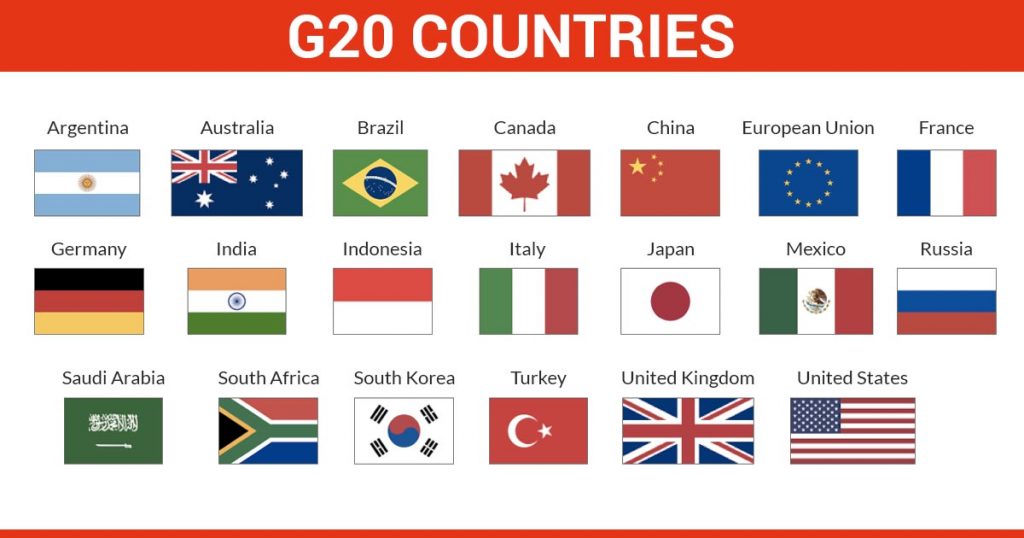
    The members of the G20 consist of 19 individual countries plus the European Union (EU).

    • The 19 member countries of the forum are Argentina, Australia, Brazil, Canada, China, France, Germany, India, Indonesia, Italy, Japan, Mexico, Russia, Saudi Arabia, South Africa, South Korea, Turkey, United Kingdom and the United States.
    • The European Union is represented by the European Commission and by the European Central Bank.

     Who are the G20 Sherpas?

    • A Sherpa is the personal representative of a head of state or government who prepares an international summit, particularly the annual G7 and G20 summits.
    • Between the summits, there are multiple Sherpa conferences where possible agreements are laid out.
    • This reduces the amount of time and resources required at the negotiations of the heads of state at the final summit.
    • The Sherpa is generally quite influential, although they do not have the authority to make a final decision about any given agreement.
    • The name is derived from the Sherpa people, a Nepalese ethnic group, who serve as guides and porters in the Himalayas, a reference to the fact that the Sherpa clears the way for a head of state at a major summit.
  • China and WHO a new story

    Context

    The WHO leadership, especially its Director-General, has been accused of serving China’s interests rather than preparing the world against the spread of the virus.

    What is the basis of accusations?

    • The first basis for these charges is the WHO’s endorsement of the Chinese claim in mid-January that there was no evidence of human-to-human transmission of the virus.
    • Second, consistent support for Beijing’s handling of the crisis.
    • Third, WHO’s criticism of other nations for imposing travel restrictions to and from China.
    • Critics also believe the WHO lulled the world into complacence by delaying the decision on calling it a global emergency.

    The new geopolitics of multilateralism

    • Whatever the merits of the above arguments, they point to the new geopolitics of multilateralism,
    • It also disproves the assumptions in both the West and India on China’s role in the UN.
    • It also underlines Beijing’s success in the leveraging of international organisations for its national advantage.
    • Nations working together against the trans-national threat: On the face of it, the sentiment that nations must work together against common trans-national threats is an eminently sensible one. But it does not easily translate into concrete actions.
    • Example of failure to act against a common threat: Take climate change. Attempts at developing collective solutions to the problem over the last three decades have foundered.
    • Most leaders agree on the problem and the solutions but are not willing to accept the framework — either the domestic or international — for distributing the costs associated with the solutions.
    • The US-China rivalry angle to the coronavirus outbreak: The problem of the cost-benefit distribution is compounded by great power rivalries. The coronavirus has shown up at a moment of deepening tensions between the US and China.
    • The grave collective challenge that the virus constitutes has only sharpened the conflict.
    • The blame game between the two: The US blames Beijing for letting this virus become a global monster and Beijing is doing all it can to deny that the virus came out of China.

    How the relationship between China and WHO has transformed over the years?

    • WHO’s actions in the past: Nearly two decades ago, during the SARS crisis, WHO was at the front and centre of pressing China to come clean on the unfolding pandemic.
    • In 2003, it had issued the organisation’s first travel advisory ever on travel to and from the epicentre of the pandemic in southern China.
    • As the SARS crisis escalated, Beijing’s traditional arguments about the centrality of state sovereignty yielded place to a new policy of working with the WHO and taking proactive steps to reassure neighbours in South East Asia.
    • Reasons for change in WHO’s stance: Some attribute the turnaround in the relationship between Beijing and WHO to China’s growing financial contributions.
    • China’s efforts to expand clout: Observers of the UN point to something more fundamental — a conscious and consequential Chinese effort to expand its clout in the multilateral system.
    • China, which was admitted to the UN system in the 1970s, was focused on finding its way in the 1980s, cautiously raised its profile in the 1990s, took on some political initiatives at the turn of the millennium and seized the leadership in the last few years.

    How India and the West are reacting to China’s rise?

    • Unprepared to deal with China’s rise at UN: Neither the West nor India have been prepared to deal with the impact of China’s rise on the UN system.
    • The US and its allies bet that China will be a “responsible stakeholder”. Put another way, they hoped that China will play by the rules set by the West.
    • China’s ambitions: China, of course, wants to set its own rules. Only the political innocents will be shocked by China’s natural ambition.
    • India’s past alignment with China: India, which considered US dominance over the international institutions in the 1990s as a major threat, chose to align with China in promoting a “multipolar world”.
    • Delhi convinced itself that despite differences over the boundary, Pakistan and other issues, there is huge room for cooperation with China.
    • Replacing the US as the dominant force: To their chagrin, the West and India are being compelled to respond to a very different environment at the UN. China wants to replace America as the dominant force in the UN.
    • The US is now fighting back. Last month, Washington went all out to defeat the Chinese candidate for the leadership of an obscure UN agency called the World Intellectual Property Organisation.

    Implications of China’s rise for India

    • Chinese hegemony vs. American primacy: Delhi discovered that Chinese global hegemony could be a lot more problematic than American primacy.
    • After all, it is China that complicates India’s plans for membership of the Nuclear Suppliers Group, protects Pakistan against international pressures on cross-border terrorism, and relentlessly pushes the UN Security Council to take up the Kashmir question.
    • India now turns to the US and its allies to pursue some of its interests in the UN.
    • Multilateralism not an end in itself: Political ironies apart, if there is one lesson that India could learn from China’s experience with WHO and the UN, it is that multilateralism is not an end in itself for major powers.
    • It is an important means to secure one’s national interest and shape the international environment.
    • As a nation battered by the Cultural Revolution, China used international cooperation and global institutions to rebuild itself in the last decades of the 20th century.
    • Ready to reorder global governance: Having developed its economy and advanced its scientific and technological base, China is now ready to reorder global governance and become a rule-maker.
    • The effects are visible in the arena of global health.
    • China’s expanding global engagement with the WHO, its substantive international health assistance programmes, and an impressive domestic health technology sector are poised to boost China’s ambition to build a “Global Silk Road for Health’.

    Conclusion

    On its part, Delhi needs to intensify the recalibration of India’s multilateralism, rewrite its diplomatic lexicon at the UN, and build new political coalitions that will simultaneously contribute to India’s internal modernisation and enhance its international influence. The corona crisis is a good moment to start writing a new script for India’s own health diplomacy.

  • Explained: Why UN Human Rights Commission intends to intervene in a SC case against CAA?

    The UN High Commissioner for Human Rights “intends to file” an Intervention Application in the Supreme Court of India seeking to intervene in Writ Petition (Civil) No. 1474 of 2019 and praying that it be allowed to make submissions.

    On what grounds is a UN body seeking to intervene in a case regarding a domestic Indian law?

    • The Office of the High Commissioner for Human Rights (UN Human Rights) is the leading UN entity on human rights.
    • The UN General Assembly entrusted both the High Commissioner and her Office with a unique mandate to promote and protect all human rights for all people.
    • As the principal United Nations office mandated to promote and protect human rights for all, OHCHR leads global human rights efforts speaks out objectively in the face of human rights violations worldwide.
    • This resolution, adopted by the UNGA in 1994, created the post of the UN High Commissioner for Human Rights.

    Its jurisdiction

    • The application says that successive High Commissioners have filed amicus curiae briefs on issues of particular public importance within proceedings before a diverse range of international and national jurisdictions.
    • It includes the European Court of Human Rights, the Inter-American Court of Human Rights, the International Criminal Court, and at the national level, the United States Supreme Court and final appeal courts of States in Asia and Latin America.

    What exactly does the intervention application say?

    • The OHCHR has welcomed as “commendable” the CAA’s stated purpose, “namely the protection of some persons from persecution on religious grounds.
    • It also “acknowledges the history of openness and welcome that India has exhibited to persons seeking to find a safer, more dignified life within its borders”.
    • However the examination of the CAA raises important issues with respect to international human rights law and its application to migrants, including refugees, says the OHCHR.
    • The CAA, it says, raises “important human rights issues, including its compatibility in relation to the right to equality before the law and nondiscrimination on nationality grounds under India’s human rights obligations”.
    • The application acknowledges that “the issue of nondiscrimination on nationality grounds falls outside the scope of this intervention”, but insists that “this in no way implies that there are not human rights concerns in this respect”.

    Why intervene?

    • The application questions the reasonableness and objectivity of the criterion of extending the benefits of the CAA to Buddhists, Sikhs, Hindus, Jains, Parsis and Christians from Afghanistan, Bangladesh and Pakistan alone.
    • It points out that while the Indian government has suggested that persons of Muslim faith, regardless of denomination or ethnicity, are protected there.
    • However recent reports by UN human rights show that Ahmadi, Hazara and Shia Muslims in these countries warrant protection on the same basis as that provided in the preferential treatment proposed by the CAA.

    Is there a specific basis on which the OHCHR has faulted the CAA?

    The application flags some central principles of international human rights law:

    1. the impact of the CAA on some migrants
    2. the enjoyment of human rights by all migrants and the rights of all migrants (non-citizens) to equality before the law and
    3. the principle of non-refoulment, which prohibits the forcible return of refugees and asylum seekers to a country where they are likely to be persecuted
    • The application mentions that all migrants “regardless of their race, ethnicity, religion, nationality and/or immigration status enjoy human rights and are entitled to protection”.
    • It cites international human rights instruments to urge the inclusion of non-discrimination, equality before the law, and equal protection before the law into the foundation of a rule of law.
    • International human rights law, the application says, does not distinguish between citizens and non-citizens or different groups of non-citizens for the purposes of providing them protection from discrimination, “including in respect of their migration status”.

    India’s stance

    • The Citizenship Amendment Act is an internal matter of India and concerns the sovereign right of the Indian Parliament to make laws.
    • MEA spokesperson insisted that no foreign party has any locus standi on issues pertaining to India’s sovereignty.
    • The CAA was “constitutionally valid and complies with all requirements of (India’s) constitutional values”, and “is reflective of our long-standing national commitment in respect of human rights issues arising from the tragedy of the Partition of India”.
  • Blue Dot Network


    With US President Donald Trump on his maiden visit to India, the two countries are expected to have discussed the Blue Dot Network, a proposal that will certify infrastructure and development projects.

    Blue Dot Network

    • Led by the US’s International Development Finance Corporation (DFC), the Blue Dot network was jointly launched by the US, Japan (Japanese Bank for International Cooperation) and Australia (Department of Foreign Affairs and Trade) in November 2019 on the sidelines of the 35th ASEAN Summit in Thailand.
    • It is meant to be a multi-stakeholder initiative that aims to bring governments, the private sector and civil society together to promote “high quality, trusted standards for global infrastructure development”.
    • The network is like a “Michelin Guide” for infrastructure projects.
    • This means that as part of this initiative, infrastructure projects will be vetted and approved by the network depending on standards, as per which, the projects should meet certain global infrastructure principles.
    • The projects that are approved will get a “Blue Dot”, thereby setting universal standards of excellence, which will attract private capital to projects in developing and emerging economies.

    Countering China’s BRI?

    • Observers have referred to the proposal as a means of countering China’s Belt and Road Initiative (BRI), which was launched over six years ago.
    • While Blue Dot may be seen as a counter to BRI, it will need a lot of work for two reasons.

    Fundamental difference between BRI and Blue Dot

    • While the former involves direct financing, giving countries in need immediate short-term relief, the latter is not a direct financing initiative and therefore may not be what some developing countries need.
    • The question is whether Blue Dot offering first-world solutions to third-world countries.
    • Secondly, Blue Dot will require coordination among multiple stakeholders when it comes to grading projects.
    • Given the past experience of Quad, the countries involved in it are still struggling to put a viable bloc. Therefore, it remains to be seen how Blue Dot fares in the long run.
  • [pib] Lucknow Declaration

    The first India-Africa Defence Ministers’ Conclave held in Lucknow has adopted the Lucknow Declaration.

    India-Africa Framework for Strategic Cooperation

    The declaration:

    • Acknowledges contribution of Indian defence forces in humanitarian assistance and disaster relief operations in Africa.
    • It appreciates initiation of Africa India Field Training Exercises with the first ever AFINDEX in March 2019 and agree that it will further strengthen cooperation in defence preparedness and security.
    • The vision is to achieve ‘a conflict-free Africa, prevent genocide, make peace a reality for all and rid the continent of wars, violent conflicts, human rights violations, and humanitarian disasters.
    • It call for deeper cooperation in the domain of defence industry including through investment, joint ventures in defence equipment software, digital defence, research & development etc.
    • It recognizes the common security challenges such as terrorism and extremism, piracy, organised crime including human trafficking, drug trafficking, weapon smuggling and others.
    • The members endorsed initiatives such as African Peace and Security Architecture (APSA), Silence The Guns in Africa and Agenda 2063.
    • It calls for strengthening the UN Counter-Terrorism mechanisms and to ensure strict compliance with the UN Security Council sanctions regime on terrorism.
    • It urged the international community to envisage the adoption of Comprehensive Convention on International Terrorism in the UNGA.
    • The members recognized the importance of the oceans and seas to the livelihoods of our peoples and that Maritime security is a pre-requisite for the development of Blue or Ocean economy.
    • It sought to increase cooperation in securing sea lines of communication, preventing maritime crimes, disaster, piracy, illegal, unregulated and unreported fishing through sharing of information and surveillance.
  • [op-ed snap] A case of a maritime presence adrift

    Context

    The International Maritime Organization (IMO), had mandated that merchant ships should not burn fuel with sulphur content greater than 0.5% beginning January 1.

    Why the new sulphur content limit matters?

    • The previous limit of 3.5 %: Before the ban, fuel had a comfortable sulphur content limit of 3.5%, which was applicable to most parts of the world.
    • Problem with low content fuel: Many industry professionals feared that the new very-low-sulphur fuel would be incompatible with the engines and other vessel equipment.
    • Problems with past US limits: Past mandates on sulphur limits in American waters had led to many technical problems. There have been instances of ships having been stranded after fine particles separated out from the fuel, damaging equipment and clogging up devices.

    How such regulations matter for India?

    • Sulphur cap one of the many problems: The global sulphur cap is only one of the many environment-related regulations that have been shaking up the shipping industry.
      • The industry is generally risk-averse and slow to accept changes.
      • For instance, efforts are ongoing to reduce nitrogen oxides (NOx) and ozone-depleting gases.
    • IMO project to decarbonise shipping: Further, the IMO has announced an ambitious project to decarbonise shipping in order to reduce carbon emissions.
    • How it matters for India? These regulations are triggering massive technological, operational and structural changes.
      • They come at a price which will have to be borne to a large extent by developing countries such as India.
      • India among 10 countries: The IMO currently lists India as among the 10 states with the “largest interest in international seaborne trade”.
      • Inadequate participation of India: But India’s participation in the IMO to advance its national interests has been desultory and woefully inadequate.
    • How it could matters: The sulphur cap, for instance-
      • Will reduce emissions.
      • Reduce the health impact on coastal populations but-
      • Ship operational costs are going up since the new fuel product is more expensive.
    • Refineries struggling to meet demand: As refineries including those in India struggle to meet the demand, freight costs have started moving up, with a cascading effect on retail prices.

    Significance of shipping and the role of IMO

    • Significance of shipping: Shipping, which accounts for over 90% by volume and about 80% by value of global trade.
      • Role of IMO: It is a highly regulated industry with a range of legislation promulgated by the IMO.
      • The IMO currently has 174 member states and three associate members; there are also scores of non-governmental and inter-governmental organisations.
      • The IMO’s policies or conventions have a serious impact on every aspect of shipping including the cost of maritime trade.
    • How IMO functions
      • The IMO, like any other UN agency, is primarily a secretariat, which facilitates decision-making processes on all maritime matters through meetings of member states.
      • How treaties are made? The binding instruments are brought in through the conventions -to which member states sign on to for compliance -as well as amendments to the same and related codes.
      • Structure of IMO: Structurally, maritime matters are dealt with by the committees of the IMO –
      • The Maritime Safety Committee (MSC).
      • Marine Environment Protection Committee (MEPC).
      • Technical Cooperation Committee.
      • Legal Committee and the Facilitation Committee.
      • Each committee is designated a separate aspect of shipping and supported by sub-committees. Working groups and correspondence groups support the subcommittees.
    • Role of subcommittees of IMO: The subcommittees are the main working organs, where the proposals from a member state are parsed before they are forwarded to one of the main committees.
      • The main committees, thereafter, with the nod of the Assembly, put the approved proposal for enactment through the Convention, amendments, and codes or circulars.

    India’s inadequate efforts at protecting the interest

    • How other countries deal with the issues: To ensure that their maritime interests are protected, the European countries move their proposals in unison and voting or support are given en bloc.
      • Permanent representative: China, Japan, Singapore, Korea and a few others represent their interests through their permanent representative as well as ensuring that a large delegation takes part and intervenes in the meetings.
    • How India is falling short? While these countries have fiercely protected their interests, India has not.
      • No permanent representative: For example, its permanent representative post at London has remained vacant for the last 25 years.
      • Representation at meetings is often through a skeletal delegation
      • India’s presentation inadequate: A review of IMO documents shows that the number of submissions made by India in the recent past has been measly and not in proportion to India’s stakes in global shipping.
    • “High-Risk Area” demarcation issue: The promulgation of “High-Risk Areas” when piracy was at its peak and dominated media headlines.
      • What happened in the issue? The IMO’s demarcation resulted in half the Arabian Sea and virtually the entire south-west coast of India being seen as piracy-infested, despite the presence of the Indian Navy and Coast Guard.
      • The “Enrica Lexie” shooting incident of 2012, off the coast of Kerala, was a direct fallout of the demarcation.
    • What were the consequences of the demarcation issue?
      • Increase in insurance costs: The “High-Risk Area” formulation led to a ballooning of insurance costs; it affected goods coming into or out of India.
      • It took great efforts to revoke the promulgation and negate the financial burden.
      • The episode highlighted India’s apathy and inadequate representation at the IMO.
      • NavIC introduction difficulty: There was also great difficulty in introducing the indigenously designed NavIC (NAVigation with Indian Constellation) in the worldwide maritime navigation system.
    • What could be the consequences in future?
      • EU’s documented procedure: In contrast, the European Union has a documented procedure on how to influence the IMO.
      • Agenda driven by developed countries: New legislative mandates, fitment of new equipment and changes to ship structural designs being brought on have been driven by developed countries.
      • Consequences for India: All the issues pushed by developed countries are not entirely pragmatic from the point of view of India’s interests.
      • Further, it will not be mere speculation to see them as efforts to push products and companies based in the West.

    Conclusion

    So far, India’s presence and participation in the IMO has been at the individual level. India should now make its presence felt so that its national interests are served. It is time India regained its status as a major maritime power.


  • [op-ed snap] As India prepares to honour Bolsonaro

    Context

    India has invited the Brazilian President to be a guest of honour for Republic Day 2020. It is also a good opportunity for focusing on intra-BRICS partnership and trade.

    Future of the BRICS

    • To move towards multi-polarity: This was set up as a move towards greater multi-polarity; hence the spread across three continents and both hemispheres.
      • Infirmities in the group: The BRICS combination accounts for about one-third of global output, but a glance at the GDP t and growth rates will show the infirmities of the group.
      • Differences in GDP: In terms of GDP, China occupies the second position; India the fifth; Brazil the ninth; Russia the 11th; and South Africa the 35th.
      • Differences in growth rate: In terms of growth rates, China grew at 6%; India at 4.5%, Russia 1.7%, Brazil 1.2% and South Africa 0.1%.
      • Both politically and economically, Brazil and South Africa have been the laggards in recent years. But there are certain similarities as well.
    • Similarities in the group: Each country has different economic and political leverage and its own burden of domestic and external issues.
      • Decision-making structure: They all share the benefits of autonomous decision making.
      • Non-affiliation: The members of the group have non-affiliation with any binding alliances.
      • Informal structure: The group’s informal structure is an advantage for coordination among the most influential non-Western countries.
    • Challenges to the survival of the group: The BRICS group can survive only if its members maximise their congruencies to the extent possible. Following are the challenges to the existence of the group-
      • The growing intensity of Sino-Russian ties.
      • The pro-American leanings in Brazil.
      • The socio-economic difficulties of South Africa after nine years under the controversial Jacob Zuma.
      • India’s many difficulties with China, including its abstention from the Regional Comprehensive Economic Partnership.

    Achievement of the grouping

    • New Development Bank: The main achievement of BRICS is the New Development Bank, with each country contributing equally to its equity.
      • The bank has so far financed over 40 projects at a cost of $12 billion.
      • The BRICS countries are also developing a joint payments mechanism to reduce foreign trade settlements in U.S. dollars.
    • BASICS: An offshoot of the group, dealing with climate change, is BASIC (BRICS without Russia).
      • BASICS met at the Spain conference last month and reiterated its support to the Paris Agreement.
    • India’s lead role: India is taking the lead role in-
      • Digital health, Digital forensics
      • Film technology.
      • Traditional medicine.
      • Sustainable water management,
      • Internships and fellowships.

    Brazil-India relation

    • Visa waiver for Indians: Brazil declared the decision to waive visa requirements for Indian citizens.
    • Potential for investments: There is potential for Brazilian investments in the sectors of space and defence, agricultural equipment, animal husbandry, post-harvest technologies, and bio-fuels.
    • Low two-way trade: The total two-way trade is at a paltry $8 billion, and the prospect of closer economic ties, however desirable, would require considerable optimism.

    Conclusion

    Both India and Brazil need to further deepen the ties and increase cooperation in various areas of cooperation. BRICS, despite the various challenges, need to focus on congruencies between them and work towards greater cooperation.

    .