💥Join UPSC 2027,2028 Mentorship (July Batch) + XFactor Notes & Microthemes PDF

Subject: Governance

Important aspects of Society

  • Civil Society Organizations are often perceived as being anti-State actors rather than non-State actors. Do you agree? Justify.

    CSOs are non-state, non-profit entities that represent citizens’ interests and act as intermediaries between the state and the people. However, their role oscillates between cooperation (as development partners) and confrontation (as watchdogs).

    Civil Society Organizations as Anti-State Actors – Arguments in Favour

    CSOs frequently expose corruption, inefficiency, and rights violations by state institutions. Governments perceive such actions as hostile scrutiny.

    Opposition to Government Policies and Projects – Eg- Narmada Bachao Andolan (NBA) opposed Sardar Sarovar dam project

    National Security Concerns – Eg- 2014 Intelligence Bureau Report claimed foreign-funded NGOs caused a “2-3% GDP slowdown” by delaying energy and mining projects.

    Mobilisation of Protests – CSOs lead agitations and mass movements that directly confront state authority. Eg- Anti-AFSPA protests in Manipur led by Irom Sharmila.

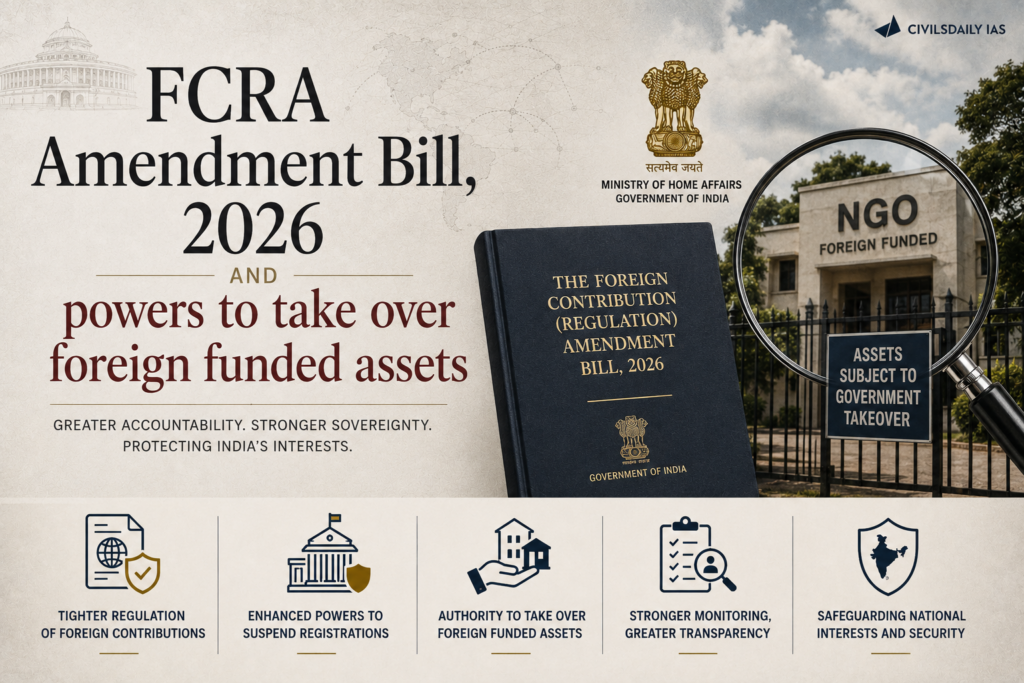
    Foreign Funding Suspicions – Eg- FCRA action against Greenpeace India for alleged anti-development activities.

    Use of PILs and Social Media Activism is perceived as obstruction. Eg- Citizens for Justice and Peace (CJP) filed petitions challenging the CAA and NRC.

    Civil Society Organizations as Non-State but Not Anti-State Actors – Arguments Against

    Complementing the State in Service Delivery – CSOs fill governance gaps in education, health, and rural development. Eg- Azim Premji Foundation Trust runs 3500+ schools

    Policy Advocacy – Eg- MKSS inspired the Right to Information Act (2005)

    CSOs empower citizens by promoting political awareness and participatory governance. Eg- ADR enhances electoral transparency through candidate data publication.

    Humanitarian and Relief Support – Eg- Akshaya Patra Foundation distributed 200 million meals during COVID-19; Goonj provided relief materials during Kerala floods.

    Promoting Inclusive Development – CSOs advance the goals of equity, gender justice, and social inclusion. Eg- Sakhi Resource Centre (Kerala)

    CSOs help India align with SDGs and climate commitments, enhancing India’s global standing. Eg- WWF-India and TERI partner with MoEFCC for biodiversity programs.

    Way Forward

    Vijay Kumar Committee Recommendations: ‘Light regulation’ of NGO

    2nd ARC: enact a law to set up an independent National Accreditation Council

    Create formal government-NGO platforms (as in Kerala’s Kudumbashree).

    Encourage Social Accountability Tools like Jan Sunwai, Community Scorecards, and Participatory Planning.

    Shift from Confrontation to Collaboration – seeing CSOs as governance partners, not adversaries

    NGOs are integral cogs in the wheel of good governance”. A balanced partnership between genuine NGOs and the government is crucial for India’s progress.

  • E-governance projects have a built-in bias towards technology and back-end integration than user-centric designs. Examine.

    The World Bank defines e-governance as the use by government agencies of information technologies that can transform relations with citizens, businesses, and other arms of government.

    E-governance Projects

    Government to Citizen (G2C) – UMANG, DigiLocker

    Government to Business (G2B) – MCA21, GSTN, GeM Portal

    Government to Government (G2G) – PRAGATI, e-Office

    Government to Employee (G2E) – SPARROW, iGOT-Karmayogi

    Built-in Bias Towards Technology and Back-End Integration

    Infrastructure-Centric Approach: Focus on servers, networks, and databases rather than citizen interface.

    Neglect of ease of access for end-users. Eg- complexity in GSTN and MCA 21 portals.

    Exclusion Errors: Aadhaar authentication failures lead to denial of benefits. Eg- Jharkhand PDS (2017) saw 10-15% exclusion (NITI Aayog).

    Technology Outpacing Capacity: Rapid adoption of AI, blockchain, and analytics without adequate digital literacy or institutional capacity at the local level.

    Lack of User-Centric Designs

    Language and Accessibility Barriers: Most portals available only in English, excluding non-English users.

    Complex Interfaces and Poorly designed websites discourage participation. Eg- multiple logins and verification steps.

    Digital Divide and Exclusion: Only 43% of rural households have internet (NFHS-5, 2021).

    Most systems lack built-in feedback loops or grievance redressal.

    Absence of Design Thinking: Systems designed from administrative, not citizen, perspective

    One-Size-Fits-All Approach: Uniform design ignores regional, gender, and social diversity, affecting inclusivity.

    However, there are few Achievements

    UMANG App: Unified access to 2,300+ government services in 23 languages

    MyGov Platform: Enables citizen consultation and idea crowdsourcing.

    Jan Soochna Portal (Rajasthan): Promotes proactive disclosure of welfare data.

    eSanjeevani Telemedicine Platform: Over 18 crore consultations, with simple, accessible interface for rural users.

    BHASHINI: Supports 35+ Indian languages, breaking language barriers and enhancing inclusivity.

    PMGDISHA: Over 6.3 crore citizens trained in digital literacy.

    Way Forward

    Adopt Design Thinking: Involve citizens in service design and usability testing.

    Local Language Interfaces: Scale BHASHINI integration across all digital services.

    Social Audits and Human Interface: Combine digital governance with local institutions for last-mile trust.

    Strengthen Digital Infrastructure: Accelerate BharatNet Phase-II to connect all Gram Panchayats

    India must move toward “Technology with Inclusion” – ensuring no beneficiary is left behind.

    Civil Society Organisations

  • The National Commission for Protection of Child Rights has to address the challenges faced by children in the digital era. Examine the existing policies and suggest measures the Commission can initiate to tackle the issue.

    The NCPCR, established under the Commission for Protection of Child Rights Act, 2005, is the apex body for safeguarding child rights under Articles 14, 15(3), 21, and 39(e)-(f) of the Constitution.

    Challenges Faced by Children in the Digital Era

    Online Sexual Exploitation: Increased exposure to pornography, grooming, and trafficking.

    Cyberbullying and Harassment: UNICEF (2019) – 1 in 3 Indian children faced online bullying.

    Privacy and Data Protection Issues

    Mental Health: Addiction, Self harm, Anxiety etc.

    Digital Divide: Unequal access to internet-based education deepens learning inequality

    Exposure to Harmful Content – Eg- Blue Whale Challenge.

    Deepfakes & AI Manipulation – Eg- Interpol flagged AI-generated child pornography.

    Functions and Powers of NCPCR

    Examine and Review Safeguards

    Inquire into Violations

    Advise on Policy and Legislation

    Monitor Implementation of child-related laws, such as the Juvenile Justice Act, POCSO Act, and RTE Act.

    Research and Awareness

    Inspect juvenile homes, observation homes, and child care institutions.

    Quasi-Judicial Powers: powers of a civil court

    Existing Policies and Initiatives

    IT (Intermediary Guidelines and Digital Media Ethics Code) Rules, 2021 – Mandate removal of child sexual abuse content and ensure age-based content filtering.

    POCSO Act, 2012 (Amended 2019) – Covers online sexual abuse and child pornography.

    National Cybercrime Reporting Portal – Allows reporting of child cyber exploitation.

    Digital India & PM eVIDYA – Promote safe and inclusive digital learning.

    NCPCR Initiatives:

    POCSO e-Box – Online reporting of sexual abuse.

    Sammaan Portal – Tracks child abuse cases online.

    Guidelines on Online Child Safety (2020) during COVID.

    Guidelines for Ed-Tech Platforms – Protect children’s digital privacy and safety.

    POCSO e-Courts Project (2018) – to fast-track POCSO trials using digital case management systems

    Issues in the Existing Policies and Legal Framework

    Fragmented Mechanism: Overlap among NCPCR, IT Ministry, and police leads to poor coordination.

    Outdated Laws: IT Act 2000 and POCSO Act 2012 don’t address AI, dark web, or social media threats.

    Weak Child Data Protection: Data Protection Act 2023 lacks strong safeguards for children’s data and consent.

    Poor Enforcement of IT Rules: Platforms often ignore self-regulatory duties to remove harmful content.

    Limited Cyber Policing: Lack of trained cyber experts and forensic tools in law enforcement.

    Low Awareness: Parents, teachers, and officials unaware of digital risks and reporting mechanisms.

    Slow Justice Delivery: POCSO trials and cybercrime cases face long delays and low conviction rates.

    Unregulated Ed-Tech and Gaming: No clear norms for content, privacy, or addictive design in children’s apps.

    Measures NCPCR Can Initiate

    Strengthen Legal and Regulatory Framework: Recommend amendments to ensure strict age verification, child data protection, and content moderation.

    Establish Digital Child Protection Cell to track online abuse and emerging threats.

    Cyber Safety Education in schools and communities.

    Conduct periodic studies on children’s digital behaviour and risks for evidence-based policymaking.

    Build Capacity of Law Enforcement on cyber forensics and child protection laws.

    Advocate screen-time guidelines, parental supervision tools, and awareness on balanced digital habits.

    The child is both a promise and a responsibility.” Thus, the 3R approach of Reform, Reorientation and Restructuring can enhance functioning of NCPCR as an effective Guardian of Child Rights.

    Comparison of Constitutions

  • “In contemporary development models, decision-making and problem-solving responsibilities are not located close to the source of information and execution, defeating the objectives of development.” Critically evaluate.

    Contemporary development models

    Neoliberal – privatization, and deregulation

    Technocratic Model – Data driven governance

    Donor-Driven Model

    PPP Model

    Participatory Development Model

    Decision-Making and Problem-Solving Not Close to Ground

    Centralized Policy Design, with limited input from grassroots institutions. Eg- Uniform guidelines under PMAY-Gramin

    Bureaucratic Hierarchies lead to delayed responses. Eg- delays in fund release under MGNREGA due to multi-tier approvals.

    Technocratic and Data-Centric Planning leads to exclusion of indigenous knowledge.

    Weak Decentralization – PRIs and ULBs lack fiscal and functional autonomy. Only 40% of states have functional District Planning Committees (NITI Aayog, 2022).

    Lack of Coordination – ministries and departments work in silos. Eg- Smart Cities Mission: 60% projects delayed due to poor coordination.

    Lack of Participatory democracy – Communities are treated as beneficiaries rather than partners in development.

    Political and Fiscal Centralization through centrally sponsored schemes

    Regulatory Capture – Eg- Nexus of Bureaucracy-Politicians-Corporate. (Vohra Committee)

    Counter-Argument

    73rd & 74th Constitutional Amendments empowered PRIs and ULBs for local governance and participatory planning.

    Gram Panchayat Development Plans (GPDPs) institutionalized bottom-up planning in over 2.6 lakh Panchayats.

    Aspirational Districts Programme (ADP) – Promotes data-driven local governance with district-level flexibility and real-time monitoring.

    PM Gati Shakti National Master Plan – Integrates 16 ministries on a GIS-based platform to align planning and execution at ground level.

    Mission Karmayogi – Builds capacity of field-level officials for local problem-solving and citizen-centric service delivery.

    Cooperative Federalism via NITI Aayog – Governing Council enable state-specific and local feedback-based planning.

    Community-Led Models – Swachh Bharat Mission and Jal Jeevan Mission emphasize village-level implementation and monitoring.

    State Level Measures – Kerala’s People’s Plan Campaign

    Way Forward

    Capability Approach – increase spending on Health (2.5%of GDP) and Education (6% of GDP)

    Adopt Best Practices – Participatory Budgeting in porto alegre brazil

    Decentralized Governance based on principle of subsidiarity.

    “Growth becomes meaningful only when it expands human freedom and capability.” – Amartya Sen

    For this, decision-making authority and problem-solving responsibilities should be at the grassroots level.

    Social Justice

    Government Policies and Interventions for Welfare Schemes for Vulnerable Sections

  • Match List-I with List-II and select the correct answer using the codes given below the lists

    Match List-I with List-II and select the correct answer using the codes given below the lists:
    List-I (Board) and List-II (Headquarters):
    A. Coffee Board – 1. Bangalore
    B. Rubber Board – 2. Guntur
    C. Tea Board – 3. Kottayam
    D. Tobacco Board – 4. Kolkata.

  • Consider the following statements

    Consider the following statements:
    1. MMTC Limited is India’s largest international trading organization.
    2. Neelachal Ispat Nigam Limited has been set up by MMTC jointly with the Government of Orissa.
    Which of the statements given above is/are correct?

  • Consider the following statements

    Consider the following statements :
    1. Between Census 1951 and Census 2001, the density of the population of India has increased more than three times.
    2. Between Census 1951 and Census 2001, the annual growth rate (exponential) of the population of India has doubled.
    Which of the statements given abova is/are correct ?

  • Consider the following

    Consider the following:
    1. Hotels and restaurants
    2. Motor transport undertakings
    3. Newspaper establishments
    4. Private medical institutions
    The employees of which of the above can have the ‘Social Security’ coverage under Employees’ State Insurance Scheme?

  • Consider the following pairs

    Consider the following pairs:
    Programme/Project Ministry
    1. Drought-Prone Area Programme : Ministry of Agriculture.
    2. Desert Development Programme : Ministry of Environment and Forests.
    3. National Watershed Development Project for Rainfed Areas : Ministry of Rural Development.
    Select the correct answer using the code given below.

  • Consider the following statements

    Consider the following statements :
    (1) The Accelerated Irrigation Benefits Programme was launched during 1996-97 to provide
    loan assistance to poor farmers.
    (2) The Command Area Development Programme was launched in 1974-75 for the development
    of water-use efficiency.
    Which of the statements given above is/are correct?