💥Mains Ready By December. Smash Mains & Smash PYQ Admissions Open

Subject: Governance

Important aspects of Society

  • CSIR ASPIRE-SHAKTI

    Why in News?

    CSIR organised ASPIRE-SHAKTI: Celebrating Women in STEM at its headquarters and released the ASPIRE-SHAKTI Compendium, highlighting the achievements of women researchers.

    Key Highlights

    • CSIR: Council of Scientific & Industrial Research
    • DSIR: Department of Scientific & Industrial Research
    • STEM: Science, Technology, Engineering and Mathematics
    • CSIR-ASPIRE was launched on International Women’s Day 2023 to support women scientists as independent Principal Investigators (PIs).
    • Out of 2,878 proposals from 969 institutions, 301 women researchers were selected (~10% selection rate).
    • Research outcomes include:
      • 253+ SCI-indexed publications
      • 15+ patent filings
      • 20+ international conference presentations
      • Training of 300+ research fellows.
    • Next phase will focus on:
      • Commercialisation of innovations
      • Industry and startup linkages
      • Technology translation
      • Greater participation from the North-East, Ladakh, and Tier-2/Tier-3 institutions.

    About CSIR-ASPIRE

    • ASPIRE: A Special Call for Research Grants for Women Scientists
    • Implemented by CSIR-Human Resource Development Group (CSIR-HRDG).
    • Supports women researchers across Life Sciences, Physical Sciences, Chemical Sciences, Engineering Sciences, and Interdisciplinary Sciences.
    • Aims to promote women-led research, innovation, and scientific leadership.

    [2018] Consider the following statements :
    Human capital formation as a concept is better explained in terms of a process which enables
    1. individuals of a country to accumulate more capital.
    2. increasing the knowledge, skill levels and capacities of the people of the country.
    3. accumulation of tangible wealth.
    4. accumulation of intangible wealth.
    Which of the statements given above is/are correct?

    [A] 1 and 2

    [B] 2 only

    [C] 2 and 4

    [D] 1, 3 and 4

  • National Institute of Science Education and Research (NISER)

    Why in News?

    The Vice President of India recently addressed the 15th Graduation Ceremony of the National Institute of Science Education and Research (NISER), Bhubaneswar.

    About NISER

    • Established in 2006.
    • An Autonomous Institute under the Department of Atomic Energy (DAE), Government of India.
    • Located about 20 km south of Bhubaneswar, Odisha.
    • Equipped with advanced laboratories, computational facilities, library, and residential hostels.
    • Affiliated with the Homi Bhabha National Institute (HBNI), Mumbai, a deemed-to-be university under the DAE.

    Objectives

    • Develop high quality human resources in basic sciences.
    • Promote excellence in scientific research and innovation.
    • Contribute to India’s knowledge economy through education and research.

    Major Activities

    • Science Education: Centre of excellence for undergraduate and postgraduate education in basic sciences.
      • Offers: Five year Integrated M.Sc. Ph.D. programmes in pure and applied sciences.
    • Scientific Research: Conducts theoretical and experimental research in frontier areas of science. Has seven Schools specializing in different scientific disciplines.
    • Science Outreach and Policy: Promotes scientific temper through outreach programmes for students and the public. Faculty members contribute to national science policy formulation through various government committees.

    About Homi Bhabha National Institute (HBNI)

    • Established in 2005.
    • A Deemed to be University under the Department of Atomic Energy (DAE).
    • Headquartered in Mumbai.
    • Integrates academic programmes of premier DAE institutions to promote advanced education and research in science, engineering, and technology.

    [2015] Indira Gandhi Peace Prize for Peace, Disarmament and Development for 2014 was given to which of the following?

    [A] Bhabha Atomic Research Centre

    [B] Indian Institute of Science

    [C] Indian Space Research Organization

    [D] Tata Institute of Fundamental Research

  • Government Tightens Regulation of High Alcohol Containing Drug Formulations

    Why in News?

    The Central Government has amended the Drugs Rules, 1945 to tighten regulation of high alcohol containing medicinal formulations, removing their exemption under Schedule K and bringing them under Schedule H1.

    Key Highlights

    • Schedule K exemption removed for medicinal formulations containing:
      • More than 12% v/v ethyl alcohol, and
      • Pack size exceeding 30 mL.
    • Such products must now obtain manufacturing and sale licenses under the Drugs and Cosmetics Act, 1940.
    • Shifted to Schedule H1, making them:
      • Available only on the prescription of a Registered Medical Practitioner (RMP).
      • Subject to strict sale records and monitoring.
    • Targets misuse of formulations such as cardamom tincture, ginger tincture, and other aromatic preparations, some containing 80 to 90% v/v ethyl alcohol.
    • Ensures availability for genuine therapeutic use while preventing diversion for intoxication.

    Drugs and Cosmetics Act, 1940

    • Regulates the import, manufacture, distribution and sale of drugs and cosmetics in India.
    • Administered by the Ministry of Health and Family Welfare.
    • Implemented through the Central Drugs Standard Control Organisation (CDSCO) and State Drug Controllers.
    • Supported by the Drugs Rules, 1945, which prescribe standards, licensing, labeling and schedules.

    Schedule K

    • Lists specified drugs exempted from certain licensing provisions under defined conditions.
    • Intended mainly for low risk preparations or specified categories of sale.
    • The amendment removes exemption for high alcohol formulations exceeding the prescribed threshold.

    Schedule H1

    • Introduced to regulate drugs prone to misuse and antimicrobial resistance.
    • Drugs can be sold only on a registered medical practitioner’s prescription.
    • Pharmacists must:
      • Maintain a separate register recording patient and prescriber details.
      • Preserve records for at least three years.
    • Originally covered certain antibiotics, anti TB medicines and other critical drugs; now also includes specified high alcohol medicinal formulations.

    [2018] Consider the following statements:

    1. The Food Safety and Standards Act, 2006 replaced the Prevention of Food Adulteration Act, 1954.
    2. The Food Safety and Standard Authority of India (FSSAI) is under the charge of Director General of Health Services in the Union Ministry of Health and Family Welfare.
    Which of the statements given above is/are correct?

    (a) 1 only

    (b) 2 only

    (c) Both 1 and 2

    (d) Neither 1 nor 2
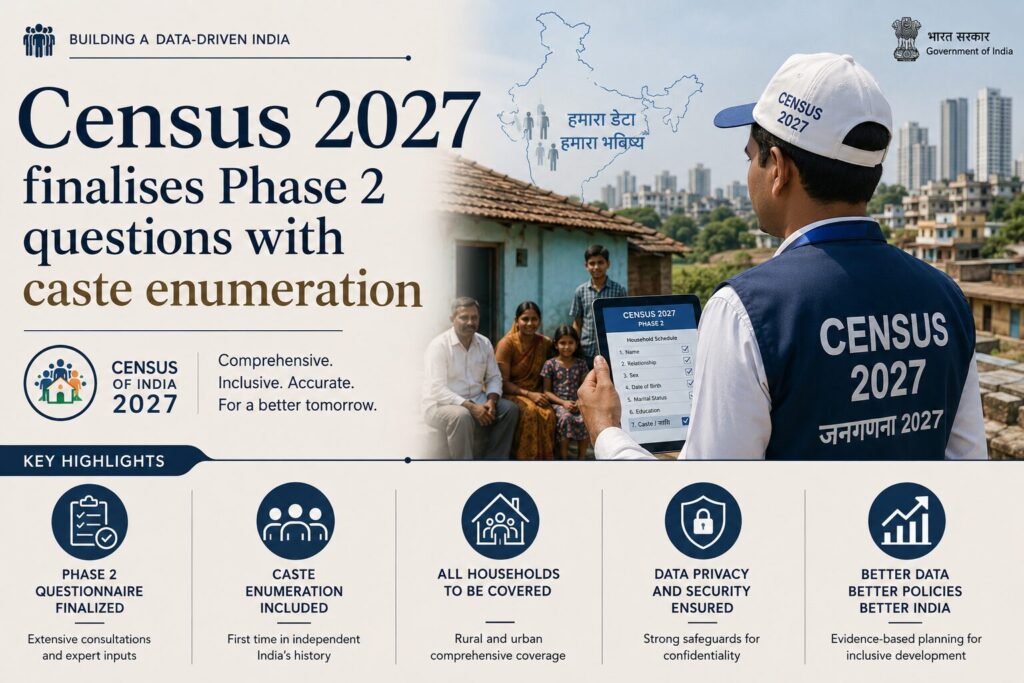
  • On the method of caste enumeration

    Why in the News?

    The pre-test for the second phase of Census 2027 began on July 6, 2026, in 16 States and Union Territories, using an “open column” for respondents to record their caste. The outcome of this pre-test will decide the final methodology for India’s first statutory caste enumeration since 1931.

    What has changed in this pre-test, and why does its outcome carry more weight than the 2011 exercise?

    1. Pre-test scope: The rehearsal for the second phase of Census ran in 16 States and Union Territories from July 6 to July 20, 2026, and included an open column for respondents to record their caste.
    2. Statutory shift: Unlike the 2011 Socio Economic and Caste Census (SECC), which was conducted outside the purview of the Census Act, caste in 2027 will be enumerated within the second and final phase of the Census itself, giving the count statutory backing.
    3. Methodology still open: Census officials stated that the final caste enumeration methodology will be prepared based on feedback from this pre-test, not fixed in advance.
    4. Historical gap: Caste-wise population, other than Scheduled Castes and Scheduled Tribes, has not been enumerated in independent India since the 1931 Census.
    5. Limited rehearsal access: Self-enumeration was permitted, with the portal accessible only from July 1 to 5, and only in the specific area undergoing the rehearsal.

    Why did the government finally agree to caste enumeration after years of resistance?

    1. Reversal in position: The BJP-led NDA government, after repeatedly opposing caste enumeration, announced on April 30, 2025, that caste would be counted during Population Census 2027.
    2. Opposition pressure: The Congress had consistently demanded a full caste count prior to this announcement.
    3. Coalition pressure: Some NDA allies also pushed for caste enumeration, adding pressure from within the ruling coalition.
    4. State-level precedent: Bihar’s 2022-23 caste-based survey demonstrated a working alternative model and added political momentum for a national exercise.

    Does repeating the open-column method risk reproducing the same unreliable outcome the government itself rejected?

    1. Scale of past failure: The 2011 SECC’s open-column method returned over 46 lakh distinct “caste names,” compared to only 4,147 recorded in the 1931 Census.
    2. Cause of inflation: Respondents recorded surnames or sub-castes as separate categories. For example, “Gupta” and “Agarwal” were recorded separately instead of under the common Baniya caste.
    3. Government’s own admission: In a 2021 Supreme Court affidavit, the Union government stated that the caste count “cannot be exponentially high” through genuine sub-caste bifurcation alone, and that SECC data cannot be relied on for reservation in education, employment, or local body elections.
    4. Method repeated despite the admission: The 2026 pre-test uses the identical open-ended caste column. Officials describe the method as “not final.”
    5. Structured alternative already exists: Current government data lists about 2,650 OBCs on the Central List, 1,170 Scheduled Castes, and 890 Scheduled Tribes — a far smaller, curated framework similar to the list-based model Bihar used, but not yet adopted for the national pre-test.

    What concerns have been raised about the process, and how has the government responded?

    1. Demand for consultation: Opposition parties have sought wider stakeholder consultation before the caste Census is finalised.
    2. Parliamentary question: On December 2, 2025, a Member of Parliament asked in the Lok Sabha whether the government would publish the draft Census questions for public and representative input, and whether it would consider best practices from state-level caste surveys.
    3. Government’s stated process: Minister of State for Home responded that draft questionnaires are field pre-tested before finalisation, consistent with over 150 years of Census practice that incorporates past learnings and stakeholder input.
    4. Repeated deferral through 2025: The government stated multiple times through 2025 that the final caste questionnaire had not been settled.
    5. Notification timeline unresolved: Parliament was informed in February 2026 that caste-related questions would be notified only before the commencement of the second Census phase, leaving the methodology undecided even as the pre-test proceeds.

    5. Why has the Census itself not just the caste count been delayed for over a decade?

    1. Two-phase structure: The Population Census is conducted in two phases, Houselisting and Housing Operations (HLO), and Population Enumeration, spanning over 11 months.
    2. Overdue cycle: The last Census was completed in 2011; the next was constitutionally due in 2021.
    3. Pandemic disruption: The first phase, due to begin April 1, 2020, was delayed by the COVID-19 pandemic that surfaced in India around March 2020.
    4. Unexplained continued delay: Pandemic-related restrictions had ended by 2022, but the government did not specify reasons for the delay beyond that point.
    5. Announced timeline: On June 4, 2025, the government announced that the Population Census, combined with caste enumeration, would be conducted in two phases by February 28, 2027, with the reference date and time of the headcount fixed at 12 a.m., March 1, 2027.

    Conclusion

    The 2027 Census will give caste enumeration statutory backing for the first time, closing the ambiguity that surrounded the unreleased 2011 SECC. The ongoing pre-test’s use of the same open-ended, self-declared caste column risks reproducing the unreliable, exponentially inflated caste count the government itself flagged before the Supreme Court in 2021. Whether the final methodology adopts a curated caste list, as Bihar’s survey did, or persists with the open column, will determine whether the resulting data is usable for its stated purpose of informing reservation, education, and employment policy. The government’s promise to notify questions only before the second phase begins leaves this central design choice unresolved even as the exercise proceeds.

    PYQ Relevance

    [UPSC 2020] Has caste lost its relevance in understanding the multicultural Indian Society? Elaborate your answer with illustrations.

    Linkage: The PYQ directly evaluates the contemporary relevance of caste. The decision to include caste in the 2027 Census itself reflects the continued administrative, political and socio-economic significance of caste in policymaking and governance. 

  • LokOS: Digital Backbone for Rural Livelihoods

    Why in News?

    The Government highlighted LokOS, the digital platform under Deendayal Antyodaya Yojana – National Rural Livelihoods Mission (DAY-NRLM), for strengthening governance, transparency, and financial inclusion of Self-Help Groups (SHGs).

    What is LokOS?

    • LokOS (Lok = People, OS = Operating System) is a web and mobile platform for end-to-end digitisation of Self-Help Groups (SHGs) and their federations.
    • Implemented under DAY-NRLM of the Ministry of Rural Development.
    • Digitises member records, savings, loans, repayments, livelihoods, and convergence with government schemes.

    Key Features

    • End-to-end digital management of SHGs, Village Organizations (VOs), and Cluster Level Federations (CLFs).
    • Aadhaar and bank-linked digital IDs for members.
    • Real-time recording of savings, loans, and repayments.
    • Livelihood profiling and scheme convergence.
    • Role-based administration and real-time dashboards.
    • Digitally tracks nearly ₹2 lakh crore worth of SHG financial transactions annually.

    SHE-LEAPS

    • Self-Help Entrepreneur Livelihoods and Enterprise Application for Prosperity and Sustainability (SHE-LEAPS) launched on 29 June 2026.
    • Operates under LokOS.
    • Supports women SHG members in enterprise creation, business management, and performance tracking.

    Coverage

    • Covers 34 States/UTs, 762 districts, 7,241 blocks, 2.57 lakh Gram Panchayats, and 5.92 lakh villages.
    • Digitally integrates: 94.16 lakh SHGs, 5.62 lakh Village Organizations, 34,314 Cluster Level Federations, and 10.03 crore SHG members

    [2023] Consider the following statements:
    1. The Self-Help Group (SHG) programme was originally initiated by the State Bank of India by providing microcredit to the financially deprived.
    2. In an SHG, all members of a group take responsibility for a loan that an individual member takes.
    3. The Regional Rural Banks and Scheduled Commercial Banks support SHGs.
    How many of the above statements are correct?

    [A] Only one

    [B] Only two

    [C] All three

    [D] None

  • MY Bharat (Mera Yuva Bharat)

    Why in News?

    The Government highlighted the achievements of MY Bharat (Mera Yuva Bharat) as India’s digital platform for youth engagement, volunteering, leadership, and nation-building.

    What is MY Bharat?

    • Launched in October 2023 under the Ministry of Youth Affairs and Sports.
    • A Digital Public Infrastructure (DPI) platform connecting youth with government, educational institutions, NGOs, and industry.
    • Aims to empower Amrit Peedhi through volunteering, skill development, experiential learning, and civic participation.

    Key Features

    • Digital Volunteerism: Over 1.52 lakh volunteering opportunities (June 2026). Supports online registration, geo-tagging, attendance, certificates, and impact tracking.
    • Experiential Learning: More than 24,900 Experiential Learning Programmes (ELPs). Offers internships, apprenticeships, industry exposure, quizzes, and competitions.
    • Leadership & Career Support: Viksit Bharat Youth Parliament for leadership development. AI-powered resume builder and mentoring. Multilingual quizzes on governance, Constitution, and public policy.

    Major Initiatives

    • MY Bharat MY Vote campaign for voter awareness.
    • Viksit Bharat Young Leaders Dialogue 2026 with over 50.42 lakh participants.
    • Nari Shakti Youth Parliament engaging 7,000+ young women.
    • Supports NSS, Nasha Mukt Bharat, Yoga Day, cleanliness drives, and padyatras.
    • Facilitated youth participation at the ECOSOC Youth Forum 2026.

    Digital Achievements

    • Guinness World Record (2026): Most users taking an online quiz in one week (390,812 participants).
    • Mobile app available in 22 Indian languages.
    • Over 1 lakh app downloads (July 2026).
    • Provides digital badges, certificates, and verified participation records.

    Future Roadmap

    • MY Bharat 2.0 will leverage Artificial Intelligence (AI), multilingual technology, open APIs, and digital credentials.
    • Targets empowering 100 million youth in line with Viksit Bharat@2047.

    [2016] Regarding DigiLocker’, sometimes seen in the news, which of the following statements is/are correct?
    1. It is a digital locker system offered by the Government under Digital India Programme.
    2. It allows you to access your e-documents irrespective of your physical location.
    Select the correct answer using the code given below.

    [A] 1 only

    [B] 2 only

    [C] Both 1 and 2

    [D] Neither 1 nor 2

  • How temples deal with donations

    Why in the News?

    Allegations of embezzlement of offerings and donations at the Ram Janmabhoomi Temple in Ayodhya have brought temple donation-handling systems under scrutiny. The episode has revealed that the Ram Temple trust operates without the statutory audit and oversight structures that govern India’s other major temples. The Ram Temple Construction Committee has sought a professional CEO while the Vishwa Hindu Parishad has demanded that temples across India be freed from government control.

    Why has the Ram Temple donations controversy exposed a broader gap in temple financial oversight?

    1. Trigger: Allegations of embezzlement of offerings and donations surfaced at the Ram Janmabhoomi Temple in Ayodhya. The allegations brought the temple’s donation-handling process into public scrutiny.
    2. Scale of the sector: India has no official count of Hindu temples. Estimates put the number at around 10 lakh.
    3. Common donation chain: Most major temples follow a similar process. Offerings are removed from donation boxes. They are then moved to counting centres for segregation, counting, and recording. Verified collections are deposited into designated bank accounts under CCTV surveillance.
    4. Unaccounted donations: Most temples are small shrines maintained by local communities or hereditary priests. A large share of cash and in-kind donations at these temples remains unaccounted for.
    5. Scale of major temple donations: Tirupati received ₹1,880 crore in annual donations, followed by Vaishno Devi at ₹230 crore, the Ram Temple at ₹150 crore, Siddhivinayak at ₹100 crore, Kashi Vishwanath at ₹80 crore, and Puri Jagannath at ₹18 crore.

    How does the Ram Temple’s donation-handling and governance framework differ institutionally from India’s other major temples?

    1. Ram Temple: The Shri Ram Janmabhoomi Teerth Kshetra Trust manages donations through a trust deed, a private legal instrument creating and governing a trust, without dedicated statutory backing. No dedicated state statute governs the temple’s administration.
    2. Tirupati: The Tirumala Tirupati Devasthanams operates under the Andhra Pradesh Charitable and Hindu Religious Institutions and Endowments Act. Its ‘Parakamani‘ system segregates finance, vigilance, and banking functions among separate personnel groups.
    3. Puri Jagannath: The Shri Jagannath Temple Act governs the temple. Hundis are sealed before and after opening, and entries are recorded in statutory forms.
    4. Vaishno Devi: The Jammu and Kashmir Shri Mata Vaishno Devi Shrine Act governs the shrine. A Shrine Board, not individual trustees, opens donation boxes through dedicated finance and security departments.
    5. Siddhivinayak: A Maharashtra law governs the temple’s trust. The main hundi is opened weekly in the presence of an executive officer, a trustee, a bank representative, and an auditor.
    6. Kashi Vishwanath: The Uttar Pradesh Shri Kashi Vishwanath Temple Act governs the temple. A Sub-Divisional Magistrate supervises the opening of its 56 donation boxes.
    7. Key distinction: Unlike these temples, the Ram Temple trust is not subject to mandatory financial audit by the state or central government. Several of its key office-bearers have long-standing associations with the RSS or its affiliates.

    Does statutory governance guarantee that temple donations remain free of controversy?

    1. Tirupati: The temple has tightened access controls, vigilance, and surveillance over the years after instances of theft involving employees and volunteers.
    2. Puri Jagannath: The Ratna Bhandar dispute centred on the custody and inventory of temple valuables. It led to court-directed scrutiny and fresh inventories.
    3. Kashi Vishwanath: Efforts have increasingly focused on routing donations through official channels. This shifts donations away from direct offerings to priests.
    4. Siddhivinayak: The temple has periodically faced scrutiny over governance and financial management.
    5. Implication: Institutional safeguards at older temples were built over time, not overnight. The Ram Temple’s current gap reflects its early stage of institutional development, not a unique failure.

    What traditions of temple management operate independent of statutory government frameworks?

    1. Family management: Temples are often managed by hereditary priest lineages known as pandas or pujaris. Offerings, donations, and ritual responsibilities traditionally belong to these families. Control rotates when multiple families are involved.
    2. Family management example: The Udupi Sri Krishna Mutt in Karnataka is administered by eight monasteries called the Ashta Mathas, founded by the 13th-century saint Madhvacharya. Each matha manages the mutt for two years. The next cycle for a matha comes only after 16 years.
    3. Mahant system: A single spiritual head, called a mahant, a spiritual head holding administrative and successor-nominating authority over a math, holds prime authority over temple assets, offerings, and administration. He typically appoints or nominates his successor.
    4. Mahant system example: The Gorakhnath Math in Gorakhpur is headed by Chief Minister Yogi Adityanath. He was appointed by the late Mahant Avaidyanath. Similar successor-based systems operate in the Shankaracharya mathas.
    5. Akhada system: Akhadas are autonomous organisations of sadhus that function as collective bodies with elected or consensus-based heads. They are also called Panchayati Akhadas, self-governing collectives of sadhus functioning through elected or consensus-based heads.
    6. Akhada system role: Akhadas appoint priests, oversee rituals, and control donations. They are prioritised for the holy dip at the Mahakumbh according to their relative status.

    Why has the Ram Temple donations controversy revived the debate over the extent of state control over religious institutions?

    1. Colonial origin of state control: The British introduced the Religious Endowments Act in 1863. It handed control of temples to committees set up under the Act, but the government retained influence through other legal provisions.
    2. Statutory blueprint: The Madras Hindu Religious Endowments Act, 1925 empowered provincial governments to legislate on endowments. Its powers expanded over time to include oversight and takeover of temple management. It became the blueprint for later state laws after Independence.
    3. Constitutional basis: Article 25(2) (The constitutional provision allowing the state to regulate secular activities linked to religious practice) empowers the state to regulate or restrict any economic, financial, political, or other secular activity associated with religious practice. This provision is the basis for state legislation governing temple endowments.
    4. Asymmetry across religions: Muslim and Christian institutions are managed through community-run boards or trusts. Statutory government-linked frameworks of the kind that govern major Hindu temples do not apply to them in the same way.
    5. Rival demands: The Ram Temple Construction Committee has proposed appointing a CEO to manage trust affairs. The Vishwa Hindu Parishad has instead called for temples across the country to be freed from government control.

    Conclusion

    The Ram Temple donations controversy stems from a specific institutional gap. The temple is governed by a trust deed, not a dedicated statute, and is not subject to mandatory financial audit. Bringing it under a statutory or audit framework similar to other major temples would close this specific gap. It would not by itself guarantee immunity from future controversy, since statutorily governed temples such as Tirupati, Puri, Kashi Vishwanath, and Siddhivinayak have all faced their own governance disputes. The unresolved question is political: whether India moves toward greater statutory oversight of temples or toward the Vishwa Hindu Parishad’s demand to free them from government control altogether.

    PYQ Relevance

    [UPSC 2024] Public charitable trusts have the potential to make India’s development more inclusive as they relate to certain vital public issues. Comment.

    Relevance: The PYQ tests the role of religious and charitable trusts in governance, public welfare, accountability, and inclusive development. The article examines how major temple trusts manage donations, institutional governance, transparency mechanisms, and the extent of state regulation, making it a direct case study of public charitable trusts in India.

  • MANAS (Madak Padarth Nishedh Asoochna Kendra)

    Why in News?

    The Government highlighted the achievements of MANAS (Madak Padarth Nishedh Asoochna Kendra), the National Narcotics Helpline, as a technology-driven platform supporting the vision of a Nasha Mukt Bharat through citizen participation, digital reporting, counselling, and rehabilitation.

    What is MANAS?

    • MANAS (Madak Padarth Nishedh Asoochna Kendra) is India’s National Narcotics Helpline.
    • Launched: 18 July 2024.
    • Implemented by: Narcotics Control Bureau (NCB) under the Ministry of Home Affairs (MHA).
    • Developed in collaboration with the Digital India Corporation (DIC).
    • A secure digital platform for:
      • Reporting drug-related offences.
      • Seeking counselling.
      • Accessing rehabilitation support.

    Key Features

    • Accessible through: Helpline: 1933, Official web portal, Email, and UMANG app
    • Allows anonymous reporting of Drug trafficking. Drug peddling. Illegal cultivation of narcotic plants.
    • Addiction-related calls are transferred to the Ministry of Social Justice and Empowerment’s de-addiction helpline (14446).
    • Features: Digital ticket generation. Workflow management. Smart IVRS (under development). Chatbot support. Multilingual and regional language assistance (being expanded).

    [2024] Consider the following activities:
    1. Identification of narcotics on passengers at airports or in aircraft
    2. Monitoring of precipitation
    3. Tracking the migration of animals
    In how many of the above activities can the radars be used?

    [A] Only one

    [B] Only two

    [C] All three

    [D] None

  • eSARAS: Digital Marketplace for Women Self-Help Groups

    Why in News?

    The Government highlighted the growing impact of eSARAS, the official digital marketplace for products made by Women Self Help Groups (SHGs) under DAY-NRLM, as a key initiative promoting rural livelihoods, women entrepreneurship and Digital India.

    What is eSARAS?

    • eSARAS (SARAS Aajeevika) is the official e-commerce platform of the Deendayal Antyodaya Yojana – National Rural Livelihoods Mission (DAY-NRLM).
    • Developed by the Ministry of Rural Development.
    • Provides women SHGs direct access to national online markets by eliminating intermediaries.
    • Supports marketing, branding, packaging and logistics.

    Key Features

    • Exclusive marketplace for SHG products.
    • Promotes One District One Product (ODOP) and traditional handicrafts.
    • Product categories include: Home & Living, Apparel & Accessories, Food Products, Personal Care, and Toys & Gifts
    • Integrated with ONDC (11+ buyer apps; 20+ crore potential buyers) and UMANG
    • Supported by eSARAS Mobile App, Fulfilment Centre, SARAS Aajeevika Gallery (New Delhi), and SARAS Shakti premium gift collection

    Key Statistics

    • 8.62 crore women SHG members have access to a digital storefront.
    • 85% linked directly to the Ministry of Rural Development network.
    • DAY-NRLM covers 7,627 blocks across India.
    • Supported by 1.51 crore community cadre members.
    • Over 800 handcrafted products listed on ONDC.

    Significance

    • Promotes women-led entrepreneurship.
    • Provides market access without intermediaries.
    • Preserves traditional crafts and cultural heritage.
    • Enhances rural incomes through digital commerce.
    • Supports Digital India, Atmanirbhar Bharat and inclusive rural development.
    • Encourages formalization of rural enterprises.

    About DAY-NRLM

    • Centrally Sponsored Scheme under the Ministry of Rural Development.
    • Aims to reduce rural poverty through: Women’s Self Help Groups, Financial inclusion, Skill development, and Sustainable livelihoods, and Enterprise promotion

    [2023] Consider the following statements:
    1. The Self-Help Group (SHG) programme was originally initiated by the State Bank of India by providing microcredit to the financially deprived.
    2. In an SHG, all members of a group take responsibility for a loan that an individual member takes.
    3. The Regional Rural Banks and Scheduled Commercial Banks support SHGs.
    How many of the above statements are correct?

    [A] Only one

    [B] Only two

    [C] All three

    [D] None

  • Academic Bank of Credits (ABC) & APAAR

    Why in News?

    The UGC mandated all Higher Education Institutions (HEIs) to upload students’ academic credits to the Academic Bank of Credits (ABC) portal by 30 June 2026, highlighting the progress of ABC and APAAR under NEP 2020.

    Academic Bank of Credits (ABC)

    • A digital repository of academic credits established by the Ministry of Education and regulated by the UGC.
    • Enables students to store, transfer and redeem academic credits earned from recognised institutions.
    • Supports multiple entry and exit, credit mobility and lifelong learning under NEP 2020.

    APAAR (Automated Permanent Academic Account Registry)

    • A unique 12 digit student ID under the One Nation, One Student ID initiative.
    • Linked with Aadhaar, DigiLocker and the ABC system.
    • Stores academic records from school, higher education and skill education.
    • 26.3 crore verified APAAR IDs generated (June 2026).

    How ABC Works

    • Students receive an ABC/APAAR ID.
    • HEIs upload credits directly to the ABC portal.
    • Credits can be transferred across institutions.
    • Credits remain valid for 7 years (or as prescribed).
    • Certificates are issued through the National Academic Depository (NAD).

    Key Features

    • Credit transfer across institutions.
    • Multiple Entry and Exit (MEE): Certificate: 1 year, Diploma: 2 years, Degree: 3 or 4 years
    • Up to 40% credits can be earned through SWAYAM.
    • Aligned with the National Credit Framework (NCrF).
    • Secure digital records through NAD-DigiLocker integration.

    Digital Public Infrastructure (DPI)

    • Part of Digital India.
    • Supported by: DigiLocker, NAD, CSCs, SAMARTH ERP
    • Future integration with Bharat Praman Chain (India’s sovereign blockchain platform) for tamper-proof academic credentials.

    [2022] Consider the following:
    1. Aarogya Setu
    2. COWIN
    3. DigiLocker
    4. DIKSHA
    Which of the above are built on to open-source digital platforms?

    [A] 1 and 2 only

    [B] 2, 3 and 4 only

    [C] 1, 3 and 4 only

    [D] 1, 2, 3 and 4