💥Join UPSC 2027,2028 Mentorship (July Batch) + XFactor Notes & Microthemes PDF

Subject: History

  • 200 Years of Kittur Uprising: Commemorating Rani Chennamma

    kittur

    Introduction

    • In 1824, a fleet of 20,000 British soldiers attempted to invade the former princely state of Karnataka, positioning themselves at the foothills of the Kittur fort.
    • However, Rani Chennamma, the Queen of Kittur, led a valiant resistance, marking one of the earliest woman-led anti-colonial struggles in India.

    Kittur Uprising: Historical Context

    • Background: Rani Chennamma’s rebellion against the British East India Company in 1824 is celebrated as a significant event in Karnataka’s political history.
    • Revolt Catalyst: The Company’s refusal to recognize Shivalingappa, adopted as the successor of Kittur under the ‘doctrine of lapse’, triggered the conflict.
    • Military Confrontation: Rani Chennamma led the Kittur army in a fierce battle against the British forces, resulting in the death of British official John Thackery.

    Doctrine of Lapse

    • Introduced by Lord Dalhousie in 1848, the Doctrine of Lapse aimed at expanding British territories in India.
    • The policy was based on the principle that a princely state without a suitable heir should become part of the British Empire.
    • Applied to princely states where the ruler died without a natural or legally adopted male heir, enabling the British to annex those states.
    • The policy was seen as illegitimate by many Indian rulers and played a role in the Indian Rebellion of 1857.
    • Several states annexed due to this Doctrine, include Satara (1848), Jaitpur (1849), Sambalpur (1849), Udaipur (1850), Jhansi (1853), and Nagpur (1854).
    • Prior to the Doctrine of Lapse, princely states had a traditional practice of selecting an heir from a group of candidates known as bhajans.
    • The policy was abandoned in 1859, two years after the end of the Company Rule in India.

    Legacy of Rani Chennamma

    • Political Leadership: Rani Chennamma’s role as an astute administrator and seasoned stateswoman is highlighted in historical records.
    • Popular Perception: Despite her contributions, Rani Chennamma’s significance in national consciousness emerged later, as Karnataka became a state much later than other regions.
    • Historical Interpretation: Folklore and local traditions fondly remember Rani Chennamma’s bravery and resilience, portraying her as a protector and guardian in Kannada lavanis or folk songs.

    Post-Rebellion Period

    • Imprisonment and Death: Following the British capture of Kittur Fort in 1824, Rani Chennamma and her family were imprisoned. She passed away in captivity in 1829.
    • Historical Records: Historians emphasize Rani Chennamma’s commitment to serving her people, even during her imprisonment, as evidenced by her efforts to support her family and people.

    Commemoration and Contemporary Relevance

    • Naanoo Rani Chennamma Campaign: Social groups across India are organizing a national campaign on February 21, commemorating Rani Chennamma’s rebellion.
    • Campaign Objectives: The campaign aims to mobilize women against patriarchal, anti-democratic, and casteist forces, invoking Rani Chennamma’s memory as a symbol of resistance and empowerment.
    • Political Significance: The campaign underscores the need for gender equality, representation, and social justice, drawing inspiration from Rani Chennamma’s legacy of courage and leadership.
  • Paruveta Utsavam of Ahobilam

    Paruveta Utsavam

    Why in the News?

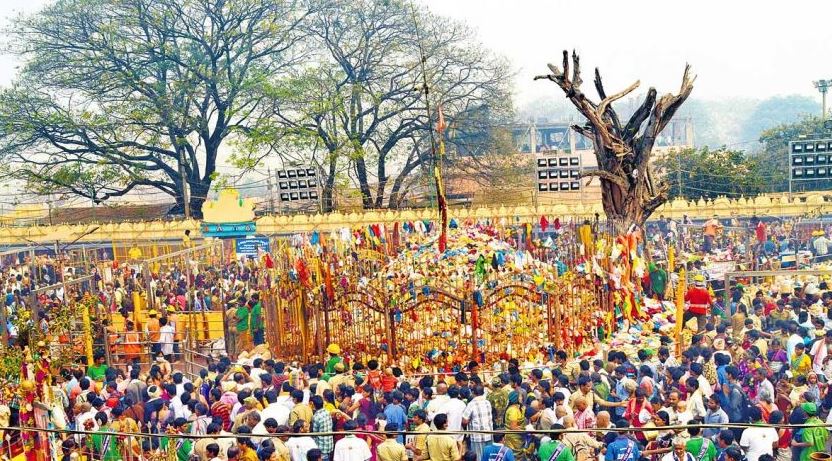
    The Indian National Trust for Art and Cultural Heritage (INTACH) is spearheading efforts to secure UNESCO recognition for the annual ‘Paruveta’ Festival celebrated at the Sri Narasimha Swamy temple in Ahobilam, Andhra Pradesh.

    About Paruveta Festival

    • The festival takes place at the Sri Narasimha Swamy temple in Ahobilam, Andhra Pradesh, attracting devotees from diverse backgrounds.
    • Celebrated by people of all castes, the festival fosters communal harmony, with devotees from various religious communities, including Muslims, offering prayers to Lord Narasimha.
    • Folklore narrates that Lord Vishnu married Chenchulakshmi, a tribal girl, in Ahobilam, strengthening ties between the deity and the local Chenchu tribe.
    • Unlike other temples where Paruveta rituals occur during Vijayadasami or Sankranti, at Ahobilam, the festival celebration spans a ‘mandala’ of 40 days.
    • Rituals:
      1. The deity is ceremoniously taken to the 32 Chenchu tribal villages surrounding Ahobilam, signifying the community’s reverence.
      2. Chenchus demonstrate their protective devotion by symbolically aiming arrows at the deity’s palanquin.
      3. Chenchu devotees undertake ‘Narasimha Deeksha’, donning yellow robes and observing celibacy during the 40-day period.
      4. Temple staff reside in these hamlets, reflecting a historical casteless society devoid of untouchability.

    UNESCO Criteria for Inclusion into the Cultural Heritage List:

    • To represent a masterpiece of human creative genius;
    • To exhibit an important interchange of human values, over some time or within a cultural area of the world, on developments in architecture or technology, monumental arts, town-planning or landscape design;
    • To bear a unique or at least exceptional testimony to a cultural tradition or to a civilization that is living or which has disappeared;
    • To be an outstanding example of a type of building, architectural or technological ensemble or landscape that illustrates (a) significant stage(s) in human history;
    • To be an outstanding example of a traditional human settlement, land use, or sea use which is representative of a culture (or cultures), or human interaction with the environment especially when it has become vulnerable under the impact of irreversible change;
    • To be directly or tangibly associated with events or living traditions, with ideas, or with beliefs, with artistic and literary works of outstanding universal significance. (The Committee considers that this criterion should preferably be used in conjunction with other criteria);

    Try this PYQ from CSP 2014:

    Every year, a month long ecologically important campaign/festival is held during which certain communities/ tribes plant saplings of fruit-bearing trees. Which of the following are such communities/tribes?

    a) Bhutia and Lepcha

    b) Gond and Korku

    c) lrula and Toda

    d) Sahariya and Agariya

    [wpdiscuz-feedback id=”l66hqdgtsf” question=”Please leave a feedback on this” opened=”1″]Post your answers here.[/wpdiscuz-feedback]

  • Kapilvastu Relics of Buddha

    Kapilvastu Relics

    Introduction

    • India will showcase some relics of Lord Buddha, currently in its possession, in Thailand from February 22 to March 18.

    Kapilvastu Relics: Details

    • Designation: The relics of Lord Buddha and his disciples Arahata Sariputra and Arahata Maudgalayana are known as the ‘Kapilvastu Relics.’
    • Origin: These relics, comprising 20 bone fragments, have been preserved at India’s National Museum.
    • Discovery: They were recovered in 1898 from a site in Bihar believed to be the ancient city of Kapilvastu. It was an inscribed casket found at the stupa site in Piprahwa (near Siddharthnagar in UP) that helped identify Kapilavastu.
    • Age: Dating back to the 4th or 5th Century BC, these relics were discovered in Bihar’s Piprahwa, believed to be the ancient city of Kapilvastu.
    • Excavation Details: The ASI unearthed these relics during excavations conducted from 1971 to 1977, discovering two inscribed steatite stone caskets containing 12 and 10 sacred relics, respectively.

    Public Display in Thailand

    • Previous Exhibitions: Portions of these relics were earlier exhibited in Sri Lanka (1976, 2012), Mongolia (1993, 2022), Singapore (1994, 2007), South Korea (1995), and Thailand (1995).
    • Construction of Pagoda: The Thai government has built a special pagoda in Bangkok to enshrine the relics during the exhibition.

    Significance of Display: Promotion of Indian Diplomacy

    • Diplomatic Achievement: This event signifies a diplomatic achievement for India, strengthening ties with Thailand and promoting cultural exchange.
    • Buddhist Circuit Development: The initiative aligns with India’s ‘Look East’ policy and emphasizes the promotion of soft power through cultural exchanges.
    • Past Engagements: India previously sent the relics to Mongolia in 2022 and Sri Lanka in 2012, showcasing its commitment to fostering cultural and spiritual ties.
  • Harappan Settlement found at Lodrani near Dholavira

    lodrani

    Introduction

    • Legend has it that Lodrani, a hamlet near Dholavira in Kutch, was believed to be sitting on buried gold, prompting locals to initiate a dig around five years ago.
    • Contrary to expectations, the excavation led to the discovery of a fortified Harappan-era settlement, challenging the assumptions about the area’s history.

    Archaeological Findings at Lodrani

    • Harappan-Era Settlement: Ajay Yadav and Damian Robinson from Oxford’s School of Archaeology led the archaeological exploration, revealing a well-preserved Harappan settlement.
    • Architectural Resemblance to Dholavira: Yadav notes striking architectural similarities between the newly discovered site, named Morodharo, and Dholavira.
    • Flourishing Ancient Life: Despite being initially dismissed as a medieval fortress, the site unveils evidence of a thriving civilization dating back around 4,500 years.

    Significance

    • Harappan Pottery: The site yielded a significant amount of Harappan pottery akin to findings at Dholavira, indicating a connection between the two settlements.
    • Chronological Placement: Experts suggest Morodharo exhibits characteristics of mature to late Harappan periods (2,600-1,300 BCE), shedding light on the region’s ancient chronology.

    Insights from Archaeologists

    • Dependence on the Sea: Both Dholavira and Morodharo depended on the sea, suggesting navigable waters near the Rann of Kutch during ancient times.
    • Archaeological Fame: Despite false starts in the past, Lodrani now claims archaeological fame, highlighting the importance of local initiatives in uncovering historical treasures.

    About Dholavira

    Description
    Discovery Discovered in 1968 by archaeologist Jagat Pati Joshi.
    Importance
    • One of the most remarkable and well-preserved urban settlements in South Asia.
    • Fifth largest metropolis of the Indus Valley Civilization.
    Location
    • Archaeological site located in the Kachchh District, Gujarat, dating from the 3rd to mid-2nd millennium BCE.
    • On Khadir bet island in the Great Rann of Kachchh.
    Strategic Location
    • Located on the Tropic of Cancer;
    • Strategic for trade and access to mineral and raw material sources.
    Archaeological Findings
    • Terracotta pottery, beads, gold and copper ornaments, seals, fish hooks, tools, urns, imported vessels.
    • Unique stone inscriptions in Indus Valley script.
    Distinct Features Cascading series of water reservoirs, outer fortification, multi-purpose grounds, unique gates, tumulus funerary architecture, multi-layered defenses.
    Decline
    • Coincided with the collapse of Mesopotamia;
    • Affected by climate change, aridity, and drying up of ancient rivers like Saraswati.

    Try this PYQ:

    Q. Which one of the following ancient towns is well-known for its elaborate system of water harvesting and management by building a series of dams and channelizing water into connected reservoirs?

    (a) Dholavira (b) Kalibangan (c) Rakhigarhi (d) Ropar


    [wpdiscuz-feedback id=”k8qvyaavu6″ question=”Please leave a feedback on this” opened=”1″]Post your answers here.[/wpdiscuz-feedback]

  • Medaram Jatara: Asia’s Largest Tribal Festival

    Medaram Jatara

    Introduction

    • People have started shopping ahead of Asia’s largest tribal festival, the Medaram Jatara. Devotees offer jaggery equivalent to their weight to the deities, Sammakka and Saralamma, during the festival.

    About Medaram Jatara

    Description
    Origin Rooted in the legend of Sammakka and Sarakka, a revered mother-daughter duo among the local tribal community.
    Historical Significance Commemorates the 13th-century battle of Sammakka and Sarakka against then local Kakatiya rulers’ taxation of the Koya people.
    Location Mulugu, Telangana, India
    Frequency Biennial festival
    Attendance Attracts around 1.5 crore devotees from various tribal and non-tribal communities from Telangana and Andhra Pradesh but also from as far as Madhya Pradesh, Jharkhand, Chhattisgarh and Maharashtra
    Political & Social Impact Declared as a State Festival in 1996;

    Receives active support from the Ministry of Tribal Affairs and Telangana state government.

    Infrastructure Development Funds allocated for community shelters and infrastructure in and around Medaram.
    Ministry Support Active participation and significant financial backing from the Ministry of Tribal Affairs and Telangana state government.
    Tribal Circuit Development Ministry of Tourism sanctions funds for the integrated development of the tribal circuit.

    Try this PYQ:

    Consider the following pairs:

    Traditions Communities
    Chaliha Sahib Festivals Sindhis
    Nanda Raj Jaat Yatra Gonds
    Wari-Warkari Santhals


    Which of the pairs given above is/are correctly matched?

    a) 1 only
    b) 2 and 3 only
    c) 1 and 3 only
    d) None of the above

    [wpdiscuz-feedback id=”nb3213ewys” question=”Please leave a feedback on this” opened=”1″]Post your answers here.[/wpdiscuz-feedback]

  • 1000-YO Mahavir Statue Found in Tamil Nadu

    mahavir

    Introduction

    • A 1,000-year-old stone statue of Thirthangara Mahavir has been found in Tamil Nadu at at Manavarayanendal near Thiruchuli in Virudhunagar district.

    Features of the Statue

    • There is a triple umbrella above the head of the statue, which has creepers carved on it.
    • It is flanked by sculptures of yakshas.
    • Based on the sculpture technique, it is assumed that the statue might belong to the 11th century AD.

    About Vardhaman Mahavir

    Description
    Birth 540 B.C.
    Birthplace Kundagrama village near Vaishali
    Family Background Belonged to the Jnatrika clan; father Siddharta was the head of the Jnathrika Kshatriya clan, and mother Trishala was a sister of Chetaka, the king of Vaishali.
    Renunciation Renounced home at the age of 30 to become an ascetic.
    Spiritual Practice Practiced austerity for 12 years.
    Attainment of Kaivalya Attained the highest spiritual knowledge called Kaivalya (conquered misery and happiness) at the age of 42.
    First Sermon Delivered his first sermon at Pava.
    Symbol Associated with the symbol of a lion.
    Missions Traveled to various regions including Koshala, Magadha, Mithila, Champa, etc.
    Passing Away Passed away at the age of 72 in 468 B.C. at Pavapuri in Bihar.
    Legacy Founded Jainism as it is known today; contributed significant teachings and principles to the religion.

    Everything you need to know about Jainism

    Description
    Origin Jainism gained prominence in the 6th century B.C. when Lord Mahavira propagated the religion.
    Founder Lord Mahavira, the 24th Tirthankara, is the central figure
    Tirthankaras
    • Jainism recognizes 24 Tirthankaras or great teachers
    • Rishabhanatha being the first and Mahavira the last.
    Meaning of “Jain” “Jain” is derived from “jina” or “jaina,” signifying the “Conqueror” or one who has conquered the inner enemies like attachment, aversion, and delusion.
    Main Principles Jainism emphasizes the Three Jewels or Triratna:

    1. Right Faith (Samyakdarshana),
    2. Right Knowledge (Samyakjnana), and
    3. Right Conduct (Samyakcharita).
    Five Doctrines Ahimsa (non-violence), Satya (truthfulness), Asteya (non-stealing), Aparigraha (non-attachment), and Brahmacharya (chastity) are the fundamental principles of Jainism.
    Concept of God
    • Jainism does not adhere to the concept of a creator God
    • Believes in the existence of liberated souls (Siddhas) who have attained spiritual perfection.
    Major Doctrines
    1. Anekantavada: Jain doctrine of non-absolutism, recognizing that truth can have multiple perspectives or facets.
    2. Syadvada: Jain doctrine stating that all judgments are conditional and true only from certain perspectives, expressed by the term “syat” (may be).
    Sects/Schools Jainism is divided into two major sects:

    1. Digambara (sky-clad) and
    2. Svetambara (white-clad)
    Spread
    • Jainism spread gradually into regions where Brahmanical influence was weak,
    • Received royal patronage from rulers like Chandragupta Maurya
    Literature Jain literature comprises:

    1. Agama (canonical) texts, which include the direct teachings of Mahavira, and
    2. Non-agama (commentaries and elaborations) works, such as the Acaranga Sutra.
    Architecture
    • Temples, caves (layana/gumphas), statues, and ornamental pillars (manastambha), exhibiting intricate designs and religious motifs.
    • Notable Jain architecture in India includes the Dilwara Temples in Mount Abu, Rajasthan, and the Girnar and Palitana Temples in Gujarat.
    • These structures exemplify intricate craftsmanship and religious symbolism.
    Jain Councils Two significant Jain councils were held for compiling and preserving Jain scriptures and teachings:

    1. First Jain Council at Pataliputra (3rd century B.C.) and
    2. Second Jain Council at Vallabhi (512 A.D.)
    Difference from Buddhism
    • Acknowledgment of a permanent self (atman),
    • Acceptance of the varna system,
    • Belief in the concept of a soul (jiva), and
    • Advocacy of extreme asceticism ex. Santhara/Sallekhana
    Thoughts on Rebirth
    Acaranga Sutra: Jainism teaches the doctrine of rebirth (samsara) and various realms of existence (lokas) based on karma, with souls cyclically transmigrating through different life forms.
  • Hastsal Minaret: The Mini Qutub Minar

    Hastsal minar

    Introduction

    • The Hastsal Minar, also known as the Mini Qutub Minar or Chhota Qutub Minar, stands as a Grade A heritage monument in Delhi, silently narrating stories of an era marked by grandeur and mystery amidst ruins and encroachment.

    About Hastsal Minaret

    Description
    Name Mini Qutub Minar (Chhota Qutub Minar, Mini Minar, Kaushal Minar, Hastsal ki Laat)
    Location Hastsal village in Uttam Nagar, West Delhi, India
    Built 1650
    Builder Mughal emperor, Shah Jahan
    Original Height 5 storeys, topped with a domed Chhatri pavilion
    Current Height 3 storeys, 16.87 meters (55 feet) tall
    Structure Built with Lakhori bricks and clad with red sandstone
    Significance Grade A listed, protected heritage monument with the Department of Archaeology, India
    History Originally built as a hunting lodge tower for Shah Jahan

    Used to have a tunnel connecting it to the royal hunting lodge nearby

    Architecture Resembles Qutub Minar in Delhi, octagonal platform, narrow staircase
    Threats Endangered due to neglect, lack of conservation, encroachment by new constructions, surrounded by urbanization
  • #AccessibleIndia: Can Mughal History Inspire Modern Inclusion?

    Accessible Tours of Agra and Fatehpur Sikri for Differently Abled Travelers  | Alphonso Stories

    Central Idea:

    The article highlights the importance of accessibility and inclusion for individuals with disabilities in public spaces, using personal experiences and examples from Fatehpur Sikri, a 16th-century monument, to underscore the need for adherence to international standards and the implementation of inclusive practices across India. It emphasizes the urgent need for prioritizing accessibility in the built environment, including ramps and other accommodations, to enable full participation and empowerment of all citizens, regardless of their physical limitations.

    Key Highlights:

    • Personal experiences at Fatehpur Sikri illustrate the significance of proper accessibility measures.
    • Lack of adherence to international standards poses challenges for individuals with disabilities in navigating public spaces.
    • The Rights of Persons with Disabilities Act (RPWD) is mentioned as a framework for promoting accessibility, but implementation lags.
    • Inclusive design is essential for ensuring equal access to public buildings, transport, and information technology.
    • The absence of accurate disability data in India raises questions about the extent of inclusivity and the need for targeted policies.

    Key Challenges:

    • Inconsistent adherence to international accessibility standards in public spaces.
    • Limited implementation of the Rights of Persons with Disabilities Act (RPWD) despite its enactment.
    • Lack of accurate disability data hampers effective policy formulation and planning.
    • Heterogeneity of disabilities poses challenges in designing inclusive solutions.
    • Socioeconomic disparities contribute to unequal access to accessible infrastructure and support services.

    Main Terms:

    • Accessibility
    • Inclusion
    • Rights of Persons with Disabilities Act (RPWD)
    • Universal design
    • Public accommodations
    • Built environment
    • International standards
    • Heterogeneity of disabilities
    • Socioeconomic disparities
    • Inclusive practice

    Accessible India Campaign| National Portal of India

    Important Phrases:

    • “International standard for a ramp slope”
    • “Rights of Persons with Disabilities Act (RPWD)”
    • “Universal design”
    • “Built environment”
    • “Socio-economic background”
    • “Accurate disability data”
    • “Inclusive environment”
    • “Heterogeneity of disability”
    • “Accessibility of public accommodations and roads”
    • “Participation in civic and socio-economic life”

    Quotes:

    • “If a city built in 1569 AD can be made nearly 95 per cent wheelchair accessible, so can all public accommodations and roads.”
    • “Only by accomplishing this can we realise the full potential of our citizenry, empowering them to actively contribute their professional expertise and diverse skills for the optimal development of the country.”
    • “It is evident that our country has miles to go before genuine inclusivity can be celebrated.”
    • “The absence of ramps is just one example of why the disabled citizenry often finds it challenging to fully participate in civic and socio-economic life, potentially resulting in diminished self-esteem.”
    • “Every Indian deserves the freedom to experience our country’s rich history and heritage along with the rights accorded to all citizens.”

    Anecdotes:

    • The personal experience of the author’s brother tipping over in a wheelchair due to a steep ramp highlights the dangers posed by inadequate accessibility measures.
    • The contrast between the accessible ramps at Fatehpur Sikri and the inaccessible environments encountered in daily life underscores the importance of universal design in public spaces.

    Useful Statements:

    • “Implementing proper accessibility measures is a cost-effective investment in enhancing accessibility for individuals with physical limitations.”
    • “Inclusive design is essential for ensuring equal access to public buildings, transport, and information technology.”
    • “In pursuing true accessibility, involving multiple end-users in the design process is crucial for determining its success.”

    Examples and References:

    • Fatehpur Sikri as an example of successful accessibility implementation.
    • Comparison between international standards and the actual accessibility of public spaces in India.
    • Mention of UN-Habitat’s definition of an inclusive environment.
    • Reference to the Rights of Persons with Disabilities Act (RPWD) as a framework for promoting accessibility.
    • World Health Organization’s data on global disability prevalence versus India’s reported disability rates.

    Facts and Data:

    • Fatehpur Sikri is mentioned as being nearly 95% wheelchair accessible.
    • The World Health Organization estimates that 16% of the global population experiences significant disabilities.
    • India’s last Census in 2011 reported only 2.2% of the population as having disabilities.

    Critical Analysis: The article effectively combines personal anecdotes with broader observations to highlight the challenges and importance of accessibility and inclusion in India. It critiques the lack of adherence to international standards and the limited implementation of legislative frameworks, emphasizing the need for concrete action to address these issues. However, it also acknowledges the complexities involved, such as the heterogeneity of disabilities and socioeconomic disparities, which require nuanced approaches to ensure meaningful inclusivity.

    Way Forward:

    • Prioritize accessibility and inclusion as national priorities, possibly under a dedicated “mission.”
    • Ensure consistent adherence to international standards in the design and construction of public spaces.
    • Improve implementation of the Rights of Persons with Disabilities Act (RPWD) and enhance data collection on disability prevalence.
    • Promote inclusive design practices and involve end-users in the planning and development of accessible infrastructure.
    • Raise awareness and advocate for the rights of individuals with disabilities to foster a more inclusive society.
  • In news: Mohammed Quli Qutb Shah’s Tomb

    In news: Mohammed Quli Qutb Shah’s Tomb

    Introduction

    • A digital twin of the Mohammed Quli Qutb Shah’s tomb was unveiled by a reality technology company, Hexagon in Hyderabad.

    Who was Mohammed Quli Qutb Shah?

    • Parentage: Muhammad Quli Qutb Shah was born on April 4, 1565, as the third son of Ibrahim Quli Qutb Shah Wali and his Hindu mother Bhagirathi.
    • Literary Talent: He was not only an able administrator but also a skilled poet who composed verses in Persian, Telugu, and Urdu.

    Contemporaries of Quli Qutb Shah


    • Akbar (1556–1605): Mughal Emperor known for his religious tolerance and administrative reforms.
    • Rani Durgavati (1550–1564): Queen of the Gondwana Kingdom in central India, renowned for her bravery in resisting Mughal expansion.
    • Maharana Pratap (1572–1597): Rajput ruler of Mewar, famous for his defiance against Mughal Emperor Akbar and his valor in battles.
    • Chand Bibi (1550–1599): Regent of the Ahmednagar Sultanate in Deccan, known for her role in defending Ahmadnagar against Mughal forces.
    • Guru Ram Das (1574–1581): Fourth Sikh Guru who established the city of Amritsar and contributed significantly to Sikhism’s growth.
    • Sher Shah Suri (1540–1545): Founder of the Sur Empire in North India, celebrated for his administrative reforms and construction of the Grand Trunk Road.

    Key Accomplishments

    [A] Reign and Accomplishments

    • Ascension to the Throne: Muhammad Quli succeeded his father in 1580 at the age of 15 and ruled for 31 years.
    • Military Campaigns: Despite facing rebellions, he effectively led troops and quelled disturbances, ensuring stability in his realm.

    [B] Foundation of Hyderabad

    • Urban Planning: Concerned about overcrowding in Golkonda, Muhammad Quli initiated the construction of Hyderabad in 1591.
    • Land Selection: While folklore suggests a romanticized version of land selection, Muhammad Quli’s vision for Hyderabad’s development aimed at relieving congestion and promoting growth.

    [C] Architectural Marvels and City Planning

    • Charminar: As the architectural centrepiece, Charminar was built under Muhammad Quli’s patronage, symbolizing the city’s grandeur.
    • City Layout: Hyderabad was meticulously planned with a gridiron layout, featuring significant landmarks like Darulshafa, Mecca Masjid, and Badshahi Ashurkhana.

    [D] Support for Arts and Literature

    • Calligraphic Art: Under Muhammad Quli’s rule, calligraphy flourished, with various scripts adorning buildings such as the Mecca Masjid.
    • Literary Contributions: Muhammad Quli’s poetic works in Urdu and Dakhni languages reflected his diverse interests and cultural appreciation.
    • Taraqqi: He was a poet himself and composed poetry in Persian and Telugu under the pen name “Taraqqi”.

    [E] Medical and Literary Contributions

    • Intellectual Hub: Hyderabad became a centre for medical and literary pursuits, with scholars producing notable works during Muhammad Quli’s reign.
    • Preservation of Culture: Muhammad Quli’s literary legacy, including his Diwan, is preserved in institutions like the Salar Jung Museum, showcasing his contribution to cultural heritage.

    Legacy and Influence

    • Cultural Integration: Muhammad Quli’s reign represents a period of cultural fusion, blending Hindu and Islamic traditions in the Deccan region.
    • Symbol of Unity: His efforts to promote harmony and coexistence endure as a testament to the inclusive ethos of his administration.
  • M.S. Swaminathan, P.V. Narasimha Rao, Charan Singh to get Bharat Ratna

    Bharat Ratna

    Introduction

    • The Bharat Ratna will be conferred on former Prime Ministers P. V. Narasimha Rao and Choudhary Charan Singh, as well as Green Revolution pioneer S. Swaminathan.
    • This will add to the two awardees already announced earlier this year — socialist leader Karpoori Thakur and former Deputy Prime Minister L. K. Advani.

    About the Bharat Ratna Laureates

    [1] Dr. M.S. Swaminathan

    Aspect Details
    Early Life
    • Born on August 7, 1925, in Kumbakonam, Madras Presidency.
    • Pursued higher education in zoology and agricultural science.
    • Passed away on 23rd September, 2023 at the age of 98.
    Career Highlights
    • Conducted research on combating potato crop parasites during a UNESCO fellowship (1949-1954).
    • Earned a PhD from the University of Cambridge in 1954.
    • Served as Director-General of the Indian Council of Agricultural Research (1979-1982).
    • Appointed as Director General of the International Rice Research Institute in 1982.
    Green Revolution Contributions
    • Pioneered high-yielding variety seeds and improved irrigation methods.
    • Collaborated with Dr. Norman Borlaug to develop high-yielding wheat varieties (1965-1970).
    Challenges and Advocacy Advocated for fair Minimum Support Prices for farmers and highlighted ecological concerns.
    Legacy and Recognition
    • Received numerous international accolades and civilian awards from India and other nations.
    • Honored with Padma Shri (1967), Padma Bhushan (1972), and Padma Vibhushan (1989) awards in India.
    • Awarded over 80 honorary doctorates from universities worldwide.


    [2] PV Narasimha Rao

    Details
    Early Life
    • Born on June 28, 1921, in Karimnagar district, Hyderabad State (now Telangana, India).
    • Passed away on December 23, 2004, in New Delhi.
    Education
    • Bachelor of Arts degree from Osmania University.
    • Higher studies at the University of Bombay and Nagpur University.
    Political Career
    • Started in the Indian National Congress.
    • Served as MLA in undivided Andhra Pradesh.
    • Held ministerial positions, including Minister of External Affairs and Minister of Defence.
    Economic Reforms (1991)
    • Initiated significant economic reforms in response to the 1991 crisis.
    • Reforms included dismantling the License Raj, opening up the economy, and initiating privatization.
    Foreign Policy
    • Strengthened ties with the United States and other major powers.
    • Initiated the “Look East Policy” to enhance engagement with Southeast and East Asia.
    South Asian Diplomacy
    • Handled the situation in Jammu and Kashmir and initiated dialogue with Pakistan.
    • Deployed peacekeeping forces to Sri Lanka as part of the Indian Peace Keeping Force (IPKF).
    Political Legacy
    • Credited with laying the foundation for India’s economic liberalization and globalization.
    • Recognized for pragmatic leadership during a critical period in India’s history.
    • Remembered as a statesman who shaped India’s economic and foreign policies.


    [3] Choudhary Charan Singh

    Aspect Details
    Early Life
    • Born on December 23, 1903, in Noorpur village near Hapur, India.
    • Entered politics during the national movement and was elected to the United Provinces Assembly from Chhaprauli in 1937.
    Political Career
    • Advocated for village economy issues and fought against the exploitation of peasants by big landlords.
    • Served as Revenue Minister in UP’s first Chief Minister Govind Ballabh Pant’s cabinet, instrumental in implementing zamindari abolition and land ceiling laws.
    • Emerged as a popular leader among North Indian farmer communities and Muslims.
    • Became UP’s first non-Congress Chief Minister in 1967, forming a coalition government.
    • Won the 1977 Lok Sabha elections on the Janata Party ticket, became Deputy PM under Morarji Desai’s government.
    • Formed the Janata Party (Secular) in 1979, briefly served as PM with support from Indira Gandhi.
    Legacy
    • Championed the cause of peasants and created a new political class representing farming communities in North India.
    • Influenced the shift of farmer communities from Congress and Jan Sangh to parties specifically representing them.
    • His son, Ajit Singh, formed the Rashtriya Lok Dal (RLD), continuing the family’s political legacy.
    • Charan Singh remains hailed as one of India’s tallest Jat leaders.


    Back2Basics: Bharat Ratna

    Details
    Nature
    • Bharat Ratna is the highest civilian award of the Republic of India.
    History and Evolution
    • Instituted in 1954.
    • Originally limited to achievements in arts, literature, science, and public services.
    • Criteria expanded in December 2011.
    First Recipients C. Rajagopalachari, Sarvepalli Radhakrishnan, and C. V. Raman were the first recipients in 1954.
    Key Aspects
    • Not mandatory to be awarded every year.
    • Can be awarded to non-Indian citizens.
    • Recommendations made by the Prime Minister to the President.
    • Restricted to a maximum of three awards per year.
    • Recipient receives a Sanad (certificate) and a medallion.
    • No monetary grant accompanies the award.
    Article Reference
    • Cannot be used as a prefix or suffix to the recipient’s name, but can be indicated in biodata/letterhead/visiting card as “Awarded Bharat Ratna by the President” or “Recipient of Bharat Ratna Award”.
    • Article 18(1) of the Constitution states that the award cannot be used as a prefix or suffix to the recipient’s name.