The External Affairs Minister, S. Jaishankar, met the President of Russia, Vladimir Putin, in Moscow for the 27th session of the India-Russia Inter-Governmental Commission on Trade, Economic, Scientific, Technological and Cultural Cooperation (IRIGC-TEC). The two sides discussed trade, energy, fertilisers, nuclear energy and high technology, working toward a bilateral trade target of $100 billion by 2030. The meeting is the first of three planned engagements between the Prime Minister and the Russian President this cycle: the Shanghai Cooperation Organisation (SCO) summit in Kyrgyzstan from August 31 to September 1, and the BRICS summit in New Delhi on September 12 and 13.
What did the IRIGC-TEC session cover?
Trade target of $100 billion by 2030: The two sides reaffirmed a bilateral trade target of $100 billion by 2030, a goal that requires sustained growth beyond current trade levels driven mainly by energy imports.
Energy cooperation, including crude and nuclear: Discussions covered continued crude oil trade alongside civil nuclear energy cooperation, an area where Russia has an established role in building reactor capacity in India.
Fertiliser supply arrangements: Fertiliser imports from Russia, a category that has grown in importance for India’s agricultural input security, featured in the discussions.
High technology cooperation: The two sides also discussed cooperation in high technology, an area the two governments have flagged for expansion beyond the traditional defence and energy relationship.
The 27th session of a long-running mechanism: The IRIGC-TEC (the standing bilateral commission that reviews India-Russia economic and technical cooperation) meeting in Moscow was its 27th session, indicating a mechanism that has operated continuously across multiple political cycles in both countries.
Why does this meeting matter ahead of two summit-level meetings?
First of three Modi-Putin engagements in this cycle: The Moscow meeting precedes two summit-level meetings between the Prime Minister and the Russian President, at the SCO summit in Kyrgyzstan from August 31 to September 1 and the BRICS summit in New Delhi on September 12 and 13, making the ministerial visit a preparatory step for both.
Sets the working agenda before leader-level talks: Ministerial-level discussions on trade, energy and technology at the IRIGC-TEC session lay the groundwork that the two leaders are expected to build on when they meet at the multilateral summits.
Multiple engagements in a short span signal sustained bilateral priority: Three India-Russia engagements within roughly three weeks, spanning a bilateral commission, a regional grouping summit and a cross-regional grouping summit, reflect the continuing weight both countries place on the relationship despite Russia’s international isolation over the Ukraine conflict.
Conclusion
The Moscow meeting sets the working agenda for a $100 billion 2030 trade target and advances discussions on energy, fertilisers and technology ahead of two further Modi-Putin meetings at the SCO summit in Kyrgyzstan and the BRICS summit in New Delhi. Whether the trade target is met will depend on how much of the current energy-driven trade can be diversified into the technology and industrial cooperation areas discussed in Moscow.
Back2Basics: India-Russia Inter-Governmental Commission on Trade, Economic, Scientific, Technological and Cultural Cooperation (IRIGC-TEC)
The standing bilateral mechanism, co-chaired at the ministerial level, that reviews and advances India-Russia cooperation across trade, energy, science, technology and cultural exchange.
Operates as one of two parallel Inter-Governmental Commissions with Russia, alongside a separate one focused on military-technical cooperation.
Meets periodically, with sessions numbered sequentially; the Moscow meeting was its 27th session.
Functions as the working-level track that prepares the ground for leader-level India-Russia summits.
Matching Previous Year Question
“[2026] The Chancellor of Germany visited India in January 2026. Which of the following is/are NOT correct in terms of outcomes? 1. MoU between All India Institute of Ayurveda and University of Hamburg 2. MoU on Youth Hockey Development between Hockey India and German Hockey Federation 3. Establishment of a bilateral dialogue mechanism on the Indo-Pacific 4. Opening of an Honorary Consul of Germany in Lucknow (a) 2 and 3 (b) 1 and 4 (c) 3 and 4 (d) 1 only ANSWER: B”
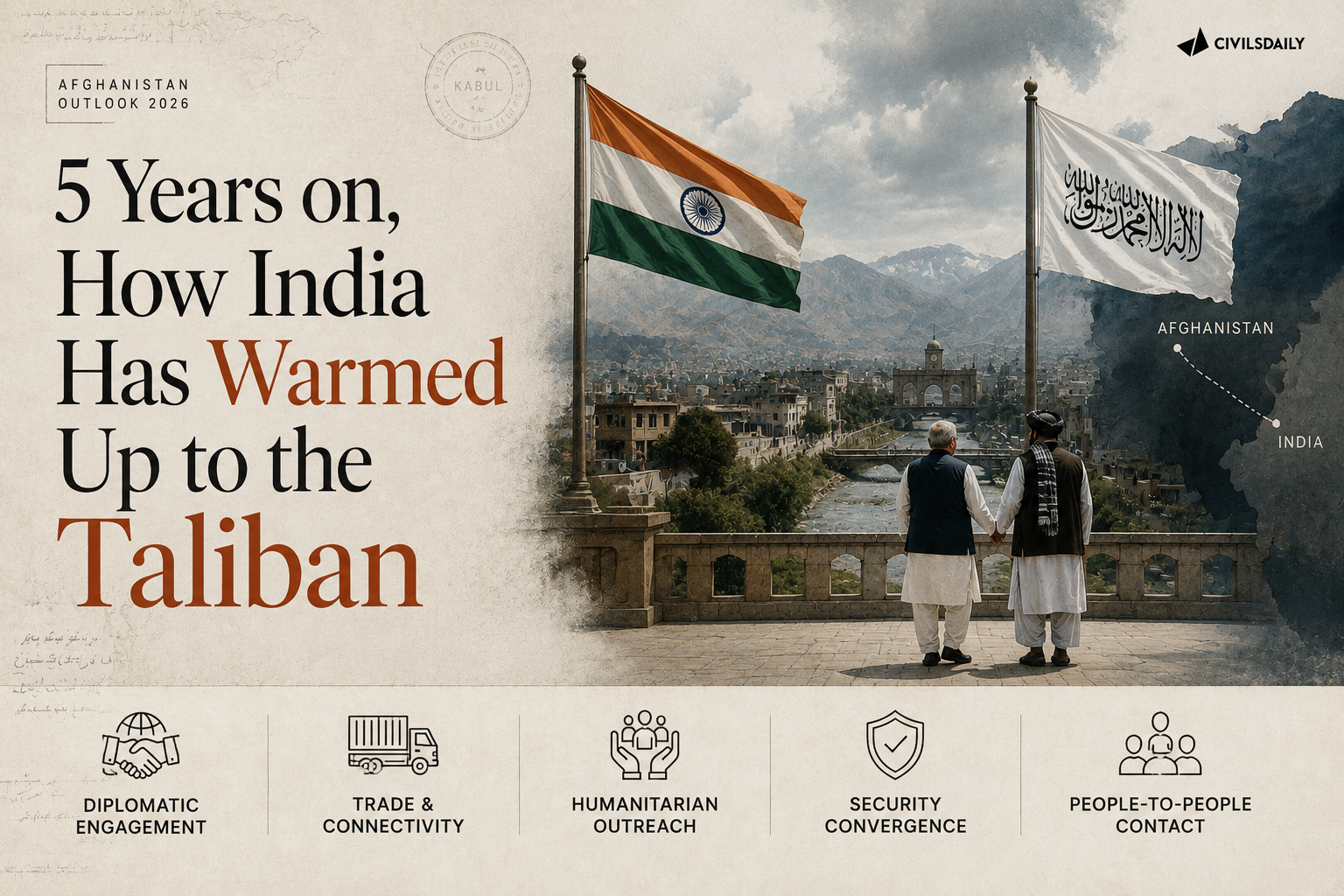
The Afghanistan embassy in New Delhi marked “victory day” on 15 August 2026, five years after the Taliban’s takeover of the country. Indian diplomats and about two dozen foreign diplomats attended the event. The occasion sits against a reversal: on 17 August 2021 India hurriedly evacuated its entire embassy from Kabul after the Ashraf Ghani led government collapsed. That collapse came ahead of the 31 August deadline set by the United States President for the withdrawal of American troops. India now conducts business with the Islamist regime without granting it official diplomatic recognition. Indian officials describe this as “cautious engagement”, and critics describe it as “opportunistic”.
What is engagement without official recognition?
The status being withheld: Diplomatic recognition is a state’s formal acceptance that a given authority is the lawful government of a country, which allows full ambassadorial exchange and treaty dealings. India has not granted it to the Taliban.
What India does instead: India deals with the Taliban as the effective administering authority, running missions, delivering aid and negotiating projects, without conceding legal status. Recognition can then be traded later for concessions.
The visible marker of the gap: The Afghan missions in Delhi, Mumbai and Hyderabad are manned by Taliban appointed diplomats. The main flagpole of the Delhi embassy continues to fly the old Afghan Republic’s tricolour.
How did India move from evacuation to engagement?
First official contact, 31 August 2021: Hours after the last United States military aircraft flew out of Kabul, ending a 20 year war, India made its first official contact with the Taliban. India’s Ambassador to Qatar met the head of the Taliban political office in Doha at the embassy.
First acknowledgement, September 2021: India recognised the Taliban as “those in positions of power and authority across Afghanistan”, the first clear description of the group as a state actor.
First aid consignment, December 2021: India sent its first consignment of medicines to Afghanistan under the new Taliban regime, choosing to distinguish the regime from the Afghan people.
Technical team, late June 2022: India sent a “technical team” to the embassy in Kabul to coordinate delivery of humanitarian aid.
Ministerial contact opens, January 2024: The Taliban Foreign Minister met diplomats from regional nations including India in January 2024. The Foreign Secretary held a substantive meeting with him in Dubai in January 2025.
Contact reaches Cabinet level, May 2025: The External Affairs Minister spoke to the Taliban Foreign Minister by phone on 15 May 2025. The call came days after India and Pakistan agreed to stop military strikes.
Mission upgrade, April to October 2025: India sent the Joint Secretary in charge of the Pakistan, Afghanistan and Iran division of the Ministry of External Affairs to Kabul in April 2025. The Taliban Foreign Minister then visited India in October 2025, and both sides decided to upgrade their missions to embassy level and appoint charge d’affaires.
Why is India deepening ties with the regime it once shunned?
Protecting a sunk investment: India invested for years in Afghanistan after the fall of the Taliban in 2001, and the government concluded that it had to upgrade engagement or watch its USD 2 to 3 billion investment go down the drain.
Leverage, not charity: The investment was meant for the people of Afghanistan and to create leverage and influence inside the country. Withdrawal would have surrendered both.
Pakistan has become the Taliban’s adversary: The Taliban’s once benefactor and ally has turned into a deadly opponent, with multiple clashes along their contested border. New Delhi reads this as a window of opportunity.
China is filling the Western vacuum: Beijing has started building bridges with the Taliban and is eyeing Afghanistan’s natural resources.
Russia is the pacing partner: Russia is the only country to have established diplomatic ties with the Taliban, and Delhi has been working with Moscow on the Taliban to keep track of Chinese influence.
Presence inside Delhi’s own calendar: The Taliban appointed Charge d’affaires, Mufti Noor Ahmad Noor, has attended the Prime Minister’s Independence Day address, the President’s At Home reception and a diplomatic event at the Norwegian embassy.
What are India’s security concerns in Afghanistan?
The operating principle: New Delhi has operated on the principle that Afghanistan’s territory should not be used for anti-India activities or for support to terrorist groups.
The threat assessment is unchanged: An 10 August 2026 report of the United Nations Security Council’s 1267 sanctions committee stated that the terrorist threat emanating from Afghanistan remained largely unchanged.
The de facto authorities cannot suppress it: The same report found that despite efforts by the de facto authorities to combat Islamic State in Iraq and the Levant-Khorasan (ISIL-K) and contain other groups, they were unable to suppress the terrorist problem. It also said Al-Qaeda’s status and strength in Afghanistan remains unchanged.
What the report did not say: It carried no mention of anti-India terror groups such as Lashkar-e-Taiba and Jaish-e-Mohammad, a silence New Delhi reads as relief rather than assurance.
Assurances so far are verbal: Engagement has been “limited”, and the Taliban has indicated it will be “reasonable” in the way it “handles” Indian concerns. The security provided to Indian diplomats in Kabul has given the Indian establishment some confidence.
The regime’s own pitch: The Charge d’affaires told the victory day gathering that Afghanistan’s geography “should not be a field for negative competition, but rather a bridge for connectivity, cooperation and shared prosperity”, a message read as directed at both India and Pakistan.
What has India given up to secure this engagement?
The aid record is substantial: Since August 2021 India has delivered 50,000 metric tonnes of wheat and over 445 tonnes of essential life saving medicines, vaccines and disaster relief material.
The rights record is not: Since taking control the Taliban has eroded the rights of Afghanistan’s 22 million women, barring school access for girls over 12, curbing travel without a male chaperone and bringing a law implying legal approval for child marriage.
India once led on this at the United Nations: A Security Council resolution on 30 August 2021 on upholding human rights and women’s rights in Afghanistan was adopted under India’s rotating presidency. In December 2022 India expressed concern over the Taliban banning women from universities.
The red lines have been dropped: Rights for minorities and women are no longer part of either the Taliban’s or India’s publicly stated red lines, and India has not insisted on the old positions.
What replaced them: India has agreed to move forward on development cooperation for Indian funded projects and on visas for Afghans visiting India for medical treatment, business and education.
Challenges to India’s engagement with the Taliban
Recognition is a one way concession: Formal recognition is the only remaining bargaining chip, and granting it removes India’s last point of leverage over the regime’s conduct. Eg. The Delhi embassy’s flagpole still carries the Afghan Republic’s tricolour, the single visible marker of what has not yet been conceded. Fix. Tie any move on recognition to specified, verifiable commitments on counter terrorism access and on women’s education, published as conditions rather than expectations.
Assurances rest on no verification mechanism: India has no independent means of confirming that Afghan territory is not being used against it, and depends on United Nations monitoring reports issued months apart. Eg. The 1267 committee’s own assessment says the de facto authorities were unable to suppress the terrorist problem. Fix. Seek a standing bilateral security channel with agreed reporting on named groups, modelled on India’s existing joint working groups on counter terrorism.
The rights silence carries a reputational cost: India’s abandonment of the positions it advanced at the Security Council in 2021 weakens its standing as a votary of rules based conduct. Eg. India’s own presidency delivered the 30 August 2021 resolution on women’s rights that it no longer presses. Fix. Separate the humanitarian and development track from the political track, so aid continues while India keeps stating the rights position in multilateral forums.
Projects have no legal protection: Indian funded assets sit in a country whose government India does not recognise, so no treaty or investment protection framework covers them. Eg. Development cooperation on Indian funded projects has restarted without any bilateral investment instrument in force. Fix. Route new project commitments through United Nations agencies and multilateral funds that carry their own immunities and audit trails.
The Pakistan window can close: The engagement rests on the Taliban’s current estrangement from Pakistan, which is a function of border clashes rather than of any settled alignment. Eg. Both sides have seen multiple clashes along their contested border. Fix. Build the relationship on connectivity and trade assets India controls, such as Chabahar port access, which survive a swing back in Kabul’s alignment.
Conclusion
India has completed a strategic embrace of the Taliban in everything except name, trading its 2021 human rights positions for security assurances and the protection of a two to three billion dollar investment. The engagement is now institutional, with Taliban appointed diplomats manning three Afghan missions in India and both sides committed to embassy level representation. What remains unresolved is recognition itself, and with it the only leverage India still holds over the regime’s conduct on terrorism and on women’s rights.
[2026] “Match List I with List II and select the answer using the code given below the Lists: List I (Project Supported by India)List II (Country) A. Mangdechhu Hydroelectric Project1. Maldivas B. Restoration of Stor Palace2. Afghanistan C. District Hospital at Dickoya3. Bhutan D. Institute of Security and Law Enforcement Studies4. Sri Lanka Code: A B C D
The head of the Kurdish led Syrian Democratic Forces (SDF) announced on 20 August 2026 that the force is being integrated into the Syrian state. The announcement completes a deal signed after clashes in January. That deal folds Kurdish military and civilian institutions into state structures. The force was the de facto army of the Kurds’ autonomous administration in northern and northeastern Syria and had been backed by Washington since its creation. Its dissolution ends years of de facto Kurdish autonomy and marks a major consolidation of control by the government in Damascus. What is unresolved is the mechanism of integration itself, which the announcement did not describe.
Who are the Syrian Democratic Forces?
A United States backed force created in 2015: The SDF was formed at the instigation of the United States. Washington was impressed by the Kurdish fighters who had defeated the Islamic State (IS) group at Kobane in the north. Washington was also seeking a reliable partner against the jihadists.
Who it was composed of: It brought together Kurds and Arabs under one command and amassed around 1,00,000 fighters at its peak.
What it controlled: It held swathes of Syria’s oil rich north and northeast as the armed wing of the Kurds’ autonomous administration.
Its standing among Syrian forces: It was Syria’s most highly trained and organised force for years.
What are the People’s Protection Units (YPG)?
The Kurdish core of the SDF: The YPG is the Kurdish militia at the centre of the SDF, with some 30,000 members, alongside the all female Women’s Protection Units.
Its origins: The YPG was formed in 2011 by veterans of the Kurdistan Workers’ Party. One of those veterans later headed the SDF.
What is the Kurdistan Workers’ Party (PKK)?
A Kurdish militant organisation based in Turkey: The PKK waged a decades long insurgency against the Turkish state and is the organisation Ankara treats the Syrian Kurdish forces as an extension of.
Its formal renunciation of violence: Following a call by its jailed leader, the PKK formally renounced its armed struggle against Turkey in May last year, drawing a line under four decades of violence that claimed some 50,000 lives.
How did the force become the ground army against the Islamic State?
It led the campaign rather than supporting it: The SDF spearheaded the battle against the Islamic State after its formation.
When that campaign ended: The group was defeated territorially in Syria four years after the SDF was created.
What the campaign bought the Kurds: Being the West’s ground partner against the jihadists is what converted a militia into an internationally supported administration holding territory.
What sequence of losses brought the force to the integration deal?
The January clashes: Kurdish forces lost large chunks of territory to government troops in clashes in January. The two sides then signed a deal to integrate Kurdish military and civilian institutions into the state.
The loss of two provinces: Arabs within the SDF’s ranks defected en masse after the Syrian President’s army took control of Raqqa and Deir Ezzor, both previously Kurdish held.
The resulting strength: Those defections left the force at half the strength it had before, according to a Syria specialist cited on the numbers.
What does the January agreement require of the force?
Expulsion of foreign cadre: The agreement stipulates that the SDF commit to expelling all non Syrian PKK leaders and members from the country.
Why a small number matters: Their numbers are estimated in the hundreds to low thousands, and they have held significant influence in command and administrative roles.
What the SDF chief acknowledged: He accepted that thousands of young Kurdish men and women from other parts of Kurdistan, meaning areas of Iran, Iraq and Turkey, had supported the force.
What he said had already happened: Those forces withdrew at the SDF’s request and according to a practical plan, which he described as the beginning of a new phase in the region.
Why has Turkey treated the force as a security threat?
Repeated cross border operations: The Kurdish force faced repeated Turkish invasions between 2016 and 2019, with Ankara stating that it wanted to push these fighters away from its border.
The organisational link Ankara asserts: Turkey has long viewed the SDF as linked to the PKK. The SDF denies the link, and analysts hold that the PKK directs the YPG behind the scenes.
Why the expulsion clause is central: Removing non Syrian cadre is the condition that addresses Ankara’s stated objection without requiring a Turkish operation.
Is integration a settlement or the end of Kurdish leverage?
The mechanism was left unstated: The SDF chief did not mention the mechanism by which the force and the Kurdish security forces were integrated into the ranks of the Syrian state, after months of wrangling between the two sides.
How the outcome is read: A Washington based expert on the Kurds described dissolution as a bitter end that marks the end of Kurdish strength in Syria.
What changed the balance: The Kurds had long dreamt of autonomy before the 2024 fall of Bashar al-Assad, and that fall saw Washington drop them in favour of the new authorities in Damascus.
Who gains: The integration is a major victory for the Syrian President. He has been working to cement control over all of Syria since the ouster of his predecessor.
Conclusion
The most capable non state force in Syria has agreed to dissolve into the state that it spent a decade holding territory against, and the Kurdish claim to autonomy has been settled in favour of central control. The immediate status is an announced integration with the mechanism undisclosed and the expulsion of non Syrian cadre still to be verified. What remains unresolved is whether Kurdish rights are protected inside the Syrian state now that the leverage that secured them has been given up.
West Asia and India’s Stakes in the Region
Energy dependence: The region supplies nearly 60 percent of India’s crude oil and about 70 percent of its liquefied petroleum gas and liquefied natural gas requirements.
The diaspora: Around 10 million Indians live and work across West Asia, and the region contributes roughly 38 percent of India’s global remittances.
Trade weight: India’s trade with the Gulf Cooperation Council stood at 178 billion dollars in 2024-25, making the bloc India’s largest trading partner grouping.
The security spillover: Instability in Syria, Yemen and Iraq creates vacuums that transnational terror groups exploit, which is how a distant civil conflict becomes an Indian security concern.
Key Facts about the Kurds
The largest stateless people: The Kurds number an estimated 25 to 35 million and are spread across Turkey, Iran, Iraq and Syria, with no state of their own.
The promise that lapsed: The Treaty of Sevres of 1920 envisaged a Kurdish state, and the Treaty of Lausanne of 1923 that replaced it dropped the provision.
Autonomy in Iraq: The Kurdistan Regional Government in northern Iraq is a constitutionally recognised autonomous region with its own parliament and security forces.
Challenges in West Asia’s Conflict Zones
State fragility outlasts the fighting: Collapsed administrations cannot deliver services even after a ceasefire holds. Eg. The war has pushed Lebanon and Syria towards state collapse, with millions of new refugees moving towards Jordan and Turkey. Fix. Sequence reconstruction finance against verified restoration of civil administration rather than against political settlements alone.
Territorial defeat does not end an insurgency: Militant organisations survive in detention camps, sleeper networks and ungoverned desert. Eg. Thousands of Islamic State fighters and their families remain in camps in northeastern Syria under uncertain custody. Fix. Agree an international framework for repatriation, prosecution and rehabilitation of foreign fighters and their dependants.
Energy chokepoints transmit conflict to distant economies: A blockade at a strait converts a regional war into a global price shock. Eg. The closure of the Strait of Hormuz during the 2026 crisis pushed Brent crude past 120 dollars a barrel. Fix. Build supply routes that bypass the Gulf and hold strategic petroleum reserves sized to a full quarter of imports.
External patrons keep local conflicts running: Rival outside powers arm competing factions, so a war outlasts the local balance of forces. Eg. The Yemen conflict has run since 2015 on Iranian backing for the Houthis against a Saudi led coalition. Fix. Tie arms transfer approvals to compliance with a monitored ceasefire rather than to the patron’s own interest.
Upstream water control converts scarcity into leverage: Dam building on shared rivers gives one riparian state control over the flows another receives. Eg. Turkey’s Southeastern Anatolia Project has cut Euphrates flows reaching Syria and Iraq. Fix. Negotiate a binding basin wide allocation treaty with a joint monitoring body.
Matching Previous Year Question
“[2018] Consider the following pairs : Towns sometimes mentioned in news | Country 1. Aleppo – Syria 2. Kirkuk – Yemen 3. Mosul – Palestine 4. Mazar-i-sharif – Afghanistan Which of the pairs given above are correctly matched? (a) 1 and 2 (b) 1 and 4 (c) 2 and 3 (d) 3 and 4 ANSWER: (b)”
The Union Finance Minister led a four minister delegation to the 4th India Singapore Ministerial Roundtable (ISMR) in Singapore on 19 and 20 August 2026. The Prime Minister had greeted her on her birthday on 18 August, crediting her role in India’s reforms and economic development and in the Centre’s endeavours for a strong and self reliant India. The greeting arrived as the organisational revamp in the ruling party revived talk of a Union Cabinet reshuffle. The exchange is read in Delhi as a vote of confidence in the office that currently carries both the external economic file and the domestic industrial and banking agenda.
What is the India Singapore Ministerial Roundtable?
A ministerial level bilateral mechanism: The roundtable is the platform on which the two governments review progress in India Singapore collaboration and identify new areas of work.
Its format: It convenes several ministers from each side at once rather than a single counterpart pairing, which allows cross portfolio decisions in one sitting.
Six pillars of cooperation: The roundtable is organised around advanced manufacturing, connectivity, digitalisation, healthcare and medicine, skills development, and sustainability.
The current round: The fourth roundtable was held on 19 and 20 August 2026.
What is the National Industrial Corridor Development and Implementation Trust?
The special purpose vehicle for industrial corridors: The trust is the central body that funds and implements India’s industrial corridor projects, including trunk infrastructure inside the corridor nodes.
How it is supervised: An Apex Monitoring Authority chaired by the Union Finance Minister reviews its progress with the concerned States and central ministries.
Which ministries carried the delegation and why does that composition matter?
Four portfolios in one delegation: The Finance Minister led a delegation comprising the Minister of External Affairs, the Minister for Commerce and Industry, and the Minister of State for Electronics and Information Technology and for Commerce and Industry.
What that combination covers: Finance, diplomacy, trade and technology were represented together, which matches the roundtable’s own spread from advanced manufacturing to digitalisation.
Who was recorded as leading: The Ministry of Finance specified that the Finance Minister was leading the delegation, which places the economic ministry rather than the foreign ministry at the head of a bilateral engagement.
What is the political reading of the greeting?
The occasion and the words used: The Prime Minister’s birthday message on 18 August credited the Finance Minister’s role in India’s reforms and economic development and in the effort towards a strong and self reliant India.
The reply: The Finance Minister responded within the hour, stating that the Prime Minister’s guidance had always served as a motivation.
The timing: The exchange followed the organisational revamp in the ruling party, which had renewed speculation about a Union Cabinet reshuffle.
The standing it confirms: The exchange is read in Delhi’s power corridors as a vote of confidence in India’s longest serving full time woman finance minister.
What economic conditions frame the Finance Ministry’s current workload?
A growth and inflation target held together: India is seeking to maintain its 7 percent growth momentum and to keep inflation in check at the same time.
Two external shocks in the same period: The economy is absorbing capital outflows alongside energy and supply chain disruptions resulting from the West Asia conflict.
Why the reforms reference matters now: A public endorsement of the reforms record lands at the point where external shocks, and not domestic demand, are the binding constraint on growth.
What did the industrial corridor review ask of the States?
The meeting held: The Finance Minister chaired the third meeting of the Apex Monitoring Authority of the National Industrial Corridor Development and Implementation Trust on 17 August.
Who attended: The Minister for Commerce and Industry, the Chief Minister of Madhya Pradesh and the Vice Chairman of NITI Aayog were present.
What the States were asked to do: States were urged to resolve bottlenecks relating to land, connectivity, utilities and statutory clearances in industrial corridors.
Why the ask sits with the States: Each of those four bottlenecks is a State subject in practice, so central capital does not convert into an operating industrial node without State action.
What has the outreach to young citizens argued?
The political context: After the students’ protest at Jantar Mantar, the Finance Minister was among the few leaders of the ruling party fronted to make an outreach to young citizens.
The positions stated: She said the young have their ears closer to the ground, denied that the government ever tried to stop protests over examination paper leaks, and acknowledged issues in the education and employment sectors.
The structural point on higher education: She said university courses do not ready graduates for jobs and do not ready them for entrepreneurship either.
The specific illustration used: A bachelor’s degree in Economics or Political Science leads a student to a master’s degree. The student still needs something more after that to be employable.
What was asked of the public sector banks?
The meetings held: The Finance Minister met the chiefs of 12 public sector banks during the same week.
The instruction given: Banks were nudged to raise their appeal to young customers without sacrificing the prudence the business requires.
The reasoning offered: Young customers who grew up with smartphones expect banking to be simple, intuitive, personalised and available at all times.
The suggested method: Banks were asked to consult young people on customer facing operations rather than to redesign the institution from the top.
Conclusion
The week placed one economic ministry at the head of a four minister bilateral delegation abroad and at the chair of the industrial corridor and public sector banking reviews at home. The current status is a completed fourth ministerial roundtable across six agreed pillars of India Singapore cooperation, with no new agreement announced. The next markers are the follow up on the pillars agreed at the roundtable and the resolution by States of the land, connectivity, utility and clearance bottlenecks flagged in the corridor review.
What is the Act East Policy?
About: The Act East Policy, launched in 2014, is India’s framework for engagement with Southeast Asia and the wider Indo-Pacific, and it added a security and connectivity dimension to the trade focused Look East Policy of 1991.
Rationale: It was designed to place the North Eastern Region at the heart of India’s external engagement and to prevent the region east of India from becoming a single power’s sphere.
The four pillars: Commerce, culture, connectivity and capacity building are the policy’s stated components, covering trade agreements, civilisational links, physical and digital connectivity, and training and development assistance.
Where it stands: Ties with the Association of Southeast Asian Nations (ASEAN) were elevated to a Comprehensive Strategic Partnership in 2022, the highest tier of the bloc’s partnership arrangements.
Key Facts about India Singapore Relations
The first comprehensive trade agreement: India and Singapore signed a Comprehensive Economic Cooperation Agreement in 2005, the first such agreement India concluded with any country.
Payments linkage: The linking of India’s Unified Payments Interface with Singapore’s PayNow in 2023 enabled low cost real time cross border remittances between the two countries.
Defence links: SIMBEX, conducted since 1994, is India’s longest running bilateral naval exercise, and Changi Naval Base features in India’s network of logistics access points in the region.
Challenges in India’s Act East Engagement
Slow project delivery undermines credibility: India is repeatedly compared unfavourably with faster moving partners on connectivity projects. Eg. The Kaladan Multi Modal Transit Transport Project has faced over a decade of delays. Fix. Move the flagship connectivity projects to a single empowered implementation authority with published milestone dates.
An asymmetric trade balance with the bloc: Tariff concessions have widened imports without a matching rise in Indian exports. Eg. India runs a trade deficit of about 40 billion dollars with ASEAN, driven by electronics and chemicals. Fix. Complete the review of the India ASEAN Trade in Goods Agreement with rules of origin tightened against third country transshipment.
Exclusion from the regional trade architecture: Staying out of the Regional Comprehensive Economic Partnership keeps Indian firms outside the region’s integrated value chains. Eg. Supply chains relocating from East Asia often bypass India for members of that agreement. Fix. Pursue bilateral economic partnership agreements with individual member states to recover the lost market access.
Instability on the land route: Civil conflict in Myanmar blocks the only land corridor connecting India to Southeast Asia. Eg. Work on the India Myanmar Thailand Trilateral Highway has stalled in contested territory. Fix. Prioritise the maritime and air legs of connectivity to Southeast Asia until the land route is secure.
Competing port investments in the region: Rival infrastructure spending has produced a network of ports around India’s maritime approaches. Eg. The expansion of the Ream Naval Base in Cambodia has raised concerns about naval access. Fix. Deepen logistics support arrangements with regional partners so that Indian naval assets have reciprocal access along the same corridors.
Matching Previous Year Question
“No direct PYQ traced in the provided files. Closest microtheme: Bilateral Relations (International Relations).”
India and the United Kingdom reviewed bilateral defence cooperation at the 25th India United Kingdom Defence Consultative Group (DCG) meeting in New Delhi on 21 August 2026. The Defence Secretary and the United Kingdom’s Permanent Under Secretary for Defence co chaired the meeting. Defence industry and research and development were the declared focus of the review. The two sides also acknowledged their maritime security cooperation in the Indo-Pacific and reaffirmed a commitment to mutual security and strategic autonomy. The meeting places the industrial and research pillar, rather than platform purchases, at the centre of a partnership that has historically been defined by equipment supply.
What is the India United Kingdom Defence Consultative Group?
The institutional channel for the defence relationship: The DCG is the standing bilateral mechanism at which the two defence establishments review the whole of their cooperation.
Who leads it: It is co chaired at the level of the Defence Secretary on the Indian side and the Permanent Under Secretary for Defence on the British side.
How long it has run: The New Delhi round was the 25th meeting of the group, which makes it one of the longer running bilateral defence dialogues India maintains.
What is the India United Kingdom Vision 2035?
The current roadmap for the partnership: Vision 2035 is the agreed framework that sets out where the two countries intend to take defence, technology, trade and security cooperation over the coming decade.
The defence component: It is paired with a 10 year Defence Industrial Road map, which is the instrument the two sides use to sequence joint industrial and research work.
What is the Indo-Pacific Oceans Initiative?
India’s cooperative framework for the maritime region: The initiative is an India led arrangement announced in 2019. Partner countries take the lead on specific pillars such as maritime security, resources and capacity building.
How partners participate: A country joins by leading or co leading a pillar rather than by signing a treaty, which is how the United Kingdom is engaged in it.
What did the two sides review on defence industrial cooperation?
Industry and research were the declared focus: The review of bilateral defence cooperation was framed around defence industry and research and development rather than around procurement.
Where that work is anchored: Ongoing defence industrial cooperation was reviewed with particular emphasis on research and development under the India United Kingdom Vision 2035 and the 10 year Defence Industrial Road map.
How will military to military exchanges expand?
Three named channels of expansion: The two countries agreed to expand exchanges between their armed forces through joint exercises, training and capacity building initiatives.
Why the format matters: Exercises and training create the interoperability that industrial cooperation alone cannot produce.
The visit itself: The meeting marked the first visit to India by the British official in his current capacity. He laid a wreath at the National War Memorial during the visit.
What does the maritime security agenda add?
Cooperation acknowledged in the Indo-Pacific: Both sides recorded robust maritime security cooperation between the two countries in the Indo-Pacific.
A new institution named: That cooperation includes the establishment of the Regional Maritime Security Centre of Excellence under the Indo-Pacific Oceans Initiative.
What framing did the two sides put on the partnership?
Regional security was discussed directly: The two sides exchanged views on regional peace and security.
Two commitments reaffirmed: They reaffirmed their commitment to mutual security and to strategic autonomy, which retains each side’s freedom of independent decision.
The declared basis of the relationship: They reiterated that the India United Kingdom Strategic Partnership is anchored in shared values of peace, stability, freedom and mutual respect.
Challenges to the India United Kingdom Strategic Partnership
Divergent positions on Russia: London has openly criticised the invasion of Ukraine, and New Delhi maintains its own relationship with Moscow. Eg. India’s continued crude imports from Russia have drawn repeated criticism in British parliamentary debate. Fix. Ring fence the disagreement in the political dialogue and keep the defence industrial track on its own timeline.
Extremist activity abroad affecting bilateral trust: Separatist mobilisation on British soil is treated by India as a security matter and by Britain as a policing and speech matter. Eg. The Five Eyes investigation into the Nijjar killing, which includes the United Kingdom, strained the relationship. Fix. Create a standing bilateral mechanism to review threats to diplomatic premises and personnel with agreed timelines for response.
Unsettled extradition of economic offenders: Cases pending for years in British courts weaken confidence in legal cooperation. Eg. The extradition of high profile fugitives such as Vijay Mallya and Nirav Modi remains unresolved. Fix. Agree a case management protocol with fixed review points so that requests do not stall indefinitely.
Carbon border levies on Indian exports: The proposed Carbon Border Adjustment Mechanism threatens Indian steel and aluminium exports and is read in India as protectionism in an environmental form. Eg. Steel and aluminium are among India’s largest industrial exports to the European market. Fix. Negotiate a mutual recognition arrangement for India’s own carbon credit trading scheme so that a domestic carbon price is counted at the border.
Migration and mobility remain unsettled: High visa fees and the health surcharge raise the cost of temporary movement, and no migration and mobility agreement covers the illegal migrant population. Eg. More than one lakh illegal Indian immigrants are estimated to be in the United Kingdom. Fix. Fast track the Double Contribution Convention so that Indian temporary workers are exempted from British National Insurance payments.
Intellectual property divergence in pharmaceuticals: British insistence on tighter intellectual property norms conflicts with India’s priority of affordable medicines. Eg. Data exclusivity demands would delay generic entry for medicines India exports at scale. Fix. Keep intellectual property provisions at the standard set by the World Trade Organization agreement and settle the rest through voluntary licensing arrangements.
Conclusion
The defence relationship has moved from an equipment supply relationship to a joint industrial and research relationship, and the 25th DCG meeting recorded that shift rather than announcing a new agreement. The stage reached is a completed secretary level review under an agreed decade long roadmap, with no new procurement decision announced. The next markers are the delivery of projects under the 10 year Defence Industrial Road map and the operation of the Regional Maritime Security Centre of Excellence.
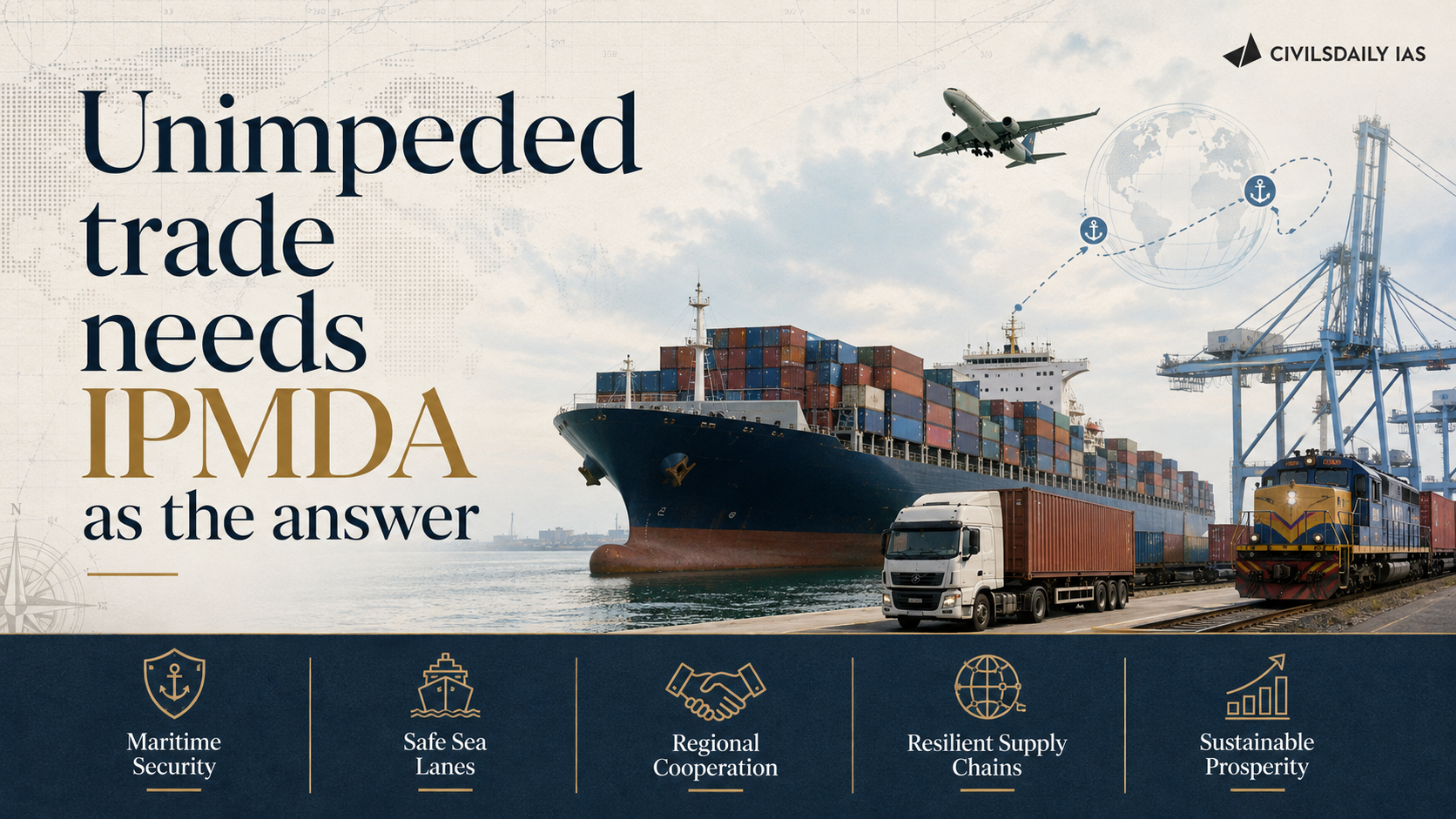
Maritime domain awareness has been identified as the missing focus in United States and India cooperation on unimpeded trade, a term both sides have agreed to without qualification. The Foreign and Commerce Ministers of the two countries have underscored the need for reciprocal trade and energy agreements. The setting is adverse on three counts: mounting sanctions have strained the relationship, visa problems affect Indians travelling to the United States, and the war in West Asia has produced an energy crisis. What is contested is whether Washington can keep the sea lanes its economy depends on open without regional powers such as New Delhi carrying part of the surveillance load.
What is the Indo-Pacific Partnership for Maritime Domain Awareness (IPMDA)?
A Quad initiative launched in 2022: IPMDA was launched under the Quadrilateral framework of India, Australia, Japan and the United States as the most credible multilateral architecture yet devised for the surveillance problem.
What it actually does: It is a technology based mechanism for sharing near real time maritime data across partner nations.
What the data is for: The shared picture allows partners to detect, deter and respond to threats to the free flow of trade.
Where its operationalisation rests: Its full operationalisation is anchored in cooperation between the United States and India under the Quad.
What is maritime domain awareness (MDA)?
A layered picture of activity at sea: MDA is the assimilation of data from several technologies into an effective understanding of the maritime domain.
What the picture is used to judge: It covers the effects of maritime activity on security, safety, the economy and the environment together, rather than naval movement alone.
What is the Automatic Identification System (AIS)?
A transponder that broadcasts a ship’s identity and position: AIS is the transponder carriage requirement applied to vessels. A fitted vessel continuously transmits its identity, position, course and speed to nearby ships and shore stations.
Why switching it off matters: A vessel that disables its transponder disappears from the civil tracking picture without leaving the water, which is the practice analysts call going dark.
Why is the Indo-Pacific the artery on which the trade argument rests?
The circulatory system of the global economy: The Indo-Pacific is a vast maritime corridor through which nearly 7 trillion dollars in trade flows annually.
What the corridor connects: It links energy producers in the Persian Gulf to manufacturing hubs in East Asia and to consumer markets across the Americas.
The chokepoints inside its waters: The Straits of Malacca, the Lombok and the Sunda straits, Hormuz, Bab-al-Mandeb and the Mozambique channel all sit within it, and each is crucial for both energy and container supplies.
Why the West Asia crisis widened the frame: The crisis demonstrated that the region is a geostrategic location not only for India and the United States but for the rest of the world.
What does the surveillance gap allow?
A gap that is geographic, jurisdictional and institutional at once: The threat to the corridor is a convergence of state sponsored coercion, illegal maritime activity and a surveillance deficit that even the United States finds challenging to address alone.
Vessels going dark: Hundreds of vessels across the Indian Ocean, the South China Sea and the Western Pacific routinely disable their AIS transponders, likely to evade sanctions and conceal cargo, which also creates safety and environmental threats.
Contraband movement at sea: Such vessels may be engaged in smuggling or in ship to ship transfers of contraband, which never touch a monitored port.
Fishing fleets outside the rules: Many smaller fishing vessels fall outside mandatory AIS carriage requirements and are found fishing illegally in other nations’ waters or on the high seas, which depletes regional stocks and undermines the food security of littoral states.
Grey zone coercion: Non state and state affiliated actors conduct operations designed to intimidate and coerce. Those operations are calibrated to escape any legal or conventional military response.
How does the shared surveillance architecture work?
The 2026 collaboration layer: The Quad’s Indo-Pacific Maritime Surveillance Collaboration 2026 (IPMSC) sits under the IPMDA architecture and rests on the shared understanding that no country can monitor the vast oceans alone.
What data is fused: It integrates commercial satellite based radio frequency monitoring, radar fusion and existing partner nation sensor networks.
What the fusion produces: Sharing that fused data with like minded partners creates a layered, near continuous picture of maritime activity.
The Indian acquisition behind it: India purchased SeaVision technology from the United States in 2025, along with software enhancements, training and the logistical support needed for mutual MDA cooperation.
Why is cooperation between the United States and India necessary but not sufficient?
The American interest is one of concentration: Regional cooperation in the Indian Ocean is essential for the United States if it is to focus on its immediate neighbourhood in the Pacific and the Atlantic.
India already holds the matching institution: The Information Fusion Centre-Indian Ocean Region (IFC-IOR), established at Gurugram in 2018, is a natural institutional complement to the regional hub architecture of IPMDA.
Why the arrangement suits India: IPMDA amplifies India’s reach without requiring it to surrender control over its own maritime data or decisions.
The stated limit: With the basics already in place, cooperation between the two countries is necessary and not sufficient to cover the corridor.
Which partners have to join for the architecture to cover the region?
The Quad and Southeast Asia: Full potential is realised only through the active participation of existing Quad partners and of Association of Southeast Asian Nations (ASEAN) partner states.
The Pacific Island nations: These states constitute critical maritime corridors and are indispensable to a continuous picture of the Pacific approaches.
The European Union: The bloc has upheld the importance of free and open trade since the Hormuz crisis, which signals an appetite for engagement that Washington and New Delhi must cultivate.
Smaller littoral partners: Bangladesh, the Maldives, the Seychelles, Sri Lanka and Fiji hold independent surveillance infrastructure of their own.
Why their systems fail: Their waters are frequently exploited because those systems remain ineffective against maritime crimes that originate beyond their jurisdictions, which is precisely the gap a shared picture closes.
What does the shift from presence to transparency change about deterrence?
The old assumption has collapsed: The strategic environment has systematically dismantled the assumption that open trade is unilaterally sustainable.
Contestation hardens into precedent: Freedom of navigation is increasingly contested, and contestation that goes unrebutted has become precedent in recent years.
Transparency as a deterrent: In a region where coercion has become the currency of power, visibility of what happens at sea has to function as deterrence in its own right.
Challenges to IPMDA
Data classification limits what can be shared: Partners will not release sensor derived military data on the same terms as commercial satellite data, which thins the picture at the point where it matters. Eg. Radio frequency and radar tracks of naval auxiliaries are routinely withheld even among treaty allies. Fix. Build the shared layer on unclassified commercial data by default and keep classified feeds in a separate bilateral channel.
Detection without enforcement changes nothing: A dark vessel identified in an exclusive economic zone still needs a ship or aircraft to intercept it. Eg. Illegal fishing fleets operating off East Africa are frequently tracked and rarely boarded. Fix. Pair the data hub with pooled coast guard patrol assets and pre agreed boarding arrangements between neighbouring states.
ASEAN hesitancy about Quad branding: Several Southeast Asian states avoid initiatives read as an anti China bloc, which limits regional take up. Eg. Divergent positions within ASEAN on the South China Sea have repeatedly blocked a unified maritime response. Fix. Route the data offer through ASEAN centred bodies and existing information fusion centres rather than under a Quad label.
Dependence on a single technology supplier: The picture rests on platforms and commercial imagery contracts controlled outside the region. Eg. India’s own MDA upgrade in 2025 came through the purchase of an American software platform. Fix. Fund an indigenous radio frequency satellite constellation so that the regional picture survives a supplier or sanctions disruption.
Continuity of a leaders’ level grouping: The Quad has no secretariat or treaty base, so its programmes track political calendars in four capitals. Eg. The grouping failed to convene a leader level summit in 2025. Fix. Anchor the surveillance programme in a standing technical secretariat with its own multi year budget line.
The dark fleet keeps growing faster than the sensors: Sanctions evasion has created a large fleet of ageing tankers with opaque ownership and no reliable insurance. Eg. Ship to ship transfers of sanctioned crude are routinely conducted outside monitored ports. Fix. Tie port entry and insurance recognition to a verified transponder record for the whole voyage.
Conclusion
Freedom of navigation in the Indo-Pacific can no longer be underwritten by a single navy, and the response has shifted from presence at sea to a shared picture of what happens at sea. IPMDA and its 2026 surveillance layer make that picture technically possible, and their value depends on whether capacity constrained littoral states, ASEAN members, the Pacific Islands and the European Union are inside the arrangement rather than outside it. What remains unresolved is enforcement, since detection produces deterrence only where a partner state can act on what it has been shown.
“[2021, GS2, 15 marks] The newly tri-nation partnership AUKUS is aimed at countering China’s ambitions in the Indo-Pacific region. Is it going to supersede the existing partnerships in the region? Discuss the strength and impact of AUKUS in the present scenario.”
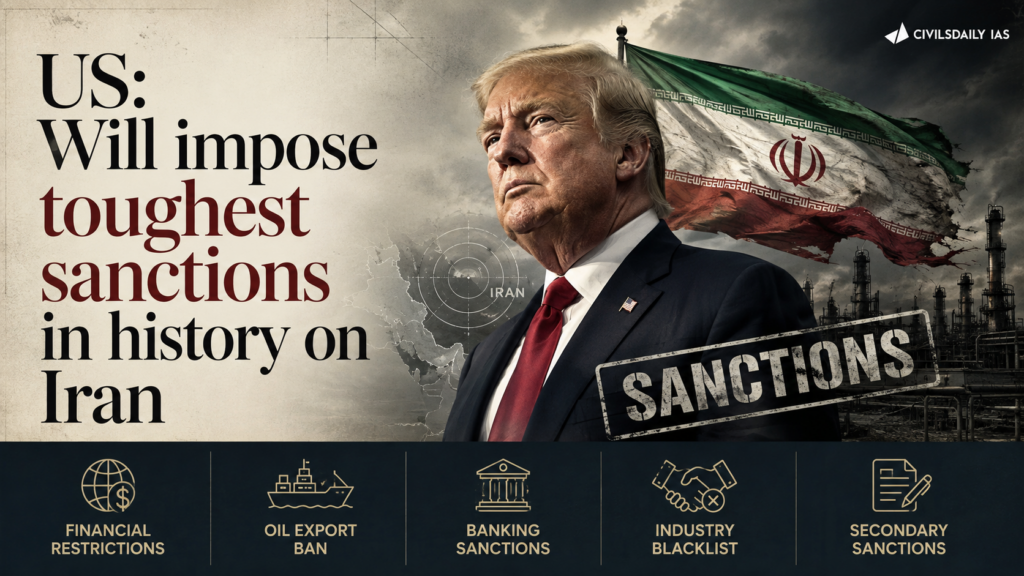
The United States Treasury Secretary announced on 20 August 2026 that Washington will impose the toughest sanctions in history on Iran, to be layered on an existing naval blockade, with the stated objective of collapsing the Iranian government. The United States President separately warned that any country whose financial institutions, businesses, airports or government entities provide any type of lifeline to Iran will itself face economic consequences. That warning converts a bilateral war into a compliance problem for every third country that trades with Iran.
What are secondary sanctions?
Definition: Secondary sanctions penalise persons and firms in third countries for dealing with a sanctioned state, even where that dealing is lawful in their own jurisdiction. They extend a national measure into an extraterritorial one.
How they bite: The penalty is exclusion, since a firm that trades with the target loses access to the sanctioning state’s financial system, markets and correspondent banking.
Why the currency matters: Their reach depends on the sanctioning state’s currency being used for settlement, which is why United States measures affect countries that have no dispute with Washington.
What is a naval blockade?
Definition: A naval blockade is the use of warships to prevent vessels entering or leaving a state’s ports or coastline. It operates through force, unlike sanctions, which operate through law and financial exclusion.
What does the announced sanctions package actually threaten?
Stated severity: The United States Treasury Secretary said Washington will impose the toughest sanctions in history on Iran.
Combination with the blockade: He described the approach as combining the existing blockade on Iran with the new sanctions, rather than replacing one with the other.
Stated objective: He said the approach would work in Iran and that Washington was going to collapse the government there.
Announced framing: The United States President promised economic warfare and isolation on an unprecedented scale, although details were scant.
Detail still pending: The Treasury Secretary said he would hold a press conference on Monday to set out the specifics.
Why does the lifeline warning make this a problem for third countries?
The categories named: The warning covers any country that allows its financial institutions, businesses, airports or government entities to provide any type of lifeline to Iran.
The threatened consequence: Such a country would itself face economic consequences, stated as tremendous in scale.
The timing: The warning was issued on Wednesday, ahead of the sanctions announcement, which places third countries on notice before the measures are published.
Breadth of the categories: Airports and government entities extend the threat beyond banking to transport and to state to state dealings.
Absence of a threshold: No minimum value or category of transaction was specified, so the scope of what counts as a lifeline remains undefined.
Why have the two ceasefires failed to hold?
Origin of the war: The United States began the war alongside Israel nearly six months before the sanctions announcement.
Two attempts: The United States and Iran twice announced ceasefire deals, in April and in June.
Their stated purpose: Both aimed to restore the free flow of shipping through Hormuz as a path towards ending the conflict.
Both collapsed: Both deals quickly crumbled, even as Israel largely withdrew from the fighting.
Leadership transition in Tehran: A 40 day commemoration ceremony for the former Iranian Supreme Leader was held in Karbala on 20 August 2026, attended by Iran’s Parliament Speaker.
What is Iran’s counter-position?
Characterisation of the measures: Iran’s foreign ministry condemned the fresh United States economic and trade sanctions, saying they targeted ordinary Iranians.
The legal charge: The ministry described the measures as economic terrorism and as crimes against humanity.
Attribution of motive: The Iranian Foreign Minister called the announcement an attempt to divert American public opinion from domestic financial problems, including record debt and rising interest rates.
The wider claim: He argued that American economic terrorism threatens the global economy and the national sovereignty of countries around the world.
The retained lever: Tehran continues its own economic pressure campaign by keeping the Strait of Hormuz largely closed.
Why has Oman become the pivot of the Hormuz question?
A separate negotiation: Iran has been negotiating an agreement on managing the Strait of Hormuz with Oman, and has said several times in recent weeks that an agreement was close.
The American response: The United States President responded to those negotiations on Monday by warning that he might bomb the Gulf state if it gets in the way.
The anomaly in that threat: Oman is a longstanding United States security partner, which makes the threat a warning to an ally rather than to an adversary.
Oman’s stated position: The Omani Foreign Minister said lasting security in the strait required a permanent peace in the region and rejected further escalation.
Its diplomatic posture: He made the statement after meeting his Japanese counterpart, which places the strait’s management within a wider set of energy importing interests.
What does the escalation mean for India?
Energy route exposure: A large share of India’s crude, liquefied natural gas (LNG) and liquefied petroleum gas (LPG) imports transits the Strait of Hormuz, so the strait’s closure raises India’s landed energy costs regardless of who supplies the cargo.
Precedent of forced exit: India stopped importing Iranian crude in May 2019 after United States waivers under the sanctions regime lapsed, ending what had been one of its largest supply relationships.
Connectivity investment at risk: India signed a ten year contract in May 2024 to operate the Shahid Beheshti terminal at Chabahar port in Iran, an asset whose viability depends on the sanctions environment.
Corridor implications: The International North South Transport Corridor to Russia and Central Asia runs through Iranian territory, so secondary sanctions affect a route India built to bypass Pakistan.
Existing exposure to secondary measures: India has already navigated the Countering America’s Adversaries Through Sanctions Act, 2017 over its purchase of the S-400 air defence system, which shows the compliance question is not new.
Challenges to a sanctions-led approach
Poor record at producing regime change: Comprehensive sanctions rarely dislodge governments and often consolidate them. Eg. Cuba has been under a United States embargo since 1962 without a change of political system.
Humanitarian burden falls on civilians: Restrictions on banking and shipping obstruct food and medicine even when formally exempted. Eg. Iran’s foreign ministry stated that the measures targeted ordinary Iranians and amounted to crimes against humanity.
Evasion through parallel networks: Targets build shadow fleets, front companies and barter arrangements that blunt enforcement. Eg. United States sanctions on Hezbollah have repeatedly targeted courier networks and exchange houses used as fronts for cash movement.
Erosion of the sanctioning currency’s role: Extraterritorial reach pushes third countries to settle trade outside the dollar. Eg. India has implemented the Special Rupee Vostro Account framework for invoicing, payment and settlement of international trade in rupees.
Alliance friction: Threats against partners weaken the coalition needed for enforcement. Eg. The United States President warned he might bomb Oman, a longstanding American security partner, over its Hormuz negotiations with Iran.
Counter escalation by the target: A sanctioned state with a chokepoint can impose costs on the sanctioning coalition’s own economies. Eg. Iran keeps the Strait of Hormuz largely closed, which carries 20 percent of global oil and 20 percent of global LNG.
Legal contestation of extraterritoriality: Third states dispute the authority of one country to regulate transactions between two others. Eg. The European Union’s Blocking Statute was updated in 1996 and again in 2018 to shield European firms from United States extraterritorial sanctions on Iran.
Conclusion
The United States has moved from military coercion to declared economic warfare against Iran, pairing an existing naval blockade with sanctions described as the toughest in history and aimed openly at collapsing the government in Tehran. The lifeline warning extends the measures to third countries, while Iran retains its own lever by keeping the Strait of Hormuz largely closed and negotiating its management with Oman. The next milestone is the United States Treasury Secretary’s announced press conference on Monday setting out the details, with the Iran Oman understanding on the strait the other outstanding variable.
About Economic Statecraft
About: Economic statecraft is the use of economic instruments, positive and negative, to change another state’s behaviour without resorting to force.
Rationale: It exists because military action is costly and diplomatic protest is weak, so states seek an intermediate instrument that imposes real cost while remaining below the threshold of war.
Positive inducements: Aid, trade preferences, market access and investment offered to secure a policy change.
Comprehensive sanctions: Blanket restrictions on trade and finance with an entire economy, which impose broad cost but weak targeting.
Targeted or smart sanctions: Asset freezes, travel bans and entity listings aimed at named individuals, firms and sectors, designed to spare the general population.
Primary sanctions: Prohibitions binding on the sanctioning state’s own persons, firms and jurisdiction.
Secondary sanctions: Penalties on third country persons for dealing with the target, which give a national measure global reach.
Multilateral sanctions: Measures mandated by the United Nations Security Council under Chapter VII, binding on all member states.
Key Concerns Regarding Economic Statecraft
Sovereignty and extraterritoriality: Secondary sanctions require states to enforce another state’s foreign policy inside their own jurisdiction. Eg. The French bank BNP Paribas paid about $8.9 billion to United States authorities in 2014 for processing transactions involving Sudan, Iran and Cuba.
Humanitarian spillover: Financial de-risking by banks blocks exempted humanitarian trade because compliance officers avoid any exposure to a sanctioned jurisdiction. Eg. The Swiss Humanitarian Trade Arrangement was created in 2020 because ordinary banking channels would not carry payments for food and medicine to Iran.
Fragmentation of the payments system: Repeated use of currency dominance as leverage accelerates the construction of alternative settlement channels and reduces future leverage. Eg. Russia built the System for Transfer of Financial Messages in 2014 as a domestic substitute for international bank messaging channels.
Weak exit mechanism: Sanctions are politically easy to impose and hard to lift, so they persist beyond the objective they were designed to achieve. Eg. The Jackson Vanik amendment of 1974 remained applicable to Russia until its repeal in 2012, long after the emigration restrictions it targeted had ended.
Measurement problem: There is no agreed method to establish that a policy change was caused by sanctions rather than by other pressures, which makes evaluation contested. Eg. Iranian oil exports fell sharply after the reimposition of sanctions in 2018 while the nuclear programme expanded, leaving both outcomes attributed to the same measures.
Laws and Instruments Governing Sanctions
Charter of the United Nations, 1945: Article 41 empowers the Security Council to decide measures not involving the use of armed force, including complete or partial interruption of economic relations, which are binding on all member states.
International Emergency Economic Powers Act, 1977: The principal United States statute allowing the President to declare a national emergency and regulate or block transactions with foreign persons.
Iran Sanctions Act, 1996: Originally the Iran and Libya Sanctions Act, it introduced penalties on foreign firms investing in Iran’s energy sector, establishing the secondary sanctions template.
Comprehensive Iran Sanctions, Accountability and Divestment Act, 2010: Widened the reach of energy sector sanctions and brought refined petroleum supply to Iran within their scope.
Countering America’s Adversaries Through Sanctions Act, 2017: Codified sanctions against Iran, Russia and North Korea and limited the President’s discretion to waive them.
India’s Measures to Manage Sanctions and Energy Risk
Special Rupee Vostro Account framework: A Reserve Bank of India mechanism for invoicing, payment and settlement of international trade in rupees, reducing dependence on third currency settlement.
Chabahar port agreement: A ten year contract signed in May 2024 to operate the Shahid Beheshti terminal, giving India a sea route to Afghanistan and Central Asia that bypasses Pakistan.
International North South Transport Corridor: A multimodal ship, rail and road route linking India to Russia and Central Asia through Iran, shortening transit time against the Suez route.
Strategic Petroleum Reserve: Underground crude caverns at Visakhapatnam, Mangaluru and Padur operated by Indian Strategic Petroleum Reserves Limited to cushion supply interruptions.
Supplier diversification: Term and spot procurement spread across Russian, West Asian, West African and American grades to reduce dependence on any single sanctioned or chokepoint dependent source.
Key Facts about United States Iran Relations
1979 Islamic Revolution: Ended the monarchy and was followed by the seizure of the United States embassy in Tehran and the severing of diplomatic relations.
1984 designation: The United States designated Iran a state sponsor of terrorism, which triggered a standing set of trade and aid restrictions.
Joint Comprehensive Plan of Action, 2015: Concluded in July 2015 between Iran and the P5+1 group, it limited Iran’s enrichment in exchange for sanctions relief.
2018 withdrawal: The United States withdrew from the agreement in May 2018 and reimposed sanctions under a maximum pressure strategy.
India’s exit from Iranian crude: India ended imports of Iranian crude oil in May 2019 after United States waivers expired.
Strait of Hormuz weight: The strait carries about 20 million barrels of oil a day, 20 percent of global oil and 20 percent of global LNG.
Back2Basics: Strait of Hormuz
Designation: A maritime chokepoint connecting the Persian Gulf to the Gulf of Oman and the Arabian Sea.
Littoral states: Iran lies on the northern shore and controls seven of the eight islands in the strait, while Oman controls the southern entrance through the Musandam exclave.
External presence: The United States Fifth Fleet, headquartered in Bahrain, acts as the external guarantor of transit through the strait.
Energy weight: It carries the highest concentration of energy flow of any chokepoint in the world.
Comparative chokepoints: The Strait of Malacca carries 23.7 percent of global seaborne trade and 80 percent of China’s energy imports, Bab el Mandeb carries 8.7 percent of global trade as the sole southern gateway to the Suez Canal, and the Suez Canal itself carries 12 percent of global maritime commerce with closure adding 9 to 17 sailing days.
Challenges in the West Asian Security and Energy Order
Chokepoint dependence with no land alternative: Pipeline bypasses cover only a fraction of the volume that moves by sea. Eg. Closure of the Strait of Hormuz affects 20 million barrels a day, which no existing pipeline network can absorb.
Non state armed actors controlling shorelines: Sea lanes can be closed by groups that hold coastline without holding a state. Eg. The Houthis control the eastern Yemeni shore of Bab el Mandeb in practice.
Proxy networks that survive sanctions on the principal: Financial pressure on a state does not disable the armed groups it funds. Eg. The United States redesignated Hezbollah for service to the Iranian government under the command of the Islamic Revolutionary Guard Corps Quds Force.
Overlapping external guarantors: Multiple outside powers with competing objectives raise the risk of miscalculation. Eg. The United States threatened to strike Oman over its Hormuz talks while relying on Omani mediation with Iran.
Absence of a regional security architecture: There is no equivalent of a regional organisation with dispute settlement authority for the Gulf. Eg. The management of the Strait of Hormuz is being negotiated bilaterally between Iran and Oman rather than through any regional body.
Energy revenue concentration in importing economies: Importing states have limited fiscal room to absorb a price shock. Eg. Every $1 per barrel increase raises India’s oil import bill by up to $2 billion on an annualised basis.
Recognition and legitimacy disputes: Contested political authority complicates any negotiated settlement. Eg. Iran’s own leadership transition was marked by a 40 day commemoration for the former Supreme Leader in August 2026.
Way Forward
Seek carve outs early rather than after listing: India should engage the United States Treasury on humanitarian, food and connectivity carve outs before the sanctions text is notified.
Protect the Chabahar exemption: Press for the continuation of the project specific exemption that has allowed the Shahid Beheshti terminal to operate, given its Afghanistan and Central Asia connectivity function.
Accelerate non dollar settlement channels: Expand the Special Rupee Vostro Account framework and rupee invoicing so that legitimate trade is not hostage to correspondent banking access.
Diversify the maritime route, not only the supplier: Build term contracts with Atlantic basin and West African producers whose cargoes do not transit Hormuz.
Support de-escalation through the Oman channel: Back a negotiated framework for managing the strait, since reopening it does more for importing economies than any adjustment to sanctions design.
Insulate the corridor investments: Structure International North South Transport Corridor participation through non sanctioned entities and multilateral instruments to limit exposure.
Build reserve depth ahead of escalation: Complete Phase II of the Strategic Petroleum Reserve so that a sanctions driven supply interruption does not translate immediately into a price shock.
“[2018, GS2, 15] In what ways would the ongoing US-Iran Nuclear Pact Controversy affect the national interest of India? How should India respond to this situation?”
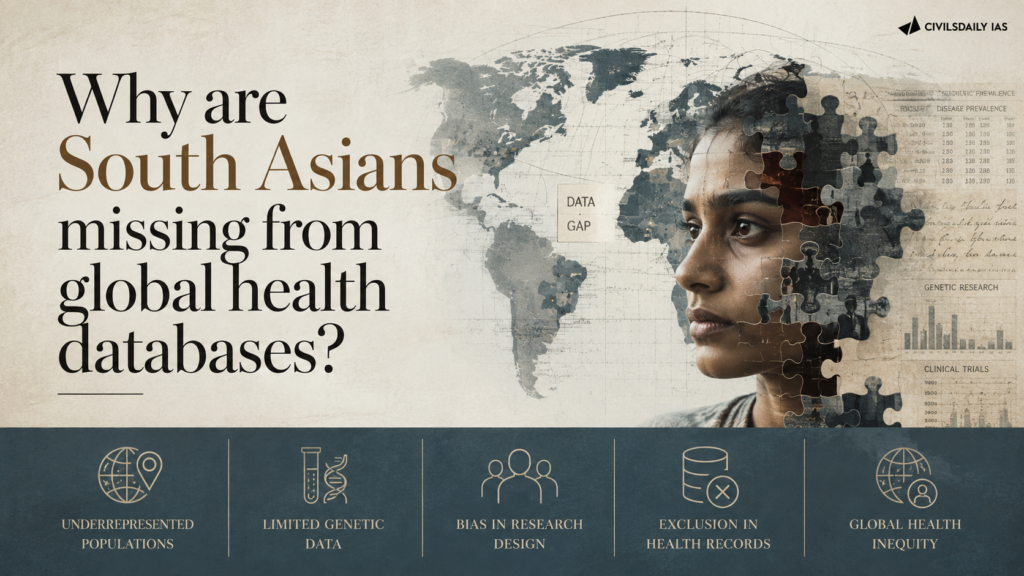
Genome wide association studies between 2005 and 2025 drew more than 86 per cent of their participants from European ancestry populations, while South Asians accounted for less than 1 per cent. That skew is now being carried into the reference atlases used to train artificial intelligence models in medicine, which converts a historical sampling gap into a bias that reproduces itself at clinical scale across South Asia and the wider low and middle income world.
What is an integrated biobank?
Definition: An integrated biobank is a large repository that stores biological samples from consenting participants alongside linked data about them, and makes both available to researchers.
What it integrates: It combines participants’ genomic information with electronic health records, environmental exposures and lifestyle data, so that genetic variation can be read against real health outcomes.
What is a genome wide association study?
Definition: A genome wide association study (GWAS) scans the genomes of many individuals to find genetic variants that occur more often in people with a particular disease than in people without it.
What it produces: It yields a list of variants statistically associated with a trait or disease, which is the raw material for downstream risk prediction tools.
What is a polygenic risk score?
Definition: A polygenic risk score combines the effects of many genetic variants associated with a disease to estimate a person’s overall genetic risk for it.
Why ancestry matters to it: The score’s weights are derived from the population it was built in, so applying it to a population with a different variant frequency structure changes its accuracy.
What is a single cell atlas?
Definition: A single cell atlas is a reference map that catalogues the gene activity of individual cells across tissues and organs, rather than of a tissue sample as a whole.
What is a low and middle income country?
Definition: Low and middle income countries are the economies classified by the World Bank below the high income threshold on gross national income per capita, a grouping used in global health to identify where disease burden and research funding diverge.
Why the category is used here: The under representation problem is stated at the level of this group, with India, Pakistan, Bangladesh and Sri Lanka as instances inside it rather than as separate cases.
What are potential years of life lost?
Definition: Potential years of life lost is a measure of premature mortality that counts the years a person would have lived had they reached a reference life expectancy.
What it captures that a death count does not: It weights a death at a young age more heavily than a death in old age, which is why it shifts burden sharply towards countries with high early mortality.
What is G6PD deficiency?
Definition: Glucose-6-phosphate dehydrogenase (G6PD) deficiency is an inherited enzyme disorder that can cause a form of anaemia when red blood cells break down under oxidative stress from certain drugs, infections or foods.
What is metabolic syndrome?
Definition: Metabolic syndrome is a clustering of obesity, raised blood sugar, abnormal cholesterol and high blood pressure that together raise the risk of cardiovascular disease and type 2 diabetes.
How large is the ancestry gap in global genomic databases?
The genome wide association study record: The GWAS Catalogue is maintained by the National Human Genome Research Institute (NHGRI) and the European Bioinformatics Institute (EBI). It records that more than 86 per cent of participants in these studies between 2005 and 2025 were of European ancestry.
The South Asian share: South Asians accounted for less than 1 per cent of participants over that same twenty year period.
The gap at the country income level: Over 90 per cent of the world’s potential years of life lost occurred in low and middle income countries. About 10 per cent of global health research funding addressed the health needs of those countries.
The share of humanity excluded: More than 20 per cent of the world is being neglected in multi modal data integration, and the exclusion denies those populations the opportunity to attain the maximal possible health.
The pattern repeats in newer tools: A study published in Cell Genomics reviewed more than 13,500 samples across three major single cell resources and found a striking and pervasive European over representation alongside under representation of Asian and Latino individuals.
The three resources reviewed: The study covered the Human Cell Atlas, the Human Tumour Atlas Network and the PsychAD Consortium.
South Asians absent from the biobanks too: South Asians remain largely absent from integrated biobanks such as the U.K. Biobank, which are the repositories that transformed biomedical research.
Why does a European skewed dataset produce worse clinical tools for South Asians?
The burden runs the other way: South Asians face higher rates of type 2 diabetes, cardiovascular disease and asthma than people of European ancestry, so the tools built on European heavy data are least accurate for the population that needs them most.
The diabetes case: More than one in ten adults globally now live with diabetes, the risk is higher for people of South Asian ancestry and it appears earlier than in many other populations.
India’s projected burden: The number of people with diabetes in India alone is projected to reach 125 million by 2045.
Risk scores lose accuracy across ancestry: A 2023 study found that polygenic risk scores for multiple sclerosis were less accurate when applied to South Asian populations.
Functional predictions are untested: Most predictions about how variants affect gene expression or cell function are inferred from European datasets, and it is not known which of those predictions hold in South Asians.
The consequence for drug discovery: This limits the ability to understand disease mechanisms and to identify drug targets relevant to South Asian populations.
Thresholds themselves need recalibration: Diagnostic thresholds, risk scores and prediction models developed predominantly from European populations require validation and, where necessary, recalibration using South Asian data.
Why can South Asia not be treated as a single genetic block?
One of the most diverse populations on earth: South Asia constitutes one of the most diverse human populations in the world, shaped by thousands of years of migration, cultural diversity, endogamy and consanguineous marriages.
Lumping erases the differences: Much existing research groups South Asians, Southeast Asians, West Asians and other Asian populations together, obscuring important differences between them.
Variation within the region: G6PD deficiency varies considerably across South Asia, with some ethnic groups in Pakistan and Afghanistan carrying the trait at much higher rates than others.
Variation within a single population: A study from Sri Lanka found that cardiometabolic risk did not fit into a single metabolic syndrome profile, and within the same population men and women showed distinct patterns of obesity, blood sugar, cholesterol and blood pressure.
The scale of Indian variation: The GenomeIndia Project has already identified more than 40 million genetic variants unique to the Indian population.
Who must be sampled: India cannot realistically be treated as one genetic block, and inclusion must extend to distinct endogamous and tribal groups rather than a few urban cohorts, since many of the harmful variants found there are not seen anywhere else.
Why is the data missing in the first place?
Infrastructure followed the money: Research funding, institutions, registries, biobanks and large population cohorts have historically been built and sustained where the money already was.
What that left behind: Low and middle income countries were left with inadequate laboratory infrastructure, inadequate biobanking facilities and too few trained personnel to run comparable studies at scale.
The imbalance is not only financial: It shapes whose problems are studied, whose questions are prioritised and whose evidence informs health policy and practice.
Ancestry classification practice: Where non European participants are recruited, they are frequently pooled into broad continental categories, which means the data collected does not resolve the differences it was collected to capture.
Why is genomic research hard for South Asian countries to prioritise?
Competing immediate needs: For most South Asian countries genomic research is difficult to prioritise against more immediate and pressing public health demands.
Infectious disease: Communicable disease control absorbs public health budgets and personnel that a genomics programme would otherwise draw on.
Maternal and child health: Maternal and child health programmes command prior claim because their outcomes are measurable within a single planning cycle.
Non communicable diseases: Treatment and screening for non communicable diseases compete for the same budget line that genomic infrastructure would need.
The mismatch in horizons: Genomic infrastructure returns value over a decade or more, while the health systems being asked to fund it are assessed on annual outcome indicators.
Why deferring is costly: Every year the region defers, the reference atlases and the models trained on them are built further without it, which raises the cost of correction later.
What genomic cohorts already exist in South Asia and why do they not add up?
GenomeIndia: India’s national population reference cohort.
Phenome India: An Indian longitudinal cohort linking health, lifestyle and clinical measurements across participants.
Longevity India: An Indian cohort focused on ageing and the biological determinants of long life.
Sri Lankan Twin Registry Biobank: A Sri Lankan registry and biobank built around twin pairs, which permits separation of genetic and environmental effects.
Pakistan Genome Resource: A Pakistani national genomic resource built on population sampling.
Why they do not combine: These independent cohorts and biobanks are mostly focused on individual diseases or specific populations, and often use different systems for collecting and storing data, which makes it difficult to bring them together for large genetic studies.
The Indian case specifically: India has several sizeable cohorts, but no harmonised system yet exists that lets researchers within and across borders work across them easily.
What does the U.K. Biobank model demonstrate that South Asian cohorts currently cannot?
United Kingdom, the integrated design: The U.K. Biobank links each participant’s genomic information to electronic health records, environmental exposure data and lifestyle data in a single resource, which is the feature that allows genotype to be read against outcome.
What that integration produced: Repositories of this design accelerated drug development, informed clinical guidelines and shaped public health policy across multiple countries, not only in the country that built them.
The contrast with South Asia: South Asian cohorts are disease specific or population specific and are stored on divergent systems, so no equivalent linkage across genomics, clinical records and exposure exists in the region.
The limit of this comparison: The U.K. Biobank is the single substantive institutional model in the evidence here, so it establishes what an integrated design makes possible, not a ranked set of alternative national models to choose between.
What does the regional proposal recommend?
The authorship: A perspective in the Lancet Regional Health – Southeast Asia, written by scientists across India, Pakistan, Bangladesh and Sri Lanka, sets out the regional response.
The core warning: The region risks being excluded from the genomic revolution unless it builds the infrastructure itself, rather than waiting for inclusion in datasets built elsewhere.
Regional collaboration between existing assets: The proposal is to build greater collaboration between existing biobanks and cohorts, rather than to construct a new central repository from scratch.
Interoperability: The aim is a system in which existing datasets can speak to each other, which is the specific technical gap that keeps Indian cohorts from being analysed together.
Inclusion of overlooked populations: Populations that have historically been overlooked, including distinct endogamous and tribal groups, are to be brought into the sampling frame.
Retained control over data use: South Asian researchers and institutions are to retain a meaningful role in how their data are used.
Benefit sharing: The researchers generating the data are to share in the scientific benefits, which addresses the extraction pattern rather than only the data gap.
Why does the gap compound rather than stay constant?
The atlases became reference maps: Single cell atlases are now the reference maps for biology and medicine, so an error in the map propagates into everything read against it.
They are now training data: Those same atlases are increasingly used to train the artificial intelligence models that will shape future research and care.
Scale changes the nature of the problem: If the underlying data continues to be skewed, the artificial intelligence models and clinical tools built on top of it will reproduce and repeat those biases at a much larger scale.
From a research gap to a clinical one: A skewed research dataset produced inaccurate studies, a skewed training dataset produces inaccurate bedside tools deployed on populations that were never in the data.
The window is closing but not shut: It is late for the region to build its own infrastructure, and it is still not too late.
Challenges to building a South Asian genomic data infrastructure
Non interoperable data standards: Existing cohorts use different collection, phenotyping and storage systems, so pooling requires retrospective harmonisation that the original consent may not permit. Eg. India’s several sizeable cohorts have no harmonised system that lets researchers work across them.
Consent and benefit sharing for community level data: Genomic data from an endogamous or tribal group carries group level implications that individual consent does not cover. Eg. The Biological Diversity Act, 2002 governs access and benefit sharing for biological resources, and its application to human genomic data drawn from identified communities is unsettled.
Sustained financing beyond donor cycles: Climate and health workforce experience across the region shows that capacity built on project funding disappears when the project ends. Eg. Genomic surveillance capacity expanded rapidly during the pandemic and contracted once the emergency funding lapsed.
Cross border data transfer rules: Regional pooling requires moving identifiable health data across national jurisdictions with differing data protection regimes. Eg. The Digital Personal Data Protection Act, 2023 permits the Central Government to restrict transfer of personal data to notified countries.
Shortage of trained personnel: Bioinformatics, genetic counselling and biobank management skills are scarce relative to the sequencing capacity being installed. Eg. Genetic counsellors in India number in the low hundreds against a population carrying a large inherited disease burden.
Risk of genetic discrimination: Widening genomic data collection without a statutory bar exposes participants to insurance and employment consequences. Eg. The Delhi High Court in United India Insurance vs Jai Parkash Tayal, 2018 held the exclusion of genetic disorders from health insurance cover unconstitutional, in the absence of any general anti discrimination statute.
Sampling reaching only urban cohorts: Recruitment gravitates to tertiary hospitals and metropolitan volunteers, reproducing inside India the same skew the region objects to globally. Eg. Inclusion of distinct endogamous and tribal groups has been identified as the specific gap in Indian sampling, not the overall sample size.
Conclusion
The under representation of South Asians in global genomic databases is no longer only an equity problem in research, it is becoming an engineering problem in clinical artificial intelligence. With more than 86 per cent of genome wide association study participants of European ancestry and South Asians below 1 per cent, the reference atlases now being used as training data carry that skew forward at scale. The response has shifted from asking for inclusion in datasets built elsewhere to building interoperable regional infrastructure that keeps control and benefit with the researchers generating the data. What remains unresolved is financing, since the region must fund a decade long investment against infectious disease, maternal and child health and non communicable disease needs that compete for the same budget.
“[2026] Which of the following statements with regard to Genome India Project is/are correct?
1. It is a part of the Human Genome Project.
2. The project is funded by the Department of Biotechnology (DBT), Government of India.
3. Its primary aim is to build a catalogue of genetic diversity of the Indian population.
India’s net oil and gas imports rose 43.4 percent in value in April to July of the current financial year, to $57.8 billion from $40.3 billion a year earlier. Import volumes barely moved, so the increase is almost entirely a price effect created by supply tightness and stifled energy flows through the Strait of Hormuz. With 88.3 percent of crude requirement met by imports, India has prioritised supply security over price, and the cost of that choice lands on the trade balance.
What are net oil and gas imports?
How the figure is built: Net oil and gas imports are arrived at by deducting petroleum product exports from oil, natural gas and petroleum product imports.
Why the deduction matters: India is a net exporter of petroleum products because of its refining capacity, so gross import figures overstate the true external drain.
What it still includes: India also imports some petroleum products, notably liquefied petroleum gas, so the netting does not remove product imports entirely.
Why it is the tracked number: It measures the actual foreign exchange outgo on energy, which is what feeds into the trade balance and the current account.
What is the Petroleum Planning and Analysis Cell?
What it is: The Petroleum Planning and Analysis Cell (PPAC) is the data and analysis body under the Ministry of Petroleum and Natural Gas. It compiles India’s official import, consumption, production and pricing statistics for petroleum and natural gas.
What is liquefied natural gas?
What it is: Liquefied natural gas (LNG) is natural gas, primarily methane, cooled to minus 162 degrees C so that it becomes liquid and can be shipped in cryogenic carriers. It must be regasified at a terminal in the importing country before use.
How it is priced: Spot LNG in Asia is priced against the Japan Korea Marker, with Henry Hub and the Title Transfer Facility serving the American and European markets.
What is liquefied petroleum gas?
What it is: Liquefied petroleum gas (LPG) is propane and butane, produced as a byproduct of oil refining or natural gas processing, and used for domestic cooking, industrial heating and autogas.
How it is priced: It is priced against the Saudi Aramco Contract Price, which is loosely linked to Brent crude.
Why did the import bill rise 43 percent when volumes barely moved?
Volumes were nearly flat: Oil and LNG imports were only marginally higher in volume terms across April to July.
Crude price did the work: The average landed price of imported crude was about $106 per barrel in April to July, sharply higher than about $68 per barrel in the corresponding period of last year.
Value rose without volume: The crude oil import bill surged by over 56 percent year on year to $63.4 billion even as volumes rose only slightly, to 81.9 million tonnes or about 600 million barrels, from 81.5 million tonnes.
The stated priority: India has been prioritising supply security over price considerations, so it imported at extremely high rates rather than curtail volumes.
Product trade moved the same way: Petroleum product export volumes fell while export value rose, and product import volumes fell faster than product import value, both reflecting high international prices.
How did each component of the energy trade basket move?
Crude oil imports, volume: 81.9 million tonnes against 81.5 million tonnes a year earlier, a rise of 0.5 percent.
Crude oil imports, value: $63.4 billion against $40.5 billion, a rise of 56.5 percent.
Petroleum product imports, volume: 9.0 million tonnes against 16.4 million tonnes, a fall of 45.1 percent.
Petroleum product imports, value: $5.6 billion against $7.6 billion, a fall of 26.3 percent.
LNG imports, volume: 11,867 million standard cubic metres against 11,269 million standard cubic metres, a rise of 5.3 percent.
LNG imports, value: $5.6 billion against $4.5 billion, a rise of 24.4 percent.
Petroleum product exports, volume: 16.5 million tonnes against 20.1 million tonnes, a fall of 17.9 percent.
Petroleum product exports, value: $16.7 billion against $12.4 billion, a rise of 34.7 percent.
Net oil and gas imports: $57.8 billion against $40.3 billion, a rise of 43.4 percent.
How exposed is India’s energy basket to the Strait of Hormuz?
Crude dependence: India depends on imports to meet over 88 percent of its crude oil requirement, and its dependence on imported oil for the four months ended July was 88.3 percent, almost flat year on year.
Gas dependence: About half of India’s natural gas consumption is met by imports, brought in as LNG.
Share routed through the strait: Around 40 percent of India’s crude oil imports, 60 percent of its LNG imports and 90 percent of its LPG imports came from West Asia through the strait.
Where the disruption showed: Petroleum product imports declined 45.1 percent in volume to 9.0 million tonnes because supply of major products India imports, such as LPG, was hit by the West Asia conflict.
Why exports fell: India’s petroleum product export volumes fell almost 18 percent year on year to 16.5 million tonnes as domestic fuel supplies were prioritised amid the global supply crunch.
Why does an oil price shock transmit into the wider economy?
The volume multiplier: India annually imports 1.8 to 2 billion barrels of oil, so every $1 per barrel increase raises the oil import bill by up to $2 billion on an annualised basis.
Share of total imports: Energy imports are a major component of India’s overall imports, so any meaningful increase moves the aggregate import number.
Trade balance and current account: A higher energy bill widens the merchandise trade deficit and feeds directly into the current account deficit.
Inflation channel: Higher landed crude costs pass into transport and freight costs and into the prices of petroleum linked goods.
Exchange rate channel: A larger dollar outgo on energy adds to demand for foreign exchange and weighs on the rupee’s exchange rate.
Challenges to managing India’s oil and gas import bill
Demand is price inelastic in the short run: Refiners cannot cut crude intake without cutting fuel supply, so a price shock passes straight into the bill. Eg. Crude import volumes rose 0.5 percent even as the crude bill rose 56.5 percent in April to July.
Concentration of LPG sourcing: A single region supplies almost the entire LPG import basket, leaving no substitute route in a disruption. Eg. The West Asian share of India’s LPG imports moves entirely through the Strait of Hormuz, with no second corridor available if the strait closes.
Fixed rupee excise blocks pass through of relief: Central excise duty is levied as a fixed amount per litre rather than as a percentage, so falling crude prices accrue to revenue rather than to consumers. Eg. When Brent fell from $80 to $60 per barrel in early 2025, Delhi petrol fell by only about Rs 2 to 3 per litre.
Strategic reserve cover below international norms: The buffer available to ride out a supply interruption is short of the accepted benchmark. Eg. India’s total crude cover of 74 days sits below the International Energy Agency norm of 90 days of net import cover.
No strategic reserve for gas at all: The gas basket has an operational buffer but no strategic cushion. Eg. India’s LNG storage tanks at regasification terminals give roughly 10 days of operational buffer, with no strategic LNG reserve in existence.
Spot LNG volatility deters utilisation: When spot prices spike, importers switch to coal or fuel oil, stranding regasification capacity. Eg. India’s roughly 42.5 million tonnes per annum of LNG regasification capacity runs at 60 to 65 percent utilisation because switching becomes rational above $15 per MMBtu.
Refinery configuration ties India to sour crude sources: Indian refineries have invested in desulphurisation capacity built around Middle Eastern grades, which limits how fast the basket can be re-sourced. Eg. Most Middle Eastern crude India buys is priced against Dubai and Oman, and Saudi, Iraqi and UAE grades track that benchmark.
Conclusion
India’s net oil and gas import bill rose to $57.8 billion in April to July from $40.3 billion a year earlier, a 43.4 percent increase driven almost wholly by price rather than volume. At 88.3 percent crude import dependence and with the West Asian shares of crude, LNG and LPG all routed through the Strait of Hormuz, a chokepoint disruption converts directly into a macroeconomic shock. The figures are provisional data from the Petroleum Planning and Analysis Cell, and the next reading will show whether the price effect persists once Hormuz flows normalise.
About India’s Crude Oil Procurement and Pricing
Who buys: State owned refiners account for 73 percent of India’s procurement through Indian Oil Corporation Limited, Bharat Petroleum Corporation Limited and Hindustan Petroleum Corporation Limited, with private refiners Reliance Industries and Nayara Energy accounting for 27 percent.
How buying works: Each refiner independently forecasts demand two to three months ahead and negotiates bilaterally with suppliers such as Rosneft, Saudi Aramco and Iraq’s State Organisation for Marketing of Oil.
How it is priced: All contracts are priced as Brent plus or minus a negotiated discount, and Middle Eastern grades track the Dubai and Oman benchmark.
Where crude lands: Crude is received by tanker at Paradip, Mumbai, Kochi and Vadinar.
Quality determines price: Sulphur content and American Petroleum Institute (API) gravity, the measure of a crude’s density, together determine refining cost and product yield, with sweet crude defined as sulphur content below 0.5 percent and sour crude requiring additional processing.
Regulatory Framework Governing India’s Petroleum and Natural Gas Sector
Ministry of Petroleum and Natural Gas: The apex policy body, which sets the framework for exploration, refining, marketing, pricing and strategic reserves, awards production sharing contracts, and exercises ownership over the public sector oil companies.
Petroleum and Natural Gas Regulatory Board: Regulates refining, processing, storage, transportation, distribution, marketing and sale of petroleum products and natural gas, authorises City Gas Distribution networks, and determines pipeline tariffs on a common carrier basis.
Directorate General of Hydrocarbons: The technical regulator for upstream exploration and production, which manages block allocations, monitors production sharing contracts, verifies reserves, approves field development plans and maintains the National Data Repository.
Oil Industry Development Board: Funded by a statutory cess on domestic crude production, it finances oil industry development and wholly owns Indian Strategic Petroleum Reserves Limited, which operates the underground reserve caverns.
Deregulated retail pricing: Petrol was deregulated in 2010 and diesel in 2014, so the Ministry does not directly set retail pump prices.
Government Initiatives in the Petroleum and Gas Sector
Strategic Petroleum Reserve: Phase I comprises 5.33 million tonnes of crude across three underground rock caverns at Visakhapatnam, Mangaluru and Padur, with a Phase II commercial cum strategic expansion under public private partnership models.
Hydrocarbon Exploration and Licensing Policy, 2016: Replaced the earlier New Exploration Licensing Policy with a uniform licence covering all hydrocarbons, open acreage licensing and revenue sharing in place of production sharing.
Administered Price Mechanism for domestic gas: The Ministry sets the administered price for domestic natural gas indexed monthly at 10 percent of the Indian Crude Basket price, following the Kirit Parikh Committee recommendations, subject to a floor and ceiling for legacy fields.
Direct Benefit Transfer for LPG: LPG is subsidised through direct transfer, with Rs 300 per cylinder for Ujjwala beneficiaries.
City Gas Distribution expansion: India’s city gas distribution network now covers 98 cities, supplying compressed natural gas for vehicles and piped natural gas for households from a mix of domestic gas and regasified LNG.
Key Facts about Global Oil Benchmarks and India’s Reserves
Brent crude: North Sea origin, 38 API and 0.37 percent sulphur, traded on the Intercontinental Exchange in London, accounting for 75 to 80 percent of global oil trade and serving as the reference against which all other grades are a premium or discount.
West Texas Intermediate: Cushing, Oklahoma origin, 39.6 API and 0.24 percent sulphur, traded on the New York Mercantile Exchange, accounting for 15 to 20 percent of global trade and typically Brent minus $0 to $5 per barrel.
Dubai and Oman: Persian Gulf origin, 31 to 33 API and 1.0 to 2.0 percent sulphur, traded on the Dubai Mercantile Exchange, accounting for 5 to 10 percent of global trade and typically Brent minus $5 to $15 per barrel.
Why OPEC does not set the price: OPEC controls 40 percent of production but Brent sets 75 to 80 percent of global prices, since markets price oil hundreds of thousands of times a day while OPEC announces targets once and has no enforcement mechanism against quota cheating.
Reserve position: India’s total crude cover is 74 days, made up of 9.5 days from the Strategic Petroleum Reserve and 64.5 days of oil marketing company commercial stocks, against the International Energy Agency norm of 90 days.
LPG and LNG cover: LPG cavern capacity of about 140,000 tonnes gives roughly 22 days of cover against consumption of about 3 million tonnes a month, while LNG has about 10 days of operational buffer and no strategic reserve.
Volatility of spot gas: The Japan Korea Marker swung from $3 per MMBtu in mid 2020 to $70 per MMBtu in August 2022.
Committee recommendation on storage: The Parliamentary Standing Committee on Petroleum in December 2023 recommended equipping refineries with two to three days of smaller strategic storage at five to six additional locations, which could add 15 to 20 days of capacity.
Back2Basics: Strait of Hormuz
Location: A narrow sea passage connecting the Persian Gulf to the Gulf of Oman and onward to the Arabian Sea.
Control: Iran controls the northern shore and seven of the eight islands in the strait, Oman controls the southern entrance, and the United States Fifth Fleet acts as the external guarantor of transit.
Oil traffic: About 20 million barrels a day pass through it, amounting to 20 percent of global oil movement.
Gas traffic: It carries 20 percent of global LNG trade, which makes closure hit gas hardest given Qatar’s dominance in LNG supply.
Strategic character: It carries the highest concentration of energy flow of any maritime chokepoint in the world.
Challenges in India’s Energy Security
Stagnant domestic crude production: Falling domestic output pushes import dependence upward regardless of demand. Eg. Cess collections of the Oil Industry Development Board have declined in real terms because domestic crude production has stagnated.
Regulatory conflict of interest: The same ministry sets the pricing environment and owns the companies whose losses that environment creates. Eg. The Ministry of Petroleum and Natural Gas simultaneously regulates the sector and holds ownership rights over Indian Oil Corporation Limited, Bharat Petroleum Corporation Limited and Hindustan Petroleum Corporation Limited.
Gaps in the regulatory perimeter: No single regulator covers the full chain from wellhead to pump. Eg. The Petroleum and Natural Gas Regulatory Board has no jurisdiction over upstream exploration, wellhead gas pricing or LPG retail pricing.
Upstream reservoir disputes slow output: Technical disputes between operators delay field development and carry royalty implications. Eg. The gas migration dispute between ONGC and Reliance Industries in the Krishna Godavari basin required adjudication by the Directorate General of Hydrocarbons.
Chokepoint concentration across all three fuels: Crude, LPG and LNG share the same maritime chokepoint, so diversification of supplier does not diversify route. Eg. LPG moves with crude tankers or on dedicated carriers through the same Strait of Hormuz.
Tax structure blunts price signals: Taxes form roughly 60 percent of the retail pump price, weakening the link between global prices and consumer behaviour. Eg. Delhi petrol at Rs 96 to 97 per litre carried Rs 13 of central excise and Rs 15 to 18 of State value added tax before the crisis.
Storage build out lags the exposure: Reserve expansion depends on capital and cavern geology, both of which take years. Eg. Phase II of the Strategic Petroleum Reserve is being pursued through public private partnership because budgetary funding alone has not delivered the capacity.
Way Forward
Complete Phase II of the Strategic Petroleum Reserve: Bring the commercial cum strategic caverns on stream to move total cover towards the 90 day International Energy Agency norm.
Adopt the refinery level storage recommendation: Implement the Parliamentary Standing Committee’s December 2023 proposal on refinery level storage, which remains a recommendation rather than sanctioned capacity.
Create a strategic gas reserve: Extend the reserve architecture to LNG, which today has only an operational buffer at regasification terminals.
Shift excise from a fixed levy to an ad valorem levy: This would let consumers receive part of the benefit when crude prices fall, restoring the price signal.
Diversify sourcing away from a single chokepoint: Expand term contracts with Atlantic basin, West African and North American suppliers so that a Hormuz disruption does not strike crude, LNG and LPG supply simultaneously.
Raise domestic production through open acreage: Accelerate block awards under the Hydrocarbon Exploration and Licensing Policy to arrest the decline in domestic output.
Separate ownership from regulation: Move ownership of the public sector oil companies out of the administering ministry so that pricing policy is not set by their shareholder.
“[2025, GS2, 15] “Energy security constitutes the dominant kingpin of India’s foreign policy, and is linked with India’s overarching influence in Middle Eastern countries.” How would you integrate energy security with India’s foreign policy trajectories in the coming years?”
India and Japan signed a Memorandum of Arrangement on Maritime Security Cooperation on 20 August 2026, after bilateral talks between the two Defence Ministers in New Delhi. The arrangement converts a relationship built on periodic exercises into a standing operational framework covering maritime domain awareness, logistics access and ship repair. It also opens naval shipbuilding and design to joint development, moving the partnership from equipment transfer towards co-production.
What is the Memorandum of Arrangement on Maritime Security Cooperation?
Nature of the instrument: A Memorandum of Arrangement is a signed framework document recording the agreed areas of cooperation between two defence establishments. It creates a standing basis for activity without the binding force of a treaty.
Parties it links: The arrangement connects the Indian Navy with the Japan Maritime Self-Defense Force.
What is Maritime Domain Awareness?
Definition: Maritime Domain Awareness (MDA) is the effective understanding of everything in the maritime space that affects security, safety, economy or the environment. It rests on tracking, identifying and sharing information on vessel movements.
Why it is built with partners: No single navy can watch an entire ocean, so MDA depends on pooling radar, satellite and automatic identification system feeds across countries.
What are Sea Lines of Communication?
Definition: Sea Lines of Communication (SLOCs) are the primary maritime routes along which trade, energy and naval forces move between ports. Disruption of a SLOC affects supply rather than territory.
Why they are defended jointly: A SLOC crosses several jurisdictions and the high seas, so its protection depends on coordinated patrolling and port access rather than any one state’s territorial control.
What is the UNICORN antenna system?
What it is: UNICORN is a Japanese shipborne integrated communications antenna system that houses multiple antennas inside a single composite mast. It lowers a warship’s radar cross section by removing external antenna clutter.
What is ATLA?
Full form and role: The Acquisition, Technology and Logistics Agency (ATLA) is Japan’s defence procurement and technology development body under its Ministry of Defense. It is the counterpart to India’s Defence Research and Development Organisation (DRDO) for joint technology work.
What is the Japan India Special Strategic and Global Partnership?
The label: It is the highest tier of India’s bilateral relationships, adopted in 2014, under which defence, economic and technology cooperation between the two countries is organised.
What does the arrangement operationally commit the two navies to?
Information sharing: The two sides agreed to deepen operational cooperation through information sharing, naval exercises, ship repair and logistics support.
Maritime domain awareness and rescue: The framework covers maritime domain awareness, search and rescue, and humanitarian assistance and disaster relief between the Japan Maritime Self-Defense Force and the Indian Navy.
Protection of sea lanes: The Ministers agreed to strengthen coordination for the protection of Sea Lines of Communications through reciprocal naval visits, joint exercises, and personnel and subject matter expert exchanges.
Logistics and port access: Logistical support was extended to include access to ports and maintenance and repair facilities.
Mine countermeasures: The two countries will move towards greater cooperation in mine countermeasures.
How does the partnership move beyond equipment transfer into co-development?
Naval shipbuilding and design: The two sides will explore joint development in naval shipbuilding and design, leveraging Japan’s technological expertise and India’s production capabilities.
Make in India framework: They will discuss greater use of India’s shipbuilding capabilities under the Make in India framework.
Reciprocal ship repair: Both countries will work towards reciprocal provision of ship repair facilities.
First equipment marker: The shipborne UNICORN integrated communications antenna system was identified as the symbol of the growing defence equipment partnership, with a commitment to its early realisation.
Research and industry channels: DRDO and ATLA will deepen cooperation in advanced defence technologies, and a Defence Industry Forum will be convened.
What does the expansion of joint exercises signal about interoperability?
Existing exercise set: The Ministers welcomed the expansion of bilateral military exercises, including Dharma Guardian and the Japan India Maritime Exercise (JIMEX), the two navies’ bilateral maritime exercise.
Veer Guardian 26: The planned Veer Guardian 26 air exercise will see Japanese fighter aircraft participate in an exercise in India for the first time.
Greater complexity: The two sides agreed to enhance the complexity of bilateral exercises rather than repeat existing formats.
Unmanned systems and short notice drills: They agreed to integrate unmanned systems and to explore short notice joint exercises, which test readiness rather than choreography.
Special forces and theatre commands: The two countries will promote exchanges between their Special Operations Forces and pursue cooperation with India’s integrated theatre commands after their establishment.
What institutional machinery will carry the cooperation forward?
A standing Working Group: The two sides agreed to establish a Working Group headed at the Director General and Joint Secretary level.
Domains it coordinates: The Working Group spans operational, intelligence, equipment, technology and industrial domains.
Industry channel: A Defence Industry Forum will be convened alongside the research level cooperation.
Ministerial channel: The two sides agreed to accelerate discussions for the fourth India Japan 2+2 Foreign and Defence Ministerial Dialogue, to be held in Tokyo this year.
Political framing: Both reaffirmed their commitment to deepen defence cooperation under the Japan India Special Strategic and Global Partnership and to work towards a free and open Indo Pacific amid heightened global tensions.
Challenges to the India Japan maritime security arrangement
Japan’s own legal constraints on transfers: Article 9 of Japan’s 1947 Constitution and the Three Principles on Transfer of Defence Equipment and Technology limit what Tokyo can sell or co-develop abroad. Eg. The US 2 amphibious aircraft deal, negotiated with India for over a decade, lapsed without an order.
Cost and schedule risk in Japanese technology tie ups: High specification Japanese systems carry costs that Indian procurement budgets absorb poorly. Eg. The Mumbai Ahmedabad High Speed Rail Project, built on Japanese technology and a Japanese loan, slipped from its 2022 target to 2027 or later.
Thin use of the existing logistics pact: Reciprocal access agreements deliver value only when used outside exercise windows. Eg. The Acquisition and Cross Servicing Agreement signed in September 2020 has been used largely around scheduled exercises rather than for continuous deployments.
Naval balance shifting faster than the partnership: The regional force ratio is moving against both partners while the arrangement is still being institutionalised. Eg. The People’s Liberation Army Navy crossed 340 battle force ships by 2021, overtaking the United States fleet in numbers.
Indian yard capacity limits co-production: Joint naval shipbuilding assumes yard capacity India has not yet built. Eg. India’s share of global shipbuilding is under 1 percent, in a sector dominated by China, South Korea and Japan.
Incomplete theatre command reform: Cooperation with India’s integrated theatre commands is conditional on those commands existing. Eg. The Inter Services Organisation (Command, Control and Discipline) Act, 2023 created the legal basis for joint commands, but no theatre command had been stood up when the arrangement was signed.
Chokepoint risks a bilateral pact cannot fix: Sea lane disruption often originates from non state actors outside either navy’s operating area. Eg. Houthi attacks in the Red Sea forced shipping to reroute around the Cape of Good Hope, adding weeks to voyages.
Conclusion
India and Japan have moved from periodic exercises to a signed operational framework covering maritime domain awareness, logistics access and ship repair, with naval shipbuilding and design opened to joint development. The arrangement’s institutional carrier is a Working Group at Director General and Joint Secretary level spanning operational, intelligence, equipment, technology and industrial domains. The next milestone is the fourth India Japan 2+2 Foreign and Defence Ministerial Dialogue, to be held in Tokyo this year, with the Veer Guardian 26 air exercise bringing Japanese fighter aircraft to India for the first time.
“[2019, GS2, 10] ‘The time has come for India and Japan to build a strong contemporary relationship, one involving global and strategic partnership that will have a great significance for Asia and the world as a whole.’ Comment.”