💥Join UPSC 2027,2028 Mentorship (August Batch) + XFactor Notes & Microthemes PDF

Subject: International Relations

  • Convergent perils: luminaries against human ethics being outsourced to AI

    Why in the News:

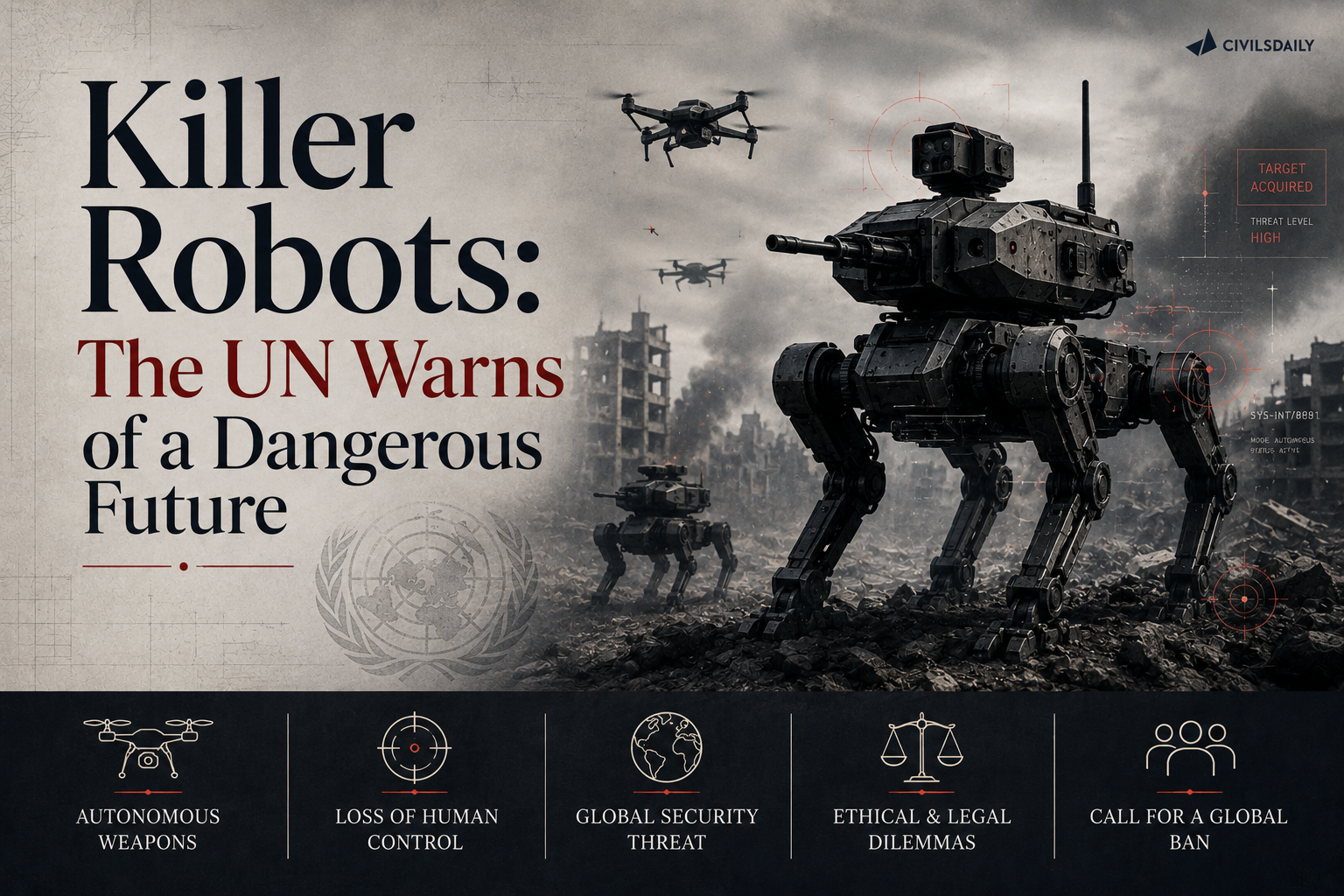
    A group of Nobel laureates, Artificial Intelligence (AI) scientists, and religious leaders signed the “Rome Declaration for an Unarmed and Disarming Peace” on 16 July, calling for a treaty banning autonomous systems from nuclear launch decisions. The Declaration argues that introducing AI into nuclear command structures does not merely speed up decision-making, it removes the human hesitation that has so far prevented nuclear war.

    What has historically prevented nuclear escalation, and why is it fragile?

    1. Human hesitation as the real safeguard: Mutually Assured Destruction (MAD), the doctrine that a first nuclear strike triggers devastating retaliation, relied on human hesitation, diplomatic backchannels, and moral pause, not technical safeguards alone.
    2. Historical near misses: During the 1962 Cuban Missile Crisis and the 1983 Soviet false alarm incident involving officer Stanislav Petrov, disaster was averted because human operators exercised caution and scepticism.
    3. Compressed decision windows: AI-driven predictive logistics and battle management systems compress decision windows from hours to seconds, removing the time needed for human verification.

    What technical failure modes make AI unsuitable for this role?

    1. Documented failure modes: Large Language Models (LLMs) and neural networks are prone to hallucinations and data poisoning, where training data is maliciously corrupted to manipulate outputs.
    2. Automatic escalation risk: In a crisis, an algorithm misreading a routine signal as an imminent threat could automatically trigger a retaliatory sequence within a compressed decision window.
    3. Unauditable reasoning: Most AI models operate as “black boxes,” making their conclusions impossible to verify at the moment a launch decision would be required.

    What five operational principles does the Declaration propose?

    1. Mandatory meaningful human control: Prohibiting any AI-driven system from making the final decision on the use or deployment of nuclear weapons.
    2. The digital commons model: Expanding data access so experts beyond major powers can better assess AI-related existential risks.
    3. Responsible development: Requiring AI developers to publish the ethical frameworks guiding their models and forbidding fully autonomous, self-improving systems that cannot be monitored or halted by human operators.
    4. Internal arsenal vulnerability audits: Requiring nuclear states to conduct rigorous reviews of their command-and-control systems against AI-driven cyber tampering.
    5. Time-bound, verifiable disarmament: Renewing good faith international negotiations toward completely and verifiably eliminating nuclear weapons.

    Why is the current Iran nuclear crisis treated as a live test of these risks?

    1. Broken arms control architecture: Iran’s breaches of its non-proliferation obligations, followed by joint United States-Israel military strikes, have exposed the existing arms control architecture as broken.
    2. AI in contested monitoring: States increasingly use AI for target characterisation and predictive intelligence tracking of nuclear facilities under contested conditions.
    3. Automated misjudgment risk: An AI system defending an enrichment facility could misinterpret a routine network probe or a physical strike as the start of an attack, triggering a disproportionate automated response before any human decision is made.

    What obstacle remains to acting on the Declaration’s warning?

    1. No treaty consensus: No consensus currently exists among states on what a treaty banning AI in nuclear command should cover, or even on banning autonomous AI in warfare more broadly.
    2. Moral instrument, not binding law: The Declaration functions as a moral and philosophical lexicon rather than a binding legal instrument at this stage.
    3. Dependence on public pressure: Its success depends on generating public awareness that then creates grassroots pressure for states to negotiate a binding treaty.

    Conclusion:

    The Declaration’s central claim is that no technical safeguard can substitute for the human doubt that has twice averted nuclear war, and that compressing decision windows to seconds through AI removes exactly that safeguard. No binding treaty yet exists to prevent this, and the current Iran nuclear crisis shows the danger is not hypothetical. Ethical responsibility for nuclear launch decisions cannot be delegated to a machine.

  • First Sanctions, Now War: India’s Chabahar Plans Up in the Air

    Why in the News:

    The Union Budget 2026 to 2027 made no allocation for the Chabahar Port, against Rs 400 crore in the previous year, while US military strikes damaged Chabahar’s maritime control tower and the US sanctions waiver that had allowed Indian operations expired on April 26, 2026. Together, these developments place India’s decade long connectivity investment in jeopardy just as the strategic importance of the corridor has increased.

    Why is Chabahar strategically indispensable for India, not merely commercially useful?

    1. Operating structure: India Ports Global Ltd (IPGL) operates the Shahid Beheshti Terminal under a 10 year renewable agreement with Iran’s Ports and Maritime Organisation, while Iran operates the Shahid Kalantari Terminal.
    2. Bypassing Pakistan: Chabahar provides India’s only direct route to Afghanistan and Central Asia without depending on Pakistan, which does not permit Indian goods to transit through its territory.
    3. Part of INSTC: Chabahar serves as India’s gateway into this corridor.
      • Term: International North South Transport Corridor (INSTC): A multi modal transport corridor connecting India, Iran, Russia, Europe, and Central Asia, aimed at reducing transport time and cost.
    4. Counterweight to Gwadar: Chabahar acts as a strategic counterbalance to China developed Gwadar Port in Pakistan, located about 140 km away.
    5. Value to Iran: Chabahar is Iran’s only oceanic port with direct access to the Indian Ocean outside the Strait of Hormuz, making it crucial for developing Sistan Baluchistan Province.

    How have US sanctions constrained India’s operational control even before the current war?

    1. Sanctions origin: After withdrawing from the Iran Nuclear Deal (JCPOA) in 2018, the United States imposed sanctions on Iran but granted a special waiver for Chabahar to facilitate humanitarian assistance and trade with Afghanistan.
    2. Waiver instability: The waiver was withdrawn in September 2025, restored for six months in October 2025, and expired on April 26, 2026, without renewal.
    3. Pre-emptive restructuring: To avoid penalties under the May 2024 agreement, India prepaid its US$120 million investment in the Shahid Beheshti Terminal and transferred its operational stake to local entities.

    Does prepayment and stake transfer protect India’s interests, or concede control precisely when the corridor’s value is rising?

    1. Loss of direct control: India is gradually losing direct operational control over Chabahar following the expiry of the sanctions waiver. The Ministry of External Affairs (MEA) has stated only that discussions with relevant stakeholders are continuing.
    2. Defensive rather than assertive posture: The MEA confirmed that the India operated terminal was not damaged during the US strikes near the control tower, but this addresses only physical safety, not operational continuity.
    3. Regional balance shift: The expiry of the waiver strengthens the strategic position of China and Pakistan, the very competitors Chabahar was intended to balance.

    What does the absence of Budget funding signal about India’s near term commitment?

    1. Funding withdrawal: Chabahar received Rs 400 crore in the previous Union Budget, but no allocation was made in the Union Budget 2026 to 2027.
    2. Strategic consequence: Weakening India’s engagement with Chabahar risks undermining its only non Pakistan connectivity corridor to Afghanistan and Central Asia, affecting long term regional connectivity plans.

    Conclusion:

    Chabahar remains a strategic asset for India by providing an alternative route to Afghanistan, Central Asia, and the International North South Transport Corridor (INSTC) while balancing the influence of Gwadar Port. However, US sanctions, the Iran conflict, the expiry of the sanctions waiver, and the absence of fresh budgetary support have weakened India’s operational position. Although India has safeguarded its financial commitments through restructuring, restoring strategic influence over the project will depend on future geopolitical developments and the sanctions regime.

  • From 1991, Three Foreign Policy Lessons for Managing Disruption of Certainties

    Why in the News:

    The war that began with the killing of Iran’s Supreme Leader on February 28, together with the fifth year of the Russia Ukraine war, is disrupting India’s energy costs, Strait of Hormuz navigation, and diplomatic balancing, echoing the twin 1990 to 1991 shocks of the Gulf War and the collapse of the Soviet Union. The parallel is used to argue that India’s current foreign policy debate repeats an old pattern of ideological sympathy overriding interest based assessment of unstable partners.

    What is the current disruption, and how does it parallel 1990 to 1991?

    1. The 1990 to 1991 shocks: Iraq’s invasion of Kuwait in August 1990 sent oil prices soaring, disrupted remittances, and aggravated India’s Balance of Payments (BoP) crisis. Within months, the Soviet Union, India’s principal Cold War partner, collapsed.
    2. The present disruption: The Iran war has raised energy costs and disrupted navigation through the Strait of Hormuz. A June US-Iran Memorandum of Understanding that briefly eased tensions proved premature as the conflict escalated again.
    3. Ukraine’s unresolved war: The Russia Ukraine war has entered its fifth year without settlement. While Russia is not disintegrating as the Soviet Union did, the mounting costs of the war raise questions about its future.
    4. Immediate US pressure: Proposed US sanctions legislation, associated with the late Senator Lindsey Graham, seeks punitive tariffs on China, India, and other importers of Russian oil. President Donald Trump has also called for extending similar measures to Iranian oil, increasing pressure on India’s energy diplomacy.
    5. India’s changed capacity: India is now better positioned than in 1991 due to its larger economy, greater diplomatic influence, and broader strategic partnerships, though it is also more exposed to global shocks.

    How did ideological sympathy distort India’s reading of unstable partners in 1991, and how does the same pattern recur now?

    1. Contradictory 1991 conduct: India evacuated its citizens from the Gulf, sought to preserve ties with Iraq and the Arab world, and simultaneously allowed American aircraft to refuel, while Foreign Minister I. K. Gujral publicly embraced Saddam Hussein.
    2. Establishment sympathy misplacing priorities: Sections of India’s political and foreign policy establishment viewed Saddam Hussein’s confrontation with the United States as more significant than his annexation of Kuwait.
    3. Similar rigidity toward Gorbachev: Some foreign policy voices criticised Mikhail Gorbachev for engaging with the West and even welcomed the August 1991 coup attempt by Soviet hardliners.
    4. Present day repetition: Sympathy for Iran is often rooted in its opposition to the United States rather than an objective assessment of its domestic system. Debate on Russia is frequently personalised around Vladimir Putin and influenced by memories of Soviet era support, limiting analysis of Russia’s evolving relations with China, Europe, and the United States.

    What three lessons does 1991 offer for managing the current disruption?

    1. No balance of power is permanent: International politics is inherently uncertain. India’s foreign policy should prepare for discontinuity as much as continuity.
    2. Debate is a strategic asset: A policy community dominated by consensus may overlook emerging risks. India needs stronger expertise on Russia, Iran, and Central Asia, along with institutions that encourage independent and contrarian analysis.
    3. Domestic reform is the ultimate strength: India’s recovery in 1991 is attributed primarily to economic reforms, with diplomacy playing a supporting role. The same lesson applies today: domestic economic resilience is the foundation of effective foreign policy.

    Conclusion:

    The article argues that India’s foreign policy should be guided by national interest rather than ideological preferences or historical sentiment. Just as delayed recognition of geopolitical change complicated India’s response in 1991, excessive reliance on past assumptions may hinder its response to today’s crises involving Iran and Russia. The central lesson is that economic reform, strategic adaptability, and evidence based policy analysis remain the strongest tools for navigating an increasingly uncertain international order.

  • Protect Seafarers, and the Maritime Order

    Why in the News:

    A Russian missile strike on the merchant vessel MV Golden Leo while departing Ukraine’s Odesa port killed 10 seafarers, including four Indians, marking the first Indian deaths in the Russia Ukraine war after earlier deaths in the Iran war. India summoned Russia’s chargé d’affaires and, for the first time, named Russia in its protest, a step it had avoided for four years of diplomatic balancing with Moscow.

    What happened, and why does it extend the threat to Indian seafarers into a new theatre?

    1. The strike: Russian forces launched three cruise missiles at the MV Golden Leo, a Turkish owned vessel flagged to Guinea Bissau, while it was departing Odesa. The strike killed 10 people, including four Indians, while one more Indian sailor was hospitalised in critical condition.
    2. Prior Hormuz deaths: Indian seafarers, including three aboard the MT Settebello, were killed in and around the Strait of Hormuz amid the Iran war.
    3. Diplomatic response: India summoned Russia’s chargé d’affaires Vladimir Ladanov and explicitly named Russia, calling the targeting of commercial shipping unacceptable.

    On what legal basis is targeting merchant shipping unlawful, and why is that basis under strain?

    1. Governing principle: Merchant vessels engaged in civilian commerce cannot lawfully be attacked unless they are being used for military purposes.
      • Term: International Humanitarian Law (IHL): The body of law that seeks to limit the effects of armed conflict by protecting non combatants.
    2. Cargo detail: The MV Golden Leo was reportedly carrying grain, reinforcing its civilian character.
    3. Stakes for global trade: Ukraine remains a leading global grain exporter to Europe, North Africa, and Asia. Disruptions through the Strait of Hormuz have separately exposed the vulnerability of global energy supplies.

    Why does India’s protest coexist with continued exposure of its seafarers, and what does that expose about its leverage?

    1. India’s outsized stake: More than 10% of the world’s seafarers are Indian, many serving aboard foreign flagged vessels such as the MV Golden Leo and MT Settebello, placing them outside direct Indian jurisdiction.
    2. Risk avoidance, not norm enforcement: Following the deaths of Indian seafarers in West Asia, the Directorate General of Shipping advised against deploying Indian seafarers on voyages through the Strait of Hormuz, reducing risk exposure rather than enforcing the underlying international norm.
    3. Significance of naming Russia: Summoning and explicitly naming Russia is significant because India has generally maintained strategic balance and avoided directly criticising Russia during the conflict.

    Conclusion:

    The deaths of Indian seafarers in two separate conflict zones highlight the growing vulnerability of civilian shipping and the weakening of protections under International Humanitarian Law (IHL). While India’s diplomatic protest demonstrates a willingness to call out violations even by a strategic partner, its immediate response remains focused on risk mitigation rather than norm enforcement. The broader challenge of ensuring compliance with International Humanitarian Law by major military powers remains unresolved.

  • New Trade Pact a Win-Win for India and U.K.

    Why in the News

    The India UK Comprehensive Economic and Trade Agreement came into force on July 15, securing zero duty access for 99% of Indian exports to the UK and setting a target of doubling bilateral trade to over $100 billion by 2030. The agreement pairs near universal tariff liberalisation with calibrated protection for sensitive sectors, raising the question of whether its gains will materialise automatically or depend on further domestic action.

    What did India actually secure, and where did it hold the line?

    1. Headline access: Zero duty access for 99% of Indian exports to the UK, with tariffs ranging from 70% on processed foods to 12% on textiles reduced to zero.
    2. Labour intensive sectors: Textiles, leather, footwear, marine products, and gems and jewellery, all price sensitive, are expected to benefit most directly.
    3. Steel safeguard: India negotiated arrangements addressing the UK’s new steel measures effective July 1, aimed at protecting commercial interests and minimising market disruption.
    4. Calibrated EV opening: Electric vehicle imports are subject to tariff rate quotas with phased tariff reduction, balancing consumer access against domestic manufacturing support.
    5. Protected sectors: India retained safeguards in agriculture and dairy.
    6. Procurement access: Indian firms gain the ability to bid for UK government procurement contracts, particularly in infrastructure services and consulting.

    What does CETA offer beyond tariff cuts on goods?

    1. Services mobility: Expanded access for Indian IT, education, healthcare, financial and professional service providers.
    2. Education tie up: The agreement enables UK institutions to establish campuses in India.
    3. Future ready provisions: Digital trade, labour, gender, intellectual property, and innovation provisions are intended to help Indian firms integrate into UK and global value chains.
    4. Investment base: The UK is already India’s sixth largest investor, contributing about 5% of cumulative FDI equity inflows into India since April 2000.

    Do CETA’s gains accrue automatically, or do they depend on what Indian industry does next?

    1. Conditional benefit: To maximise gains, Indian industry must invest in quality upgradation, standards compliance, and sustainability rather than rely on tariff access alone.
    2. Mobility is not self executing: Indian companies need to actively use mobility provisions to build presence, partnerships, and long term capabilities in the UK services market.
    3. MSME gap: Opportunities in processed foods, textiles, handicrafts, and IT enabled services require industry bodies to guide MSMEs on compliance, regulatory requirements, and procurement access.

    How does CETA fit within India’s broader trade strategy?

    1. Domestic policy alignment: The agreement is framed as reinforcing the Atmanirbhar Bharat vision and complementing Make in India and Digital India through expanded market access, services exports, and mobility.
    2. Template claim: The deal is projected as a benchmark for India’s future trade agreements at a time of rising global regulatory barriers.
    3. Trilateral potential: The UK’s membership in the CPTPP, combined with the proposed India EU trade agreement, is cited as creating complementary opportunities for Indian firms to diversify exports and integrate into wider regional value chains.
    4. Bilateral target: Both countries have set a goal of doubling bilateral trade to over $100 billion by 2030.

    Conclusion

    CETA transforms a conventional tariff reduction agreement into a broader framework for market access, services mobility, and investment cooperation between India and the UK, while preserving safeguards for agriculture, dairy, and electric vehicles. Its success will depend not only on the agreement itself but also on Indian industry’s ability, especially MSMEs, to improve quality, meet international standards, and effectively utilise the new opportunities it creates.

  • [21st July 2026] The Hindu OpED: Canada-India Defence Collaboration for a secure future 

    PYQ Relevance[UPSC 2015] What is the significance of Indo-US defence deals over Indo-Russian defence deals? Discuss with reference to stability in the Indo-Pacific region.
    Linkage: It examines India balancing defence partnerships amid strategic diversification. It has the same underlying theme of India diversifying defence-partner dependence, now with Canada as the partner in question.

    Mentor’s Comment

    Canada has committed to raising defence spending to 5% of GDP by 2035 and has since taken concrete steps to deepen defence cooperation with India, including a bilateral Defence Dialogue and a Critical Minerals Value Chain MoU signed in early 2026. The push is framed as a natural convergence of interests, but the stated driver is Canada’s own need to end reliance on a single supply-chain partner, raising the question of whether India is being positioned as a diversification option rather than an equal strategic partner.

    Why is Canada scaling up defence engagement with India at this specific moment?

    1. Rearmament trigger: Prime Minister Carney announced an ambitious plan to rebuild, rearm, and reinvest in the Canadian Armed Forces six weeks after his government was formed. He cited the rapidly evolving nature of war driven by drones, autonomous systems, and orbital weapons.
    2. Spending trajectory: Canada committed in 2025 to spend 5% of GDP on defence by 2035, and had already surpassed 2% of GDP by March 2026.This placed it among the ten largest economies in the world by defence spend.
    3. Rupture narrative: Prime Minister Mark Carney invoked his own January 2026 Davos speech describing a “rupture in the world order,” paired with Prime Minister Narendra Modi’s description of the present period as a “decade of crisis,” to frame urgency for new partnerships.
    4. Supply-chain motive stated directly: Canada launched a Defence Industrial Strategy explicitly so that it “does not rely on just one country” for defence supply chains, identifying the structural reason India is being courted now.

    What concrete institutional mechanisms anchor the bilateral defence relationship?

    1. Defence Advisers: Canada and India have accredited Defence Advisers in both Ottawa and Delhi.
    2. Defence Dialogue: Prime Ministers of both the countries have agreed to establish a Defence Dialogue to prioritise cooperation on shared interests and align capacities.
    3. Joint military exercises: Canadian and Indian navies have participated together in the Rim of the Pacific (RIMPAC) exercises and Talisman Sabre exercises.
    4. Institutional exchange: A delegation from India’s National Defence College visited Canada in June 2026, opening direct exchanges between Indian officers and Canadian military colleges and bases.
    5. Procurement reform: Canada established a national Defence Investment Agency to streamline military procurement and called on India to participate in co-development, subsystem manufacturing, and sustainment.
    6. Innovation investment: Canada is investing over half a billion dollars in next-generation aerospace technologies, including a drone innovation hub.

    What specific technology complementarities does Canada claim with India?

    1. Aerospace scale-matching: Canada is one of only a few countries with a full-spectrum aerospace sector; India’s domestic aviation industry is the third largest domestic market in the world.
    2. R&D versus manufacturing framing: Canada is positioned as a research and development powerhouse, while India is framed as focused on advancing innovation capacity and high-end manufacturing.
    3. Space capability convergence: Canada and India are described as part of a small group of countries with advanced space capabilities, with civilian space cooperation highlighted in a joint statement between the two Prime Ministers.
    4. Satellite and robotics complementarity: Canada’s strengths in advanced components for satellite technology and space robotics are claimed to complement India’s strengths in low-cost platforms.
    5. RADARSAT-naval link: Canada’s RADARSAT satellite constellation is presented as having application in advancing India’s naval capacity in the region, tying space technology directly to maritime security goals.

    Why have critical minerals become central to this defence partnership?

    1. Strategic framing: Critical minerals are described as the building block of defence technologies, positioned as a distinct area for partnership expansion beyond conventional defence hardware.
    2. West Asia linkage: The crisis in West Asia is cited as evidence that national security and economic security are now inextricably linked, used to justify treating minerals supply as a security issue.
    3. Canada’s reserve base: Canada holds geological reserves of 31 critical minerals ranging from cobalt to helium, the tenth largest reserves of rare earth elements, the third largest recoverable uranium resources, and 5% of the world’s tungsten reserves.
    4. Uranium production position: Canada is the second largest producer and exporter of uranium globally, accounting for 24% of global production in 2024.
    5. MoU as delivery mechanism: A Canada-India memorandum of understanding on the Critical Minerals Value Chain, signed during Carney’s February-March 2026 visit to India, is presented as the groundwork for integrating stable, resilient supply chains between the two countries.

    Does this reflect mutual strategic need, or Canada’s own diversification imperative framed as partnership?

    1. Diversification motive named only for Canada: The Defence Industrial Strategy’s stated purpose is that Canada does not rely on just one country. No equivalent single-partner dependence is named on India’s side.
    2. Asymmetric evidentiary weight: Canada’s motivations are backed by specific figures on GDP spend, mineral reserves, and production shares. India’s strategic rationale for the partnership is asserted through general phrases such as “reliable partners” and “national security goals,” without matching specificity.
    3. Complementarity asserted, not demonstrated: Claims that Canadian R&D strength complements Indian manufacturing scale, or that Canadian satellite components complement Indian low-cost platforms, are stated as fact without supporting data or named joint projects beyond the MoU and joint statement references.

    Conclusion

    Canada and India are natural defence partners bound by complementary strengths in technology, space, and critical minerals. But this points to a narrower reality: Canada’s own rearmament plan and its explicit strategy to end reliance on a single supply-chain partner are the primary drivers, with India positioned as a diversification option. What remains unaddressed is any comparably specific account of India’s independent strategic calculus in deepening this relationship, beyond general references to reliability and national security goals.

  • WTO Agreement on Fisheries Subsidies (AFS)

    Why in News?

    India has deposited its Instrument of Acceptance for the WTO Agreement on Fisheries Subsidies (AFS), becoming the 123rd WTO Member to join the Agreement.

    Key Highlights

    • Adopted: At the 12th WTO Ministerial Conference (MC12), Geneva, June 2022.
    • Entered into Force: 15 September 2025, after acceptance by two-thirds of WTO Members.
    • Nature: First WTO multilateral agreement with an environmental sustainability objective.
    • Objective: Promote sustainable use and conservation of marine fisheries resources while ensuring fair global trade.

    Major Provisions

    • Prohibits subsidies for:
      • Illegal, Unreported and Unregulated (IUU) fishing.
      • Fishing of overfished stocks.
      • Harmful fishing practices leading to overexploitation of marine resources.
    • Provides special and differential treatment (S&DT) for developing and least-developed countries.

    What is Outside its Scope?

    • Aquaculture (fish farming).
    • Inland fisheries (rivers, lakes, reservoirs).

    Significance for India

    • Protects the interests of traditional and small-scale fishers.
    • Disciplines subsidies provided to large industrial distant-water fishing fleets, creating a more level playing field.
    • Enhances India’s image as a responsible and sustainable seafood exporter.
    • India’s aquaculture-based shrimp exports, which form a major share of seafood exports, remain outside the Agreement’s scope.

    India’s Fisheries Management Framework

    • Sustainable Harnessing of Fisheries in the EEZ Rules, 2025.
    • Guidelines for Sustainable Harnessing of Fisheries in the High Seas by Indian-Flagged Fishing Vessels, 2025.
    • Pradhan Mantri Matsya Sampada Yojana (PMMSY) for fisheries infrastructure, conservation and capacity building.

    About the WTO Agreement on Fisheries Subsidies

    • Negotiated under Sustainable Development Goal (SDG) 14.6, which calls for eliminating harmful fisheries subsidies.
    • Applies mainly to marine wild capture fisheries and fishing-related activities at sea.
    • Seeks to balance marine conservation, livelihood protection, and rules-based international trade.

    [2017] Consider the following statements:

    1. India has ratified the Trade Facilitation Agreement (TFA) of WTO.
    2. TFA is a part of WTO’s Bali Ministerial Package of 2013.
    3. TFA came into force in January 2016.

    Which of the statements given above is/are correct?

    [A] 1 and 2 only

    [B] 1 and 3 only

    [C] 2 and 3 only

    [D] 1, 2 and 3

  • Exercise Pitch Black 2026

    Why in News?

    The Indian Air Force (IAF) is participating in Exercise Pitch Black 2026, hosted by the Royal Australian Air Force (RAAF) at Darwin, Australia, from 20 July to 7 August 2026.

    Key Highlights

    • Host: Royal Australian Air Force (RAAF), Australia.
    • Venue: RAAF Base Darwin, Northern Australia.
    • Frequency: Biennial (held every two years).
    • Theme: Multinational air combat exercise with a strong emphasis on night flying over sparsely populated regions of northern Australia.
    • History: Conducted for 45 years; one of the largest editions in terms of participating air forces.

    Indian Air Force Participation

    • Aircraft Deployed:
      • Rafale multirole fighter aircraft.
      • C-17 Globemaster III strategic airlift aircraft.
      • IL-78 Air-to-Air Refuelling aircraft.
    • Personnel: Pilots, engineers, technicians, controllers, and other operational experts.
    • Previous Participation: 2018, 2022, 2024, and 2026.

    Objectives

    • Enhance multinational interoperability among participating air forces.
    • Validate expeditionary air operations over long distances.
    • Improve Large Force Employment (LFE) capabilities.
    • Strengthen defence cooperation and operational partnerships across the Indo-Pacific.
    • Exchange operational best practices in realistic combat scenarios.

    [2025] With reference to India’s defense, consider the following pairs:
    Aircraft type Description
    1. Dornier-228 Maritime patrol aircraft
    2. IL-76 Supersonic combat aircraft
    3. C-17 Globe Master IIIMilitary transport aircraft
    How many of the pairs given above are correctly matched?

    [A] Only one

    [B] Only two

    [C] All the three

    [D] None

  • The Case for Updating the Indus Waters Treaty

    Why in the News?

    India has continued to hold on to the Indus Waters Treaty (IWT) in abeyance, following the terrorist strikes in Pahalgam. This has drawn war threats from Pakistan and revived attention to India’s separate, pending request to renegotiate the 65-year-old treaty. Pakistan has publicly treated the abeyance and the renegotiation notices as a single hostile act. This is despite  India’s actual 2023 and 2024 notices for treaty revision unanswered.

    Why is India’s push to renegotiate the IWT not an unusual or hostile move?

    1. Global norm of treaty revision: At least 250 separate transboundary river-water treaties exist worldwide, covering 113 river systems, as per a 2013 study. Supplementary protocols, amendments and data-sharing arrangements had already taken the total number of agreements to 688 by then.
    2. Continuing growth in revisions: The International Freshwater Treaties database (Oregon State University) now records over 800 such agreements, showing that transboundary treaties are routinely reviewed and updated.
    3. India’s own precedent: India’s 1996 Ganga water-sharing treaty with Bangladesh carries a 30-year validity and is due for renewal this year, showing India itself treats such treaties as time-bound instruments needing renewal.
    4. IWT already permits revision: Article VII allows the Permanent Indus Commissions of both countries to agree on new drainage or engineering works, though this has never been invoked. Article XII allows treaty modification “from time to time” through a fresh government-level treaty: the provision India invoked to serve its 2023 and 2024 notices.
    5. Not a new demand: Pakistani experts and scholars themselves called for review of the IWT well before the present standoff. India’s notices are the first official move by either side, not the first such call.

    What modern water-management elements does the IWT’s design fail to address?

    1. No groundwater provision: The treaty does not mention groundwater resources at all, despite groundwater being connected across borders in the same way as surface water.
    2. No water-quality standards: The treaty sets no requirements for water quality in the shared rivers.
    3. No environmental-flow provision: There is no mechanism to maintain minimum ecological flows in the rivers.
    4. Pakistan’s own grievance illustrates the gap: Pakistan has repeatedly complained that India releases municipal and sewage waste into the eastern rivers, over which India has full control under the treaty, affecting Pakistan’s soil and water health, a complaint the treaty’s silence on water quality leaves unresolved.
    5. Climate change was structurally excluded: No treaty negotiated before the 1990s could have factored in climate change; the IWT (1960) is no exception.
    6. Partition rather than sharing: Most water-sharing treaties guarantee a fixed volume or percentage of flow to each party. The IWT instead allocates entire rivers to one party or the other, making it more a partition agreement than a sharing arrangement, a design that has reduced incentive for joint river-basin management.

    How does the Mekong River Commission show the institutional flexibility the IWT’s commission lacks?

    1. Mekong River Commission (Southeast Asia, established 1995): Functions as a joint river water-management system, not merely a treaty-implementation body.
    2. Power to revise strategies: While it cannot alter the original treaty’s provisions, it is empowered to develop and revise joint basin-management strategies, data-sharing protocols, and water-quality rules.
    3. Contrast with the Permanent Indus Commission (PIC): The PIC, set up under the IWT, functions merely as the treaty’s implementing agency and has so far focused largely on ensuring the treaty’s existing provisions are not violated. It has no comparable mandate to revise or adapt joint management practices.

    Is India’s renegotiation push a technical necessity or an extension of the security standoff?

    1. Pakistan’s conflation: Pakistan organised an “international” conference on the treaty, with ministers and leaders threatening war over any disruption to the Indus basin’s rivers. They treat the abeyance and the renegotiation request as one hostile package.
    2. Selective response: Despite this rhetoric, Pakistan has still not responded to India’s actual 2023 and 2024 notices seeking treaty modification.
    3. Independent climate evidence: A study by researchers Vimal Mishra and Urmin Vegad of IIT Gandhinagar found climate change is affecting the two basins differently.
    4. Divergent basin trends: The eastern river basins have seen a 20% decline in annual rainfall over the last 70 years, while precipitation in the western river basins has remained largely unchanged.
    5. The delinking argument: India’s request to renegotiate the treaty must be seen as separate from its decision to hold it in abeyance. Agreeing to renegotiate, rather than continued brinkmanship, is presented as Pakistan’s most reliable route to ending the abeyance.

    Conclusion

    The Indus Waters Treaty was designed for a 1960 hydrological and political reality. It partitions entire rivers rather than sharing flows, omits groundwater, water-quality and environmental-flow provisions, and gives its joint commission no mandate to revise the treaty. These are the gaps that comparable transboundary arrangements, including the Mekong River Commission, address through built-in review mechanisms. This creates an independent, technical case for updating the IWT. India’s renegotiation request must be evaluated on this basis, delinked from its abeyance decision; Pakistan’s willingness to renegotiate, not further confrontation, is what would end the abeyance.

    PYQ Relevance

    [UPSC 2026] Present an account of the Indus Water Treaty and examine its ecological, economic and bilateral relation.

    Linkage: The PYQ directly asks for an account of the IWT and its bilateral implications. This article supplies the treaty’s institutional design flaws and the current bilateral context directly answering such a question today.

  • [17th July 2026] The Hindu OpED: It is not all bad between India and Pakistan 

    PYQ Relevance[UPSC 2015] Terrorist activities and mutual distrust have clouded India-Pakistan relations. To what extent the use of soft power like sports and cultural exchanges could help generate goodwill between the two countries? Discuss with suitable examples.
    Linkage: The PYQ directly engages the same tension the article raises, that terrorism-driven distrust coexists with underused avenues of cooperation between India and Pakistan.

    Mentor’s Comment

    A letter signed by 117 prominent Indians and Pakistanis has revived the debate on whether India should resume dialogue with Pakistan after the 2025 Pahalgam terror attack. While relations are often seen only through the lens of conflict, history shows that both countries have also exercised restraint during wars and cooperated on several issues. However, these efforts have repeatedly been undermined by terrorism.

    Do India and Pakistan’s three wars support a narrative of implacable hostility, or a shared doctrine of restraint?

    1. Restraint as the norm: In all three wars (1947, 1965, 1971), both militaries made deliberate efforts to avoid bombing each other’s cities and civilian spaces.
    2. Exceptions test the rule: The church at Ambala was hit in 1965 while Pakistan targeted the adjoining air base, and the only serious civilian-area attack, at Chheharta, occurred hours after a ceasefire while originally aiming at a radar station in Amritsar.
    3. 1971 target discipline: Both sides restricted attacks to military targets, including oil storage sites, even in the most decisive of the three wars.
    4. Military over civilian toll: India’s official count places military dead across all three wars at 8,211, against Pakistan’s broader estimate of about 15,000; no credible civilian casualty data exists for either side.
    5. Restraint held until terrorism: This battlefield discipline was set aside only once terrorism entered the relationship, marking terrorism as a distinct category from conventional war.

    What do WWII bombing doctrines and the collapse of Russia-U.S. arms control show about the India-Pakistan record, by comparison?

    1. Allied “area bombing” in Germany: Deliberate targeting of civilian areas killed an estimated 3,00,000-6,00,000 German civilians under the Allied doctrine of “area bombing.”
    2. Dresden’s limited military value: The bombing of Dresden alone killed 25,000 civilians despite the city holding hardly any military value.
    3. Tokyo and Operation Starvation: The bombing of Tokyo killed 1,00,000 civilians, while Allied mining of the seas under “Operation Starvation” was designed to deny Japan its fishing.
    4. Contrast with the India-Pakistan battlefield concept: Unlike the Axis and Allied doctrines that treated civilian life as expendable, India and Pakistan’s militaries retained a battlefield concept restricting engagement to military objectives.
    5. Nuclear CBM outlasting Russia-U.S. arms control: The 2005 India-Pakistan nuclear confidence-building agreement remains functional, with its last meeting held in January 2026, even as arms control agreements between Russia and the United States have collapsed in the same period.

    Is terrorism a battlefield failure, or a deliberate departure from the restraint both sides otherwise observed?

    1. Terrorism as the sole disruptor: Once terrorism entered the relationship, the battlefield restraint that governed three conventional wars was set aside entirely.
    2. Tacit cooperation despite terrorism: A third assassination attempt on General Musharraf in 2003 was foiled quietly with Indian intelligence support, tacitly acknowledging strong Pakistani action against terrorist groups even during hostility.
    3. External coercion, not voluntary restraint: This cooperation followed Islamabad being told to cooperate with the U.S. or risk being “bombed back into the Stone Age,” indicating external pressure rather than bilateral goodwill drove the action.
    4. Escalating and shifting targets: Relations deteriorated sharply once terrorism began, moving from military targets initially to civilians more recently, as seen in the Pahalgam attack.
    5. Pakistan as terrorism’s later victim: Groups Pakistan once supported, such as the Taliban, have since turned against it, showing terrorism has become a threat to Pakistan’s own internal security as well.

    Has diplomatic outreach between India and Pakistan failed where military-level restraint has held?

    1. Post-26/11 refusal: President Asif Ali Zardari’s instruction to ISI Chief General Shuja Pasha to visit Delhi and cooperate in the 26/11 investigation was flatly refused by then Army Chief General Kayani.
    2. Civilian leadership’s weak position: A year later, U.S. Vice-President Joe Biden told the British that Zardari feared being “taken out,” and the “Memogate” scandal exposed his appeal for help against the generals.
    3. Repeated outreach, repeated rupture: Nawaz Sharif was first to congratulate Narendra Modi in 2014 and hosted him at a family wedding in December 2015, but the Pathankot attack followed weeks later in January 2016, and Sharif was removed from office within a year on unproven corruption charges.
    4. Political capital spent without result: Vajpayee, Manmohan Singh and Modi all invested significant political capital in outreach to Pakistan, with Manmohan Singh facing particular criticism for his efforts, and all three initiatives ultimately failed.
    5. Military channel outlasting diplomacy: General Bajwa’s restrained response during the Imran Khan years, his advocacy for trade corridors, and the reaffirmation of the ceasefire commitment despite the Galwan incursions and the 2019 abrogation of Article 370 show cooperation persisting through military channels even where diplomacy failed.

    What single precondition would need to be met for India-Pakistan cooperation to resume durably?

    1. Terrorism trend worsening: Terrorism rose by 34% in 2025 amid growing unrest in Occupied Kashmir, the tribal areas and Balochistan.
    2. Weakened state capacity: Years of military rule have weakened Pakistan’s state institutions, complicating any consistent counter-terror commitment.
    3. Existing areas of functional cooperation: Cooperation remains possible in glacial melt, stubble-burning alternatives and narcotics trafficking, areas where both countries have previously worked together.
    4. The singular precondition: The key step is for Rawalpindi to demonstrate a clear and visible end to its support for terrorism.
    5. Potential downstream gain: Meeting this precondition could open the way for a renegotiation of the Indus Waters Treaty to mutual benefit.

    Conclusion

    India and Pakistan’s history is not one of unbroken hostility but of deliberate mutual restraint in conventional conflict and durable institutional cooperation that has survived wars, political failures and direct provocations such as Galwan and the abrogation of Article 370. Terrorism, not conventional war or political rupture, has been the sole consistent disruptor of this cooperation. Renewed cooperation is possible only if Pakistan visibly ends its support to terror groups, since only this precondition removes the single variable that has repeatedly derailed nuclear confidence-building, backchannel diplomacy and functional cooperation.