💥Join UPSC 2027,2028 Mentorship (July Batch) + XFactor Notes & Microthemes PDF

Subject: International Relations

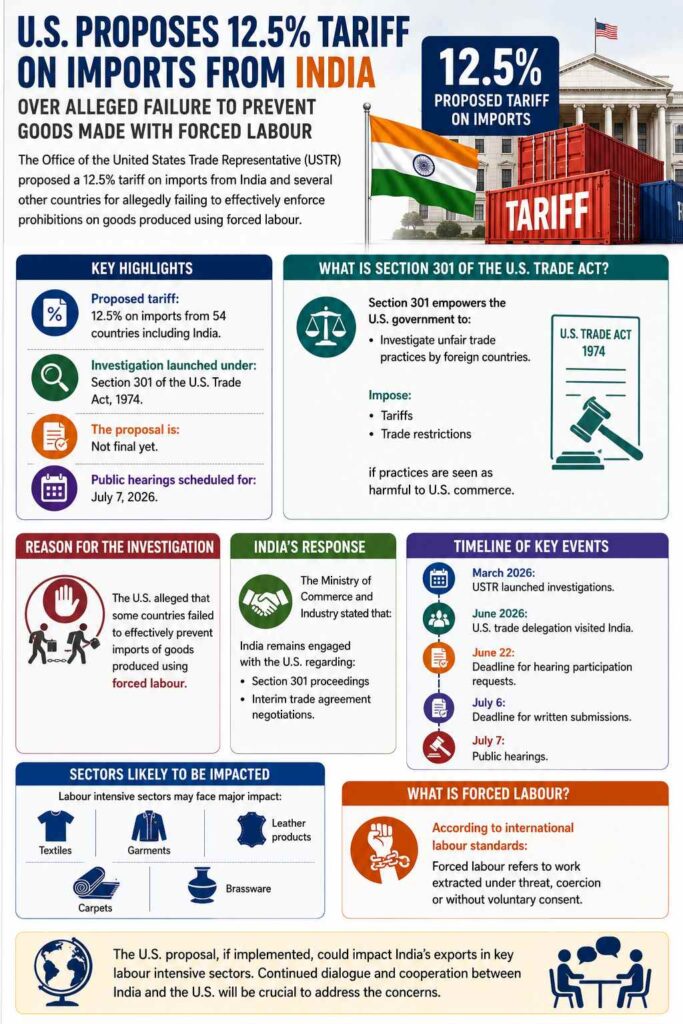
  • India–US Trade Issue and ILO Compliance  

    Why in the News?

    India responded to investigations by the United States Trade Representative under Section 301 on forced labour and excess capacity.

    Key Points

    • Section 301: US law to investigate unfair trade practices and impose tariffs.
    • India on Forced Labour: India has ratified International Labour Organization conventions:
      • Forced Labour Convention, 1930
      • Abolition of Forced Labour Convention, 1957
    • India on Excess Capacity: Economy is largely domestic demand driven
      • Export to GDP ratio about 12 percent
    • Trade Surplus Argument: Trade surplus is a normal outcome of global trade
      • Based on comparative advantage
    • US Concerns: Overcapacity affecting US jobs and industries
    • India’s Counter
      • India accounts for only about 3.1 percent of US imports
      • Limited role in US trade deficit
    [2018] International Labour Organization’s Conventions 138 and 182 are related to: 
    (a) Child labour 
    (b) Adaptation of agriculture practices to global climate change 
    (c) Regulation of food prices and food security 
    (d) Gender parity at the workplace
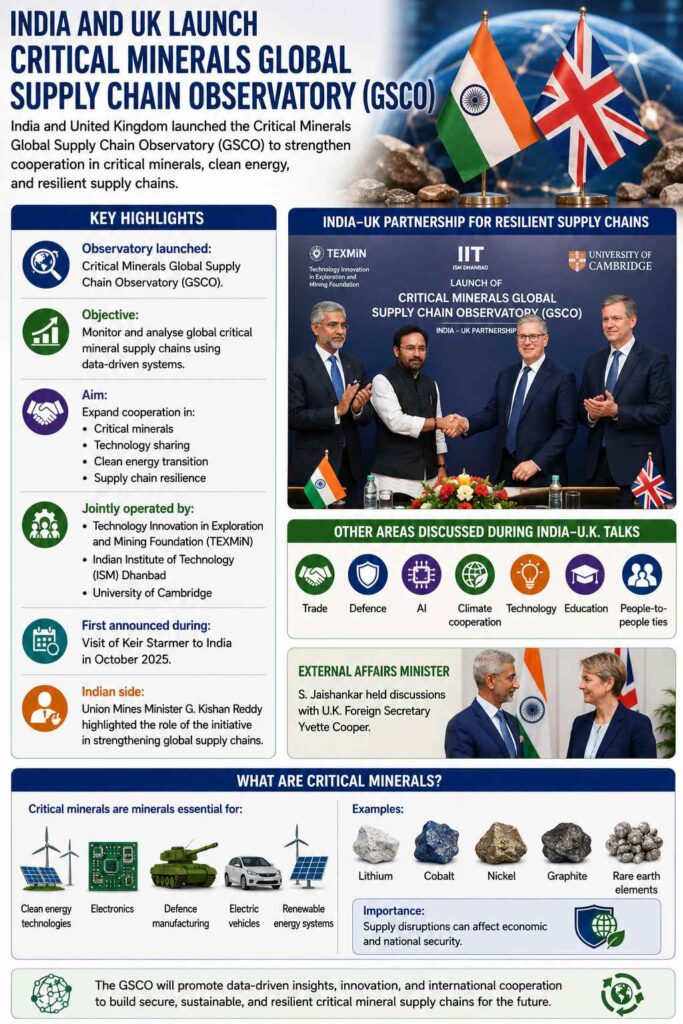
  • India–Zambia Talks on Critical Minerals 

    Why in the News?

    • India’s negotiations with Zambia over critical minerals mining have stalled due to lack of clarity on mining rights.
    • Zambia is a landlocked country in Southern Africa bordered by eight nations: the Democratic Republic of the Congo (north), Tanzania (northeast), Malawi and Mozambique (east), Zimbabwe and Botswana (south), Namibia (southwest), and Angola (west).

    Key Highlights

    • India allocated: ~9,000 sq km in Zambia for exploration
    • Minerals: Cobalt and Copper
    • Exploration: Indian geologists collected samples
    • Plan:
      • 3-year exploration
      • Later private sector participation (if mining rights granted)

    What are Critical Minerals

    • Essential for:
      • Energy transition
      • Strategic industries
      • High-tech manufacturing

    Key Minerals

    1. Cobalt

    • Used in: EV batteries and Electronics
    • India: Highly import dependent

    2. Copper

    • Used in: Power infrastructure, Electronics, and Construction
    • Imports rising due to domestic constraints

    Why Talks Stalled

    • Zambia has not assured: Mining rights
    • Without rights: Commercial extraction not possible

    India’s Strategy

    • Secure minerals via: Government-to-government deals
    • Focus regions: Africa, Australia, and Latin America
    [2023] About three-fourths of world’s cobalt, a metal required for the manufacture of batteries for electric motor vehicles, is produced by: 
    (a) Argentina 
    (b) Botswana 
    (c) the Democratic Republic of the Congo 
    (d) Kazakhstan
  • Why is the Strait of Hormuz critical to global energy flows?

    Why in the News?

    The Strait of Hormuz has re-emerged as the epicentre of a deepening global energy and security crisis following escalating tensions involving Iran, the United States, and Israel. Recent U.S.-led military actions and Iran’s retaliatory tightening of maritime access have disrupted one of the world’s most critical oil arteries. A U.S. naval blockade of vessels to and from Iranian ports, followed by a fragile ceasefire allowing only limited ship movement, has drastically reduced daily vessel traffic, from around 130 ships to just a few on some days. 

    What is the Strait of Hormuz?

    The Strait of Hormuz is a narrow, strategically vital waterway connecting the Persian Gulf to the Gulf of Oman and the Arabian Sea. It is widely considered the world’s most important oil transit chokepoint because it is the only sea passage for oil tankers leaving the Persian Gulf.

    Geography and Location

    1. Bordering Countries: The strait is bounded by Iran to the north and Oman (specifically the Musandam Peninsula) and the United Arab Emirates (UAE) to the south.
    2. Dimensions: It is approximately 167 km (104 miles) long. At its narrowest point, it spans only 33-39 km.
    3. Shipping Lanes: Because of the narrow geography, commercial vessels must follow a Traffic Separation Scheme (TSS). These shipping lanes are only about 3 km (2 miles) wide in each direction, separated by a 3 km (2-mile) buffer zone.

    Why are maritime chokepoints central to global energy security?

    1. Geographical Constraint: Concentrates shipping into narrow corridors with no viable alternatives; e.g., Hormuz at its narrowest is 33 km wide
    2. Trade Dependence: Carries 70-80% of global oil trade via sea routes
    3. Systemic Vulnerability: Single disruption halts traffic instantly; e.g., current blockade reducing ship movement
    4. Economic Impact: Triggers oil price spikes, inflation, and supply chain disruptions
    5. Energy Security Link: Directly affects import-dependent countries like India, Japan, South Korea.

    Why is the Strait of Hormuz uniquely critical among global chokepoints?

    1. Energy Volume: Handles ~21 million barrels/day (~20% global consumption)
    2. LNG Flows: Facilitates major LNG exports from Qatar and UAE
    3. Regional Connectivity: Links Persian Gulf producers to global markets via Indian Ocean
    4. Asian Dependence: Nearly 80% of flows directed to Asia (India, China, Japan)
    5. Lack of Alternatives: No equally efficient substitute route for Gulf oil exports

    What recent geopolitical developments have escalated risks in the Strait?

    1. Military Escalation: U.S. and Israeli strikes on Iran triggered tensions
    2. Maritime Restrictions: Iran tightened access in retaliation
    3. Naval Blockade: U.S. restricted vessels to/from Iranian ports
    4. Traffic Collapse: Ship movements dropped from ~130/day to minimal levels
    5. Fragile Ceasefire: Partial reopening but continued uncertainty

    What are the economic and strategic consequences of disruption?

    1. Oil Price Volatility: Immediate upward pressure on global crude prices
    2. Inflationary Trends: Higher transport and energy costs
    3. Supply Chain Disruptions: Delays in critical commodities
    4. Strategic Vulnerability: Increased dependence on volatile regions
    5. Global Growth Impact: Slowing economic activity due to uncertainty

    Which other global chokepoints reinforce the fragility of maritime trade?

    1. Strait of Malacca: Shortest route between Indian and Pacific Oceans; critical for East Asia trade
    2. Bab-el-Mandeb Strait: Connects Red Sea to Gulf of Aden; vulnerable to conflict
    3. Suez Canal: Key Europe-Asia route; blockage disrupts global trade
    4. Panama Canal: Connects Atlantic and Pacific; vital for global shipping

    How does international law govern navigation through such chokepoints?

    1. Transit Passage: Ensures uninterrupted navigation through straits used for international navigation
    2. UNCLOS Framework: Balances sovereignty of coastal states with global navigation rights
    3. Non-Suspension Principle: Passage cannot be arbitrarily blocked
    4. Security Exception: States may regulate for security but not fully restrict

    Conclusion

    The Strait of Hormuz illustrates how geography, geopolitics, and global markets intersect. Its disruption exposes structural vulnerabilities in global energy systems, necessitating diversification, strategic reserves, and diplomatic stability.

    PYQ Relevance

    [UPSC 2022] Mention the significance of straits and isthmus in international trade. 

    Linkage: The PYQ tests the direct conceptual foundation for understanding Hormuz as a maritime chokepoint controlling global trade flows. It enables linking geography with economics by explaining how narrow passages influence global energy security and trade routes.

  • India to Gain Preferential Access to 38 Developed Countries  

    Why in the News?

    Union Commerce Minister Piyush Goyal announced that India will soon get preferential market access to 38 developed countries through multiple Free Trade Agreements (FTAs).

    These countries together account for:

    • Two thirds of global trade
    • Two thirds of global GDP

    Key FTAs Mentioned

    Already Operational

    • EFTA Countries (Effective October 2025): Switzerland, Norway, Liechtenstein, and Iceland

    Upcoming FTAs

    1. UK FTA: Expected to become operational: May 1, 2026

    2. Oman FTA: Expected to become operational: June 1, 2026

    3. New Zealand FTA

    • Signing expected soon
    • Likely operational: January 2027

    4. European Union (EU) FTA: Expected operational timeline: Early next year

    • Around January–February

    What is Preferential Access

    Preferential access means:

    • Lower tariffs for Indian exports
    • Better market access compared to competitors
    • Boost to exports and manufacturing

    Example:

    • If India’s tariff = lower than competitors
    • Indian goods become more competitive
    [2017] ‘Broad-based Trade and Investment Agreement (BTIA)’ is sometimes seen in the news in the context of negotiations held between India and 
    (a) European Union 
    (b) Gulf Cooperation Council 
    (c) Organization for Economic Cooperation and Development 
    (d) Shanghai Cooperation Organization
  • Chagos Islands  

    Why in the News?

    • The United Kingdom has put on hold the deal to cede sovereignty of the Chagos Islands, keeping the long-running UK–Mauritius sovereignty dispute unresolved.

    About the Chagos Islands

    • Location: Central Indian Ocean
    • Distance: About 1,600 km south of India
    • Type: Archipelago (group of islands)
    • Status: British Overseas Territory
    • Established: 1965 (British Indian Ocean Territory)

    Major Islands in Chagos Archipelago

    • Diego Garcia (Largest island)
    • Peros Banhos Atoll
    • Solomon Islands
    • Egmont Islands
    • Eagle Islands
    • Nelsons Island
    • Three Brothers Islands
    • Danger Island
    [2022] Which one of the following statements best reflects the issue with Senkaku Islands, sometimes mentioned in the news? 
    a) It is generally believed that they are artificial islands made by a country around South China Sea. 
    b) China and Japan engage in maritime disputes over these islands in East China Sea. 
    c) A permanent American military base has been set up there to help Taiwan to increase its defence capabilities. 
    d) Though International Court, of Justice declared them as no man’s land, some South-East Asian countries claim them.

  • Difficult to replace the Gulf as a supply source

    Why in the News?

    Recent US-Iran Talks have revived concerns over instability in the Persian Gulf, a region supplying a significant share of global oil and gas. Replacing Gulf energy is extremely difficult due to cost, infrastructure, and geopolitical constraints, making this a major global economic risk. The issue gains importance as disruptions could trigger inflation, supply shocks, and energy insecurity worldwide, unlike earlier periods when diversified supply chains cushioned shocks.

    Why is replacing Gulf oil supply structurally difficult?

    1. Cost Advantage: Ensures lowest production costs globally, making alternatives economically unviable; Gulf oil extraction remains cheaper than shale or deepwater.
    2. Infrastructure Lock-in: Supports established export terminals, pipelines, and shipping routes, unlike emerging producers lacking scale.
    3. Production Scale: Provides large surplus capacity, especially in Saudi Arabia and UAE, unmatched globally.
    4. Market Integration: Facilitates long-term contracts and refining compatibility, limiting substitution flexibility.

    Why is Qatar’s LNG central to global energy security?

    1. Export Dominance: Ensures ~77-90 MTPA LNG supply, forming ~20% of global LNG trade .
    2. Infrastructure Concentration: Supports production at Ras Laffan-the world’s largest LNG hub, creating systemic vulnerability.
    3. Long-term Contracts: Locks supply for Europe, China, Japan under 15-20 year agreements, limiting flexibility.
    4. Disruption Impact: Removes 12.8 MTPA (17% capacity) due to attacks, creating multi-year supply gaps

    How do geopolitical tensions impact global energy security?

    1. Supply Disruption Risk: Increases vulnerability due to chokepoints like the Strait of Hormuz, through which ~20% of global oil passes.
    2. Price Volatility: Triggers sharp price spikes affecting global inflation and trade balances.
    3. Strategic Dependencies: Reinforces reliance of major economies (India, China, EU) on Gulf imports.
    4. Energy Weaponisation: Enables use of oil supply as a geopolitical tool.

    What are the limitations of alternative energy sources?

    1. US Shale Constraints: Faces high production costs and rapid decline rates, limiting scalability.
    2. Renewables Gap: Ensures long-term transition, but lacks immediate substitution capacity for fossil fuels.
    3. Other Producers: Countries like Venezuela or Africa face political instability, sanctions, or infrastructure deficits.
    4. Logistical Challenges: Increases transportation costs and delays due to rerouting supply chains.

    Why are countries shifting to US and alternative supplies?

    1. Forced Diversification: Compels buyers to shift to US LNG due to Qatar shutdown .
    2. Sanctions & Blockades: Limits access to Iranian and Venezuelan oil due to US restrictions.
    3. Capacity Constraints: US operates near full capacity, limiting immediate scalability.
    4. Cost Escalation: Raises import costs due to longer shipping routes and spot pricing. 

    How does maritime security shape energy flows?

    1. Chokepoint Vulnerability: Concentrates risk in narrow passages like Hormuz. Even after some diversion of exports through pipelines, the blockade gas choked of perhaps 15 million barrels of oil supply per day.
    2. Naval Presence: Ensures security through US and allied naval deployments, but raises escalation risks.
    3. Shipping Insurance Costs: Increases during tensions, raising overall oil prices.
    4. Trade Route Diversification Limits: Alternative routes remain underdeveloped or costly.

    What are the broader economic implications of Gulf supply disruptions?

    1. Inflationary Pressures: Raises fuel and transport costs globally.
    2. Fiscal Stress: Impacts import-dependent countries like India via higher subsidy burdens.
    3. Industrial Slowdown: Affects manufacturing and logistics sectors.
    4. Energy Transition Delay: Forces continued reliance on fossil fuels due to lack of immediate substitutes. 

    Conclusion

    The Persian Gulf remains structurally indispensable to global energy security due to its cost efficiency, scale of production, and entrenched supply networks. Disruptions in the region expose the limits of current diversification efforts and underline persistent geopolitical vulnerabilities. Ensuring stability in Gulf supply chains, while accelerating energy transition, strategic reserves, and diversified sourcing, remains critical to mitigating future shocks and sustaining global economic stability.

    PYQ Relevance

    [UPSC 2017 The question of India’s Energy Security constitutes the most important part of India’s economic progress. Analyze India’s energy policy cooperation with West Asian countries.

    Linkage: Energy security remains a recurring GS-3 theme, linking economy, external sector stability, and geopolitics, with frequent focus on import dependence and West Asian dynamics. The article highlights structural dependence on Gulf energy and chokepoint risks (Hormuz), directly reflecting India’s vulnerabilities discussed in the PYQ.

  • Argentina Withdraws from World Health Organisation

    Why in the News?

    Argentina has formally withdrawn from the World Health Organization (WHO), with the withdrawal becoming effective in March 2026 after a one year notice period.

    Key Highlights

    • Argentina notified UN Secretary General on March 17, 2025
    • Withdrawal became effective after one year, as per Vienna Convention on the Law of Treaties
    • Decision taken under President Javier Milei
    • Confirmed by Foreign Minister Pablo Quirno

    Reasons for Withdrawal

    • Argentina cited:
      • Greater policy sovereignty
      • Independent health policy making
      • Better resource allocation
      • Reduced external influence
    • Government also stated:
      • Argentina does not rely on WHO funding
      • Healthcare services will not be affected

    After Withdrawal

    Argentina will continue cooperation through:

    • Bilateral agreements
    • Regional health forums
    • International collaboration outside WHO

    About World Health Organization (WHO)

    • Established: 1948
    • Headquarters: Geneva, Switzerland
    • Members: 194 countries
    • Type: UN Specialized Agency

    Functions

    • Global health coordination
    • Pandemic response
    • Health standards and guidelines
    • Data monitoring and research
    • Technical assistance to countries

    Vienna Convention on the Law of Treaties

    • Governs international agreements
    • Allows withdrawal after notice period
    • Standard withdrawal period: 1 year
    [2024] Consider the following pairs: Country : Reason for being in the news 
    1 Argentina : Worst economic crisis 
    2 Sudan : War between the country’s regular army and paramilitary forces 
    3 Turkey : Rescinded its membership of NATO 
    How many of the pairs given above are correctly matched? 
    (a) Only one pair (b) Only two pairs (c) All three pairs (d) None of the pairs
  • Philippines Opens Coast Guard Base on Thitu Island

    Why in the News?

    The Philippines opened a new Coast Guard base on Thitu Island (Pag-asa Island) in the South China Sea, strengthening its presence in a disputed maritime region claimed by China.

    Key Highlights

    • Location: Thitu Island (Pag-asa Island)
    • Region: South China Sea
    • Purpose: Strengthen sovereignty and maritime security
    • The base will include:
      • Patrol ships
      • Aircraft
      • Surveillance systems
      • Search and rescue operations

    The base will also support:

    • Fishermen protection
    • Environmental monitoring
    • Law enforcement

    Why the South China Sea is Important

    • Major global trade route
    • Rich in:
      • Fisheries
      • Oil and gas reserves
    • Strategic military importance

    Dispute in the South China Sea

    • China claims almost the entire South China Sea, including areas claimed by:
      • Philippines
      • Vietnam
      • Malaysia
      • Brunei
      • Taiwan
    • China’s claim is based on the Nine-Dash Line, which was:
      • Rejected by 2016 International Arbitration Tribunal
      • Based on UNCLOS (1982)
    • China rejected the ruling and continues to assert control.

    About Thitu Island (Pag-asa Island)

    • Located in Spratly Islands
    • Controlled by Philippines since 1970s
    • About 400 residents
    • Strategic location near Chinese military bases
    • China has built artificial islands and military infrastructure nearby, including Subi Reef.
    [2022] With reference to the United Nations Convention on the Law of Sea, consider the following statements: 1 A coastal state has the right to establish the breadth of its territorial sea up to a limit not exceeding 12 nautical miles, measured from baseline determined in accordance with the convention. 2 Ships of all states, whether coastal or land-locked, enjoy the right of innocent passage through the territorial sea. 3 The Exclusive Economic Zone shall not extend beyond 200 nautical miles from the baseline from which the breadth of the territorial sea is measured. Which of the statements given above are correct? (a) 1 and 2 only (b) 2 and 3 only (c) 1 and 3 only (d) 1, 2 and 3
  • For China, trade risks spur larger diplomatic role

    Why in the News?

    China has, for the first time, jointly proposed a peace initiative with Pakistan on the West Asia conflict. This marks a clear shift from its earlier low-profile, reactive diplomacy to proactive crisis engagement. This is significant because China traditionally avoided political entanglement in volatile regions, focusing instead on economic ties. However, disruptions in critical chokepoints like the Strait of Hormuz and Bab-el-Mandeb, through which a substantial portion of global energy and trade flows, have exposed China’s vulnerability, given that nearly a quarter of global trade and a major share of its energy imports pass through these routes.

    What are the key features of the China-Pakistan five-point initiative for restoring peace and stability in the Gulf and Middle East Region?

    1. Immediate Cessation of Hostilities: Ensures de-escalation through ceasefire and facilitates humanitarian assistance across war-affected regions.
    2. Peace Talks and Sovereignty Protection: Safeguards territorial integrity and national independence of Iran and Gulf states while ensuring dialogue-based conflict resolution and prohibiting use of force during negotiations.
    3. Protection of Civilians and Infrastructure: Ensures adherence to International Humanitarian Law (IHL) by preventing attacks on civilians, energy facilities, desalination plants, power infrastructure, and peaceful nuclear installations.
    4. Security of Shipping Lanes: Ensures safe passage of commercial and civilian vessels through the Strait of Hormuz and restores normal maritime trade flows critical for global energy supply.
    5. Primacy of UN Charter: Reinforces multilateralism by upholding the United Nations’ central role and promoting a comprehensive peace framework based on international law.

    What explains China’s shift from economic presence to diplomatic activism?

    1. Economic Dependence: Reflects reliance on West Asian energy imports from Iran and Saudi Arabia, ensuring industrial continuity.
      1. Economic Dependence: Reflects high reliance on West Asian energy, with over 50% of China’s crude oil imports sourced from the Middle East (2024) and ~45–50% of its oil imports transiting through the Strait of Hormuz. Additionally, China alone accounts for ~37.7% of all oil flows passing through Hormuz, making it the single largest beneficiary of this chokepoint
    2. Supply Chain Vulnerability: Exposes risks to raw materials and intermediate goods essential for manufacturing dominance.
    3. Strategic Signalling: Demonstrates intent to shape global governance beyond trade through mediation initiatives.
    4. Institutional Expansion: Strengthens influence via BRICS expansion including Iran and Saudi Arabia, ensuring diplomatic leverage.

    How do maritime chokepoints shape China’s strategic calculations?

    1. Hormuz Dependency: Ensures energy security as a significant share of China’s oil imports passes through the Strait of Hormuz.
    2. Bab-el-Mandeb Disruptions: Increases freight and insurance costs due to Houthi attacks, affecting Red Sea–Suez trade routes.
    3. Malacca Dilemma: Highlights vulnerability due to dependence on narrow maritime routes near Malaysia and Indonesia.
    4. Trade Exposure: Reflects that nearly one-quarter of global trade passes through these routes, impacting Chinese exports.

    Why is the China-Pakistan initiative geopolitically significant?

    1. Crisis Mediation Role: Facilitates ceasefire, humanitarian access, and dialogue, marking China’s diplomatic assertiveness.
    2. Islamic World Access: Strengthens engagement through Pakistan’s regional connections and political legitimacy.
    3. Non-Western Diplomacy: Promotes Global South-led conflict resolution frameworks.
    4. Precedent Setting: Builds on earlier Iran-Saudi Arabia rapprochement mediated by China in 2023.

    What are the economic consequences of instability in West Asia for China?

    1. Energy Market Volatility: Disrupts oil supply chains, increasing costs and affecting industrial production.
    2. Logistics Disruptions: Forces rerouting via Cape of Good Hope, increasing transit time and shipping costs.
    3. Export Market Risks: Affects access to European markets dependent on Red Sea routes.
    4. Commodity Constraints: Leads to tighter controls on exports like fertilizers to safeguard domestic supply.

    How does changing US posture create space for China?

    1. Selective Engagement: Reduces direct US involvement in regional supply disruptions.
    2. Energy Self-Reliance: Limits US vulnerability due to domestic energy production.
    3. Leadership Vacuum: Enables China to expand diplomatic footprint in crisis management.
    4. Strategic Rebalancing: Reflects shift from security-centric to selective intervention approach.

    What lessons does China draw from the “Malacca Dilemma”?

    The Malacca Dilemma is China’s strategic vulnerability regarding its heavy reliance on the narrow Strait of Malacca for energy imports and trade. Coined by Hu Jintao in 2003, it highlights fears that a hostile power, primarily the US, could block this 2.8 km-wide chokepoint, disrupting ~80% of China’s oil imports

    1. Chokepoint Vulnerability: Recognizes risks of external pressure on critical maritime routes.
    2. Diversification Strategy: Promotes alternative trade routes and supply chains.
    3. Infrastructure Investments: Strengthens Gwadar port and connectivity via China-Pakistan Economic Corridor (CPEC).
    4. Strategic Autonomy: Reduces dependence on vulnerable maritime corridors.

    Conclusion

    China’s evolving diplomatic posture in West Asia reflects a transition from economic pragmatism to strategic activism. Its growing role is driven by structural vulnerabilities in trade and energy flows, reinforcing its ambition to shape global governance while securing national interests.

    PYQ Relevance

    [UPSC 2017] The question of India’s Energy Security constitutes the most important part of India’s economic progress. Analyze India’s energy policy cooperation with West Asian Countries

    Linkage: It highlights how energy dependence on West Asia shapes foreign policy and economic stability. It links to the article by showing how energy security and chokepoints like Hormuz drive geopolitical engagement.

  • Iran war and the looming prospect of stagflation

    Why in the News?

    The ongoing Iran-linked geopolitical tensions have revived fears of stagflation, a rare but severe macroeconomic condition combining high inflation with low growth. The escalation of the Iran-related conflict has triggered energy supply disruptions and price shocks, reminiscent of the 1970s oil crisis, one of the rare historical episodes of stagflation. Unlike recent crises (2008 financial crisis or 2022 Russia-Ukraine war), the current situation combines both price shock and physical supply constraints, making it more severe.

    What explains the concept of stagflation in economic theory?

    1. Stagflation Definition:
      1. Stagflation refers to a macroeconomic condition characterized by simultaneous high inflation, low or negative growth, and high unemployment, typically triggered by negative supply shocks, especially in energy markets.
      2. Combines inflation + stagnation, contradicting traditional Phillips Curve trade-off.
    2. Historical Origin: Coined by Iain Macleod during the 1970s oil crisis.
    3. Empirical Evidence: US GDP growth fell to -0.5% (1974) and -0.2% (1975) with inflation at 11% and 9.1% respectively. (1973-74 Oil Shock triggered by the OPEC oil embargo following the Yom Kippur War (1973)).
    4. UK Case: Inflation reached 24.2% (1975) with stagnant growth.
    5. Key Insight: Demonstrates breakdown of conventional demand-management tools.

    How do negative supply shocks trigger stagflation?

    1. Supply Shock Mechanism: Refers to a leftward shift of the aggregate supply curve (AS) in macroeconomics, or the market supply curve (S) in microeconomics.
      1. Aggregate Supply (AS): In economy-wide analysis, a negative shock (e.g., rise in crude oil prices) shifts Short-Run Aggregate Supply (SRAS) leftward, leading to higher general price level (inflation) and lower real GDP (output contraction)
      2. Market Supply Curve (S): At the commodity level, higher input costs or disrupted production shift the supply curve (S₀ to S₁ leftward), raising equilibrium price (P₀ to P₁) and reducing quantity (Q₀ to Q₁).
      3. Core Outcome: Simultaneous price rise + output fall, which forms the basis of stagflation. 
    2. About the Graph:
      1. Initial Equilibrium: Intersection of D (demand) and S₀ (original supply) at (P₀, Q₀)
      2. Negative Supply Shock: Supply curve shifts leftward (S₀ to S₁) due to higher input costs (e.g., oil)
      3. New Equilibrium:
        1. Price rises: (P₀ to P₁)
        2. Quantity/output falls: (Q₀ to Q₁)
        3. Macro Interpretation: In AS-AD framework, SRAS shifts left leading to inflation + lower GDP = stagflation
    1. Energy Disruptions: Wars, pandemics, and shipping chokepoint closures (e.g., Strait of Hormuz) reduce supply.
    2. Non-linear Effects: Small supply disruptions cause disproportionate economic impact.
    3. Example: COVID disruptions showed difficulty in restoring production chains.

    Why is the current Iran conflict more alarming than past crises?

    1. Dual Shock Nature: Combines price shock + supply disruption, unlike 2008 (demand collapse) or 2022 (primarily price-driven).
    2. Energy Availability Risk: Not just cost, but availability of oil and gas is uncertain.
    3. Global Integration: Higher dependence on energy-intensive production and petrochemicals.
    4. Supply Chain Sensitivity: Disruptions propagate across industries (plastics, fertilizers, transport).
    5. Expert Assessment: Identified as more pernicious than 2022 or 2008 crises.

    How has structural transformation increased vulnerability to energy shocks?

    1. Agricultural Transition: Shift from organic inputs to urea and DAP fertilizers.
    2. Household Energy Shift: Replacement of biomass fuels with LPG (near-universal coverage).
    3. Industrial Dependence: Petrochemicals used in plastics, fibers, pipes, cables.
    4. Economic Complexity: Modern economies have higher input-output interlinkages.
    5. Result: Greater exposure to energy supply disruptions across sectors.

    Why are traditional policy tools inadequate against stagflation?

    1. Monetary Policy Limitation:
      1. Interest Rate Hikes: Controls inflation but worsens growth and unemployment.
      2. Money Tightening: Reduces demand but does not fix supply shortages.
    2. Fiscal Policy Limitation: Expansionary Spending: Boosts demand but fuels inflation when supply is constrained.
    3. Policy Trade-off: Cannot simultaneously address inflation and stagnation effectively.
    4. Structural Nature: Stagflation is primarily a supply-side problem, unlike demand-driven recessions.

    Can the world avoid a repeat of 1970s stagflation?

    1. Duration Factor: Short-lived shocks may allow quick supply restoration (S₁ to S₀).
    2. Geopolitical Resolution: Early end to Iran conflict reduces long-term impact.
    3. Adaptive Capacity: Modern economies have better logistics and diversification, but vulnerabilities remain.
    4. Risk Condition: Prolonged disruptions lead to high probability of stagflation. 

    Conclusion

    The current Iran-linked crisis represents a classical negative supply shock with modern complexities, making stagflation a tangible risk. Unlike past crises, the combination of energy dependence, global integration, and supply rigidity amplifies its impact. Addressing it requires structural supply-side interventions, not merely demand management.

    PYQ Relevance

    [UPSC 2024] What are the causes of persistent high food inflation in India? Comment on the effectiveness of the monetary policy of the RBI to control this type of inflation.

    Linkage: It highlights supply-side inflation (cost-push) similar to energy shocks causing stagflation. It demonstrates limitations of monetary policy in addressing supply disruptions, thne core issue in stagflation.