💥Mains Ready By December. Smash Mains & Smash PYQ Admissions Open

Subject: International Stories of Key Importance

  • Highlights of the Global Innovation Index, 2025

    Why in the News?

    The World Intellectual Property Organization (WIPO) has released the Global Innovation Index (GII) 2025.

    About the Global Innovation Index (GII):

    • Overview: Annual ranking of 139 economies by their innovation capacity and success.
    • Publishers: Jointly by Cornell University, INSEAD, and the World Intellectual Property Organization (WIPO).
    • Origin: First published in 2007.
    • Indicators: Uses 80+ metrics across 7 pillars.
    • Structure:
      • Innovation Input Sub-Index: Institutions, human capital and research, infrastructure, market sophistication, business sophistication.
      • Innovation Output Sub-Index: Knowledge and technology outputs, creative outputs.
    • Purpose: Helps governments evaluate how effectively R&D, education, and infrastructure are translated into innovation outcomes.

    Key Highlights of GII 2025:

    • Global R&D growth: Slowed to 2.9% (2024) and 2.3% (2025 projection), down from 4.4% earlier; lowest since the 2010 financial crisis.
    • Top Performers: Switzerland (1st), Sweden (2nd), United States (3rd), followed by Republic of Korea, Singapore, United Kingdom, Finland, Netherlands, Denmark, and China (10th).
    • China: Surpassed Switzerland in knowledge and technology outputs; 2nd highest in R&D expenditure; world leader in patent filings.
    • Regional Trends: Europe dominates with 15 of top 25 economies; Southeast, East Asia and Oceania (SEAO) region has 6 economies in top 25.
    • India: Ranked 38th globally with a score of ~40.5; top among lower-middle income countries and in Central & Southern Asia.
      • Strengths: Knowledge and technology outputs (22nd), market sophistication, and human capital and research.
      • Weaknesses: Business sophistication, infrastructure, and institutions remain lagging.
    [UPSC 2019] The Global Competitiveness Report is published by the:

    Options:

    (a) International Monetary Fund  (b) United Nations Conference on Trade and Development  (c) World Economic Forum * (d) World Bank


  • Let Griger counters, not guesses, shape Iran Actions

    Introduction

    The nuclear question has once again moved to the forefront of global geopolitics. Following the U.S. strikes on Iran’s underground nuclear site at Fordow in June 2025, the E3 (Britain, France, Germany) invoked the “snapback” clause of the 2015 nuclear deal, citing Iranian violations. If diplomacy falters, UN sanctions on enrichment, arms transfers, finance, and shipping will return, escalating global risks. The crisis is magnified by the absence of verified facts after the International Atomic Energy Agency (IAEA) staff withdrew from Iran. In this environment of speculation and heightened risks, verification, not guesswork, must anchor diplomacy.

    Why is this news significant?

    The crisis is not just another Middle Eastern standoff; it is unprecedented in multiple ways. For the first time since 2015, the snapback clause has been triggered, threatening the revival of stringent UN sanctions. The crisis has exposed the vacuum of verified facts, as IAEA inspectors have been expelled, leaving the world to act on rumors. The stakes are global from oil markets and shipping insurance to regional stability and nuclear proliferation. For India, the challenge is sharper: ensuring uninterrupted oil flows through the Strait of Hormuz, stability in its extended neighborhood, and the safety of 8 million Indian citizens in West Asia.

    Why does the absence of IAEA verification matter?

    1. Verification as the hinge of diplomacy: IAEA access substitutes speculation with facts and provides baselines for negotiations.
    2. Market stability: Comparable IAEA presence in Ukraine’s Zaporizhzhia plant calmed global markets; similar oversight in Iran could reduce volatility.
    3. Iran’s sovereignty concerns: Iran argues that inspectors compromise sovereignty and risk enabling strikes — past Israeli and U.S. strikes followed IAEA disclosures.
    4. Parliamentary resistance: Such episodes have hardened Iranian domestic opposition to IAEA cooperation.

    What are the risks if Iran withdraws from the NPT?

    1. Legal vacuum: Withdrawal strips the IAEA of legal authority to inspect Iranian sites.
    2. Escalation to uncharted territory: Harder sanctions, further isolation, and the military option returning to the table.
    3. Global instability: From oil prices to nuclear proliferation, the fallout would be worldwide.

    How is India placed in this unfolding crisis?

    1. Bridge-builder role: As a long-standing IAEA Board member with ties across divides, India is well-positioned to facilitate consensus.
    2. SCO and BRICS engagement: India joined others in condemning U.S.-Israel strikes, supporting a multilateral call for technical IAEA access.
    3. Technical contribution: India’s IAEA-certified Tarapur facility could analyze samples under safeguards, providing credible support.
    4. Energy and diaspora stakes: Protecting oil supplies and ensuring the safety of Indians abroad makes stability in West Asia non-negotiable for New Delhi.

    What are the choices before the global community?

    1. Diplomatic opening: Iran’s recent agreement with the IAEA in Cairo (Sept 9, 2025) and allowing inspectors at Bushehr offer small openings.
    2. Snapback pause: If Iran extends verification to bombed sites, E3 may pause the snapback, shifting momentum back to diplomacy.
    3. Alternative — escalation: Failure of diplomacy risks sanctions, military standoffs, and cycles of strike and counterstrike.

    Conclusion

    The Iran nuclear standoff represents a defining moment for global non-proliferation and regional stability. What the world requires today is not speculation, but credible verification, structured dialogue, and sustained diplomacy. For India, the stakes go beyond principles of international order to immediate concerns of energy security, diaspora protection, and regional peace. By using its credibility in multilateral forums and offering technical expertise, India can position itself as a constructive stakeholder. Ultimately, the crisis will test whether global powers can rise above unilateralism and competing interests to uphold collective security and prevent a slide into escalation.

    PYQ Relevance

    [UPSC 2018] In what ways would the ongoing US-Iran Nuclear Pact Controversy affect the national interest of India? How should India respond to this situation?

    Linkage: The ongoing U.S.-Iran nuclear pact controversy directly impacts India’s energy security, diaspora safety in West Asia, and regional stability. Escalation could disrupt oil supplies through the Strait of Hormuz and complicate India’s strategic balance between the U.S., Iran, and Gulf states. India must respond with measured diplomacy, supporting verification through the IAEA while safeguarding its vital national interests.
  • Scarborough Shoal in South China Sea

    Why in the News?

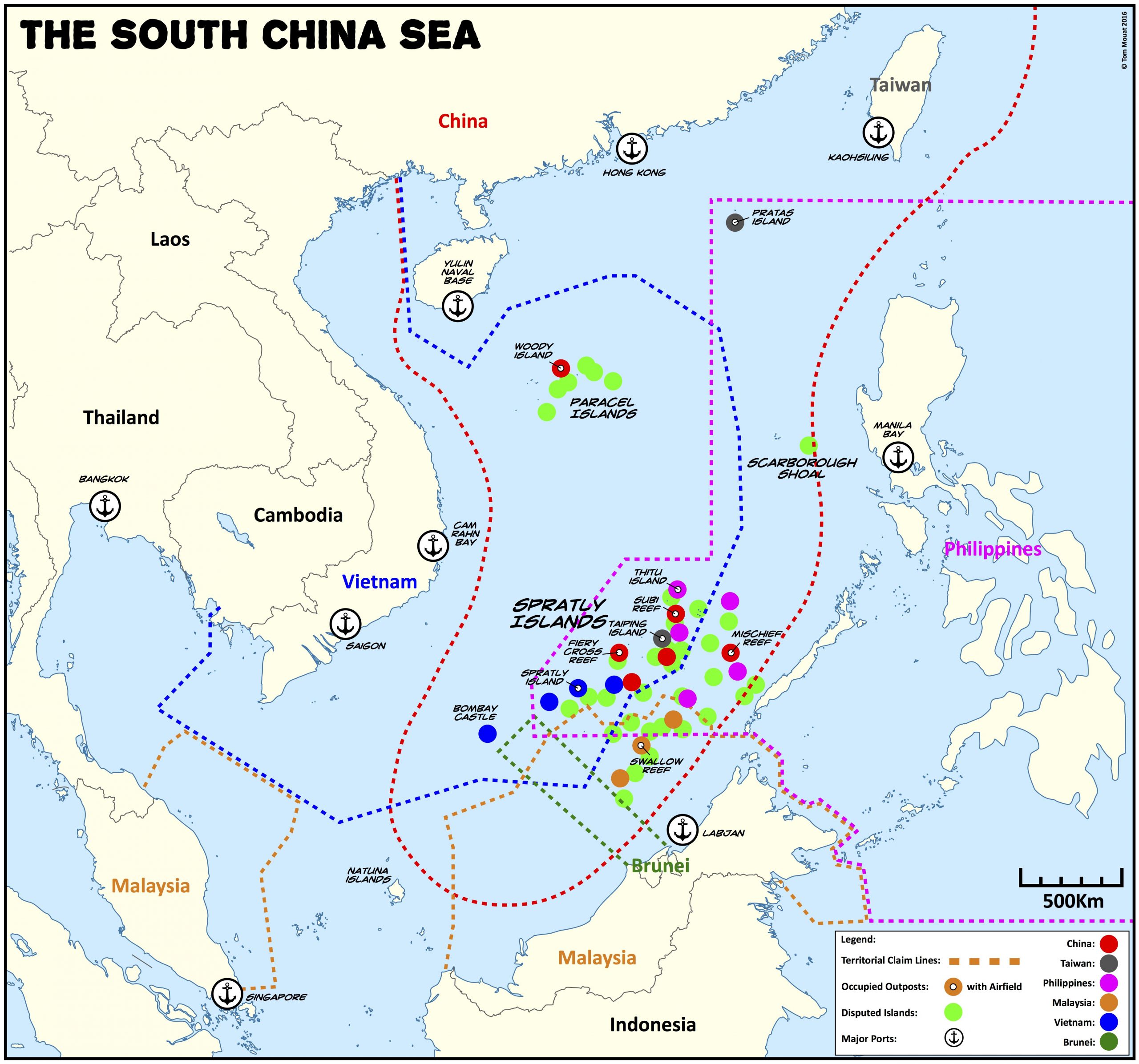
    China’s State Council has approved the creation of a national nature reserve at Scarborough Shoal (Huangyan Dao in Chinese, Bajo de Masinloc/Panatag Shoal in the Philippines).

    About Scarborough Shoal:

    • Geography: A triangle-shaped chain of reefs and rocks in the South China Sea, about 200 km from Luzon (Philippines) and 800+ km from Hainan (China).
    • Status: Uninhabited but strategic, located near shipping lanes carrying $3 trillion in trade annually.
    • Significance: The lagoon shelters boats, and surrounding waters hold rich fish stocks vital for Zambales and Pangasinan communities.

    Disputes about it:

    • Sovereignty Claims: Both China and the Philippines claim ownership.
    • 2016 Arbitration Ruling: Permanent Court of Arbitration (The Hague) held China’s nine-dash line claim invalid, declaring Scarborough a traditional fishing ground under UNCLOS; China rejected the verdict.
    • Philippines’ Grounds: Lies within Manila’s Exclusive Economic Zone (EEZ), making China’s reserve “illegitimate and unlawful.”
    • International Response: The US, Japan, Australia, and Canada conduct naval patrols/drills supporting the Philippines and freedom of navigation.
    [UPSC 2022] Which one of the following statements best reflects the issue with Senkaku Islands, sometimes mentioned in the news ?

    Options: (a) It is generally believed that they are artificial islands made by a country around South China Sea.

    (b) China and Japan engage in maritime disputes over these islands in East China Sea.*

    (c) A permanent American military base has been set up there to help Taiwan to increase its defence capabilities.

    (d) Though International Court of Justice declared them as no man’s land, some South-East Asian countries claim them.


  • Power of Siberia 2 Pipeline

    Why in the News?

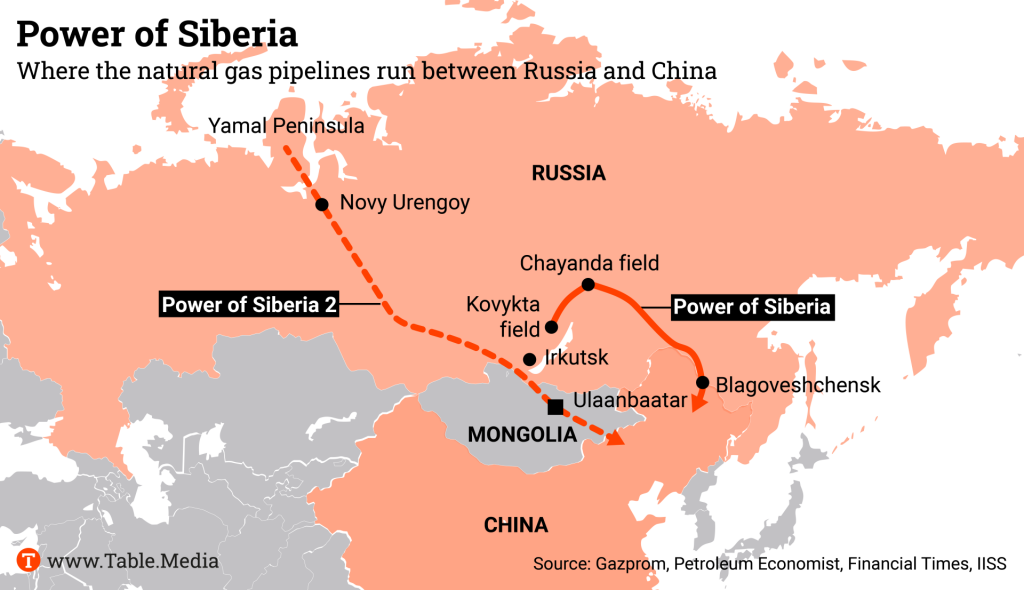
    Russia has announced a “legally binding” memorandum with China to build the Power of Siberia 2 pipeline, highlighting closer Russia–China ties amid Western sanctions.

    Power of Siberia 2 Pipeline

    What are Power of Siberia Pipelines?

    • Power of Siberia 1: Operational pipeline from eastern Siberia to northern China; commercial exports since Dec 2019.
    • Specifications: Length over 5,100 km (3,968 km in Russia), diameter 1,420 mm, capacity 61 bcm/year (38 bcm contracted to China). Built to withstand –62°C, using 2.25 million tonnes of steel.
    • Gas Source & Route: Supplies from Chayanda field (Yakutia) and later Kovykta field; passes via Amur Gas Processing Plant; two tunnels cross under the Amur River into China, linking to Heihe–Shanghai pipeline.
    • Timeline: Construction began 2014, completed 2019, full 38 bcm deliveries by 2025.
    • Power of Siberia 2: Planned 2,600 km pipeline exporting 50 bcm/year from Yamal & western Siberia fields to China, via Mongolia (Soyuz Vostok segment).
    • Status: Gazprom–CNPC signed a binding memorandum. Pricing, financing, and timelines remain unsettled; deliveries may start by 2030.

    Geopolitical Significance:

    • Political Symbolism: Project showcases Russia–China partnership, snubs Western LNG, and reflects defiance of sanctions.
    • Strategic Showcase: Analysts call it political theatre — Russia grows more dependent on China, while China gains strategic leverage.
    [UPSC 2024] Consider the following statements:

    Statement-I: Sumed pipeline is a strategic route for Persian Gulf oil and natural gas shipments to Europe.

    Statement-II: Sumed pipeline connects the Red Sea with the Mediterranean Sea.

    Which one of the following is correct in respect of the above statements?”

    Options: (a) Both Statement-I and Statement-II are correct and Statement-II explains Statement-I* (b) Both Statement-I and Statement-II are correct, but Statement-II does not explain Statement-I (c) Statement-I is correct, but Statement-II is incorrect (d) Statement-I is incorrect, but Statement-II is correct


  • [6th Spetember 2025] The Hindu Op-ed: India’s Strategic autonomy in a multipolar world

    PYQ Relevance

    [UPSC 2014] With respect to the South China Sea, maritime territorial disputes and rising tension affairs the need for safeguarding maritime security to ensure freedom of navigation and even flight throughout the region. In this context, discuss the bilateral issues between India and China.

    Linkage: India’s stance on the South China Sea highlights strategic autonomy — upholding freedom of navigation under UNCLOS while resisting China’s expansive claims. Bilateral tensions persist, from border clashes (2020) to disputes over India’s oil exploration with Vietnam in contested waters. Yet, India balances deterrence through the Quad and cooperation via BRICS/SCO, reflecting a cautious but autonomous approach.

    Mentor’s comment

    Strategic autonomy is more than just a diplomatic catchphrase for India, it is the lifeline of its foreign policy in an era of multipolar flux. As India seeks to balance ties with the United States, China, and Russia, while also positioning itself as the voice of the Global South, the concept is no longer theoretical but a daily practice. For UPSC aspirants, understanding this evolving doctrine is essential to connect historical continuities with present-day challenges of geopolitics, economy, and technology.

    Introduction

    Strategic autonomy, once confined to the academic realm of international relations, has become a core principle of India’s foreign policy. Rooted in India’s colonial history and first institutionalized through Nehru’s Non-Alignment Movement, it has today evolved into a doctrine of multi-alignment, pragmatism, and resilience. In a world where U.S. unipolarity is waning, China is rising, and Russia is recalibrating its global role, India faces both opportunities and constraints. The essence of strategic autonomy lies in navigating this turbulent multipolarity while safeguarding sovereignty, growth, and global aspirations.

    The Evolution and Relevance of Strategic Autonomy

    1. Historical roots: Emerged from India’s colonial subjugation and Nehru’s vision of non-alignment.
    2. Cold War practice: Balanced ties with both blocs while retaining independence.
    3. Contemporary shift: Modi-era “multi-alignment” emphasizes flexibility with powers like the U.S., Russia, and China.
    4. Core principle: Not isolationism but adaptability in safeguarding national interests.

    How the Global Order Shapes India’s Autonomy

    1. Fragmented multipolarity: Decline of U.S. dominance, rise of China, Russia’s revisionism, and West’s internal divisions.
    2. Volatility in partnerships: U.S. unpredictability under Trump strained trade ties and increased pressure on India over Russia.
    3. Fluid environment: India must recalibrate ties to secure territorial integrity, economic growth, and regional stability.

    India’s Engagement with the United States

    1. Deepened partnership: Defence cooperation, intelligence sharing, joint exercises, and technology transfers.
    2. New initiatives: Quad, Indo-Pacific dialogues, I2U2, and IMEC reflecting shared concerns about China.
    3. Friction points: Trade tariffs, sanctions, and pressure to reduce Russia ties.
    4. India’s stance: Balanced engagement, cooperative yet assertively independent.

    India’s Balancing Act with China

    1. Security challenge: Border clashes of 2020 ended the façade of benign coexistence.
    2. Dual reality: China remains India’s major trading partner despite tensions.
    3. Strategic response: Strengthened border infrastructure, deepened Indo-Pacific ties, and indigenous defence push.
    4. Diplomatic engagement: Continued participation in BRICS, SCO to balance rivalry with dialogue.

    India’s Enduring Partnership with Russia

    1. Historical solidarity: Long-standing defence cooperation rooted in Cold War ties.
    2. Ukraine conflict test: Continued oil imports and weapons purchases despite Western criticism.
    3. Autonomous approach: Diversification of defence imports without abandoning Russia.
    4. Core principle: Refusal to choose sides in binary contests.

    Strategic Autonomy in the Global South Context

    1. Voice of the Global South: Asserted during India’s G20 presidency in 2023.
    2. India’s stance: “Non-West” but not “anti-West”, balancing pragmatism with plural democracy.
    3. Resonance abroad: Other rising powers too seek agency, not vassalage, in global politics.

    Domestic and Technological Dimensions of Autonomy

    1. Internal constraints: Political polarisation, economic vulnerabilities, institutional weaknesses.
    2. Modern domains: Cyber threats, AI warfare, space competition, data sovereignty.
    3. Recent steps: Indigenous platforms, critical minerals security, global tech governance participation.

    Conclusion

    Strategic autonomy is not about standing alone, but about standing tall. It requires balancing ties with major powers, investing in national capacity, and adapting to new-age domains of competition. India’s rise as a sovereign pole in the multipolar order rests on maintaining autonomy without succumbing to bloc politics. The essence is not isolation, but resilience, the art of walking the tightrope with clarity, confidence, and conviction.

    Value Addition

    Definition of Strategic Autonomy

    General Definition:

    • Strategic autonomy is a nation’s ability to pursue independent foreign and security policies, making sovereign decisions without being bound by external pressures, alliances, or blocs.
    • MEA perspective: It is about “maximizing national interest through diversified engagements” — not neutrality, not isolation, but flexibility and resilience.

    Evolution of Strategic Autonomy in India

    • Colonial Context: India’s colonial past created a deep-rooted desire to preserve independence in foreign policy.
    • Nehruvian Non-Alignment (1950s–1970s)
      • Core principle: India would not align with any Cold War bloc.
      • 1955 Bandung Conference and NAM (1961 Belgrade) institutionalized this vision.
      • Quote (Nehru, 1946): “We propose, so far as we can, to keep away from the power politics of groups, aligned against one another.”
    • Indira Gandhi Era (1970s–1980s)
      • Tilt towards USSR (1971 Indo-Soviet Treaty of Peace, Friendship and Cooperation).
      • Still claimed non-alignment, but practice became more pragmatic.
    • Post-Cold War Recalibration (1990s–2000s)
      • Unipolar U.S.-dominated world; India liberalised economy and sought closer U.S. ties while keeping Russia engaged.
      • Strategic autonomy” re-emerged as India avoided being a U.S. ally despite growing partnership.
    • 21st Century: Multi-Alignment
      • India now engages multiple powers simultaneously: U.S. (Quad, I2U2, IMEC), Russia (defence, energy), China (BRICS, SCO), EU (trade), Global South (voice in G20).
      • Current doctrine: “Autonomy through diversification”, maintaining flexibility across issues.

    Multi-Alignment in India’s Foreign Policy

    • Overview: Instead of non-alignment (staying out of blocs), India today practices multi-alignment — engaging with all major powers, often simultaneously, without exclusive commitment.
    • Examples:
      • Quad (U.S., Japan, Australia, India) → Indo-Pacific security.
      • BRICS (Brazil, Russia, India, China, South Africa) → financial/strategic cooperation.
      • SCO (Russia, China, Central Asia) → security & regional stability.
      • I2U2 (India, Israel, UAE, U.S.) → technology, infrastructure, food security.
      • IMEC → new economic corridor connecting India–Middle East–Europe.

    Key Quotes for Value Addition

    • Jawaharlal Nehru (1946): “We propose, so far as we can, to keep away from the power politics of groups, aligned against one another.” (Origin of non-alignment).
    • Atal Bihari Vajpayee (2003, as PM): “India and the United States may disagree on some issues, but as sovereign countries, we have the right to pursue our national interests.” (Strategic autonomy in U.S. ties).
    • Dr. Manmohan Singh (2005, PM): “Our strategic autonomy does not mean isolation. It means engaging all major powers on equal terms.”
    • S. Jaishankar (External Affairs Minister):
      • “Multi-alignment is the call of the day. Strategic autonomy in today’s multipolar world means engaging America, Russia, China, Europe, and others — each on its own merit.”
      • “Partnerships must be based on interests, not sentiment, not inherited obligations.”
      • “We are non-West, but not anti-West.” (G20 context, 2023).
    • Shivshankar Menon (Former NSA & diplomat):
      • “Strategic autonomy is not a slogan. It is the art of being flexible in a world where alliances are rigid, and sovereignty is contested.”
      • “For India, autonomy lies in not choosing sides but choosing our interests.”
  • In news: Strait of Malacca

    Why in the News?

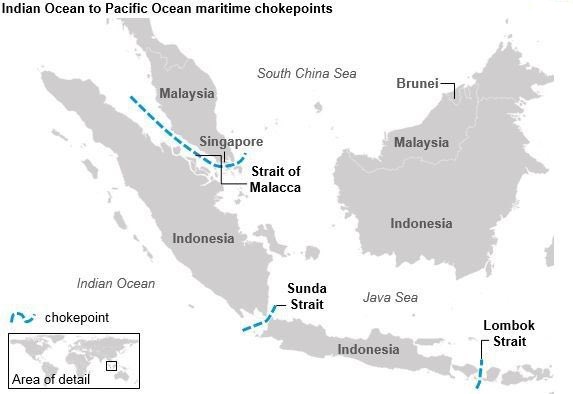
    Singapore’s PM has acknowledged India’s intent to join the Malacca Straits Patrol (currently undertaken by Malaysia, Indonesia, Thailand, and Singapore).

    In news: Strait of Malacca

    About Strait of Malacca:

    • Location: Narrow waterway in Southeast Asia, between the Malay Peninsula (northeast) and Sumatra, Indonesia (southwest).
    • Length & Width: Extends about 800–900 km; width varies from 65 km in the south to 250 km in the north.
    • Depth: The southern end is narrow and shallow, usually less than 37 m deep, posing navigational challenges.
    • Geological Setting: Part of the Sunda Shelf formation, created after post-glacial sea level rise around 2.6 million years ago.
    • Key Ports: Hosts major hubs like Singapore, Port Klang, Penang, and Melaka, making it one of the busiest shipping lanes globally.

    Strategic and Economic Importance:

    • Global Chokepoint: Links the Indian Ocean (Andaman Sea) with the Pacific Ocean (South China Sea), forming a vital maritime chokepoint.
    • Trade Corridor: The shortest sea route between the Middle East/Africa and East Asia, critical for global commerce.
    • Volume of Trade: Handles about 60% of world maritime trade, including large-scale oil shipments from the Middle East to China, Japan, and Southeast Asia.
    • Economic Impact: Any disruption could severely affect supply chains and energy security worldwide.
    • Geopolitical Significance: Attracts competing interests of India, China, the US, and ASEAN states, making it a hotspot for regional and global strategic rivalry.
    [UPSC 2010] Which one of the following can one come across if one travels through the Strait of Malacca ?

    Options: (a) Bali (b) Brunei (c) Java (d) Singapore*


  • Highlights of the Global Peace Index, 2025

    Why in the News?

    India has ranked 115th in the Global Peace Index, 2025 published by the Institute for Economics and Peace (IEP).

    About Global Peace Index (GPI):

    • Publisher: Released annually by the Institute for Economics and Peace (IEP), Sydney.
    • Coverage: Ranks 163 countries/territories, representing 99.7% of world population.
    • Indicators: Based on 23 metrics grouped under three domains:
      • Societal Safety & Security (crime, terrorism, political stability).
      • Domestic & International Conflicts.
      • Degree of Militarisation (defence spending, arms imports, personnel).
    • Launch: First published in 2007; now a key global benchmark for peace, stability, and security.

    Key Highlights of GPI 2025:

    • Top 10: Iceland (1st), Ireland, New Zealand, Finland, Austria, Switzerland, Singapore, Portugal, Denmark, Slovenia.
    • India’s Position: Ranked 115th (score 2.229), an improvement from 116th in 2024 (+0.58%).
    • Neighbour Comparison:
      • Pakistan – 144th (much lower).
      • Nepal, Bhutan, Bangladesh – higher than India, reflecting stronger peace metrics.
    • Least Peaceful: Russia, Ukraine, Sudan, DR Congo, Yemen, hit by wars, humanitarian crises, and instability.
    • Regional Insights:
      • Europe dominates top ranks.
      • Singapore is only Asian country in top 10.
      • South America shows gains (Argentina, Peru).
      • South Asia, Middle East, Africa remain volatile.
    [UPSC 2023] Consider the following pairs:

    1. North Kivu and Ituri: War between Armenia and Azerbaijan

    2. Nagorno-Karabakh: Insurgency in Mozambique

    3. Kherson and Zaporizhzhia: Dispute between Israel and Lebanon

    How many of the above pairs are correctly matched?

    Options: (a) Only one (b) Only two (c) All three (d) None*


  • In news: Sudan’s Darfur Region

    Why in the News?

    A landslide in Sudan’s western Darfur region reportedly wiped out a village, killing an estimated 1,000 people.

    In news: Sudan’s Darfur Region

    About Darfur Region:

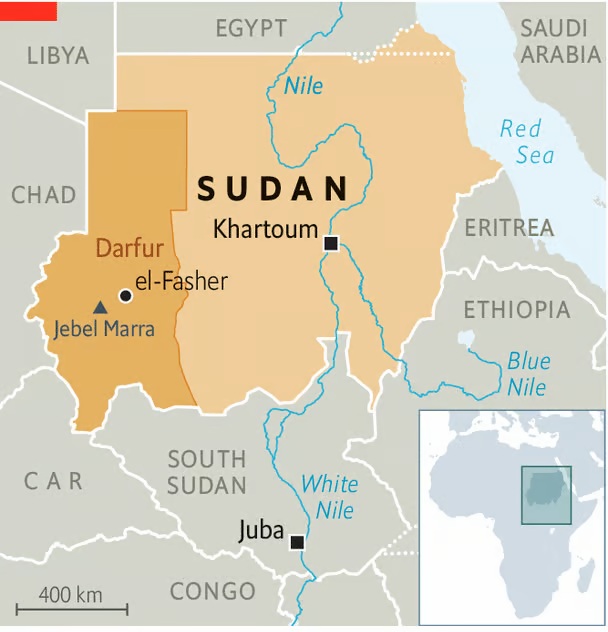
    • Location & Size: Western Sudan; borders Chad, Libya, CAR; spans about 493,000 sq. km (nearly France-sized).
    • Geography: Predominantly arid/semi-arid; desert north, fertile south. Highly vulnerable to drought, desertification, and climate change.
    • Administrative Units: Divided into five states — North, South, West, Central, East Darfur.
    • Demographics: Mixed ethnic groups — Arab pastoralists and non-Arab farming communities.
    • Capital: El Fasher, main hub for administration, economy, and humanitarian operations.

    Ongoing Conflict & Crisis:

    • Origins of Uprising: Armed rebellion began in 2003 (SLM, JEM) against political and economic marginalization.
    • Janjaweed & RSF: Janjaweed militias, accused of genocide and ethnic cleansing, later evolved into Rapid Support Forces (RSF), now central to instability.
    • Humanitarian Crisis: Since 2003, region has seen mass killings, displacement, refugee flows, ranked among the worst global humanitarian crises.
    • Current Instability: Renewed 2023 violence between RSF and rival groups worsened agriculture, aid, and governance.
    • Regional Impact: Conflict spills into Chad and CAR, destabilizing the Sahel region.
    • Natural Disasters: Alongside conflict, disasters like the 2025 Darfur landslide (~1,000 deaths) add to human suffering.
    [UPSC 2024] Consider the following statements:

    Statement-I: There is instability and worsening security situation in the Sahel region.

    Statement-II: There have been military takeovers/coups d’état in several countries of the Sahel region in the recent past.

    Which one of the following is correct in respect of the above statement?

    a) Both Statement-I and Statement-II are correct and Statement-II explains Statement-I

    b) Bothe Statement-I and Statement-II are correct, but Statement-II does not explain Statement-I

    c) Statement-I is correct, but Statement-II is incorrect

    d) Statement-I is incorrect, but Statement-II is correct


  • In news: Donbas Region

    Why in the News?

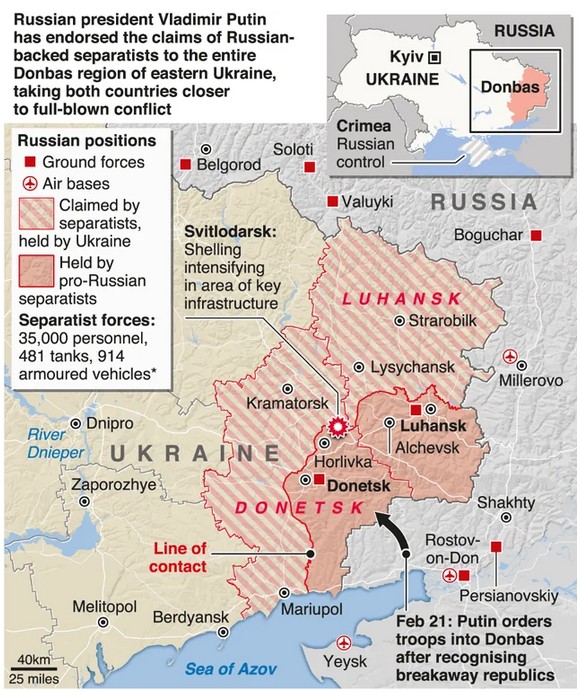
    The mineral-rich Donbas region remains central to future of Russia-Ukraine peace talks.

    About Donbas Region:

    • Constituent Areas: Includes Donetsk and Luhansk oblasts in eastern Ukraine.
    • Geographical Position: Bordered by the Sea of Azov in the south, which connects to the Black Sea via the Strait of Kerch.
    • Industrial Hub: Known as Ukraine’s industrial heartland due to large mineral and energy resources.
    • Coal Reserves: Ukraine possesses ~32 gigatonnes of hard coal, most concentrated in Donbas (IEA estimate).
    • Shale Gas Potential: Yuzivska shale gas field (Donetsk–Kharkiv) holds 1.2–2 trillion cubic metres of gas in place, one of Europe’s largest untapped reserves.
    • Salt Production: Home to Artemsil, once among Europe’s largest salt mines, producing ~2 million tonnes annually until closed in 2022 due to conflict.

    Strategic Significance of the Region:

    • For Russia:
      • Resources: Rich in coal, shale gas, salt, and coal bed methane, enhancing its resource security.
      • Geography: Provides land link to Crimea and direct access to the Sea of Azov.
      • Demographics: Large Russian-speaking population offers political and cultural leverage.
    • For Ukraine:
      • Economy: Core to industrial base, especially steel production.
      • Energy Security: Control of Yuzivska shale gas could reduce reliance on imports.
      • Sovereignty: Represents a vital part of national unity and territorial integrity.
    • Geopolitical Dimension: Sea of Azov crucial for connecting Donbas resources to Black Sea trade routes.
    • Conflict Relevance: Since Crimea’s annexation (2014) and escalation in 2022, control of Azov and Kerch Strait vital for Russia’s naval dominance.
    [UPSC 2023] Consider the following pairs: Area of conflict mentioned in news : Country where it is located

    1. North Kivu and Ituri : War between Armenia and Azerbaijan

    2. Nagorno-Karabakh : Insurgency in Mozambique

    3. Kherson and Zaporizhzhia : Dispute between Israel and Lebanon

    How many of the above pairs are correctly matched?

    Options: (a) Only one (b) Only two (c) All three (d) None*


  • Xinjiang-Xizang Railway Line

    Why in the News?

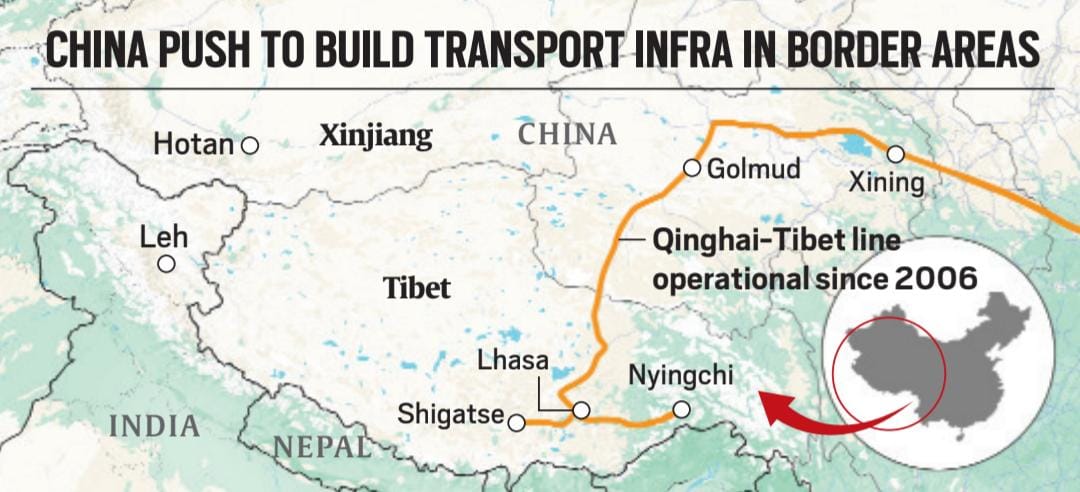
    China has launched the Xinjiang–Xizang Railway Line, a strategic, economic, and engineering milestone, connecting Xinjiang with Tibet.

    Xinjiang-Xizang Railway Line

    About the Xinjiang–Xizang Railway Line:

    • Overview: A major high-altitude railway project connecting Hotan in Xinjiang to Shigatse and Lhasa in Tibet (Xizang).
    • Total length planned: ~2,000 km, part of China’s larger 5,000 km rail grid in Tibet by 2035.
    • Construction is phased:
      • Shigatse–Pakhuktso section (by 2025)
      • Pakhuktso–Hotan section (by 2035).
    • Terrain: Himalayas, Karakoram, Kunlun ranges, deserts, glaciers, and permafrost — average altitude above 4,500m.
    • Significance: Seen as one of China’s most advanced and difficult transport projects, comparable to the Qinghai–Tibet Railway (2006).

    Strategic Implications of the Project:

    • Military Mobility: Proximity to Aksai Chin and Line of Actual Control (LAC) enhances Chinese troop deployment and logistics capabilities.
    • Regional Integration: Links Xinjiang (Uyghur region) and Tibet (Buddhist region) with mainland China, supporting Sinicisation and demographic shifts.
    • Economic Role: Opens remote high-altitude areas to trade, energy transport, and tourism, reducing isolation of minority regions.
    • Political Control: Strengthens Beijing’s hold over restive border provinces and suppresses separatist tendencies.
    • India Factor: Raises security concerns as India is also upgrading border infrastructure post-2020 Galwan clash.
    • Part of “Go West Strategy” (2000): Long-term plan to develop western provinces with infrastructure and integrate them into China’s national economy.
    [UPSC 2023] With reference to India’s projects on connectivity, consider the following statements :

    1. East-West Corridor under Golden Quadrilateral Project connects Dibrugarh and Surat.

    2. Trilateral Highway connects Moreh in Manipur and Chiang Mai in Thailand via Myanmar.

    3. Bangladesh-China -India -Myanmar Economic Corridor connects Varanasi in Uttar Pradesh with Kunming in China. How many of the above statements are correct?

    Options: (a) Only one (b) Only two (c) All three (d) None*