💥Mains Ready By December. Smash Mains & Smash PYQ Admissions Open

Subject: International Stories of Key Importance

  • Taiwan Fires HIMARS in Anti-Invasion Drill

    Why in the news?

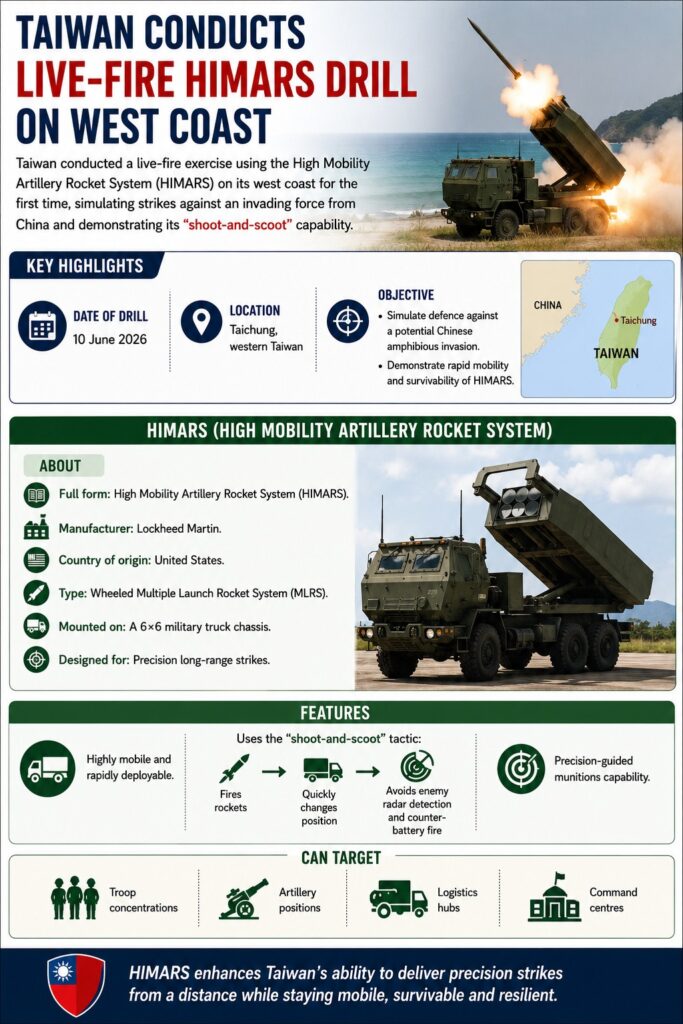
    Taiwan conducted a live-fire exercise using the High Mobility Artillery Rocket System (HIMARS) on its west coast for the first time, simulating strikes against an invading force from China and demonstrating its “shoot-and-scoot” capability.

    HIMARS (High Mobility Artillery Rocket System)

    • Full form: High Mobility Artillery Rocket System (HIMARS).
    • Manufacturer: Lockheed Martin.
    • Country of origin: United States.
    • Type: Wheeled Multiple Launch Rocket System (MLRS).
    • Mounted on: A 6×6 military truck chassis.
    • Designed for: Precision long-range strikes.

    Range

    • Approximately 300 km (190 miles) using long-range precision rockets.
    • From western Taiwan, it can potentially strike targets in China’s Fujian Province across the Taiwan Strait.

    What is “Shoot-and-Scoot”?

    • A battlefield tactic used by mobile artillery systems.
    • Involves:
      1. Moving to a firing position.
      2. Launching rockets.
      3. Immediately relocating before enemy counter-attacks.

    [2022] Which one of the following statements best reflects the issue with Senkaku Islands, sometimes mentioned in the news?

    a) It is generally believed that they are artificial islands made by a country around South China Sea.

    b) China and Japan engage in maritime disputes over these islands in East China Sea.
    c) A permanent American military base has been set up there to help Taiwan to increase its defence capabilities.
    d) Though International Court, of Justice declared them as no man’s land, some South-East Asian countries claim them.

  • NATO Baltic Command Centre

    Why in the news?

    Germany and the Netherlands announced the establishment of a joint NATO tactical headquarters in the Baltic region to strengthen deterrence against Russia.

    Key Highlights

    • The joint command centre is called:
      • 1GNC (German-Netherlands Corps)
    • Will operate mainly in:
      • Estonia
      • Latvia
    • Can command up to 50,000 troops

    Functions of 1GNC

    • Planning military exercises
    • Operational command during conflicts
    • Strengthening NATO’s eastern flank
    • Rapid military response capability

    About the German-Netherlands Corps

    • Established in 1995
    • Headquarters located in Münster
    • Germany and Netherlands rotate leadership
    • Supported by personnel from 14 NATO countries

    Note: The Baltic region in Northern Europe comprises the countries surrounding the Baltic Sea. It is most commonly divided into the Baltic States (Estonia, Latvia, and Lithuania), alongside neighboring nations like Sweden, Finland, Denmark, Germany, Poland, and Russia.

    [2025] Consider the following countries:
    I. Austria
    II. Bulgaria
    III. Croatia
    IV. Serbia
    V. Sweden
    VI. North Macedonia
    How many of the above are members of the North Atlantic Treaty Organization?

    [A] Only three

    [B] Only four

    [C] Only five

    [D] All the six

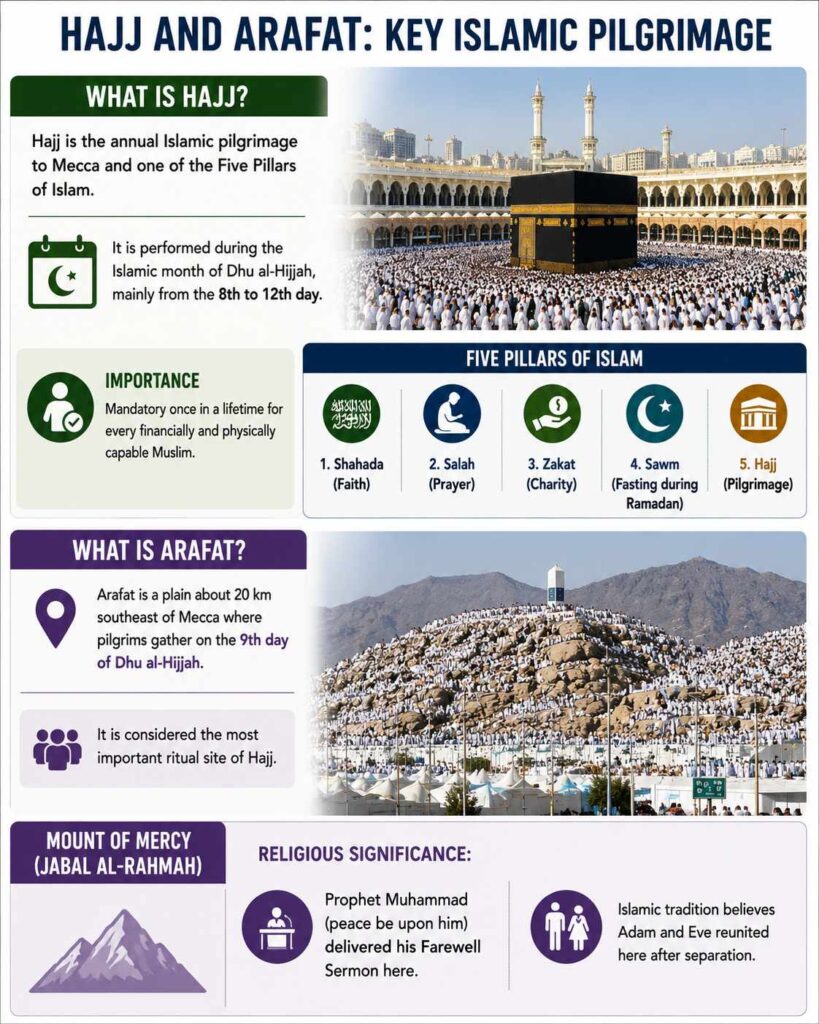
  • Haj Pilgrimage and Mount of Mercy (Arafat)

    Why in News?

    Muslim pilgrims gathered at the Mount of Mercy (Jabal al-Rahmah) on the plain of Arafat near Mecca during the annual Hajj pilgrimage.

    What is Hajj?

    • Hajj is the annual Islamic pilgrimage to Mecca and one of the Five Pillars of Islam. It is performed during the Islamic month of Dhu al-Hijjah, mainly from the 8th to 12th day.

    Importance

    • Mandatory once in a lifetime for every financially and physically capable Muslim.

    Five Pillars of Islam

    • Shahada (Faith)
    • Salah (Prayer)
    • Zakat (Charity)
    • Sawm (Fasting during Ramadan)
    • Hajj (Pilgrimage)

    What is Arafat?

    • Arafat is a plain about 20 km southeast of Mecca where pilgrims gather on the 9th day of Dhu al-Hijjah. It is considered the most important ritual site of Hajj.

    Mount of Mercy (Jabal al-Rahmah)

    Religious significance:

    • Prophet Muhammad delivered his Farewell Sermon here.
    • Islamic tradition believes Adam and Eve reunited here after separation.

    [2022] The term “Levant” often heard in the news roughly corresponds to which of the following regions?

    [A] Region along the eastern Mediterranean shores

    [B] Region along North African shores stretching from Egypt to Morocco

    [C] Region along Persian Gulf and Horn of Africa

    [D] The entire coastal areas of Mediterranean Sea

  • Russia Uses Oreshnik missile in Major Attack on Ukraine

    Why in the News?

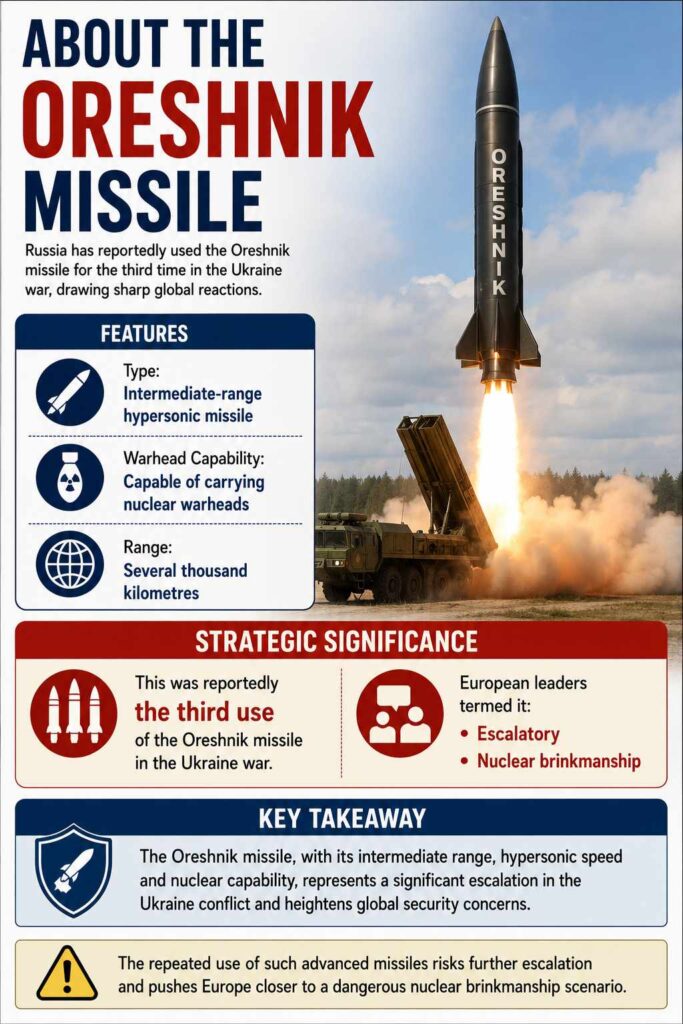
    Russia launched a large-scale missile and drone attack on Ukraine, including the use of the hypersonic Oreshnik missile near Kyiv.

    Key Highlights

    • Russia carried out one of the heaviest bombardments on: Kyiv
    • Hundreds of Drones and Missiles were used.

    About the Oreshnik Missile

    Features

    • Intermediate-range hypersonic missile [Range of 3,000 km to 5,500 km]
    • Capable of carrying: Nuclear warheads

    Strategic Significance

    • This was reportedly: The third use of the Oreshnik missile in the Ukraine war.
    • European leaders termed it:
      • Escalatory
      • Nuclear brinkmanship

    [2023] Consider the following countries
    1. Bulgaria
    2. Czech Republic
    3. Hungary
    4. Latvia
    5. Lithuania
    6. Romania
    How many of the above countries share a land border with Ukraine?

    [A] Only two

    [B] Only three

    [C] Only four

    [D] Only five

  • Hainan Free Trade Port (FTP) Initiative

    Why in the News?

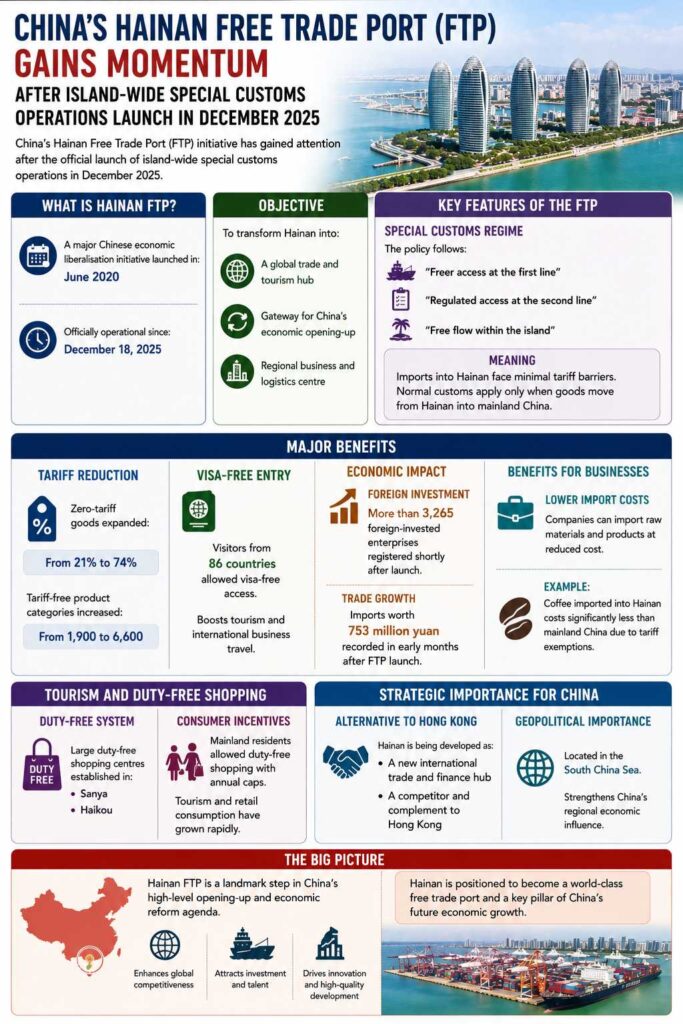
    China’s Hainan Free Trade Port (FTP) initiative has gained attention after the official launch of island-wide special customs operations in December 2025.

    What is Hainan FTP?

    • A major Chinese economic liberalisation initiative launched in June 2020
    • Officially operational since December 18, 2025

    Objective

    To transform Hainan into:

    • A global trade and tourism hub
    • Gateway for China’s economic opening-up
    • Regional business and logistics centre

    Key Features of the FTP

    The policy follows:

    • “Freer access at the first line”
    • “Regulated access at the second line”
    • “Free flow within the island”

    Meaning

    • Imports into Hainan face minimal tariff barriers.
    • Normal customs apply only when goods move from Hainan into mainland China.

    Major Benefits

    Tariff Reduction

    • Zero-tariff goods expanded From 21% to 74%
    • Tariff-free product categories increased From 1,900 to 6,600

    Visa-Free Entry

    • Visitors from 86 countries allowed visa-free access.
    • Boosts tourism and international business travel.

    Economic Impact

    • Foreign Investment: More than 3,265 foreign-invested enterprises registered shortly after launch.

    Trade Growth

    • Imports worth 753 million yuan recorded in early months after FTP launch.

    Benefits for Businesses

    • Lower Import Costs: Companies can import raw materials and products at reduced cost.
    • Example: Coffee imported into Hainan costs significantly less than mainland China due to tariff exemptions.

    Tourism and Duty-Free Shopping

    Duty-Free System

    • Large duty-free shopping centres established in:
      • Sanya
      • Haikou

    Consumer Incentives

    • Mainland residents allowed duty-free shopping with annual caps.
    • Tourism and retail consumption have grown rapidly.

    Strategic Importance for China

    Alternative to Hong Kong

    • A new international trade and finance hub
    • A competitor and complement to Hong Kong

    Geopolitical Importance

    • Located in the South China Sea
    • Strengthens China’s regional economic influence.

    [2022] Which one of the following statements best reflects the issue with Senkaku Islands, sometimes mentioned in the news?

    a) It is generally believed that they are artificial islands made by a country around South China Sea.
    b) China and Japan engage in maritime disputes over these islands in East China Sea.
    c) A permanent American military base has been set up there to help Taiwan to increase its defence capabilities.
    d) Though International Court, of Justice declared them as no man’s land, some South-East Asian countries claim them.

  • India-Africa Forum Summit Postponed Due to Ebola Crisis

    Why in the News?

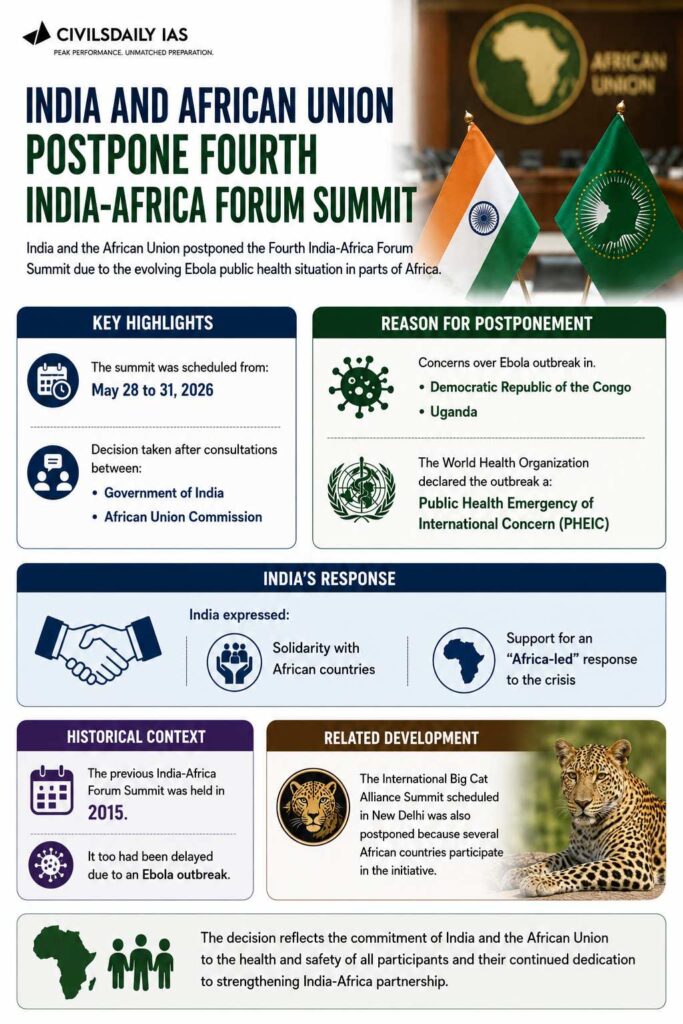
    India and the African Union postponed the Fourth India-Africa Forum Summit due to the evolving Ebola public health situation in parts of Africa.

    Key Highlights

    • The summit was scheduled from:
      • May 28 to 31, 2026
    • Decision taken after consultations between:
      • Government of India
      • African Union Commission

    Reason for Postponement

    • Concerns over Ebola outbreak in:
      • Democratic Republic of the Congo
      • Uganda
    • The World Health Organisation declared the outbreak a Public Health Emergency of International Concern (PHEIC)

    India’s Response

    India expressed:

    • Solidarity with African countries
    • Support for an “Africa-led” response to the crisis

    Historical Context

    • The previous India-Africa Forum Summit was held in 2015.
    • It too had been delayed due to an Ebola outbreak.

    Related Development

    • The International Big Cat Alliance Summit scheduled in New Delhi was also postponed because several African countries participate in the initiative.

    Importance of India-Africa Forum Summit

    The summit strengthens cooperation in:

    • Trade and investment
    • Health
    • Development partnership
    • Capacity building
    • Energy and technology

    About Ebola

    • Severe viral disease affecting humans and primates.
    • Spread through: Direct contact with infected bodily fluids

    What is PHEIC?

    A Public Health Emergency of International Concern is declared by WHO when an outbreak:

    • Poses international health risks
    • Requires coordinated global response

    [2015] Among the following, which were frequently mentioned in the news for the outbreak of Ebola virus recently?

    (a) Syria and Jordan

    (b) Guinea, Sierra Leone and Liberia

    (c) Philippines and Papua New Guinea

    (d) Jamaica, Haiti and Surinam

  • Besides Hormuz, two more straits in India Ocean are vital for global trade

    Why in the News?

    Tensions around the Strait of Hormuz have again brought global maritime chokepoints into focus after Iran discussed tighter regulation of vessel movement through the route. Also, global trade does not depend only on Hormuz. Both the Bab-el-Mandeb Strait and the Strait of Malacca are equally critical. At the same time, any disruption in these narrow passages can delay trade, increase fuel prices, and disrupt supply chains worldwide.

    What are the major maritime chokepoints and why are they important?

    A strait is a naturally narrow water passage connecting two larger water bodies and acting as a route for ships and maritime trade.

    1. Strait of Hormuz
      1. Connects the Persian Gulf with the Gulf of Oman and Arabian Sea.
      2. Serves as the main exit route for oil from Gulf countries.
      3. Handles nearly 20% of global oil and LNG trade.
    2. Bab-el-Mandeb Strait
      1. Connects the Red Sea and Suez Canal to the Gulf of Aden and the Indian Ocean.
      2. Located between Yemen (Arabian Peninsula) and Djibouti-Eritrea (Horn of Africa).
      3. Functions as the western gateway of the Indian Ocean.
    3. Strait of Malacca
      1. Connects the Indian Ocean to the South China Sea and Pacific Ocean.
      2. Lies between Indonesia, Malaysia, and Singapore.
      3. Functions as the eastern gateway of the Indian Ocean and Asia’s most important trade corridor.

    Together, these narrow maritime routes form the backbone of globalisation by enabling uninterrupted movement of oil, gas, manufactured goods, food commodities, and industrial inputs.

    Why Are Maritime Straits Called the Lifelines of Global Trade?

    1. Maritime Chokepoints: Refers to narrow sea passages through which a disproportionately high volume of world trade moves, making them economically indispensable.
    2. Indian Ocean Centrality: Facilitates nearly 100,000 vessel movements annually, making the Indian Ocean a major highway of world commerce.
    3. Container Trade: Carries approximately 30% of global container traffic, reflecting dependence of manufacturing economies on uninterrupted shipping.
    4. Energy Transit: Supports nearly 80% of global seaborne oil trade, making disruptions immediately visible in fuel prices and inflation.
    5. Supply Chain Dependence: Ensures movement of electronics, machinery, industrial raw materials, food products, and consumer goods.
    6. Economic Shock Potential: Creates systemic risks because disruption in one chokepoint can affect prices and deliveries worldwide.
    7. Example: The Ever Given blockage in the Suez Canal (2021) delayed global trade worth billions of dollars and exposed vulnerabilities in maritime logistics.

    How Does the Strait of Malacca Function as Asia’s Economic Lifeline?

    1. Strategic Connectivity & Geography
      1. Strategic Connectivity: Connects the Indian Ocean with the South China Sea and Pacific Ocean, making it the shortest maritime route between Asia, the Middle East, and Europe.
      2. Geographical Feature: Extends roughly 900 km, narrowing to nearly 2.8 km at its narrowest point, creating a major bottleneck.
        1. The Phillips Channel Choke Point: The precise narrowest point (2.8 km / 1.7 miles) is located specifically in the Phillips Channel near Singapore. This is the absolute bottleneck where collision and piracy risks are highest.
    2. Global Economic & Trade Impact Traffic:
      1. Trade Share: Facilitates nearly 24% of global maritime trade.
      2. Shipping Traffic: Carries around 45% of global shipping traffic and nearly one-third of global trade.
      3. Dry Bulk Trade: Facilitates approximately 23% of dry bulk cargo, including coal, grains, and minerals.
    3. Energy Security & East Asian Dependence
      1. East Asian Dependence: Supports manufacturing economies of China, Japan, South Korea, and ASEAN nations.
      2. China’s “Malacca Dilemma”: Coined by Hu Jintao (2003), referring to China’s strategic vulnerability because nearly 75% of Chinese oil imports transit through Malacca.
      3. Global Oil Hub: Accounts for nearly 29% of global seaborne oil shipments (surpassing the Strait of Hormuz at over 23 million barrels per day).
    4. Operational Monopolies & Constraints
      1. Alternative Route Constraints: Makes the Lombok and Sunda Straits commercially unattractive as they add nearly 1,000-1,500 nautical miles and up to five extra sailing days.
      2. Singapore’s Strategic Position: Reinforces importance because Singapore functions as one of the world’s busiest transshipment and ship-refuelling hubs.

    Why Is Bab-el-Mandeb Emerging as the Most Vulnerable Trade Chokepoint?

    1. Strategic Position & Geography
      1. Strategic Position: Connects the Red Sea and Suez Canal with the Gulf of Aden and the Indian Ocean, serving as the western maritime gateway.
      2. Meaning of the Name: Means “Gate of Tears”, historically associated with dangerous navigation.
      3. The Choke Point: Narrows to just 26 km (16 miles) wide, concentrating vessel traffic.
    2. Global Trade & Energy Impact
      1. Trade Volume: Handles around 8.7% of global seaborne trade.
      2. Oil Transit: Facilitates nearly 9.3% of global crude oil and petroleum shipments.
      3. Europe-Asia Trade Link: Acts as a critical route connecting European and Asian markets via the Suez Canal.
    3. Security Threats & Geopolitical Risk
      1. Security Threat: Faces attacks from Yemen-based Houthi rebels, especially after the Israel-Gaza conflict (2023).
      2. Asymmetric Warfare: Proximity to unstable coastlines makes commercial vessels easy targets.
    4. Commercial Fallout & Economic Toll
      1. Insurance Costs: Raises shipping insurance premiums due to missile and drone threats.
      2. Commercial Disruptions: Forces shipping companies to avoid the route, delaying supply chains.
      3. Slow Recovery: Shipping traffic has recovered only partially despite naval interventions.

    Why Are Alternative Routes Not a Practical Solution?

    1. Cape of Good Hope Diversion: Forces ships bypassing Bab-el-Mandeb to sail around southern Africa.
    2. Time Penalty: Adds nearly 10-14 days to shipping journeys.
    3. Cost Escalation: Increases voyage costs by nearly $2 million per trip due to higher fuel consumption and labour expenses.
    4. Infrastructure Challenges: Limits viability of alternative Indonesian straits because of shallow waters and weaker port infrastructure.
    5. Commercial Efficiency: Makes existing chokepoints indispensable as shorter routes reduce transport cost and turnaround time.

    How Are Geopolitical Tensions Turning Maritime Routes into Strategic Flashpoints?

    1. Weaponisation of Geography: Converts narrow waterways into tools of geopolitical pressure.
      1. Example: The Strait of Hormuz; Amid severe escalations, the waterway has effectively seen halts in commercial oil and gas transit. This is due to the targeted drone strikes, naval gridlocks, and aggressive state enforcement
    2. Unilateral Control Risks: Raises concerns when coastal states attempt tighter control or regulation over globally used waterways.
      1. Example: The South China Sea; The China Coast Guard (CCG) has scaled up aggressive patrols, using high-pressure water cannons and ramming tactics against Philippine vessels near Scarborough and Sabina Shoals. This is done to enforce unilateral sovereignty over a critical trade artery.
    3. Non-State Actor Threats: Demonstrates how militant groups can disrupt world trade despite advanced naval surveillance.
      1. Example: The Red Sea & Bab-el-Mandeb; Yemen-based Houthi rebels utilized inexpensive drones and anti-ship missiles
    4. Freedom of Navigation Concerns: Challenges the principle of free maritime movement under UNCLOS.
      1. Example: The Black Sea Corridor; The ongoing naval blockades and targeted infrastructure strikes stemming from the Russia-Ukraine war have severely challenged free navigation principles
    5. Naval Competition: Encourages stronger maritime deployments by powers including India, China, and the United States.

    What Are the Implications for India?

    1. Energy Security: India imports nearly 85% of crude oil, much of which passes through Indian Ocean chokepoints.
    2. Trade Dependence: Nearly 95% of India’s trade by volume moves through maritime routes.
    3. Strategic Geography: Places India at the centre of Indian Ocean security dynamics.
    4. SAGAR Doctrine: Strengthens India’s maritime cooperation and regional security approach.
    5. Indian Navy’s Role: Supports anti-piracy operations, maritime surveillance, and protection of Sea Lines of Communication (SLOCs).

    Conclusion

    According to Dr C Rajamohan, ‘’Unlike the Atlantic and Pacific oceans, the Indian Ocean is closed, that is, few straits control its access. This makes these straits immensely important for international trade.’’ The growing vulnerability of the Hormuz, Bab-el-Mandeb, and Malacca straits shows how globalisation depends on a few narrow maritime routes. As geopolitical tensions intensify and shipping disruptions become frequent, ensuring secure and open sea lanes has become central to global economic stability. For India, safeguarding these maritime corridors is no longer merely a strategic concern but an economic necessity.

    PYQ Relevance

    [UPSC 2024] Discuss the geopolitical and geostrategic importance of Maldives for India with a focus on global trade and energy flows. Further also discuss how this relationship affects India’s maritime security and regional stability amidst international competition?

    Linkage: This PYQ tests understanding of the Indian Ocean Region (IOR), maritime geopolitics, trade routes, energy flows, and strategic competition. Similarly, Bab-el-Mandeb, Hormuz, and Malacca shape global trade and energy security in the IOR, directly connecting with India’s maritime interests and regional strategic stability.
  • Strategic Importance of Indian Ocean Straits

    Why in the News?

    Rising tensions around the Strait of Hormuz have highlighted the strategic importance of other Indian Ocean chokepoints such as the Bab-el-Mandeb Strait and the Strait of Malacca for global trade and energy supplies.

    Strait of Hormuz

    • Connects the Persian Gulf with the Arabian Sea.
    • Carries around:
      • One-fifth of global oil and LNG supplies.
    • Iran recently announced mechanisms to regulate vessel movement.

    Bab-el-Mandeb Strait

    • Between Arabian Peninsula and Horn of Africa.
    • Connects:
      • Red Sea
      • Suez Canal
      • Gulf of Aden
    • Importance
      • About 8.7% of global seaborne trade passed through it in 2023.
      • Major route linking Asia and Europe.
      • Important for global crude oil shipments.
    • Security Concerns
      • Threatened by Houthi attacks from Yemen.
      • Disruptions affect shipping through the Suez Canal route.

    Strait of Malacca

    • Between: Indonesia, Malaysia, and Singapore
    • Shortest sea route linking Indian Ocean and Pacific Ocean.
    • Around 24% of global maritime trade passed through it in 2023.
    • Carries:
      • 45% of global oil shipments
      • 26% of internationally traded cars
      • 23% of dry bulk cargo
    [2024] Consider the following statements: 
    Statement-I Sumed pipeline is a strategic route for Persian Gulf oil and Natural gas shipments to Europe. 
    Statement-II: Sumed pipeline connects the Red Sea with the Mediterranean Sea. 
    Which one of the following is correct in respect of the above statements? 
    [A] Both Statement-I and Statement-II are correct and Statement-II explains Statement-I 
    [B] Both Statement-I and Statement-II are correct, but Statement-II does not explain Statement-I 
    [C] Statement-I is correct, but Statement-II is incorrect 
    [D] Statement-I is incorrect, but Statement-II is correct
  • [14th May 2026] The Hindu OpED: The Xi-Trump summit- shadow boxing on Iran

    Mentor’s Comment

    The Xi-Trump (China-USA) summit in Beijing (2026) has become geopolitically important as the U.S. faces growing difficulty in managing its confrontation with Iran. The conflict has become costly, unpopular, and difficult to resolve, pushing Washington to explore China’s help for a diplomatic exit. This marks a major shift from earlier U.S. resistance to China’s rise and resembles the 1972 Nixon-China diplomatic opening, where strategic cooperation helped solve larger geopolitical problems.

    Why is the Xi-Trump summit being compared to the 1972 Nixon-China breakthrough?

    1. Historical Parallel: The summit is compared with the 1972 Nixon-Mao meeting, which fundamentally altered Cold War geopolitics and enabled U.S.-China normalization.
    2. Strategic Bargaining: The 1972 summit involved reciprocal concessions, including U.S. recognition of the People’s Republic of China and downgrading Taiwan’s status in exchange for strategic cooperation.
    3. Current Context: Present negotiations similarly indicate transactional diplomacy, where Chinese cooperation on Iran could be exchanged for concessions on tariffs, technology restrictions, or Taiwan.
    4. Geopolitical Reordering: The summit may redefine strategic alignments amid intensifying great-power competition and regional instability in West Asia.

    How has the Iran crisis emerged as the central issue in the U.S.-China diplomacy?

    1. Strategic Deadlock: The U.S. seeks an exit from an increasingly costly and unpopular confrontation with Iran without appearing strategically weak.
    2. Hormuz Leverage: Iran retains strategic influence through the Strait of Hormuz, through which nearly 20% of global crude oil trade passes, creating risks of global energy disruption.
    3. Military Asymmetry: Iran has adopted asymmetric tactics instead of direct military confrontation. This increases costs for adversaries while avoiding conventional escalation.
    4. Domestic Political Pressure: The inability of the U.S. administration to secure a decisive outcome risks political consequences during domestic electoral cycles.

    Why has China emerged as Iran’s principal strategic anchor?

    1. Energy Dependence: China purchases more than 80% of Iranian oil exports, estimated at nearly $45 billion in 2025, making it Tehran’s largest economic partner.
    2. Trade Connectivity: Bilateral trade between China and Iran exceeds $9 billion, including dependence on Chinese industrial and technological inputs.
    3. Diplomatic Engagement: Iranian Foreign Minister Abbas Araghchi visited Beijing for consultations, signalling China’s increasing diplomatic role.
    4. Strategic Shielding: China, alongside Russia, has resisted Western-led pressure, including opposition to the U.S.-backed resolutions in the United Nations Security Council (UNSC).

    How has Iran responded to American pressure and negotiations?

    1. Negotiation Breakdown: Iran reportedly rejected a U.S. proposal after prolonged negotiations, indicating declining trust between Washington and Tehran.
    2. Escalatory Risks: The U.S. military option remains constrained due to fears of wider regional destabilisation and concerns over legal authorisation under the War Powers Act.
    3. Expanded Demands: Iran has reportedly increased demands involving security guarantees, sanctions relief, release of frozen assets, closure of U.S. military bases, and ceasefires in regional conflict zones.
    4. Strategic Confidence: Iran’s ability to sustain pressure despite sanctions reflects its confidence in alternative partnerships, particularly with China and Russia.

    Can China realistically mediate between the United States and Iran?

    1. Mediator Role: China possesses leverage due to its economic dependence relationship with Iran and growing diplomatic acceptance in West Asia.
    2. Transactional Diplomacy: Beijing may seek concessions on bilateral issues such as tariffs, sanctions, technology controls, and Taiwan in return for diplomatic assistance.
    3. Regional Stability Interest: Sustained conflict threatens Chinese energy security through rising oil prices and disruption of Gulf maritime routes.
    4. Calculated Neutrality: China may prefer limited mediation rather than deep intervention, preserving relations with all regional actors.

    What are the larger geopolitical implications of the summit?

    1. Great Power Politics: The summit reflects increasing interdependence between geopolitical rivals despite strategic competition.
    2. Multipolar Transition: China’s expanding diplomatic role indicates a gradual movement toward a more multipolar global order.
    3. Energy Security Risks: Prolonged instability in West Asia threatens global oil prices and maritime trade.
    4. Institutional Contestation: Divergence in the UNSC demonstrates weakening consensus among major powers on conflict resolution.

    Conclusion

    The Xi-Trump summit highlights the intersection of regional crises and great-power diplomacy. Iran has evolved from a regional security issue into a strategic bargaining chip in U.S.-China relations. Any durable resolution will depend on balancing coercive diplomacy with negotiated settlements while ensuring regional stability and uninterrupted energy flows.

    PYQ Relevance

    [UPSC 2018] In what ways would the ongoing US-Iran Nuclear Pact controversy affect the national interest of India? How should India respond to this situation?

    Linkage: The rising U.S.-Iran tensions have their impact on global oil supply, regional stability, and diplomacy. The PYQ links directly to India’s energy security, West Asia policy, and strategic balancing amid great-power rivalry

  • The toll of structural adjustments on the global south and a case for accountability

    Why in the News?

    A new paper published in BMJ Global Health (March 2026) has revived scrutiny of IMF and World Bank Structural Adjustment Programmes (SAPs), arguing that these institutions owe reparations to Global South countries for long-term socio-economic damage.

    What are Structural Adjustment Programmes (SAPs)?

    They are a set of economic mandates imposed by international financial institutions, principally the International Monetary Fund (IMF) and the World Bank, on developing nations. They are imposed as a strict prerequisite for securing new loans, refinancing existing debt, or avoiding sovereign default. 

    How did Structural Adjustment Programmes emerge in the Global South?

    1. Debt Crisis: Developing countries borrowed heavily during the 1970s for industrialization and imports. Rising interest rates by the U.S. Federal Reserve in the late 1970s sharply increased repayment burdens.
    2. Dollar-Denominated Loans: Countries borrowing in U.S. dollars faced rising repayment obligations due to currency depreciation beyond domestic control.
    3. IMF-World Bank Intervention: Financial assistance became conditional upon implementing structural economic reforms aimed at restoring macroeconomic stability.
    4. Debt Leverage: Creditor institutions used debt obligations to push policy reforms in exchange for access to loans and refinancing.
    5. Historical Context: SAPs coincided with the rise of market-oriented neoliberal economic policies globally.

    What were the major components of Structural Adjustment Programmes?

    1. Fiscal Austerity: Reduced public expenditure on healthcare, education, subsidies, and social security to reduce fiscal deficits.
    2. Privatization: Transferred state-owned enterprises and public services to private ownership.
    3. Trade Liberalization: Removed trade barriers and opened domestic markets to global competition.
    4. Deregulation: Reduced industrial regulations, labour protections, and capital controls.
    5. Currency Devaluation: Encouraged export competitiveness through exchange-rate reforms.
    6. Conditional Financing: Linked access to international loans with compliance to reform packages.

    How did SAPs affect economic growth in the Global South?

    1. Growth Slowdown: Economic growth reportedly declined sharply during adjustment periods. The Global South’s average growth rate fell from nearly 3.2% before SAPs to 0.7% during the 1980s-1990s.
    2. Income Loss: Developing countries collectively lost an estimated $480 billion annually in potential national income.
    3. Latin America: Real per capita income reportedly declined by 15% after 1980, recovering to previous levels only by 2006.
    4. Sub-Saharan Africa: Income levels reportedly fell sharply before eventual recovery decades later.
    5. Industrial Weakening: Liberalization exposed domestic industries to global competition before adequate institutional preparedness.
    6. Developmental Sovereignty: Reduced state capacity to pursue independent industrial policy.

    What social consequences emerged from Structural Adjustment Programmes?

    1. Healthcare Retrenchment: Public health expenditure cuts weakened medical infrastructure and service delivery.
    2. Education Cuts: Reduced state spending constrained human capital development.
    3. Child Mortality: SAP-linked effects reportedly contributed to 56.62 additional child deaths per 1,000 births in Sub-Saharan Africa.
    4. Maternal Mortality: Around 360 additional maternal deaths per 1,00,000 births were associated with SAP-linked reforms.
    5. Excess Mortality: Nearly 3,05,000 excess infant deaths reportedly occurred between 1986-2010 relative to pre-adjustment trends.
    6. User Fees: Privatization and reduced welfare spending increased costs of essential services.
    7. Food Inflation: Currency depreciation increased food prices and reduced affordability.

    Did SAPs reinforce historical patterns of economic dependency?

    1. Neo-Colonial Continuity: Critics argue SAPs reopened developing economies to exploitative global market structures.
    2. Labour Cost Compression: Reduced labour protections lowered production costs for multinational firms.
    3. Capital Flight: Liberalized financial systems facilitated outflows of profits.
    4. Profit Repatriation: Private capital reportedly extracted profits exceeding $250 billion annually.
    5. Trade Deregulation: Wealth transfers through tax avoidance reportedly exceeded $1 trillion annually.
    6. Domestic Reinvestment Loss: Economic surpluses were diverted away from national development priorities.

    Why is there a growing demand for accountability and reparations?

    1. Institutional Responsibility: IMF and World Bank are viewed as principal architects of adjustment policies.
    2. Public Service Losses: Compensation demands focus on healthcare, education, and welfare spending losses.
    3. Counterfactual Justice: Proposals estimate damages by comparing actual outcomes with hypothetical development without SAPs.
    4. Mortality Compensation: Reparative justice arguments extend to health and mortality impacts.
    5. Governance Imbalance: The Global North controls a disproportionate share of voting power within Bretton Woods institutions.
    6. Sovereign Immunity: Legal protections restrict lawsuits against international financial institutions.

    What reforms are suggested for global financial governance?

    1. Conditionality Reform: Eliminates rigid structural adjustment requirements tied to financial assistance.
    2. Institutional Democratization: Expands policy voice of developing countries within IMF and World Bank governance.
    3. Policy Sovereignty: Ensures aid recipients retain flexibility over domestic development choices.
    4. Alternative Financing: Expands access to institutions such as the New Development Bank (BRICS Bank) and the Asian Infrastructure Investment Bank (AIIB).
    5. Inclusive Development: Balances macroeconomic stability with social welfare investments.

    Conclusion

    The structural adjustment debate reflects a larger tension between macroeconomic stabilization and social justice. While fiscal discipline and market reforms can support economic efficiency, externally imposed conditionalities without domestic context risk undermining welfare and developmental autonomy. Future global financial governance requires balancing economic reform with equity, democratic participation, and sovereign policy space.

    PYQ Relevance

    [UPSC 2024] Examine the pattern and trend of public expenditure on social services in the post-reforms period in India. To what extent this has been in consonance with achieving the objective of inclusive growth?

    Linkage: The PYQ examines whether post-reform economic policies balanced fiscal reforms with social sector expenditure to ensure inclusive growth. IMF-World Bank structural adjustment policies are critiqued for reducing public spending on health, education and welfare. This highlights how austerity can undermine inclusive development outcomes.