Consider the following statements:
1. The Constitution of India defines its ‘basic structure’ in terms of federalism, secularism, fundamental rights and democracy.
2. The Constitution of India provides for ‘judicial review’ to safeguard the citizens’ liberties and to preserve the ideals on which the Constitution is based.
Which of the statements given above is/are correct?
Subject: Judiciary
-
Consider the following statements
-
With reference to India, consider the following statements
With reference to India, consider the following statements:
1.Judicial custody means an accused is in the custody of the concerned magistrate, and such an accused is locked up in the police station, not in jail.
2.During judicial custody, the police officer in charge of the case is not allowed to interrogate the suspect without the approval of the court.Which of the statements given above is/are correct?
-
Consider the following statements
Consider the following statements :
1. Pursuant to the report of H.N. Sanyal Committee, the Contempt of Courts Act, 1971 was passed.
2. The Constitution of India empowers the Supreme Court and the High Courts to punish for contempt of themselves.
3. The Constitution of India defines Civil Contempt and Criminal Contempt.
4. In India, the Parliament is vested with the powers to make laws on Contempt of Court.Which of the statements given above is/are correct ?4
-
Supreme Court Dismisses Meenakshi Natarajan’s Plea Against Rejection of Rajya Sabha Nomination
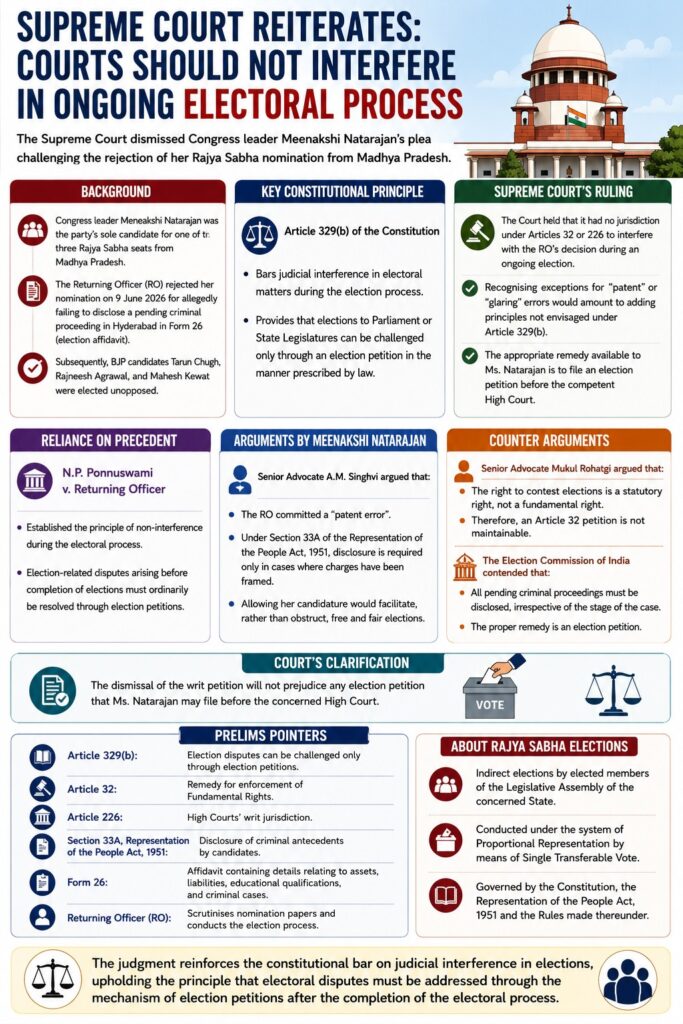
Why in the news?
The Supreme Court dismissed Congress leader Meenakshi Natarajan’s plea challenging the rejection of her Rajya Sabha nomination from Madhya Pradesh, reiterating that courts should not ordinarily interfere in an ongoing electoral process.
Background
- Congress leader Meenakshi Natarajan was the party’s sole candidate for one of the three Rajya Sabha seats from Madhya Pradesh.
- The Returning Officer (RO) rejected her nomination on 9 June 2026 for allegedly failing to disclose a pending criminal proceeding in Hyderabad in Form 26 (election affidavit).
- Subsequently, BJP candidates Tarun Chugh, Rajneesh Agrawal, and Mahesh Kewat were elected unopposed.
Key Constitutional Principle
- Article 329(b) of the Constitution: Bars judicial interference in electoral matters during the election process.
- Provides that elections to Parliament or State Legislatures can be challenged only through an election petition in the manner prescribed by law.
Supreme Court’s Ruling
- The Court held that it had no jurisdiction under Articles 32 or 226 to interfere with the RO’s decision during an ongoing election.
- Recognising exceptions for “patent” or “glaring” errors would amount to adding principles not envisaged under Article 329(b).
- The appropriate remedy available to Ms. Natarajan is to file an election petition before the competent High Court.
Reliance on Precedent
- N.P. Ponnuswami v. Returning Officer: Established the principle of non-interference during the electoral process.
- Election-related disputes arising before completion of elections must ordinarily be resolved through election petitions.
Arguments by Meenakshi Natarajan
- Senior Advocate A.M. Singhvi argued that: The RO committed a “patent error”.
- Under Section 33A of the Representation of the People Act, 1951, disclosure is required only in cases where charges have been framed.
- Allowing her candidature would facilitate, rather than obstruct, free and fair elections.
Counter Arguments
- Senior Advocate Mukul Rohatgi argued that:
- The right to contest elections is a statutory right, not a fundamental right.
- Therefore, an Article 32 petition is not maintainable.
- The Election Commission of India contended that:
- All pending criminal proceedings must be disclosed, irrespective of the stage of the case.
- The proper remedy is an election petition.
Court’s Clarification
- The dismissal of the writ petition will not prejudice any election petition that Ms. Natarajan may file before the concerned High Court.
Prelims Pointers
- Article 329(b): Election disputes can be challenged only through election petitions.
- Article 32: Remedy for enforcement of Fundamental Rights.
- Article 226: High Courts’ writ jurisdiction.
- Section 33A, Representation of the People Act, 1951: Disclosure of criminal antecedents by candidates.
- Form 26: Affidavit containing details relating to assets, liabilities, educational qualifications, and criminal cases.
- Returning Officer (RO): Scrutinises nomination papers and conducts the election process.
-
The ordinance question before the SC
Why in the News?
The Supreme Court recently witnessed the swearing-in of five new judges after a Presidential Ordinance increased its sanctioned strength from 34 to 38 judges. While two appointments filled pre-existing vacancies, three judges were appointed to posts that exist solely because of the Ordinance.
How has the Ordinance altered the composition of the Supreme Court?
- Presidential Ordinance: Increased the sanctioned strength of the Supreme Court from 34 judges to 38 judges.
- Five New Appointments: Five judges were sworn in following the Ordinance.
- Existing Vacancies: Two appointments filled already existing lawful vacancies.
- Ordinance-Created Posts: Three appointments were made against posts created solely through the Ordinance.
- Temporary Basis: The additional posts continue only so long as the Ordinance remains operational or is replaced by legislation.
- Constitutional Provision: Article 124 leaves determination of the number of Supreme Court judges to Parliament.
Why does the issue raise concerns regarding judicial independence?
- Security of Tenure: Judicial independence requires judges to occupy constitutionally secure offices free from executive discretion.
- Executive Dependence: Ordinance-created positions remain dependent upon the executive’s temporary legislative action.
- Institutional Perception: Independence includes not merely actual autonomy but also the appearance of autonomy from political branches.
- Temporary Offices: Judges occupying posts that may disappear if the Ordinance lapses could create perceptions of institutional dependence.
- Basic Structure Doctrine: Judicial independence forms part of the Constitution’s basic structure and cannot be diluted indirectly.
How does the controversy relate to the NJAC judgment and judicial primacy?
- NJAC Judgment (2015): Supreme Court Advocates-on-Record Association v. Union of India struck down the 99th Constitutional Amendment and the National Judicial Appointments Commission (NJAC).
- Parliamentary Support: The amendment was passed by 367 votes to 1 in the Lok Sabha and ratified by States.
- Composition of NJAC: Included the Chief Justice of India, two senior-most judges, the Union Law Minister, and two eminent persons.
- Veto Provision: Any two members could veto a recommendation.
- Judicial Concern: The Court held that this arrangement undermined judicial primacy in appointments.
- Present Contradiction: Critics argue that accepting appointments against Ordinance-created posts appears inconsistent with the Court’s earlier insistence on institutional independence.
Why is the use of Ordinances controversial in constitutional governance?
- Article 123 Power: Enables the President to promulgate Ordinances when Parliament is not in session.
- Temporary Nature: Ordinances cease to operate six weeks after Parliament reassembles unless approved.
- Executive Withdrawal: Ordinances may be withdrawn before parliamentary approval.
- Democratic Concern: Frequent reliance on Ordinances may bypass normal legislative scrutiny.
- Institutional Stability: Temporary laws may create uncertainty in long-term institutional arrangements such as judicial appointments.
What has the Supreme Court previously held regarding Ordinance-making powers?
- D.C. Wadhwa v. State of Bihar (1986): Held that repeated re-promulgation of Ordinances amounts to a fraud on the Constitution.
- Krishna Kumar Singh v. State of Bihar (2017): Seven-judge Bench ruled that Ordinance-making cannot become a parallel source of legislation.
- Legislative Supremacy: Ordinances are intended as exceptional measures, not substitutes for parliamentary law-making.
- Constitutional Morality: Executive convenience cannot replace legislative deliberation.
What legal uncertainties arise if the Ordinance lapses?
- Reversion of Strength: Supreme Court strength would revert from 38 to 34 judges.
- Status of Judges: Questions may arise regarding judges appointed against Ordinance-created posts.
- Unsettled Position: No direct precedent exists concerning judges appointed to judicial offices that cease due to lapse of an Ordinance.
- De Facto Doctrine: Judicial acts may continue to remain valid under the doctrine affirmed in Gokaraju Rangaraju v. State of Andhra Pradesh (1980).
- Institutional Litigation: Potential legal challenges may emerge regarding continuation of such appointments.
How has the Collegium’s decision to recommend appointments against Ordinance-created judicial posts generated constitutional concerns?
- Anticipated Vacancies: Forthcoming retirements are expected to create regular vacancies in the Court.
- Possible Regularisation: Some Ordinance-appointed judges may subsequently occupy these permanent posts.
- Continuing Uncertainty: At least one appointment remains dependent on the validity of the Ordinance.
- Expectation of Ratification: The decision assumes Parliament will replace the Ordinance with legislation.
- Balancing Priorities: The Collegium sought to address judicial vacancies while relying on future legal regularisation.
Does judicial independence require more than formal constitutional safeguards?
- Substantive Independence: Independence is not merely the legal authority to disagree with the executive.
- Perception of Neutrality: Courts must remain visibly detached from political dependence.
- Institutional Confidence: Public trust depends on the judiciary appearing free from executive patronage.
- Constitutional Culture: Independence requires an instinctive separation from executive influence, not merely procedural safeguards.
- Separation of Powers: Long-term legitimacy rests on maintaining clear constitutional boundaries among institutions.
Conclusion
The controversy is less about the competence of the appointed judges and more about the constitutional method through which their offices were created. The episode highlights the tension between addressing judicial vacancies and preserving judicial independence. A constitutional democracy requires not only an independent judiciary but also institutional arrangements that are visibly free from executive dependence and temporary political contingencies.
PYQ Relevance
[UPSC 2014] Critically examine the Supreme Court’s judgement on the National Judicial Appointments Commission (NJAC) Act, 2014 with reference to appointment of judges of higher judiciary in India.
Linkage: The PYQ examines judicial independence and the constitutional principles governing appointments to the higher judiciary. The article questions whether appointments to Ordinance-created Supreme Court posts are consistent with the judiciary’s insistence on institutional independence reflected in the NJAC judgment.
-
[4th June 2026] The Hindu OpED: Preserving the record: On the right to be forgotten
PYQ Relevance[UPSC 2017] Examine the scope of Fundamental Rights in the light of the latest judgement of the Supreme Court on Right to Privacy
Linkage: The question examines the expansion of Article 21 and the constitutional status of informational privacy after the Puttaswamy judgment. The Right to be Forgotten is a direct extension of the right to informational privacy, raising questions about balancing privacy with open justice, transparency, and public access to judicial records.Mentor’ Comment
A recent Delhi High Court order on the Right to be Forgotten has revived the debate over whether individuals can seek removal of their names from online court records. The case is significant because it brings into direct conflict two constitutional principles, the right to privacy recognised in the Puttaswamy judgment (2017) and the principle of open justice. This comes at a time when digitisation and search engines have made judicial records permanently accessible and searchable.
What is the Right to be Forgotten?
- The Right to Be Forgotten (RTBF) is the legal concept that empowers individuals to request the removal, erasure, or de-indexing of their personal data from internet searches, databases, and public platforms when that information becomes outdated, irrelevant, or harmful to their reputation.
- It is built on the principle of informational self-determination, allowing people to reclaim control over their digital narrative and move on from past events without facing lifelong social or professional stigma.
What is the Open Justice Principle?
- The Open Justice Principle is a foundational legal rule stating that judicial proceedings and records must be open to the public and the media to guarantee transparency, fairness, and public trust in the legal system.
- It is summarized by the classic legal maxim: “Justice must not only be done, but must manifestly and undoubtedly be seen to be done.”
How Has Digitisation Transformed the Debate on Open Justice and Privacy?
- Digital Permanence: Court records remain searchable indefinitely through search engines and online legal databases.
- Expanded Accessibility: Judicial records are accessible globally to anyone with internet access.
- Automated Archiving: Search engines and digital repositories replicate records across multiple platforms.
- Enhanced Public Scrutiny: Facilitates public understanding of judicial processes and legal developments.
- Persistent Reputational Impact: Allegations may remain associated with individuals even after acquittal or discharge.
Implication
The digital environment has transformed court publicity from a temporary consequence into a potentially permanent one
Why Does the Right to be Forgotten Conflict with the Principle of Open Justice?
- Privacy Protection: Enables individuals to exercise control over personal information.
- Transparency Requirement: Ensures judicial functioning remains open to public scrutiny.
- Historical Record: Judicial decisions form part of the state’s official record.
- Democratic Accountability: Open records strengthen public confidence in courts.
- Freedom of Expression: Access to information supports informed public discourse.
Core Constitutional Tension
Right to Privacy Open Justice Protects personal dignity Ensures transparency Limits unnecessary exposure Facilitates public scrutiny Supports informational autonomy Preserves public records Prevents perpetual stigma Maintains historical accuracy Why Did the Delhi High Court Favour Greater Privacy Protection?
- Search Engine Excerpts: Search engines may display isolated portions of judgments without context.
- Name-Based Discovery: Public access does not necessarily require searching cases through an accused person’s name.
- Replication Problem: Updating official records may not update copies stored on other websites.
- Context Loss: Fragmented information can misrepresent judicial outcomes.
- Digital Harm: Continuous association with allegations may affect reputation despite legal exoneration.
Judicial Concern
The Court recognized that merely updating records may not adequately protect privacy because digital content often persists across multiple platforms.
Is Discoverability the Real Problem, or Is It Incomplete Information?
The core issue is not public access itself but incomplete records.
- Acquittal Visibility: Searches should reveal both allegations and subsequent acquittals.
- Contextual Accuracy: Complete judicial history should accompany search results.
- Information Integrity: Users should receive accurate and updated records.
- Balanced Disclosure: Transparency should include final outcomes, not merely initial accusations.
- Digital Correction: Records should evolve with judicial developments.
Example
If an individual is acquitted, anyone accessing the proceedings should also immediately find the acquittal order instead of only the original accusation.
Why Are Judicial Records Treated as Public Records of the State?
- Official Character: Court records constitute official acts of the State.
- Institutional Memory: They preserve the history of judicial administration.
- Legal Precedent: Judicial decisions guide future legal interpretation.
- Public Accountability: Citizens can assess judicial functioning.
- Rule of Law: Transparent records strengthen trust in legal institutions.
Can Digital Accuracy Offer a Better Solution than Digital Erasure?
Key Measures
- Record Updating: Reflect acquittals, discharges, settlements, and final outcomes prominently.
- Database Synchronisation: Ensure legal repositories regularly update records.
- Contextual Search Results: Display complete procedural history.
- Judicial Oversight: Impose obligations on registries and legal information platforms.
- Responsible Indexing: Ensure search engines provide context alongside judicial records.
Expected Outcome: Protects privacy without undermining transparency or historical recordkeeping.
How Does the European Experience Inform the Debate?
The concept gained massive global prominence following the landmark 2014 Google Spain v. AEPD ruling by the Court of Justice of the European Union (CJEU). It is now strictly codified under Article 17 of the General Data Protection Regulation (GDPR) as the “Right to Erasure”
- European Origin: RTBF emerged in response to persistent digital records.
- Balancing Test: Privacy claims are assessed against freedom of expression and public interest.
- Context-Based Approach: No absolute right to deletion exists.
- Public Interest Exception: Information relevant to public accountability may remain accessible.
- Proportionality Principle: Competing rights are balanced case-by-case.
Conclusion
The challenge is not whether judicial records should be accessible, but whether they should remain accurate and complete in the digital age. A balanced approach that preserves open justice while ensuring updated and contextualised records can protect both privacy and transparency, thereby strengthening public trust in the judiciary and the rule of law.
-
How Delhi HC’s pathbreaking ruling on Google keyword advertising means
Why in the News?
The Delhi High Court recently ruled that Google’s practice of allowing advertisers to purchase competitors’ registered trademarks as keywords for online advertisements can amount to trademark infringement.
How Did the Hindware-Google Trademark Dispute Originate?
Background of the dispute
- Hindware Trademark: Hindware possessed a registered trademark with substantial market goodwill built over decades in the sanitaryware sector.
- Discovery in 2013: Hindware found that competitors Grohe India Pvt. Ltd. and Cera Sanitaryware Ltd. had purchased the keyword “Hindware” through Google AdWords.
- Search Result Diversion: Searches for “Hindware”, “Hindware Sanitary”, or related terms displayed competitors’ websites and advertisements prominently.
- Consumer Impact: Users intending to purchase Hindware products were redirected toward rival brands.
- Legal Objection: Hindware argued that its trademark was being commercially exploited without authorization.
How Does Google’s Keyword Advertising System Function?
Mechanism of Google AdWords
- Keyword Advertising: Advertisers bid for specific words or phrases that trigger sponsored advertisements.
- Sponsored Search Results: Paid advertisements appear alongside or above organic search results.
- Auction-Based Model: Google conducts auctions among advertisers bidding for keywords.
- Revenue Generation: Google earns revenue through a Cost-Per-Click (CPC) model.
Illustrative Example
- Trademark Search: A user searching for “Nokia” or “Sony” may be shown advertisements from competitors if those companies purchased the trademark as a keyword.
- Commercial Outcome: User attention may shift from the trademark owner to competing brands.
Why Did Hindware Consider Keyword Advertising a Trademark Infringement?
Hindware’s Legal Arguments
- Registered Trademark Protection: Hindware argued that its trademark enjoys legal protection under the Trade Marks Act, 1999.
- Unauthorized Commercial Use: Competitors used the trademark for generating advertising impressions without consent.
- Diversion of Customers: Searches intended for Hindware products were redirected toward rival companies.
- Misappropriation of Goodwill: Competitors benefited from brand value created through Hindware’s investments over decades.
- Consumer Confusion: Users searching specifically for Hindware could be influenced toward alternative brands.
Trademark Law Basis
- Advertising Use: Hindware argued that keyword bidding constitutes use of a trademark in advertising.
- Section 29(6) Relevance: The practice falls within the statutory meaning of trademark use in advertising.
[About Section 29(6) of Trade Marks Act, 1999: Trademark is deemed to be used if a person
- Affixes it to goods or packaging.
- Offers goods or services under that trademark.
- Imports or exports goods under that trademark.
- Uses the trademark in advertising.]
What Defence Did Google Present Before the Court?
Backend Function Argument
- Invisible Keywords: Google argued that keywords operate only as backend triggers.
- No Visible Display: Users cannot see purchased keywords during searches.
- Technical Facilitation: The platform merely facilitates ad placement based on advertiser-selected terms.
Consumer Awareness Argument
- Sponsored Labels: Advertisements are marked separately from organic search results.
- Distinct Identification: Users can distinguish advertisements from natural search results.
- Reduced Confusion Claim: Clear labeling minimizes the possibility of consumer deception.
Global Policy Argument
- International Practice: Google highlighted that keyword advertising involving trademarks is permitted in several jurisdictions.
- Policy Consistency: The company argued that its India policy aligns with broader global advertising practices.
Competition Argument
- Market Access: Google contended that keyword bidding enables smaller firms to compete with established brands.
- Restriction Concern: Prohibiting keyword purchases could reduce competitive advertising opportunities.
Why Did the Court Reject Google’s Position?
- Recognition of Trademark Use
- Commercial Exploitation: The Court held that keyword bidding amounts to trademark use in advertising.
- Revenue Generation: Google earns direct revenue through auctions involving trademarked terms.
- Advertising Function: Trademarked keywords serve as commercial tools for attracting consumers.
- Free-Riding on Goodwill
- Brand Investment: Trademark owners spend significant resources building consumer trust.
- Unfair Advantage: Competitors benefit from that goodwill without making equivalent investments.
- Monetization of Reputation: Google profits from the commercial value attached to others’ trademarks.
- Consumer Diversion
- Search Intent: Users searching for “Hindware” generally seek Hindware products.
- Traffic Redirection: Sponsored advertisements can divert consumers toward competing brands.
- Marketplace Distortion: Consumer attention shifts from the trademark owner to advertisers.
- Judicial Observation
- Free-Riding Finding: The Court observed that Google’s conduct effectively monetizes investments made by trademark owners.
- Commercial Benefit: Google derives revenue from trademark popularity despite not owning the trademark itself.
What Did the Delhi High Court Ultimately Rule?
- Trademark Protection: Restrained Google from using “Hindware” or combinations of related words as advertising keywords.
- Infringement Recognition: Treated such use as capable of constituting trademark infringement under the Trade Marks Act.
- Goodwill Protection: Reinforced legal protection for brand reputation and consumer association.
Significance of the Judgment
- Digital Trademark Jurisprudence: Establishes an important precedent for online trademark disputes.
- Platform Accountability: Expands scrutiny of intermediary business models.
- Consumer Interest Protection: Addresses concerns regarding diversionary advertising.
What Are the Broader Implications for India’s Digital Economy?
Impact on Digital Advertising
- Advertising Strategy Changes: Companies may face restrictions on bidding for competitors’ trademarks.
- Compliance Costs: Platforms may need stronger trademark monitoring systems.
- Keyword Auction Reforms: Search engines may need to redesign advertising policies.
Impact on Trademark Law
- Expanded Interpretation: Strengthens protection against indirect commercial exploitation.
- Digital Application: Extends traditional trademark principles into online advertising environments.
Impact on Competition
- Brand Protection: Strengthens rights of trademark owners.
- Market Entry Concerns: Smaller firms may lose a low-cost mechanism for attracting consumers.
- Competition-Law Debate: Raises questions regarding balance between competition and intellectual property rights.
Impact on Platform Governance
- Intermediary Responsibility: Increases expectations of proactive trademark compliance.
- Algorithmic Accountability: Highlights legal scrutiny of automated advertising systems.
What Are the Key Legal and Policy Issues Emerging from the Judgment?
- Trademark Rights vs Competition
- Trademark Protection: Ensures exclusive commercial benefit from brand identity.
- Competitive Advertising: Enables market entrants to challenge dominant firms.
- Intellectual Property vs Digital Innovation
- Rights Enforcement: Protects investments in brand development.
- Innovation Concerns: Excessive restrictions may affect advertising innovation.
- Consumer Protection vs Commercial Freedom
- Consumer Clarity: Reduces misleading diversion.
- Advertising Freedom: Limits comparative visibility strategies.
Conclusion
The Delhi High Court’s ruling marks an important step in adapting trademark law to the digital economy. By recognizing keyword advertising as potential trademark use, the judgment strengthens brand protection while raising important questions about competition, platform accountability, and consumer choice in online markets.
Value Addition
Trademark
- Definition: A sign, symbol, word, phrase, logo, design, or combination distinguishing goods or services of one entity from another.
- Legal Basis: Trade Marks Act, 1999.
- Validity: Registration valid for 10 years and renewable indefinitely.
Intellectual Property Rights (IPR) Ecosystem in India
Constitutional Basis:
- Article 300A: Protects property rights.
- Legal Shield: Guarantees no property deprivation without legal authority.
- IP Inclusion: Covers both tangible and intellectual property
Institutional Framework
- Department for Promotion of Industry and Internal Trade (DPIIT):
- Ministry: Ministry of Commerce and Industry.
- Status: Non-statutory body (Central Government Department).
- Policy Maker: Formulates and amends all national IPR policies.
- Parent Body: Oversees the functioning of the CGPDTM and CIPAM.
- Global Liaison: Represents India at international forums like WIPO.
- Controller General of Patents, Designs and Trade Marks (CGPDTM)
- Ministry: Ministry of Commerce and Industry (attached office of DPIIT).
- Status: Statutory body.
- IP Registry: Manages statutory offices for Patents, Designs, Trade Marks, and Geographical Indications.
- E-Filing Hub: Operates the centralized online registration portals.
- Quasi-Judicial Power: Hears and decides intellectual property disputes and oppositions.
- Cell for IPR Promotion and Management (CIPAM)
- Ministry: Ministry of Commerce and Industry (professional body under DPIIT).
- Status: Non-statutory body (Executive Agency).
- Policy Executor: Implements targets set by the National IPR Policy.
- Public Outreach: Conducts IP awareness campaigns across schools and universities.
- Enforcement Training: Trains police, customs, and judiciary staff to curb piracy.
PYQ Relevance
[UPSC 2024] What is the present world scenario of Intellectual Property Rights with respect to life materials? Although India is second in the world to file patents, still only a few have been commercialized. Explain the reasons behind this less commercialization.
Linkage: The PYQ examines the protection, commercialization, and enforcement of Intellectual Property Rights in a rapidly evolving technological environment. The Delhi High Court’s ruling extends trademark protection to digital advertising practices, addressing new-age IPR challenges in the platform economy.
-
How many High Courts in India have jurisdiction over more than one State (Union Territories not included)
How many High Courts in India have jurisdiction over more than one State (Union Territories not included)?
-
Consider the following statements : The Supreme Court of India tenders advice to the President of India on matters of law or fact
Consider the following statements : The Supreme Court of India tenders advice to the President of India on matters of law or fact
1. on its own initiative (on any matter of larger public interest).
2. if he seeks such an advice.
3. only if the matters relate to the Fundamental Rights of the citizens.
Which of the statements given above is/are correct ? -
What is the provision to safeguard the autonomy of the Supreme Court of India
What is the provision to safeguard the autonomy of the Supreme Court of India?
1. While appointing the Supreme Court Judges, the President of India has to consult the Chief Justice of India.
2. The Supreme Court Judges can be removed by the Chief Justice of India only.
3. The salaries of the Judges are charged on the Consolidated Fund of India to which the legislature does not have to vote.
4. All appointments of officers and staff of the Supreme Court of India are made by the Government only after consulting the Chief Justice of India.
Which of the statements given above is/are correct?