With reference to India, consider the following statements :
1. Government law officers and legal firms are recognised as advocates, but corporate lawyers and patent attorneys are excluded from recognition as advocates.
2. Bar Councils have the power to lay down the rules relating to legal education and recognition of law colleges.
Which of the statements given above is/are correct ?
Subject: Judiciary
-
With reference to India, consider the following statements
-
[29th May 2026] The Hindu OpED: Will increasing the strength of the SC solve the pendency problem
PYQ Relevance[UPSC 2024] Explain the reasons for the growth of Public Interest Litigation in India. As a result of it, has the Indian Supreme Court emerged as the world’s most powerful judiciaryLinkage: The PYQ examines the expanding role and jurisdiction of the Supreme Court, which lies at the core of the present debate on pendency and judicial burden.The article discusses judicial reforms and institutional capacity of the Supreme Court. Efficient justice delivery is essential for preserving judicial independence and constitutional governance. Mentor’s Comment
The Union government has recently increased the sanctioned strength of the Supreme Court from 34 to 38 judges, reviving an old debate on judicial reforms: Can more judges solve India’s mounting judicial pendency? The issue has direct relevance for judicial reforms, separation of powers, access to justice, and constitutional governance in India.
What is the Constitutional Provision Governing the Number of Supreme Court Judges?
- Article 124(1): Establishes the Supreme Court and provides for a Chief Justice of India (CJI) and other judges.
- Parliamentary Power: The Constitution does not fix a permanent number of judges. It authorises Parliament to determine the number of judges by law.
- Flexible Institutional Design: Enables periodic expansion of judicial strength based on rising caseload, pendency, and administrative requirements.
How has the Number of Supreme Court Judges Increased?
- Ordinary Legislation: Increase in judicial strength requires amendment of the Supreme Court (Number of Judges) Act, 1956.
- No Constitutional Amendment Required: Since Article 124 empowers Parliament, increase occurs through ordinary parliamentary legislation, not a constitutional amendment under Article 368.
- Recent Change (2025): Parliament passed the Supreme Court (Number of Judges) Amendment Bill, 2025, increasing sanctioned strength from 34 to 38 judges.
- Ordinance Route: The President promulgated an ordinance under Article 123 before Parliament formally completed the process, despite Parliament expected to convene shortly.
How Has the Supreme Court’s Strength Increased Over Time?
Year Strength of SC Judges 1950 8 (including CJI) 1956 11 1960 14 1977 18 1986 26 2009 31 2019 34 2025 38 What Does This Trend Indicate?
- Rising Caseload: Expansion reflects increasing litigation and constitutional responsibilities.
- Persistent Pendency: Repeated increases have not prevented rising backlog, indicating structural inefficiencies beyond numerical shortage.
- Shift in Institutional Role: Expansion coincides with the Supreme Court increasingly functioning as a general appellate court, rather than primarily a constitutional court.
Can Increasing Judicial Strength Alone Reduce Pendency in the Supreme Court?
- Judicial Capacity: Increasing sanctioned strength from 34 to 38 judges enhances disposal capacity and may reduce waiting time for hearings.
- Limited Impact: Pendency of nearly 94,000 cases suggests backlog is structural rather than merely numerical.
- Historical Continuity: Successive governments have periodically increased judicial strength, yet pendency continues to rise.
- Institutional Limitation: More judges do not automatically improve efficiency unless accompanied by procedural reforms.
- Concerns Over Ordinance Route: The government introduced the increase through an ordinance, despite Parliament being expected to convene soon, raising concerns about legislative bypass.
Has the Supreme Court Drifted from Its Intended Constitutional Role?
- Constitutional Design: The Supreme Court was envisioned primarily as a constitutional court, dealing with substantial constitutional interpretation.
- Article 136 Expansion: The Court’s extraordinary power under Article 136 (Special Leave Petition) has expanded its jurisdiction significantly.
- Routine Appeals: A substantial share of the Court’s docket is now occupied by SLPs, converting the Court into a de facto regular appellate court.
- Judicial Observation (2016): A Constitution Bench refused to restrict Article 136, observing that no effort should be made to reduce the Court’s powers.
- Consequences: Excessive appellate workload diverts attention from constitutional matters of national significance.
Do Special Leave Petitions (SLPs) Contribute to Judicial Backlog?
- Extraordinary Remedy: SLPs were designed as exceptional remedies under Article 136 for rare cases involving grave injustice.
- Judicial Overreach of Scope: SLPs now dominate a substantial portion of Supreme Court litigation.
- Absence of Guidelines: Lack of strict admission standards has encouraged indiscriminate filing.
- Case Example: Vijaya Bank v. Prashant B. Narnaware: A contractual employment dispute reached the Supreme Court despite involving issues more suited for lower courts.
- Constitutional Concern: Excessive admission of routine matters dilutes the Court’s constitutional focus.
Does Government Litigation Worsen Judicial Pendency?
- Largest Litigant: Governments remain among the largest litigants in Indian courts.
- National Litigation Policy Failure: The proposed National Litigation Policy (NLP) aimed to reduce avoidable government litigation but was never effectively implemented.
- Routine Appeals Culture: Government departments frequently pursue appeals even in settled legal matters.
- Administrative Inconsistency: Frequent changes in legal officers produce contradictory litigation strategies.
- Institutional Burden: Excessive state appeals consume judicial time and prolong case disposal.
- Illustration: Cases often remain pending for years before reaching the Supreme Court because High Courts do not conclusively settle disputes.
Will More Benches Improve Consistency or Create Conflicting Judgments?
- Expanded Bench Strength: More judges imply greater number of division benches.
- Potential Benefit: Greater benches may increase disposal rates and reduce waiting time.
- Risk of Fragmentation: Larger bench numbers may generate inconsistent judicial interpretations.
- Polyvocality Challenge: Different benches may reach different conclusions on similar legal principles.
- Need for Coordination: Greater reference to larger Constitution Benches becomes essential for doctrinal consistency.
Can Institutional Reforms Address Pendency More Effectively Than Numerical Expansion?
- Filtering Mechanism: Strengthens scrutiny of frivolous litigation, particularly under Article 136.
- Case Prioritisation: Ensures only cases involving substantial constitutional questions reach the Supreme Court.
- Written Submissions: Reduces prolonged oral arguments and judicial time consumption.
- Bench Management: Facilitates better coordination among benches to reduce conflicting rulings.
- High Court Empowerment: Encourages High Courts to decisively settle disputes rather than passing litigation upward.
- Case Illustration: State of Uttaranchal v. Balwant Singh Chaufal (2010): Supreme Court stressed that Public Interest Litigation (PIL) must serve genuine public causes and not personal interests.
Can Judicial Appointments Improve Gender Representation?
- New Opportunity: Four additional judicial positions create scope for increasing women’s representation.
- Gender Gap: High Courts continue to have relatively low numbers of senior women judges.
- Transparency Need: Judicial appointments require greater openness and diversity considerations.
- Convention Bias: Seniority norms have often disadvantaged women in elevation to higher courts.
Conclusion
Increasing the sanctioned strength of the Supreme Court from 34 to 38 judges may improve disposal rates and reduce immediate workload pressures, but pendency is fundamentally a structural and institutional challenge rather than a purely numerical one. Sustainable reform requires restoring the Court’s constitutional role through stricter filtering of Special Leave Petitions (SLPs), reducing excessive government litigation, strengthening High Courts, improving case management, and ensuring doctrinal consistency. Judicial expansion can facilitate faster justice only when accompanied by systemic reforms that enhance efficiency, coherence, and access to justice.
-
Why SC online gaming tax verdict could be a final death blow to sector
Why in the News?
The Supreme Court recently upheld the constitutional validity of the government’s retrospective 28% GST levy on online real-money gaming, reviving tax demands of nearly ₹2.5 lakh crore against gaming companies, fantasy sports platforms, and casinos. The ruling is significant because it overturns relief granted by the Karnataka High Court .
Understanding Online Gaming in India: What is Being Regulated?
- Online gaming refers to digital games played over the internet through mobile applications, websites, or gaming platforms.
- In India, the sector includes real-money gaming, fantasy sports, skill-based games (rummy, poker), casino-style betting, and casual entertainment gaming.
- The regulatory challenge arises because gaming falls at the intersection of technology, taxation, public order, consumer protection, and gambling laws, with different legal treatment depending on the nature of the game.
How is online gaming regulated in India?
- Constitutional Position: Betting and gambling fall under the State List (Entry 34, List II, Seventh Schedule), allowing states to enact their own laws. This has created a fragmented regulatory landscape.
- Central Regulation: The Union government regulates aspects relating to intermediary liability, digital platforms, taxation, cybersecurity, money laundering, and online content.
- IT Rules Framework: The Information Technology (Intermediary Guidelines and Digital Media Ethics Code) Rules, 2021, amended in 2023, introduced provisions for regulation of online real-money games, due diligence by intermediaries, and verification mechanisms.
- State-Level Variation: States adopt differing approaches:
- Permissive Approach: States such as Sikkim and Nagaland license certain online skill games.
- Restrictive Approach: States such as Tamil Nadu and Telangana imposed restrictions on some online money games citing addiction and public welfare concerns.
- Tax Regulation: Since October 2023, online gaming, casinos, and horse racing attract 28% GST on the full face value of bets/deposits, rather than only platform commissions.
What is the difference between a ‘Game of Skill’ and a ‘Game of Chance’?
Game of Skill
- A game in which success predominantly depends upon a player’s knowledge, training, strategy, judgment, or expertise, even if some chance element exists.
- Examples:
- Rummy: Recognised by courts as substantially skill-based.
- Fantasy Sports (Dream11): Judicial rulings have treated team selection requiring statistical judgment as skill-oriented.
- Chess, Bridge, E-sports: Depend primarily on cognitive ability and strategy.
- Judicial Position: Courts have held that a game remains one of skill if skill predominates over chance.
Game of Chance
- A game in which outcomes depend predominantly on luck, randomness, or uncertain events, with limited influence of player expertise.
- Examples:
- Roulette
- Slot machines
- Lottery
- Casino gambling
- These activities are generally treated as betting or gambling and face stricter regulation.
Why does the skill-versus-chance distinction matter?
- Legal Treatment: Games of skill generally receive greater constitutional protection under Article 19(1)(g) (right to trade/business), whereas gambling may face prohibition.
- Taxation: The GST dispute emerged because gaming firms argued that skill-based games should be taxed on Gross Gaming Revenue (GGR) rather than total player deposits.
- State Regulation: Several states permit skill games while prohibiting gambling and betting.
- Consumer Welfare: Governments increasingly view even skill-based money gaming through a public health lens due to addiction concerns.
Why has the Supreme Court verdict become a watershed moment for India’s online gaming sector?
- Retrospective Tax Validation: Upholds the constitutional validity of the 28% GST levy retrospectively, reviving tax notices worth approximately ₹2.5 lakh crore against gaming firms, fantasy sports companies, and casinos.
- Judicial Finality: Settles a prolonged legal dispute by dismissing petitions filed by gaming companies challenging GST demands and retrospective tax notices.
- Reversal of Earlier Relief: Overturns relief granted by the Karnataka High Court to Gameskraft, which had challenged a ₹21,000 crore GST notice.
- Massive Fiscal Exposure: Creates unprecedented liabilities for firms such as Dream11, which reportedly faced notices of around ₹40,000 crore, and Delta Corp, which received notices totalling ₹23,204 crore.
How did the dispute over GST liability on online gaming emerge?
- Taxation Ambiguity: Emerged from disagreement over whether GST should apply only on platform fees/commissions (Gross Gaming Revenue-GGR) or on the full value of deposits/bets placed by users.
- Industry Position: Argued that taxation should apply prospectively from 1 October 2023, following GST Council amendments.
- Government Position: Treated real-money gaming involving uncertain outcomes as betting and gambling, irrespective of skill elements.
- Skill vs Chance Debate: The industry maintained that games such as fantasy sports and rummy involve skill and should be taxed differently from gambling.
- Supreme Court Position: Accepted the government’s interpretation by treating online money gaming involving uncertain outcomes as taxable similarly to betting activities.
Why is taxation on the ‘full face value’ of bets controversial?
- Commercial Unsustainability: Imposes GST on the entire deposited amount rather than platform earnings, substantially increasing tax liability.
- Revenue Mismatch: Creates tax demands many times higher than cumulative revenues generated by companies.
- Retrospective Burden: Applies liabilities to past operations, creating sudden and severe liquidity pressures.
- Consumer Pricing Constraints: Restricts firms’ ability to transfer increased tax burdens to users due to market competition and affordability concerns.
- Business Viability Risk: Forces firms to reconsider business models, downsize operations, or shift to alternative sectors.
- Illustration: A platform earning only a small commission on player deposits may still face taxation on the total deposited amount, sharply inflating liabilities.
Does the verdict strengthen fiscal governance or undermine ease of doing business?
- Tax Certainty: Strengthens clarity by resolving prolonged legal ambiguity regarding GST treatment.
- Revenue Protection: Enhances government capacity to prevent tax avoidance and regulatory arbitrage.
- Consumer Protection: Aligns with state concerns regarding gambling addiction and financial vulnerability among youth.
- Retrospective Taxation Concerns: Raises questions regarding predictability of taxation, a core element of investment confidence.
- Ease of Doing Business: Creates apprehensions regarding sudden regulatory shifts affecting emerging digital sectors.
- Regulatory Signalling: Indicates stronger state oversight over digital platforms operating in legally grey areas.
How has India’s regulatory approach towards online gaming evolved?
- Tax Tightening: GST Council introduced 28% GST on online gaming based on the face value of bets.
- Security Concerns: Authorities flagged concerns relating to digital wallets, cryptocurrency-based transfers, illicit fund movement, and money laundering.
- National Security Risks: Identified gaming platforms as potential communication channels for organised criminal and extremist activities.
- Legal Restrictions: The Promotion and Regulation of Online Gaming (PROG) Act, 2025 introduced strict restrictions on online money gaming platforms.
- Financial Restrictions: Prohibits banks and financial institutions from facilitating transactions linked to prohibited platforms.
- Penal Consequences: Provides imprisonment and financial penalties for operators, promoters, and facilitators of prohibited gaming activities.
Can India balance innovation in digital gaming with regulatory safeguards?
- Regulatory Clarity: Requires a transparent legal distinction between games of skill and games of chance.
- Consumer Safeguards: Ensures age verification, spending limits, addiction prevention, and grievance redressal.
- Proportionate Taxation: Supports sustainable taxation aligned with actual revenue generation.
- Technology Oversight: Strengthens anti-money laundering (AML) and cybersecurity frameworks.
- Economic Potential: Recognises gaming as part of India’s digital economy, employment generation, and technology ecosystem.
- Federal Coordination: Requires harmonisation between central taxation policies and state gambling laws.
Conclusion
The Supreme Court verdict represents more than a taxation dispute; it signals a decisive shift in India’s governance of emerging digital sectors. While the judgment strengthens regulatory clarity and fiscal oversight, the retrospective nature and scale of tax liabilities raise concerns regarding investment certainty and innovation. India’s challenge lies in designing a framework that simultaneously ensures consumer protection, revenue integrity, and sustainable growth of legitimate digital enterprises.
-
A revival of sedition tied to consent
Why in the News?
The Supreme Court on May 21, 2026, clarified that courts may resume proceedings in pending sedition cases under Section 124A of the IPC if the accused voluntarily consent, partially relaxing the 2022 stay order. The development has revived debate over free speech and misuse of sedition while its constitutional validity remains pending before the Court.
What is Sedition?
Sedition under Section 124A of the Indian Penal Code (IPC), 1860 historically criminalised acts bringing “hatred, contempt or disaffection” against the government established by law. Although Section 124A stands repealed with the enforcement of the Bharatiya Nyaya Sanhita (BNS), 2023, a comparable provision now exists under Section 152 of the BNS, titled “Acts Endangering Sovereignty, Unity and Integrity of India.” The Supreme Court’s recent clarification primarily concerns pending Section 124A IPC cases, while the constitutional debate has now expanded to include Section 152 of the BNS.
Feature Section 124A IPC Section 152 BNS Law Indian Penal Code, 1860 Bharatiya Nyaya Sanhita, 2023 Offence Name Sedition Acts Endangering Sovereignty, Unity and Integrity of India Focus Hatred/disaffection against government Secession, armed rebellion, separatism, subversive activities Terminology Explicitly used term “sedition” Removes word “sedition” Punishment Life imprisonment or up to 3 years + fine Life imprisonment or up to 7 years + fine Criticism Misuse against dissent Alleged “repackaged sedition” with broader scope Why has sedition remained controversial since colonial times?
- Colonial Origins: Sedition traces back to the Statute of Westminster, 1275, and later became part of British colonial criminal law.
- Colonial Instrument: Used by British authorities against Indian nationalists including Bal Gangadhar Tilak and Mahatma Gandhi.
- Nehru’s Criticism: Prime Minister Jawaharlal Nehru described sedition in Parliament (1951) as “highly objectionable and obnoxious.”
- Democratic Contradiction: Critics argue sedition criminalises legitimate criticism of government.
- Recent Misuse Example: A former independent MP and her husband reportedly faced sedition charges after allegedly threatening to recite the Hanuman Chalisa outside a former Maharashtra Chief Minister’s residence.
How has the Supreme Court’s May 21 clarification altered the status of sedition proceedings?
- Judicial Clarification: Permits courts to continue trials, appeals, and proceedings under Section 124A if the accused person voluntarily consents.
- Partial Revival: Modifies the effective pause imposed by the Supreme Court’s May 2022 interim order, which had directed governments to refrain from registering fresh FIRs and coercive action under sedition.
- Case Illustration: The clarification emerged in State of Madhya Pradesh v. Kanhaiya Lal, where accused persons convicted under sedition sought appeal proceedings.
- Procedural Shift: Allows High Courts and lower courts to proceed selectively rather than maintaining a blanket suspension.
Why had sedition proceedings been effectively paused since 2022?
- Constitutional Challenge: Multiple petitions led by S.G. Vombatkere v. Union of India questioned Section 124A for violating fundamental rights, especially free speech under Article 19(1)(a).
- Executive Reconsideration: The Union Government informed the Supreme Court in 2022 that it intended to re-examine the sedition provision.
- Interim Judicial Protection: The Court expected governments not to register new FIRs, continue investigations, or take coercive action during reconsideration.
- Protection Against Misuse: Intended to prevent arbitrary criminalisation of speech while constitutional validity remained unresolved.
How does a consent-based revival create unequal legal consequences?
- Legal Disparity: Creates different legal outcomes between accused persons who consent to proceedings and those who refuse due to fear of imprisonment.
- Coercive Choice: Places vulnerable accused persons between two difficult outcomes:
- Consent to trial: Risk imprisonment under a constitutionally contested law.
- Refusal to consent: Remain indefinitely trapped in legal limbo.
- Unequal Burden: Individuals seeking quick closure may voluntarily proceed despite uncertainty, whereas others continue facing unresolved proceedings.
- Judicial Inconsistency: Produces uneven implementation of Section 124A across courts and states.
Why is prolonged delay in deciding sedition’s constitutionality problematic?
- Rule of Law Concerns: Citizens remain subject to prosecution under a law whose constitutional status remains undecided.
- Violation of Personal Liberty: Prolonged uncertainty potentially affects Article 21 (Right to Life and Personal Liberty).
- Administrative Burden: Courts and police continue managing pending cases without legal clarity.
- Judicial Delay: The S.G. Vombatkere petitions have remained unresolved for nearly four years despite the law’s immense constitutional significance.
- Constitutional Ambiguity: Creates uncertainty regarding permissible limits of dissent and criticism.
What constitutional safeguards currently govern sedition law?
- Kedar Nath Singh v. State of Bihar (1962): Supreme Court upheld sedition but restricted it only to speech involving incitement to violence or public disorder.
- Protection of Criticism: Mere criticism of government policies, measures, or actions does not amount to sedition.
- Article 19(2): Permits reasonable restrictions on free speech in interests of sovereignty, integrity, and public order.
- Article 21 Linkage: Excessive restrictions on speech may indirectly affect liberty and dignity.
- Judicial Balancing: Courts attempt to reconcile national security with democratic dissent.
Should sedition continue in a constitutional democracy?
Arguments Supporting Retention
- National Security: Ensures legal protection against secessionism, violent insurgency, and anti-state mobilisation.
- Public Order: Enables state intervention against speech directly inciting violence.
- Sovereignty Protection: Addresses organised attempts to destabilise constitutional authority.
Arguments Supporting Repeal
- Chilling Effect: Discourages legitimate criticism and democratic dissent.
- Colonial Legacy: Retains a law originally designed to suppress anti-colonial voices.
- Potential Misuse: Broad interpretation enables politically motivated prosecutions.
- Redundancy: Provisions relating to terrorism, unlawful activity, criminal conspiracy, and incitement to violence already exist.
Conclusion
The Supreme Court’s clarification on resuming pending Section 124A IPC (sedition) proceedings for consenting accused has reopened concerns over free speech, legal certainty, and constitutional fairness. A democratic constitutional order requires that restrictions on dissent remain narrowly defined, judicially consistent, and proportionate, making an early adjudication on the validity of Section 124A IPC and Section 152 of the BNS, 2023 essential to balance national security with civil liberties.
PYQ Relevance
[UPSC 2014] What do you understand by the concept “freedom of speech and expression”? Does it also cover hate speech? Why do the films in India stand on a slightly different plane from other forms of expression? Discuss.
Linkage: This PYQ examines freedom of speech and reasonable restrictions under Article 19, central to the sedition debate. Sedition similarly concerns limits on speech vis-à-vis public order, sovereignty, and democratic dissent.
-
SC upholds SIR as EC’s constitutional duty
Why in the News?
In a landmark judgement, the Supreme Court of India unanimously upheld the Election Commission of India’s (ECI) authority to conduct a Special Intensive Revision (SIR) of electoral rolls.
What is Special Intensive Revision (SIR) of electoral rolls?
The Special Intensive Revision (SIR) is a massive, door-to-door voter list verification and clean-up exercise conducted by the Election Commission of India (ECI). Its core philosophy is to ensure that “no eligible citizen is left out while no ineligible person is included in the Electoral Roll“.
The ECI typically uses two different methods to maintain voter lists:
- Summary Revision (Routine): Done annually or before minor elections. It updates the voter list mostly at a desk level, adding new 18-year-olds or processing forms submitted voluntarily by citizens without visiting every home.
- Special Intensive Revision (SIR): An extraordinary, physically demanding exercise. Booth Level Officers (BLOs) must physically visit every single household in a designated region to manually verify the identity and status of every registered voter.
The Step-by-Step SIR Process:
- Pre-Enumeration: The ECI prints unique, pre-filled Enumeration Forms (EFs) for every registered voter using existing databases.
- House-to-House Verification: Government-appointed Booth Level Officers (BLOs) make at least three distinct visits to every home. They hand over the EFs, help family members link entries with older historical lists, and note down changes.
- Data Collection: The BLOs mark down and flag voters who fall into the “ASDD” category: Absent, Shifted, Dead, or Duplicate. New eligible voters are provided Form 6 to register immediately.
- Draft and Hearings: A purged “Draft Electoral Roll” is published. Anyone whose name is dropped or flagged is issued an official notice and given a fair hearing to provide supportive documentation (like Aadhaar, government IDs, or old birth records) to prove their eligibility.
- Final Roll Publication: Once all claims, disputes, and appeals are legally settled by District Magistrates, the finalized, clean voter list is published.
Why has the Supreme Court upheld Bihar’s SIR as constitutionally valid?
- Constitutional Mandate: Recognises that the ECI has a constitutional obligation to conduct free and fair elections, which requires maintaining accurate and updated electoral rolls.
- Citizenship Requirement: Affirms that citizenship constitutes a precondition for enrolment in electoral rolls, making scrutiny of citizenship legally permissible during roll revision.
- Article 324 Authority: Strengthens the ECI’s powers under Article 324, which grants superintendence, direction, and control over elections.
- Electoral Integrity: Accepts that electoral democracy depends not merely on polling but also on accurate voter identification and authentic electoral rolls.
- Judicial Validation: Rejects the argument that SIR amounts to a “backdoor citizenship screening exercise”, holding that such verification falls within EC’s legitimate powers.
Why did Bihar’s Special Intensive Revision become politically and legally controversial?
- Voter Exclusion Concerns: Critics argued that SIR risked excluding legitimate voters through stringent verification measures.
- Citizenship Screening Allegation: Petitioners claimed the exercise indirectly imposed a citizenship verification process under the guise of electoral revision.
- Pending Judicial Challenge: The second phase of SIR commenced even while legal challenges remained pending before the Supreme Court, intensifying political contestation.
- Political Opposition: Opposition parties termed the verdict a setback for electoral inclusiveness and democratic participation.
- Federal Implications: Concerns emerged regarding possible replication of such exercises in other States, potentially altering electoral politics.
What constitutional and legal reasoning did the Supreme Court rely upon?
- Electoral Roll Purity: The Court held that maintaining a clean electoral roll remains essential to constitutional democracy.
- Constitutional Competence: Recognised ECI’s authority to examine citizenship issues only for electoral enrolment purposes, without replacing statutory citizenship authorities.
- Citizenship Adjudication: Clarified that disputed citizenship cases requiring determination under the Citizenship Act, 1955 must be referred to competent authorities.
- Representation of the People Framework: Linked EC’s powers to the Representation of the People Act, 1950, governing electoral registration.
- Judicial Interpretation of Article 324: Expanded the interpretation of Article 324 as a continuous supervisory power extending beyond election-day management.
How serious were inaccuracies in Bihar’s electoral rolls that justified the SIR exercise?
- Large-Scale Migration: The Court recognised substantial migration patterns affecting voter records.
- Duplicate Entries: Accepted concerns regarding repeated duplication of voter names, creating inaccuracies.
- Demographic Change: Acknowledged shifts in population and residence affecting electoral eligibility.
- Death and Non-reporting: Identified failures in removing deceased voters due to inadequate reporting systems.
- Massive Scale of Electoral Revision: Bihar’s final electoral roll published in September 2024 recorded nearly 7.42 crore electors, compared with approximately 7.89 crore voters notified in June 2025, indicating substantial revision.
- Purged Voter Data: Around 65 lakh electors were reportedly excluded after verification, making the exercise politically sensitive and administratively significant.
Does the judgment expand the Election Commission’s institutional power?
- Institutional Strengthening: Enhances EC’s constitutional legitimacy in undertaking intensive roll verification exercises.
- Supervisory Expansion: Interprets Article 324 broadly to include continuous oversight over electoral machinery.
- Administrative Responsibility: Places responsibility on ECI to balance electoral purity with inclusiveness.
- Future Precedent: Creates judicial precedent for similar voter verification exercises in other States.
- Accountability Requirement: Simultaneously requires procedural safeguards to prevent arbitrary deletions or disenfranchisement.
What concerns remain regarding the implementation of SIR?
- Risk of Exclusion: Vulnerable populations, migrants, marginalised communities, and those lacking documents may face exclusion risks.
- Documentation Challenges: Citizenship and residence verification may disproportionately burden poorer citizens.
- Administrative Discretion: Excessive discretion by local officials may produce errors or politically motivated exclusions.
- Electoral Trust Deficit: Perceived bias in revision exercises may reduce confidence in electoral neutrality.
- Democratic Balance: Ensures electoral integrity but requires safeguards to preserve universal franchise.
Conclusion
The Supreme Court’s endorsement of Bihar’s SIR reinforces the Election Commission’s constitutional authority to preserve electoral integrity through accurate voter rolls. However, the legitimacy of such exercises will depend on procedural fairness, transparency, and safeguards against wrongful exclusion. The challenge lies in balancing electoral purity with inclusive democratic participation.
PYQ Relevance
[UPSC 2022] Discuss the role of the Election Commission of India in the light of the evolution of the Model Code of Conduct
Linkage: This question links to the constitutional powers and institutional autonomy of the ECI under Article 324, which the present judgment substantially expands in the context of electoral roll verification.
-
Supreme Court Upholds Bihar SIR Exercise
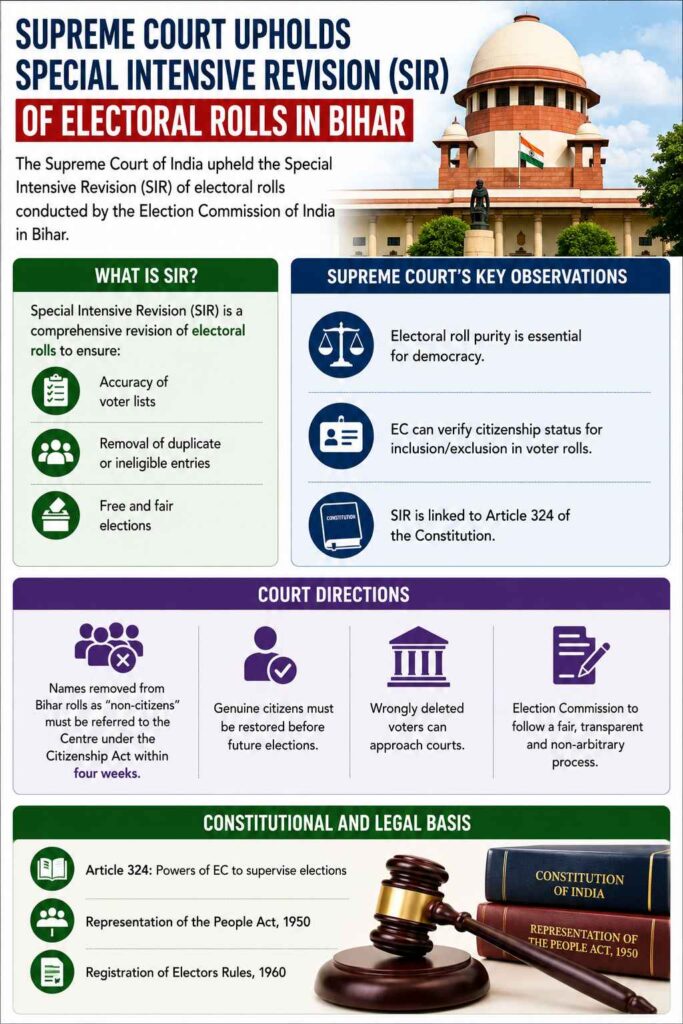
Why in News?
The Supreme Court of India upheld the Special Intensive Revision (SIR) of electoral rolls conducted by the Election Commission of India in Bihar.
What is SIR?
Special Intensive Revision (SIR) is a comprehensive revision of electoral rolls to ensure:
- Accuracy of voter lists
- Removal of duplicate or ineligible entries
- Free and fair elections
Supreme Court’s Key Observations
- Electoral roll purity is essential for democracy.
- EC can verify citizenship status for inclusion/exclusion in voter rolls.
- SIR is linked to Article 324 of the Constitution.
Court Directions
- Names removed from Bihar rolls as “non-citizens” must be referred to the Centre under the Citizenship Act within four weeks.
- Genuine citizens must be restored before future elections.
- Wrongly deleted voters can approach courts.
Constitutional and Legal Basis
- Article 324: Powers of EC to supervise elections
- Representation of the People Act, 1950
- Registration of Electors Rules, 1960
Reasons Supporting SIR
The Court accepted EC’s concerns regarding:
- Migration
- Duplicate entries
- Unreported deaths
- Urbanisation
- Long gap since last intensive revision
Safeguards Mentioned by Court
- Notice before deletion
- Opportunity of hearing
- Aadhaar accepted as indicative document
- Publication of excluded voters list
[2017] Right to vote and to be elected in India is a
A. Fundamental Right
B. Natural Right
C. Constitutional Right
DLegal Right -
The judiciary’s role in complete justice
Why in the News?
The debate around Article 142 has gained attention after the Supreme Court recognised safe travel on National Highways as part of Article 21 (Right to Life) in In Re: Phalodi Accident vs NHAI (2025). Acting suo motu, the Court flagged a serious concern, over 30% of road deaths occur on National Highways, despite their limited share in total road length. The judgment signals a stronger judicial role where existing laws fail to ensure justice.
What is Article 142 of the Constitution of India?
- It states that the Supreme Court may pass any decree or order necessary for doing complete justice.
- Article 142 is extraordinary, not unlimited. The Court has repeatedly said it cannot violate substantive law or the Constitution and must respect separation of powers.
- Examples of Use:
- Bhopal Gas Tragedy (1991): SC used Article 142 for settlement-related directions.
- Ayodhya Verdict (2019): Court used Article 142 to allot alternative land for mosque construction.
- Divorce Cases: SC has dissolved marriages irretrievably even when statutory conditions were not fully met.
- Phalodi Accident Case (2025): Used to strengthen road safety and recognise safe highways under Article 21.
Why has Article 142 become central to the idea of “complete justice”?
- Constitutional Empowerment: Article 142 authorises the Supreme Court to pass orders necessary for ensuring complete justice where statutory mechanisms are inadequate.
- Residual Jurisdiction: Functions as a constitutional reserve power in situations where ordinary legal procedures fail to address exceptional injustice.
- Justice Beyond Technicalities: Enables equitable relief even where procedural or technical legal barriers exist.
- Constitutional Safety Valve: Fills institutional gaps when existing laws are silent, rigid, or incapable of immediate grievance redressal.
- Expansion of Rights-Based Jurisprudence: Strengthens substantive justice under Article 21, including newer dimensions such as road safety and dignified living.
- Illustration: Highway Safety Judgment (2025): In In Re: Phalodi Accident vs NHAI (2025), the Court recognised safe and motorable roads as part of Right to Life, while responding to alarming road fatalities.
How did the Supreme Court justify judicial intervention in the highway safety case?
- Suo Motu Cognisance: The Court initiated proceedings after two road accidents in November 2025 led to 34 deaths.
- Right to Life Expansion: Interpreted Article 21 to include safe travel and well-maintained highways.
- Governance Failure: Judicial intervention emerged against the backdrop of persistent road safety failures.
- Striking Data: National Highways accounted for over 30% of road fatalities in India, despite comprising a limited share of total roads.
- Policy Context: Government targets 50% reduction in road accident fatalities by 2030 through the 4E Strategy:
- Engineering: Improves road infrastructure and black-spot correction.
- Education: Strengthens road safety awareness.
- Enforcement: Ensures traffic regulation compliance.
- Emergency Medical Services: Supports rapid trauma response.
- Mixed Outcomes: Despite a reported 11% decline in fatalities in 2024, accident deaths remain substantially high.
What is the constitutional meaning of “complete justice”?
- Substantive Justice: Ensures outcomes aligned with fairness rather than rigid procedural compliance.
- Natural Justice: Requires adherence to principles of fair hearing, reasonableness, and equity.
- Constitutional Morality: Enables courts to protect constitutional values in emerging socio-legal contexts.
- Dynamic Interpretation: Adapts legal remedies to changing social realities where statutes lag behind societal needs.
- Institutional Trust: Strengthens public confidence by preventing denial of justice due to legal loopholes.
- Constitutional Intent: Reflects the framers’ objective of preserving justice even in legally exceptional situations.
Can High Courts also exercise powers similar to Article 142?
- Constitutional Difference: High Courts do not possess powers identical to Article 142.
- Judicial Clarification: In Anil Kumar Jain v. Maya Jain, the Supreme Court held that Article 226 powers of High Courts are not co-extensive with Article 142 powers.
- Broader Writ Jurisdiction: High Courts may still deliver equitable relief under Article 226 for enforcement of fundamental and legal rights.
- Institutional Limitation: High Courts remain constrained by statutory frameworks to a greater extent than the Supreme Court.
- Functional Similarity: Both institutions pursue justice, but the Supreme Court possesses wider constitutional discretion.
What judicial principles regulate the exercise of Article 142?
- Extraordinary Nature: Article 142 operates as an exceptional power and not an ordinary judicial mechanism.
- Judicial Restraint: Courts exercise caution to avoid institutional excess.
- Faith and Trust Principle: Judicial legitimacy depends upon restrained and principled use of extraordinary authority.
- Natural Justice Requirement: Fairness remains indispensable in all judicial interventions.
- Judicial Precedent: In Delhi Judicial Service Association v. State of Gujarat, the Court recognised Article 142 as distinct from ordinary law.
- Limited Exercise Principle: In Hitesh Bhatnagar v. Deepa Bhatnagar, the Court emphasised cautious application of extraordinary jurisdiction.
Does Article 142 strengthen justice or undermine separation of powers?
- Judicial Activism: Supports proactive constitutional interpretation where governance gaps persist.
- Institutional Corrective: Responds to administrative inaction or legislative silence.
- Separation of Powers Concern: Critics argue frequent reliance on Article 142 risks judicial encroachment into executive and legislative domains.
- Procedural Bypass Criticism: Courts may bypass established statutory frameworks while granting remedies.
- Counterargument: Judicial intervention becomes necessary where evolving social issues outpace legislation.
- Illustration: Social Change: Courts have intervened in matters involving rights, dignity, and emerging social realities where existing laws proved inadequate.
How has judicial precedent shaped the doctrine of complete justice?
- Equitable Justice Principle: In Canara Bank v. Debasis Das, the Court held that the Constitution seeks substantive justice beyond procedural rigidity.
- Legal Gap Filling: Article 142 addresses situations where legal systems fail to provide direct remedies.
- Precedent-Based Expansion: Judicial decisions have progressively broadened the operational meaning of “complete justice”.
- Balance with Constitutionalism: Courts continue to emphasise limits to avoid institutional imbalance.
Case Contribution Delhi Judicial Service Association v. State of Gujarat (1991) Recognised independent scope of Article 142 Canara Bank v. Debasis Das (2003) Reinforced substantive justice and natural justice Anil Kumar Jain v. Maya Jain (2009) Clarified High Courts cannot exercise Article 142 powers Hitesh Bhatnagar v. Deepa Bhatnagar (2011) Emphasised restraint in Article 142 use In Re: Phalodi Accident v. NHAI (2025) Linked safe highways with Article 21 What are the criticisms of Article 142?
- Judicial Overreach: Expands the Court’s role beyond interpretation into policy-making, raising concerns of institutional overreach.
- Weakens Separation of Powers: Allows the judiciary to enter domains traditionally reserved for the Legislature or Executive.
- Bypassing Statutory Framework: Enables relief beyond existing laws, sometimes diluting Parliament-made procedures.
- Ambiguous Scope: The term “complete justice” lacks clear constitutional limits, creating scope for subjective interpretation.
- Democratic Accountability Concerns: Unelected judges making wide-ranging decisions may raise questions of democratic legitimacy.
Conclusion
Article 142 reflects the Constitution’s commitment to ensuring justice where statutory remedies prove inadequate. However, constitutional legitimacy requires a careful balance between judicial innovation and institutional restraint. The enduring challenge lies in preserving the Supreme Court’s role as the guardian of justice without unsettling the constitutional equilibrium among organs of the State.
PYQ Relevance
[UPSC 2020] Judicial legislation is antithetical to the doctrine of separation of powers as envisaged in the Indian Constitution. In this context justify the filing of large number of public interest petitions praying for issuing guidelines to executive authorities
Linkage: The PYQ directly tests the tension between judicial activism, judicial overreach, and separation of powers, the core debate surrounding Article 142. Article 142 embodies the same dilemma: Should courts intervene to ensure complete justice when governance fails, or does it amount to judicial legislation?
-
Oral remarks and institutional limits
Why in the News?
Recent oral remarks by the Chief Justice of India during a court hearing, and the clarification that followed, have revived debate on the limits of judicial remarks from the bench. The issue is important because oral observations now spread quickly through media and social platforms, often influencing public opinion before a final court judgment is delivered.
Why Does the Distinction Between Oral Remarks and Judicial Orders Matter?
Oral remarks are observations, questions, or comments made by judges during court hearings to test arguments and clarify issues. Judicial orders/judgments are formal, reasoned, and legally binding decisions issued by the court after due consideration.
- Institutional Discipline: Ensures judicial legitimacy rests on reasoned orders rather than spontaneous courtroom observations.
- Due Process: Prevents prejudicial comments from influencing ongoing proceedings before facts are fully adjudicated.
- Judicial Neutrality: Protects courts from appearing partisan, emotional, or personally opinionated.
- Public Trust: Prevents informal comments from shaping public perception in ways inconsistent with final judicial reasoning.
- Digital Amplification: Makes oral remarks consequential because media circulation often precedes written judgments.
What Constitutional and Ethical Standards Govern Judicial Speech from the Bench?
Restatement of Values of Judicial Life (1997)
- Institutional Restraint: The Full Court adopted the Restatement of Values of Judicial Life on 7 May 1997, directing judges not to enter public debate or express views on matters likely to arise for judicial determination.
- Judicial Discipline: Item 8 restrains judges from public commentary on political or controversial issues affecting impartiality.
Benjamin Cardozo’s Judicial Standard
- Reasoned Adjudication: Judges must derive inspiration from “consecrated principles,” not personal emotions or impulsive sentiment.
- Institutional Method: Judicial discretion must remain disciplined by legal tradition, analogy, and constitutional order.
- Core Principle: Bench remarks must test legal positions rather than become vehicles for personal commentary.
Constitutional Standards: The Oath of Office (Third Schedule)
- Before a judge takes their seat, they swear an oath under the Third Schedule of the Indian Constitution. They vow to perform their duties “without fear or favor, affection or ill-will.”
Article 211 & Article 121 (Mutual Immunity): The Constitution sets up a strict separation of powers through a “speech immunity” pact between the Judiciary and Parliament:
- Article 121 bars Parliament from discussing the conduct of any Supreme Court or High Court judge (except during removal proceedings).
- Article 211 applies the same restriction to State Legislatures.
Global Standards Adopted by India
The Bangalore Principles of Judicial Conduct (2002): Formulated by global chief justices (and heavily endorsed by the Supreme Court of India), this is the international gold standard for judicial behavior. It highlights six core values, three of which directly govern speech from the bench:
Value The Judicial Speech Rule Impartiality A judge must ensure that their speech, both in the courtroom and in judgments, does not manifest bias or prejudice towards any person or group. Propriety A judge must accept personal restrictions that might seem burdensome to ordinary citizens. Their language must remain courteous, patient, and dignified at all times. Equality A judge must not, by words or conduct, manifest bias or prejudice based on irrelevant grounds like race, color, sex, religion, or national origin. How Did the Supreme Court Clarify the Status of Oral Remarks in the Vijaya Bhaskar Case?
Background of the Case
- COVID-19 Context: In April 2021, the Madras High Court, while hearing a petition concerning COVID protocol violations during election rallies, criticised the Election Commission.
- Sharp Oral Observation: The Bench remarked that the Election Commission was “singularly responsible” for the situation and “should probably be booked for murder charges.”
Supreme Court Intervention
- Media Reporting Challenge: The Election Commission challenged media reporting of these oral observations.
- Case: Chief Election Commissioner v. M.R. Vijayabhaskar (2021).
Key Judicial Standard Established
- Bench Questions: Courts may ask difficult or provocative questions to test legal arguments.
- Language Restriction: Judicial freedom does not extend to “scathing language” directed against institutions or individuals crossing recognised judicial standards.
- Institutional Distinction: Courts clarified that formal opinions emerge through written judgments, not oral observations during hearings.
- Judicial Creativity: The Court accepted spontaneity during hearings but emphasised constitutional restraint.
Important Principle
- Dual Test: The standard governing both bench questions and judicial language derives from judicial discipline and restraint.
When Do Judicial Oral Remarks Raise Questions of Institutional Restraint?
Justice Antonin Scalia (2003, University of Texas Admissions Hearing)
- Controversial Comment: Suggested some African-American students may perform better at less competitive institutions.
- Institutional Criticism: The remark attracted widespread criticism for prejudicial implications.
- No Retraction: Justice Scalia later reiterated the position.
Justice S.A. Bobde (2021 Rape Bail Hearing)
- Insensitive Observation: During a rape-related bail hearing in Maharashtra, Justice Bobde reportedly asked whether the accused would marry the victim.
- Public Backlash: The remark drew criticism for trivialising sexual violence.
- Subsequent Clarification: Court clarified the statement had been misunderstood.
Justice Ruth Bader Ginsburg (2016 US Presidential Election)
- Political Comment: Called Donald Trump a “faker.”
- Retraction: Later expressed regret, recognising judges must avoid entering political debates.
Chief Justice D.Y. Chandrachud (Marriage Equality Case, 2023)
- Oral Observation: Suggested absolute notions of “man” and “woman” were socially constructed.
- Final Judgment Contrast: Six months later, the written judgment reflected a different legal position, showing oral remarks need not indicate final judicial reasoning.
Chief Justice Surya Kant Controversy (2025)
- Current Trigger: Remarks concerning senior advocate designation reignited debate over judicial language and institutional limits.
How Has Technology Changed the Consequences of Judicial Oral Remarks?
- Instant Dissemination: Oral observations now circulate immediately through television, digital media, and social media platforms.
- Narrative Formation: Public opinion often forms before courts deliver reasoned judgments.
- Reputational Impact: Institutions and individuals may face reputational injury from informal remarks.
- Judicial Pressure: Courts increasingly face pressure to clarify statements made during hearings.
- Institutional Risk: Blurs distinction between courtroom exchange and authoritative judicial pronouncement.
Can Judicial Spontaneity Coexist with Institutional Restraint?
- Argument Testing: Courts require freedom to ask uncomfortable questions and challenge arguments.
- Temperate Language: Judicial speech must avoid ridicule, humiliation, or prejudicial framing.
- Clarification Mechanism: Later clarifications may reduce controversy but cannot fully erase public impact.
- Institutional Balance: Judges must preserve spontaneity without compromising constitutional dignity.
- Core Challenge: Maintaining the distinction between testing legal positions and institutional commentary.
Conclusion
Judicial institutions derive legitimacy not only from constitutional authority but also from restraint in speech and conduct. While oral remarks help courts test arguments, maintaining a clear distinction between bench observations and written judgments remains essential to preserve judicial neutrality, public trust, and institutional credibility in the digital age.
PYQ Relevance
[UPSC 2023] Constitutionally guaranteed judicial independence is a prerequisite of democracy.” Comment.
Linkage: The PYQ tests understanding of judicial independence, institutional credibility, and constitutional restraint in democratic governance. The article examines how judicial conduct and oral remarks can affect institutional neutrality and public trust, both essential for judicial independence.
-
Delhi Police Seek Review of UAPA Bail Principles
Why in the News?
The Delhi Police urged the Supreme Court of India to refer the issue of bail under the Unlawful Activities (Prevention) Act, 1967 (UAPA) to a larger Bench, citing “conflicting” judgments on prolonged incarceration and bail.
Key Issue Before the Court
- The question is whether: Long incarceration and delay in trial can override strict bail restrictions under UAPA.
Delhi Police’s Argument
Additional Solicitor General S. V. Raju argued:
- Under Section 43D(5) of UAPA, the presumption of innocence takes a “backseat”.
- If accusations appear “prima facie true”, bail restrictions become mandatory.
- Conflicting Supreme Court judgments require consideration by a larger Bench.
Background of the Case
- The hearing concerned bail pleas of:
- Abdul Khalid Saifi
- Tasleem Ahmad
- Accused in the 2020 Delhi riots conspiracy case.
Reference to Recent Supreme Court Judgment
- A Bench led by: B. V. Nagarathna and Ujjal Bhuyan recently observed:
- “Bail is the rule and jail is the exception” even under UAPA.
- Prolonged incarceration violates:
- Right to life
- Personal liberty
- Speedy trial under Article 21 of the Constitution of India
K.A. Najeeb Judgment
- The Court referred to the Union of India v. K.A. Najeeb case, which held: Constitutional courts can grant bail despite UAPA restrictions when trials are excessively delayed.
Section 43D(5) of UAPA
- Restricts bail if accusations appear prima facie true.
- Considered one of the strictest bail provisions in Indian law.
Related Development
A Delhi court dismissed interim bail plea of Umar Khalid for attending bereavement rituals and caring for his ailing mother.
UPSC Prelims Pointers
- UAPA is India’s anti-terror law.
- Section 43D(5) imposes strict bail conditions.
- Article 21 guarantees life and personal liberty.
- K.A. Najeeb judgment recognised prolonged incarceration as ground for bail.
[2020] Consider the following statements:
1. The Constitution of India defines its ‘basic structure’ in terms of federalism, secularism, fundamental rights and democracy.
2. The Constitution of India provides for ‘judicial review’ to safeguard the citizens’ liberties and to preserve the ideals on which the Constitution is based.
Which of the statements given above is/are correct?
a) 1 only
b) 2 only
c) Both 1 and 2
d) Neither 1 nor 2 -
Supreme Court on Bail and UAPA
Why in the News?
The Supreme Court of India expressed “serious reservations” about aspects of its earlier judgment denying bail to Umar Khalid and Sharjeel Imam in the Delhi riots conspiracy case under the Unlawful Activities (Prevention) Act, 1967 (UAPA).
Key Observations by the Court
- The Court reaffirmed that:
- “Bail is the rule, jail is the exception.”
- Justice Ujjal Bhuyan stated that prolonged incarceration without timely trial violates:
- Right to life
- Personal liberty
- Speedy trial under Article 21 of the Constitution of India
Section 43-D(5) of UAPA
- Restricts grant of bail if accusations appear “prima facie true”.
- Creates a very low threshold for the prosecution to oppose bail.
Court’s Observation
- Courts cannot keep an accused indefinitely jailed merely because charges appear prima facie true.
- Delayed trials can convert pre-trial detention into punishment itself.
Reference to K.A. Najeeb Judgment
- The Court referred to the K.A. Najeeb Judgment, which held that constitutional courts can grant bail despite UAPA restrictions when incarceration becomes excessively prolonged.
Constitutional Principle
- Presumption of innocence remains a cornerstone of criminal justice.
- Section 43-D(5) remains subordinate to Article 21.
Background of the Case
- Delhi Police booked Umar Khalid and others under UAPA in connection with the 2020 Delhi riots conspiracy case linked to protests against the Citizenship Amendment Act (CAA).
- Umar Khalid had spent over five years in prison as an undertrial.
[2020] Consider the following statements:
1. The Constitution of India defines its ‘basic structure’ in terms of federalism, secularism, fundamental rights and democracy.
2. The Constitution of India provides for ‘judicial review’ to safeguard the citizens’ liberties and to preserve the ideals on which the Constitution is based.
Which of the statements given above is/are correct?
a) 1 only b) 2 only c) Both 1 and 2 d) Neither 1 nor 2 - The Court reaffirmed that: