Why in the News
The Chief Minister of Jammu and Kashmir has warned of youth led protests if the Cabinet’s proposal to cap reservation at 50 percent, sent to the Lieutenant Governor in November 2025, is not acted upon. Reservation in the Union Territory stands at 70 percent after a 2024 amendment made by the administration when no elected Assembly existed. An elected Cabinet is therefore seeking to reverse a quota that only the same executive channel can now undo.
What is the Jammu and Kashmir Reservation Act, 2004?
- About: The Jammu and Kashmir Reservation Act, 2004 governs reservation in government appointments, admission to professional institutions and promotions in the Union Territory.
- Categories covered: It provides for Scheduled Castes, Scheduled Tribes, Other Backward Classes, residents of backward areas, residents of areas along the Actual Line of Control and the International Border, persons with disabilities and former service personnel.
- Distinctive feature: Reservation on the basis of residence in border and backward areas is specific to this Union Territory and has no direct parallel in most States.
- How percentages change: Category wise percentages are fixed through rules and amendments issued by the administration, so the quota can be altered without a fresh statute from an elected legislature.
- Post 2019 status: The Act continued to apply after the reorganisation of the State, and was amended by Parliament in 2023 to replace the earlier expression for backward classes with Other Backward Classes.
What is the Actual Line of Control category?
- About: The Actual Line of Control (ALC) category covers residents of villages lying along the line dividing Indian and Pakistani held territory, who face shelling, restricted cultivation and displacement.
- Why it exists: The reservation compensates for the loss of education and employment opportunity caused by proximity to the line, and a parallel category exists for residents along the International Border (IB) in the Jammu plains.
Who is an Agniveer?
- About: An Agniveer is a soldier recruited under the Agnipath scheme of 2022 for a four year term in the armed forces, after which 25 percent of each batch is retained in regular service.
- Why reservation is promised: The remaining personnel leave service in their twenties, so the Centre and several States have announced quotas for them in police and paramilitary recruitment.
What is the current status of reservation in Jammu and Kashmir?
- Before August 2019: 43 percent of posts in government jobs were reserved across all categories, before the abrogation of the erstwhile State’s special status on 5 August 2019.
- After the 2024 amendment: Total reservation stands at 70 percent, leaving 30 percent of posts for open competition.
- The Scheduled Tribe share: The Scheduled Tribe quota was raised from 10 percent to 20 percent.
- The pending proposal: A Cabinet sub committee report of October 2025 recommended capping reservation at 50 percent, the Cabinet accepted it, and the file went to the Lieutenant Governor in November 2025.
- National baseline for comparison: At the Union level, Scheduled Castes hold 15 percent, Scheduled Tribes 7.5 percent, Other Backward Classes 27 percent for the non creamy layer, and the economically weaker sections 10 percent.
- The ceiling position: Indra Sawhney v. Union of India, 1992 fixed a 50 percent ceiling on reservation, relaxable only in extraordinary situations. The economically weaker sections quota sits outside that ceiling after Janhit Abhiyan v. Union of India, 2022.
Constitutional Provisions Related to Reservation
- Article 15(4): Permits special provision for the advancement of socially and educationally backward classes, Scheduled Castes and Scheduled Tribes.
- Article 15(5): Permits reservation in admission to educational institutions, including private unaided institutions, excluding minority institutions.
- Article 15(6) and Article 16(6): Inserted by the 103rd Amendment Act, 2019, permitting up to 10 percent reservation for economically weaker sections in education and public employment.
- Article 16(1) and Article 16(2): Guarantee equality of opportunity in public employment and bar discrimination on grounds of religion, race, caste, sex, descent, place of birth or residence.
- Article 16(4): Permits reservation in appointments for any backward class not adequately represented in the services of the State.
- Article 16(4A): Permits reservation in promotion with consequential seniority for Scheduled Castes and Scheduled Tribes.
- Article 16(4B): Allows carry forward of unfilled reserved vacancies without counting them against the ceiling of the succeeding year.
- Article 335: Requires claims of Scheduled Castes and Scheduled Tribes to be considered consistently with the maintenance of efficiency of administration, a term the Constitution does not define.
- Article 338, 338A and 338B: Establish the National Commissions for Scheduled Castes, Scheduled Tribes and Backward Classes.
- Article 340: Empowers the President to appoint a commission to investigate the conditions of backward classes, the provision under which the Mandal Commission was set up.
- Article 341 and Article 342: Empower the President to specify the Scheduled Castes and Scheduled Tribes for a State or Union Territory, with any change requiring an Act of Parliament.
- Article 342A: Inserted by the 102nd Amendment and modified by the 105th Amendment Act, 2021, restoring the power of States and Union Territories to prepare their own list of socially and educationally backward classes.
- Article 46: Directs the State to promote the educational and economic interests of the weaker sections, particularly Scheduled Castes and Scheduled Tribes.
How did the quota rise from 43 percent to 70 percent?
- The instrument: In 2024 the Lieutenant Governor announced an amendment to the Jammu and Kashmir Reservation Act, 2004, raising total reservation from 43 percent to 70 percent in government jobs.
- The timing: The amendment came barely a month before the 2024 parliamentary elections.
- The driver: Scheduled Tribe status was granted to the Pahari community, which sharply enlarged the population drawing on the Scheduled Tribe quota.
- The countervailing move: Gujjars and Bakerwals, who already held Scheduled Tribe status, had consistently opposed Pahari inclusion. The Scheduled Tribe quota was raised from 10 percent to 20 percent so that existing beneficiaries were not diluted.
- The residual pool: Candidates outside every reserved category were left competing for 30 percent of posts, which drew sharp criticism from unreserved applicants.
Why is the elected government under pressure?
- Data placed on the floor of the Assembly: In February the government answered a motion by a People’s Conference legislator with figures showing significantly more reserved category certificates issued in Jammu than in Kashmir.
- Dissent from within the ruling party: In October 2025 a Member of Parliament from the Chief Minister’s own party sat on protest with unreserved category candidates outside the Chief Minister’s residence.
- Manifesto commitments: The National Conference and the Peoples Democratic Party both promised in their 2024 Assembly manifestos to revisit the policy, framing it cautiously as rationalisation of reservation.
- A competing promise: The Bharatiya Janata Party promised additional reservation for Agniveers and reservation in promotions for employees from reserved groups.
- The street risk: The Chief Minister has warned that youth led agitation of the kind seen elsewhere could follow if the Cabinet decision continues to go unanswered.
Why has the proposal not moved?
- What the Cabinet did: The Cabinet accepted the sub committee’s recommendation of a 50 percent cap and sent the file to the Lieutenant Governor’s residence for clearance in November 2025.
- What followed: Queries were raised on the report, the government responded to them, and there has been no movement since.
- Why clearance is required: Jammu and Kashmir is a Union Territory with a legislature, where the Council of Ministers aids and advises the Lieutenant Governor and any difference of opinion is referred to the President.
- Limits on the elected tier: Under the Jammu and Kashmir Reorganisation Act, 2019 the Assembly cannot legislate on public order and police, and the administration retains substantial executive authority.
- The transparency objection: The stated grievance is that Cabinet approvals are held without any communicated decision, which leaves the elected government publicly answerable for an outcome it cannot deliver.
Major debates surrounding reservation
- The 50 percent ceiling: Indra Sawhney fixed the limit, and States have breached it repeatedly. Tamil Nadu’s 69 percent reservation survives because it was placed in the Ninth Schedule in 1994.
- The economically weaker sections carve out: Janhit Abhiyan upheld the 10 percent quota by a 3 to 2 majority, which unsettled the ceiling as a firm rule and reopened the question of economic criteria.
- Social exclusion against economic upliftment: One position treats reservation as a remedy for historical exclusion from representation, another treats it as an instrument against poverty.
- Sub classification within categories: State of Punjab v. Davinder Singh, 2024 permitted States to sub classify Scheduled Castes for more targeted quotas, overruling E V Chinnaiah, 2004.
- Efficiency of administration: Article 335 conditions reservation on efficiency, and the absence of a definition leaves the balance to be argued case by case.
- Reservation in promotions: M Nagaraj, 2006 and Jarnail Singh, 2018 require quantifiable data on inadequacy of representation before promotion quotas, and the sufficiency of that data is routinely litigated.
- Who is listed as a Scheduled Tribe: Inclusion in the Article 342 list follows a Presidential order amended by Parliament, and the criteria applied for the Pahari inclusion are disputed by communities already on the list.
- Absence of current backward class data: Quota shares are set without an enumerated count of backward classes, which is the core of the demand for a caste census.
Challenges to the reservation framework in Jammu and Kashmir
- The reserved pool exceeds the open pool: At 70 percent, unreserved candidates compete for less than a third of posts. e.g. general category aspirants in the Union Territory contest 30 percent of vacancies against roughly 50 percent available in most other States.
- Certification depends on revenue records: Residence based categories require boundary determinations that are open to error and manipulation. e.g. villages that straddle the notified Actual Line of Control belt generate contested certificates for the same locality.
- Contest within Scheduled Tribes: Existing tribes argue that a linguistic and geographic grouping does not meet the listing criteria. e.g. Gujjars and Bakerwals opposed Pahari inclusion on the argument that it dilutes a quota meant for pastoral communities with distinct traits and isolation.
- The formal employment base is narrow: Government service is the principal source of secure employment, so quota changes carry outsized political weight. e.g. private sector job creation in the Union Territory remains limited, which turns every recruitment notification into a political event.
- Litigation risk on the ceiling: Any quota above 50 percent must justify an extraordinary situation. e.g. the Supreme Court struck down Maharashtra’s Maratha reservation in Jaishri Laxmanrao Patil v. Chief Minister, 2021 for breaching the limit without such justification.
- Quota fixed by executive route: The increase was made by the administration when no elected Assembly existed, so accountability for it sits with neither the present Cabinet nor a legislature. e.g. the 2024 amendment was announced by the Lieutenant Governor a month before a national election.
- Regional perception of unequal benefit: Certificate issuance patterns feed a Jammu against Kashmir framing of the whole policy. e.g. the figures tabled in the Assembly in February became the basis for a protest by unreserved category aspirants.
Conclusion
Reservation in Jammu and Kashmir stands at 70 percent, set by an executive amendment made when no elected Assembly existed, and it can be reduced only through the same executive channel. The Cabinet’s recommendation of a 50 percent cap has been with the Lieutenant Governor since November 2025 without a decision, so a social justice dispute has become a question of who governs the Union Territory. The next milestone is the Lieutenant Governor’s decision on the file, or a reference to the President if the difference of opinion persists.
What is Reservation?
- About: Reservation is a form of positive discrimination that sets aside a fixed proportion of public posts, legislative seats and educational places for groups identified as socially and educationally backward or inadequately represented.
- Rationale: Formal equality under Article 16(1) leaves historically excluded groups competing from unequal starting positions, and reservation supplies the substantive equality that Article 16(4) permits as a facet of, not an exception to, equality.
- Vertical reservation: Quotas for Scheduled Castes, Scheduled Tribes, Other Backward Classes and economically weaker sections, which are mutually exclusive categories.
- Horizontal reservation: Quotas for women, persons with disabilities and ex servicemen, which cut across every vertical category rather than forming a separate block.
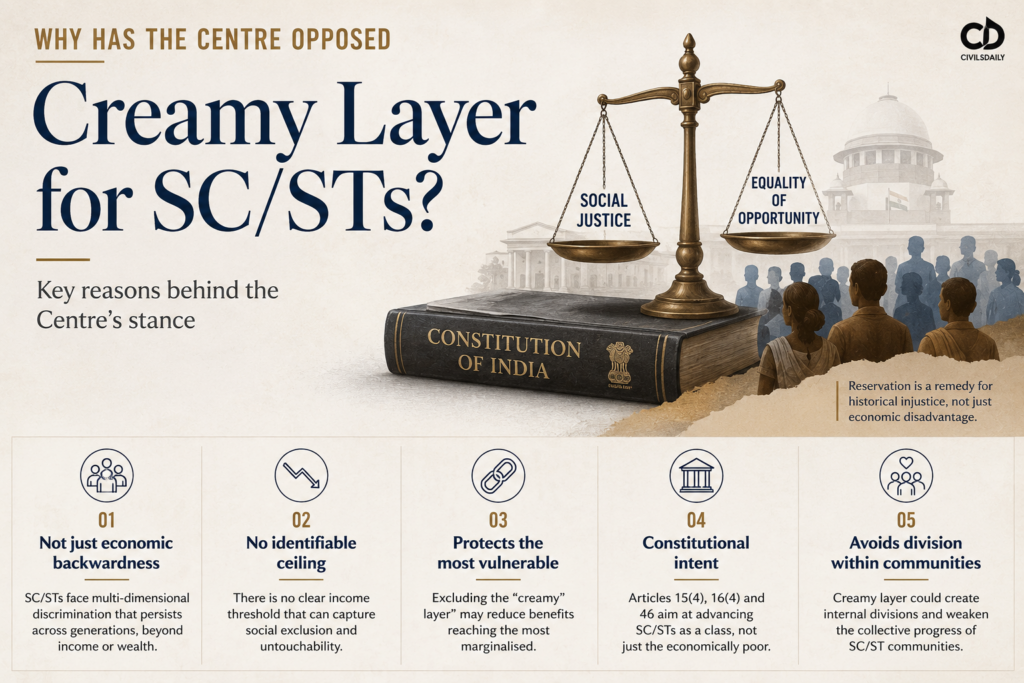
- Creamy layer: The filter excluding the economically advanced within a backward class, applied to Other Backward Classes since Indra Sawhney and extended to promotion quotas for Scheduled Castes and Scheduled Tribes in Jarnail Singh, 2018.
- Reservation in legislatures: Distinct from employment quotas, provided under Articles 330 and 332 for Scheduled Castes and Scheduled Tribes and under the 106th Amendment for women.
Key Concerns Regarding Reservation
- Benefit capture within categories: Dominant sub groups absorb a disproportionate share of reserved posts, which is what prompted the sub classification question in Davinder Singh.
- Absence of current data: Quota shares rest on the 1931 caste enumeration and on estimates, with no current count of backward class population.
- Erosion of the ceiling: Successive carve outs and State enactments above 50 percent have made the Indra Sawhney limit a contested rather than settled rule.
- Shrinking public sector: The reserved pool shrinks as government recruitment falls and contractual hiring rises, so quotas apply to a diminishing base.
- Backlog vacancies: Reserved posts remain unfilled and are carried forward or converted, which defeats the adequacy of representation the quota exists to secure.
- No coverage of the private sector or the higher judiciary: Reservation does not extend to private employment or to appointments to the higher judiciary, which limits its reach in the fastest growing segments.
Constitutional and Statutory Framework Governing the Union Territory of Jammu and Kashmir
- Article 239: Provides for administration of Union Territories by the President through an Administrator, designated in this case as the Lieutenant Governor.
- Article 239A: Permits Parliament to create a legislature and a Council of Ministers for a Union Territory, the provision extended to Jammu and Kashmir.
- Article 240: Empowers the President to make regulations for specified Union Territories.
- Article 246(4): Empowers Parliament to legislate for a Union Territory on any matter, including matters in the State List.
- Article 370: Rendered inoperative in 2019, with the abrogation upheld in In Re Article 370 of the Constitution, 2023, which also directed restoration of statehood at the earliest.
- Jammu and Kashmir Reorganisation Act, 2019: Reorganised the State into the Union Territories of Jammu and Kashmir and of Ladakh, and defined the legislative and executive scheme for the former.
- The Assembly may legislate on State List and Concurrent List subjects, excluding public order and police, which remain with the Union.
- Section 53: The Council of Ministers aids and advises the Lieutenant Governor on matters within the Assembly’s competence, and a difference of opinion is referred to the President for decision.
Laws and Rules Governing Reservation in Jammu and Kashmir
- Jammu and Kashmir Reservation Act, 2004: The parent statute governing reservation in appointments, promotions and admissions in the Union Territory.
- It recognises reservation on the basis of residence in areas adjoining the Actual Line of Control and the International Border, a category unique to this territory.
- Jammu and Kashmir Reservation Rules, 2005: Prescribe the category wise percentages and the procedure for issuing category certificates.
- Jammu and Kashmir Reservation (Amendment) Act, 2023: Enacted by Parliament, replacing the earlier expression for weak and under privileged classes with Other Backward Classes.
- Constitution (Jammu and Kashmir) Scheduled Tribes Order (Amendment) Act, 2024: Added the Pahari Ethnic Group, Paddari Tribe, Koli and Gadda Brahmin to the Scheduled Tribe list for the Union Territory.
- Jammu and Kashmir Reorganisation Act, 2019: Supplies the constitutional framework within which reservation rules are amended by the administration.
- Constitution (One Hundred and Third Amendment) Act, 2019: Introduced the 10 percent economically weaker sections quota, which applies in the Union Territory as elsewhere.
Back2Basics: Gujjars, Bakerwals and Paharis
- Gujjars and Bakerwals together form the third largest community in Jammu and Kashmir and are the largest Scheduled Tribe group in the Union Territory.
- They are transhumant pastoralists, moving seasonally with livestock between the Pir Panjal foothills in winter and high altitude meadows in summer.
- Gujjars are primarily buffalo and cattle herders, while Bakerwals are goat and sheep herders who undertake the longer migration.
- Their language is Gojri, and both communities were granted Scheduled Tribe status in 1991 along with the Gaddi and Sippi.
- Paharis are a linguistic and cultural grouping, not a single caste, spread across Rajouri, Poonch, Baramulla, Kupwara and Anantnag, and include Hindus, Muslims and Sikhs.
- The Justice G D Sharma Commission, constituted in 2020 to examine socially and educationally backward classes in the Union Territory, recommended Scheduled Tribe status for the Pahari speaking people.
- Their inclusion in the Scheduled Tribe list took effect through an Act of Parliament in 2024, since Article 342(2) requires parliamentary law to amend a Presidential order.
Government Initiatives
- Pradhan Mantri Anusuchit Jaati Abhyuday Yojana (PM-AJAY): Merges village development, grants in aid and hostel construction schemes for Scheduled Caste welfare.
- Eklavya Model Residential Schools: Residential schools for Scheduled Tribe students in blocks with a significant tribal population.
- Pradhan Mantri Janjati Adivasi Nyaya Maha Abhiyan (PM-JANMAN): Saturation coverage of basic services for Particularly Vulnerable Tribal Groups.
- Dharti Aaba Janjatiya Gram Utkarsh Abhiyan: Convergence mission covering tribal majority villages across housing, water, electricity, health and skilling.
- Post Matric Scholarship and National Overseas Scholarship: Educational support for Scheduled Caste, Scheduled Tribe and Other Backward Class students, including for study abroad.
- Stand Up India: Bank loans for greenfield enterprises by Scheduled Caste, Scheduled Tribe and women entrepreneurs.
- National Commissions for Scheduled Castes, Scheduled Tribes and Backward Classes: Constitutional bodies investigating denial of safeguards and advising on socio economic development.
- Van Dhan Vikas Kendras: Value addition and market linkage for minor forest produce collected by tribal households, run under the Ministry of Tribal Affairs.
Key Facts about Reservation
- The first formal reservation in India was introduced in the princely State of Kolhapur in 1902.
- The Mandal Commission was appointed in 1979, submitted its report in 1980, and its 27 percent Other Backward Class quota was implemented from 1990 and upheld in 1992.
- Indra Sawhney v. Union of India, 1992 fixed the 50 percent ceiling, applied the creamy layer filter to Other Backward Classes, and barred reservation in promotions.
- The 77th Amendment Act, 1995 restored reservation in promotions, the 81st Amendment Act, 2000 dealt with backlog vacancies, the 82nd Amendment Act, 2000 allowed relaxation in qualifying marks, and the 85th Amendment Act, 2001 provided consequential seniority.
- Tamil Nadu retains 69 percent reservation, protected by placement in the Ninth Schedule in 1994.
- The 103rd Amendment Act, 2019 introduced the 10 percent economically weaker sections quota, upheld in Janhit Abhiyan, 2022.
- The 105th Amendment Act, 2021 restored the power of States to identify their own socially and educationally backward classes.
- The 106th Amendment Act, 2023 provides one third reservation for women in the Lok Sabha and State Assemblies.
Challenges in Implementing Reservation
- Absence of enumerated data: Quota design rests on estimates rather than a current count of backward class population. e.g. the last caste wise enumeration of the full population dates to 1931, and the Socio Economic and Caste Census of 2011 caste data was never fully released.
- Creamy layer capture: The advanced within a backward class corner a disproportionate share of reserved seats. e.g. the Other Backward Class creamy layer income limit was last revised to 8 lakh rupees a year in 2017, and its revision has been repeatedly deferred.
- Unfilled reserved vacancies: Posts notified as reserved remain vacant and are carried forward or lapse. e.g. successive parliamentary replies have shown large backlogs of reserved Group A posts in central ministries and public sector undertakings.
- Litigation over promotion quotas: Every promotion quota requires fresh quantifiable data, which States struggle to produce. e.g. promotions in several State services stalled for years after M Nagaraj until the data requirement was clarified in Jarnail Singh, 2018.
- Fraudulent category certificates: Verification systems are weak and detection comes long after appointment. e.g. States have periodically cancelled appointments made on forged Scheduled Tribe certificates after scrutiny committee findings.
- Shrinking public employment base: Contractual and outsourced hiring falls outside the reservation framework altogether. e.g. large parts of State health and education recruitment now run through contractual posts to which roster rules do not apply.
- Exclusion of the private sector: Reservation does not extend to private employment, which now generates most new jobs. e.g. proposals for private sector reservation have remained at the level of voluntary affirmative action codes.
- Intra category conflict: Adding a new group to an existing list without enlarging the quota sets beneficiaries against each other. e.g. the Pahari inclusion in Jammu and Kashmir required raising the Scheduled Tribe quota from 10 percent to 20 percent to prevent dilution.
Way Forward
- Complete a caste enumeration: Publish backward class population data so quota shares rest on counted figures rather than estimates, and revise category shares on that basis.
- Legislate the ceiling position clearly: Settle whether and on what evidence a State may cross 50 percent, so the question stops being resolved case by case in court.
- Enforce the creamy layer with periodic revision: Index the income threshold and apply the filter uniformly, so benefits reach the least advantaged within each category.
- Fill backlog vacancies through special recruitment drives: Run time bound drives with a public roster audit for every ministry and State department.
- Extend roster rules to contractual posts: Apply reservation to contractual and outsourced public employment so the shrinking regular cadre does not hollow out the entitlement.
- Build a verifiable certificate system: Digitise category and residence certificates with a single verification database to reduce forgery and duplicate issuance.
- Settle the Jammu and Kashmir file with a reasoned decision: Require the Lieutenant Governor to communicate a decision on the Cabinet’s 50 percent recommendation, or refer the difference to the President as the statute contemplates.
- Invest in the pre entry stage: Expand scholarships, coaching and school quality in backward areas, since reservation cannot compensate for the absence of a qualifying candidate pool.
Matching Previous Year Question
“[2023] Consider the following statements:
Statement-I: The Supreme Court of India has held in some judgements that the reservation policies made under Article 16(4) of the Constitution of India would be limited by Article 335 for maintenance of efficiency of administration.
Statement-II: Article 335 of the Constitution of India defines the term ‘efficiency of administration’.
Which one of the following is correct in respect of the above statements?
(a) Both Statement-I and Statement-II are correct and Statement-II is the correct explanation for Statement-I
(b) Both Statement-I and Statement-II are correct and Statement-II is not the correct explanation for Statement-I
(c) Statement-I is correct but Statement-II is incorrect
(d) Statement-I is incorrect but Statement-II is correct
Answer: (c)”