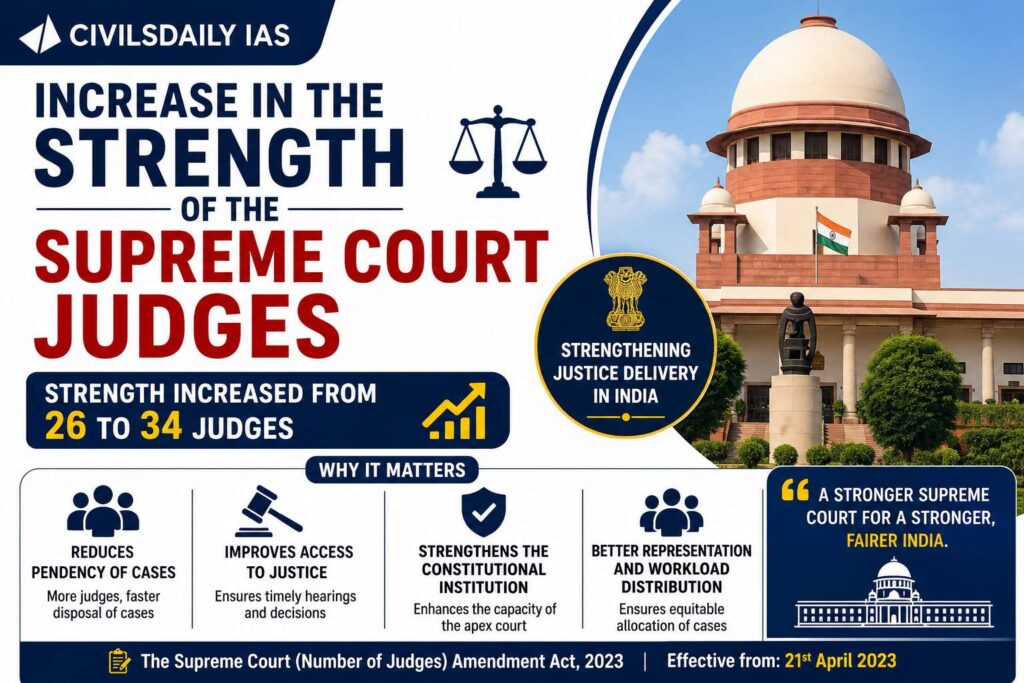
The Union Cabinet has approved increasing the strength of the Supreme Court of India from 34 to 38 judges, aiming to address the growing pendency of cases.
Key Highlights
Current sanctioned strength: 34 judges (including CJI)
Proposed new strength: 38 judges
Amendment required in: Supreme Court (Number of Judges) Act, 1956
Constitutional Provision
Article 124(1)
Provides for establishment of the Supreme Court
Parliament has power to increase number of judges by law
Year
Amendment Act Name
Judges (Excl. CJI)
Total Strength
1950
Constitution of India (Original)
7
8
1956
Supreme Court (Number of Judges) Act
10
11
1960
Amendment Act, 1960
13
14
1977
Amendment Act, 1977
17
18
1986
Amendment Act, 1986
25
26
2009
Amendment Act, 2008 (Enacted 2009)
30
31
2019
Amendment Act, 2019
33
34
2026
Amendment Bill, 2026*
37
38
Reason for Increase
Rising pendency of cases
Current backlog: over 92,000 cases
Increased filings after:
Expansion of e filing system
Post pandemic litigation growth
Appointment Process
After amendment, Supreme Court Collegium recommends names
Collegium System: System where senior Supreme Court judges recommend judicial appointments and transfers
Appointments made by the President of India
[2024] The power to increase the number of judges in the Supreme Court of India is vested in? (a) The President of India (b) The Parliament (c) The Chief Justice of India (d) The Law Commission
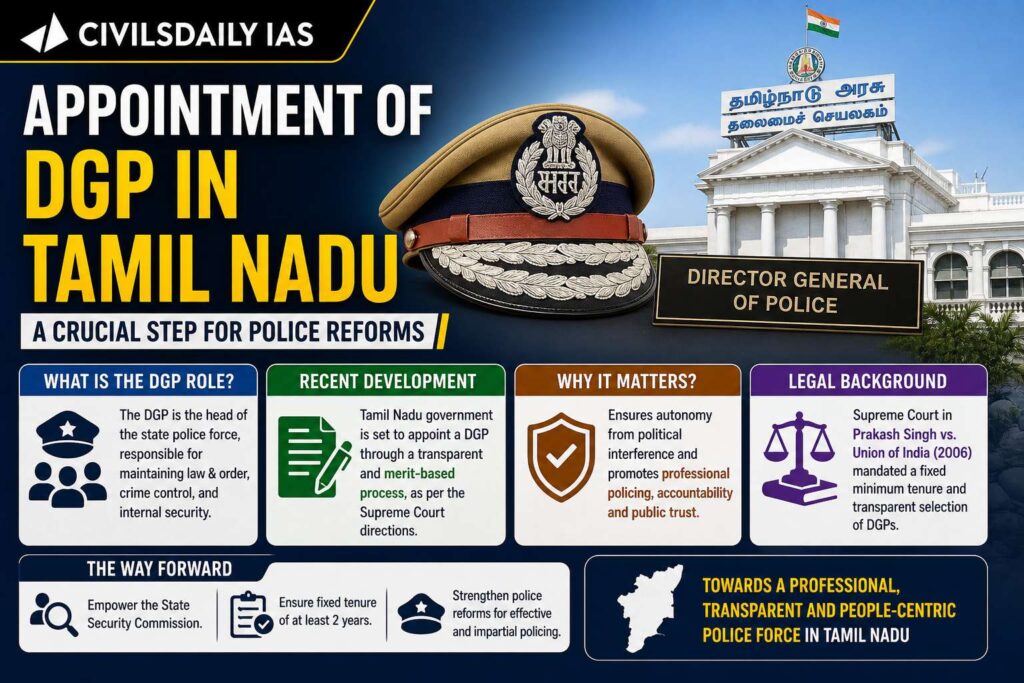
The Union Public Service Commission is set to convene a panel to shortlist candidates for the post of Director General of Police (DGP) in Tamil Nadu, following Supreme Court guidelines on police reforms.
What is DGP
Director General of Police (DGP) is the highest ranking police officer in a State
Heads the State Police Force
Also referred to as Head of Police Force (HoPF)
Appointment Process
UPSC forms a panel of three senior IPS officers
Panel sent to State Government
State selects one officer as DGP
Role of UPSC
Ensures merit based and transparent selection
Conducts Empanelment Committee Meeting (ECM)
Key Supreme Court Guidelines
(From Prakash Singh v Union of India, 2006)
DGP should have a minimum tenure of 2 years
Selection from panel prepared by UPSC
Officers should have minimum residual service
Appointment should not be made just before retirement
Important Terms
Empanelment Committee Meeting (ECM): Meeting conducted by UPSC to shortlist eligible officers
Residual Service: Remaining service period before retirement
Key Issues Highlighted
Delays in appointment process
Debate over extension beyond retirement
Ensuring independence and stability of police leadership
Significance
Strengthens police reforms and accountability
Ensures professional and merit based appointments
Reduces political interference in policing
[2019] With reference to the Chief Secretary of a state, consider the following statements: 1. Chief Secretary is appointed by the Governor of the state for a fixed tenure of two years. 2. The Central government has the power to approve extension of service of Chief Secretary for a period not exceeding six months. Which of the statements given above is/are correct? [A] 1 only [B] 2 only [C] Both 1 and 2 [D] Neither 1 nor 2
PYQ Relevance[UPSC 2024] Explain the reasons for the growth of public interest litigation in India. As a result of it, has the Indian Supreme Court emerged as the world’s most powerful judiciary?Linkage: The PYQ directly addresses evolution, expansion, and consequences of PIL, which is the core theme of the article. The second part critically links to judicial overreach and institutional balance, exactly reflecting concerns raised in the debate on reconsidering PIL jurisdiction.
Mentor’s Comment
Debate on the scope of Public Interest Litigation (PIL) has resurfaced due to increasing concerns over its misuse, judicial overreach, and dilution of its original purpose. While PIL once transformed access to justice in India, recent trends show “agenda-driven litigation,” “ambush PILs,” and excessive judicial intervention in executive domains. The issue is critical for balancing judicial activism with institutional discipline.
What is Public Interest Litigation (PIL)?
Public Interest Litigation (PIL) is a legal mechanism in India that allows any citizen or organization to file a lawsuit in a High Court or Supreme Court to protect the rights or interests of the public at large, particularly marginalized or disadvantaged groups. It bypasses the traditional “locus standi” rule, meaning a person filing the case doesn’t need to be personally aggrieved.
Key Aspects of PIL
Purpose: To ensure social justice, enforce human rights, and promote public welfare, rather than enforcing individual legal rights.
Subject Matter: PILs often address issues such as environmental pollution, terrorism, road safety, construction hazards, human rights violations, and public health.
Legal Basis: It is a form of judicial activism, primarily developed through interpretations by the Supreme Court, rather than being defined in a specific statute.
Legal Mandates and Guidelines
While there is no “PIL Act,” the process is governed by specific legal provisions and court-mandated rules:
Section 133 of the Criminal Procedure Code (CrPC): Allows a Magistrate to take action against public nuisances, serving as a lower-level legal tool for public interest matters.
Supreme Court Rules, 2013: Order XXXVIII specifically regulates the procedures for filing PILs to ensure they are not misused.
Judicial Guidelines: In cases like S.P. Gupta v. Union of India, the Supreme Court established clear guidelines to verify the credentials of petitioners and ensure that only genuine public causes are entertained, preventing frivolous litigation.
Where should courts draw the line in who can file PILs?
Locus Standi Relaxation: Enabled access to justice for marginalized groups; e.g., Hussainara Khatoon case expanded prisoner rights.
Citizen Standing Expansion: Allowed individuals without direct injury to file PILs, shifting from representative to open-ended standing.
Risk of Over-expansion: Created scope for individuals with no direct stake to litigate, weakening judicial discipline.
Need for Direct Stake: Ensures only affected or genuinely interested parties approach courts, reducing frivolous litigation.
Do PILs risk judicial overreach into executive functions?
Judicial Activism: Courts intervened in governance gaps, ensuring accountability in cases of executive inaction.
Overreach Concerns: Courts increasingly encroach into policy domains reserved for the executive.
Case Illustration: Courts declined direct intervention in hate speech regulation, directing authorities instead highlighting limits of judicial power.
Institutional Balance: Requires respecting separation of powers while ensuring accountability.
Are PILs becoming tools for strategic or ‘ambush’ litigation?
Ambush PILs: Filed strategically to secure early dismissal or interim relief.
Blocking Genuine Claims: Prevent legitimate litigants from accessing justice.
Example: Petitions filed with intent to influence outcomes rather than resolve issues.
Structural Issue: Rooted in the flexible nature of PIL itself.
Has PIL diluted due process and procedural safeguards?
Bypassing Procedures: Courts sometimes relax procedural rules in PIL cases.
Example: Environmental cases like MC Mehta show limits of judicial capacity in long-term governance issues.
Need for Oversight: Retention of limited supervision post-judgment ensures accountability.
What is the role of amicus curiae in PIL proceedings?
Expanded Role: Courts rely heavily on amicus curiae in complex cases.
Risk of Overreach: Amicus sometimes assumes quasi-judicial functions.
Example: TN Godavarman case expanded forest jurisprudence but raised concerns about accountability.
Need for Guidelines: Clear boundaries required to maintain neutrality.
What reforms are needed to strengthen PIL jurisdiction?
Threshold Criteria: Ensures only cases involving rights violations or executive inaction are entertained.
Restrict Policy Formation: Prevents courts from acting as policymakers.
Representation of Marginalized: Ensures PIL retains focus on vulnerable groups.
Clear Guidelines: Standardizes admissibility and procedural norms.
Conclusion
PIL remains a powerful instrument for social justice but faces credibility challenges due to misuse and overreach. Institutional safeguards, stricter admissibility criteria, and adherence to separation of powers are necessary to preserve its legitimacy while ensuring continued access to justice.
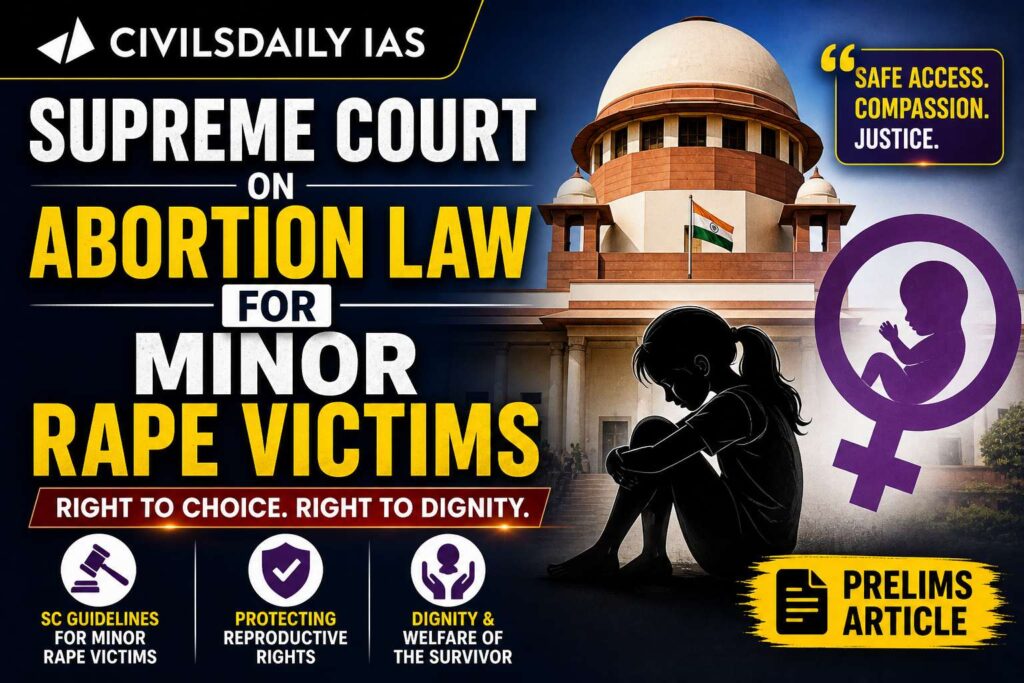
The Supreme Court of India has asked the Union government to consider removing the time limit on abortion in cases involving minor rape survivors, while hearing a case allowing termination of a 30 week pregnancy of a 15 year old survivor.
Background
Under the Medical Termination of Pregnancy Act, 1971 (amended in 2021):
Abortion allowed up to 24 weeks for special categories
Rape survivors
Minors
Women with disabilities
Key Observations of the Court
State or doctors cannot decide for the survivor
Decision should rest with:
Survivor
Parents or guardians
Emphasised reproductive autonomy and dignity
Forcing continuation of pregnancy may cause lifelong trauma
Court’s Suggestions
Amend law to:
Remove time limit for abortion in minor rape cases
Ensure speedy trial (within one week)
Provide compensation to victim (including property of accused)
Legal and Constitutional Aspects
Article 21
Right to life and personal liberty
Includes reproductive autonomy and bodily integrity
Reproductive Rights: Recognised as part of privacy and dignity
Key Issues Highlighted
Conflict between: Foetal rights vs rights of the survivor
Importance of informed consent
Role of doctors: Provide medical guidance, not impose decisions
Important Concepts
Medical Termination of Pregnancy (MTP): Legal framework governing abortion in India
Reproductive Autonomy: Right of a woman to make decisions about her body and pregnancy
[2019] Which Article of the Constitution of India safeguards one’s right to marry the person of one’s choice? (a) Article 19 (b) Article 21 (c) Article 25 (d) Article 29
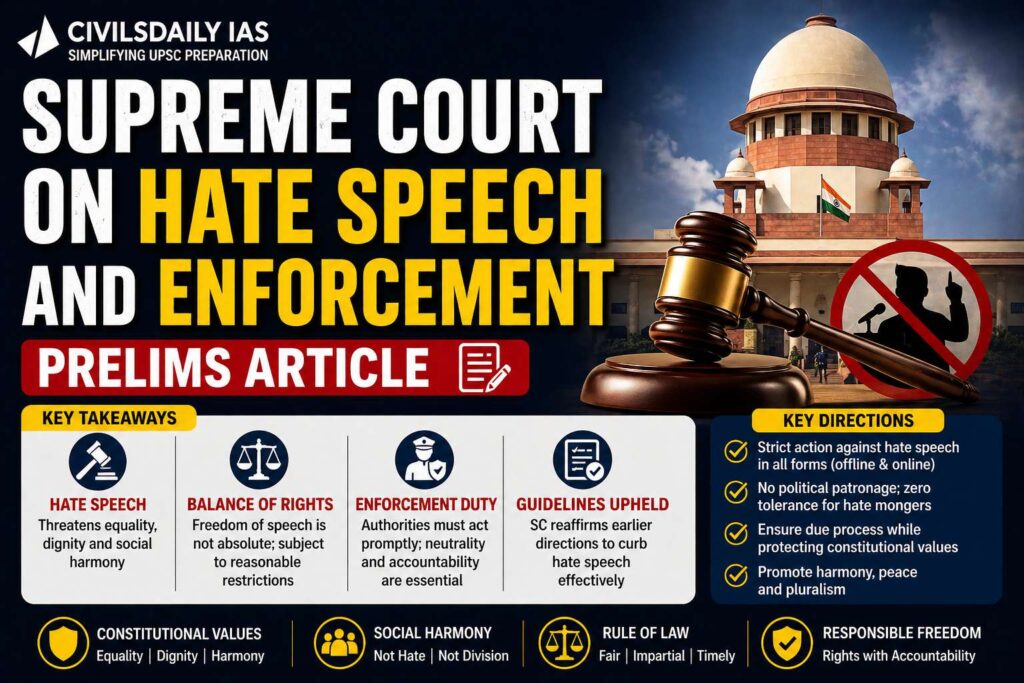
The Supreme Court recently held that hate speech comes from an “us vs them” mindset. It weakens fraternity and social harmony. The Court refused to ask for new laws. It stressed poor enforcement of existing laws as the real problem. This is important because public debate often demands stricter laws. The Court says laws already exist but are not applied well. Petitions showed hate speech continues despite past judgments. This points to a system failure, not a legal gap.
What is the constitutional and philosophical basis of the Court’s observation?
Fraternity as a constitutional value: Ensures social cohesion and unity in diversity as part of the Preamble.
Moral fabric of society: Strengthens dignity and mutual respect among citizens.
Antithesis of hate speech: Undermines inclusiveness by promoting exclusion and hostility.
Why did the Court refuse to mandate new laws on hate speech?
Judicial restraint: Preserves separation of powers by avoiding legislative functions.
Existing legal framework: Includes provisions under IPC/BNS addressing public order and incitement.
Institutional role clarity: Limits judiciary to interpretation and application of law.
Avoidance of overreach: Prevents creation of parallel regulatory regimes.
What are the existing hate speech laws in India?
Article 19(1)(a): Ensures freedom of speech.
Article 19(2): Allows restrictions for public order and morality.
Bharatiya Nyaya Sanhita (BNS):
Section on promoting enmity: Penalizes speech causing hatred between groups.
Public mischief provisions: Punish rumours leading to fear or violence
Representation of People Act, 1951:
Electoral hate speech: Bars appeals based on religion, caste, etc.
IT Rules and IT Act:
Online regulation: Targets fake news and harmful content.
What explains the persistence of hate speech despite legal provisions?
Enforcement deficit: Weak implementation by law enforcement agencies.
Administrative failure: Inconsistent application of laws across regions.
Delayed justice delivery: Reduces deterrence effect of existing laws.
Societal normalization: Continued tolerance of divisive narratives.
How does hate speech threaten constitutional order and public harmony?
Erosion of fraternity: Weakens unity in a diverse society.
Public order disruption: Leads to inter-group hostility and violence.
Institutional strain: Challenges governance and law enforcement credibility.
Democratic decline: Undermines inclusive participation and trust.
What role should institutions play in addressing hate speech?
Law enforcement agencies: Ensure consistent and unbiased application of laws.
Judiciary: Uphold constitutional values through interpretation.
Legislature: Maintain clarity and adequacy of legal provisions.
Civil society: Promote awareness and counter divisive narratives.
What broader societal transformation is required?
Mindset shift: Moves from identity-based exclusion to inclusive citizenship.
Ethical reinforcement: Promotes empathy and respect in public discourse.
Educational reforms: Integrates constitutional values into curricula.
Media responsibility: Reduces sensationalism and misinformation.
Conclusion
The Supreme Court reframes hate speech as a societal and enforcement issue rather than a legislative gap. Addressing it requires strengthening institutional accountability and nurturing constitutional values of fraternity and inclusiveness.
PYQ Relevance
[UPSC 2022] Right of movement and residence throughout the territory of India are freely available to the Indian citizens, but these rights are not absolute. Comment.
Linkage: This question reflects the idea that Fundamental Rights are subject to reasonable restrictions, similar to Article 19(2) limits on hate speech. The Supreme Court judgment reinforces that free speech is not absolute and must align with public order, dignity, and fraternity.
The Supreme Court of India, while hearing the Sabarimala review case, observed that courts cannot reform religion, even as debates continue on balancing religious freedom and constitutional rights.
Background of the Case
Concerns entry of women aged 10 to 50 years into the Sabarimala Temple
2018 judgment allowed entry, upholding right to worship
Review petitions challenge this verdict
Key Observations by the Court
Courts cannot initiate religious reform
Reform must come from within religion or society
Need to balance:
Religious practices
Constitutional values
Arguments Presented
For Reform (Indira Jaising’s View)
Religion must evolve to remain relevant
Equality (Article 14) and dignity (Article 21) cannot be subordinate to religion
Religious practices must align with constitutional morality
Concerns Raised by Judges
Reforms should not destroy core religious identity
Need to avoid excessive interference in doctrinal matters
Key Constitutional Provisions
Article 14: Right to equality before law
Article 21: Right to life and dignity
Article 25: Freedom of religion and worship
Important Legal Concepts
Essential Religious Practices Test
Determines which practices are essential to a religion
Only essential practices get constitutional protection
Constitutional Morality: Principles like equality, dignity, and justice guide interpretation of laws
[2019] Which Article of the Constitution of India safeguards one’s right to marry the person of one’s choice? (a) Article 19 (b) Article 21 (c) Article 25 (d) Article 29
The Supreme Court of India, in an April 2026 judgment, highlighted that hate speech and rumour mongering threaten the constitutional value of fraternity, but declined to direct enactment of new laws, emphasizing effective enforcement of existing legal provisions.
Key Observations of the Court
Hate speech arises from an “us versus them” mindset
It promotes exclusion and discrimination
Undermines fraternity and unity in a diverse society
Considered against constitutional morality and civilisational ethos
Linked to the idea of “Vasudhaiva Kutumbakam” (world is one family)
Constitutional Provisions Involved
Article 19(1)(a): Guarantees freedom of speech and expression
Article 19(2): Allows reasonable restrictions on grounds like:
Public order
Decency
Morality
Sovereignty and integrity
Fraternity (Preamble): Ensures unity and sense of brotherhood among citizens
Legal Position on Hate Speech
No single comprehensive law exclusively defining hate speech
Covered under various provisions:
Indian Penal Code sections related to
Promoting enmity
Public mischief
IT laws for online content
Court’s Stand
Court cannot legislate new laws
Responsibility lies with: Legislature and Executive
Focus should be on better implementation of existing laws
Key Concepts
Hate Speech: Speech that incites hatred, discrimination, or violence against groups
Fraternity: A constitutional value promoting unity, dignity, and brotherhood
[2017] The mind of the makers of the Constitution of India is reflected in which of the following? (a) The Preamble (b) The Fundamental Rights (c) The Directive Principles of State Policy (d) The Fundamental Duties
A judge of the Delhi High Court refused to recuse herself from hearing the Delhi excise policy case, officially titled Central Bureau of Investigation (CBI) v. Kuldeep Singh and Ors. involving prominent political figures. This is despite allegations of bias raised by the litigant. This marks a departure from established judicial conventions, where even a reasonable apprehension of bias often leads to recusal to preserve institutional trust. The episode is significant because it highlights a tension between the “duty to sit” and the need to ensure fairness, especially in politically sensitive litigation.
Note: The Central Bureau of Investigation (CBI) is the premier domestic crime-investigating agency of India. Operating under the jurisdiction of the Ministry of Personnel, Public Grievances and Pensions
What is judicial recusal in India?
In India, judicial recusal is the act of a judge stepping away from a case to prevent any real or perceived conflict of interest or bias.
It is rooted in the principles of Natural Justice, specifically the maxim Nemo judex in causa sua, no person should be a judge in their own cause.
How Recusal Works in India
Uncodified Practice: Unlike some other countries, India has no codified law or statute governing recusal. Instead, it is guided by judicial precedents, ethical norms, and the judge’s oath of office.
Voluntary Process: Recusal is generally a voluntary action taken by the judge based on their own conscience and discretion.
Request by Parties: While a litigant or lawyer can request a recusal, they cannot compel a judge to withdraw; the final decision rests solely with the judge concerned.
Reassignment: If a judge recuses, the case is referred to the Chief Justice (the “Master of the Roster”) to be assigned to a different bench.
What constitutes judicial recusal and why is it critical to justice delivery?
Judicial Impartiality: Ensures fairness in adjudication by eliminating bias; rooted in natural justice principle nemo judex in causa sua (no one should be judge in their own cause).
Public Confidence: Strengthens legitimacy of courts; justice must not only be done but also seen to be done (R v Sussex Justices, 1923).
Ethical Standards: Aligns with Bangalore Principles of Judicial Conduct emphasizing integrity, propriety, and independence.
Global Practice: Reflects best practices across jurisdictions, including rejection of Victorian-era “duty to sit” doctrine.
What were the grounds for seeking recusal in the present case?
Prior Adverse Findings: Judge had earlier ruled on related matters, raising concerns of predisposition.
Ideological Association: Attendance at events linked to a particular ideological group (ABAP).
Familial Professional Links: Judge’s children working as panel lawyers for the government.
Political Context: Statement by a Union Minister predicting case outcome heightened apprehension.
Reasonable Apprehension: Litigant argued that these factors cumulatively undermine impartial adjudication.
How has the Supreme Court defined the legal threshold for recusal?
Reasonable Apprehension Test: Establishes whether a fair-minded observer would suspect bias (P.K. Ghosh case, 1995).
Litigant’s Perception: Recognizes that perception of bias matters, not just actual bias (Ranjit Thakur case, 1987).
Appearance vs Reality: Accepts that even appearance of bias can vitiate proceedings (State of Punjab v Davinder Pal Singh Bhullar, 2011).
Judicial Discretion: Leaves decision to judge’s conscience; no statutory compulsion exists.
Rejection of Duty to Sit: Moves away from obligation to hear all cases (Indore Development Authority case, 2019).
Prevention of “Bench Hunting”: Courts often warn against frivolous recusal pleas used by litigants as a strategy for “forum shopping “, attempting to avoid a specific judge in hopes of getting a more favourable one.
Why is the present decision considered a deviation from established norms?
The episode underscores the need to reconcile judicial discretion with institutional accountability. Strengthening recusal norms through codification and procedural safeguards is essential to preserve judicial credibility and constitutional morality.
PYQ Relevance
[UPSC 2023] Constitutionally guaranteed judicial independence is a prerequisite of democracy. Comment.
Linkage: Judicial recusal directly operationalizes judicial independence by preventing bias and ensuring impartial adjudication. The Delhi High Court episode highlights how weak recusal standards can undermine public trust, thereby affecting the democratic legitimacy of the judiciary.
PYQ Relevance[UPSC 2020] Discuss the role of the Election Commission of India in the light of the evolution of the Model Code of Conduct. Linkage: The question examines the scope and limits of ECI’s powers in ensuring free and fair elections. The article highlights concerns of constitutional overreach by ECI in voter roll purges, directly questioning its mandate and procedural fairness.
Mentor’s Comment
The issue of electoral roll purges has emerged as a major constitutional concern following the Election Commission of India’s (ECI) Special Intensive Revision (SIR) in states like Assam, Kerala, Tamil Nadu, West Bengal, and Puducherry. What makes this significant is the scale and nature of voter deletion. There are reports of lakhs of genuine voters being removed, including 91 lakh in West Bengal and 64 lakh in Bihar, many categorized under the vague term “logical discrepancy.” This marks a sharp deviation from past practices where revisions were limited, transparent, and conducted well before elections.
Does the ECI have the constitutional authority to determine citizenship?
Article 324 Limitation: Empowers ECI to conduct elections, not determine citizenship; this power lies with the Union government.
Home Ministry Mandate: Citizenship laws are administered by the Union Home Ministry, which must notify valid documents.
Jurisdictional Overreach: ECI prescribing documents for citizenship proof exceeds its constitutional scope.
Judicial Gap: Supreme Court did not decisively address this separation of powers issue.
Why is the Special Intensive Revision (SIR) being criticised?
Procedural Deviation: Conducted in election-bound states, violating norms of pre-election summary revisions.
Intensive Nature: SIR requires fresh enumeration instead of updating existing rolls, making it disruptive.
Time Constraints: Conducted within months before elections, compromising thorough verification.
Past Practice Contrast: Earlier revisions were gradual and inclusive; SIR appears abrupt and exclusionary.
How does the documentation requirement affect voter inclusion?
Document Exclusion: Aadhaar, ration card, voter ID not accepted as proof of citizenship.
Mass Deletions: Example: 91 lakh voters removed in West Bengal due to inability to produce documents.
Administrative Burden: Citizens forced into repeated verification cycles.
Does the categorisation of “logical discrepancy” violate legal norms?
Undefined Term: No legal basis under Representation of the People Act or Registration of Electors Rules.
Arbitrary Classification: Allows subjective deletion without clear criteria.
Transparency Deficit: Lack of publicly defined parameters reduces accountability.
Impact on Rights: Leads to disenfranchisement without due process.
Are principles of natural justice being violated?
Denial of Hearing: Deletions reportedly carried out without prior notice or opportunity to respond.
Statutory Violation: Contravenes provisions ensuring verification and objections.
Electoral Fairness: Free and fair elections compromised when voters are excluded arbitrarily.
Judicial Concern: Courts expected to safeguard procedural fairness.
How does this impact democratic representation?
Mass Exclusion: Large-scale deletions distort electoral outcomes.
Voter Suppression Risk: Marginalized groups disproportionately affected.
Trust Deficit: Reduces confidence in electoral institutions.
Systemic Bias Potential: Selective deletion may influence political outcomes.
Conclusion
The electoral roll revision controversy highlights the tension between administrative efficiency and constitutional safeguards. Ensuring inclusion, transparency, and legal compliance remains essential to uphold democratic legitimacy.
In a significant expansion of fundamental rights, the Supreme Court of India ruled in August 2025 that access to safe, motorable, and well-maintained roads is an integral part of the Right to Life under Article 21 of the Constitution.
Key Legal Pronouncements
The Bench, comprising Justices J.B. Pardiwala and R. Mahadevan, linked the quality of infrastructure to constitutional guarantees:
Article 21 (Right to Life): The Court held that “life” is not merely physical existence but includes the right to live with dignity, which is hindered by poor and unsafe road conditions.
Article 19(1)(d): The right to move freely throughout the territory of India is a basic right. The Court noted that this right becomes “illusory” if the state fails to provide motorable roads.
State Responsibility: The judgment explicitly stated that it is the mandatory responsibility of the State to develop and maintain roads under its control.
Case Background
The ruling emerged from a dispute between Umri Pooph Pratappur (UPP) Tollways Private Limited and the Madhya Pradesh Road Development Corporation Limited (MPRDC).
The Project: A ‘Build, Operate, and Transfer’ (BOT) agreement for a 43.7-km road project in Madhya Pradesh worth ₹73.68 crore.
The Shift: While the case was a commercial dispute over a concession agreement, the Court used the platform to emphasize the public interest aspect of infrastructure.
[2019] Which Article of the Constitution of India safeguards one’s right to marry the person of one’s choice? (a) Article 19 (b) Article 21 (c) Article 25 (d) Article 29