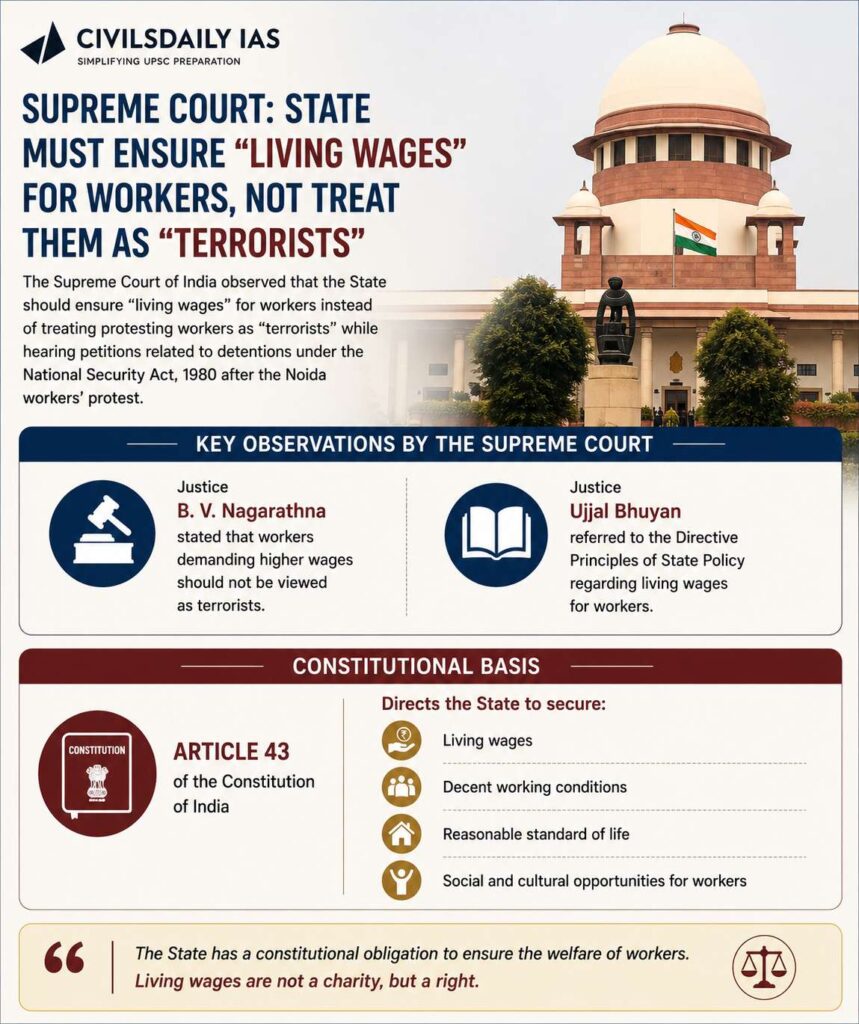
The Supreme Court of India observed that the State should ensure “living wages” for workers instead of treating protesting workers as “terrorists” while hearing petitions related to detentions under the National Security Act, 1980 after the Noida workers’ protest.
Key Observations by the Supreme Court
Justice B. V. Nagarathna stated that workers demanding higher wages should not be viewed as terrorists.
Justice Ujjal Bhuyan referred to the Directive Principles of State Policy regarding living wages for workers.
Constitutional Basis
Article 43 of the Constitution of India
Directs the State to secure:
Living wages
Decent working conditions
Reasonable standard of life
Social and cultural opportunities for workers
Issue Before the Court
Family members of detained protestors challenged arrests under the NSA.
Petitioners alleged:
Multiple FIRs based on the same conspiracy
No preliminary enquiry
Protestors labelled as “left-wing sympathisers”
Court Directions
The Supreme Court ordered production of two detainees from Kasna jail on May 18.
Restrained the Uttar Pradesh government from shifting them to police remand.
Allegations of custodial torture were also raised before the Court.
About the National Security Act (NSA), 1980
Preventive detention law allowing detention to maintain:
National security
Public order
Essential supplies and services
Allows detention without formal charges for a specified period.
[2017] Which principle among the following was added to the Directive Principles of State Policy by the 42nd Amendment to the Constitution? (a) Equal pay for equal work for both men and women (b) Participation of workers in the management of industries (c) Right to work, education and public assistance (d) Securing living wage and human conditions of work to workers
During the Sabarimala Temple Entry Dispute review hearing, the Union government argued before the Supreme Court that all religious practices are presumed constitutionally protected unless they violate: Public order, Morality, and Health
The Centre also questioned the judicially evolved doctrine of “Essential Religious Practices” (ERP).
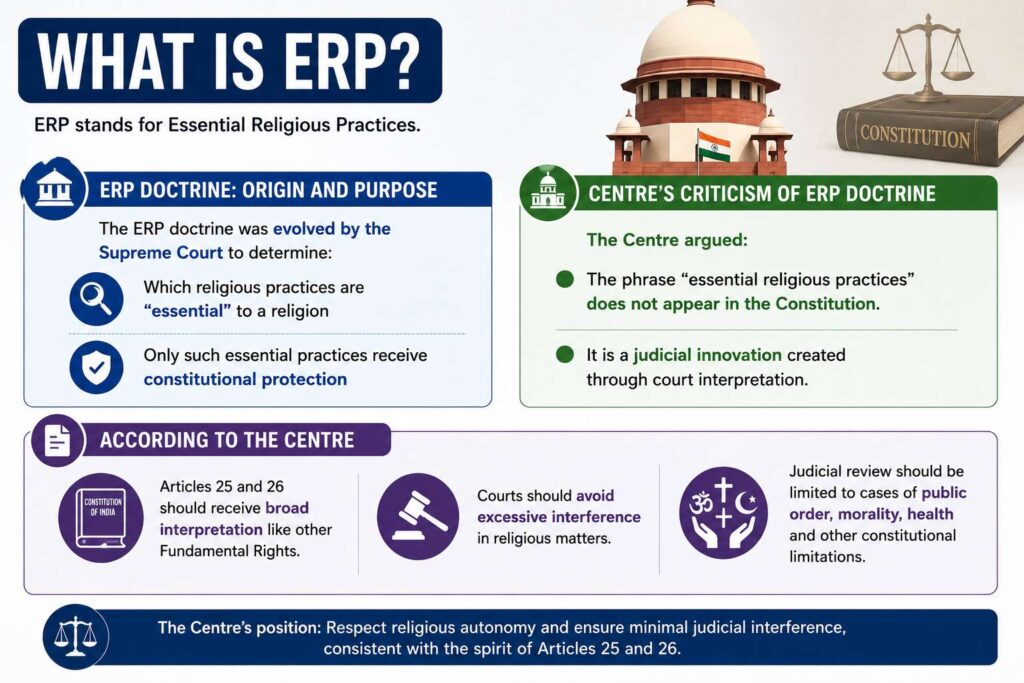
What is ERP?
The ERP doctrine was evolved by the Supreme Court to determine:
Which religious practices are “essential” to a religion
Only such essential practices receive constitutional protection
Centre’s Criticism of ERP Doctrine
The Centre argued:
The phrase “essential religious practices” does not appear in the Constitution.
It is a judicial innovation created through court interpretation.
According to the Centre:
Articles 25 and 26 should receive broad interpretation like other Fundamental Rights.
Courts should avoid excessive interference in religious matters.
Supreme Court’s Observations
Faith Beyond Rituals: Surya Kant observed:
One need not visit temples to be religious.
Even lighting a lamp in a hut can express faith.
Hinduism as a Way of Life: Justice B. V. Nagarathna remarked:
Hinduism is a “way of life”
It is not dependent solely on rituals or temple visits
Related Case Laws
Shirur Mutt Case
Origin of ERP doctrine
Court held religion includes essential practices
Indian Young Lawyers Association v. State of Kerala
Allowed women of all ages entry into Sabarimala Temple
[2020] Consider the following statements: 1. The Constitution of India defines its ‘basic structure’ in terms of federalism, secularism, fundamental rights and democracy. 2. The Constitution of India provides for ‘judicial review’ to safeguard the citizens’ liberties and to preserve the ideals on which the Constitution is based. Which of the statements given above is/are correct? a) 1 only b) 2 only c) Both 1 and 2 d) Neither 1 nor 2
Vijay won the confidence motion in the Tamil Nadu Legislative Assembly with 144 votes, ensuring the survival of the TVK-led coalition government.
Key Highlights of the Floor Test
Confidence Motion Passed
The motion moved by Chief Minister Vijay received: 144 votes in favour
Supporting Parties
Indian National Congress
Communist Party of India
Communist Party of India (Marxist)
Viduthalai Chiruthaigal Katchi
Indian Union Muslim League
25 rebel AIADMK MLAs
One AMMK MLA
Constitutional Significance of Floor Test
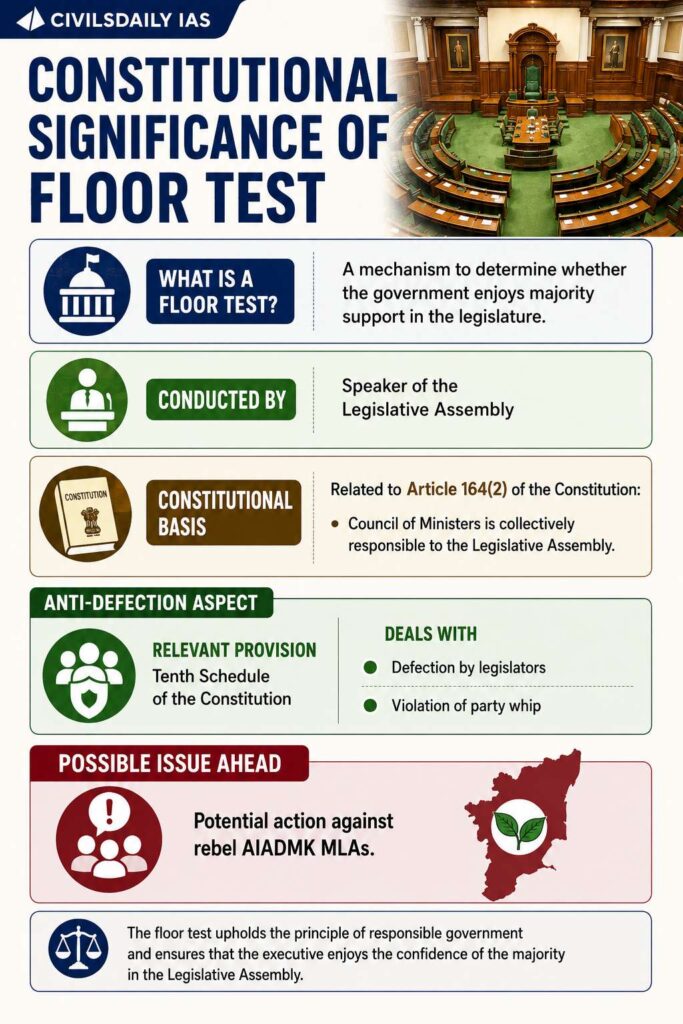
What is a Floor Test?: A mechanism to determine whether the government enjoys majority support in the legislature.
Conducted By: Speaker of the Legislative Assembly
Constitutional Basis: Related to Article 164(2) of the Constitution:
Council of Ministers is collectively responsible to the Legislative Assembly.
Anti-Defection Aspect
Relevant Provision: Tenth Schedule of the Constitution
Deals With
Defection by legislators
Violation of party whip
Possible Issue Ahead
Potential action against rebel AIADMK MLAs.
Note: In India, the office of the “whip” is not explicitly mentioned in the Constitution, the Rules of the House, or any parliamentary statute; rather, it is based on convention. However, the authority to issue whips and the consequences for defying them are legally upheld by the Tenth Schedule (Anti-Defection Law).
[2020] A Parliamentary System of Government is one in which a) All political parties in the Parliament are represented in the Government b) the Government is responsible to the Parliament and can be removed by it c) the Government is elected by the people and can be removed by them d) the Government is chosen by the Parliament but cannot be removed by it before completion of a fixed term
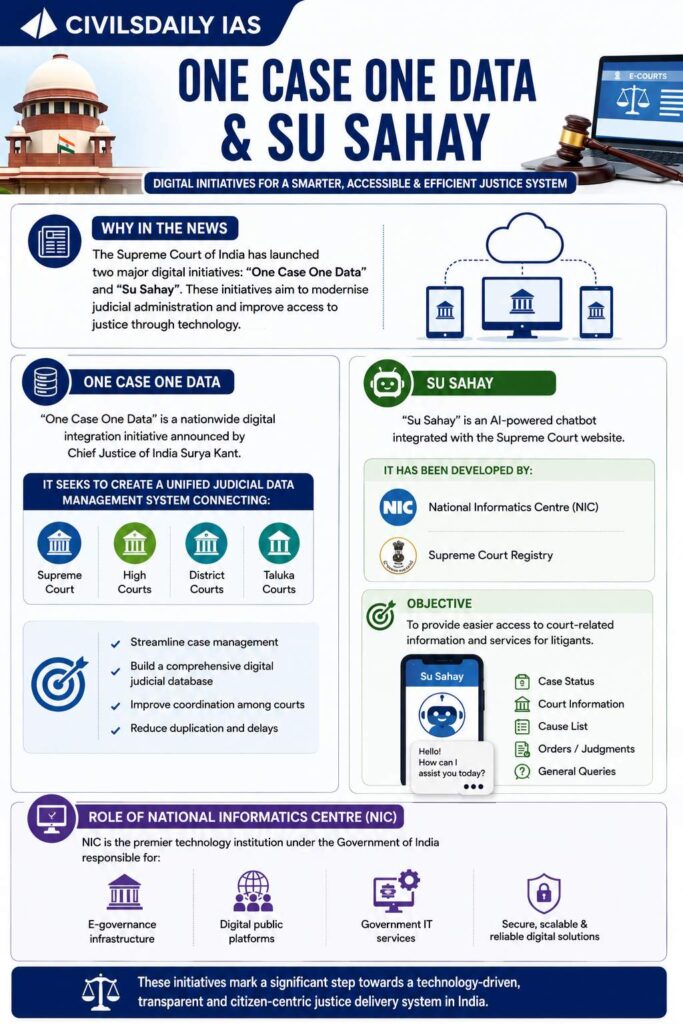
The Supreme Court of India has launched two major digital initiatives: “One Case One Data” and “Su Sahay”. These initiatives aim to modernise judicial administration and improve access to justice through technology.
One Case One Data
“One Case One Data” is a nationwide digital integration initiative announced by Chief Justice of India Surya Kant.
It seeks to create a unified judicial data management system connecting:
Supreme Court
High Courts
District Courts
Taluka Courts
Objective
Streamline case management
Build a comprehensive digital judicial database
Improve coordination among courts
Reduce duplication and delays
Su Sahay
“Su Sahay” is an AI-powered chatbot integrated with the Supreme Court website.
It has been developed by:
National Informatics Centre (NIC)
Supreme Court Registry
Objective: To provide easier access to court-related information and services for litigants.
Role of National Informatics Centre (NIC)
NIC is the premier technology institution under the Government of India responsible for:
E-governance infrastructure
Digital public platforms
Government IT services
[2022] Consider the following: 1. Aarogya Setu 2. CoWIN 3. DigiLocker 4. DIKSHA Which of the above are built on top of open-source digital platforms? (a) 1 and 2 only (b) 2, 3 and 4 only (c) 1, 3 and 4 only (d) 1, 2, 3 and 4
The debate over electoral roll transparency grew after SIR 2.0 during the West Bengal Assembly elections highlighted problems in voter verification and deletion. Even after ECINet became fully operational in January 2026, concerns arose over lack of transparency, inconsistent procedures, and a large number of disputes, including nearly 34 lakh appeals and around 7 lakh voter deletion appeals. This contrasts with the Election Commission’s claim of “error-free” electoral rolls and raises concerns about fairness, wrongful voter exclusion, and the possible role of AI in improving electoral monitoring.
What is ECINet?
ECINET is the Election Commission of India’s unified digital platform launched in early 2026 to streamline electoral services for over 100 crore voters. It acts as a “single-point” interface, integrating over 40 existing mobile and web applications into one seamless experience. Launched at the India International Conference on Democracy and Election Management (IICDEM) 2026, the platform is designed to enhance transparency, credibility, and public trust in the electoral process. It follows strict cybersecurity protocols and is compliant with the Representation of the People Acts.
Key Features of ECINET
Unified Services: It subsumes previous standalone apps like the Voter Helpline, cVIGIL (for code of conduct complaints), and Saksham (for PwD voters).
Multilingual Support: The platform is available in 22 scheduled Indian languages plus English.
User Benefits: Electors can use it for voter registration, downloading digital IDs (e-EPIC), searching electoral rolls, and tracking application statuses.
Official Tools: It provides dedicated, secure access for over 11 lakh Booth Level Officers (BLOs) and 45 lakh polling officials to manage data and monitor ground-level functions in real-time.
Why did SIR 2.0 expose structural weaknesses in electoral roll management?
Procedural Volatility: Frequent changes in Standard Operating Procedures (SOPs) reportedly excluded millions of genuine voters from electoral rolls and triggered disputes over voter eligibility.
ASDD Criteria: Inclusion of Absent, Shifted, Duplicate, Dead (ASDD) filters intended to improve electoral accuracy reportedly resulted in exclusion of legitimate voters.
Burden of Proof Shift: Responsibility shifted from correcting database defects to voters repeatedly proving eligibility despite long voting histories.
Data Inaccuracies: Legacy SIR 2002-04 databases reportedly contained inaccurate, incomplete, and non-searchable records, creating inconsistencies.
Logical Discrepancies: Variations in logical discrepancy criteria across regions produced non-uniform outcomes for similarly placed voters.
Family Data Errors: Minor mismatches in names, age, or family details reportedly triggered exclusions.
How did selective transparency raise concerns over institutional neutrality?
Incomplete Disclosure: The Election Commission reportedly did not disclose the status of approximately 34 lakh appeals, including 7 lakh deletion appeals, pending before tribunals.
Selective Reporting: One tribunal reportedly disposed of 1,777 appeals, allowing 1,717 citizen appeals while rejecting 60 EC appeals, whereas comparable reports from other tribunals remained unavailable.
Uneven Transparency: Inclusion of only 1,607 voters before polling despite relevant ECINet data availability raised concerns over selective information disclosure.
Constitutional Accountability: Limited public reporting weakened institutional transparency expected from a constitutional authority.
Public Trust Deficit: Perceptions of opacity strengthened concerns regarding neutrality and procedural fairness.
What evidence suggests large-scale disenfranchisement risks?
Pending Appeals: Nearly 34 lakh pending appeals reportedly remained unresolved during the revision process.
Deletion Cases: Around 7 lakh deletion appeals indicated large-scale contestation over voter exclusion.
High Appeal Success Rate: Inclusion appeals reportedly recorded a success rate exceeding 99%, suggesting possible procedural overreach in deletions.
Electoral Consequences: Several excluded individuals reportedly later secured electoral victories, including an elected MLA, raising concerns over accuracy.
Constituency-Level Impact: Around 49 Assembly constituencies reportedly recorded higher vote margins than disputed voter exclusion numbers, raising concerns regarding electoral legitimacy.
How can AI-enabled oversight improve electoral roll governance?
Continuous Monitoring: Integration with ECINet enables real-time oversight of electoral roll revision processes.
Anomaly Detection: AI systems can identify unusual spikes in voter deletions, repeated rejection trends, and geographic inconsistencies.
Pattern Recognition: Monitoring of voter-official interactions facilitates identification of procedural bias or discriminatory practices.
Neutrality Indicators: Real-time dashboards generate metrics related to consistency, efficiency, neutrality, and citizen satisfaction.
Audit Trails: Digital tracking ensures transparency in every procedural decision and voter transaction.
Predictive Alerts: Early-warning systems flag irregularities before escalation into large-scale disenfranchisement.
What specific anomalies can an AI watchdog identify?
Deletion Surges: Detects abnormal spikes in voter deletions across constituencies.
Official-Level Bias: Flags repeated rejection trends linked to specific officials.
Regional Variations: Identifies inconsistencies in SOP implementation across districts and States.
Family Data Mismatches: Recognizes exclusion patterns emerging from minor spelling or demographic discrepancies.
Community-Level Disparities: Detects concentrated deletions affecting specific regions, castes, or communities.
Grievance Delays: Tracks unresolved complaints and procedural bottlenecks.
Communication Gaps: Monitors delays in notifications, circulars, and institutional instructions.
Can AI strengthen institutional neutrality without replacing constitutional authority?
Decision Support: AI functions as an oversight layer rather than a replacement for Election Commission authority.
Transparency Enhancement: Public auditability improves democratic legitimacy.
Administrative Efficiency: Automated analysis reduces grievance pendency and verification delays.
What are the limitations and risks of AI in electoral governance?
Algorithmic Bias: Poorly designed systems may reproduce existing administrative prejudices.
Privacy Concerns: Large-scale voter databases raise risks regarding data misuse.
Opacity Risks: Non-transparent algorithms may weaken public confidence.
Cybersecurity Threats: Electoral databases remain vulnerable to cyberattacks.
Institutional Resistance: Administrative dependence on legacy systems may delay adoption.
Conclusion
Electoral credibility depends not merely on voting but on accurate voter inclusion. SIR 2.0 exposed concerns regarding transparency, consistency, and accountability in electoral roll management. An AI-enabled oversight mechanism integrated with ECINet can strengthen neutrality, improve procedural consistency, and reduce disenfranchisement risks. However, algorithmic transparency, legal safeguards, and constitutional oversight remain essential to preserve democratic legitimacy.
PYQ Relevance
[UPSC 2022] Discuss the role of the Election Commission of India in the light of the evolution of the Model Code of Conduct
Linkage: This article directly relates to the Election Commission’s role in ensuring free, fair, and transparent elections, especially through accurate electoral rolls. It expands the debate by examining AI-based oversight, electoral neutrality, transparency, and accountability in voter verification and deletion processes.
The Supreme Court, while hearing challenges to the Chief Election Commissioner and Other Election Commissioners (Appointment, Conditions of Service and Term of Office) Act, 2023, revived debate on the independence of the Election Commission. The controversy emerged after the 2023 law overturned the Supreme Court’s Anoop Baranwal v. Union of India (2023) framework by removing the Chief Justice of India from the selection committee and replacing the position with a Union Cabinet Minister. The core issue concerns whether an executive-dominated appointment process affects the constitutional independence of the Election Commission and the principle of free and fair elections.
Timeline: Evolution of the CEC Appointment Controversy
1950: The Constitution of India comes into force. Article 324(2) empowers Parliament to enact a law governing the appointment of the Chief Election Commissioner (CEC) and Election Commissioners (ECs).
1950-1991: No parliamentary law regulates appointments to the Election Commission of India (ECI). Appointments remain under executive discretion.
1991: Parliament enacts the Election Commission (Conditions of Service of Election Commissioners and Transaction of Business) Act, 1991.
Regulates salary, tenure, and service conditions of Election Commissioners.
Does not provide a framework for appointments.
2022: Petitioners file the Anoop Baranwal v. Union of India case before the Supreme Court, challenging executive dominance in appointments to the ECI.
March 2023: Supreme Court delivers judgment in Anoop Baranwal v. Union of India (2023). Creates an interim appointment mechanism comprising:
Prime Minister
Leader of Opposition in Lok Sabha
Chief Justice of India (CJI)
March 2023: Supreme Court states that the interim mechanism will continue until Parliament enacts a law under Article 324(2).
December 2023: Parliament passes the Chief Election Commissioner and Other Election Commissioners (Appointment, Conditions of Service and Term of Office) Act, 2023. Key Change under 2023 Act:
Replaces the Chief Justice of India in the selection committee with a Union Cabinet Minister nominated by the Prime Minister.
Creates a 2:1 executive majority in the committee.
2024: Multiple petitions challenge the constitutional validity of the Chief Election Commissioner and Other Election Commissioners (Appointment, Conditions of Service and Term of Office) Act, 2023 before the Supreme Court.
2025: Supreme Court begins detailed hearings on whether the 2023 law undermines the independence of the Election Commission and the principle of free and fair elections under the Constitution.
How Were Election Commissioners Appointed Before 2023?
Constitutional Vacuum: Article 324(2) permitted Parliament to regulate appointments through legislation, but no law was enacted for decades.
Executive Dominance: Appointments remained under executive control through recommendations routed by the Union Law Ministry to the Prime Minister and President.
Bureaucratic Preference: Election Commissioners were largely selected from senior civil servants, with the senior-most Election Commissioner usually elevated as CEC.
1991 Act Limitation: The Election Commission (Conditions of Service of Election Commissioners and Transaction of Business) Act, 1991 regulated salaries, tenure, and service conditions but did not govern appointments.
Institutional Concern: Petitioners in Anoop Baranwal v. Union of India argued that executive-led appointments compromised institutional neutrality and electoral fairness.
Why Did the Supreme Court Intervene in the Anoop Baranwal Case?
Institutional Independence: The Court emphasized that free and fair elections require an independent Election Commission insulated from political interference.
Legislative Inaction: The Court criticized Parliament’s prolonged failure to enact a law despite explicit constitutional mandate under Article 324(2).
Constitutional Morality: The judgment reinforced democratic accountability and separation of powers.
Interim Appointment Mechanism: The Court directed that appointments would be made by a committee comprising:
Prime Minister
Leader of Opposition in Lok Sabha
Chief Justice of India
Judicial Safeguard: Inclusion of the CJI ensured neutrality and reduced risks of partisan appointments.
Institutional Strengthening: The Court made a “fervent appeal” for strengthening the Election Commission institutionally and financially.
What Changes Did the 2023 Law Introduce?
Selection Committee Revision: The 2023 law replaced the CJI with a Union Cabinet Minister nominated by the Prime Minister.
Executive Majority: The selection committee now consists of:
Prime Minister
Union Cabinet Minister nominated by PM
Leader of Opposition
Numerical Dominance: The executive effectively controls two out of three seats in the committee.
Legal Protection Clause: The Act states that appointments cannot be invalidated merely due to vacancy or defects in the committee’s composition.
Legislative Override: Parliament effectively replaced the Supreme Court’s interim mechanism with a statutory framework favoring executive primacy.
Why Is the 2023 Law Facing Constitutional Challenge?
Electoral Neutrality Concern: Petitioners argue that executive dominance undermines the independence of the Election Commission.
Basic Structure Question: Challenges invoke principles of free and fair elections, judicial independence, and democracy as part of the Constitution’s basic structure.
Conflict with Judicial Spirit: Critics contend that the law dilutes safeguards established in the Anoop Baranwal judgment.
Separation of Powers Issue: Removal of the CJI is viewed as reducing institutional checks on executive discretion.
Democratic Credibility: Concerns persist regarding public trust in electoral administration.
How Does This Debate Affect India’s Democratic Framework?
Electoral Legitimacy: Independent election management ensures acceptance of electoral outcomes.
Constitutional Governance: The issue tests the balance between Parliament’s legislative authority and constitutional safeguards.
Institutional Trust: Public confidence in the Election Commission affects democratic participation.
Global Democratic Image: India’s standing as the world’s largest democracy depends significantly on perceived electoral integrity.
Precedent for Other Institutions: The case may influence future debates on appointments to constitutional bodies such as:
CBI
Lokpal
Information Commissions
What Are the Key Constitutional and Legal Provisions Involved?
Article 324: Vests superintendence, direction, and control of elections in the Election Commission.
Article 324(2): Allows Parliament to enact a law regulating appointment of Election Commissioners.
Basic Structure Doctrine: Protects democracy, rule of law, judicial review, and free and fair elections.
1991 Act: Governs salaries and conditions of service but originally excluded appointment procedures.
2023 Act: Introduces statutory framework for appointments and committee structure.
Conclusion
The controversy surrounding the Chief Election Commissioner and Other Election Commissioners (Appointment, Conditions of Service and Term of Office) Act, 2023 highlights the larger constitutional challenge of balancing executive authority with institutional independence. Since free and fair elections form part of the Constitution’s basic structure, the credibility of the Election Commission remains central to democratic legitimacy. The Supreme Court’s decision in the ongoing challenge will shape the future of electoral reforms, constitutional governance, and public trust in democratic institutions.
PYQ Relevance
[UPSC 2022] Discuss the role of the Election Commission of India in the light of the evolution of the Model Code of Conduct.
Linkage: The PYQ is directly linked to the independence, neutrality, and constitutional status of the Election Commission of India (ECI). The 2023 CEC Appointment Act and Anoop Baranwal v. Union of India debate examine whether executive-controlled appointments can affect free and fair elections and ECI credibility.
The Supreme Court, in May 2025, ruled that medical negligence proceedings can continue even after the death of the accused doctor if the claim relates to financial loss recoverable from the doctor’s estate. The judgment creates a distinction between personal claims such as pain, suffering, or reputational damage, which extinguish upon death, and pecuniary claims, which survive against legal heirs to the extent of inherited property. The ruling is significant because it modifies the traditional common law principle “actio personalis moritur cum persona” and strengthens consumer rights in healthcare disputes.
What constitutional and legal principles govern medical negligence liability in India?
Article 21: The Supreme Court of India interprets the right to life as including the right to health. This mandates that both public and private healthcare providers maintain standards that ensure accessible and accountable care.
Consumer Protection Framework: Treats healthcare as a “service” under consumer law, enabling compensation claims.
Legal Principles & Tests
The Bolam Test: This is the primary standard used by Indian courts. A doctor is not negligent if they acted in accordance with a practice accepted as proper by a responsible body of medical professionals, even if a different body of opinion exists.
Jacob Mathew Guidelines: To prevent the harassment of doctors, criminal prosecution for negligence requires a high degree of “gross” negligence. Police cannot arrest a doctor without an independent opinion from a competent medical board.
Res Ipsa Loquitur: Meaning “the thing speaks for itself,” this principle is used when the negligence is so obvious (e.g., leaving a surgical tool inside a patient) that the burden of proof shifts to the doctor to prove they were not negligent.
Tort Liability: Recognizes compensation for breach of duty causing injury or loss.
How did the Supreme Court interpret survivability of medical negligence claims?
Pecuniary Liability: Allows continuation of claims involving financial loss against the deceased doctor’s estate.
Personal Claims: Extinguishes claims involving pain, suffering, defamation, or reputational injury upon death.
Estate Accountability: Restricts liability only to the value of property inherited by legal heirs.
Substantive Justice: Prevents procedural termination of compensation claims merely due to death of the accused.
Consumer Protection Continuity: Ensures pending medical negligence complaints remain maintainable under law.
Why did the Court revisit the common law doctrine “actio personalis moritur cum persona”?
Traditional Principle: Held that personal legal actions die with the person.
Indian Modification: Indian statutes progressively restricted the absolute application of the doctrine.
Legal Representatives Suits Act, 1855: Permitted suits involving monetary losses against estates of deceased persons.
Indian Succession Act, 1925: Section 306 preserved rights to prosecute or defend actions except in strictly personal injuries.
Judicial Modernisation: Adapted colonial common law principles to contemporary consumer rights jurisprudence.
What statutory provisions formed the basis of the judgment?
Legal Representatives Suits Act, 1855
Monetary Claims: Permits legal proceedings against legal representatives for financial loss caused by the deceased.
Estate Limitation: Restricts recovery to inherited estate and not personal assets of heirs.
Section 306 of Indian Succession Act, 1925
Survival of Actions: Preserves rights to prosecute or defend legal proceedings after death.
Exceptions Clause: Excludes defamation, assault, and purely personal injuries not causing death.
Order XXII of Code of Civil Procedure (CPC)
Substitution Mechanism: Enables replacement of deceased parties with legal representatives.
Procedural Continuity: Prevents automatic abatement where right to sue survives.
Consumer Protection Act
Section 13(7): Applies CPC provisions regarding death of parties to consumer disputes.
Consumer Rights Protection: Facilitates continuation of compensation claims in healthcare disputes.
How does the judgment strengthen consumer rights in healthcare?
Compensation Continuity: Ensures victims are not denied remedy due to death of the doctor.
Institutional Accountability: Reinforces trust in civil compensation mechanisms.
Access to Justice: Prevents procedural loopholes from defeating substantive claims.
Victim-Centric Jurisprudence: Prioritizes restitution for financial injury suffered by patients.
Legal Certainty: Clarifies ambiguity regarding maintainability of pending negligence claims.
What concerns emerge from the judgment?
Liability Uncertainty: Creates ambiguity where legal heirs inherit no estate.
Enforcement Challenges: Complicates determination of extent of inherited assets.
Defensive Medicine: May increase risk-averse medical practices in critical care.
Litigation Expansion: Could increase long-pending compensation disputes against estates.
Professional Anxiety: Raises concerns regarding prolonged legal exposure for medical practitioners and families.
How does the judgment affect the healthcare ecosystem?
Medical Governance: Strengthens accountability standards in healthcare delivery.
Insurance Relevance: Increases importance of professional indemnity insurance for doctors.
Hospital Liability: Encourages institutional compliance and risk-management systems.
Patient Awareness: Expands understanding of legal remedies available in medical negligence.
Judicial Oversight: Enhances role of courts in balancing professional autonomy with patient rights.
Conclusion
The judgment strengthens patient rights and accountability in healthcare by allowing pecuniary medical negligence claims to continue against a deceased doctor’s estate. It reflects the expanding scope of Article 21, consumer protection, and substantive justice in India’s healthcare governance framework.
PYQ Relevance
[UPSC 2024] In a crucial domain like the public healthcare system, the Indian State should play a vital role to contain the adverse impact of marketisation of the system. Suggest some measures through which the State can enhance the reach of public healthcare at the grassroots level.
Linkage: The PYQ focuses on State accountability in ensuring accessible and ethical healthcare amid rising commercialization of the sector. The present judgment strengthens patient rights, consumer protection, and medical accountability, linking healthcare governance with Article 21 and professional ethics.
The debate on the tenure and removal of a Chief Minister has re-entered public discourse after West Bengal Chief Minister Mamata Banerjee questioned the fairness of electoral processes following the BJP’s victory in the state. The controversy has revived critical constitutional questions: Can a Governor remove a Chief Minister?What does “pleasure of the Governor” actually mean?Is resignation mandatory after electoral defeat? The issue is significant because it directly concerns the balance between constitutional morality, democratic legitimacy, gubernatorial discretion, judicial review, and federalism.
What Does “Pleasure of the Governor” Actually Mean Under Article 164?
Article 164: Provides that the Chief Minister is appointed by the Governor and holds office during the Governor’s pleasure.
Parliamentary System: Limits gubernatorial discretion because the Council of Ministers remains collectively responsible to the Legislative Assembly.
Constitutional Convention: Ensures that the Governor acts on the aid and advice of the Council of Ministers in ordinary circumstances.
Dr. B.R. Ambedkar’s Clarification: Stated in the Constituent Assembly that “pleasure” cannot be interpreted arbitrarily and survives only as long as the ministry enjoys Assembly confidence.
Constitutional Morality: Prevents misuse of gubernatorial authority for partisan political intervention.
Shamsher Singh v. State of Punjab (1974): Established that the Governor is only a constitutional head and ordinarily acts on ministerial advice.
Nabam Rebia v. Deputy Speaker (2016): Restricted discretionary powers of Governors in legislative matters.
Can a Governor Remove a Chief Minister Arbitrarily?
Legislative Majority: Determines the continuance of the Chief Minister, not the subjective satisfaction of the Governor.
Judicial Interpretation: Restricts arbitrary dismissal powers and strengthens parliamentary accountability.
Floor Test Principle: Requires objective verification of majority support on the Assembly floor.
S.R. Bommai Case (1994): Established that the majority must be tested in the House and not determined by the Governor’s personal assessment.
Constitutional Safeguard: Prevents politically motivated dismissal of elected governments.
Exceptional Situations: Permit Governor intervention only when no party demonstrates majority support or constitutional machinery collapses.
Why Is the Floor Test Considered the Ultimate Constitutional Test?
Democratic Legitimacy: Ensures that elected representatives determine the survival of the government.
Collective Responsibility: Requires the Council of Ministers to retain Assembly confidence under Article 164(2).
Judicial Preference: Recognizes floor tests as the most transparent mechanism for resolving majority disputes.
Political Stability: Prevents horse-trading and speculative claims regarding majority support.
Recent Examples: Floor tests were ordered in states such as Maharashtra, Karnataka, Madhya Pradesh, and Uttarakhand during political crises.
Failure to Prove Majority: Compels resignation of the Chief Minister or dismissal of the ministry.
Does a Chief Minister Automatically Cease to Hold Office After Electoral Defeat?
A Chief Minister does not automatically cease to hold office the instant electoral results are declared. While the loss of majority makes resignation the standard constitutional convention, the incumbent typically transitions into a caretaker capacity until new arrangements are made, ensuring administrative continuity.
Article 172: The Legislative Assembly normally continues for five years from the date of its first sitting, after which it stands dissolved by efflux of time.
Majority Principle: A Chief Minister can continue only so long as they enjoy the confidence of the Legislative Assembly under Article 164(2).
No Immediate Termination: The Chief Minister does not automatically cease to hold office on the day election results are declared or when the Assembly’s tenure expires.
Caretaker Convention: The outgoing ministry continues in a caretaker capacity to ensure continuity of governance until a new government is formed.
Loss of Mandate: Electoral defeat or loss of majority creates a constitutional expectation of resignation, though office does not terminate instantly.
Governor’s Constitutional Role: If doubt exists regarding majority support, the Governor may require the Chief Minister to prove majority through a floor test.
Dismissal of Ministry: The Governor may dismiss the Council of Ministers only when the Chief Minister refuses to resign despite clearly losing majority support and failing a floor test.
Can Election Results and Electoral Processes Be Challenged in Court?
Election results and electoral processes in India can be challenged in court, but strictly through a specific legal mechanism called an Election Petition.
Representation of the People Act, 1951, Election Petition Mechanism: Under Article 329(b) of the Constitution and the Representation of the People Act (RPA), 1951, an election can only be questioned by an election petition.
Who can file: Any candidate who contested the election or any elector (voter) from that specific constituency.
Where to file: The petition must be filed in the High Court of the state where the constituency is located. For Presidential or Vice-Presidential elections, petitions are filed directly in the Supreme Court.
Timeline: The petition must be submitted within a strict window of 45 days from the date of the result declaration.
Article 329(b) of the Indian Constitution:It bars courts from interfering with electoral matters. It states that no election to Parliament or State Legislature can be challenged except through an election petition presented to the authorized body. It restricts judicial intervention during the election process, ensuring disputes are handled post-election.
Grounds for Challenging Results: An election can be declared void by the High Court under Section 100 of the RPA, 1951, on several grounds, including:
Corrupt Practices: Evidence of bribery, undue influence, or appealing to voters on the basis of religion, race, caste, or language.
Nomination Issues: Improper acceptance or rejection of any nomination papers.
Disqualification: The elected candidate was not qualified or was disqualified to take the seat on the date of the election.
Procedural Non-compliance: Any non-compliance with the provisions of the Constitution or the RPA that materially affects the result
Role of Judicial Review and Writ Jurisdiction: While Article 329(b) bars interference during the election process, courts maintain limited oversight through other avenues:
Writ Petitions (Article 226/32): Courts may intervene via writ jurisdiction for broader integrity issues, such as arbitrary deletion of names from electoral rolls or administrative actions that disturb a “level playing field,” provided they do not stop the election process itself.
Appeals: A High Court decision on an election petition can be appealed to the Supreme Court within 30 days
What Happens if No Party Can Form a Stable Government?
When no single party or pre-poll alliance secures a clear majority in a state election, the situation is known as a Hung Assembly. In such a scenario, the constitutional process follows several steps to explore options for government formation before resorting to fresh elections.
The Governor’s Discretionary Role: The Governor acts as the “executive head” and must find a leader who can command the confidence of the Legislative Assembly. According to guidelines from Indian constitutional practice and the Sarkaria Commission, the Governor typically follows this order of preference:
Pre-poll Alliance: The combination of parties that contested the election together.
Single Largest Party: The party with the most seats, even if it lacks a majority on its own.
Post-poll Coalition: A new alliance formed by parties after results are declared to reach the required numbers.
Proving a Majority (Floor Test): The invited leader is appointed as Chief Minister and is usually given a specific timeframe (often around 10 days) to prove their majority through a Floor Test. If they fail to win this vote of confidence, the Governor may invite the next most viable claimant.
President’s Rule (Article 356): If the Governor is satisfied that no party or coalition can form a stable government, they report a “failure of constitutional machinery” to the President. Under Article 356 of the Constitution, the President’s Rule is imposed:
The State Government is suspended, and the Governor administers the state on behalf of the President.
The Legislative Assembly is either suspended (kept in “animated suspension”) or dissolved.
Fresh Elections: If the political deadlock cannot be resolved during the period of President’s Rule, the Governor, under Article 174(2)(b), dissolves the Assembly and calls for fresh elections. This allows the electorate to provide a new mandate.
Conclusion
The continuance of a Chief Minister depends fundamentally on majority support in the Legislative Assembly and not on the personal discretion of the Governor. Judicial interpretation, constitutional conventions, and parliamentary norms collectively ensure that democratic legitimacy prevails over arbitrary authority. The debate surrounding gubernatorial powers highlights the continuing need for constitutional morality, political neutrality, and institutional accountability within India’s federal parliamentary system.
PYQ Relevance
[UPSC 2022] Discuss the procedures to decide the disputes arising out of the election of a Member of the Parliament or State Legislature under The Representation of the People Act, 1951. What are the grounds on which the election of any returned candidate may be declared void? What remedy is available to the aggrieved party against the decision? Refer to the case laws.
Linkage: The PYQ is directly linked to election petitions, Article 329(b), jurisdiction of High Courts, and judicial review of electoral disputes under the Representation of the People Act, 1951. It helps in understanding constitutional limits on court intervention during elections, electoral integrity, and landmark election case laws.
The Supreme Court of India, during hearings linked to the Sabarimala Temple review case, questioned the maintainability of PILs challenging the practice of excommunication in the Dawoodi Bohra community.
Background of the Case
Challenge relates to the power of Dawoodi Bohra religious leaders to: Excommunicate members from the community
Based on the 1962 judgment in: Sardar Syedna Taher Saifuddin vs State of Bombay
The practice of excommunication in the Dawoodi Bohra community is a long-standing and controversial religious authority exercised by its head, the Dai-ul-Mutlaq.
It involves the formal expulsion of a member, resulting in a “civil death” where the individual is barred from communal assets like mosques and burial grounds.
1962 Supreme Court Judgment
Upheld excommunication as a protected religious practice under Article 26(b)
Article 26(b) grants religious denominations the right to manage their own religious affairs.
Maharashtra Social Boycott Law (2016)
Maharashtra Protection of People from Social Boycott (Prevention, Prohibition and Redressal) Act, 2016
Prohibits various forms of:
Social boycott
Ostracisation
Makes excommunication punishable
Key Constitutional Questions
Religious Rights vs Individual Rights
Whether denominational rights under Article 26 can override: Human dignity and Individual freedoms
Maintainability of PILs
Can a Constitution Bench judgment be challenged through: PILs under Article 32?
Important Constitutional Provisions
Article 32Article\ 32Article 32
Right to constitutional remedies
Allows citizens to approach Supreme Court for enforcement of Fundamental Rights
Article 26Article\ 26Article 26
Freedom to manage religious affairs by denominations
[2021] We adopted parliamentary democracy based on the British model, but how does our model differ from that model? 1. As regards legislation, the British Parliament is supreme or sovereign but in India, the power of the Parliament to legislate is limited. 2. In India, matters related to the Amendment of an Act of the Parliament are referred to the Constitution Bench by the Supreme Court. Select the correct answer using the code given below. [A] 1 only [B] 2 only [C] Both 1 and 2 [D] Neither 1 nor 2
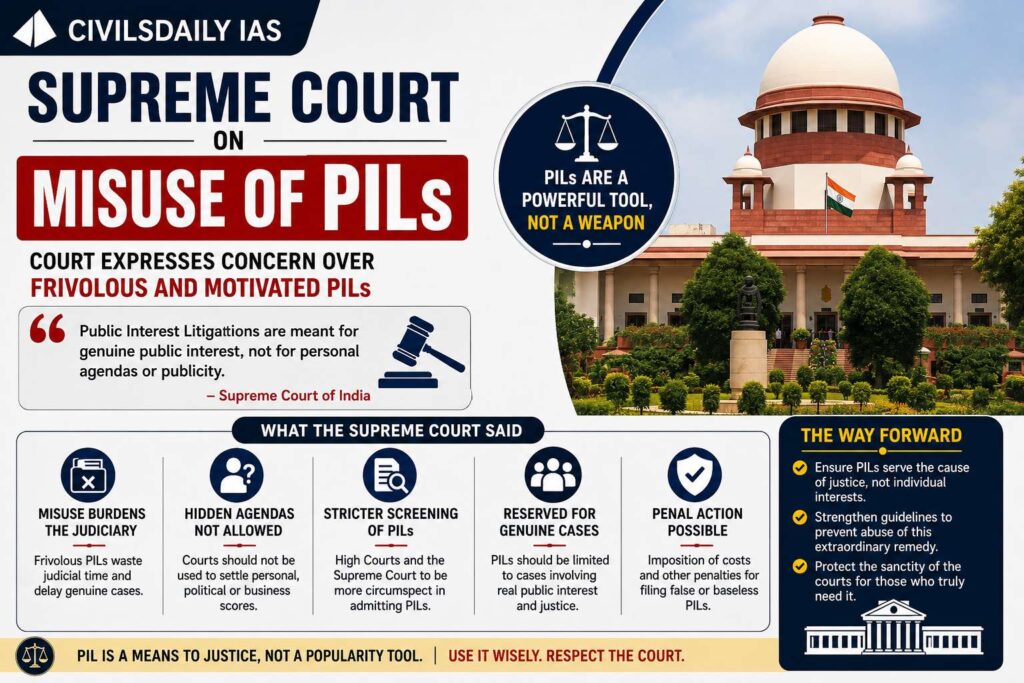
Justice B.V. Nagarathna of the Supreme Court of India remarked that Public Interest Litigation (PIL) has increasingly turned into “private interest litigation”, “publicity interest litigation”, and “paisa interest litigation” during hearings in the Sabarimala review case.
What is Public Interest Litigation (PIL)
A legal mechanism allowing courts to address issues affecting the public at large
Developed by the Indian judiciary after the Emergency period
Intended to improve access to justice for:
Poor
Marginalised
Vulnerable groups
Concerns Raised by the Court
PILs increasingly filed for:
Personal interest
Political motives
Publicity
Financial gain (“paisa interest litigation”)
Court stressed difference between:
Genuine public interest
Unnecessary interference
Key Legal Concept
Locus Standi
Right of a person or organisation to bring a case before court
PIL relaxed traditional rules of locus standi
Important Constitutional Aspects
PIL linked with:
Article 32 (Right to Constitutional Remedies)
Article 226 (High Court writ jurisdiction)
Constitutional and Legal Context
Inter State and International Rivers
Water is a State subject under State List
Union can regulate inter state rivers under certain conditions
[2022] With reference to the writs issued by the Courts in India, consider the following statements: 1. Mandamus will not lie against a private organisation unless it is entrusted with a public duty. 2. Mandamus will not lie against a Company even though it may be a Government Company. 3. Any public minded person can be a petitioner to move the Court to obtain the writ of Quo Warranto. Which of the statements given above are correct? [A] 1 and 2 only [B] 2 and 3 only [C] 1 and 3 only [D] 1, 2 and 3