💥Join UPSC 2027,2028 Mentorship (July Batch) + XFactor Notes & Microthemes PDF

Subject: Internal Security

  • INAS 335 (Ospreys) and MH-60R Seahawk Helicopters

    Why in the News?

    The Indian Navy will commission its second MH-60R helicopter squadron, INAS 335 (Ospreys), on December 17 at INS Hansa, Goa, marking a major step in naval modernisation.

    MH-60R Seahawk Helicopter

    • It is a US made, advanced multi role maritime helicopter.
      • Equipped with state of the art avionics, sensors and advanced weapon systems.
      • Capable of addressing both conventional and asymmetric threats.
      • Fully integrated with Indian Navy fleet operations.
      • Designed for sustained operations in open seas.

    Strategic Significance

    • Significantly enhances the Indian Navy’s operational readiness.
      • Extends the Navy’s operational reach, supporting blue water navy capabilities.
      • Strengthens India’s maritime presence in the Indian Ocean Region.
      • Acts as a deterrent against potential maritime threats.

    Prelims Pointers

    • INS Hansa is the Indian Navy’s premier naval air station located in Goa.
      • MH-60R helicopters form a key component of India’s maritime aviation modernisation programme.
    Which one of the following is the best description of ‘INS Astradharini’, that was in the news recently? (2016)

    (a) Amphibious warfare ship 

    (b) Nuclear-powered submarine 

    (c) Torpedo launch and recovery vessel 

    (d) Nuclear-powered aircraft carrier

  • NATGRID  

    Why in the News?

    • NATGRID is now receiving around 45,000 data-access requests per month, according to government officials.
    • At the 2024 DGP Conference (Nov 28–30, Raipur), chaired by the Prime Minister, all law-enforcement agencies were directed to scale up use of NATGRID in investigations.
    • States have been asked by the Ministry of Home Affairs (MHA) to use the platform extensively to access multiple government and private datasets.

    What is NATGRID?

    • National Intelligence Grid (NATGRID) is an integrated intelligence platform that provides secure, real-time access to various databases for police and investigative agencies.
    • Conceptualised in 2009 after the 26/11 Mumbai terror attacks.
    • Became operational in 2023 (last year).
    • It is accessible only to authorised security agencies.

    Institutional Developments

    • NATGRID gained momentum in 2019 under Home Minister Amit Shah, who resolved inter-agency differences and expanded access to States.
    • In 2020, NATGRID signed an MoU with the National Crime Records Bureau (NCRB) to access the Crime and Criminal Tracking Network and Systems (CCTNS), which links ~14,000 police stations nationwide.

    Recent Challenges Reported

    • Slow or time-consuming login procedures
    • Delays in receiving information that is expected to be real-time

    UPSC Prelims Pointers

    • NATGRID conceptualised → 2009, after 26/11.
    • Operational → 2023.
    • Provides access to government + private datasets.
    • No FIR required to use the platform.
    • Integrated with CCTNS through an MoU with NCRB (2020).
    • Access allowed to SP-rank officers and central agencies.
    • Aim → real-time, secure, multi-source data access for intelligence and investigation.
  • India Expands Heron Mk II UAV Fleet

    Why in the news? 

    In the aftermath of Operation Sindoor, the Indian Army, Air Force, and Navy have initiated emergency procurement of satellite-linked Heron Mk II Unmanned Aerial Vehicles (UAVs) from Israel. This marks the first induction of Heron Mk II by the Indian Navy.

    What is Emergency Procurement?

    • Covered under Defence Acquisition Procedure (DAP).
    • Allows armed forces to procure weapons/systems worth up to ₹300 crore per case.
    • Meant for urgent operational requirements.
    • Fast-tracked contracting and delivery timelines.

    About Heron Mk II (MALE UAV)

    Category: MALE – Medium Altitude Long Endurance.
    Manufacturer: Israel Aerospace Industries (IAI).

    Key Features (Prelims Points):

    • Endurance: > 24 hours continuous flight.
    • Payload Capacity: ~ half a tonne.
    • Sensors:
      • Synthetic Aperture Radar (SAR)
      • Electro-Optical/Infrared (EO/IR)
      • SIGINT (Signals Intelligence)
    • SATCOM-enabled:
      • Encrypted satellite communication
      • Enables Beyond Line-of-Sight (BLOS) operations.
    • Fully automated Take-off & Landing (ATOL).
    • All-weather ISR platform (Intelligence, Surveillance, Reconnaissance).

    Current Indian Operators:

    • Indian Army (deployed in northern sector).
    • Indian Air Force.
    • Indian Navy (first time induction now).
    With reference to Agni-IV Missile, which of the following statements is/are correct? (2014)

    1. It is surface-to surface missile. 

    2. It is fuelled by liquid propellant only. 

    3. It can deliver one-tonne nuclear warheads about 7500km away. 

    Select the correct answer using the code given below: 

    (a) 1 only 

    (b) 2 and 3 only 

    (c) 1 and 3 only 

    (d) 1, 2 and 3 only

  • DRI Seizes 32 kg Methamphetamine in North East

    Why in the News?

    The Directorate of Revenue Intelligence (DRI) has seized 32 kg methamphetamine tablets worth ₹32 crore in two separate operations in Assam and Tripura, exposing the continued use of the Indo–Myanmar route for drug trafficking. Three persons have been arrested under the NDPS Act, 1985.

    About Methamphetamine  

    • A synthetic psychostimulant
    • Known as Ya Ba / Speed pills in Southeast Asia
    • Highly addictive
    • Controlled under Schedule of NDPS Act, 1985

    What is Hydroponic Weed?

    • Marijuana grown in nutrient-rich water systems, not soil
    • Higher potency due to controlled conditions
    • New smuggling trend: carried by air passengers into NE India

    NDPS Act, 1985  

    • Regulates narcotic drugs and psychotropic substances
    • Provides for seizure, arrests, forfeiture
    • Commercial quantity offences: 10–20 years imprisonment
    • Empowered agencies: DRI, NCB, Customs, State Police, BSF, Assam Rifles
    Q: India’s proximity to two of the world’s biggest illicit opium-growing states has enhanced her internal security concerns. Explain the linkages between drug trafficking and other illicit activities such as gunrunning, money laundering and human trafficking. What countermeasures should be taken to prevent the same? (UPSC 2018) 
  • Government plans unification of port security regulations- sovereign entity to oversee private ports while CISF will regulate 80 ports

    Why In The News?

    The government has designated CISF as the security regulator for 250+ seaports to strengthen coastal security.

    1) New Security Framework:

    • Sovereign Entity at Seaports: Government to deploy CISF as a sovereign security force at private cargo-handling ports for a uniform security system.
    • Initial Coverage: CISF to regulate 80 major export-import seaports for access control, cargo screening, and seafront patrolling.
    • Phase-wise Expansion: Remaining 170 seaports will be brought under CISF in stages.
    • ISPS Code Role: CISF designated as the Recognised Security Organisation under the International Ship and Port Facility Security Code.

    2)Framework for Seaport Security in India:

    • International Ship and Port Facility Security (ISPS) Code:
      India’s port security system aligns with the mandatory global ISPS Code, introduced after 9/11 to protect ships and port facilities from terrorism and other maritime threats.
    • Central Industrial Security Force (CISF) as Security Regulator:
      The Government of India has recently designated the CISF as the Recognised Security Organisation (RSO) for ports, marking a major reform to strengthen and standardise port security across the country.

    3)Challenges to Port Security:

    • Non-Standardised Security Framework:
      • Security at many non-major ports historically lacked uniformity and expert oversight.
      • Heavy dependence on private security agencies or local police resulted in inconsistent standards.
    • Transnational & Non-Traditional Threats:
      • Maritime terrorism remains a persistent risk.
      • Smuggling and drug trafficking, with ports often used for large narcotics consignments.
      • Cyberattacks targeting port IT systems and critical infrastructure.
    • Infrastructure & Manpower Gaps:
      • Difficulty in ensuring uniform, high-quality security infrastructure across 250+ ports.
      • Significant manpower shortages: CISF requires 800-1,000 personnel per major seaport and has requested 10,000 additional personnel for initial deployment.
    • Coastal Vulnerabilities:
      • Large stretches of coastline remain open, poorly monitored, or unguarded.
      • Absence of a sovereign security force at private ports has created long-standing security gaps.
    • Identified Gaps in Official Reviews:
      • Coastal security flagged as a priority for discussion at the Director Generals of Police (DGP) Conference, attended by the Prime Minister.
      • The 2023 MHA guidelines highlighted major deficiencies and recommended comprehensive improvements.

    4) Committee Recommendations:

    • Committee Findings: A 2024 Joint Committee (CISF + Director General Shipping) conducted gap analysis and proposed corrective measures.
    • Hybrid Security Model: Core security functions to be handled by CISF, while State Police/private agencies manage non-core duties.

    5)About CISF:

    • Overview: CISF is a Central Armed Police Force under the Ministry of Home Affairs, headquartered in New Delhi; motto: “Protection and Security.”
    • Establishment:
      • Formed in 1969 through the CISF Act, 1968 with three battalions.
      • Declared an Armed Force of the Union after the 1983 amendment.
      • Expanded into a multi-skilled force with 188,000+ personnel.
      • Provides security to 359 establishments nationwide.
    • Organisation Structure:
      • Headed by a Director-General (IPS), assisted by an Additional DG.
      • Divided into seven sectors: Airport, North, North-East, East, West, South, Training.
      • Has a dedicated Fire Service Wing.
    • Functions:
      • Secures critical infrastructure: nuclear and space facilities, airports, seaports, power plants.
      • Protects Delhi Metro, Parliament Complex, heritage monuments, and major government buildings.
      • Responsible for airport security since 2000 (post IC-814 hijacking).
      • Provides VIP security to designated protectees.
      • Trained in disaster management (floods, earthquakes, cyclones).
      • Operates India’s largest Fire Protection Service among CAPFs.
      • Post-2008 Mumbai attacks, expanded to private sector security.
      • Functions as a compensatory cost force, billing clients for services.
    [UPSC 2023] With reference to Home Guards, consider the following statements:

    1. Home Guards are raised under the Home Guards Act and Rules of the Central Government.

    2. The role of the Home Guards is to serve as an auxiliary force to the police in maintenance of internal security.

    3. To prevent infiltration on the international border/coastal areas, the Border Wing Home Guards Battalions have been raised in some States.

    How many of the above statements are correct?

    Options: (a) Only one (b) Only two* (c) All three (d) None


  • IAF’s Tejas jet crashes during demo flight at Dubai Air Show, pilot killed

    Why In The News?

    An Indian Air Force Tejas fighter jet crashed during the Dubai Air Show, killing Wing Commander Namansh Syal, after spiralling out of control and igniting on impact at Al Maktoum International Airport.

    1)Tejas Mk1A: 

    • About: The Tejas Mk1A is an upgraded variant of India’s Light Combat Aircraft (LCA) Tejas, developed by Hindustan Aeronautics Limited (HAL).
    • Purpose: This version is aimed to enhance operational and combat capabilities, survivability and maintainability over the baseline Mk1.
    • Capabilities:
      • Active Electronically Scanned Array (AESA) radar integration.
      • Electronic Warfare Suite (EWS) – radar‑warning and self‑protection jamming.
      • Upgraded Flight Control Computer (DFCC Mk1A) for better maneuverability and stability.
      • Missile compatibility- Beyond Visual Range (BVR) missiles, Air-to-Air and Air-to-Ground missiles and Advanced Short Range Air-to-Air Missiles (ASRAAM).
      • Planned integration of Combined Interrogator and Transponder (CIT)Software Defined Radio (SDR) and Operating Data Link (ODL) with existing onboard avionics.

    2) LCA Tejas:

    • About: The LCA Tejas programme, initiated by the Government of India in 1984, aimed to replace the ageing MiG-21 fighter jets. The programme is managed by the Aeronautical Development Agency (ADA).
    • Features:
      • Lightest, smallest, and tailless multi-role supersonic fighter in its class.
      • Capable of carrying a variety of air-to-air, air-to-surface, and precision-guided weapons.
      • Maximum payload capacity of 4000 kg.
      • Maximum speed: Mach 1.8.
      • Range: 3,000 km.
    • Variants of Tejas:
      • Tejas Trainer: 2-seater operational conversion trainer for training air force pilots.
      • LCA Navy: Twin- and single-seat carrier-capable for the Indian Navy.
      • LCA Tejas Navy MK2: This is phase 2 of the LCA Navy variant.
      • LCA Tejas Mk-1A: This is an improvement over the LCA Tejas Mk1 with a higher thrust engine.

    3)Fifth Generation Fighter Jets:

    • About:
      • Combat Role: Designed for highly contested combat zones with advanced air and ground threats.
      • Stealth & Speed: Feature stealth technology and supercruise capability.
      • Key Advantages:
        • Multi-spectral low-observable design
        • Enhanced self-protection
        • Radar jamming capabilities
        • Fully integrated avionics systems
      • Global Operators:
        • Russia: Sukhoi Su-57
        • China: Chengdu J-20
        • United States: F-35 series
    • Need for India:
      • Squadron Strength: IAF has ~30 squadrons, below the sanctioned 42.
      • Ageing Fleet:
        • MiG-21
        • MiG-29
        • Jaguar
        • Mirage 2000
        • All to be phased out by mid-next decade.
      • Airpower Gap:
        • China: 3,304 aircraft
        • India: 2,296 aircraft
        • Pakistan: 1,434 aircraft
      • Strategic Need: Strengthen air defences against China and Pakistan and increase defence self-reliance.
      • Indigenous Development:
        • Developing AMCA
        • Five prototypes planned
        • Joint effort by ADA, HAL, and private industry
      • Strategic Positioning: 5G fighters would place India alongside the US, Russia, and China.
    [UPSC 2024] Question: Consider the following aircraft:

    1. Rafael

    2. MiG-29

    3. Tejas MK-1

    How many of the above are considered fifth generation fighter aircraft?

    Options: (a) Only one (b) Only two (c) All three (d) None*


  • The threat of digital tradecraft in terrorism

    Introduction

    The blast near Delhi’s Red Fort on November 10, killing 15 and injuring over 30, exposed the operational use of encrypted digital platforms, dead-drop communication, and modular terror cells. The investigation demonstrates a transition from traditional networks to digitally shielded ecosystems, reducing visibility for intelligence agencies and constraining surveillance outcomes.

    The new face of terror: What has the investigation revealed?

    1. Encrypted Communication: Enables concealed coordination, protects identity layers, and reduces interception by routing messages through shielded platforms.
    2. Digital Dead-Drops: Facilitates asynchronous message exchange without direct contact, ensuring operational secrecy and reducing surveillance exposure.
    3. Compartmentalised Cells: Strengthens deniability by separating roles across modules led by three individuals linked to medical and academic institutions.
    4. Behavioural Masking: Utilises familiar vehicles and repetitive low-risk movement patterns to support covert reconnaissance without triggering alerts.
    5. Enhanced IED Architecture: Ensures higher lethality through layered mechanisms and precise triggering processes.

    Distinctive Features of This Incident

    1. Multi-Layer Encryption: Reduces actionable intelligence, constrains lawful interception, and delays early detection of operational chatter.
    2. Surveillance-Resistant Tools: Utilises VPNs, spoofed identifiers, and encrypted messaging apps, enabling secure command dissemination.
    3. Hybrid Planning: Integrates digital coordination with physical site visits, ensuring real-time situational assessment without exposing handlers.
    4. Decentralised Decision Structures: Prevents traceability by shifting from hierarchical control to remote guidance via anonymised digital nodes.

    Why are modern counterterrorism frameworks struggling?

    Constraints on Counterterrorism Architecture

    1. Limited Penetration of Encrypted Platforms: Restricts information extraction, narrows visibility over operational trails, and weakens evidence chains.
    2. Diminished HUMINT Opportunities: Reduces physical touchpoints and complicates informant-based intelligence generation.
    3. Fragmented Global Cooperation: Slows data sharing when platforms are hosted outside domestic jurisdiction, weakening investigation pace.
    4. Technological Mismatch: Creates capability gaps as terror networks adopt advanced masking, encryption, and anonymisation faster than security upgrades.

    Operational Impact of Digital Tradecraft

    1. End-to-end encryption (E2EE) Platforms: Shields logistics, finances, and movement plans, enabling uninterrupted operational execution.
    2. Remote Radicalisation and Supervision: Facilitates cross-border ideological influence and guidance without physical linkages.
    3. Metadata Evasion: Minimises digital footprints by exploiting layered encryption and controlled online presence.
    4. Coordination Efficiency: Enhances planning speed and reduces command exposure by relying on decentralised digital frameworks.

    Required Strategic Adaptations

    1. Digital Forensics Expansion: Strengthens cryptographic analysis, behavioural modelling, and dark-web investigation capacity.
    2. Lawful Interception Reform: Establishes judicially supervised mechanisms enabling secure access to encrypted communication when mandated.
    3. Inter-Agency Data Fusion: Integrates intelligence, cyber cells, and police units on unified platforms to improve threat detection and response.
    4. Cyber Infrastructure Modernisation: Enhances surveillance technologies, metadata analytics, and predictive systems to match digital threat evolution.
    5. International Data Cooperation: Accelerates cross-border evidence sharing and improves alignment with global counterterrorism frameworks.

    Conclusion

    The Red Fort blast demonstrates a shift toward encrypted, decentralised, and digitally concealed terror ecosystems. The emerging landscape requires specialised digital forensics, integrated intelligence systems, and balanced legal frameworks to strengthen operational readiness. Counterterrorism capacities must evolve to address threats emerging from opaque digital environments rather than visible physical terrains alone.

    PYQ Relevance

    [UPSC 2016] Use of Internet and social media by non-state actors for subversive activities is a major concern. How have these been misused in the recent past? Suggest effective guidelines to curb the above threat.

    Linkage: The misuse of Internet and social media by non-state actors remains a recurring internal security theme. The encrypted digital activity with respect to the recent The recent Red Fort blast make the issue current and significant. The topic continues to appear because communication networks are now central to modern security threats.

  • More than two decades later, there is light at the end of the Red Corridor

    INTRODUCTION

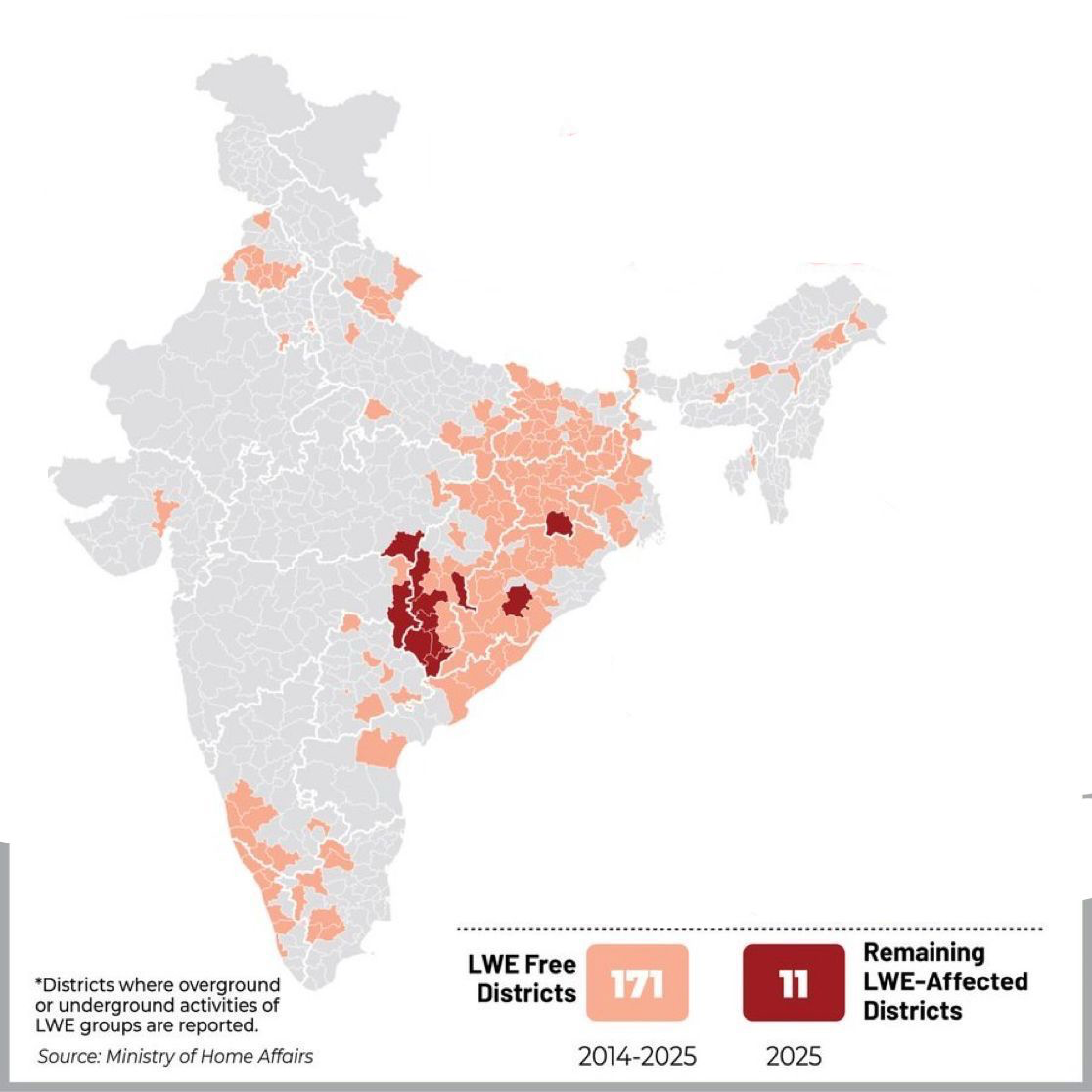
    Left-Wing Extremism (LWE) has historically affected large tribal hinterlands across central India. Recent field reports indicate a visible decline in Maoist hold, accompanied by expanding state presence, renewed market activity, and local confidence in security forces. The transformation represents a significant shift from earlier decades marked by fear, isolation, and violence.

    Why in the news?

    A major setback to Maoists occurred recently when top Andhra-Odisha border commander Madvi Hidma was killed in a security operation, followed by the elimination of seven more Maoists, including an explosives expert. These back-to-back encounters highlight the rapid weakening of LWE networks across the Red Corridor.

    Why is the region witnessing a visible shift in confidence?

    1. Reduced Fear: The article notes that locals now openly interact with security forces, signalling erosion of Maoist coercion.
    2. Increased Presence: Security deployment strengthened continuous area domination, reducing the probability of Maoist reprisals.
    3. Civilian Mobility: Market activity in evening hours increased, contrasting earlier periods when movement after dusk was restricted due to threats.
    4. Symbolic Change: Locals offering security personnel chai and sitting freely with them indicates behavioural trust, not forced compliance.

    What structural changes weakened Maoist dominance?

    1. Road Connectivity: New roads and bridges reduced forest isolation, weakening Maoist geographical advantage and enabling faster troop mobility.
    2. Communication Facilities: Mobile networks expanded surveillance, reduced Maoist anonymity, and enabled quicker civilian distress calls.
    3. Administrative Outreach: Frequent visits by district officials ensured service delivery and reduced ideological appeal.
    4. Disruption of Recruitment: Youth engagement in local markets, transport, and small businesses reduced Maoist manpower pipelines.

    How did security operations evolve on the ground?

    1. Stronghold Penetration: Forces entered areas earlier considered “liberated zones”, indicating territorial rollback.
    2. Integrated Command: Inter-state coordination between Chhattisgarh, Maharashtra, Telangana improved operational continuity.
    3. Sanitisation Efforts: Regular area domination patrols lowered the possibility of ambushes.
    4. Intelligence Support: Human intelligence from locals increased due to declining fear, enabling targeted strikes.

    What has changed in the population’s everyday life?

    1. Economic Activity: Markets extending late into evening reflect safety and disposable income circulation.
    2. Transport Revival: Locals travelling without escorts marks reduced threat perception.
    3. Women’s Movement: Increased participation by women in markets shows greater autonomy and reduced intimidation.
    4. Community Interaction: Openness to engage with forces signals normalisation of state-citizen interaction.

    Why has the Maoist strategy weakened?

    1. Loss of Terrain Control: Eroded forest sanctuaries limit guerrilla advantage.
    2. Depleted Cadres: Surrenders and casualties reduced leadership continuity.
    3. Ideological Attrition: Reduced resonance of Maoist messaging as development outreach substitutes grievances.
    4. Operational Fatigue: Continuous pressure limited long-duration planning, reducing capability for large-scale attacks.

    CONCLUSION

    The article highlights a decisive shift in the Red Corridor, where expanded state presence and growing public confidence have significantly reduced Maoist influence. The transition reflects a combination of operational consistency, improved connectivity, and changing local behaviour, collectively signalling a new phase in India’s long battle against Left-Wing Extremism.

    PYQ Relevance

    [UPSC 2022] Naxalism is a social, economic and developmental issue manifesting as a violent internal security threat. Discuss the emerging issues and suggest a multilayered strategy to tackle the menace of Naxalism.

    Linkage: The PYQ matches the article’s focus on LWE decline driven by security consolidation and development outreach. It directly links to how improved roads, markets, and public confidence are weakening Naxalism.

  • Army sets up three new garrisons near the Siliguri Corridor

    Why in the News?

    India has set up three new Army garrisons at Dhubri, Kishanganj, and Chopra to secure the vulnerable eastern frontier and protect the Siliguri Corridor amid instability in Bangladesh and rising Chinese activity.

    Army sets up three new garrisons near the Siliguri Corridor

    About Siliguri Corridor:

    • Overview: A narrow land strip connecting mainland India to the Northeast, popularly called the Chicken Neck due to its thin, vulnerable shape.
    • Dimensions: Roughly 60 km long and 17–22 km wide, making it one of India’s most strategically sensitive corridors.
    • Location: Lies in northern West Bengal, bordered by Nepal (west), Bangladesh (south), Bhutan (north), with China’s Chumbi Valley close to the tri-junction.
    • Link to Northeast: The only land route for supplying all eight northeastern states, carrying road, rail, fuel, food and military logistics (except limited Bangladesh transit routes).
    • Strategic Sensitivity: Its narrowness and proximity to the India–China–Bhutan tri-junction make it a potential chokepoint in conflict scenarios.
    • Military Importance: Acts as the primary logistical artery for moving Indian Army troops and equipment toward Sikkim and Arunachal Pradesh, especially during LAC tensions.
    • Security Challenges: Surrounded by multiple international borders, making it prone to illegal immigration, smuggling, cross-border crime, and potential external military pressure.
    • Economic Significance: Key route for trade with Nepal and Bhutan, and supports tourism to Darjeeling, Sikkim and Bhutan.

    About the New Eastern Garrison Deployments:

    • Purpose: Developed to address rising security risks due to political changes in Bangladesh, demographic pressures along the border, and China’s increasing activity near the tri-junction.
    • Locations:
      1. Lachit Borphukan Military Station, Dhubri (Assam)
      2. Forward base, Kishanganj (Bihar)
      3. Forward base, Chopra (West Bengal)
    • Operational Role: Enables continuous surveillance, rapid troop movement, and strengthens defence preparedness across the India–Bangladesh frontier.
    • Local Support: Assam facilitated quick setup of the Dhubri station, named after Ahom general Lachit Borphukan, symbolising regional identity and military determination.

    Drivers Behind the Reinforcement:

    • Regime Change in Bangladesh: Expected shifts in border behaviour, cross-border movement, and potential security spillovers.
    • Illegal Immigration Concerns: Union Home Ministry has flagged demographic changes in border districts linked to cross-border inflow.
    • China’s Expanding Influence:
      • Accelerated LAC military build-up in Arunachal Pradesh.
      • Growing ties with Pakistan and Bangladesh, including a trilateral meet in Kunming, raising regional security concerns.
    • Regional Military Activity: India has conducted major exercises like Poorvi Prachand Prahar and IAF flying displays in Assam to signal operational readiness.
    • Pakistan–Bangladesh Engagements: Recent visit of a Pakistan Navy ship to Chattogram (first since 1971) has added a fresh strategic dimension to India’s eastern security planning.
  • Compound effect: On digital arrest scams

    Introduction

    The Supreme Court of India’s recent directive for a comprehensive probe into proliferating digital scams underscores the scale and sophistication of cyber fraud plaguing Indian citizens. The Court’s focus on “digital arrest” scams, where criminals impersonate law enforcement officials to extort money highlights a disturbing transformation in global cybercrime: industrial-scale scam operations embedded in Southeast Asian conflict zones.

    Why in the News

    For the first time, the Supreme Court has intervened directly to address the globalised architecture of digital scams targeting Indian citizens. These scams run from “scam compounds” in Myanmar, Cambodia, and other parts of Southeast Asia combine human trafficking, digital slavery, and organised crime. Thousands of Indians have fallen victim, some trafficked to operate scams, others defrauded online. The situation represents both a national security concern and a humanitarian crisis, demanding urgent multilateral action.

    Understanding the ‘Scam Compound’ Phenomenon

    1. Industrial-scale operations: Scam compounds operate from conflict-ridden or special economic zones in Myanmar, Cambodia, and Laos, exploiting weak governance.
    2. Cross-border architecture: These are not isolated crimes but coordinated, transnational enterprises involving militias, private entities, and local regimes.
    3. Digital slavery model: Trafficked individuals are forced, under threat and torture, to perpetrate scams such as “digital arrest,” “pig butchering,” and crypto investment frauds.
    4. State complicity: In Myanmar, regime-backed Border Guard Forces allegedly facilitate these compounds, converting scams into revenue streams for military operations.

    KK Park Cyber Scam Hub in Myanmar

    How the Digital Scam Network Operates

    1. Recruitment through deception: Victims are lured by fake job ads in cities like Bangkok, offering attractive salaries under visa-free entry regimes.
    2. Trafficking & confinement: Once recruited, they are trafficked into border regions controlled by ethnic militias in Myanmar and held captive in “digital sweatshops.”
    3. Coercive work environment: Workers face violence, sexual harassment, and torture if they fail to meet scam targets.
    4. Key scam types:
      1. “Digital arrest scams” impersonation of law enforcement to extort money.
      2. “Pig butchering scams” combining online romance and crypto fraud.
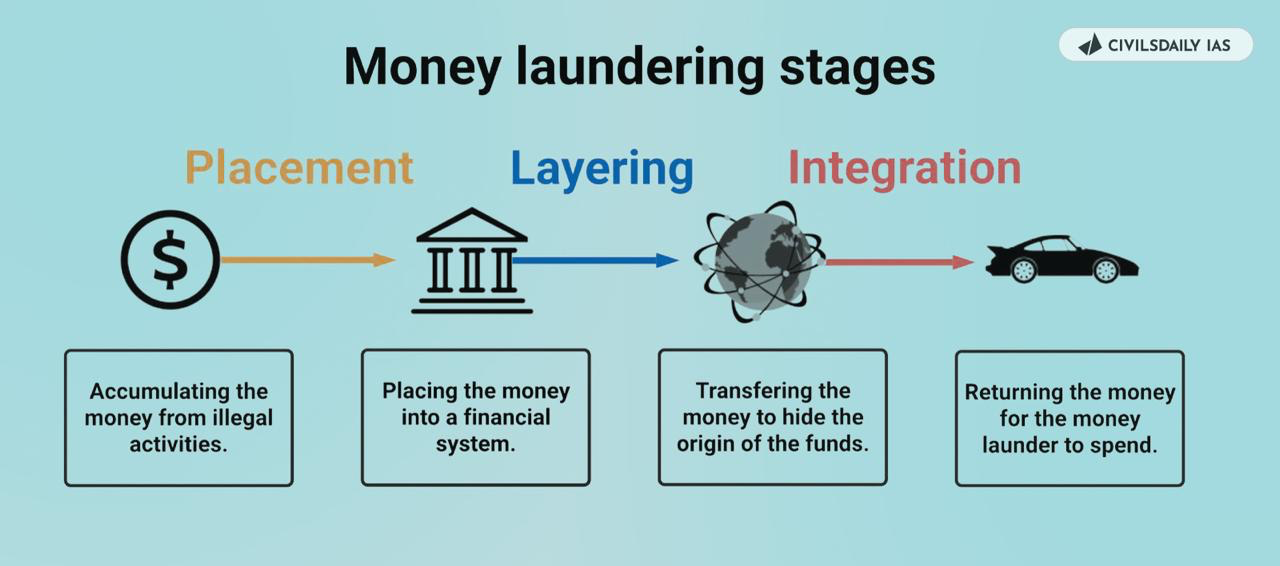
    5. Crypto laundering networks: Proceeds are funneled via money mules and institutions like Cambodia’s Huione Pay, then converted into cryptocurrency to evade tracing.

    Why Southeast Asia Became the Epicentre

    1. Conflict & weak governance: Myanmar’s post-2021 coup turmoil has enabled militia-run economies.
    2. Borderland lawlessness: Regions under Border Guard Forces function beyond formal state oversight.
    3. Economic desperation: Regional instability and poverty create fertile recruitment grounds.
    4. Regime complicity: Militias tax scam centres to fund armed operations, sustaining a vicious cycle of profit and repression.

    India’s Dual Crisis

    1. Forced scam labour: Thousands of Indian citizens trafficked and enslaved in these compounds.
    2. Domestic victimisation: Thousands more in India fall prey to online frauds orchestrated by these same captives.
    3. Diplomatic and enforcement challenge: Tackling both victim rescue abroad and fraud prevention at home requires synchronised national and international coordination.

    Policy Imperatives and India’s Way Forward

    1. Public awareness campaigns: The Reserve Bank of India and Union Ministries must amplify citizen education about emerging digital fraud patterns.
    2. Cybercrime infrastructure: Strengthening cyber policing, digital forensics, and cross-border data sharing frameworks.
    3. Regional cooperation: Collaborate with China, Thailand, Vietnam, and affected ASEAN nations to forge joint task forces.
    4. Diplomatic pressure: Use bilateral and multilateral diplomacy to pressurise Myanmar’s junta and Cambodia’s regime to dismantle scam hubs.
    5. Global recognition: Mobilise the United Nations to classify this crisis as a modern manifestation of slavery needing urgent international intervention.

    Conclusion

    The proliferation of scam compounds across Southeast Asia exposes the dark underbelly of the global digital economy where technology meets trafficking. For India, the challenge is dual: protect citizens from victimisation and rescue those coerced into perpetration. This crisis demands that India integrate cyber security, diplomacy, and human rights enforcement under one coordinated regional framework.

    PYQ Relevance

    [UPSC 2021] Keeping in view India’s internal security, analyse the impact of cross-border cyber attacks. Also, discuss defensive measures against these sophisticated attacks.

    Linkage: This question directly relates to the rise of transnational scam compounds in Southeast Asia that exploit digital networks to target Indian citizens. It underscores the urgent need for coordinated international and domestic cyber defense frameworks.