💥Join UPSC 2027,2028 Mentorship (July Batch) + XFactor Notes & Microthemes PDF

Subject: Internal Security

  • National IED Data Management System (NIDMS)  

    Why in the News?

    Union Home Minister Amit Shah virtually inaugurated the National IED Data Management System (NIDMS) at the National Security Guard garrison in Manesar, calling it a next generation shield against terrorism.

    What is NIDMS

    • A national online digital platform and centralised repository of data related to Improvised Explosive Device (IED) incidents
    • Designed to support investigation, pattern analysis, and deterrence strategies against terror attacks
    • Provides single click access to IED related data across India
    • Nodal Agency: National Security Guard (NSG)
    • Launched by the Ministry of Home Affairs

    Key Objectives

    • Strengthen counter terrorism investigations
    • Identify patterns in modus operandi and explosives
    • Enable scientific and evidence based prosecution
    • Improve inter agency coordination

    Key Features

    • Two way data platform
      • Agencies can upload fresh IED incident data
      • Agencies can access historical data
    • Comprehensive database: Chronicles all bomb blasts since 1999
    • One nation one data repository: Uniform access for central and state agencies
    • Fully secure national digital platform
    • Enables standardisation, integration, and secure sharing of IED data

    Agencies Covered

    • National Investigation Agency
    • State Anti Terrorism Squads
    • Central Armed Police Forces
    • State and Union Territory police forces
    • Intelligence and investigation agencies

    Integration with Other Security Databases

    NIDMS will interlink with existing national security platforms:

    • CCTNS connecting over 17,700 police stations
    • ICJS 2 integrating data from 22,000 courts
    • e Prisons database with over 2.2 crore prisoners
    • e Prosecution database with around 2 crore cases
    • e Forensics with more than 31 lakh samples
    • NAFIS with over 1.2 crore fingerprints
    [2020] In India, the term “Public Key Infrastructure” is used in the context of: 

    (a) Digital security infrastructure 

    (b) Food security infrastructure 

    (c) Health care and education infrastructure 

    (d) Telecommunication and transportation infrastructure

  • [8th Jaunary 2026] The Hindu OpED: Natgrid, the search engine of digital authoritarianism

    PYQ Relevance

    [UPSC 2023] What are the internal security challenges being faced by India? Give out the role of Central Intelligence and Investigative Agencies tasked to counter such threats.

    Linkage: NATGRID represents the technological backbone of intelligence coordination among central agencies. The question allows analysis of how intelligence reforms post-26/11 rely increasingly on data integration, while raising concerns of accountability and oversight.

    Mentor’s Comment

    This article examines the transformation of India’s intelligence architecture through the National Intelligence Grid (NATGRID). It evaluates how a system conceived after the 26/11 terror attacks for intelligence coordination is evolving into a large-scale, algorithm-driven surveillance infrastructure. The piece raises constitutional, institutional, and ethical concerns relevant to internal security, governance, civil liberties, and democratic accountability.

    Introduction

    Conceived as a technological “crown jewel,” NATGRID aimed to enable seamless intelligence coordination. However, its evolution from a post-crisis intelligence grid into a population-wide surveillance architecture marks a fundamental shift in India’s security-liberty balance.

    Why in the News?

    NATGRID has re-emerged as a major policy concern due to recent reports highlighting its expanded operationalisation, widening user base, and integration with the National Population Register (NPR). Intelligence access has shifted from post-event investigation to real-time, algorithmic risk assessment. The scale is unprecedented, around 45,000 queries per month, extended to state police officers down to the Superintendent of Police rank, marking a sharp departure from earlier centralised intelligence control. This expansion occurs without a statutory framework or independent oversight, raising fears of institutionalised mass surveillance and digital authoritarianism.

    Why did NATGRID emerge after 26/11?

    1. Intelligence Fragmentation: Identified failure to synthesise scattered inputs such as visa records, travel itineraries, hotel stays, and financial trails related to David Headley.
    2. Post-Crisis Imperative: Positioned as a technological fix to prevent future terror attacks through real-time data aggregation.
    3. Institutional Expansion: Envisioned as middleware enabling 11 central agencies to query databases across 21 categories, spanning identity, travel, telecom, finance, and assets.

    How did NATGRID evolve institutionally?

    1. Administrative Clearance: Operationalised through executive decisions rather than Parliamentary legislation.
    2. Delayed Rollout: Long gestation period led to perceptions of “vapourware” until post-2020 acceleration.
    3. Operational Activation: Publicly announced in 2009; cleared in 2012 without statutory safeguards; rebranded under Mission Mode Project “Horizon.”

    What scale of intelligence access does NATGRID now enable?

    1. Query Volume: Handles approximately 45,000 intelligence queries per month.
    2. User Expansion: Access widened beyond central agencies to state police officers up to SP rank.
    3. Routine Policing Shift: Intelligence access integrated into everyday law enforcement rather than exceptional counter-terror operations.

    Why does integration with NPR mark a structural break?

    1. Population Mapping: NPR data includes demographic, biometric, residential, lineage, and identity details.
    2. Function Creep: Converts a population register into an intelligence query platform.
    3. Paradigm Shift: Moves intelligence from tracking discrete events to continuous surveillance of individuals.
    4. Political Sensitivity: NPR’s linkage with NRC debates amplifies concerns of profiling and citizenship filtering.

    How does algorithmic policing change the nature of surveillance?

    1. Entity Resolution: Deployment of “Gandiva,” an analytics engine capable of linking fragmented datasets to identify individuals.
    2. Predictive Risk Assessment: Uses facial recognition, KYC databases, and driving licence records.
    3. Inference at Scale: Algorithms determine intent based on pattern recognition rather than human judgment.
    4. Bias Amplification: Existing social biases embedded in data risk reinforcing caste, religious, and geographic profiling.

    Why is lack of oversight a central concern?

    1. Absence of Statute: No dedicated law governing scope, limits, or accountability of NATGRID.
    2. Judicial Gap: Legality of large-scale intelligence surveillance remains unadjudicated despite pending cases.
    3. Clerical Overload: Tens of thousands of monthly requests undermine meaningful scrutiny.
    4. Autonomous Surveillance: Weak Parliamentary oversight allows self-justifying intelligence architectures.

    Why does the argument of “intelligence necessity” fall short?

    1. Operational Failures: 26/11 highlighted deficits in training and ground-level policing, not data scarcity.
    2. Over-Reliance on Technology: Intelligence failures often stem from institutional silos, not lack of databases.
    3. False Positives Risk: Automated “hits” can trigger irreversible harm without due process.
    4. Learning Deficit: Local police lacked firearm training during 26/11 despite intelligence availability.

    What constitutional values are at stake?

    1. Privacy Erosion: Expansive surveillance contradicts proportionality standards laid down in privacy jurisprudence.
    2. Due Process Deficit: Automated suspicion undermines presumption of innocence.
    3. Chilling Effect: Normalisation of surveillance reshapes citizen-state relations.
    4. Judicial Precedent: Reliance on Justice K.S. Puttaswamy (Retd.) v. Union of India (2017) contrasts with unchecked surveillance growth.

    Conclusion

    NATGRID reflects a decisive shift in India’s internal security architecture from intelligence coordination to continuous, technology-driven surveillance. While conceived to prevent failures like 26/11, its expansion in scale, scope, and access, without a clear statutory framework or independent oversight, raises fundamental concerns about privacy, proportionality, and democratic accountability. Intelligence systems that rely on algorithmic inference and population-wide data integration risk normalising suspicion and eroding constitutional safeguards. Effective counter-terrorism requires not only technological capability but also institutional accountability, legal clarity, and professional capacity-building. Without these correctives, NATGRID risks functioning less as a preventive security instrument and more as an enduring infrastructure of digital authoritarianism.

  • INS Vagsheer

    Why in the News?

    • Droupadi Murmu became the second Indian President to undertake a submarine sortie, embarking on INS Vagsheer from Karwar naval base.

    About INS Vagsheer

    • Sixth submarine of the Kalvari class (Scorpene class) under Project-75
    • Operated by the Indian Navy
    • Named after the sandfish, a deep sea predator of the Indian Ocean
    • Commissioned on 15 January 2025
    • Sister vessels
      • INS Kalvari December 2017
      • INS Khanderi September 2019
      • INS Karanj March 2021
      • INS Vela November 2021
      • INS Vagir January 2023

    Indigenous Systems Onboard

    • Air conditioning plant
    • Internal communication network
    • Ku Band SATCOM system

    Prelims Takeaway

    • INS Vagsheer is the last submarine of the first Kalvari class batch
    • Built in India under Project-75
    • Among the quietest conventional submarines globally
    • Important milestone for self reliance in defence manufacturing
    Consider the following statements: (2009)

    1. INS Sindhughosh is an aircraft carrier. 

    2. INS Viraat is a submarine. 

    Which of the statements given above is/are correct? 

    (a) 1 only (b) 2 only (c) Both 1 and 2 (d) Neither 1 nor 2

  • Samudra Pratap

     Why in the News?

    The Indian Coast Guard inducted Samudra Pratap, the first indigenously built Pollution Control Vessel (PCV), under the 02 PCV project of Goa Shipyard Limited.

    About Samudra Pratap

    • First indigenously designed and built Pollution Control Vessel of the Indian Coast Guard
      Largest ship in the ICG fleet
      • Built to enhance marine pollution response, firefighting, and high-precision operations

    Advanced Onboard Systems

    • Integrated Bridge System (IBS)
      Integrated Platform Management System (IPMS)
      Automated Power Management System (APMS)
      High capacity external firefighting system

    Prelims Pointers

    • Samudra Pratap is a Pollution Control Vessel, not an offshore patrol vessel
      • Built by Goa Shipyard Limited
      • First ICG ship with Dynamic Positioning DP 1
      • Focused on pollution response and firefighting, not combat dominance
    Which one of the following is the best description of ‘INS Astradharini’, that was in the news recently? (2016)

    (a) Amphibious warfare ship 

    (b) Nuclear-powered submarine 

    (c) Torpedo launch and recovery vessel 

    (d) Nuclear-powered aircraft carrier

  • Financial Fraud Risk Indicator (FRI)

    Why in the News?

    The Department of Telecommunications has reported that the Financial Fraud Risk Indicator (FRI) has prevented potential losses of about ₹660 crore across the banking ecosystem within six months of its rollout.

    What is Financial Fraud Risk Indicator (FRI)?

    • A risk based early warning system to detect financial fraud
    • Launched in May 2025
    • Developed by the Digital Intelligence Unit
    • Classifies mobile numbers based on likelihood of financial fraud

    Risk Categories Under FRI

    • Medium Risk
    • High Risk
    • Very High Risk

    Data Sources Used for Classification

    Indian Cybercrime Coordination Centre via National Cybercrime Reporting Portal
    • DoT’s Chakshu platform
    • Intelligence shared by banks and financial institutions

    How FRI Works

    • Suspected mobile number is flagged by any stakeholder
    • Number undergoes multidimensional risk analysis
    • Classified into Medium, High, or Very High fraud risk
    • Risk status shared instantly with stakeholders through DoT’s Digital Intelligence Platform (DIP)

    Role of Mobile Number Revocation List (MNRL)

    • Issued regularly by DoT’s Digital Intelligence Unit
    • Contains numbers disconnected due to:
    • Cybercrime involvement
    • Failed verification
    • Exceeding permissible usage limits
    • Such numbers are frequently reused for financial fraud

    Why FRI is Effective?

    • Fraudulent numbers are often short lived
    • Traditional verification takes time
    • FRI provides preemptive risk signalling before losses occur

    Use by Banks and Financial Institutions

    • Decline suspicious transactions
    • Delay high risk transactions
    • Send alerts and warnings to customers
    • Strengthen UPI and digital payment security

    Prelims Pointers

    • FRI is a preventive tool, not a law enforcement mechanism
    • Operates in real time
    • Enhances coordination between telecom and financial sectors
    • Supports secure digital payments ecosystem

    Which of the following is a most likely consequence of implementing the ‘Unified Payments Interface (UPI)’? (2017)

    (a) Mobile wallets will not be necessary for online payments

    (b) Digital currency will totally replace physical currency

    (c) FDI inflows will drastically increase

    (d) Direct transfer of subsidies… will become very effective.

  • GhostPairing Cyber Attack

    Why in the News?

    The Indian Computer Emergency Response Team has issued an advisory warning WhatsApp users about a new cyber attack technique called GhostPairing.

    What is GhostPairing?

    • GhostPairing is a WhatsApp account takeover attack
    • Hackers secretly link their own device to a victim’s WhatsApp account
    • No password theft or SIM swap is required
    • Victim often remains unaware of the compromise
    • Gives attackers near complete access to chats and data

    How GhostPairing Works (Modus Operandi)?

    • Victim receives a message from a trusted contact saying “Hi, check this photo”
    • Message contains a malicious link with Facebook style preview
    • Link opens a fake Facebook photo viewer
    • User is prompted to “verify” to view content
    • Victim enters phone number and pairing code
    • Attackers use the code to link their device
    • Full WhatsApp access is granted to attackers

    Advisory and Preventive Measures

    • Do not click suspicious links even from known contacts
    • Never share WhatsApp verification or pairing codes
    • Regularly check Linked Devices in WhatsApp settings
    • Enable two step verification
    • Log out unknown linked devices immediately

    Prelims Pointers

    • GhostPairing exploits human trust, not software vulnerability
    • Uses social engineering and fake web interfaces
    • CERT In is the nodal agency for cyber security advisories in India
    • Linked device feature can be misused if verification codes are shared

    The terms ‘Wanna Cry, Petya and Eternal Blue’ sometimes mentioned in the news recently are related to: (2018)

    (a) Exo-planets 

    (b) Crypto-currency 

    (c) Cyber attacks 

    (d) Mini satellites

  • Sashastra Seema Bal (SSB)

    Why in the News?

    The Prime Minister, Narendra Modi, extended greetings to all personnel of the Sashastra Seema Bal on its Raising Day.

    About Sashastra Seema Bal (SSB)

    • Formerly known as Special Service Bureau
    • Established: 15 March 1963
    • Background: Formed after the Sino Indian Conflict of 1962
    • Force Type: Central Armed Police Force (CAPF)
    • Administrative Control: Ministry of Home Affairs

    Mandate and Area of Responsibility

    • Guards India’s international borders with Nepal and Bhutan
    • Promotes border security awareness among border populations

    Roles and Functions

    • Prevents smuggling, illegal immigration, and transnational crimes
    • Checks unauthorised entry and exit along the border
    • Assists in border area development
      • Construction of schools, toilets, roads, and public infrastructure
    • Performs law and order duties, counter insurgency operations, and election duties
    • Participates in UN peacekeeping missions when assigned by the central government

    Prelims Pointers

    • Border responsibility: Nepal and Bhutan only
    • Under Ministry of Home Affairs, not Defence Ministry
    • Origin linked to 1962 Sino Indian War
    • Combines border guarding with community oriented development
    [2023] With reference to Home Guards, consider the following statements: 

    1. Home Guards are raised under the Home Guards Act and Rules of the Central Government. 

    2. The role of the Home Guards is to serve as an auxiliary force to the police in maintenance of internal security. 

    3. To prevent infiltration on the international border/coastal areas, the Border Wing Home Guards Battalions have been raised in some States. 

    How many of the above statements are correct? 

    (a) Only one (b) Only two (c) All three (d) None

  • [20th December 2025] The Hindu OpED: Significance of a strong defense industrial base

    PYQ Relevance

    [UPSC 2021] Analyse the multidimensional challenges posed by external state and non-state actors to the internal security of India. Also discuss measures required to be taken to combat these threats.

    Linkage: This question is relevant to GS III as it examines internal security challenges posed by external state and non-state actors. The article is directly linked as it explains how a strong domestic defence industrial base enhances strategic autonomy and resilience required to effectively counter such threats.

    Why in the News

    India’s defence industrial ecosystem is undergoing a structural transition after decades of import dependence and restrictive policies. Recent reforms, opening the sector to private participation, liberalising foreign direct investment, corporatisation of legacy institutions, and expansion of indigenous procurement, have led to rapid growth in defence production and exports to over 80 countries. This marks a sharp departure from a period characterised by monopoly production, lack of competition, and structural vulnerability. 

    Introduction

    A strong defence industrial base underpins national security, economic resilience, and strategic autonomy. For India, historical policy constraints limited private sector participation and fostered import dependence, weakening both security preparedness and industrial capability. Recent reforms signal a shift towards self-reliance, export orientation, and integration with global supply chains. In an evolving global security landscape, this transition is central to India’s strategic and economic ambitions.

    Structural Constraints in India’s Defence Manufacturing

    1. Restrictive Policy Framework: Limited private participation and absence of competition constrained innovation and efficiency.
    2. Import Dependence: Excessive reliance on foreign suppliers exposed vulnerabilities in times of conflict and supply-chain disruption.
    3. Monopolistic Production Structure: Dominance of state-controlled entities reduced incentives for cost efficiency and technological upgrading.
    4. Strategic Vulnerability: Dependence on external suppliers undermined operational readiness and economic potential.

    Reform-Led Transformation of the Defence Ecosystem

    1. Private Sector Entry: Opening of defence manufacturing to private firms expanded capacity and innovation.
    2. FDI Liberalisation: Relaxed investment norms facilitated technology inflows and global integration.
      1. India permits Foreign Direct Investment up to 74% under the automatic route in defence manufacturing, which facilitates faster capital inflows and technology transfer without prior government approval.
      2. FDI beyond 74% is allowed through the government approval route in cases where it results in access to modern technology or enhances national security interests.
    3. Institutional Restructuring: Corporatisation of legacy production units improved accountability and efficiency.
    4. Indigenous Procurement Expansion: Emphasis on domestic production under the ‘Make’ procedure stimulated innovation.
    5. Export Growth: Defence exports now span more than 80 countries, reflecting ecosystem maturation.

    Global Security Environment and Strategic Opportunity

    1. Geopolitical Instability: Conflicts in Europe, West Asia, and Asia exposed fragility of global supply chains.
    2. Resilience through Domestic Capacity: Nations with strong domestic defence industries demonstrated higher strategic resilience.
    3. European Defence Reorientation: Renewed defence spending and saturation of traditional suppliers opened new markets.
    4. Cost-Effective Demand: Growing global demand for reliable and affordable defence platforms aligns with India’s strengths.
    5. Geostrategic Advantage: India’s Indian Ocean positioning and diplomatic outreach enhance export credibility.

    Procedural and Regulatory Bottlenecks

    1. Regulatory Complexity: Cumbersome licensing and approvals deter private and MSME participation.
    2. Export Licensing Delays: Slow clearances reduce competitiveness in time-sensitive global markets.
    3. Technology Transfer Approvals: Protracted processes impede collaboration and joint ventures.
    4. Investment Uncertainty: Lack of long-term demand visibility discourages large-scale private investment.

    Recalibrating Institutional Roles

    1. DRDO Reorientation: Core focus on frontier research and strategic technologies.
    2. Production Shift: Scaling and commercialisation to move increasingly towards industry.
    3. Public-Private Collaboration: Alignment with global best practices strengthens competitiveness.
    4. Export Facilitation: Dedicated, professionally staffed export facilitation agency enhances outreach and coordination.

    Financial, Testing, and Certification Challenges

    1. Credit Access Constraints: Competitive financing remains difficult for domestic manufacturers.
    2. Stringent Domestic Standards: Excessive compliance requirements delay market entry.
    3. Testing Infrastructure Gaps: Limited integrated testing facilities increase costs and timelines.
    4. Certification Barriers: Lack of international certification reduces export acceptance.

    Strategic Significance of Defence Exports

    1. Technological Maturity: Exports signal reliability and advanced manufacturing capability.
    2. Strategic Credibility: Defence supplies enhance trust and long-term security partnerships.
    3. Geopolitical Leverage: Defence trade strengthens India’s role in global security architecture.
    4. Employment Generation: High-skilled jobs contribute to economic diversification.

    Conclusion

    A strong defence industrial base is not merely an industrial objective but a defining pillar of India’s strategic and economic future. Sustained reforms, institutional clarity, and ecosystem development are essential to translate recent progress into enduring strategic capability and global influence.

    Defence Procurement Mechanism and Policies in India 

    1. Defence Acquisition Procedure (DAP) governs capital procurement of defence equipment and prioritises indigenous design, development, and manufacturing.
    2. Buy (Indian-IDDM) category ensures preference to indigenously designed, developed, and manufactured defence platforms.
    3. Buy (Indian) and Buy & Make (Indian) categories facilitate domestic production with limited foreign collaboration.
    4. Make Procedure supports indigenous development of complex defence systems through industry-led design and innovation.
    5. Strategic Partnership Model enables long-term partnerships between Indian private firms and global OEMs in critical defence segments.
    6. Defence Public Sector Undertakings (DPSUs) and Ordnance Factory Corporatisation improve efficiency, accountability, and competitiveness.
    7. Defence Industrial Corridors strengthen regional manufacturing ecosystems and supply-chain integration.
    8. Offset Policy mandates technology transfer and domestic value addition in large defence contracts.
    9. FDI Liberalisation in Defence allows foreign investment to facilitate technology inflow while retaining Indian control.
    10. Export Authorisation Reforms simplify licensing procedures to promote defence exports.
    11. Negative Import Lists restrict procurement of specified defence items from abroad to encourage domestic production.
    12. Defence Testing Infrastructure Scheme expands certification and testing facilities to reduce entry barriers for domestic manufacturers.
    13. iDEX Framework integrates startups and MSMEs into defence innovation and procurement.
    14. Long-Term Integrated Perspective Plan (LTIPP) provides capability planning to align procurement with strategic requirements.
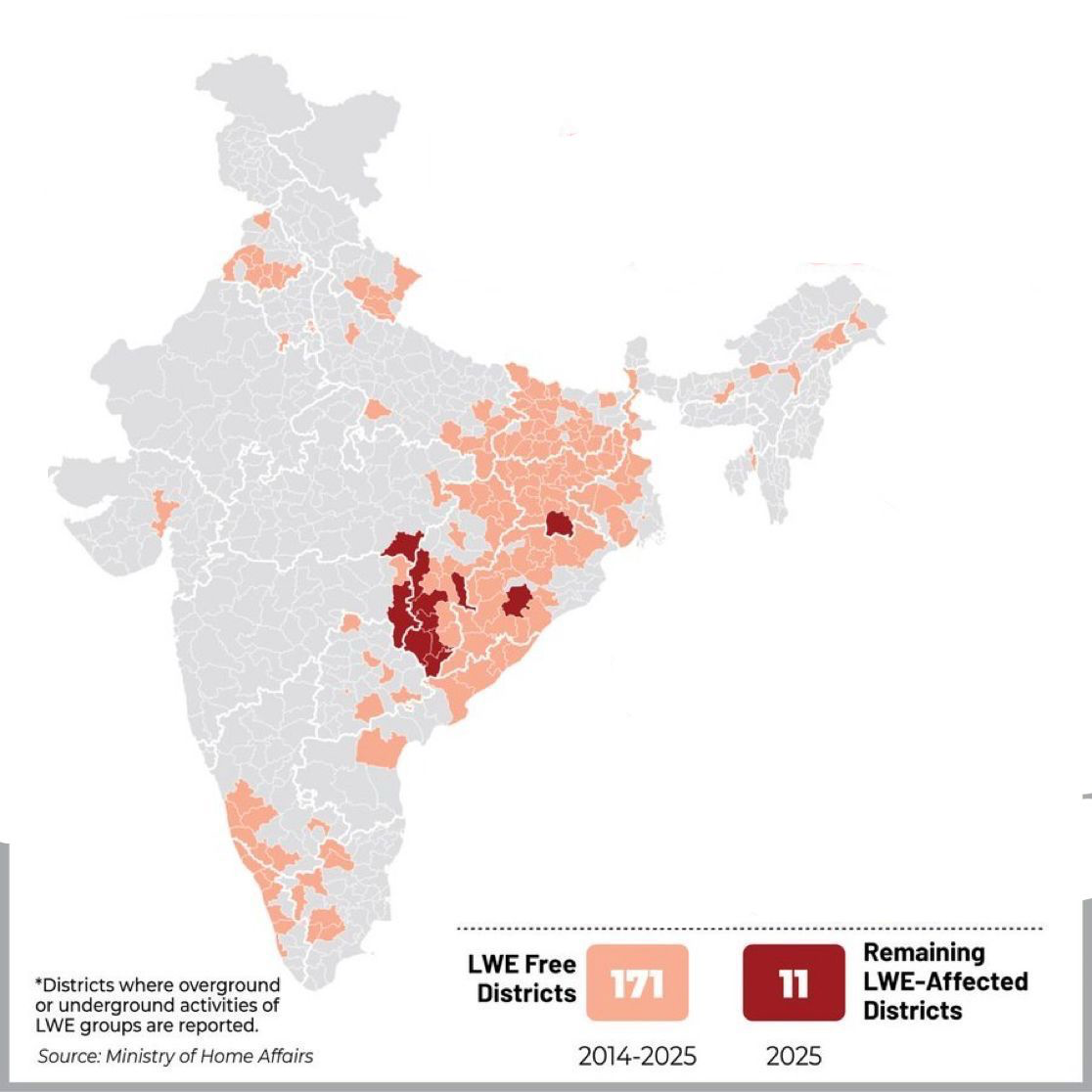
  • The future of governance in post-Maoist India

    Introduction

    The Maoist movement in India emerged and expanded not merely as an armed insurgency but as a response to prolonged governance failure in Fifth Schedule areas. Administrative neglect, weak service delivery, erosion of tribal self-governance, and systematic alienation from land and forests created conditions for parallel Maoist authority structures. While security operations have weakened Maoist violence, the deeper governance paradoxes of the Fifth Schedule administration remain unresolved, threatening durable peace and democratic legitimacy.

    Why in the News

    The article gains relevance as India enters a post-Maoist phase in several Fifth Schedule districts following sustained security operations. While insurgent violence has declined sharply since the peak of the 1990s and early 2000s, governance outcomes in these regions remain weak. Planning Commission’s Expert Group (2008) recorded that regions with abundant natural resources were reduced to “penury due to state neglect and poor governance.” Despite constitutional safeguards, tribal areas continue to face under-representation, diluted self-rule, and extractive development. The contrast between declining insurgency and persistent governance failure marks a critical inflection point in India’s internal security and federal governance trajectory.

    Evolution of Maoism as a Governance Phenomenon

    1. Administrative Neglect: Enabled Maoist penetration by leaving large governance vacuums in health, education, policing, and justice delivery.
    2. Parallel Authority Structures: Maoists provided dispute resolution, welfare access, food rations, and swift justice through kangaroo courts.
    3. Political Mobilisation: Insurgency functioned as a vehicle for tribal assertion against state institutions perceived as extractive.

    Constitutional Vision of the Fifth Schedule

    1. Protective Framework: Designed as a socio-political contract recognising distinct tribal histories and vulnerabilities.
    2. Institutional Architecture: Tribal Advisory Councils, Governor’s special powers, and restrictions on land alienation.
    3. Developmental Autonomy: Emphasised governance aligned with tribal customs, livelihoods, and cultural preservation.

    Structural Failures in Fifth Schedule Governance

    1. Under-Representation of Adivasis: Locals largely excluded from bureaucracy, policing, and revenue administration.
    2. Administrative Alienation: Officials lacked cultural familiarity and sensitivity to tribal social structures.
    3. Weak Institutional Capacity: Fifth Schedule provisions remained procedural rather than transformative.

    Land, Forests, and the Crisis of Resource Governance

    1. Land Alienation: Millions dispossessed despite constitutional safeguards and land acquisition laws.
    2. Revenue Administration Abuse: Land acquisition and forest governance emerged as the most violated provisions.
    3. Extractive Development Model: Mineral-rich regions experienced development without local benefit-sharing.

    Failure of Decentralised Self-Governance Mechanisms

    1. PESA Dilution: Panchayat Extension to Scheduled Areas Act remained poorly implemented and routinely violated.
    2. Gram Sabha Marginalisation: Consent provisions ignored in mining, land acquisition, and forest diversion.
    3. State Resistance: Amendments and administrative practices diluted original intent of self-rule.

    Contradictions in Rights-Based Legislation

    1. Forest Rights Act (FRA): Provided legal protection but faced bureaucratic resistance and weak enforcement.
    2. CAF Act, 2016: Prioritised compensatory afforestation over livelihood and habitation rights.
    3. Legal Dilution: Judicial and executive interventions weakened protective intent of tribal legislation.

    Governance Improvements and Their Limits

    1. Service Delivery Gains: Improved access to roads, telecom, welfare schemes, and digital payments.
    2. Digital Governance: Cash transfers and e-governance reduced some leakages.
    3. Persistent Institutional Weakness: Education, policing, health, judiciary, and revenue administration remain inadequate.

    Post-Maoist Governance Challenge

    1. Leadership Vacuum: Absence of credible tribal leadership in governance institutions.
    2. Performance Deficit: Panchayats in Fifth Schedule areas underperform compared to Sixth Schedule autonomous councils.
    3. Trust Deficit: Continued alienation risks ideological re-radicalisation despite reduced violence.

    Way Forward

    1. Fifth Schedule Reorientation: Ensures faithful implementation of constitutional safeguards by operationalising the Governor’s special responsibilities, strengthening Tribal Advisory Councils, and limiting routine administrative overrides.
    2. PESA-Centred Decentralisation: Restores primacy of Gram Sabhas in land acquisition, mining approvals, forest governance, and welfare delivery to re-establish democratic legitimacy at the grassroots.
    3. Rights-Based Resource Governance: Enforces Forest Rights Act provisions in letter and spirit, integrates livelihood security with conservation, and curbs extractive practices that marginalise tribal communities.
    4. Administrative Inclusion: Expands recruitment, posting, and capacity-building of local tribal personnel in policing, revenue administration, and service delivery institutions.
    5. Development-Security Convergence: Aligns security operations with civil administration through coordinated district.

    Conclusion

    The retreat of Maoist violence in large parts of India marks a significant security achievement, but it does not signify the resolution of the deeper governance crisis that gave rise to Left Wing Extremism. Persistent administrative under-representation of adivasis, dilution of Fifth Schedule protections, weak implementation of PESA and forest rights, and extractive resource governance continue to erode state legitimacy in these regions. Without restoring genuine tribal self-governance, strengthening local institutions, and aligning development with constitutional intent, the post-Maoist phase risks becoming a period of fragile stability rather than durable peace. Sustainable normalcy in Fifth Schedule areas ultimately depends on governance reform, not security dominance alone.

    PYQ Relevance

    [UPSC 2020] What are the determinants of left-wing extremism in Eastern part of India? What strategy should the Government of India, civil administration and security forces adopt to counter the threat in the affected areas? 

    Linkage: This question directly falls under GS Paper III (Internal Security), particularly the syllabus areas of Left Wing Extremism (LWE), role of governance deficits in internal security, and coordinated civil-security responses. It tests the ability to link development, governance, and security, a recurring UPSC demand.

  • Does India need to upgrade its biosecurity measures

    Introduction

    Biosecurity refers to institutional and regulatory measures designed to prevent the intentional misuse of biological agents, toxins, or technologies. Unlike biosafety, which focuses on preventing accidental release of pathogens, biosecurity addresses deliberate threats to human, animal, and agricultural health. The expansion of biotechnology has increased human control over biological systems, simultaneously raising the risk of malicious exploitation and necessitating upgraded governance mechanisms.

    Understanding Biosecurity in the Indian Context

    1. Conceptual Scope: Ensures prevention, detection, and response to intentional misuse of biological agents across laboratories, agriculture, and public health systems.
    2. Differentiation from Biosafety: Addresses deliberate misuse rather than accidental pathogen release.
    3. Sectoral Coverage: Extends protection beyond human health to livestock, crops, and supply chains.

    Evolution of Global Biosecurity Norms

    1. Biological Weapons Convention (1975): Prohibits development, use, and stockpiling of biological weapons and mandates destruction of existing arsenals.
    2. Normative Significance: Establishes the first global legal framework banning an entire category of weapons of mass destruction.
    3. Implementation Gap: Lacks a verification mechanism, increasing reliance on national biosecurity systems.

    Drivers of Biosecurity Risks in India

    1. Geographical Exposure: Facilitates cross-border transmission of pathogens due to porous borders and ecological diversity.
    2. Agrarian Dependence: Increases vulnerability of food systems to agro-terrorism and livestock disease outbreaks.
    3. Population Density: Amplifies impact of biological incidents on public health infrastructure.
    4. Non-State Actor Threats: Highlights risks from terror groups, illustrated by reported Ricin toxin preparation cases.

    Role of Emerging Biotechnologies

    1. Dual-Use Nature: Enables legitimate research while lowering entry barriers for malicious experimentation.
    2. Technological Diffusion: Expands access to genetic manipulation tools beyond state laboratories.
    3. Risk Amplification: Increases probability of low-cost, high-impact biological incidents.

    India’s Existing Biosecurity Architecture

    1. Department of Biotechnology: Oversees research governance and laboratory safety frameworks.
    2. National Centre for Disease Control: Manages disease surveillance and outbreak response systems.
    3. Department of Animal Husbandry and Dairying: Monitors livestock biosecurity and transboundary diseases.
    4. Plant Quarantine Organisation of India: Regulates agricultural imports and exports to prevent pest and pathogen entry.
    5. Legal Frameworks:
      1. Environment (Protection) Act, 1986: Regulates hazardous microorganisms and GMOs.
      2. WMD and Delivery Systems Act, 2005: Criminalises unlawful biological weapons activities.

    Institutional and Legal Gaps Highlighted

    1. Fragmented Governance: Dispersed responsibilities across multiple ministries without unified coordination.
    2. Surveillance Asymmetry: Strong outbreak response but weaker preventive intelligence mechanisms.
    3. Non-State Actor Focus: Limited emphasis on bio-terrorism preparedness compared to conventional security threats.

    Conclusion

    India’s internal security landscape is being reshaped by the convergence of emerging technologies, porous borders, and the growing role of non-state actors. While the country has built sectoral capacities in health, agriculture, and research governance, the absence of an integrated biosecurity framework leaves critical gaps in prevention and early detection. Strengthening biosecurity is therefore not only a public health or scientific necessity but a core internal security imperative, requiring coordinated regulation, intelligence integration, and sustained institutional preparedness.