💥Join UPSC 2027,2028 Mentorship (July Batch) + XFactor Notes & Microthemes PDF

Subject: Internal Security

  • [pib] Exercise Pacific Reach, 2025

    Why in the News?

    INS Nistar, the Navy’s new indigenous Diving Support Vessel, made its maiden port call at Singapore to join the multinational Exercise Pacific Reach 2025.

    About Exercise Pacific Reach:

    • Overview: A biennial, multinational submarine rescue exercise initiated in 1996 (Asia-Pacific).
    • Objective: Enhances cooperation, interoperability, and readiness in submarine rescue.
    • Pacific Reach 2025 (XPR-25): 9th edition, hosted by Singapore.
    • Phases:
      • Harbour Phase: Seminars, Subject Matter Expert Exchanges (SMEE), medical symposium, cross-deck visits.
      • Sea Phase: Live submarine rescue drills, intervention ops, deep-water simulated emergencies, and Mass Evacuation Exercises (MASSEVEX).
    • Participation: 40+ countries (participants + observers).

    India’s Participation:

    • INS Nistar: India’s indigenous Diving Support Vessel (DSV), mothership for Deep Submergence Rescue Vehicle (DSRV).
    • Submarine Rescue Unit (East): Taking part in live rescue drills.
    • Significance: Showcases 80% indigenous capability (built by Hindustan Shipyard Ltd), and positions India as a regional leader in humanitarian submarine rescue.

    Back2Basics: INS Nistar

    • Commissioning: First indigenous DSV, commissioned July 2025 at Visakhapatnam.
    • Design: Built with 80% indigenous content, in line with Aatmanirbhar Bharat.
    • Capability: Supports DSRV rescue ops up to 300 m; equipped with ROVs, hyperbaric lifeboats, subsea cranes, helipad, and medical facilities.
    • Role: Provides endurance for long missions, reinforcing India’s deep-sea rescue & maritime safety architecture.
  • To build Roads is to build peace: Developmet in tribal hinterlands affected by Maoist Insurgency

    Introduction

    Roads in India’s Maoist-affected areas are more than physical infrastructure; they are symbols of the state itself. For communities long governed by neglect or non-state actors, the arrival of a road often marks the first visible sign of governance. Research and field evidence indicate that road development improves access to electricity, healthcare, education, and security while simultaneously displacing the influence of insurgents. Yet, roads alone cannot resolve conflict—they must be embedded in an ecosystem of justice, dignity, and inclusion.

    Why is this in the news?

    In regions affected by Maoist insurgency, particularly in Chhattisgarh, Jharkhand, and Odisha, roads have emerged as a strategic instrument of peacebuilding. Recent studies (Jain & Biswas, 2023) show a correlation between road connectivity and reduced crime, while international evidence (Prieto-Curiel & Menezes, 2020) highlights how poor connectivity perpetuates violence globally. This marks a shift in governance strategy, from viewing infrastructure as purely developmental to recognizing it as a political and stabilising force.

    How do roads reclaim governance from insurgents?

    1. Governance presence: Roads bring schools, clinics, and police stations, representing visible and accountable state authority.
    2. Displacement of parallel systems: Maoists often establish informal courts, taxation systems, and welfare activities in remote areas. Roads weaken these structures by enabling the state to reclaim legitimacy.
    3. Diego Gambetta’s insight: Like the Sicilian Mafia, insurgents thrive where the state withdraws. Infrastructure fills the governance vacuum.

    What role do insurgent groups play in governance gaps?

    1. Informal welfare: Research by Alpa Shah (2018) and Human Rights Watch (2009) shows Maoists provide rudimentary health and welfare services in villages.
    2. Strategic legitimacy: As Zachariah Mampilly (2011) argues, such services are not altruistic but intended to gain legitimacy.
    3. Coercion with care: Maoist medical aid or welfare is tied to fear and control, not democratic accountability.

    Why are extralegal institutions problematic?

    1. Absence of safeguards: Maoist-run “jan adalats” often issue punishments, even executions, without due process.
    2. Opaque justice: Decisions reflect entrenched hierarchies, patriarchy, and mob reprisals rather than rule of law.
    3. Comparison with khap panchayats: Like insurgent institutions, caste councils also deliver swift but exclusionary justice outside constitutional norms.

    How do roads act as political infrastructure?

    1. Symbolic presence: Each road signals that “the state is here to stay,” as seen in Chhattisgarh under B.V.R. Subrahmanyam’s governance strategy.
    2. Crime reduction: Jain and Biswas (2023) show connectivity lowers rural crime rates.
    3. Global parallels: Prieto-Curiel & Menezes (2020) demonstrate that poor connectivity correlates with higher violence across contexts.

    What safeguards are essential for success?

    1. Justice mechanisms: Roads must be accompanied by functioning courts and legal institutions to prevent arbitrary authority.
    2. Healthcare and welfare: Clinics, schools, and social infrastructure ensure that development is inclusive.
    3. Community participation: Roads must be built with the village, not just through the village, to ensure legitimacy and trust.

    Conclusion

    Roads in conflict-prone tribal regions represent more than mobility, they embody the arrival of governance and the possibility of peace. Yet, infrastructure without justice risks becoming a symbol of control rather than inclusion. For lasting impact, roads must be accompanied by democratic institutions, safeguards, and rights-based governance. To build roads, then, is indeed to build peace.

    Value Addition

    Naxalism: Definition & Origins

    • Definition: Left-Wing Extremism (LWE); armed, rural-based movement rooted in land alienation, poverty, displacement, forest rights, and state neglect.
    • Origins: Began with the 1967 Naxalbari peasant uprising in West Bengal; later consolidated under CPI (Maoist) formations.
    • Areas Most Affected — Historical Peak (late 2000s)
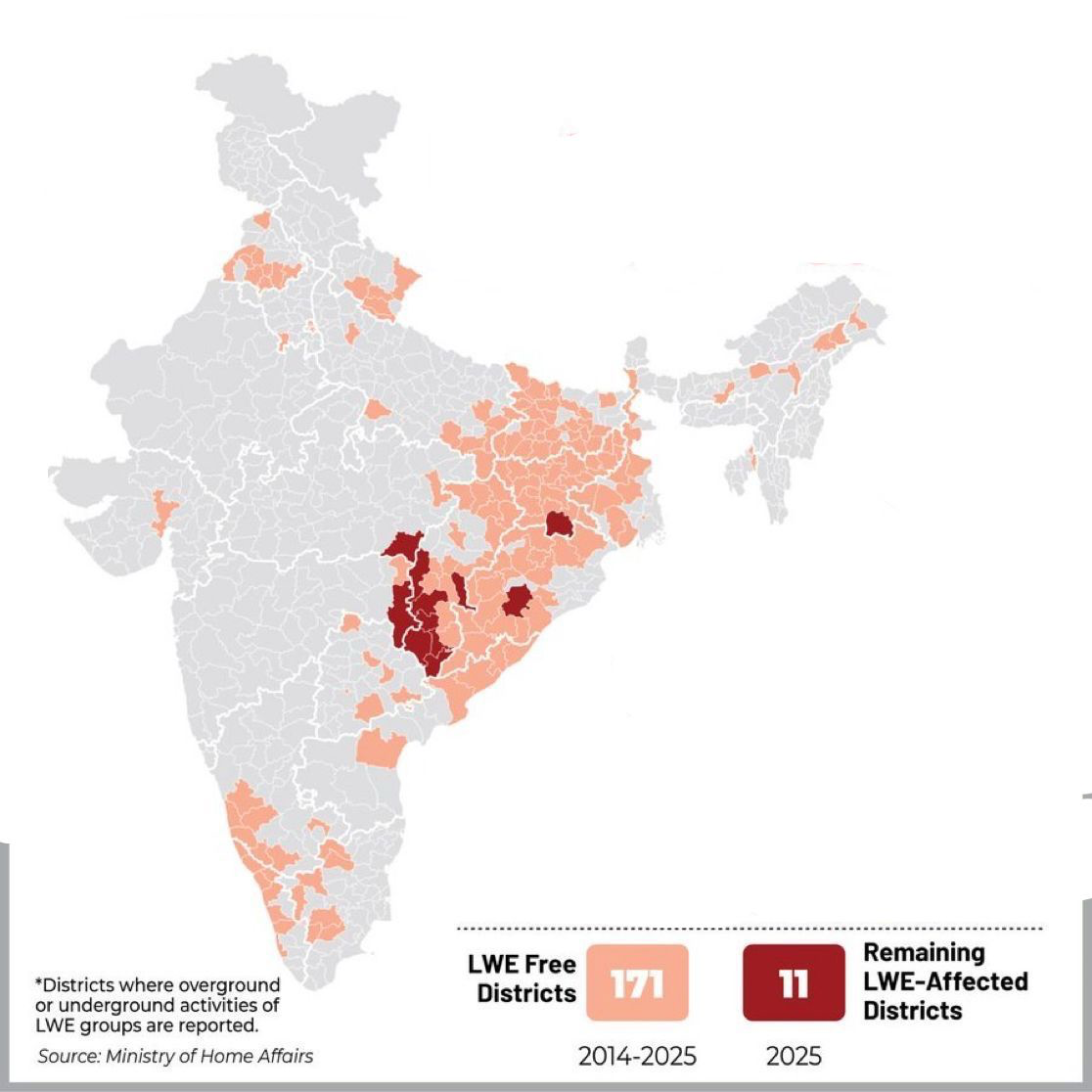
      • Spread: Nearly 180 districts across multiple states — the so-called Red Corridor.
      • Core states: Chhattisgarh, Jharkhand, Odisha, Bihar, Andhra Pradesh/Telangana, parts of Maharashtra & Madhya Pradesh.
    • Areas Most Affected — Recent (2024–25)
      • Reduced footprint: Down to ~38 districts (2024); further shrinking per 2025 statements.
      • Residual hotspots: Bastar (Chhattisgarh), Gadchiroli (Maharashtra), parts of Jharkhand & Odisha, and Chhattisgarh–Telangana border.
    • Why This Shift Matters 
      • Then: Widespread insurgency → blanket rural development response.
      • Now: Concentrated in forested pockets → targeted counter-insurgency + development (roads, police camps, rehabilitation).

    What is Operation Black Forest?

    • What / where / when: Operation Black Forest (also reported as Operation Kagar in some outlets) was a focused anti-Maoist offensive launched along the Chhattisgarh–Telangana border in April–May 2025 targeting PLGA (People’s Liberation Guerrilla Army) units in hilly forest belts such as the Kareguttalu/Karegutta hills. 
    • Claimed outcomes (official account): The government/security forces announced significant results — arrests, large recoveries of IEDs, explosives and weapons and the neutralisation (killed/captured) of several Maoists; the Home Minister hailed the operation as a major success and linked it to the government’s goal of a “Naxal-free India.’’

    India’s Current Strategy Against Naxalism

    • Security operations & coordination – Intensified offensives (e.g., Operation Black Forest), joint CRPF/state police actions, inter-state Unified Commands.
    • Connectivity first – Roads → schools → clinics → police camps; infrastructure as the entry point of governance.
    • Surrender & rehabilitation – Incentives for cadres to lay down arms, with livelihood and legal reintegration support.
    • Technology & intelligence – Use of UAVs, better signal interception, geolocation, and joint intel sharing.
    • Development & governance – Focus on PESA, land and forest rights, MGNREGA, social welfare schemes to address grievances.
    • Exam angle: India uses a mix of “hard” (security, tech) and “soft” (development, rights, rehab) measures — success lies in balancing both.

    Way Forward (Practical + Scholarly Insights)

    • Consolidate gains, avoid militarised development – Pair operations with public-goods delivery to build trust.
    • Rights-based development – Implement PESA/FRA in spirit; ensure Gram Sabha consent and agency.
    • Build accountable institutions – Mobile courts, health camps, schools, and police with transparency; replace jan adalats with constitutional justice.
    • Credible rehabilitation – Beyond cash payouts, provide skills, jobs, and long-term livelihood security.
    • Address political economy – Regulate mining/plantation projects; enforce benefit-sharing and consent to prevent discontent.
    • Theoretical insightsGambetta: extralegal actors thrive in governance vacuums → fill with state services. Mampilly: insurgent welfare is strategic → counter with accountable service delivery.
    • Human rights monitoring – Independent oversight of security and development efforts to ensure legitimacy.
    • One-liner synthesis for mains: Operational successes show improved reach, but a true “Naxal-free” India requires roads + rights + jobs anchored in constitutional justice and inclusive governance.

    PYQ Relevance

    [UPSC 2022] Naxalism is a social, economic and development issues manifesting as a violent internal security threat. In this context, discuss the emerging issues and suggest a multilayered strategy to tackle the menace of Naxalism.

    Linkage: The article shows how roads act as instruments of governance, reducing isolation and weakening insurgent legitimacy, thereby addressing the socio-economic roots of Naxalism. Yet, it cautions that infrastructure alone cannot resolve conflict unless coupled with justice, healthcare, education, and community participation. This aligns with the PYQ’s call for a multi-layered strategy—combining development, security, and rights-based governance.

  • [pib] Exercise ZAPAD 2025

    Why in the News?

    An Indian Armed Forces contingent has departed for Mulino Training Ground, Nizhniy, Russia, to participate in Exercise ZAPAD 2025.

    About Exercise ZAPAD:

    • Meaning: “ZAPAD” means West in Russian; a series of large-scale joint strategic military drills led by Russia and Belarus.
    • Origins: Started during the Soviet era with Zapad-77, Zapad-81, Zapad-84, reflecting Cold War dynamics.
    • Post-Soviet Revival: Resumed with Zapad-99 (1999), partly as a response to NATO’s Yugoslavia operations.
    • Frequency: Held about once every 4 years, with major editions in 2009, 2013, 2017, 2021, and 2025.
    • Series Context: Forms part of Russia’s rotating operational drills along with Vostok (East), Tsentr (Central), and Kavkaz (Caucasus).
    • Scale: Zapad-2021 involved ~200,000 personnel from 17 countries, one of the largest recent drills.

    Geopolitical Significance:

    • Deterrence: Sends a strategic message to NATO about Russian readiness.
    • Allied Assurance: Reassures Russia’s partners and allies of its military strength.
    [UPSC 2024] Which of the following statements about ‘Exercise Mitra Shakti-2023’ are correct?

    1. This was a joint military exercise between India and Bangladesh.

    2. It commenced in Aundh (Pune).

    3. Joint response during counter-terrorism operations was a goal of this operation.

    4. Indian Air Force was a part of this exercise.

    Select the answer using the code given below:


    Options: (a) 1, 2 and 3 (b) 1 and 4 (c) 1 and 4 (d) 2, 3 and 4*


  • Technology Perspective and Capability Roadmap (TPCR-2025)

    Why in the News?

    The Ministry of Defence has released the Technology Perspective and Capability Roadmap 2025 (TPCR-2025), a 15-year blueprint for military preparedness and modernization.

    About Technology Perspective and Capability Roadmap (TPCR-2025):

    • Overview: A strategic modernization blueprint released by the Ministry of Defence to guide India’s Armed Forces for the next 10–15 years.
    • Scope: Covers tri-services for multi-domain operations across land, sea, air, cyber, and space.
    • Industry Role: Provides clear requirements to defence industry, MSMEs, and start-ups to focus R&D, manufacturing, and innovation.
    • Policy Alignment: Linked to Atmanirbhar Bharat, reducing import dependence and strengthening indigenous production.
    • Objective: Ensure forces remain technologically competitive, prepared for emerging threats, and resilient in a dynamic security environment.

    Key Features of TPCR-2025:

    • Nuclear & CBRN Preparedness: Strengthening nuclear command systems, survivability infrastructure, radiation detection, decontamination units, unmanned CBRN (Chemical, Biological, Radiological, and Nuclear) vehicles.
    • Drones & Unmanned Systems: Development of stealth drones (range 1,500 km, altitude 60,000 ft), AI-enabled loitering munitions, anti-drone EW bubbles.
    • Electronic & Cyber Warfare: Deployment of advanced jammers, EW payloads, info-dominance systems, and readiness for cyber and space warfare.
    • Service Modernization:
      • Army: New tanks, light tanks, UAV-launched PGMs, electromagnetic weapons.
      • Navy: New destroyers, corvettes, mine vessels, nuclear-powered warships, third aircraft carrier.
      • Air Force: Stratospheric airships, long-range cruise missiles, hardened PGMs.
    • Implementation: Regular industry–services consultations, engagement with MSMEs and start-ups, periodic updates.

    Significance:

    • Serves as a capability roadmap for long-term defence planning.
    • Strengthens domestic defence ecosystem.
    • Ensures future combat readiness in multi-domain operations.
    [UPSC 2020] In India, why are some nuclear reactors kept under “IAEA safeguards” while others are not?

    Options: (a) Some use uranium and others use thorium

    (b) Some use imported uranium and others use domestic supplies

    (c) Some are operated by foreign enterprises and others are operated by domestic enterprises

    (d) Some are State-owned and others are privately owned *


  • What is Free Movement Regime (FMR)?

    Why in the News?

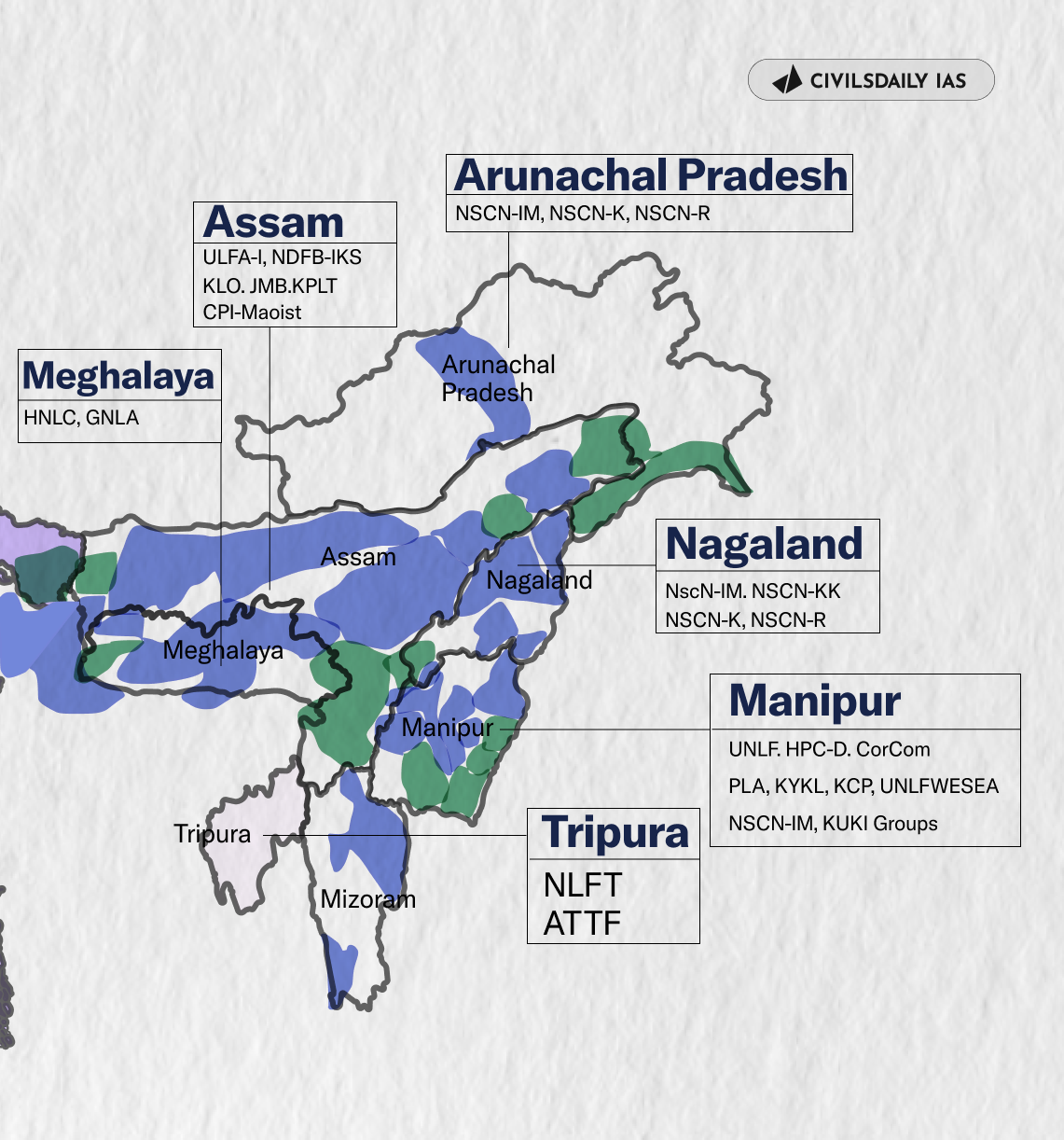
    Ahead of PM Modi’s Manipur visit, United Naga Council (UNC) has announced a trade embargo from against the India–Myanmar border fence and the suspension of the Free Movement Regime (FMR).

    What is Free Movement Regime (FMR)?

    About the Free Movement Regime (FMR):

    • Overview: Introduced in the 1970s, FMR allowed residents within 16 km of the India–Myanmar border to travel freely up to 16 km across without visa requirements.
    • Border length: India–Myanmar border stretches 1,643 km across four states: Arunachal Pradesh (520 km), Nagaland (215 km), Manipur (398 km), Mizoram (510 km).
    • Purpose: To recognize ethnic, cultural, and familial ties of communities (Kuki, Naga, Mizo, etc.) living across the unfenced border.
    • Revision: Last revised in 2016 under the Act East Policy.
    • Suspension: On February 8, 2024, MHA formally announced its scrapping, citing:
      • Internal security risks.
      • Illegal immigration and demographic changes in NE states.
      • Cross-border drug trafficking and insurgency links.

    Stakeholder Perspectives:

    • Kuki groups: View FMR suspension and fencing as an attack on shared ethnic ties, even comparing it to the Berlin Wall. Recently reached an understanding with MHA negotiators.
    • Naga groups (UNC): Strongly opposed to border fencing and FMR suspension, claiming it undermines homeland, land rights, and identity. Announced a trade embargo in protest.
    • Meiteis (Valley population): Support suspension, arguing that FMR facilitated illegal migration, illicit drug trade, and aggravated ethnic tensions.
    • Government of India: Defends suspension on security and demographic grounds, while attempting to balance peace talks with tribal groups.
    [UPSC 2016] Consider the following statements:

    I. Assam shares a border with Bhutan and Bangladesh

    II. West Bengal shares a border with Bhutan and Nepal

    III. Mizoram shares a border with Bangladesh and Myanmar

    Which of the statements given above are correct?

    Options: (a) I, II and III * (b) I and II only (c) II and III only (d) I and III only


  • Immigration and Foreigners (Exemption) Order, 2025

    Why in the News?

    The Ministry of Home Affairs (MHA) has issued the Immigration and Foreigners (Exemption) Order, 2025, notified under Section 33 of the Immigration and Foreigners Act, 2025.

    What is Immigration and Foreigners Act, 2025?

    • Enactment: Passed by Parliament, effective 1 Sept 2025.
    • Objective: Unifies scattered immigration laws into a single framework, balancing national security, demographic protection, humanitarian obligations, and economic openness.
    • Repeals: Passport (Entry into India) Act, 1920; Registration of Foreigners Act, 1939; Foreigners Act, 1946; Immigration (Carriers’ Liability) Act, 2000.
    • Key Provisions:
      • All foreigners must enter, stay, exit with valid passport & visa, unless exempted.
      • Digital system with biometrics, AI-based monitoring, and real-time agency coordination.
      • New visa categories: Skilled Talent, Startup, Investor, Digital Nomad, Business Plus.
      • Mandatory reporting by hotels, landlords, universities, hospitals on foreign guests/students/patients.
      • Entry to protected/restricted areas subject to special permits; mountaineering expeditions need prior approval.
    • Penalties: Up to 7 years imprisonment and ₹10 lakh fine for forged documents; detention centres allowed for illegal foreigners till deportation.
    • Institutions:
      • National Immigration Authority for policy and central database.
      • Bureau of Immigration, led by Commissioner, for operations.

    About Immigration and Foreigners (Exemption) Order, 2025:

    • Overview: Issued by Ministry of Home Affairs (MHA) on 1 Sept 2025 under Section 33 of the Immigration and Foreigners Act, 2025.
    • Objective: Consolidates earlier scattered exemptions to simplify rules, enable regional mobility with Nepal & Bhutan, extend humanitarian relief to refugees/persecuted minorities, and provide legal clarity to carriers.
    • Replaces: The Registration of Foreigners (Exemption) Order, 1957 and Immigration (Carriers’ Liability) Order, 2007.
    • Exemptions:
      • Indian Armed Forces members on duty and families using govt transport.
      • Indian citizens entering via Nepal/Bhutan borders.
      • Nepal & Bhutan citizens (except if entering from China, Hong Kong, Macau, Pakistan).
      • Tibetans registered with India, religious minorities from Afghanistan, Bangladesh, Pakistan (who entered before Dec 31, 2024), and Sri Lankan Tamils sheltered till Jan 9, 2015.
      • Diplomats, visa-on-arrival nationals, foreign military personnel on goodwill or exercises.
    • Carriers’ Liability: Rail, road, air, sea operators exempted where forged documents need expert verification or ships/aircraft are diverted.
    [UPSC 2021] With reference to India, consider the following statements:

    1.There is only one citizenship and one domicile.

    2.A citizen by birth only can become the Head of State.

    3.A foreigner, once granted citizenship, cannot be deprived of it under any circumstances.

    Which of the statements given above is/are correct?

    Options: (a) 1 only* (b) 2 only (c) 1 and 3 (d) 2 and 3


  • [pib] Exercise ‘BRIGHT STAR 2025’

    Why in the News?

    India is set to participate with over 700 personnel from tri-services for 19th edition of Exercise Bright Star 2025 in Egypt.

    About Exercise Bright Star:

    • Origin: Began in 1980 as a US–Egypt bilateral drill after the Egypt–Israel peace treaty.
    • Nature: Now one of the largest and longest-running multinational tri-service military exercises in the Middle East.
    • Frequency: Held biennially in Egypt with the United States as the principal partner.
    • Objectives:
      • Enhance regional security and stability.
      • Improve jointness, interoperability, and operational coordination among partner nations.

    Key Highlights of the 2025 Edition:

    • Scale: Approximate 7,900 troops from 43 nations.
      • 13 countries directly deploying troops.
      • 30 countries participating as observers.
    • Strategic Significance:
      • Builds defence cooperation between India, Egypt, US, and partner nations.
      • Important amid West Asia, Red Sea, and Gulf security challenges.
    [UPSC 2024] Which of the following statements about ‘Exercise Mitra Shakti-2023’ are correct?

    1. This was a joint military exercise between India and Bangladesh.

    2. It commenced in Aundh (Pune).

    3. Joint response during counter-terrorism operations was a goal of this operation.

    4. Indian Air Force was a part of this exercise.

    Select the answer using the code given below:

    Options: (a) 1, 2 and 3 (b) 1 and 4 (c) 1 and 4 (d) 2, 3 and 4*


  • Exercise Maitree

    Why in the News?

    The 14th Maitree Exercise between Indian and Thai Army will be held in Umroi, Meghalaya returning to India after five years.

    About Exercise Maitree:

    • Overview: A bilateral military exercise between the Indian Army and the Royal Thai Army.
    • Started: 2006, as a collaborative initiative to deepen defense ties.
    • Frequency: Held annually, alternating between India and Thailand.
    • Participants: Company-level contingents (approx. 70–80 soldiers each); Indian units have included Ladakh Scouts, while Thai units have included Infantry Regiments.
    • Objective: To build interoperability, mutual trust, and cooperation in counter-terrorism, insurgency management, and peacekeeping operations.

    Key Features:

    • Counter-Terrorism Focus: Joint training for counter-terror and counter-insurgency operations, especially in semi-urban and jungle terrain.
    • UN Mandate Training: Exercises designed to simulate peacekeeping operations under UN Charter VII.
    • Humanitarian Drills: Includes disaster relief, humanitarian assistance, and urban evacuation operations.
    • Strategic Relevance:
      • Strengthens India–Thailand defense cooperation under the 2012 MoU.
      • Supports India’s Act East Policy and shared maritime/strategic interests in the Bay of Bengal–Andaman Sea region.
      • Enhances interoperability for multinational operations and regional stability.
    [UPSC 2024] Which of the following statements about ‘Exercise Mitra Shakti-2023’ are correct?

    1. This was a joint military exercise between India and Bangladesh.

    2. It commenced in Aundh (Pune).

    3. Joint response during counter-terrorism operations was a goal of this operation.

    4. Indian Air Force was a part of this exercise.

    Select the answer using the code given below:

    Options: (a) 1, 2 and 3 (b) 1 and 4 (c) 1 and 4 (d) 2, 3 and 4*


  • Induction of INS Udaygiri and INS Himgiri Stealth Nilgiri Class Frigates

    Why in the News?

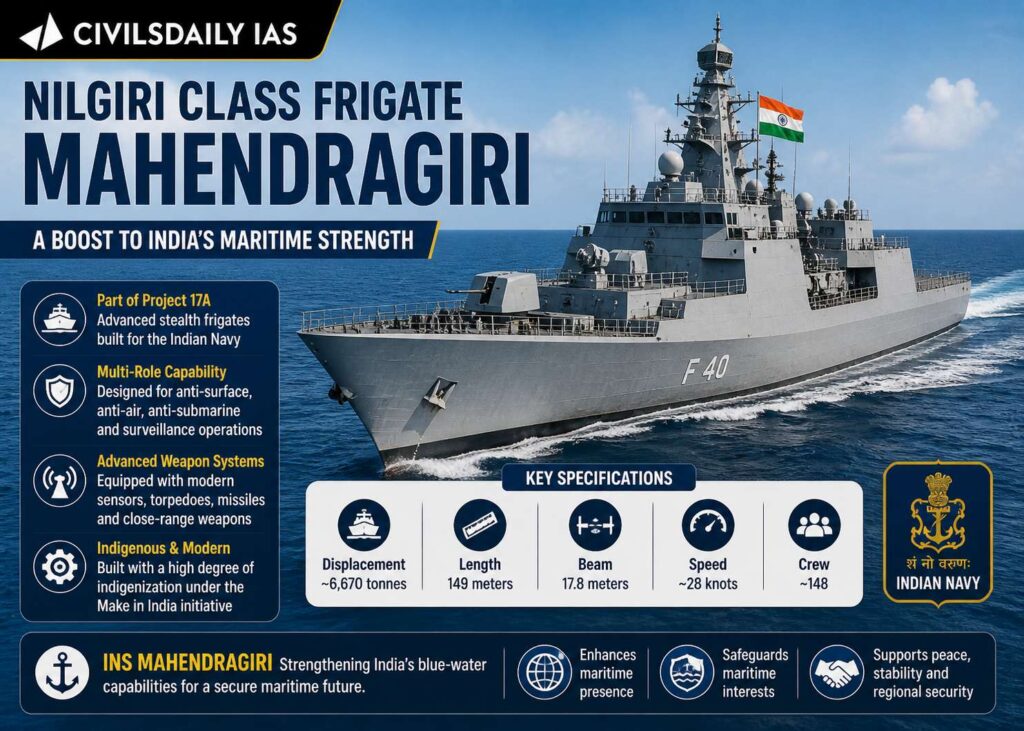
    The Indian Navy has commissioned INS Udaygiri and INS Himgiri, Nilgiri-class frigates built under Project 17A, at Visakhapatnam.

    Induction of INS Udaygiri and INS Himgiri Stealth Nilgiri Class Frigates

    About INS Udaygiri & INS Himgiri:

    Feature INS Udaygiri INS Himgiri
    Builder Mazagon Dock Shipbuilders Ltd. (MDL), Mumbai Garden Reach Shipbuilders & Engineers (GRSE), Kolkata
    Series / Class 2nd ship of Project 17A;

    100th vessel designed by Navy’s Warship Design Bureau

    1st Project 17A frigate from GRSE
    Naming After Udaygiri mountain range (AP); earlier ship (1976–2007) Legacy of original INS Himgiri (1974–2005)
    Displacement / Size ~6,700 tonnes ~6,670 tonnes; Length: 149 m
    Propulsion CODOG (Combined Diesel or Gas) CODOG; speeds 28+ knots
    Stealth Features Reduced radar, infrared, and acoustic signatures Enhanced radar & IR signature reduction
    Armament BrahMos, Barak-8 SAMs, 76 mm gun, CIWS, advanced ASW weapons BrahMos, Barak-8, CIWS, ASW rocket launchers, torpedo tubes, EW systems
    Aviation Facilities Flight deck + hangar for MH-60 Romeo, ALH Dhruv Mk-III, Sea King helicopters
    Indigenous Content ~75% (local sensors, systems, IPMS) ~75%


    [UPSC 2016] Which one of the following is the best description of ‘INS Astradharini’, that was in the news recently?

    Options: (a) Amphibious warfare ship (b) Nuclear-powered submarine (c) Torpedo launch and recovery vessel* (d) Nuclear-powered aircraft carrier


  • How have deception techniques evolved

    Introduction

    Modern warfare is no longer about firepower alone; it is equally about deception. As precision-guided missiles, drones, and AI-enabled targeting systems grow deadlier, militaries are turning to decoy technologies to confuse radars, mislead missiles, and protect valuable assets. India’s reported use of the AI-enabled X-Guard decoy during Operation Sindoor shows how deception has become a central element of national security strategy.

    The Growing Relevance of Deception in Modern Warfare:

    1. Evolving threat environment: Precision-guided munitions, drones, and AI-enabled targeting systems make military platforms highly vulnerable.
    2. Strategic asset: Decoys create confusion, waste enemy munitions, and buy crucial time for retaliation.
    3. Game-changing event: Operation Sindoor showcased India’s successful use of an AI-enabled decoy, termed by experts as “the best instance of spoofing and deception ever seen.”

    Inside the X-Guard Fibre-Optic Towed Decoy 

    1. Lightweight & reusable: At just 30 kg, retractable and deployable in flight.
    2. Radar mimicry: Replicates the Rafale’s Radar Cross Section (RCS), doppler velocity, and spectral signature across multiple bands.
    3. 360-degree jamming: Works seamlessly with the Rafale’s SPECTRA suite to form a layered defensive shield.
    4. Operational success: Reports suggest Pakistan’s J-10C fighters misidentified decoys as actual aircraft, wasting advanced PL-15E missiles.

    Global landscape of comparable decoy systems: 

    1. BriteCloud (Leonardo UL): Used on Eurofighter Typhoons, Gripen-Es, and some F-16s.
    2. AN/ALE-50/55 series (Raytheon/BAE Systems): Deployed on U.S. Navy F/A-18E/F Super Hornets.
    3. Adaptability to UAVs: Modified for platforms like Israeli Herons and U.S. MQ-9 Reapers.

    Battlefield deception on Land Forces: 

    1. Inflatable & heat-emitting decoys: Simulate tanks, artillery, and missile batteries to divert strikes.
    2. Ukraine’s wooden & 3D-printed fakes: Exhaust Russian drone and missile stocks.
    3. Russia’s Inflatech decoys: Create entire armoured formations in minutes.
    4. Indian Army initiative (2025): Issued a request for decoys mimicking T-90 tanks, including thermal and acoustic signatures.

    Naval countermeasures and Decoy strategies

    1. Layered naval countermeasures: Chaff, acoustic decoys, and offboard active deception protect against missiles and submarines.
    2. Nulka decoy (Australia–U.S.): Self-propelled system mimicking large ship radar signatures to mislead missile guidance.

    Conclusion

    Deception, once limited to camouflage and dummy equipment, has evolved into a sophisticated digital-age shield. Airborne fibre-optic decoys, inflatable ground tanks, and naval missile deflectors now define modern survivability. India’s reported use of the X-Guard highlights its adaptation to the evolving battlefield. For a relatively low investment, such systems deliver high-impact protection, proving that in the wars of tomorrow, deception may be as decisive as destruction.

    PYQ Relevance

    “How is S-400 air defence system technically superior to any other system presently available in the world?”

    Linkage: This question shows UPSC’s focus on defence technology and comparative capability analysis. The same lens applies to India’s deployment of AI-enabled decoys like the X-Guard FOTD, which enhance survivability against advanced missile systems. Both highlight the importance of evaluating cutting-edge military technology for national security.