💥Join UPSC 2027,2028 Mentorship (July Batch) + XFactor Notes & Microthemes PDF

Subject: Internal Security

  • Exercise MILAN, 2026

    Why in the News?

    India will host the International Fleet Review, Exercise MILAN- 2026, and the Indian Ocean Naval Symposium (IONS) Conclave of Chiefs together in Visakhapatnam from February 15–25, 2026.

    About Exercise MILAN:

    • Overview: Biennial multilateral naval exercise hosted by the Indian Navy to promote interoperability, maritime cooperation, and goodwill among friendly navies.
    • Origin: First conducted in 1995 under the Andaman and Nicobar Command with participation from Indonesia, Singapore, Sri Lanka, and Thailand.
    • Growth: Expanded over the years to include 40–55 participating nations, reflecting India’s growing maritime diplomacy under Act East Policy and SAGAR (Security and Growth for All in the Region) initiative.
    • Participation: The 2026 edition will see participation from over 50 navies, including the U.S., Russia, Japan, Australia, and ASEAN countries.
    • Venue: The 2026 edition will be hosted at Visakhapatnam under the Eastern Naval Command, marking the largest MILAN to date.
    • Structure: Conducted in two phases, a Harbour Phase (seminars, workshops, cultural exchanges, planning conferences) and a Sea Phase (joint operational exercises).
    • Sea Phase Activities: Includes anti-submarine warfare (ASW), air defence, maritime domain awareness (MDA), search and rescue (SAR), and complex fleet manoeuvres.
    • Strategic Significance: Strengthens regional maritime security, demonstrates India’s indigenous naval capabilities, and reinforces its role as a net security provider in the Indo-Pacific.

    Back2Basics: Indian Ocean Naval Symposium (IONS)

    • Overview: A voluntary, multilateral maritime cooperation initiative launched by the Indian Navy in 2008 to enhance regional maritime security and dialogue among littoral nations of the Indian Ocean Region (IOR).
    • Membership: Comprises 25 member states and 9 observer countries, spanning Africa, West Asia, South Asia, Southeast Asia, and Australia.
    • Objective: To promote maritime safety, security, capacity building, information sharing, and cooperation in Humanitarian Assistance and Disaster Relief (HADR) operations.
    • Chairmanship: The chairmanship rotates biennially among member nations; India will assume the chair for 2025–2027.
    • Key Areas of Focus:
      • Enhancing maritime domain awareness (MDA) and information exchange.
      • Combating piracy, illegal fishing, human trafficking, and terrorism at sea.
      • Strengthening maritime connectivity and blue economy cooperation.
      • Coordinating disaster relief and search-and-rescue operations.


    [UPSC 2024] Which of the following statements about ‘Exercise Mitra Shakti-2023’ are correct?

    1. This was a joint military exercise between India and Bangladesh.

    2. It commenced in Aundh (Pune).

    3. Joint response during counter-terrorism operations was a goal of this operation.

    4. Indian Air Force was a part of this exercise.

    Select the answer using the code given below:

    Options: (a) 1, 2 and 3 (b) 1 and 4 (c) 1 and 4 (d) 2, 3 and 4*


  • KK Park Cyber Scam Hub in Myanmar

    Why in the News?

    Around 500 Indian nationals who escaped the KK Park cybercrime compound in Myawaddy township, southeastern Myanmar, are being rescued by the Government of India.

    KK Park Cyber Scam Hub in Myanmar

    About KK Park Cyber Scam Hub:

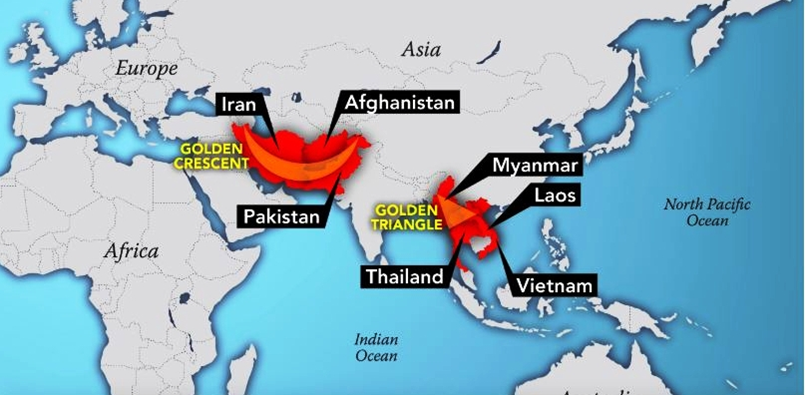
    • Location & Setting: Situated in Myawaddy township, Karen State, Myanmar, near the Thailand border; originally built (2019–2021) as a border trade zone, later transformed into a cybercrime and human trafficking hub.
    • Control & Operations: Managed by the Border Guard Force (BGF) under Saw Chit Thu, a junta-allied militia leader sanctioned by the U.S. Treasury.
    • Nature of Activities: Functions as a “scam city” employing thousands of trafficked workers for online fraud, crypto scams, and romance-investment schemes.
    • Human Trafficking: Victims are recruited via fake overseas job offers, then imprisoned, tortured, and forced to commit cybercrimes after passport confiscation.
    • Scale: At its peak, housed over 20,000 trafficked workers, generating billions annually through global online fraud networks.
    • Structure: Operated like a self-contained enclave with dormitories, shops, and armed security — preventing worker escape.

    Global Concern and UN Findings:

    • UN Reports:  Identified by the United Nations Office on Drugs and Crime (UNODC) and the Global Initiative Against Transnational Organized Crime (GI-TOC) as part of a network of cyber-scam compounds spanning Myanmar, Cambodia, and the Lao People’s Democratic Republic (Laos).
    • Economic Scale: The cyber-scam economy earns over USD 10 billion annually, victimising users in 110 countries.
    • Myanmar’s 2025 Raid: Seizure of 30 Starlink terminals was seen as a cosmetic crackdown, as ringleaders escaped beforehand.
    • UN Appeal: Calls for cross-border enforcement, crypto tracking, and victim rehabilitation, viewing scam hubs as a fusion of trafficking and transnational organised crime.

    How does it impact Indians?

    • Victimisation: India serves as both a source and target of such scams; hundreds trafficked to Myanmar and Cambodia under fake IT job offers.
    • Rescue Operations: Since 2022, over 1,600 Indians repatriated, including 500 from KK Park (2025); IAF rescued 283 stranded in Thailand earlier.
    • Cyber Threats: Rising crypto frauds, impersonation scams, and digital extortion targeting Indian citizens.
    • Government Response: EAM S. Jaishankar confirmed coordination for repatriation and stronger cyber-diplomacy engagement.
    • Policy Imperative: Highlights India’s need for international law enforcement cooperation, cybersecurity awareness, and anti-trafficking vigilance across Southeast Asia.
    [UPSC 2024] Consider the following statements:
    Statement-I: There is instability and worsening security situation in the Sahel region.
    Statement-II: There have been military takeovers/coups d’état in several countries of the Sahel region in the recent past.
    Which one of the following is correct in respect of the above statements?
    Options: (a) Both Statement-I and Statement-II are correct and Statement-II explains Statement-I *
    (b) Both Statement-I and Statement-II are correct, but Statement-II does not explain Statement-I
    (c) Statement-I is correct, but Statement-II is incorrect
    (d) Statement-I is incorrect, but Statement-II is correct


  • [pib] Exercise KONKAN-25

    Why in the News?

    Exercise KONKAN-25 has commenced off the western coast of India, marking two decades of India–UK maritime cooperation.

    About Exercise KONKAN:

    • Nature & Objective: Exercise KONKAN is an annual bilateral maritime exercise between the Indian Navy and the Royal Navy of the United Kingdom.
    • Objective: To strengthen interoperability, joint maritime operations, and mutual understanding.
    • Origin: Initiated in 2004, the exercise has expanded into a multi-domain naval engagement involving surface, sub-surface, and aerial warfare.
    • Venue Rotation: Conducted alternately in Indian and UK waters, it symbolises the long-standing India–UK strategic defence partnership.
    • Vision: It aligns with the India–UK Vision 2035, promoting free, open, and rules-based seas across the Indo-Pacific.

    Key Features:

    • Two-Phase Format:
      • Harbour Phase – Professional interactions, cross-deck visits, sports & cultural events, subject-matter expert exchanges, and working group meetings.
      • Sea Phase – Complex operational drills including anti-air, anti-surface, and anti-submarine warfare, flying operations, seamanship drills, and live-fire gunnery.
    • Major Participants (2025):
      • IndiaCarrier Battle Group led by INS Vikrant, supported by destroyers, frigates, submarines, and naval air assets.
      • United KingdomCarrier Strike Group 25 (CSG-25) led by HMS Prince of Wales, joined by allies Norway (HNoMS Roald Amundsen) and Japan (JS Akebono).
    • Special Highlight: First-ever carrier strike group collaboration between India and the UK, marking a new milestone in joint naval power projection.
    [UPSC 2024] Which of the following statements about ‘Exercise Mitra Shakti-2023’ are correct?

    1. This was a joint military exercise between India and Bangladesh.

    2. It commenced in Aundh (Pune).

    3. Joint response during counter-terrorism operations was a goal of this operation.

    4. Indian Air Force was a part of this exercise.

    Select the answer using the code given below:

    (a) 1, 2 and 3 (b) 1 and 4 (c) 1 and 4 (d) 2, 3 and 4*


  • A red sunset? Why Maoist movement is on the decline

    Introduction

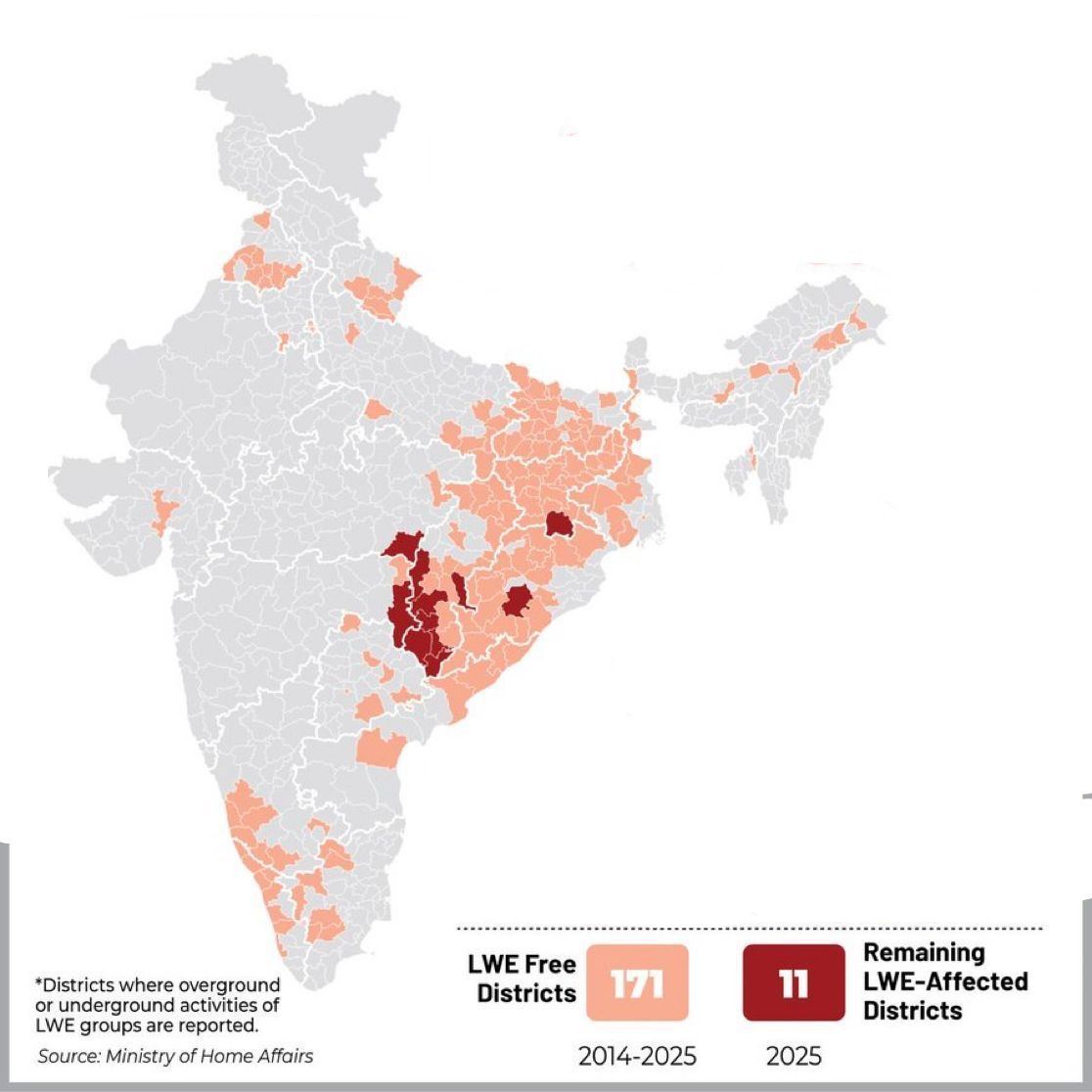
    For nearly six decades, the Maoist insurgency has tested India’s state capacity, governance, and security architecture. Born from socio-economic inequalities and agrarian distress, it once posed a threat spanning the “Red Corridor” from Andhra Pradesh to Bihar. However, in 2025, India seems to be witnessing what could be a historical inflection point, a near end of the movement. The combination of relentless security operations, developmental outreach, and ideological erosion has pushed the insurgency to its lowest ebb in history, limited now to just 38 districts.

    Why is this in the news?

    For the first time in six decades, the Maoist movement has reached the brink of extinction. This sharp decline is a historic reversal from the early 2000s, when the insurgency had spread across nearly 180 districts, posing an existential challenge to internal peace.

    The Union Home Ministry’s data for 2025 reveals:

    1. 270 Maoists killed, 680 arrested, and 1,225 surrendered.
    2. The insurgency is now confined to 38 districts, a dramatic fall from its 2005 peak.
    3. Top Maoist leaders, including Mallojula Venugopal Rao, have called for the “cessation of armed struggle”, signaling an ideological collapse within.
    4. This represents a turning point in India’s counter-insurgency history, where military, governance, and psychological strategies appear to have converged successfully.

    What led to the decline of the Maoist movement?

    • Relentless Security Operations
      1. Persistent operations by security forces under the Union Ministry of Home Affairs and state police coordination have dismantled Maoist strongholds.
      2. Leaders such as Katta Ramachandra Reddy and Kalayari Reddy have been neutralized, causing organizational paralysis.
    • Curtailment of Resources: Maoists face acute shortages of arms, ammunition, and funding, with security blockades choking supply lines across Bastar-Dandakaranya region.
    • Collapse of Ideological Unity: 
      1. Internal ideological fractures deepened after the deaths of key leaders like Kishenji and Charu Majumdar.
      2. Letters by surviving leaders calling for surrender reflect a moral fatigue within the movement.
    • Tribal Alienation: Once rooted in tribal grievances, the Maoist narrative lost resonance as tribal communities began benefiting from welfare schemes, education, and employment programs.

    Has this happened before? Understanding the cyclical pattern

    • Historical Fluctuations: The Maoist movement, born in Naxalbari (West Bengal, 1967), has seen cycles of rise and suppression.
      1. 1970s: Spread into Andhra Pradesh, Chhattisgarh, Jharkhand, and Odisha.
      2. 1990s: Revival through the People’s War Group (PWG).
      3. 2000s: Peak insurgency affecting nearly 180 districts.
    • Distinctiveness of 2025 Phase: Unlike previous lulls, this decline is structural, not temporary—rooted in the erosion of ideology and grassroots support rather than mere state force.

    Is the movement really over?

    1. Residual Threats Persist:
      1. Maoist influence lingers in border areas of Chhattisgarh, Jharkhand, and Odisha.
      2. Their transition to smaller, mobile guerrilla units may prolong low-intensity violence.
    2. Surrender vs. Rehabilitation:
      1. While many cadres have surrendered, effective reintegration policies—jobs, skill-building, and psychological counseling—remain key to ensuring they don’t relapse into militancy.
    3. Need for Vigilance: Experts warn against complacency. Maoism thrives in governance vacuums—where corruption, displacement, or inequality persist, new movements could emerge.

    What lessons does this offer for internal security and governance?

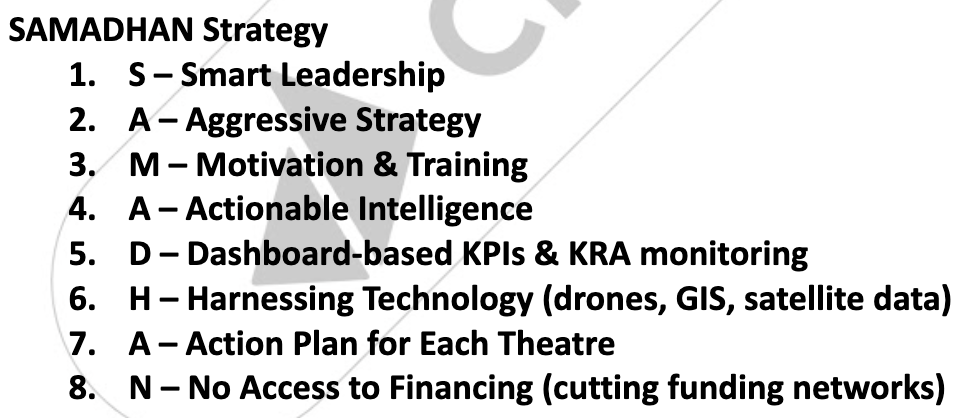
    1. Integrated Strategy Works: A mix of security action, development, and psychological outreach has proven effective—embodying the “Samadhan Doctrine” (Solution through Smart Leadership, Aggressive Strategy, Motivation, and Action).
    2. Development as Deterrence: Expanding roads, schools, and welfare programs in tribal areas helped dismantle Maoist influence.
    3. Institutional Coordination: Joint efforts by the Centre and States, under continuous review of MHA, have created sustained momentum.

    Conclusion

    The “Red Sunset” of the Maoist insurgency is not just a victory of arms but a triumph of governance and persistence. India’s approach, combining security precision with socio-economic inclusion, offers a replicable model for countering internal conflicts.

    However, sustaining peace will depend on addressing root causes, land alienation, forest rights, and local governance deficits, lest another insurgency rises from the same soil.

    PYQ Relevance

    [UPSC 2022] Naxalism is a social, economic and development issues manifesting as a violent internal security threat. In this context, discuss the emerging issues and suggest a multilayered strategy to tackle the menace of Naxalism.

    Linkage: The 2025 developments highlighted in “A Red Sunset” perfectly exemplify how the government’s multi-dimensional approach, combining security operations, socio-economic welfare, and ideological disengagement, has yielded tangible results. It reinforces the UPSC 2022 theme that Naxalism is not merely a law-and-order issue but a socio-economic one demanding a holistic, multilayered strategy.

  • Sir Creek Border Dispute

    Why in the News?

    Union Defence Minister recently warned Pakistan against misadventure in the Sir Creek region, stressing India’s resolve to defend its territorial integrity.

    Sir Creek Border Dispute

    About Sir Creek:

    • Location & Geography: Sir Creek is a 96-km-long tidal estuary in the Rann of Kutch, forming part of the border between Gujarat (India) and Sindh (Pakistan).
    • Physical Features: It flows into the Arabian Sea, with marshy, saline mudflats that provide vital habitat for migratory birds.
    • Historical Name: Originally known as Ban Ganga, renamed Sir Creek after a British surveyor, Sir Richard Burton (commonly credited).
    • Economic & Strategic Importance: The area hosts rich fishing grounds and potential oil and gas deposits, while being crucial for maritime boundary delimitation and coastal security.

    Historical Background of the Dispute:

    • 1908 Conflict: Disagreement between the Kutch ruler (British India) and Sindh government over fishing rights and territorial limits.
    • 1914 Bombay Government Resolution: Placed the boundary along the eastern bank (favouring Sindh/Pakistan), but also referred to the Thalweg Principle, supporting India’s claim.
      • This principle defines the border along the line of greatest depth of a river’s main navigable channel
    • 1924–25 Developments: Boundary pillars were erected and Survey of India maps marked the mid-channel as the boundary, strengthening India’s case.
    • Post-Partition Period: Dispute intensified; following the 1965 India–Pakistan war, the Rann of Kutch issue went to a UN-sponsored Tribunal.
    • 1968 Tribunal Award: Allocated 90% of the Rann to India but excluded Sir Creek, leaving it unresolved.
    • Post-1982 UNCLOS Impact: With the introduction of Exclusive Economic Zones (EEZs), control over Sir Creek gained renewed importance for maritime claims and resource access.

    India’s Position:

    • Navigability Claim: India asserts that Sir Creek is navigable at high tide, making the Thalweg Principle applicable.
    • Legal & Historical Basis:
      • 1925 Resolution and Survey of India maps.
      • Boundary pillars of 1924 marking mid-channel.
      • 1819 Treaty between East India Company and Kutch rulers, showing continued Indian jurisdiction.
    • Geographical Argument: India maintains the Rann is land, not water, invalidating Pakistan’s demand for median-line division.
    • Strategic Implication: Acceptance of India’s position ensures larger EEZ access, security leverage, and greater control in the Arabian Sea.
    [UPSC 2022] Consider the following countries:

    1. Azerbaijan 2. Kyrgyzstan 3. Tajikistan 4. Turkmenistan 5. Uzbekistan

    Which of the above have borders with Afghanistan ?

    Options: (a) 1, 2 and 5 only (b) 1, 2, 3 and 4 only (c) 3, 4 and 5 only* (d) 1, 2, 3, 4 and 5


  • An anti-terror role that defies logic

    Introduction

    The global fight against terrorism is rooted in credibility, trust, and collective responsibility. Yet, the United Nations’ recent decision to entrust Pakistan with leadership positions in the Taliban Sanctions Committee and as Vice-Chair of the UNSC Counter-Terrorism Committee has sparked disbelief. For a country long accused of sheltering terrorists, from Osama bin Laden to Lashkar-e-Taiba and Jaish-e-Mohammad, this appointment is not just ironic but deeply unsettling. Coupled with financial support such as the IMF’s billion-dollar loan to Pakistan despite concerns of terror financing, these developments expose critical vulnerabilities in the UN system. For India, which continues to suffer from cross-border terrorism, this represents a significant diplomatic and security challenge.

    Why is this in the news?

    Pakistan, accused for decades of harbouring terrorists and backing attacks on Indian soil, has been elevated to leadership in global counter-terrorism mechanisms. The timing is striking: the move came just weeks after the April 2025 Pahalgam attack where terrorists killed Indian tourists, followed by India’s Operation Sindoor against terror launchpads. To add to the irony, Pakistan also assumed the UNSC Presidency in July 2025. This is not the first time the UN has made such questionable appointments (Libya on Human Rights, Saudi Arabia on Women’s Rights), but Pakistan’s case is especially alarming given its record of state-sponsored terror. The decision casts doubt on the UN’s integrity, raises questions about its vetting process, and undermines India’s global campaign to expose Pakistan as a terror sponsor.

    How has Pakistan’s role in terrorism been established?

    1. Osama bin Laden Shelter: Found in Abbottabad, near Pakistan’s military academy.
    2. Cross-border attacks: From the 2008 Mumbai attacks to the 2019 Pulwama bombing and the 2025 Pahalgam attack, evidence points to Pakistan-backed groups.
    3. Terror groups supported: Lashkar-e-Taiba (LeT), Jaish-e-Mohammad (JeM), and networks across Afghanistan and Balochistan.
    4. Public protection of terrorists: Hafiz Saeed, despite being a UN-designated terrorist, continues to appear at PoK launchpads and public events under the watch of Pakistan’s security forces.

    Why is Pakistan’s UN role a paradox?

    1. Contradiction with objectives: Pakistan’s terror links directly undermine the goals of the Counter-Terrorism Committee.
    2. FATF leniency: Removal from the FATF grey list in 2022 despite unresolved financing concerns highlights weak vetting.
    3. Geopolitical trade-offs: Powerful nations enable Pakistan’s elevation to secure their own strategic and economic interests.
    4. Dangerous precedent: It signals that state-sponsored terror can be diplomatically whitewashed.

    What loopholes in the UN system does this expose?

    1. Selection flaws: No stringent vetting for compliance with counter-terrorism standards.
    2. Inconsistent moral compass: Earlier cases include Libya chairing the UNHRC and Saudi Arabia heading UN Women’s Rights Commission.
    3. Financial contradictions: IMF’s $1 billion loan in May 2025, just after the Pahalgam attack, raises ethical red flags.
    4. Rewarding duplicity: Pakistan even announced ₹14 crore compensation to families of terrorists, including kin of JeM chief Masood Azhar.

    How does this affect India’s security and diplomacy?

    1. Narrative war: Pakistan may use its position to shift blame for regional instability onto India.
    2. UNSC power play: As vice-chair, Pakistan can obstruct India’s efforts to sanction Pakistan-based terrorists.
    3. Taliban equation: Pakistan could derail India’s outreach to the Taliban regime.
    4. Increased threats: Likely escalation of infiltration, asymmetric warfare, and cyber-attacks on India.

    What counter-measures can India adopt?

    1. Diplomatic alliances: Leverage partnerships with UNSC members to balance Pakistan’s influence.
    2. Narrative building: Intensify global campaigns via media, academia, and diaspora to expose Pakistan’s duplicity.
    3. Engage Taliban directly: Humanitarian missions in Kabul to weaken Pakistan’s monopoly.
    4. Security strengthening: Bolster intelligence and counter-infiltration mechanisms.
    5. Push for accountability: Advocate for periodic reviews and performance audits of UN counter-terrorism bodies.

    Conclusion

    The UN’s decision to entrust Pakistan with counter-terrorism roles is more than a diplomatic anomaly, it is a strategic failure with global repercussions. For India, it signifies a heightened threat environment, a greater diplomatic challenge, and a call for proactive global engagement. What begins as “a seat at the table” could soon translate into control over the agenda. The real danger is not Pakistan’s presence in UN committees but the global community pretending it does not matter.

    UPSC Relevance

    [UPSC 2015] Terrorist activities and mutual distrust have clouded India-Pakistan relations. To what extent the use of soft power like sports and cultural exchanges could help generate goodwill between the two countries? Discuss with suitable examples.

    Linkage: Pakistan’s elevation to UN counter-terrorism roles despite its proven terror links deepens mutual distrust with India, underscoring why soft power avenues like sports and cultural exchanges remain fragile yet essential tools to rebuild limited goodwill.

  • National Security Act of 1980

    Why in the News?

    Climate activist Sonam Wangchuk, leading the demand for statehood and Sixth Schedule protections for Ladakh, was detained under the National Security Act (NSA) in Leh.

    About the National Security Act, 1980:

    • Enactment: Passed on 23 September 1980; applicable across India (earlier not in Jammu & Kashmir).
    • Constitutional Basis: Rooted in Article 22(3)(b) (preventive detention permitted) and Article 22(4) (limit of 3 months unless Board approves).
    • Objective: Provides for preventive detention to safeguard defence, national security, public order, foreign relations, and essential supplies/services.
    • Grounds for Detention: Acts prejudicial to India’s defence or security, harming foreign relations, disturbing public order, endangering essential supplies, or regulating foreigners’ presence/expulsion.
    • Authorities Empowered: Centre, States, District Magistrates, and Police Commissioners (if authorised).
    • Duration: Detention up to 12 months; must communicate grounds within 5 days (extendable to 15). A person can be held 10 days without disclosure of charges.
    • Advisory Board: Composed of three persons qualified to be High Court judges. Orders reviewed within 3 weeks; if no sufficient cause exists, release is mandatory.
    • Background: Builds on colonial-era Bengal Regulation III (1818), Rowlatt Acts (1919), post-independence Preventive Detention Act (1950), and MISA (1971, repealed 1977). Reintroduced by Indira Gandhi in 1980.

    Legal Options after Arrest under NSA:

    • Representation to Government: Detainee can file a written representation challenging detention.
    • Advisory Board Review: Must be reviewed within 3 weeks; release ordered if detention unjustified.
    • Judicial Remedies: Writ petition in High Court (Art. 226) or Supreme Court (Art. 32).
    • Revocation: Centre or State may revoke detention anytime.
    • Limitations: No right to lawyer before Advisory Board; grounds may be withheld in “public interest.”
    [UPSC 2023] Consider the following statements:

    1. According to the Constitution of India, the Central Government has a duty to protect States from internal disturbances.

    2. The Constitution of India exempts the States from providing legal counsel to a person being held for preventive detention.

    3. According to the Prevention of Terrorism Act, 2002, the confession of the accused before the police cannot be used as evidence.

    How many of the above statements are correct?

    (a) Only one* (b) Only two (c) All three (d) None


  • India’s first overseas Defence Facility in Morocco

    Why in the News?

    Defence Minister Rajnath Singh inaugurated Tata Advanced Systems’ plant at Berrechid, Morocco—India’s first overseas and Morocco’s largest defence manufacturing facility.

    About India’s Morocco Defence Facility:

    • Developer: Established by Tata Advanced Systems Limited (TASL) – India’s first overseas defence manufacturing facility and Morocco’s largest defence plant.
    • Scale & Capacity: Spread over 20,000 sq. m. with capacity to produce ~100 armoured vehicles annually.
    • Product: Focused on the Wheeled Armoured Platform (WhAP) 8×8, jointly developed by TASL and DRDO.
    • Variants: Modular designs include Infantry Fighting Vehicle, Armoured Personnel Carrier, Reconnaissance Vehicle, Command Post, Mortar Carrier, and Ambulance.
    • Operations: First deliveries to the Royal Moroccan Army scheduled for October 2025.

    Significance:

    • Strategic Expansion: Extends India’s defence vision from Make in India to Make for the World.
    • Diplomatic Milestone: Symbolises stronger India–Morocco defence ties, marked by the first visit of an Indian Defence Minister to Morocco.
    • Economic & Employment Boost: Creates jobs in Morocco; 33% local sourcing of components (to increase to 50%).
    • Export Hub: Morocco’s location makes it a gateway to Africa and Europe, enhancing India’s defence export footprint.
    • Security Role: Enhances regional defence capacity and establishes India as a credible global supplier of armoured vehicles.
    [UPSC 2017] What is the importance of developing Chabahar Port by India?

    Options: (a) India’s trade with African countries will enormously increase.

    (b) India’s relations with oil-producing Arab countries will be strengthened.

    (c) India will not depend on Pakistan for access to Afghanistan and Central Asia. *

    (d) Pakistan will facilitate and protect the installation of a gas pipeline between Iraq and India.


  • Upgradation of Army Radars

    Why in the News?

    After Operation Sindoor and Pakistani drone incursions, the Army is upgrading air defence with advanced radars to counter low-RCS (radar cross-section) drones and other aerial threats along northern and western borders.

    What are Radars?

    • About: Radar stands for Radio Detection and Ranging; it uses radio waves to locate, track, and measure speed of objects.
    • Components: Transmitter emits radio signals, receiver captures reflections.
    • Functions: Measures direction, distance (via time delay), and velocity (via Doppler shift).
    • Types in air defence:
      • Surveillance radars: Monitor airspace and detect aerial objects, not directly linked to weapons.
      • Fire control radars: Provide targeting data to guide anti-aircraft guns or missiles.

    Current Indian Capabilities:

    • Indian Air Force: Operates High-Power Radars and Medium-Power Radars for long-range, high-altitude threats such as jets, AWACS, and large transport aircraft.
      • For fire control, the Air Force employs systems like the 3D Central Acquisition Radar and Rajendra radar.
    • Indian Army: Uses Low-Level Light-Weight Radars, designed to pick up low-flying, small radar cross-section objects like drones.
      • Upgraded Flycatcher and Air Defence Tactical Control Radar systems to aim weapons and manage local defence.

    India’s Air Defence Infrastructure:

    • Missile systems: Includes Russian S-400 and the indigenous Akash missile system.
    • Army’s Akashteer system: Integrates radars, sensors, air defence guns, and communications into a real-time operational air picture.
    • IAF’s IACCS (Integrated Air Command and Control System): Unifies data from multiple assets for coordinated detection and interception.
    • Mission Sudarshan Chakra: Ongoing modernisation programme; DRDO recently tested the Integrated Air Defence Weapon System.
    [UPSC 2024] Consider the following activities:

    1. Identification of narcotics on passengers at airports or in aircraft

    2. Monitoring of precipitation

    3. Tracking the migration of animals

    In how many of the above activities can the radars be used?

    (a) Only one (b) Only two* (c) All three (d) None


  • The conduct of social media companies amid political unrest

    Introduction

    The insurrection in Nepal, which led to the fall of the K.P. Sharma Oli government after just two days, brought with it an immediate digital clampdown: a ban on 26 social media platforms. While such state actions are not unprecedented, what deserves scrutiny is the consistent passivity of social media companies in moments of political crisis. Despite marketing themselves as champions of free expression, Big Social firms often prioritise profit motives and regulatory compliance over defending user rights. The Nepal episode is not an isolated case but part of a global pattern spanning Russia, Myanmar, Nigeria, and Iran.

    Why is this issue in the news?

    The Nepal unrest marks the latest instance of governments weaponising internet shutdowns, but the bigger story is the role of social media platforms. Instead of resisting, they largely issued boilerplate statements, leaving millions of users disconnected. This sharp contrast between their claims of empowering citizens and their reluctance to act exposes the gap between rhetoric and responsibility. The scale of the problem is massive, bans disrupt civic life, cost economies billions, and exacerbate inequality in times of crisis.

    The Conduct of Social Media Companies Amid Political Unrest

    Why do social media companies stay passive?

    1. Profit Motives: Companies fear losing access to lucrative markets more than reputational harm.
    2. Government Pressure: Host states can fine, jail, or exclude companies, discouraging open resistance.
    3. Commercial Interests vs. Civic Responsibility: Platforms project neutrality but continue profiting while users bear risks.

    How has this pattern unfolded globally?

    1. Russia (2018): Telegram fought bans technically but gave little political solidarity to users facing arrests.
    2. Myanmar (2021): Facebook ban cut off protestors from news and organising tools.
    3. Nigeria (2021): Twitter suspension cost the economy $26 million/day while the company stayed largely silent.
    4. Iran (2022): Instagram and WhatsApp issued generic appeals while small businesses collapsed.

    What technological solutions exist but remain unused?

    1. Decentralised Networks: Tor, I2P, Mastodon, and Signal proxies allow traffic rerouting.
    2. Corporate Tools: Google’s Outline VPN, YouTube’s delivery networks, and WhatsApp piggybacking on HTTPS could bypass bans.
    3. Underdeployment: Companies avoid such measures due to fears of retaliation and loss of ad-driven surveillance models.

    How does Big Social compare with other industries?

    1. Financial Sector: PayPal and Visa cut services in Russia citing ethics.
    2. Wikipedia: Won a legal battle against Turkey’s ban.
    3. Telecom Firms: Unlike them, SM companies market themselves as defenders of expression, making passivity starker.

    What are the wider consequences of passivity?

    1. Digital Divide: Richer users bypass bans with VPNs, poorer citizens are excluded.
    2. Insecurity: Users shift to unsafe alternatives, scams rise, and access to trusted news collapses.
    3. Corporate Power Paradox: Meta’s revenue ($134 bn) and Alphabet’s ($300 bn) exceed GDPs of Nepal and Nigeria, yet they plead helplessness.

    What could be the way forward?

    1. Transparency Mandates: Publish shutdown orders, legal justifications, and company responses.
    2. Technical Contingencies: Industry-wide standards for proxy modes, redundancy, and fallback networks.
    3. Regional Cooperation: Blocs like AU and SAARC can negotiate common demands.
    4. Moral Responsibility: Companies must balance profit motives with defending civic infrastructure.

    Conclusion

    The Nepal episode illustrates a broader global pattern where social media companies retreat into silence during political unrest. While they claim neutrality, their choices are deeply political, amplifying inequalities and weakening democratic resilience. Given their vast resources and influence, neutrality is no longer an option. Transparency, decentralisation, and moral responsibility must become cornerstones of their global operations, especially in the Global South where civic stakes are highest.

    Value Addition

    • Santa Clara Principles (2018): 
      • Framework urging tech companies to publish government takedown requests, explain moderation decisions, and ensure due process in digital rights protection.
      • Highlights the need for transparency and accountability in content moderation.
    • UNHRC Resolution (2016):
      • Declared internet shutdowns as a violation of international law and an infringement on freedom of expression.
      • Recognises access to the internet as a fundamental enabler of human rights.
    • Economic Impact of Shutdowns:
      • Nigeria’s Twitter ban (2021) cost the economy nearly $26 million/day, showing how bans hurt not just civic spaces but also small businesses and livelihoods.
      • Similarly, India has often topped the list of internet shutdowns globally, costing billions annually.
    • Concept of Digital Authoritarianism:
      • Use of internet control, shutdowns, and surveillance by states to curb dissent. Seen in Myanmar (2021 coup), Iran (2022 protests), and Nepal (2025 unrest).
    • Surveillance Capitalism (Shoshana Zuboff):
      • Business model of Big Tech that monetises user data through targeted ads. Centralised control discourages adoption of decentralised, privacy-respecting technologies.
    • Civic Infrastructure at Risk:
      • Platforms are not neutral spaces but essential public utilities during crises. Their passivity undermines democratic resilience and widens the digital divide.
    • Technological Solutions & Precedents:
      • Signal Proxies (Iran, 2022) – volunteers hosted relays to bypass censorship.
      • Wikipedia vs. Turkey – fought a multi-year legal battle and restored access, unlike Big Social’s passivity.
      • Google’s Outline VPN – toolkit for journalists and activists, an example of proactive circumvention tools.
    • International Comparisons:
      • Financial Sector – PayPal & Visa cut ties with Russia citing ethics after Ukraine invasion.
      • Telecoms – forced into compliance immediately with shutdown orders, unlike Big Social which claims neutrality yet markets itself as pro-free expression.

    PYQ Relevance:

    [UPSC 2016] Use of internet and social media by non-state actors for subversive activities is a major security concern. How have these been misused in the recent past? Suggest Effective guidelines to curb the above threat.

    Linkage: The Nepal case and similar crises show how governments misuse shutdowns while non-state actors exploit social media for mobilisation, misinformation, and violence. The passivity of Big Social aggravates risks by denying safe, transparent channels, widening the digital divide. Thus, effective guidelines must balance security imperatives with digital rights, corporate accountability, and technological safeguards.