Why in the News
An India based defence startup announced that it had successfully demonstrated a rotating detonation engine (RDE) at a Defence Research and Development Organisation (DRDO) facility in Hyderabad. The physics of the design has been understood since the 1960s, and the binding constraint has never been the theory but the materials, computing and diagnostics needed to hold a continuous supersonic detonation inside a compact chamber. Despite a global cluster of tests and funding rounds in 2026, no model is known to be ready for commercial or military use anywhere.
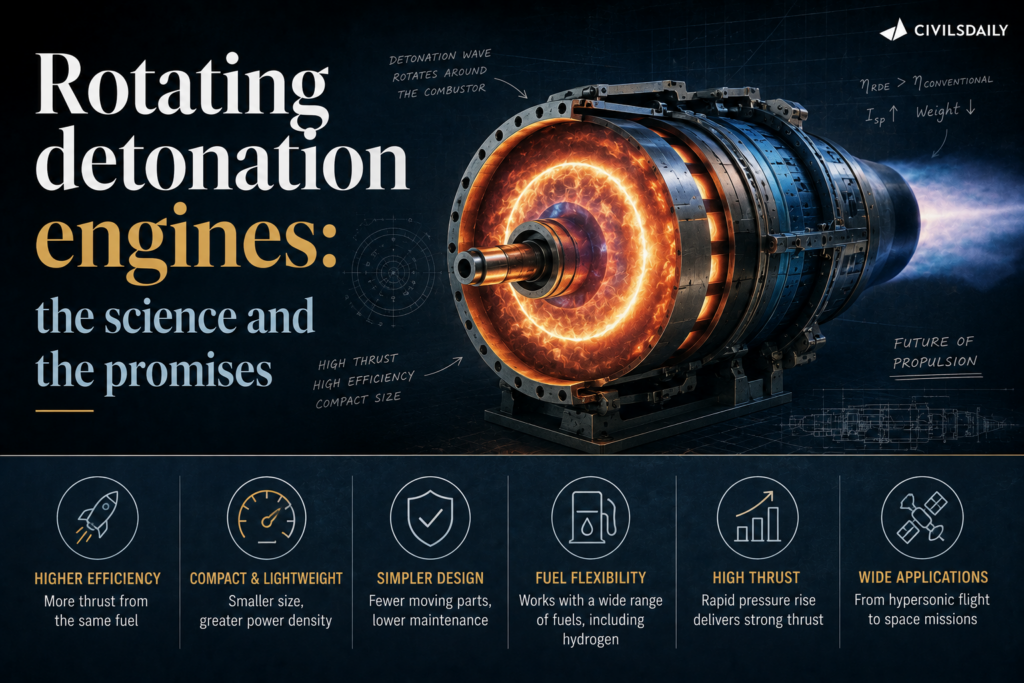
What is a rotating detonation engine (RDE)?
- What it is: An engine design in which combustion happens as a continuous detonation travelling in a circle inside a ring shaped chamber, rather than as a flame front sweeping through a cylinder.
- Its promise: It uses fuel more efficiently than conventional rocket engines, so the same task needs correspondingly less fuel.
- Why the saving matters: Launching satellites and carrying explosives to distant targets are both expensive, and fuel saved can be passed to the payload, whether a satellite or a warhead.
- The efficiency figure: Going by physics alone, RDEs offer around 10 per cent to 25 per cent more thermodynamic efficiency than conventional combustors, with the exact value depending on real world conditions and engine design.
- What it produces: It can continuously generate thrust, or mechanical energy if coupled to a piston.
- Its current state: RDEs are confined to research and development, and there are no models known to be ready for commercial or military use.
What is deflagration?
- What it is: Combustion in which a flame introduced into a fuel and air mixture travels through that mixture at less than the speed of sound.
- What it does thermodynamically: The combustion happens at constant pressure, because the mixture is free to expand as it heats up instead of being confined under pressure.
What is detonation?
- What it is: Combustion in which the flame travels through the mixture at more than the speed of sound, imposing a shock wave on the mixture and heating it, which triggers rapid combustion behind the wave.
- What it does thermodynamically: The combustion happens at constant volume, because the shock wave compresses the unburned mixture immediately before combustion and the mixture has no time to expand.
What is a pulsed detonation engine (PDE)?
- What it is: The simplest type of detonation engine, using a long tube as the combustion chamber so a detonation can pass through the whole mixture.
- Its cycle: The detonation races down the tube, compressing and burning the fuel and air mixture, and the hot high pressure products expand out of the open end at high speed. The tube is then purged before the next cycle begins.
What is an annular combustor?
- What it is: A combustion chamber shaped as two concentric cylinders with a narrow ring shaped gap between them, the gap being called the annulus.
- Why the RDE uses it: The annulus gives the detonation wave a closed circular path to travel, which is what converts a one shot detonation into a continuous one.
What is thermodynamic efficiency?
- What it measures: How much of a fuel’s chemical energy becomes useful work rather than being shed as waste heat.
- What a gain translates into: An RDE that improves thermodynamic efficiency by 20 per cent could theoretically require around 17 per cent less fuel for the same output, assuming other losses are unchanged.
Why does detonation deliver more efficiency than deflagration?
- The regular engine case: A spark plug introduces a flame into the fuel and air mixture in the combustion chamber, and it travels through at subsonic speed.
- The expansion difference: In deflagration the mixture expands freely as it heats, so combustion proceeds at constant pressure.
- The compression difference: In detonation the shock wave compresses the unburned mixture just before it burns, so combustion proceeds at constant volume.
- The pressure outcome: A detonation engine therefore produces combustion products at a higher pressure.
- The energy conversion: More of the fuel’s chemical energy is converted into pressure rather than being shed as heat, and that is the entire basis of the fuel efficiency claim.
- The comparison held constant: The advantage holds for a detonation engine against a regular engine burning the same fuel.
How does an RDE sustain a continuous detonation?
- The design choice: Instead of the detonation passing through a long tube once, it is made to flow in a circle.
- The chamber: The combustion chamber has an annular shape, and fuel and oxidiser are injected continuously into the ring shaped gap.
- The wave: One or more detonation waves race through the annulus while injection continues.
- The timing requirement: Fuel is injected into the annulus just ahead of the detonation wave, so the wave always meets fresh mixture.
- The exhaust: The wave consumes the fresh fuel and air mixture and expels the products through the nozzle along its axis.
- The rate: As long as fuel keeps arriving at the right time and in the right condition, the detonation can keep going even at thousands of times per second.
- The output: By Newton’s third law the momentum of the expelled gases produces an equal and opposite momentum on the engine, which is what generates thrust.
Who is developing rotating detonation engines and with what funding?
- D-Propulse, India: The India based defence startup that recently announced a successful RDE demonstration at a DRDO facility in Hyderabad.
- NASA, United States: Ran a full scale RDE test in 2023 in which the engine fired for 251 seconds, a record at the time.
- GE Aerospace and Lockheed Martin: Demonstrated an RDE for hypersonic missiles in January, using air drawn from the atmosphere.
- SpaceWorks, United States: Reported hot fire tests of its RDE for rockets in February.
- Astrobotic, United States: Test fired its Chakram RDE continuously for 300 seconds.
- L3Harris, United States: Announced that it had tested two RDEs, in April and May respectively.
- Stellar Alpina, Switzerland: Completed a commercial RDE hot fire test and raised CHF 3.5 million.
- Juno Propulsion: Raised $1.4 million to develop an RDE for spacecraft thrusters.
- Venus Aerospace, United States: Raised $91 million in July to scale its tested RDE, then partnered with Lockheed Martin.
- What the roster shows: Activity is concentrated in the United States and in venture funded startups, and it spans rockets, hypersonic missiles and spacecraft thrusters rather than a single application.
Why was a 1960s concept only testable now?
- The theory was settled early: Scientists worked out how an RDE could function by the 1960s, and building one was a different matter.
- Injection and pressure control: Sustaining a continuous detonation in a compact chamber requires engineers to precisely control fuel injection and internal pressure.
- Chamber geometry: The chamber needs a specific geometry for the engine to work as intended.
- Instability sensitivity: Unlike in regular engines, even small instabilities in the fuel and air mixture can destabilise an RDE.
- Temperature threshold: Engine materials must withstand more than 2,000 degrees Celsius.
- Pressure threshold: Materials must survive 10 to 100 atmospheres of pressure, and much higher in brief moments.
- Speed threshold: Detonation speeds exceed 1,500 m/s.
- Oscillation and loading: Pressures oscillate at several thousand cycles per second, and the structure sees potentially tens to hundreds of g depending on the design.
- What had to arrive first: Working RDEs required advances in high speed computing, diagnostics, fuel injection, materials and manufacturing.
Why does the efficiency gain matter for launch and strike systems?
- Cost of access to space: Launching satellites on rockets is expensive, and fuel is a dominant share of the launch mass.
- Cost of long range strike: Carrying explosives to distant targets on missiles is equally expensive on the same fuel logic.
- The trade converted: Less fuel for the same task means more mass available for payload.
- Commercial consequence: Passing that saving to the satellite or warhead increases the profitability of the mission.
- Why launch benefits most: The gain is considered significant specifically for rocket launches, where the fuel to payload ratio is most punishing.
- The air breathing variant: For hypersonic missiles the engine draws oxidiser from the atmosphere, which removes the need to carry it.
Why does a settled physics advantage still have no deployable engine?
- The stated status: RDEs remain confined to research and development, with no models known to be ready for commercial or military use.
- The evidence gap: Actual data from many tests by commercial entities are not available in the public domain.
- What the efficiency claim rests on: The 10 per cent to 25 per cent figure is derived from physics alone, not from fielded performance.
- The qualification the source itself attaches: The saving that can be passed to the payload holds at least on paper.
- Where the difficulty sits: The obstacle is not the thermodynamics but the survivability of materials and the controllability of the detonation.
- The demonstration versus product gap: A successful hot fire test proves the wave can be sustained, and it does not prove an engine can be throttled, restarted, integrated and qualified for flight.
- The funding signal: Capital is arriving before a product exists, which is a bet on the remaining engineering rather than a proof that it is solved.
Challenges to rotating detonation engine development
- Material survivability under cyclic thermal load: Wall materials face more than 2,000 degrees Celsius and pressure oscillations of several thousand cycles per second, which drives fatigue cracking. e.g. regeneratively cooled chamber liners in conventional engines already fail at far lower thermal cycling rates.
- Detonation wave instability: Wave count, direction and mode can shift during a run, which changes thrust unpredictably. e.g. test campaigns commonly report transitions between single wave and multiple wave modes in the same firing.
- Injector design and mixing: Fuel and oxidiser must mix fully in the microseconds before the wave arrives, and incomplete mixing quenches the detonation. e.g. deflagration to detonation transition failures reported in early pulsed detonation engine work.
- Nozzle matching: The exhaust leaves the annulus with a rotating, unsteady pressure field that a conventional bell nozzle is not designed for. e.g. aerospike and plug nozzle concepts are being revisited specifically for detonation exhausts.
- Absence of validated test data: Commercial developers do not release performance data, so independent verification of efficiency claims is not possible. e.g. the hot fire results announced by several firms in 2026 carry no published specific impulse figures.
- Qualification and certification burden: Flight qualification requires demonstrated restart, throttling and life cycle margins that no RDE has yet shown. e.g. human rated engines must clear multiple full duration firings with margin, a standard the 251 second NASA record does not yet meet.
- Dual use export control: Detonation propulsion for hypersonic applications falls within missile technology control regimes, which restricts collaboration. e.g. Missile Technology Control Regime Category I restrictions on complete rocket systems and their major subsystems.
- Manufacturing tolerance: The annulus gap must be held to fine tolerance across a hot, deforming structure, which requires additive manufacturing at aerospace grade. e.g. additive manufactured combustion chambers have to be qualified for porosity and residual stress before flight use.
- Talent and facility scarcity: Very few facilities can instrument a detonation at these speeds and pressures. e.g. high speed schlieren and pressure diagnostics capable of resolving events at several thousand cycles per second exist in a handful of laboratories.
Conclusion
The rotating detonation engine’s advantage is a settled point of physics: replacing constant pressure deflagration with constant volume detonation converts more chemical energy into pressure instead of shedding it as heat, and that is worth roughly 10 per cent to 25 per cent in thermodynamic efficiency. What remains unsolved is entirely an engineering problem of materials, wave control and diagnostics, which is why a design understood in the 1960s still has no commercially or militarily ready model anywhere. The Hyderabad demonstration places India inside the small group attempting that engineering, and a demonstration is not yet a qualified engine.
“[2026] Consider the following statements about involvement of private entities in India’s space programme:
1. IN-SPACe is an autonomous agency formed to facilitate participation of private entities.
2. Agnikul Cosmos launched the world’s first flight using 3D-printed rocket engine.
3. Skyroot Aerospace has developed liquid fuel for GSLV.
(a) 1 only
(b) 2 and 3 only
(c) 1 and 2 only
(d) 1, 2 and 3