💥Join UPSC 2027,2028 Mentorship (August Batch) + XFactor Notes & Microthemes PDF

Subject: Space Technology

  • IIST Scientists detected Circular Polarisation near massive Protostar

    Why in the News?

    Researchers at the Indian Institute of Space Science and Technology (IIST) has detected radio emissions with circular polarisation near a massive young protostar, IRAS 18162-2048.

    About Protostars:

    • Definition: Early-stage stars formed by the gravitational collapse of dense regions in molecular clouds.
    • Accretion Phase: They actively gather gas and dust but have not yet begun sustained nuclear fusion.
    • Jet Ejection: Bipolar jets—high-speed streams of particles—are commonly emitted from their poles.
    • Massive Protostars: Expected to evolve into stars with masses over 8–10 times that of the Sun.
    • Role of Magnetism: Magnetic fields likely influence both jet formation and ejection mechanisms.

    About the Protostar IRAS 18162-2048:

    • Overview: Situated about 4,500 light years away in the Milky Way.
    • Jet Feature: Powers the HH80-81 jet—one of the galaxy’s largest and brightest protostellar jets.
    • Magnetic Detection: First direct evidence of magnetic fields from the protostar itself, not just its jet.
    • Observation Challenges: Heavily shrouded in dense gas and dust, making traditional observation difficult.
    • Jet Dynamics: Suggests that magnetic fields and rotational energy drive its development.

    Recent Observations:

    • Detection Method: Observed circular polarisation in radio waves—where electromagnetic fields rotate along their path.
    • Rarity: Circular polarisation is extremely faint and seldom detected, even in intense sources like active galactic nuclei.
    • Scientific Milestone: First-ever estimation of magnetic field strength near a massive protostar using circular polarisation.
    • Magnetic Field Strength: Estimated to be 100 times stronger than Earth’s magnetic field.
    • Theoretical Support: Findings reinforce the theory that magnetic fields power jets from both stars and black holes.
    [UPSC 2023] Consider the following pairs:

    Objects in space :: Description

    1. Cepheids : Giant clouds of dust and gas in space

    2. Nebulae : Stars which brighten and dim periodically

    3. Pulsars : Neutron stars that are formed when massive stars run out of fuel and collapse How many of the above pairs are correctly matched?

    Options: (a) Only one* (b) Only two (c) All three (d) None


  • GW231123: Biggest Black Hole Merger Detected

    Why in the News?

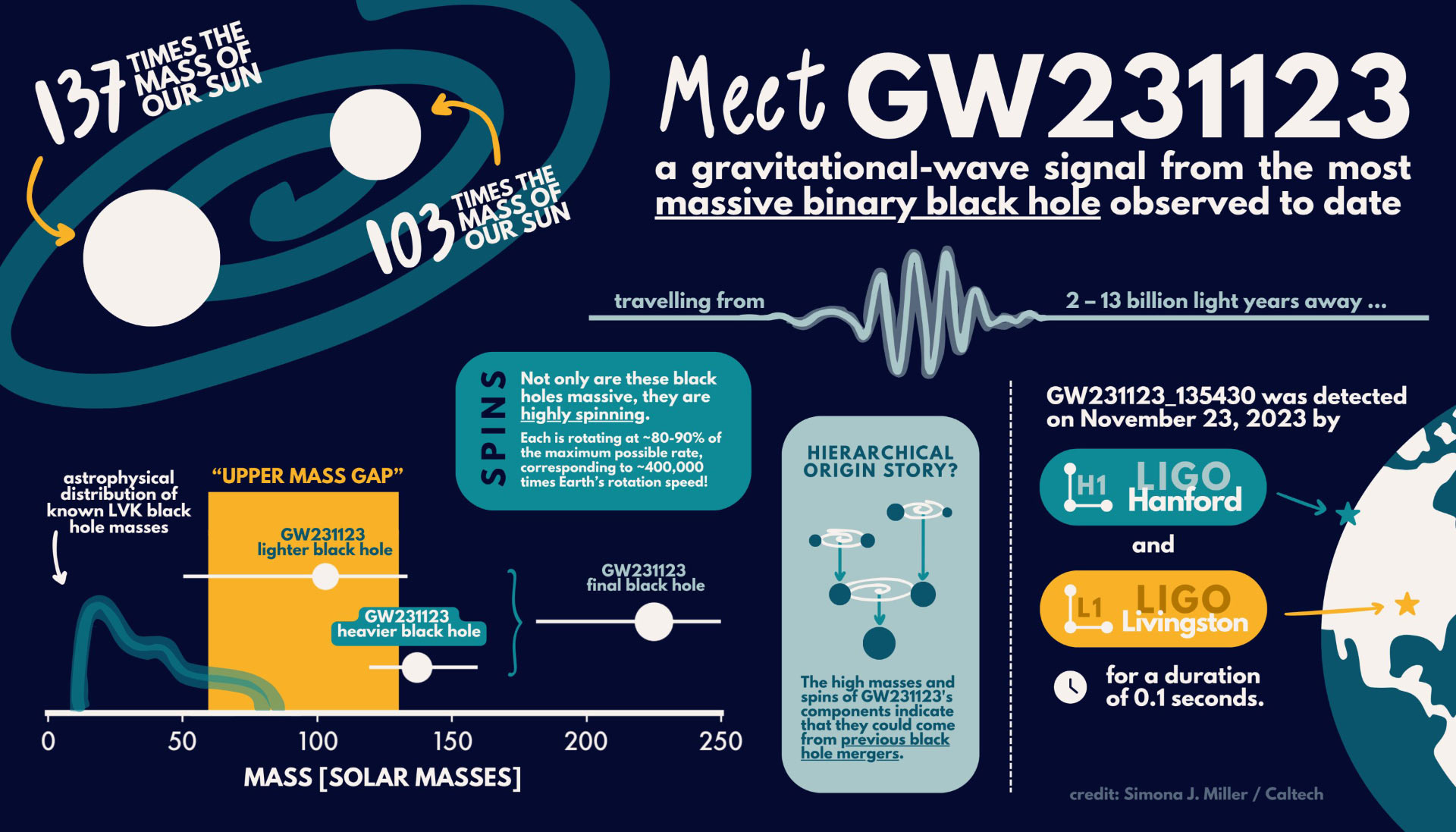
    Researchers have reported the detection of an exceptionally massive black hole merger, labelled GW231123.

    GW231123: Biggest Black Hole Merger Detected

    About Black Holes and Black Hole Merger:

    • Overview: Black holes are extremely dense celestial objects whose gravitational pull is so strong that even light cannot escape.
    • Types of Black Holes:
      1. Stellar-mass: Around 20 times the mass of the Sun or more.
      2. Intermediate-mass: Between 100 and 100,000 times the mass of the Sun.
      3. Supermassive: From 100,000 to several billion times the mass of the Sun.
    • Black Hole Merger:
      • Occurs when two black holes orbit each other, lose energy via gravitational waves, and merge into a larger black hole.
      • The GW231123 event involved black holes of approximately 140 and 100 solar masses, forming a final black hole of 225 solar masses — the largest detected through gravitational waves.
      • Scientists suggest such massive black holes may form via hierarchical mergers (successive black hole mergers).
      • Supports theories on the formation of supermassive black holes, often found at galactic centers.

    Recent Observations:

    • Event Timing: The GW231123 event was detected on November 23, 2023, though it occurred billions of years ago.
    • Signal Characteristics:
      • Lasted only a tenth of a second but matched Einstein’s predictions under General Relativity.
      • Both black holes were rapidly spinning, hinting at a complex formation history.
    • Scientific Significance:
      • Involved intermediate-mass black holes, rarely observed in nature.
      • Challenges existing models of black hole formation via stellar collapse.
      • Indicates the presence of black holes in the so-called “forbidden mass gap”.
    • Conference Presentation:
      • Findings to be presented at the 24th International Conference on General Relativity and Gravitation (GR24) and the 16th Edoardo Amaldi Conference on Gravitational Waves, held in Glasgow, UK (July 14–18, 2025).
    • Broader Implications:
      • Opens new questions about the origin of massive black holes.
      • Offers insights into gravitational physics, cosmology, astrophysics, and potentially particle physics or cosmic string theory.
      • Model refinements are ongoing to better understand such extreme cosmic phenomena.

    Gravitational Wave Detection Network:

    • Nature of Gravitational Waves: Invisible ripples in spacetime caused by cataclysmic cosmic events like black hole collisions; predicted by Einstein in 1916.
    • Global Detection Network (LIGO–Virgo–KAGRA):
      • Laser Interferometer Gravitational-Wave Observatory (LIGO):
        • Operates two detectors in the United States (in the states of Louisiana and Washington).
        • First detected gravitational waves in 2015, leading to a Nobel Prize in Physics in 2017.
      • Virgo Observatory: Located near Pisa, Italy and operated by the European Gravitational Observatory.
      • Kamioka Gravitational Wave Detector (KAGRA): Located underground in the Kamioka mine, Japan, and notable for its cryogenic mirror technology.
    • LIGO-India:
      • Under construction in Hingoli, Maharashtra in partnership with the US National Science Foundation.
      • Involves scientists from 17 Indian institutions.
    [UPSC 2019] Recently, scientists observed the merger of giant ‘blackholes’ billions of light-years away from the Earth.

    What is the significance of this observation?

    Options: (a) Higgs boson particles’ were detected. (b) Gravitational waves’ were detected * (c) Possibility of inter-galactic space travel through ‘wormhole’ was confirmed. (d) It enabled the scientists to understand ‘singularity’.


  • Vera C Rubin Observatory 

    Why in the News?

    The Vera C. Rubin Observatory has recently begun a 10-year project to study dark matter and dark energy using a 3,200-megapixel camera (of the Simonyi Survey Telescope) from its site in the Chilean Andes.

    Vera C Rubin Observatory 

    About Vera C. Rubin Observatory:

    • Location: The Vera C. Rubin Observatory is situated on Cerro Pachón in the Chilean Andes, at an altitude of 8,684 feet.
    • Naming: It is named after Vera C. Rubin, the astronomer who first provided robust observational evidence for the existence of dark matter in the 1970s.
    • Survey Duration: The observatory will carry out a 10-year continuous survey of the entire southern sky.
    • Data Volume: It is designed to collect approximately 20 terabytes of astronomical data per night.
    • Observation System: The telescope operates using an automated scripting system that selects observation targets dynamically, rather than through manual scheduling.
    • Objectives: Its key goals include understanding the formation of galaxies, identifying a possible ninth planet, detecting potentially hazardous asteroids, and studying the nature of dark matter and dark energy.

    Key Features:

    • Telescope Design: The observatory uses the Simonyi Survey Telescope, which features a three-mirror optical system for wide-field imaging.
    • How big is it: It has a field of view of 9.6 square degrees (compared to 0.04 sq. deg. for Hubble and 0.11 sq. deg. for James Webb), a 3,200-megapixel camera (vs. Hubble’s ~1.0 MP).
    • Field of View: It can capture a field of view equivalent to 40 full Moons in a single exposure — far wider than traditional space telescopes.
    • Spectral Filters: The camera includes six optical filters that capture data from across the electromagnetic spectrum, including ultraviolet and infrared light.
    • Slewing Speed: The telescope is the fastest-moving large telescope, capable of repositioning and stabilizing in just 5 seconds.
    • Imaging Frequency: It can take up to 1,000 images per night, allowing it to scan the entire sky every three nights.
    • Change Detection: Its automated software compares new and old images to detect changes, issuing up to 10 million alerts per night for transient astronomical events.

    Breakthrough Discoveries:

    • First Light: The observatory released its first test images on June 23, 2025.
    • Initial Discoveries: Within 10 hours of collecting engineering data, it identified 2,104 new asteroids, including 7 near-Earth objects (NEOs).
    • Expected Discoveries: Over the full 10-year mission, it is projected to discover over 5 million asteroids and around 100,000 NEOs.
    • Impact on Database: These findings would triple the current global inventory of known asteroids.
    • Universe Mapping: The observatory will produce the most detailed map of the large-scale structure of the universe to date.
    • Dark Matter Study: The data will support analysis of dark matter, which constitutes 27% of the universe’s composition.
    • Dark Energy Study: It will also help scientists understand dark energy, which makes up 68% of the universe and drives cosmic expansion.
    • Visible Matter Context: Only 5% of the universe is composed of visible matter, making the observatory’s data essential to studying the remaining 95%.
    [UPSC 2002] The world’s highest ground-based telescopic observatory is located in:

    Options: (a) Colombia (b) India (c) Nepal (d) Switzerland


  • What is Axiom-4 Mission?

    Why in the News?

    The launch of Axiom-4 (Ax-4), a private mission to the International Space Station (ISS), has finally lifted-off after several postponements due to weather conditions.

    About Axiom-4 Mission:

    • Axiom Mission 4 (Ax-4) is a private spaceflight organized by Axiom Space.
    • It aims to transport a crew to the International Space Station (ISS) for a 14-day mission.
    • This will be Axiom Space’s 4th mission to the ISS, following their previous missions (Ax-1, Ax-2, and Ax-3).
    • The mission will launch from the Kennedy Space Center in Florida using SpaceX’s Falcon 9 rocket.
    • The spacecraft for this mission is a SpaceX Crew Dragon, known for its advanced technology and safety features.
    • This mission is organised in collaboration with NASA, highlighting a strong partnership between private space companies and government space agencies to further space exploration and research.
    • Crew:
      1. Peggy Whitson: A veteran astronaut with extensive experience, having completed multiple missions to the ISS.
      2. Sławosz Uznanski: A Polish astronaut joining the mission, marking a significant milestone for Poland in space exploration.
      3. Tibor Kapu: A Hungarian astronaut, adding to the diversity of the mission crew.
      4. Group Captain Shubhanshu Shukla: An Indian astronaut, making headlines as part of this international crew.

    Significance of Ax-4 Mission for India

    • The mission is a collaborative effort resulting from an agreement between ISRO and NASA.
    • It provides ISRO with an early opportunity to test experiments in space, originally planned for Gaganyaan.
    • Key Indian Experiments on Axiom-4:
      • Microgravitys impact on muscle dysfunction.
      • Use of computer screens in zero gravity and their effects on human cognition and vision.
      • Growth of six varieties of crop seeds in space conditions.
      • Tardigrade survival study—these microscopic creatures can endure extreme environments and may provide insight into life support systems in space.

    Back2Basics: International Space Station (ISS)

    • The ISS, orbiting 430 kilometres above Earth, completes 16 orbits daily, witnessing 16 sunrises and sunsets.
    • It orbits Earth every 90 minutes at 8 km per second.
    • Spanning 109 meters, it’s almost as long as an American football field.
    • It includes 6 sleeping areas, 2 bathrooms, a gym, and a panoramic view bay window.
    • Its solar array wingspan is 109 meters, and the station houses about 13 km of electrical wiring.
    • Its journey began on November 20, 1998, with Russia’s Zarya Control Module.
    • The US added the Unity Node 1 module on December 4, 1998, marking the start of a functional space lab.
    • It evolved into its current form after 42 assembly flights.


    PYQ:

    [2019] What is India’s plan to have its own space station and how will it benefit our space programme?

  • CROPIC Initiative

    Why in the News?

    The Ministry of Agriculture and Farmers Welfare is set to launch CROPIC (Collection of Real Time Observations & Photo of Crops)- a digital initiative that uses field photography and AI-based models to monitor crop health and automate loss assessment.

    What is CROPIC?

    • Overview: CROPIC is a digital initiative launched by the Ministry of Agriculture and Farmers Welfare.
    • Objective: The aim of CROPIC is to monitor crop health, assess crop losses, and assist with insurance payouts under the Pradhan Mantri Fasal Bima Yojana (PMFBY).
    • Technology Integration: It leverages field photography, artificial intelligence, and a cloud-based analysis system to streamline crop monitoring.
    • Process: CROPIC is designed to automate the crop loss assessment process and improve the transparency and speed of compensation to farmers.
    • Pilot Timeline: The initiative will be piloted during Kharif 2025 and Rabi 2025–26, and expanded nationwide in 2026.
    • Implementation: The project is funded through the Fund for Innovation and Technology (FIAT) under PMFBY, which has an allocation of ₹825 crore.

    Key Features of CROPIC:

    • Mobile App-Based Data Collection: Crops are photographed 4–5 times per season using the CROPIC mobile app, with images collected by farmers and field officials.
    • Crowdsourced Inputs: Real-time photographs are crowdsourced directly from the field, ensuring up-to-date and location-specific crop data.
    • AI-Based Photo Analysis: Images are uploaded to a cloud platform, where AI algorithms analyze them to detect:
      • Crop type and stage
      • Health status
      • Visible damage or stress
    • Web-Based Dashboard: Processed data is presented on a visual dashboard for use by government officials and policymakers.
    • Insurance Integration: During claim processing under PMFBY, officials use the app to gather photographic evidence, automating crop loss verification.
    • Crop Signature Database: CROPIC will help build a digital image library of crop types, aiding future research and development in agricultural analytics.
    [UPSC 2019] For the measurement/estimation of which of the following are satellite images/remote sensing data used?

    1. Chlorophyll content in the vegetation of a specific location

    2. Greenhouse gas emissions from rice paddies of a specific location

    3. Land surface temperatures of a specific location Select the correct answer using the code given below.

    Options: (a) 1 only (b) 2 and 3 only (c) 3 only (d) 1, 2 and 3*


  • Expert Explains: Why Axiom-4 matters

    Why in the News?

    Recently, Indian astronaut Shubhanshu Shukla’s trip to the International Space Station (ISS) on the Axiom-4 mission is not just a proud moment but an important step forward in India’s growing space journey.

    What distinguishes Shukla’s Axiom-4 mission from Rakesh Sharma’s 1984 spaceflight?

    Rakesh Sharma’s 1984 Spaceflight Shubhanshu Shukla’s Axiom-4 Mission (2025)
    Nature of Participation Symbolic participation as part of a Soviet mission Strategically integrated with India’s own space goals (e.g., Gaganyaan)
    Technological & Program Context India lacked space infrastructure and human spaceflight roadmap ISRO is a global space leader with advanced plans, including space station
    Practical Value & Experience Limited scope for operational follow-up and knowledge transfer Provides real-life experience and critical inputs for Gaganyaan and beyond


    Why is Shukla’s mission crucial for India’s Gaganyaan programme? 

    • Real-life Operational Experience: Shukla’s direct experience in space provides practical insights that simulations and training cannot replicate. Eg: As designated pilot, he will operate systems, respond to contingencies, and interact with international crew — skills critical for Gaganyaan’s success.
    • Validation of Safety Protocols: Human spaceflight demands rigorous safety and risk management strategies. Eg: Shukla’s feedback will help ISRO refine life-support systems, re-entry safety measures, and astronaut training for Gaganyaan.
    • Technology Testing and Experimentation: Axiom-4 allows ISRO to test custom-designed biological and technological experiments in zero gravity before Gaganyaan. Eg: Muscle degradation studies and moong dal growth experiments can inform long-duration crew health planning.
    • Knowledge Transfer and Crew Preparation: Shukla becomes a knowledge resource for other Gaganyaan astronauts and mission planners. Eg: His debriefings and experience logs can train upcoming Indian astronauts in real mission dynamics.
    • Interface with the ISS and International Best Practices: Gaganyaan and future Indian missions will benefit from understanding ISS operational standards. Eg: Shukla’s ISS stay gives ISRO insights into modular space living, docking operations, international coordination, etc., crucial for building India’s own space station.

    How do Axiom-4 experiments align with India’s space research goals?

    • Focus on Human Physiology in Space: Experiments like muscle behaviour studies in zero gravity help understand health impacts of space travel. Eg: Findings will aid in preparing astronauts for long-duration missions under Gaganyaan and future space station plans.
    • Biological Experiments for Space Farming: Studies on sprouting moong dal and micro-algae explore sustainable food solutions in space. Eg: Results can support self-sustaining life-support systems for interplanetary travel or moon habitats.
    •  Indigenised Research Capabilities: Experiments are customised to Indian needs, marking ISRO’s entry into tailor-made space research. Eg: Conducting India-centric biology and material science experiments builds a national space science ecosystem.
    • Data for Technology Development: Outcomes can validate and improve space health-monitoring tools and biological sensors. Eg: Data from Axiom-4 can be used to refine wearables for vital monitoring in Gaganyaan.
    • Laying Groundwork for Future Missions: Insights from Axiom-4 serve as trial runs for similar experiments on Gaganyaan and beyond. Eg: Positive results could lead to advanced biotech payloads on future ISRO-led space missions.

    What is the role of the private sector in India’s space economy?

    • Enhancing Innovation and R&D: Private companies foster cutting-edge research and technological advancements in space applications. Eg: Startups like Skyroot Aerospace and Agnikul Cosmos are developing indigenous launch vehicles.
    • Reducing Burden on ISRO: Private participation allows ISRO to focus on core research and strategic missions, while routine tasks are outsourced. Eg: Satellite manufacturing and component fabrication are now being handled by private firms.
    • Boosting Economic Contribution: Expanding private sector involvement helps increase India’s share in the global space market, currently at just 2%. Eg: With policy support, India aims to capture 10% of the $1 trillion space economy by 2030.
    • Job Creation and Skill Development: The growth of private space ventures leads to new employment opportunities and capacity building. Eg: Space-tech startups are hiring young engineers, promoting STEM education and aerospace skills.
    •  Encouraging Global Collaborations: Private firms enable international partnerships and technology transfers, enhancing global credibility. Eg: Pixxel has partnered with international clients for hyperspectral imaging satellites.

    Way forward: 

    • Establish a Robust Regulatory Framework: Create a clear, transparent, and enabling policy environment through institutions like IN-SPACe to facilitate private investments, streamline licensing, and ensure intellectual property protection.
    • Strengthen Public-Private Partnerships (PPP): Promote joint missions, co-development of technologies, and knowledge sharing between ISRO and private companies to accelerate innovation and reduce development costs.

    Mains PYQ:

    [UPSC 2017] India has successfully achieved several milestones in space missions including the Chandrayaan and Mars Orbitter Mission, but has not ventured into manned space mission, both in terms of technology and logistics? Explain critically.

    Linkage:  The article “India’s New Era of Human Spaceflight” explicitly states that Shubhanshu Shukla’s Axiom-4 mission is designed to provide critical inputs for India’s upcoming Gaganyaan mission, which is the nation’s first human spaceflight, thereby filling this very gap in technology and logistics.
  • Voyager Tardigrades Experiment

    Why in the News?

    As part of his upcoming two-week stay on the International Space Station (ISS) under Axiom-4 Mission, Indian astronaut Shubhanshu Shukla will conduct the Voyager Tardigrades experiment.

    Voyager Tardigrades Experiment

    What are Tardigrades?

    • Tardigrades, also called “water bears” or “moss piglets”, are microscopic aquatic animals that have existed for around 600 million years.
    • They are about 0.5 mm long, with four pairs of clawed legs and a specialized mouth for sucking nutrients from plant cells and tiny invertebrates.
    • Tardigrades live in diverse habitats, including mosses, lichens, mountaintops, ocean depths, and even Antarctica.
    • They are famous for their extreme resilience, having survived all five major mass extinction events and capable of enduring conditions that would kill most other life forms.

    About Voyager Tardigrades Experiment:

    • Overview: The experiment will be conducted by Indian astronaut Shubhanshu Shukla during his mission aboard the International Space Station (ISS).
    • Experimental Process: Tardigrades will be transported in their dormant “tun” state, then revived and observed in microgravity conditions.
    • Research Focus: The experiment will examine how space radiation and microgravity affect tardigrade survival, reproduction, and DNA repair mechanisms.
    • Scientific Objective: Researchers aim to identify genes responsible for space resilience in tardigrades and apply these insights to enhance astronaut protection and preserve biological materials during long-term space travel.

    Significance of Tardigrades in Space Research:

    • Extreme Survivors: They are among the most resilient organisms on Earth, capable of surviving temperatures from near absolute zero to over 150°C, intense radiation, deep-sea pressure, and even the vacuum of space.
    • Dormancy Mechanisms: Their survival strategy relies on cryptobiosis and anhydrobiosis, where their metabolism drops nearly to zero and water content is drastically reduced.
    • Protective Proteins: They produce unique proteins like CAHS, which form a gel-like matrix around cells to protect them from damage in extreme environments.
    • Biomedical Applications: Studying these proteins may help scientists develop radiation shields for astronauts, preserve human tissues and organs, and advance cryopreservation techniques.
    • Agricultural and Material Use: Insights from tardigrades could also lead to engineering drought-resistant crops and designing new biomaterials for use on Earth and in space.
    [UPSC 2012] Other than resistance to pests, what are the prospects for which genetically engineered plants have been created?

    1. To enable them to withstand drought

    2. To increase the nutritive value of the produce

    3. To enable them to grow and do photosynthesis in spaceships and space stations

    4. To increase their shelf life.

    Options: (a) 1 and 2 only  (b) 3 and 4 only (c) 1, 2 and 4 only* (d) 1, 2, 3 and 4


  • NASA captures image of Mars’ Arsia Mons Volcano 

    Why in the News?

    NASA’s Mars Odyssey orbiter has captured a spectacular image of Arsia Mons, one of Mars’ largest volcanoes.

    mons

    About Arsia Mons Volcano:

    • Location: Arsia Mons is a massive shield volcano on Mars, located in the Tharsis region near the planet’s equator.
    • Volcanic Chain: It is part of the Tharsis Montes trio, which includes Pavonis Mons and Ascraeus Mons.
    • Size and Structure: The volcano rises about 20 km (12 miles) in height and spans 450 kilometres in diameter, making it one of the largest in the Solar System.
    • Summit Caldera: Arsia Mons has an enormous caldera, or summit crater, measuring 120 kilometres across, which is much wider than most Earth volcanoes.
    • Volcano Type: It is a shield volcano, characterised by gentle slopes formed through successive lava flows.
    • Surface Features: Signs of lava channels, landslides, and possible ancient glaciers have been observed on its flanks.
    • Cloud Activity: Known as the cloudiest volcano on Mars, Arsia Mons regularly develops water-ice clouds near its summit, especially at sunrise and during aphelion, when Mars is farthest from the Sun.

    Its Significance:

    • Recent Imaging: A new image released by NASA shows Arsia Mons piercing through morning haze, offering scientists a horizon-level view of Martian terrain.
    • Scientific Importance: Observations help researchers analyse Martian weather, seasonal climate patterns, and atmospheric behaviour.
    • Mission Relevance: Arsia Mons plays a key role in understanding Mars’ volcanic history, dust storm formation, and identifying future landing zones.
    • Exploration Support: Data from this region improve planetary weather models and assist in safe mission planning for upcoming robotic and human missions.

    Back2Basics: NASA’s Mars Odyssey Orbiter  

    • Launch: Mars Odyssey was launched in 2001, making it NASA’s longest-operating spacecraft at Mars.
    • Technology: The orbiter captured the Arsia Mons image using the THEMIS (Thermal Emission Imaging System) camera.
    • Capabilities: This instrument detects both visible and infrared light, allowing scientists to study surface temperatures, mineral compositions, and atmospheric properties.
    • Unique Technique: To photograph Arsia Mons against the Martian horizon, the orbiter rotated its camera 90 degrees, deviating from its usual ground-facing orientation.
    • Contributions: It continues to monitor climate changes, study volcanoes and dust storms, and assist with landing site selection.
    • Support Role: It also serves as a communication relay for other active Mars missions, enabling data transfer and navigation for landers and rovers.


    [UPSC 2016] Consider the following statements:

    The Mangalyaan launched by ISRO 1. is also called the Mars Orbiter Mission 2. made India the second country to have a spacecraft orbit the Mars after USA 3. made India the only country to be successful in making its spacecraft orbit the Mars in its very first attempt

    Which of the statements given above is/are correct?

    Options: (a) 1 only (b) 2 and 3 only (c) 1 and 3 only * (d) 1, 2 and 3


  • Bharat Forecast System for Panchayat-Level Weather Forecasting

    Why in the News?

    The India Meteorological Department (IMD) has unveiled the Bharat Forecast System (BFS) for weather predictions at panchayat level.

    About Bharat Forecast System (BFS)

    • Launch: The BFS was launched by IMD and developed by IITM Pune under the Ministry of Earth Sciences.
    • Forecast Accuracy: It delivers hyperlocal weather predictions at the panchayat level, using a 6 km × 6 km grid — the highest resolution in the world.
    • Supercomputing Power: The system runs on two advanced supercomputers: Arka at IITM Pune and Arunika at NCMRWF Delhi.
    • Purpose: BFS enhances short- and medium-term forecasts critical for agriculture, disaster preparedness, and public safety.

    Key Features of BFS:

    • High-Resolution Forecasting: It provides 6 km resolution forecasts, improving on the earlier 12 km resolution. It covers the tropical region between 30° South and 30° North latitude.
    • Advanced Supercomputing: Arka- 11.77 petaflops, 33 petabytes; Arunika- 8.24 petaflops, 24 petabytes; Arka reduces forecast processing time from 10 hours to 4 hours; Includes a dedicated AI system with 1.9 petaflops power.
    • Real-Time Nowcasting: Uses data from 40 Doppler Weather Radars (set to grow to 100); Provides real-time forecasts for the next 2 hours with high accuracy.
    • Smart Grid Design: Uses a Triangular-Cubic Octahedral (TCO) grid, focusing computing power on weather-sensitive regions.
    • Practical Benefits: Helps forecast heavy rainfall, improve crop planning, manage flood risk, and guide resource allocation.
    • Global Benchmark: Most global models operate at 9–14 km resolution; India is now the only country with 6 km operational weather forecasts.
    [UPSC 2017] With reference to ‘Indian Ocean Dipole (IOD)’ sometimes mentioned in the news while forecasting Indian monsoon, which of the following statements is/are correct?

    1. IOD phenomenon is characterized by a difference in sea surface temperature between tropical Western Indian Ocean and tropical Eastern Pacific Ocean.

    2. An IOD phenomenon can influence an El Nino’s impact on the monsoon.

    Select the correct answer using the code given below:

    Options: (a) 1 only (b) 2 only (c) Both 1 and 2* (d) Neither 1 nor 2


  • Tianwen-2 Mission 

    Why in the News?

    China is set to launch its first asteroid sampling mission, called Tianwen-2, to study and collect samples from the near-Earth asteroid 469219 Kamo‘oalewa.

    If successful, China will join a small group of countries — including the United States and Japan — that have returned asteroid samples to Earth.

    What is the Kamo‘oalewa Asteroid?

    • Kamo‘oalewa was discovered in 2016 using the Pan-STARRS 1 telescope in Hawaii.
    • It is a quasi-satellite of Earth, which means it orbits the Sun but stays close to Earth and is affected by Earth’s gravity.
    • It has a highly elliptical orbit and seems to move ahead of and behind Earth, giving the illusion of orbiting Earth.
    • Kamo‘oalewa has been in this orbit for around 100 years and is expected to remain in it for the next 300 years.

    About the Tianwen-2 Mission:

    • Mission Type: Tianwen-2 is China’s first asteroid sample return mission.
    • Target: It will explore 469219 Kamo‘oalewa, a near-Earth quasi-satellite asteroid.
    • Asteroid Origin: Kamo ‘oalewa may contain lunar fragments ejected during a past collision.
    • Sample Collection:
      • Touch-and-Go Technique: Uses a projectile or gas to loosen and collect surface material.
      • Anchor-and-Attach Technique: Uses robotic arms to anchor and drill for deeper samples.
    • Post-Sample Phase: After sample return, the probe will travel to the main asteroid belt for further exploration.
    • Key Technologies: Equipped with high-resolution cameras, intelligent onboard systems, and precise control to operate in low-gravity conditions.

    Tianwen-1 Mission:

    • Mission Type: Tianwen-1 was China’s first Mars mission, launched in July 2020.
    • Launch Vehicle: It was launched aboard a Long March 5 rocket.
    • Mission Structure: Consisted of an orbiter, lander, and rover — all in one launch.
    • Landing Site: Successfully landed in Utopia Planitia, a northern Martian plain.
    • Scientific Goals:
      • Studied Martian soil, rocks, and geological structure.
      • Analyzed climate, atmosphere, and subsurface water or ice.
    • Unique Feature: Deployed the first ground-penetrating radar on the Martian surface.


    [UPSC 2014] Consider the following pairs:

    Spacecraft Purpose

    1. Cassini-Huygens : Orbiting the Venus and transmitting data to the Earth.

    2. Messenger : Mapping and investigating.

    3. Voyager 1 and 2 : Exploring the outer solar system.

    Select the correct answer using the code given below.

    Options: (a) 1 only (b) 2 and 3 only* (c) 1 and 3 only (d) 1, 2 and 3 only