💥Join UPSC 2027,2028 Mentorship (August Batch) + XFactor Notes & Microthemes PDF

Subject: Space Technology

  • Extreme Nuclear Transients (ENTs) and the Big Bang

    Extreme Nuclear Transient

    Why in the News?

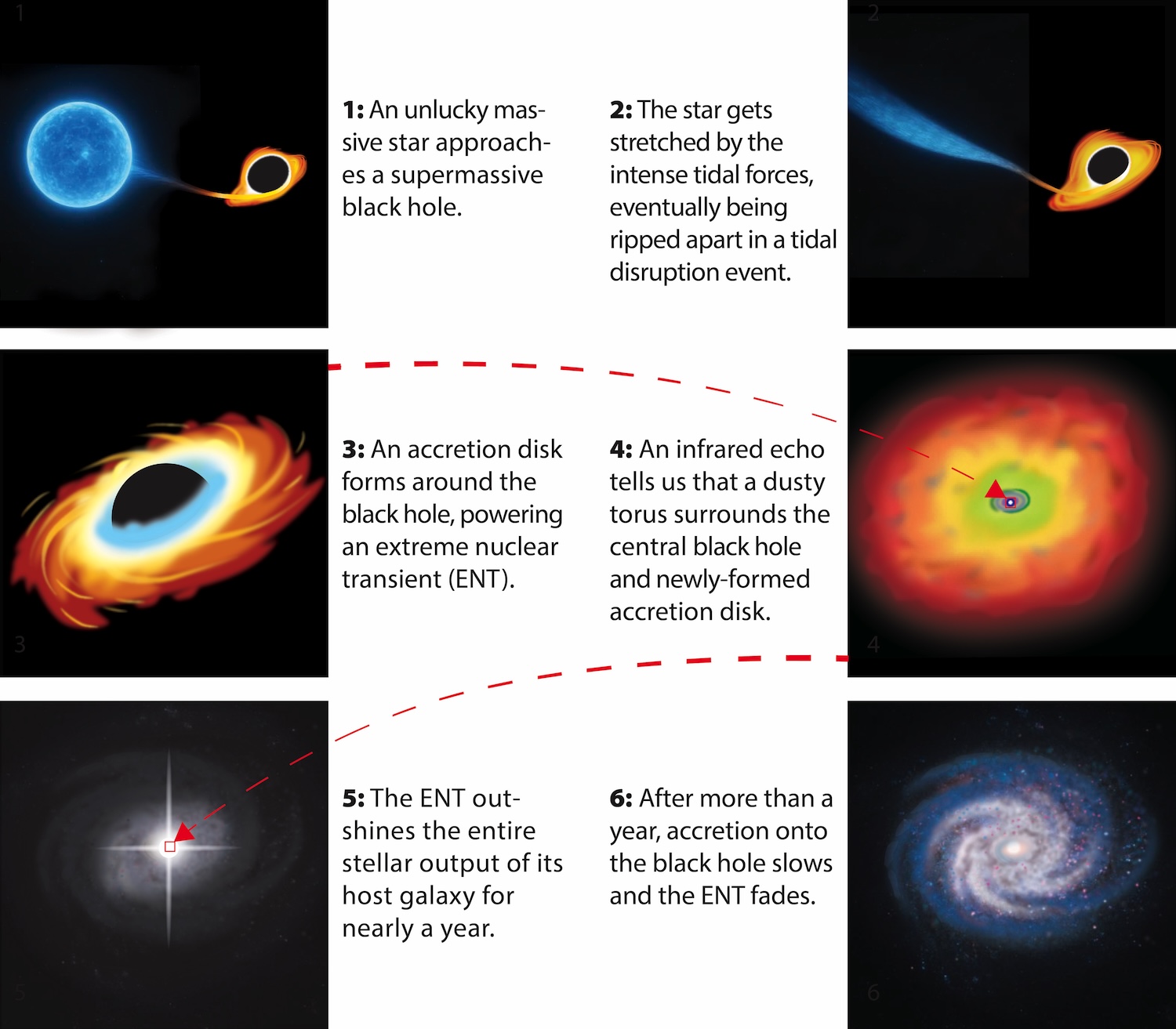
    New research by the University of Hawaii has discovered Extreme Nuclear Transients (ENTs), the most powerful explosions since the Big Bang, surpassing even gamma-ray bursts (GRBs) in energy output.

    Back2Basics: Big Bang

    • Proponent: In 1927 by Georges Lemaître.
    • Timeline: Universe originated ~13.7–13.8 billion years ago from a singularity.
    • Phases: Began with cosmic inflation, followed by expansion, cooling, and formation of matter, light, and four fundamental forces.
    • Cosmic Evolution: Led to atoms, stars, galaxies, and planets; universe still expanding.
    • Evidence: Supported by cosmic microwave background radiation and Hubble’s observations of galaxy redshifts.

    About Extreme Nuclear Transients (ENTs):

    • Discovery: First reported by astronomers at the University of Hawaii’s Institute for Astronomy (IfA).
    • Cause: Triggered when massive stars (≥3 times Sun’s mass) are torn apart by supermassive black holes at galactic centers.
    • Energy Output: Release ten times more energy than gamma-ray bursts (GRBs), earlier considered the brightest cosmic events.
    • Duration: Remain luminous in radio wavelengths for years, unlike short-lived bursts.

    How ENTs differ from other cosmic events?

    • Gamma-Ray Bursts (GRBs): They come from collapsing stars or mergers; short-lived but highly energetic. ENTs are more powerful and last longer.
    • Tidal Disruption Events (TDEs): TDEs also shred stars, but ENTs involve larger black holes and massive stars, making them rarer.
    • Fast X-ray Transients (FXTs): They are faint, brief X-ray bursts from trapped jets in supernovae. ENTs are brighter, multi-wavelength, and more energetic.

    Scientific Importance of ENTs:

    • Most Energetic Events: Represent the most powerful class of transients ever observed.
    • Black Hole Studies: Offer insights into supermassive black hole dynamics and their role in galactic evolution.
    • Early Universe Clues: Help probe massive stars soon after galaxy formation.
    • Future Observations: Key targets for next-generation telescopes like the Vera C. Rubin Observatory and Nancy Grace Roman Space Telescope.
    [UPSC 2012] Which of the following is/are cited by the scientists as evidence for the continued expansion of the universe?

    1. Detection of microwaves in space

    2. Observation of redshift phenomenon in space

    3. Movement of asteroids in space

    4. Occurrence of supernova explosions in space

    Select the correct answer using the code given below:

    (a) 1 and 2 * (b) 2 only (c) 1, 3 and 4 (d) None of the above.


  • Gaganyaan Analog Experiments (Gyanex)

    Why in the News?

    Gyanex (Gaganyaan Analog Experiments) ground-based astronaut simulations are being conducted by ISRO with ICMR and Institute of Aerospace Medicine, Bengaluru, to prepare Indian astronauts for the 2027 Gaganyaan mission.

    What are Gaganyaan Analog Experiments (Gyanex)?

    • Purpose: India’s first systematic programme in space medicine and astronaut psychology, preparing protocols for Gaganyaan and future missions like space stations and lunar expeditions.
    • Setup: Conducted at the Institute of Aerospace Medicine, Bengaluru, with ICMR support. Astronauts and defence personnel live in a mock spacecraft simulator under confinement, consuming DRDO-developed space food.
    • Activities: Strict space-like routines involving scientific experiments, resource management, schedules, and limited supplies. Tests also cover communication with time-delay simulation.
    • Gyanex-1: Group Captain Angad Pratap and two others confined for 10 days; completed 11 experiments on psychology, biomedicine, and communications.
    • Microgravity Simulation: Weightlessness cannot be reproduced on Earth; instead, 7-day bed-confinement at 6° head tilt studied microgravity effects.
    • Other Indian Analog Missions:
      • Ladakh Human Analog Mission (Nov 2024): Simulated interplanetary survival in cold, barren terrain.
      • HOPE Habitat at Tso Kar (Aug 2025): Tested 8 m habitat + 5 m utility module in Mars-like conditions of low pressure, saline permafrost, and high UV radiation.

    About Gaganyaan Mission:

    • Overview: India’s first human spaceflight mission, initiated in 2007, to send 3 astronauts into Low Earth Orbit (400 km) for 3 days, followed by Arabian Sea splashdown.
    • Rocket: Human-Rated LVM3 (HLVM3), adapted from GSLV Mk3, certified in 2025 for safe human use.
    • Significance: India to become the 4th nation (after US, Russia, China) with crewed spaceflight capability.
    • Latest Timeline (as of Sept 2025):
      • Dec 2025: First uncrewed mission (G1) with humanoid Vyommitra.
      • 2026: Two more uncrewed flights for life-support, avionics, and escape tests.
      • Early 2027: First crewed mission – 3 astronauts in orbit for 3 days.
    • Progress so far:
      • 80–85% development complete: avionics, parachutes, crew safety systems validated.
      • Integrated Air Drop Test (Aug 2025): Confirmed crew module deceleration.
      • Crew Escape System: Multiple ground and flight tests successful.
      • Recovery: Indian Navy and Australian Space Agency conducting splashdown drills.
      • Four IAF test pilots shortlisted: Shubhanshu Shukla, Prasanth Balakrishnan Nair, Angad Pratap, Ajit Krishnan.
      • All trained in Russia, now in advanced Indian training. Final crew of three will be chosen for maiden flight.
    [UPSC 2016] Consider the following statements: The Mangalyaan launched by ISRO

    1. is also called the Mars Orbiter Mission

    2. made India the second country to have a spacecraft orbit the Mars after USA

    3. made India the only country to be successful in making its spacecraft orbit the Mars in its first attempt.

    Select the correct answer using the code given below:

    Options: (a) 1 only (b) 2 and 3 only (c) 1 and 3 only * (d) 1, 2 and 3


  • ‘Blood Moon’ and Lunar Eclipse

    Why in the News?

    Viewers across Asia, Australia, and parts of Africa witnessed a Blood Moon on 8th September, a spectacular form of total lunar eclipse visible.

    About Lunar Eclipse:

    • Overview: Happens when Earth comes between Sun and Moon, blocking sunlight from reaching the Moon.
    • Earth’s Shadow:
      • Umbra: Dark central shadow, causes total or partial eclipses.
      • Penumbra: Outer shadow, causes faint dimming.
    • Types:
      1. Total Eclipse: Moon passes fully through umbra.
      2. Partial Eclipse: Only part of Moon enters umbra.
      3. Penumbral Eclipse: Moon passes through penumbra with subtle darkening.
    • Frequency: Occurs 2–4 times per year, visible from different regions.

    Why lunar eclipse don’t occur every month?

    : Lunar eclipses don’t happen every month because the Moon’s orbit around the Earth is tilted by about 5 degrees relative to the Earth’s orbit around the Sun. This tilt, known as orbital inclination, means that during a full Moon, the Moon often passes above or below Earth’s shadow, preventing a perfect alignment required for an eclipse. Eclipses only occur when the alignment is precise, allowing the Sun, Earth, and Moon to line up in a straight line.

    What is Blood Moon?

    • Meaning: Refers to the reddish glow of the Moon during a total lunar eclipse.
    • Cause: Rayleigh scattering in Earth’s atmosphere.
      • Short wavelengths (blue, violet) scatter away.
      • Longer wavelengths (red, orange) bend around Earth and light the Moon.
    • Colour Intensity:
      • Presence of dust, aerosols, volcanic ash deepens the red shade.
      • Cleaner atmosphere produces a lighter red or orange.
    • Historical Insight: Medieval records of Blood Moons helped identify volcanic eruptions between 1100–1300 CE, confirmed by a 2023 University of Geneva study.

    Significance:

    • Scientific: Acts as a natural indicator of atmospheric composition, dust, and pollution; helps model planetary atmospheres.
    • Historical/Environmental: Provides evidence of past volcanic events and climate conditions.
    • Cultural: Linked to myths and superstitions, though harmless scientifically.
    • Public Engagement: Widely followed celestial event that aids astronomy outreach and awareness.
    [UPSC 2019] On 21st June, the Sun

    Options: (a) does not set below the horizon at the Arctic Circle*

    (b) does not set below the horizon at Antarctic Circle

    (c) shines vertically overhead at noon on the Equator

    (d) shines vertically overhead at the Tropic of Capricorn


  • New Horizons and Stellar Parallax Navigation

    Why in the News?

    A recent study has showcased that spacecrafts can locate themselves using a simple stellar parallax method with just two nearby stars, without relying on Earth.

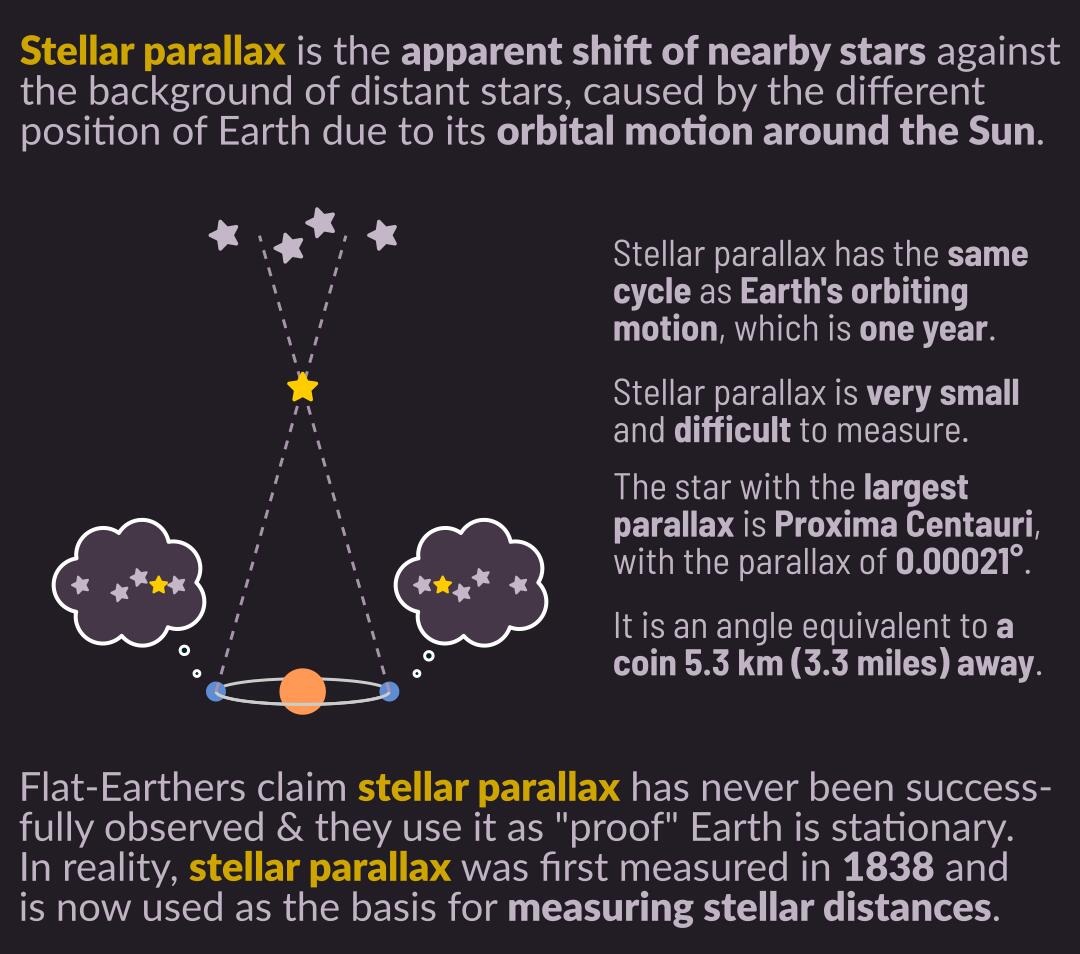
    New Horizons and Stellar Parallax Navigation

    What is Stellar Parallax?

    • Overview: Stellar parallax is the apparent shift in a star’s position against background stars when observed from two different vantage points.
    • Example: On Earth, this is measured every 6 months as the planet moves to opposite sides of its orbit.
    • Parallax Angle: The degree of this shift gives the star’s distance. Larger parallax means the star is closer.
    • Application in Space: By observing stars from both Earth and a spacecraft (billions of km apart), the relative positions can be compared to calculate the spacecraft’s distance.

    About the New Horizons Demonstration:

    • Spacecraft: Launched in 2006, New Horizons explored Pluto (2015) and is now beyond 60 AU (astronomical units).
    • Observation: On April 23, 2020, astronomers measured parallaxes of Proxima Centauri (4.2 light years) and Wolf 359 (7.9 light years) using Earth-based telescopes and New Horizons’ onboard instruments.
    • Results:
      • Proxima’s parallax: 32.4 arcseconds
      • Wolf 359’s parallax: 15.7 arcseconds
      • Derived spacecraft position: 46.89 AU, matching DSN’s 47.11 AU reading.
    • Requirements: Only a camera, onboard computer, and stellar catalogue — no special equipment needed.

    Significance:

    • Self-sufficient Navigation: Enables spacecraft to calculate their position without depending solely on Earth-based radio signals.
    • For Future Missions: Particularly useful for interstellar missions, where Earth’s beacons won’t be practical.
    • Simplicity: Unlike more complex astrometric navigation or pulsar navigation, this method is accessible with minimal hardware.
    • Educational Value: Though not precise enough yet for real-time navigation, it is a proof of concept for deep-space autonomy.
    [UPSC 2012] A person stood alone in a desert on a dark night and wanted to reach his village which was situated 5 km east of the point where he was standing. He had no instruments to find the direction, but he located the polestar. The most convenient way now to reach his village is to walk in the:

    Options: (a) direction facing the polestar

    (b) direction opposite to the polestar

    (c) direction keeping the polestar to his left *

    (d) direction keeping the polestar to his right


  • [pib] PRATUSH Mission

    Why in the News?

    Raman Research Institute (RRI) has devised the Probing ReionizATion of the Universe using Signal from Hydrogen (PRATUSH) Telescope to study the “Cosmic Dawn” by detecting radio signals from neutral hydrogen gas.

    About the PRATUSH Mission:

    • Developer: Designed by the Raman Research Institute (RRI), Bengaluru, an autonomous institute under the Department of Science and Technology (DST).
    • Main Goal: To study the Cosmic Dawn – the period when the first stars and galaxies formed – by detecting the faint 21-cm radio signal from neutral hydrogen.
    • Why from the Moon? On Earth, these signals get lost due to radio noise (like FM signals) and atmospheric distortions. The lunar far side is the quietest place in the inner Solar System for radio astronomy, making it the best site.
    • Scientific Importance: Will help scientists understand how the first stars heated and ionized hydrogen gas, how the early Universe changed, and may even give clues about dark matter and fundamental physics.

    Key Features:

    • Compact Design: Small, lightweight, low-power, and cost-effective – in line with the global trend of miniaturized space instruments.
    • Digital Receiver System:
      • Uses a single-board computer (like Raspberry Pi prototype).
      • Equipped with FPGA (Field Programmable Gate Array) for high-speed radio data processing.
    • How it Works:
      • Antenna collects faint hydrogen signals.
      • Analog receiver amplifies them.
      • Digital receiver + FPGA convert them into detailed spectral fingerprints of sky brightness.
    • Test Results: Lab trials (352 hours) showed extremely low noise (few millikelvins), proving it can detect faint cosmic signals.
    • SWaP Advantage: Optimized for Size, Weight, and Power (SWaP), making it highly suitable for space deployment.
    [UPSC 2010]  In the context of space technology, what is Bhuvan, recently in the news?

    Options:

    (a) A mini satellite launched by ISRO for promoting the distance education in India

    (b) The name given to the next Moon Impact Probe, for Chandrayaan-II

    (c) A geoportal of ISRO with 3D imaging capabilities of India *

    (d) A space telescope developed by ISRO


  • NASA-ESA Solar Orbiter Mission

    Why in the News?

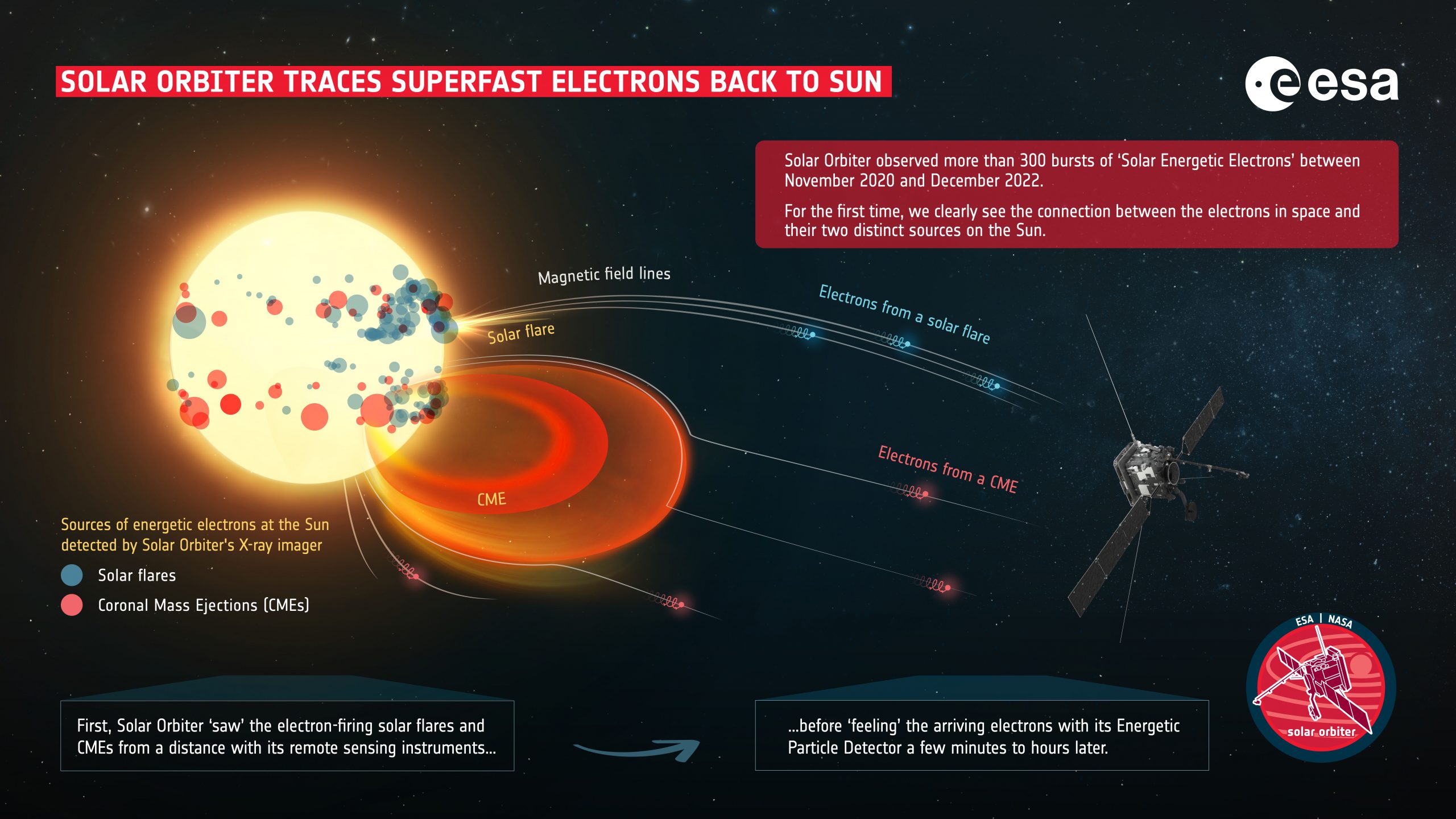
    The NASA-ESA Solar Orbiter Mission has recently traced the origin of Solar Energetic Electrons (SEE), advancing knowledge of solar activity and space weather.

    NASA-ESA Solar Orbiter Mission

    About NASA–ESA Solar Orbiter Mission:

    • Launch & Cost: Launched in Feb 2020 on an Atlas V from Cape Canaveral; joint ESA–NASA mission worth $1.5 billion.
    • Duration: Primary mission till 2026, extendable to 2030.
    • Orbit: Highly eccentric, approaching 0.28 AU (inside Mercury’s orbit); gradually tilts to image Sun’s poles.
    • Payload: 10 instruments — both in-situ (solar wind, magnetic fields, particles) and remote sensing (imaging, spectroscopy).
    • Firsts & Objectives: First to image solar poles; aims to study solar wind origin, solar cycle dynamics, causes of flares/CMEs, and their impact on heliosphere & space weather.

    What are Solar Energetic Electrons (SEE)?

    • What are they: Streams of high-energy electrons released into space, travelling across the heliosphere.
    • Sources: Emerge from solar flares (sudden surface bursts) and coronal mass ejections (CMEs) (plasma + magnetic eruptions).
    • Patterns: Release not always immediate; often delayed by hours due to turbulence/scattering in interplanetary medium.
    • Solar Orbiter Observations: Detected 300+ bursts (2020–22), clearly linking SEE to solar flares/CMEs for the first time.

    Significance of the recent findings:

    • Science: Clarifies Sun’s particle acceleration mechanisms.
    • Space Weather: CMEs are the main drivers of severe events — affecting satellites, GPS, communication, power grids, and astronaut safety.
    • Practical Utility: Improves solar storm forecasting and early-warning systems for infrastructure & human spaceflight.
    • Long Term Implications: Expected to revolutionise solar physics and our predictive capacity of Sun–Earth interactions.
    [UPSC 2022] If a major solar storm (solar flare) reaches the Earth, which of the following are the possible effects on the Earth?

    1. GPS and navigation systems could fail.

    2. Tsunamis could occur at equatorial regions.

    3. Power grids could be damaged.

    4. Intense auroras could occur over much of the Earth.

    5. Forest fires could take place over much of the planet.

    6. Orbits of the satellites could be disturbed.

    7. Shortwave radio communication of the aircraft flying over polar regions could be interrupted.

    Select the correct answer using the code given below:

    (a) 1, 2, 4 and 5 only (b) 2, 3, 5, 6 and 7 only (c) 1, 3, 4, 6 and 7* only (d) 1, 2, 3, 4, 5, 6 and 7


  • Jarosite in Kutch: India’s Mars Analogue Site

    Why in the News?

    Matanomadh in Kutch, Gujarat, with jarosite deposits like those on Mars, is being considered by ISRO as a test site for future Mars missions.

    What is Jarosite?

    • Composition: A yellow, iron-rich sulphate mineral containing iron, sulphur, oxygen, and potassium.
    • Formation: Develops when volcanic ash or sulphur-bearing minerals chemically react with water, making it a marker of past water–rock interaction.
    • Discovery in India: Reported in 2016 at Matanomadh, Kutch (Gujarat) by ISRO’s Space Applications Centre; also found at Varkala cliffs, Kerala. Kutch is more suitable for planetary research.
    • Martian Link: Detected in 2004 by NASA’s Opportunity Rover. This referred as terrestrial clone of Martian surface.
    • Global Occurrence: Found in Mexico, Spain, Canada, Japan, and the USA (Utah, California), all serving as Mars analogue sites.

    Matanomadh’s Significance for Mars Study:

    • Mars Analogue Value: Geological dating shows deposits about 55 million years old (Paleocene period), resembling early Martian conditions.
    • Test Bed for ISRO: Provides ground for testing rover mobility, drilling systems, geochemical studies, and remote sensing for Mangalyaan-2 and future missions.
    • Astrobiology Potential: Since jarosite can trap organic molecules, it helps in shaping strategies to search for signs of past life on Mars.
    • Complement to Ladakh: While Ladakh sites simulate Martian climate, Matanomadh represents Martian geology and mineralogy, creating a comprehensive Mars-analogue ecosystem in India.
    • Conservation Importance: Facing threats from waterlogging and coal mining; scientists urge its declaration as a Planetary Geo-heritage Site.
    • Strategic Edge: Strengthens India’s role in planetary exploration, astrobiology research, and international collaborations.
    [UPSC 2016] Consider the following statements:

    1. The Mangalyaan launched by ISRO

    2. is also called the Mars Orbiter Mission

    3. made India the second country to have a spacecraft orbit the Mars after USA

    4. made India the only country to be successful in making its spacecraft orbit the Mars in its very first attempt

    Which of the statements given above is/are correct?

    (a) 1 only   (b) 2 and 3 only   (c) 1 and 3 only * (d) 1, 2 and 3


  • Kulasekarapattinam Launch Complex

    Why in the News?

    ISRO Chairman V. Narayanan announced that the upcoming rocket launching site at Kulasekarapattinam (Tamil Nadu) will handle 20–25 satellite launches annually.

    Kulasekarapattinam Launch Complex

    About Kulasekarapattinam Spaceport:

    • Location: Coastal hamlet near Tiruchendur, Thoothukudi district, Tamil Nadu; inaugurated by PM in February 2024.
    • Second Spaceport: India’s second spaceport after Satish Dhawan Space Centre (Sriharikota, Andhra Pradesh, 1971).
    • Capacity: Can handle 20–25 launches annually, including 24 launches using a Mobile Launch Structure.
    • Focus: Dedicated to Small Satellite Launch Vehicles (SSLVs), with capacity to launch rockets up to 500 kg.
    • Facilities: About 35 facilities including launch pad, rocket integration units, ground range, checkout systems, and Mobile Launch Structure with onboard checkout computers.

    Advantages offered by Kulasekarapattinam Spaceport:

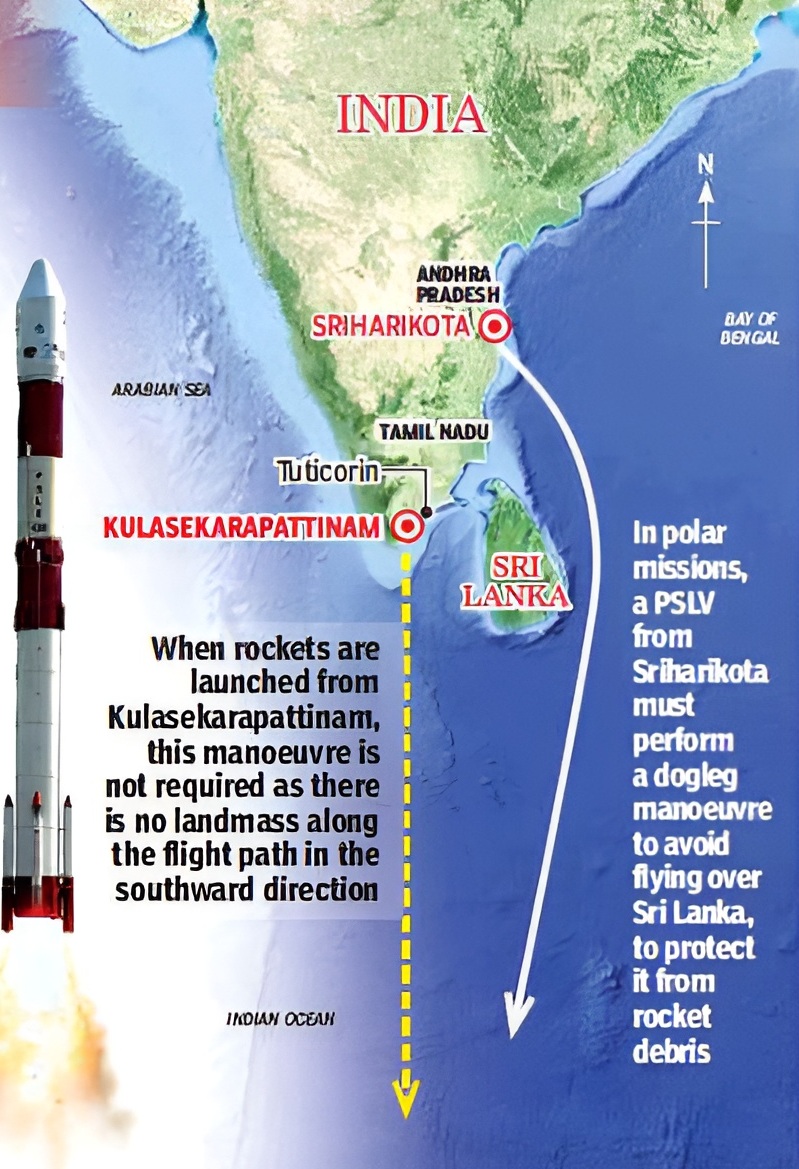
    • Direct Southward Launches: Location allows launches into the Indian Ocean without crossing landmasses; ensures more safety from debris fall.
    • No Dogleg Manoeuvre: Unlike Sriharikota, no detour is needed to avoid Sri Lanka, saving fuel.
    • Efficient Trajectory: Improves efficiency for satellites in Sun-Synchronous Polar Orbits (SSPOs).
    • Payload Advantage: SSLVs from Kulasekarapattinam can place ~300 kg into SSPO, higher than from Sriharikota.
    • Decongestion: Reduces pressure on Sriharikota, which will focus on larger PSLV, GSLV, and Gaganyaan launches.
    • Commercial Boost: Strengthens India’s role in the global small-satellite launch market, enhancing space economy.
    • Strategic Advantage: Near-equator position provides benefits for certain orbital paths.
    [UPSC 2008] ISRO successfully conducted a rocket test using cryogenic engines in the year 2007. Where is the test-stand used for the purpose, located?

    Options: (a) Balasore (b) Thiruvananthapuram (c) Mahendragiri* (d) Karwar


  • SpaceX’s Starship completes critical test flight

    Why in the News?

    SpaceX’s Starship has completed its first fully successful test flight after a series of failures.

    SpaceX’s Starship completes critical test flight

    About SpaceX Starship:

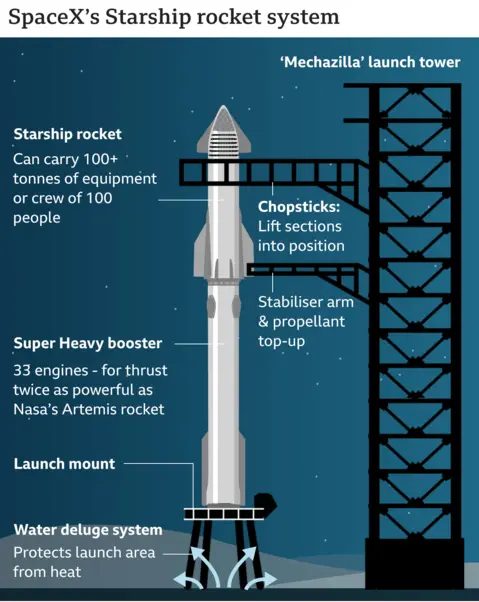
    • Design: A two-stage heavy-lift launch vehicle built to carry crew and cargo to Earth orbit, the Moon, Mars, and beyond.
    • Developer: SpaceX, founded by Elon Musk, with the vision of enabling interplanetary travel and colonisation.
    • Size: Nearly 120 metres tall with booster, making it the largest rocket ever built and flown. Taller than Saturn V (111 m) and India’s Qutub Minar (72.5 m).
    • Historic Test Flight: On 27 August 2025, achieved its first fully successful flight. Booster splashed down in the Gulf of Mexico, spacecraft reached the Indian Ocean.
    • Role in NASA Missions: Critical to Artemis Program for returning humans to the Moon and later missions to Mars.
    • Long-term Goal: Make Starship fully and rapidly reusable, cutting costs and redefining space travel.

    Key Features of Starship:

    • Two-Stage Rocket System:
      • Super Heavy booster powered by 33 Raptor engines generating 74 meganewtons of thrust, nearly double NASA’s SLS and twice Saturn V.
      • Engines burn liquid oxygen and methane, enabling deep-space use and Mars resource utilisation.
      • Booster fully reusable, capable of atmospheric re-entry and recovery.
      • Six Raptor engines and four landing fins, designed for full reusability on long-duration missions.
    • Payload Capacity: Can carry up to 150 tonnes to Low-Earth Orbit and over 100 tonnes to the Moon and Mars, more than all soft-landed lunar payloads combined.
    • Cost Reduction Potential: Estimated to deliver 100 tonnes of cargo to Mars for ~$50 million, compared to NASA Shuttle’s $1.5 billion per launch with far less payload.
    [UPSC 2025] Consider the following space missions:

    I. Axiom-4 II. SpaDeX III. Gaganyaan

    How many of the space missions given above encourage and support microgravity research?

    Options: (a) Only one (b) Only two (c) All the three* (d) None


  • Discovery of Rare Quadruple Star System with Brown Dwarfs

    Why in the News?

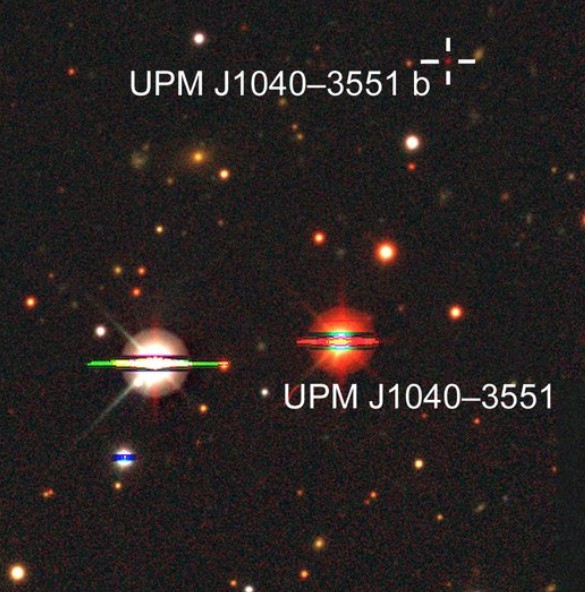
    Scientists have identified UPM J1040−3551 AabBab, a rare quadruple star system with two brown dwarfs orbiting two red dwarfs.

    Discovery of Rare Quadruple Star System with Brown Dwarfs

    About UPM J1040−3551 AabBab:

    • Overview: Newly discovered quadruple star system in the Milky Way.
    • Composition: Two cold T-type brown dwarfs orbiting a pair of young red dwarf stars.
    • Uniqueness: First known system of its kind; extremely rare as brown dwarfs usually exist alone, with less than 5% chance of companions.
    • Significance: Offers new insights into the formation and evolution of low-mass stars and sub-stellar objects.

    What are Brown Dwarfs?

    • Overview: Celestial objects between stars and planets in characteristics.
    • Formation: Form like stars from collapsing gas and dust but lack sufficient mass for sustained hydrogen fusion.
    • Nickname: Often called “failed stars” due to absence of sustained nuclear fusion.
    • Mass Range: Can reach up to about 70 times the mass of Jupiter.
    • Atmosphere: Similar to gas giants like Jupiter and Saturn, with molecules and water vapor clouds.
    • Detection: Very faint and cold; usually identified in multiple-star systems where brighter stars help estimate their properties.
    • Astronomical Importance: Help define the boundary between stars and planets; provide clues to conditions necessary for stellar and planetary formation.
    • Cosmological Role: Studying their abundance and distribution aids in understanding mass distribution in the universe and connections to dark matter.
    [UPSC 2024] Consider the following statements:

    Statement-I: Giant stars live much longer than dwarf stars.

    Statement-II: Compared to dwarf stars, giant stars have a greater rate of nuclear reactions.

    Which one of the following is correct in respect of the above statements?

    Options: (a) Both Statement-I and Statement-II are correct and Statement-II explains Statement-I

    (b) Both Statement-I and Statement-II are correct, but Statement-II does not explain Statement-I

    (c) Statement-I is correct, but Statement-II is incorrect

    (d) Statement-I is incorrect, but Statement-II is correct*