💥Join UPSC 2027,2028 Mentorship (August Batch) + XFactor Notes & Microthemes PDF

Subject: Space Technology

  • Europe’s Proba-3 Mission to arrive in India

    Europe's Proba-3 Mission to arrive in India

    Why in the News?

    • India is set to launch the European Space Agency’s (ESA) PROBA-3 Mission in December from the Sriharikota spaceport.
      • The mission will use ISRO’s PSLV rocket to place two satellites in orbit, designed to study the Sun’s corona, or outer atmosphere.

    About Proba-3 Mission:

    Details
    Mission Name PROBA-3 (Project for On-Board Autonomy-3)
    Objective Study the Sun’s corona by creating an artificial eclipse with precision formation flying of two satellites
    Launch Date and Location December 4, 2024, from Sriharikota spaceport, India, via ISRO’s PSLV-XL rocket
    Orbit Highly elliptical orbit, ranging from 600 km to 60,000 km, with a 19.7-hour orbital period
    Satellites Two satellites: 

    1. Coronagraph spacecraft (340 kg) and
    2. Occulter spacecraft (200 kg)
    Alignment Precision Millimeter-level alignment to block the Sun’s light and allow continuous corona observation
    Key Scientific Goals Observe solar phenomena, such as solar flares and coronal mass ejections, to improve space weather forecasting
    Unique Features First ESA mission dedicated to precision formation flying, using smaller, agile satellites for cost-effective observation
    International Collaboration Jointly developed by ESA and ISRO, with contributions from France, Belgium, and the Netherlands
    Communication Support Managed via antenna in Santa Maria (Azores) and ground station in Redu (Belgium)
    Significance Advances solar research and international collaboration; enhances space weather insights, supporting infrastructure on Earth


    PYQ:

    [2016] What is ‘Greased Lightning-10 (GL-10)’, recently in the news?

    (a) Electric plane tested by NASA

    (b) Solar-powered two-seater aircraft designed by Japan

    (c) Space observatory launched by China

    (d) Reusable rocket designed by ISRO

  • Does the Sun rotate?

    sun

    Why in the News?

    Indian astronomers at the Kodaikanal Solar Observatory (KSO) have achieved a groundbreaking feat by mapping, for the first time, the variation in the Sun’s rotation speed from its equator to its poles.

    Sun’s Rotation: Key Facts

    • Unlike a solid body, the Sun exhibits differential rotation, meaning different parts of the Sun rotate at different speeds.
    • The rotation speed varies depending on latitude, with faster rotation near the equator and slower rotation toward the poles.
    • This variation is primarily due to the Sun’s composition of gaseous plasma rather than solid material.

    Rotation Period Variation by Latitude:

    • Equatorial Regions: The rotation period at the equator is the fastest, around 24.47 days (sidereal rotation).
    • Sunspot Zones (about 16 degrees latitude): Rotation slows slightly, with a period of about 27.3 days.
    • Higher Latitudes (up to 75 degrees): Rotation slows significantly; for example, at 75 degrees latitude, the rotation period is about 33.4 days.
    • Poles: The slowest rotation occurs at the poles, with a period around 31.1 days.

    Sidereal vs. Synodic Rotation Periods:

    • Sidereal Rotation Period: The time taken for the Sun to complete one full rotation relative to distant stars. It varies by latitude, from 24.47 days at the equator to around 33.4 days at higher latitudes.
    • Synodic Rotation Period: This is the time for a fixed feature on the Sun to appear in the same position when observed from Earth. It is longer than the sidereal period due to Earth’s own movement around the Sun, averaging around 26.24 days.

    Why Differential Rotation Occur?

    • Gaseous Plasma Composition: The Sun is composed of plasma—a hot, ionized state of matter—which allows its different regions to rotate at different speeds.
    • Convective Zone Dynamics: The outer convective layer of the Sun contributes to differential rotation. Plasma circulates, rising and sinking, which influences the rotational speed at different latitudes.

    Scientific Implications

    • Solar Dynamo Theory: The differential rotation of the Sun is central to theories about the solar dynamo—the process that generates the Sun’s magnetic field.
    • Mystery of Differential Rotation: Despite extensive research, the exact mechanism behind the Sun’s differential rotation remains an active area of investigation in solar physics.

    PYQ:

    [2013] Consider the following phenomena

    1. Size of the sun at dusk

    2. Colure of the sun at dawn

    3. Moon being visible at dawn

    4. Twinkle of stars in the sky

    5. Polestar being visible in the sky

    Which of the above are optical illusions?

    (a) 1, 2 and 3

    (b) 3, 4 and 5

    (c) 1, 2 and 4

    (d) 2, 3 and 5

  • First ‘Black Hole Triple’ System Discovered

    Scientists have discovered a “black hole triple” in space, marking the first time such a system has been identified.

    Why in the News?

    Scientists have discovered a “black hole triple” in space, marking the first time such a system has been identified.

    Black Hole Triple: What does it mean?

    • Many black holes are found in binary systems with another star or black hole.
    • This triple system includes two stars orbiting a black hole:
      • The nearer star orbits the black hole every 6.5 days.
      • The distant star orbits approximately every 70,000 years.
    • The system, located in the constellation Cygnus, features V404 Cygni, one of the oldest black holes known, which is nine times larger than the Sun.
    • It is 8,000 light years away from Earth.

    What is a Black Hole?

    • A black hole is a space region with such strong gravity that no light or matter can escape.
    • Most black holes form from supernova explosions—the death of massive stars.
    • This triple system suggests an alternative, less violent formation process.

    How was it discovered?

    • Researchers from Caltech and MIT discovered the system while reviewing astronomical data from telescopes.
    • They described the stars as being gravitationally bound, indicating they form a triple system.
    • It is believed that  V404 Cygni did not form through a supernova explosion, which typically ejects outer stars.
    • Instead, it likely formed through direct collapse: the star collapsed inward without exploding.
    • Known as a “failed supernova”, this process causes an implosion without expelling matter, leading to a gentler black hole formation.

    Future of the Triple System

    • The triple system may not remain as such, as V404 Cygni is consuming the nearby star.
    • This discovery suggests that some existing binary systems may have originally been triple systems, where the black hole later consumed one of its members.

    PYQ:

    [2019] Recently, scientists observed the merger of giant ‘blackholes’ billions of light-years away from the Earth. What is the significance of this observation?

    (a) ‘Higgs boson particles’ were detected.
    (b) ‘Gravitational waves’ were detected.
    (c) Possibility of inter-galactic space travel through ‘wormhole’ was confirmed.
    (d) It enabled the scientists to understand ‘singularity’

  • Betelgeuse, one of the Brightest Stars predicted to Explode

    Recent research has revealed a surprising finding about Betelgeuse (which was believed to explode): the star’s unusual brightening and dimming patterns may be influenced by an unseen companion star.

    Why in the News?

    Recent research has revealed a surprising finding about Betelgeuse (which was believed to explode): the star’s unusual brightening and dimming patterns may be influenced by an unseen companion star.

    About Betelgeuse

    • Betelgeuse is a red supergiant star in the Orion constellation, marking Orion’s left shoulder.
    • It is among the brightest and largest stars visible in the night sky, located about 650 light-years from Earth.
    • The star is nearing the end of its life, and when it dies, its explosion is expected to be visible during the day for several weeks.
    • Betelgeuse is vast, measuring more than 700 million miles (1.2 billion kilometers) in diameter.
    • Known for its periodic dimming and brightening, Betelgeuse has two distinct pulsation cycles:
      • A short-term cycle of about one year.
      • A longer six-year cycle called a long secondary period.
    • Researchers believe this longer cycle may be caused by Betelbuddy (an unseen companion star) moving through the dust surrounding Betelgeuse.

    Indicators and Scientific Evidence

    • Betelgeuse’s cyclic dimming and brightening patterns indicate it is nearing the end of its life.
    • Its massive size and expansion as a red supergiant suggest it is in a late stellar stage.
    • Cooling surface temperature and mass loss through stellar winds signal increasing instability.
    • Spectral analysis shows heavy elements in Betelgeuse’s layers, typical of late-stage fusion.
    • An unseen companion star, or “Betelbuddy,” may be influencing its brightness and internal structure.

    Potential Effects of Betelgeuse’s Supernova on Earth and Our Solar System

    • Betelgeuse’s supernova will likely be visible in daylight for weeks and brighter than the Moon at night.
    • At 650 light-years away, dangerous radiation would dissipate before reaching Earth, posing no harm.
    • Space missions and satellites may experience minor interference from increased cosmic rays.
    • The explosion will enrich the interstellar medium with heavy elements, contributing to new star formation.
    • The supernova will provide valuable scientific insights into stellar life cycles and cosmic element formation.

    PYQ:

    [2017] The terms ‘Event Horizon’, ‘Singularity’, ‘String Theory’ and ‘Standard Model’ are sometimes seen in the news in the context of:

    (a) Observation and understanding of the Universe

    (b) Study of the solar and the lunar eclipses

    (c) Placing satellites in the orbit of the Earth

    (d) Origin and evolution of living organisms on the Earth

  • Moonlight Programme

    Why in the News?

    The European Space Agency (ESA) launched its Moonlight Lunar Communications and Navigation Services (LCNS) Programme.

    About Moonlight Programme

    Details
    Agency European Space Agency (ESA)
    Purpose To establish a communications and navigation infrastructure around the Moon to support future lunar missions by space agencies and private companies.
    Planned Missions Supports over 400 moon missions planned over the next 20 years.
    Satellite Constellation Deployment of 5 lunar satellites to provide communication and navigation services.
    Data Transfer Range Enables data transfer between Earth and the Moon over a distance of 400,000 km.
    First Satellite Lunar Pathfinder, a communications relay satellite built by Surrey Satellite Technology Ltd, is set to launch in 2026.
    Operational Timeline Initial services expected to begin by 2028, with full operational capability by 2030.
    Primary Focus Area Coverage around the Moon’s South Pole, an area of high interest due to favorable lighting conditions and potential water ice presence in permanently shadowed craters.
    Global Collaboration Collaboration with NASA and JAXA (Japanese Space Agency) as part of LunaNet for standardizing lunar mission communications and navigation.
    Significance – Enables over 400 lunar missions
    – Supports NASA’s Artemis programme
    – Provides continuous all-weather connectivity for lunar missions
    – Focuses on the South Pole for ice deposits
    – Reduces costs by sharing infrastructure
    – Technological advancements for Mars missions (MARCONI)
    Strategic Advantage Enhances ESA’s role in global lunar exploration and contributes to the future of commercial lunar activities.
  • What is Wayanad’s new X-band Radar?

    Why in the News?

    After the floods and landslides in Wayanad in July 2024, the Union Ministry of Earth Sciences approved the installation of an “X-band radar” in the district.

    What is an X-Band Radar?

    • An X-band radar is a type of radar that operates in the 8-12 GHz frequency range of the electromagnetic spectrum, with wavelengths of 2-4 cm.
    • This radar is particularly useful for detecting smaller particles like raindrops, fog, and other fine materials due to its shorter wavelengths, which allow for higher resolution images.

    Key Features of X-Band Radar:

    • High Resolution: The shorter wavelength provides more detailed images, making it ideal for tracking weather phenomena, including precipitation and particle movements.
    • Limited Range: They have a relatively shorter range compared to other types like S-band radars because higher frequency signals get attenuated (weakened) faster as they travel through the atmosphere.

    Applications: In weather forecasting, X-band radars are used for short-range weather monitoring, such as predicting rainfall intensity and landslides. They are also used in air traffic control and military applications.

    What is a Doppler Radar?  

    • A Doppler radar is a type of radar used primarily in meteorology to measure the velocity and movement of weather formations, such as clouds and storms.
    • It works on the principle of the Doppler effect, which refers to the change in frequency of waves as their source moves relative to the observer.

    It’s applications: 

    • Velocity Measurement: By measuring these changes in frequency, Doppler radar can determine how fast the object (e.g., rain cloud) is moving and in which direction.
    • Weather Monitoring: Doppler radar helps in tracking rainfall intensity, detecting wind patterns, and predicting the formation of storms or tornadoes.

    India’s Radar Network

    • The India Meteorological Department (IMD) began using radars in weather applications in the 1950s.
      • The first indigenously designed X-band storm detection radar was installed in 1970 in New Delhi.
    • In 1996, the IMD replaced 10 outdated X-band radars with digital X-band radars.
    • India’s radar network includes both wind-finding and storm-detecting X-band radars. The country also uses S-band radars (2-4 GHz) for long-range detection. The first S-band cyclone detection radar was installed in Visakhapatnam in 1970.

    Recent Developments:

    • In September 2024, the Ministry of Earth Sciences announced that India would install 56 additional Doppler radars over the next few years.
    • On September 11, 2024, the Union Cabinet approved the ₹2,000-crore ‘Mission Mausam’, which aims to upgrade meteorological infrastructure, including the installation of up to 60 radars by 2026.
    • The Wayanad radar initiative also includes the installation of a C-band radar (4-8 GHz) in Mangaluru, with an observational range of 250 km.

    About the NISAR

    • NISAR, short for NASA-ISRO Synthetic Aperture Radar, is a joint satellite mission being developed by NASA and ISRO.
    • NISAR will use radar imaging to create a high-resolution map of the earth’s landmasses, tracking changes in natural processes.
    • Its payload consists of an L-band radar (1.25 GHz, 24 cm) built by NASA and an S-band radar (3.2 GHz, 9.3 cm) built by ISRO.
    • NISAR is expected to launch in 2025 aboard an ISRO GSLV Mk II rocket, with a total cost of $1.5 billion, primarily funded by NASA.


    PYQ:

    [2016] Discuss India’s achievements in the field of Space Science and Technology. How the application of this technology has helped India in its socio-economic development?

  • Hanle Dark Sky Reserve Star Party observed in Ladakh

    Why in the News?

    Expert astro-photographers and astronomers have gathered at the Hanle Dark Sky Reserve from for the second Star Party.

    Star Party and Its Details

    • The Star Party at the Hanle Dark Sky Reserve is a gathering of amateur astronomers and astro-photographers who travel to Hanle to observe and capture celestial phenomena.
    • It was hosted by the Indian Institute of Astrophysics (IIA) from and attended by over 45 astronomy enthusiasts from across India.
    • Participants brought their own telescopes and cameras to capture unique celestial events, including faint galaxies, the Zodiacal Light, and the rare sight of Venus casting a shadow.

    About Hanle Dark Sky Reserve (HDSR)

    • The HDSR is a designated area in Changthang region of eastern Ladakh created to control man-made light pollution and protect the naturally dark night skies.
    • It spans approximately 1,073 square kilometers and is home to the Indian Astronomical Observatory, operated by the Indian Institute of Astrophysics (IIA).
    • Established to promote astronomy and astrophotography, it offers some of the darkest skies in India, ideal for astronomical research.
    • Hanley is also the home to second-highest optical telescope in the world, established in 2001 by IIA.

    Special Features of HDSR and the Surrounding Region

    • High Altitude: Hanle is situated at a high altitude, providing clearer skies with minimal atmospheric interference.
    • Minimal Light Pollution: The region has low light pollution, which makes it perfect for observing faint celestial objects.
    • Dry Climate: The dry weather in the region contributes to excellent visibility, reducing the impact of humidity on astronomical observations.

    Significance of HDSR

    • Astrophotography and Research: The dark skies allow for detailed observation of celestial phenomena and astrophotography, attracting enthusiasts and researchers.
    • Astro-Tourism: The reserve fosters astro-tourism, boosting the local economy by creating jobs for guides and supporting infrastructure.
    • Preservation of Night Skies: It plays a crucial role in preserving the natural darkness of the sky, curbing light pollution in the region.
    • International Attention: The reserve has attracted amateur and professional astronomers from across India and beyond, making it a hub for astronomical events.
    PYQ:

    [2018] Consider the following phenomena:

    1. Light is affected by gravity.
    2. The Universe is constantly expanding.
    3. Matter warps its surrounding space-time.

    Which of the above is/are the prediction/predictions of Albert Einstein’s General Theory of Relativity, often discussed in media?

    (a) 1 and 2 only
    (b) 3 only
    (c) 1 and 3 only
    (d) 1, 2 and 3

  • Findings based on China’s Chang’e-5 Mission

    Why in the News?

    • Scientists long believed that volcanic activity on the moon ceased about a billion years ago.
      • However, a study based on China’s Chang’e-5 mission samples has questioned this belief with evidence suggesting the moon had active volcanoes as recently as 120 million years ago.

    Chang’e-5 Mission: Overview and Recent Findings

    • Chang’e-5 is a mission launched in November 2020 as part of the Chang’e lunar exploration program.
    • It was designed to:
      • Collect samples from the moon’s surface and bring them back to Earth for analysis.
      • Study the geology and mineral composition of the moon.
    • It successfully landed on theMons Rumker region”, a volcanic complex in the Oceanus Procellarum (the ‘Ocean of Storms’) area on the moon’s near side, and returned about 1.7 kg of lunar material to Earth in December 2020.

    Recent Findings Based on Chang’e-5 Mission

    • Recent studies of samples have revealed evidence of volcanic activity on the moon as recently as 116-135 million years ago.
      • It challenges the previous belief that the moon’s volcanic activity ceased about a billion years ago.
    • The analysis of lunar glass beads collected by Chang’e-5 has provided insights into both volcanic eruptions and asteroid impacts that shaped the moon’s surface.

    What are the Beads on the Moon?

    • Lunar glass beads are small, spherical or egg-shaped glass particles found on the moon’s surface.
    • These beads are formed in two main ways:
      • Volcanic Activity: During volcanic eruptions, molten lava fragments are thrown into the air, where they cool rapidly and form glass beads.
      • Impact Events: When asteroids or meteorites hit the moon’s surface, the intense pressure and heat melt the surface material. The molten material cools quickly, forming glass beads as it lands back on the surface.
    • These beads are important because they:
      • Provide clues about the moon’s geological history.
      • Help scientists determine the age of volcanic eruptions.
      • Offer insights into the formation of the moon’s surface and its volcanic and impact events.

    Key characteristics of Lunar Glass Beads

    • Composition: These beads are primarily made of silicon, magnesium, and iron, with trace amounts of other elements such as potassium, titanium, and uranium.
    • Volcanic vs. Impact Beads: Volcanic glass beads tend to be more uniform, while impact beads may show fractures or deformations caused by high-energy impacts. Volcanic beads often contain more volatile elements like sulphur, which are released during eruptions.

    PYQ:

    [2012] What do you understand by the term Aitken basin?

    (a) It is a desert in the southern Chile which is known to be the only location on earth where no rainfall takes place.

    (b) It is an impact crater on the far side of the Moon.

    (c) It is a Pacific coast basin, which is known to house large amounts of oil and gas.

    (d) It is a deep hyper saline anoxic basin where no aquatic animals are found.

  • How Starlink satellites are ‘blinding’ astronomers?

    Why in the News?

    Starlink satellites, operated by Elon Musk’s SpaceX, are causing issues for astronomers by disrupting both optical and radio astronomy due to unintended electromagnetic radiation (UEMR).

    What is a Starlink Satellite?

    • Starlink satellites are part of a network created by Elon Musk’s SpaceX to provide high-speed internet to remote areas around the world.
    • The network, known as a satellite constellation, currently includes more than 6,300 satellites orbiting Earth at around 550 km altitude.
    • These satellites aim to offer internet connectivity to places that would otherwise lack access, especially in rural or underserved regions.

    Why Radio Astronomy matters?

    • Radio astronomy is a branch of astronomy that studies celestial objects using radio frequencies instead of visible light.
    • Radio telescopes detect radio waves, which are longer than light waves, emitted by objects in space such as stars, galaxies, and even black holes.
    • Radio astronomy is important because it helps scientists study the universe beyond what can be seen with optical telescopes.
    • Radio noise from sources like satellites can interfere with these observations, making it difficult for astronomers to collect data, similar to how bright lights can obscure faint stars.

    What Starlink does to Space Communications?

    • Starlink satellites are designed to improve global internet access, especially in hard-to-reach places, by transmitting signals from space.
    • However, these satellites also emit unintended electromagnetic radiation (UEMR), which causes radio noise that disrupts radio astronomy observations.
    • The situation may worsen as more satellites are launched — some estimates suggest 100,000 satellites could be orbiting Earth by 2030.
    • There are currently no regulations controlling how much radio pollution these satellites can emit, making it harder for astronomers to mitigate the impact on their work.

    PYQ:

    [2011] A layer in the Earth s atmosphere called Ionosphere facilitates radio communication. Why?

    1. The presence of ozone causes the reflection of radio waves to Earth.

    2. Radio waves have a very long wavelength.

    Which of the statements given above is/are correct?

    (a) 1 Only

    (b) 2 only

    (c) Both 1 and 2

    (d) Neither 1 nor 2

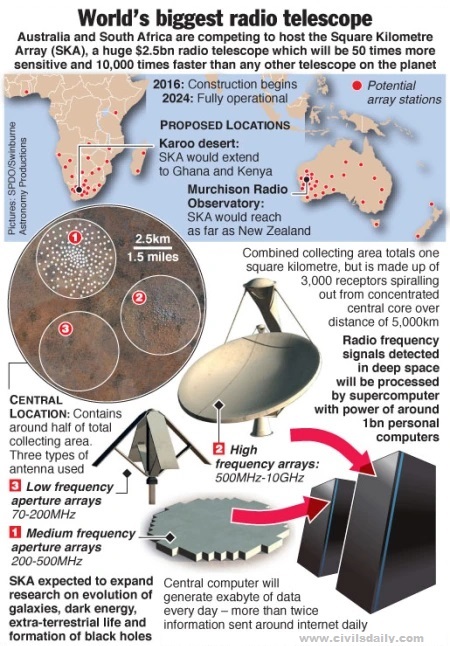
  • Square Kilometer Array (SKA) becomes partially functional

    Why in the News?

    The Square Kilometer Array (SKA), the world’s largest radio telescope, has carried out its first observations, marking a major milestone.

    About Square Kilometer Array (SKA) Project:

    Details
    Project Overview SKA is a global project aimed at building the world’s largest radio telescope network to explore the universe, galaxies, dark matter, and extraterrestrial life.
    Construction Phases Two phases:

    1. SKA-Mid in South Africa operates in higher frequency ranges.
    2. SKA-Low in Australia operates in lower frequency ranges.

    Phase 1 (SKA- Mid) began in December 2022. Full operations expected by 2029.

    Headquarters Jodrell Bank Observatory, UK
    Site Locations Telescope arrays in Australia (low-frequency) and South Africa (mid-frequency).
    Design and Features
    • 197 parabolic radio antennae in South Africa
    • 131,072 low-frequency antennae in Australia

    These are capable of detecting faint radio signals from vast distances.

    Global Consortium 16 member countries, including Australia, South Africa, India, China, Japan, and several European nations.
    India’s Role
    • India’s Giant Metrewave Radio Telescope (NCRA, TIFR) is a key partner
    • SKA India consortium (20+ institutions) involved in software, signal processing, and digital hardware development
    Key Technologies Advanced interferometer system using wave interference for data collection.
    Scientific Objectives
    • Explore galaxies at the edge of the universe
    • Study the ‘Dark Ages’ and phenomena like dark matter and dark energy
    • Search for extraterrestrial life
    Frequency Range Operates between 50 MHz to 15.4 GHz
    Global Collaboration Key collaboration among India, Australia, South Africa, Italy, and other member nations for data generation, analysis, and installation of antennas.


    PYQ:

    [2022] Launched on 25th December, 2021, James Webb Space Telescope has been much in the news since then. What are its unique features which make it superior to its predecessor Space Telescopes? What are the key goals of this mission? What potential benefits does it hold for the human race?

    [2015] In the context of modern scientific research, consider the following statements about ‘IceCube’, a particle detector located at South Pole, which was recently in the news:

    1. It is the world’s largest neutrino detector, encompassing a cubic kilometre of ice.

    2. It is a powerful telescope to search for dark matter

    3. It is buried deep in the ice.

    Which of the statements given above is/are correct?

    (a) 1 only

    (b) 2 and 3 only

    (c) 1 and 3 only

    (d) 1, 2 and 3 only