💥Join UPSC 2027,2028 Mentorship (August Batch) + XFactor Notes & Microthemes PDF

Subject: Space Technology

  • Jupiter Icy Moons Explorer (JUICE) Mission

    Why in the News?

    European scientists are preparing to execute a first-of-its-kind ‘Double Slingshot’ orbital maneuver to guide the JUICE probe towards Jupiter using a double slingshot technique.

    About JUICE Mission:

    Details
    Launch
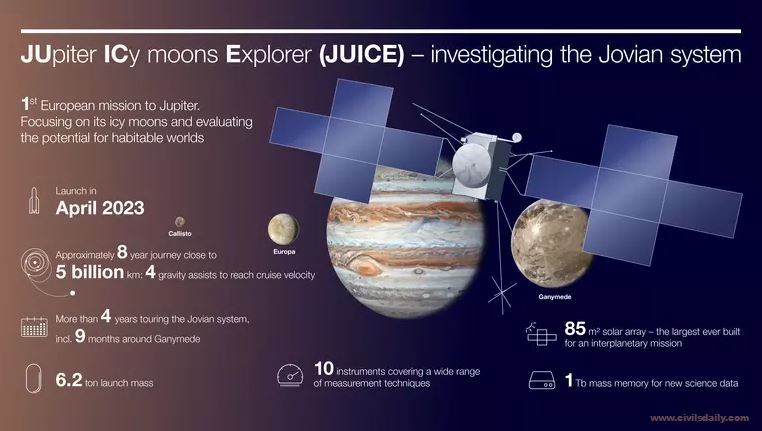
    • By European Space Agency (ESA) on April 14, 2023, Ariane 5 rocket
    • To study Jupiter’s Moons
    Aim Investigating the potential for life on Jupiter’s moons and understanding the Jovian system
    Mission Duration
    • Approximately 12 years
    • Expected arrival at Jupiter in July 2031
    Primary Objectives
    • Ganymede Exploration: Study its surface, subsurface, magnetic field, and potential subsurface ocean to assess habitability.
    • Europa Exploration: Investigate the surface, subsurface, and potential ocean beneath the ice; analyze interactions with Jupiter’s magnetosphere to assess its potential to support life.
    • Callisto Exploration: Study its surface, geological diversity, and possible subsurface ocean; understand its history of impacts and tectonic activity.
    • Jupiter System Exploration: Analyze Jupiter’s atmosphere, magnetosphere, and their interactions with the moons; study the dynamics of the magnetosphere and its influence on the surrounding environment.
    Key Instruments
    • JANUS: Jovis, Amorum ac Natorum Undique Scrutator (Optical Camera)
    • RIME: Radar for Icy Moons Exploration
    • J-MAG: JUICE Magnetometer
    • MAJIS: Moons and Jupiter Imaging Spectrometer
    Significance
    • First interplanetary spacecraft to the outer Solar System planets not launched by the United States
    • First mission set to orbit a moon other than Earth’s Moon

    What is the Double Slingshot Maneuver?

    • The JUICE probe will first use the moon’s gravity to set itself on the correct trajectory towards Earth.
    • Immediately after, it will use Earth’s gravity to slow down and redirect towards Venus and, eventually, Jupiter.

    Significance of the Gravity Assist

    • This technique, used for decades in space exploration, involves using a planet or moon’s gravity to alter the speed or direction of a spacecraft.
    • It is unique as it involves back-to-back gravity assists using both the moon and Earth’s gravity, which has never been attempted before.

    PYQ:

    [2020] The experiment will employ a trio of spacecraft flying in formation in the shape of an equilateral triangle that has sides one million kilometres long, with lasers shining between the craft.” The experiment in question refers to

    (a) Voyager-2

    (b) New Horizons

    (c) LISA Pathfinder

    (d) Evolved LISA

  • ISRO’s SSLV-D3 successfully launches EOS-08 Satellite

    Why in the News?

    • Indian Space Research Organisation (ISRO) successfully launched the EOS-08 Earth Observation Satellite using the Small Satellite Launch Vehicle (SSLV)-D3.
      • This marks the third and final development flight of the SSLV.

    About EOS-08 Satellite:

    Details
    Type Earth Observation Satellite (EOS)
    Design Platform Built on ISRO’s Microsat/IMS-1 bus, known for its compact and efficient design.
    Orbit Operates in a Circular Low Earth Orbit (LEO) at an altitude of 475 km with an inclination of 37.4°.
    Mission Life 1 year
    Payloads Electro Optical Infrared Payload (EOIR): Captures images in MIR and LWIR bands for surveillance, disaster monitoring, and environmental assessments.
    Global Navigation Satellite System-Reflectometry (GNSS-R) Payload: Monitors ocean surface winds, soil moisture, and inland water bodies using GNSS-R-based remote sensing.
    SiC UV Dosimeter: Monitors UV irradiance, particularly for ISRO’s Gaganyaan Mission, ensuring safety against UV radiation.
    Technological Innovations Integrated Avionics System: Combines Communication, Baseband, Storage, and Positioning (CBSP) functions into one system.
    Embedded Technologies: Includes a Structural Panel Embedded with PCB, Embedded Battery, enhancing structural efficiency and power reliability.
    Advanced Antennas: Micro-DGA (Dual Gimbal Antenna) and M-PAA (Phased Array Antenna) for precise control and enhanced signal transmission.
    Flexible Solar Panels & Nano Star Sensor: Improves energy efficiency and satellite orientation in space.

    Back2Basics: Small Satellite Launch Vehicle (SSLV)-D3

    • SSLV is designed to launch Mini, Micro, or Nanosatellites (10 to 500 kg) into a 500 km planar orbit.
    • SSLV is a 3-stage launch vehicle with all solid propulsion stages and a liquid propulsion-based Velocity Trimming Module (VTM) as the terminal stage.
    • SSLV is designed for low cost and low turn-around time.
    • The vehicle offers flexibility in accommodating multiple satellites and is capable of launch-on-demand.
    • SSLV requires minimal launch infrastructure, making it a versatile option for satellite deployment.

    PYQ:

    [2018] With reference to India’s satellite launch vehicles, consider the following statements:

    1. PSLVs launch the satellites useful for Earth resources monitoring whereas GSLVs are designed mainly to launch communication satellites.
    2. Satellites launched by PSLV appear to remain permanently fixed in the same position in the sky, as viewed from a particular location on Earth.
    3. GSLV Mk III is a four-stage launch l vehicle with the first and third stages l using solid rocket motors; and the second and fourth stages using liquid rocket engines.

    Which of the statements given above is/are correct?

    (a) 1 only

    (b) 2 and 3

    (c) 1 and 2

    (d) 3 only

  • Indian Astronomers discover new method for Solar Cycle Amplitude Prediction

    Why in the News?

    • Astronomers from the Indian Institute of Astrophysics (IIA) have developed a new method to predict the amplitude of the upcoming solar cycle.

    What is Space Weather?

    • Space weather refers to the varying conditions within the solar system and its heliosphere, influenced by the Sun and solar wind.
    • The main components of space weather include: solar wind, coronal mass ejections, and solar flares.
    • These components can compress the Earth’s magnetosphere, triggering geomagnetic storms.
    • This can disrupt communication, power transmission, damage spacecraft electronics, and pose threats to astronauts.

    Solar Cycle and Its Importance

    • The activity of the Sun follows an approximately 11-year periodic cycle, marked by variations in the number of sunspots on the Sun’s surface.
    • This solar cycle influences space weather, Earth’s atmosphere, and climate variations.
    • Predicting the amplitude of the solar cycle is a major challenge in astrophysics, as it directly affects related phenomena and space weather.

    Research Findings

    • IIA researchers discovered that the width of supergranular cells on the solar surface during the minimum year of the solar cycle is correlated with the number of sunspots observed during the subsequent solar cycle maximum.
    • This simple method can be used to predict the strength of the upcoming solar cycle, which is valuable for space weather forecasting.

    What are Supergranular Cells?

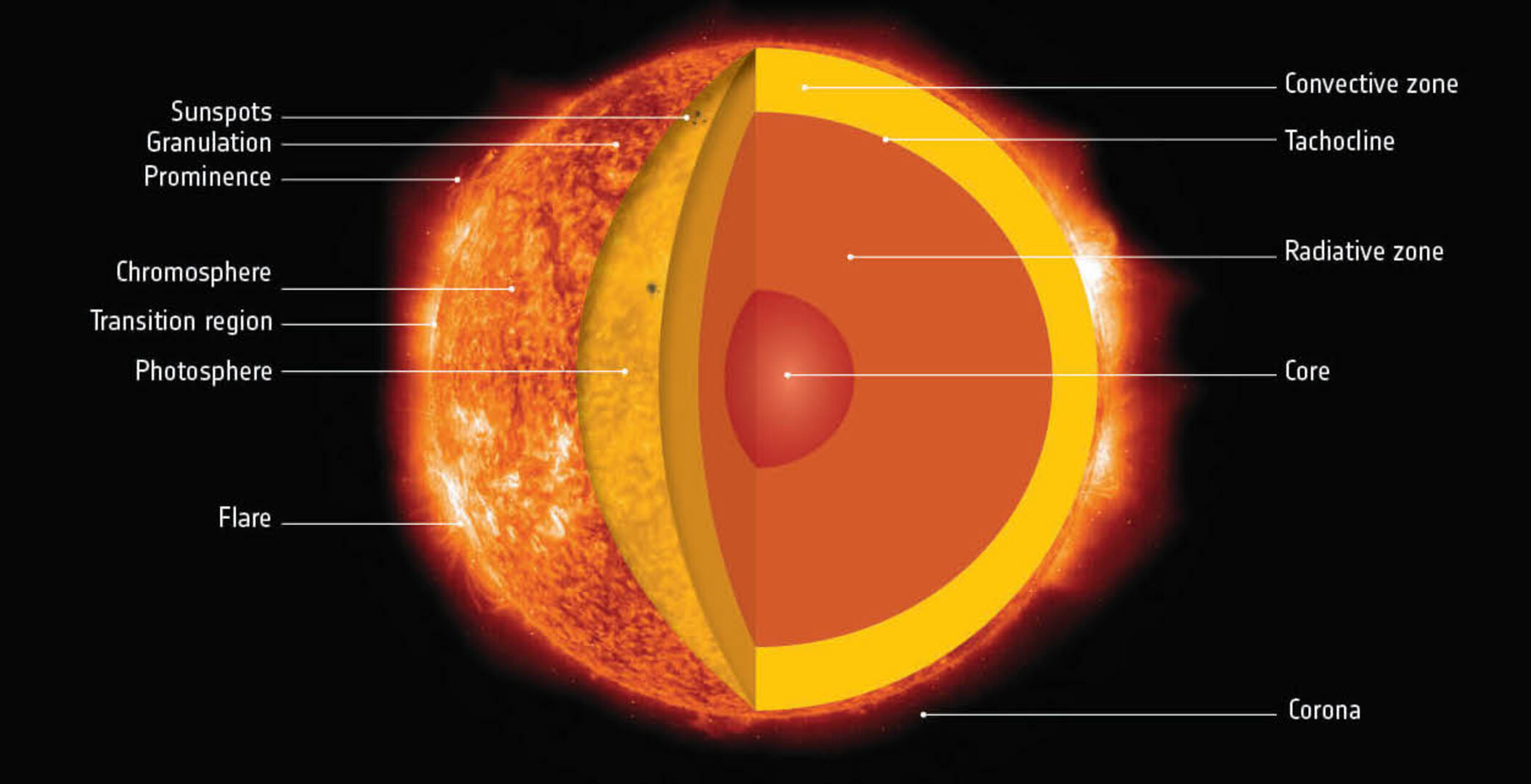
    • Supergranular Cells are large convective cells on the Sun’s surface, with diameters of about 30,000 km.
    • These cells are part of the solar convection zone where hot plasma rises, cools as it reaches the surface, and then sinks back down in a continuous cycle.
    • Characteristics:
      • Supergranular cells are larger than granules, another type of convective cell on the Sun. Its borders, known as supergranular lanes, are about 5,000 km thick.
      • Plasma within these cells moves from the center of the cell toward the edges, where it sinks back into the Sun’s interior. This movement creates a network of lanes that can be observed on the solar surface.
      • Supergranular cells are associated with the magnetic field concentrations on the Sun’s surface, often where sunspots and other magnetic features appear.

    PYQ:

    [2022] If a major solar storm (solar flare) reaches the Earth, which of the following are the possible effects on the Earth?

    1. GPS and navigation systems could fail.
    2. Tsunamis could occur at equatorial regions.
    3. Power grids could be damaged.
    4. Intense auroras could occur over much of the Earth.
    5. Forest fires could take place over much of the planet.
    6. Orbits of the satellites could be disturbed.
    7. Shortwave radio communication of the aircraft flying over pola-regions could be interrupted.

    Select the correct answer using the code given below:

    (a) 1, 2, 4 and 5 only
    (b) 2, 3, 5, 6 and 7 only
    (c) 1, 3, 4, 6 and 7 only
    (d) 1, 2, 3, 4, 5, 6 and 7

  • August 23rd declared as National Space Day

    Why in the News?

    The Centre has officially declared August 23rd as “National Space Day” in honor of the Chandrayaan-3 Mission’s historic achievement.

    About the National Space Day:

    • It is set to be celebrated on August 23rd every year.
    • It marks the successful landing of the Chandrayaan-3 mission’s Vikram Lander and Pragyan Rover on the Moon.
    • Theme for 2024:
      • Touching Lives while Touching the Moon: India’s Space Saga” highlights space exploration’s impact on society and technology.
    • Significance:
      • India became the fourth country to land on the Moon and the first to land near the Moon’s southern polar region.

    About Chandrayaan-3 Mission:

    Details
    Launch
    • India’s third lunar mission, second attempt at soft landing on the Moon.
    • Launched on July 14, 2023. Landed on August 23.
    Landing Site Near the Lunar South Pole (Coordinates: 69.373°S 32.319°E)
    Mission Objectives
    • Demonstrate safe and soft landing on the Moon.
    • Rover mobility on lunar surface.
    • Conduct in-situ scientific experiments.
    Components
    • Propulsion Module: Carries lander and rover to 100 km lunar orbit; includes SHAPE payload.
    • Lander Module (Vikram): Instruments: ChaSTE, ILSA, Langmuir Probe, Laser Retroreflector Array.
    • Rover Module (Pragyan): Instruments: APXS, LIBS.
    Major Findings
    • Lunar Surface Temperature: Recorded up to 70°C, higher than expected.
    • Elemental Composition: Sulphur, aluminum, calcium, iron, chromium, titanium, manganese, silicon, and oxygen confirmed.
    Landing Site Name Named by PM as ‘Shiv Shakti’ (Sanctioned by IAU as “Statio Shiv Shakti”).


    PYQ:

    [2016] Consider the following statements:

    The Mangalyaan launched by ISRO

    1. is also called the Mars Orbiter Mission
    2. made India the second country to have a spacecraft orbit the Mars after USA
    3. made India the only country to be successful in making its spacecraft orbit the Mars in its very first attempt

    Which of the statements given above is/are correct?

    (a) 1 only

    (b) 2 and 3 only

    (c) 1 and 3 only

    (d) 1, 2 and 3

  • [pib] National Pharmaceutical Pricing Authority (NPPA)

    Why in the News?

    The NPPA monitors the prices of scheduled as well as non-scheduled medicines under Drugs (Prices Control) Order, 2013 (DPCO, 2013), informed the Union Minister of State for Chemicals and Fertilizers.

    What are Scheduled and Non-Scheduled Formulations?

    [A] Scheduled Formulations:

    • Defined as formulations listed in Schedule-I of the Drugs (Prices Control) Order, 2013 (DPCO, 2013).
    • Ceiling prices of these formulations are revised annually based on the Wholesale Price Index (WPI) for the preceding calendar year.
    • National Pharmaceutical Pricing Authority (NPPA) is responsible for revising and notifying these prices.

    [B] Non-Scheduled Formulations:

    • Defined as formulations not included in Schedule-I of the DPCO, 2013.
    • Prices of these formulations can be increased by manufacturers, but the Maximum Retail Price (MRP) cannot be increased by more than 10% during the preceding 12 months.
    • NPPA also monitors the prices of non-scheduled formulations to ensure compliance.

    Action is taken against companies selling formulations at prices higher than permissible, and overcharged amounts are recovered.

    About National Pharmaceutical Pricing Authority (NPPA)

    • NPPA was set up as an independent regulator on August 29, 1997, for drug pricing and ensuring affordable access to medicines.
    • It is an attached office of the Department of Pharmaceuticals (DoP), Ministry of Chemicals & Fertilizers.
    • NPPA is not a Statutory or Constitutional Body.
    • It is responsible for implementing and enforcing the provisions of the DPCO.

    Functions of NPPA:

    • Fixation and revision of prices of ‘Scheduled’ drugs under Drug (Price Control) Orders.
      • Scheduled drugs (15% of the pharma market) are allowed an increase based on WPI.
      • Non-scheduled drugs (85% of the pharma market) are allowed an automatic 10% increase annually.
    • Monitoring and enforcement of drug prices.
    • Ensuring availability and accessibility of all medicines and medical devices, including non-scheduled drugs.
    • Undertaking or sponsoring studies on drug pricing.
    • Collecting and maintaining data on production, exports, imports, market share, and profitability of pharmaceutical companies.
    • Advising the Central Government on changes or revisions in drug policy.

    Back2Basics: Drugs (Prices Control) Order (DPCO)

    • The DPCO is an order issued by the Government of India under Sec. 3 of Essential Commodities Act, 1955 to regulate the prices of drugs.
    • The Order provides the list of price controlled drugs, procedures for fixation of prices of drugs, method of implementation of prices fixed by Govt., penalties for contravention of provisions etc.
    • Under the provisions of DPCO 2013, only the prices of drugs that figure in the National List of Essential Medicines (NLEM) are monitored and controlled by the regulator, the National Pharmaceutical Pricing Authority.
      • Essential medicines are those that satisfy the priority healthcare needs of the majority of the population.


    PYQ:

    [2019] How is the Government of India protecting traditional knowledge of medicine from patenting by pharmaceutical companies?

  • NASA’s Cassini-Huygens Mission

    Why in the News?

    • US space agency NASA’s Cassini-Huygens spacecraft launched in October 1997.
      • Using Cassini’s radar data, scientists from Cornell University have discovered new information about the liquid ocean on Titan, Saturn’s largest moon.

    Observations made about Titan

    • Titan is composed of hydrocarbons – organic chemicals consisting of carbon and hydrogen.
    • The astronomers have reportedly located calm seas of methane with a slow tidal current.

    About Cassini-Huygens Mission

    • The Cassini-Huygens mission was a collaborative project between NASA, the European Space Agency (ESA), and the Italian Space Agency (ASI) to explore Saturn and its moons.
    • The spacecraft was named after astronomers Giovanni Cassini and Christian Huygens.
    • The mission consisted of the Cassini orbiter and the Huygens probe.
    • It was launched on October 15, 1997.
    • It ended its mission on September 15, 2017 by plunging into Saturn’s atmosphere.

    Key Achievements:

    • Saturn Exploration:
      • Detailed study of Saturn’s atmosphere, rings, and magnetosphere.
      • Discovered new rings and observed the complex structure of the existing ones.
    • Moons of Saturn:
      • Titan Exploration: Huygens probe successfully landed on Titan, Saturn’s largest moon, on January 14, 2005, providing the first direct exploration of Titan’s surface and atmosphere.
      • Enceladus Discoveries: Found water-ice plumes erupting from Enceladus, indicating a subsurface ocean that could potentially harbor life.
    • Other Moons: Provided detailed images and data on other moons like Lapetus, Rhea, Dione, and Tethys.
    • Technological Milestones:
      • Demonstrated the success of long-duration missions in deep space.
      • Advanced the understanding of spacecraft navigation and operation in complex planetary environments.

    PYQ:

    [2014] Which of the following pairs is/are correctly matched?

    Spacecraft Purpose
    1. Cassini-Huygens Orbiting the Venus and transmitting data to the Earth
    2. Messenger Mapping and investigating the Mercury
    3. Voyager 1 and 2 Exploring the outer solar system

    Select the correct answer using the code given below:

    (a) 1 only
    (b) 2 and 3 only
    (c) 1 and 3 only
    (d) 1, 2 and 3

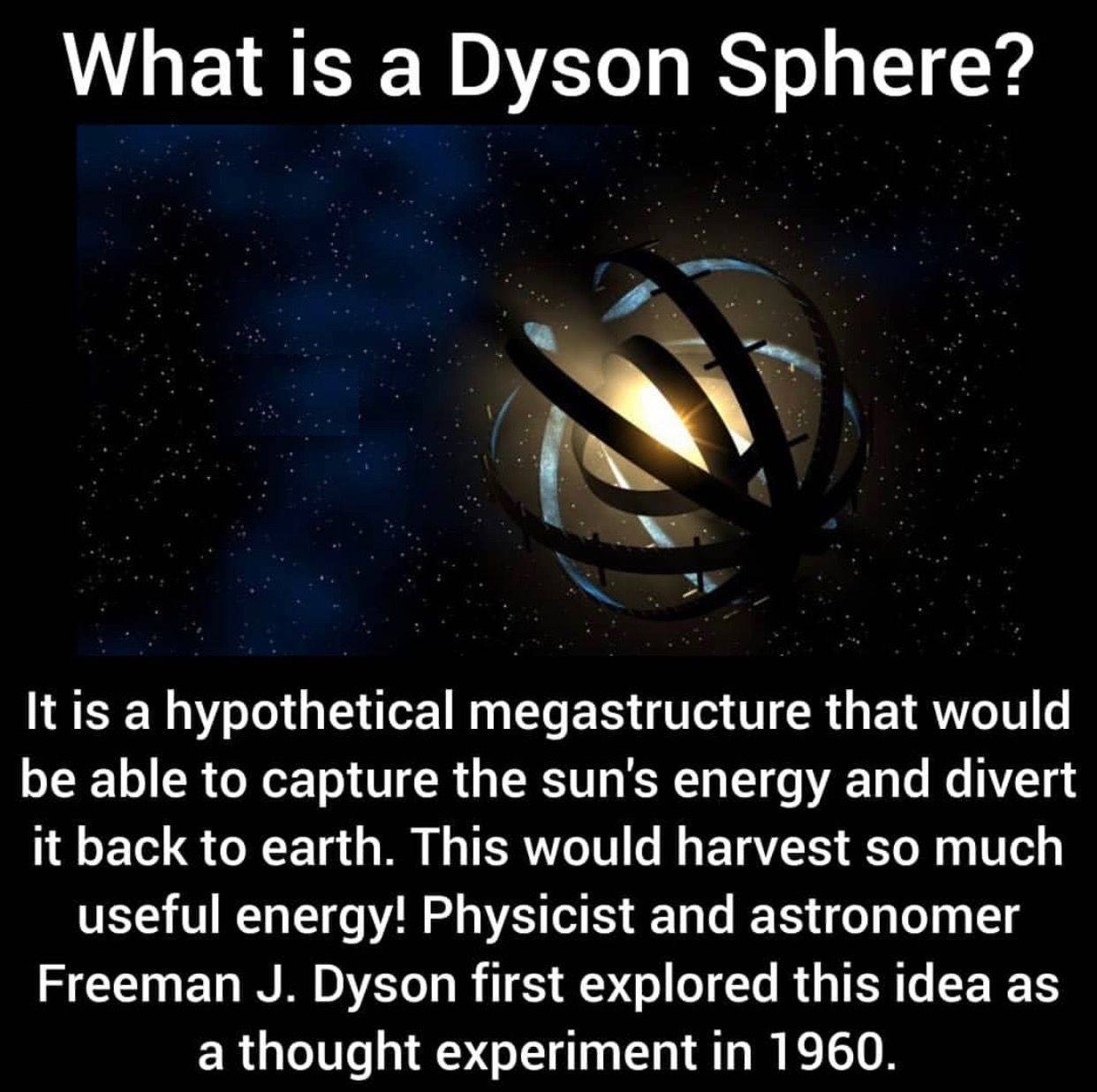
  • What is the Dyson Sphere?

    Why in the News?

    Recently, astronomers have made progress in finding possible candidates as Dyson Sphere, sparking new excitement and debate about extraterrestrial life.

    What is a Dyson Sphere? 

    • Imagine you are an astronomer looking for extraterrestrial life and you find a star covered by solar panels. This structure, collecting massive amounts of solar energy, is known as a Dyson sphere.
    • The concept is named after Freeman Dyson, a theoretical physicist who lived from 1923 to 2020.
    • Dyson proposed that advanced civilizations would need to harness a star’s energy, constructing a spherical array of solar collectors around it.
    • He suggested that the heat emitted as infrared radiation could indicate the presence of these massive structures and thus intelligent life.

    Who was Freeman Dyson (1923-2020)?

    • Dyson was a renowned British-American theoretical physicist and mathematician known for his work in quantum electrodynamics, solid-state physics, and astronomy.
    • Born on December 15, 1923, in England, he made significant contributions to science and technology, including the Dyson Sphere concept—a hypothetical structure that could encompass a star to capture its power output.
    • He was also a prominent futurist and author, exploring ideas on space travel, extraterrestrial life, and the future of humanity.
    • Dyson spent much of his career at the Institute for Advanced Study in Princeton and was known for his interdisciplinary approach to science.


    PYQ:

    [2015] The term ‘Goldilocks Zone’ is often seen in the news in the context of

    (a) The limits of habitable zone above the surface of the Earth

    (b) Regions inside the Earth-like planets in outer space

    (c) Search for the Earth-like planets in outer space

    (d) Search for meteorites containing precious metals

  • Vasco da Gama’s toxic legacy is now a ‘pandemic’ that kills 8 million globally   

    Why in the news? 

    On July 8th, 1497, Vasco da Gama’s historic voyage began, reshaping global maritime routes and leaving a lasting impact on trade and culture. This era of exploration introduced and disseminated tobacco, profoundly affecting societies in numerous ways.

    Cultivation and Production of Tobacco

    • Historical Introduction: Tobacco was originally cultivated by Native Americans and brought to Europe in the 16th century. It was introduced to South Asia by European traders and colonizers, notably the Portuguese, Dutch, and British.
    • Economic Significance: Tobacco is a drought-tolerant crop providing livelihoods to many. It accounts for about 2% of India’s agricultural exports and employs over 45 million people.
    • Revenue Generation: The tobacco industry is a major source of revenue through taxation and exports, generating over ₹22,000 crores annually.

    Implications on Human Health

    • Health Issues: Tobacco use contributes to various cancers (lung, mouth, throat, oesophagus, pancreas, and bladder), respiratory diseases (COPD, emphysema, chronic bronchitis), cardiovascular problems (heart disease, stroke, hypertension), and other conditions like diabetes, infertility, weakened immune system, and complications in pregnancy.
    • Addiction: Nicotine, a highly addictive substance in tobacco, alters brain function leading to severe addiction.
    • Health Crisis: In India, tobacco use causes over 1.2 million deaths annually. It is responsible for 27% of all cancers and adds significant costs to healthcare and productivity losses, totaling approximately ₹1.82 trillion annually.

    Ethical and Revenue Considerations

    • Economic Benefits vs. Health Costs: While tobacco provides economic benefits and employment, it comes with tremendous human and financial costs due to tobacco-related illnesses.
    • Constitutional Provisions: Under Article 21 of the Indian Constitution guarantees the right to life and health. The Directive Principles of State Policy mandate the state to improve public health and living standards.So,Govt. has responsibility to prevent tobacoo consumption.

    Indian needs to Stack Up Its Priorities

    • Institutional Conflict: The Indian Council of Medical Research (ICMR) focuses on eliminating tobacco to mitigate health impacts, while the Indian Council of Agricultural Research (ICAR) aims to increase tobacco crop yields.
    • Policy and Ethical Dilemma: The conflicting priorities between ICMR and ICAR create significant policy challenges. The constitutional mandate to prioritize public health should guide policy decisions.

    Will CRISPR make a difference?

    • Gene Editing Potential: CRISPR technology offers potential solutions by developing genetically modified tobacco plants with reduced nicotine content.
    • Research Developments: Studies have shown promise in using CRISPR to significantly lower nicotine levels in tobacco plants. However, further characterization is needed to ensure these modifications do not negatively impact other important traits.
    • Collaborative Efforts: Collaboration between ICMR and ICAR is crucial to align scientific advancements with public health goals and agricultural sustainability.

    The Tobacco Lobby and Surrogate Advertising

    • Circumventing Regulations: The tobacco industry employs surrogate advertising to promote its products despite stringent advertising bans. These tactics perpetuate tobacco consumption, especially among youth, undermining public health efforts.
    • Aggressive Lobbying: The tobacco industry has a large network of 1,027 registered lobbyists at the state level in 2024, many of whom are former government employees. They engage in extensive lobbying to weaken, delay or block life-saving tobacco control measures.

    Way forward: 

    • Implement Stricter Regulations: Enforce stringent regulations on tobacco advertising, including surrogate advertising, and ensure compliance through regular monitoring and penalties.
    • Ban on Public Smoking: Implement and strictly enforce smoking bans in public places to reduce exposure to second-hand smoke.

    Mains PYQ: 

    Q What are the research and developmental achievements in applied biotechnology? How will these achievements help to uplift the poorer sections of the society? (UPSC IAS/2021)
  • What is OpenAI’s secret Project ‘Strawberry’?

    Why in the News?

    • US-based OpenAI emerged as a major player with its AI chatbot ChatGPT, capable of answering questions and processing images.
      • OpenAI is now reportedly developing a new AI model with improved reasoning capabilities, potentially changing the AI landscape.

    What is Project Strawberry?

    • Nearly six months ago, OpenAI’s secretive Project Q* (Q-Star) gained attention for its innovative approach to AI training.
    • OpenAI is now working on a new reasoning technology under the code name “Strawberry” believed to be the new name for Project Q*.
    • Strawberry aims to enable AI models to plan ahead, autonomously search the internet, and conduct deep research.

    What are Large Language Models (LLMs)?

    • LLMs are advanced artificial intelligence (AI) systems designed to understand, generate, and process human language.
    • They are built using deep learning techniques, particularly neural networks, and are trained on vast amounts of text data.

    Difference from Existing AI Models

    • Existing Large Language Models (LLMs) can summarize texts and compose prose but struggle with common sense problems and multi-step logic tasks.
    • Current LLMs cannot plan ahead effectively without external frameworks.
    • Strawberry models are expected to enhance AI reasoning, allowing for planning and complex problem-solving.
    • These models could enable AI to perform tasks that require a series of actions over an extended time, potentially revolutionizing AI’s capabilities.

    Potential Applications of Strawberry Models

    • Advanced AI models could conduct experiments, analyze data, and suggest new hypotheses, leading to breakthroughs in sciences.
    • In medical research, AI could assist in drug discovery, genetics research, and personalized medicine analysis.
    • AI could solve complex mathematical problems, assist in engineering calculations, and participate in theoretical research.
    • AI could contribute to writing, creating art and music, generating videos, and designing video games.

    Ethical Considerations  

    • Impact on Jobs: Improved AI capabilities may intensify concerns about job displacement and the ethical implications of AI reproducing human work.
    • Power Consumption and Ethics: The vast amounts of power required to run advanced AI models raise environmental and ethical questions.

    PYQ:

    [2020] With the present state of development, Artificial Intelligence can effectively do which of the following?

    1. Bring down electricity consumption in industrial units.
    2. Create meaningful short stories and songs.
    3. Disease diagnosis.
    4. Text-to-Speech Conversion.
    5. Wireless transmission of electrical energy.

    Select the correct answer using the code given below:

    (a) 1, 2, 3 and 5 only
    (b) 1, 3 and 4 only
    (c) 2, 4 and 5 only
    (d) 1, 2, 3, 4 and 5

  • Cave on the Moon: What this discovery means for space exploration?

    Why in the News?

    • Scientists have confirmed the presence of a cave on the Moon, near the site of the first lunar landing 55 years ago.
    • This discovery could provide astronauts with a potential habitat on the Moon in the future.

    About the Cave on Mare Tranquillitatis

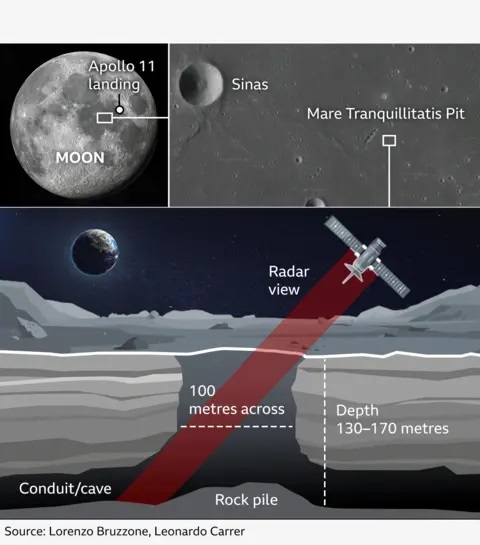
    • A study titled “Radar evidence of an accessible cave conduit on the Moon below the Mare Tranquillitatis pit” was published in the journal Nature Astronomy.
    • The study established the presence of a moon cave at the Sea of Tranquillity, a large, dark, basaltic plain on the Moon’s surface.
    • The cave is located 400 kilometers from where astronauts Neil Armstrong and Buzz Aldrin landed in 1969.
    • It is roughly 45 meters wide and up to 80 meters long, with an area equivalent to 14 tennis courts.

    Research Method

    • Researchers analyzed photos taken in 2010 by NASA’s Lunar Reconnaissance Orbiter (LRO) spacecraft.
    • They concluded that the pit was the entry point to a cave created by the collapse of a lava tube, a tunnel formed when molten lava flows beneath a field of cooled lava.

    Back2Basics: Lunar Reconnaissance Orbiter (LRO) 

    • NASA launched the LRO on June 18, 2009.
    • LRO’s primary mission is to map the Moon’s surface in high detail to identify safe landing sites and locate potential resources.
    • It is equipped with seven scientific instruments, including a camera, a laser altimeter, and a radiation detector.
    • LRO has provided critical data on lunar topography, temperature, and radiation levels, significantly enhancing our understanding of the Moon.

    Characteristics of Lunar Caves

    • Craters are bowl-shaped and result from asteroid or comet strikes.
    • Pits, in contrast, appear as massive steep-walled depressions.
    • At least 200 such pits have been discovered, with 16 believed to have formed from collapsed lava tubes due to volcanic activity over a billion years ago.

    Benefits for Human Exploration

    • The Moon is exposed to solar radiation 150 times stronger than Earth.
    • The lunar surface heats to about 127 degrees Celsius during the day and cools to around -173 degrees Celsius at night.
    • Caves, however, maintain stable average temperatures of around 17 degrees Celsius.
    • They could shield human explorers from radiation and micrometeorites, making them viable for future lunar bases or emergency shelters.

    Challenges and Further Research

    • The depth of such caves could present challenges for accessibility.
    • There are risks of potential avalanches and cave-ins.

    Need for Further Research

    • Further research is needed to understand and map the structural stability of the caves.
    • This could be done using ground-penetrating radar, robots, or cameras.
    • To become viable habitats, caves would need systems to monitor movement or seismic activity and safety zones for astronauts in case of a cave collapse.

    PYQ:

    [2008] Selene-1, the lunar orbiter mission belongs to which one of the following?

    (a) China

    (b) European Union

    (c) Japan

    (d) USA