💥Join UPSC 2027,2028 Mentorship (August Batch) + XFactor Notes & Microthemes PDF

Subject: Space Technology

  • TRISHNA Mission

    Why in the News?

    Philippe Baptiste, head of the French Space Agency, talked about the joint India-France “TRISHNA Mission.”

    TRISHNA Mission:

    Details
    Overview A joint Indo-French Earth observation satellite project developed by ISRO and CNES (French Space Agency).

    Acronym for “Thermal infraRed Imaging Satellite for High-resolution Natural resource Assessment” (TRISHNA Mission)

    Launch Year Targeted for 2026.
    Mission Lifespan Designed for a 5-year operational life.
    Primary Objectives • Monitor water and energy budgets of the continental biosphere.

    • Assess evapotranspiration for efficient water management.

    • Improve agricultural water productivity and assist in irrigation water management.

    • Provide high-resolution observations of water quality in coastal and inland waters. 

    • Assess urban heat islands and detect heat anomalies.

    Payloads Thermal Infrared (TIR) Payload: Provided by CNES, this sensor maps surface temperature and emissivity in high resolution.

    Visible-Near Infrared-Short Wave Infrared (VNIR-SWIR) Payload: Developed by ISRO, this sensor uses seven spectral bands for detailed mapping of surface reflectance.

    Orbit and Spatial Resolution • TRISHNA will operate in a sun-synchronous orbit at an altitude of 761 km.

    • Spatial resolution: 57 meters for land and coastal areas, 1 km for ocean and polar regions.

    Application and Significance   • Supports water resource management, agriculture, and urban planning through precise data on water stress, crop productivity, and urban heat islands.
    • Enhances climate resilience by tracking droughts, evapotranspiration, and permafrost changes.
    • Contributes to global environmental initiatives like GEOGLAM and Sustainable Development Goals (SDGs) by providing key agricultural and climate variables.


    PYQ:

    [2016] Discuss India’s achievements in the field of Space Science and Technology. How the application of this technology helped India in its socio-economic development?

    [2010] In the context of space technology, what is “Bhuvan”, recently in the news?

    (a) A mini satellite launched by ISRO for promoting the distance education in India

    (b) The name given to the next Moon Impact Probe, for Chandrayaan-II

    (c) A geoportal of ISRO with 3D imaging capabilities of India

    (d) A space telescope developed by India

  • Chandrayaan-4, Venus orbiter gets approval from Cabinet

    Why in the News?

    The Union Cabinet approved the expansion of the Chandrayaan-4 mission, Venus Orbiter Mission (Shukrayaan Misison), Gaganyaan, the development of India’s first space station (the Bharatiya Antariksh Station), and NextGen launch vehicles.

    About Chandrayaan-4 Mission

    • Chandrayaan-4 is the fourth mission in India’s Chandrayaan program (2003).
    • The mission is currently under conceptualisation and expected to launch around 2027.
    • Aims: To develop technology for a successful moon landing and ensure a safe return to Earth.
    • The mission will be launched in two phases onboard two LVM3 rockets.
    • It will collect lunar samples for analysis on Earth.

    About Venus Orbiter Mission (VOM)

    • The VOM, also called Shukrayaan-1, is an upcoming ISRO mission targeting a 2028 launch. 
    • The mission aims to study Venus’ surface, atmosphere, volcanic activity, and solar wind interactions with its ionosphere.
    • It will have a mission duration of 4 years.
    • The spacecraft will operate in an elliptical orbit, with distances of 60,000 km at apoapsis and 500 km at periapsis.
    • Its payload has a capacity of 100 kg, is powered by 500 watts, and will feature Indian and international instruments for comprehensive analysis.
    • For the mission’s payload and technology, collaborations with NASA, CNES (France), and Russia have been established.

    PYQ:

    [2016] The Mangalyaan launched by ISRO:

    1. is also called the Mars Orbiter Mission
    2. made India the second country to have a spacecraft orbit the Mars after USA
    3. made India the only country to be successful in making its spacecraft orbit the Mars in its very first attempt

    Which of the statements given above is/are correct?

    (a) 1 only
    (b) 2 and 3 only
    (c) 1 and 3 only
    (d) 1, 2 and 3

  • How good are Modern Telescopes?

    Why in the News?

    Modern telescopes, both on Earth and in space, expand our understanding of the universe by gathering and focusing light from distant celestial bodies, revealing cosmic secrets.

    Modern Telescopes: Everything you need to know

    Primary Functions and Features

    Purpose  • Telescopes serve as windows into space, revealing distant celestial bodies and helping explore the universe.
    • Their primary function is to gather more light than the human eye can, making faint objects visible.
    Types 1. Reflecting Telescopes:
    • Use mirrors to focus light and create images.
    • Most common in large observatories due to the use of parabolic mirrors, which prevent light scattering and offer clear images.
    2. Refracting Telescopes:
    • Use lenses to bend and focus light (Concave and Convex lenses used)
    • Limited by lens size, with a maximum of about 1 meter (e.g., Yerkes Observatory). Large lenses may sag, distorting the image.
    Primary purpose  • Telescopes are designed to collect more light than the human eye.
    • The light-gathering ability is proportional to the size of the aperture (opening).
    • Example: A small 70mm telescope collects 118 times more light than the human eye.

    Features of Telescopes

    Brightness and Magnitude • Celestial objects’ brightness is measured in apparent magnitude (lower numbers = brighter).
    • Examples: Sun (-26.78), Venus (-4.92), Sirius (-1.46), Andromeda Galaxy (+3.44).
    • Small telescopes can detect objects with magnitudes up to +11.2, which are 100 times fainter than what the human eye can see.
    Resolution and Detail • The resolution of a telescope determines how much detail it can show.
    • A small telescope can resolve details 1.47 arcseconds apart (40 times more detail than the human eye, which resolves details 60 arcseconds apart).

    Why are Telescopes set up on Mountains?

    Mountaintop benefits • High-altitude observatories are set up to reduce atmospheric distortion, which affects image quality (e.g., stars twinkling).
    • Space telescopes, like Hubble, are entirely above the atmosphere and provide clear, undistorted images.
    Adaptive Optics • Ground-based telescopes use adaptive optics to correct atmospheric distortions.
    • Lasers create artificial stars, and the telescope adjusts its mirrors to reduce twinkling.

    About the New Segmented Mirrors

    Overcoming Mirror Limitations • Large mirrors (over 8.5 meters) can sag under their own weight.
    Segmented mirrors solve this by using smaller sections to create larger, effective mirrors (e.g., Extremely Large Telescope (ELT) with a 39.3-meter aperture).
    Notable Telescopes  Large Binocular Telescope (LBT): Two 8.4-meter mirrors, combined aperture of 11.9 meters.
    Extremely Large Telescope (ELT): Under construction in Chile, it will have a 39.3-meter aperture.
    Subaru Telescope (Hawaii): Captured objects with a magnitude of +27.7, 100 million times fainter than what the human eye can see.


    PYQ:

    [2015] In the context of modern scientific research, consider the following statements about ‘IceCube’, a particle detector located at South Pole, which was recently in the news:

    1. It is the world’s largest neutrino detector, encompassing a cubic kilometre of ice.

    2. It is a powerful telescope to search for dark matter

    3. It is buried deep in the ice.

    Which of the statements given above is/are correct?

    (a) 1 only

    (b) 2 and 3 only

    (c) 1 and 3 only

    (d) 1, 2 and 3 only

  • Polaris Dawn: SpaceX’s Mission for First private Spacewalk

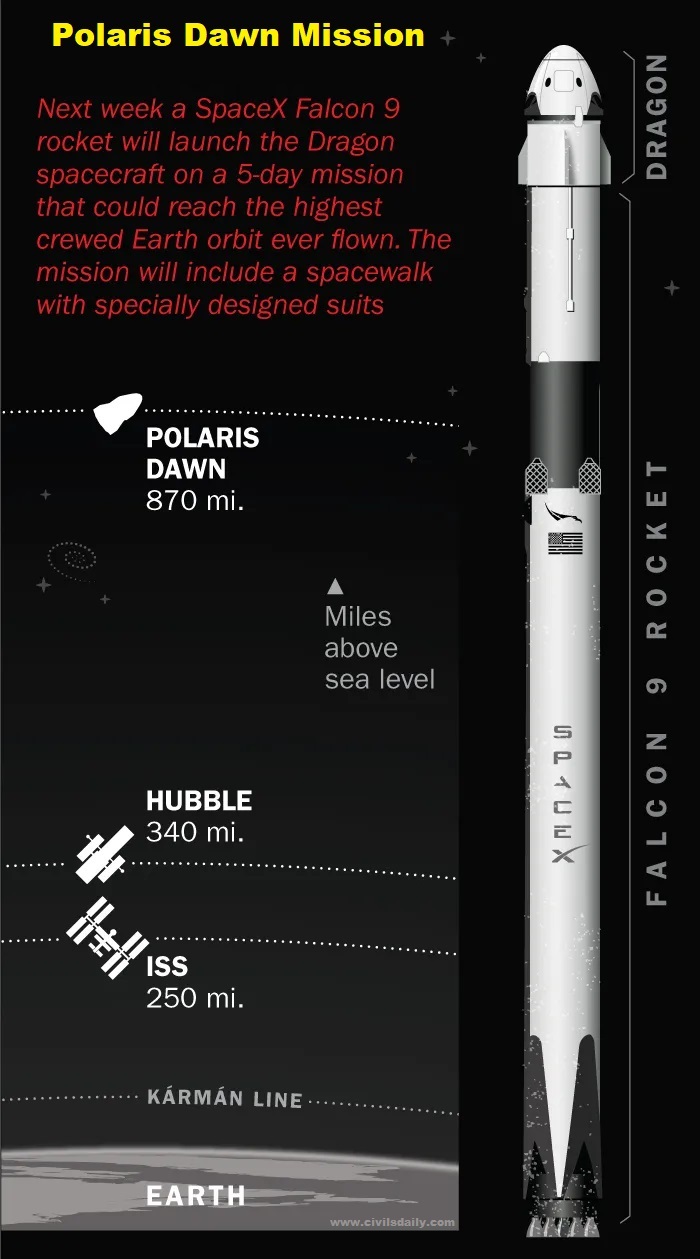
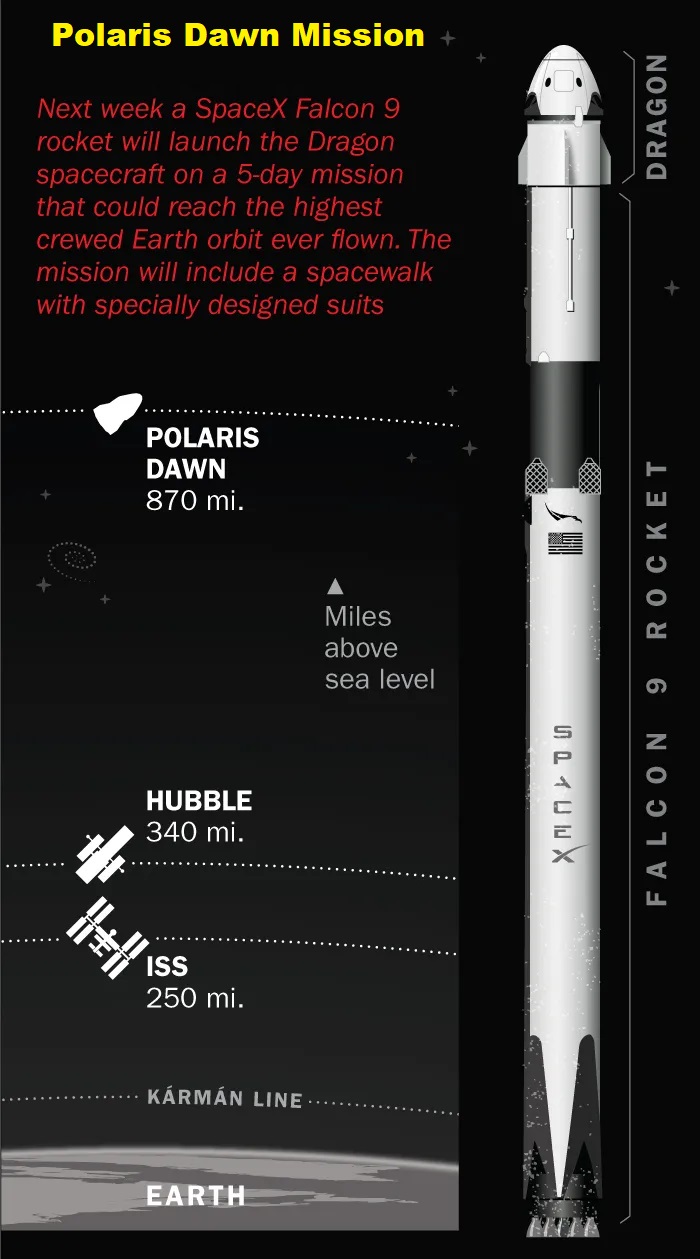
    SpaceX launched its Polaris Dawn Mission sending a four-person crew of civilians on a first-ever commercial spacewalk into Earth's Van Allen radiation belts.

    Why in the News?

    SpaceX launched its Polaris Dawn Mission sending a four-person crew of civilians on a first-ever commercial spacewalk into Earth’s Van Allen radiation belts.

    What is Polaris Dawn Mission?

    • It is a privately-funded space mission led by billionaire entrepreneur Jared Isaacman, in collaboration with SpaceX.
    • It is set to be the first non-government mission to conduct a spacewalk.
    • This 700km altitude will surpass the current record held by NASA’s Gemini 11 mission in 1966.
    • The mission will test new spacesuits designed by SpaceX to protect astronauts from high radiation levels encountered in the Van Allen Belts.

    What are the Van Allen Belts?

    • The Van Allen Belts are two zones of charged particles that surround Earth, held in the magnetosphere.
    • These belts were discovered in 1958 by American physicist James Van Allen.

    Why are the Van Allen Belts dangerous for Humans?

    • The Van Allen Belts are dangerous for humans because they contain high levels of radiation that can pose significant health risks to astronauts.
    • The belts are filled with charged particles that can cause radiation sickness, damage human tissues, and increase the risk of cancer. 


    PYQ:

    [2011] What is the difference between asteroids and comets?

    1. Asteroids are small rocky planetoids, while comets are formed of frozen gases held together by rocky and metallic material.
    2. Asteroids are found mostly between the orbits of Jupiter and Mars, while comets are found mostly between Venus and Mercury.
    3. Comets show a perceptible glowing tail, while asteroids do not.

    Which of the statements given above is/are correct?

    (a) 1 and 2 only
    (b) 1 and 3 only
    (c) 3 only
    (d) 1, 2 and 3

  • BepiColombo Mission

    BepiColombo

    Why in the News?

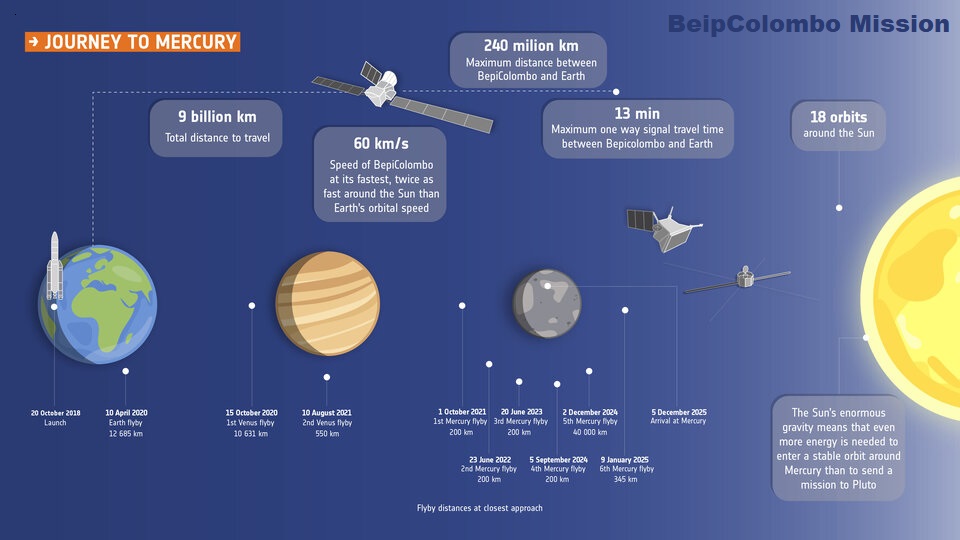
    • On Thursday, the ESA-Japan spacecraft “BepiColombo” made its closest approach to Mercury, capturing detailed images of its sunrise-lit surface and revealing the planet’s south pole.

    Highlights of the Latest Flyby:

      • BepiColombo uses flybys of Earth, Venus, and Mercury to slow down and enter orbit around Mercury. This approach gives scientists new information about Mercury’s south pole and its unusual peak ring craters, which haven’t been studied much before.

      Note: Flybys are close passes of a spacecraft near a planet or celestial body

    About BepiColombo Mission:

    Details
    Collaboration  European Space Agency (ESA) and Japan Aerospace Exploration Agency (JAXA)
    Launch Date
    • October 20, 2018
    • Expected to enter Mercury’s orbit by late 2026.
    Launch Vehicle Ariane 5 Rocket
    Objectives
    • Study Mercury’s magnetic field
    • Investigate surface composition and geology
    • Analyze Mercury’s interaction with solar wind
    • Study exosphere and geological history
    Spacecraft Components
    • ESA’s Mercury Planetary Orbiter (MPO):  Focus on surface and interior study
    • JAXA’s Mercury Magnetospheric Orbiter (MIO): Focus on magnetic field and surrounding space
    Planned Flybys
    • 6 (Flybys of Earth, Venus, and Mercury)
    • Ongoing, with 4 out of 6 Mercury flybys completed
    Craters Studied Vivaldi Crater, Stoddart Crater
    Significance Second mission ever to orbit Mercury (after NASA’s Messenger, 2004)
    Challenges
    • Mercury’s proximity to the Sun accelerates spacecraft, requiring multiple flybys to slow down
    • Thruster issues causing mission delay


    PYQ:

    [2008] What is the purpose of the US Space Agency’s Themis Mission, which was recently in the news?

    (a) To study the possibility of life on Mars.

    (b) To study the satellites of Saturn.

    (c) To study the colourful display of high latitude skies.

    (d) To build a space laboratory to study the stellar explosions.

  • What is Helium and why is it used in Rockets?

    Why in the News?

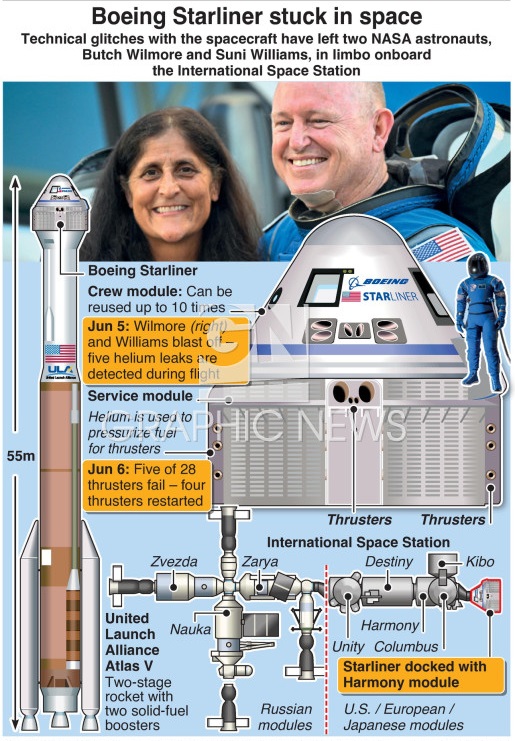
    Two NASA astronauts aboard Boeing’s Starliner will remain on the International Space Station (ISS) for an extended period due to issues with a faulty propulsion system, including helium leaks.

    helium

    About Helium

    • Helium is inert, meaning it does not react or combust when exposed to other substances.
    • This makes it ideal for pressurization and cooling systems in rockets and spacecraft.
    • With an atomic number of 2, Helium is second lightest element after hydrogen, helping to keep the rocket’s weight low, which is crucial for achieving the necessary speeds and altitudes to reach orbit.
    • It has an extremely low boiling point (-268.9°C), allowing it to stay in a gaseous state in super-cold environments, where many rocket fuels are stored.
    • Though non-toxic, helium cannot be inhaled on its own as it displaces oxygen, which is vital for human respiration.

    How is Helium used for space applications?

    • Fuel Tank Pressurization: Helium pressurizes fuel tanks, ensuring a consistent flow of fuel to the rocket’s engines, even as the fuel is burned.
    • Cooling Systems: It also plays a key role in cooling systems, particularly in environments where rocket fuel and oxidizer need to be stored at extremely low temperatures.
    • Maintaining Tank Pressure: As fuel and oxidizer are consumed, helium fills the empty space left behind, ensuring the overall pressure inside the tanks remains stable.

    Is Helium prone to leaks?

    • Helium’s small atomic size and low molecular weight make it prone to leaking through tiny gaps or seals in storage tanks and fuel systems.
    • Since helium is rare in Earth’s atmosphere, even minor leaks are easily detectable, making it a valuable tool for spotting potential faults in spacecraft fuel systems.
    • Examples of Leaks:
      • In May, hours before Boeing’s Starliner spacecraft attempted its first astronaut launch, sensors detected a small helium leak in one of its thrusters.
      • After Starliner launched in June, additional leaks were found in space, prompting NASA to return the spacecraft to Earth without its crew.

    Alternatives to Helium

    • Argon and Nitrogen: Some rocket launches have experimented with other inert gases like argon and nitrogen, which are sometimes cheaper, but helium remains the industry standard.
    • Ariane 6’s Novel System: Europe’s new Ariane 6 rocket abandoned helium in favor of a pressurization system that converts small amounts of its liquid oxygen and hydrogen into gas for pressurizing the fuel.
      • However, during Ariane 6’s debut launch, this system failed in space, adding to the global rocket industry’s pressurization challenges.

    PYQ:

    [2012] A team of scientists at Brookhaven National Laboratory included those from India created the heaviest anti-matter (anti-helium nucleus). What is/are the implication/implications of the creation of anti-matter?

    1. It will make mineral prospecting and oil exploration easier and cheaper.

    2. It will help prove the possibility of the existence of stars and galaxies made of anti-matter.

    3. It will help understand the evolution of the universe.

    Select the correct answer using the codes given below:

    (a) 1 only

    (b) 2 and 3 only

    (c) 3 only

    (d) 1, 2 and 3

  • What is the Principle of Planetary Protection?

    Why in the News?

    • Planetary protection is a crucial principle in space missions that travel from Earth to other planetary bodies, such as the Moon or Mars.
      • The goal is to preserve both Earth’s biosphere and the planetary body’s environment from contamination by alien microbial life.

    About Planetary Protection:

    Details
    Definition Safeguarding Earth’s biosphere and other planetary bodies from microbial contamination during space missions.
    Objective Prevent contamination of Earth’s environment and other planets by alien microbes or Earth-origin microorganisms.
    Legal Basis Article IX of Outer Space Treaty (1967) mandates avoiding harmful contamination in space exploration.
    Importance
    • Protects integrity of scientific research on other planets.
    • Prevents potential biological threats to Earth.
    Methods of Implementation
    • Spacecraft sterilization (e.g. baking in a dry room at 120°C for 3 days).
    • Planning missions to avoid cross-contamination.
    Key Applications Missions to Mars, Moon, Europa and other celestial bodies where contamination may disrupt research or pose risks.
    Challenges Increased costs and technical demands for maintaining sterile spacecraft and environments.
    Recent Example China’s Tianwen-3 Mars sample-return mission (2028) confirmed adherence to planetary protection principles.
    Global Cooperation International space agencies follow planetary protection guidelines for sustainable and safe space exploration.
  • Study reveals intriguing Magnetic behavior on Mars

    Why in the News?

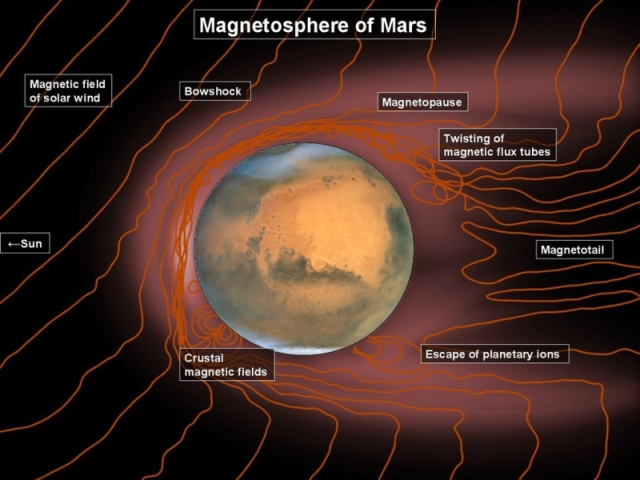
    A study conducted by the Indian Institute of Geomagnetism (IIG) revealed significant variations in the strength of Mars’ crustal magnetic field between day and night.

    Notable facts about Mars:

    • Mars is the fourth planet from the Sun and the second-smallest in the Solar System, larger only than Mercury.
    • Named after the Roman god of war, Mars is often called the “Red Planet” due to its reddish appearance from iron oxide on its surface.
    • It is a terrestrial planet with a thin atmosphere, featuring surface characteristics like impact craters, valleys, deserts, and polar ice caps.
    • Mars shares similar days and seasons to Earth because of its comparable rotational period and axial tilt.
    • It hosts Olympus Mons, the largest volcano and highest mountain on any planet, and Valles Marineris, one of the largest canyons in the Solar System.

    Key Findings on Mars’s Magnetic 

    • Mars’ crustal magnetic field is significantly stronger during the daytime and nearly non-existent at night-time.
      • This suggests a diurnal variation in the magnetic field strength on the Martian surface.
    • The crustal magnetic field of Mars is primarily located in the southern hemisphere, specifically poleward of 30°S latitude.
    • The magnetic fields are scattered within a region between 120° E and 240° E, indicating uneven distribution across the Martian surface.
    • The daytime crustal magnetic field plays a crucial role in controlling the ionosphere in Mars’ southern hemisphere.
    • This influence impacts communication and navigation systems of future missions.

    Data Utilization from MAVEN Satellite:

    • The study utilized data from the MAVEN (Mars Atmosphere and Volatile EvolutioN) Satellite, which has been orbiting Mars since 2014.
    • MAVEN’s data on electron density and magnetic field were critical in investigating how Mars’ crustal magnetic field affects its plasma environment and ionosphere.

    Significance of the Study

    • Understanding Mars’ crustal magnetic field is essential for future robotic and manned missions, as it provides natural magnetic shielding against space radiation.
    • The insights from the study can help in developing strategies to mitigate the effects of space weather on spacecraft and astronauts.

    PYQ:

    [2016] The Mangalyaan launched by ISRO

    1. is also called the Mars Orbiter Mission.
    2. made India the second country to have a spacecraft orbit the Mars after USA
    3. made India the only country to be successful in making its spacecraft orbit Mars in its very first attempt.

    Which of the statements given above is/are correct?

    (a) 1 only
    (b) 2 and 3 only
    (c) 1 and 3 only
    (d) 1, 2 and 3

  • Polaris Dawn Mission: A Private Space Endeavor

    Why in the News?

    Polaris Dawn is set to be the first privately-funded mission to conduct a spacewalk, aiming to reach an altitude of about 700 kilometers above Earth, the highest altitude for a human space mission to date.

    What is Polaris Dawn Mission?

    • Polaris Dawn is a privately-funded space mission led by billionaire entrepreneur Jared Isaacman, in collaboration with SpaceX.
    • It is set to be the first non-government mission to conduct a spacewalk.
    • This 700km altitude will surpass the current record held by NASA’s Gemini 11 mission in 1966.
    • The mission will test new spacesuits designed by SpaceX to protect astronauts from high radiation levels encountered in the Van Allen Belts.

    What are the Van Allen Belts?

    • The Van Allen Belts are two zones of charged particles that surround Earth, held in the magnetosphere.
    • These belts were discovered in 1958 by American physicist James Van Allen.
    1. Inner Belt: This belt is located approximately 680 to 3,000 km above Earth’s surface and is primarily composed of high-energy protons. It is formed by cosmic rays interacting with Earth’s atmosphere.
    2. Outer Belt: Located about 15,000 to 20,000 km above Earth’s surface, the outer belt mainly consists of high-energy electrons captured from solar wind.

    Why are the Van Allen Belts dangerous for Humans?

    • The Van Allen Belts are dangerous for humans because they contain high levels of radiation that can pose significant health risks to astronauts.
    • The belts are filled with charged particles that can cause radiation sickness, damage human tissues, and increase the risk of cancer. 


    PYQ:

    [2011] What is the difference between asteroids and comets?

    1. Asteroids are small rocky planetoids, while comets are formed of frozen gases held together by rocky and metallic material.
    2. Asteroids are found mostly between the orbits of Jupiter and Mars, while comets are found mostly between Venus and Mercury.
    3. Comets show a perceptible glowing tail, while asteroids do not.

    Which of the statements given above is/are correct?

    (a) 1 and 2 only
    (b) 1 and 3 only
    (c) 3 only
    (d) 1, 2 and 3

  • A look at ongoing Indian Space Missions

    Why in the News?

    Since Chandrayaan 3’s successful moon landing on August 23, 2023 and its declaration of National Space Day, ISRO has remained highly active with several key missions, despite a quieter phase at Sriharikota.

    Key Missions and Milestones:

    Details Date
    Chandrayaan 3
    • Successful Moon landing by Vikram lander.
    • August 23 declared as India’s National Space Day.
    August 23, 2023
    Aditya L1
    • Solar science mission to study the Sun.
    • Reached Earth-Sun L1 point on January 6, 2024.
    • Studied solar storm in May 2024.
    Launched: September 2, 2023
    L1 Orbit: January 6, 2024
    Gaganyaan TV-D1
    • First abort mission for Gaganyaan program.
    • Tested Crew Escape System (CES); crew module recovered by INS Shakthi.
    October 21, 2023
    XPoSat
    • X-ray Polarimeter Satellite to study radiation polarization.
    • Second such space observatory after NASA’s IPEX.
    Launched: January 1, 2024
    INSAT-3DS
    • Meteorological satellite launched to support GSLV credibility for NISAR mission.
    • Enhances weather forecasting capabilities.
    Launched: February 17, 2024
    RLV-TD (Pushpak)
    • Reusable Launch Vehicle tests (LEX-02 and LEX-03) conducted.
    • Simulated landing conditions for future Orbital Return Flight.
    LEX-02: March 22, 2024
    LEX-03: June 7, 2024
    SSLV
    • Final development flight of Small Satellite Launch Vehicle (SSLV).
    • Successfully placed EOS-08 and SR-0 Demosat in orbit.
    August 16, 2024
    ISRO Roadmaps
    • 25-year roadmap until 2047.
    • Plans for crewed lunar missions, sample-return missions, and the Bharatiya Antariksh Station (BAS) by 2035.
    Announced: December 2023
    Next-Generation Launch Vehicle (NGLV)
      • New 3-stage launch vehicle under development to replace GSLV.
    • Powered by semi-cryogenic, liquid, and cryogenic engines.
    • Project report submitted to Union Cabinet.
    Project report submitted: February 2024
    NSIL Missions
    • Agreement with SpaceX for GSAT-20/GSAT-N2 launch.
    • SSLV launch service agreement with an Australian company.
    2024
    Private Space Missions
    • Agnikul Cosmos launched SoRTeD-01, first semi-cryogenic engine vehicle from Indian soil.
    • Skyroot and Dhruva Space progressing with tests and launches.
    2024
    IN-SPACe Initiatives
    • Released ‘Norms, Guidelines, and Procedures for Authorisation of Space Activities’.
    • Granted first satellite broadband license to Eutelsat
    • OneWeb and first ground station service license to Dhruva Space.
    • 100 % Direct FDI policy.
    2024