💥Join UPSC 2027,2028 Mentorship (August Batch) + XFactor Notes & Microthemes PDF

Subject: Space Technology

  • ISRO has a problem: many rockets, but too few satellites to launch 

    Why in the News? 

    After the ambitious Next Generation Launch Vehicle (NGLV) was finalized in June 2024, ISRO Chairman S. Somanath stated its launch capability exceeded demand threefold, highlighting a need for robust domestic market demand for launch vehicles.

    What is the present scenario of Satellites in India?   

    • India operates a diverse fleet of satellites with applications in Communications, Remote Sensing, Positioning, Navigation and Timing (PNT), Meteorology, Disaster Management, Space-based internet, Scientific missions, and Experimental missions.
    • India currently has four main launch vehicles: the Small Satellite Launch Vehicle (SSLV), the Polar Satellite Launch Vehicle (PSLV), the Geosynchronous Satellite Launch Vehicle (GSLV), and the Launch Vehicle Mark-III (LVM-3), capable of launching satellites up to four tonnes to geosynchronous orbit.
    • For satellites weighing more than four tonnes, India relies on foreign launch vehicles, such as Europe’s Ariane V and SpaceX’s Falcon 9, to meet its heavy payload requirements.
    • India has been actively involved in significant space missions like Chandrayaan 3 (a lunar mission) and Aditya L1 (a mission to study the Sun), showcasing its growing capabilities in space exploration.

    Existing Demand-Driven Model in India – Before and After       

    • Before (Supply-Driven Model)
        • The Indian Space Research Organisation (ISRO) primarily built and launched satellites based on its assessments and planned missions without waiting for specific customer demands.
        • After launching satellites, ISRO would then look for customers who needed the services provided by the satellites, which sometimes led to underutilization or delayed utilization of satellite capabilities.
        • The space sector was heavily government-controlled, with limited involvement and investment from private players
        • There was less emphasis on educating potential customers about the benefits and applications of space-based services, leading to lower demand from various sectors.
    • After 2020 (Demand-Driven Model)
      • The Space sector reforms 2019-2020 encouraged greater private sector participation, fostering innovation, competition, and commercialization in the Indian space industry.
      • Satellites are now built and launched based on confirmed customer demands, ensuring that each satellite has a predefined purpose and user base before it is sent into space.
      • The market demand for satellite services is validated and secured before the construction and launch phases, leading to better alignment of resources and higher utilization rates.

    Major Three Limitations Associated at Present Time:

    • Limited Launch Vehicle Capability: Currently, the Indian launch vehicles have restricted payload capacities, necessitating multiple launches for larger missions, increasing costs and complexity.
    • Demand-Supply Mismatch: Transitioning from a supply-driven to a demand-driven model faces challenges, including the need to educate potential customers and create a robust private sector ecosystem.
    • Economic and Technological Constraints: High costs of developing and maintaining launch vehicles and satellites, coupled with the early stages of implementing cost-effective reusable technologies, and insufficient infrastructure and investment.

    Way forward: 

    • Enhance Launch Vehicle Capacity: Invest in research and development to upgrade existing launch vehicles like GSLV and LVM-3 to increase payload capacity, reducing dependence on foreign launch providers.
    • Strengthen Market Engagement and Education: Expand outreach programs to educate potential customers across sectors about the benefits and applications of satellite-based services.
    • Promote Private Sector Participation: Facilitate a conducive regulatory environment to attract private investments and foster innovation in satellite manufacturing and launch services.

    Mains PYQ: 

    Q India has achieved remarkable successes in unmanned space missions including the Chandrayaan and Mars Orbiter Mission, but has not ventured into manned space missions. What are the main obstacles to launching a manned space mission, both in terms of technology and logistics? Examine critically. (UPSC IAS/2017)
  • 100 years of Electroencephalography (EEG)

    Why in the News?

    This year marks the 100th anniversary of the first human electroencephalography (EEG) by German physiologist Hans Berger.

    Historical Development of EEG

    • The development of EEG started with Richard Caton in 1875, who first noticed electrical signals in the brains of animals.
    • His work was expanded by Adolf Beck and later by Vladimir Pravdich-Neminsky, who recorded the first EEG of a dog.
    • Hans Berger was the first to record these signals from a human brain in 1924.

    What is EEG?

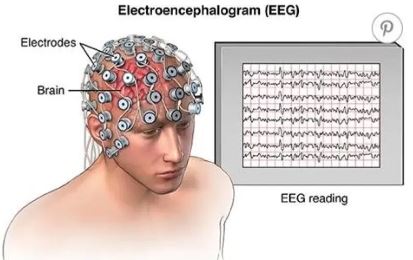
    • EEG stands for electroencephalography. “Electro” means electricity, “encephalo” refers to the brain, and “graphy” means recording.
    • It tracks the electrical activity in the brain that happens when neurons, the brain’s cells, move tiny charged particles. 
    • This helps doctors tell if the brain is working normally or not.
    • Doctors use EEG to diagnose epilepsy, check how deep a person is under anesthesia, study sleep patterns, and even confirm if a person has passed away.

    Understanding Volume Conduction

    • Volume conduction explains how the brain’s electrical signals move through different layers like skin and bone to reach the electrodes on the scalp.
    • The signals that electrodes pick up need to be cleaned up from any distortions caused by these layers or other noises before doctors can read them accurately.

    How does an EEG Test Works?

    • Neurons interact with their surroundings and sometimes push ions around.
    • This movement creates waves of electrical activity.
    • Electrodes on the head detect these waves and measure how strong they are, which is then recorded as an EEG.
    • Setting up an EEG involves putting gel on the head and placing electrodes accurately, which can be affected by things like having thick hair.

    What EEG Can and Can’t Show?

    • Strengths: EEG is very good at catching fast changes in the brain’s electrical activity, which is helpful for immediate observations.
    • Limitations: It mainly detects signals from the surface of the brain and is better at picking up signals from certain types of cell parts than others.
      • Pinpointing exactly where the brain an activity started can be difficult.

    Cost and Accessibility

    • EEG is simple and affordable compared to other methods like MRI.
    • It’s portable, doesn’t use large equipment, and is safe.

    PYQ:

    [2015] With reference to ‘Near Field Communication (NFC) Technology’, which of the following statements is/are correct?

    1. It is a contactless communication technology that uses electromagnetic radio fields.

    2. NFC is designed for use by devices which can be at a distance of even a metre from each other.

    3. NFC can use encryption when sending sensitive information.

    Select the correct answer using the code given below:

    (a) 1 and 2 only

    (b) 3 only

    (c) 1 and 3 only

    (d) 1, 2 and 3

  • India-based Neutrino Observatory

    Why in the News?

    • Takaaki Kajita, a Nobel laureate has supported India’s pursuit of a neutrino lab.
      • Despite numerous obstacles, Kajita believes that the India-based Neutrino Observatory (INO) project, which would rank as one of the largest basic science projects in the country, is still worth pursuing.

    Who is Takaaki Kajita?

    • Takaaki Kajita is a Japanese physicist who was awarded the 2015 Nobel Prize in Physics for discovering the oscillations of neutrinos from one flavour to another, which proved that those subatomic particles have mass.
    • He shared the prize with Canadian physicist Arthur B. McDonald.16 May 2024

    About India-based Neutrino Observatory (INO):

    Details
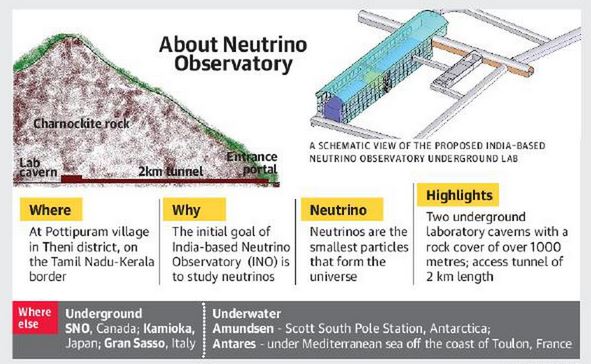
    Location INO Peak near Theni, Tamil Nadu, India
    Objective Study atmospheric neutrinos and provide precise measurements of neutrino mixing parameters
    Project Scope One of the largest experimental particle physics projects in India
    Initial Completion Date Originally planned for 2015
    Key Equipment
    • Iron Calorimeter (ICAL) Detector, designed to probe Earth matter effects on neutrino propagation and determine neutrino oscillation parameters.
    • 50,000 tonnes, the world’s largest magnet, four times larger than CERN’s CMS detector magnet
    Research Goals
    • Neutrino Oscillation Parameters: Unambiguous and precise determination using atmospheric neutrinos.
    • Matter Effects: Study through electric charge identification to determine the sign of mass differences.
    • CP Violation: Investigate charge-conjugation and parity violations in the leptonic sector.
    • CPT Violation: Possible studies of charge-conjugation, parity, and time-reversal violations.
    • Kolar Events: Study possible identification of very-high-energy neutrinos and multi-muon events in Kolar Gold Fields.
    Historical Discussions Initial discussions in 1989, formal collaboration in 2001, and MoU signed in 2002
    Current Status Construction stalled as of July 2021 due to local opposition and environmental concerns; ongoing legal and governmental deliberations


    What is Neutrinos?

    Neutrinos, often referred to as “ghost particles,” are subatomic particles with nearly zero mass and no electric charge.

    Other issues in space:

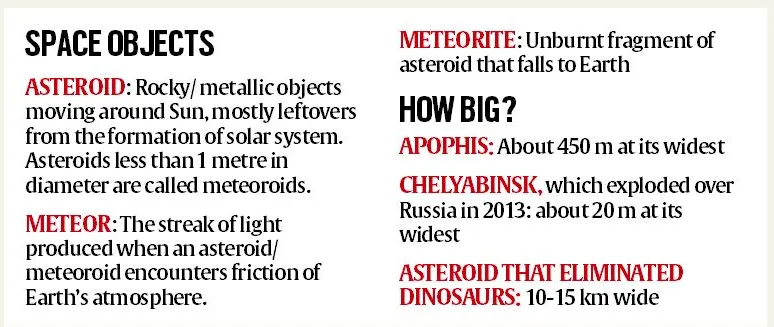
    Last week, ISRO Chairman S Somanath expressed the possibility of engaging with the asteroid Apophis during its close approach to Earth at a distance of 32,000 km in 2029.

    What is Apophis?

    • Apophis is classified as a near-Earth asteroid (NEA), specifically a Potentially Hazardous Asteroid (PHA) due to its size and proximity to Earth’s orbit.
    • Apophis is approximately 335 meters (1,100 feet) in diameter, making it one of the larger near-Earth asteroids.
    • Discovered in 2004, Apophis initially posed a 2.7% chance of colliding with Earth, raising alarms due to its size (about 450 m wide).
    • Subsequent observations ruled out immediate collision risks in 2029, 2036, and 2068, but it will pass close to Earth in 2029 at 32,000 km.


    PYQ:

    [2010] India-based Neutrino Observatory is included by the planning commission as a mega-science project under the 11th Five-year plan. In this context, consider the following statements:

    1. Neutrinos are chargeless elementary particles that travel close to the speed of light.
    2. Neutrinos are created in nuclear reactions of beta decay.
    3. Neutrinos have a negligible, but non-zero mass.
    4. Trillions of Neutrinos pass through the human body every second.

    Which of the statements given above are correct?

    (a) 1 and 3 only

    (b) 1, 2 and 3 only

    (c) 2, 3 and 4

    (d) 1, 2, 3 and 4

  • ISRO’s plans to venture into planetary defence 

    Why in the news? 

    Last week, ISRO Chairman S Somanath expressed the possibility of engaging with the asteroid Apophis during its close approach to Earth at a distance of 32,000 km in 2029. However, the specific manner of ISRO’s involvement has not yet been determined.

    Space objects: 


    The asteroid Apophis may pose a threat:

    • Initial Concerns: Discovered in 2004, Apophis initially posed a 2.7% chance of colliding with Earth, raising alarms due to its size (about 450 m wide).
    • Revised Risk: Subsequent observations ruled out immediate collision risks in 2029, 2036, and 2068, but it will pass close to Earth in 2029 at 32,000 km.
    • Potential Impact: Its size could cause significant damage if it were to collide with Earth, though recent observations suggest no imminent danger.

    Other possible incoming threats from space:

    • Daily Encounters: Thousands of asteroids enter Earth’s atmosphere daily, most burning up due to friction, causing phenomena like fireballs.
    • Russian Example: In 2013, a 20-meter asteroid exploded above Russia, releasing significant energy and causing damage and injuries.
    • Detection Challenges: Some asteroids are detected only upon entering the atmosphere, especially those coming from the direction of the Sun, which can obscure detection.

    ISRO’s plan: From sci-fi to reality:

    • Planetary Defense Initiative: ISRO aims to develop capabilities in planetary defense, potentially participating in missions to study and potentially deflect asteroids.
    • Collaboration: Considering sending its own spacecraft or collaborating with other space agencies, like NASA, which has already redirected a spacecraft to study Apophis in 2029.
    • Evolution of ISRO: Reflects ISRO’s evolution as a space agency, transitioning from aspirations to reality in tackling global space objectives, demonstrating growing confidence and capabilities.

    Way forward: 

    • Form Partnerships: ISRO should actively seek partnerships with leading space agencies like NASA, ESA (European Space Agency), and others involved in asteroid detection and planetary defense.
    • Joint Missions: Collaborate on joint missions to study and potentially mitigate asteroid threats. This could include sharing resources, technology, and expertise to maximize effectiveness and minimize costs.

    Mains PYQ: 

    Q What is India’s plan to have its own space station and how will it benefit our space programme? (UPSC IAS/2019)

  • Universe had Spiral Galaxies 4 billion years sooner than expected: Study

    Why in the News?

    A new study has revealed more spiral galaxies in the universe’s youth than astronomers had previously expected.

    Universe’s Age and Galaxy Types

    • The universe is about 13.8 billion years old and hosts various kinds of galaxies, from spiral to elliptical.
    • Astronomers believed spiral galaxies formed about 6 billion years ago, but the new study calls this into question.
    • Younger galaxies tend to spiral, while older ones have a variety of shapes, making the study of older galaxies more challenging due to fainter light.

    Back2Basics: Spiral Galaxy

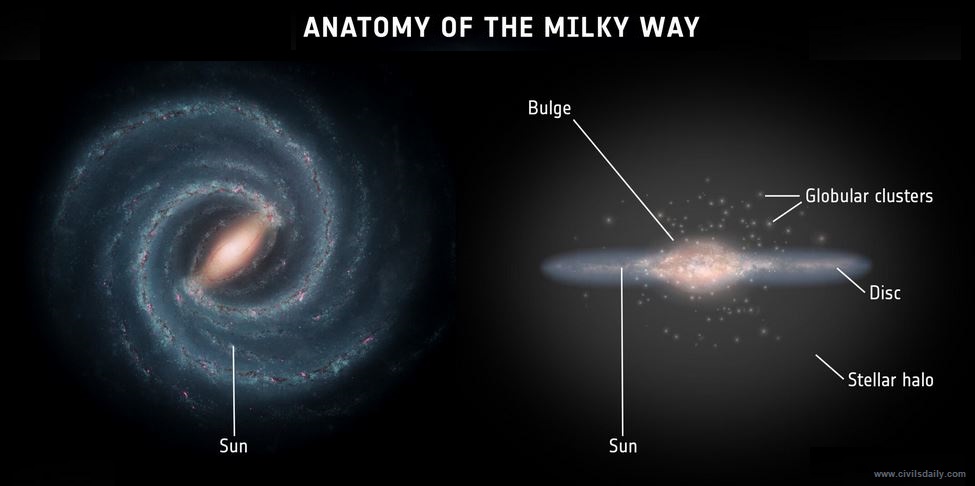
    • Spiral galaxies are a type of galaxy characterized by their spiral structure.
    • They are among the most common types of galaxies in the universe.
    • Our own Milky Way is a classic example of a spiral galaxy.

    Key Characteristics:

    • Central Bulge: A dense, spherical structure at the centre composed mainly of older stars.
    • Disk: Surrounding the bulge is a flat, rotating disk of stars, gas, and dust. The disk contains younger stars and spiral arms.
    • Spiral Arms: These are the defining features, winding outward from the central bulge. The arms are sites of active star formation and appear brighter due to the presence of young, hot stars.
    • Halo: A roughly spherical region surrounding the disk, containing old stars and globular clusters.

    Formation and Evolution:

    • Spiral galaxies are thought to form from the gravitational collapse of gas and dust in the early universe.
    • They maintain their structure through the rotation of the disk and the gravitational influence of the central bulge and halo.
    • Interactions and mergers with other galaxies can distort or destroy their spiral structure, potentially transforming them into elliptical galaxies.

    Formation of Galaxies

    • As the universe cooled from a dense plasma state, hot gas formed clumps that became galaxies.
    • These early galaxies had irregular shapes and lacked disks.
    • Spiral Formation Theory:
      • The traditional theory suggested that it took billions of years for hot, thick disks to become thinner and form spiral arms.
      • The new study suggests that cooling and spiral formation occur around the same cosmic time.

    How is this verified?

    • Astronomers observe star formation in real time but study galaxy evolution through “astronomical archaeology.”
      • Understanding the fraction of spiral galaxies helps astronomers trace the biography of galaxies.
      • Infrared and optical wavelengths are used to detect early galaxies, requiring powerful telescopes due to the faint light of older galaxies.
    • Study Methodology:
      • The University of Missouri team used the JWST to study 873 galaxies and identified at least 216 spiral galaxies, some dating to 1.5 billion years after the universe’s birth.
      • Each of the six authors classified the images as spiral or non-spiral, ensuring the result is free of human bias.

    Findings and Implications

    • The fraction of spiral galaxies increased from about 8% to 48% between 3 billion and 7 billion years after the Big Bang, higher than previously observed.
    • The study challenges existing models and suggests that galaxy formation theories need to be more complex.

    PYQ:

    [2022] Launched on 25th December, 2021, James Webb Space Telescope has been much in the news since then. What are its unique features which make it superior to its predecessor Space Telescopes? What are the key goals of this mission? What potential benefits does it hold for the human race?

  • Why Indian-origin astronaut Sunita Williams is stuck in space?  

    Why in the News?

    The scheduled return of the Starliner spacecraft, which transported NASA astronauts Sunita Williams and Butch Wilmore to the International Space Station (ISS) earlier this month, has been delayed.

    What is the Starliner mission?

    • Objective: The Starliner Crew Flight Test mission aimed to transport NASA astronauts Sunita Williams and Butch Wilmore to the International Space Station (ISS) and demonstrate the spacecraft’s capability to safely ferry crew to and from low-Earth orbit (LEO).
    • Craft Description: CST-100 Starliner, developed by Boeing in collaboration with NASA’s Commercial Crew Program, is designed to accommodate up to seven passengers or a mix of crew and cargo for LEO missions. It is reusable up to 10 times with a turnaround time of six months.
    • Significance: Marks Boeing’s contribution to NASA’s efforts since the retirement of the Space Shuttle Program in 2011, alongside SpaceX’s Dragon spacecraft, which first delivered cargo in 2012 and transported astronauts in 2020.

    What has caused the delay?

    • Technical Issues: Multiple setbacks delayed the mission, including a faulty pressure valve on the Atlas V upper stage, engineering problems with other mechanisms, and issues with a spacecraft valve regulating oxidisers.
    • Specific Challenges: Post-launch, Starliner encountered five helium leaks, malfunctioning maneuvering thrusters, and a propellant valve failure, necessitating mid-mission fixes and assessments.

    What would happen to the astronauts?

    • Current Status: Sunita Williams and Butch Wilmore remain aboard the ISS, where they are conducting research and experiments. The spacecraft can stay docked for up to 45 days, and the ISS has sufficient supplies for extended periods.
    • Contingency Plan: If safety concerns persist or the Starliner issues cannot be resolved in time, the astronauts may return to Earth aboard SpaceX’s Dragon spacecraft, currently also docked at the ISS.

    Way forward ( what can NASA do?) 

    • Thorough Technical Review: NASA should conduct a comprehensive technical review of the Starliner spacecraft’s systems and components to identify the root causes of the multiple issues encountered during the mission.
    • Enhanced Mission Preparedness: NASA should prioritise enhancing mission preparedness protocols for commercial crew missions, including stricter pre-launch checks, contingency planning for mid-mission anomalies, and robust communication and coordination between mission control and astronauts aboard the ISS. This proactive approach can mitigate risks and ensure smoother operations in future missions.

    Mains PYQ: 

    Q What is India’s plan to have its own space station and how will it benefit our space programme? (UPSC IAS/2019)

  • Geoportals for Enhanced Rural Land Records and Emergency Management

    Why in the News?

    • The Union Ministry of Science and Technology launched two Geoportals: ‘Bhuvan Panchayat (Ver. 4.0)’ for rural land records and ‘National Database for Emergency Management (NDEM Ver. 5.0)’.
      • These portals were developed by the Indian Space Research Organization (ISRO).
      • These geospatial tools provide high-resolution satellite imagery of 1:10K scale for various locations across the country.

    About Bhuvan Panchayat (Ver. 4.0)

    • This portal supports “Space-based Information Support for Decentralized Planning (SISDP)”.
    • It aims to empower citizens at the grassroots level by providing real-time land record data and reducing dependency on local administration and corruption.
    • It promotes ease of living through digitalisation and better land revenue management.
    • By providing real-time data accessible to citizens, it reduces opportunities for corruption at the local level.
    • It enhances transparency and efficiency in land record management, aiding in effective governance and planning.

    About National Database for Emergency Management (NDEM Ver. 5.0)

    • This portal provides space-based inputs on natural disasters, aiding in disaster risk reduction in India and neighbouring countries.
    • It establishes an effective early warning system to proactively prevent disasters and monitor land use changes.
    • A command centre has been established to monitor situations and provide valuable inputs continuously.
    • The portal is designed to assist not only India but also neighbouring countries in disaster management.
    • It enhances coordination between various agencies and local authorities for effective disaster response and management.

    PYQ:

    [2023] With reference to the Digital India Land Records Modernisation Programme, consider the following statements :

    1. To implement the scheme, the Central Government provides 100% funding.
    2. Under the Scheme, Cadastral Maps are digitized.
    3. An initiative has been undertaken to transliterate the Records of Rights from local language to any of the languages recognized by the Constitution of India.

    Which of the statements given above are correct?

    (a) 1 and 2 only

    (b) 2 and 3 only

    (c) 1 and 3 only

    (d) 1, 2, and 3

  • India-Kenya Partnership to Boost Africa’s Space Capabilities

    Why in the News?

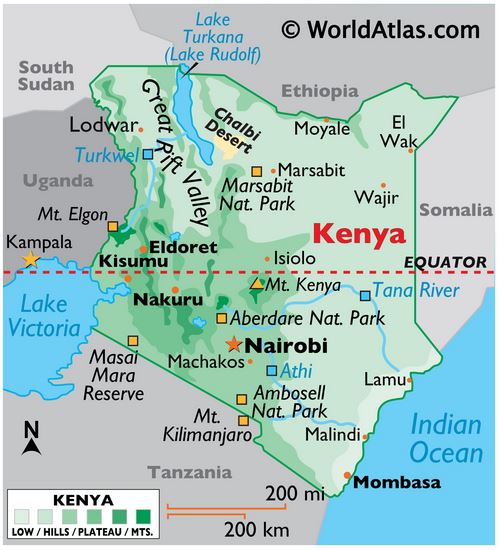
    • India has shown interest in partnering with Kenya to develop and expand Africa’s space capabilities for predicting and monitoring extreme weather events.
      • Kenya aims to be an active player in the global space economy, projected to grow significantly by 2035.

    Conference Highlights and Recommendations

    • Conference Conclusion: Calls for more resources for sustainable space activities, including accurate weather and climate event monitoring.
    • Awareness and Innovations: The expo, themed ‘Space technology for societal benefits,’ aimed to raise awareness about space opportunities for societal benefits like climate change mitigation and socio-economic development.
    • Support for Private Sector: Experts recommended that African governments support private sector innovations for data commercialization and explore funding models to de-risk the space sector.
    • STEM Education: Emphasis on boosting national capabilities in space science, breaking entry barriers for women, and promoting STEM education.

    India-Kenya Space Collaboration

    The India-Kenya Space Collaboration particularly aims for:

    • Addressing Food Security: Space technology will be crucial for food security, providing accurate early warning systems for farmers and real-time monitoring for climate change mitigation.
    • Sustainable Development: Space technology integration offers enhanced data for informed decision-making, essential for Kenya’s sustainable development.
    • Regional Collaboration: Kenya is pursuing collaboration on peaceful uses of outer space with African countries such as South Africa, Angola, Rwanda, Uganda, Ethiopia, Sudan, Egypt, Algeria, Nigeria, and Ghana.
    • Capacity Development: Focus on developing indigenous capacity in space systems engineering and utilising space services for socio-economic development through joint projects.

    Kenyan endeavours so far  

    • Earth Observation Centre: Plans to establish a Centre for Earth Observation at the Luigi Broglio Malindi Space Centre.
    • International Training Centre: Partnership with the Italian Space Agency to establish a Training Centre for Space Education, enhancing national and regional capabilities.

    Back2Basics: India-Kenya Relations

    Historical Ties:

    • Early Connections: Trade between India and the Swahili Coast dates back to ancient times, as documented in the ‘Periplus of the Erythraean Sea’ (60 CE).
    • Colonial Era: Both nations share a legacy of struggle against colonialism, with Indian communities actively supporting Kenya’s freedom struggle.

    Diplomatic Relations:

    • Establishment of Diplomatic Presence: India set up the office of Commissioner for British East Africa residents in Nairobi in 1948, and a High Commission was established following Kenya’s independence in 1963. An Assistant High Commission is also located in Mombasa.
    • High-Level Visits: Numerous high-level visits by Indian leaders, including Presidents and Prime Ministers, have strengthened bilateral ties.

    Bilateral Trade:

    • Trade Agreement: The India-Kenya Trade Agreement signed in 1981 granted both nations Most Favoured Nation status.
    • Indian Exports to Kenya: Petroleum products, pharmaceuticals, steel products, machinery, yarn, vehicles, and power transmission equipment.
    • Kenyan Exports to India: Soda ash, vegetables, tea, leather, and metal scrap.
    • Investment: India is the second-largest investor in Kenya, with over 60 major Indian companies operating in sectors like manufacturing, real estate, pharmaceuticals, telecom, IT & ITES, banking, and agro-based industries.

    Development Cooperation:

    • Development Assistance: India provides loans, credit, and developmental support to Kenya, including capacity-building initiatives such as scholarships for Kenyan students.
    • Agricultural Support: India aids in agrarian development by supplying machinery and facilitating technology transfer.
    • Healthcare Contributions: India is a key supplier of pharmaceuticals to Kenya and has supported healthcare initiatives, including donating 1.12 million doses of the Covishield vaccine in 2021.
    • Environmental Conservation: Cheetahs under the reintroduction project are also being brought from Kenya.

    Cultural and Diaspora Links:

    • Indian Community: Indians have a long-standing presence in Kenya, contributing significantly to its society and economy.
    • Official recognition: In 2017, the Kenyan government recognized the Indian descent as the 44th tribe of the country.

    International Cooperation:

    • Common Interests: Both nations share interests in various international forums, including the Commonwealth, Non-Aligned Movement, and Indian Ocean Rim Association (IORA).
    • Regional Engagement: Kenya is an active member of the African Union, with which India has long-standing connections.


    PYQ:

    [2015] Increasing interest of India in Africa has its pro and cons. Critically Examine.

  • Chang’e 6 Lunar Probe

    Why in the News?

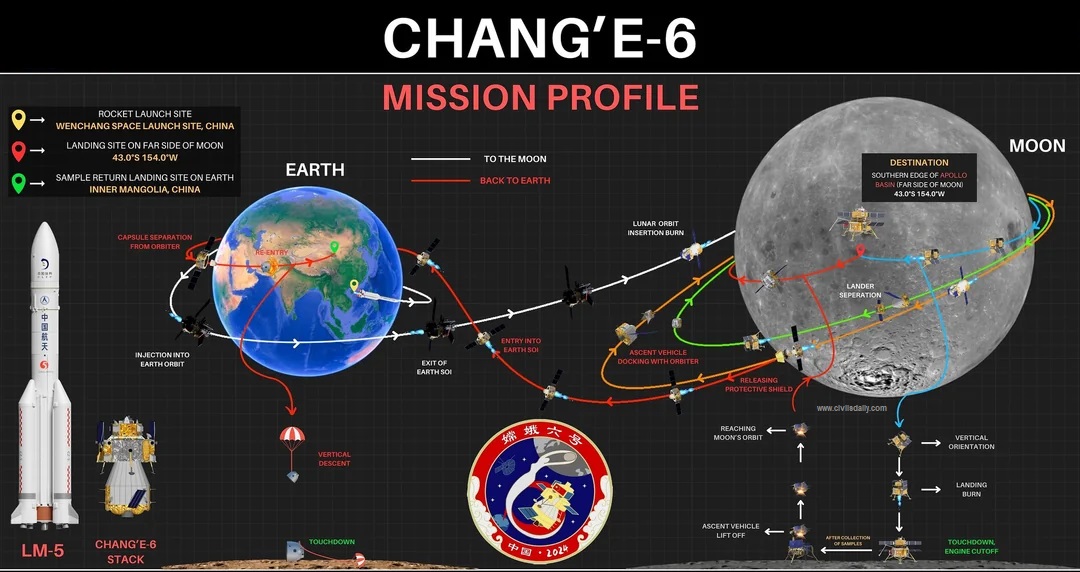
    • On June 25, Chang’e-6 became the world’s first spacecraft to bring back samples from the far side of the Moon.
      • Chang’e-6 successfully returned with samples from the lunar far side, making China the first country to achieve this feat.

    About Chang’e-6 Mission 

    • The mission lasted 53 days, starting with a launch on May 3, 2024, and ending with the return capsule landing on June 25, 2024.
    • The lander descended into the South Pole-Aitken basin, one of the largest impact basins in the solar system, believed to contain material from the lunar mantle.
    • The lander used robotic scoops and drills to collect about 2 kilograms of lunar material, including both surface soil and subsurface samples.

    Components of Chang’e-6 

    1. Lander: Equipped with drills and scoops for sample collection.
    2. Ascender: Transported samples from the lunar surface to lunar orbit.
    3. Orbiter: Carried the samples from lunar orbit back to Earth.
    4. Returner: Brought the samples safely back to Earth.

    Collaboration and Payloads

    The mission carried instruments from international partners, including:

    • French DORN: Studied lunar dust and volatiles.
    • Italian INRRI: Measured distances using a retroreflector.
    • Swedish NILS: Detected negative ions on the lunar surface.
    • Pakistani ICUBE-Q CubeSat: Imaged the lunar surface and obtained magnetic field data.

    Scientific Goals  

    • Sample Analysis: Scientists aim to learn more about the Moon’s internal structure and the differences between its near and far sides.

    China’s Lunar Exploration Program

    • Chang’e-6 follows previous missions under China’s Lunar Exploration Program, marking the next step in incremental technological advancements.
    • Phases of Exploration: The program has four phases:
    1. First Phase: Reaching lunar orbit, completed by Chang’e 1 (2007) and Chang’e 2 (2010).
    2. Second Phase: Landing and roving, achieved by Chang’e 3 (2013) and Chang’e 4 (2019).
    3. Third Phase: Sample collection and return, accomplished by Chang’e 5 (2020) and Chang’e 6 (2024).
    4. Fourth Phase: Developing a robotic research station near the Moon’s South Pole, aiming for crewed lunar landings in the 2030s.

    Previous Lunar Sample Missions

    • Apollo 11 Mission (1969): The US mission brought 22 kg of lunar material, including 50 rocks.
    • Luna 16 Mission (1970): Soviet robotic mission brought lunar samples to Earth.
    • Chang’e-5 Mission (2020): Predecessor to Chang’e-6, returned 2 kg of lunar soil from the near side.

    Significance of Sample Return Missions

    • Laboratory Analysis: Allows the use of sophisticated instruments to study the chemical, isotopic, mineralogical, structural, and physical properties of samples.
    • Long-term Preservation: Samples can be preserved and re-examined by future generations with advanced technology.
    • Technological Feat: Recovering samples from the far side is a significant technological achievement.
    • Step Towards Human Exploration: Success of Chang’e-6 is seen as a step towards China’s goal of landing astronauts on the Moon by 2030.
    • Launch Pad for Deep Space: The Moon could serve as a base for future deep space missions and extraterrestrial exploration.

    Outcome: New Lunar Race

    • Global Participation: India, China, Japan, the US, and Russia launched lunar missions in 2023.
    • Future Missions: Over 100 Moon missions by governments and private companies are expected by 2030.
    • Long-term Goals: Unlike the 20th-century space race, today’s missions aim to establish a long-term presence and use lunar resources.

    India’s Chandrayaan-4 Mission

    • Chandrayaan-4, under development by ISRO, will also be a sample return mission to be launched tentatively by 2028.
    • Chandrayaan-3 landed near the Moon’s South Pole last year, about 600 km from the target area for Chandrayaan-4.


    PYQ:

    [2016] Discuss India’s achievements in the field of Space Science and Technology. How the application of this technology helped India in its socio-economic development?

  • China-France launches SVOM Satellite for Gamma-Ray Burst Study

    Why in the News?

    The Space Variable Objects Monitor (SVOM) satellite jointly developed by China and France was launched from the Xichang Satellite Launch Center.

    About Space Variable Objects Monitor (SVOM)

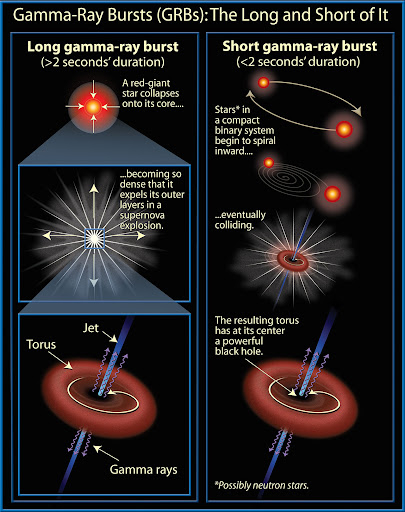
    • The SVOM is designed to study gamma-ray bursts (GRBs) resulting from explosive cosmic events like black hole births and neutron star collisions.
    • It is the first astronomy satellite developed jointly by China and France, following their collaboration on an oceanographic satellite launched in 2018.

    Importance of Studying Gamma-Ray Bursts (GRBs)

    • GRBs are highly energetic bursts of gamma rays, lasting from less than a second to several minutes, occurring in distant parts of the universe.GRBs can erupt with a luminosity a quintillion times that of the Sun.
    • Types of GRBs:
    1. Short GRBs: Result from collisions of neutron stars or a neutron star with a black hole, lasting less than two seconds, often followed by kilonovas.
    2. Long GRBs: Result from the explosive deaths of massive stars, lasting two seconds or longer.

    Mission and Objectives of SVOM

    • Primary Objective: To search for and study GRBs across the universe.
    • Data Collection: Measure and analyze electromagnetic radiation properties of GRBs.
    • Scientific Goals: Unlock mysteries about the universe’s evolution and gravitational waves, which are often associated with neutron star collisions.
    • Real-time Detection: Transmit GRB data to ground control within about one minute, enabling coordinated observations with ground-based stations globally.

    Features and Capabilities of SVOM

    • Satellite Specifications: Weighs 930 kg and is equipped with four payloads, two developed by France and two by China.
    • French Contributions: ECLAIRs and MXT telescopes to detect and capture GRBs.
    • Chinese Contributions:
    1. Gamma Ray Burst Monitor (GRM): Measures the spectrum of GRBs.
    2. Visible Telescope (VT): Detects and observes visible emissions immediately after a GRB.
    • Orbit Details: Placed in a low Earth orbit at an altitude of 625 km, with an orbital period of 96 minutes.

    Significance of SVOM’s Findings

    • Early Universe Insights: Aim to detect the earliest GRBs, providing information on the universe’s early stages and evolution.
    • Kilonova Detection: Capability to search for kilonovas, enhancing understanding of stellar evolution and the origin of heavy elements like gold and silver in the universe.

    PYQ:

    [2019] Recently, scientists observed the merger of giant ‘blackholes’ billions of light-years away from the Earth. What is the significance of this observation?

    (a) ‘Higgs boson particles’ were detected.

    (b) ‘Gravitational waves’ were detected.

    (c) Possibility of inter-galactic space travel through ‘wormhole’ was confirmed.

    (d) It enabled the scientists to understand ‘singularity’.