💥Join UPSC 2027,2028 Mentorship (August Batch) + XFactor Notes & Microthemes PDF

Subject: Space Technology

  • BlueBird 6 Satellite and LVM 3

    Why in the News?

    The Indian Space Research Organisation ISRO is scheduled to launch the BlueBird 6 satellite, developed by US based AST SpaceMobile, on 21 December 2025 using India’s heavy lift rocket LVM 3.

    About BlueBird 6 Satellite

    Developer: AST SpaceMobile USA
    Purpose: Provides direct to device internet connectivity, enabling normal mobile phones to access broadband without dependence on ground based cell towers
    Weight: Around 6.5 tonnes, making it among the heaviest commercial satellites launched by ISRO
    Orbit: Low Earth Orbit LEO
    Technology: Equipped with one of the largest phased array antennas ever deployed in space, covering nearly 2,400 square feet
    • Capable of direct communication with standard smartphones
    Significance: Enhances global mobile broadband connectivity, particularly in remote and rural regions
    Strategic importance: Strengthens Indo US space cooperation and expands commercial space launch collaboration
    Future impact: Helps bridge the digital divide by providing internet access in regions without cellular infrastructure

    About LVM 3

    • Full name: Launch Vehicle Mark 3
    • Also called GSLV Mk III or Bahubali
    • India’s heavy lift launch vehicle developed by ISRO
    • Designed for large satellite launches and human spaceflight missions

    With reference to India’s satellite launch vehicles, Consider the following statements: (2018)

    1. PSLVs launch the satellites useful for Earth resources monitoring whereas GSLVs are designed mainly to launch communication satellites. 

    2. Satellites launched by PSLV appear to remain permanently fixed in the same position in the sky, as viewed from a particular location on Earth. 

    3. GSLV Mk III is a four-stage launch vehicle with the first and third stages using solid rocket motors, and the second and fourth stages using liquid rocket engines. 

    Which of the statements given above is/ are correct? 

    (a) 1 only (b) 2 and 3 (c) 1 and 2 (d) 3 only

  • NSIL and ISRO Technology Transfer 

    Why in the News?

    NewSpace India Limited (NSIL) has so far signed 70 Technology Transfer Agreements (TTAs) to license technologies developed by ISRO to Indian industries.

    About NSIL

    • Commercial arm of the Department of Space (DoS), incorporated under the Companies Act 2013.
    • Mandated to:
      • Commercialise ISRO technologies.
      • Enable industry participation in space missions.
      • Act as the actual licensor of ISRO technologies.

    Technology Transfer Mechanism

    Types of Agreements

    1. Technology Transfer Agreements (TTAs) – Define rights, obligations, and usage of transferred technology.
    2. Non-Disclosure Agreements (NDAs) – Contain explicit confidentiality clauses protecting commercially sensitive information.

    Role of IN-SPACe

    • Acts as a facilitator for Non-Governmental Entities (NGEs).
    • NSIL remains the licensing authority.

    Oversight for Fairness

    • A dedicated Technology Transfer Committee reviews all proposals.
    • Ensures transfers are transparent, equitable, and accountable.

    Transparency and RTI Compliance

    • NSIL is a public authority under RTI Act, 2005.
    • Suo motu disclosure under Section 4:
      • Lists technologies available for transfer.
      • Guidelines and procedures for NGEs.
      • Periodically updated information on technology transfers.

    What Information is Public?

    • Names and details of industries receiving ISRO technologies
      (furnished under RTI and available via ISRO/DoS websites such as URSC, IN-SPACe, NSIL).
    • Media publications also highlight certain transfers.

    Information Exempt from Disclosure

    Under Section 8(1)(d) of the RTI Act, NSIL does not disclose:

    • Commercial terms.
    • Payment details.
    • Copies of agreements.
      These are considered commercially sensitive or strategic.
    With reference to the Indian Regional Navigation Satellite System (IRNSS), Consider the following statements : (2018)

    1. IRNSS has three satellites in geostationary and four satellites in geosynchronous orbits. 

    2. IRNSS covers entire India and about 5500 sq. km beyond its borders. 

    3. India will have its own satellite navigation system with full global coverage by the middle of 2019. 

    Which of the statements given above is/are correct ? 

    (a) 1 only (b) 1 and 2 only (c) 2 and 3 only (d) None

  • Aditya-L1 Reveals Why the 2024 Solar Storm Behaved Unusually

    Why in the news?

    • In May 2024, Earth experienced the strongest solar storm in over two decades, popularly known as Gannon’s Storm.
    • A collaborative study using Aditya-L1 and six NASA satellites has explained the unusual behaviour and enhanced intensity of this storm.

    What Are CMEs?

    • Coronal Mass Ejections (CMEs): Massive bubbles of charged gas and magnetic energy expelled from the Sun.
    • When directed towards Earth, CMEs can:
      • Disturb the magnetosphere
      • Disrupt satellites, communication networks, GPS
      • Trigger geomagnetic storms affecting power grids

    Key Findings of the Study

    1. Collision of Two CMEs

    • Instead of a single CME rope, two CMEs collided in space.
    • This collision compressed and distorted their magnetic structures.

    2. Magnetic Reconnection Inside the CME

    • Magnetic fields inside one CME snapped and rejoined, creating new magnetic pathways. This internal breakup is called magnetic reconnection.
    • Consequences:
      • Sudden reversal and strengthening of magnetic fields
      • Enhanced geomagnetic impact on Earth
      • Acceleration of charged particles detected by satellites

    3. First Multi-Vantage Observation

    • Observations came from Aditya-L1 and six US satellites:
      • NASA Wind
      • ACE
      • THEMIS-C
      • STEREO-A
      • MMS
      • DSCOVR (NASA-NOAA)
    • Enabled simultaneous study of the storm from Earth, Moon, and L1 point.

    4. Discovery of a Giant Reconnection Region

    • Aditya-L1’s precise magnetic field measurements showed:
      • Reconnection region ≈ 1.3 million km across
      • Nearly 100 times Earth’s diameter
    • First recorded instance of such a giant internal magnetic breakup within a CME.
    If a major solar storm (solar flare) reaches the Earth, which of the following are the possible effects on the Earth ? (2022)

    1. GPS and navigation systems could fail. 

    2. Tsunamis could occur at equatorial regions. 

    3. Power grids could be damaged. 

    4. Intense auroras could occur over much of the Earth. 

    5. Forest fires could take place over much of the planet. 

    6. Orbits of the satellites could be disturbed. 

    7. Shortwave radio communication of the aircraft flying over polar regions could be interrupted. 

    Select the correct answer using the code given below: 

    (a) 1, 2, 4 and 5 only (b) 2, 3, 5, 6 and 7 only (c) 1, 3, 4, 6 and 7 only (d) 1, 2, 3, 4, 5, 6 & 7

  • INS Aridhaman

    Why in the News

    The Indian Navy has indicated that INS Aridhaman, India’s third nuclear powered ballistic missile submarine (SSBN), will be inducted soon.

    About INS Aridhaman

    • Second submarine of the Arihant class SSBNs
      • Developed under the Advanced Technology Vessel (ATV) project
      • Built at Ship Building Centre, Visakhapatnam
      • Strengthens India’s nuclear triad with credible sea based deterrence.

    Strategic Significance 

    • Enhances deterrence posture under No First Use policy
      • Consolidates India’s position as a blue water navy
      • Increases maritime security presence in the Indian Ocean Region

    Note: A blue water navy is a maritime force that can operate far beyond its own coastal waters and project power across the deep oceans of the world.

    Consider the following statements: (2023)

    1. Ballistic missiles are jet-propelled at sub-sonic speeds throughout their flights, while cruise missiles are rocket-powered only in the initial phase of flight. 

    2. Agni-V is a medium-range supersonic cruise missile, while BrahMos is a solid-fuelled intercontinental ballistic missile. 

    Which of the statements given above is/are correct? 

    (a) 1 only (b) 2 only (c) Both 1 and 2 (d) Neither 1 nor 2

  • Understanding concerns around Sanchar Saathi

    Introduction

    The Department of Telecommunications (DoT) has instructed smartphone manufacturers and importers to pre-install the Sanchar Saathi application on all new mobile devices. The app is designed to combat digital fraud, trace stolen devices, and prevent misuse of SIMs. But its mandatory installation has raised widespread concerns about privacy, surveillance, user consent, and constitutional rights. The government later clarified that the app is “optional,” but the directive mandating its pre-installation has created ambiguity.

    Why in the news

    Sanchar Saathi’s mandatory pre-installation order marks a major shift because devices in India have never required a state-controlled app by default. This reversal from voluntary to mandatory installation has generated concerns about surveillance risks, access to sensitive data, and violation of user consent. The scale is significant as India is the world’s second-largest smartphone market; even small changes affect millions. Legal experts view it as a possible infringement of the fundamental right to privacy.

    What the Government’s App Actually Does

    1. Blocking & Tracking: Allows blocking or locating lost/stolen phones anywhere in India using IMEI-based tracing.
    2. User Option to Block IMEI: Enables users to prevent stolen devices from being activated.
    3. Support to Law Enforcement: Assists police in identifying counterfeit devices and preventing black-market circulation.
    4. Fraud Prevention: Helps report fraudulent calls, messages, and online scams via unified channels.

    Why Has Sanchar Saathi Triggered Concerns?

    1. Ambiguity Around Consent
      1. Unclear Mandate: Pre-installation directive contradicts the Minister’s statement that the app is optional.
      2. User Autonomy: Mandatory installation affects user ability to choose, delete, or disable the app freely.
    2. Expanded State Power
      1. Exceptional Move: First time the government mandated a wide-scale state app on all devices.
      2. Precedent Risks: May normalise future mandates for state surveillance tools.
    3. Privacy Risks
      1. Data Access: App uses Android’s Mobile Security Framework enabling access to call logs, camera, SMS, and unique device identifiers.
      2. Opaque Permissions: Apple devices require permissions for photos, files, and camera.
      3. Potential Misuse: Centralised data collection may heighten misuse & monitoring risks.

    What Data Does Sanchar Saathi Collect?

    1. IMEI Data: Unique identifier used to block stolen devices.
    2. Call Logs & SMS Data: Access allowed when reporting fraud or using suspicious call detection features.
    3. Camera Access: Needed for uploading barcodes of mobile equipment (IMEI verification).
    4. Personal Information: Includes phone numbers, Aadhaar-linked data, and registration details.
    5. Problem: The app’s privacy policy bans sharing identifiable information except when required by law, but the phrase “required by law” remains broad and open-ended.

    Constitutional & Legal Concerns

    1. Lack of Consent: Forced Pre-installation undermines voluntary, informed consent, a core component upheld under the Puttaswamy judgment (2017).
    2. Three-fold Privacy Test: Experts argue mandatory pre-installation fails:
      1. Legality: No explicit statutory backing for a nationwide mandate.
      2. Necessity: No demonstrated need requiring compulsory installation.
      3. Proportionality: Data access far exceeds the minimum required for fraud detection.
    3. Surveillance & “Function Creep”
      1. Risk of Expansion: Potential to expand into unrelated data surveillance functions.
      2. No Independent Oversight: Absence of clear audit mechanisms, grievance redressal, or limits on retention periods.

    Way Forward 

    1. Clarity of the mandate: Issue a clear written policy stating the app’s status to remove confusion.
    2. Addressing Privacy Risks: Limit data permissions to essential functions and publish regular audit reports.
    3. Ensuring Consent & User Autonomy: Provide a visible and fully functional uninstall or disable option.
    4. Preventing Surveillance Overreach: Create independent oversight to monitor misuse and restrict function creep.
    5. Building Trust Through Transparency: Disclose data flows, retention rules, and access logs in the public domain.

    Conclusion

    Sanchar Saathi addresses real concerns of digital fraud and misuse of mobile devices. However, its mandatory pre-installation, broad data permissions, unclear safeguards, and inconsistent communication have created concerns about state overreach and privacy violations. The app’s utility must be balanced with constitutional guarantees, transparent policy design, and robust data protection mechanisms.

    PYQ Relevance

    [UPSC 2024] Right to privacy is intrinsic to life and personal liberty and is inherently protected under Article 21 of the constitution. Explain. In this reference, discuss the law relating to D.N.A. testing of a child in the womb to establish its paternity.

    Linkage: This PYQ links directly to debates on privacy, consent, and proportionality governing state access to sensitive personal data. It shows how intrusion into bodily or digital autonomy must meet strict constitutional tests.
  • International Astronomical Union (IAU) 

    Why in the news?

    • A 3.5-billion-year-old Martian crater has been named after Indian geologist M.S. Krishnan. The naming was approved by the International Astronomical Union (IAU).
    • Several other names proposed by Kerala scientists for Martian landforms were also approved.

    About the Martian Crater

    • Estimated to be 3.5 billion years old, dating back to Mars’ early geological history.
    • Located in a region studied for traces of ancient water and habitability.

    Who Was M.S. Krishnan?

    • Full name: Maharajapuram Seetharaman Krishnan
    • One of India’s most influential geologists, known as a foundational figure in modern Indian geological studies.
    • Served as Director, Geological Survey of India (GSI) (1950–1956).

    Major Contributions

    • Mapped India’s geological structures, including:
      • Indian stratigraphy
      • Peninsular shield
      • Himalayan formations
    • Played a leading role in mineral exploration and petroleum geology in India.
    • Contributed to studies on:
      • Gondwana formations
      • Economic geology
      • Earth resources of India

    Famous Work

    • Author of the landmark textbook “Geology of India and Burma”, a globally referenced work in earth sciences.

    About the International Astronomical Union (IAU)

    • Founded: 1919
    • A senior international body that governs professional astronomical activities worldwide.
    • Mission: Promote and safeguard astronomy through research, communication, education, development, and international cooperation.
    • Headquarters: Paris, France
    • India is a member of it 
    What is the purpose of ‘evolved Laser Interferometer Space Antenna (ELISA)’ project? (2017)

    (a) To detect neutrinos 

    (b) To detect gravitational waves 

    (c) To detect the effectiveness of missile defence system 

    (d) To study the effect of solar flares on our communication systems

    This PYQ is selected because it directly tests knowledge of a major international scientific venture in the field of astronomy/cosmology, which is conceptually linked to the mandate of the IAU

  • Study on Lithium-Rich Red Giant Stars and Helium Abundance

    Why in the News?

    A recent study conducted by Indian Institute of Astrophysics (IIA) has discovered a link between Lithium-rich red giant stars and their enhanced helium abundance.

    What are Red Giant Stars?

    • Overview: Evolved stars that have exhausted core hydrogen, causing the core to contract and the outer layers to expand into a large, cool, reddish envelope.
    • Formation Process: Core contraction increases temperature while the outer shell expands and cools, triggering hydrogen shell burning.
    • Temperature and Luminosity: Surface temperature drops to 2,000–5,000 K, but luminosity rises sharply due to vastly increased radius.
    • Internal Fusion: Helium fusion begins in the core, producing heavier elements like carbon and oxygen.
    • Evolutionary Stage: Represents the late life cycle of medium-mass stars; the Sun will enter this phase in about 5 billion years.
    • End Stage: Outer layers are shed into a planetary nebula, leaving a white dwarf remnant that cools over time.

    Key Findings of the Study:

    • New Discovery: IIA established the first spectroscopic link between helium enhancement and lithium enrichment in red giant stars.
    • Data Source: Based on Himalayan Chandra Telescope observations and archival global spectroscopic datasets.
    • Sample Profile: 20 cool giants studied- 18 red giants and 2 supergiants.
    • Helium-Enriched Stars: Six stars showed high helium-to-hydrogen ratios (He/H > 0.1).
    • Distribution: Five were red giants and one a supergiant, showing a trend toward helium enhancement in lithium-rich giants.
    • Scientific Insight: Offers direct evidence of deep internal mixing and nucleosynthesis shaping surface chemical composition.

    What is the correlation between Lithium and Helium?

    • Coupled Enrichment: All helium-enhanced giants were lithium-rich, suggesting a shared internal mixing mechanism.
    • Asymmetry: Not all lithium-rich giants showed helium enhancement, implying lithium can rise without parallel helium increase.
    • Internal Mixing Role: Deep convection likely dredges up newly formed helium and lithium from the interior to the photosphere.
    • Photospheric Evidence: Confirms mixing-driven changes detectable on the stellar surface during the red giant stage.

    Significance of the Findings:

    • First Measurement: Provides the first direct spectroscopic photospheric helium estimates for normal and lithium-rich red giants.
    • Astrophysical Value: Refines understanding of mixing, nucleosynthesis, and energy transport inside red giant branch (RGB) stars.
    • Galactic Evolution: Improves models of how stars contribute heavier elements to the interstellar medium.
    • Methodological Advance: Strengthens indirect helium-measurement techniques for cool stars where helium lines are not visible.
    • Evolutionary Insight: Shows helium enrichment is integral to changes in luminosity, temperature evolution, and mass-loss pathways.
    [UPSC 2023] Consider the following pairs:

    Objects in space: Description

    1. Cepheids : Giant clouds of dust and gas in space

    2. Nebulae : Stars which brighten and dim periodically

    3. Pulsars : Neutron stars that are formed when massive stars run out of fuel and collapse

    How many of the above pairs are correctly matched?

    Options: (a) Only one* (b) Only two (c) All three (d) None


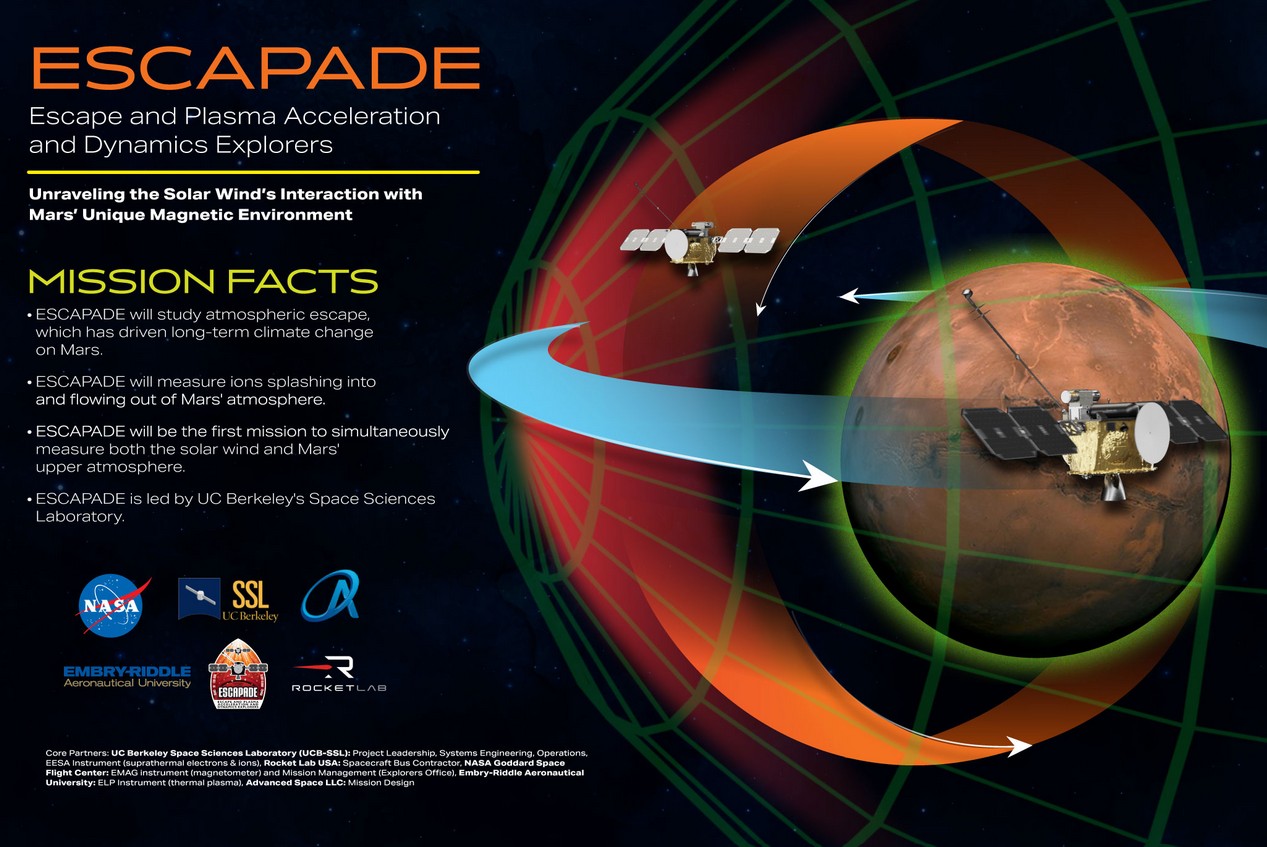
  • NASA’s ESCAPADE Mission to Mars

    Why in the News?

    NASA launched the ESCAPADE mission aboard the New Glenn rocket developed by Blue Origin.

    About ESCAPADE Mission:

    • Mission Overview: ESCAPADE is a NASA Mars mission consisting of two identical orbiters (Blue and Gold) designed to study how the solar wind interacts with the Martian atmosphere and magnetosphere.
    • Launch: Launched aboard Blue Origin’s New Glenn rocket, marking a major step for commercial heavy-lift launches.
    • Programme: Part of NASA’s SIMPLEx programme, which focuses on low-cost, small planetary missions using compact spacecraft.
    • Science Goal: To understand how Mars lost its ancient thick atmosphere by measuring plasma, magnetic fields, and ion escape processes driven by the solar wind.
    • Trajectory: Uses an innovative path via the Earth–Sun L2 point, loitering for nearly a year before heading to Mars due to an imperfect launch-window alignment; arrival expected in 2027.

    Key Features of ESCAPADE:

    • Twin–Spacecraft Design: Two orbiters operate together to take simultaneous measurements, allowing scientists to separate time-varying vs space-varying phenomena around Mars.
    • Hybrid Magnetosphere Focus: Mars lacks a global magnetic field but has patchy crustal magnetisation; ESCAPADE will map how these regions interact with solar-wind plasma and how ions escape into space.
    • Low-Cost Architecture: Built on Rocket Lab’s Photon spacecraft bus, making ESCAPADE a model for frequent, affordable interplanetary missions (~200–500 kg class).
    • Advanced Instruments:
      1. EMAG (magnetometer) to measure magnetic fields.
      2. EESA (electrostatic analyzer) to analyse ions and electrons.
      3. ELP (Langmuir probe) to study plasma density and temperature.
    • Innovative Mission Timeline:
      • One year at Earth–Sun L2.
      • Transfer to Mars in 2027.
      • Science operations begin after Mars-orbit insertion.
    • Science Operations:
      • String-of-pearls formation: both orbiters on the same orbit, separated by minutes.
      • Divergent orbits: spacecraft split to sample different regions of Mars’s space environment.
    • Commercial Enabling: Demonstrates the role of commercial heavy rockets like New Glenn in future deep-space missions.
    [UPSC 2018] What is the purpose of the US Space Agency’s Themis Mission, which was recently in the news?

    Options: (a) To study the possibility of life on Mars

    (b) To study the satellites of Saturn

    (c) To study the colorful display of high latitude skies*

    (d) To build a space laboratory to study stellar explosions


  • What is the Rare Earth Hypothesis?

    Why in the News?

    This newscard is an excerpt from the original article published in The Hindu.

    What is the Rare Earth Hypothesis?

    • About: Proposed by Peter Ward (palaeontologist) and Donald Brownlee (astronomer) in 2000, it suggests that simple life (like microbes) may be common, but complex life (like plants and animals) is extremely rare in the universe.
    • Core Idea: Earth supports advanced life because of a unique mix of conditions such as a stable orbit, a protective magnetic field, active plate tectonics, and giant planets like Jupiter that shield it from asteroids.
    • Meaning: The Earth is not an ordinary planet; it is a special case where everything aligned perfectly to allow complex life to evolve.

    How does it differ from other Theories?

    • Drake Equation / Mediocrity Principle: Say that life should be common since there are billions of stars; the Rare Earth Hypothesis says complex life is rare even if basic life is not.
    • Fermi Paradox: Asks “Where is everybody?” The Rare Earth answer is that complex intelligent life is rare, so we don’t see others.
    • Copernican Principle: Claims Earth is ordinary; the Rare Earth Hypothesis argues Earth is extraordinary and rare in its conditions.

    Evidence supporting the Hypothesis:

    • Exoplanet Studies (Kepler Mission): Thousands of Earth-sized planets found, but few have stable climates or protective atmospheres like Earth.
    • M-dwarf Planets: Many orbit small stars and lose their atmospheres due to strong radiation.
    • No Alien Signals: Breakthrough Listen and other searches found no technosignatures from intelligent civilizations.
    • Earth’s Uniqueness: Plate tectonics and a carbon cycle help Earth keep a stable climate for billions of years; such conditions have not yet been found elsewhere.

    Scientific Outlook and Future Research:

    • Current View: Microbial life might exist on many planets, but stable, complex ecosystems like Earth’s are probably rare.
    • Ongoing Studies:
      • James Webb Space Telescope (JWST) searches for gases like oxygen, methane, and water on distant planets.
      • Planetary models test if other worlds have tectonics or internal heat for climate balance.
      • Technosignature surveys continue for traces of intelligent life.
    • Future Missions: Extremely Large Telescope (ELT) and Habitable Worlds Observatory (HWO) will study exoplanet atmospheres more closely.
    • Significance: The Rare Earth Hypothesis remains plausible but unproven, showing that life may be widespread, but Earth-like complexity could be one of the universe’s rarest achievements.
    [UPSC 2018] Which of the following phenomena might have influenced the evolution of organisms?

    1. Continental drift

    2. Glacial cycles

    Select the correct answer using the code given below.

    Options: (a) 1 only (b) 2 only (c) Both 1 and 2* (d) Neither 1 nor 2


  • Visible Emission Line Coronagraph (VELC) onboard Aditya-L1

    Why in the News?

    Scientists at the Indian Institute of Astrophysics (IIA), in collaboration with NASA, have made the first spectroscopic observations of a Coronal Mass Ejection (CME) in the visible wavelength range, using the Visible Emission Line Coronagraph (VELC) aboard Aditya-L1.

    About Visible Emission Line Coronagraph (VELC):

    • Overview: The VELC is the primary scientific payload onboard Aditya-L1, India’s first solar observatory mission.
    • Developer: Designed and built by the Indian Institute of Astrophysics (IIA) at its CREST campus, Hosakote (Karnataka).
    • Function: It is an internally occulted coronagraph capable of imaging, spectroscopy, and spectro-polarimetry of the solar corona, the outermost layer of the Sun’s atmosphere.
    • Objective: To study coronal mass ejections (CMEs), solar wind acceleration, coronal temperature, plasma velocity, and magnetic field dynamics close to the solar limb.
    • Capabilities:
      • Observes the corona as close as 1.05 solar radii from the Sun’s surface.
      • Equipped with a spectrograph, polarimeter, and detectors for high-resolution data.
      • Enables continuous 24-hour solar observation from Lagrange Point L1.
    • Significance: Provides first-ever spectroscopic data of CMEs near the Sun, enhancing understanding of space weather and solar activity.
    • Key Findings:
      • Electron Density: ~370 million electrons per cubic centimetre within the CME, several times higher than the ambient solar corona (10–100 million/cm³).
      • Energy: ~9.4 × 10²¹ joules- nearly 100 trillion times the energy released by the Hiroshima bomb.
      • Mass: ~270 million tonnes- about 180 times the mass of the iceberg that sank the Titanic.

    Back2Basics: Aditya-L1 Mission

    • Overview: India’s first space-based solar mission, developed by the Indian Space Research Organisation (ISRO).
    • Launch & Position: Launched in 2023; placed at the Lagrange Point 1 (L1), approximately 1.5 million km from Earth, providing an uninterrupted view of the Sun.
    • Purpose: To study the Sun’s outer atmosphere (corona), solar radiation, magnetic storms, and space weather phenomena.
    • Key Objectives:
      • Understand the dynamics of solar corona and solar wind.
      • Study solar flares, CMEs, and their impact on Earth’s magnetosphere.
      • Monitor space weather to protect satellites and communication systems.
    • Scientific Payloads (7 instruments):
      1. VELC – Visible Emission Line Coronagraph (solar corona imaging).
      2. SUIT – Solar Ultraviolet Imaging Telescope.
      3. SoLEXS – Solar Low Energy X-ray Spectrometer.
      4. HEL1OS – High Energy L1 Orbiting X-ray Spectrometer.
      5. ASPEX – Aditya Solar Wind Particle Experiment.
      6. PAPA – Plasma Analyser Package for Aditya.
      7. Magnetometer – Measures magnetic fields at L1.
    • Significance:
      1. First Indian mission to continuously observe the Sun.
      2. Strengthens India’s position in global heliophysics research.
      3. Provides early warnings for geomagnetic storms affecting satellites and power grids.
    [UPSC 2022] If a major solar storm (solar flare) reaches the Earth, which of the following are the possible effects on the Earth ?

    1. GPS and navigation systems could fail.

    2. Tsunamis could occur at equatorial regions.

    3. Power grids could be damaged.

    4. Intense auroras could occur over much of the Earth.

    5. Forest fires could take place over much of the planet.

    6. Orbits of the satellites could be disturbed.

    Select the correct answer using the code given below:

    (a) 1 and 2 only (b) 3 and 4 only (c) 1, 3, 4 and 6 only* (d) 2, 5 and 6 only