đŸ’„Join UPSC 2027,2028 Mentorship (July Batch) + XFactor Notes & Microthemes PDF

Subject: Trivia

  • NCRB data on Accidental Deaths and Suicides

    The cases of suicide and the number of accidental deaths registered an increase across the country last year compared to 2018, according to the annual National Crime Records Bureau (NCRB) report.

    Do you know?

    NCRB also released data on hate crimes, fake news, and anti-national activities etc.

    (1) Data on Suicides

    • Statewise data: The maximum cases of mass/family suicides were reported from Tamil Nadu (16), followed by Andhra Pradesh (14), Kerala (11) and Punjab (9) and Rajasthan (7).
    • Unemployed person: Suicides by unemployed persons amounting to 14% were in Kerala (1,963), followed by 10.8% in Maharashtra, 9.8% in Tamil Nadu, 9.2% in Karnataka and 6.1% in Odisha. Of the 97,613 male suicides, the maximum were daily wage earners (29,092), followed by self-employed persons (14,319) and the unemployed (11,599).
    • Farmer’s suicide: Majority of victims engaged in the farming sector were reported in Maharashtra (38.2% of 10,281), Karnataka (19.4%), AP (10.0%), MP (5.3%) and Chhattisgarh & Telangana (4.9% each),” said the report.
    • Rural-Urban: The suicide rate in cities (13.9%) was higher compared to the all-India average. Family problems (other than marriage related problems)’ (32.4%); ‘marriage related problems’ (5.5%); and ‘illness’ (17.1%) accounted for 55% of the total suicides.
    • Gender-specific cases: The overall male-female ratio was 70.2:29.8. Nearly 68.4% of males were married and the ratio was 62.5% for female victims. While 12.6% of the total victims were illiterate, 16.3% had studied up to primary level, 19.6% up to middle level and 23.3% up to Matriculation level. Only 3.7% were graduates and above.
    • Defence personnel: In the Central Armed Police Forces, a total of 36 personnel died by suicide, 38.9% were due to “family problems”.

    (2) Data on Accidents

    • Accidental deaths in the country increased by 2.3%. Compared to 4,11,824 in 2018, the figure stood at 4,21,104 last year.
    • The rate (per lakh population) increased from 31.1 to 31.5. The maximum casualties of 30.9% were reported in the 30-45 years age group, followed by 26% in the 18-30 years’ age group.
    • The highest rate was reported from Puducherry (72.8), followed by Chhattisgarh (68.6), Maharashtra (57.4), Haryana (54.3), Goa (51.5) and Madhya Pradesh (51.4).
    • Maharashtra reported the highest deaths (70,329), amounting to nearly one-sixth of the total figure. UP, the most populous state, accounted for 9.6% cases, followed by MP (10.1%).
    • Maximum deaths (85.4%) were in road accidents. While 38% of the victims were two-wheeler riders, 14.6% involved trucks.
    • Dangerous/careless driving or overtaking contributed to 25.7% road accidents, claiming 42,557 lives and leaving more than 1 lakh people injured.

    (3) Deaths due to disasters

    • A total of 8,145 deaths were due to the causes attributable to forces of nature, including 35.3% due to lightning, 15.6% by heat/sunstroke and 11.6% deaths in floods.
    • Maximum deaths (400) due to lightning was reported each from Bihar and Madhya Pradesh, followed by Jharkhand (334) and Uttar Pradesh (321).

    Back2Basics: NCRB

    • The NCRB is an Indian government agency responsible for collecting and analyzing crime data as defined by the Indian Penal Code (IPC) and Special and Local Laws (SLL).
    • It is headquartered in New Delhi and is part of the Ministry of Home Affairs (MHA).
    • It was set-up in 1986 to function as a repository of information on crime and criminals so as to assist the investigators in linking crime to the perpetrators.
    • It was set up based on the recommendation of the Task-force 1985 and National Police Commission 1977.
  • Who was Dr. Dwarkanath Kotnis?

    A bronze statue of Indian doctor Dwarkanath Kotnis is set to be unveiled in China.

    Try this PYQ:

    Q.A recent movie titled The Man Who Knew Infinity is based on the biography of

    (a) S. Ramanujan
    (b) S. Chandrasekhar
    (c) S. N. Bose
    (d) C. V. Raman

    Dr. Dwarkanath Kotnis

    • He is revered in China for his contributions during the Chinese revolution headed by its founder Mao Zedong and World War II.
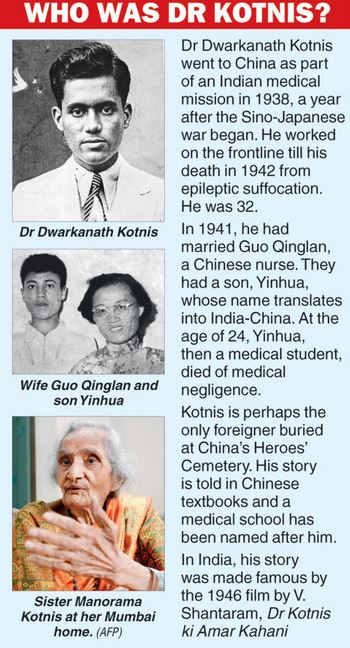
    • He hailed from Sholapur in Maharashtra came to China in 1938 as part of a five-member team of doctors sent by the Indian National Congress to help the Chinese during World War II.
    • He joined the Communist Party of China (CPC) in 1942 and died the same year at the age of 32.
    • Kotnis’ medical assistance during the difficult days of the Chinese revolution was praised by Chinese leader Mao Zedong.
    • His statues and memorials were also set in some of the Chinese cities in recognition of his services.

    A revered personality in China

    • Late Chinese leader Mao Zedong was deeply affected by his death.
    • Mao wrote in his eulogy that “the army has lost a helping hand; the nation has lost a friend. Let us always bear in mind his internationalist spirit”.
    • Kotnis is remembered not only as a symbol inspiring medical students to work hard, but also an eternal bond between the people of China and India.
  • PVTGS in Andaman

    Five members of the Great Andamanese tribe, a Particularly Vulnerable Tribal Group (PVTGs) have tested positive for COVID-19.

    Try this PYQ:

    Q. Consider the following statements about Particularly Vulnerable Tribal Groups (PVTGs) in India:

    1. PVTGs reside in 18 States and one Union Territory.
    2. A stagnant or declining population is one of the criteria for determining PVTG status.
    3. There are 95 PVTGs officially notified in the country so far.
    4. Irular and Konda Reddi tribes are included in the list of PVTGs.

    Which of the statements given above are correct?(CSP 2019)

    (a) 1, 2 and 3

    (b) 2, 3 and 4

    (c) 1, 2 and 4

    (d) 1, 3 and 4

    PVTGs in Andaman

    • Great Andamanese is one of five PVTGs that reside in Andamans archipelago.
    • The Great Andamanese speak Jeru dialect among themselves and their number stands at 51 as per the last study carried out by Andaman Adim Janjati Vikas Samiti in 2012.
    • The five PVTGS residing in Andamans are Great Andamanese, Jarwas, Onges, Shompens and North Sentinelese.

    What are PVTGs?

    • There are certain tribal communities who have declining or stagnant population, low level of literacy, pre-agricultural level of technology and are economically backward.
    • They generally inhabit remote localities having poor infrastructure and administrative support.
    • These groups are among the most vulnerable section of our society as they are few in numbers, have not attained any significant level of social and economic development.
    • 75 such groups have been identified and categorized as Particularly Vulnerable Tribal Groups (PVTGs).
  • Turkey’s Maritime Disputes

    Turkish President Erdogan has asserted that his country will take whatever belongs to it in the Mediterranean, as well as Aegean and the Black Sea.

    Try this PYQ:

    Q.Turkey is located between

    (a) The Black Sea and Caspian Sea

    (b) The Black Sea and Mediterranean Sea

    (c) Gulf of Suez and the Mediterranean Sea

    (d) Gulf of Aqaba and the Dead Sea

    Assertion over the Mediterranean

    • Greece and Turkey have been locked in a dispute over control of eastern Mediterranean waters.
    • They are at odds over the rights to potential hydrocarbon resources, based on conflicting claims over the extent of their continental shelves.
    • The Turkish navy will hold the shooting exercises in the eastern Mediterranean off the coast of Iskenderun, northeast of Cyprus.
    • Cyprus was divided in 1974 following a Turkish invasion triggered by a Greek-inspired coup.
    • Turkey recognizes the Turkish-populated north of Cyprus as a separate state, which is not recognised by other countries.
  • Hindu Women’s Inheritance Rights

    The Supreme Court has expanded a Hindu woman’s right to be a joint legal heir and inherit ancestral property on terms equal to male heirs.

    What is the ruling?

    • The SC Bench ruled that a Hindu woman’s right to be a joint heir to the ancestral property is by birth and does not depend on whether her father was alive or not when the law was enacted in 2005.
    • The Hindu Succession (Amendment) Act, 2005 gave Hindu women the right to be coparceners or joint legal heirs in the same way a male heir does.
    • Since the coparcenary (heirship) is by birth, it is not necessary that the father coparcener should be living as on 9.9.2005, the ruling said.

    What is the 2005 law?

    • The Mitakshara school of Hindu law codified as the Hindu Succession Act, 1956 governed succession and inheritance of property but only recognised males as legal heirs.
    • The law applied to everyone who is not a Muslim, Christian, Parsi or Jew by religion.
    • Buddhists, Sikhs, Jains and followers of Arya Samaj, Brahmo Samaj are also considered Hindus for the purposes of this law.
    • In a Hindu Undivided Family, several legal heirs through generations can exist jointly.

    Background

    • Traditionally, only male descendants of a common ancestor along with their mothers, wives and unmarried daughters are considered a joint Hindu family.
    • The legal heirs hold the family property jointly.
    • Women were recognised as coparceners or joint legal heirs for partition arising from 2005.
    • The 174th Law Commission Report had also recommended this reform in Hindu succession law.
    • Even before the 2005 amendment, Andhra Pradesh, Karnataka, Maharashtra and Tamil Nadu had made this change in the law, and Kerala had abolished the Hindu Joint Family System in 1975.

    What did the law bring in?

    • Section 6 of the Act was amended that year to make a daughter of a coparcener also a coparcener by birth “in her own right in the same manner as the son”.
    • The law also gave the daughter the same rights and liabilities “in the coparcenary property as she would have had if she had been a son”.
    • The law applies to ancestral property and to intestate succession in personal property — where succession happens as per law and not through a will.

    How did the case come about?

    • While the 2005 law granted equal rights to women, questions were raised whether the law applied retrospectively and if the rights of women depended on the living status of their father.
    • Different benches of the Supreme Court had taken conflicting views on the issue. Different High Courts had also followed different views of the top court as binding precedents.
    • The Prakash v Phulwati (2015) case held that the benefit of the 2005 amendment could be granted only to “living daughters of living coparceners” as on September 9, 2005 (the date when the amendment came to force).
    • In February 2018 a bench headed by Justice A K Sikri held that the share of a father who died in 2001 will also pass to his daughters as coparceners during the partition of the property as per the 2005 law.

    The present case

    • These conflicting views led to a reference to a three-judge Bench in the current case.
    • The ruling now overrules the verdicts from 2015 and April 2018.
    • It settles the law and expands on the intention of the 2005 legislation to remove the discrimination as contained in section 6 of the Hindu Succession Act, 1956.
    • It gave equal rights to daughters in the Hindu Mitakshara coparcenary property as the sons have.

    What was the government’s stand?

    • The solicitor argued in favour of an expansive reading of the law to allow equal rights for women. He referred to the objects and reasons of the 2005 amendment.
    • The Mitakshara coparcenary law not only contributed to discrimination on the ground of gender but was oppressive and negated the fundamental right of equality guaranteed by the Constitution.
  • [pib] Thenzawl Golf Resort Project

    Union Minister for Culture & Tourism has inaugurated the “Thenzawl Golf Resort” Project at Aizawl, Mizoram.

    Try this question for mains:

    Q. Swadesh Darshan Scheme is one of the most ambitious schemes to transform the tourism industry in India. Comment.

    Thenzawl Golf Resort Project

    • The Project is sanctioned under the Integrated Development of New Eco-Tourism under Swadesh Darshan- North East Circuit.
    • It is designed by Graham Cooke and Associates, one of top-ranked Canada based Golf Course architectural firm.
    • It is designed to have facilities of international standards.
    • The competitive advantage of Thenzawl Golf Course is that it will provide quality golfing experience and international facilities at a fair price.

    Back2Basics: Swadesh Darshan Scheme

    • Swadesh Darshan Scheme is one of the flagship schemes of the Ministry of Tourism, for development of thematic circuits in the country in a planned and prioritized manner.
    • The scheme was launched in 2014 -15 as a Central Sector Scheme.
    • It aims for integrated development of theme-based tourist circuits in the country.
    • Under the scheme, the identified thematic circuits for development are: North-East Circuit, Buddhist Circuit, Himalayan Circuit, Coastal Circuit, Krishna Circuit, Desert Circuit, Tribal Circuit, Eco Circuit, Wildlife Circuit, Rural Circuit, Spiritual Circuit, Ramayana Circuit, Heritage Circuit, Sufi Circuit, and Tirthankara Circuit.
    • “Development of North East Circuit: Imphal & Khongjom” is the first project implemented under the Scheme.
  • Commonwealth Human Rights Initiative (CHRI)

    The CHRI has released a report on “Eradicating Modern Slavery: An assessment of Commonwealth government progress”.

    Try this PYQ from CSP 2012:

    Q.Consider the following statements:

    1. The Commonwealth has no charter, treaty or constitution
    2. All the territories/countries once under the British Empire (jurisdiction/rule/mandate) automatically joined the Commonwealth as its members

    Which of the statements given above is/are correct?

    (a) 1 only

    (b) 2 only

    (c) Both 1 and 2

    (d) Neither 1 nor 2

    About the report

    The report was released on the occasion of World Day Against Trafficking in Persons by the Commonwealth Human Rights Initiative (CHRI) and an international anti-slavery organisation Walk Free.

    Highlights of the report

    • The report assessed the progress made by Commonwealth countries on the promises made in 2018 to end modern slavery by 2030 and achieve the SDGs of ending forced labour, human trafficking and child labour.
    • The report found that one-third of the Commonwealth countries had criminalised forced marriage, while 23 had not criminalised commercial sexual exploitation of children.
    • Commonwealth countries have made little progress towards their commitment to eradicate modern slavery by 2030.
    • One in every 150 people in the Commonwealth is living in conditions of modern slavery.
    • Out of 54 countries, only four engage with business to investigate supply chains, and all countries report gaps in victim assistance programs
    • None of the Asian countries in the group had implemented laws against forced labour in supply chains.

    India is the worst performer

    • India had fared the worst in terms of coordination with no national coordinating body or National Action Plan in place.
    • India, like all other Commonwealth countries in Asia, had not ratified the International Labour Organization’s 2011 Domestic Workers Convention or the 2014 Forced Labour Protocol.
    • The report said India accounted for one-third of all child brides in the world.
    • Despite being the largest country in the region, India has the weakest response on national coordination, with no national coordinating body or National Action Plan in place.

    Back2Basics: Commonwealth of Nations

    • The Commonwealth of Nations is an intergovernmental organisation of 53 member states that are mostly former territories of the British Empire.
    • It dates back to the first half of the 20th century with the decolonization of the British Empire through increased self-governance of its territories.
    • It was originally created as the British Commonwealth of Nation through the Balfour Declaration at the 1926 Imperial Conference, and formalized by the UK through the Statute of Westminster in 1931.
    • The current body was formally constituted by the London Declaration in 1949, which modernized the community, and established the member states as “free and equal”.
    • The symbol of this free association is Queen Elizabeth II, who is the Head of the Commonwealth.
    • The Queen is head of state of 16 member states, known as the Commonwealth realms, while 32 other members are republics and five others have different monarchs.
    • Member has no legal obligations to one another. Instead, they are united by language, history, culture and their shared values of democracy, human rights and the rule of law.

    Commonwealth Human Rights Initiative (CHRI)

    • It is an independent, non-partisan & nonprofit international NGO which works towards the practical realization of human rights in the countries of the Commonwealth.
    • It was founded in 1987 and is headquartered at New Delhi.
    • CHRI’s objectives are to promote awareness and adherence to the Commonwealth’s Harare Declaration, to the Universal Declaration of Human Rights, to other internationally recognised human rights instruments.
    • The organisation specializes in transparency and accountability issues, with a focus on access to justice and access to information.
    • The organisation mainly works in South Asia, East Africa, and Ghana region.
  • Lancet’s analysis of population trends for 2017-2100

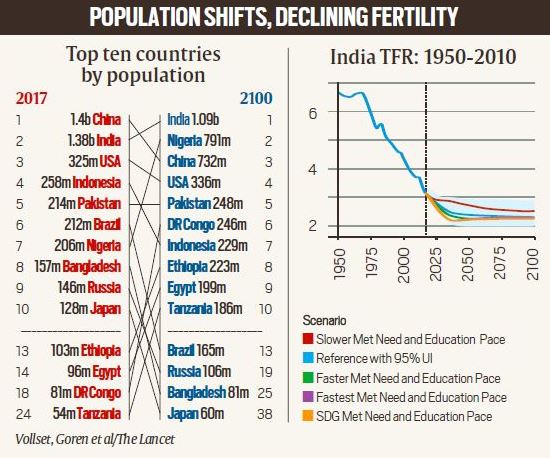
    When this century ends, India may no longer be a country of a billion, says a projection that appears in the online edition of the Lancet. The reference forecasts for China and India peaked before 2050 and both countries thereafter had steep declining trajectories.

    Try this question from CSP 2011:

    Q.India is regarded as a country with ‘Demographic Dividend’. This is due to

    (a) Its high population in the age group below 15 years

    (b) Its high population in the age group of 15-64 years

    (c) Its high population in the age group above 65 years

    (d) Its high total population

    World to see the peak

    • A new analysis published in The Lancet has projected that the world population will peak much earlier than previously estimated.
    • It projects the peak at 9.73 billion in 2064, which is 36 years earlier than the 11 billion peaks projected for 2100 by last year’s UN report World Population Prospects.
    • For 2100, the new report projects a decline to 8.79 billion from the 2064 peak.

    5 most populated countries

    • The five largest countries in 2100 are projected to be India, Nigeria, China, the U.S. and Pakistan.
    • However, these forecasts showed different future trajectories between countries.
    • Nigeria is forecast to have continued population growth through 2100 and was expected to be the second-most populous country by then.

    Predictions on India’s population

    • For India, the report projects a peak population of 1.6 billion in 2048, up from 1.38 billion in 2017.
    • By 2100, the population is projected to decline by 32% to 1.09 billion.
    • However, meeting UN Sustainable Goal Development targets, the peak would be earlier and see a population decline to 929 million.
    • Conventional wisdom is that though a decline in population is expected, it is expected to begin only around 2046.
    • The fall according to the latest 2019 assessment by the UNDP calculation, is expected to see India’s population settle at a little over 1.4 billion.

    Reasons for fall

    • The sharper fall is due to the assumption that all women globally will have much higher access to contraception and education.
    • This scenario will lead to a sharper reduction in the Total Fertility Rate, a metric that shows on average how many children a woman must have to keep replenishing the population.
    • A TFR is lower than 2.1leads to a decline in a country’s population.
  • Mapping: Islands of Polynesia

    How did the Polynesian peoples come to live on the far-flung islands of the Pacific? The question has intrigued researchers for centuries.

    The newscard contains some trivial facts. However, aspirants are advised to observe the map.

    Study on Polynesia

    • Norwegian explorer Thor Heyerdahl brought the topic to public attention when he sailed a balsa-wood raft called the Kon-Tiki from Peru to Polynesia in 1947.
    • His goal was to demonstrate such voyages were possible, supporting theories linking Polynesian origins to the Americas.
    • Decades of research in archaeology, linguistics and genetics now show that Polynesian origins lie to the west, ultimately in the islands of Southeast Asia.

    New evidence for American interlopers

    • A new study published in Nature reports genetic evidence of Native American ancestry in several Polynesian populations.
    • Other researchers have previously found evidence of indigenous American DNA in the genomes of the modern inhabitants of Rapa Nui.
    • Rapa Nui, also known as Easter Island, is the part of Polynesia closest to South America.
    • This suggests the “Amerindian” genetic component was likely introduced later via Chilean colonists.
  • Sindhu Darshan Puja

    During his day-long whirlwind visit, PM Narendra performed Sindhu Darshan Puja at Nimu, the forward brigade place in Ladakh.

    Sindhu Darshan Puja.

    ⊁ Sindhu Darshan Festival is a festival of India held every year on full moon day (on Guru Purnima) in the month of June.
    ⊁ It is held at Leh, in Ladakh District of Ladakh. It stretches for three days.
    ⊁ It was first started in the October by veteran politician L.K. Advani, 1997 and continues to be held every year since then, attracting large number of foreign and domestic tourists.
    ⊁ The main reason behind the celebration of Sindhu Darshan Festival is to endorse the Indus River (Sindhu River) as an icon of the communal harmony and unity of India.