đŸ’„Join UPSC 2027,2028 Mentorship (July Batch) + XFactor Notes & Microthemes PDF

Subject: Trivia

  • Making of the Modern City of Kolkata

    A 2003 judgment by the Calcutta High Court generates discussion of the city’s age, its date of founding, and Job Charnock, whom many credits for having “found” the city of Calcutta.

    Calcutta: Who founded the city?

    Nobody.

    • A place then called Kalikatah was an important religious centre due to the existence of the Kali temple in the adjacent village of Kalighat.
    • The first literary reference to the site is found in Bipradas Pipilai’s magnum opus Manasa Mangala which dates back to 1495.
    • Abul Fazl’s Ain-I-Akbari dating 1596 also mentions the place.
    • The Sabarna Roy Choudhury family was granted the Jagirdari of Kalikatah by Emperor Jehangir in 1608.

    Who was Job Charnock?

    • Job Charnock (1630–1693) was an English administrator with the East India Company.
    • He was once regarded as the founder of the city of Kolkata (formerly Calcutta).
    • However, this view is challenged, and in 2003 the Calcutta High Court declared that he ought not to be regarded as the founder.
    • Charnock was entrusted with procuring the Company’s saltpetre and appointed to the centre of the trade, Patna in Bihar in1659.

    Beginning of Urbanization

    • The establishment of the Government House in 1767 and the Lottery Commission in 1817 were the other important developments in the city’s history that gave its urban landscape more defined contours.
    • This commission was entirely responsible for the setting up of the city’s roads, streets and lanes.
    • Some markers of urban settlements include planned roads, water supply and transport.
    • The establishment of these in the early 19th century was responsible for making Calcutta the great city that it eventually became.

    Significance of Kolkata

    One of the most significant developments that gave the city a semblance of urban formation occurred in 1756 when the Nawab of Bengal Siraj ud-Daulah lay siege to Calcutta.

    • This was in retaliation for the British East India Company engaging in unauthorized development of the structure that is now known as Fort William.
    • The East India Company was defeated in a decisive battle, making them realise the vulnerability of the fort.
    • Post 1757 the fort was remade and fortified with enhanced protection, the construction was exceptionally well done.
    • It was really this attack on Fort William, a bastion of the British and other Europeans living there, that changed the map of Calcutta.
    • The Europeans who used to primarily lived inside the fort—the European merchants, the administrators etc—started moving out.
    • They knew that if there was an attack, there was infrastructure to save them. That was European Calcutta, what we call ‘White Town’.

    Hey! We won’t let you move away without answering this PYQ:

    Wellesley established the Fort William College at Calcutta because (CSP 2020):

    (a) He was asked by the board of directors at London to do so

    (b) He wanted to revive interest in oriental learning in India

    (c) He wanted to provide William Carey and his associates with employment

    (d) He wanted to train British civilians for administrative purposes in India.


    [wpdiscuz-feedback id=”dyj3y3x5ai” question=”Please leave a feedback on this” opened=”1″]Post your answers here: [/wpdiscuz-feedback]

  • Places in news: Indira Point

    The Swarnim Vijay Varsh Victory Flame was taken to Indira Point, the southernmost tip of the country on August 22, 2021, as part of its voyage to the Nicobar Group of Islands.

    Indira Point

    • Indira Point is the southernmost point of Indian Territory.
    • It is a village in the Nicobar district at Great Nicobar Island of Andaman and Nicobar Islands in India.
    • Rondo Island, Indonesia’s northernmost island in Sabang district of Aceh province of Sumatra, lies 163 km south of Little Andaman Island and 145 km or 80 nautical miles from Indira point.
    • The point was formerly known as Pygmalion Point and Parsons Point. It was renamed in honour of Indira Gandhi during mid-1980s.
    • Galathea National Park and Lighthouse are the major attractions here.

    India and Indonesia are upgrading the deep sea port Sabang under the strategic military and economic collaboration to protect the channel between Great Nicobar Island and Rondo Island which is 612 km or 330 nautical miles from Indira Point.

    What is Swarnim Vijay Varsh?

    • It marks the 50th anniversary of the 1971 India-Pakistan war.
    • Vijay Diwas is celebrated every year on December 16 to mark India`s triumph in liberating Bangladesh.
    • The journey of the Victory Flame is taken from north to south corners of India.
  • Water shortage in Colorado River Basin

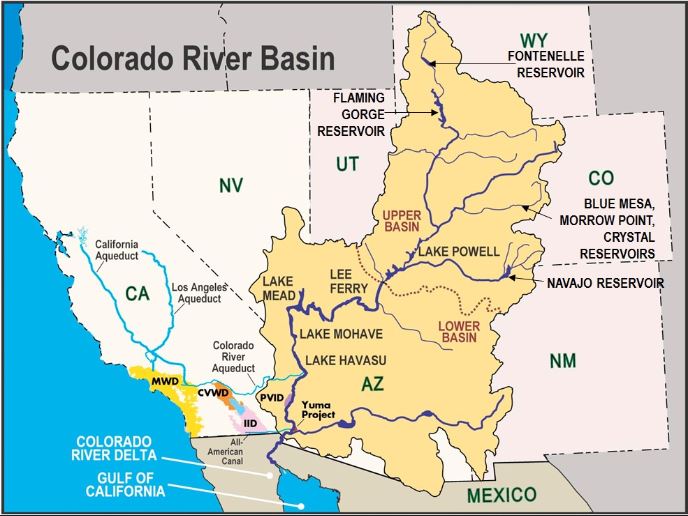
    The federal government in the US has declared a water shortage for the Colorado river basin due to a historic drought.

    Try this PYQ

    Q. Consider the following pairs

    River – Flows into

    1. Mekong — Andaman Sea
    2. Thames — Irish Sea
    3. Volga — Caspian Sea
    4. Zambezi — Indian Ocean

    Which of the pairs given above is/are correctly matched?(CSP 2020)

    (a) 1 and 2 only

    (b) 3 only

    (c) 3 and 4 only

    (d) 1, 2 and 4 only


    [wpdiscuz-feedback id=”4q08sbziii” question=”Please leave a feedback on this” opened=”1″]Post your answers here (you need to sign-in for that).[/wpdiscuz-feedback]

    Colorado River

    • The Colorado River flows from the Rocky Mountains into the southwestern US and into Mexico.
    • The river is fed by snowmelt from the Rocky and Wasatch mountains and flows a distance of over 2,250 km (river Ganga flows through a distance of roughly 2,500 km) across seven states and into Mexico.
    • The Colorado River Basin is divided into the Upper (Wyoming, Colorado, New Mexico, Utah and northern Arizona) and Lower Basins (parts of Nevada, Arizona, California, southwestern Utah and western New Mexico).
    • In the Lower Basin, the Hoover Dam controls floods and regulates water delivery and storage.
    • Apart from the Hoover dam, there is the Davis Dam, Parker Dam and the Imperial Dam that regulate the release of water from the Hoover Dam.

    Major lakes in its basin

    • Lake Mead is the largest reservoir in the US in terms of volume and was formed in the 1930s by the Hoover Dam in Southern Nevada.
    • Its main source of water is obtained from the Rocky Mountain snowmelt and runoff.
    • The other is Lake Powell, the reservoir created by the Glen Canyon Dam in Arizona.

    Reasons for shortage

    • Since the year 2000, this river basin has been experiencing a prolonged drought.
    • This persistent drought has led to a lowering down of the water levels in the basin’s reservoirs to meet the demand over the years.
    • But even with great water storing capacity, over the years the demand for water from the basin has increased whereas supply is restricted.

    UPSC 2022 countdown has begun! Get your personal guidance plan now! (Click here)

  • Person in news: Abanindranath Tagore

    Year-long celebrations marking 150 years of Abanindranath Tagore have been kicked off in Kolkata.

    Abanindranath Tagore (1871-1951)

    • Tagore CIE was the principal artist and creator of the “Indian Society of Oriental Art”.
    • A nephew of Rabindranath Tagore and a decade younger to the poet, he helped shape modern Indian art and was the creator of the iconic ‘Bharat Mata’ painting.
    • He was also the first major exponent of Swadeshi values in Indian art, thereby finding the influential Bengal school of art, which led to the development of modern Indian painting.
    • He was also a noted writer, particularly for children.
    • Tagore sought to modernize Mughal, Rajput styles to counter the influence of Western models of art, as taught in art schools under the British Raj.
    • Along with other artists from the Bengal school of art, Tagore advocated in favor of a nationalistic Indian art derived from Indian art history, drawing inspiration from the Ajanta Caves.

    Q. Which among the following event happened earliest? (CSP 2018)

    (a) Swami Dayanand established Arya Samaj.

    (b) Dinabandhu Mitra wrote Neeldarpan.

    (c) Bankim Chandra Chattopadhyay wrote Anandmath.

    (d) Satyendranath Tagore became the first India to succeed in the Indian Civil Services Examination.

    [wpdiscuz-feedback id=”g8kqy5pabf” question=”Please leave a feedback on this” opened=”1″]Answer this PYQ in the comment box:[/wpdiscuz-feedback]


  • [pib] Exercise Cutlass Express 2021

    Indian Naval Ship Talwar is participating in Exercise Cutlass Express 2021, being conducted along the East Coast of Africa.

    Exercise Cutlass Express

    • The exercise is an annual maritime exercise conducted to promote national and regional maritime security in East Africa and the Western Indian Ocean.
    • Indian Navy is participating in the exercise in a ‘trainer role’.

    The 2021 edition of the exercise involves the participation of:

    • 12 Eastern African countries, US, UK, India
    • Various international organizations like International Maritime Organization (IMO), United Nations Office on Drugs and Crime (UNODC), Interpol, European Union Naval Force (EUNAVFOR), Critical Maritime Routes Indian Ocean (CRIMARIO), and EUCAP Somalia

    Focus of the exercise

    • The exercise focuses on East Africa’s coastal regions.
    • It is designed to assess and improve combined maritime law enforcement capacity, promote national and regional security and increase interoperability between the regional navies.
    • As part of the exercise, the Indian Navy, together with other partners, shall undertake the training of contingents from various participating countries in various fields across the spectrum of maritime security operations.

    Must read:

    [Prelims Spotlight] Defence Exercises

  • Sainath awarded 2021 Fukuoka Prize

    Noted journalist P. Sainath has been selected as one of the three recipients of the Fukuoka Prize for 2021.

    Fukuoka Prize

    • The Fukuoka Prize is given annually to distinguished people to foster and increase awareness of Asian cultures, and to create a broad framework of exchange and mutual learning among the Asian people.
    • The Prize was established in 1990 by the city of Fukuoka in Japan and the Fukuoka City International Foundation.
    • The Grand Prize has earlier been awarded to Muhammad Yunus from Bangladesh, historian Romila Thapar, and sarod maestro Amjad Ali Khan. Eleven Indians have received the Fukuoka Prize so far.
    • 115 people from 28 countries and areas have received the Prize in the past 30 years.

    Citation for the award

    • In a statement issued Mr. Sainath was described as a “very deserving recipient of the Grand Prize of Fukuoka Prize”.
    • The Secretariat noted his work for creating a new form of knowledge through his writings and commentaries on rural India and for “promoting civil cooperation”.
  • Skull found in China represents a new human species

    Scientists have announced that a skull discovered in northeast China represents a newly discovered human species they have named Homo longi, or “Dragon Man”.

    Answer this PYQ in the comment box:

    Q.The word ‘Denisovan’ is sometimes mentioned in media in reference to (CSP 2019):

    (a) fossils of a kind of dinosaurs

    (b) an early human species

    (c) a cave system found in North-East India.

    (d) a geological period in the history of Indian subcontinent

    Who is the “Dragon Man”, the latest Chinese discovery?

    • The cranium found in China has been dubbed the “Dragaon Man” or Homo longi, a name that has been derived from the Long Jiang or Dragon River in the Heilongjiang province of China where the city of Harbin is located.
    • The skull was reportedly discovered back in 1933, when a bridge was built over the Songhua River.
    • For thousands of years, the skull remained buried in sediments.
    • Because of the distinctive shape of the skull, which was found almost complete, some members of the team have suggested that it be declared a part of a new species of the genus Homo.
    • Significantly, the size of the skull, which has a considerable brain capacity, is comparable to that of modern humans and Neanderthals.

    Why is this discovery being considered significant?

    • For one, it brings new knowledge about the evolution of Homo sapiens.
    • It might help to bridge the gaps between our ancient ancestors called Homo erectus and us.
    • This knowledge is important because there is very little consensus in the scientific community about how different human species are related, and which species are our immediate ancestors.
    • Smithsonian for instance notes that some palaeontologists believe Homo heidelbergensis to be our immediate ancestors.
    • This species was discovered in 1908, and lived about 700,000 to 200,000 years ago in Europe and possibly China and some parts of Africa.

    Back2Basics: Species of Humans

    • Modern humans are the only human species that exist in the world today.
    • While the exact number of human species is a matter of debate, most scientists believe that there are at least 21 of them.

    As per the Smithsonian National Museum of Natural History, there are over 21 human species.  Major among these are:

    (1) Sahelanthropus tchadensis

    • Sahelanthropus tchadensis is believed to be the oldest member of the human family tree.
    • It lived about 7-6 million years ago somewhere around present-day Chad in Africa.
    • It had both ape-like and human-like features and was bipedalled, an ability that may have increased its chances of survival.

    (2) Homo erectus

    • Homo erectus lived about 1.89 million-110,000 years ago, in Northern, Eastern, and Southern Africa and Western and East Asia.
    • ‘Turkana Boy’ is the most complete fossil belonging to this species and is dated to be around 1.6 million years old.

    (3) Modern man

    • Homo neanderthalensis lived about 400,000-40,000 years ago and co-existed with Homo sapiens for a few thousand years.
    • They lived in Europe and in southwestern and central Asia.
    • Homo sapiens evolved about 300,000 years ago, and are found worldwide.
  • [pib] 6 years of Urban Transformation

    The Ministry of Housing and Urban Affairs (MoHUA) has commemorated 6 years of the three transformative Urban Missions vis. Smart Cities Mission (SCM), Atal Mission for Urban Rejuvenation and Urban Transformation (AMRUT) and Pradhan Mantri Awas Yojana-Urban (PMAY-U). All these missions were inaugurated in 2015.

    [A] Pradhan Mantri Awas Yojana – Urban (PMAY)

    • PMAY is an initiative in which affordable housing will be provided to the urban poor with a target of building 2 crore (20 million) affordable houses by 31 March 2022.
    • It has two components: for the urban poor and also for the rural poor.
    • This scheme is converged with other schemes to ensure houses have a toilet, Saubhagya Yojana electricity connection, Ujjwala Yojana LPG connection, access to drinking water, and Jan Dhan banking facilities, etc.

    [B] Atal Mission for Rejuvenation & Urban Transformation (AMRUT)

    • AMRUT was launched with the focus to establish an infrastructure that could ensure adequate robust sewage networks and water supply for urban transformation by implementing urban revival projects.
    • The components of the AMRUT consist of capacity building, reform implementation, water supply, sewerage and septage management, stormwater drainage, urban transport, and the development of green spaces and parks.
    • During the process of planning, the Urban Local Bodies (ULBs) will strive to include some smart features in the physical infrastructure components.
    • Rajasthan was the first state in the country to submit State Annual Action Plan under Atal Mission for Rejuvenation and Urban Transformation (AMRUT).

    [C] Smart Cities Mission

    • National Smart Cities Mission is an urban renewal and retrofitting program by the Government of India with the mission to develop smart cities across the country, making them citizen-friendly and sustainable.
    • The Union Ministry of Urban Development is responsible for implementing the mission in collaboration with the state governments of the respective cities.
    • All the participating cities from West Bengal have withdrawn from the Smart Cities Mission.
    • Mumbai and Navi Mumbai from Maharashtra have also been withdrawn from the Smart Cities Mission.
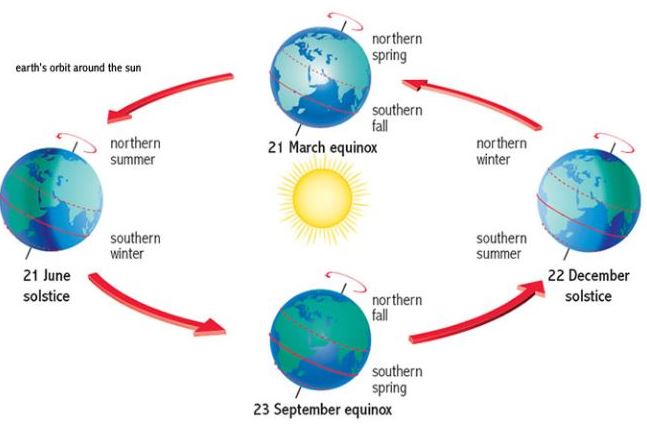
  • What is Summer Solstice?

    The summer solstice will happen today around 9:02 am on Monday (Indian Standard Time).

    What is Summer Solstice?

    • Solstice means “sun stands still” in Latin.
    • The longest day of 2021 for those living north of the Equator is June 21.
    • This day is characterized by a greater amount of energy received from the sun.
    • In technical terms, this day is referred to as the summer solstice, the longest day of the summer season. It occurs when the sun is directly over the Tropic of Cancer, or more specifically right over 23.5-degree north latitude.

    The Southern Hemisphere receives most sunlight on December 21, 22 or 23 when the northern hemisphere has its longest nights– or the winter solstice.

    Why do we have summer solstice?

    • Since Earth rotates on its axis, the Northern Hemisphere gets more direct sunlight between March and September over the course of a day.
    • This also means people living in the Northern Hemisphere experience summer during this time.
    • The rest of the year, the Southern Hemisphere gets more sunlight.
    • During the solstice, the Earth’s axis — around which the planet spins, completing one turn each day — is tilted in a way that the North Pole is tipped towards the sun and the South Pole is away from it.

    Answer this PYQ in the comment box:

    Q.On 21st June, the Sun (CSP 2019):

    (a) Does not set below the horizon at the Arctic Circle

    (b) Does not set below the horizon at Antarctic Circle

    (c) Shines vertically overhead at noon on the Equator

    (d) Shines vertically overhead at the Tropic of Capricorn

    Some other facts

    • Summer solstice does not mean the earliest sunrise or latest sunset.
    • Although June 21 will be the longest day in 2021, it does not necessarily mean that it brings the earliest sunrise or latest sunset.
    • It depends on the latitudinal location of the country.
  • Thomas Hickey’s 19th century painting on smallpox vaccination

    A 19th-century portrait of three women from Mysore has been going viral as “one of the most important scientific pictures in the history of medicine in India”.

    What did the portrait depict?

    • Believed to be painted in 1805 by Irish-born artist Thomas Hickey, the oil on canvas was initially thought to be portraits of “dancing girls or courtesans”.
    • The painting depicted one of the first vaccine drives in India, with bejewelled women from the Wadiyar dynasty posing for Hickey.
    • The canvas was commissioned to promote participation in the smallpox vaccination programme and the women posing with the scars.

    What is smallpox?

    • Smallpox is an acute contagious disease caused by the variola virus, a member of the orthopoxvirus family.
    • It was one of the most devastating diseases known to humanity and caused millions of deaths before it was eradicated.
    • It is believed to have existed for at least 3000 years.

    How and when did the smallpox vaccine reach India?

    • The smallpox vaccine, discovered by Edward Jenner in 1796, was the first successful vaccine to be developed.
    • On June 14, 1802, Anna Dusthall, an Anglo-Indian toddler, was the first person in India to be successfully vaccinated against the virus that relied on the cowpox virus, “a mild cousin of smallpox” to trigger immunity.
    • The “vaccine vesicle” that came on the arm of the receiver was a source of lymphatic fluid or pus that would act as a vaccine, leading to an arm-to-arm immunisation chain.
    • The vaccine subsequently travelled to different parts of India, including Hyderabad, Cochin, Madras and Mysore.

    How was the drive carried out?

    • While the lymph was at times reportedly dried and sealed between glass plates to be transported, it often did not survive long journeys, due to which the British had to primarily rely on a human chain.
    • There was also opposition from the domestic population on the introduction of the cowpox virus and also because some believed the goddess of smallpox would be angered by the vaccination.
    • With Tipu Sultan defeated in Mysore, and the reinstatement of the Wadiyars, the East India Company was trying to strengthen its position in South India.
    • It protected the ex-pat population from an epidemic, making vaccination essential.
    • Queen Lakshmi Ammanni, who had lost her husband to smallpox, supported their cause and wanted to vaccine her population against the deadly virus.
    • The painting was supposed to encourage participation in the vaccination drive.