đŸ’„Join UPSC 2027,2028 Mentorship (July Batch) + XFactor Notes & Microthemes PDF

Subject: Trivia

  • Timbuktu: The faraway land

    Timbuktu is a western African city whose name is a metaphor for a place too exotic and remote to even imagine, now is in the grasp of Covid-19.

    Try this question from CSP 2018:

    Q.Very recently, in which of the following countries have lakhs of people either suffered from severe famine/acute malnutrition or died due to starvation caused by war/ethnic conflicts?

    (a) Angola and Zambia

    (b) Morocco and Tunisia

    (c) Venezuela and Colombia

    (d) Yemen and South Sudan

    Timbuktu

    • Timbuktu is a city in Mali, situated 20 km north of the Niger River.
    • The mystique of Timbuktu owes a lot to its inaccessibility, which continues even today.
    • It is located on the southern tip of the Sahara desert where there is nothing but thousands of miles of barren desert to its north.
    • It was a regional trade centre in medieval times, where caravans met to exchange salt from the Sahara Desert for gold, ivory, and slaves from the Sahel, which could be reached via the nearby Niger River.
  • Oculudentavis khaungraae

    Scientists have found the skull of a 99-million-year-old flying dinosaur that is tinier than the tiniest bird known to humans.

    • The bird-like dinosaur was found stuck in a gob of tree resin that eventually hardened into amber, preserving it for millions of years to come.
    • The fossil was dug up in 2016 from a mine in Myanmar. It was so slight; it likely weighed just 2 grams.
    • The dinosaur skull holds around 100 sharp teeth, which hints at its ferocious nature despite its small size.
    • It even had teeth in the back of its jaw, under its eye.


  • Changes in SDGs

    Thirty-six major changes to the global indicator framework for the Sustainable Development Goals (SDGs) were approved and adopted by the UN Statistical Commission (UNSC).

    Sustainable Development Goals

    • The UN General Assembly in its 70thSession considered and adopted the Sustainable Development Goals (SDGs) for the next 15 years.
    • The 17 SDGs came into force with effect from 1stJanuary, 2016.
    • Though not legally binding, the SDGs have become de facto international obligations and have potential to reorient domestic spending priorities of the countries during the next fifteen years.
    • Countries are expected to take ownership and establish a national framework for achieving these Goals.
    • Implementation and success will rely on countries’ own sustainable development policies, plans and programmes.

    About the changes

    • These changes are based on the ‘2020 comprehensive review’ conducted by the UN Inter-Agency and Expert Group on SDG Indicators (IAEG-SDGs).
    • The revised global framework will have 231 indicators, approximately the same number as in the original framework, the statement said.
    • The global indicator framework was adopted by the UN General Assembly on July 6, 2017.

    Eight additional indicators were added across six SDG goals — 2, 3, 4, 10, 13 and 16.

    These include:

    • Indicator 13.2.2 on the total greenhouse gas emissions per year for the SDG target 13.2 to integrate climate change measures into national policies, strategies and planning.
    • Prevalence of anaemia in women aged 15-49 years, by pregnancy status (percentage) under the target 2.2 to end forms of malnutrition by 2030.
    • A new indicator on reducing the percentage of bloodstream infections due to selected antimicrobial-resistant organisms has been added under the Global health goal (SDG 3).
    • Indicator 10.7.3 on the number of migrants killed while attempting to cross maritime, land and air borders.
    • Indicator 10.7.4 on the proportion of the population who are refugees, by country of origin.

    Six indicators across six SDG goals — 1, 4, 8, 11, 13 and 17 — have been deleted.

     These include:

    • Indicator 1.a.1 on the proportion of domestically-generated resources allocated by the government directly to poverty reduction programmes.
    • Indicator 4.2.1 on the proportion of children under five years of age who are developmentally on track in health, learning and psychosocial well-being, by sex.
    • The portion of the indicator that measures progress for children between 0 and 23 months of age, which is currently in tier III was proposed for deletion by the IAEG.
    • Under the SDG goal on combating climate change, the indicator 13.3.2, quantifying the number of countries that have communicated the strengthening of capacity-building for implementing adaptation, mitigation and technology transfer, and development actions has been deleted.
  • International Mother Language Day


    Friday, February 21 was International Mother Language Day.

    International Mother Language Day

    • It has been observed since 1999 to promote “linguistic and cultural diversity and multilingualism”, according to the UN.
    • Of the world’s 6,000 languages, 43% are estimated as endangered, according to the UN.
    • On the other hand, just 10 languages account for as many as 4.8 billion speakers — over 60% of the world population.
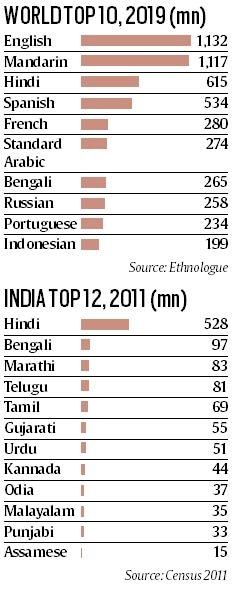
    • Globally, English remains the most widely spoken language with 1.13 billion speakers in 2019, followed by Mandarin with 1.17 billion, according to the online database Ethnologue.

    Why February 21?

    • UNESCO declared International Mother Language Day in 1999, to commemorate a 1952 protest against West Pakistan’s imposition of Urdu as the official language of East Pakistan (present-day Bangladesh).
    • According to a report, police opened fire on demonstrating Dhaka University students and “some people were killed”.
    • When thousands thronged the university the next day, police fired again, killing more people.
    • In Bangladesh, since 1953, February 21 is observed as Ekushe Day, after the Bengali word for twenty-one.
    • According to the South Asia Democratic Forum, five among those killed were recognised as “language martyrs — Abul Barkat, Abdul Jabbar, Rafiquddin Ahmad, Abdus Salman and Shafiur Rahman.

    Data on Indian languages

    • Hindi is third with 615 million speakers while Bengali is seventh with 265 million.
    • In India, Hindi is the most spoken language with over 528 million speakers in 2011, as per the Census.
    • Bengali had 97.2 million speakers in 2011, followed by Marathi (83 million), while other languages with over 50 million speakers are Telugu (81 million), Tamil (69 million), Gujarati (55.5 million) and Urdu (50.8 million).
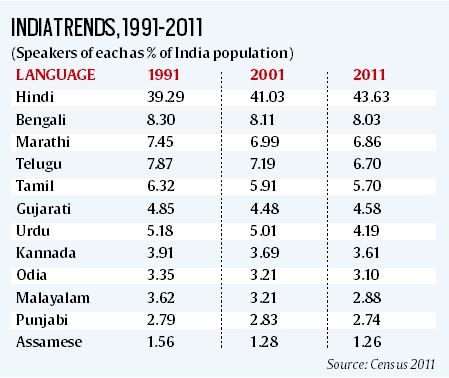
    • Percentage trends from 1991 to 2011 underline the growth of the most widely spoken language, Hindi, which was spoken by 39.29% of the Indian population in 1991, and whose share grew to 43.63% in 2011.
    • For other languages in India’s top 12, the 2011 percentage share has fallen when compared to that in 1991.
  • ‘2 Billion Kilometers to Safety’ campaign


    The UN Refugee Agency UNHCR has announced a new global campaign urging people worldwide to cover the total distance travelled by refugees each year – 2 billion kilometers – by running, jogging or walking.

    About the campaign

    • The “2 Billion Kilometers to Safety” campaign vies to encourage people to support refugees by championing individual acts of solidarity.
    • The goal is to acknowledge the resilience and strength of refugees.
    • It calls on the public to show their solidarity with refugees by running, walking or cycling to collectively cover two billion kilometers.
    • Participants can use their fitness apps or the campaign website to log the kilometers and contribute to the global total.

    Distance covered by refugees 

    • UNHCR traced the journeys of refugees around the world and calculated that, collectively, people forced to flee travel approximately two billion kilometers every year to reach the first point of safety.
    • This is roughly the distance that separates Earth from somewhere between the planets Saturn and Uranus.
    • According to UNHCR estimates, Syrian refugees travelled over 240 kilometers each to reach Turkey.
    • South Sudanese refugees travelled more than 640 kilometers to reach Kenya. Rohingya refugees from Myanmar travelled approximately 80 kilometers to reach Bangladesh.
  • Global Go To Think-Tank Index

    Centre for Science and Environment (CSE) was placed No. 16 among 2019’s ‘top environment policy think tanks’ of the world in Global Go To Think Tank Index.

    Think-Tank Index

    • The Index is released by University of Pennsylvania each year since 2008.
    • It evaluates public-policy research analysis and engagement organisations that generate policy-oriented research, analysis, and advice on domestic and international issues.
    • It claims to enable policy makers and the public to make informed decisions on public policy.
    • The 2020 report raised some critical threats and opportunities that think tanks across the globe face.
    • It called upon such organisations to develop national, regional, and global partnerships and create new, innovative platforms to deliver for an ever-expanding audience of citizens, policy makers and businesses.

    India’s performance

    • CSE climbed up two notches in the 14th version of the report.
    • The organisation also moved up three places among ‘best independent think tanks’ to be at No.123 in the world and sixth among Indian think tanks.
    • Globally, it was ranked 41 of 60 organisations committed to energy and resource policy. It remained at No.58 among organisations working on science and technology policy in the world — fifth in India.

    CSE as forerunner

    • CSE was named the ‘national climate leader’ from India for 2019 in the first National Climate Leader Awards published in the Global Spotlight Report #22 by Climate Scorecard.
    • CSE also received the prestigious Indira Gandhi Prize for Peace, Disarmament and Development for 2018 in 2019 for ‘pioneering work on environment and sustainable development’.
    • CSE also featured in four other rankings in the report: ‘top water security think tanks’; ‘top energy and resource policy think tanks’; ‘top science and technology policy think tanks’ and ‘best independent think tanks’.
    • It also ranked 18 among 78 global think tanks for its work on ‘water security’ — second in India after Ashoka Trust for Research in Ecology and the Environment.
  • Beating Retreat Ceremony

    The Beating Retreat ceremony recently took place at Vijay Chowk. The ceremony, which takes place on January 29 every year, marks the culmination of the four-day Republic Day celebrations.

    What is the Beating Retreat function?

    • ‘Beating Retreat’ marks a centuries old military tradition, when the troops ceased fighting, sheathed their arms and withdrew from the battlefield and returned to the camps at sunset at the sounding of the Retreat.
    • The military tradition began in 17th century England, when King James II ordered his troops to beat drums, lower flags and organise a parade to announce the end of a day of combat.
    • The ceremony was then called ‘watch setting’ and took place at sunset after firing a single round from the evening gun.
    • The ceremony is currently held by Armed Forces in the UK, US, Canada, New Zealand, Australia, and India, among others.

    How did it begin in India?

    • Beating the Retreat’ has emerged as an event of national pride when the Colours and Standards are paraded.
    • The ceremony traces its origins to the early 1950s when Major Roberts of the Indian Army indigenously developed the unique ceremony of display by the massed bands.
    • Section D (Ceremonials) at the Ministry of Defence conducts the event.
    • The ceremony consists of musical performances by the bands, who each year play Indian and western tunes.
  • ‘Time to Care’ Report


    The report ‘Time to Care’  was recently released ahead of the 50th Annual Meeting of the World Economic Forum (WEF).

    ‘Time to Care’ Report

    • It is published by Oxfam International.
    • Its calculations are based on the latest data sources available, including from the Credit Suisse Research Institute’s Global Wealth Databook 2019 and Forbes’ 2019 Billionaires List.

    Findings of the report

    • Although global inequality has declined over the past three decades, domestic income inequality has risen in many countries, particularly in advanced economies and reached historic highs.
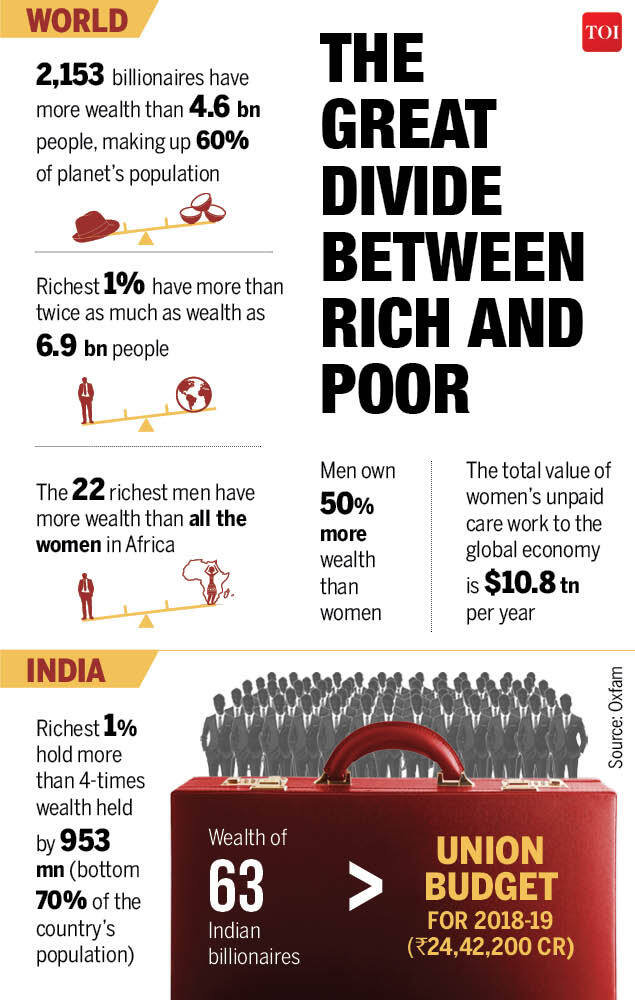
    • The report said that the world’s 2,153 billionaires have more wealth than the 4.6 billion people who make up 60 per cent of the planet’s population.
    • The report flagged that global inequality is shockingly entrenched and vast and the number of billionaires has doubled in the last decade, despite their combined wealth having declined in the last year.
    • The Oxfam report further said “sexist” economies are fuelling the inequality crisis by enabling a wealthy elite to accumulate vast fortunes at the expense of ordinary people and particularly poor women and girls.

    Income inequality in India

    • India’s richest 1 per cent hold more than four-times the wealth held by 953 million people who make up for the bottom 70 per cent of the country’s population.
    • The total wealth of all Indian billionaires is more than its full-year budget.
    • Regarding India, Oxfam said the combined total wealth of 63 Indian billionaires is higher than the total Union Budget of India for the fiscal year 2018-19 which was at Rs 24,42,200 crore.
    • It further said women and girls put in 3.26 billion hours of unpaid care work each and every day — a contribution to the Indian economy of at least Rs 19 lakh crore a year, which is 20 times the entire education budget of India in 2019 (Rs 93,000 crore).
    • He said women and girls are among those who benefit the least from today’s economic system.
    • They spend billions of hours cooking, cleaning and caring for children and the elderly. Unpaid care work is the ‘hidden engine’ that keeps the wheels of our economies, businesses and societies moving.

    Data on earnings

    • Oxfam said governments are massively under-taxing the wealthiest individuals and corporations and failing to collect revenues that could help lift the responsibility of care and tackle poverty and inequality.
    • As per the report, it would take a female domestic worker 22,277 years to earn what a top CEO of a technology company makes in one year.
    • With earnings pegged at Rs 106 per second, a tech CEO would make more in 10 minutes than what a domestic worker would make in one year.
    • Besides, direct public investments in the care economy of 2 per cent of GDP would potentially create 11 million new jobs and make up for the 11 million jobs lost in 2018, the report said.
  • Global Social Mobility Report 2020


    The Global Social Mobility Report was recently released at the ongoing World Economic Forum at Davos, Switzerland.

    Global Social Mobility Report

    • The World Economic Forum organizes the well-known annual gathering of the world’s most influential business and political decision-makers at Davos.
    • It has come out with its first-ever Global Social Mobility Report, which has ranked India a lowly 72 out of the 82 countries profiled.
    • According to the report, the Nordic economies such as Denmark and Finland top the social mobility rankings while countries like India, Pakistan, Bangladesh and South Africa languish at the bottom (see Table 1).

    Table 1: WEF’s Global Social Mobility Rankings

    Country Rank (out of 82)
    Denmark 1
    Germany 11
    United Kingdom 21
    United States 27
    Russia 39
    China 45
    Saudi Arabia 52
    Brazil 60
    India 76
    Pakistan 79


    What is the context for this report?

    • Notwithstanding fast global growth, inequalities have been growing across the world.
    • The rise of inequality has not only created massive social unrest but also adversely affected the global consensus on the kind of economic policies that countries follow.
    • A good example of this is the rise of trade protectionism across the world over the past few years.
    • Be it US or the UK several countries have started looking inwards in the hope that greater trade protectionism will help allay the fears and apprehensions of domestic workers.

    What is Social Mobility?

    • Typically, inequalities are measured in income terms. And this measure has been found inadequate.
    • As the report states, “many situations exist where, despite high levels of absolute income mobility, relative social mobility remains low.
    • For example, in economies such as China and India, economic growth can lift entire populations upward in terms of absolute income, but an individual’s status in society relative to others remains the same”.
    • The report states: “The notion of relative social mobility is more closely related to the social and economic status of an individual relative to their parents. I
    • n a country with a society with perfect relative mobility, a child born in a low-income family would have as much chance to earn a high income as a child born to parents who earn a high income”.

    Thus, the concept of social mobility is much broader than just looking at income inequality. It encompasses several concerns such as:

    • Intragenerational mobility: The ability for an individual to move between socio-economic classes within their own lifetime.
    • Intergenerational mobility: The ability for a family group to move up or down the socio-economic ladder across the span of one or more generations.
    • Absolute income mobility: The ability for an individual to earn, in real terms, as much as or more than their parents at the same age.
    • Absolute educational mobility: The ability for an individual to attain higher education levels than their parents.
    • Relative income mobility: How much of an individual’s income is determined by their parents’ income.
    • Relative educational mobility: How much of an individual’s educational attainment is determined by their parents’ educational attainment.

    Why does social mobility matter?

    • How far an individual can move up in the society determines a lot whether one is closer to the income “floor” (or poor) or “ceiling” (or rich).
    • Social mobility levels, then, can help us understand both the speed – that is, how long it takes for individuals at the bottom of the scale to catch up with those at the top – and the intensity – that is, how many steps it takes for an individual to move up the ladder in a given period – of social mobility.
    • Research also shows that countries with high levels of relative social mobility—such as Finland, Norway or Denmark— exhibit lower levels of income inequality.
    • Conversely, countries with low relative social mobility—such as India, South Africa or Brazil—also exhibit high levels of economic inequality.
    • That’s why it matters for countries like India to increase social mobility.


    As shown in Table 2, it would take a whopping 7 generations for someone born in a low-income family in India to approach mean income level; in Denmark, it would only take 2 generations.


    Table 2: Income Mobility across Generations

    Country Number of generations required by a poor family member to achieve mean income level
    Denmark 2
    United States/ United Kingdom 5
    Germany/ France 6
    India/China 7
    Brazil/South Africa 9


    So, how is social mobility calculated?

    The WEF’s Global Social Mobility Index assesses the 82 economies on “10 pillars” spread across the following five key dimensions of social mobility:

    1. Health;
    2. Education (access, quality and equity, lifelong learning);
    3. Technology;
    4. Work (opportunities, wages, conditions);
    5. Protection and Institutions (social protection and inclusive institutions).

    How did India perform on each of the 10 pillars of social mobility?

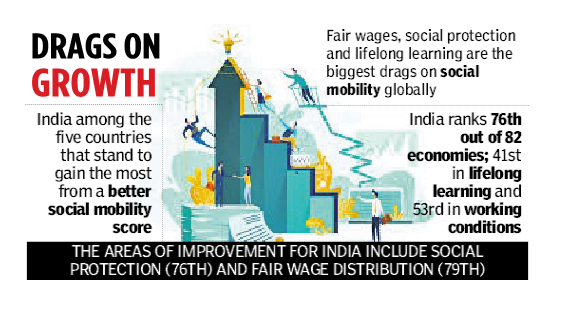
    India’s overall ranking is a poor 76 out of the 82 countries considered. Thus it should not come as any surprise that India ranks lowly in individual parameters as well.

    Table 3 below provides the detailed breakup.

    Table 3: Where India ranks on the 10 Pillars of Social Mobility

    Parameter Rank (out of 82 countries)
    Health 73
    Access to Education 66
    Quality and Equity in Education 77
    Lifelong learning 41
    Access to Technology 73
    Work Opportunities 75
    Fair Wage Distribution 79
    Working Conditions 53
    Social Protection 76
    Inclusive Institutions 67


    Back2Basics

    World Economic Forum (WEF)

    • The WEF based in Cologny-Geneva, Switzerland, is an NGO founded in 1971.
    • The WEF’s mission is cited as “committed to improving the state of the world by engaging business, political, academic, and other leaders of society to shape global, regional, and industry agendas”.
    • It is a membership-based organization, and membership is made up of the world’s largest corporations.
    • The WEF hosts an annual meeting at the end of January in Davos, a mountain resort in GraubĂŒnden, in the eastern Alps region of Switzerland.

    Various reports published by WEF:

    [Tikdam: Most (Not all) reports titled with ‘Global’ are released by WEF.]

    1. Global Competitiveness Report
    2. Global Information Technology Report
    3. Global Gender Gap Report
    4. Global Travel and Tourism Report
    5. Global Enabling Trade Report etc.
  • Yada Yada Virus

    A new virus detected in Australian mosquitoes has been provisionally named the Yada Yada virus (YYV).

    Yada Yada

    • It is an alphavirus, a group of viruses that the researchers described as small, single-stranded positive-sense RNA viruses.
    • It includes species important to human and animal health, such as Chikungunya virus and Eastern equine encephalitis virus.
    • They are transmitted primarily by mosquitoes and (are) pathogenic in their vertebrate hosts.
    • Unlike some other alphaviruses, Yada Yada does not pose a threat to human beings.