💥Join UPSC 2027,2028 Mentorship (June Batch) + Access XFactor Notes & Microthemes PDF

Type: Prelims Only

  • Foreign Policy Watch: India-Africa

    India-Africa Forum Summit Postponed Due to Ebola Crisis

    Why in the News?

    India and the African Union postponed the Fourth India-Africa Forum Summit due to the evolving Ebola public health situation in parts of Africa.

    Key Highlights

    • The summit was scheduled from:
      • May 28 to 31, 2026
    • Decision taken after consultations between:
      • Government of India
      • African Union Commission

    Reason for Postponement

    • Concerns over Ebola outbreak in:
      • Democratic Republic of the Congo
      • Uganda
    • The World Health Organisation declared the outbreak a Public Health Emergency of International Concern (PHEIC)

    India’s Response

    India expressed:

    • Solidarity with African countries
    • Support for an “Africa-led” response to the crisis

    Historical Context

    • The previous India-Africa Forum Summit was held in 2015.
    • It too had been delayed due to an Ebola outbreak.

    Related Development

    • The International Big Cat Alliance Summit scheduled in New Delhi was also postponed because several African countries participate in the initiative.

    Importance of India-Africa Forum Summit

    The summit strengthens cooperation in:

    • Trade and investment
    • Health
    • Development partnership
    • Capacity building
    • Energy and technology

    About Ebola

    • Severe viral disease affecting humans and primates.
    • Spread through: Direct contact with infected bodily fluids

    What is PHEIC?

    A Public Health Emergency of International Concern is declared by WHO when an outbreak:

    • Poses international health risks
    • Requires coordinated global response

    [2015] Among the following, which were frequently mentioned in the news for the outbreak of Ebola virus recently?

    (a) Syria and Jordan

    (b) Guinea, Sierra Leone and Liberia

    (c) Philippines and Papua New Guinea

    (d) Jamaica, Haiti and Surinam

  • Innovations in Sciences, IT, Computers, Robotics and Nanotechnology

    New Crystal Discovered in Debris of First Nuclear Explosion

    Why in the News?

    Scientists discovered a previously unknown crystal in trinitite, the glass formed after the 1945 Trinity nuclear test conducted by the United States in New Mexico.

    Key Highlights

    • Study published in: Proceedings of the National Academy of Sciences
    • Researchers identified a rare cage-like crystal called a Clathrate

    What is Trinitite?

    • Glassy green material formed when the nuclear blast melted desert sand.
    • Created during the Trinity test on July 16, 1945.

    About the New Crystal

    • Composed of:
      • Calcium
      • Copper
      • Silicon
    • Classified as a Type-I clathrate

    Features

    • Silicon atoms form cage-like structures trapping other elements inside.
    • First clathrate discovered from a nuclear explosion product.

    How Was it Formed?

    The crystal formed under extreme conditions:

    • Temperature Above 1,500°C
    • Pressure Up to 8 gigapascals
    • Rapid cooling preserved the crystal structure.

    Link with Quasicrystals

    The study followed earlier discovery of a Quasicrystal in red trinitite (2021)

    Quasicrystals

    • Have ordered but non-repeating atomic patterns.
    • Earlier believed impossible in nature.
    • Researchers found Clathrates and quasicrystals formed separately during the blast.

    Scientific Importance

    The findings suggest:

    • Extreme environments can create entirely new forms of matter.
    • Nuclear blast conditions may help scientists develop novel synthetic materials.

    [2013] The efforts to detect the existence of Higgs boson particle have become frequent news in the recent past. What is /are the importance/importances of discovering this particle?
    1. It will enable us to understand why elementary particles have mass.
    2. technology to transferring matter from one point to another without traversing the physical space between them.
    3. It will enable us to create better fuels for nuclear fission.
    Select the correct answer using the codes given below:

    [A] 1 only
    [B] 2 and 3 only
    [C] 1 and 3 only
    [D] 1, 2 and 3

  • Industrial Sector Updates – Industrial Policy, Ease of Doing Business, etc.

    Core Sector Growth Rises to 1.7% in April 2026

    Why in the News?

    Growth in India’s eight core industries increased to 1.7% in April 2026, mainly driven by strong performance in the steel and cement sectors.

    What are Core Sectors?

    The eight core industries are:

    • Coal
    • Crude oil
    • Natural gas
    • Refinery products
    • Fertilisers
    • Steel
    • Cement
    • Electricity
    • These sectors together have about 40% weight in the Index of Industrial Production (IIP).

    Key Highlights

    Overall Growth

    • April 2026: 1.7%
    • March 2026:
      • Revised upward to 1.2%
      • Earlier estimated contraction: -0.4%

    Sector-wise Performance

    Positive Growth

    Steel

    • Grew by 6.2%
    • Driven by higher construction and industrial activity.

    Cement

    • Grew by 9.4%
    • Highest growth in three months.

    Electricity

    • Grew by 4.1%
    • Three-month high.

    Sectors in Contraction

    Crude Oil

    • Contracted by 3.9%
    • Eighth consecutive month of decline.

    Natural Gas

    • Contracted by 4.3%
    • Affected by West Asia energy crisis.

    Fertilisers

    • Contracted by 8.6%
    • Linked to rising gas import prices.

    Coal

    • Output declined by 8.7%
    • Second consecutive month of contraction.

    Refinery Products

    • Contracted by 0.5%.

    [2015] In the ‘Index of Eight Core Industries’, which one of the following is given the highest weight?

    (a) Coal Production

    (b) Electricity generation

    (c) Fertilizer production

    (d) Steel production

  • Dams and Hydroprojects

    Centre Opposes New Hydel Projects in Upper Ganga Basin

    Why in the News?

    The Union government informed the Supreme Court of India that no new hydroelectric projects should be permitted in the upper reaches of the Ganga in Uttarakhand.

    Key Highlights

    • Ministries of:
      • Environment
      • Jal Shakti
      • Power
    • Submitted a common affidavit opposing new hydel projects in the Alaknanda and Bhagirathi basins.

    Projects Allowed

    The Centre allowed only seven ongoing or substantially completed projects, including:

    • Tehri Pumped Storage Project
    • Tapovan Vishnugad
    • Vishnugad Pipalkoti
    • Singoli Bhatwari
    • Phata Byung

    Reasons for Restricting New Projects

    The government cited:

    • Seismic fragility of the Himalayas
    • Cumulative impact of “bumper-to-bumper” dams
    • Flood disasters such as:
      • 2013 Kedarnath floods
      • 2025 Dharali flash flood

    Background

    • The case originated after the 2013 Kedarnath disaster.
    • The Supreme Court had asked expert committees to study the impact of hydropower projects in Uttarakhand.

    [2009] The Dul Hasti Power Station is based on which one of the following rivers?

    (a) Beas

    (b) Chenab

    (c) Ravi

    (d) Sutlej

  • Liquor Policy of States

    Supreme Court Flags Lack of Uniform Excise Laws Across States

    Why in the News?

    The Supreme Court of India raised concerns over differing State excise laws and the absence of a uniform definition of liquor “bottle”, which allegedly enables deceptive alcohol packaging.

    Key Observations by the Court

    • Chief Justice Surya Kant observed that cheap alcohol is being marketed deceptively as:
      • Fruit juice
      • Flavoured beverages
    • The Court noted misleading branding, such as“Green apple” vodka

    Issue Raised in the Petition

    • The petition was filed by: Community Against Drunken Driving

    Main Concerns

    • No uniform definition of “bottle” across States.
    • Some State excise laws even include:
      • Sacks
      • Wrappers
      • Cartons

    Risks Highlighted

    The petition argued that such packaging:

    • Encourages underage drinking
    • Promotes public consumption
    • Increases smuggling risks
    • Encourages drinking while travelling
    • Creates environmental hazards

    Public Health Concerns

    • Attractive colourful packaging resembles fruit drinks.
    • Health warnings are often not prominently displayed.
    • Alcohol companies allegedly use deceptive marketing to expand consumption.

    Court Action

    • The Supreme Court issued notice to:
      • Central Government
      • All State Governmentsare
    • seeking responses on the issue.

    Constitutional and Governance Aspect

    • Alcohol regulation falls under the State List in the Seventh Schedule of the Constitution.
    • States have power to frame excise laws and regulate liquor sale and taxation.

    [2024] Which one of the following statements is correct as per the Constitution of India?

    • (a) Inter-State trade and commerce is a State subject under the State List.
    • (b) Inter-State migration is a State subject under the State List.
    • (c) Inter-State quarantine is a Union subject under the Union List.
    • (d) Corporation tax is a State subject under the State List
  • Foreign Policy Watch: Indo-Pacific and QUAD

    Besides Hormuz, two more straits in India Ocean are vital for global trade

    Why in the News?

    Tensions around the Strait of Hormuz have again brought global maritime chokepoints into focus after Iran discussed tighter regulation of vessel movement through the route. Also, global trade does not depend only on Hormuz. Both the Bab-el-Mandeb Strait and the Strait of Malacca are equally critical. At the same time, any disruption in these narrow passages can delay trade, increase fuel prices, and disrupt supply chains worldwide.

    What are the major maritime chokepoints and why are they important?

    A strait is a naturally narrow water passage connecting two larger water bodies and acting as a route for ships and maritime trade.

    1. Strait of Hormuz
      1. Connects the Persian Gulf with the Gulf of Oman and Arabian Sea.
      2. Serves as the main exit route for oil from Gulf countries.
      3. Handles nearly 20% of global oil and LNG trade.
    2. Bab-el-Mandeb Strait
      1. Connects the Red Sea and Suez Canal to the Gulf of Aden and the Indian Ocean.
      2. Located between Yemen (Arabian Peninsula) and Djibouti-Eritrea (Horn of Africa).
      3. Functions as the western gateway of the Indian Ocean.
    3. Strait of Malacca
      1. Connects the Indian Ocean to the South China Sea and Pacific Ocean.
      2. Lies between Indonesia, Malaysia, and Singapore.
      3. Functions as the eastern gateway of the Indian Ocean and Asia’s most important trade corridor.

    Together, these narrow maritime routes form the backbone of globalisation by enabling uninterrupted movement of oil, gas, manufactured goods, food commodities, and industrial inputs.

    Why Are Maritime Straits Called the Lifelines of Global Trade?

    1. Maritime Chokepoints: Refers to narrow sea passages through which a disproportionately high volume of world trade moves, making them economically indispensable.
    2. Indian Ocean Centrality: Facilitates nearly 100,000 vessel movements annually, making the Indian Ocean a major highway of world commerce.
    3. Container Trade: Carries approximately 30% of global container traffic, reflecting dependence of manufacturing economies on uninterrupted shipping.
    4. Energy Transit: Supports nearly 80% of global seaborne oil trade, making disruptions immediately visible in fuel prices and inflation.
    5. Supply Chain Dependence: Ensures movement of electronics, machinery, industrial raw materials, food products, and consumer goods.
    6. Economic Shock Potential: Creates systemic risks because disruption in one chokepoint can affect prices and deliveries worldwide.
    7. Example: The Ever Given blockage in the Suez Canal (2021) delayed global trade worth billions of dollars and exposed vulnerabilities in maritime logistics.

    How Does the Strait of Malacca Function as Asia’s Economic Lifeline?

    1. Strategic Connectivity & Geography
      1. Strategic Connectivity: Connects the Indian Ocean with the South China Sea and Pacific Ocean, making it the shortest maritime route between Asia, the Middle East, and Europe.
      2. Geographical Feature: Extends roughly 900 km, narrowing to nearly 2.8 km at its narrowest point, creating a major bottleneck.
        1. The Phillips Channel Choke Point: The precise narrowest point (2.8 km / 1.7 miles) is located specifically in the Phillips Channel near Singapore. This is the absolute bottleneck where collision and piracy risks are highest.
    2. Global Economic & Trade Impact Traffic:
      1. Trade Share: Facilitates nearly 24% of global maritime trade.
      2. Shipping Traffic: Carries around 45% of global shipping traffic and nearly one-third of global trade.
      3. Dry Bulk Trade: Facilitates approximately 23% of dry bulk cargo, including coal, grains, and minerals.
    3. Energy Security & East Asian Dependence
      1. East Asian Dependence: Supports manufacturing economies of China, Japan, South Korea, and ASEAN nations.
      2. China’s “Malacca Dilemma”: Coined by Hu Jintao (2003), referring to China’s strategic vulnerability because nearly 75% of Chinese oil imports transit through Malacca.
      3. Global Oil Hub: Accounts for nearly 29% of global seaborne oil shipments (surpassing the Strait of Hormuz at over 23 million barrels per day).
    4. Operational Monopolies & Constraints
      1. Alternative Route Constraints: Makes the Lombok and Sunda Straits commercially unattractive as they add nearly 1,000-1,500 nautical miles and up to five extra sailing days.
      2. Singapore’s Strategic Position: Reinforces importance because Singapore functions as one of the world’s busiest transshipment and ship-refuelling hubs.

    Why Is Bab-el-Mandeb Emerging as the Most Vulnerable Trade Chokepoint?

    1. Strategic Position & Geography
      1. Strategic Position: Connects the Red Sea and Suez Canal with the Gulf of Aden and the Indian Ocean, serving as the western maritime gateway.
      2. Meaning of the Name: Means “Gate of Tears”, historically associated with dangerous navigation.
      3. The Choke Point: Narrows to just 26 km (16 miles) wide, concentrating vessel traffic.
    2. Global Trade & Energy Impact
      1. Trade Volume: Handles around 8.7% of global seaborne trade.
      2. Oil Transit: Facilitates nearly 9.3% of global crude oil and petroleum shipments.
      3. Europe-Asia Trade Link: Acts as a critical route connecting European and Asian markets via the Suez Canal.
    3. Security Threats & Geopolitical Risk
      1. Security Threat: Faces attacks from Yemen-based Houthi rebels, especially after the Israel-Gaza conflict (2023).
      2. Asymmetric Warfare: Proximity to unstable coastlines makes commercial vessels easy targets.
    4. Commercial Fallout & Economic Toll
      1. Insurance Costs: Raises shipping insurance premiums due to missile and drone threats.
      2. Commercial Disruptions: Forces shipping companies to avoid the route, delaying supply chains.
      3. Slow Recovery: Shipping traffic has recovered only partially despite naval interventions.

    Why Are Alternative Routes Not a Practical Solution?

    1. Cape of Good Hope Diversion: Forces ships bypassing Bab-el-Mandeb to sail around southern Africa.
    2. Time Penalty: Adds nearly 10-14 days to shipping journeys.
    3. Cost Escalation: Increases voyage costs by nearly $2 million per trip due to higher fuel consumption and labour expenses.
    4. Infrastructure Challenges: Limits viability of alternative Indonesian straits because of shallow waters and weaker port infrastructure.
    5. Commercial Efficiency: Makes existing chokepoints indispensable as shorter routes reduce transport cost and turnaround time.

    How Are Geopolitical Tensions Turning Maritime Routes into Strategic Flashpoints?

    1. Weaponisation of Geography: Converts narrow waterways into tools of geopolitical pressure.
      1. Example: The Strait of Hormuz; Amid severe escalations, the waterway has effectively seen halts in commercial oil and gas transit. This is due to the targeted drone strikes, naval gridlocks, and aggressive state enforcement
    2. Unilateral Control Risks: Raises concerns when coastal states attempt tighter control or regulation over globally used waterways.
      1. Example: The South China Sea; The China Coast Guard (CCG) has scaled up aggressive patrols, using high-pressure water cannons and ramming tactics against Philippine vessels near Scarborough and Sabina Shoals. This is done to enforce unilateral sovereignty over a critical trade artery.
    3. Non-State Actor Threats: Demonstrates how militant groups can disrupt world trade despite advanced naval surveillance.
      1. Example: The Red Sea & Bab-el-Mandeb; Yemen-based Houthi rebels utilized inexpensive drones and anti-ship missiles
    4. Freedom of Navigation Concerns: Challenges the principle of free maritime movement under UNCLOS.
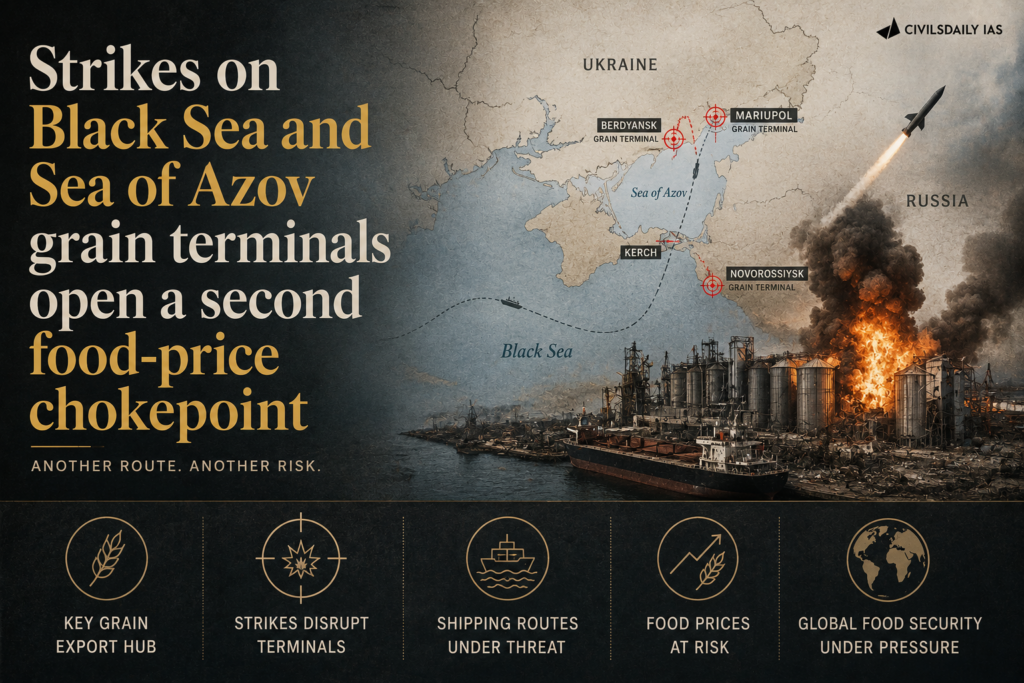
      1. Example: The Black Sea Corridor; The ongoing naval blockades and targeted infrastructure strikes stemming from the Russia-Ukraine war have severely challenged free navigation principles
    5. Naval Competition: Encourages stronger maritime deployments by powers including India, China, and the United States.

    What Are the Implications for India?

    1. Energy Security: India imports nearly 85% of crude oil, much of which passes through Indian Ocean chokepoints.
    2. Trade Dependence: Nearly 95% of India’s trade by volume moves through maritime routes.
    3. Strategic Geography: Places India at the centre of Indian Ocean security dynamics.
    4. SAGAR Doctrine: Strengthens India’s maritime cooperation and regional security approach.
    5. Indian Navy’s Role: Supports anti-piracy operations, maritime surveillance, and protection of Sea Lines of Communication (SLOCs).

    Conclusion

    According to Dr C Rajamohan, ‘’Unlike the Atlantic and Pacific oceans, the Indian Ocean is closed, that is, few straits control its access. This makes these straits immensely important for international trade.’’ The growing vulnerability of the Hormuz, Bab-el-Mandeb, and Malacca straits shows how globalisation depends on a few narrow maritime routes. As geopolitical tensions intensify and shipping disruptions become frequent, ensuring secure and open sea lanes has become central to global economic stability. For India, safeguarding these maritime corridors is no longer merely a strategic concern but an economic necessity.

    PYQ Relevance

    [UPSC 2024] Discuss the geopolitical and geostrategic importance of Maldives for India with a focus on global trade and energy flows. Further also discuss how this relationship affects India’s maritime security and regional stability amidst international competition?

    Linkage: This PYQ tests understanding of the Indian Ocean Region (IOR), maritime geopolitics, trade routes, energy flows, and strategic competition. Similarly, Bab-el-Mandeb, Hormuz, and Malacca shape global trade and energy security in the IOR, directly connecting with India’s maritime interests and regional strategic stability.

  • Foreign Policy Watch: India-United States

    U.S. Clears Apache and Howitzer Support Deals for India

    Why in the News?

    The United States approved support service deals for Apache helicopters and M777 howitzers for India, strengthening India-U.S. defence ties.

    Key Highlights

    Apache Helicopter Support Deal

    • Estimated value: $198.2 million
    • Includes:
      • Engineering and logistics support
      • Technical data and publications
      • Personnel training
      • Maintenance support

    M777A2 Ultra-Light Howitzer Support

    • Estimated value: $230 million
    • Includes:
      • Spare parts
      • Repairs
      • Technical assistance
      • Field service support

    About AH-64E Apache

    • Advanced attack helicopter used for:
      • Precision strikes
      • Anti-armour operations
      • Battlefield support

    About M777A2 Ultra-Light Howitzer

    • Lightweight artillery gun.
    • Can be airlifted for rapid deployment in mountainous regions.
    [2025] With reference to India’s defense, consider the following pairs: Aircraft type Description 
    1. Dornier-228: Maritime patrol aircraft 
    2. IL-76: Supersonic combat aircraft 
    3. C-17: Globe Master IIIMilitary transport aircraft 
    How many of the pairs given above are correctly matched? 
    [A] Only one [B] Only two [C] All the three [D] None
  • Terrorism and Challenges Related To It

    Delhi Police Seek Review of UAPA Bail Principles

    Why in the News?

    The Delhi Police urged the Supreme Court of India to refer the issue of bail under the Unlawful Activities (Prevention) Act, 1967 (UAPA) to a larger Bench, citing “conflicting” judgments on prolonged incarceration and bail.

    Key Issue Before the Court

    • The question is whether: Long incarceration and delay in trial can override strict bail restrictions under UAPA.

    Delhi Police’s Argument

    Additional Solicitor General S. V. Raju argued:

    • Under Section 43D(5) of UAPA, the presumption of innocence takes a “backseat”.
    • If accusations appear “prima facie true”, bail restrictions become mandatory.
    • Conflicting Supreme Court judgments require consideration by a larger Bench.

    Background of the Case

    • The hearing concerned bail pleas of:
      • Abdul Khalid Saifi
      • Tasleem Ahmad
    • Accused in the 2020 Delhi riots conspiracy case.

    Reference to Recent Supreme Court Judgment

    • A Bench led by: B. V. Nagarathna and Ujjal Bhuyan recently observed:
    • “Bail is the rule and jail is the exception” even under UAPA.
    • Prolonged incarceration violates:
      • Right to life
      • Personal liberty
      • Speedy trial under Article 21 of the Constitution of India

    K.A. Najeeb Judgment

    • The Court referred to the Union of India v. K.A. Najeeb case, which held: Constitutional courts can grant bail despite UAPA restrictions when trials are excessively delayed.

    Section 43D(5) of UAPA

    • Restricts bail if accusations appear prima facie true.
    • Considered one of the strictest bail provisions in Indian law.

    Related Development

    A Delhi court dismissed interim bail plea of Umar Khalid for attending bereavement rituals and caring for his ailing mother.

    UPSC Prelims Pointers

    • UAPA is India’s anti-terror law.
    • Section 43D(5) imposes strict bail conditions.
    • Article 21 guarantees life and personal liberty.
    • K.A. Najeeb judgment recognised prolonged incarceration as ground for bail.
    [2020] Consider the following statements: 
    1. The Constitution of India defines its ‘basic structure’ in terms of federalism, secularism, fundamental rights and democracy. 
    2. The Constitution of India provides for ‘judicial review’ to safeguard the citizens’ liberties and to preserve the ideals on which the Constitution is based. 
    Which of the statements given above is/are correct? 
    a) 1 only
    b) 2 only
    c) Both 1 and 2
    d) Neither 1 nor 2
  • Wildlife Conservation Efforts

    Tiger Deaths in Kanha Tiger Reserve Raise CDV Concerns

    Why in the News?

    A sixth tiger has died in Madhya Pradesh’s Kanha Tiger Reserve within a month, with authorities suspecting infection by the Canine Distemper Virus (CDV).

    Key Highlights

    • Latest victim:
      • Six-year-old male tiger
      • Found dead in Mukki range of KTR
    • Earlier deaths: One tigress and four cubs in Sarhi range

    What is CDV (Canine Distemper)?

    • Highly contagious viral disease.
    • Mainly spreads through infected dogs.
    • Affects:
      • Respiratory system
      • Nervous system
      • Immune system

    Why is it a Concern?

    • Virus may be spreading across different ranges of the reserve.
    • Stray dogs entering buffer and core forest areas are suspected carriers.

    Role of Authorities

    • The National Tiger Conservation Authority (NTCA) and Union government have sought reports from State officials regarding the tiger deaths.

    About Kanha Tiger Reserve

    • Located in Madhya Pradesh.
    • One of India’s major tiger reserves.
    • Part of the Project Tiger network.
    Consider the following statements about National Tiger Conservation Authority (NTCA): 
    1.It was constituted under Biodiversity act, 2002. 
    2.It is a statutory authority to implement Project Tiger. 
    Which of the statements given above is/are correct? 
    [A] 1 only [B] 2 only [C] Both 1 and 2 [D] Neither 1 nor 2
  • Wildlife Conservation Efforts

    Using DNA Maps to Trace Pangolin Trafficking

    Why in the News?

    Scientists have developed advanced “DNA maps” to identify the origin and trafficking routes of illegally traded pangolins, helping expose international wildlife smuggling networks.

    Key Highlights

    • Study published in PLOS Biology on May 7, 2026.
    • Researchers mapped trafficking routes of:
      • White-bellied pangolin
      • Sunda pangolin
      • Chinese pangolin

    How the DNA Mapping Works

    • Scientists analysed 671 specific locations in the pangolin genome that differ across populations.
    • Used:
      • Museum specimens
      • Recent pangolin samples
    • Created a large geo-referenced genetic database to identify the origin of trafficked pangolins.

    Major Findings

    • Researchers found evidence of trafficking routes from: Arunachal Pradesh and Assam
    • feeding illegal trade networks through Yunnan in China.

    Significance

    • Helps identify poaching hotspots accurately.
    • Assists enforcement agencies in tracking wildlife crime networks.
    • Can improve international cooperation against illegal wildlife trade.

    About Pangolins

    • Pangolins are scaly mammals threatened by:
      • Habitat loss
      • Illegal trafficking
    • Hunted mainly for:
      • Scales
      • Meat

    Conservation Status

    • Protected under: Schedule I of the Wild Life (Protection) Act, 1972
    • Listed under: Appendix I of Convention on International Trade in Endangered Species of Wild Fauna and Flora
    [2022] Consider the following statements: DNA Barcoding can be a tool to: 
    1. Assess the age of a plant or animal. 
    2. Distinguish among species that look alike. 
    3. Identify undesirable animal or plant materials in processed foods. 
    Which of the statements given above is/are correct? 
    [A] 1 only [B] 3 only [C] 1and 2 [D] 2 and 3