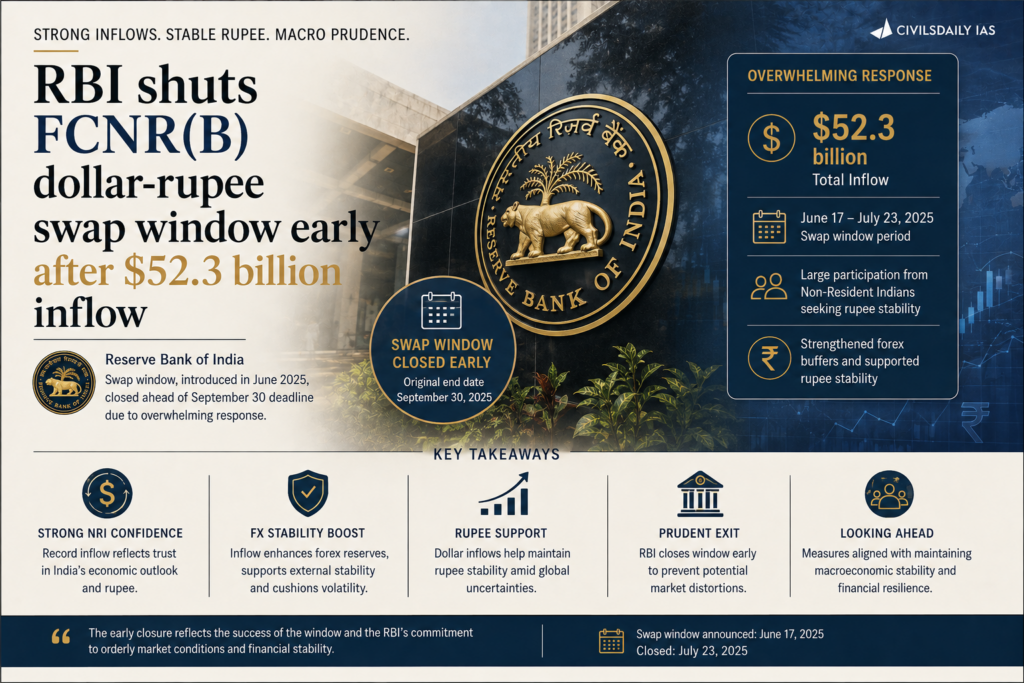
The Reserve Bank of India (RBI) will close its special US dollar-rupee swap window for fresh Foreign Currency Non-Resident (Bank) [FCNR(B)] deposits on 31 August 2026, after attracting $52.3 billion.
What is the FCNR(B) Swap Window?
Banks mobilise fresh 3 to 5 year FCNR(B) deposits in foreign currency.
Banks swap the dollars with the RBI for rupees at a concessional rate.
The RBI returns the dollars when the swap matures.
The concessional rate covers the bank’s hedging cost.
Key Definitions
FCNR(B): Foreign Currency Non-Resident (Bank) term deposit held by NRIs or Persons of Indian Origin in foreign currency.
Hedging Cost: Cost incurred to protect against exchange-rate fluctuations.
ECB: External Commercial Borrowing, or loans raised by eligible Indian entities from non-resident lenders.
OFCB: Overseas Foreign Currency Borrowing, or foreign currency funds borrowed by Indian banks from overseas markets.
Balance of Payments (BoP): Record of all economic transactions between residents of a country and the rest of the world during a period.
Why was the window closed early?
FCNR(B) route attracted $52.3 billion.
Total inflows through the three components reached $56.846 billion by 13 August.
High mobilisation indicated strong response.
Swaps against already mobilised deposits remain possible until 11 September.
Impact on Forex Reserves
India’s foreign exchange reserves reached around $707 billion as of 7 August, with foreign currency assets driving much of the increase.
However, FCNR(B) inflows are debt creating and will eventually require repayment in foreign currency.
“[2021] Consider the following:
1. Foreign currency convertible bonds
2. Foreign institutional investment with certain conditions
3. Global depository receipts
4. Non-resident external deposits.
Which of the above can be included in Foreign Direct Investments?
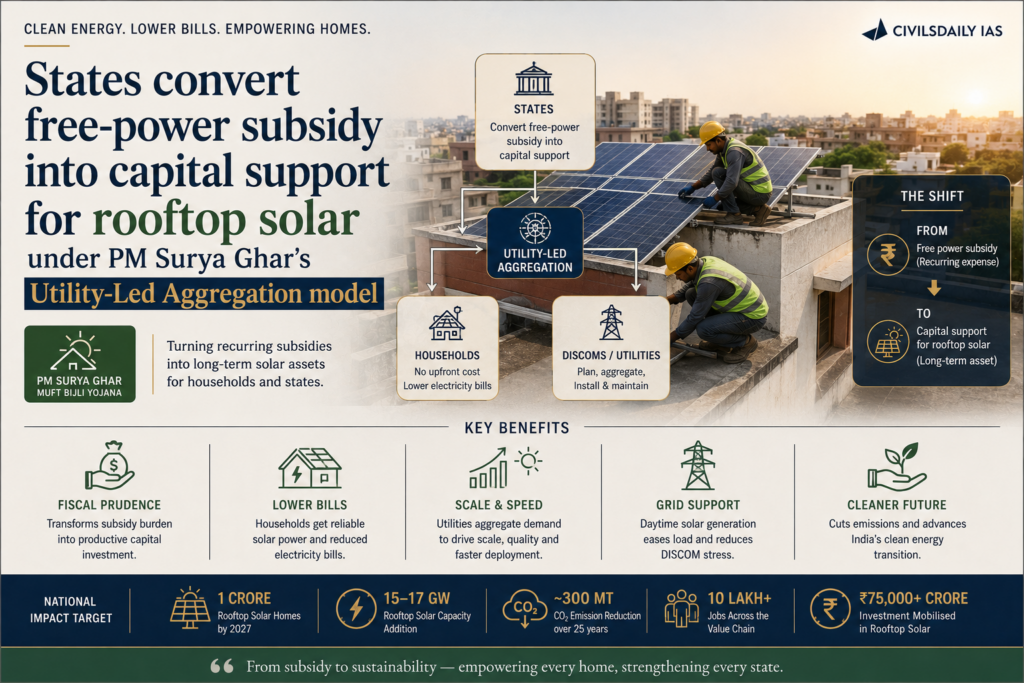
States such as Uttar Pradesh, Andhra Pradesh and Bihar are shifting recurring free-power subsidies towards one-time capital support for rooftop solar under the Utility-Led Aggregation (ULA) model.
What is PM Surya Ghar Yojana?
Ministry: Ministry of New and Renewable Energy (MNRE)
Launch: 13 February 2024
Target: 1 crore households with grid-connected rooftop solar by March 2027.
Outlay: ₹75,021 crore.
Benefit: Up to 300 units of free electricity per month.
Central subsidy: ₹30,000/kW up to 2 kW, plus ₹18,000 for the third kW, capped at ₹78,000.
Eligibility: Household must have a suitable roof and grid connection.
What is ULA?
Utility-Led Aggregation (ULA) is a model where the distribution company (DISCOM) aggregates household demand and arranges rooftop solar installations at scale.
States convert recurring electricity subsidies into one-time capital support for installing solar systems.
Why the Shift?
Reduces recurring State subsidy burden.
Creates a 25-year generating asset.
Reduces DISCOM’s cost of supplying subsidised daytime electricity.
Aggregated procurement can reduce installation costs.
Current Progress
52 lakh households had installed rooftop systems by 13 August.
About 2 lakh of 30 lakh ULA installations are complete.
Target: 1 crore households by March 2027.
Key Definitions
Rooftop Solar: Solar photovoltaic system installed on a building roof and connected to the electricity distribution network.
Net Metering: Allows surplus rooftop electricity exported to the grid to be adjusted against electricity consumed.
DISCOM: Distribution Company responsible for electricity distribution.
ALMM: Approved List of Models and Manufacturers for eligible solar modules.
Challenges
Financial stress of DISCOMs
High upfront installation costs
Limited rooftop access for tenants and apartment residents
No battery-storage subsidy
Grid and transformer capacity constraints
Dependence on imported solar cells and wafers
“[2025] Consider the following statements about ‘PM Surya Ghar Muft Bijli Yojana’:
I. It targets installation of one crore solar rooftop panels in the residential sector.
II. The Ministry of New and Renewable Energy aims to impart training on installation, operation, maintenance and repairs of solar rooftop systems at grassroot levels.
III. It aims to create more than three lakhs skilled manpower through fresh skilling and up-skilling, under scheme component of capacity building.
A seven-judge Constitution Bench will hear from 6 October 2026 whether legislative privileges override the freedom of speech. The reference revives a dispute from the 2003 attempt by the Tamil Nadu Assembly to arrest journalists over a critical editorial.
What is the constitutional question?
Privilege versus speech: Whether privileges under Article 194 can override Article 19(1)(a) free speech.
Interplay of Articles: The case engages Articles 194(3), 19, and 21 together.
Origin: It stems from a 2003 Assembly resolution to arrest newspaper journalists.
What are legislative privileges?
Definition: Special rights of a legislature and its members to function without external interference.
Article 194: Grants privileges to state legislatures, mirroring Article 105 for Parliament.
Uncodified: Privileges remain largely uncodified, drawing on British parliamentary practice.
Why is the tension unresolved?
Two rights collide: A legislature’s authority to punish for contempt sits against a citizen’s free speech.
Judicial review scope: Whether courts can review a House’s exercise of privilege is itself disputed.
Chilling effect: Broad privilege can deter press criticism of legislatures.
“[2023, GS2, 10] Discuss the role of Presiding Officers of state legislatures in maintaining order and impartiality in conducting legislative work and in facilitating best democratic practices.”
[2017] Which one of the following statements is correct?
[A] Rights are absolute and can never be restricted by the State.
[B] Rights are legally enforceable claims that individuals have against the State
[C] Rights are privileges granted by the government that can be revoked at any time.
[D] Rights are moral values that do not require legal protection.
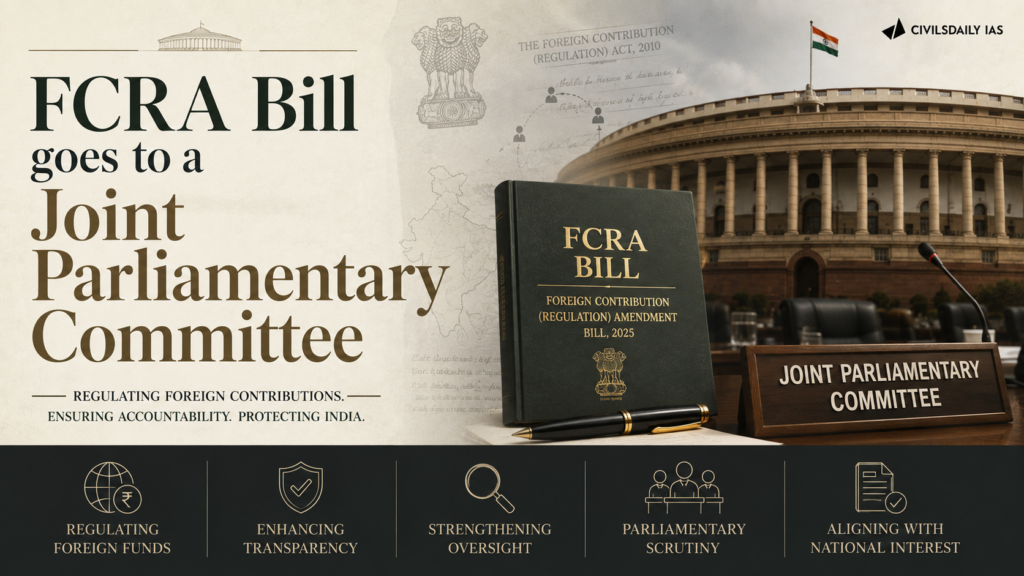
The Foreign Contribution (Regulation) Amendment Bill, 2026 was referred to a Joint Parliamentary Committee (JPC). The referral has renewed attention on how parliamentary committees shape legislation.
What is a Joint Parliamentary Committee?
Ad hoc committee: A JPC is set up for a specific bill or inquiry and dissolves after it reports.
Composition: Members are drawn from both Houses, in proportion to party strength.
Recommendations: Its recommendations are advisory, not binding on the government.
Why does the committee route matter?
Scrutiny space: Committees allow detailed, less partisan examination away from the floor.
Declining use: Bills referred to committees fell from about 71% in the 15th Lok Sabha to about 16% in the 17th.
Delay lever: Referral can also defer a contentious bill.
What is contested in the FCRA amendment?
Foreign funding control: The Foreign Contribution (Regulation) Act, 2010 governs foreign donations to NGOs and associations.
Civil society concern: Tighter rules are opposed as constraining non-governmental organisations and religious bodies.
Conclusion
The referral subjects a contested bill to committee scrutiny without settling it. The current status is examination by the JPC, with its report the next milestone.
Back2Basics: Parliamentary Committees
Standing committees: Permanent bodies such as the Public Accounts Committee and departmental committees.
Ad hoc committees: Temporary bodies such as a JPC or a Select Committee.
Financial committees: Public Accounts Committee, Estimates Committee, and Committee on Public Undertakings.
“[2023, GS2, 15] Explain the structure of the Parliamentary Committee system. How far have the financial committees helped in the institutionalization of Indian Parliament?”
[2018] With reference to the Parliament of India, which of the following Parliamentary Committees scrutinizes and reports to the House whether the powers to make regulations, rules, sub-rules, by-laws etc. conferred by the constitution of delegated by the Parliament are being properly exercised by the Executive within the scope of such delegation ?
A parliamentary inquiry committee found all three charges proved against a former High Court judge, including failure to explain cash recovered from his residence and interference with evidence. The issue is whether the removal process can continue after his resignation.
Removal of Judges: Constitutional Framework
Article 124(4): Supreme Court judges can be removed only for proved misbehaviour or incapacity.
Article 217: Deals with the tenure and removal of High Court judges.
Judges (Inquiry) Act, 1968: Provides the inquiry mechanism and formulation of charges.
Parliamentary approval: Removal requires a special majority in each House, in the same session.
Final step: After Parliament passes the address, the President issues the removal order.
What did the Inquiry Committee Find?
All three charges were proved.
The judge failed to satisfactorily explain the cash recovered from his residence.
The committee found attempts to interfere with evidence.
Key Constitutional Issue After Resignation
Removal is primarily linked to holding judicial office.
Resignation ends the judge’s tenure, creating a question about whether Parliament can still complete the removal process.
Possible consequences involving pension or future disqualification make the issue constitutionally significant.
There is no settled precedent on completing the removal process against a judge who has already resigned.
Prelims Facts
Ground for removal → Proved misbehaviour or incapacity
High Court judge → Article 217
Supreme Court judge → Article 124
Inquiry procedure → Judges (Inquiry) Act, 1968
Removal requires → Special majority in both Houses
Final removal order → President
Policy disagreement → Not a ground for removal
Historical fact → No Indian judge has so far been removed after completion of the parliamentary removal process.
“[2025, GS2, 15] “Constitutional morality is the fulcrum which acts as an essential check upon the high functionaries and citizens alike…” In view of the above observation of the Supreme Court, explain the concept of constitutional morality and its application to ensure balance between judicial independence and judicial accountability in India.”
[2021] With reference to Indian Judiciary, consider the following statements: 1. Any retired judge of the Supreme Court of India can be called back to sit and act as a Supreme Court judge by the Chief Justice of India with prior permission of the president of India. 2. A High Court in India has the power to review its own judgement as the Supreme Court does. Which of the statements given above is/are correct?
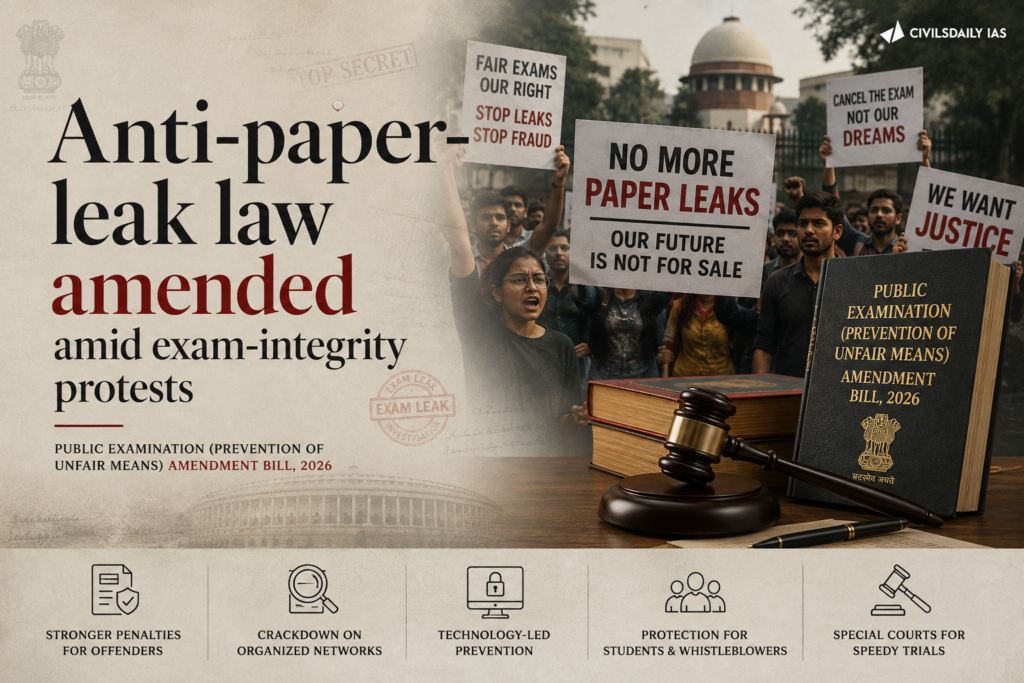
The Public Examination (Prevention of Unfair Means) Amendment Bill, 2026 seeks to strengthen the 2024 law against organised cheating and examination paper leaks amid concerns over NEET and recruitment examination irregularities.
What is the Public Examination Act, 2024?
Objective: Criminalises organised cheating, paper leaks, impersonation and other unfair means.
Coverage: Applies to major public examinations conducted by bodies such as UPSC, SSC and NTA.
Penalties: Provides imprisonment and heavy fines for organised examination malpractice.
Focus: Targets organised networks rather than genuine candidate errors.
Why was it amended?
Exam-leak crisis: Repeated paper leaks and irregularities exposed weaknesses in examination governance.
Enforcement gaps: Strengthening was considered necessary after experience with the 2024 framework.
Public trust: Fair examinations are essential for merit-based recruitment and equal opportunity.
What does the crisis reveal?
Aspiration-opportunity gap: Large numbers of candidates compete for limited government jobs.
Institutional trust deficit: Repeated leaks undermine confidence in recruitment institutions.
Governance challenge: Legal punishment alone cannot ensure examination integrity without secure technology, accountable agencies and speedy investigation.
Prelims Pointers
Act: Public Examinations (Prevention of Unfair Means) Act, 2024
Ministry/Department: Department of Personnel and Training
Targets: Organised cheating, paper leaks and impersonation
Important distinction: The Act does not automatically cover all university or State board examinations unless the concerned government adopts the framework.
“[2024, GS2, 15] What are the aims and objects of the recently passed and enforced, The Public Examination (Prevention of Unfair Means) Act, 2024? Whether University/State Education Board examinations, too, are covered under the Act?”
[2021] With reference to the Union Government, consider the following statements: 1. N. Gopalaswamy Iyengar Committee suggested that a minister and a secretary be designated solely for pursuing the subject of administrative reform and promoting it. 2. In 1970, the Department of Personnel was constituted on the recommendation of the Administrative Reforms Commission, 1966, and this was placed under the Prime Minister’s charge. Which of the statements given above is/are correct?
Both Houses passed a Bill to rename Kerala as “Keralam”, its name in Malayalam. The change follows two resolutions of the Kerala Assembly and routes through the constitutional process for altering a state’s name.
How is a state renamed under the Constitution?
Parliament’s power: Under Article 3, Parliament can alter the name of a state by law.
Presidential referral: Such a Bill needs the President’s recommendation and the views of the affected state legislature.
Simple majority: The change is passed by ordinary legislative majority, not a constitutional amendment.
Why “Keralam”?
Linguistic identity: “Keralam” is the state’s name in Malayalam, and the change aligns official usage with local usage.
Assembly resolutions: The Kerala Assembly twice sought the change unanimously.
Why does the process matter?
Union primacy: Only Parliament, not the state, can effect the legal renaming.
Federal courtesy: The state legislature’s view is sought, but its resolution is not binding.
Back2Basics: Article 3 of the Constitution
Scope: Formation of new states and alteration of areas, boundaries, or names of existing states.
Initiation: Only on the President’s recommendation, after seeking the state legislature’s views.
Nature: Treated as an ordinary law, reflecting the “indestructible states” feature of Indian federalism.
“[2022, GS1, 15] The political and administrative reorganization of states and territories has been a continuous ongoing process since the mid-nineteenth century. Discuss with examples.”
[2025] Consider the following pairs : State:Description 1. Arunachal Pradesh: The capital is named after a fort, and the state has two National Parks 2. Nagaland: The State came into Existence on the basis of a Constitutional Amendment Act. 3. Tripura: Initially a Part ‘C’ State, it became a centrally administered territory with the reorganization of State in 1956 and later attained the status of a full-fledged State How many of the above pairs are correctly matched?
The National Aeronautics and Space Administration (NASA) has asked the Indian Space Research Organisation (ISRO) to join its Moon Base programme, a project to establish a permanent research station on the Moon. The offer exposes a tension between the chance to accelerate ISRO’s own crewed-mission goals and the risk of locking India into another agency’s technology ecosystem. Space cooperation has continued to progress even amid the volatility of India-US relations.
What is the Moon Base programme?
About: An ambitious project to establish a permanent research station on the Moon where astronauts can live, work, and carry out experiments for extended periods.
Sequence: It is the logical follow-up to landing humans on the Moon, aimed at preparing the ground for longer stays.
What is the Artemis programme?
About: A US-led programme that aims to land humans on the Moon before 2028, the first crewed return since 1972.
Purpose: It is spearheaded by the United States and is designed to move faster and more efficiently by bringing in partner countries and private companies.
What are the Artemis Accords?
About: A US-led coalition of spacefaring countries setting principles for cooperative and sustainable lunar exploration, which India has already signed.
Contested feature: The Accords sidestep and seek to replace the 1979 Moon Agreement, a framework for multilateral governance of lunar resources.
What is the 1979 Moon Agreement?
About: An international agreement that seeks to develop a multilateral governance framework for the use of lunar resources.
Relevance: The Artemis Accords are seen as an alternative that the Moon Agreement’s supporters view as bypassing multilateral governance.
What does India gain from joining?
Crewed-mission experience: ISRO, which plans to land humans on the Moon by 2040, would gain hands-on experience in executing complex crewed missions.
Technology access: Participation offers access to technologies relevant to sustained lunar operations.
Existing commitments: India has signed the Artemis Accords and agreed with the US to develop a strategic framework for human spaceflight cooperation.
Strategic stakes: Over coming decades the Moon could become strategically and economically important as countries begin to extract lunar resources.
What are the risks of joining? (the central tension)
US-led alliance perception: The Artemis Accords are increasingly seen as a US-led alliance, and two major space powers, China and Russia, are not part of it.
Technology lock-in: It is important that ISRO does not get locked into NASA’s technology ecosystem, which would make it vulnerable to technology denial.
Goal displacement: Cooperation should help ISRO achieve its own goals faster, not lead it to abandon or delay them in the service of someone else’s goals.
Wariness of structures: India has been wary of joining such international structures, and signing the Accords already represented a choice.
Government Initiatives in the Space Sector
Gaganyaan: India’s human spaceflight programme to send astronauts to low-Earth orbit.
Bharatiya Antariksh Station: India’s planned space station for sustained microgravity research.
IN-SPACe: The body enabling private participation in the space sector.
Challenges for India’s Lunar Cooperation
Technology denial: Dependence on foreign systems risks future denial.
Alliance optics: Alignment with a US-led coalition affects ties with other space powers.
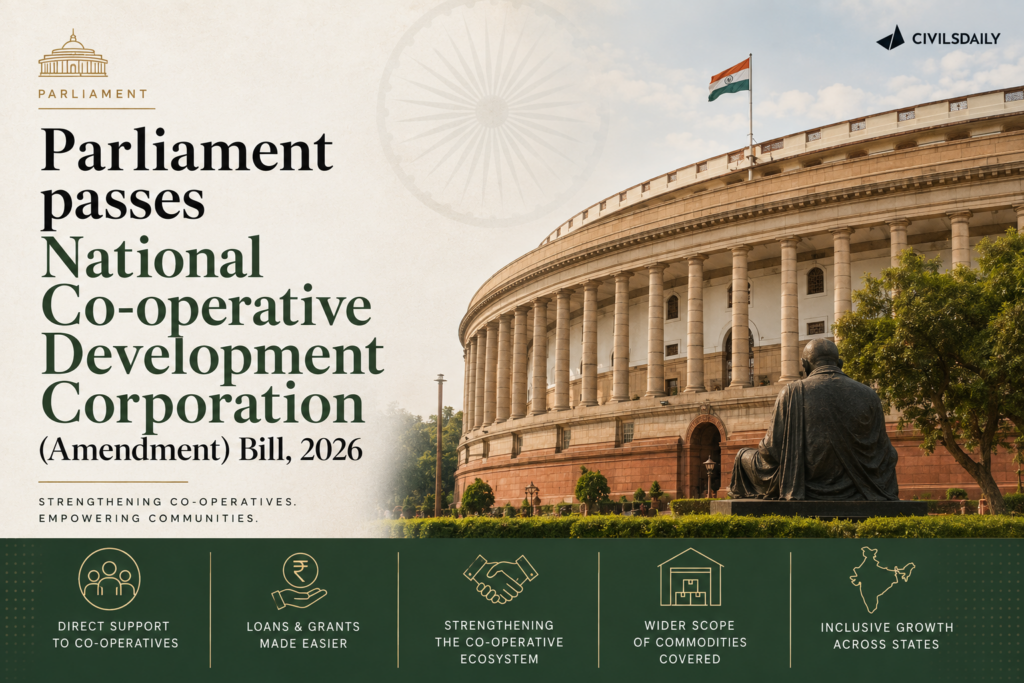
Parliament passed the National Cooperative Development Corporation (Amendment) Bill, 2026, enabling the NCDC to provide loans and grants directly to cooperative societies.
What is NCDC?
NCDC (National Cooperative Development Corporation) is a statutory corporation established under the National Cooperative Development Corporation Act, 1962.
Functions under the Ministry of Cooperation.
Promotes and finances cooperatives involved in production, processing, marketing, storage and trade of agricultural and allied produce.
What does the Amendment Change?
Direct lending: NCDC can directly provide loans and grants to cooperative societies.
Wider coverage: Definition of foodstuffs expanded to include processed food and other food items notified by the Centre.
No additional budgetary outlay: The Bill does not provide for additional government financial assistance.
Why is it Needed?
Faster flow of credit by removing intermediary delays.
Supports over 8 lakh cooperatives with more than 30 crore members.
Extends cooperative financing into value added food chains.
Why are States Concerned?
Cooperation is largely a State subject.
Direct central lending may bypass State governments and registrars.
Raises concerns about cooperative federalism and centralisation.
Key Challenges
Financial weakness and poor governance of PACS (Primary Agricultural Credit Societies).
Dual regulatory control.
Regional concentration of cooperatives.
Delayed elections and audits.
Limited professional management.
Centre State friction.
Constitutional Framework
Entry 32, State List: Incorporation and regulation of cooperative societies within a State.
Article 43B: Promotes voluntary formation and autonomous functioning of cooperatives.
Part IXB, Articles 243ZH to 243ZT: Constitutional provisions on cooperatives.
Multi State Cooperative Societies Act, 2002: Governs cooperatives operating across multiple States.
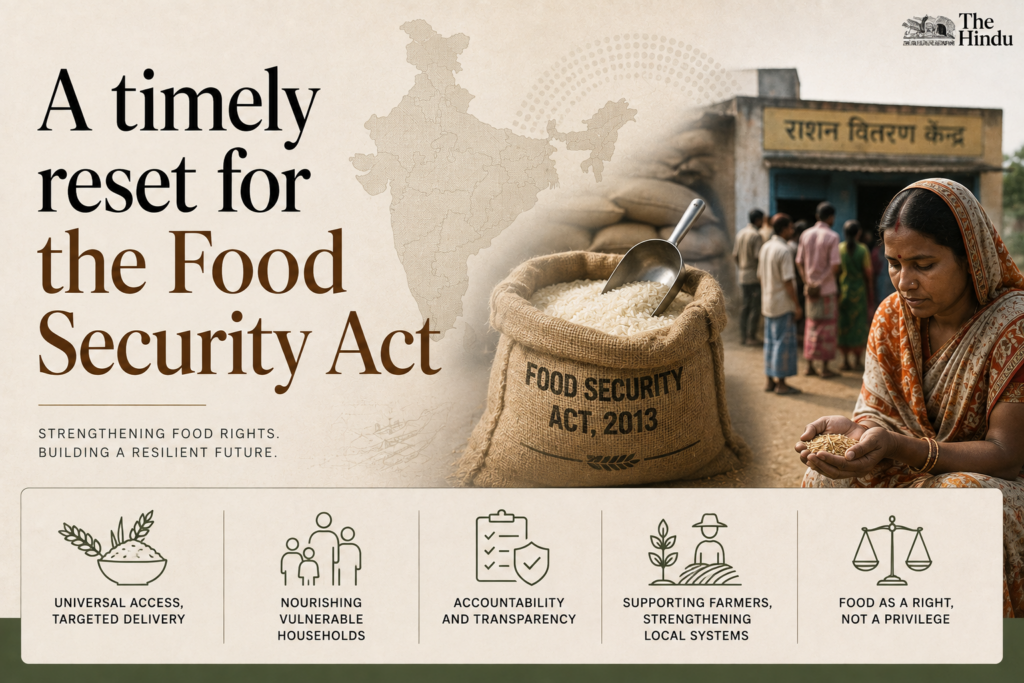
The draft National Food Security (Amendment) Bill, 2026 proposes to link Antyodaya Anna Yojana (AAY) entitlements to household size, opening a new phase in India’s food security debate. The reset exposes a triple tension: correcting the inequity of a flat household ration without reducing existing foodgrain access, while building a pathway from cereal security toward nutrition security amid a rising burden of diabetes and other non-communicable diseases.
What is the National Food Security Act, 2013?
Definition: The National Food Security Act, 2013 (NFSA) legally guarantees subsidised foodgrains to a large share of the population through the Public Distribution System, treating food as a legal entitlement rather than welfare.
Coverage design: It allows coverage of up to 75% of the rural and 50% of the urban population, split into Priority Households and Antyodaya Anna Yojana households.
What is the Antyodaya Anna Yojana (AAY) category?
Definition: AAY covers the poorest of the poor households and provides a flat 35 kg of foodgrains per household per month, regardless of household size.
Contrast: Priority Households instead receive 5 kg of foodgrains per person per month, a per-head rather than per-household entitlement.
Why does the flat AAY entitlement create inequity?
Small households protected: The flat 35 kg shields smaller and highly vulnerable families, such as a widow or an older person living alone.
Large households squeezed: A seven-member AAY household receives only 5 kg per person and an eight-member household about 4.4 kg, below the Priority Household entitlement.
The distortion: Support per person falls as household size rises, inverting the intended pro-poor design.
What does the draft amendment propose?
Per-person formula: The draft proposes 7 kg of foodgrains per person, capped at 35 kg per household.
Winners and losers: It would reduce support for households with one to four members by 20% to 80%, leave those with five or more members unchanged, and give no AAY household any additional foodgrain.
The design flaw: By reducing rather than raising any allocation, it corrects inequity by levelling down.
Why does the proposal risk reducing existing access?
Tamil Nadu illustration: The State reports that 15.75 lakh of its 18.64 lakh AAY households, or 84.5%, have fewer than five members.
Allocation cut: The proposal would reduce the State’s monthly AAY allocation from 65,261 tonnes to 42,040 tonnes, a fall of about 35.6%.
Composition matters: A smaller household may include a person with a disability, a widow or an older person living alone, so headcount alone is a poor proxy for need.
Why must coverage, not just the formula, be reformed?
Outdated ceiling: The NFSA’s 81.35-crore beneficiary ceiling remains based on Census 2011, though about 80 crore people currently receive free foodgrains.
Coverage erosion: Against an estimated population of 146.4 crore in 2025, the ceiling covers only 55.6% of people.
Recalculation needed: The ceiling should be recalculated when Census 2027 figures become available, with accessible inclusion and appeal mechanisms in the interim.
Why is grain alone not nutrition security?
Uneven child nutrition: NFHS-6 (2023-24) found stunting among under-fives fell from 35.5% to 29.3%, but wasting barely moved from 19.3% to 19.0% and underweight from 32.1% to 31.8%.
Diet inadequacy: Only about 15% of children aged six to 23 months receive a minimally adequate diet.
Double burden: The ICMR-India Diabetes study estimated 101 million Indians had diabetes and 136 million had prediabetes in 2021.
Life-course risk: Maternal undernutrition and low birth weight raise the risk of non-communicable diseases later in life.
Should the PDS cereal basket be blamed for diabetes risk?
Not a direct cause: Foodgrain entitlement should not itself be equated with diabetes risk.
The real concern: A predominantly cereal-based basket, combined with diets already high in carbohydrates and low in protein, can reinforce dietary imbalance.
Evidence: A 2025 ICMR-INDIAB study of 18,090 adults found carbohydrates supplied 62.3% of daily energy and protein 12%, with the highest carbohydrate intake carrying 30% higher odds of newly diagnosed type 2 diabetes.
Millets caution: Replacing refined cereals with whole-wheat or millet flour was not linked to lower risk when the carbohydrate share stayed high, so more grain or millets alone is not a complete nutrition policy.
How can diets be diversified without cutting cereals?
Balanced target: The ICMR-NIN 2024 guidelines recommend cereals and millets provide at most 45% of energy, with more from pulses, milk, nuts, vegetables and fruits.
What the PDS can do: The PDS can best supply affordable, shelf-stable foods, with States supported to offer pulses, local rice, wheat, millet choices and healthy edible oils.
Procurement link: Local production and consumption should guide supply chains and effective Minimum Support Price procurement for pulse, millet and oilseed growers.
Programme convergence: Sustained investment should link the PDS, Anganwadi services and Pradhan Mantri Poshan Shakti Nirman (PM POSHAN), providing eggs, milk or suitable alternatives where feasible.
Separate budgeting: Dietary diversification must be separately budgeted, not financed by reducing cereal entitlements, against a food subsidy allocation of Rs 2,27,629 crore in the 2026-27 Union Budget.
Phased pilots: Additions should be tested through State pilots assessing consumption, dietary diversity, anaemia, glycaemic risk, wastage and exclusion.
How does the delivery network enable this reform?
Digitised last mile: By the end of 2025, 5.50 lakh of 5.51 lakh fair price shops used electronic point-of-sale devices.
Portability: One Nation One Ration Card covered nearly all NFSA beneficiaries, supporting portability and monitoring.
Safeguards needed: Systems must include reliable offline alternatives, assisted or doorstep access for people with limited mobility, and a guarantee that authentication failure will not deny entitled foodgrains.
Nutrition referral: Fair price shops could carry multilingual receipts and messages and, where feasible, link willing adults to diabetes and hypertension services, with over 1.86 lakh Ayushman Arogya Mandirs and 41.3 crore diabetes screenings recorded by June 2026.
What three safeguards should anchor the reform?
No-loss guarantee: Any per-person formula should preserve the existing 35 kg monthly entitlement for every AAY household.
Periodic review: The adequacy of the 35 kg ceiling should be reviewed for larger and high-dependency households using consumption, nutritional and fiscal evidence.
Separately financed diversification: Dietary diversification must be separately financed and progressively implemented without reducing existing cereal entitlements.
Conclusion
The proposed amendment is an opportunity to correct the inequity of a flat AAY ration, but only if it preserves the 35 kg entitlement, assesses the needs of larger households, and finances a gradual transition toward more diverse and nutritious diets. India’s next food security reform must protect people from hunger while addressing the dietary drivers of diabetes, judged not by tonnes of grain moved but by whether vulnerable families can eat enough, eat healthier and obtain their entitlements with dignity.
Food Security in India (Foundational Context)
About: Food security means physical, economic and social access to sufficient, safe and nutritious food for an active, healthy life.
Scale: The NFSA covers about 80 crore people through the world’s largest food-based safety net.
Progress: The share of households unable to afford the ICMR-NIN recommended diet fell from about 52% in 2011-12 to about 25% in 2023-24, at 25% rural and 21% urban.
Back2Basics: National Food Security Act, 2013
Coverage: Up to 75% of rural and 50% of urban population.
Entitlement: 5 kg per person per month for Priority Households; 35 kg per household for AAY households.
Woman as head: The eldest woman aged 18 or above is the head of household for ration card issuance.
Maternity and child benefits: Entitlements for pregnant and lactating women and for children through supplementary nutrition programmes.
Grievance redress: State and district-level redress and vigilance mechanisms.
Statutory Framework Governing Food Security
Article 21: The right to life, read to include the right to food.
Article 47 (DPSP): Duty of the State to raise nutrition levels and the standard of living.
National Food Security Act, 2013: Legal entitlement to subsidised foodgrains.
Essential Commodities Act, 1955: Regulation of production, supply and distribution of essential commodities.
Government Initiatives for Food and Nutrition Security
Public Distribution System: Distribution of subsidised foodgrains through fair price shops.
PM POSHAN: Hot cooked meals for schoolchildren.
Anganwadi and ICDS: Supplementary nutrition for young children and pregnant or lactating women.
One Nation One Ration Card: Portable ration access across States.
Pradhan Mantri Garib Kalyan Anna Yojana: Free foodgrains scheme scaling the NFSA entitlement.
Key Facts about Food Security
PoS coverage: 5.50 lakh of 5.51 lakh fair price shops digitised by end 2025.
Diabetes burden: 101 million diabetics and 136 million prediabetics estimated in 2021.
Guideline: ICMR-NIN 2024 caps cereals and millets at 45% of dietary energy.
Challenges in Food and Nutrition Security
Cereal-heavy basket: High carbohydrate share crowding out protein and micronutrients.
Double burden: Coexistence of undernutrition and rising non-communicable diseases.
Outdated coverage: Beneficiary ceiling frozen at Census 2011.
Exclusion errors: Authentication failures and mobility barriers at the last mile.
Fiscal pressure: Large and rising food subsidy bill.
Procurement skew: MSP concentrated in rice and wheat over pulses and oilseeds.
Way Forward
No-loss safeguard: Legally protect the 35 kg AAY entitlement in any new formula.
Update coverage: Recalculate the ceiling on Census 2027 with accessible appeals.
Diversify diets: Separately fund pulses, millets and healthy oils in the PDS.
Converge programmes: Link PDS, Anganwadi and PM POSHAN for nutrition delivery.
Pilot before scale: Test additions through phased State pilots measuring nutrition and fiscal outcomes.
Previous Year Question
[2018] With reference to the provisions made under the National Food Security Act, 2013, consider the following statements:
1. The families coming under the category of ‘below poverty line (BPL)’ only are eligible to receive subsidised food grains.
2. The eldest woman in a household, of age 18 years or above, shall be the head of the household for the purpose of issuance of a ration card.
3. Pregnant women and lactating mothers are entitled to a ‘take-home ration’ of 1600 calories per day during pregnancy and for six months thereafter.
Which of the statements given above is/are correct?
(a) 1 and 2
(b) 2 only
(c) 1 and 3
(d) 3 only
[2021 GS3 15m] What are the salient features of the National Food Security Act, 2013? How has the Food Security Bill helped in eliminating hunger and malnutrition in India?”