💥UPSC 2027,2028 Mentorship (May Batch) + Access XFactor Notes & Microthemes PDF

Type: Prelims Only

  • Foreign Policy Watch: India-Iran

    West Asia Conflict May Slow India’s Growth More Than Inflation

    Why in the News

    The ongoing conflict involving Iran, Israel and the United States has pushed up oil prices and disrupted energy supplies. Analysts believe the situation may slow India’s economic growth, while the Reserve Bank of India (RBI) is likely to keep interest rates relatively low.

    Key Economic Developments

    • Oil prices have risen about 15% after the conflict began.
    • The Indian rupee has hit record lows and bond yields have risen.
    • Financial markets saw sell-offs in equity, debt and currency markets.
      • These developments have raised concerns about India’s current account deficit and growth outlook.

    Impact on India’s Economy

    • Slower Economic Growth: Disruption of natural gas supplies from the Middle East may affect sectors such as:
      • Fertilizers
      • Power generation
    • If disruptions last more than four weeks, growth could be affected for at least a quarter.
    • Oil Price Risk: If crude oil prices stay above $90–95 per barrel for several quarters,
      • India’s growth may slow from above 7% to around 6.5%.
    • Pressure on External Balance: Higher oil prices can:
      • Increase India’s import bill
      • Widen the current account deficit
      • Depreciate the rupee.

    Inflation Outlook

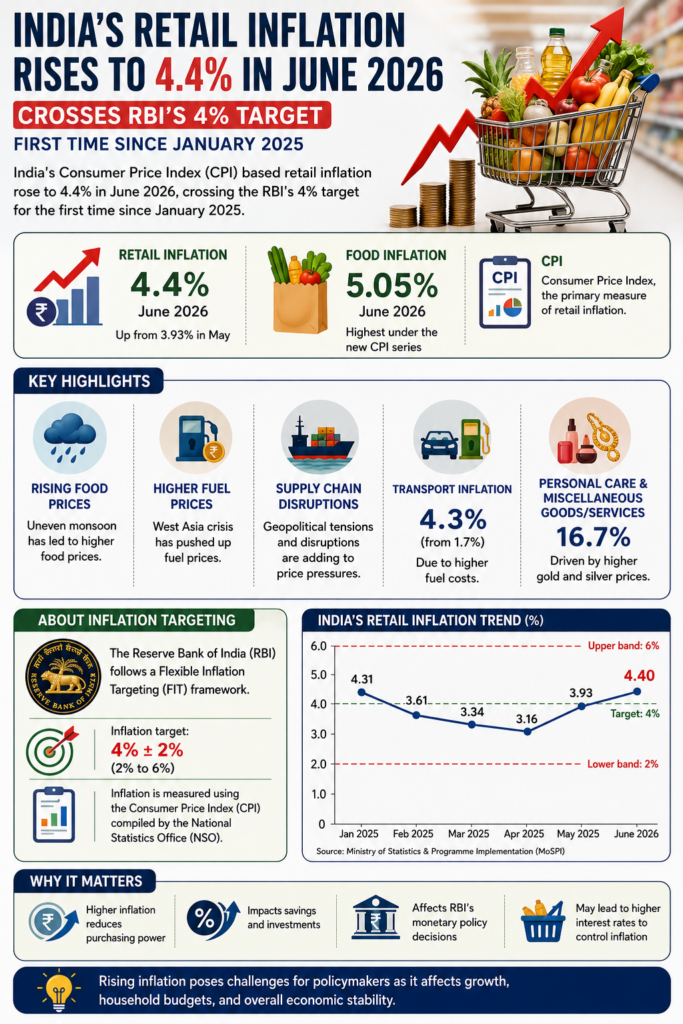
    • Despite higher oil prices, inflation risks remain moderate.
    • India’s retail inflation was 2.75% in January, near the lower end of RBI’s 2–6% tolerance band.
    • A 10–20% rise in global oil prices may increase inflation by 25–50 basis points.
      • Government actions such as holding retail fuel prices steady or reducing excise duties may cushion inflation.

    RBI’s Likely Policy Response

    • RBI had already cut the repo rate by 125 basis points in 2025.
    • Policymakers may prioritise supporting economic growth rather than raising rates immediately.
    • However, if oil prices cross $100 per barrel, central banks globally may adopt a more hawkish stance.
    [2023] Consider the following statements: Statement-I: In the post-pandemic recent past, many Central Banks worldwide had carried out interest rate hikes. Statement-II: Central Banks generally assume that they have the ability to counteract the rising consumer prices via monetary policy means. Which one of the following is correct in respect of the above statements? (a) Both Statement-I and Statement-II are correct and Statement-II is the correct explanation for Statement-I (b) Both Statement-I and Statement-II are correct and Statement-II is not the correct explanation for Statement-I (c) Statement-I is correct but Statement-II is incorrect (d) Statement-I is incorrect but Statement-II is correct
  • Growing Concern Over Nicotine Pouches in India

    Why in the News

    Health experts and anti-tobacco activists are demanding stricter regulation or a ban on nicotine pouches, which are increasingly being sold online in India. Tamil Nadu’s Directorate of Drugs Control has issued alerts and notices against their illegal sale.

    What are Nicotine Pouches?

    • Small microfiber pouches containing nicotine powder, flavourings and additives.
    • Placed between the gum and lip, where nicotine is absorbed through the mouth lining.
    • Do not contain tobacco, but still deliver nicotine directly to the bloodstream.

    According to the Centers for Disease Control and Prevention, nicotine pouches dissolve in the mouth and do not require spitting.

    Why Experts Are Concerned

    • Highly Addictive: Nicotine is a highly addictive chemical, especially harmful for youth and pregnant women.
    • Not Approved for Smoking Cessation: Neither the U.S. Food and Drug Administration nor Indian authorities approve nicotine pouches as a quitting aid.
    • Health Risks: Possible effects include:
      • Cardiovascular problems
      • Gum disease and oral health issues
      • Increased overall nicotine intake
    • Some pouches reportedly contain up to 50 mg nicotine, far higher than standard nicotine replacement products.
    [2020] Which of the following are the reasons/factors for exposure to benzene pollution? Automobile exhaust Tobacco smoke Wood burning Using varnished wooden furniture Using products made of polyurethane Select the correct answer using the code given below: (a) 1, 2 and 3 only (b) 2 and 4 only (c) 1, 3 and 4 only (d) 1, 2, 3, 4 and 5
  • HPV Vaccine Policy: India-made Cervavac Yet to Enter National Programme

    Why in the News

    India has launched a large-scale HPV vaccination campaign for adolescent girls using Gardasil, while the India-made vaccine Cervavac has not yet been included in the national immunisation programme due to ongoing research on its single-dose effectiveness.

    HPV Vaccine Campaign in India

    • India plans to vaccinate 1.15 crore girls aged 14 years.
    • The campaign currently uses Gardasil-4, developed by Merck.
    • Vaccination is supported by funding from Gavi.

    About the Indigenous Vaccine: Cervavac

    • Developed through collaboration between:
      • Department of Biotechnology
      • BIRAC
      • Bill and Melinda Gates Foundation
      • Serum Institute of India
    • Officially launched in 2022.
    • Estimated price if procured by government: ₹200–400 per dose (much cheaper than global vaccines).

    Why Cervavac is Not Yet in the Programme

    • Ongoing ICMR Study: The Indian Council of Medical Research is studying whether one dose of Cervavac produces enough long-lasting antibodies. Results expected by 2027.
    • WHO Recommendation Change: The World Health Organization now allows single-dose HPV vaccination in national programmes. Gardasil already has WHO prequalification for single-dose use, while Cervavac does not yet.
    • Free Vaccine Supply: India received GAVI support providing limited “free” HPV vaccine doses, encouraging the use of Gardasil initially.

    Two-Dose vs Single-Dose Debate

    • Earlier recommendation: 2 doses for girls aged 9–15 (6 months apart).
    • New WHO guidance (2022): Countries may use single-dose schedules to improve coverage and reduce costs.
    • Single-dose programmes are easier to implement because adolescent girls may not return for the second dose.

    Burden of Cervical Cancer in India

    • Second most common cancer among Indian women.
    • About 80,000 new cases annually.
    • Around 42,000 deaths each year.
    • India accounts for about 20% of global cervical cancer cases.

    About HPV (Human Papillomavirus)

    • A group of viruses spread mainly through sexual contact.
    • Certain strains such as HPV-16 and HPV-18 cause most cervical cancers.
    • Vaccination significantly reduces risk.
    [2022] In the context of vaccines manufactured to prevent COVID-19 pandemic, consider the following statements: The Serum Institute of India produced COVID-19 vaccine named Covishield using mRNA platform. Sputnik V vaccine is manufactured using vector-based platform. COVAXIN is an inactivated pathogen-based vaccine. Which of the statements given above are correct? (a) 1 and 2 only (b) 2 and 3 only (c) 1 and 3 only (d) 1, 2 and 3
  • Industrial Sector Updates – Industrial Policy, Ease of Doing Business, etc.

    Morbi Ceramic Industry Faces Shutdown Risk

    Why in the News

    The ceramic industry in Morbi, Gujarat may face a shutdown due to disruptions in natural gas and propane supplies following escalating conflict in West Asia and the closure of the Strait of Hormuz.

    Importance of Morbi Ceramic Cluster

    • Morbi is India’s largest ceramic manufacturing hub.
    • Around 600 ceramic units operate in the region.
    • The industry employs 2–4 lakh workers directly and indirectly.
    • Produces tiles, sanitaryware and vitrified products exported globally.

    Why the Industry is Affected

    • Dependence on Gas-Based Fuel
      • Ceramic units rely heavily on propane and natural gas for: Firing kilns and Drying processes. About 80% of units use propane as the main fuel.
    • Disruption of Energy Supplies
      • Gas shipments from Gulf countries are stuck due to tensions involving Iran, Israel, and the United States. Closure or disruption in the Strait of Hormuz, a critical global shipping route, has interrupted supplies.
    • Limited Fuel Stocks
      • Propane stocks: 2–4 days.
      • Natural gas (CNG) supplies: about one week.
      • If supplies do not resume soon, the industry may suspend operations within 7–10 days.
    [2024] Consider the following statements: Statement-I: Sumed pipeline is a strategic route for Persian Gulf oil and natural gas shipments to Europe. Statement-II: Sumed pipeline connects the Red Sea with the Mediterranean Sea. Which one of the following is correct in respect of the above statements? (a) Both Statement-I and Statement-II are correct and Statement-II explains Statement-I (b) Both Statement-I and Statement-II are correct, but Statement-II does not explain Statement-I (c) Statement-I is correct, but Statement-II is incorrect (d) Statement-I is incorrect, but Statement-II is correct
  • Monsoon Updates

    El Niño Likely to Develop After July 2026: WMO

    Why in the News

    The World Meteorological Organization has indicated high chances of the development of El Niño in the second half of 2026, after the current **La Niña conditions weaken and transition to ENSO-neutral.

    What is El Niño?

    • El Niño is the warm phase of the El Niño–Southern Oscillation (ENSO).
    • It is a periodic warming of sea surface temperatures in the central and eastern equatorial Pacific Ocean.
    • This warming disrupts global atmospheric circulation and affects weather patterns worldwide.

    ENSO Phases

    • El Niño (Warm Phase)
      • Warmer Pacific Ocean temperatures.
      • Often linked to weaker monsoon rainfall in India.
    • La Niña (Cool Phase)
      • Cooler-than-normal Pacific waters.
      • Often associated with stronger monsoon rainfall in India.
    • ENSO Neutral
      • Neither El Niño nor La Niña conditions.
    • Currently, La Niña is weakening, and neutral conditions are expected soon.

    Impact on India

    • India receives over 70% of annual rainfall during the southwest monsoon (June–September).
    • July and August alone contribute more than 50% of seasonal rainfall.
    • If El Niño develops after July, it could reduce monsoon rainfall and affect agriculture, water supply, and food production.

    Key Prelims Points

    • ENSO occurs in the equatorial Pacific Ocean.
    • El Niño years often correlate with weaker Indian monsoon, though not always.
    • Monitoring agencies include IMD and WMO.
    • ENSO affects temperature, rainfall, cyclones, and global climate patterns.
    [2011] La Nina is suspected to have caused recent floods in Australia. How is La Nina different from EI Nino? La Nina is characterized by unusually cold ocean temperature in the equatorial Indian ocean whereas EI Nino is characterized by unusually warm ocean temperature in the equatorial Pacific Ocean. EI Nino has an adverse effect on the southwest monsoon of India, but La Nina has no effect on monsoon climate. Select the correct answer using the code given below: (a) 1 only (b) 2 only (c) Both 1 and 2 (d) Neither 1 nor 2
  • Festivals, Dances, Theatre, Literature, Art in News

    Return of 16th Century Bronze Statue of Thirumangai Alvar

    Why in the News

    The Ashmolean Museum has returned a 16th century bronze statue of Thirumangai Alvar to the Government of India after provenance research confirmed that the idol originally belonged to the Sundararaja Perumal Temple in Tamil Nadu.

    Key Facts

    • The statue was handed over to the Indian High Commission in London.
    • The Ashmolean Museum had acquired the idol in 1967 from a private collector J.R. Belmont.
    • Provenance research linked the statue to a 1957 photograph from the temple archives preserved by the Institut Français de Pondichéry and the École française d’Extrême-Orient.
    • In 2020, the temple authorities filed a police complaint after discovering that the original idol had been replaced with a replica.
    About Thirumangai AlvarOne of the 12 Alvars, the Tamil poet-saints devoted to Lord Vishnu.Associated with the Bhakti movement in South India.His hymns are part of the Divya Prabandham, an important Vaishnavite devotional text.

    Significance of the Repatriation

    • Restoration of stolen cultural heritage to its original religious context.
    • Demonstrates growing global cooperation against illicit trafficking of antiquities.
    • Strengthens India’s efforts to recover temple idols and artefacts smuggled abroad.

    Prelims Pointers

    • Alvars: Tamil Vaishnavite saints who composed devotional hymns to Vishnu.
    • Major Alvar texts compiled in Nalayira Divya Prabandham.
    • Idol repatriation often occurs through provenance research and diplomatic negotiations.
    [2022] The world’s second tallest statue in sitting pose of Ramanuja was inaugurated by the Prime Minister of India at Hyderabad recently. Which one of the following statements correctly represents the teachings of Ramanuja? (a) The best means of salvation was devotion. (b) Vedas are eternal, self-existent and wholly authoritative. (c) Logical arguments were essential means for the highest bliss. (d) Salvation was to be obtained through meditation.
  • Foreign Policy Watch: India-Iran

    Iran War Impact: Rice Exports Disrupted and Fertilizer Prices Rising

    Why in the News

    Escalating conflict involving Iran, Israel and the United States has disrupted trade routes and raised global energy prices. This has affected India’s rice exports and increased fertilizer prices such as urea and DAP.

    Impact on India’s Rice Exports

    • Suspension of Shipments
      • Export of basmati rice to West Asia has been halted.
      • Ships carrying rice are stranded at ports or at sea.
    • Importance of West Asia for Basmati
      • India exports about 6 million tonnes of basmati rice annually.
      • 70–75% goes to West Asian markets.
      • About 1 million tonnes exported to Iran alone.
    • Major buyers include: Iran, Saudi Arabia, Iraq, and UAE
      • Exports are usually highest between October and March.

    Rising Shipping and Logistics Costs

    • Ship fuel price jumped from $480 to $925 per barrel in a few days.
    • Container and bulk vessel availability reduced.
    • Exporters advised to avoid new CIF contracts and prefer FOB terms.
    • Basmati wholesale prices have already risen 10–15%.

    Fertilizer Prices Increasing

    Global energy price rise has pushed up fertilizer costs.

    • Urea
      • Could exceed $1000 per tonne if conflict continues.
      • Used extensively during India’s sowing season.
    • DAP (Di-Ammonium Phosphate)
      • Expected to rise from about $850 to $1000 per tonne (FOB).

    Why Fertilizer Prices Are Rising

    1. Energy cost linkage
      • Urea production depends heavily on natural gas and LNG.
    2. Supply concentration
      • Morocco holds about 70% of global phosphate reserves.
      • Canada and Belarus dominate potash production.
    3. War-related supply disruptions
      • Transport and insurance costs rising.

    Fertilizer Situation in India

    • Urea sales (Apr–Dec 2025): 31.16 million tonnes (up 3.8%).
    • Domestic production: 22.44 million tonnes (down 3%).
    • Imports: 8 million tonnes (up 85.3%).
    • India remains heavily dependent on fertilizer imports.
    [2019] Among the following, which one is the largest exporter of rice in the world in the last five years? (a) China  (b) India  (c) Myanmar  (d) Vietnam
  • India Ranks Second Globally in Childhood Obesity

    Why in the News

    The World Obesity Atlas 2026, released by the World Obesity Federation on World Obesity Day (March 4), reported that India ranks second globally in childhood obesity, after China.

    Key Findings

    Scale of Childhood Obesity in India (2025)

    • Children aged 5–9: ~15 million overweight or obese
    • Children aged 10–19: ~26 million overweight or obese

    High BMI figures among children:

    • China: 62 million
    • India: 41 million
    • United States: 27 million
    • India therefore ranks second globally in number of children with high BMI.

    Global Trend

    • 20.7% of children worldwide (ages 5–19) are overweight or obese.
    • This increased from 14.6% in 2010.
    • By 2040, about 507 million children globally may be overweight or obese.

    Major Risk Factors Identified in India

    • Low Physical Activity: 74% of adolescents (11–17 years) do not meet recommended physical activity levels.
    • Poor Nutrition: Increased consumption of sugary beverages among children.
    • Inadequate School Nutrition: Only 35.5% of school-age children receive school meals.
    • Sub-optimal Breastfeeding: 32.6% of infants (1–5 months) do not receive optimal breastfeeding.

    Health Risks Linked to High BMI

    By 2040, India may see rising cases of:

    • Hypertension
    • Hyperglycaemia
    • High triglycerides
    • Metabolic dysfunction-associated steatotic liver disease (MASLD)
      • These conditions increase the risk of diabetes and cardiovascular diseases later in life.

    Recommended Policy Actions

    • Introduce taxes on sugar-sweetened beverages.
    • Restrict junk food marketing targeting children.
    • Promote healthy school meals and physical activity.
    • Strengthen nutrition and breastfeeding programmes.

    Prelims Pointers

    • BMI (Body Mass Index) = weight (kg) ÷ height² (m²).
    • World Obesity Day is observed on March 4.
    • Childhood obesity increases risk of Type 2 diabetes and cardiovascular diseases.
    • MASLD refers to Metabolic Dysfunction-Associated Steatotic Liver Disease.
    [2016] Which of the following is/are the indicator/ indicators used by IFPRI to compute the Global Hunger Index Report? Undernourishment Child stunting Child mortality Select the correct answer using the code given below. (a) 1 only (b) 2 and 3 only (c) 1, 2 and 3 (d) 1 and 3 only

  • Foreign Policy Watch: India-Nepal

    India–Nepal MoU on Forests, Wildlife & Climate Cooperation

    Why in the News

    India and Nepal signed a Memorandum of Understanding to enhance bilateral cooperation in forests, wildlife, biodiversity conservation and climate change.

    Key Features of the MoU

    1. Areas of Cooperation

    • Forest management
    • Wildlife protection
    • Biodiversity conservation
    • Climate change mitigation and adaptation
    • Restoration of wildlife corridors
    • Exchange of technical expertise and best practices

    2. Focus on Transboundary Conservation

    Given shared ecosystems across the India–Nepal border, the MoU emphasises:

    • Landscape level biodiversity planning
    • Creation of transboundary conservation landscapes
    • Interlinking protected areas
    • Smart green infrastructure in biodiversity hotspots

    3. Key Species Identified

    • The agreement prioritises conservation of: Elephant, Gangetic dolphin, Rhinoceros, Snow leopard, Tiger, and Vultures
    • These species move across borders and require coordinated habitat protection.

    4. Combating Wildlife Crime

    • Joint action against forest and wildlife crime
    • Capacity building of frontline enforcement staff
    • Improved coordination between agencies

    Institutional Context

    • Signed between:
      • Ministry of Environment, Forest and Climate Change
      • Ministry of Forests and Environment, Nepal
    [2019] Consider the following statements: 

    1. Asiatic lion is naturally found in India only. 
    2. Double-humped camel is naturally found in India only. 
    3. One-horned rhinoceros is naturally found in India only. 

    Which of the statements given above is/are correct? 

    (a) 1 only (b) 2 only (c) 1 and 3 only (d) 1, 2 and 3

  • Foreign Policy Watch: India-Iran

    U.N. Nuclear Watchdog Holds Emergency Meet in Vienna

    Why in the News

    The International Atomic Energy Agency held an emergency meeting in Vienna on March 2 amid escalating conflict in West Asia following U.S.–Israeli strikes on Iran.

    About the International Atomic Energy Agency (IAEA)

    • The International Atomic Energy Agency (IAEA) is an autonomous UN organization focused on promoting peaceful nuclear technology use. Established in 1957 after U.S. President Dwight Eisenhower’s “Atoms for Peace” speech, it headquartered in Vienna, Austria, and works with over 170 member states

    What the IAEA Said

    • No indication that Iran’s nuclear installations were damaged.
    • No abnormal rise in radiation levels detected in the region.
    • Facilities mentioned include:
      • Bushehr Nuclear Power Plant
      • Tehran research reactor
      • Nuclear fuel cycle facilities
    • However, IAEA said it has faced communication blackout from Iranian authorities.
    • Director General Rafael Grossi issued the official statement.

    Iran’s Position

    • Iran’s ambassador to the IAEA claimed the Natanz uranium enrichment facility was targeted.
    • No public evidence provided so far.
    • Tehran has previously suspended cooperation with IAEA after foreign strikes.

    Iran may use alleged attacks to justify:

    • Restricting IAEA inspections.
    • Increasing uranium enrichment levels.
    • Framing actions as “self defense”.
    [2020] In India, why are some nuclear reactors kept under “IAEA Safeguards” while others are not? 

    (a) Some use uranium and others use thorium 

    (b) Some use imported uranium and others use domestic supplies 

    (c) Some are operated by foreign enterprises and others are operated by domestic 

    (d) Some are State-owned and others are privately-owned