💥UPSC 2027,2028 Mentorship (May Batch) + Access XFactor Notes & Microthemes PDF

Type: Prelims Only

  • Tourism Sector

    Kashmir Promotes Almond and Tulip Bloom to Revive Tourism

    Why in the News

    The government of Jammu and Kashmir is promoting almond blossoms and tulip blooms to revive tourism in Kashmir after a decline in tourist arrivals following a terror attack in 2025.

    Key Initiative

    Chief Minister Omar Abdullah will inaugurate a Spring Festival at Badamwari Garden to showcase blooming almond trees and attract tourists.

    Badamwari Almond Garden

    • Located in Srinagar.
    • Spread over 300 kanals (about 37.5 acres).
    • Dates back to before the 14th century.
    • Situated near the Hari Parbat area.

    Tulip Festival

    • Tulip is a flowering plant belonging to the genus Tulipa in the lily family (Liliaceae). It is one of the most popular ornamental flowers in the world, known for its bright colors and simple cup shaped petals.
    • The Indira Gandhi Memorial Tulip Garden will open to visitors from March 16.
    • Key features:
      • 1.8 million tulip bulbs planted.
      • 70–75 tulip varieties.
      • Often compared to the Keukenhof.
    • In April 2025, the garden attracted 8.25 lakh visitors.

    Tourism Impact

    • Tourism contributes about 7% to Jammu and Kashmir’s Gross State Domestic Product (GSDP).
    • Tourist arrivals dropped from 26 lakh in 2024 to 11.16 lakh in 2025 after the Pahalgam terror attack and subsequent security concerns.
    • Following a security audit, major tourist destinations have reopened.

    Objective of the Initiative

    • Revive tourism in Kashmir.
    • Promote spring flower tourism similar to Japan’s cherry blossom festivals.
    • Highlight Kashmir’s floriculture and natural beauty.
    Consider the following plants: Groundnut Horse-gram Soybean How many of the above belong to the pea family? (a) Only one (b) Only two (c) All three (d) None
  • The Crisis In The Middle East

    India Looks to New Gas Sources to Ease LPG Shortage

    Why in the News

    Amid supply disruptions caused by the West Asia conflict, officials say India is turning to new sources of natural gas such as the United States and Norway to address the current shortage of cooking gas (LPG).

    Key Developments

    • India is facing a temporary shortage of LPG and LNG supplies.
    • The government has increased domestic LPG production by about 10%.
    • Oil refineries have been directed to prioritise propane and butane for LPG production.
      • This directive was issued by the Ministry of Petroleum and Natural Gas.

    Diversifying Gas Imports

    • India is exploring imports from: United States and Norway
    • Earlier, a major share of LNG imports came from Qatar.

    Price Changes

    • Earlier LNG price: $6–8 per MMBtu
    • Current price: around $15 per MMBtu
    • At higher prices, imports from distant suppliers become economically viable despite longer shipping distances.

    Supply Challenges

    • Shipping LNG from the U.S. or Norway can take about two months.
    • This may cause a short-term supply gap before new cargoes arrive.
    • However, officials expect the shortage to be temporary.

    Government Priority

    • The government has prioritised domestic LPG supply for households over commercial users.
    • To address concerns of hotels and restaurants, a committee of oil marketing companies (OMCs) has been set up to review requests for commercial LPG supplies.

    Key Terms

    • LPG (Liquefied Petroleum Gas)
      • Mainly composed of propane and butane.
      • Used widely as cooking fuel in households.
    • LNG (Liquefied Natural Gas): Natural gas (mostly methane) cooled to −160°C to transport it in liquid form.

    Significance for India

    • India imports a large share of its energy requirements.
    • Disruptions in West Asia affect fuel supply, prices, and energy security.
    • Diversifying suppliers helps reduce dependence on a single region.
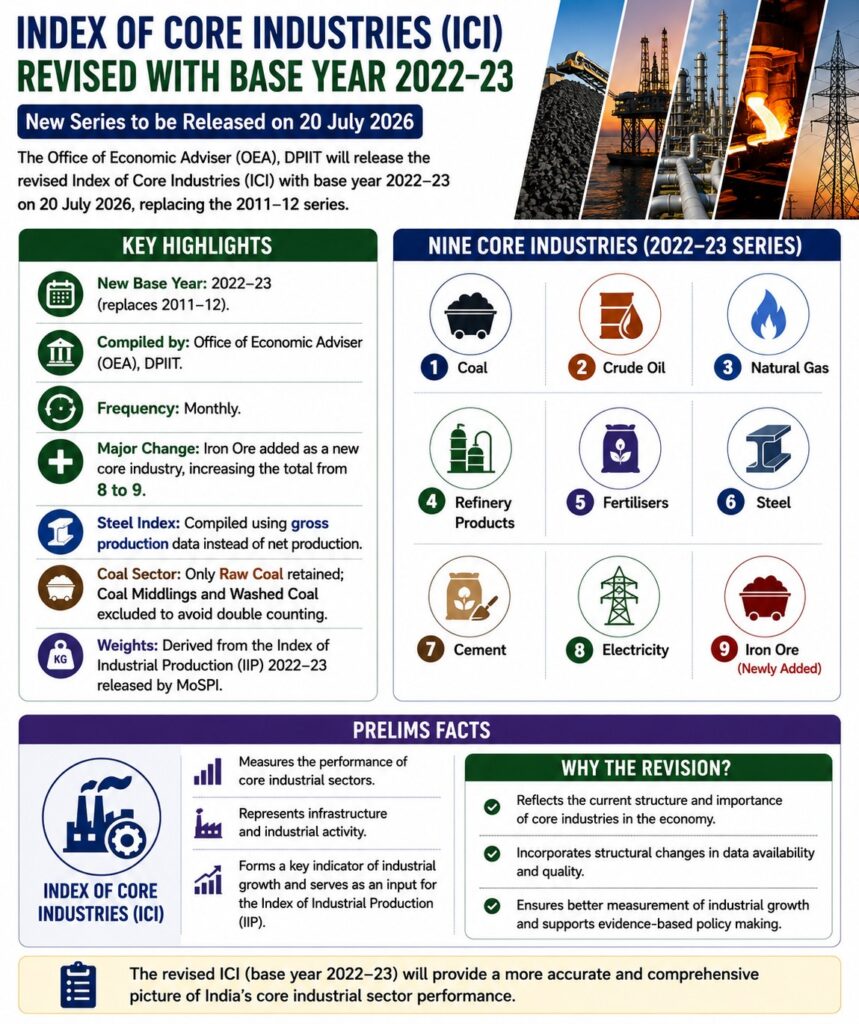
    [2012] In India the overall Index of Industrial Production, the Indices of Eight Core Industries have combined weight of 37.90%. Which of the following are among those Eight Core Industries? 1. Cement 2. Fertilizers 3. Natural Gas 4. Refinery products 5. Textiles Select the correct answer using the code given below: (a) 1 and 5 only (b) 2, 3 and 4 only (c) 1, 2, 3 and 4 only (d) 1, 2, 3, 4 and 5
  • Electoral Reforms In India

    Opposition Considers Impeachment Motion Against CEC Gyanesh Kumar

    Why in the News

    • Opposition parties, including the Indian National Congress and All India Trinamool Congress, are discussing the possibility of moving an impeachment motion against Gyanesh Kumar in Parliament.
    • Congress leader K C Venugopal stated that the entire Opposition will take a collective decision on the proposal.

    Impeachment Process of the Chief Election Commissioner (CEC)

    • The removal procedure is provided under Article 324(5) of the Constitution of India.
    • Grounds for Removal: The Chief Election Commissioner can only be removed on grounds similar to those of a Supreme Court judge, mainly: Proved misbehaviour and Incapacity.

    Step-by-Step Process

    • Notice of Motion: A removal motion must be signed by:
      • At least 100 members of the Lok Sabha, or
      • At least 50 members of the Rajya Sabha.
    • Admission of Motion
      • The motion is submitted to the Speaker of Lok Sabha or Chairman of Rajya Sabha.
      • They may accept or reject the motion.
    • Investigation: If admitted, an investigative committee is formed to examine the charges.
    • Parliamentary Voting: If the committee finds the charges valid, the motion is debated and voted upon in both Houses.
    • Special Majority Required: Removal requires:
      • Majority of total membership of the House, and
      • Two-thirds majority of members present and voting.
    • Final Removal: After both Houses pass the motion, the President of India issues the removal order.
    [2017] Consider the following statements: The Election Commission of India is a five-member body. Union Ministry of Home Affairs decides the election schedule for the conduct of both general elections and bye-elections. Election Commission resolves the disputes relating to splits/mergers of recognized political parties. Which of the statements given above is/are correct? (a) 1 and 2 only (b) 2 only (c) 2 and 3 only (d) 3 only
  • ISRO Missions and Discoveries

    FSI Stops AI-Based Deforestation Alerts to States

    Why in the News

    The Forest Survey of India (FSI) has stopped issuing fortnightly deforestation alerts through its AI-based Anavaran Deforestation Alert System. The portal has not been updated since November 2025.

    What was the Anavaran System?

    • An AI and satellite-based monitoring system launched in January 2024.
    • Provided deforestation alerts every 15 days to states.
    • Alerts included precise geographic coordinates where forest cover loss was detected.

    Purpose:

    • Enable quick field inspections by forest officials.
    • Improve near-real-time monitoring of deforestation.

    Technology Used

    The system used remote sensing and machine learning:

    • Google Earth Engine
    • Sentinel-2
    • Sentinel-1

    Features:

    • Optical satellite imagery (Sentinel-2).
    • Synthetic Aperture Radar (SAR) data from Sentinel-1 for cloudy or monsoon conditions.
    • Machine learning algorithms compared before-and-after images to detect forest loss.

    Performance of the System

    • 12,351 alerts issued between Jan 2024 and Oct 2025.
    • Average alerts per month: 561
    • Alerts increased to 1,028 per month during Nov–March, when deforestation peaks.

    Why Alerts Were Stopped

    • According to FSI officials:
      • The system was only a pilot project.
      • The government is currently reviewing feedback from states on its usefulness.
      • Active monitoring reportedly stopped in January 2026.

    Comparison with Global Systems

    • The system was considered similar to Terra‑I, used in countries like Peru. However, Anavaran had higher spatial resolution:
      • 10–20 metre resolution (Sentinel satellites)
      • Terra-I: 250 metre resolution

    Other Forest Monitoring Systems in India

    • Van Agni Portal
    • Fire alerts using satellite data have been operational since 2004.
    [2015] In which of the following activities are Indian Remote Sensing (IRS) satellites used? 1. Assessment of crop productivity 2. Locating ground water resources 3. Mineral exploration 4. Telecommunications 5. Traffic studies Select the correct answer using the code given below. (a) 1, 2 and 3 only (b) 4 and 5 only (c) 1 and 2 only (d) 1, 2, 3, 4 and 5
  • The Crisis In The Middle East

    Mojtaba Khamenei Becomes Iran’s New Supreme Leader

    Why in the News

    The Assembly of Experts has appointed Mojtaba Khamenei as the new Supreme Leader of Iran following the death of former leader Ali Khamenei in a U.S.–Israeli strike.

    Key Highlights

    • Age: 57
    • Position: Third Supreme Leader of Iran.
    • Predecessors:
      1. Ruhollah Khomeini (1979–1989)
      2. Ali Khamenei (1989–2026)

    Role of the Supreme Leader in Iran

    • The Supreme Leader is the highest authority in Iran’s political system.
    • Key powers include:
      • Head of state
      • Commander-in-chief of armed forces
      • Control over the judiciary, military, and security agencies
      • Influence over foreign and defence policy
      • Ability to appoint key officials and veto decisions
    • Although Iran elects a President, the Supreme Leader holds ultimate authority.
    [2016] Which of the following is not a member of ‘Gulf Cooperation Council’? (a) Iran (b) Saudi Arabia (c) Oman (d) Kuwait
  • Economic Indicators and Various Reports On It- GDP, FD, EODB, WIR etc

    250 Years of The Wealth of Nations: Adam Smith’s Lessons

    Why in the News

    The famous economics book An Inquiry into the Nature and Causes of the Wealth of Nations completed 250 years on March 9, 2026. The work by Adam Smith continues to influence debates on free trade, taxation, monopolies, and economic inequality.

    About The Wealth of Nations

    • Published in 1776, during the Scottish Enlightenment.
    • Considered the foundational text of classical economics.
    • Analyses the sources of national wealth, labour productivity, trade, and markets.
      • Smith is often called the “father of modern economics”.

    Key Economic Ideas of Adam Smith

    • Division of Labour: Specialisation improves productivity.
      • Example used by Smith: pin factory, where each worker performs a specific task to increase output.
    • Free Markets: Economic activity works best when individuals pursue self-interest within competitive markets.
    • The “Invisible Hand”: Individuals pursuing their own interest can unintentionally benefit society as a whole. Markets allocate resources efficiently without heavy government intervention.
    • Free Trade: Smith criticised mercantilism, the idea that countries should maximise exports and minimise imports.
    • He argued that:
    • Trade allows nations to specialise in what they produce efficiently.
    • Greater trade leads to mutual prosperity.
    [2011] What does the term “economic liberalization” refer to in the context of the Indian economy? (a) Expansion of the public sector (b) Restriction of foreign investment (c) Removal of restrictions on private sector and encouragement of free market policies (d) Increase in trade barriers
  • RBI Notifications

    RBI Conducts OMO Purchase to Inject Liquidity

    Why in the News

    The Reserve Bank of India (RBI) conducted Open Market Operations (OMO) purchase of Government Securities worth ₹50,000 crore to inject liquidity into the banking system. Another tranche of ₹50,000 crore is scheduled shortly.

    Key Highlights

    • Amount purchased: ₹50,000 crore worth of Government Securities (G-Secs).
    • Total planned purchase: ₹1,00,000 crore in two tranches.
    • Maturity range of securities:
      • 6.01% G-Sec maturing 2030
      • 7.30% G-Sec maturing 2053

    Purpose:

    • Inject liquidity into the banking system.
    • Offset liquidity shortage caused by advance tax payments.
    • Ensure banks have sufficient funds for lending.

    What are Open Market Operations (OMO)?

    • Open Market Operations are a key monetary policy tool used by the RBI.
    • Definition: Buying or selling government securities in the open market to regulate money supply and liquidity.
    • If RBI buys G-Secs
      • Injects liquidity
      • Increases money supply
      • Encourages lending
    • If RBI sells G-Secs
      • Absorbs liquidity
      • Reduces money supply

    Additional Measures

    • The Government of India conducted a switch auction, buying back ₹6,309 crore of G-Secs and issuing ₹6,431 crore of new bonds.
    • These operations help manage the government’s debt maturity profile.
    [2013] In the context of Indian economy, ‘Open Market Operations’ refers to: (a) borrowing by scheduled banks from the RBI (b) lending by commercial banks to industry and trade (c) purchase and sale of government securities by the RBI (d) None of the above

  • Wildlife Conservation Efforts

    Cheetah Population in India Crosses 50 Under Project Cheetah

    Why in the News

    A Namibian cheetah Jwala gave birth to five cubs at Kuno National Park, taking India’s total cheetah population to 53. The development is a major milestone under Project Cheetah.

    Key Highlights

    • Five cubs born to Namibian cheetah Jwala.
    • Recently, another cheetah Gamini delivered four cubs at the same park.
    • Total cheetah population in India: 53.
    • Indian-born cubs: 33.
    • Successful litters in India: 10.

    About Project Cheetah

    • Launched on 17 September 2022 by Narendra Modi.
    • Eight cheetahs were translocated from Namibia to Kuno National Park.
    • Aim: Reintroduce cheetahs in India after extinction.

    Background

    • Cheetahs became extinct in India in 1952 due to hunting and habitat loss.
    • The species is the fastest land animal.

    Objectives of the Programme

    • Restore the cheetah population in India.
    • Re-establish a functional grassland ecosystem.
    • Promote wildlife tourism and conservation awareness.
    • Improve genetic diversity and species recovery.
    [2024] Consider the following statements: Lions do not have a particular breeding season. Unlike most other big cats, cheetahs do not roar. Unlike male lions, male leopards do not proclaim their territory by scent marking.Which of the statements given above are correct? (a) 1 and 2 only (b) 2 and 3 only (c) 1 and 3 only (d) 1, 2 and 3
  • New Species of Plants and Animals Discovered

    Silent Valley Bird Survey

    Why in the News
    A recent bird survey in Silent Valley National Park recorded 192 bird species, highlighting the park’s rich avian biodiversity.

    Key Findings

    • Survey dates: March 6 to 8, 2026
    • Organisers:
      • Kerala Forest Department
      • Malabar Natural History Society
    • Participants: About 85 birdwatchers from Kerala and Tamil Nadu.
    • Covered both core and buffer zones of the park.

    Important Observations

    • Total species recorded: 192 bird species
    • Rare migratory birds: Asian house martin and Western house martin. 

    Endemic Western Ghats species recorded:

    • Nilgiri laughingthrush
    • Black-and-orange flycatcher
    • White-bellied treepie
    • Nilgiri pipit
    • White-bellied blue flycatcher
    • Nilgiri sholakili (Nilgiri blue robin)

    About Silent Valley National Park

    • Located in Palakkad.
    • Part of the Western Ghats biodiversity hotspot.
    • Known for tropical evergreen forests and high endemism.
    [2020] With reference to India’s biodiversity, Ceylon frogmouth, Coppersmith barbet, Graychinned minivet and White-throated redstart are: (a) Birds (b) Primates (c) Reptiles (d) Amphibians
  • Chile Eliminates Leprosy

    Why in the News

    The World Health Organization (WHO) and the Pan American Health Organization (PAHO) have officially verified Chile as the first country in the Americas and the second globally to eliminate leprosy as a public health problem.

    Leprosy (Hansen’s Disease)

    • A chronic infectious disease caused by the bacterium Mycobacterium leprae.
    • Primarily affects:
      • Skin
      • Peripheral nerves
      • Upper respiratory tract mucosa
      • Eyes
    • If untreated, it can cause permanent nerve damage and disability.

    Transmission

    • Spread through respiratory droplets from the nose and mouth of untreated patients.
    • Requires close and prolonged contact.
    • Not highly contagious.

    Incubation Period

    • Very long incubation period.
    • Average: ~5 years, but symptoms may appear up to 20 years later.

    Symptoms

    • Pale or reddish skin patches with loss of sensation
    • Numbness and nerve damage
    • Muscle weakness in hands and feet
    • Painless ulcers on soles of feet
    • Eye damage in severe cases

    Treatment

    • Multi-Drug Therapy (MDT) provided free worldwide by WHO.
    • Combination of medicines:
      • Rifampicin
      • Dapsone
      • Clofazimine
    • 100% curable if treated early.
    • Early treatment prevents disability.
    [2014] Consider the following diseases: Diphtheria  Chickenpox  Smallpox Which of the above diseases has/have been eradicated in India? (a) 1 and 2 only  (b) 3 only  (c) 1, 2 and 3 only  (d) None of the above