In this section, we will deal with the sector which seeks to empower the youth – Skills and Job Creation.
Take a look at basic statistics, which will give you a larger picture about govt.’s approach towards Education, Skills and Job Creation, where the emphasis is to make India a knowledge based and productive society:
1500 Multi-skill training institutes to be set up
Objective to skill 1 crore youth in the next 3 years under the PM Kaushal Vikas Yojna
National Skill Development Mission has imparted training to 76 lakh youth
Focus Areas
#1. Skill India Mission
The National Skill Development Mission has created an elaborate skilling eco-system and imparted training to 76 lakh youth. Govt. will set up 1500 multi-Skill training institutes across the country, to capitalise our demographic advantage.
Benefits: The emphasis on skill development will resonate with India’s youth seeking to improve their employability quotient.
Career Portal
Govt. had launched National Career Service in July, 2015, where 35 million jobs seekers have registered. Govt. will make 100 Model Career Centres operational by the end of 2016-17. It will also inter-link State Employment Exchanges with the National Career Service platform.
New Initiative
Certification
Govt. will set up a National Board for Skill Development Certification in partnership with the industry and academia.
Benefits: This will help formally skilled youth to be recognised for employment purposes in public & private sector.
Massive Open Online Courses
Entrepreneurship education and training will be provided in 2200 colleges, 300 schools, 500 govt ITIs and 50 vocational training centres through Massive Open Online Courses. Govt. will make efforts to connect aspiring entrepreneurs, particularly those from remote parts of the country, to mentors and credit markets.
Job Creation
Govt of India will pay the Employee Pension Scheme contribution of 8.33% for all new employees drawing a salary of up to Rs.15,000 a month and enrolling in EPFO, for the first 3 years of their employment.
Govt. will amend Income Tax Act in order to broaden the scope of employment generation incentives.
Benefits: This will incentivize the employers to recruit unemployed persons and that too in the formal sector. It could also lead to migration of informal sector workers to the formal sector. Of the 470 million plus workforce in India, less than 10% are in the formal sector.
Retail Sector
In order to simplify the regulations for the retail sector, which is the largest service sector employer in the country, Govt will circulate a model Model Shops and Establishments Bill, which can be adopted by the State Govts on voluntary basis. The model bill seeks to allow small and medium shops to remain open all 7 days a week on voluntary basis. This will help in creation of new jobs in retail sector.
Challenge
In India, only about 2.2% of workforce had received formal vocational training. Even those who had received any form of vocational training, the majority had either acquired a hereditary skill or learned on the job
Without access to affordable and appropriate skills training, young people, particularly those leaving rural areas and small towns for big cities, will be stuck in low-wage, insecure jobs that will leave them in want or poverty
Job creation has not kept pace with India’s demographic momentum, and in the coming days, it will pose a problem for a skilled workforce
In this section, we will deal with the sector which will determine how well we use our demographic dividend – Education Sector.
Take a look at basic statistics, which will give you a larger picture about govt.’s approach towards Education, Skills and Job Creation, where the emphasis is to make India a knowledge based and productive society:
Allocation for education sector – Rs 68,968 cr
Higher Education Financing Agency to be set-up with initial capital base of Rs 1000 Crores
Digital Depository to be set-up for certificates, mark sheets, etc
Initiative to make world-class teaching and research institutions
Focus Areas
#1. School Education
Govt. will allocate increasing share for quality improvement under Sarva Shiksha Abhiyan. 62 new Navodaya Vidyalayas will be opened in the remaining uncovered districts over the next two years
#2. Higher Education
Govt. will ensure an enabling regulatory architecture to empower 10 public and 10 private institutions to emerge as world-class Teaching and Research Institutions. This will enhance affordable access to high quality education for ordinary Indians.
Benefits: Govt. seeks to stress on the importance of teaching along with recognising the role of private sector in the education sector – not all world-class institutions that emerge from India need to be publicly funded.
Govt. will setup a Higher Education Financing Agency with an initial capital base of Rs. 1,000 crores. It will be a not-for-profit organisation that will leverage funds from the market and supplement them with donations and CSR funds. These funds will be used to finance improvement in infrastructure in the top institutions.
According to ministry of corporate affairs, education and skill development attracted 23% of the CSR spending for FY15.
Benefits: Since Banks are finding it difficult to manage the NPAs from the education loans, a dedicated agency would give the much needed thrust.
Digital Depository
Govt. will establish a Digital Depository for School Leaving Certificates, College Degrees, Academic Awards and Mark sheets, on the pattern of a Securities Depository. This will help validate authenticity, safe storage and easy retrieval of these documents.
There is little to offer in terms of any concrete steps to improve the quality of elementary education
Teachers training does not figure in this year’s budget
The whole purpose of CSR is defeated if the govt lays down the agenda on what the priority areas for companies should be. It also shifts the accountability for CSR from the company to the govt
It seems that the Rs.1000 crore fund will be mostly used for redressal of the problems of students seeking educational loan. Also, the current outstanding educational loans are around Rs.50,000 crore, how a fund of Rs.1,000 crore will resolve the massive requirements of educational loans
Future
There is group of secretaries proposal to phase out Sarva Shiksha Abhiyan as it currently exists and replace it with an outcome-based financing program that links 20% of the education budget to performance on outcomes
India has no concept of Dual citizenship.We have a madhyammarg approach of OCI.
Now,if we don’t recognize Dual Citizenship then how some foreign nationals,ethnically Indians are having citizenship of 2 countries like Ind and US,India and UK etc?
In JNU case,if central government involuntarily deprives some accusses of their citizenship of India on the basis that by speech they have shown himself disloyal towards constitution of India.
Then can we run sedition case on them thereafter?
We follow the standard pattern delineated in chapter one i.e. ‘quotable quotes’, statistics, major themes and recommended reading. Click on the hyperlinks in green to read and revise the topic hyperlinked.
Let’s get started
A market economy requires unrestricted entry of new firms, new ideas, and new technologies so that the forces of competition can guide capital and labour resources to their most productive and dynamic uses
But it also requires exit so that resources are forced or enticed away from inefficient and unsustainable uses
Joseph Schumpeter expounded the concept of “creative destruction,” the “process of industrial mutation that incessantly revolutionizes the economic structure from within, incessantly destroying the old one, incessantly creating new ones”
Structural impediments to India’s progress-
Problems of entry i.e. “licence-quota-permit Raj”
It has been largely taken care of by-
liberalization(delicensing, end of permit quota system) , privatization (Divestment and end of public sector monopoly), Globalization (FDI and reduced tariff) reforms of 1991
New initiative of across the board FDI liberalization and Start up-Stand up programme aim to further liberalize the entry.
But exit (chakrvyuah) remains the major challenge-
What is this problem of exit and what’s it’s magnitude?
Inefficient and unsustainable firms are not allowed to wind down their operations and exit from the market
In a normal economy, old firms would be the ones that were efficient, only then could they survive for that long and hence should be much bigger in size than new firms
But in India avg 40 year old firm is just 1.5 times larger than a new firm (8 times in US
Worst part is that a decade back they were 2.5 times larger i.e. inefficient firms are not allowed to exit and they remain small
What are the costs of impeded exit?
#1. Fiscal cost
Of course, inefficient firms are supported by explicit (bailouts) or implicit (free power, reduced tariff, interest subvention etc) government subsidies
High subsidies # high borrowings # high fiscal deficit # high debt # high interest cost.
Add to this the tax revenue forgone, if efficient firms were allowed to take their place i.e. Double whammy of low tax and high subsidies
#2. Economic cost-
Market economy is supposed to allocate resources/ factors of production (capital and labour) in the most efficient way towards most profitable ventures
Lack of exit leads to misallocation of resources with enormous costs for a capital starved country such as India
Overhang of stressed assets on corporate and bank balance sheets reflect same problem (remember twin balance sheet challenges, 4Rs solution discussed in part one) of difficulty of apportioning costs of past mistakes
#3. Political costs
Anti poor, anti dalit, anti minority source-fabfilmz.in
Benefits of impeded exit follows to rich (firms are owned by richie rich naa) # govt charged as pro rich # No political constituency for reform measures (recall debate on land ordinance)
No action against willful defaulters # erosion of legitimacy of regulatory institutions such as RBI
Let’s take an example of fertilizer subsidies
Fiscal cost- .8% of GDP, much of which leaks abroad or to non-agricultural uses, or goes to inefficient producers, or to firms given the exclusive privilege to import.
But precisely for these reasons it has proved politically impossible to close the inefficient firms or eliminate the canalisation of imports. Rich farmers have internalised the benefits and prevent reforms
What causes an exit problem?
3 Is
#1. Interests – Power of vested interests which is aggravated by certain imbalances or asymmetry
Concentrated producer interests (a few losers stand to lose by lot) v/s diffused consumer interests (individual benefit small but aggregate benefit large)
Concentrated interests have more voice, backed by financial power and often democratic political systems tend to give disproportional influence to them (vocal minority v/s silent majority)
In the case of administrative schemes, vested interests often create a market of their own, planning their actions to benefit from it: put differently, this is a case of supply creating its own demand
Bureaucratic inertia perpetuates persistence
50 percent of schemes are 25 years old. extra vigilance is necessary to ensure that schemes remain relevant and useful over time. And vigilance should probably increase in proportion to the longevity. (for these reasons only concept of ZERO based budgeting was introduced)
Q. List down advantages/ disadvantages of zero based budgeting.
#2. Institutions– Paradoxical situation of both weak and strong institutions delaying exit
Weak institutions –
Inability to punish willful defaulters (legitimacy of institutions itself is questioned)
Judiciary- Tareekh pe Tareekh (time and cost overrun)
source-worldlistz.com
Eg. Debt recovery tribunal- share of settled cases is small and declining (4 lakh crore locked up)
Strong institutions so called referee or vigilance institutions– CBI, CVC, CAG, Judiciary combined with the asymmetric incentives for bureaucrats that favours abundant caution and hence the status quo.
Incentives are stacked against decisions to precipitate exit for fear of being seen as favouring corporate interests and hence susceptible to scrutiny, encouraging ever-greening of loans, postponing exit
#3. Ideas/ ideology
Very difficult to phase out entitlements especially in a country with sizable poverty and inequality and one that is a democracy
The objective is often laudable but once the policies and programs have been set in place, they are very difficult to reverse
For instance, minimum support prices (MSPs) were envisioned as an insurance mechanism for farmers, but have become price floors instead, favouring some crops in some regions at the expense of other
How to address the problem
#1. Avoid exit through liberal entry: promote competition via private sector entry rather than change ownership through privatization. Eg. BSNL, MTNL were not privatized but liberal entry to private telcos
Advantage- It bypasses opposition from managers as well as labour interests.
#2. Direct policy action- Frame better laws, align incentives with the objectives
Govt response– a new bankruptcy law (solves weak institution problem), amendment to prevention of corruption act (solves strong referee institution problem), reforms in PPP (Kelkar Committee Report)
#3. Technology and the JAM solution: Direct Benefit Transfer (DBT) for targeting and protecting the poor while removing distortions
Brings down human discretion and the layers of intermediaries
Breaks the old shackles and old ways of doing business
#4. Transparency: Transparently reflect economic as well as social, environmental and health costs and benefits
Eg. Costs of producing cereals in Punjab and Haryana; declining water table, soil quality degradation, post harvest burning of stalks causing pollution, rich farmers getting benefits
v/s benefits from pulses; nitrogen fixation, lower import dependency etc.
#5. Exit as an opportunity- It’s not the business of govt to be in business. For eg. loss making Air India
Opposition from existing managers or employees’ interests; solution- earmark resources earned from privatization for compensation and retraining;
credibly ensure that reservation policies will be maintained in the privatized enterprise as well
convert part of land into land bank and develop industrial clusters or in dense urban areas nurture start ups
A few more points about strong referee institution problems
Prevention of corruption act (PCA) definition of corruption does not include words like ‘corruptly’ or ‘wrongfully’ i.e. no requirement of mens rea or guilty intent hence even a benefit conferred inadvertently is sufficient to be prosecuted
For example, suppose an honest public servant makes, in good faith, an error of judgment and undervalues an asset which is being disinvested. Obviously that undervaluation causes a pecuniary gain to the buyer of the asset and is not in public interest, he is in way benefited but can still be prosecuted.
Misaligned incentive structure– external monitoring in the public sector tends to be skewed towards bad decisions that were taken rather than good decisions that were not taken (i.e. opportunities that were missed).
This promotes a culture where avoidance of mistakes is more important than the pursuit of opportunities
Result –
The reluctance of government to accept responsibility for its own delays in projects
The penchant for departments to appeal even fair and reasonable arbitration awards or lower court judgments
The tendency to raise tax disputes based on audit objections even if the tax authority disagrees with the auditor
The reluctance of civil servants to sell land or divest public enterprises
Solution:
Source- telegraphindia.com
Amendment to prevention of Corruption act (prs bill summary) to prevent prosecution for mere administrative errors, differentiating cases of graft from those of genuine errors of decision-making
Providing investigative agencies with tools, skills and training to do a proper investigation of modern day financial crime and corruption so that culprits do not go scot free either
Reexamine the cost of elaborate but largely ineffective and counterproductive vigilance machinery
What you have to read for yourself
All the boxes from the chapter plus bankruptcy box from statistical appendix
Open all the hyperlinks. Learn, understand and revise.
Ask all your doubts in the comment section below or in doubts clearing forum . all your suggestions, criticism and feedback are most welcome.
If you like what you read, show your support to Civilsdaily and give us a hi 5 at the Android Play –Click here.
सामाजिक क्षेत्र: समाज के कमजोर वर्गों के विकास के मायने में सामाजिक क्षेत्र अहम हो जाता है।
आइये सबसे पहले बुनियादी आंकड़ों पर एक नजर डालते हैं क्योंकि आकंड़े इस बात का आईना होते हैं कि सरकार ने किस तरह से बड़ी आबादी के व्यापक हितों को योजनाओं के तहत साधा है।
शिक्षा और स्वास्थ्य देखभाल सहित सामाजिक क्षेत्र के लिए 1,51,581 करोड़ रुपये का आबंटन।
भारत की जनसंख्या के एक तिहाई हिस्से को नई स्वास्थ्य बीमा योजना से जोड़ा गया।
3000 मेडिकल स्टोर्स को प्रधानमंत्री जन औषधि योजना के तहत खोले जाने का ऐलान।
सभी बीपीएल परिवारों को रसोई गैस कनेक्शन दिया जाना।
देशभर के जिला अस्पतालों में डायलिसिस सेवाएं प्रदान करने के लिए नेशनल डायलिसिस सर्विस शुरू करने की घोषणा।
मुख्य बिंदु
#1. जेनेरिक दवाएं
सरकार ने प्रधानमंत्री जन औषधि योजना के तहत वर्ष 2016-17 के दौरान 3,000 नए दवा स्टोर खोल उनके माध्यम से जेनेरिक दवाओं की आपूर्ति करना सुनिश्चित किया है। यानी लोगों को सस्ती कीमतों पर अच्छी दवाएं उपलब्ध होंगी। फार्मा सेक्टर का विकास इसी से जुड़ा पहलू है।
#2. अनुसूचित जाति, अनुसूचित जनजाति और महिलाएं
सरकार ने अनुसूचित जाति और अनुसूचित जनजाति और महिलाओं को उद्यमी बनाने की दिशा में कदम बढ़ाया है। सरकार ने इस वर्ग को सक्षम बनाने के लिए स्टैंडअप इंडिया योजना की पहल की है। इस योजना के चलते इस वर्ग के 2.5 लाख लोगों को सीधा फायदा पहुंचेगा साथ ही इन दोनों वर्ग के उद्यमियों को सहायता उपलब्ध कराने के लिए राष्ट्रीय अनुसूचित जाति/ जनजाति केंद्र स्थापित किया जाएगा। इस योजना से प्रत्येक श्रेणी के एक उद्यमी के लिए प्रति बैंक शाखा कम से कम ऐसी दो परियोजनाओं को मदद मिलेगी। इस योजना से कम से कम 2.5 लाख उद्यमियों को लाभ मिलेगा।
#2.उद्यमियता- एससी/एसटीऔर महिलाएं
सरकार का उद्योग संघों और सूक्ष्म, लघु और मध्यम उद्यम मंत्रालय की भागीदारी में राष्ट्रीय अनुसूचित जाति/जनजाति केन्द्र की स्थापना करने का प्रस्ताव है। यह केन्द्र अनुसूचित जाति/जनजाति के उद्यमियों को केन्द्र सरकार की खरीदारी नीति 2012 के अधीन अपनी जिम्मेदारी पूरी करने के लिए वैश्विक सर्वश्रेष्ठ कार्य विधि अपनाने और स्टैंड अप इंडिया पहल का लाभ उठाने के लिए पेशेवर मदद उपलब्ध कराएगा।
नए कदम
स्वास्थ्य बीमा देश में गरीबी की रेखा से नीचे जीवन यापन करने वाले लोग हर साल कई खतरनाक बीमारियों और आकस्मिक हादसों मे मारे हैं। एक नई स्वास्थ्य सुरक्षा योजना में परिवार प्रति 1 लाख रुपए के लिए स्वास्थ्य कवर प्रदान किया गया है। वरिष्ठ नागरिकों को 30,000 रुपये तक एक अतिरिक्त टॉप-अप पैकेज उपलब्ध कराया जाएगा।
स्वास्थ्य देखभाल
इस समय देश मेें कई सुदूरवर्ती इलाकों के लोग स्वास्थ केंद्रों पर पहुंचने से पहले ही दम तोड़ देते हैं। उनका डायलिसेस ही नहीं हो पाता है। गुर्दे खराब होने की स्थिति में रोगियों को नियमित जांच की जरूरत होती है। सरकार ने इस संबंध में पीपीपी मोड के माध्यम से राष्ट्रीय स्वास्थ्य मिशन के तहत एक ‘राष्ट्रीय डायलिसिस सेवा कार्यक्रम’ का शुभारंभ किया है।
रसोई गैस
बीपीएल परिवारों को सरकार सब्सिडी देकर गैस कनेक्शन मुहैया कराएगी। इस घोषणा से 2016-17 में लगभग 1.5 करोड़ बीपीएल परिवारों को फायदा होगा। सरकार देश में रसोई गैस को पूरे देश में सर्व सुलभ कराने की हिमायती है। इससे काफी हद तक उन गरीब महिलाओं और बीपीएल परिवारों के लोगों को फायदा होगा जिनके परंपरागत चूल्हों खाने बनाने से सेहत पर खराब असर पड़ता है।
आलोचना
स्वास्थ्य नीति के लिए सरकार की समग्र सोच क्या है इस पर बजट में कोई रोशनी नहीं डाली गई है। हालांकि इसमें बीमा सेक्टर पर काफी बढ़चढ़कर बातें कही गई हैं लेकिन उसकी अपनी सीमाएं हैं। इसे सरकार की स्वास्थ्य नीति की ताकत नहीं कहा जा सकता।
नई बीमा योजना, नाम बदलकर महज राष्ट्रीय स्वास्थ्य बीमा योजना का रूपांतरण लगता है।
India 2016, better known as INDIA YEAR BOOK (IYB) among the IAS aspirants was released couple of weeks back. The book is considered as holy grail of UPSC preparation. Offline coaching wallahs and book publishers would give you separate notes for IYB.
Online IAS gurus turned coaching wallahs (you know who I am talking about) would post a strategy with page numbers for most important stuff and after the exam, search from IYB for questions asked in the IAS prelims and sometimes even IAS mains and would put them in Yearbook stuff questions category.
New age coaching wallahs (online test series and micro planing wallahs) would assure you that they would include questions from year book in their tests and they would make you read the IYB. Even some toppers would recommend reading IYB especially for first time aspirants (or freshers as they say).
By all accounts IYB seems like a very important book to read for IAS preparation. It’s a very fat book, some 1000+ pages. It has a great cover pic jacket. So question arises, how to read this book effectively?
Well I am not a big fan of this book. Naah, I said it very mildly, this book is pure rubbish. If you have already bought it, aaj hi raddi wale ko de do.
First let me bust the myth of a lot questions being directly asked from the book and strategy of selective reading. Click on hyperlinked texts to read analysis and questions of coaching wallahs.
Which of the above flows / flow through Arunachal Pradesh?
(a) 1 only (b) 2 and 3 only (c) 1 and 3 only (d) 1, 2 and 3
(Chapter Land the People: The Brahmaputra rises in Tibet, where it is known as Tsangpo and runs a long distance till it crosses over into India in Arunachal Pradesh under the name of Dihang. Near Passighat, the Debang and Lohit join the river Brahmaputra and the combined river runs all along the Assam in a narrow valley. It crosses into Bangladesh downstream of Dhubri. The principal tributaries of Brahmaputra in India are the Subansiri, Jia Bhareli, Dhansiri, Puthimari, Pagladiya and the Manas….)
Seriously, they want you to prepare geography from IYB. Are you kidding me?
It does not tell anything about Barak river, how would I know whether or not Barak river flows from Arunachal or not. I would need to see the map and yessss IYB does not teach you geography through maps.
It does not tell me whether or not Subansiri also flows through Arunachal.
You decide it for yourself, if that’s not fraud, what is. Would you want to prepare polity from India year book? Okay, let’s see
#2. The power of Supreme Court of India to decide disputes between the Centre and the States falls under its
advisory jurisdiction
appellate jurisdiction
original jurisdiction
writ jurisdiction
Two questions which made IYB relevant again
Saka era, 21st March
Satyamev jayate, mundak upanishad
These are given in the national symbol chapter but they come in news every year on 21st March.
Satyamev jayate? Come onnnn, everyone studies it in 5th standard and if you didn’t remember it, chances are you wouldn’t even after reading this chapter.
And national symbol chapter is also given in history book Grover and Grover, so i can say, questions directly asked from Grover, start reading Grover also for history.
Other questions as you can all see are all far fetched hyperboles!
Let’s come to their selective reading strategy. I read what they recommended. For instance in energy chapter, IAS Score recommended reading e wastes, renewable energy etc. I did and result was waste of 20 previous minutes of my life.
A few facts
India 2016 is updated only till November 2015, in most cases till June 2015. IAS Mains will be in Dec 2016, won’t be of any use
There are only facts no analysis making it a very boring read (second to none)!
Presentation is worse than the worst presented book you would have read. Someone ask them to at least put 10 images in a 1000 page book. In geography, they don’t even present maps. The font size is going to make you want to go for prescription glasses!
Every economic, commercial and agricultural data is infinite times better presented in economic survey.
Then what explains the popularity and seemingly unwavering faith in the so called India year book?
India year book was meant for the time when IAS paper was more static in nature and Internet was not available (80s, 90s even early noughties). It provided every scheme even if incomplete, non analytical and only factual information in one place.
Internet 1st entered into India on 15th August 1995 and became ubiquitous if I can say so during last decade, more precisely in 2010s only.
IAS aspirants are budding bureaucrats. They are status quoists and risk averse (even though this exam itself is the biggest gamble). So for instance, when everyone had left Orkut and migrated to Facebook and other social platforms, they continued on Orkut. During its final days, Orkut was sustained by IAS aspirants community alone. You don’t believe me? check out with the ForumIAS admins!
On top of that fraud payed by coaching wallahs and online gurus help perpetuate the myth that is INDIA YEAR BOOK
Now there are 4 options available with you
Read the book from cover to cover or as coaching wallah and online gurus suggest, 1st reading only to highlight important stuff and then in 2nd reading highlighted stuff as well as notes making and 3rd reading, only reading notes. May god be with you!
Buy any substandard summary of book from the market. Well, it will save time compared to option one but you would still get nothing out of that
Read chapter 2 national symbols, chapter 4 agriculture , global and regional security scenario from chapter 9, defence and last chapter diary of national events. Read chapter 28, welfare if you do not have any idea about schemes for weaker sections
Not reading the book at all and using that time to read good books, newspapers, magazines. Very decent approach.
You can make out my order of recommendations.
What you should do instead
Read policy and updates from analytical websites. For policy updates follow PRS Legislative research. This is the best resource you can find out there!
You can go back in time and read their monthly policy reviews. It’s available from March 2014, I suppose.
We asked students to fill up the google form and tell us about their struggles. Some really good stories will be put in here so that they help in comforting every other reader (that they all sail in same boat).
———
Confession #1
An upsc aspirant is the most soft target as far as civil services exam is concerned. There will be hundreds of people giving you advice on what to do in life and keep a check on your upsc results and give suggestion when you fail in it. A person who had never even filled the form will tell you how hard this exam is. I know one thing it doesn’t matter how you performed in your college exams ,we all know how u can get marks in those exam. But upsc is altogether a very different thing. I remember telling people how a person named Rukmani Riar AIR 2 in 2012 CSE was just on the line , she scored 199 in preliminary and that year cut off was 198 and then went on to become the second topper and also Ira Singhal AIR 1 in 2014 exam for that matter. Upsc is a mix of both luck and hard work. I believe that luck has a peculiar habit of helping those who doesn’t depend on it. You just need to keep walking. Whenever i feel its getting tough i just remember the lines from Robert Frosts well known piece “woods are lovely dark and deep but I have promises to keep A miles to go before i sleep”
Inflation or price rise has been a major concern of policymakers for a long long time. Common man also lists price rise among his top most concerns. Responsibility of controlling price rise lies with government and RBI. But to control something, we need data which tells us direction in which we are moving.
In India, that data or measure of inflation is Wholesale Price Index (WPI) and Consumer Price Index (CPI). But of late both these data sets are moving in opposite direction.
Then are the prices rising or falling? What explains the difference b/w these two indicators? Which one should be used for taking important policy decisions which affect the whole economy? And finally why is inflation such a bad thing and if it were such a bad thing, surely deflation should be great. who wouldn’t like cheap goods! But why is then Japan struggling with precisely such a thing and Eurozone doing its utmost to avoid deflation?
Let’s understand inflation
Inflation is a sustained increase in the general price level of goods and services in an economy over a period of time.
Note here the term general price level i.e. increase in price of only 1 or 2 commodities is not inflation but increase in prices of a basket of goods and services.
Let’s understand this with a one commodity economy first-
Suppose in India only apples are consumed and they cost 100 rs a kg in 2010
Year
Commodity
Price
Quantity (Kg)
Bill
Inflation
2010
Apple
100
1
100
No data
2011
Apple
110
1
110
110-100/100
2012
Apple
130
1
130
130-110/110
But suppose both apples are oranges are consumed in India and prices of oranges actually fell from 100 to 95 and then 90.
Inflation in oranges 95-100/100 would be -5%
so general inflation would be 10% + (-5%) = 5% right? If you think so, CSAT mein kamjor lagte ho. Consider this
Year
Commodity
Price
Quantity (kg)
Bill
Inflation
2010
1. Apple
2. Orange
100
100
1
2
100*1 + 100*2 = 300
No data
2011
1. Apple
2. Oranges
110
95
1
2
100*1 + 95*2= 300
300-300/300 =
Here, we introduce the concept of weights. When calculating general inflation, we need to assign weights to different goods and services in the proportion they are consumed and then we take weighted average to compute general inflation.
The year whose consumption level is included in creation of basket of goods and services is called base year, in this case 2010. Base Year has to be frequently revised as consumption basket keeps on changing. For instance, pizza would not have been in the consumption basket about a decade back.
Base Effect
Scenario one,
Year
Commodity
Price
inflation
2010
Apple
100
No data
2011
Apple
150
50%
2012
Apple
140
140-150/150= negative inflation
in 2012 there is negative inflation while w.r.t to 2010, prices have risen significantly.
Scenario two
Year
Commodity
Price
inflation
2010
Apple
100
No data
2011
Apple
120
20%
2012
Apple
140
140-120/120= 17%
In this scenario also prices in 2010 and 2012 are same but due to excessive inflation in 2011 in earlier case, 2012 appeared to be deflationary. This anomalous situation is being created due to base effect.
What we were calculating till now was price rise in items average citizen consume. Because we are talking about consumers this is called Consumer Price Index (CPI) inflation.
Let’s know more about CPI inflation in India
Base year- 2012
Calculated by – Central Statistical Organization (CSO) in Ministry of Statistics and Programme Implementation (MoSPI) using Laspeyres formula (basically our weighted average formula)
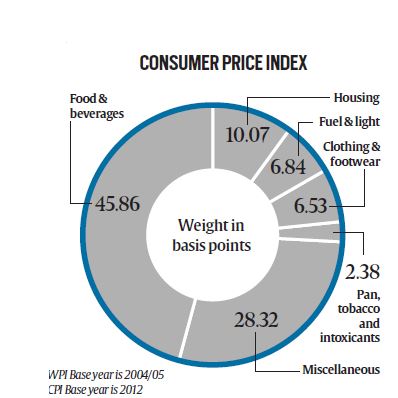
Source- firstpost
Basket:
These broad categories are further divided into subcategories but that’s not important. What is important is that about 46% weight is given to food items and any increase in food prices will lead to increase in CPI inflation.
Other point to note is that health, education etc services are also there in CPI basket. we shall later see services are not in WPI basket and thus CPI gauges services inflation as well.
But food prices are highly volatile as food products can’t be stored for long and prices depend on agriculture output. Also food is an essential good and people will buy food no matter what the food prices are, food inflation is not much affected by central bank policies. It’s a supply side issue.
Similar is the case with fuel prices which are highly volatile.
When we remove these components from overall inflation, we get core inflation
Core CPI =Headline CPI MINUS (food and fuel components.)
Why is overall inflation called Headline Inflation?
That is what newspaper headlines report
Because consumption basket of rural and urban areas are different, CPI inflation is calculated separately for rural and urban areas.
CPI (rural) and CPI (urban) both have same 2012 base with slightly different weightage. For instance Rural CPI doesn’t consider Housing inflation. Weightage of food items is about higher in rural areas. Weighted average of CPI(R) and CPI(U) gives overall CPI inflation.
Earlier we used to calculate 4 different categories of CPI inflation
Agricultural Labourer (AL)
Rural Labourer (RL)
Industrial Workers (IW)
Urban Non-Manual Employees (UNME)
First 3 computed by Labour bureau, as you can guess and the last one by CSO. We continue to compute these indices but focus now is on CPI (rural), CPI (Urban) and overall CPI
Why is CPI important-
It directly affects what consumers pay to buy a select basket of goods and services. It is thus better indicator of the cost of living and, hence, reflecting the welfare objective of monetary policy.
Let’s now take a look at Wholesale Price Index (WPI) inflation.
As the name suggests it computes price rise at the level of goods and services sold at wholesale level
Base Year : 2004
Calculated by Economic Adviser in the commerce ministry using same Laspeyres formula
Source- firstpost
Basket
Primary Articles include food, non food and minerals
Weightage of food items in WPI is weightage of primary food articles (cereal, pulses etc) + weightage of manufactured food items (ice cream, ghee, butter etc)
14% + 10% = 24%
Core WPI ignore Food and Fuel (volatile components)
Core WPI is WPI of Non-food manufacturing industries
Note here that WPI does not take into account inflation in services sector such as education, health etc. while 65% of our GDP comes from services sector i.e. it does not give complete picture of price rise in the economy.
In spite of that, RBI used to focus on WPI earlier as CPI basket and base year was not frequently revised and data set was not robust but after the signing of monetary policy framework RBI has decided to focus on CPI as it directly affects consumers and thus better indicator for policy formulation.
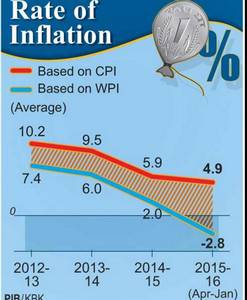
But if RBI is to focus on CPI only, what’s the importance of WPI and why so much divergence with WPI in negative and CPI 5% in positive.
WPICPI divergence Source-economic survey
Statistical difference –
inclusion of services in CPI
Different weightage to different items with food occupying highest weightage in CPI and food inflation being higher
While reduced crude prices leading to negative WPI
2. Transaction costs – Middlemen might have increased their profit margin
3. Taxes – Indirect taxes
If same item has higher inflation in CPI than WPI, possible reason could be higher margins and govt can target that area to bring down inflation.
Other measure of inflation is GDP deflator which we understood in this article
What is Produce Price Index (PPI)
PPI is inflation at producer level without any tax component
Advantage of PPI over WPI
Majority of the OECD countries measure inflation based on PPI (International Best Practice)
WPI includes taxes while PPI tracks inflation minus tax component
PPI will track average change over time in selling prices received by domestic producers for their output for both goods and services while WPI tracks transaction only at the wholesale level for goods.
Govt set up a committee headed by Professor BN Goldar to devise PPI.
Earlier two separate groups headed by Abhijit Sen and Saumitra Chaudhuri underscored the importance of PPI but felt that more work and data was needed to fully construct PPI.
Let’s understand some other terms associated with inflation
Deflation- Opposite of inflation i.e. general decline in prices. it is generally associated with contracting economy i.e. recession and is much more dangerous than inflation.
Disinflation-Slow down in the rate of inflation i.e. prices are still rising but as the lower pace. Eg. If inflation rate was 10%, 2 years back, 8% last year and, 6% this year, economy is said to be in disinflation.
Hyperinflation– Very high and accelerating inflation which cause people to severely curtail their use of the currency as currency simply becomes worthless. For instance in Germany after 1st world war or in Zimbabwe a few years back. Prices rise 10% or more month on month.
stagnation plus inflation i.e. inflation in a stagnating economy. Generally inflation is associated with a booming, high growth economy but when economy is contracting, growth rates are coming down, unemployment is rising and there is high inflation , it is called stagflation.
What are the causes of inflation?
Essentially there is more amount of money to buy limited amount of goods and services leading to rise in prices (demand supply mismatch). It could be due to following reasons-
Demand pull inflation – increases in aggregate demand due to increased private and government spending. Thus high fiscal deficits, high subsidies lead to demand pull inflation.
Cost push inflation– also called “supply shock inflation,” is caused by a drop in aggregate supply. This may be due to natural disasters, or increased prices of inputs. For example, a sudden decrease in the supply of oil, leading to increased oil prices, can cause cost-push inflation. Producers for whom oil is a part of their costs could then pass this on to consumers in the form of increased prices. Another example could be inflation due to high administered prices due to high MSP.
Monetary policy can mainly control demand pull inflation by raising interest rates, tightening liquidity thus reducing amount of money available. Supply side inflation is difficult to control by monetary authorities and in case of India main cause of inflation is high food prices which is a supply side issue due to rigidities in agriculture markets. Then why does RBI raise interest rate when inflation is due to supply side issues such as high food prices?
Here comes the role of 3rd factor-
3. Built in inflation is induced by adaptive expectations, and is often linked to the price-wage spiral. Essentially workers try to keep their wages up with prices (above the rate of inflation), and firms pass these higher labor costs on to their customers as higher prices, leading to a ‘vicious circle’.
Wage-Price Spiral Source – abahe.co.uk
RBI raises rates to break this vicious circle.
For this very reason, RBI conducts survey of inflationary expectations and latest surveys suggest in spite of inflation being down to 5%, expectations are of double digit inflation due to very high inflation for a prolonged period.
Let’s now understand effects of inflation
General Effects –
As same amount of money buys less goods, purchasing power of currency comes down, currency depreciates in international exchange rate market. How? Learn here
It benefit borrowers or debtors as in real terms they have to repay less amount in real terms while it hurts creditors or savers.
Year
Borrowed/ lent
Inflation
Apple price
Real amount Borrowed/ returned
2010
1000
No data
100
10 kg
2011
1000
10%
110
9 .1 kg
You can clearly see, borrower/ debtor has to return less in real term, thus advantage debtor/and disadvantage creditor / bond holder.
Negative effect-
Uncertainty about future rate of inflation makes it difficult to conclude business deals, affects investment.
Savers tend to park their money in fixed assets, financial savings fall. One of the reason for gold rush in India was high inflation.
Hurts poor the most as they are not able to bargain for higher wages to keep up with the rising prices
Hoarding– to take advantage of higher prices in future, this furthers inflation and vicious cycle starts. Recall the case of pulse hoarders when pulse prices were shooting up.
Finally there is always that risk of inflation going out of control resulting in hyperinflationary situation which can cripple the whole economy
Positives
1.Most important positive is that it avoids deflationary tendencies which is the worst
Effects of deflation
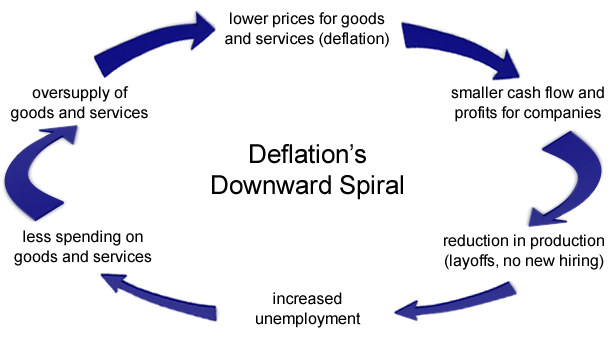
As we saw above, it harms borrowers resulting in inability to repay loans. Companies and banks collapse
While in inflation people start hoarding, here people postpone their purchases in the expectation of future fall in prices. If nobody buys, demand goes down and economy goes under recession resulting in job losses and high unemployment
Source-investinganswers
Labour-market adjustments- Nominal wages are slow to adjust downwards. Since inflation allows real wages to fall even if nominal wages are kept constant, moderate inflation enables labor markets to reach equilibrium faster.
Consider this, real salary has decreased but person would feel he had been awarded 8% pay hike.
Year
Nominal salary
Inflation
Apple price
Real salary in apples
2010
1000
No data
100
10 kg
2011
1080
20%
120
9 kg
But if there were no inflation, he would have resisted wage decline, though it would have been same, worth 9 kg apples.
Year
Nominal salary
Inflation
Apple price
Real salary in apples
2010
1000
No data
100
10 kg
2011
900
0
100
9 kg
In emerging economies such as India, structure of economy changes rapidly and thus more frequent churning and adjustment in labour market is required. It is for this reason that inflation level of 4-6% is considered healthy in emerging economies while most advanced economies don’t like inflation beyond 2%.
Inflation especially demand pull inflation is associated with high growth and low unemployment. As demand rises, industries increase their production leading to higher growth and employment. This holds true only for short term.
A few more terms before we wind up our discussion –
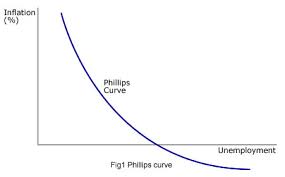
Phillips curve is a historical inverse relationship between rates of unemployment and corresponding rates of inflation.
Misery index – the sum of the inflation and unemployment rates
Modified misery index – sum of the interest, inflation, and unemployment rates, minus the year-over-year percent change in per-capita GDP growth
In the next article we shall discuss tools available with government and RBI to control inflation and why monetary policy transmission is very poor in India.
Now it’s time to solve a few questions asked in previous years IAS prelims-
#1. Which of the following brings out the ‘Consumer Price Index Number for Industrial Workers? (IAS pre 2015)
(a) The Reserve Bank of India
(b) The Department of Economic Affairs
(c) The Labour Bureau
(d) The Department of Personnel and Training
#2. A rise in general level of prices may be caused by
an increase in the money supply
a decrease in the aggregate level of output
an increase in the effective demand
Select the correct answer using the codes given below.
1 only
1 and 2 only
2 and 3 only
1, 2 and 3
#3. Consider the following statements: (IAS Pre 2014)
Inflation benefits the debtors.
Inflation benefits the bond-holders.
Which of the statements given above is/are correct?
1 only
2 only
Both 1 and 2
Neither 1 nor 2
#4. India has experienced persistent and high food inflation in the recent past. What could be the reasons?(2011)
Due to a gradual switchover to the cultivation of commercial crops, the area under the cultivation of food grains has steadily decreased in the last five years by about 30%.
As a consequence of increasing incomes, the consumption patterns of the% people have undergone a significant change.
The food supply chain has structural constraints.
Which of the statements given above are correct?
(a.) 1 and 2 only
(b.) 2 and 3 only
(c.) 1 and 3 only
(d.) 1, 2 and 3
#5. A rapid increase in the rate of inflation is sometimes attributed to the “base effect”. What is “base effect”?(2011)
(a.) It is the impact of drastic deficiency in supply due to failure of crops
(b.) It is the impact of the surge in demand due to rapid economic growth
(c.) It is the impact of the price levels of previous year on the calculation of inflation rate
(d.)None of the statements (a), (b) and (c) ‘given above is correct in this context
#6. Economic growth is usually coupled with (2011)