In this section, we will deal with the issue which is of critical importance to the growth of every economy – Financial Sector Reforms.
Take a look at overall approach of govt. towards financial sector reforms:
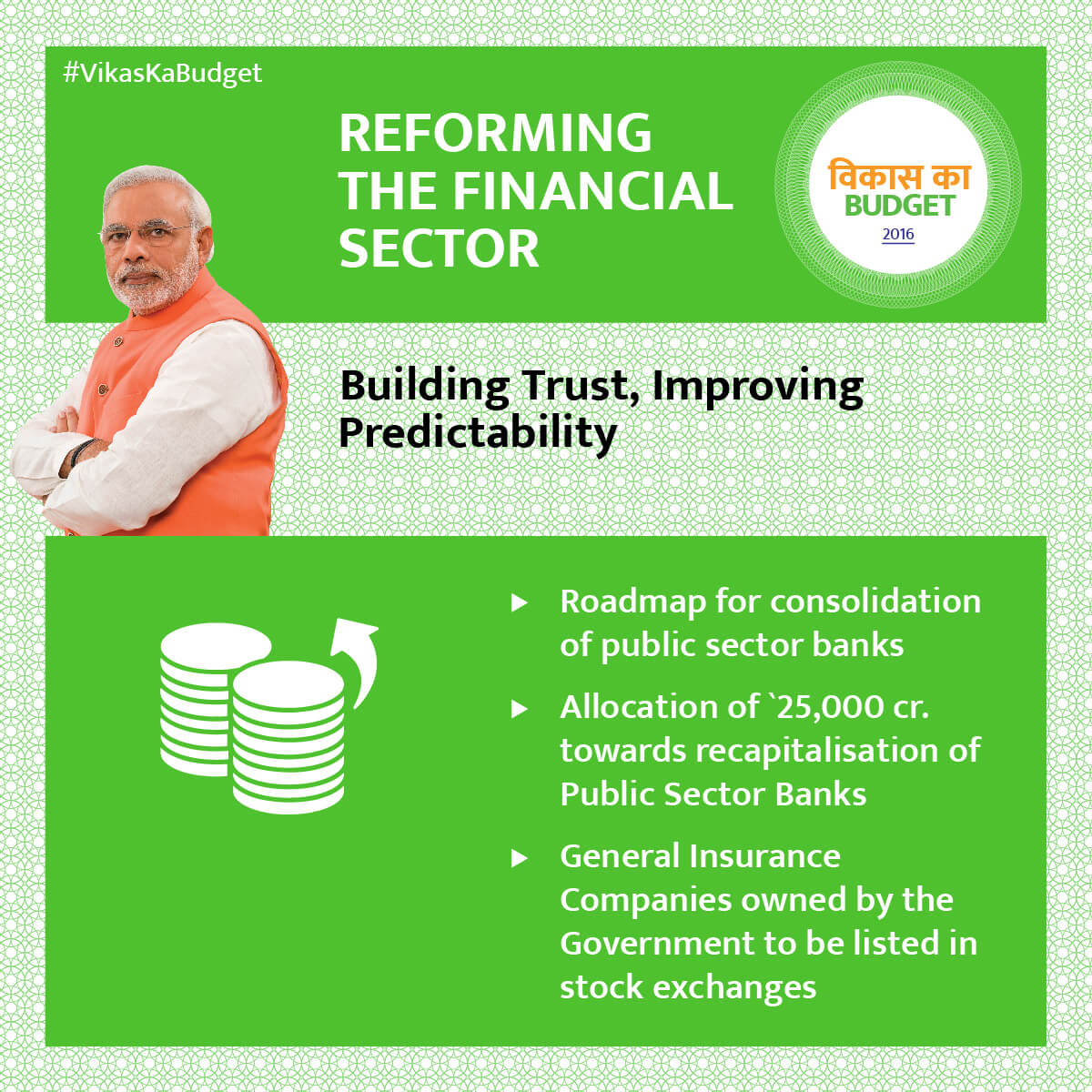
Rs 25,000 crore towards recapitalisation of public sector banks
Target of disbursement under MUDRA increased to 1,80,000 crore
Banking Board Bureau to be operationalised
General Insurance companies will be listed in the stock exchange
Focus Areas
Monetary Policy Committee
Govt. will amend RBI Act 1934, to provide statutory basis for a Monetary Policy Framework and a Monetary Policy Committee through the Finance Bill 2016.
Capital Market
RBI will improve greater retail participation in govt securities
SEBI will develop new derivative products in the commodity derivatives market
Revamping Public Sector Banks
Govt. to allocate Rs. 25000 crore towards recapitalization of public sector banks
The Debt Recovery Tribunals will be strengthened with focus on improving the existing infrastructure for speedier resolution of stressed assets
Efforts are made to address structural issues in various sectors like Power, Coal, Highways, Sugar and Steel, with a focus on reviving stalled projects
Govt. had launched this scheme for the benefit of bottom of the pyramid entrepreneurs. Banks and NBFC-MFIs have sanctioned about Rs. 1 lakh crore to over 2.5 crore borrowers under PMMY. Govt. has increased the target next year to Rs. 1,80,000 crore.
Govt. will introduce a comprehensive Code on Resolution of Financial Firms as a Bill, in order to provide a specialised resolution mechanism to deal with bankruptcy situations in banks, insurance companies and financial sector entities
Govt. will bring in a comprehensive central legislation to deal with the menace of illicit deposit taking schemes as poor and the financially illiterate are the worst-victims.
Amendments in SARFAESI Act, 2002
Govt. will bring necessary amendments in the SARFAESI Act 2002, tackle the problem of stressed assets in the banking sector. It will enable the sponsor of an Asset Reconstruction Companies to hold up to 100% stake in it and permit non-institutional investors to invest in Securitization Receipts.
Financial Data Management Centre
The centre will be set up under the aegis of the Financial Stability Development Council to facilitate integrated data aggregation and analysis in the financial sector.
What’s Financial Stability Development Council?
The idea to create such a super regulatory body was first mooted by the Raghuram Rajan Committee in 2008. Finally in 2010, the then Finance Minister of India, Pranab Mukherjee, decided to set up such an autonomous body dealing with macro prudential and financial regularities in the entire financial sector of India.
Chairperson: The Union Finance Minister of India
Post Office ATMs
To provide better access to financial services, especially in rural areas, we will undertake a massive nationwide rollout of ATMs and Micro ATMs in Post Offices over the next three years.
The general insurance companies owned by the govt will be listed in the stock exchanges, in order to promote public shareholding in govt-owned companies as a means of ensuring higher levels of transparency and accountability.
A simple act by a young IAS officer in Bihar’s Gopalganj district has set an example of how a big social change is possible even in the remotest part of rural India.
Last week, the district administration in Gopalganj was shocked to discover that a group of local residents in Kalyanpur area had banned a widow from cooking mid-day meal in the village’s middle school.
This, according to some villagers, was because of their perceived superstition that allowing a widow to cook meal for children would be a bad omen.
The Gopalganj District Magistrate, Rahul Kumar, ordered the villagers to immediately stop this practice and allow the widow to resume cooking the mid-day meal.
Kumar tweeted, “Some misled villagers opposed a widow cook and threatened to withdraw their Children from school after she was rightfully reinstated.”
The young bureaucrat then decided to visit the village and asked the widow in question to cook meal for himself. Kumar then tweeted the photo of him eating the meal cooked by the widow, who was being ostracised by a group of ‘misled’ people.
Kumar tweeted, “Sometimes u do symbolic things to overcome people’s beliefs. Asked the same widow cook to serve me the meal. (sic)”
Reviewing the functioning of the lower level of administration, Patna district magistrate Sanjay Kumar Aggarwal on Sunday took to a clerk’s job and suggested method to reduce time for completing the work.
In his two-hour visit to the legal cell of the Secretariat, Aggarwal found that 375 cases of stamp refund were pending which would take about two years to dispose.
But, the DM, who was transferred to the state capital in December last, found a way out to cut short the time and suggested how the work could be done in a month, an official statement said.
During the visit, the DM came across an employee who appeared over-aged while one of her certificates, alleged to be forged, stated that she was 55 years old. Aggarwal has instructed officials to constitute a medical board to verify her age, the statement said.
Starting Sunday, the DM decided to visit different sections of district administration once a week to improve the work culture at lower level. He has also ordered Section, Block, District and Circle officers to do the same every Tuesday and review work, it said.
Aggarwal was recently awarded by the Election Commission of India for best electoral practices during his tenure as the DM of Gaya.
India lives in villages and agriculture is the soul of Indian economy- Mahatma Gandhi
“Most of the world’s poor people earn their living from agriculture, so if we knew the economics of agriculture, we would know much of the economics of being poor.”- Theodore Schultz, Nobel laureate
As per NSS data avg annual income of the median farmer net of production costs from cultivation is less than Rs 20,000 (avg per cpaita income at current prices is about 98000 per annum in India)
Post independence agricultural success
Chronic food shortages of 1960s (recall PL 480 programme) have given way to grain self-sufficiency(not nutrition self sufficiency) despite a two-and-a-half fold increase in population.
In 1966-67, Indian wheat and milk production were just about 1/3 of US output. Contrast it with recent figures with wheat output being 60% higher than America’s, while milk output being 50% higher. (Result of green and white revolution)
This seems like a remarkable success. Then, what’s the problem with Indian agriculture?
Indian agriculture has become cereal-centric (wheat and rice production to the neglect of pulses and oil seed production even though demand for protein based items is rising)
It is regionally biased (Punjab, Haryana, western UP cornering all agri subsidies) and input-intensive, consuming generous amounts of land, water, and fertiliser
Input intensive cultivation means there is sharp decline in cultivable land available per capita as also much lower levels of water per capita
Challenge of climate change – erratic monsoon, more frequent flood and droughts
Challenge of income- As we mentioned above avg income of farmer from agriculture is just 20000 per annum.
Let’s discuss some major issues with agriculture
Productivity/ Yield- low productivity esp. in pulses is the central challenge facing Indian agriculture.
Consider the case of wheat and rice-
As already stated, Indian agriculture has become cereal centric and input intensive and these two crops are grown on most fertile tracts with irrigation facilities and corner bulk of agri support available to all crops across country. Yet, if we compare average yield of wheat and rice in India with China, we find that
avg yields of wheat is 39% below China and in case of rice 46% below that of China’s.
In wheat save for Punjab and Haryana, most states have yield lower than that of B’desh
In paddy even Punjab trails behind yield level of China while other states trail behind even B’desh.
Now if we compare productivity in pulses of which India is topmost producer, consumer as well as importer, yield gaps are even more stark.
On an avg, countries like Brazil, Nigeria, and Myanmar have higher yields
even the key pulse producing state of M.P. has 60% yield of China’s
Take home message from above analysis-
Yield gap varies among states in India and we could make rapid gains in productivity through convergence within India
For instance, in pulses, if all states were to attain even Bihar’s level of productivity, pulses production would increase by an estimated 41% on aggregate and we would be self sufficient in pulses
Why is pulses productivity so low (land related reasons)
Most of the land dedicated to growing pulses in each state is unirrigated
National output of pulses comes predominantly from un-irrigated land
Issue of Intensive use of water (problem of Indian agriculture becoming highly input intensive)
Although water is one of India’s most scarce natural resources, We use 2 to 4 times more water to produce a unit of major food crop than does China and Brazil.
We have invested in flood irrigation method (canal and tube wells) which is highly inefficient way of using water
Also despite being water scarce, we are virtually exporting water by exporting water guzzling crops such as paddy, sugarcane, cotton also meat (not exactly crop)
India now exports about 1 per cent of total available water every year (demand of 13m people)
source- wikipedia
Reason for inefficient use of water-subsidies on power and water for agriculture.
Result– water tables are declining at a rate of 0.3 meters per year
Solution- shift tosprinkler and drip irrigation and rainwater harvesting.
Leverage MGNREGA labour to build rainwater harvesting structures.
accord “infrastructure lending” status to these new technologies (infra lending status decreases cost of borrowing to invest in these technologies)
Govt. response– Convergence of various schemes under PM krishi Sinchai Yojana which will help in convergence of investments in irrigation, from water source to distribution and end-use i.e. at individual farm level.
What is drip irrigation?
source-wikipedia
A type of micro irrigation method in which perforated pipes are placed either above or slightly below ground and drip water on the roots and stems of plants, directing water more precisely to crops that need it
It reduces consumption of fertiliser (through fertigation ) and water lost to evaporation, and higher yields than traditional flood irrigation <Fertigation is the process of introducing fertiliser directly into the crop’s irrigation system.>
Problem in adoption of drip irrigation- high initial cost of purchase and the skill required for maintenance.
Solution- the increase in yields and reduction in costs of power and fertiliser use can help farmers recover the fixed cost quickly. Hence, provision for credit to farmers to adopt this technology.
But there are teething troubles in agri finance as mentioned in last year’s economic survey box-
Problem of agri finance-
40% of agri finance still by informal sector
26% by usurious moneylenders
Share of long-term finance i.e. capital loans in overall credit going down over the years (70% in 1991 to 40% in 2011)
Share of small loans decreasing (less than 2lakh rupee loan from 78% of total in 2000 to 48 % in 2011 and 10 lakh and above from 8% in 2000 to 28%in 2011) March rush (jan to march quarter) in loan disbursal i.e. loan in lean season to comply with PSL
More and more agri loans going to urban and metropolitan areas
Implication of all this is that lending to agriculture is grossly misallocated # largely to ;arge farmers # not being used for capital formation # worst of all may not even be going into agriculture.
Issue of Minimum support Price (MSP) and Procurement being cereal centric and regionally biased
while the government announces MSP for 23 crops, effective MSP-linked procurement occurs mainly for wheat, rice and cotton and indirectly for sugarcane via sugar mills
Even in these crops majority of procurement is from Punjab, Haryana, Western UP.
Poor farmers aof Rajasthan and Jharkhand are not even aware of any such MSP policy
Result– Regional disparity, excess stock of wheat and pulses and import and volatility in prices of pulses.
Solution-reorienting agriculture price policies, such that MSPs are matched by public procurement efforts towards crops that better reflect the country’s natural resource scarcities i.e. provide higher MSP for those crops which we import such as pulses and oil seeds and at the same time procure thise crops so that MSP policy is effective on the ground.
One way we discussed in chapter two was to not only taking economic but social and environmental costs and benefit into account while deciding MSP.Copy pasting from chapter two
Eg. Costs of producing cereals in Punjab and Haryana; declining water table, soil quality degradation, post harvest burning of stalks causing pollution, rich farmers getting benefits
v/s benefits from pulses; nitrogen fixation, lower import dependency etc.
For cereals a system of Price Deficiency payment can be instituted
Under this system if the price in an APMC mandi fell below the MSP then the farmer would be entitled to a maximum of, say, 50% of the difference between the MSP and the market price. This subsidy could be paid to the farmer via Direct Benefits Transfer (DBT)
For eg. If say MSP for wheat is 100 rs per kg. In present scenario, govt would procure it at 100 no matter if market demand is very low and prices some 10 rs per kg. Farmer has no incentive to switch to other crops to reflect market demand.
But in price deficiency payment, he will receive only 10 + (1/2*100-10) = 10 + 45 = 55 rs. It protects farmers while signalling him to produce crops reflecting market demand.
Issue of Agri Research and extension
Agricultural extension is the application of scientific research and new knowledge to agricultural practices through farmer education. Basically educating farmers about the latest technologies being developed in the labs i.e. lab to land linkage.
While Indian Council of Agricultural Research (ICAR) with agriculture research universities played a key role in the Green revolution. Of late agriculture research has been plagued by severe under investment and neglect.
Three key weaknesses
Agri education is weak in states due to (i) resource crunch, (ii) difficulty in attracting talented faculty, (iii) limited linkages and collaborations with international counterparts, (iv) weakening of the lab-to-land connect; and, (v) lack of innovation
Low investment in public agricultural research in India. As share of agriculture GDP, it is even less than that of Bangladesh and Indonesia
Majority (63.5 per cent) of scientists have low to very low level of productivity
Solution
There is need of instituting performance indicators in universities.
Improve investment as a proportion of agri GDP
securing participation from the private sector
instituting a system in which the winner is offered a proportionately large enough award for innovating desirable agricultural traits (such as improving pules productivity considerably) but the intellectual property rights of the innovation are transferred to the government
Leverage mobile phones to provide timely information to farmers
Leverage the potential of drones (UAVs) to provide crucial information on crop health, irrigation problems, soil variation and even pest and fungal infestations that are not apparent at eye level to farmers
Improve regulatory process to address concerns against GM crops while adapting high yielding technologies
Agriculture market segmentation
Last year’s economic survey mentions, effectively, India has not one, not 29 but thousands of agricultural markets.
Why are so many markets bad?
Whole capitalistic economy is dependent on trade, competition and specialisation and so many markets prevent that thus reduces overall welfare because it prevents gains through competition, efficient resource allocation, specialization in sub sectors (everyone has to produce everything as they can’t trade with others resulting in jack of all trades master of none) and fewer intermediaries.
If there were one common market, prices would be same from Kashmir to Kanyakumari and Dwarka to Puri (don’t add transport and storage cost please).
In USA which has a common market, maximum price variation is in case of peanuts with highest prices being 1.75 times that of lowest prices. Remarkably it is lower than India’s minimum price variation crop Tur dal.
It creates particular problem for perishables such as fruits, vegetables, onions, hence sudden and sharp spike in prices in one area while being sold at throwaway prices in some other area
Remove laws that force farmers to sell to local monopolies i.e APMC act
What you have to read for yourself
All the figures which are basically curves
Open all the hyperlinks. Learn, understand and revise
Read chapter eight A National Market for Agricultural Commodities- Some Issues and the Way Forward from last year’s economic survey to understand concepts behind need for common agri market
Ask all your doubts in the comment section below or in doubts clearing forum . All your suggestions, criticism and feedback are most welcome.
If you like what you read, show your support to Civilsdaily and give us a hi 5 at the Android Play –Click here.
Among the many requests and suggestions, one which we have been hearing for quite sometime is this:
It is difficult to find related long form writeups in Civilsdaily
To solve for this particular problem, we have introduced a new concept called Collections. Collections are a group of posts which have similar theme. This is the most efficient way to discover relevant and related content for your IAS Prep in one place.
Introducing Collections
Over the last 2 days, we sat down and reviews all the long form write-ups written in last one year and put them into collection buckets. Now that we have segregated all the related posts, open them, read through, make notes and prepare well. Click on the headlines to go to the respective collections.
Reflections and articles which help the aspirants stay on the path to conquer civil services. May contain anecdotes from in service officers or leaders from other walks of life.
Everything related to discussions, chapter summaries, key takeaways and questions around the Indian Economic Survey. Most important annual document to study for IAS Prelims and Mains (GS papers).
Everything related to discussions, policy changes, key takeaways and questions around the Annual Budget. Most useful for statistics and policy comparison for IAS Prelims and Mains.
PIB is a nodal agency of the Government of India to facilitate private media. This collection contains all the most important releases drafted over time.
Detailed explanation of some of the important judgements in India to help you understand the modern day evolution of Indian constitution. Beneficial for developing a thorough understanding for IAS Mains & interview.
Posts we think more aspirants should read. Recommended by Civilsdaily staff. For example, this post goes into the collection of CD recommends!
PS: Aspirants who requested for more frequent email updates, please check on your *promotion* tab at the gmail. Most of our emails go directly to that tab (courtesy google). Please drag and drop any one of those emails in your personal tabs so that you get all information directly in your main inbox.
Sir,while reading economic survey 1st chapter,i came across a word GVA(gross value added),so i need to know what is GVA?,how it is different from GDP and what is the significance of using it?.
First established as Indian Ocean Rim Initiative in Mauritius on March 1995 and formally launched in 1997 by the conclusion of a multilateral treaty known as the Charter of the Indian Ocean Rim Association for Regional Cooperation.
It is based on the principles of Open Regionalism for strengthening Economic Cooperation particularly on Trade Facilitation and Investment, Promotion as well as Social Development of the region.
Members:
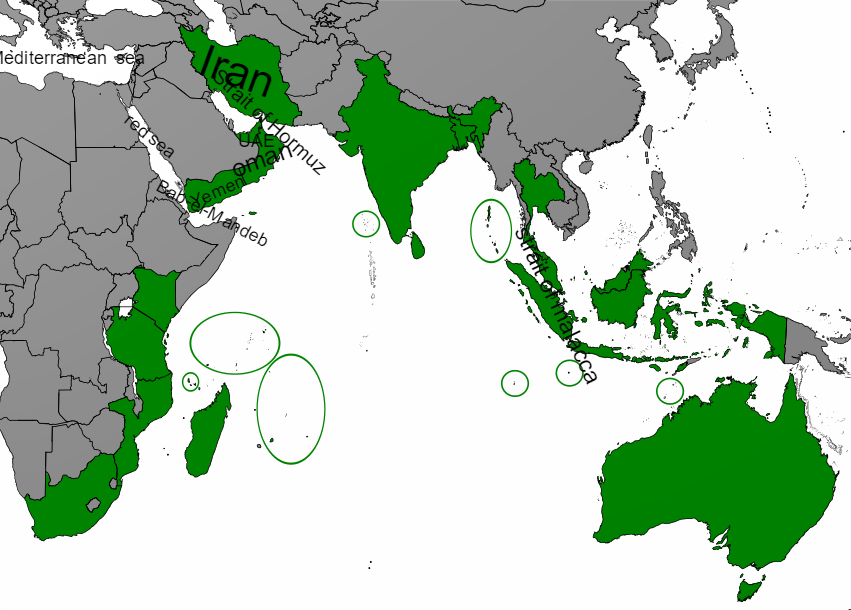
20 member states (including India) and 7 dialogue partners, the Indian Ocean Tourism Organisation and the Indian Ocean Research Group has observer status. 20th member was Comoros (latest added in 2012)
Locate all these islands and straits in your map. Source-wikipedia
Objectives:
To promote sustainable growth and balanced development of the region and member states
To focus on those areas of economic cooperation which provide maximum opportunities for development, shared interest and mutual benefits
To promote liberalisation, remove impediments and lower barriers towards a freer and enhanced flow of goods, services, investment, and technology within the Indian Ocean rim
In recent years, new and emerging issues for the better management and governance of Indian Ocean resources have begun taking shape.
Such issues include blue economy development and sectoral integration
Six priority areas:
Maritime safety and security
Trade and investment facilitation
Fisheries management
Disaster risk management
Academic science and technology cooperation
Tourism and cultural exchanges
First IORA Ministerial Blue Economy Conference –
In 2015, First IORA Ministerial Blue Economy Conference, titled as, Enhancing Blue Economy Cooperation for Sustainable Development in the IORA Region, was held in Mauritius
Blue Economy is a new comprehensive concept, incorporating the Ocean Economy, environment and sustainability to provide basic human needs such as potable water, food, jobs and habitable shelter
Conference aims to act as an ideal platform to bring together Member States and Dialogue Partners of the IORA to promote Blue Economy in the Indian Ocean region
Conference focused on 4 priority areas namely :
Fisheries & Aquaculture
Renewable Ocean Energy
Seaports & Shipping
Seabed Exploration & Minerals
China’s thrust for IORA membership: Is it push for Go Global policy?
China is the second-largest economy after the USA, among the current dialogue partners of the IORA (China, Egypt, Japan, the USA, the UK and France)
Recently, China is even reported to have expressed its interest in becoming a full member of the IORA
China’s dialogue with the IORA has been propelled by trends of globalisation and the process of regional integration, where she can play a leading role
China vigorously implements the ‘go global’ strategy by encouraging well-established Chinese enterprises to invest in and cooperate with countries in the Indian Ocean Rim region
While pushing ahead a going global strategy, China urges companies with proper capabilities to go to Indian Ocean Rim countries to invest
China would pursue active participation with the IOR-ARC in light of economic globalisation and regional economic integration
What is the real significance (geostrategic and geoeconomic) of IORA for China?
As a connector between Africa, Asia and Oceania, it is the most important transport zone, almost 80% of the global oil and liquid natural gas shipments pass through it
Three strategic chokepoints – the Strait of Hormuz, Bal-el-Mandeb and the Strait of Malacca, connect the IOR with the Persian Gulf, the Red Sea and the South China Sea resp.
They have 7 adjacent IORA member countries, namely Oman, the UAE, Iran (Strait of Hormuz), Yemen (Bal-el-Mandeb), Indonesia, Malaysia and Singapore (Strait of Malacca)
Almost 85% of China’s oil and gas supplies and most of its maritime cargo, trade and transport pass through these choke-points
Do It Yourself (DIY)– Learn more about other major choke points of the world.
Future Ahead for India
India along with IORA could transform the region, and focusing on Security and Growth for All in the Region (SAGAR), as envisioned by Prime Minister Modi during his recent visit to Mauritius.
UPSC ke Sawaal
#1. With reference to ‘Indian Ocean Rim Association for Regional Cooperation (10R-ARC)’, consider the following statements : (IAS pre 2015)
I. It was established very recently in response to incidents of piracy and accidents of oil spills.
2. It is an alliance meant for maritime security only.
Which of the statements given above is/are correct?
(a) I only
(b) 2 only
(c) Both I and 2
(d) Neither I nor 2
#2. Between India and east Asia, the navi-gation-time and distance can be greatly reduced by which of the following ? (IAS pre 2010) #importance of map marking
Deepening the Malacca straits between Malaysia and Indonesia.
Opening a new canal across the kra isthmus between the gulf of Siam and Andaman sea.
Which of the statements given above is/are correct ?
(a) 1 only. (b) 2 only. (c) Both 1 and 2. (d) Neither 1 nor 2
#3. Which one of the following can one come across if one travels through the Strait of Malacca? (IAS pre 2011) #importance of map marking
This thread is dedicated to short videos, preferably less than five minutes (can extend up to 10 if very interesting) which would add value to UPSC preparation.
Posting is simple. Just introduce the topic of video and post the youtube link. Further discussion on the subject cam commence in the thread itself.
P.S.- Don’t post political stories, motivation videos and RSTV, LSTV long 30 minutes videos. You can create separate thread for the same.
On average 16 questions are asked from economy portion and all the questions are very doable i.e. solid 32 marks you can easily get out of 105-100 needed to clear prelims i.e. solid 30% from economy alone! Unlike Environment and Biodiversity part of syllabus, there is no Greek or Latin here.
But very often when I talk to aspirants, I hear the usual refrain, I have no background in economics, my economy portion is weak, I don’t understand anything in economics and so I don’t read economics/ business section of newspaper and am not able to attempt many questions correctly in mock tests as well as actual exam.
What lies behind this mortal fear of economics?
Before starting preparation for IAS, most of us have neither read economics as a subject in school or college nor would we follow news items related to economy save for budget may be. We only watch political debates on TV
Economy section of newspaper is filled with economic jargon such as repo, SLR, CRR, core inflation, terms of trade, monetary transmission, real GDP, nominal GDP, fiscal deficit, current account deficit ..list just goes on. To average reader it doesn’t make any sense so he doesn’t care to read that section. It takes you into a vicious cycle and makes you hate economy
Economics books available in the market for UPSC preparation ain’t great. They just write anything and everything under the sun in boring mundane language. Of course we all have better things to do in life. So, people buy the recommended books, read 10 pages and never open that book again for by now they hate economics even more
Websites which simplify economics such as investopedia are not written with Indian audience in mind, people just get lost
Fundamental questions are not answered on Indian Website while useless detail is incorporated in the article. Average reader begins to rattaofy every data set and soon loses interest
We can hear you shouting, we all agree with you, that’s exactly the problem, now tell us the solution and if all books are shitty which one would you recommend. Please don’t tell us you are bringing a new book in the market.
Before we come to the solution, let’s read the syllabus in the words of UPSC
Economic and Social Development Sustainable Development, Poverty, Inclusion, Demographics, Social Sector initiatives, etc.
It does not say anything about conceptual macroeconomics but we all know therein lies the crux of matter.
We divide the conceptual part into following parts for convenience-
National income accounting; Budget and Fiscal policy,Banking and finance,RBI and monetary policy; Money Market and Stock Market; International Market, trade and balance of payment; Micro economy
So, what’s the solution?
Solution emerges from the problem my friends. Real crux of the problem is economic jargon and solution lies in dejargonising economics. We can hear you whispering, what an idiot, there are so many economic dictionaries in the market to do just that thing.
Friends problem with economic dictionary is the same as problem with normal English dictionary. You didn’t learn your vocabulary from dictionary, did you? We built our vocabulary as we kept reading. We can’t understand things without context and often the context is missing there.
So what do we recommend?
Start with NCERT class 12 Macroeconomics. This book has very very basic stuff, lots of derivations which will not be asked in exam but if you want to understand economics well, sit tight with pencil and paper and derive those equations. There are just 6 chapters, less than 100 pages yes, not even 100 pages. If you read one chapter at a time, it will take not more than two hours and in less than a week, you will be own the macroeconomics.
Read 11th standard economics book, India’s economic development. Read it like a story but try to understand important stuff like poverty, human resource development etc. It won’t take many hours.
For those who are game, read 12th standard microeconomics. It’s not a must read, sirf jinda dil logon ke liye.
Now comes the most important part.Read economy/ business section of newspaper everyday. Ask questions,why has RBI raised rates, why are industrialists clamoring for rate cut and try to answer them when you read them. It will consolidate your concepts.
Do a simple Google search whenever you come across a term you don’t understand. Still don’t understand, get it resolved here.
Having done one to six faithfully, read two volumes of Sriram Economy book. But only after doing point one to six.
But certainly NCERT won’t be sufficient for UPSC right. That’s why I said, read volume one of economic survey line to line and selective reading of volume two. Keep reading business/economy section of newspaper. Get your doubts cleared then and there.
Economics at the entry level (GS pre and mains) is the easiest subject. There’s not much to mug up and only two concepts, concept of demand and supply and that of opportunity cost. Every other principle, theorem can be derived from this concept. For instance, you think just because you don’t have to pay anything to read this article, it’s free. It has cost my friends, opportunity cost. You could be doing something else in the time if not reading the article. Why have I written this article? Simple, I feel there was demand for such an article. That’s it. These are the only concepts.
You don’t trust us, right. Don’t trust anyone. Always verify. So here is my verification. Click on separate hyperlinks
But, we would make things much simpler for you and this is what we have planned for you-
Stories and news cards related to economy are already being covered regularly. That will help you with the current economics
Economic survey will be covered very comprehensively chapter by chapter.
Concepts presented in economic survey such as genesis of various financial crises or how the flexible exchange rate system reduces the ferocity of crisis or why government plans to disband classification into plan and non plan etc., will be dealt with separately depending on use appetite
Concepts of economics will be covered in a very dynamic fashion. Everything will be dejargonisied by breaking them into component parts. Fundamental questions will be answered without cluttering the articles with useless data copy pasted from official reports. It will help you solidify your concepts but I would still recommend reading NCERT macro first.
International organisations like WTO, IMF, World Bank group will be covered under our IR series, click here
We have already pushed a few articles as back to basics. More will be available on your desk very soon. Every concept will be covered here but I would still recommend you read economic survey very carefully. More than half of your economics will be done.
We don’t recommend Dutt and Sundaram, kapadia, Mishra and Puri, Ramesh Singh are useless books. Don’t waste your time over reading those books. Wikipedia and Investopedia will give you more information in a much better way.
Economics for mains is a different story altogether but without basics, you won’t be able to do that either. We shall analyse economics for mains some other day.
If you are at a stage where you can appreciate Indian Economics discussions or annual budget discussions, do give these a read –
In this section, we will deal with the sector that holds the potential to transform India – Infrastructure and Investment Sector.
Focus Area
Road Sector
The process of road construction will be accelerated and govt. has allocated Rs. 55,000 crore in the Budget for roads and highways. Govt. will approve nearly 10,000 kms of National Highways in 2016-17 and nearly 50,000 kms of State highways will also be taken up for up-gradation as National Highways.
Govt has started a series of measures for modernizing the ports and increasing their efficiency. Govt. is planning to develop new greenfield ports both in the eastern and western coasts of the country along with expedition of National Waterways.
Govt. is drawing an action plan for revival of un-served and under-served airports. There are some 160 airports and air strips which can be revived at an indicative cost of Rs. 50 crore to Rs. 100 crore each. Union govt. will partner with the States to develop some of these airports for regional connectivity.
Govt is planning to incentivise gas production from deep-water, ultra deep-water and high pressure-high temperature areas, which are presently not exploited on account of higher cost and higher risks.
Govt. will diversify the sources of power generation for long term stability. A comprehensive plan will be prepared to augment the investment in nuclear power generation.
Govt will permit mobilisation of additional finances by various institutions such as NHAI, PFC, REC, IREDA, NABARD and Inland Water Authority to the extent of Rs. 31,300 crore through raising of bonds during 2016-17.
New Initiatives
Abolition of Permit-Raj
Govt. will bring necessary amendments in the Motor Vehicles Act and open up the road transport sector in the passenger segment. An enabling eco-system will be provided for the States which will have the choice of adopting the new legal framework. Entrepreneurs will be able to operate buses on various routes, subject to certain efficiency and safety norms.
Impact: It will lead to more efficient public transport facilities, greater public convenience, new investments, creation of new jobs, growth of start-up entrepreneurs and other multiplier effects.
Reviving the Public Private Partnership
Govt. will take various measures to revive the PPP sector:
It will introduce Public Utility (Resolution of Disputes) Bill to streamline institutional arrangements for resolution of disputes in infrastructure related construction contracts, PPP and public utility contracts
Guidelines for renegotiation of PPP Concession Agreements will be issued without compromising transparency
A new credit rating system for infrastructure projects will be developed, instead of relying upon a standard perception of risk which often result in mispriced loans
100% FDI will be allowed through FIPB route in marketing of food products produced and manufactured in India, as lot of fruits and vegetables either do not fetch the right prices or fail to reach the markets. This move will benefit farmers, give impetus to food processing industry and create vast employment opportunities.
Govt. has also proposed changes in the areas of insurance and pension, Asset Reconstruction Companies, Stock Exchanges, etc
Public Sector Enterprises
Govt. has approved a new policy for management of its investment in PSUs, including disinvestmentand strategic sale. Govt. will leverage the assets of CPSEs for generation of resources for investment in new projects. The NITI Aayog will identify the CPSEs for strategic sale.
The Department of Disinvestment is being re-named as the Department of Investment and Public Asset Management (DIPAM).
Challenge
There is a need for consolidation, starting from approval to implementation, apart from an institutional mechanism for fair pricing and competition in infrastructure policy.
Criticism
There are no big reforms or major policy turnarounds in this regard.
PS: Please click on the green hyperlinked text to read more about the concepts. Revise and revise & feel free to ask pertinent questions.