Why in the news?
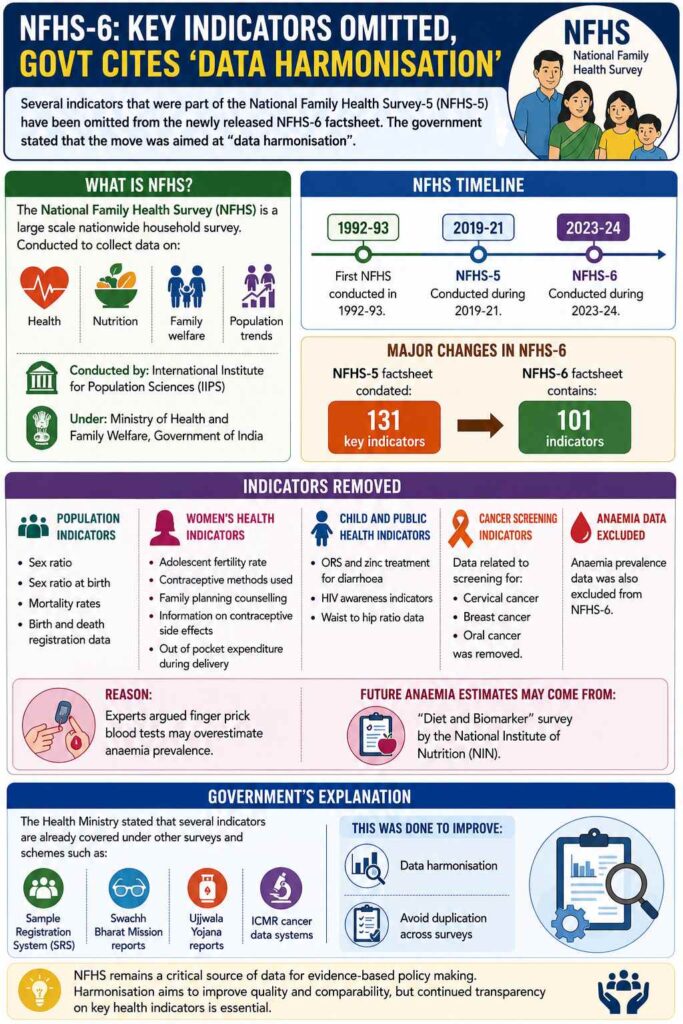
Several indicators that were part of the National Family Health Survey-5 (NFHS-5) have been omitted from the newly released NFHS-6 factsheet. The government stated that the move was aimed at “data harmonisation”.
What is NFHS?
The National Family Health Survey (NFHS) is:
- A large scale nationwide household survey.
- Conducted to collect data on:
- Health
- Nutrition
- Family welfare
- Population trends.
- Conducted by: International Institute for Population Sciences
- Under: Ministry of Health and Family Welfare
NFHS Timeline
- First NFHS conducted in 1992-93.
- NFHS-5 Conducted during 2019-21.
- NFHS-6 Conducted during 2023-24.
Major Changes in NFHS-6
- NFHS-5 factsheet contained 131 key indicators.
- NFHS-6 factsheet contains: 101 indicators.
Indicators Removed
Population Indicators
- Sex ratio
- Sex ratio at birth
- Mortality rates
- Birth and death registration data
Women’s Health Indicators
- Adolescent fertility rate
- Contraceptive methods used
- Family planning counselling
- Information on contraceptive side effects
- Out of pocket expenditure during delivery
Child and Public Health Indicators
- ORS and zinc treatment for diarrhoea
- HIV awareness indicators
- Waist to hip ratio data
Cancer Screening Indicators
Data related to screening for:
- Cervical cancer
- Breast cancer
- Oral cancer
was removed.
Anaemia Data Excluded
- Anaemia prevalence data was also excluded from NFHS-6.
- Reason: Experts argued finger prick blood tests may overestimate anaemia prevalence.
- Future anaemia estimates may come from: “Diet and Biomarker” survey by the National Institute of Nutrition.
Government’s Explanation
The Health Ministry stated that:
- Several indicators are already covered under other surveys and schemes, such as:
- Sample Registration System (SRS)
- Swachh Bharat Mission reports
- Ujjwala Yojana reports
- ICMR cancer data systems.
This was done to improve:
- Data harmonisation
- Avoid duplication across surveys.
[2024] The total fertility rate in an economy is defined as:
[A] the number of children born per 1000 people in the population in a year.
[B] the number of children born to a couple in their lifetime in a given population.
[C] the birth rate minus death rate.
[D] the average number of live births a woman would have by the end of her child-bearing age.