💥Join UPSC 2027,2028 Mentorship (July Batch) + XFactor Notes & Microthemes PDF

Author: CD Staff

  • [Prelims Spotlight] Important Keywords Regarding Budget, Fiscal Policy and Taxation


    Prelims Spotlight is a part of “Nikaalo Prelims 2020” module. This open crash course for Prelims 2020 has a private telegram group where PDFs and DDS (Daily Doubt Sessions) are being held. Please click here to register.


    24 March 2020

    Important keywords regarding budget, fiscal policy and taxation


    Annual financial statement:

    The Union Budget is the annual financial statement that contains the government’s revenue and expenditure for a fiscal year.

    It may also include planned sales volumes and revenues, resource quantities, costs and expenses, assets, liabilities and cash flows.

    The statement details the revenues from all sources, and expenditure on all activities that the government will undertake for the fiscal year. The fiscal year is calculated from 1 April-31 March.

    Under Article 112 of the Constitution, the government has to present a statement of estimated revenue and expenditure for every fiscal. This statement is called the annual financial statement. This document is divided into three sections: For each of these funds, the central government is required to present a statement of revenue and expenditure.

    1. Consolidated Fund:

    The Consolidated Fund of India, created under Article 266 of the Indian Constitution, includes the revenues received by the government and expenses made by it.

    All the revenue that the government receives through direct (income tax, corporation tax etc.) or indirect tax (Goods and Services Tax or GST) go into the Consolidated Fund of India.

    Revenue from non-tax sources like dividends, profits from the PSUs, and income from general services also contribute to the fund. Recoveries of loans, earnings from disinvestment and repayment of debts issued by the Centre also contribute to the fund.

    However, no money can be withdrawn for meeting expenses until the government gets the approval of the Parliament. Examples of expenditure include wages, salaries and pension of government employees, and other fixed costs. The repayment of debts incurred by the government is also done through the Consolidated Fund of India.

    The Consolidated Fund of India is divided into five parts:

    • Revenue account – receipts,
    • Revenue account – disbursements,
    • Capital account – receipts,
    • Capital account – disbursements, and
    • Disbursements ‘charged’ on the Consolidated Fund of India.

    Disbursements ‘charged’ on the Consolidated Fund of India is a special category within the Consolidated Fund of India which is not put to vote in the Parliament.

    This means whatever comes under this category need to be paid, whether the Budget is passed or not.

    The salary and allowances of the President, speaker and deputy speaker of the Lok Sabha, chairman and deputy chairman of the Rajya Sabha, salaries and allowances of Supreme Court judges, pensions of Supreme Court and High Court judges come under this category.

    2.Contingency fund:

    Like the Consolidated Fund of India, the Contingency Fund of India constitutes a part of the annual financial statement.

    Established under Article 267(1) of the Indian Constitution, the fund is maintained by the ministry of finance on behalf of the President of India.

    As the name suggests, the Contingency Fund of India is an account maintained for meeting expenses during any unforeseen emergencies.

    Parliamentary approval for such unforeseen expenditure is obtained, ex- post-facto, and an equivalent amount is drawn from the Consolidated Fund of India to recoup the Contingency Fund after such ex-post-facto approval.

    3. Public account.

    Article 266 of the Constitution defines the Public Account as being those funds that are received on behalf of the Government of India.

    Money held by the government in a trust — such as in the case of Provident Funds, Small Savings collections, income of government set apart for expenditure on specific objects like road development, primary education, reserve/special Funds, etc — are kept in the Public Account.

    Public Account funds do not belong to the government and have to be finally paid back to the persons and authorities that deposited them.

    Parliamentary authorisation for such payments is not required.

    However, when money is withdrawn from the Consolidated Fund with the approval of Parliament and kept in the Public Account for expenditure for a specific purpose, it is submitted for a vote in Parliament.

    Appropriation bill

    Appropriation Bill is a money bill that allows the government to withdraw funds from the Consolidated Fund of India to meet its expenses during the course of a financial year.

    As per Article 114 of the Constitution, the government can withdraw money from the Consolidated Fund only after receiving approval from Parliament.

    To put it simply, the Finance Bill contains provisions on financing the expenditure of the government, and Appropriation Bill specifies the quantum and purpose for withdrawing money.

    Vote-on-account

    The Constitution says that no money can be withdrawn by the government from the Consolidated Fund of India except under appropriation made by law.

    For that, an appropriation bill is passed during the Budget process.

    However, the appropriation bill may take time to pass through the Parliament and become a law. Meanwhile, the government would need permission to spend even a single penny from April 1 when the new financial year starts.

    Vote on the account is the permission to withdraw money from the Consolidated Fund of India in that period, usually two months.

    Vote on the account is a formality and requires no debate. When elections are scheduled a few months into the new financial year, the government seeks vote on account for four months. Essentially, vote on account is the interim permission of the parliament to the government to spend money.

    Corporation tax:

    Corporation tax is a direct tax imposed on the net income or profit that enterprises make from their businesses. Companies, both public and privately registered in India under the Companies Act 1956, are liable to pay corporation tax. This tax is levied at a specific rate according to the provisions of the Income Tax Act, 1961.

    Fringe benefits tax (FBT):
    The taxation of perquisites – or fringe benefits – provided by an employer to his employees, in addition to the cash salary or wages paid, is fringe benefits tax. It was introduced in Budget 2005-06. The government felt many companies were disguising perquisites such as club facilities as ordinary business expenses, which escaped taxation altogether. Employers have to now pay FBT on a percentage of the expense incurred on such perquisites.

    Direct Tax:

    A direct tax is paid directly by an individual or organization to the imposing entity. A taxpayer, for example, pays direct taxes to the government for different purposes, including real property tax, personal property tax, income tax, or taxes on assets. Direct taxes are based on the ability-to-pay principle. This economic principle states that those who have more resources or earn a higher income should pay more taxes.

    Indirect Tax
    In the case of indirect taxes, the incidence of tax is usually not on the person who pays the tax. These are largely taxes on expenditure and include Customs, excise and service tax.

    Indirect taxes are considered regressive, the burden on the rich and the poor is alike. That is why governments strive to raise a higher proportion of taxes through direct taxes. Moving on, we come to the next important receipt item in the revenue account, non-tax revenue.

    Non-tax revenue:

    Other than taxation being a primary source of income, the government also earns a recurring income, which is called non-tax revenue. While sources of tax revenue are few, the sources of non-tax revenue are many, with the number of collections per source. Although there are many sources of non-tax revenue, the amount per source is much less than that for tax revenue.

    For example, when citizens use services offered by the government, they pay bills, which are categorised as non-tax revenue, as the government provides infrastructure support to implement the services. Non-tax revenue also includes the interest collected by the government on the loans or funds offered to states.

    Grants-in-aid and contributions
    The third receipt item in the revenue account is relatively small grants-in-aid and contributions. These are in the nature of pure transfers to the government without any repayment obligation.
    These include expense incurred on organs of state such as Parliament, judiciary and elections. A substantial amount goes into administering fiscal services such as tax collection. The biggest item is the interest payment on loans taken by the government. Defence and other services like police also get a sizeable share. Having looked at receipts and expenditure on revenue account we come to an important item, the difference between the two, the revenue deficit.

    Revenue deficit:

    Revenue deficit arises when the government’s revenue expenditure exceeds the total revenue receipts.

    Revenue deficit includes those transactions that have a direct impact on a government’s current income and expenditure. This represents that the government’s own earnings are not sufficient to meet the day-to-day operations of its departments. Revenue deficit turns into borrowings when the government spends more than what it earns and has to resort to the external borrowings.

                   Revenue Deficit= Total revenue receipts – Total revenue expenditure.

    Revenue Deficit deals only with the government’s revenue receipts and revenue expenditures.

    Note that revenue receipts are receipts which neither create liability nor lead to a reduction in assets.

    It is further divided into two heads:

    • Receipt from Tax (Direct Tax,  Indirect Tax)
    • Receipts from Non-Tax Revenue

    Revenue Expenditure is referred to as the expenditure that does not result in the creation of assets reduction of liabilities. It is further divided into two types

    • Plan revenue expenditure
    • Non-plan revenue expenditure

    Fiscal Deficit:
    The fiscal deficit is defined as an excess of total budget expenditure over total budget receipts excluding borrowings during a fiscal year. In simple words, it is the amount of borrowing the government has to resort to meet its expenses. A large deficit means a large amount of borrowing. The fiscal deficit is a measure of how much the government needs to borrow from the market to meet its expenditure when its resources are inadequate.

    Primary deficit:

    Primary deficit is defined as a fiscal deficit of current year minus interest payments on previous borrowings.

             Primary deficit= Fiscal deficit – Interest payment on the previous borrowing

    In other words, whereas fiscal deficit indicates borrowing requirement inclusive of interest payment, the primary deficit indicates borrowing requirement exclusive of interest payment (i.e., amount of loan).

    We have seen that borrowing requirement of the government includes not only accumulated debt, but also interest payment on the debt. If we deduct ‘interest payment on debt’ from borrowing, the balance is called the primary deficit.

    Public debt:

    Public debt receipts and public debt disbursals are borrowings and repayments during the year, respectively. The difference is the net accretion to the public debt. Public debt can be split into internal (money borrowed within the country) and external (funds borrowed from non-Indian sources). Internal debt comprises treasury bills, market stabilisation schemes, ways and means advance, and securities against small savings.

    Ways and means advance (WMA):

    One of RBI’s roles is to serve as banker to both central and state governments. In this capacity, RBI provides temporary support to tide over mismatches in their receipts and payments in the form of ways and means advances.

    CESS:
    This is an additional levy on the basic tax liability. Governments resort to cess for meeting specific expenditure.

    Dividend distribution tax:

    A dividend is a return given by a company to its shareholders out of the profits earned by the company in a particular year. Dividend constitutes income in the hands of the shareholders which ideally should be subject to income tax.

    However, the income tax laws in India provided for an exemption of the dividend income received from Indian companies by the investors by levying a tax called the Dividend Distribution Tax (DDT) on the company paying the dividend. This tax has been abolished in the 2020-21 budget.

    FRBM Act 2003:

    The Fiscal Responsibility and Budget Management Act (FRBM Act), 2003, establishes financial discipline to reduce the fiscal deficit.

    What are the objectives of the FRBM Act?

    The FRBM Act aims to introduce transparency in India’s fiscal management systems. The Act’s long-term objective is for India to achieve fiscal stability and to give the Reserve Bank of India (RBI) flexibility to deal with inflation in India. The FRBM Act was enacted to introduce a more equitable distribution of India’s debt over the years.

    Key features of the FRBM Act

    The FRBM Act made it mandatory for the government to place the following along with the Union Budget documents in Parliament annually:

    1. Medium Term Fiscal Policy Statement

    2. Macroeconomic Framework Statement

    3. Fiscal Policy Strategy Statement

    The FRBM Act proposed that revenue deficit, fiscal deficit, tax revenue and the total outstanding liabilities be projected as a percentage of gross domestic product (GDP) in the medium-term fiscal policy statement.


  • [Prelims Spotlight] Important keyword related to various economic Indicators


    Prelims Spotlight is a part of “Nikaalo Prelims 2020” module. This open crash course for Prelims 2020 has a private telegram group where PDFs and DDS (Daily Doubt Sessions) are being held. Please click here to register.


    23 March 2020

    Important Keywords related to Various Economic Indicators

    Economic indicators are key stats about the economy that can help you better understand where the economy is headed. Here are several of the different types of economic indicators and how they may be used to understand the state of the economy. The most frequently used economic indicators are- GDP, The Stock Market, Unemployment, Consumer Price Index, Balance of Trade, Interest rate, Currency strength, Income and Wages etc.

    Types of Economic Indicators

    There are three types of economic indicators: leading, lagging and coincident.

    1. Leading indicators point to future changes in the economy. They are extremely useful for short-term predictions of economic developments because they usually change before the economy changes.
    2. Lagging indicators usually come after the economy changes. They are generally most helpful when used to confirm specific patterns. You can make economic predictions based on the patterns, but lagging indicators cannot be used to directly predict economic change.
    3. Coincident indicators provide valuable information about the current state of the economy within a particular area because they happen at the same time as the changes they signal.

    Terms to economic indicators

    Asset turnover ratio-

     Asset turnover ratio is the ratio between the value of a company’s sales or revenues and the value of its assets. It is an indicator of the efficiency with which a company is deploying its assets to produce the revenue.

    Amortisation

    The running down or payment of a loan by instalments. An example is a repayment mortgage on a house, which is amortised by making monthly payments that over a pre-agreed period of time cover the value of the loan plus interest. With loans that are not amortised, the borrower pays the only interest during the period of the loan and then repays the sum borrowed in full.

    Appreciation

    A rise in the value of an asset and the opposite of depreciation. When the value of a currency rises relative to another, it appreciates.

    Balance of payment-

    The total of all the money coming into a country from abroad less all of the money going out of the country during the same period. This is usually broken down into the current account and the capital account. The current account includes:

    *visible trade (known as merchandise trade), which is the value of exports and imports of physical goods;

    *invisible trade, which is receipts and payments for services, such as banking or advertising, and other intangible goods, such as copyrights, as well as cross-border dividend and interest payments;

    *private transfers, such as money sent home by expatriate workers;

    *official transfers, such as international aid.

    The capital account includes:

    *long-term capital flows, such as money invested in foreign firms, and profits made by selling those investments and bringing the money home;

    *short-term capital flows, such as money invested in foreign currencies by international speculators, and funds moved around the world for business purposes by multinational companies. These short-term flows can lead to sharp movements in exchange rates, which bear little relation to what currencies should be worth judging by fundamental measures of value such as purchasing power parity.

    As bills must be paid, ultimately a country’s accounts must balance (although because real life is never that neat a balancing item is usually inserted to cover up the inconsistencies).

    According to the RBI, the balance of payment is a statistical statement that shows

    1. The transaction in goods, services and income between an economy and the rest of the world,

    2. Changes of ownership and other changes in that economy’s monetary gold, special drawing rights (SDRs), and financial claims on and liabilities to the rest of the world, and

    3. Unrequited transfers.

    Balanced Budget

    When total public-sector spending equals total government income during the same period from taxes and charges for public services. Politicians in some countries, such as the United States, have argued that the government should be required to run a balanced budget in order to have sound public finances. However, there is no economic reason why public borrowing needs necessarily be bad. For instance, if the debt is used to invest in things that will increase the growth rate of the economy–infrastructure, say, or education–it may be justified. It may also make more economic sense to try to balance the budget on average over an entire economic cycle, with public-sector deficits boosting the economy during recession and surpluses stopping it overheating during booms than to balance it every year.

    Bank rate-

    Bank rate is the rate charged by the central bank for lending funds to commercial banks.

    Base rate-

    Base rate is the minimum rate set by the Reserve Bank of India below which banks are not allowed to lend to its customers.

    Basis point

    One one-hundredth of a percentage point. Small movements in the interest rate, the exchange rate and bond yields are often described in terms of basis points. If a bond yield moves from 5.25% to 5.45%, it has risen by 20 basis points.

    Broad money to reserve money

    It is a measure of the money multiplier. Money multiplier shows the mechanism by which reserve money creates money supply in the economy. It is again dependent on two variables, namely the currency deposit ratio and reserve deposit ratio.

    It is a measure of the money multiplier. Money multiplier shows the mechanism by which reserve money creates money supply in the economy. It is again dependent on two variables, namely the currency deposit ratio and reserve deposit ratio.

    Bubble-

    When the price of an asset rises far higher than can be explained by fundamentals, such as the income likely to derive from holding the asset.

    Capacity cost-

    An expenditure or cost incurred by a company in order to expand its business operations. In other words, these are expenses incurred by an organization to increase its capacity to conduct business operations.

    Capital account

    The capital account can be regarded as one of the primary components of the balance of payments of a nation. It gives a summary of the capital expenditure and income for a country.

    The capital expenditure and income is tracked by way of funds in the form of investments and loans flowing in and out of an economy. This account comprises foreign direct investments, portfolio investments, etc. It gives a summary of the net flow of both private and public investment into an economy.

    A capital account deficit shows that more money is flowing out of the economy along with an increase in its ownership of foreign assets and vice-versa in case of a surplus. The balance of payments contains the current account (which provides a summary of the trade of goods and services) in addition to the capital account which records all capital transactions.

    Capital adequacy ratio

    The ratio of a BANK’s CAPITAL to its total ASSETS, required by regulators to be above a minimum (“adequate”) level so that there is little RISK of the bank going bust. How high this minimum level is may vary according to how risky a bank’s activities are.

    Capital flight

    When CAPITAL flows rapidly out of a country, usually because something happens which causes investors suddenly to lose confidence in its economy. (Strictly speaking, the problem is not so much the MONEY leaving, but rather that investors in general suddenly lower their valuation of all the assets of the country.) This is particularly worrying when the flight capital belongs to the country’s own citizens. This is often associated with a sharp fall in the EXCHANGE RATE of the abandoned country’s currency.

    Capital gains

    The PROFIT from the sale of a capital ASSET, such as a SHARE or a property. Capital gains are subject to TAXATION in most countries. Some economists argue that capital gains should be taxed lightly (if at all) compared with other sources of INCOME. They argue that the less tax is levied on capital gains, the greater is the incentive to put capital to productive use. Put another way, capital gains tax is effectively a tax on CAPITALISM. However, if capital gains are given too friendly a treatment by the tax authorities, accountants will no doubt invent all sorts of creative ways to disguise other income as capital gains.

    Call money rate-

    Call money rate is the rate at which short term funds are borrowed and lent in the money market.
    The duration of the call money loan is 1 day. Banks resort to these type of loans to fill the asset-liability mismatch, comply with the statutory CRR and SLR requirements and to meet the sudden demand of funds. RBI, banks, primary dealers etc are the participants of the call money market. Demand and supply of liquidity affect the call money rate. A tight liquidity condition leads to a rise in call money rate and vice versa.

    Consumer surplus-

    Consumer surplus is defined as the difference between the consumers’ willingness to pay for a commodity and the actual price paid by them, or the equilibrium price.

    Total social surplus is composed of consumer surplus and producer surplus. It is a measure of consumer satisfaction in terms of utility.

    Graphically, it can be determined as the area below the demand curve (which represents the consumer’s willingness to pay for a good at different prices) and above the price line. It reflects the benefit gained from the transaction based on the value the consumer places on the good. It is positive when what the consumer is willing to pay for the commodity is greater than the actual price.

    Consumer surplus is infinite when the demand curve is inelastic and zero in case of a perfectly elastic demand curve.

    Contractionary policy

    Contractionary policy is a kind of policy which lays emphasis on reduction in the level of money supply for lesser spending and investment thereafter so as to slow down an economy.

    Core inflation

    An inflation measure which excludes transitory or temporary price volatility as in the case of some commodities such as food items, energy products etc. It reflects the inflation trend in an economy.

    Cost-push inflation

    Cost-push inflation is inflation caused by an increase in prices of inputs like labour, raw material, etc. The increased price of the factors of production leads to a decreased supply of these goods. While the demand remains constant, the prices of commodities increase causing a rise in the overall price level. This is in essence cost-push inflation.

    Countervailing Duties

    Duties that are imposed in order to counter the negative impact of import subsidies to protect domestic producers are called countervailing duties.

    In cases foreign producers attempt to subsidize the goods being exported by them so that it causes domestic production to suffer because of a shift in domestic demand towards cheaper imported goods, the government makes mandatory the payment of a countervailing duty on the import of such goods to the domestic economy.

    This raises the price of these goods leading to domestic goods again being equally competitive and attractive. Thus, domestic businesses are cushioned. These duties can be imposed under the specifications given by the WTO (World Trade Organization) after the investigation finds that exporters are engaged in dumping. These are also known as anti-dumping duties.

    Collateral

    An ASSET pledged by a borrower that may be seized by a lender to recover the value of a loan if the borrower fails to meet the required INTEREST charges or repayments.

    Crowding out effect

    A situation when increased interest rates lead to a reduction in private investment spending such that it dampens the initial increase of total investment spending is called crowding out effect.

    Sometimes, the government adopts an expansionary fiscal policy stance and increases its spending to boost economic activity. This leads to an increase in interest rates. Increased interest rates affect private investment decisions. A high magnitude of the crowding-out effect may even lead to lesser income in the economy.

    Currency Deposit ratio

    The currency deposit ratio shows the amount of currency that people hold as a proportion of aggregate deposits.

    Deflation

    When the overall price level decreases so that inflation rate becomes negative, it is called deflation. It is the opposite of the often-encountered inflation.

    Depreciation

    The monetary value of an asset decreases over time due to use, wear and tear or obsolescence. This decrease is measured as depreciation.

    Depression

    Depression is defined as a severe and prolonged recession. A recession is a situation of declining economic activity. Declining economic activity is characterized by falling output and employment levels. Generally, when an economy continues to suffer a recession for two or more quarters, it is called depression.

    The level of productivity in an economy falls significantly during a depression. Both the GDP (gross domestic product) and GNP (gross national product) show a negative growth along with greater business failures and unemployment.

    When a recession continues to take its toll on any economy, the built-in process triggers further cuts in investment as well as consumption spending due to loss of confidence among investors and consumers. Also, the financial crisis may lead to decreased availability for credit. Excessive fluctuations happen in the relative value of the currency. Overall trade and commerce get reduced. The Great Depression of 1929 is considered to be the most classic example of depression in economic history.

    ETF

    ETFs or exchange-traded funds are similar to index mutual funds. However, they trade just like stocks.

    ETFs were started in 2001 in India. They comprise a portfolio of equity, bonds and trade close to its net asset value. These funds mainly track an index, a commodity, or a pool of assets.

    They have the following advantages over mutual funds and equity/debt funds:

    1. Lower Costs: An investor who buys an ETF doesn’t have to pay an advisory/management fee to the fund manager and taxes are relatively lower in ETFs.

    2. Lower Holding Costs: As commodity ETFs are widely traded in, there isn’t any physical delivery of the commodity. The investor is just provided with an ETF certificate, similar to a stock certificate.

    Gross Domestic Saving

    Gross Domestic Saving is GDP minus the final consumption expenditure. It is expressed as a percentage of GDP.

    Gross National Product

    Gross National Product (GNP) is the Gross Domestic Product (GDP) plus net factor income from abroad.

    GNP measures the monetary value of all the finished goods and services produced by the country’s factors of production irrespective of their location. Only the finished or final goods are considered as factoring intermediate goods used for manufacturing would amount to double counting. It includes taxes but does not include subsidies.

    Inferior goods

    An inferior good is a type of good whose demand declines when income rises. In other words, the demand of inferior goods is inversely related to the income of the consumer.

    Libor

    LIBOR, the acronym for London Interbank Offer Rate, is the global reference rate for unsecured short-term borrowing in the interbank market. It acts as a benchmark for short-term interest rates. It is used for pricing of interest rate swaps, currency rate swaps as well as mortgages. It is an indicator of the health of the financial system and provides an idea of the trajectory of impending policy rates of central banks.

    LIBOR is administered by the Intercontinental Exchange or ICE. It is computed for five currencies with seven different maturities ranging from overnight to a year. The five currencies for which LIBOR is computed are Swiss franc, euro, pound sterling, Japanese yen and US dollar. ICE benchmark administration consists of 11 to 18 banks that contribute for each currency.

    Liquidity

    Liquidity means how quickly you can get your hands on your cash. In simpler terms, liquidity is to get your money whenever you need it.

    Liquidity trap

    A liquidity trap is a situation when expansionary monetary policy (increase in the money supply) does not increase the interest rate, income and hence does not stimulate economic growth.

    The liquidity trap is the extreme effect of monetary policy. It is a situation in which the general public is prepared to hold on to whatever amount of money is supplied, at a given rate of interest. They do so because of the fear of adverse events like deflation, war.

    In that case, a monetary policy carried out through open market operations has no effect on either the interest rate or the level of income. In a liquidity trap, the monetary policy is powerless to affect the interest rate.

    Marginal standing facility

    Marginal standing facility (MSF) is a window for banks to borrow from the Reserve Bank of India in an emergency situation when inter-bank liquidity dries up completely.

    Banks borrow from the central bank by pledging government securities at a rate higher than the repo rate under liquidity adjustment facility or LAF in short.

    Moral hazard

    Moral hazard is a situation in which one party gets involved in a risky event knowing that it is protected against the risk and the other party will incur the cost. It arises when both parties have incomplete information about each other.

    Net interest income

    Net interest income (NII) is the difference between the interest income a bank earns from its lending activities and the interest it pays to depositors.

    Net interest income = Interest earned – interest paid

    Net interest margin

    Net interest margin or NIM denotes the difference between the interest income earned and the interest paid by a bank or financial institution relative to its interest-earning assets like cash.

    Net interest margin = (Investment returns – interest expenses) / average earning on assets

    NIM measures the effectiveness of a company’s investment decisions, particularly for financial institutions.

    Non-performing asset

    A non-performing asset (NPA) is a loan or advance for which the principal or interest payment remained overdue for a period of 90 days.

    Banks are required to classify NPAs further into Substandard, Doubtful and Loss assets.

    1. Substandard assets: Assets which has remained NPA for a period less than or equal to 12 months.

    2. Doubtful assets: An asset would be classified as doubtful if it has remained in the substandard category for a period of 12 months.

    3. Loss assets: As per RBI, “Loss asset is considered uncollectible and of such little value that its continuance as a bankable asset is not warranted, although there may be some salvage or recovery value.”

    Phillips curve

    The inverse relationship between the unemployment rate and inflation when graphically charted is called the Phillips curve. William Phillips pioneered the concept first in his paper “The Relation between Unemployment and the Rate of Change of Money Wage Rates in the United Kingdom, 1861-1957,’ in 1958. This theory is now proven for all major economies of the world.

    Producer surplus

    Producer surplus is defined as the difference between the amount the producer is willing to supply goods for and the actual amount received by him when he makes the trade.

    Purchasing power parity

    The theory aims to determine the adjustments needed to be made in the exchange rates of two currencies to make them at par with the purchasing power of each other. In other words, the expenditure on a similar commodity must be the same in both currencies when accounted for the exchange rate. The purchasing power of each currency is determined in the process.

    Quantitative easing

    Quantitative easing is an occasionally used monetary policy, which is adopted by the government to increase the money supply in the economy in order to further increase lending by commercial banks and spending by consumers. The central bank (Read: The Reserve Bank of India) infuses a pre-determined quantity of money into the economy by buying financial assets from commercial banks and private entities. This leads to an increase in banks’ reserves.

    Real GDP at factor cost

    Real GDP is the nominal GDP after adjusting for any price changes attributable to either inflation or deflation.

     Nominal GDP or the GDP at current price can present a distorted picture of the actual growth in GDP owing to price changes. However, if we consider the price of the base year as constant and compute the GDP growth rate of the current year using that constant price, the value so arrived at will give a true picture of the actual growth rate in GDP. This measure is called the Real GDP or the GDP at a constant price. It does not factor taxes and subsidies.

    A new indicator called GDP deflator is derived by dividing nominal GDP by real GDP. It is a measure of price changes in the economy.

    Recession

    Recession is a slowdown or a massive contraction in economic activities. A significant fall in spending generally leads to a recession.

    Such a slowdown in economic activities may last for some quarters thereby completely hampering the growth of an economy. In such a situation, economic indicators such as GDP, corporate profits, employment, etc., fall.

    Recessionary gap

    This is a situation wherein the real GDP is lower than the potential GDP at the full employment level. The economy operates below the full employment level in a recessionary gap.

    A recessionary gap is also termed as a contractionary gap. An economy doesn’t necessarily operate at the full employment level. So the difference that exists between the potential full-employment equilibrium and the actual ones is the recessionary gap.

    Regressive risk

    Under this system of taxation, the tax rate diminishes as the taxable amount increases. In other words, there is an inverse relationship between the tax rate and taxable income. The rate of taxation decreases as the income of taxpayers increases.

    This system of taxation generally benefits the higher sections of the society having higher incomes as they need to pay tax at lesser rates. On the other hand, people with lesser incomes are burdened with a higher rate of taxation.

    Repo rate

    Repo rate is the rate at which the central bank of a country (Reserve Bank of India in case of India) lends money to commercial banks in the event of any shortfall of funds.

    REPO means Re Purchase Option – the rate by which RBI gives loans to other banks. Bank re-purchase the securities deposited with RBI at the REPO rate.

    Repo rate is used by monetary authorities to control inflation.

    Reserve ratio

    Also known as Cash Reserve Ratio, it is the percentage of deposits which commercial banks are required to keep as cash according to the directions of the central bank.

    Reverse repo rate

    Reverse repo rate is the rate at which the central bank of a country (Reserve Bank of India in case of India) borrows money from commercial banks within the country. It is a monetary policy instrument which can be used to control the money supply in the country.

    Secondary market

    This is the market wherein the trading of securities is done. Secondary market consists of both equity as well as debt markets.

    Securities issued by a company for the first time are offered to the public in the primary market. Once the IPO is done and the stock is listed, they are traded in the secondary market. The main difference between the two is that in the primary market, an investor gets securities directly from the company through IPOs, while in the secondary market, one purchases securities from other investors willing to sell the same.

    Securitization

    Securitization is a process by which a company clubs its different financial assets/debts to form a consolidated financial instrument which is issued to investors. In return, the investors in such securities get interest.

    This process enhances liquidity in the market. This serves as a useful tool, especially for financial companies, as it helps them raise funds. If such a company has already issued a large number of loans to its customers and wants to further add to the number, then the practice of securitization can come to its rescue.

    Shorting or short selling

    In capital markets, the act of selling a security at a given price without possessing it and purchasing it later at a lower price is known as shorting. This is also termed as short selling.

    Social capital

    In capital markets, the act of selling a security at a given price without possessing it and purchasing it later at a lower price is known as shorting. This is also termed as short selling.

    Social capital is an important constituent of the prosperity of a company. Social networks in an organization include the trust among the employees, their satisfaction level with the job and also the quality of communications that take place with the peers, seniors and subordinates.

    Strong social networking, coupled with an efficient performance by the workforce, signifies a healthy state of affairs for the company. Social capital stresses the importance of these social networks and relationships and aims to use it in the best possible way for achieving organizational goals.

    Social capital might have its share of pros and cons, but if it is utilized properly, it can pave the way for an organization’s prosperity.

    Soft currency

    Soft currency is a currency which is hypersensitive and fluctuates frequently. Such currencies react very sharply to the political or the economic situation of a country.

    Soft loans

    A soft loan is basically a loan on comparatively lenient terms and conditions as compared to other loans available in the market. These easier conditions might be in the form of lower interest rates, prolonged repayment duration, etc.

    Special Drawing Rights

    This is a kind of reserve of foreign exchange assets comprising leading currencies globally and created by the International Monetary Fund in the year 1969.

    SDR is often regarded as a ‘basket of national currencies’ comprising four major currencies of the world – US dollar, Euro, British Pound and Yen (Japan). The composition of this basket of currencies is reviewed every five years wherein the weightage of currencies sometimes get altered.

    Statutory liquidity ratio

    The ratio of liquid assets to net demand and time liabilities (NDTL) is called the statutory liquidity ratio (SLR).

    Stimulus package

    The stimulus package is a package of tax rebates and incentives used by the governments of various countries to stimulate the economy and save their country from a financial crisis.

    Underwriting

    Underwriting is one of the most important functions in the financial world wherein an individual or an institution undertakes the risk associated with a venture, an investment, or a loan in lieu of a premium. Underwriters are found in banking, insurance, and stock markets.

    The nomenclature ‘underwriting’ came about from the practice of having risk takers to write their name below the total risk that s/he undertakes in return for a specified premium in the early stages of the industrial revolution.

    Velocity of circulation

     Velocity of circulation is the amount of units of money circulated in the economy during a given period of time.

    Velocity of circulation is measured by dividing GDP by the country’s total money supply. A high velocity of circulation in a country indicates a high degree of inflation. It helps in determining how vigorous a country’s economy is.

    Venture capital

    Start up companies with a potential to grow need a certain amount of investment. Wealthy investors like to invest their capital in such businesses with a long-term growth perspective. This capital is known as venture capital and the investors are called venture capitalists.

    Windfall gain

    Windfall gain (or windfall profit) is an unexpected gain in income which could be due to winning a lottery, unforeseen inheritance or shortage of supply. Windfall gains are transitory in nature.


  • [Prelims Spotlight] Physiographic Divisions of India


    Prelims Spotlight is a part of “Nikaalo Prelims 2020” module. This open crash course for Prelims 2020 has a private telegram group where PDFs and DDS (Daily Doubt Sessions) are being held. Please click here to register.


    21 March 2020

    Let’s begin with the first physiographic division. It consists of:

    • THE HIMALAYAS, and
    • The Northeastern hills (Purvanchal).

    A) The Himalayas:

    The Himalayas are the highest and longest of all young fold mountains of the world. The Pamir, known as the roof of the world, connects the Himalayas with the high ranges of Central Asia.

    Let’s begin by understanding how the Himalayas came into being:

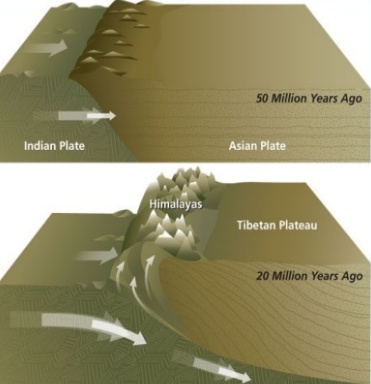
    About 40 to 50 million years ago, two large landmasses, India and Eurasia, driven by plate movement, collided. As a result, the sediments accumulated in Tethys Sea (brought by rivers) were compressed, squeezed and series of folds were formed, one behind the other, giving birth to folded mountains of the Himalayas.

    Recent studies show that India is still moving northwards at the rate of 5cm/year and crashing into the rest of Asia, thereby constantly increasing the height of Himalayas.

    The North-South division of the Himalayas

    The Himalayas consist of a series of parallel mountain ranges:

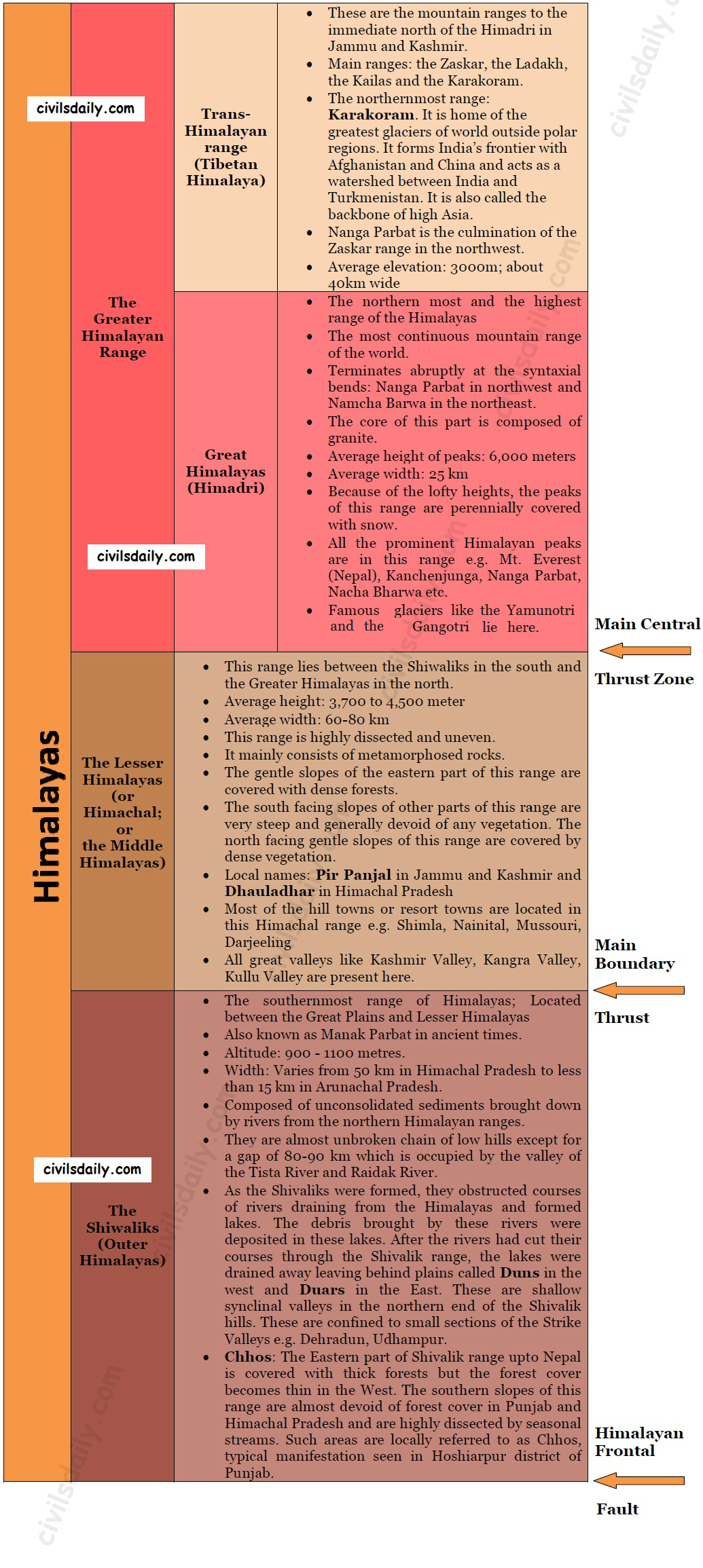
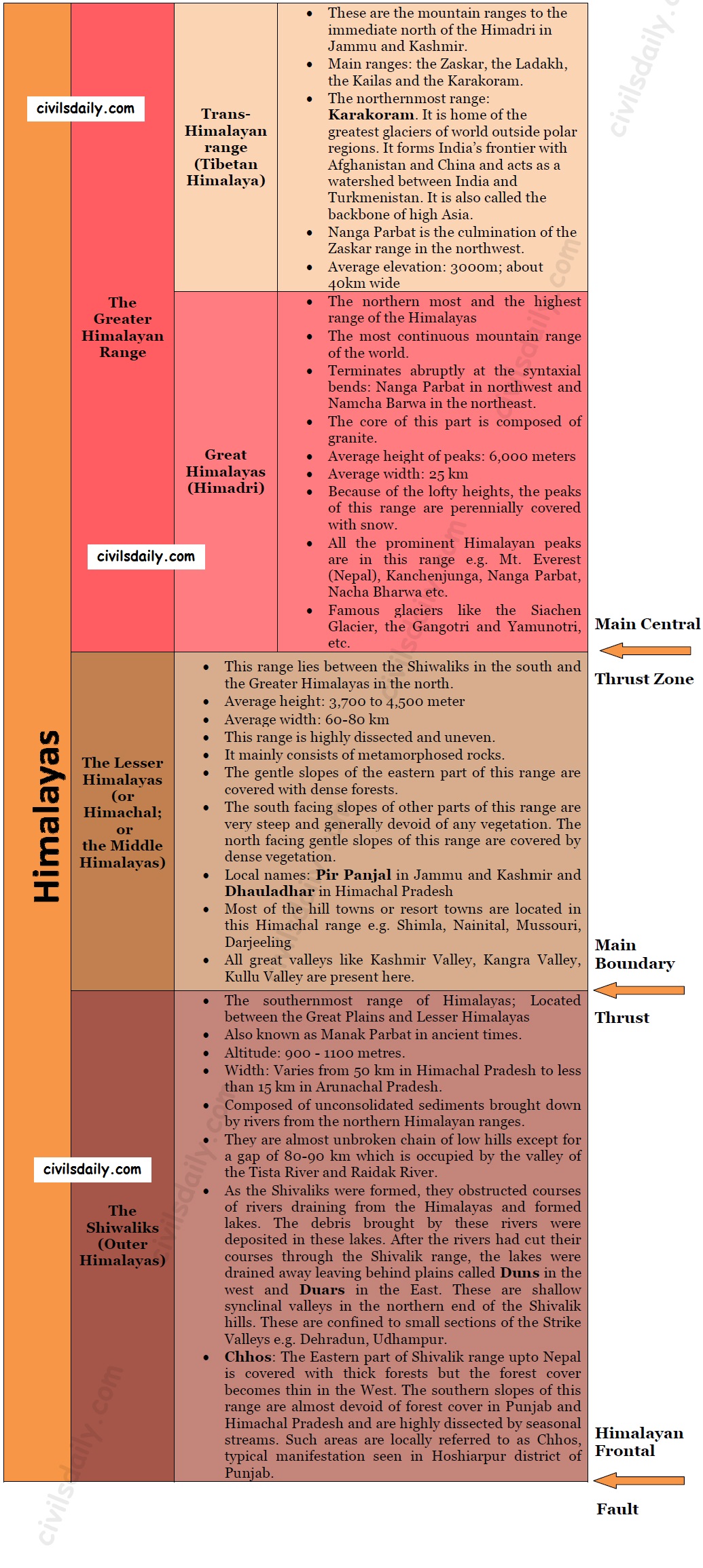
    1. The Greater Himalayan range, which includes:
      • The Great Himalayas(Himadri), and
      • The Trans-Himalayan range
    2. The Lesser Himalayas (or Himachal), and
    3. The Outer Himalayas (or Shiwalik).

    • Formation of these ranges: The Himadri and Himachal ranges of the Himalayas have been formed much before the formation of Siwalik range. The rivers rising in the Himadri and Himachal ranges brought gravel, sand and mud along with them, which was deposited in the rapidly shrinking Tethys Sea. In the course of time, the earth movements caused the folding of these relatively fresh deposits of sediments, giving rise to the least consolidated Shiwalik range.
    • Characteristic Features:
      • Notice in the map shown above that the Himalayas form an arcuate curve which is convex to the south. This curved shape of the Himalayas is attributed to the maximum push offered at the two ends on the Indian peninsula during its northward drift. In the north-west, it was done by Aravalis and in the Northeast by the Assam ranges.
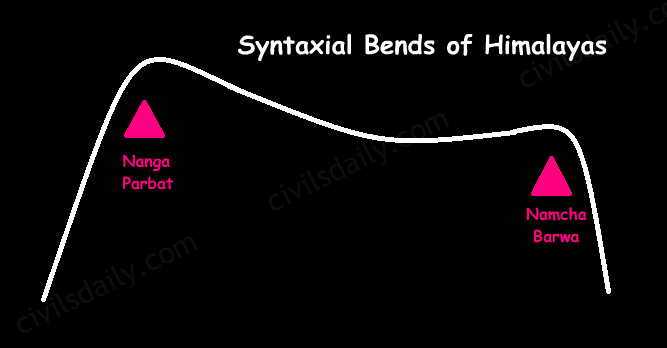
      • Syntaxis/ Syntaxial bends: The gently arching ranges of the Himalayan mountains on their Western and Eastern extremities are sharply bent southward in deep Knee-bend flexures that are called syntaxial bends. On both the ends, the great mountains appear to bend around a pivotal point. The western point is situated south of the Pamir where the Karakoram meets the Hindu Kush. A similar sharp, almost hairpin bend occurs on the eastern limit of Arunachal Pradesh where the strike of the mountain changes sharply from the Easterly to Southerly trend. Besides these two major bends, there are a number of minor syntaxial bends in other parts of Himalayas.

        Syntaxial Bends of Himalayas

      • The Himalayas are wider in the west than in the east. The width varies from 400 km in Kashmir to 150 km in Arunachal Pradesh. The main reason behind this difference is that the compressive force was more in the east than in the west. That is why high mountain peaks like Mount Everest and Kanchenjunga are present in the Eastern Himalayas.
      • The ranges are separated by deep valleys creating a highly dissected topography.
      • The southern slopes of the Himalayas facing India are steeper and those facing the Tibetan side are generally gentler.
    • Let’s take up these Himalayan mountain ranges one by one:

      The Himalayan Ranges | the Greater Himalayan Range, the Lesser Himalayas, the Shivaliks

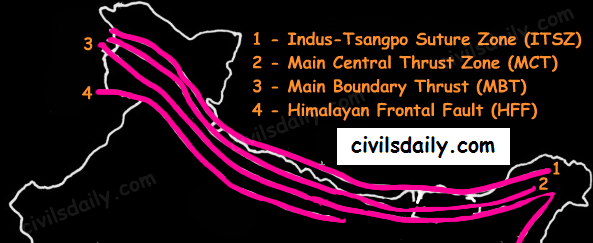
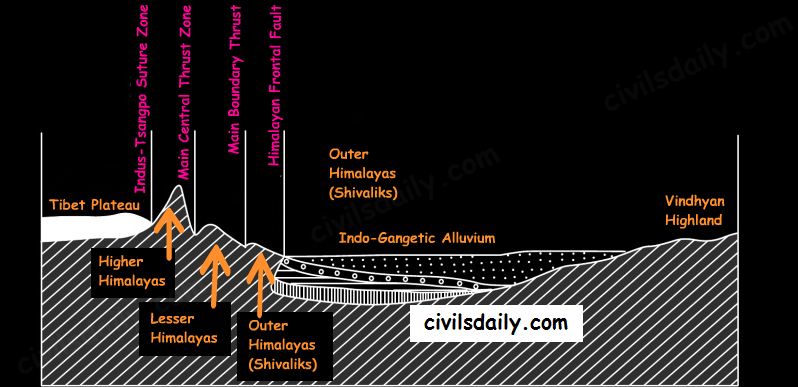
      Indus-Tsangpo Suture Zone: It represents a belt of tectonic compression caused by the underthrusting of the Indian shield/ plate against the Tibetan mass. It marks the boundary between the Indian and Eurasian plates. The suture zone stretches from the North-Western Himalayan syntaxis bordering the Nanga Parbat to the East as far as the Namche Barwa Mountain. The Karakoram Range and the Ladakh plateau lie to the north of ITSZ and originally formed a part of the European plate. Main Central Thrust Zone: This separates the Higher Himalayas in the north from lesser Himalayas in the south. It has played an important role in the tectonic history of these mountains. Main Boundary Thrust: It is a reverse fault of great dimensions which extends all the way from Assam to Punjab and serves to separate the outer Himalayas from the lesser Himalayas.Himalayan Frontal Fault: It is a series of reverse faults that demarcates the boundary of the Shivalik from of the Himalayan province from the alluvial expanse of the Indo-Gangetic plains.

    Major Faults of the Himalayas – ITSZ, MCT, MBT, HFF
    The Himalayan Complex: A Cross-sectional View

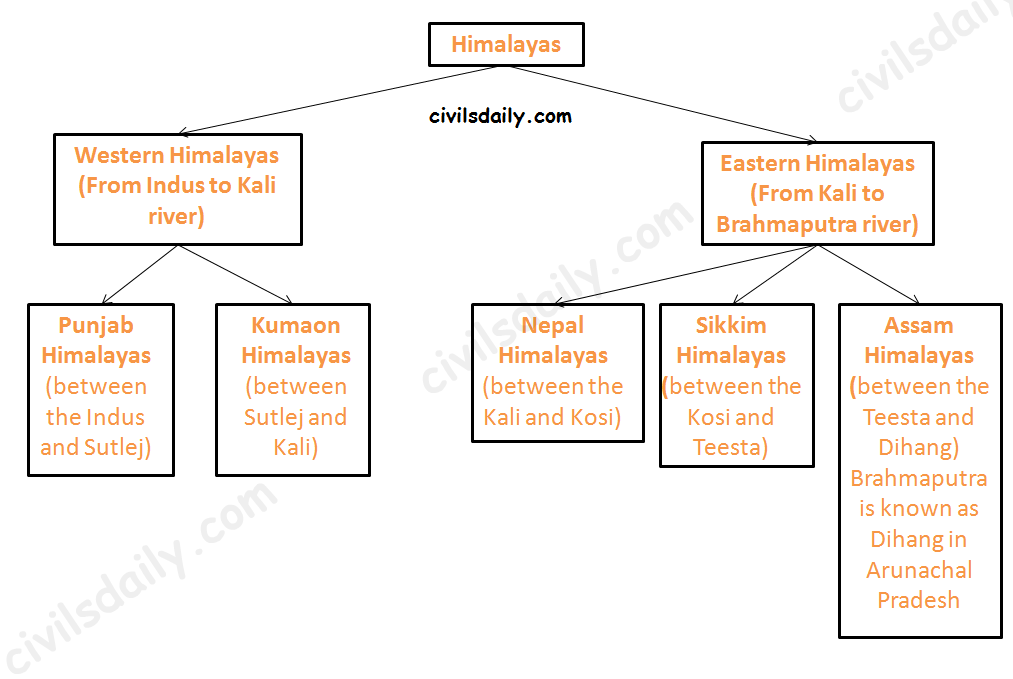
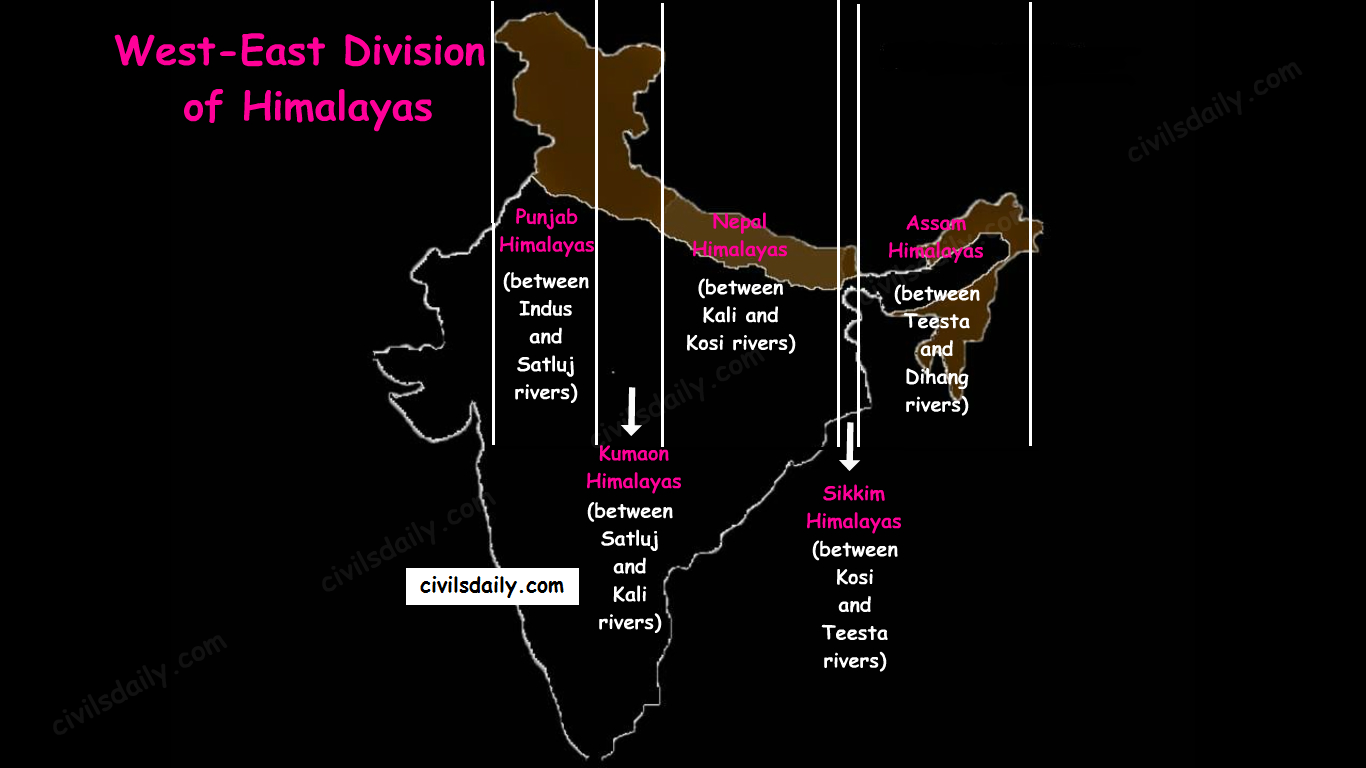
    Besides the longitudinal divisions, the Himalayas have been divided on the basis of regions from west to east:

    These divisions have been demarcated by river valleys:

    The Regional Divisions of Himalayas – the Western and Eastern Himalayas.
    1. Punjab Himalayas:
      • A large portion of Punjab Himalayas is in Jammu and Kashmir and Himachal Pradesh. Hence they are also called the Kashmir and Himachal Himalaya.
      • Major ranges: Karakoram, Ladakh, Pir Panjal, Zaskar and Dhaola Dhar.
      • The general elevation falls westwards.
      • The Kashmir Himalayas are also famous for Karewa formations.
        • ‘Karewas’ in Kashmiri language refer to the lake deposits, found in the flat-topped terraces of the Kashmir valley and on the flanks of the Pir Panjal range.
        • These deposits consist of clays, silts and sands, these deposits also show evidence of glaciation.
        • The occurrence of tilted beds of Karewas at the altitudes of 1500-1800m on the flanks of the Pir Panjal strongly suggests that the Himalayas were in process of uplift as late as Pliocene and Pleistocene (1.8mya to 10kyears ago)
        • Karewas are famous for the cultivation of Zafran, a local variety of saffron.
    2. Kumaon Himalayas
    3. Nepal Himalayas:
      • Tallest section of Himalayas
    4. Sikkim Himalayas:
      • Teesta river originates near Kanchenjunga
      • Jelep la pass- tri-junction of India- China-Bhutan
    5. Assam Himalayas:
      • The Himalayas are narrower in this region and Lesser Himalayas lie close to Great Himalayas.
      • Peaks: Namcha Barwa, Kula Kangri
      • Bengal ‘Duars’
      • Diphu pass- tri-junction of India- China-Myanmar
      • The Assam Himalayas show a marked dominance of fluvial erosion due to heavy rainfall.
    The West-East Division of Himalayas

    Glaciers and Snowline:

    Snowline: The lower limit of perpetual snow is called the ‘snowline’. The snowline in the Himalayas has different heights in different parts, depending on latitude, altitude, amount of precipitation, moisture, slope and local topography.

    1. The snowline in the Western Himalaya is at a lower altitude than in the Eastern Himalaya. E.g. while the glaciers of the Kanchenjunga in the Sikkim portion hardly move below 4000m, and those of Kumaon and Lahul to 3600m, the glaciers of the Kashmir Himalayas may descend to 2500m above the sea level.

    • It is because of the increase in latitude from 28°N in Kanchenjunga to 36°N in the Karakoram (Lower latitude —> warmer temperatures —> higher snowline).
    • Also, the Eastern Himalayas rise abruptly from the planes without the intervention of High ranges.
    • Though the total precipitation is much less in the western Himalayas, it all takes place in the form of snow.

    2. In the Great Himalayan ranges, the snowline is at a lower elevation on the southern slopes than on the northern slopes. This is because the southern slopes are steeper and receive more precipitation as compared to the northern slopes.

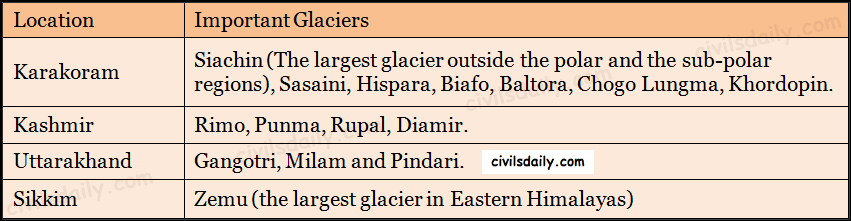
    Glaciers: The main glaciers are found in the Great Himalayas and the Trans-Himalayan ranges (Karakoram, Ladakh and Zaskar). The Lesser Himalayas have small glaciers, though traces of large glaciers are found in the Pir Panjal and Dhauladhar ranges. Some of the important glaciers are:

    Important Glaciers and their Locations

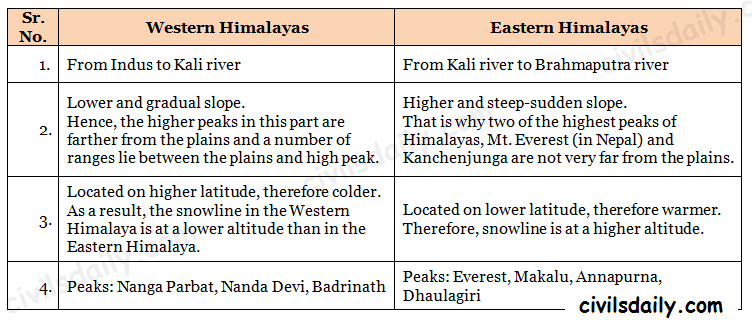
    Key differences between the Eastern and Western Himalayas:

    Key Difference between the Western and Eastern Himalayas.

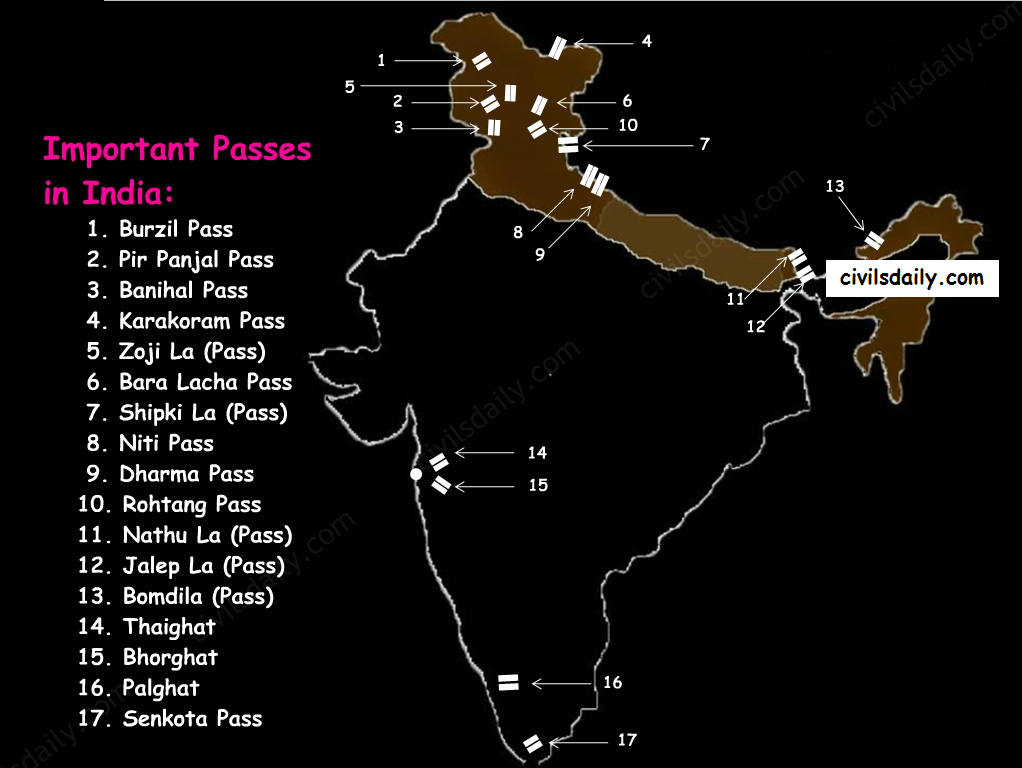
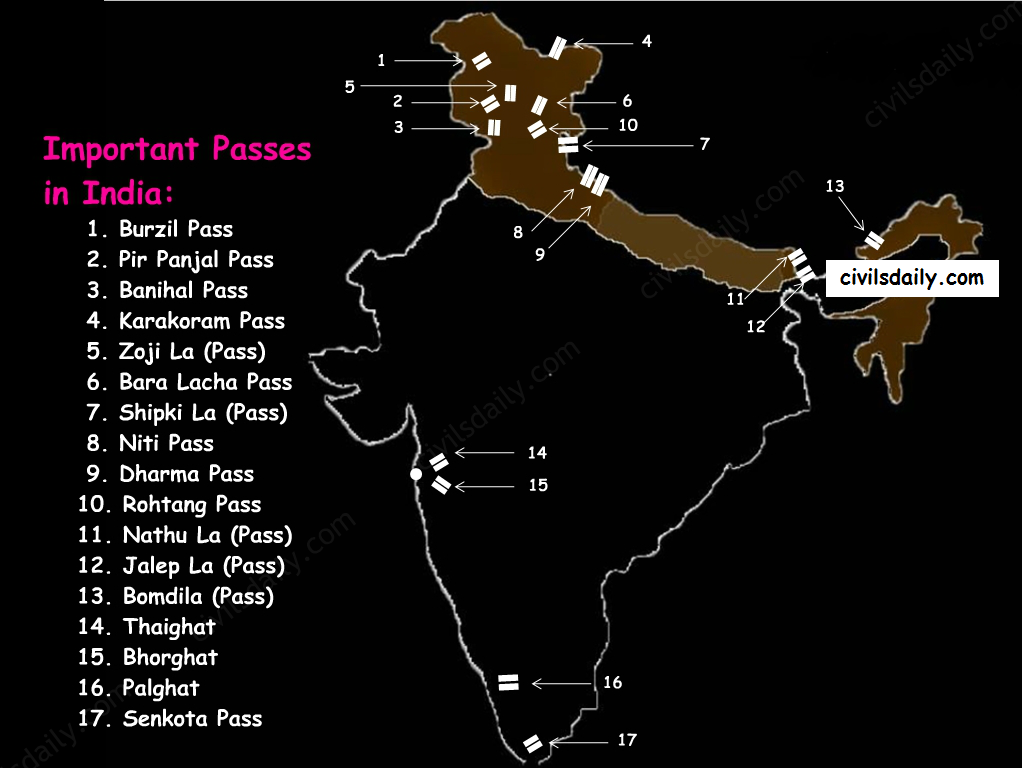
    Important Passes in India:

    A pass is a narrow gap in a mountain range which provides a passageway through the barrier.

    Important Passes in India
    1. Pir Panjal Pass – It provides the shortest and the easiest metal road between Jammu and the Kashmir Valley. But this route had to be closed down as a result of partition of the subcontinent.
    2. Banihal Pass – It is in Jammu and Kashmir. The road from Jammu to Srinagar transversed Banihal Pass until 1956 when Jawahar Tunnel was constructed under the pass. The road now passes through the tunnel and the Banihal Pass is no longer used for road transport.
    3. Zoji La (Pass) – It is in the Zaskar range of Jammu and Kashmir. The land route from Srinagar to Leh goes through this pass.
    4. Shipki La (Pass) – It is in Himachal Pradesh. The road from Shimla to Tibet goes through this pass. The Satluj river flows through this pass.
    5. Bara Lacha Pass – It is also in Himachal Pradesh. It links Mandi and Leh by road.
    6. Rohtang Pass – It is also in Himachal Pradesh. It cuts through the Pir Panjal range. It links Manali and Leh by road.
    7. Niti Pass – It is in Uttarakhand. The road to the Kailash and the Manasarovar passes through it.
    8. Nathu La (Pass) – It is in Sikkim. It gives way to Tibet from Darjeeling and Chumbi valley. The Chumbi river flows through this pass.
    9. Jalep La (Pass) – At the tri-junction of India- China-Bhutan. The Teesta river has created this pass.

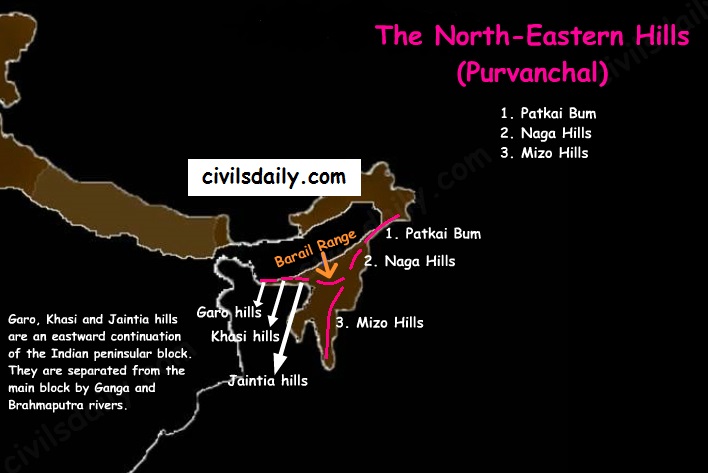
    B) The North-Eastern Hills and Mountains

    The North-Eastern Hills (Purvanchal): Patkai Bum, Naga Hills, Mizo Hills

    The Brahmaputra marks the eastern border of Himalayas. Beyond the Dihang gorge, the Himalayas bend sharply towards the south and form the Eastern hills or Purvanchal.

    • These hills run through the northeastern states of India.
    • These hills differ in scale and relief but stem from the Himalayan orogeny.
    • They are mostly composed of sandstones (i.e. Sedimentary rocks).
    • These hills are covered with dense forests.
    • Their elevation decreases from north to south. Although comparatively low, these hill ranges are rather forbidding because of the rough terrain, dense forests and swift streams.
    • Purvanchal hills are convex to the west.
    • These hills are composed of:
      • Patkai Bum – Border between Arunachal Pradesh and Myanmar
      • Naga Hills
      • Manipuri Hills – Border between Manipur and Myanmar
      • Mizo Hills.
    • Patkai Bum and Naga Hills form the watershed between India and Myanmar.
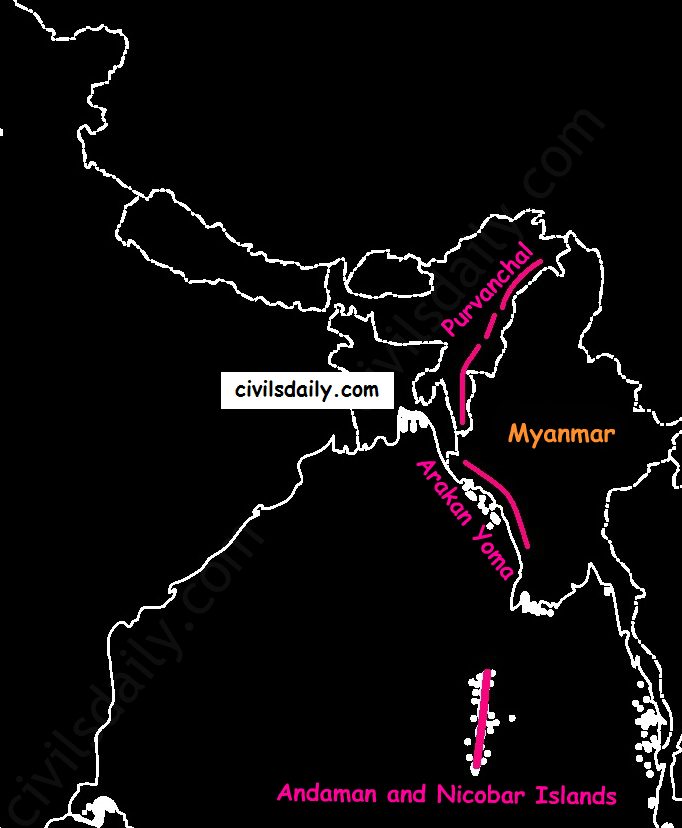
    • Extension of Purvanchal continues in Myanmar as Arakan Yoma –then Andaman and Nicobar Islands.
    Arakan Yoma – An Extension of Purvanchal in Myanmar

    The importance of Himalayan Region:

    1. Climatic Influence – The altitude of the Himalayas, their sprawl and extension intercept the summer monsoon. They also prevent the cold Siberian air masses from entering into India.
    1. Defence
    2. Source of perennial rivers
    3. Source of fertile soils
    4. Generation of hydroelectricity
    5. Forest wealth
    6. Orchards
    7. Minerals – The Himalayan region is rich in minerals e.g. gold, silver, copper, lead etc. are known to occur. Coal is found in Kashmir. But at the present level of technological advancement, it is not possible to extract these minerals. Also, it is not economically viable.
    8. Tourism
    9. Pilgrimage

    NORTHERN PLAINS

    Location and Extent:

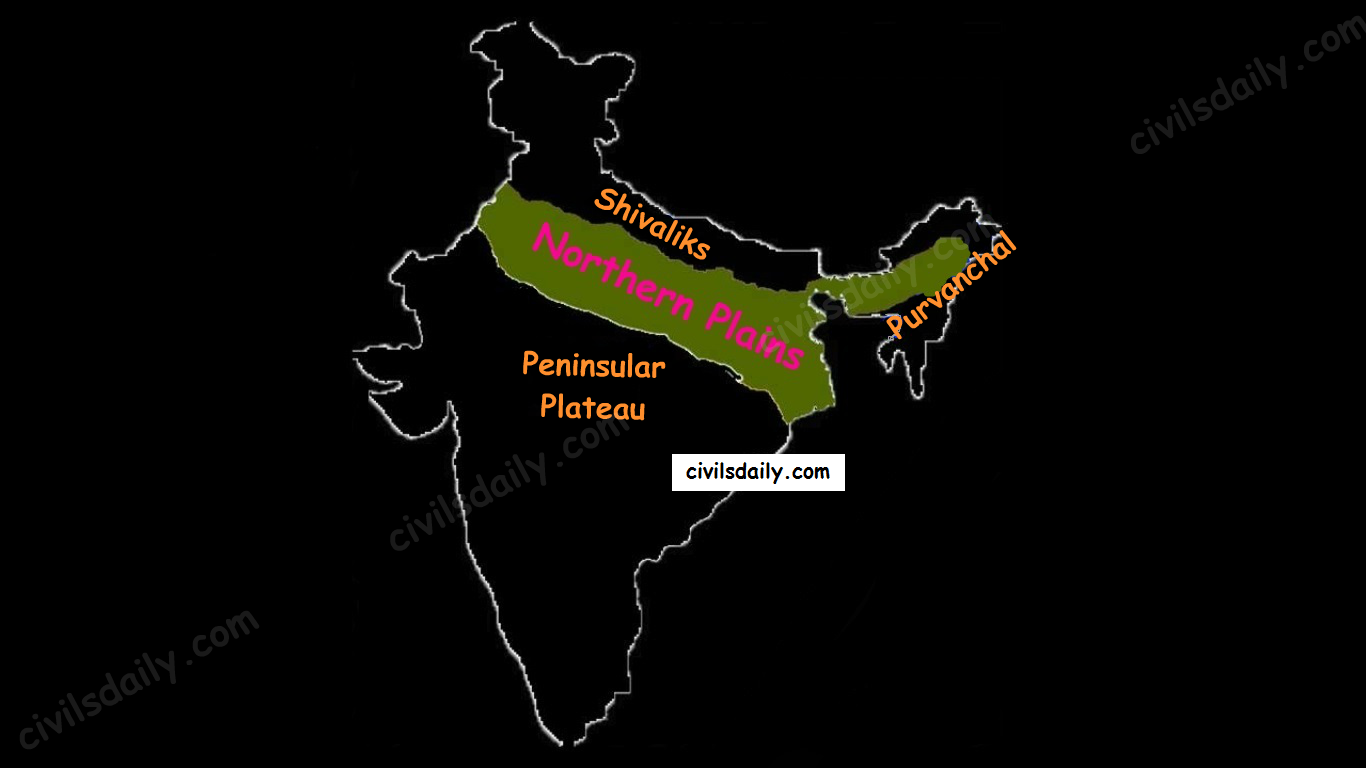
    Northern plains are the youngest physiographic feature in India. They lie to the south of the Shivaliks, separated by the Himalayan Frontal Fault (HFF). The southern boundary is a wavy irregular line along the northern edge of the Peninsular India. On the eastern side, the plains are bordered by the Purvanchal hills.

    The Physiographic Divisions of India: the Northern Plains

    Formation of Northern Plains:

    Due to the uplift of the Himalayas in the Tethys Sea, the northern part of the Indian Peninsula got subsided and formed a large basin.

    northern-plains
    Source

    That basin was filled with sediments from the rivers which came from the mountains in the north and from the peninsula in the south. These extensive alluvial deposits led to the formation of the northern plains of India.

    Chief Characteristics:

    • The northern plain of India is formed by three river systems, i.e. the Indus, the Ganga and the Brahmaputra; along with their tributaries.
    • The northern plains are the largest alluvial tract of the world. These plains extend approximately 3200 km from west to east.
    • The average width of these plains varies between 150 and 300 km. In general, the width of the northern plains increases from east to west (90-100km in Assam to about 500km in Punjab).
    • The exact depth of alluvium has not yet been fully determined. According to recent estimates, the average depth of alluvium in the southern side of the plain varies between 1300-1400m, while towards the Shiwaliks, the depth of alluvium increases. The maximum depth of over 8000m has been reached in parts of Haryana.
    • The extreme horizontality of this monotonous plain is its chief characteristic (200m – 291m). The highest elevation of 291 m above mean sea level near Ambala forms a watershed between the Indus system and Ganga system).
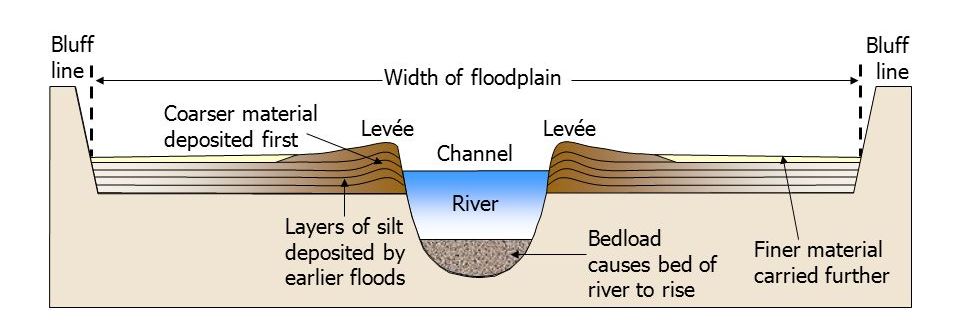
    • The monotony of the physical landscape is broken at the micro-level by the river bluffs, levees etc.
      • [Floodplain – That part of a river valley, adjacent to the channel, over which a river flows in times of a flood.
      • Levee – An elevated bank flanking the channel of the river and standing above the level of the flood plain.
      • Bluff – A river cut cliff or steep slope on the outside of a meander. A line of bluffs often marks the edge of a former floodplain.]
    slide_34
    Source

    Physiographic Divisions of the Northern Plains:

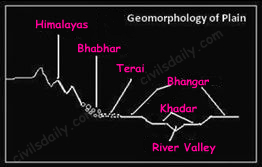
    From the north to the south, the northern plains can be divided into three major zones:

    1. The Bhabar
    2. The Tarai
    3. The alluvial plains.

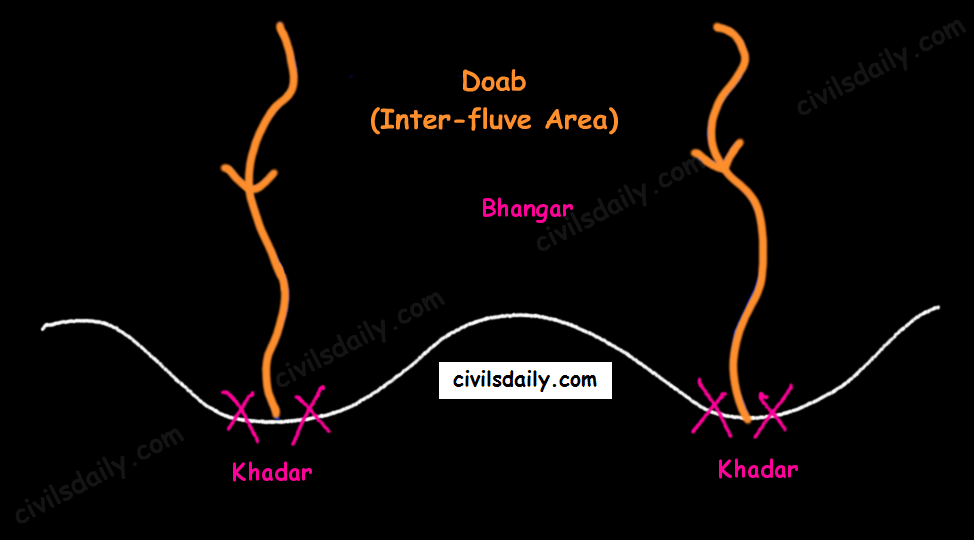
    The alluvial plains can be further divided into the Khadar and the Bhangar as illustrated below:

    Geomorphology of the Northern Plains

    Let’s understand these divisions one by one:

    Bhabar:

    • Bhabar is a narrow belt (8-10km wide) which runs in the west-east direction along the foot of the Himalayas from the river Indus to Teesta.
      alluvial-fan

      Source

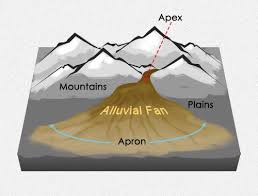
    • Rivers which descend from the Himalayas deposit their load along the foothills in the form of alluvial fans.
    • These fans consisting of coarser sediments have merged together to build up the piedmont plain/the Bhabar.
    • The porosity of the pebble-studded rock beds is very high and as a result, most of the streams sink and flow underground. Therefore, the area is characterized by dry river courses except in the rainy season.
    • The Bhabar track is not suitable for cultivation of crops. Only big trees with large roots thrive in this region.
    • The Bhabar belt is comparatively narrow in the east and extensive in the western and north-western hilly region.

    Tarai:

    • It is a 10-20 km wide marshy region in the south of Bhabar and runs parallel to it.
    • The Tarai is wider in the eastern parts of the Great Plains, especially in the Brahmaputra valley due to heavy rainfall.
    • It is characterized by the re-emergence of the underground streams of the Bhabar belt.
    • The reemerged water transforms large areas along the rivers into badly drained marshy lands.
    • Once covered with dense forests, most of the Tarai land (especially in Punjab, Uttar Pradesh and Uttarakhand) has been reclaimed and turned into agricultural land over a period of time.

    Bhangar:

    • It is the older alluvium along the river beds forming terraces higher than the flood plain.
    • Dark in colour, rich in humus content and productive.
    • The soil is clayey in composition and has lime modules (called kankar)
    • Found in doabs (inter-fluve areas)
    • ‘The Barind plains’ in the deltaic region of Bengal and the ‘bhur formations’ in the middle Ganga and Yamuna doab are regional variations of Bhangar. [Bhur denotes an elevated piece of land situated along the banks of the Ganga river especially in the upper Ganga-Yamuna Doab. This has been formed due to accumulation of wind-blown sands during the hot dry months of the year]
    • In relatively drier areas, the Bhangar also exhibits small tracts of saline and alkaline efflorescence known as ‘Reh’, ‘Kallar’ or ‘Bhur’. Reh areas have spread in recent times with an increase in irrigation (capillary action brings salts to the surface).
    • May have fossil remains of even those plants and animals which have become extinct.

    Khadar:

    • Composed of newer alluvium and forms the flood plains along the river banks.
    • Light in colour, sandy in texture and more porous.
    • Found near the riverbeds.
    • A new layer of alluvium is deposited by river flood almost every year. This makes them the most fertile soils of Ganges.
    • In Punjab, the Khadar rich flood plains are locally known as ‘Betlands’ or ‘Bets’.
    • The rivers in Punjab-Haryana plains have broad flood plains of Khadar flanked by bluffs, locally known as Dhayas. These bluffs are as high as 3metres.

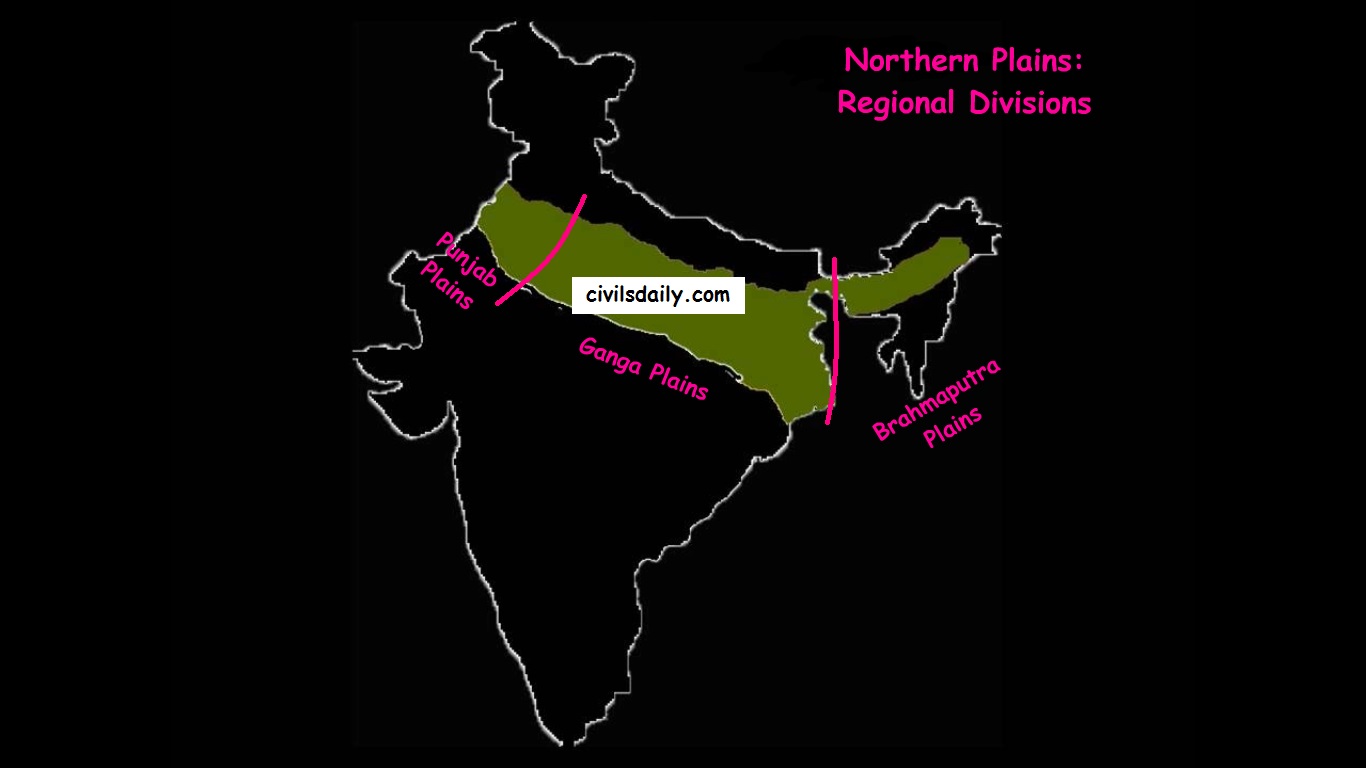
    Northern Plain: Regional Divisions

    The Regional Divisions of the Northern Plains: Punjab, Ganga and the Brahmaputra Plains.
    1. Punjab Plains:
    • The Punjab plains form the western part of the northern plain.
    • In the east, the Delhi-Aravalli ridge separates it from the Ganga plains.
    • This is formed by the Indus and its tributaries; like Jhelum, Chenab, Ravi, Beas and Sutlej. A major portion of these plains is in Pakistan.
    • It is divided into many Doabs (do-“two” + ab- “water or river” = “a region or land lying between and reaching to the meeting of the two rivers”).
      Khadar and Bhangar
    • Important features:
      • Khadar rich flood plains known as ‘Betlands’ or ‘Bets’.
      • The rivers in Punjab-Haryana plains have broad flood plains of Khadar flanked by bluffs, locally known as Dhayas.
      • The northern part of this plane adjoining the Shivalik hills has been heavily eroded by numerous streams, which are called Chhos.
      • The southwestern parts, especially the Hisar district is sandy and characterized by shifting sand-dunes.
    1. Ganga Plains:
    • The Ganga plains lie between the Yamuna catchment in the west to the Bangladesh border in the East.
    • The lower Ganga plain has been formed by the down warping of a part of Peninsular India between Rajmahal hills and the Meghalaya plateau and subsequent sedimentation by the Ganga and Brahmaputra rivers.
    • The main topographical variations in these plains include Bhabar, Tarai, Bhangar, Khadar, levees, abandoned courses etc.
    • Almost all the rivers keep on shifting their courses making this area prone to frequent floods. The Kosi river is very notorious in this respect. It has long been called the ‘Sorrow of Bihar’.
    • The northern states, Haryana, Delhi, UP, Bihar, part of Jharkhand and West Bengal in the east lie in the Ganga plains.
    • The Ganga-Brahmaputra delta: the largest delta in the world. A large part of the coastal delta is covered tidal forests called Sunderbans. Sunderbans, the largest mangrove swamp in the world gets its name from the Sundari tree which grows well in marshland. It is home to the Royal Tiger and crocodiles.
    1. Brahmaputra Plains:
    • This plain forms the eastern part of the northern plain and lies in Assam.
    • Its western boundary is formed by the Indo-Bangladesh border as well as the boundary of the lower Ganga Plain. Its eastern boundary is formed by Purvanchal hills.
    • The region is surrounded by high mountains on all sides, except on the west.
    • The whole length of the plain is traversed by the Brahmaputra.
    • The Brahmaputra plains are known for their riverine islands (due to the low gradient of the region) and sand bars.
    • The innumerable tributaries of the Brahmaputra river coming from the north form a number of alluvial fans. Consequently, the tributaries branch out in many channels giving birth to river meandering leading to the formation of bill and ox-bow lakes.
    • There are large marshy tracts in this area. The alluvial fans formed by the coarse alluvial debris have led to the formation of terai or semi-terai conditions.

    Significance of this region:

    • The plains constitute less than one-third of the total area of the country but support over 40 percent of the total population of the country.
    • Fertile alluvial soils, flat surface, slow-moving perennial rivers and favourable climate facilitate an intense agricultural activity.
    • The extensive use of irrigation has made Punjab, Haryana and western part of Uttar Pradesh the granary of India (Prairies are called the granaries of the world).
    • Cultural tourism: Several sacred places and centres of pilgrimage are situated in these plains e.g. Haridwar, Amritsar, Varanasi, Allahabad, Bodh Gaya etc.
    • The sedimentary rocks of plains have petroleum and natural gas deposits.
    • The rivers here have very gentle gradients which make them navigable over long distances.


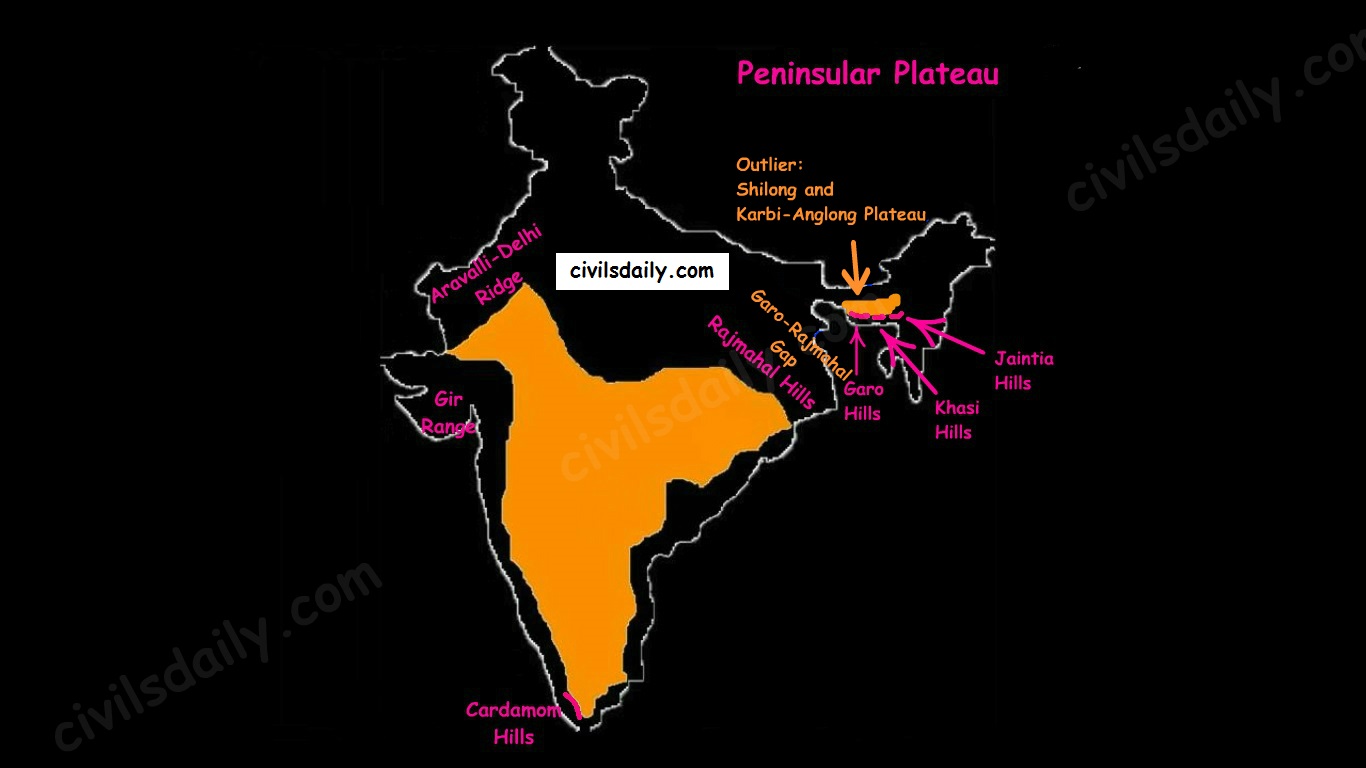
    PENINSULAR PLATEAU

    A. Location and Extent

    • The Peninsular Plateau lies to the south of the Northern Plains of India.
    • It is bordered on all sides by the hill ranges:
    • Delhi ridge in the north-west (extension of Aravalis),
    • the Rajmahal Hills in the east,
    • Gir range in the west, and
    • the Cardamom Hills in the south constitute the outer extent of the peninsular plateau.
    The Physiographic Divisions of India | The Peninsular Plateau
    • Outlier:
      • Shillong and Karbi-Anglong plateau.

    Note: Kutchch Kathiawar region – The region, though an extension of Peninsular plateau (because Kathiawar is made of the Deccan Lava and there are tertiary rocks in the Kutch area), they are now treated as an integral part of the Western Coastal Plains as they are now levelled down.

    • The Garo-Rajmahal Gap:
      • The two disconnected outlying segments of the plateau region are seen in the Rajmahal and Garo-Khasi Jaintia hills.
      • It is believed that due to the force exerted by the northeastward movement of the Indian plate at the time of the Himalayan origin, a huge fault was created between the Rajmahal hills and the Meghalaya plateau
      • Later, this depression got filled up by the deposition activity of the numerous rivers.
      • As a result, today the Meghalaya and Karbi Anglong plateau stand detached from the main Peninsular Block.

    Geological History and Features:

    The peninsular plateau is a tableland which contains igneous and metamorphic rocks. It is one of the oldest and the most stable landmass of India.

    In its otherwise stable history, the peninsula has seen a few changes like:

    1. Gondwana Coal Formation.
    2. Narmada-Tapi rift valley formation.
    3. Basalt Lava eruption on Deccan plateau:

    During its journey northward after breaking off from the rest of Gondwana, the Indian Plate passed over a geologic hotspot, the Réunion hotspot, which caused extensive melting underneath the Indian Craton. The melting broke through the surface of the craton in a massive flood basalt event, creating what is known as the Deccan Traps (Its various features have been discussed in the later portion of the article).

    Chief Characteristics:

    The entire peninsular plateau region is an aggregation of several smaller plateaus and hill ranges interspersed with river basins and valleys. The Chhattisgarh plain occupied by the dense Dandakaranya forests is the only plain in the peninsula.

    1. General elevation and flow of rivers:

    • The average elevation is 600-900 metres.
    • The general elevation of the plateau is from the west to the east, which is also proved by the pattern of the flow of rivers.
    • Barring Narmada and Tapti all the major rivers lying to the south of the Vindhyas flow eastwards to fall into the Bay of Bengal.
    • The westward flow of Narmada and Tapi is assigned to the fact that they have been flowing through faults or rifts which were probably caused when the Himalayas began to emerge from the Tethys Sea of the olden times.

    2. Some of the important physiographic features of this region are:

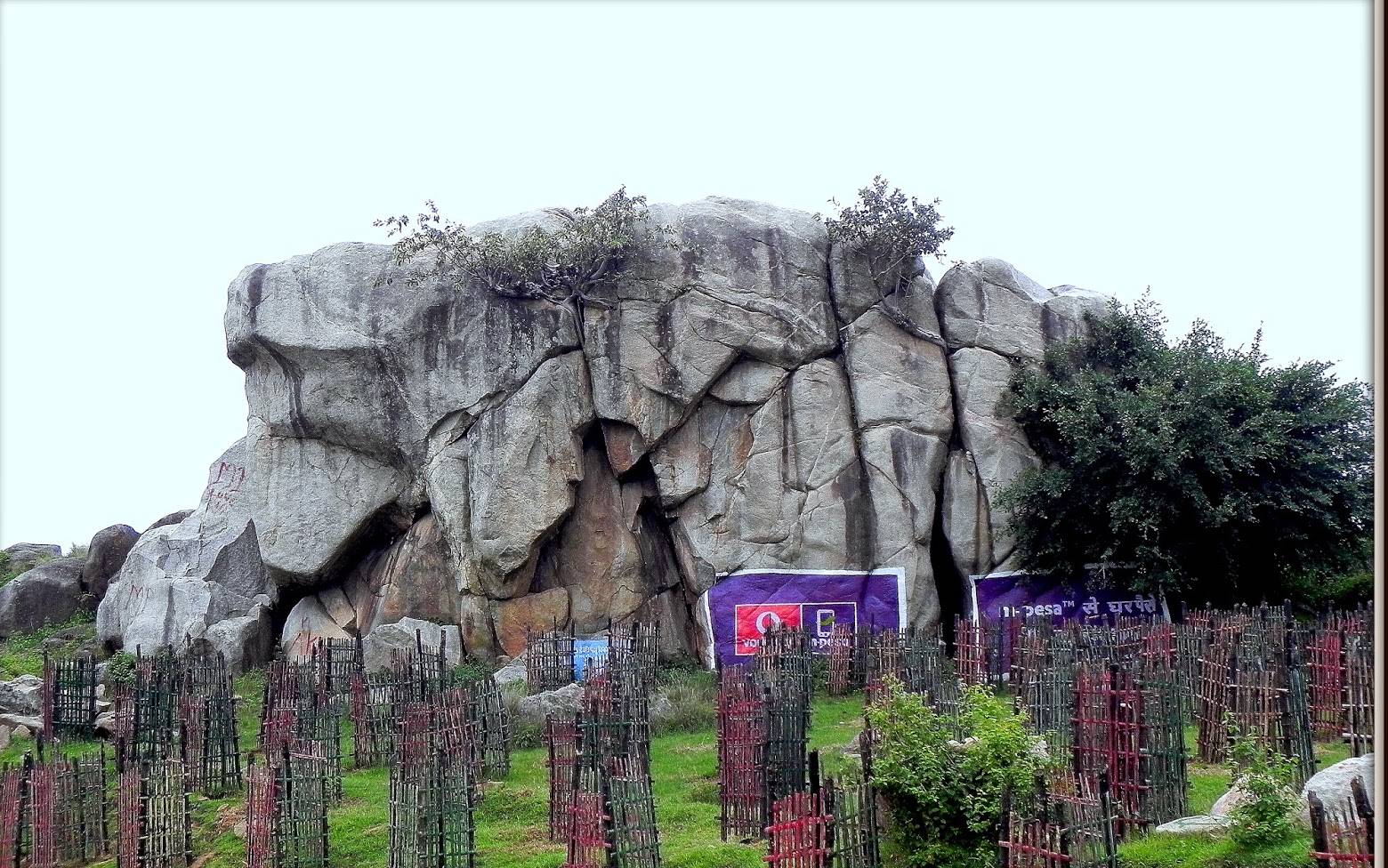
    • Tors – Prominent, isolated mass of jointed, weathered rock, usually granite.
    A granite tor near Ranchi
    A granite tor near Ranchi
    • Block Mountains and Rift Valleys:
    • Spurs: A marked projection of land from a mountain or a ridge
    spur
    Image Source
    • Bare rocky structures,
    • Series of hummocky hills and wall-like quartzite dykes offering natural sites for water storage.
    • Broad and shallow valleys and rounded hills
    • Ravines and gorges: The northwestern part of the plateau has a complex relief of ravines and gorges. The ravines of Chambal, Bhind and Morena are some of the well-known examples.

    3. The Deccan Traps:

    • One of the most important features of the peninsular plateau is the black soil area in the western and northwestern part of the plateau, which is known as the Deccan Trap.
    • From the end of the Cretacious until the beginning of the Eocene, numerous fissure-type eruptions took place in the north-western part of the Deccan plateau. It is believed that the lava outpourings were more than the mass comprising the present-day Himalayas.
    • It covers a major portion of the Maharashtra plateau and parts of Gujarat, northern Karnataka and Malwa plateau. Some parts of Tamil Nadu, Andhra Pradesh, UP, and Jharkhand have some outliers of Deccan trap.
    • Basalt is the main rock of the region.
    • The region has black cotton soil as a result of weathering of this lava material and this soil is one of the finest examples of the parent material controlled soils.

    Physiographic Divisions:

    On the basis of prominent relief features, the peninsular plateau can be divided into three broad groups:

    • The Central Highlands
    • The Deccan Plateau
    • The Northeastern Plateau.
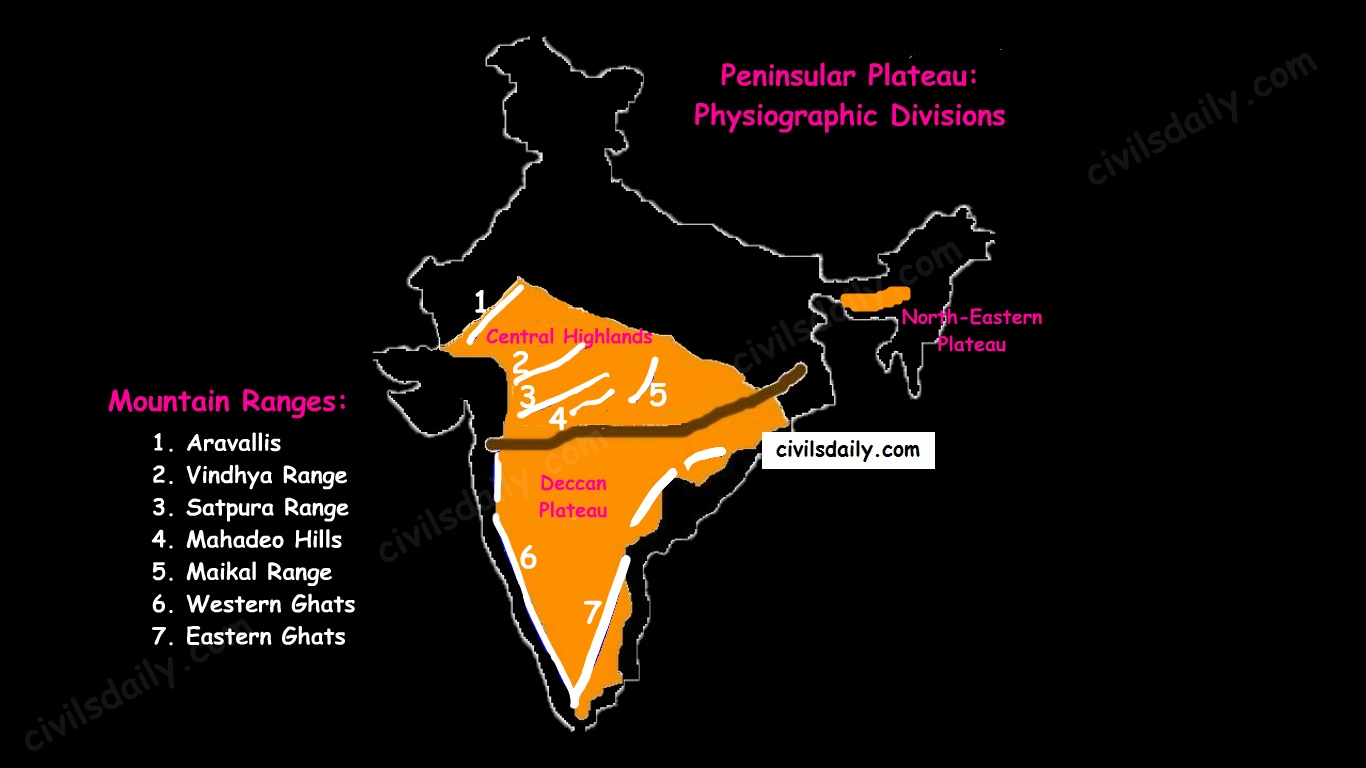
    Physiographic Divisions and Important Mountain Ranges of the Peninsular Plateau

    Let’s take up these divisions one by one:

    1. The Central Highlands

    • The northern segment of the peninsular plateau is known as the Central Highlands.
    • Location:
      1. North of Narmada river.
      2. They are bounded to the west by the Aravallis.
      3. Satpura ranges (formed by a series of scarped plateaus) lie in the South.
    • General Elevation: 700-1,000 m above the mean sea level and it slopes towards the north and northeastern directions.
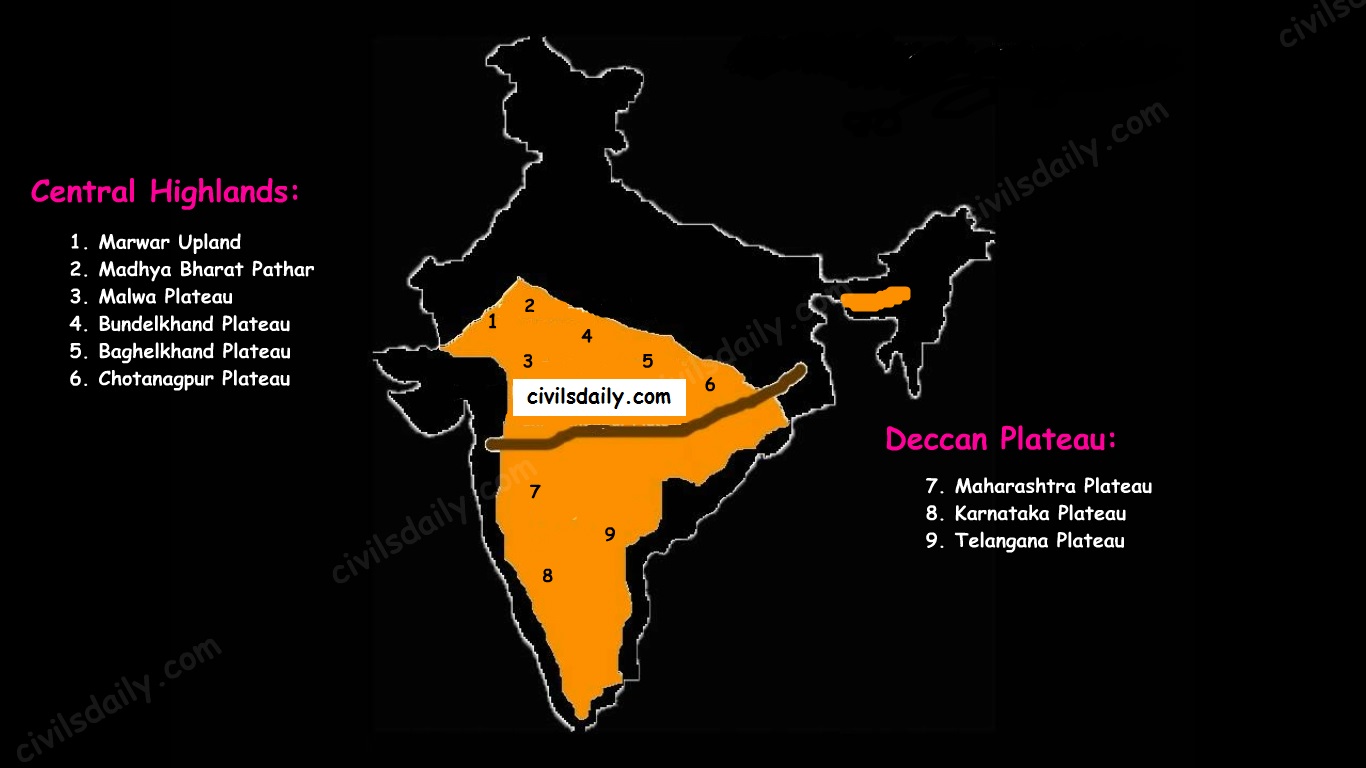
    • These highlands consist of the:
      1. Marwar upland – to the east of Aravallis in Rajasthan
        • A rolling plain carved by Banas river. [Rolling Plain: ‘Rolling plains’ are not completely flat; there are slight rises and fall in the landform. Ex: Prairies of USA]
        • The average elevation is 250-500 m above sea level.
      2. Madhya Bharat Pathar – to the east of Marwar upland.
      3. Malwa plateau – It lies in Madhya Pradesh between Aravali and Vindhyas. It is composed of the extensive lava flow and is covered with black soils.
      4. Bundelkhand plateau – It lies along the borders of UP and MP. Because of intensive erosion, semi-arid climate and undulating area, it is unfit for cultivation.
      5. Baghelkhand plateau – It lies to the east of the Maikal range.
      6. Chhotanagpur plateau – the northeast part of Peninsular plateau.
        • It Includes Jharkhand, parts of Chhattisgarh and West Bengal.
        • This plateau consists of a series of step-like sub-plateaus (locally called peatlands – high-level plateau). It is thus famous as the Patland plateau and known as Ruhr of India.
        • Rajmahal Hills are the northeastern projection of Chhota Nagpur Plateau.
        • It is a mineral-rich plateau.
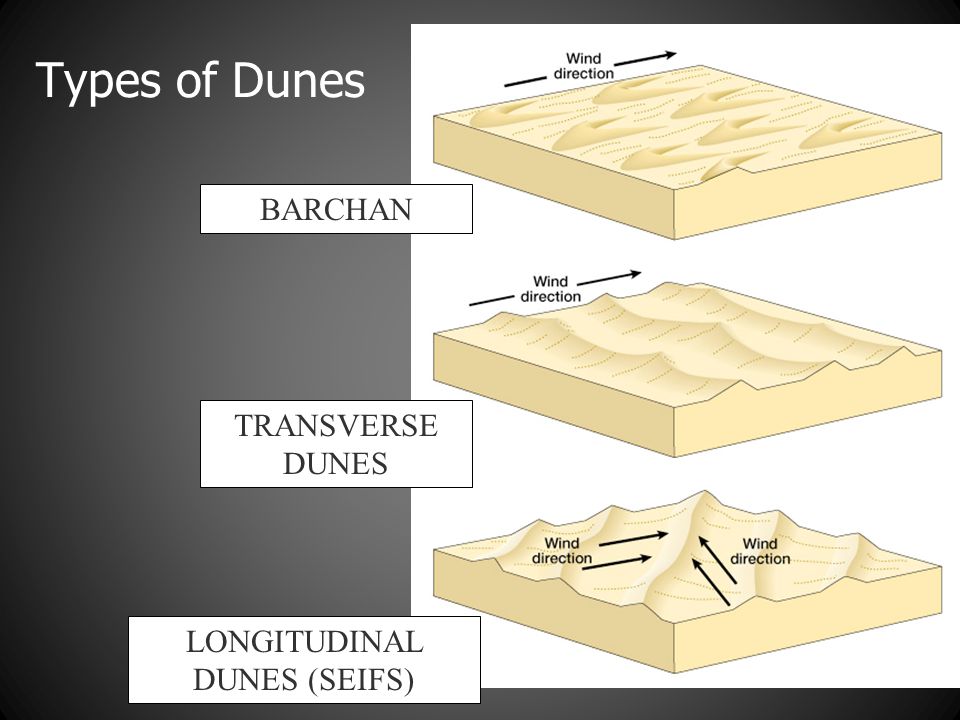
    • The extension of the Peninsular plateau can be seen as far as Jaisalmer in the West, where it has been covered by the longitudinal sand ridges and crescent-shaped sand dunes called barchans.
    • This region has undergone metamorphic processes in its geological history, which can be corroborated by the presence of metamorphic rocks such as marble, slate, gneiss, etc.
    • Most of the tributaries of the river Yamuna have their origin in the Vindhyan and Kaimur ranges. Banas is the only significant tributary of the river Chambal that originates from the Aravalli in the west.
    Physiographic Divisions of the Peninsular Plateau – the Central Highlands and the Deccan Plateau

    2. The Deccan Plateau

    • The Deccan Plateau lies to the south of the Narmada River and is shaped as an inverted triangle.
    • It is bordered by:
      1. The Western Ghats in the west,
      2. The Eastern Ghats in the east,
      3. The Satpura, Maikal range and Mahadeo hills in the north.
    • It is volcanic in origin, made up of horizontal layers of solidified lava forming trap structure with step-like appearance. The sedimentary layers are also found in between the layers of solidified lava, making it inter–trapping in structure.
    • Most of the rivers flow from west to east.
    • The plateau is suitable for the cultivation of cotton; home to rich mineral resources and a source to generate hydroelectric power.
    • The Deccan plateau can be subdivided as follows:
      1. The Maharashtra Plateau – it has typical Deccan trap topography underlain by basaltic rock, the regur.
      2. The Karnataka Plateau (also known as Mysore plateau) – divided into western hilly country region of ‘Malnad’ and plain ‘Maidan’
      3. Telangana Plateau

    3. The Northeastern Plateau:

    • The Meghalaya (or Shillong) plateau is separated from peninsular rock base by the Garo-Rajmahal gap.
    • Shillong (1,961 m) is the highest point of the plateau.
    • The region has the Garo, Khasi, Jaintia and Mikir (Rengma) hills.
    • An extension of the Meghalaya plateau is also seen in the Karbi Anglong hills of Assam.
    • The Meghalaya plateau is also rich in mineral resources like coal, iron ore, sillimanite, limestone and uranium.
    • This area receives maximum rainfall from the south-west monsoon. As a result, the Meghalaya plateau has a highly eroded surface. Cherrapunji displays a bare rocky surface devoid of any permanent vegetation cover.

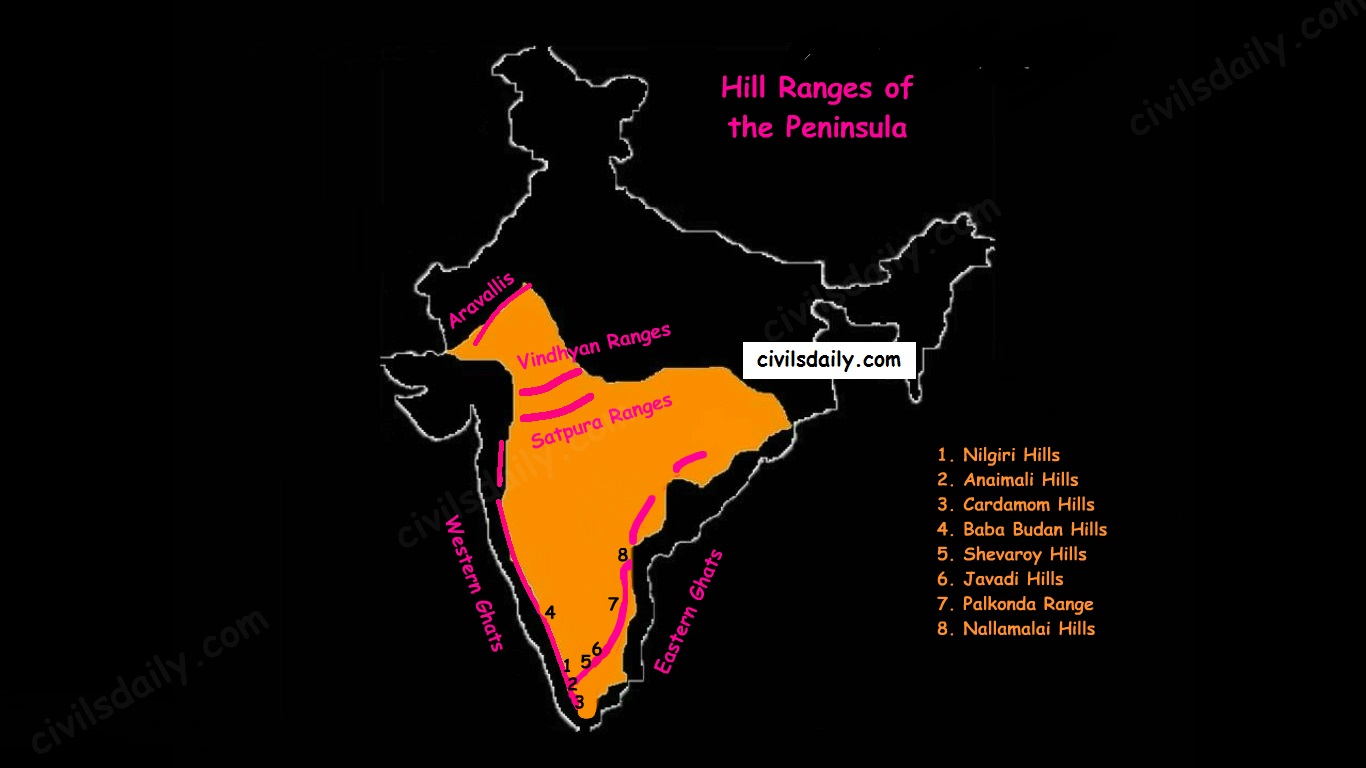
    Hill ranges of the peninsula:

    Most of the hills in the peninsular region are of the relict type (residual hills). They are the remnants of the hills and horsts formed many million years ago (horst: uplifted block; graben: subsided block).

    The plateaus of the Peninsular region are separated from one another by these hill ranges and various river valleys.

    Hill Ranges of the Peninsula

    1. The Aravalli Mountain Range:

    • It is a relic of one of the oldest fold mountains of the world.
    • Its general elevation is only 400-600 m, with few hills well above 1,000 m.
    • At present, it is seen as a discontinuous ridge from Delhi to Ajmer and rising up to 1722m (Gurushikhar peak in Mount Abu) and thence southward.
    • It is known as ‘Jarga’ near Udaipur and ‘Delhi Ridge’ near Delhi.
    • Dilwara Jain Temple, the famous Jain temple is situated on Mt. Abu.

    2. Vindhyan Ranges:

    • They rise as an escarpment running parallel to the Narmada-Son valley.
    • General elevation: 300 to 650 m.
    • Most of them are made up of sedimentary rocks of ancient ages.
    • They act as a watershed between Gangetic and peninsular river systems.

    3. Satpura ranges:

    • Satpura range is a series of seven mountains (‘Sat’ = seven and ‘pura’ = mountains).
    • The seven mountain ranges or folds of Satpura’s are:
      • Maikal Hills
      • Mahadeo Hills near Pachmarhi
      • Kalibhit
      • Asirgarh
      • Bijagarh
      • Barwani
      • Arwani which extends to Rajpipla Hills in Eastern Gujarat.
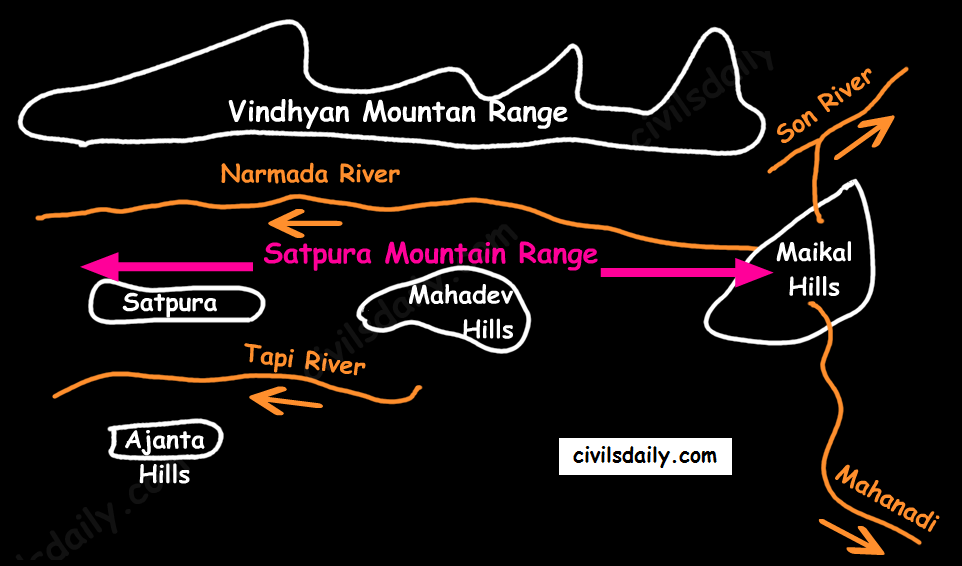
    • Satpura ranges run parallel between Narmada and Tapi, parallel to Maharashtra-MP border.
    • Dhupgarh (1,350 m) near Pachmarhi on Mahadev Hills is the highest peak of the Satpura Range.
    • Amarkantak (1,127 m) is another important peak. Amarkantak is the highest peak of the Maikal Hills from where two prominent rivers – the Narmada and the Son originate.
    • Note that three rivers originate from the three sides of Maikal hills (as shown in the following map) but, from Amarkantak, only two rivers (the Narmada and the Son) originate (and not Mahanadi).
    The Satpura Mountain Range

    4. Western and Eastern Ghats:

    • The Western Ghats:
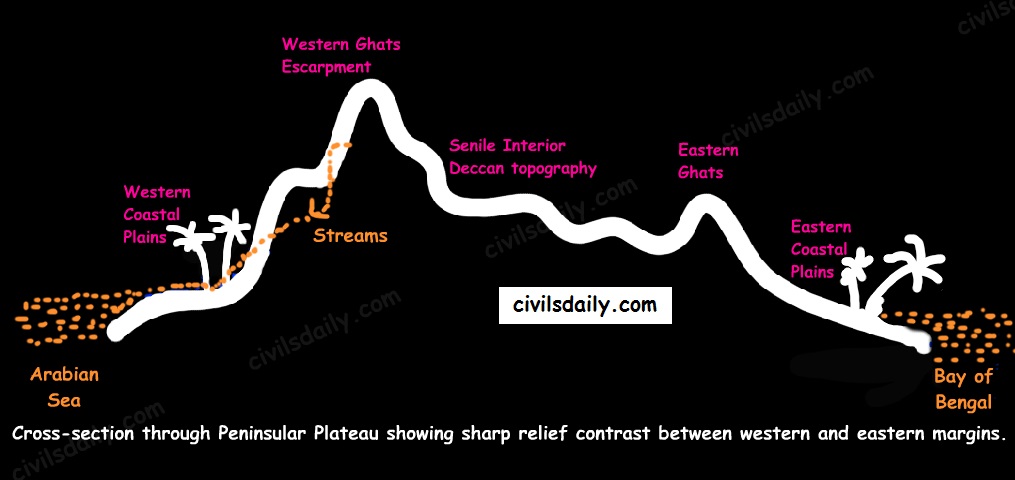
      • These are a faulted part of the Deccan plateau running parallel from the Tapi valley to a little north of Kanyakumari (1600km). Their western slope is like an escarpment while eastern slope merges gently with the plateau.
      • Their average elevation is about 1,500 m with the height increasing from north to south.
    • The Eastern Ghats are in the form of residual mountains which are not regular but broken at intervals.
    • The Eastern and the Western Ghats meet each other at the Nilgiri hills.
    • A brief comparison between them:
    Differences between the Western and Eastern Ghats.
    A cross-sectional view through the Peninsular Plateau showing sharp relief contrast between the western and eastern margins

    Note: The Western Ghats are continuous and can be crossed through passes only. There are four main passes which have developed in the Western Ghats. These are:

    1. Thal Ghat – It links Nasik to Mumbai.
    2. Bhor Ghat – It links Mumbai to Pune.
    3. Pal Ghat – This pass is located between the Nilgiris and the Annamalai mountains. It is in Kerala and connects Kochi and Chennai.
    4. Senkota Pass – This pass located between the Nagercoil and the Cardamom hills links Thiruvananthapuram and Madurai.

    For the geographical location of these passes, see the following map:

    Important Passes in India

    Significance of the Peninsular Region:

    • Rich in mineral resources: The peninsular region of India is rich in both metallic and non-metallic minerals. About 98% of the Gondwana coal deposits of India are found in the peninsular region.
    • Agriculture: Black soil found in a substantial part of the peninsula is conducive for the cultivation of cotton, maize , citrus fruits etc. Some areas are also suitable for the cultivation of tea, coffee, groundnut etc.
    • Forest Products: Apart from teal, sal wood and other forest products, the forests of Western and Eastern Ghats are rich in medicinal plants and are home to many wild animals.
    • Hydel Power: many rivers, which have waterfalls. They help in the generation of hydroelectric power.
    • Tourism: There are numerous hill stations and hill resorts like Ooty, Mahabaleshwar, Khandala, etc.

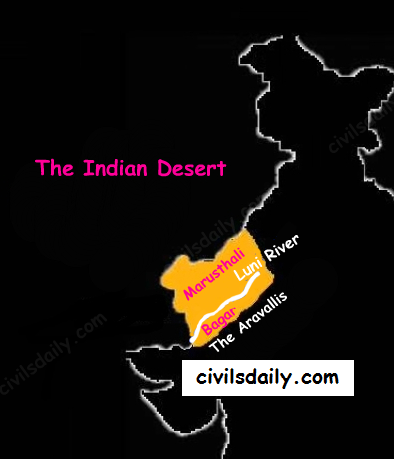
    THE INDIAN DESERT

    The Indian desert is also known as the Thar Desert or the Great Indian Desert.

    Location and Extent:

    • Location – To the north-west of the Aravali hills.
    • It covers Western Rajasthan and extends to the adjacent parts of Pakistan.
    The Physiographic Divisions of India | The Indian Desert

    Geological History and Features

    • Most of the arid plain was under the sea from Permo-Carboniferous period and later it was uplifted during the Pleistocene age. This can be corroborated by the evidence available at wood fossils park at Aakal and marine deposits around Brahmsar, near Jaisalmer (The approximate age of the wood fossils is estimated to be 180 million years).
    • The presence of dry beds of rivers (eg Saraswati) indicates that the region was once fertile.
    • Geologically, the desert area is a part of the peninsular plateau region but on the surface, it looks like an aggradational plain.

    Chief Characteristics:

    • The desert proper is called the Marusthali (dead land) as this region has an arid climate with low vegetation cover. In general, the Eastern part of the Marushthali is rocky, while its western part is covered by shifting sand dunes.
    • Bagar: Bagar refers to the semi-desert area which is west of Aravallis. Bagar has a thin layer of sand. It is drained by Luni in the south whereas the northern section has a number of salt lakes.
    • The Rajasthan Bagar region has a number of short seasonal streams which originate from the Aravallis. These streams support agriculture in some fertile patches called Rohi.
    • Even the most important river ‘Luni’ is a seasonal stream. The Luni originates in the Pushkar valley of the Aravalli Range, near Ajmer and flows towards the southwest into the Rann of Kutch.
    • The region north of Luni is known as the Thali or sandy plain.
    • There are some streams which disappear after flowing for some distance and present a typical case of inland drainage by joining a lake or playa e.g. the Sambhar Lake. The lakes and the playas have brackish water which is the main source of obtaining salt.
    • Well pronounced desert land features:
      • Sand dunes: It is a land of undulating topography dotted with longitudinal dunes, transverse dunes and barchans. [Barchan – A crescent-shaped sand dune, the horns of which point away from the direction of the dominant wind; Longitudinal dune – A sand dune with its crest running parallel to the direction of prevailing wind]
    sand-dunes
    Image Source
    • Mushroom rocks
    • Shifting dunes (locally called Dhrians)
    • Oasis (mostly in its southern part)


    THE COASTAL PLAINS

    Of the total coastline of India (7517 km), that of the peninsula is 6100 km between the peninsular plateau and the sea. The peninsular plateau of India is flanked by narrow coastal plains of varied width from north to south.

    The Physiographic Divisions of India | The Coastal Plains

    On the basis of the location and active geomorphologic processes, these can be broadly divided into two parts:

    • The western coastal plains
    • The eastern coastal plains.

    We now take them up one by one:

    The Western Coastal Plain

    1. Extent: The Western Coastal Plains are a thin strip of coastal plains with a width of 50 km between the Arabian Sea and the Western Ghats.

    2. Subdivisions: Extending from the Gujarat coast in the north to the Kerala coast in the south, the western coast may be divided into following divisions:

    • Kachchh and Kathiawar coast in Gujarat,
    • Konkan coast in Maharashtra,
    • Goan Coast in Karnataka, and
    • Malabar coast in Kerala

    Note: Kutch and Kathiawar, though an extension of Peninsular plateau (because Kathiawar is made of the Deccan Lava and there are tertiary rocks in the Kutch area), they are still treated as an integral part of the Western Coastal Plains as they are now levelled down.

    Subdivisions of the eastern and Western Coastal Plains

    3. A coastline of submergence: The western coastal plains are an example of the submerged coastal plain. It is believed that the city of Dwaraka which was once a part of the Indian mainland situated along the west coast is submerged underwater.

    4. Characteristic Features:

    • The western coastal plains are narrow in the middle and get broader towards north and south. Except for the Kachchh and Kathiawar coastal region, these are narrower than their eastern counterpart.
    • The coast is straight and affected by the South-West Monsoon winds over a period of six months. The western coastal plains are thus wetter than their eastern counterpart.
    • The western coast being more indented than the eastern coast provides natural conditions for the development of ports and harbours. Kandla, Mazagaon, JLN port Navha Sheva, Marmagao, Mangalore, Cochin, etc. are some of the important natural ports located along the west coast.
    • The western coastal plains are dotted with a large number of coves (a very small bay), creeks (a narrow, sheltered waterway such as an inlet in a shoreline or channel in a marsh) and a few estuaries. The estuaries, of the Narmada and the Tapi are the major ones.
    • The rivers flowing through this coastal plain do not form any delta. Many small rivers descend from the Western Ghats making a chain of waterfalls.
    • The Kayals – The Malabar coast has a distinguishing feature in the form of ‘Kayals’ (backwaters). These backwaters are the shallow lagoons or the inlets of the sea and lie parallel to the coastline. These are used for fishing, inland navigation and are important tourist spots. The largest of these lagoons is the Vembanad lake. Kochi is situated on its opening into the sea.

    The Eastern Coastal Plain

    1. Extent: The Eastern Coastal Plains is a strip of coastal plain with a width of 100 – 130 km between the Bay of Bengal and the Eastern Ghats

    2. Subdivisions: It can be divided into two parts:

    • Northern Circar: The northern part between Mahanadi and Krishna rivers. Additionally, the coastal tract of Odisha is called the Utkal plains.
    • Coromandel Coast (or Payan Ghat): The southern part between Krishna and Kaveri rivers.

    3. A coastline of emergence: The eastern coastal plain is broader and is an example of an emergent coast.

    4. Characteristic features:

    • The eastern coastal plains are wider and drier resulting in shifting sand dunes on its plains.
    • There are well-developed deltas here, formed by the rivers flowing eastward in to the Bay of Bengal. These include the deltas of the Mahanadi, the Godavari, the Krishna and the Kaveri.
    • Because of its emergent nature, it has less number of ports and harbours. The continental shelf extends up to 500 km into the sea, which makes it difficult for the development of good ports and harbours.
    • Chilika lake is an important feature along the eastern coast. It is the largest saltwater lake in India.

    Significance of the Coastal Plains region:

    1. These plains are agriculturally very productive. The western coast grows specialized tropical crops while eastern coasts witnessed a green revolution in rice.
    2. The delta regions of eastern coastal plains have a good network of canals across the river tributaries.
    3. Coastal plains are a source of salt, monazite (used for nuclear power) and mineral oil and gas as well as centres of fisheries.
    4. Although lacking in adequate natural harbours, with a number of major and minor ports, coastal plains are centres of commerce and have attracted dense human settlements.
    5. The coastal regions of India are noted for tourist centres, fishing and salt making.


    THE ISLANDS

    There are two major island groups in India

    1. The island groups of Bay of Bengal: Andaman & Nicobar Islands
    2. The island groups of Arabian Sea: Lakshadweep and Minicoy Islands
    The Physiographic Divisions of India | The Islands

    Let’s take these up one by one:

    Andaman & Nicobar Islands:

    • Also called the emerald islands.
    • Location and Extent:
      • These are situated roughly between 6°N-14°N and 92°E -94°E.
      • The most visible feature of the alignment of these islands is their narrow longitudinal extent.
      • These islands extend from the Landfall Island in the north (in the Andamans) to the Indira Point (formerly known as Pygmalion Point and Parsons Point) in the south (In the Great Nicobar).
    • Origin: The Andaman and Nicobar islands have a geological affinity with the tertiary formation of the Himalayas, and form a part of its southern loop continuing southward from the Arakan Yoma.
    • The entire group of islands is divided into two broad categories:
      • The Andaman in the north, and
      • The Nicobar in the south.

    They are separated by a water body which is called the Ten-degree channel.

    • The Andaman islands are further divided into:
      • Great Andamans
        • North Andaman
        • Middle Andaman
        • South Andaman
      • Little Andaman

    Little Andaman is separated from the Great Andamans by the Duncan Passage.

    The Andaman and Nicobar Islands
    • Chief Characteristics:
      • These are actually a continuation of Arakan Yoma mountain range of Myanmar and are therefore characterized by hill ranges and valleys along with the development of some coral islands.
      • Some smaller islands are volcanic in origin e.g. the Barren island and the Narcondam Island. Narcondam is supposed to be a dormant volcano but Barren perhaps is still active.
      • These islands make an arcuate curve, convex to the west.
      • These islands are formed of granitic rocks.
      • The coastal line has some coral deposits and beautiful beaches.
      • These islands receive convectional rainfall and have an equatorial type of vegetation.
      • These islands have a warm tropical climate all year round with two monsoons.
      • The Saddle peak (North Andaman – 738 m) is the highest peak of these islands.
      • The Great Nicobar is the largest island in the Nicobar group and is the southernmost island. It is just 147 km away from the Sumatra island of Indonesia.

    Lakshadweep Islands:

    • These islands were earlier (before 1st November 1973) known as Laccadive, Minicoy and Amindivi Islands.
    • Location:
      • These are scattered in the Arabian Sea between 8°N-12°N and 71°E -74°E longitude.
      • These islands are located at a distance of 280 km-480 km off the Kerala coast.
    • Origin: The entire island group is built of coral deposits.
    • Important islands:
      • Amindivi and Cannanore islands in the north.
      • Minicoy (lies to the south of the nine-degree channel) is the largest island with an area of 453 sq. km.
    map_of_lakshadweep-en-svg
    Source
    • Chief Characteristics:
      • These consist of approximately 36 islands of which 11 are inhabited.
      • These islands, in general, have a north-south orientation (only Androth has an East-West orientation.
      • These islands are never more than 5 metres above sea level.
      • These islands have calcium-rich soils- organic limestones and scattered vegetation of palm species.
      • One typical feature of these islands is the formation of the crescentic reef in the east and a lagoon in the west.
      • Their eastern seaboard is steeper.
      • The Islands of this archipelago have storm beaches consisting of unconsolidated pebbles, shingles, cobbles and boulders on the eastern seaboard.
      • The islands form the smallest Union Territory of India.

    Other than the above mentioned two major groups, the important islands are:

    1. Majauli: in Assam. It is:
      1. The world’s largest freshwater (Brahmaputra river) island.
      2. India’s first island district
    2. Salsette: India’s most populous island. Mumbai city is located on this island.
    3. Sriharikota: A barrier island. On this island is located the satellite launching station of ISRO.
    4. Aliabet: India’s first off-shore oil well site (Gujarat); about 45 km from Bhavnagar, it is in the Gulf of Khambat.
    5. New Moore Island: in the Ganga delta. It is also known as Purbasha island. It is an island in the Sunderban deltaic region and it was a bone of contention between India and Bangladesh. In 2010, it was reported to have been completely submerged by the rising seawater due to Global warming.
    6. Pamban Island: lies between India and Sri Lanka.
    7. Abdul Kalam Island: The Wheeler Island near the Odisha coast was renamed as Abdul Kalam island in 2015. It is a missile launching station in the Bay of Bengal. The first successful land-to-land test of the Prithvi Missile was conducted from the mainland and it landed on the then uninhabited ‘Wheeler Island’ on November 30, 1993.
  • [Prelims Spotlight] Policies and Schemes Regarding Women/ Functions and Powers of Legislature


    Prelims Spotlight is a part of “Nikaalo Prelims 2020” module. This open crash course for Prelims 2020 has a private telegram group where PDFs and DDS (Daily Doubt Sessions) are being held. Please click here to register.


    20 March 2020


    Schemes and Policies for Women

           SCHEME       OBJECTIVES              SALIENT                                   FEATURES MINISTRY
    Nirbhaya Fund -Nirbhaya Fund is an Indian rupee 10 billion corpus announced by Government of India in its 2013 Union Budget.
    -According to the then Finance Minister P. Chidambaram, this fund is expected to support initiatives by the government and NGOs working towards protecting the dignity and ensuring the safety of women in India.
    -Nirbhaya (fearless) was the pseudonym given to the 2012 Delhi gang-rape victim to hide her actual identity.
    Earlier Ministry of Home Ministry, Now Ministry of Women & Child
    ICDS -To prevent and reduce young child under-nutrition
    (% underweight children 0- 3 years) by 10 percentage
    points,
    -Enhance early development and learning outcomes in
    all children 0-6 years of age,
    -improve the care and nutrition of girls and women and
    reduce anaemia prevalence in young children, girls and
    women by one fifth by the end of the 12th five-year plan.
    -It is a centrally sponsored scheme
    -The engagement of the Anganwadi worker and helper from the same village
    -It is a universal and self-selecting scheme i.e. anyone can visit the Aanganwadi centre and
    enrol these services.
    -Package of six services i.e.
    o SNP – supplementary nutrition programme
    o Pre-school education
    o Health and nutrition education,
    o Immunization,
    o Health check-up and
    o Referral services to the beneficiaries
    AEC-cum-crèche, AWC-cum counsellor.
    Ministry of Women & Child
    Mahila Police Volunteer It envisages the creation of a link between the police authorities and the local communities in villages through police volunteers who will be women specially trained for this purpose. Under this scheme, it is expected to have at least one such volunteer in every village whose primary job will be to keep an eye on situations where women in the village are harassed or their rights and entitlements are denied or their development is prevented. Joint initiative b/w Min. of WCD and Home Min. Ministry of Women & Child and Home Ministry
    UJJAWALA Yojana A comprehensive scheme for prevention of trafficking and rescue, rehabilitation and reintegration of victims of trafficking and commercial sexual exploitation Ministry of Women & Child
    One-Stop centre scheme 1. To provide integrated support and assistance to women affected by violence, both in private and public spaces under one roof.
    2. To facilitate immediate, emergency and non-emergency access to a range of … support under one roof to fight against any forms of violence against women
    1. These centres will provide immediate access to a range of services including medical, legal, psychological and counselling support to the victims.
    2. The OSC will support all women including girls below 18 years of age affected by violence, also for girls below 18 years of age, institutions and authorities established under Juvenile Justice (Care and Protection of Children) Act, 2000 and the Protection of Children from Sexual Offences Act, 2012 will be linked with the OSC.
    3. In addition to this, a single uniform number –181 will provide 24-hour emergency response to all women affected by violence, through referral (linking with appropriate authorities such as Police, OSC or hospital); funding thru’ Nirbhaya fund
    Ministry of Women & Child
    Swadhar Grehs Homes for relief and rehabilitation of women in difficult circumstances including survivors of rape/assault etc.
    Provision for food clothing, counselling. training, clinical and legal aid; long term
    Ministry of Women & Child
    She-Box Online complaint Management System for women working in both public and private organizations to ensure effective implementation of the Sexual Harassment of Women at Workplace Act Ministry of Women & Child
    Universalization of Women Helpline Ministry of Women & Child
    The mission for Protection and Empowerment for Women : To achieve holistic empowerment of women through
    the convergence of schemes/programmes of different Ministries/
    Department of Government of India as well as State
    Governments
    -It aimed at improving the declining Child Sex Ratio; ensuring survival. & protection
    of the girl child; ensuring her education, and empowering her to fulfil her potentials social sector welfare schemes for care, protection and development of
    women.
    -It will provide an interface for rural women to approach the government for availing their entitlements and for empowering them through training and capacity building.
    Ministry of Women & Child
    Mahila Shakti Kendra -Mahila Shakti Kendras will converge all Govt. Schemes for women at National, State, District and Block level
    Skill Development, Employment, Digital Literacy, Health and Nutrition.
    -Through this scheme, the government plans to reach 115 most backward districts in the country with 920 Mahila Shakti Kendra…
    Ministry of Women & Child
    PRIYADARSHINI SCHEME(discontinued in 2016) Women’s Empowerment and Livelihoods Programme in the Mid Gangetic Plains Ministry of Women & Child
    Sabla -Enable the adolescent girls for self-development and
    empowerment
    -Improve their nutrition and health status.
    -Promote awareness about health, hygiene, nutrition, adolescent
    reproductive and sexual health (ARSH) and family and child care.
    -To educate, skill and make them ready for life’s challenges
    Nutrition provision
    – Iron and folic acid (IFA) supplementation
    – Health check-up and referral services
    – Nutrition & health education (NHE)
    -Counselling/guidance on family welfare, ARSH, child
    care practices and home management.
    -Upgrade home-based skills, life skills and integrate
    with the national skill development program (NSDP)
    for vocational skills.
    -Mainstream out of school adolescent girls into
    formal/non-formal education.
    -Provide information/guidance about existing public
    services such as PHC, CHC, post office, bank, police
    the station, etc.
    Ministry of Women & Child
    Saksham Ministry of Women & Child
    Mahila Kisan Sashaktikaran Pariyojana -Empower women in agriculture by making systematic investments to enhance their participation and productivity,
    -Create and sustain agriculture-based livelihoods of rural women.
    -a sub-component of the Deendayal Antodaya Yojana-NRLM (DAY-NRLM)
    – Under the Pariyojana, projects are conceived in such a manner that the skill base of the women in agriculture is enhanced to enable them to pursue their livelihoods on a sustainable basis.
    -Under MKSP sustainable agriculture, 58 projects from 14 States have been sanctioned which will benefit 24.5 lakhs Mahila Kisans during the period.
    Ministry of Rural Development
    Beti Bachao Beti Padhao 1.Prevent Female infanticide
    2.Ensure Every Girl Child is Protected
    3.Ensure every Girl Child is educated
    Enforcement of PC & PNDT Act, nation-wide awareness and advocacy campaign and multi-sectoral action in select 100 districts (low on Child Sex Ratio) in the first phase.
    -Under this scheme, there is a strong emphasis on mindset change through training, sensitization, awareness-raising and community mobilization on ground.
    It is a tri-ministerial effort of Ministries of Women and Child Development, Health & Family Welfare and Human Resource Development.
    Sukanya samriddhi yojana 1.(Minor) bank account for girl child below the age of 10.
    2.She can withdraw 50% of the money after reaching the age of 18 e.g. for higher education. 18 years deadline will also help to prevent child-marriages.
    For initial account opening, minimum deposit Rs.1000 required.
    Later, any amount in multiples of 100 can be deposited, but maximum Rs. 1.5 lakh per year.
    Interest rate: 9.1% compounded annually.
    Ministry of Women & Child
    Pocso-e Box 1, POCSO e-box is a unique endeavour by NCPCR for receiving an online complaint of Child Sexual Abuse directly from the victim.
    2. Through a well-defined procedure, complaints are directly followed up by a team which counsels the victim, providing further guidance for required legal action. Through a short animation film embedded in the e-box, it assures the victim not to feel bad, helpless or confused as it’s not her fault. With the e-box, it is easy to register a complaint through a step-by-step guided process.
    The Ministry of Women & Child
    It is an initiative of the National Commission for Protection of Child Rights (NCPCR), for Direct online Reporting of Child Sexual Abuse.
    NARI Due to scattered information on various women-centric schemes/legislations, there is a lack of awareness
    among people regarding the same. To address this problem the government launched NARI portal as a single
    window access to information and services
    Ministry of Electronics & Information Technology
    e-samvaad Portal It is a platform for NGOs and civil society to interact with the Ministry of Women and Child Development
    (MWCD) by providing their feedback, suggestions, put up grievances, share best practices etc.
    • This will help in the formulation of effective policies and measures for the welfare of women and children.
    Ministry of Women & Child
    Stree Swabhiman -It aims to create a sustainable model for providing adolescent girls and women access to affordable sanitary products in rural areas.
    -Under this project, sanitary napkin micro manufacturing units (semi-automatic and manual process
    production unit) are being set up at CSCs across India, particularly those operated by women entrepreneurs.
    -The product will be sold under the local brand name and marketed by village-level entrepreneurs.
    -Each facility will employ 8-10 women and educate women of their society to overcome this social taboo.
    -It also has a menstrual hygiene related awareness generation component and is also expected to reduce
    drop-out rates in girls on reaching puberty.
    Ministry of
    Electronics and Information
    technology (MeITY)
    PROGRAM TO TRAIN ELECTED WOMEN REPRESENTATIVES OF
    PANCHAYATI RAJ INSTITUTIONS
    -The program aimed at capacity building of EWRs is being organized by the National Institute of Public Cooperation and
    Child Development (NIPCCD) of the MoWCD.
    -It is the first-ever initiative which will train approximately twenty thousand EWRs covering nearly 50 EWRs
    from each district (by March 2018) who will go out and administer the villages professionally.
    – It will help in creating model villages, ensure their effective participation in the governance process and help
    preparing women as political leaders of the future.
    Ministry of women and Child
    Support to Training and Employment
    Programme for Women (STEP)
    -To provide competencies and skill that enable women to become self-employed/entrepreneurs.
    -The scheme is intended to benefit women who are in the age group of 16 years and above across the country.
    Ministry of women and Child
    Rashtriya Mahila Kosh -RMK is a national credit fund for women under the aegis of the Ministry of Women and Child Development.
    -It was established in 1993 for socio-economic empowerment of women.
    -It aims to provide financial services with backward and forward linkages for women in the unorganized sector through Intermediary Micro Finance Organizations (IMOs) and Women Self Help Groups (SHGs) and to augment their capacities through multi-pronged efforts.
    -RMK also extends micro-credit to the women in the informal sector through a client-friendly, without collateral and in a hassle-free manner for income generation activities
    Ministry of women and child


    Functions and powers of the legislature

    Loksabha (house of people) + RajyaSabha (Council of states) + President

    LokSabha RajyaSabha
    Other names The lower house, house of people Upper house, the council of states
    Total strength (state+UT+nominated) 530+13+2 29 elected from states + 4 from UTs + 12 Nominated by president
    Maximum strength (state+UT+nominated) 530+20+2 238 +12
    Mode of election Direct election – First past the post Indirect by MLAs – proportional representation by a single transferable vote
    Life cycle 5 yr or until dissolved Continuing chamber (6 year of MP)
    Min. age to contest polls 25 30
    Presiding officer Speaker Vice President (Ex officio
    Who can be nominated 126 Constitutional Amendment Act removed nomination provision  for Anglo-Indians
    Special knowledge in Literature, art, science, social service


    LS RS
    Money Bill, certification and voting on it Introduced here, speaker certifies can vote and amend Can’t be introduced, can’t vote, can only send recommendation within 14 days
    Estimate committee members All 30 from LS No role
    Joint sitting presided by Speaker > deputy speaker Not by VP
    National emergency discontinuation Resolution by LS No role
    No confidence motion, censure motion adjournment motion Only in LS


    RS LS
    Parliamentary law on the state list Authorizes (Art 249)
    Creation of new AIS Authorizes (Art 312)
    Introduction of motion to remove VP Introduced here and passed by an effective majority LS – simple majority required


    Presiding officers

    Speaker of previous LS vacates post before the first meeting of new LS

    President appoints speaker Pro Tem – usually a senior-most member

    Presides over a first meeting, the oath to members, the election of the speaker

    Speaker is elected and pro tem cease to exist

    Speaker fixes the date for the election of deputy speaker

    Nominates panel of =<10 chairpersons to preside in his/ deputy’s absence


    Election and removal (Speaker, deputy and vice CP) and salary

    Election -By the members of particular house by a simple majority

    Removal – 14 days notice and the effective majority of the house

    Charged on CFI and thus non-votable

    Titbits:

    1. President is part of parliament but not the presiding officer of any house
    2. VP is not the part of parliament yet presiding officer and ex officio chairperson of RS
    3. President can not chair joint sitting even in the absence of the speaker and deputy speaker. Deputy CP chairs the sitting in such eventuality
    4. Being elector of the same state is not a requirement to contest the election of RS or LS (elector in any constituency in India)
    5. Bills introduced by ministers are public bills, those by other members (including members of the ruling party) are private bills.

    Unique provisions

    1. Question hour and not Zero hours is the first hour of parliamentary proceeding.
    2. Indian innovation – Zero hour and Calling attention motion
    3. Not mentioned in the rule of the procedure – Zero hours (calling attention motion is in rules)
    4. Censure motion should state the reasons and can be initiated against the individual minister as well; no such requirement for the no-confidence motion, only against CoM
    5. Adjournment motion is an extraordinary device to draw attention to the urgent matter of public importance
    Ordinary Bill Money bill CAB
    Government approval No Required (introduced by minister only) No
    Introduction Either house Only LS Either house
    Passage Simple majority Simple Special
    Amendments Simple majority RS only recommends changes within 14 days Special majority
    Deadlock President can call Joint session after 6 month LS doesn’t have to accept recommendations, bill is passed as such No joint sitting
    Returning by President Can return once for reconsideration or withhold assent Can’t return, either assent or reject Shall assent


    Titbits:

    1. Only 3 joint sittings so far – dowry bill, banking services bill and POTA bill
    2. Only 14 private member bills have been passed so far, last bill (supreme court enlargement of jurisdiction bill )was in 1968
    3. Right of transgender persons bill was passed by RS (1st private member bill to get the nod of the upper house in 45 years)

    Budget (Annual Financial Statement, Article 112)

    1. Presentation of the budget by FM
    2. General discussion – discuss as a whole
    3. Scrutiny by departmental committees – for 3 to 4 weeks
    4. Voting on demand for grants – voting only in LS and only on non-charged expenditure (cut motions at this stage). On last day all remaining demands are put together and put to vote – guillotine
    5. The passing of appropriation bill – voted demands plus charged expenditure, no amendments can be moved here
    6. The passing of finance bill – financial proposals (taxes), amendments to reduce taxes can be moved
    Fund Consolidated fund Contingency Public accounts
    What comes All receipts and payments Money comes from CFI to meet unforeseen expenditure All public money except CFI (provident fund, remittances etc)
    Parliamentary approval Yes No. finance secretary on behalf of the president Not required, executive operates

    Titbits:

    1. Charged expenditure can be discussed but not voted
    2. Salary and allowance of SC judges, UPSC members, CAG, President, VP, Speaker, deputy, vice CP etc are charged on CFI
    3. Salaries and Expenditure of election commission is not charged on CFI
    4. Salary of high court judges is charged on CF of states while their pension in charged on CFI


    State legislative assembly (Vidhansabha)

    Vidhan Sabha is equivalent to LS and Vidhan Parishad to RS

    Differences are mentioned below

    Vidhan Parishad (legislative council): 7 states, Andhra, Bihar, J&K, K’taka, Maharashtra, Telangana, UP

    Creation and Abolition of Vidhan Parishad: Vidhan Sabha passes a resolution by the special majority and Parliament agrees to that resolution by a simple majority

    Titbits:

    1. Bill passed by Vidhan Sabha – Vidhan Parishad can amend w/i 3 months – Vidhan Sabha accepts or rejects amendments – Vidhan Parishad can hold the bill for 1 more month
    2. Bill passed by Vidhan Parishad – Vidhan Sabha rejects – the bill is killed
    3. No provision for joint sitting in states
    4. The maximum strength of Vidhan Parishad ⅓ of Vidhan Sabha, min 40
    5. ⅚ indirectly elected, ⅙ nominated

    Governor can reserve all the bills for presidential assent

    Once he reserves the bill, his role is over and the president can assent, hold back, reject or send the bill for reconsideration

    Situations where Parliament can pass a bill on state subject

    Condition Duration
    National emergency 6 months after the expiry of emergency
    President’s rule Indefinitely but legislature can repeal or modify
    International treaty/ agreement Indefinitely
    RS passes a resolution by ⅔ majority 1 year of resolution plus 6 months <resolution can be passed again>
    2 or more states pass the resolution <applicable only ti those states> Indefinitely


    Types of majority

    Eg. Total seats – 545

    Vacancies due to death and resignation – 10

    Absence – 20

    Total vote cast – 500 ( 15 present did not cast vote)

    Type Simple Effective Absolute ⅔ majority Special Absolute ⅔
    Definition 50% present and voting +1 50% of (total – vacancies) +1 50% of total + 1 ⅔ present and voting +1 Absolute and ⅔ simultaneously ⅔ of total +1
    Example (500/2) +1 (545-10)/2 +1 (545/2) +1 (⅔*500) +1 (⅔*545)
    Used Ordinary bill, a money bill Removal of the speaker, deputy speaker in LS, VP and vice Cp in RS No where Art 249, 312, 169 Art 368, removal of judges of the supreme court, high court, CAG Impeachment of president


    Parliamentary committees

    Committee Estimates committee Public accounts committee Departmentally related standing committees (24)
    Membership 30 (LS) 22 (15+7) 21+10
    Appointment Elected every year by proportional representation Elected every year by proportional representation Nominated by Speaker and CP
    Chairperson Ruling party member Opposition member from 1967
    Role Examine estimates included in the budget and suggest economies in expenditure Examines the audit report of CAG Demand for grants and bills


  • [Prelims Spotlight] Important Historical Sculpture/Tribes in India, Their festivals, and Culture.


    Prelims Spotlight is a part of “Nikaalo Prelims 2020” module. This open crash course for Prelims 2020 has a private telegram group where PDFs and DDS (Daily Doubt Sessions) are being held. Please click here to register.


    19th March 2020


           Famous Sculpture/                             Painting Era/ Dynasty      Monument
    Bodhisattva Padmapani Gupta Period Ajanata
    Mahakapi Jataka Sunga Bharhut stupa
    Torso of Vishnu Gupta Period Mathura
    Stupa worship Mauryan/Sunga period Bharhut stupa
    Yakshini Mauryan/Sunga period Bharhut stupa
    Queen Maya’s dream Mauryan/Sunga period Bharhut stupa
    Painting of Yashodahara,Rahul & buddha Gupta Period Ajanata
    Standing Buddha Gupta Period Sarnath
    Seated Buddha Kushanas Mathura
    Standing Buddha Kushanas Gandhara
    Mara Vijaya Multiple period Ajanta
    Maheshmurthi Rashtrakuta Period Elephanta caves
    Shiva chasing boar Vijaynagara Period Lepakshi temple
    Shiva killing Tripurasura Thanjavoor
    Dakshinamurthy Vijaynagara Period Lepakshi temple
    Ladies attending Parvathy Vijaynagara Period Lepakshi temple
    Krishna playing the flute Pundareekapuram temple
    Sheshashayana Vishnu Gupta Period Dashavtar temple
    Vishnu in Nara-Narayan form Gupta Period Dashavtar temple
    Arjun Penance Pallavas Mahabalipuram
    Statue of Suparshvanatha Pallavas
    Statue of Gommateshwara, Ganga Dynasty Shravanbelagola, Karnataka
    Yakshi Mauryan Period Didarganj
    Durga with eight arms shown in the act of defeating Mahishasura, Pallavas Mahishasura Mardini Cave, Mahabalipuram
    Ravana Shaking Mount Kailasha Rashtrakuta Ellora
    Nandi bull Cholas Brihadeshwara temple
    Kalyana Sundara Murthy Rashtrakuta Ellora
    Nayika Ganga Dynasty Lingraj temple
    Nataraja Cholas Brideshwar temple
    Manjira player Ganga Dynasty Surya Mandir,Odhisa
    Mohini Hoysalas Chennakeshava temple
    Pillars with horse rider Naykas Meenakshi temple
    Worship of Bodhi tree Mauryan Period Bharhut
    Animals worshipping Bodhi tree Sungas Sanchi
    Yakshini Sungas Sanchi
    Taming of Nalagiri elephant Mauryan Period Amravati
    Head of Buddha Kushanas Gandhara
    Seated Buddha Kushanas Mathura
    Dwarfish Yaksha Pithalkoda caves
    Five Ratha Pallavas Mahabalipuram
    Vrikshika Sunga Sanchi Stupa
    Buddha’s Great departure Kushanas Gandhara
    Indra flying amid clouds together with celestial nymphs Gupta Period Ajanta


    The following table contains the tribes in India, significant aspects of their life, and festivals they celebrate.

    Name of the tribe States/ Region Significant aspects related to the tribe Festivals
    Munda Chota Nagpur Plateu 1.Christianity is their main religion.
    2..They speak Mundari which is austro-asiatic Language.
    Main festivals of Munda tribe are Mage Parab , Ind-Parab Jom-Nagoa or Jom Nawa ,Batauli ,Kolom Sing ,Phagu Festival ,Sarhul or Ba Parab ,Karam and Sohrai Festival
    Santhals West Bengal, Bihar, Orissa, Jharkhand and Assam. 1.Santhals are the third largest tribe in India.
    2.Santhals speak Santhali, which belongs to the Austro- Asiatic language family. Santhals have their script called Olchiki, which was developed by Dr Raghunath Murmu in 1925.
    3.Santhals have no temples of their own. They even do not worship any idols. Santhals follow the Sarna religion.
    Santhals mainly celebrate the Karam festival which falls in the month of September and October
    Angami Nagaland 1.Men wear shawls called white Mhoushu and the black Lohe. The women wear Mechala – the wrap around skirt and shawls of unique designs and patterns
    2.Christianity is the major religion followed among the Angami tribal people
    3.Angamis are quite popular for their woodcraft and artwork.
    Sekrenyi is the main festival celebrated among the Angamis in Nagaland.
    Bhils The central Bhils are found in the mountain regions in the Indian states of Madhya Pradesh, Maharashtra, Gujrat and Rajasthan. Bhils are also found in the north eastern parts of Tripura. 1.Religion practice among the Bhils differ from place to place. Most of them worship local deities like Khandoba, Kanhoba, Bahiroba, and Sitalmata. Some of the worship Tiger God called ‘vaghdev’. They have no temples of their own.
    2.Ghoomar is the most famous dance among the Bhils.
    3.Than Gair is the religious dance drama performed by the men in the month of Sharavana (July and August)
    The Baneshwar fair is the main festival celebrated among the Bhils. This fair is held during the period of Shivatri (in the month of January or February) and is dedicated to Baneshwar Mahadev also known as Lord Shiva. On this occasion Bhils gather all together set up camps on the banks of the Som and Mahi river.
    Chenchus Chenchu inhabit in the Nallamalai hills, which have been the part of the Nagarjuna Sagar Tiger Sanctuary for centuries in Andhra Pradesh India. 1.Chenchus talk in Chenchu language with the Telgu accent. Their language is also known as Chenchucoolam, Chenchwar, Chenswar or Choncharu.
    2.Chenchus worship number of deities. They mainly believe in Bhagaban taru who lives in the sky and look after the Chenchus in all their doings. Another deity they worship is Garelamai Sama, who is the Goddess of forest.
    Khasis Khasi tribe is mainly found in the sate of Assam and the Khasi Jaintia hills in Meghalaya 1.Khasis speak Khasi, which is an Austro- Asiatic language. It is the part of the Mon-Khmer group of languages.
    2.Khasis have a matriachal society.
    3.Most of the Khasis follow Christianity as the religion. The Khasi believe in the supreme creator God U Blei Nong-thaw.
    Nongkrem is the major festival celebrated among the Khasis.
    Bhuthias Bhutia tribes are of the Tibetan origin. They migrated to Sikkim around 16th century. In the northern part of the Sikkim where they are the major inhabitants, they are known as the Lachenpas and Lachungpas. Majority of the Bhutias are concentrated in the dry valley of the North Sikkim. 1.Bhutia tribes usually speak Sikkimese.
    2.The legal system among the Bhutias is termed as the Dzumsa, which means the rendezvous point of the common masses.
    3. Bhutia male wear Bakhu which is a loose traditional dress with the full sleeves. While the women dress consists of Silken Honju, which is the full sleeves blouse
    Losar and Losoong are the main festivals celebrated among the Bhutia tribes.
    Gonds The Gonds are the tribal community mostly found in the Gond forests of central India. They are widely spread in the Chhindwara District of Madhya Pradesh 1.Gonds tribe speak Gondi language which is related to the Telgu and the other Dravidian languages.
    2.Gonds have been largely influenced by the Hindus and for the long time have been practicing the Hindus culture and traditions. Gonds are the worshipers of Janani or the mother of creator.
    3.Gusadi dance is the most famous dance perfomed by the Gonds.
    Gonds fair and festivals are influenced from the Hindu traditions. Keslapur Jathra is the important festival of the Gonds.
    Gaddis Himachal Pradesh. 1.The main occupation of Gaddi tribes is shepherding and they make their livelihood by rearing and selling sheeps, goats, mules and horses
    2. They speak Gaddi langauge
    The Namagen dance is performed in the month of September to celebrate the autum. They were costumes which are largely woolen and studded with ornaments of silver. They are worn by women.
    Birhor Chattisgarh 1.They follow Hinduism and have their indigenous traditional beliefs. ‘Sing Bonga’, is regarded by the people as the supreme god.
    2.Birhor tribe is one of the primitive tribes. They belong to the Proto-Australoid stock; linguistically, they originate from the Austro-Asiatic group.
    Garo Meghalaya 1.In Garo tribes, women are the owners of property thus making it a matrilineal society.
    2.most of the Garos adopted Christianity. These tribes speak Garo language, which is also further divided into different sub-languages or dialects.
    Wangala is one of the significant festivals of these tribes This festival is celebrated after the harvest of crops as thanks giving ceremony to their deity Salijong
    Zeliang Nagaland 1.The Zeliang practice wet cultivation or Panikheti and terraced cultivation. They practice Jhum cultivation though they prefer Panikheti.
    2.Many have accepted the religion of Christianity.
    The Hega festival is one of the most important and the largest festivals among the Zeliang community
    Rengma Nagaland 1.They belong to the Mongoloid racial stock. The Rengma is a patriarchal society therefore the line of descent is traced through the male side and property rights goes to the male line.

    2.The Rengma tribes are agriculturists. They grow paddy through Jhum cultivation and wet cultivation.

    3.Traditionally Rengma tribes are worshippers of supernatural beings. The Supreme god is known as Teronyu. Nyensug and Nyensugi are the next important god and goddesses who are worshipped for household wealth. Now most of the Rengma tribes are Christians

    Ngada is the most important festival of Rengma tribes. It is celebrated after harvesting the crop or at the end of November or in the beginning of December. Actually it is a “Thanks giving” festival of the Rengma tribes
    Ao Nagaland The Ao Nagas are rich in their folk literature.
    With the arrival of Christian missionaries in the 19th century the Ao were some of the earliest converts to Christianity among the other Naga tribes.
    1. The Aos observe Moatsü Mong after the sowing is done. The festival provides them a period of recreation and entertainment after the stressful work of clearing fields, burning jungles, sowing seeds, cleaning up the Tsubu (wells) and repairs and construction of houses by elders of the Putu Menden, stretching over a week.
    2.Aos have another festival called Tsüngrem Mong. It is celebrated in the eve of the harvest.
    Lushai Manipur/Mizoram 1.Lushai tribes have developed expertise in swimming and hunting. That they are good archers are apparent from the fact that they can nicely handle ‘Sairawkher’.
    2.The way they dress shows that these Lushai tribes have got aesthetic sense. Lukhum is a special hat worn by the Lushai tribes. It is sharp in shape, mainly prepared from ‘bamboo splits’. Special open-hexagonal weave are used for weaving these hats.
    3.For proper administration, the whole of the Lushai society are segregated into clans and castes, nicely run by a village head. Different is the way in which they practice the ‘Sakhua sacrifice’. These Lushai tribes are pious.
    There Bamboo dance(known as Cheraw dance) is very famous.
    Hmar Manipur 1.The society is patrilineal and patriarchal in nature.
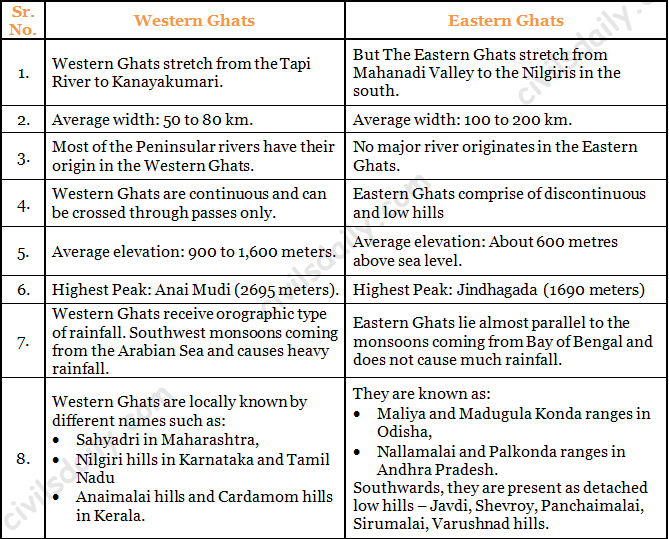
    2. Hmars worship supernatural beings. Pathien is the supreme god.
    3.The Hmars depend on forest products. Their economy can be classified dually -traditional and subsidiary occupations.
    Chawn-lam, Dar-lam, Pheipheet-lam, Hrang-lam, Tinna-Hla-lam are the common dances of the Hmar community. All dances are based on the rhythmic tunes of musical instruments.
    Kuki Manipur Kuki Tribe of Manipur are mainly followers of Christianity and Judaism.
    Mizo Mizoram 1.The Mizos are of the Mongoloid racial stock with well built features.
    2.They follow Christianity
    3.The Mizos are mainly an agricultural people. Jhum cultivation is the traditional form of agriculture that is practiced
    The Mizo celebrate many festivals among which Chapchar kut and Pavlkut are most important festivals. Chapchar kut is celebrated in the month of March. It is the spring festival celebrated. Pawl kut is a harvest festival celebrated in the months of December and January.
    Chakesang Nagaland Held in between March and April, the Tsukhenyi festival is one of the least known tribal festivals in India that is celebrated with great enthusiasm by the Chakesang Nagass
    Limboos Sikkim 1.Many Limbu follow a combination of Buddhism and their traditional beliefs.
    2.There traditional group dance is called dhannach and is performed during marriage,death or any festivities
    3.The traditional dress of Limboos are mekhli and Taga
    Lepchas Sikkim 1.The Lepchas are the aboriginal inhabitants of Sikkim and they are mostly settled in North Sikkim. They are mostly Buddhist but many of them have now adopted Christianity
    2. The traditional cloths of the Lepchas are woven in exquisite colour combinations. Men’s dress is called Thokro-Dum and the female’s dress is called Dumdyam or Dumvum.
    3. The Lepcha trace their descent patrilineally. The marriage is negotiated between the families of the bride and the groom.
    Apatani Aruanchal Pradesh 1.UNESCO has proposed the Apatani valley for inclusion as a World Heritage Site for its “extremely high productivity” and “unique” way of preserving the ecology
    2. Women of the Apatani Tribe, in India’s Apatani plateau, are famous for the bizarre nose plugs they’ve been wearing since times long passed.
    They have two major festival- Dree and Myoko.
    Nyishis Aruanchal Pradesh 1.The Nyishi language belongs to the Sino-Tibetan family, however, the origin is disputed.
    2.Polygyny is prevalent among the Nyish.
    3. The Nyishis, who traditionally wear cane helmets surmounted by the crest of a hornbill beak (known as pudum, padam), have considerably affected the population of this bird.
    Several organizations, such as the Arunachal Wildlife and Nature Foundation and the Wildlife Trust of India, have been trying to stop the Nyishi hunting these birds in order to protect them from extinction. Nature reserves, such as the Pakke Sanctuary, are being set up to protect the birds, while artificial materials, such as fiberglass, have been introduced as an alternative to the hornbill beak in Nyishi dress.
    Nyokum is the festival celebrated by the Nyishi people, a religion which commemorates their ancestors.
    Adis Aruanchal Pradesh Adi dances vary from the slow, rustic and beautifully enchanting style Ponung (performed in Solung festival) to the exhilarating, exuberant thumps of Delong performed by Men in Etor festival. These dances have led to certain forms of dancing which jointly narrate a story, the Tapu (War Dance). In the Tapu War Dance, the dancers vigorously re-enact the actions of war, its gory details and the triumphant cries of the warriors. Yakjong is performed in Aran festival. The Adi celebrate a number of festivals, in particular their prime festivals are Aran, Solung, Etor.Solung, is observed in the first week of September for five days or more. It is a harvest festival performed after the sowing of seeds and transplantation, to seek for future bumper crops. Ponung songs and dances are performed by women folk during the festival
    Sema/Sumi Nagas Nagaland 1.The ‘Sumi Naga’ is one of the major Naga peoples in Nagaland, India. The Sumis mainly inhabit the Zunheboto district, although many have spread and is now living in a few more districts within Nagaland.
    2.Sumi Naga tribe practiced kiti-do and were a headhunter as every other Naga tribals .
    Tuluni (July 8) is a festival of great significance for the Sumi. This festival is marked with feasts as the occasion occurs in the bountiful season of the year. Drinking rice beer indispensably forms as part of the feasts. Rice beer is served in a goblet made of bamboo or made from the leaf of plantain. This drink is called Tuluni which gives the festival its name.
    Konyak tribe Nagaland The Konyak are a Naga people, and are recognised among other Naga by their tattoos, which they have all over their face and hands; facial tattoos were earned for taking an enemy’s head. They are called the land of Angh’s. They have the largest population among the Nagas. Aoleang is the biggest festival for the Konyak. They wear their traditional attire and sing folk song to celebrate the Aoleang festival.
    Reang Tripura 1.The Reangs are basically a semi-nomadic tribe who practice jhum (slash and burn) or shifting method of cultivation on the hill sides.
    2. The Reang basically belonged to the Mongoloid group and speaks the Tibeto-Burmese language ‘Kau Bru
    The Hodaigri dance amongst the Reang (Bru) was usually performed on the occasion of Maikhlungmo rituals i.e. worship of Goddess of food grains and cotton especially during the month of September-October
    Mishing Assam 1.The Mishing tribe is the second largest tribe among the other tribes of North- East India.
    2.Traditionally Mishing people live near the bank of river and they build their “Chang Ghar” with the help of timber bamboo, thatch, etc for comfort living.
    Mishing people are easy going, very simple living and are fond of festivals. The main festival is “Ali-Aye-Ligang” which is the most colourful spring festival held every year on first Wednesday of the month “Gimur polo”(Feb-March).
    Karbi Assam 1.The Karbis believes in animism which consists of such a belief in the role of spiritual beings in human life.
    2. Various types of dances are performed by the youths during the performances of Chomangkan, the death ceremony and other socio-religious festivals. The Karbis have very limited number of musical instruments. A big drum called Cheng is their main musical instrument.
    A number of festivals are observed by the people belonging to Karbi tribal group. Like for instance, they celebrate ‘Chojun Puja’ or ‘Swarak Puja’, ‘Rongker’, ‘Chokk-eroi’, ‘Hacha-Kekan’, ‘Chomangkan’.
    Mikir Assam
    Kols Madhya Pradesh Most of these tribes are landless labourer. They prefer to live in groups near villages called Kolhan
    Bonda Odhisa The Bonda are an ancient tribe of people who live in the isolated hill regions of the Malkangiri district of southwestern Odisha, India,
    Oarons Odhisa,Bihar and Jharkhand 1.Oraon also called Kurukh, aboriginal people of the Chota Nagpur region in the state of Jharkhand, India. They call themselves Kurukh and speak a Dravidian language akin to Gondi and other tribal languages of central India.
    2.Speakers of Oraon number about 1,900,000, but in urban areas, and particularly among Christians, many Oraon speak Hindi as their mother tongue.
    3.It was long thought that the Oraons and the other tribals were animists, people who attribute a living soul to plants, inanimate objects and natural phenomena. This view has been discarded although amateur anthropologists still sort it out in articles, in popular magazines. The Oraons are not nature worshipers.
    Murias Chattisgarh 1.The Muria are an adivasi (scheduled tribe) of the Bastar district of Chhattisgarh, India. They are part of the Gondi people.
    2.They have mixed-sex dormitories where adolescents are sent to practice premarital sex, sometimes with a single partner and sometimes serially.
    3.The Muria are traditionally animists, with village and clan deities
    Korba Chattisgarh Famous for there Karma dance
    Sahariya Rajasthan 1.Sahariya Tribe is the only primitive tribe of the Rajasthan state
    2.They follow Hindu religious practices and speak a dialect influenced by Hadoti.
    Irulas Tamil Nadu 1. They inhabit the area of the Nilgiri mountains, in the states of Tamil Nadu and Kerala, India
    2.Early 20th century anthropological literature classified the Irular under the Negrito ethnic group.
    3.Unlike the Negrito tribes in the Andaman Islands who have retained their language, Irular speak the Irula language, a Dravidian language that is closely related to Tamil, Yerukala, Sholaga and other Tamil languages
    Badagas Tamil Nadu 1.The Badagas live in the Nilgiri Hills of Tamil Nadu, India. They speak the unwritten Badaga language and are the one of the social groups in Nilgiris
    2.Thundu (a white piece of cloth) forms an integral part of the attire of Badaga women and as a cultural item, is presented to visiting dignitaries as a gesture of good will.
    Their important festival is Hethai Habba.
    Uralis Kerela 1.The Urali tribes like most of the tribes in south India, worship nature as Gods and inventor of the world. They consider the Sun as ‘the creator of all souls’ and moon as the mother of all creation.
    2.The Uralis generally do not engage in inter-tribal marriage, instead they prefer to marry within their own tribe. It is custom amongst them to wear a sacred thread on special occasions like weddings and funerals.
    Jarawas Andaman & Nicobar Island 1.The Jarawa are still at the primitive stage of life on earth. They entirely depend upon forest and sea for food. Wild boar and monitor lizard are consumed. Various kinds of fruit , honey and tubers are parts of their diet too.
    2.The jarawas of both sexes go complete naked. However some ornaments made with shells and palm leaves are worn by them but these are not in the sense to cover their nudity.
    This tribe has lived in the southeast part of Andaman but after the British regime they shifted to the western region of the island. They have forever been hunter gatherers in the true sense however things have changed since the 1990’s specially after the building of the old trunk road.
    Sentinelese Andaman & Nicobar Island 1.The Sentinelese people are said to be so hostile that their home has been named the ‘hardest place to visit’ in the world.The Sentinelese and other indigenous Andamanese peoples are frequently described as negritos,
    2.They inhabit the North Sentinel island, and are the only remaining tribe in the Andamans to still maintain their isolation from the rest of the world. Nobody knows exactly how they look, the population or how they live. Since 1967, the indian governments with the help of anthropologists have tried to make contact with the tribe. They tried giving gifts of food, coconuts, etc but they were always met with hostility. The tribe showers arrows and stones at whoever comes near the island.
    .
    Onge Andaman & Nicobar Island Onges are one of the most primitive tribes in India. They belong to the Negrito racial stock and they have been mainly seen near the Dugong creek in Little Andaman. They are dependent on the food provided by nature and are a semi-nomadic tribe.
    The onge population fell post british colonization from 672 in 1986 to 92 in 1901 but has remained stable since.
    Shompen Andaman & Nicobar Island The Shompens, who live in the Great Nicobar island, are a semi-nomadic people. They wander in their forest and coastal habitat in search of fruits and games. There are two territorial groups among the Shompens; The habitation of Shompens is the Great Nicobar which is the largest among the Nicobar group of Islands. Like the Nicobarese, they belong to the Mongoloid race.
    Pangwal Himachal Pradesh. 1.These rugged people, who are Hindus, have their unique customs, traditions, and institutions. The native Pangwals and Bhotis are robust, hardworking, handsome people who keep the valley’s unique culture alive in folk songs, music and tribal dances. Music, dance and the locally brewed liquor ‘patar’, play a significant role in the life of the Pangwals. One of the major festivals celebrated towards the end of February is ‘Jukaru’
    Sherdukpen Aruanchal Pradesh 1.The Sherdukpen language is part of the Kanauri branch of the Tibeto-Burman family.
    2.Bardo Chham is a folk dance of Sherdukpens, a small community of West Kameng District of Arunachal Pradesh, Bardo Chham is based on the stories of good and evil. According to the local beliefs, there are both good and evil in mankind. The Sherdukpens mask themselves representing the different animals and dance to show an act of fighting the evil forces.
    Wattal tribe Jammu & Kashmir Dumhal dance is performed by Wattal tribe on special occassions
    Bhutias Sikkim 1.The Bhutia are a community of people of Tibetan ancestry, who speak Lhopo or Sikkimese, a Tibetan dialect fairly mutually intelligible to standard Tibetan
    2. Singhi Chham or Kanchendzonga Dance is a dance form in Sikkim whereby the dancers perform in a lion costume that represents the snow lion. It is a dance of the Bhutia people
    Todas Tamil Nadu Tribals of Nilgiri hills


  • [Prelims Spotlight] Mass Movements


    Prelims Spotlight is a part of “Nikaalo Prelims 2020” module. This open crash course for Prelims 2020 has a private telegram group where PDFs and DDS (Daily Doubt Sessions) are being held. Please click here to register.


    18 March 2020

    Mass Movements


    The Non-Cooperation Movement-  1920-22

    Following events acted as the catalysts which finally resulted in the launch of the Non-Cooperation Movement by Gandhiji on August 1, 1920.

    Backdrop

    • The Rowlatt Act (February 1919), the Jallianwala Bagh massacre (13 April 1919) and martial law in Punjab had belied all the generous wartime promises of the British.
    • The Montagu-Chelmsford Reforms satisfied few.
    • The treatment meted out to Turkey after the World War-I incensed had incensed the Indian Muslim, which led to the launch of Khilafat movement.

    What were the aspects of Non-Cooperation Movement?

    • The program of the non-cooperation included within its ambit-
      • Surrender of titles and honours.
      • Boycott of government-affiliated schools and colleges, law courts, foreign cloths and could be included to resignation from government service.
      • Mass civil disobedience.
      • Non-payment of taxes.
    • On the other hand, it also included-
      • Establishing national schools and colleges.
      • Establishing panchayats to settle the disputes.
      • Encouraging hand spinning and weaving.
      • Maintaining Hindu-Muslim unity.
      • Observing strict non-violence.
    • Several changes were made in Congress’ creed and organisation, which include-
      • The goal of the Congress was changed from attainment of self-government to attainment of Swaraj by peaceful and legitimate means.
      • The Congress was now to have Working Committee of fifteen members to look after its day-to-day affairs (the same proposal made by Tilak in 1916 was not accepted!).
      • The provincial Congress Committees were now to be organized on linguistic basis.
      • Congress was to use Hindi as far as possible.

    How the movement unfolded?

    • Gandhiji, along with Ali Brothers (who were the foremost Khilafat leaders) undertook nationwide tour during which he addressed hundreds of meetings and met a large number of students.
    • R. Das played a major role in promoting the movement and Subhas Bose became the principal of the National College in Calcutta.
    • The spirit of unrest and defiance of authority engendered by the Non-Cooperation Movement contributed to rise of many local movements in the different parts of the country.
    • In May 1921, the British Government tried through Gandhi-Reading talks to persuade Gandhiji to ask Ali brothers to withdraw from their speeches those passages that contained suggestions of violence.
      • This was an attempt to drive the wedge between the Khilafat leaders and Gandhiji.
    • By December 1921, the Government had changed the policy and started repression of the movement.
    • Public meeting and assemblies were banned, newspapers gagged, and midnight raids on Congress and Khilafat movement became common.
    • In response, Gandhiji declared mass civil disobedience movement would begin in Bardoli taluqa of Surat district.
    • But before the launch of the mass civil disobedience, the Chauri Chaura incident on February 5, 1922, resulted in the withdrawal of the movement by Gandhiji.


    The Civil Disobedience Movement 1930-31

    On 2 March 1930 Gandhiji addressed his historic letter to the Viceroy Irwin in which he first explained at great length why he regarded British rule as a curse. He then informed the Viceroy his plan of action. When Gandhiji reached the Dandi on 6 April 1930 by picking up a handful of salt he inaugurated the Civil Disobedience Movement.

    Backdrop

    • An announcement on 8 November 1927 of an all-White Simon Commission to recommend whether India was ready for further constitutional progress and on which lines.
    • The response in India was immediate. That no Indian should be thought fit to serve on a body that claimed the right to decide the political future of India was an insult no Indian of even the most moderate political opinion was willing to swallow.
    • The Congress resolved on the boycott of the commission at its annual session in Madras in December 1927.

    How the movement unfolded?

    • Once the way was cleared by Gandhiji’s ritual beginning at Dandi, the defiance of salt laws started all over the country.
    • The Government’s failure to arrest Gandhiji for breaking the salt law was used by the local level leaders to impress upon the people that ‘the Government is afraid of persons like ourselves’.
    • In Tamil Nadu, C. Rajagopalachari led a salt march from Trichinopoly to Vedaranniyam on the Tanjore coast.
    • On 23 April, the arrest of Congress leaders in the North-West Frontier Province led to the mass demonstration of unprecedented magnitude in Peshawar.
    • In Peshawar, the atmosphere created by the Khudai Khidmatgars contributed to the mass upsurge in Peshawar during which the city was virtually in the hands of non-violent revolutionaries.
    • It was increasingly becoming clear that the Government’s gamble of non-interference with the movement would result in its spending itself out.
    • On May 4, the Viceroy finally ordered Gandhiji’s arrest.
    • Gandhiji’s announcement that he would now proceed to continue his defiance of the salt laws by leading a raid on the Dharasana Salt Works had forced the Government to act.
    • Coming as it did at a high point in the movement, it only acted as a further spur to activity, and caused endless trouble for the government.
    • Dharsana Satyagraha carried out in the absence of Gandhiji with Sarojini Naidu in the lead, in which Satyagrahis were beaten with the lathis till they fell down.
    • This form of Satyagraha was adopted by the people who soon made it a mass affair.
    • But the salt Satyagraha was only the catalyst and the beginning, for a rich variety of forms of defiance that it brought in its wake.
    • Eastern India became the scene of a new kind of no-tax campaign-refusal to pay the chowkidara tax levied specifically on the villagers.
    • In Gujarat, in Kheda district, in Bardoli taluqa in Surat district, and Jambusar in Broach district a determined no-tax movement was in progress.
    • P. was setting up another kind of movement- a no-revenue no-rent campaign.
    • On January 5, 1931, the Viceroy announced the unconditional release of Gandhiji and all other members of the Congress working committee.
    • On March 5, 1931 the fortnight-long discussion culminated in Gandhi-Irwin Pact which was variously described as a truce and a provisional settlement and ended the Non-Cooperation Movement.


    The Quit India Movement

    ‘Quit India’, this powerful slogan launched the legendary struggle which also became famous by the name of the ‘August Revolution’.

    Backdrop

    • The failure of the Cripps Mission in April 1942 made it clear that Britain was unwilling to offer an honourable settlement and real constitutional advance during the war.
    • The empty gesture of the Cripps offer convinced even those Congressmen like Nehru and Gandhiji, who did not want to do anything to hamper the anti-fascist War efforts.
    • Other factors that made a struggle both inevitable and necessary were-
      • Popular discontent product of rising prices and war-time shortages.
      • The growing feeling of an eminent British collapse.
      • The manner in which British evacuated from Malaya and Burma leaving the people there to their fate

    How the movement unfolded?

    • A fortnight after Cripps’ departure Gandhiji drafted a resolution for the Congress Working Committee, calling for Britain’s withdrawal and the adoption of non-violent non-cooperation against any Japanese invasion.
    • Congress edged towards Quit India while Britain moved towards arming itself with special powers to meet the threat.
    • The historic August meeting at Gowalia Tank in Bombay marked the beginning of the movement. The meeting was unprecedented in the popular enthusiasm it generated.
    • The Government, however, was in no mood to either negotiate with the Congress or wait for the movement to be formally launched.
    • In the early hours of 9 August, in a single sweep, all the top leaders of the Congress were arrested and taken to an unknown destination.
    • The sudden attack by the government produced an instantaneous reaction among the people.
    • As soon as the news of the arrest spread lakhs of people flocked to Gowalia Tank where a mass meeting had been scheduled.
    • There were similar disturbances on 9 August in Ahmedabad and Poona.
    • On the 10th, Delhi and many towns in U.P. and Bihar, including Kanpur, Allahabad, Varanasi, and Patna followed the suit with hartals, public demonstrations and processions in defiance of the law.
    • Meanwhile, many provincial and local level leaders who had evaded arrest returned to their homes through devious routes set about organising resistance.
    • As the news spread in the rural areas, the villagers joined the townsmen in recording their protest.
    • For the first six or seven weeks after 9 August, there was a tremendous mass upsurge all over the country.
    • The brutal and all-out repression succeeded within a period of six or seven weeks in bringing about a cessation of the mass phase of the struggle.
    • But in the meantime, underground networks were being consolidated in various parts of the country.
    • This leadership saw the role of the underground movement as being that of keeping up the popular morale by continuing to provide the line of command and a source of guidance and leadership to the activists all over the country.
  • [Prelims Spotlight] Locations in the News


    Prelims Spotlight is a part of “Nikaalo Prelims 2020” module. This open crash course for Prelims 2020 has a private telegram group where PDFs and DDS (Daily Doubt Sessions) are being held. Please click here to register.


    17th March 2020


    Locations in the news

    1. Wuhan City, China

    • Wuhan city is the capital of Hubei province, the People’s Republic of China.
    • The COVID-19 outbreak was first identified in Wuhan in December 19 and recognised as a pandemic by WHO on 11 March 2000.
    • The new coronavirus emerged from Wuhan wet market, where live animal that would never normally meet in the wild live side by side, facilitating the trans-species mutations of pathogens.

    2. Idlib province of Syria

    • Capital City-Idlib
    • The northern Syrian province of Idlib was the last remaining stronghold controlled by forces opposed to President Bahar-al Assad.
    • The opposition once controlled large parts of the country but the Syrian army has retaken most of the territory over the past five years with the help of Russian air power and Iran-backed militiamen.

    3. Middle-East peace plan

    • The concept map of the proposed plan by the US shows the occupied Jordan valley under Israeli control.
    • And a West Bank split north and south around Jerusalem.
    • In a concession to the Palestinians, however, a plan to link Gaza to the West Bank by road has been revived.

    4.Abqaiq and Khurais oilfields

    • A drone attack on the oil processing plant at Abqaiq and the country’s second-largest oil field at Khurais in the eastern province north of Riyad created uncertainties in the global oil market.
    • These attacks along with the attacks on the oil tankers in the sea were events that led to the US strike that killed the Iranian general.

    5. New Ramsar sites in India

    • The Ramsar Convention has declared 10 more wetlands in India as sites of international importance.
    • This brings the total number of Ramsar sites in India to 37. Some of the newly added sites are-
      • Nandur Madhameshwar- First site in Maharashtra.
      • Saman Bird Sanctuary-Mainpuri, UP
      • Nawabganj Bird Sanctuary- Unnao, UP
      • Samaspur Bird Sanctuary- Raebareli UP
      • Sandi Bird Sanctuary- Hardoi UP
      • Parvati Arga Bird Sanctuary –UP
      • Sarsai Nawar Jheel- Etawah UP
      • Beas conservation reserve-Punjab

    6. Archaeological excavation at Dhaba

    • An archaeological excavation carried out at Dhaba in the upper Son valley in Madhya Pradesh has found evidence of continuous human occupation in this area almost 80,000 years ago.
    • The large Megalithic tools were dated between approximately 80,000 years and 65,000 years and small tools were dated approximately 50,000 years.


  • [Prelims Spotlight] Important Straits


    Prelims Spotlight is a part of “Nikaalo Prelims 2020” module. This open crash course for Prelims 2020 has a private telegram group where PDFs and DDS (Daily Doubt Sessions) are being held. Please click here to register.


    16th March 2020

    Important straits in the news.

    A strait is a naturally formed, narrow, typically navigable waterway that connects two larger bodies of water. Most commonly it is a channel of water that lies between two landmasses. Some straits are not navigable, for example, because they are too shallow, or because of an unnavigable reef or archipelago.

    Strait of Hormuz


    • It links the Persian Gulf (west) with the Gulf of Oman and the Arabian Sea (southeast).
    • On the north coast lies Iran, and on the south coast the United Arab Emirates and Musandam, an exclave of Oman. 
    • The strait is 35 to 60 miles (55 to 95 km) wide and separates Iran from the Arabian Peninsula.
    • It contains the islands of Qeshm (Qishm), Hormuz, and Hengām (Henjām) and is of great strategic and economic importance, especially as oil tankers collecting from various ports on the Persian Gulf must pass through the strait.
    • OPEC members Saudi Arabia, Iran, the UAE, Kuwait and Iraq export most of their crude via the Strait
    • Qatar, the world’s biggest liquefied natural gas (LNG) exporter, sends almost all of its LNG through the Strait
    • The UAE and Saudi Arabia have sought to find other routes to bypass the Strait, including building pipelines.

    2. Strait of Malacca

    • Strait of Malacca connects the Andaman Sea (Indian Ocean) and the South China Sea (Pacific Ocean).
    • Stretching about 800km, it is the longest straits in the world and facilitates not just shipping and the movement of people in the surrounding communities but is a confluence of trade, cultures, ideas, and knowledge between the East and West.
    • It runs between the Indonesian island of Sumatra to the west and peninsular (West) Malaysia and extreme southern Thailand to the east and has an area of about 25,000 square miles (65,000 square km).
    • The strait derived its name from the trading port of Melaka (formerly Malacca)—which was of importance in the 16th and 17th centuries—on the Malay coast.
    • As the link between the Indian Ocean and the South China Sea, the Strait of Malacca is the shortest sea route between India and China and hence is one of the most heavily travelled shipping channels in the world.
    • Singapore, one of the world’s most important ports, is situated at the strait’s southern end.
    • The global shift in economic power from the West to the East coupled with burgeoning trade, investments, and production in areas spanning the Indian and Pacific Ocean regions has given increasing importance to this region.

    3. Bab-el-Mandab

    • The Bab al-Mandab strait is the narrow waterway that separates the Arabian Peninsula from the Horn of Africa.
    • It links the Red Sea to the Gulf of Aden and the Indian Ocean.
    • At its narrowest point, the strait is only 29 km wide between Yemen on one side and Djibouti and Eritrea on the other.
    • It is a key strategic channel for commerce and trade, with an estimated 4 percent of global oil supply passing through it.

    4. Palk Strait

    • It connects the Bay of Bengal in the northeast with Palk Bay in the southwest.
    • The strait is 40 to 85 miles (64 to 137 km) wide, 85 miles long, and less than 330 feet (100 metres) deep.
    • It receives several rivers, including the Vaigai (India), and it contains many islands on the Sri Lankan side.
    • The Sethusamudram Ship Canal Project (SSCP) is a 167 km long shipping canal, and envisages the creation of a navigable canal from the Gulf of. Mannar to the Bay of Bengal to facilitate the movement of ships.
    • The Adam’s Bridge is a series of sand shoals created by sedimentation over a period of time.
    • All islands are made up of a calcareous framework of dead reef and sand.
    • In India, the Gulf of Mannar region in Tamil Nadu is one of the four major coral reef areas and the others are Gulf of Kutch in Gujarat, Lakhsadweep and Andaman and Nicobar islands.
    • With its rich biodiversity of over 4,000 species of various flora and fauna, part of this Gulf of Mannar between Rameswaram and Tuticoirin covering 21 islands and the surrounding shallow coastal waters was declared as a Marine National Park in 1986.

    5.Sunda Strait

    • It links the Java Sea (Pacific Ocean) with the Indian Ocean (south).
    • Sunda Strait, Indonesian Selat Sunda, is a channel, 16–70 miles (26–110 km) wide, between the islands of Java (east) and Sumatra.
    • The Sunda Strait is an important passage connecting the Indian Ocean with eastern Asia.
    • The strait stretches in a roughly northeast/southwest orientation, with a minimum width of 24 km (15 mi) at its northeastern end between Cape Tua on Sumatra and Cape Pujat on Java.
    • It is very deep at its western end, but as it narrows to the east it becomes much shallower, with a depth of only 20 m (65 feet) in parts of the eastern end.
    • It is notoriously difficult to navigate because of this shallowness, very strong tidal currents, sandbanks, and man-made obstructions such as oil platforms off the Java coast.
    • The strait’s narrowness, shallowness, and lack of accurate charting make it unsuitable for many modern, large ships, most of which use the Strait of Malacca instead.

    6.Mozambique Channel

    • It is located between the island nation of Madagascar on the east and Mozambique on the African mainland (west).
    • About 1,000 miles (1,600 km) long, it varies in width from 250 to 600 miles (400 to 950 km) and reaches a maximum depth of 10,000 feet (3,000 m).
    • The Comoro Archipelago marks the northern entrance, and the islands of Bassas da India and Europa lie in the south.
    • An important route for shipping in eastern Africa, it receives all major Madagascar rivers and has the ports of Mahajanga (Majunga) and Toliary (Tuléar) on the same coast.
    • Along the opposite coast are the mouth of the Zambezi River and the ports of Maputo (formerly Lourenço Marques), Moçambique, and Beira.
    • The Mozambique Current passes through the strait.

    7.Gibraltar Strait

    • It is a channel connecting the Mediterranean Sea with the Atlantic Ocean, lying between southernmost Spain and northwesternmost Africa.
    • It is 36 miles (58 km) long and narrows to 8 miles (13 km) in width between Point Marroquí (Spain) and Point Cires (Morocco).
    • It is one of the most significant global sea lanes because it provides a means of seaborne transit for shipping between the Atlantic and Mediterranean, and via the Suez Canal into the Indian Ocean and beyond.
    • After the English Channel, the Strait is the world’s busiest shipping lane.

    8. Bosphorus strait and Dardanelles strait

    • Bosphorus,also known as the Strait of Istanbul, is a narrow, natural strait and an internationally significant waterway located in northwestern Turkey.
    • The Bosporus connects the Black Sea with the Sea of Marmara, and, by extension via the Dardanelles, the Aegean and Mediterranean seas.
    • It is the world’s narrowest strait used for international navigation.
    • Dardanelles is a narrow, natural strait and internationally significant waterway in northwestern Turkey that forms part of the continental boundary between Europe and Asia, and separates Asian Turkey from European Turkey.
    • The Dardanelles connects the Sea of Marmara with the Aegean and Mediterranean Seas, while also allowing passage to the Black Sea by extension via the Bosphorus.
    • The Dardanelles is 61 kilometres (38 mi) long, and 1.2 to 6 kilometres (0.75 to 3.73 mi) wide, averaging 55 metres (180 ft) deep with a maximum depth of 103 metres (338 ft) at its narrowest point abreast the city of Çanakkale

    9. Yucatan Strait

    Joining seas/ Water Bodies : Gulf of Mexico and Caribbean Sea

    Location: Mexico-Cuba

    10. Mesina Strait  

    Joining seas/ Water Bodies : Mediterranean Sea

    Location: Italy-Sicily

    11. Otranto Strait

    Joining seas/ Water Bodies :Adriatic Sea & Ionian Sea

    Location: Italy-Albania

    12. Cook Strait 

    Joining seas/ Water Bodies :South Pacific Ocean

    Location:  New Zealand (North & South Islands)

    13. North Channel

    Joining seas/ Water Bodies :Irish Sea & Atlantic Ocean

    Location: Ireland-England

    14. Hudson strait     

    Joining seas/ Water Bodies : Gulf of Hudson & Atlantic Ocean

    Location: Canada

    15. Magellan strait   

    Join: Pacific and South Atlantic Ocean

    Location: Chile

    16. Makassar Strait

    Joining seas/ Water Bodies: the Java Sea & Celebes Sea

    Location: Indonesia

    17. Tsugaru Strait 

    Joining seas/ Water Bodies: Japan Sea and Pacific Ocean

    Location: Japan (Hokkaido-Honshu Island)

    18. Tatar Strait  

    Joining seas/ Water Bodies: Japan Sea & Okhotsk Sea

    Location: Russia (East Russia-Sakhalin Islands)

    19. Fovex Strait 

    Joining seas/ Water Bodies: South Pacific Ocean

    Location: New Zealand (South Island- Stewart Island)

    20. Formosa Strait  

    Joining seas/ Water Bodies: the South China Sea & East China Sea

    Location: China-Taiwan

    21. Taurus Strait

    Joining seas/ Water Bodies:Arafura Sea & Gulf of Papua

    Location: Papua New Guinea — Australia

    22. Bass Strait

    Joining seas/ Water Bodies: the Tasman Sea & South Sea

    Location: Australia

    23. Bering Strait

    Joining seas/ Water Bodies: the Bering Sea & Chukchi Sea

    Location: Alaska-Russia

    24. Bonne-Fasio Strait

    Joining seas/ Water Bodies: Mediterranean Sea

    Location: Corsica — Sardinia

    25. Davis Strait  

    Joining seas/ Water Bodies : the Baffin Bay & Atlantic Ocean

    Location: Greenland-Canada

    26. Denmark Strait 

    Joining seas/ Water Bodies: North Atlantic and the Arctic Ocean

    Location: Greenland-Iceland

    27. Dover strait  

    Joining seas/ Water Bodies: The English Channel & North Sea

    Location: England-France

    28. Florida Strait

    Joining seas/ Water Bodies: Gulf of Mexico and the Atlantic Ocean

    Location: USA-Cuba


  • [Prelims Spotlight] Key terms related to Medieval and Ancient history.


    Prelims Spotlight is a part of “Nikaalo Prelims 2020” module. This open crash course for Prelims 2020 has a private telegram group where PDFs and DDS (Daily Doubt Sessions) are being held. Please click here to register.


    14th March 2020


    Important officers and their role in the Maurya Empire

    1. Sannidhata – Treasurer and keeper of the stores in Maurya Period. He was in charge of the collection of revenue from various parts of the kingdom and looked after the income and expenditure by supervising the works of akshapataladhyaksha (Accountant-General)
    2. SamhartaHis function was to collect Revenue both in cash and kind.
    3. AmatyasThey were some sort of administrative personnel or civil servants who filled the highest administrative and judicial appointments.
    4. RajukasAshoka appointed a class of officers known as the Rajukas, who were vested with the authority of rewarding as well we punishing people.
    5. Adhyaksas-­ The officers who looked after the various departments.
    6. Yuktas- They appear to have been the subordinate official whose duties were largely secretarial works and accounting.
    7. Gopa and Sthanika- There was an intermediate level of administration between the district level and village level, which was administered by the Gopa and Sthanikas.
    8. Gramika- Head of the village. He was not a paid servant and was chosen among village elders.
    9. Grambhojaka- Gramika was helped by Grambhojaka.
    10. Pramukha- Eighteen chief handicrafts of the time were organised in guilds called as Shrenis, the president of Shrenis was known as Pramukha.

    Important officers of the Gupta empire

    1. Uparika- He was directly appointed by the king as a provincial governor.
    2. Kumaramatyas- A link between the central and the provincial administration under the Guptas was provided by the officers called Kumaramatyas and Ayuktas. Kumaramatyas was a body of top-ranking officials attached not only to the king but also to the crown-prince and sometimes placed in charge of district.
    3. Gopasramin- In Samudraguptas period an officer working as akshapataladhikrita. Their function was to enter numerous matters in the accounts register, recover royal dues and to check embezzlement and recover fines.
    4. Sandhivigrahika-The foreign minister, minister of war and peace. First appeared under the rule of Samudragupta.
    5. Mahabaldikarta-Commander-in-Chief.
    6. Mahadandanayaka-
    7. Mahapratihara- Chief of palace guards.
    8. Pustapala- Record-keeper. Maintained record of land transactions in a district. They were also known as Karanika.
    9. Vishaya- Vishayas were divided into smaller parts called Vithis which were the villages and consisted of the lowest unit of administration.
    10. Mahattama,Mahattaka and Mahattara- Elder who assisted the Gramika in the village administration.
    11. Agharikas- During the reign of Harsha, Agharikas looked after the land given in charity.
    12. Samantas- Feudal chiefs.

    Important officers of Satvahana Period

    1. Uparakshita- In Satvahanas kingdom, their function was building caves for monks.
    2. Gaulamika- Administration of the villages was placed under them in the Satvahana period.
    3. Valaikkarars- Troops in the royal service and were the bodyguard of the monarch


    Medieval India

    Amils Revenue officers

    Arz-i-mamalik Minister in-charge of the army of the whole country.

    Ahl-i-qalam– Reporter

    Baqqal– Trader, grain-dealer

    Batai– Division of crop between the cultivator and landlord or the government, payments may be in

    kind or cash

    Barid- An intelligence officer appointed by the state to collect information

    Chachar– Land out of cultivation for 3-4 years.

    Chaauth or Chauthaai– One-fourth of the land revenue, originally a Zamindari charge in Gujrat demanded by Shivaji as a war expense.

    Charai– A tax on cattle.

    Dagh System– A system of branding of horses and animal.

    Dam- A copper coin considered as 1/40* the silver rupee for the official purposes.

    Dastur-al-amal- Rule book

    Dhimmi-  A non-Muslim client or subject

    Darul Mulk- Capital

    Gumashta- An agent or representative

    Hamam– A room for the bath of hot and cold water

    Hundi- A bill of exchange

    Jamabandi– Settlement of the amount of revenue assessed upon an estate or district

    Jarib– A measurement, land measurement or survey

    Jihat– Extra cesses

    Jizya– (a) In the literature of Delhi sultanate, any tax which is not kharaj or land tax

    (b) In the Shariat, a personal and yearly tax on non-Muslims.

    Kankut– Estimation of land revenue

    Karori– A revenue officer.

    Khiraj– Land revenue

    Mahal- A group of land regarded as a unit for land revenue purposes.

    Mansab– A military rank conferred by the Mughal emperor.

    Mauza- Revenue term for village

    Mokasa- Grant of land for military service, rent-free land.

    Nabud– Remission of land revenue on account of natural disasters.

    Paibaqi- Land reserved for allotment in jagir

    Polaj- Land continuously in cultivation

    Sarrafs– Money Chargers, bankers

    Saurghal-Rent-free land

    Taqavi- Advance of money for sowing or extending cultivation

    Upari- Temporary occupant; tenant at will.

    Usar- Barren land

    Zawabit- Secular laws.

  • [Prelims Spotlight] Important Socio-Religious Movements and Newspapers and Journals related with the Freedom Struggle


    Prelims Spotlight is a part of “Nikaalo Prelims 2020” module. This open crash course for Prelims 2020 has a private telegram group where PDFs and DDS (Daily Doubt Sessions) are being held. Please click here to register.


    13th March 2020


    Important Socio-Cultural Reform movements


    1. Brahmo Samaj

    • Raja Ram Mohan Roy (1772-1833) founded the Brahmo Sabha in August 1828; it was later renamed Brahmo Samaj.
    • The Samaj was committed to “the worship and adoration of Eternal, Unsearchable, Immutable Being who is the author and Preserver of the Universe”.
    • Prayers, Meditations and reading of the Upanishads were to be the forms of worship and no forms of a graven image, statute or sculpture, carvings, paintings, picture, portraits etc were to be allowed in the Samaj buildings, thus underlining the Samaj’s opposition to idolatry and meaningless rituals.
    • The long-term agenda of Brahmo Samaj was to Purify Hinduism and to preach monotheism.
    • This long-terms agenda was based on twin pillars of reason and Vedas and
    • The Samaj kept its emphasis on human dignity, opposition to idolatry and criticism of social evils such as Sati.
    • Maharishi Debendranath Tagore gave a new life to the movement when the joined it in 1843.
    • The Samaj supported widow remarriage, women’s education, the abolition of polygamy improvement in ryots’ condition and temperance.
    • When Keshub Chandra Sen was made the acharya by soon after he joined it, the Samaj experienced another phase of energy, vigour and eloquence. He was instrumental in popularising the movement.
    • After Keshab Chandra Sen was dismissed from the Brahmo Samaj owing to his radical reforms he founded Brahmo Samaj of India.
    • Significance of the Brahmo Samaj-
      • Denounce polytheism and idol worship.
      • Discarded faith in divine avatars.
      • It denied that any scripture could enjoy the status of ultimate authority transcending human reason and conscience.
      • It criticised the caste system.
      • Took no definite stand on the doctrine of karma and transmigration of the soul.

    2. Prarthana Samaj

    • Keshab Chandra Sen helped found the Prarthana Samaj in Bombay in 1863.
    • They relied on education and persuasion rather than on confrontation with Hindu orthodoxy.
    • It’s four-point social agenda includes-
      • Disapproval of the cast system.
      • Women’s education.
      • Widow remarriage
      • Raising the age of marriage for both male and female.
    • Prominent figures include-
      • G. Ranade (1842-1901)
      • G. Bhandarkar
      • G. Chandavarkar. 

     3. Young Bengal Movement

    • Henry Vivan Derozio, who taught at the Hindu College was the leader and its inspirer.
    • During the 1820s and early 1830s, there emerged a radical intellectual trend among the youth in Bengal which came to be known as ‘Young Bengal Movement’.
    • Drawing inspiration from the French Revolution, Derozio inspired his pupils to
      • Think freely and rationally.
      • Question all authority.
      • Love, liberty and equality and freedom.
      • Oppose decadent customs and traditions.
    • The movement also supported women’s rights and education.
    • The movement, however, failed to have long term impact, reasons for which are-
      • Prevailing social conditions at that time were not ripe for the adoption of radical ideas.
      • The movement lacked any real link with the masses.

     4. Paramhansa Mandalis

    • It was founded in Maharashtra in 1849.
    • The founder of this movement believed in one god.
    • They were primarily focused on breaking the caste barriers.
    • They also advocated widow remarriage and women’s education.
    • Branches of Paramhansa Mandalis existed in Poona, Satara and other towns of Maharashtra.

     5. Satya Shodhak Samaj

    • Jyotiba Phule founded the Satyashodhak Samaj in 1873.
    • Its leadership came primarily from the backward classes-Malis, Telis, Kunbis, Saris and Dhangars.
    • Main aims of the movement were-
      • Social service.
      • Spread of education among women and lower classes.
    • Phule aimed at the complete abolition of the caste system and socio-economic equalities.
    • The movement gave a sense of identity to the deprived communities as a class against Brahmins who were seen as the exploiters.

    6.The Ramkrishna Movement

    • It was led by Ramkrishna Paramhansa.
    • The Brahmo Samaj appealed more to the intellectual elite in Bengal, while the average Bengali found more emotional satisfaction in the cult of bhakti and yoga so the movement found many followers.
    • Two objectives of the Ramakrishna movement were
      • To bring into existence a band of monks dedicated to a life of renunciation and practical spirituality.
      • In conjunction with lay disciples to carry on preaching, philanthropic and charitable works, looking upon all men, women and children, irrespective of caste, creed or colour, as veritable manifestations of the Divine.
    • The second objective was taken up by Swami Vivekananda after Ramakrishna’s death when he founded the Ramakrishna Mission in 1897.
    • Paramahamsa sought salvation through traditional ways of renunciation, meditation and bhakti amidst increasing westernisation and modernisation.

    7. The Servants of India Society.

    • Gopal Krishna Gokhale (1866-1915), founded the Servants of India Society in 1905 with the help of M.G. Ranade.
    • The aim of the society was-
      • to train national missionaries for the service of India;
      • to promote, by all constitutional means, the true interests of the Indian people;
      • to prepare a cadre of selfless workers who were to devote their lives to the cause of the country in a religious spirit.
    • The society chose to remain aloof from political activities and organisations like the Indian National Congress.

    8. Arya Samaj

    • Dayananda Saraswati (1824-1883) founded the movement.
    • Dayananda subscribed to the Vedic notion of chaturvarna system in which a person was not born in any caste but was identified according to the occupation the person followed.
    • The Arya Samaj fixed the minimum marriageable age at twenty-five years for boys and sixteen years for girls.
    • Inter-caste marriages and widow remarriages were also encouraged. Equal status for women was the demand of the Samaj, both in letter and in spirit.

    9. Sree Narayana Guru Dharma Paripalana (SNDP) Movement

    • It was started by Sree Narayana Guru Swamy (1856- 1928) among the Ezhavas of Kerala.
    • Ezhavas were a backward caste of toddy-tappers and were considered to be untouchables, denied education and entry into temples.
    • The SNDP movement was an example of a regional movement born out of the conflict between the depressed classes and upper castes.
    • Sree Narayana Guru held all religions to be the same and condemned animal sacrifice besides speaking against divisiveness on the basis of caste, race or creed.
    • The movement as a whole brought transformative structural changes such as upward social mobility, a shift in the traditional distribution of power and a federation of ‘backward castes’ into a large conglomeration.

    10. Sef-Respect Movement

    • This movement was started by V. Ramaswamy Naicker, a Balija Naidu, in the mid-1920s.
    • The movement aimed at a rejection of the brahminical religion and culture which Naicker felt was the prime instrument of exploitation of the lower castes.
    • He sought to undermine the position of brahmin priests by formalising weddings without brahmin priests.

    11. Temple Entry Movement

    • K. Madhavan, a prominent social reformer and editor of Deshabhimani, took up the issue of temple entry with the Travancore administration. Nothing transpired.
    • In the meanwhile, Vaikom, in the northern part of Travancore, became a centre of agitation for temple entry.
    • In 1924, the Vaikom Satyagraha led by K.P. Kesava was launched in Kerala demanding the throwing open of Hindu temples and roads to the untouchables.
    • Gandhi undertook a tour of Kerala in support of the movement.
    • Leaders like P. Krishna Pillai and A.K. Gopalan were among the satyagrahis.
    • Finally, in 1936, the Maharaja of Travancore issued a proclamation throwing open all government-controlled temples to all Hindus.

    12. Aligarh Movement

    • A section of Muslims led by Syed Ahmed Khan (1817-1898) was ready to allow the official patronage to stimulate a process of growth among Indian Muslims through better education and employment opportunities.
    • He wanted to reconcile Western scientific education with the teachings of the Quran which were to be interpreted in the light of contemporary rationalism and science even though he also held the Quran to be the ultimate authority.
    • He said that religion should be adaptable with time or else it would become fossilised, and that religious tenet was not immutable.
    • He advocated a critical approach and freedom of thought and not complete dependence on tradition or custom.
    • He was also a zealous educationist-founded the Mohammedan Anglo-Oriental College (later, the Aligarh Muslim University) at Aligarh in 1875.
    • The Aligarh Movement emerged as a liberal, modern trend among the Muslim intelligentsia based in Mohammedan Anglo-Oriental College, Aligarh.
    • It aimed at spreading-
      • (i) modern education among Indian Muslims without weakening their allegiance to Islam;
      • (ii) social reforms among Muslims relating to purdah, polygamy, widow remarriage, women’s education, slavery, divorce, etc.
    • The ideology of the followers of the movement was based on a liberal interpretation of the Quran and they sought to harmonise Islam with modern liberal culture.
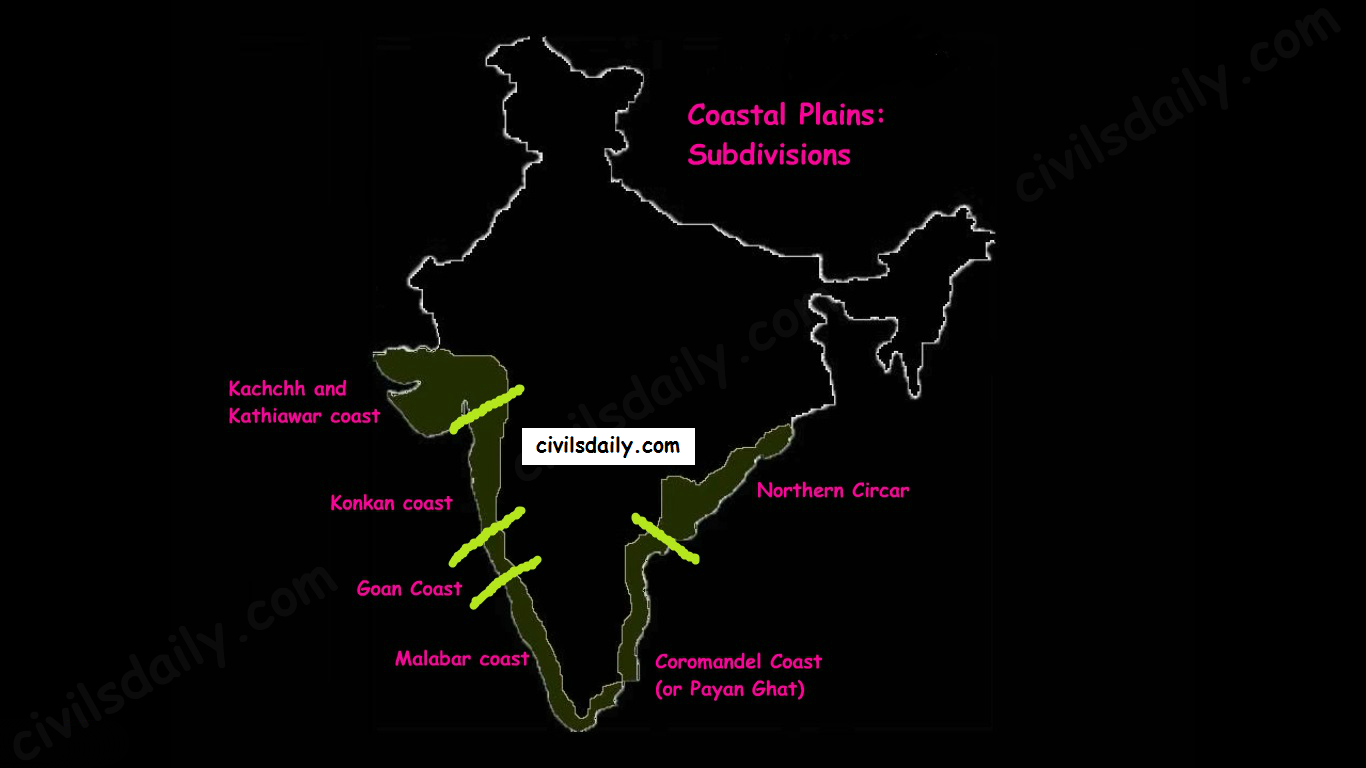
    • They wanted to impart a distinct socio-cultural identity to Muslims on modern lines.

    13. The Deoband School (Darul Uloom)

    • The Deoband Movement was begun at the Darul Uloom,Deoband, in Saharanpur district (United Provinces) in 1866 by Mohammad Qasim Nanotavi (1832-80) and Rashid Ahmed Gangohi (1828-1905) to train religious leaders for the Muslim community.
    • The Deoband Movement was organised by the orthodox section among the Muslim ulema as a revivalist movement.
    • It has the twin objectives of propagating pure teachings of the Quran and Hadis among Muslims and keeping alive the spirit of jihad against the foreign rulers.
    • On the political front, the Deoband school welcomed the formation of the Indian National Congress and in 1888.
    • Shibli Numani, a supporter of the Deoband school, favoured the inclusion of English language and European sciences in the system of education.
    • He founded the Nadwatal Ulama and Darul Uloom in Lucknow in 1894-96. He believed in the idealism of the Congress and cooperation between the Muslims and the Hindus of India to create a state in which both could live amicably.

    14. Sikh Reform Movements.

    • The Sikh community could not remain untouched by the rising tide of rationalist and progressive ideas of the nineteenth century.
    • The Singh Sabha Movement was founded at Amritsar in 1873 with a two-fold objective—
      • to make available modern western education to the Sikhs, and
      • to counter the proselytising activities of Christian missionaries as well as the Brahmo Samajists, Arya Samajists and Muslim maulvis.
    • For the first objective, a network of Khalsa schools was established by the Sabha throughout Punjab.
    • In the second direction, everything that went against the Gurus’ teachings was rejected, and rites and customs considered to be consistent with Sikh doctrine were sought to be established.
    • The Akali movement (also known as Gurudwara Reform Movement) was an offshoot of the Singh Sabha Movement.
    • It aimed at liberating the Sikh gurudwaras from the control of corrupt Udasi mahants.
    • The government tried its repressive policies against the non-violent non-cooperation satyagraha launched by the Akalis in 1921 but had to bow before popular demands.
    • The government passed the Sikh Gurudwaras Act in 1922 (amended in 1925) which gave the control of gurudwaras to the Sikh masses to be administered through Shiromani Gurudwara Prabandhak Committee (SGPC) as the apex body.
    • The Akali Movement was a regional movement but not a communal one.
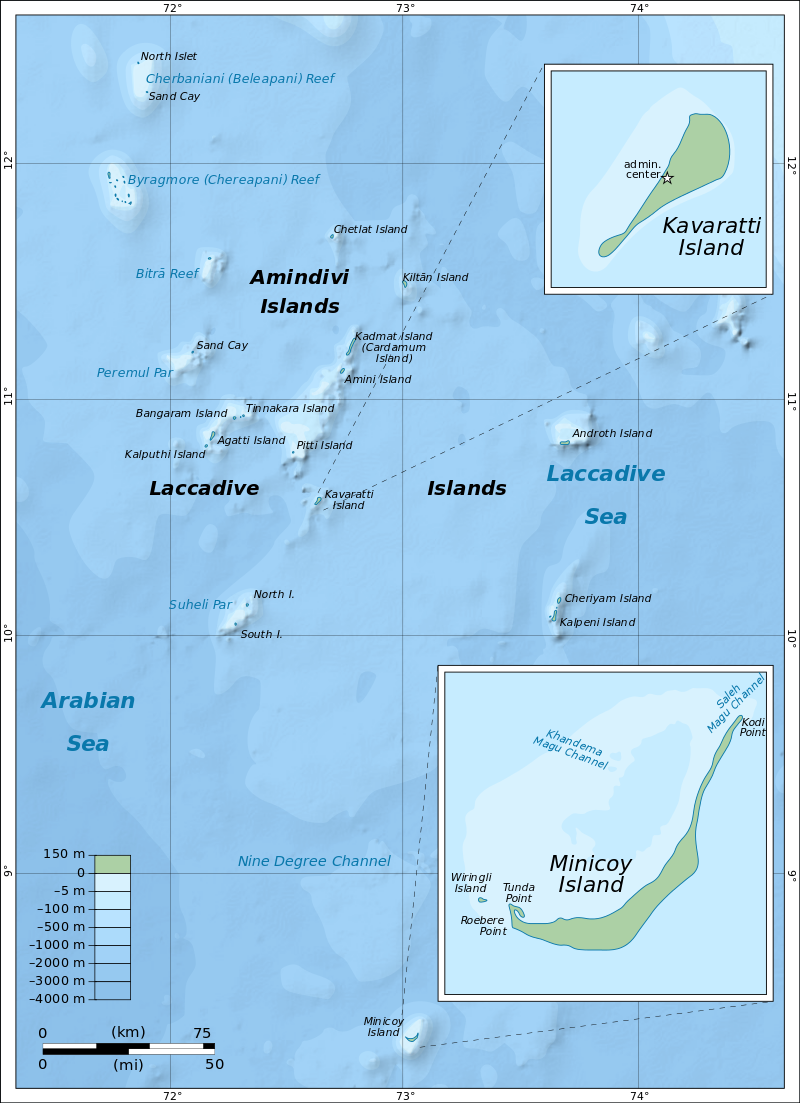
    15. The Theosophical Movement

    • A group of westerners led by Madame H.P. Blavatsky and Colonel M.S. Olcott, who were inspired by Indian thought and culture, founded the Theosophical Society in New York City, the United States in 1875.
    • In 1882, they shifted their headquarters to Adyar, on the outskirts of Madras.
    • The society believed that a special relationship could be established between a person’s soul and God by contemplation, prayer, revelation, etc.
    • It accepted the Hindu beliefs in reincarnation and karma and drew inspiration from the philosophy of the Upanishads and Samkhya, yoga and Vedanta schools of thought.
    • It aimed to work for the universal brotherhood of humanity without distinction of race, creed, sex, caste or colour.
    • It opposed child marriage and advocated the abolition of caste discrimination, uplift of outcastes, improvement in the condition of widows.
    • In India, the movement became somewhat popular with the election of Annie Besant (1847-1933) as its president.
    • She laid the foundation of the Central Hindu College in Benaras in 1898 where both Hindu religion and Western scientific subjects were taught.
    • The Theosophical Society provided a common denominator for the various sects and fulfilled the urge of educated Hindus.
    • To an average Indian, the Theosophist philosophy seemed to be vague and lacking a positive programme; to that extent, its impact was limited to a small segment of the westernised class.
    • As religious revivalists, the Theosophists did not attain much success.
    • But as a movement of westerners glorifying Indian religious and philosophical traditions, it gave much-needed self-respect to the Indians fighting British colonial rule.
    • Viewed from another angle, the Theosophists also had the effect of giving a false sense of pride to the Indians in their outdated and sometimes backwards-looking traditions and philosophy.


    Important Newspapers associated with the freedom Struggle


        Name of the Paper             or journal


    Year and Place  of           Publication        

    Name of the Founder          or       Editor


         Bengal Gazette


    1780, Calcutta


    James Augustus Hicky

    India Gazette 1787, Calcutta Henry Louis Vivian Derozio was associated with it
     

         Bombay Herald           (First Paper from                   Bombay)

    1789, Bombay ————
         Digdarshana

    (First Bengali Monthly)


    1818, Calcutta


    ———–


    Bengal Gazette        (First Bengali                    Newspaper)


    1818, Calcutta Harishchandra Ray
     

        Sambad Kaumudi

        (Weekly in Bengali)


    1821 Raja Ram Mohan Roy
     

       Mirat-ul-Akbar                   (First Journal in        Persian)

    1822, Calcutta Raja Ram Mohan Roy
            Banga-Duta            (A weekly in four languages- English, Bengali, Persian, Hindi) 1822, Calcutta Raja Ram Mohan Roy and Dwarkanath Tagore and others.
        Bombay Times   (From 1861 onwards, The Times of India)


    1838, Bombay Foundation laid by Robert Knight                            Started by Thomas Bennett


          Rast Goftar            (A Gujarati fortnightly) 1851 Dadabhai Naoroji
          Hindu Patriot 1853, Calcutta Girishchandra Ghosh
     

             Bengalee


    1862, Calcutta

    Girishchandra Ghosh

    (Taken over by S.N. Banerjea in 1879)

        Amrit Bazar Patrika 1868, Jessore District Sisirkumar Ghosh and Motilal Ghosh
        Bangadarshana              (In Begali) 1873, Calcutta Bankimchandra Chatterji
     

        Indian Statesman

    (Later, The Statesman)

    1875, Calcutta Started by Robert Knight
     

     The Hindu (In Egnlish)

    (Started as weekly)

    1878, Madras G.S. Aiyar, Viraraghavachari and Subha Rao Pandit
     

       Tribune (daily)

    1881, Lahore Dayal Singh Majeetia
       Kesari(Marathi daily)             and    Maharatta (English            weekly) 1881, Bombay Tilak, Chiplunkar, Agarkar
    Swadeshmitran                  (A Tamil paper) Madras  

    G.S. Aiyar

     Paridasak (a weekly) 1886 Bipin Chandra Pal (publisher)
     

          Yugantar                          

    1906, Bengal  

    Barindra Kumar Ghosh andBhupendra Dutta


       Indian Sociologist


    London


    Shyamji Krishnavarma


        Bande Matram


    Paris


    Madam Bhikaji Kama


           Talwar


    Berlin


    Virendranath Chattopadhyay


          Ghadar


    Vancouver


    Ghadar Party


         Bombay Chronicle               (a daily)


    1913, Bombay


    Started by Pherozeshah Mehta


    The Hindustan Times

    1920, Delhi Founded by K. M. Panikkar as a part of the Akali Dal Movement
     

    Leader (in English)

         ———- Madan Mohan Malaviya
     

    Bahishkrit Bharat (Marathi fortnightly)


    1927


    B. R. Ambedkar


       Kudi Arasu (Tamil)


    1910


    E.V. Ramaswamy Naicker (Periyar)


    Bandi Jivan


    Bengal


    Sachindranath Sanyal


    National Herald


    1938


    Started by Jawaharlal Nehru