đŸ’„Join UPSC 2027,2028 Mentorship (July Batch) + XFactor Notes & Microthemes PDF

Author: CD Staff

  • [Prelims Spotlight] Important Policies and Schemes Regarding Education


    Prelims Spotlight is a part of “Nikaalo Prelims 2020” module. This open crash course for Prelims 2020 has a private telegram group where PDFs and DDS (Daily Doubt Sessions) are being held. Please click here to register.


    12th March 2020

    Important Schemes and Policies related to education.


    1. SHREYAS Scheme: Scheme for Higher Education Youth in Apprenticeship and Skill (SHREYAS)

    Launched by- Ministry of Human Resource Development

    Important objectives-

    • Improve employability: The scheme aims to improve the employability of introducing employment relevance to the learning process of higher education.
    • Linking education with industry: Close link between education and industry/service sector.
    • Establishing earn while you learn the system into education

    Operation of the scheme-

    • It will be operated in conjunction with the National Apprenticeship Promotion Scheme.
    • The scheme will be implemented by the Sector Skill Council.

    2.  NEAT Scheme- National Educational Alliance for Technology (NEAT) 

    Launched by- Ministry of Human Resource Development

    Objective- Objective is to use Artificial Intelligence to make learning more personalised and customised as per the requirements of the learner.

    • It is a PPP based scheme.
    • MHRD would act as a facilitator to ensure that the solutions are freely available to a large number of economically backward students.
    • MHRD would create and maintain a National NEAT platform that would provide one-stop access to these technological solutions.
    • EdTech companies would be responsible for developing solutions and manage the registration of learners through the NEAT portal.

    3. EQUIP- Education Quality Upgradation and Inclusion Programme (EQUIP)’

    • It is a Five-year vision plan, finalised and released by HRD Ministry.
    • The ten Expert Groups have suggested more than 50 initiatives that would transform the higher education sector completely.
    • The groups have suggested 10 goals for the higher education sector.
    • Key Goals are-
      • Double the Gross Enrolment Ratio (GER) in higher education and resolve the geographically and socially skewed access to higher education institutions in India.
      • Position at least 50 Indian institutions among the top-1000 global universities.
      • Double the employability of the students passing out of higher education
      • Achieve a quantum increase in investment in higher education.

      Important Initiatives launched in 2019-

    • DHRUV- The Pradhan Mantri Innovative Learning Programme –
      • DHRUV has been started by the Ministry of Human Resource Development, Government of India to identify and encourage talented children to enrich their skills and knowledge.
      • In centres of excellence across the country, gifted children will be mentored and nurtured by renowned experts in different areas, so that they can reach their full potential.
      • The program aims to cover two areas namely Science and Arts.
      • The program is to be launched from the Indian Space Research Organisation (ISRO).
    • NISHTHA- National Initiative for School Heads and Teachers Holistic Advancement.
      • Its aim is to build capacities of 42 Lakh government teachers across the country.
      • The basic objective of this massive training programme ‘NISHTHA’ is to motivate and equip teachers to encourage and foster critical thinking in students.
    • PARAMARSH- Paramarsh’ for Mentoring NAAC Accreditation Aspirant Institutions to promote Quality Assurance in Higher Education
      • The scheme will be operationalized through a “Hub & Spoke” model wherein the Mentor Institution, called the “Hub” is centralized and will have the responsibility of guiding the Mentee institution through the secondary branches the “Spoke”.
    • SHAGUN– Union HRD Minister launches Integrated Online junction for School Education ‘Shagun’
      • It is one of the world’s largest Integrated Online Junction for – School Education.
      • It is an over-arching initiative to improve the school education system by creating a junction for all online portals and websites relating to various activities of the Department of School Education and Literacy in the Government of India and all States and Union Territories.
    • UDISE+ Unified District Information System for Education Plus – To ensure quality, credibility and timely availability of information from all the schools in the country.

    4. RISE Revitalising Infrastructure and Systems in Higher Education (RISE).

    • Higher Education Financing Agency (HEFA) scope was expanded to meet the rising financial requirements of educational infrastructure in the country
    • The Cabinet Committee on Economic Affairs has approved the proposal for expanding the scope of Higher Education Financing Agency (HEFA) by enhancing its capital base to Rs. 10,000 crore and tasking it to mobilise Rs. 1,00,000 crore for Revitalizing Infrastructure and Systems in Education (RISE) by 2022.
    • The CCEA has also approved that the modalities for raising money from the market through Government guaranteed bonds and commercial borrowings.
    • In order to expand this facility to all institutions, especially to the institutions set up after 2014, Central Universities which have very little internal resources, and the school education/health education infrastructure like AllMSs, Kendriya Vidyalayas, the CCEA has approved five windows for financing under HEFA.

    5. IMPRESS- Impactful Policy Research in Social Sciences

    • Under the Scheme, 1500 research projects will be awarded for 2 years to support the social science research in the higher educational institutions and to enable research to guide policymaking.
    • The broad objective is to identify and fund research proposals in social sciences with maximum impact on governance and society.

    6. SPARC- Scheme for Promotion of Academic and Research Collaboration.

    • SPARC scheme aims at improving the research ecosystem of India’s higher educational institutions by facilitating academic and research collaborations between Indian Institutions and the best institutions in the world.
    • At a total cost of Rs.418 Cr for implementation up to 31.3.2020 and Indian Institute of Technology Kharagpur is the National Coordinating Institute to implement the SPARC programme.
    • Only such Indian institutes can apply which are in top 100 NIRF ranking or top 100 NIRF subject ranking.

     7. LEAP-Leadership for Academicians Programme

    • It is a flagship leadership development training programme.
    • It is a three weeks Flagship leadership development training programme (2 weeks domestic and one-week foreign training) for second level academic functionaries in public-funded higher education institutions.
    • The implementation of LEAP Programme will be through 15 NIRF top-ranked Indian Institutions.

    8. ARPIT- Annual Refresher Programme In Teaching (ARPIT)

    • It is a major and unique initiative of online professional development of 15 lakh higher education faculty using the MOOCs platform SWAYAM.
    • For implementing ARPIT, 75 discipline-specific institutions have been identified and notified as National Resource Centres (NRCs) in the first phase.

    9. Pradhan Mantri Vidya Lakshmi Karyakram- It is a first of its kind portal for students seeking Education Loan.

    • A fully IT-based Student Financial Aid Authority has been proposed through the ‘Pradhan Mantri Vidya Lakshmi Karyakram.
    • This initiative aims to bring on board all Banks providing Educational Loans.

    10. Institutes of Eminence Scheme-

    • The aim of the scheme is to bring higher educational institutions selected as IoEs in top 500 of the world ranking in the next 10 years and in top 100 eventually overtime.
    • The salient features are available in the UGC Guidelines and the UGC Regulations under which greater autonomy viz.
      • To admit foreign students up to 30% of admitted students.
      • To recruit foreign faculty up to 25% of faculty strength.
      • To offer online courses up to 20% of its programmes; to enter into academic collaboration with top 500 in the world ranking Institutions without permission of UGC.
      • Free to fix and charge fees from foreign students without restriction.
      • The flexibility of course structure in terms of a number of credit hours and years to take a degree; complete flexibility in fixing of curriculum and syllabus, etc. has been provided to IoEs.
    • Each Public Institution selected as IoE will be provided financial assistance up to Rs. 1000 Cr over a period of five years.
    • The private institution will not be given any funds.

    11. Samagra Shiksha Scheme

    • The scheme is an overarching programme for the school education sector extending from pre-school to class XII and aims to ensure inclusive and equitable quality education at all levels of school education.
    • It envisages the ‘school’ as a continuum from pre-school, primary, upper primary, secondary to senior secondary levels and subsumes the three erstwhile centrally sponsored schemes- Sarva Shiksha Abhiyan (SSA), Rashtriya Madhyamik Shiksha Abhiyan (RMSA) and Teacher Education(TE).
    • Bridging gender and social category gaps at all levels of school education is one of the major objectives of the scheme.
    • The scheme reaches out to girls and children belonging to Scheduled Caste (SC), Scheduled Tribe (ST), minority communities and transgender.
    • The Samagra Shiksha scheme supports States for a strengthening of school infrastructure including in rural areas.
    • The scheme provides for the infrastructural strengthening of existing government schools based on the gaps determined by Unified District Information System for Education (UDISE) and proposals received from respective States/UTs.

    12. Sarva Shiksha Abhiyan-

    • Universalizing elementary education across the countryRashtriya Avishkar Abhiyan, Vidhyanjali, PBBB.
    • Sarva Shiksha Abhiyan is implemented as a Centrally Sponsored Scheme in partnership with State Governments for universalizing elementary education across the country. Its overall goals include universal access and retention, bridging of gender and social category gaps in education and enhancement of learning levels of children.
    • SSA provides for a variety of interventions, including inter alia, the opening of new schools, construction of schools and additional classrooms, toilets and drinking water, provisioning for teachers, periodic teacher training and academic resource support, textbooks and support for learning achievement. These provisions are made in accordance with norms and standards and free entitlements as mandated by the Right of Children to Free and Compulsory Education (RTE) Act, 2009. 

    13. Rashtriya Madhyamic Shiksha Abhiyan (RMSA)-

    • It aims to raise the minimum level of education to class X and universalize access to secondary education.
    • To ensure good-quality secondary education with a focus on Science, Mathematics and English; and
    • To reduce the gender, social and regional gaps in enrolments, dropouts and improving retention.
    • To make sure that the secondary schools conform to prescribed norms, removing gender, socio-economic and disability barriers, etc. Important physical facilities are provided which include, (i) additional classrooms, (ii) laboratories, (iii) libraries, (iv)art and crafts room, (v) toilet blocks, (vi) drinking water provisions, (vii) electricity / telephone/internet connectivity and (viii) disabled-friendly provisions. Improvement in quality through, (i) appointment of additional teachers to improve PTR (ii) in-service training of teachers, (iii) ICT enabled education, (iv)curriculum reforms and (v) teaching learning reforms. Equity aspects addressed through (i) special focus in micro-planning, (ii) preference to areas with concentration of SC/ST/minority for opening of schools, (iii) special enrolment drive for the weaker section, (iv more female teachers in schools and (v) separate toilet blocks for girls. 

    14. Rashtriya Ucchatar Shiksha Abhiyan (RUSA)-

    • It is a Centrally Sponsored Scheme (CSS), launched in 2013. It aims at providing strategic funding to eligible state higher educational institutions based on their progress.
    • The key objectives of RUSA are to improve access, equity and quality in higher education through planned development of higher education at the state level.
    • The central funding (in the ratio of 60:40 for general category States, 90:10 for special category states and 100% for union territories) would be norm based and outcome dependent.
    • The funding flows from the central ministry through the state governments/union territories to the State Higher Education Councils before reaching the identified institutions.

     15. Unnat Bharat Abhiyan (UBA)-

    • It aims at-
      • Building institutional capacity in Institutes of higher education in research & training relevant to the needs of rural India.
      • As a flagship programme of the Ministry of HRD, it aims to link the Higher Education Institutions with a set of at least (5) villages, so that these institutions can contribute to the economic and social betterment of these village communities using their knowledge base.
      • Provide rural India with professional resource support from institutes of higher education, especially those which have acquired academic excellence in the field of Science, Engineering & Technology and Management.
    • The UBA 2.0 was officially launched on 25th April, 2018

    16. SWAYAM-

    • Study Webs of Active Learning for Young Aspiring Minds is an indigenous IT platform for hosting the Massive Open Online Courses (MOOCs).
    • SWAYAM is designed to achieve the three cardinal principles of Education Policy viz., access, equity and quality.
    • It targets those students who could not complete their studies and professionals who wish to upgrade their knowledge.
    • This is done through an indigenous developed IT platform that facilitates hosting of all the courses, taught in classrooms from 9th class till post-graduation to be accessed by anyone, anywhere at any time.

    17. Saksham Scholarship Scheme-

    • The scheme was launched in 2014-15, with the objective of encouraging economically weaker differently-abled students to pursue technical education at Diploma and Degree levels.
    • The scholarship amount of Rs.30,000 is provided towards tuition fee reimbursement and Rs.20000 as contingency allowance for 1000 persons/annum.

    18. Swayam Prabha-

    • The SWAYAM PRABHA is a group of 32 DTH channels devoted to telecasting of high-quality educational programmes on a 24X7 basis using the GSAT-15 satellite.
    • Every day, there will be new content for at least (4) hours which would be repeated 5 more times in a day, allowing the students to choose the time of their convenience.
    • Information and Library Network (INFLIBNET), an autonomous Inter-University Centre (IUC) of UGC maintains the web portal.
    • The DTH Channels shall cover the following:
      • Higher Education.
      • School education (9-12 levels)
      • Curriculum-based courses that can meet the needs of life-long learners of Indian citizens in India and abroad.
      • Assist students (class 11th & 12th) prepare for competitive exams.

    19.Shala Darpan Portal-

    • It is an E-Governance school automation and management system for Navodaya Vidyalaya Samiti (NVS).
    • This portal has been developed for information sharing and knowledge dissemination for employees and students across schools and offices of NVS.

    20. All School Monitoring Individual Tracing Analysis (ASMITA)-

    • Shala Asmita Yojana (SAY) aims to track the educational journey of close to 25 crore school students from Class I to Class XII across 15 lakh schools in the country.
    • Students will be tracked through their Aadhaar numbers and incase those not having a unique number will be provided with it.
    • This online database will carry information about student attendance and enrolment, mid-day meal service, learning outcomes and infrastructural facilities, among other things, on one platform for both private and government schools. 

    21. Global Initiative of Academic Network (GIAN)-

    • It is intended to enlarge and deepen the interface of India’s institutions of higher learning and globally recognised institutions of academic eminence.
    • Under it, faculty from highly rated institutions abroad will visit India, interact and partner with their counterparts and with students, and deliver specialised courses. 

    22. IMPRINT India-

    • It is MHRD supported Pan-IIT + IISc joint initiative to address the major science and engineering challenges that India must address and champion to enable, empower and embolden the nation for inclusive growth and self-reliance.
    • This novel initiative with a twofold mandate is aimed at:
      • Developing new engineering education policy.
      • Creating a road map to pursue engineering challenges
    • IMPRINT provides the overarching vision that guides research into areas that are predominantly socially relevant.

    23. Ishan Uday and Ishan Vikas-

    • Ishan Vikas and Ishan Uday schemes are being implemented for the students of the North-Eastern region.
    • Ishan Vikas is coordinated by IIT, Guwahati.
    • Under it selected school children from the North Eastern States  are  brought in close contact with the Indian Institute of Technology (IITs), Indian Institutes of Science Education and Research (IISERs) and  National Institute of Advanced Studies (NIAS) during the vacation period
    • Ishan Uday Scholarship Scheme is administered by the University Grants Commission (UGC). Under the scheme, the scholarship is provided to the economically backward students from the North East Region for pursuing general degree courses, technical and professional degree courses.
    • It is envisaged to provide 10000 scholarships annually.

    24. Shodhganga-

    • It is the repository developed to contain an electronic copy of all M.Phil/PhD thesis to make it accessible to all institutions.
    • The task of setting-up of this repository is assigned to Information and Library Network (INFLIBNET), an interuniversity centre of the University Grants Commission (UGC).
    • It also provides access to Indian theses and dissertations in open access to the worldwide academic community and making visibility of Indian research to other countries.

    25. Vidya Virta Abhiyan-

    • It is to encourage varsities to display portraits of Param Veer Chakra-decorated soldiers.
    • The objective is to instil a sense of nationalism and patriotism among the students
    • Universities and educational institutions across the country will have a wall of heroes, depicting portraits of soldiers who showed extraordinary courage in defending the nation.

    26. Diksha Portal-

    • HRD ministry has launched Diksha Portal (diksha.gov.in) for providing a digital platform to a teacher to make their lifestyle more digital.
    • It will serve as National Digital Infrastructure for Teachers.
    • Diksha portal will enable, accelerate and amplify solutions in the realm of teacher education. It will aid teachers to learn and train themselves for which assessment resources will be available.

    27. Margadarshan-

    • The scheme aims to provide mentoring to institutes by a well-performing Institute.
    • Institutions of repute will act as a mentor with its existing facilities to serve as the hub to guide and disperse knowledge to 10 technical institutions.
    • It is under the purview of All India Council for Technical Education (AICTE), a national-level apex advisory body under the Ministry of Human Resource and Development.
    • Mentor institute also provides services to faculty for self-improvement.
    • Government-owned, aided and self-financed institutes and universities approved by AICTE can participate.

    28. JIGYASA-

    • It is a student- scientist connect programme by the Ministry of HRD and Ministry of S&T.
    • It focuses on connecting school students and scientists so as to extend student‘s classroom learning to research laboratory based learning by visiting CSIR laboratories and by participating in mini-science projects.
    • CSIR and Kendriya Vidyalaya Sangathan (KVS) are collaborating to implement this programme.

    29. Maitreyi Yatra-

    • It is an exclusive student exchange programme for J&K organized by Ministry of Human Resource development.
    • It provides a good opportunity for the youth of J&K to be acquainted with culture, language and development story of different parts of the country.

    30. Madhyamik and Ucchatar Shiksha Kosh (MUSK)-

    • It is a non-lapsable pool in the Public Account for secondary and higher, education known as “Madhyamik and Uchchtar Shiksha Kosh” (MUSK) into which all proceeds of “Secondary and Higher Education Cess” will be credited.
    • The funds arising from the MUSK would be utilized for schemes in the education sector which would be available for the benefit of students of secondary and higher education, all over the country.
    • The MUSK would be maintained as a Reserve Fund in the non-interest bearing section of the Public Accounts of India.
    • The major benefit will be enhancing access to secondary and higher education through the availability of adequate resources while ensuring that the amount does not lapse at the end of the financial year.

    31. National Testing Agency (NTA)-

    • It has been established as a premier, specialist, autonomous and self-sustained testing organization to conduct entrance examinations for admission/fellowship in higher educational institutions.
    • It will be registered as a society under the Indian Societies Registration Act.
    • It will act an autonomous and self-sustained premier testing organization chaired by an eminent educationist appointed by Ministry of HRD.
    • It would conduct those entrance examinations which are currently being conducted by the CBSE (NEET, JEE), AICTE etc, thereby relieving them of this responsibility.


  • [Prelims Spotlight] Important Seas and Mountain Ranges of the World


    Prelims Spotlight is a part of “Nikaalo Prelims 2020” module. This open crash course for Prelims 2020 has a private telegram group where PDFs and DDS (Daily Doubt Sessions) are being held. Please click here to register.


    11th March 2020

    Tasman Sea

    The Tasman Sea is a marginal sea of the South Pacific Ocean, situated between Australia and New Zealand. It measures about 2,000 kilometres (1,200 mi) across and about 2,800 kilometres (1,700 mi) from north to south. The sea was named after the Dutch explorer Abel Janszoon Tasman, who was the first recorded European to encounter New Zealand and Tasmania. The British explorer Captain James Cook later extensively navigated the Tasman Sea in the 1770s as part of his first voyage of exploration.

    Persian Gulf

    This inland sea of some 251,000 square kilometres (96,912 sq mi) is connected to the Gulf of Oman in the east by the Strait of Hormuz; and its western end is marked by the major river delta of the Shatt al-Arab, which carries the waters of the Euphrates and the Tigris. Its length is 989 kilometres (615 miles), with Iran covering most of the northern coast and Saudi Arabia most of the southern coast. The Persian Gulf is about 56 km (35 mi) wide at its narrowest, in the Strait of Hormuz. The waters are overall very shallow, with a maximum depth of 90 metres (295 feet) and an average depth of 50 metres (164 feet).

    Countries with a coastline on the Persian Gulf are (clockwise, from the north): Iran; Oman’s exclave Musandam; the United Arab Emirates; Saudi Arabia; Qatar, on a peninsula off the Saudi coast; Bahrain, on an island; Kuwait; and Iraq in the northwest. Various small islands also lie within the Persian Gulf, some of which are the subject of territorial disputes between the states of the region.

    Mediterranean Sea
    The Mediterranean Sea is a sea connected to the Atlantic Ocean, surrounded by the Mediterranean Basin and almost completely enclosed by land: on the north by Southern Europe and Anatolia, on the south by North Africa, and on the east by the Levant. The sea is sometimes considered a part of the Atlantic Ocean, although it is usually identified as a separate body of water.

    The countries with coastlines on the Mediterranean Sea are

    1. Albania
    2. Algeria
    3. Bosnia and Herzegovina
    4. Croatia
    5. Cyprus
    6. Egypt
    7. France
    8. Greece
    9. Israel
    10. Italy
    11. Lebanon
    12. Libya
    13. Malta
    14. Morocco
    15. Monaco
    16. Montenegro
    17. Slovenia
    18. Spain
    19. Syria
    20. Tunisia
    21. Tukey

    In addition, the Gaza Strip (“Palestine” has been associated with the geographical area that currently covers the State of Israel, the West Bank and the Gaza Strip) and the British Overseas Territories of Gibraltar and Akrotiri and Dhekelia have coastlines on the sea.

    Black Sea

    The Black Sea is a marginal sea of the Atlantic Ocean. It has an area of 436,400 km2 (168,500 sq mi) (not including the Sea of Azov). The roughly oval-shaped Black Sea occupies a large basin strategically situated at the southeastern extremity of Europe but connected to the distant waters of the Atlantic Ocean by the Bosporus (which emerges from the sea’s southwestern corner), the Sea of Marmara, the Dardanelles, the Aegean Sea, and the Mediterranean Sea.

    Countries bordering the Black Sea are-

    1. Ukraine
    2. Russia
    3. Georgia
    4. Turkey
    5. Bulgaria
    6. Romania


    Caspian Sea

    The Caspian Sea is the largest enclosed inland body of water on Earth by area, variously classed as the world’s largest lake or a full-fledged sea. It is in an endorheic basin (a basin without outflows) located between Europe and Asia.

    The Caspian Sea is bordered on the northwest by Russia, on the northeast by Kazakhstan, on the west by Azerbaijan, on the southeast by Turkmenistan, and on the south by Iran. It is classified as both a sea and a lake, and it is the largest enclosed inland body of water in the world.

    1. Azerbaijan
    2. Iran
    3. Kazakhstan
    4. Russia
    5. Turkmenistan


    Red Sea

    The Red Sea (also the Erythraean Sea) is a seawater inlet of the Indian Ocean, lying between Africa and Asia. The connection to the ocean is in the south through the Bab el Mandeb strait and the Gulf of Aden. To the north lie the Sinai Peninsula, the Gulf of Aqaba, and the Gulf of Suez (leading to the Suez Canal). The sea is underlain by the Red Sea Rift which is part of the Great Rift Valley.

    The salinity of the Red Sea is greater than the world average, approximately 4 percent. This is due to several factors:

    • Lack of significant rivers or streams draining into the sea.
    • Limited connection with the Indian Ocean, which has lower water salinity.
    • High rate of evaporation and very little precipitation.

    The six countries bordering the Red Sea proper are:


    Eastern shore:

    • Saudi Arabia
    • Yemen
    • Western shore:
      • Egypt
      • Sudan
      • Eritrea
      • Djibouti

    Aral Sea

    The Aral Sea was an endorheic lake lying between Kazakhstan (Aktobe and Kyzylorda Regions) in the north and Uzbekistan (Karakalpakstan autonomous region) in the south. The name roughly translates as “Sea of Islands”, referring to over 1,100 islands that once dotted its waters; in the Turkic languages aral means “island, archipelago”.


    South China Sea

    The South China Sea is a marginal sea that is part of the Pacific Ocean, encompassing an area from the Karimata and Malacca Straits to the Strait of Taiwan of around 3,500,000 square kilometres (1,400,000 sq mi). The area’s importance largely results from one-third of the world’s shipping sailing through its waters and that it is believed to hold huge oil and gas reserves beneath its seabed.

    It is located

    • south of China;
    • east of Vietnam and Cambodia;
    • northwest of the Philippines;
    • east of the Malay peninsula and Sumatra, up to the Strait of Malacca in the western, and
    • north of the Bangka–Belitung Islands and Borneo

    Ross sea

    The Ross Sea is a deep bay of the Southern Ocean in Antarctica, between Victoria Land and Marie Byrd Land. It derives its name from the British explorer James Ross who visited this area in 1841. To the west of the sea lies Ross Island and to the east Roosevelt Island, while the southernmost part is covered by the Ross Ice Shelf, and is about 200 miles (320 km) from the South Pole.

    Weddel sea

    The Weddell Sea is part of the Southern Ocean and contains the Weddell Gyre. Its land boundaries are defined by the bay formed from the coasts of Coats Land and the Antarctic Peninsula. The easternmost point is Cape Norvegia at Princess Martha Coast, Queen Maud Land. To the east of Cape Norvegia is the King Haakon VII Sea. Much of the southern part of the sea is covered by a permanent, massive ice shelf field, the Filchner-Ronne Ice Shelf .
    The sea is named after the Scottish sailor James Weddell, who entered the sea in 1823 and originally named it after King George IV; it was renamed in Weddell’s honour in 1900.


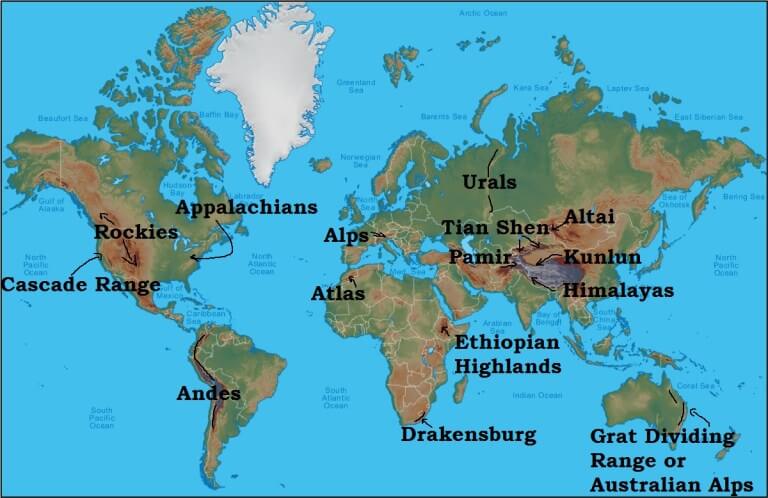
    Mountain Ranges

    Sr. No. Mountain Range Important/Highest Peaks Location Description
    1 Rocky Mountains Mt. Elbert (highest peak in the Rockies) North America It is one of the longest fold mountains in the world and extends from Canada to Western US (New Mexico State)
    2 Appalachian Mountains Mt. Mitchell, North Carolina, US (highest peak of Appalachian Mountains) North America It is a fold mountain with rich in mineral resources
    3 Alps Mont Blanc (French –Italian border) Europe It is a folded mountain and source for rivers like Danube, Rhine, etc.
    4 Sierra Nevada Mt. Whitney California, USA Habitat for many Red Indian tribes
    5 Alaska Range Mt. McKinley North America Mt. McKinley highest peak in North America
    6 Altai Mountains Belukha mountain Central Asia Young folded mountain which extends from Kazakhstan to northern China.
    7 Andes Mountains Mt. Aconcagua South America Longest mountain chain in the world
    8 Atlas Mountains Mt. Toubkal Northwestern Africa Young fold mountain spreading over Morocco and Tunisia.
    9 Drakensberg Mountains Mt. Lesotho South Africa Young folded mountain
    10. Caucasus Mountain Mt. Elbrus Europe Located between the Black Sea and the Caspian Sea
    11. Ural Mountains Mt. Narodnaya Russia This mountain range act as a boundary between Europe and Asia.
    12. Hindukush Mountains Mt. Trich Mir Pakistan and Afghanistan Folded mountain with rugged topography which makes it difficult for transportation.
    13. Himalayas Mt. Everest Asia Young fold mountains in Asia which separates Indian sub-continent from Asian plains
    14. Arakan Yoma Mt. Kennedy peak Myanmar It extends from north to south direction. Shifting cultivation is practised.
    15. Kunlun Mountains Mt. Muztag North of Tibetan plateau and western China It is one of the young folded mountains.
    16. Vosges Mt. Grand Ballon Eastern France, Europe Famous for the cultivation of grapes and manufacture of wines.
    17. Great Dividing Range Mt. Kosciuszko Australia This range is the source for the rivers Darling and Murray.


    Mountains-in-the-world

  • [Prelims Spotlight] Important Governor Generals and Viceroys


    Prelims Spotlight is a part of “Nikaalo Prelims 2020” module. This open crash course for Prelims 2020 has a private telegram group where PDFs and DDS (Daily Doubt Sessions) are being held. Please click here to register.


    9th March 2020

    With almost absolute power the Governor-General and viceroy played a significant role in the shaping history of the country. Following are some of these important figures and significant events and major reforms carried out by them.

            Governor Generals of                            Bengal/India

                        (Period)

                      Important events/Reforms


    Warren Hastings

    (1773-1785)


    Regulating Act of 1773.

    First Governor-General of Bengal.

    End of the dual system of administration (1765-1772).

    Supreme Court at Calcutta.

    Wrote Introduction to the first English translation of Gita.

    Founded Madarasa Aliya at Calcutta.


    Lord Cornwallis

    (1786-1793)


    Separation of three branches of service: commercial, judicial and revenue.

    Permanent Land Revenue Settlement of Bengal-1793.

    Reformed, modernised and rationalised the civil service.

    Introduced the Cornwallis Code.

    Sanskrit College, Varanasi.


    Lord Wellesley

    (1797-1805)


    Introduction of Subsidiary Alliance System.

    Fourth Anglo-Mysore war.

    Fort William College, Calcutta.


    Lord Hastings

    (1813-1823)


    Anglo-Nepal War-(1814-16)

    Third Anglo-Maratha War-(1817-19) and dissolution of Maratha confederacy.

    Introduction of Ryotwari System of Thomas Munro, Governor of Madras-1820.


    Lord William Bentinck

    (1828-1835)


    Charter Act of 1833.

    Abolition of Sati-1829.

    Resolution of 1835 and Education reforms and introduction of English as the official language.

    The annexation of Mysore-1831, Coorg, and Central Cachar-1831.


    Lord Dalhousie

    (1848-1856)


    Introduction of the Doctrine of Lapse and annexations of Satara-1848, Jaitpur and Sambhalpur-1849, Udaipur-1852, Jhansi-1853, Nagpur-1854 and Awadh-1856.

    Wood’s Dispatch of 1854.

    Railway Minute of 1853.

    Telegraph and Postal reforms.

    Widow Remarriage Act-1856.


    Lord Canning

    (1856-1857)


    Establishment of universities at Bombay, Madras and Calcutta.

    Mutiny of 1857.


           Governor-General                            and

             Viceroy of India

                    (Period)

                                   Important events/Reforms
     Lord Canning

    (1858-1862)

    Transfer of control from East India Company to the Crown by the Government of India Act 1858

    Indian Councils Act-1861


    Lord Mayo

    (1869-1872)


    Opening of Rajkot College in Kathiawad and Mayo College at Ajmer for political training of Indian Princes.

    Statistical Survey of India was established.

    Department of Agriculture and Commerce was established.

    Introduction of state railways.


    Lord Lytton

    (1876-1880)


    The great famine of 1876 affecting Bombay, Madras, Mysore, Hyderabad, Central India and Punjab.

    Appointment of Famine Commission under the presidency of Richard Strachey.

    Vernacular Press Act was passed- 1878.

    The Arms Act-1878.


    Lord Ripon

    (1880-1884)


    Education Commission 1882 under William Hunter-1882.

    Ilbert Bill controversy.

    Repeal of Vernacular Press Act in 1882.

    The First Factory Act in 1881 to improve labour conditions.

    Government resolution on local self government-1882.


    Lord Dufferin

    (1884-1888)


    Establishment of Indian National Congress.


    Lord Lansdowne

    (1888-1894)


    The categorisation of civil services into imperial, provincial and subordinate.

    Indian Councils Act-1892

    Durand Commission (1893) was set up to define the Durand Line between India and Afghanistan.


    Lord Curzon

    (1899-1905)


    Police Commission (1902) was appointed under Sir Andrew Frazer.

    University Commission (1902) was appointed and Universities Act (1904) was passed.

    Department of Commerce and Industry was established.

    Calcutta Corporation Act-1899

    Partition of Bengal (1905).


    Lord Minto-II

    (1905-1910)


    Popularisation of anti-partition and Swadeshi Movements.

    Split in Indian National Congress at Surat in 1907.

    Indian Muslim League was established by Aga Khan (1907)

    Morley-Minto reforms or Indian Councils Act 1909.


    Lord Hardinge-II

    (1910-1916)

     Transfer of capital from Calcutta to Delhi (1911).

    Establishment of Hindu Mahasabha (1915) by Madan Mohan Malviya.

          Lord Chelmsford

    (1916-1921)

    Home Rule League was formed by Annie Besant and Tilak (1916)

    Lucknow session of Congress (1916).

    Lucknow Pact between Congress and Muslim League (1916).

    Champaran Satyagraha (1918), and Satyagraha at Ahmadabad (1918).

    Montague’s August Declaration.

    Government of Indian Act- 1919

    Jallianwalla Bagh massacre (1919).

    Non-Cooperation and Khilafat Movements were launched.

    Foundation of Women’s University at Poona (1916) and Saddler’s Commission was appointed for reforms in educational policy.

    Appointment of S. P. Sinha as governor of Bihar first Indian to do so.


    Lord Reading

    (1921-1926)


    The Chaura-Chauri Incident-Feb5, 1922 and withdrawal of Non-Cooperation movement.

    Moplah rebellion in Kerala (1921).

    Repeal of the Press Act of 1910 and Rowlatt Act of 1919.

    Kakori train robbery (1925)

    Establishment of Swaraj Party (1922).

    The decision to hold a simultaneous examination for ICS in Delhi and London with effect from 1923.


    Lord Irwin

    (1926-1931)


    Simon Commission-1928

    Appointment of the Harcourt Butler Indian States Commission (1927)

    Murder of Saunders and Bomb blast in the Assembly Hall of Delhi-1929

    Lahore session of Congress 1929 and Purna Swaraj Resolution.

    Dandi March (12 March, 1929) and launch of Civil Disobedience Movement.


    Lord Willingdon

    (1931-1936)


    Second Round Table Conference and failure of the conference, resumption of the Civil Disobedience Movement.

    Announcement of the Communal Award (1932).

    Poona Pact (1932)

    Third Round Table Conference 1932.

    The Government of India 1935.

    Establishment of All India Kisan Sabha 1936.

    Establishment of Congress Socialist Party by Acharya Narendra Dev and Jayaprakash Narayan (1934)


    Lord Linlithgow

    (1936-1944)


    First general elections were held and Congress attained absolute majority (1936-1937).

    Congress ministers resigned (1937) after the outbreak of WW-II

    Subhash Chandra Bose elected as the president of Congress-1938.

    Lahore Resolution by Muslim League for the demand of separate state for Muslims.

    August Offer by the viceroy-1940.

    Cripp’s Mission to India

    Passing of the Quit India Resolution by Congress-1942


    Lord Wavell

    (1944-1947)


    C Rajgopalachari’s CR Formula (1944) and Gandhi-Jinnah Talks failed.

    Wavell Plan and the Shimla Conference (1942)

    Cabinet Mission and Congress accepted its plan 1946

    Observance of the ‘Direct Action Day’ (16 August 1946) by the Muslim League.

    Elections to the Constituent Assembly and formation of Interim Government by the Congress (September 1946).

    Announcement of the end of British rule in India by Clement Attlee on February 20, 1946


    Lord Mountbatten

    (1947-48)

    June Third Plan (June 3, 1947) announced.

    Introduction of Indian Independence Bill in the House of Commons.

    Appointment of two boundary commissions under Sir Cyril Radcliff for the partition of Bengal and Punjab.


  • [Prelims Spotlight] Various Defence Exercises in News


    Prelims Spotlight is a part of “Nikaalo Prelims 2020” module. This open crash course for Prelims 2020 has a private telegram group where PDFs and DDS (Daily Doubt Sessions) are being held. Please click here to register.


    7th March 2020

    Various Defence Exercises in News

    The defence is a major part of any country. Thus, every country tries and devotes half of its budget in defence. So, there are joint military exercises happening which benefits both the participating nations. Thus, in this article, we will discuss some of the important joint exercises in India like Indra and Maitree. Also, these exercises are important from learning as well as the strategic point of view for both the nations.

    India + XYZ Army Navy Air Force
    ASEAN + Force 18
    Australia AUSTRA HIND AUSINDEX / KAKADU
    Bangladesh Sampriti CORPAT
    China Hand in hand Chang Thang
    France Shakti Varuna GARUDA
    Indonesia GARUDA SHAKTI IND-INDO CORPAT

    And

    Samudra Shakti

    Japan Dharma Guardian Malabar (India, Japan, and the USA), Sahyog-Kaijin SHINYUU MAITRI
    Kazakhstan Prabal Dostyk and KAZIND
    Kyrgyzstan Khanjar
    Maldives Ekuverin
    Mongolia Nomadic Elephant / KHAN QUEST
    Nepal Surya Kiran (BIANNUAL)
    Oman AL NAGAH (SUCCESS) Naseem Al Bahr Eastern Bridge-IV
    Russia Indra INDRA NAVY AVIAINDRA-14
    Seychelles LAMITYE
    Singapore Ex AGNI WARRIOR and Ex BOLD KURUKSHETRA SIMBEX JOINT MILITARY TRAINING
    South Africa, Brazil IBSAMAR
    Sri Lanka Mitra Shakti SLINEX
    Thailand Maitree /  COBRA GOLD (Observer Plus) INDO-THAI CORPAT (Bi-annual) SIAM BHARAT
    UAE Desert Eagle-II
    UK Ajeya Warrior Konkan IndraDhanush -IV
    or “Rainbow”.
    USA YudhAbhyas/ Cope/

    Tiger Triumph

    VAJRA PRAHAR

    Malabar RIMPAC (Multilateral) Red Flag
    Brunei ADMM+ Exercise (Multilateral)
    Malaysia MAITREE ARF DIREx
    Myanmar IMBEX IMCOR
    Qatar Za’ir-Al-Bahr (Roar of the Sea)    
    Uzbekistan Dustlik    


    Other Important Exercise

    Exercise TSENTR 2019 China, Tajikistan, India, Kyrgyzstan, Kazakhstan, Pakistan and Uzbekistan Russia(Host)

  • [Prelims Spotlight] Important Articles/ Schedules of the Constitution

    Prelims Spotlight is a part of “Nikaalo Prelims 2020” module. This open crash course for Prelims 2020 has a private telegram group where PDFs and DDS (Daily Doubt Sessions) are being held. Please click here to register.


    6th March 2020 

    Important Articles / Schedules of the Constitution.

    The Constitution of India is the supreme law of India. The document lays down the framework demarcating fundamental political code, structure, procedures, powers, and duties of government institutions and sets out fundamental rights, directive principles, and the duties of citizens. 

    It was adopted by the Constituent Assembly of India on 26 November 1949 and became effective on 26 January 1950. The constitution replaced the Government of India Act 1935 as the country’s fundamental governing document, and the Dominion of India became the Republic of India. To ensure constitutional autonomy, its framers repealed prior acts of the British parliament in Article 395. 

    The constitution declares India a sovereign, socialist, secular, democratic republic, assuring its citizens justice, equality and liberty, and endeavours to promote fraternity. The original 1950 constitution is preserved in a helium-filled case at the Parliament House in New Delhi. The words “secular” and “socialist” were added to the preamble in 1976 during the emergency.

    The Indian constitution is the world’s longest for a sovereign nation. At its enactment, it had 395 articles in 22 parts and 8 schedules. At about 145,000 words, it is the second-longest active constitution – after the Constitution of Alabama – in the world.

    Articles in Indian Constitution: As the written constitution is a compact document like a book, it has various parts, parts have various chapters, chapters have various articles.

    The constitution has a preamble and 395 articles, which are grouped into 25 parts. With 12 schedules and five appendices, it has been amended 103 times; the latest amendment became effective on 14 January 2019. Despite various amendments, the number of articles in the Constitution still remains 395. There is nothing like Article 396. The new articles are always inserted in between i.e. Article 31A.

    IMPORTANT TITBIT:  If counted separately there are 444 Articles but in the Constitution of India there are only 396 Articles. The rest are merely clauses or sub-clauses added later. The reason behind this is that there is a rule that no one can alter the basic structure of the COI. Now a problem came up, which was how to include more articles as you cannot add a 397th article as it would be against the Basic Structure Doctrine, so a solution that came up, which was that to include the new articles in clauses or sub-clauses of the existing articles.

    Here are the lists of various important Articles of the Indian Constitution. 

    S.No

    Article

    Deals with

    1 1 Name and Territory of Union
    2 3 New States Formation, Alteration of Boundaries, etc.
    3 13 Laws inconsistent with or in derogation of the Fundamental Rights
    4 14 Equality before Law (popularly known as Right to Equality)
    5 15 Prohibition of Discrimination (on basis of religion, race, caste, sex or place of birth)
    6 16 Equality in case of Public Employment
    7 17 Abolition of Untouchability
    8 18 Abolition of Titles
    9 19 Protection of Certain Rights to Freedom (popularly known as Right to Freedom)
    10 19a Freedom of Speech & Expression
    11 19b Right to Peaceful Assembly
    12 19c Freedom of Association
    13 19d Right to Move Freely through India
    14 19e Freedom of Settlement & Residence
    15 19f (Omitted as a fundamental right – governed by article 300A.) Right to Own Personal Property.
    16 19g Freedom to Practise any Profession, Occupation, Trade or Business
    17 21 Right to Life and Personal Liberty
    18 21A Right to Education
    19 23 Prohibition of Human Trafficking and Forced Labour
    20 24 Prohibition of Child Labour
    21 25 Freedom to Practise & Propagate Religion Freely
    22 29 Protection of Interests of Minorities
    23 32 Remedies for enforcement of Fundamental Rights including writs
    24 44 Uniform Civil Code
    25 50 Separation of Judiciary from Executive
    26 51 Promotion of International Peace and Security
    27 51A Fundamental Duties
    28 72 Powers of President to Grant Pardons etc.
    29 76 Attorney-General of India
    30 78 Duties of Prime Minister
    31 85 Sessions of Parliament, Prorogation and Dissolution
    32 93 The Speaker & Deputy Speaker of Lok Sabha
    33 100 Voting in Houses
    34 105 Powers, Privileges, etc. of Members of Parliament
    35 106 Salaries and Allowances of Members of Parliament
    36 108 Joint Sitting of both Houses of Parliament
    37 109-110 Money Bills
    38 112 Budget
    39 123 President’s Power to Promulgate Ordinance while Parliament in Recess
    40 127 Appointment of ad hoc Judges in the Supreme Court
    41 139 Supreme Court’s Powers to Issue Certain Writs
    42 141 Supreme Court’s Law Binding on All Courts
    43 148-149 Comptroller and Auditor-General of India
    44 155 Appointment of Governor
    45 161 Power of Governors to Grant Pardon etc.
    46 165 Advocate-General for the State
    47 167 Duties of Chief Minister
    48 224 Appointment of Additional & Acting Judges in High Courts
    49 224A Appointment of Retired Judges in High Courts
    50 226 Power of High Courts to issue writs
    51 280 Finance Commission
    52 312 All India Services
    53 324 Election Commission
    54 335 SCs and STs claim to Services and Posts
    55 343 Official Language
    56 352 National Emergency
    57 356 President’s Rule in case of Failure of Constitutional Machinery in States
    58 360 Financial Emergency
    59 368 Power of Parliament to Amend the Constitution
    60 370 Temporary provisions with respect to the state of Jammu and Kashmir
    61 392 Power of the President to remove difficulties


    Schedules of the Indian Constitution:

    Like a book contains appendices to explain things and provide extra info, the constitution contains various schedules. They are Lists that categorize and tabulate bureaucratic activity and policy of the Government. They are kept separate because it is a lengthy document and hence, not included in the original text of constitution but they are very much part of the constitution. 


    Important Titbits:

    1. Originally they were 8 in number, now they are 12. 
    2. The 4 new schedules were added: IX through the 1st Constitution Amendment Act 1951); X through Anti-Defection Law 52nd CAA 1985; XI through the 73rd CAA Panchayati Raj 1992 and XII through the 74th CAA Municipality 1992.
    3. Matters added to the 9th schedule after 24th April 1973 (Kesavananda Bharati Case) are not immune to judicial review (I.R. Coelho case)


    Schedules of Indian Constitution


    Numbers

    Subject Matter

    First Schedule
    1. Names of the States and their territorial jurisdiction.
    2. Names of the Union Territories and their extent.
    Second Schedule Provisions relating to the emoluments, allowances, privileges and so on of:

    1. The President of India
    2. The Governors of States
    3. The Speaker and the Deputy Speaker of the Lok Sabha
    4. The Chairman and the Deputy Chairman of the Rajya Sabha
    5. The Speaker and the Deputy Speaker of the Legislative Assembly in the states
    6. The Chairman and the Deputy Chairman of the Legislative Council in the states
    7. The Judges of the Supreme Court
    8. The Judges of the High Courts
    9. The Comptroller and Auditor-General of India
    Third Schedule Forms of Oaths or Affirmations for:

    1. The Union ministers

    2. The candidates for election to the Parliament

    3. The members of Parliament

    4. The judges of the Supreme Court

    5. The Comptroller and Auditor-General of India

    6. The state ministers

    7. The candidates for election to the state legislature

    8. The members of the state legislature

    9. The judges of the High Courts

    Fourth Schedule Allocation of seats in the Rajya Sabha to the states and the union territories.
    Fifth Schedule Provisions relating to the administration and control of scheduled areas and scheduled tribes.
    Sixth Schedule Provisions relating to the administration of tribal areas in the states of Assam, Meghalaya, Tripura and Mizoram.
    Seventh Schedule Division of powers between the Union and the States in terms of List I (Union List), List II (State List) and List III (Concurrent List). Presently, the Union List contains 100 subjects (originally 97), the state list contains 61 subjects (originally 66) and the concurrent list contains 52 subjects (originally 47).
    Eighth Schedule Languages recognized by the Constitution. Originally, it had 14 languages but presently there are 22 languages. They are: Assamese, Bengali, Bodo, Dogri (Dongri), Gujarati, Hindi, Kannada, Kashmiri, Konkani, Mathili (Maithili), Malayalam, Manipuri, Marathi, Nepali, Oriya, Punjabi, Sanskrit, Santhali, Sindhi, Tamil, Telugu, and Urdu. Sindhi was added by the 21st Amendment Act of 1967; Konkani, Manipuri and Nepali were added by the 71 st Amendment Act of 1992; and Bodo, Dongri, Maithili and Santhali were added by the 92nd Amendment Act of 2003.
    Ninth Schedule Acts and Regulations (originally 13 but presently 282) 19 of the state legislatures dealing with land reforms and the abolition of the zamindari system and of the. Parliament dealing with other matters. This schedule was added by the 1st Amendment (1951) to protect the laws included in it from judicial scrutiny on the ground of violation of fundamental rights. However, in 2007, the Supreme Court ruled that the laws included in this schedule after April 24, 1973, are now open to judicial review.
    Tenth Schedule Provisions relating to the disqualification of the members of Parliament and State Legislatures on the ground of defection. This schedule was added by the 52nd Amendment Act of 1985, also known as Anti-defection Law.
    Eleventh Schedule Specifies the powers, authority and responsibilities ofPanchayats. It has 29 matters. This schedule was added by the 73rd Amendment Act of 1992.
    Twelfth Schedule Specifies the powers, authority, and responsibilities of Municipalities. It has 18 matters. This schedule was added by the 74th Amendment Act of 1992.


  • Gear up for This week’s Samachar Manthan lecture on 20th October

    Dear students,

    We understand that the UPSC exam is a generalist exam. It’s more important to cover more issues than to cover one issue in more depth. Hence, through Samachar Manthan, we are trying to maintain a fine balance of covering many important news items and having a detailed discussion on selected topics which require the same. On daily basis a news gets repeated multiple times. Scattered knowledge is not adequately useful when you have to write a 200 words answer within 6-7 minutes. To handle this, Samachar manthan covers such issues in a comprehensive and consolidated manner which is the smart strategy.

    Benefits of Samachar Manthan

    • Packed 3 – 3.5 hours Weekly videos will focus on news and its importance from both prelims and mains perspective.
    • This program will also help you understand how to utilize current affairs in all your prelims and mains papers.
    • This ideology makes this course the best utilization of your time.
    • Detailed coverage would mean analysis from all the angles like background or history, features, significance, challenges and way forward. Also, multiple sources like epw, diplomat magazine etc will be referred to in the video lectures.
    • Such an approach will help in writing multidimensional answers.
    • Also which part of the topic is important from mains and prelims perspective will also be discussed.
    • Audio Visual Learning is more impactful than simply glancing through the material. So that you are able to retain information for long also interlink with any new information you get.
    • 4 stage structure of Video->Notes->testing->review to perfect your preparation
    • The sequence of video->Notes->testing->review is the best way to ensure maximum retention and a rock solid preparation. Each component of the program has been meticulously crafted.

    For example this week, we will be covering the following issues;

    Economics

    •  [Op-ed snap] Regulator needs to address risks to financial stability
    • Green Channel Combination
    • Automatic Exchange of Information (AEOI) Programme
    • [op-ed snap] The great disruption of 2016
    • [op-ed snap] A land of missed calls and revised deadlines
    • Global Competitiveness Index 2019
    • Slowdown in the credit flow
    • Can the government intercept WhatsApp?
    • Small businesses provide most jobs in underdeveloped, developing nations: ILO
    • [op-ed snap] The efficiency promise of the bankruptcy code
    • India’s industrial production shrinks 1.1% in August
    • [op-ed snap] The policy way out
    • Issues in cooperative banks

    Enviro & Biodiversity

    • The fight over Mumbai’s Aarey Colony
    • Evolution of Universe after the Big Bang
    • Graded Response Action Plan
    • [oped of the day] Rethinking water management issues
    • GEMINI system to aid fishermen
    • Coalition for Disaster Resilient Infrastructure (CDRI)

    Governance

    • e-DantSeva
    • World Vision Report
    • [op-ed snap] Uncaging India
    • WHO India Country Cooperation Strategy 2019–2023
    • Pradhan Mantri Innovative Learning Programme (PMILP) – ‘DHRUV’
    • Mahatma Gandhi National Fellowship Programme
    • [op-ed snap] The minimum wage solution
    • Government launches SUMAN scheme, assures free medicines for pregnant women
    • [oped of the day] Let’s use cognitive science insights for better learning

    History

    • Satnami Rebellion
    • Mahabalipuram’s China connection

    International Relations

    • Turkish offensive in Syria
    • India-Bangladesh relations
    • [oped of the day] Techno-Politics: Focus on China’s facial recognition technologies
    • RCEP
    • Coordinated Patrol (CORPAT) 2019
    • Modi-Xi ‘Informal Summit’

    Polity

    [op-ed snap] Privacy rights & wrongs 54

    Science Tech

    • Nobel Prize in Chemistry: for Lithium ion battery
    • 82 Moons orbiting Saturn
    • [op-ed snap] How things work
    • Elastocaloric effect
    • Ionospheric Connection Explorer
    • [oped of the day] On AI, various government agencies have conflicting and confusing strategies


    So to be thorough in your preparation and to have an integrated approach, join Samachar Manthan here.

  • [Burning Issue] RTI amendment Bill

    RTI amendment Bill

    CONTEXT

    The Right to Information (Amendment) Bill, 2019 that amends the Right to Information Act, 2005 has been introduced in Lok Sabha.

    What does the RTI Act do?

    • Under the RTI Act, 2005, Public Authorities are required to make disclosures on various aspects of their structure and functioning.
    • This includes: (i) disclosure on their organisation, functions, and structure, (ii) powers and duties of its officers and employees, and (iii) financial information.

    Need:

    The intent of such suo moto disclosures is that the public should need minimum recourse through the Act to obtain such information. The intent behind the enactment of the Act is to promote transparency and accountability in the working of Public Authorities.

    Who is included in the ambit of ‘Public Authorities’?

    ‘Public Authorities’ include bodies of self-government established under the Constitution, or under any law or government notification. For instance, these include Ministries, public sector undertakings, and regulators. It also includes any entities owned, controlled or substantially financed and non-government organizations substantially financed directly or indirectly by funds provided by the government.

    How is the right to information enforced under the Act?

    • The Act has established a three tier structure for enforcing the right to information guaranteed under the Act.
    • Public Authorities designate some of their officers as Public Information Officers.
    • The first request for information goes to Central/State Assistant Public Information Officer and Central/State Public Information Officer, designated by the Public Authorities. These Officers are required to provide information to an RTI applicant within 30 days of the request.
    • Appeals from their decisions go to an Appellate Authority.

    Information Commissions:

    • Appeals against the order of the Appellate Authority go to the State Information Commission or the Central Information Commission.
    • These Information Commissions consists of a Chief Information Commissioner, and up to 10 Information Commissioners.


    What does the Right to Information (Amendment) Bill, 2019 propose?

    • The Bill changes the terms and conditions of service of the CIC and Information Commissioners at the centre and in states.
    • The Bill states that the central government will notify the term of office for the CIC and the ICs.
    • The Bill states that the salaries, allowances, and other terms and conditions of service of the central and state CIC and ICs will be determined by the central government.

    History of amendments

    • “Amendments” have haunted the Right to Information (RTI) community ever since the RTI Act came into effect almost 14 years ago.
    • Rarely has a law been so stoutly defended by activists. It is not possible to pass a perfect law.
    • But it was a popular opinion strongly held by most RTI activists that a demand for progressive amendments could be used as a smokescreen by the establishment to usher in regressive changes.

    Background of amendments

    • Nevertheless, the sword of Damocles of regressive amendments has hung over the RTI with successive governments.
    • Amendments have been proposed since 2006, just six months after the law was implemented and many times thereafter.
    • Peoples’ campaigns, through reasoned protest and popular appeal, have managed to have them withdrawn.

    The proposed amendments

    1.Challenging Autonomy

    In the form of the Right to Information (Amendment) Bill, 2019, they seek to amend Sections 13, 16, and 27 of the RTI Act which carefully links, and thereby equates, the status of the Central Information Commissioners (CICs) with the Election Commissioners and the State Information Commissioners with the Chief Secretary in the States, so that they can function in an independent and effective manner.

    2. Giving central overarching power – The deliberate dismantling of this architecture empowers the Central government to unilaterally decide the tenure, salary, allowances and other terms of service of Information Commissioners, both at the Centre and the States.

    Why is there a need of change?

    Some feel that it is because the RTI helped with the cross-verification of the affidavits of powerful electoral candidates with official documents and certain Information Commissioners having ruled in favour of disclosure.

    Challenge to the misuse of power – It is unlikely to be a set of instances but more the fact that the RTI is a constant challenge to the misuse of power.

    Empowering a citizen’s access to power and decision-making –

    • In a country where the rule of law hangs by a slender thread and corruption and the arbitrary use of power is a daily norm, the RTI has resulted in a fundamental shift — empowering a citizen’s access to power and decision-making.
    • It has been a lifeline for many of the 40 to 60 lakh ordinary users, many of them for survival.
    • It has also been a threat to arbitrariness, privilege, and corrupt governance.
    • More than 80 RTI users have been murdered because their courage and determination using the RTI was a challenge to unaccountable power.

    Impact of RTI

    • The RTI has been used brilliantly and persistently to ask a million questions across the spectrum — from the village ration shop, the Reserve Bank of India, the Finance Ministry, on demonetisation, non-performing assets, the Rafale fighter aircraft deal, electoral bonds, unemployment figures, the appointment of the Central Vigilance Commissioner (CVC), Election Commissioners, and the (non)-appointment of the Information Commissioners themselves.
    • The information related to decision-making at the highest level has in most cases eventually been accessed because of the independence and high status of the Information Commission.

    Significance of RTI

    • The RTI movement has struggled to access information and through it, a share of governance and democratic power.
    • The Indian RTI law has been a breakthrough in creating mechanisms and platforms for the practice of continual public vigilance that are fundamental to democratic citizenship.
    • The mostly unequal struggle to extract information from vested interests in government needed an institutional and legal mechanism which would not only be independent but also function with a transparency mandate and be empowered to over-ride the traditional structures of secrecy and exclusive control.
    • An independent Information Commission which is the highest authority on information along with the powers to penalise errant officials has been a cornerstone of India’s celebrated RTI legislation.

    Part of checks and balances

    • The task of the Information Commission is therefore different but no less important than that of the Election Commission of India.
    • Independent structures set up to regulate and monitor the government are vital to a democratic state committed to deliver justice and constitutional guarantees.
    • The separation of powers is a concept which underscores this independence and is vital to our democratic checks and balances.
    • When power is centralised and the freedom of expression threatened no matter what the context, democracy is definitely in peril.
    • Sections being amended – Apart from Section 13 which deals with the terms and conditions for the Central information Commission, in amending Section 16, the Central government will also control through rules, the terms and conditions of appointment of Commissioners in the States. This is an assault on the idea of federalism.

    Opaque moves

    Checks by committee –

    • All the provisions related to appointment were carefully examined by a parliamentary standing committee and the law was passed unanimously.
    • It has been acknowledged that one of the most important structural constituents of any independent oversight institution, i.e. the CVC, the Chief Election Commission (CEC), the Lokpal, and the CIC is a basic guarantee of tenure. In the case of the Information Commissioners they are appointed for five years subject to the age limit of 65 years.
    • It was on the recommendation of the parliamentary standing committee that the Information Commissioner and CIC were made on a par with the Election Commissioner and the CEC, respectively.

    Challenges in the manner of amendment being pursued

    1.Bypassing examination by the standing committee – The manner in which the amendments are being pushed through without any citizen consultation, bypassing examination by the standing committee demonstrates the desperation to pass the amendments without even proper parliamentary scrutiny.

    2.Pre-legislative consultative policy – The mandatory pre-legislative consultative policy of the government has been ignored.

    Previous governments eventually introduced a measure of public consultation before proceeding with the amendments.

    3.Violation of Constitutional Values –

    • If the amendments are discussed by citizens and RTI activists in the public domain, it would be apparent that these amendments fundamentally weaken an important part of the RTI architecture.
    • They violate the constitutional principles of federalism, undermine the independence of Information Commissions, and thereby significantly dilute the widely used framework for transparency in India.

    Conclusion

    The RTI has unshackled millions of users who will continue to use this democratic right creatively and to dismantle exclusive power. The RTI has been and will be used to withstand attacks on itself and strengthen the movement for transparency and accountability in India. Eventually, the Narendra Modi government will realise that while it might be able to amend a law, it cannot stop a movement.


  • [Burning Issue] The Protection of Children from Sexual Offences (Amendment) Bill, 2019

    The Protection of Children from Sexual Offences (Amendment) Bill, 2019

    Stringent punishments under POCSO Act

    • In a historic decision to protect the children from Sexual offences, the Union Cabinet chaired by PM Modi has approved the Amendments in the Protection of Children from Sexual Offences (POCSO) Act, 2012.
    • It will make punishment more stringent for committing sexual crimes against children including death penalty.
    • The amendments also provide for levy of fines and imprisonment to curb child pornography.

    Salient Features of the POCSO Act 2012

    • This act is applicable to the whole of India and provides protection to children under the age of 18 years against sexual offences.
    • Definition of sexual abuse – penetrative and non-penetrative assault, as well as sexual harassment and pornography, and deems a sexual assault to be “aggravated” under certain circumstances, such as when the abused child is mentally ill or when the abuse is committed by a person in a position of trust or authority vis-a-vis the child, like a family member, police officer, teacher, or doctor.
    • It has raised the age of consensual sex from 16 years as per Indian Penal Code, 1860 to 18 years. This means that –
      • Any person (including a child) can be prosecuted for engaging in a sexual act with a child irrespective of whether the latter consented.
      • A husband or wife can be prosecuted for engaging in a sexual act with his or her spouse under the age of eighteen years.
    • The burden of proof lies on the accused – punishment has been provided for false complaints or false information with malicious intent.
    • People who traffic children for sexual purposes are also punishable under the provisions relating to abetment in the Act.
    • In keeping with the best international child protection standards, the Act also casts a legal duty upon a person who has knowledge that a child has been sexually abused to report the offence; if he fails to do so, he may be punished with six months’ imprisonment and/ or a fine.
    • The Act also casts the police in the role of child protectors and are given the responsibility of making urgent arrangements for the care and protection of the child, such as obtaining emergency medical treatment for the child and placing the child in a shelter home, should the need arise.
    • The police are also required to bring the matter to the attention of the Child Welfare Committee (CWC) within 24 hours of receiving the report, so the CWC may then proceed where required to make further arrangements for the safety and security of the child.
    • The Act also makes provisions for the medical examination of the child designed to cause as little distress as possible. The examination is to be carried out in the presence of the parent or other person whom the child trusts, and in the case of a female child, by a female doctor.
    • The Act further makes provisions for avoiding the re-victimisation of the child at the hands of the judicial system. It provides for special courts that conduct the trial in-camera and without revealing the identity of the child, in a manner that is as child-friendly as possible.
    • The Special Court can determine the amount of compensation to be paid to a child who has been sexually abused for the child’s medical treatment and rehabilitation.
    • The Act stipulates that a case of child sexual abuse must be disposed of within one year from the date the offence is reported.

    Role of police: The Act casts the police in the role of child protectors during the investigative process. Thus, the police personnel receiving a report of sexual abuse of a child are given the responsibility of making urgent arrangements for the care and protection of the child, such as obtaining emergency medical treatment for the child and placing the child in a shelter home, and bringing the matter in front of the Child Welfare Committee (CWC), should the need arise.

    Safeguards: The Act further makes provisions for avoiding the re-victimisation of the child at the hands of the judicial system. It provides for special courts that conduct the trial in-camera and without revealing the identity of the child, in a manner that is as child-friendly as possible. Hence, the child may have a parent or other trusted person present at the time of testifying and can call for assistance from an interpreter, special educator, or other professional while giving evidence. Above all, the Act stipulates that a case of child sexual abuse must be disposed of within one year from the date the offence is reported.

    Mandatory reporting: The Act also provides for mandatory reporting of sexual offences. This casts a legal duty upon a person who has knowledge that a child has been sexually abused to report the offence; if he fails to do so, he may be punished with six months’ imprisonment and/ or a fine.

    Definitions: The Act defines a child as any person below eighteen years of age. It defines different forms of sexual abuse, including penetrative and non-penetrative assault, as well as sexual harassment and pornography. It deems a sexual assault to be “aggravated” under certain circumstances, such as when the abused child is mentally ill or when the abuse is committed by a person in a position of trust or authority like a family member, police officer, teacher, or doctor.

    What are the amendments proposed?

    • The act will be amended to introduce the death penalty as a punishment for offences of penetrative sexual assault and aggravated penetrative sexual assault.
    • Aggravated penetrative sexual assault: The Act defines certain actions as “aggravated penetrative sexual assault”. These include cases when a police officer, a member of the armed forces, or a public servant commits penetrative sexual assault on a child. It also covers cases where the offender is a relative of the child, or if the assault injures the sexual organs of the child or the child becomes pregnant, among others. The Bill adds two more grounds to the definition of aggravated penetrative sexual assault. These include: (i) assault resulting in the death of child, and (ii) assault committed during a natural calamity.
    • Penetrative sexual assault: Under the Act, a person commits “penetrative sexual assault” if he: (i) penetrates his penis into the vagina, mouth, urethra or anus of a child, or (ii) makes a child do the same, or (iii) inserts any other object into the child’s body, or (iv) applies his mouth to a child’s body parts. The punishment for such offence is imprisonment between seven years to life, and a fine. The Bill increases the minimum punishment from seven years to ten years. It further adds that if a person commits penetrative sexual assault on a child below the age of 16 years, he will be punishable with imprisonment between 20 years to life, along with a fine.
    • Aggravated sexual assault: Under the Act, “sexual assault” includes actions where a person touches the vagina, penis, anus or breast of a child with sexual intent without penetration. “Aggravated sexual assault” includes cases where the offender is a relative of the child, or if the assault injures the sexual organs of the child, among others. The Bill adds two more offences to the definition of aggravated sexual assault. These include: (i) assault committed during a natural calamity, and (ii) administering any hormone or any chemical substance, to a child for the purpose of attaining early sexual maturity.
    • Storage of pornographic material: The Act penalises storage of pornographic material for commercial purposes with a punishment of up to three years, or a fine, or both. The Bill amends this to provide that the punishment can be imprisonment between three to five years, or a fine, or both. In addition, the Bill adds two other offences for storage of pornographic material involving children. These include: (i) failing to destroy, or delete, or report pornographic material involving a child, and (ii) transmitting, propagating, or administering such material except for the purpose of reporting

    What is the rationale behind the legislation?

    • As per the last available data from the National Crime Records Bureau 2016 of child rape cases came up before the courts under the POCSO Act read with Indian Penal Code Section 376.
    • Less than three per cent cases ended in convictions, pointing to the need for better access to justice for all, and not just more stringent conviction in a small percentage of cases.
    • There is the belief that harsher punishments will deter people from committing child rape.
    • Also, justice for child survivors demands that the law provide for the death penalty.
    • Lastly, the disgust for the crime makes the perpetrator ‘deserving’ of death penalty.

    Why are the arguments flawed?

    1. Deterrence

    The deterrence argument puts forth that fear of harshest punishment will prevent individuals from committing child rape.

    • But social, economic, cultural, psychological and other factors in one’s life interact in far more complex ways.
    • Various studies have proved the uncertainty of death penalty in being an effective deterrent.
    • Moreover, in the context of child rape, many preventive measures and policies do have a definitive impact on preventing child rape.
    • These may include risk assessment and management, cognitive behavioural treatment and community protection measures.
    • Diverting resources to the death penalty, is more like taking away from developing these strategies that have greater preventive potential.

    2. Justice

    The argument of death penalty as justice to the child survivor seeks to cover-up the real reasons preventing justice.

    • Notably, the conviction rates are low under the Protection of Children from Sexual Offences Act, 2012.
    • There are some grave concerns over the manner of investigations and criminal prosecutions under the POCSO Act.There is lack of specialised investigators, prosecutors, judges, mental health professionals, doctors, forensic experts and social workers.
    • Inadequate child protection and rehabilitation services, lack of compliance with child-friendly legal procedures are some other concerns.
    • Furthermore no real system of positive measures to reduce vulnerabilities of children in this context has been developed.
    • Working on these shortfalls is the need of the hour to ensure justice for child survivors.

    3 Under-reporting

    A large proportion of perpetrators are family members or those close to or known to the family.

    • This results in massive underreporting of such crimes.
    • This concern will only intensify with death penalty, as the child’s family risks sending a family member or a known person to the gallows.

    4. Legal

    Under the Constitution, a legislation has to always give a sentencing judge the option to choose between life imprisonment and death penalty. Death penalty cannot be declared as the only punishment for any crime. The sentencing judges will have to make this choice in the context of child rape too.

    5. Vulnerability

    The arbitrariness of the death penalty in India also arises from the discriminatory impact of the choice of what constitutes ‘rarest of rare’.

    • The Death Penalty India Report of 2016 found that over 75% of death row prisoners were extremely poor.
    • They belong to marginalised groups with barely any meaningful access to legal representation.
    • Thus, in most cases, the weakest sections of the society bear the burden of the death penalty.
    • It is important to understand this implication, in the discussion on death penalty for child rape.

    Challenges

    • It is frightening to see a society which is getting more and more literate and educated, is not aware of the concerned laws and legislations, otherwise, the original POCSO Act was good enough to create fear in the minds of people. This is evident from the rising number of cases of sexual assault on child.
    • The resolution of such cases is not quick. It takes time to punish the criminals.
    • Regarding the death penalty, there is a controversy. In some cases, it creates a deterrence but there is also a view that if one knows that one is going to get a death penalty for committing one such crime, one would probably commit more such crimes as anyway one is going to get the death penalty.
    • The damage that is done to a child psychology by a person of trust cannot be compensated with anything.
    • People are not even aware of the fact that the POCSO law is a gender neutral law.
    • Implementation of the law remains a problem. The Kathua Rape case took 16 months for the main accused to be convicted whereas the POCSO Act clearly mentions that the entire trial and conviction process has to be done in one year.
    • The POCSO Act gives the judges in the designated POCSO courts a lot of power to announce interim medical compensations for relief to victims. The judges in many cases do not provide for the same. Also, there have been cases when the compensation has reached to the victims after their death.
    • The rate of conviction under the POCSO act is only about 32% if one takes the average of the past 5 years and the percentage of cases pending is 90%.
    • As per the POCSO Act, FIR must be registered under the 30 days but this hardly happens.
    • Politicization of rapes on communal angles is another challenge. The Unnao rape case and Kathua rape case are some of the examples.

    What is the way forward?

    • Measures that governments ought to take are different from steps meant to convey public abhorrence.
    • The social menace of child rape requires sustained planning, engagement, and investment of resources by the government.
    • Death penalty for child rape is a counterproductive diversion and an easy way out on the issue.
  • [Burning Issue] Application of Behavioural Economics in India

    Application of Behavioural Economics in India

    The Economic Survey 2019 has drawn on Nobel Laureate Richard Thaler’s Behavioural Economics Theory to lay out what it describes as an “ambitious agenda” for behaviour change that will bring in social change, which in turn, will help India transit to a $5 trillion economy by 2024-25. Programmes such as Swachh Bharat Mission, Jan Dhan Yojana and Beti Bachao Beti Padhao, provide testimony to the potential for behavioural change in India.

    Given India’s rich cultural and spiritual heritage, social norms(that play a very important role in shaping the behaviour), can be utilized to effect behavioural change. Behavioural economics is, however, not a panacea to policymaking.

    What is Behavioural Economics?

    • Behavioural economics is a method of economic analysis that applies psychological insights into human behaviour to explain economic decision-making
    • In reality, decisions made by people often deviate from the various theories of classical economics. Drawing on the psychology of human behaviour, behavioural economics provides insights to ‘nudge’ people towards desirable behaviour.
    • The US academic Richard Thaler has won the Nobel prize in economics in 2017 for his pioneering work in this field.

    What are nudges?

    If policy design is thought as the map and development outcomes as the destination, then nudges can be the road signs that gently guide you towards the best route.

    Formulating these road signs requires expertise at two levels:

    1. Understanding why consumers pick less optimum routes (cognitive biases)
    2. Designing signs that guide users to better routes (nudges/interventions).

    Background:

    ‘Nudge’ theory was proposed originally in US ‘behavioral economics’. But, it was popularized by the 2008 book, ‘Nudge: Improving Decisions About Health, Wealth, and Happiness‘, written by American academics Richard H Thaler and Cass R Sunstein. The book is based strongly on the Nobel prize-winning work of the Israeli-American psychologists Daniel Kahneman and Amos Tversky.

    Nudge theory is a flexible and modern concept for:

    1. Understanding of how people think, make decisions, and behave.
    2. Helping people improve their thinking and decisions.
    • Managing change of all sorts.
    1. Identifying and modifying existing unhelpful influences on people.

    Basis for such interventions:

    Behavioural economists have found that all sorts of psychological or neurological biases cause people to make choices that seem contrary to their best interests. The idea of nudging is based on research that shows it is possible to steer people towards better decisions by presenting choices in different ways.

    • Nudges and other behavioural change interventions primarily rely on design and messaging that address the effect of behavioural biases on human behaviour.
    • These biases are no unique phenomenon in government and public policy, neither do they affect only a small percentage of the population—cognitive biases are everywhere.
    • Take for example the IKEA effect (named after the do-it-yourself Swedish furniture retailer). This bias leads to us placing a disproportionately high value on ideas or products that we had a hand in creating. The bias can prevent us from recognising early on that our much-valued product isn’t working well, or make us closed to ideas from elsewhere since we’re attached to the home-grown idea.
    • Another common bias that we face on a daily basis comes from the psychological theory of framing—where the construction of a sentence or situation changes your perception or reaction of it (reactions in newspapers to the latest census results on religious groups are an excellent example of framing).

    Do such interventions work?

    Previous experiences suggest that, if planned carefully, and backed by accurate bias-targeting, then, such interventions do work.

    Success stories:

    • In Israel, the issuing or renewal of an ID, passport or driving license, became conditional upon answering the question of becoming a registered donor. The default option was an ‘opt-in’ provision, which greatly increased the list of registered donors by targeting the status quo bias.
    • Similarly, in Singapore—known for a number of innovations in governance—providing the average electricity usage of the locality on the back of bills has nudged households to think about their own energy consumption, driving them towards reducing it to the average levels, an example of the groupthink effect.
    • Copenhagen’s experiment of using green footsteps to lead to trash bins helped reduce littering by 46%.
    • In the field of tax collection, nudge has helped boost revenues for cash-strapped governments. For instance, in Singapore, printing tax bills on the pink paper typically used for debt collection led to an improvement in the prompt payment rate of between three to five percentage points.

    Applying behavioural science in India

    • Analysis of social norms
    1. Efforts in Bihar, to improve the quality of health-care service delivery by front-line workers takes into account popular ‘rituals’, like keeping a baby away from the ground in a cot (palna), or marking decorations around her hearth (chulah), for transmitting messages that are culturally acceptable
    • Behavioural science can be applied to large-scale programmes
    1. The very nature of the science being imbued in a social and cultural context enables it to generate effective and sustained results to public service programmes
    2. Research is going on in Tamil Nadu and Bihar to analyse core social motivators for open defecation and related behaviours with culturally appropriate social measures to convert toilet usage into a sustained habit
    • Interventions that are designed using this science can reduce the intent-to-action gap
    1. There are a plethora of tools like defaults, reminders, prompts, and incentives that can reduce poor adherence and increase compliance for sustained impact throughout the life of an intervention
    2. A good example of this is Kilkari, a mobile service by the government that delivers free, weekly and time-appropriate audio messages about pregnancy, childbirth and childcare directly to families’ mobile phones
    • Data collected and evaluated from a behavioural insights approach can be used for better management of programme performances
    1. Rigorous evaluation of behaviour is often missed while measuring programme performances, and often this missing data can help explain the limited impact of well-intended government programmes
    2. The impressive work done by the Ministry of Rural Development, on monitoring the implementation of national flagship schemes through DISHA dashboards, can be leveraged for evaluating behavioural change on the ground

    The learnings of the economic survey on Behavioral Economics

    • A key principle of behavioural economics is that while people’s behaviour is influenced significantly by social norms, understanding the drivers of these social norms can enable change. In India, where social and religious norms play such a dominant role in influencing behaviour; behavioural economics can, therefore, provide a valuable instrument for change.
    • Many Indian schemes that employ insights from behavioural economics have met with success. For example:
      • The Swachh Bharat Mission (SBM) and the Beti Bachao, Beti Padhao (BBBP) scheme, Give it up (LPG subsidy).
    • The Survey, therefore, lays out an ambitious agenda for behavioural change by applying the principles of behavioural economics to several issues, including gender equality, a healthy and beautiful India, savings, tax compliance and credit quality.

    Behavioural Economics’ application in the Indian context

    • Recently, behavioural economists have discovered the efficacy of a new class of policies called “nudge” policies. Nudge policies gently steer people towards desirable behaviour even while preserving their liberty to choose.
    • According to Nudge theory: People need reminders and positive reinforcement to sustain socially desirable behaviour.
    • According to the Organisation for Economic Cooperation and Development, there are more than 202 government institutions using behavioural insights around the world.
    • Examples of nudge policies:
      • For increasing tax compliance in India: Citizens can be sent variations of text messages on how their taxes make a difference to public services.
      • For reducing drop out rate in poor families: Parents can be informed about the average income gains from spending one more year in school for children.
      • To increase savings rate: People can be offered specially designed savings accounts that locked up funds until a self-specified target was met.
    • Behavioural economics is, however, not a panacea to policymaking.

    Limitations of Behavioural Economics

    • ‘Give It Up’ -LPG subsidy was a comparatively easy policy to be induced by behavioural economics as it requires only a one-time action of affluent households, whereas task is very difficult in case of Beti Bachao, Beti Padao and SBM, as it requires continuous effort to dislodge mind-sets that prevailed for decades.
    • Community-led sanitation schemes, part of the SBM, did include steps to change behaviour, but advertising campaigns such as the Beti Bachao Beti Padhao scheme did not target specific states where child sex ratios were already skewed (although it was effective in Haryana, which also has a very poor sex ratio)
    • The applications of behavioural insights appeared to be a result of confirmation bias (to the extent that past policies were viewed with a behavioural lens).
    • Survey held, reducing corruption, discouraging the conspicuous display of wealth and inculcating a sense of pride of being the highest taxpayer in a district (by naming buildings after them) would go a long way in ensuring behavioural change vis-Ă -vis tax compliance
      • But this could easily lead to a backlash among lower taxpayers, and hurt tax morale disproportionately.

    In this scenario, government regulation, taxes and free-market policies should be clubbed with a nudge effect to increase the efficacy of policymaking. If it is implemented diligently than Indian policymaking will be transformed:

    • From BBBP to BADLAV (Beti Aapki Dhan Lakshmi Aur Vijay Lakshmi)
    • From Swachh Bharat to Sundar Bharat
    • From “Give it up” for the LPG subsidy to “Think about the Subsidy”
    • From tax evasion to tax compliance

    And the dream of New India 2022 can be realised.


  • Gear up for This week’s Samachar Manthan lecture on 21st July Sunday

    Dear students,

    We understand that the UPSC exam is a generalist exam. It’s more important to cover more issues than to cover one issue in more depth. Hence, through Samachar Manthan, we are trying to maintain a fine balance of covering many important news items and having a detailed discussion on selected topics which require the same. On daily basis a news gets repeated multiple times. Scattered knowledge is not adequately useful when you have to write a 200 words answer within 6-7 minutes. To handle this, Samachar manthan covers such issues in a comprehensive and consolidated manner which is the smart strategy.

    Benefits of Samachar Manthan

    • Packed 3 – 3.5 hours Weekly videos will focus on news and its importance from both prelims and mains perspective.
    • This program will also help you understand how to utilize current affairs in all your prelims and mains papers.
    • This ideology makes this course the best utilization of your time.
    • Detailed coverage would mean analysis from all the angles like background or history, features, significance, challenges and way forward. Also, multiple sources like epw, diplomat magazine etc will be referred to in the video lectures.
    • Such an approach will help in writing multidimensional answers.
    • Also which part of the topic is important from mains and prelims perspective will also be discussed.
    • Audio Visual Learning is more impactful than simply glancing through the material. So that you are able to retain information for long also interlink with any new information you get.
    • 4 stage structure of Video->Notes->testing->review to perfect your preparation
    • The sequence of video->Notes->testing->review is the best way to ensure maximum retention and a rock solid preparation. Each component of the program has been meticulously crafted.

    For example this week, we will be covering the following issues;

    Economics
    Utkarsh 2022
    [op-ed snap] Diluting the code
    Basel Norms
    [op-ed snap] Caution on spectrum
    [pib] Indian Nuclear Insurance Pool
    Merchant Discount Rate

    Enviro & Biodiversity
    Zero based natural farming
    Explained: Where to plant a trillion trees to save planet Earth?
    Plan Bee
    [op-ed snap] Turning down the heat
    Desert Locusts incursion in India
    Bengal port records country’s highest sea level rise in 50 years
    [op-ed snap] picking out plastic

    Governance 
    Coffee Table Book for partnership between India and the UN World Food Programme
    Generic Drugs
    Feminization of Agriculture
    Automated facial recognition: what NCRB proposes, what are the concerns
    [op-ed snap] One more quota
    Witness Protection Scheme
    The Protection of Children from Sexual Offences (Amendment) Bill, 2019
    Death Penalty provisions for Sexual offences against Children
    Single Tribunal for hear water disputes
    Explained: How PIB accreditation helps journalists
    [op-ed of the day] The Malaise of malnutrition
    [op-ed of the day] A demographic window of opportunity
    Study in India’ programme
    Model Tenancy Act
    Lifting 271 mn out of poverty in 10 yrs, India fastest, Jharkhand No. 1 area: UN
    [op-ed of the day] A welcome debate on electoral reforms
    LaQshya Initiative
    Private member’s Bill calls for two-child norm
    [op-ed snap] Law and beyond

    International Relations 
    [op-ed of the day] A shot at economic logic
    [op-ed of the day] Game of chicken that can end in disaster

    Polity 
    Human Rights Courts in India
    Explained: Anti-Defection Law

    Science Tech 
    Black Gold 50

    Internal security
    Automated facial recognition: what NCRB proposes, what are the concerns

    And these issues will be covered in detail

    • Human Rights Courts in India
    •  Anti-Defection Law
    • Feminization of Agriculture
    • Merchant Discount Rate
    • Electoral reforms

    So to be thorough in your preparation and to have an integrated approach, join Samachar Manthan here.