đŸ’„Join UPSC 2027,2028 Mentorship (July Batch) + XFactor Notes & Microthemes PDF

Author: CD Staff

  • [Prelims Spotlight] Important Rebellion – Part 2

    Prelims Spotlight is a part of “Nikaalo Prelims 2020” module. This open crash course for Prelims 2020 has a private telegram group where PDFs and DDS (Daily Doubt Sessions) are being held. Please click here to register.

    Important Rebellion – Part 2


    4 April 2020

    NOTE: For better visibility of the text, right-click on the image and open in new tab

  • [Prelims Spotlight] Important Schemes Regarding MSME Sectors


    Prelims Spotlight is a part of “Nikaalo Prelims 2020” module. This open crash course for Prelims 2020 has a private telegram group where PDFs and DDS (Daily Doubt Sessions) are being held. Please click here to register.


    3 April 2020

    Credit Guarantee Trust Fund for Micro and Small Enterprises (CGTMSE)

    What is CGTMSE?

    • CGTMSE is a fund which provides a guarantee for loans given to MSEs i.e. in case borrowers fails to give back loans, the bank will get their money from this fund.
    • It is a Central Government program to promote MSMEs.
    • Government has increased corpus of fund from Rs 2500 crore to Rs 7500 crore
    • Now loans given by NBFCs can also be covered under this fund

    Udyami Mitra’ portal

    • Small Industries Development Bank of India (SIDBI) has revamped its Udyami Mitra with enhanced features.
    • The portal was launched to improve the accessibility of credit for the MSMEs.
    • It helps MSMEs for submission of loan applications which can be picked up by multiple lenders.
    • It aims at bringing in transparency in the processing of loans by the banks.
    • Now non-banking finance companies and small finance banks are being on-boarded on the platform for enhancing the flow of credit to MSMEs.
    • Under the new capitalisation plan, banks will have to compete for loans through the revamped udyamimitra portal.

    A Scheme for Promotion of Innovation, Rural Industry and Entrepreneurship (ASPIRE)

    • ASPIRE has been launched on 16.03.2015 with an objective to set up a network of technology centres, incubation centres to accelerate entrepreneurship and also to promote start-ups for innovation and entrepreneurship in the rural and agriculture-based industry with a fund of Rs.210 crores.
    • The planned outcomes of ASPIRE are setting up Technology Business Incubators (TBI), Livelihood Business Incubators (LBI) and creation of a Fund of Funds for such initiatives with SIDBI.

    Prime Ministers Employment Generation Programme, PMEGP

    • Khadi and Village Industries Commission (KVIC) is a nodal implementation agency at the national level.
      At State and district level, State offices of KVIC, Khadi and Village Industries Boards (KVIBs) and District Industry Centres (DIC) are the implementing agencies.

    Objectives

    • To generate continuous and sustainable employment opportunities in Rural and Urban areas of the country
    • To provide continuous and sustainable employment to a large segment of traditional and prospective artisans, rural and urban unemployed youth in the country through setting up of micro-enterprises.
    • To facilitate the participation of financial institutions for higher credit flow to the micro sector.

    Eligibility

    • Individuals above 18 years of age
    • VIII Std. pass required for the project above Rs.10.00 lakhs in manufacturing and above Rs. 5.00 lakhs for Service Sector
    • Self Help Groups and Charitable Trusts
    • Institutions registered under Societies Registration Act- 1860
    • Production-based Co-operative Societies

    Salient features of the scheme

    • The Scheme is implemented through KVIC and State/UT Khadi & V.I. Boards in Rural areas and through District Industries Centres in Urban and Rural areas in ratio of 30:30:40 between KVIC / KVIB / DIC respectively.
    • No income ceiling for setting up projects.
    • Assistance under the Scheme is available only to new units to be established.
    • Existing units or units already availed any Govt. Subsidy either under State/Central Govt. Schemes are not eligible.
    • Any industry including Coir Based projects excluding those mentioned in the negative list.
    • Per capita investment should not exceed Rs. 1.00 lakhs in plain areas and Rs. 1.50 lakhs in Hilly areas.
    • The maximum project cost of Rs. 25.00 lakhs in the manufacturing sector and Rs. 10.00 lakhs in Service Sector.
    Credit Linked Capital Subsidy Scheme (CLCSS) -CLCSS aims at facilitating technology up-gradation of Micro and Small Enterprises (MSEs) by providing 15% capital subsidy (limited to maximum Rs.15 lakhs) for purchase of Plant & Machinery.

    -Maximum limit of eligible loan for calculation of subsidy under the scheme is Rs.100 lakhs. Presently, more than 1500 well established/improved technologies under 51 sub-sectors have been approved under the Scheme.

    UDYAM SAKHI

    It is a network for nurturing social entrepreneurship creating business models revolving around low-cost products and services to resolve social inequities.

    Mission

    • Udyam Sakhi seeks to encourage women entrepreneurs and to aid, counsel, assist and protect their interests. It also preserves free competitive enterprise and to maintain and strengthen the overall economy of our nation.
    • The Udyam Sakhi helps Indian women to start, build and grow businesses. It recognises that women entrepreneur in the industry is critical to economic recovery and strength, in building the nation’s future, and to helping India compete in today’s global marketplace.
    Samadhan Portal The portal aims at empowering micro and small entrepreneurs across country to directly register their cases relating to delayed payments by Central Ministries, Departments, CPSEs, State Governments. The Samadhaan portal will give information about pending payment of MSEs with individual CPSEs/Central Ministries, State Governments, etc.

    The CEO of PSEs and Secretary of Ministries concerned will also be able to monitor cases of delayed payment under their jurisdiction and issue necessary instructions to resolve the issues.

    The portal will facilitate monitoring of delayed payment in more effective manner. The information on portal will be available in public domain, thus exerting moral pressure on defaulting organisations. The MSEs will also be empowered to access portal and monitor their cases.

    Zero Defect, Zero Effect

    • ZED Scheme aims to rate and handhold all MSMEs to deliver top quality products using clean technology.
    • It will have sector-specific parameters for each industry.
    • ZED Scheme is meant to raise quality levels in unregulated MSME sector which is an engine of growth for the Indian economy.
    • The scheme will be the cornerstone of the Central Government’s flagship Make in India programme, which is aimed at turning India into a global manufacturing hub, generating jobs, boosting growth and increase incomes.

    National Schedule Caste and Schedule Tribes (SC/ST) Hub

    • Ministry of  Micro, Small and Medium Enterprises (MSME) is implementing a scheme of  National Schedule Caste and Schedule Tribes (SC/ST) Hub.
    • The Hub is set up to provide professional support to SC/ST entrepreneurs to fulfil the obligations under the Central Government Public Procurement Policy for Micro and Small Enterprises Order 2012, adopt applicable business practices and leverage the Stand-Up India initiatives.
    • The functions of Hub include collection, collation and dissemination of information regarding SC/ST enterprises and entrepreneurs, capacity building among existing and prospective SC/ST entrepreneurs through skill training and EDPs, vendor development etc.
    • Four special subsidy schemes/programmes have been approved under National SC/ST Hub namely
      • Single Point Registration Scheme
      • Special Marketing Assistance Scheme (SMAS)
      • Performance & Credit Rating Scheme and
      • Special Credit Linked Capital Subsidy Scheme.

    SFURTI

    • As per the revised guidelines, the following schemes are being merged into SFURTI:
    1. The Scheme for Enhancing Productivity and Competitiveness of Khadi Industry and Artisans
    2. The Scheme for Product Development, Design Intervention and Packaging (PRODIP)
    3. The Scheme for Rural Industries Service Center (RISC) and
    4. Other small interventions like Ready Warp Units, Ready to Wear Mission, etc.

    Objectives of Scheme

    • To organize the traditional industries and artisans into clusters to make them competitive and provide support for their long term sustainability and economy of scale;
    • To provide sustained employment for traditional industry artisans and rural entrepreneurs;
    • To enhance the marketability of products of such clusters by providing support for new products, design intervention and improved packaging and also the improvement of marketing infrastructure;
    • To equip traditional artisans of the associated clusters with the improved skills and capabilities through training and exposure visits;
    • To make provision for common facilities and improved tools and equipment for artisans to promote optimum utilization of infrastructure facilities;
    • To strengthen the cluster governance systems with the active participation of the stakeholders, so that they are able to gauge the emerging challenges and opportunities and respond to them in a coherent manner;
    • To build up innovated and traditional skills, improved technologies, advanced processes, market intelligence and new models of public-private partnership s, so as to gradually replicate similar models of cluster-based regenerated traditional industries
    • To look for setting up of multi-product cluster with an integrated value chain and a strong market-driven approach for viability and long term sustainability of the cluster;
    • To ensure convergence from the design stage with each activity of the cluster formation and operations thereof.
    • To develop specific product lines out of the currently offered diversified basket of heterogeneous products based on the understanding of the target consumer segment. A brand unification exercise also needs to be done to maximize the value.

    Trade-Related Entrepreneurship Development Assistance Scheme (TREAD) Women entrepreneurship programme

    • There is a provision of Govt of India Grant up to 30% of Loan/credit sanctioned subject to a maximum ceiling of 30 Lakhs to NGOs as appraised by Lending Institutes/Banks for undertaking capacity building activities such as Training, counselling, participation in exhibitions, the establishment of new SHGs etc and other components as approved by Bank/Steering Committee.
    • The non-farming activities taken up by women are Tailoring, Handicrafts, Embroidery, Toy making, Readymade garments, Candle making, Agarbatti making, paper cup and plate making, Masala powder making, Saree weaving, Coir mat making, Pickles making, Readymade garments, basketry and brooms making, Jute bag making etc.
    • The focus of the scheme is to promote self-employment and income generation activities for women mostly from SHG groups in the non-farm sector.
  • [Prelims Spotlight] Schemes, Project and Policies Regarding Science and Tech.


    Prelims Spotlight is a part of “Nikaalo Prelims 2020” module. This open crash course for Prelims 2020 has a private telegram group where PDFs and DDS (Daily Doubt Sessions) are being held. Please click here to register.


    2 April 2020

    1. SATHI

    The Department of Science & Technology has launched a unique scheme called “Sophisticated Analytical & Technical Help Institutes(SATHI)”.

    Objectives of the Scheme

    • SATHI will address the problems of accessibility, maintenance, redundancy and duplication of expensive equipment in the institutions.
    • This will also foster a strong culture of collaboration between institutions and across disciplines to take advantage of developments, innovations and expertise in diverse areas.

    2. National Mission on Quantum Technologies & Applications (NM-QTA)

    The Finance Minister in budget 2020 has announced a National Mission on Quantum Technologies & Applications (NM-QTA).

    About NM-QTA

    • The mission will function under the Department of Science & Technology (DST).
    • It will be able to address the ever-increasing technological requirements of society and take into account the international technology trends.
    • The mission will help prepare next-generation skilled manpower, boost translational research and also encourage entrepreneurship and start-up ecosystem development.

    3. Project MANAV: Human Atlas Initiative

    • For the first time, Indian scientists will be mapping every single tissue of the human body to have a deeper understanding of the roles of tissues and cells linked to various diseases.
    • Department of Biotechnology (DBT) launched MANAV: Human Atlas Initiative towards improving knowledge on human physiology.
    • It is a project funded by DBT, which aims at creating a database network of all tissues in the human body from the available scientific literature.
    • It is a project that involves scientific skill development for annotation, science outreach along with handling big data.
    • It will involve gaining better biological insights through physiological and molecular mapping, develop disease models through predictive computing and have a holistic analysis and finally drug discovery.
    • The student community, who will be the backbone on assimilating the information, will be trained and imparted with skills to perform annotation and curation of information that will ultimately form the online network.
    • DBT has invested funds shared between two institutions in Pune – National Centre for Cell Science (NCCS) and Indian Institute of Science, Education and Research (IISER), Pune.
    • Besides, Persistent Systems Limited has co-funded the project and is developing the platform.

    4. Project Cosmic Microwave Background-Bharat

    • CMB stands for Cosmic Microwave Background, and the scientific space project CMB-Bharat has been presented as a proposal to ISRO and is under consideration.
    • In the workshop, project CMB-Bharat, which could help us listen to the faintest murmurs of the early universe, was discussed.
    • CMB-Bharat is a proposal for comprehensive next-generation Cosmic Microwave Background (CMB) mission in international collaboration with major Indian contribution.
    • This referred to quantum gravitational waves, which are different from what LIGO detectors had observed that were classical in nature.

    5. Phyto-Pharma Plant Mission

    Objectives

    • Rs 50 crore Mission aimed at conservation and cultivation of endangered and threatened endemic medicinal plants, and discovery of new botanical drugs for unmet medical needs using the rich traditional ethnobotanical knowledge and biodiversity of these states and at the same time also improve the availability of authentic and quality botanical raw material on a sustainable basis for a boom in the phyto-pharmaceutical industry
    • Nodal Ministry –Ministry of Science & Technology

    6. Brahmaputra Biodiversity and Biology Boat

    Objectives

    • B4 will establish a large barge on the river with a well-equipped laboratory for analysis of all components of the entire ecosystem of the river and surroundings. The B4 will link to all the local research institutions along the river, as well as national and international laboratories
    • Nodal Ministry –Ministry of Science & Technology

    7. INSPIRE (INNOVATION IN SCIENCE PURSUIT FOR INSPIRED RESEARCH)

    Objectives

    • To attract talent to Science.
    • To communicate to the youth of the country the excitements of creative pursuit of science, attract talent to the study of science at an early age and thus build the required critical human resource pool for strengthening and expanding the Science & Technology system and R&D base.
    • It does not believe in conducting competitive exams for the identification of talent at any level.
    • It believes in and relies on the efficacy of the existing educational structure for the identification of talent.
    • INSPIRE has three components:
    • i. Scheme for Early Attraction of Talent (SEATS)
    • ii. Scholarship for Higher Education (SHE)
    • iii. Assured Opportunity for Research Careers (AORC)
    • The Inspire Awards have been renamed as MANAK

    8. JIGYASA –

    Objectives

    • Student-Scientist Connect Programme
    • Connecting school students and scientists so as to extend student’s classroom learning with that of a very well planned research laboratory-based learning.
    • CSIR + Kendriya Kendriya Vidyalaya Sangathan (KVS).

    9. VAJRA

    Objectives –

    • The Government of India recently launched VAJRA (Visiting Advanced Joint Research) Faculty scheme by the Department of Science and Technology which enables NRIs and overseas scientific community to participate and contribute to research and development in India. The Science and Engineering Research Board (SERB), a statutory body of the Department will implement the Scheme.
    • International Faculty / scientists/technologists including Non-resident Indians (NRI) and Persons of Indian Origin (PIO) / Overseas Citizen of India (OCI) are offered adjunct / visiting faculty positions in Indian Institutions / Universities for a period of 1-3 months under this scheme. The faculty can also undertake the role of teaching /mentoring apart from R&D.
    • Public funded institutions and national laboratories are allowed to host the VAJRA faculty.
    • Nodal Ministry –Ministry of Science & Technology

    10. National Initiative for Developing & Harnessing Innovation (NIDHI)

    Objectives

    A programme to address the complete chain of innovation ecosystem right from scouting to mentoring to scaling up innovations. launched by DST. Establishment of a research park at IIT Gandhinagar has been supported at a cost of Rs.90 cr.

    11.Surya Jyoti

    Objectives

    • In order to capture daylight and concentrate the same inside a dark room, particularly in the urban slum or rural areas which lack electricity supply, a low cost and energy-efficient Micro Solar Dome (Surya Jyoti) has been tested and developed. -Potential users of this device are10 million households.
    • According to preliminary estimates, if this technology is adopted in 10 million households only, it has the potential of saving 1750 million units of energy.
    • It would also lead to an emission reduction of about 12.5 million ton of CO2 equivalent, hence giving a fillip to the mission of ‘Clean India, Green India’.
    • The manufacturing process, being labour-intensive, would also generate huge job opportunities in the economy.
    • Nodal Ministry – Department of Science & Technology.

    12. Rashtriya Avishkar Abhiyan

    • Rashtriya Avishkar Abhiyan is running successfully to motivate children to learn Science, Maths and Technology through observation and experimentation.
    • It was launched on 9th July 2015 by Late Dr A.P.J. Abdul Kalam, Former President of India.
    • Nodal Ministry-HRD Ministry.
  • [Prelims Spotlight] Important Reports and Indices (Part 2)


    Prelims Spotlight is a part of “Nikaalo Prelims 2020” module. This open crash course for Prelims 2020 has a private telegram group where PDFs and DDS (Daily Doubt Sessions) are being held. Please click here to register.


    1 April 2020

    Technology and Energy Security

    Report name – Technical Cooperation Report

    Issuing agency – IAEA (International Atomic Energy Agency)


    Report name – Nuclear Technology Review

    Issuing agency – IAEA (International Atomic Energy Agency)


    Report name – Safety Reports

    Issuing agency – ICAO (International Civil Aviation Organization)


    Report name – Global Innovation Index

    Issuing agency – Cornell University INSEAD and the World Intellectual Property Organization (WIPO)


    Report name – World Energy Outlook (WEO)

    Issuing agency – International Energy Agency


    Report name – Southeast Asia Energy Outlook

    Issuing agency – International Energy Agency


    Report name – OPEC Monthly Oil Market Report

    Issuing agency – OPEC (Organization of the Petroleum Exporting Countries )


    Report name – World Oil Outlook

    Issuing agency – OPEC (Organization of the Petroleum Exporting Countries)


    Report name – World Intellectual Property Report (WIPR)

    Issuing agency – WIPO (World Intellectual Property Organization)


    Report name – Global Information Technology Report

    Issuing agency – WEF (World Economic Forum)


    Report name – The Energy Report

    Issuing agency – WWF (World Wildlife Fund)


    Social development

    Report name – Global Wage Report

    Issuing agency – ILO (International Labour Organization)


    Report name – World Employment and Social Outlook

    Issuing agency – ILO (International Labour Organization)


    Report name – World Social Protection Report

    Issuing agency – ILO (International Labour Organization)


    Report name – Global Hunger Index

    Issuing agency – Welthungerhilfe and Concern Worldwide


    Report name – World Happiness Report

    Issuing agency – Sustainable Development Solutions Network (SDSN)


    Report name – Global Corruption Report (GCR)

    Issuing agency – Transparency International


    Report name – Levels and Trends in Child Mortality Report

    Issuing agency – UN Inter-agency Group


    Report name – The State of the World’s Children reports

    Issuing agency – UNICEF (United Nations Children’s Emergency Fund )


    Report name – Report on Regular Resources

    Issuing agency – UNICEF (United Nations Children’s Emergency Fund )


    Report name – The Global Report

    Issuing agency – UNHCR (United Nations High Commissioner for Refugees).


    Report name – State of the World Population

    Issuing agency – UNFPA (United Nations Population Fund)


    Report name – Global education monitoring Report

    Issuing agency – UNESCO (United Nations Educational, Scientific and Cultural Organization)


    Report name – Global Gender Gap Report

    Issuing Agency – World Economic Forum (WEF)


    Report name – Human Capital Report 2016

    Issuing agency – World Economic Forum


    Security Issues

    Report name – World Wildlife Crime Report

    Issuing agency – UNODC (United Nations Office on Drugs and Crime)


    Report name – World Drug Report

    Issuing agency – UNODC (United Nations Office on Drugs and Crime)


    Report name – Global Report on Trafficking in Persons

    Issuing agency – UNODC (United Nations Office on Drugs and Crime)


    Report name – Reports on Counterfeiting and Organized Crime

    Issuing agency – UNICRI (United Nations Interregional Crime and Justice Research Institute)


    Report name – Global Money Laundering Report

    Issuing agency – FATF (Financial Action Task Force)

  • [Prelims Spotlight] National Parks and Wildlife sanctuaries in India/ Soils and Crops in India


    Prelims Spotlight is a part of “Nikaalo Prelims 2020” module. This open crash course for Prelims 2020 has a private telegram group where PDFs and DDS (Daily Doubt Sessions) are being held. Please click here to register.


    31 March 2020

    NATIONAL PARKS AND WILDLIFE SANCTUARIES IN INDIA

            NATIONAL PARKS                                                           STATES

    Papikonda National Park — Andhra Pradesh
    Rajiv Gandhi National Park — Andhra Pradesh
    Lanjamadugu Wildlife Sanctuary — Andhra Pradesh
    Namdapha National Park — Arunachal Pradesh
    Dibang Wildlife Sanctuary — Arunachal Pradesh
    Manas National Park (UNESCO) — Assam
    Nameri National Park — Assam
    Rajiv Gandhi Orang National Park — Assam
    Kaziranga National Park (UNESCO) — Assam
    Dibru Sai Khowa National Park — Assam
    Gautam Budha Wildlife Sanctuary — Bihar
    Valmild National Park — Bihar
    Rajgir Wildlife Sanctuary — Bihar
    Indravati National Park — Chhattisgarh
    Achanakmar Wildlife Sanctuary — Chhattisgarh
    Kanger Valley National Park — Chhattisgarh
    Tamor Pingla Wildlife Sanctuary — Chhattisgarh
    Guru Ghasi Das (Sanjay) National Park — Chhattisgarh
    Gomarda Wildlife Sanctuary — Chhattisgarh
    Bhagwan Mahavir National Park — Goa
    Vansda National Park — Gujarat
    Kutch Desert Wildlife Sanctuary — Gujarat
    Indian Wild Ass Sanctuary — Gujarat
    Marine National Park (First Marine National Park) — Gujarat
    Black Buck National Park — Gujarat
    Gir Forest National Park — Gujarat
    Kalesar National Park — Haryana
    Sultanpur National Park — Haryana
    Lippa Asrang Wildlife Sanctuary — Himachal Pradesh
    Tundah Wildlife Sanctuary — Himachal Pradesh
    Inderkilla National Park — Himachal Pradesh
    Great Himalayan National Park — Himachal Pradesh
    Pin Valley National Park — Himachal Pradesh
    Khirganga National Park — Himachal Pradesh
    Simbalbara National Park — Himachal Pradesh
    Sechu Tuan Nala Wildlife Sanctuary — Himachal Pradesh
    Salim All National Park — Jammu & Kashmir
    Kishtwar National Park — Jammu & Kashmir
    Hemis National Park (Largest in Area) — Jammu & Kashmir
    Changtang Wildlife Sanctuary — Jammu & Kashmir
    Dachigam National Park — Jammu & Kashmir
    Kara Koram Wildlife Sanctuary — Jammu & Kashmir
    Hirpora Wildlife Sanctuary — Jammu & Kashmir
    Lachipora Wildlife Sanctuary — Jammu & Kashmir
    Betla National Park — Jharkhand
    Hazaribagh National Park — Jharkhand
    Lawalong Wildlife Sanctuary — Jharkhand
    Nagarhole National Park — Karnataka
    Cauvery Wildlife Sanctuary — Karnataka
    Kudremukh National Park — Karnataka
    Bannerghatta National Park — Karnataka
    Bandipur National Park — Karnataka
    Arabithittu Wildlife Sanctuary — Karnataka
    Nugu Wildlife Sanctuary — Karnataka
    Pushpagiri Wildlife Sanctuary — Karnataka
    Chinnar Wild Life Sanctuary — Kerala
    Idukki Wildlife Sanctuary — Kerala
    Periyar National Park — Kerala
    Silent Valley National Park — Kerala
    Eravikulam National Park — Kerala
    Parambikulam Wildlife Sanctuary — Kerala
    Malabar Wildlife Sanctuary — Kerala
    Anamudi Shola National Park — Kerala
    Pampadum Shola National Park — Kerala
    Pench National Park — Madhya Pradesh
    Bandhavgarh National Park (Highest Numbers of Tigers) — Madhya Pradesh
    Kanha National Park — Madhya Pradesh
    Madhav National Park — Madhya Pradesh
    Panna National Park — Madhya Pradesh
    Satpura National Park — Madhya Pradesh
    Van Vihar National Park — Madhya Pradesh
    Gandhi Sagar Sanctuary — Madhya Pradesh
    National Chambal Sanctuary — Madhya Pradesh
    Mandla Plant Fossils National Park — Madhya Pradesh
    Pachmari Wildlife Sanctuary — Madhya Pradesh
    Phen Wildlife Sanctuary — Madhya Pradesh
    Ratapani Tiger Reserve — Madhya Pradesh
    Sanjay National Park — Madhya Pradesh
    Chandoli National Park — Maharashtra
    Gugamal National Park — Maharashtra
    Sanjay Gandhi (Borivilli) National Park — Maharashtra
    Koyna Wildlife Sanctuary — Maharashtra
    Navegaon National Park — Maharashtra
    Tadoba National Park — Maharashtra
    Dhakna Kolkaz Wildlife Sanctuary — Maharashtra
    Phansad Wildlife Sanctuary — Maharashtra
    Wain Ganga Wildlife Sanctuary — Maharashtra
    Keibul Lamjao National Park — Manipur
    Yagoupokpi Lokchao Wildlife Sanctuary — Manipur
    Nokrek National Park — Meghalaya
    Nongkhyllem Wildlife Sanctuary — Meghalaya
    Balphakram National Park — Meghalaya
    Khawnglung Wildlife Sanctuary — Mizoram
    Murlen National Park — Mizoram
    Ngengpui Wildlife Sanctuary — Mizoram
    Phawngpui Blue Mountain National Park — Mizoram
    Pulebarze Wildlife Sanctuary — Nagaland
    Intanki National Park — Nagaland
    Simplipal National Park — Orissa
    Chilka Wild Life Sanctuary — Orissa
    Baisipalli Wildlife Sanctuary — Orissa
    Bhitarkanika National Park — Orissa
    Debrigarh Wildlife Sanctuary — Orissa
    Kuldiha Wildlife Sanctuary — Orissa
    Ranthambore National Park — Rajasthan
    Sariska National Park — Rajasthan
    First National Park in the world, which was successfully adapted by Royal Bengal Tiger]
    Darrah National Park — Rajasthan
    Desert National Park — Rajasthan
    Keoladeo National Park (UNESCO) — Rajasthan
    Mount Abu Wildlife Sanctuary — Rajasthan
    Jawaharsagar Wildlife Sanctuary — Rajasthan
    Phulwari Wildlife Sanctuary — Rajasthan
     Keladevi Wildlife Sanctuary — Rajasthan
    Fambonglho Wildlife Sanctuary — Sikkim
    Khangchendzonga National Park — Sikkim
    Kyongnosla Alpine Sanctuary — Sikkim
    Pangolakha Wildlife Sanctuary — Sikkim
    Shingba Rhododendron Sanctuary — Sikkim
    Mukurthi National Park — Tamilnadu
    Shenbagathoppu Grizzled Squirrel Wildlife Sanctuary — Tamilnadu
    Satyamanglam wild Life Sanctuary — Tamilnadu
    Indira Gandhi (Annamalai) National Park — Tamilnadu
    Guindy National Park — Tamilnadu
    Mudumalai National Park — Tamilnadu
    Vettangundi Wildlife Sanctuary — Tamilnadu
    Gulf of Mannar Marine National Park — Tamilnadu
    Mrugavani National Park — Telangana
    Sipahijola Wildlife Sanctuary — Tripura
    Bisan (Rajbari) National Park — Tripura
    Gumti Wildlife Sanctuary — Tripura
    Clouded Leopard National Park — Tripura
    Chandra Prabha Wildlife Sanctuary — Uttar Pradesh
    Dudhwa National Park — Uttar Pradesh
    Ranipur Sanctuary — Uttar Pradesh
    Rajaji National Park — Uttarakhand
    Gangotri National Park — Uttarakhand
    Nanda Devi National Park (UNESCO) — Uttarakhand
    Jim Corbett National Park (Oldest Park) — Uttarakhand
    Valley of Flowers National Park (UNESCO) — Uttarakhand
    Askot Musk Deer Sanctuary — Uttarakhand
    Govind Pashu Vihar — Uttarakhand
    Kedarnath Wildlife Sanctuary — Uttarakhand
    Sundarbans National Park — West Bengal
    Gorumara National Park — West Bengal
    Buxa National Park — West Bengal
    Jaldapara National Park — West Bengal
    Neora Valley National Park — . West Bengal
    Singalila National Park — West Bengal
    Mahatma Gandhi Marine National Park — Andaman & Nicobar Islands
    Rani Jhansi Marine National Park — Andaman & Nicobar Islands
    Saddle Peak National Park — Andaman & Nicobar Islands
    Middle Button Island National Park — Andaman & Nicobar Islands
    South Button Island National Park — Andaman &Nicobar Islands
    Mount Harriet National Park — Andaman &Nicobar Islands
    North Button Island National Park — Andaman & Nicobar Islands
    Campbell Bay National Park — Andaman & Nicobar Islands
    Galathea National Park — Andaman & Nicobar Islands

    Soils and Crops of India

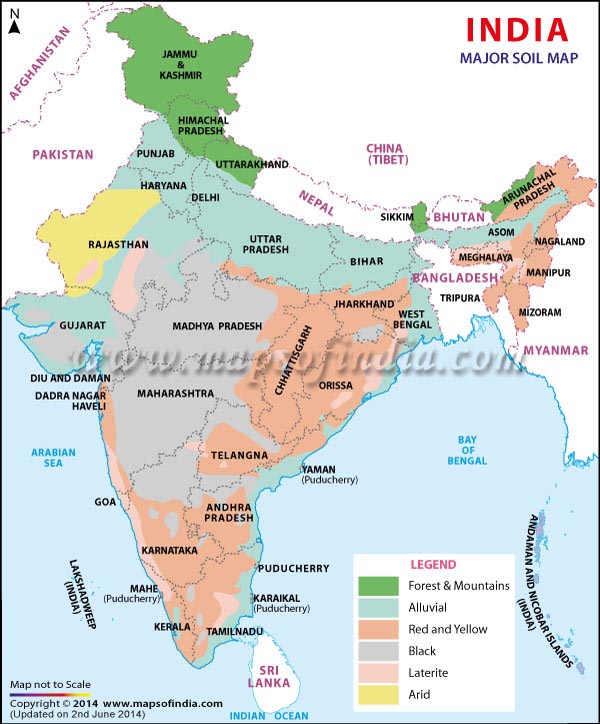
    We learnt about the various ways to classify soils. In this article, we will look at the various types of Indian soils in detail (According to ICAR’s classification). Let’s begin!
    Source

    1. Alluvial Soils

    • Formation: They are mainly derived from the debris brought down from the Himalayas or the silt left out by the retreating sea. Thus they are azonal soils.
    • Areas: Alluvial soils are widespread in the northern plains and the river valleys. Through a narrow corridor in Rajasthan, they extend into the plains of Gujarat. In the Peninsular region, they are found in deltas of the east coast and in the river valleys.
    • Soil texture: The alluvial soils vary in nature from sandy loam to clay. These soils are more loamy and clayey in the lower and middle Ganga plain and the Brahmaputra valley. The sand content decreases from the west to east.
    • Soil Colour: The colour of the alluvial soils varies from the light grey to ash grey depending on the depth of the deposition, the texture of the materials, and the time taken for attaining maturity.
    • Other Characteristic Features:
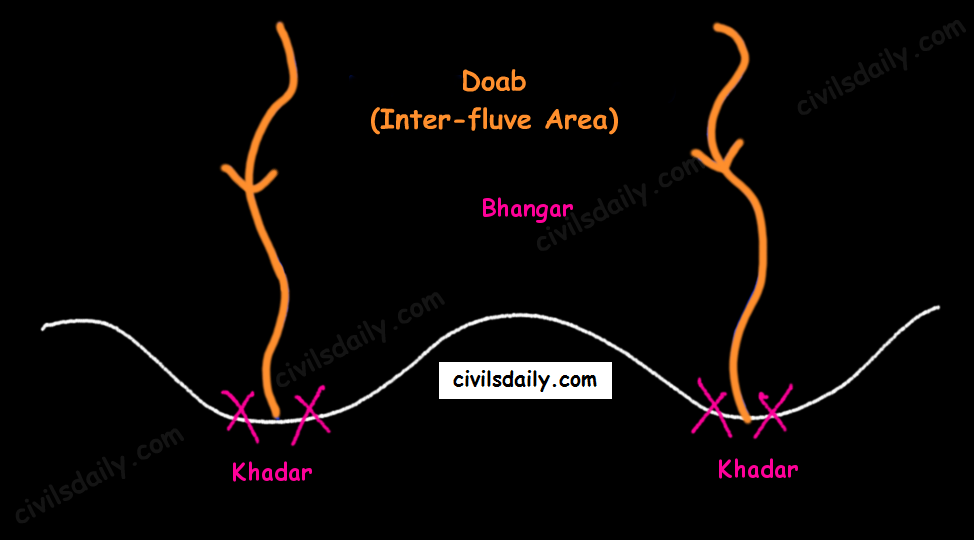
      • In the Upper and Middle Ganga plain, two different types of alluvial soils have developed, viz. Khadar and Bhangar.
    Khadar and Bhangar
      • Khadar: the newer alluvium deposited by floods annually, enriches the soil by depositing fine silts, light colour, found near river beds, porous in nature. Bhangar: older alluvium, clayey, darker, has lime nodules called Kankars, found in doabs (inter-fluve areas).
      • Alluvial soils of the northern plains —> transported soils —>, therefore, lack humus —> lack nitrogen [That is why we need to use nitrogenous fertilisers in the northern plains!]. Exception: the Ganga-Brahmaputra delta region is rich in humus.
      • These soils lack in nitrogen, phosphorus and humus. However, they are generally rich in potash and lime.
      • The soil profile has no stratification.
      • Alluvial soils are intensively cultivated.
      • In certain areas, these soils are covered with unproductive wind-borne soil called Loess.
    • Limitations:
      • Allow water to sink into lower strata, and
      • Lack nitrogen (But these soils are capable of fixing nitrogen very rapidly through leguminous crops (peas, beans, cloves etc.)
    • Suitable Crops: Wheat, rice, maize, sugarcane, pulses, oilseeds, fruits and vegetables, leguminous crops.

    2. Black Soil

    • These soils are locally known as the ‘Regur Soil’ or the ‘Black Cotton Soil’. Internationally, these are known as ‘tropical chernozems’. These soils are famous for the cultivation of cotton.
    • Formation: These have mainly formed from the Deccan Trap rocks —> Zonal Soils
    • Areas: These are found in the Deccan trap region. Black soil covers most of the Deccan Plateau which include parts of:
      • Maharashtra,
      • Madhya Pradesh,
      • Gujarat,
      • Andhra Pradesh and some parts of
      • Tamil Nadu.
    • Soil Texture: Black cotton soil (regur soil) is highly argillaceous i.e. clayey. It is deep and impermeable and thus has high water retention capacity.
    • Soil Colour: These soils are black in colour due to the presence of iron, aluminium compounds and humus.
    • Other Characteristic Features:
      • These soils are rich in minerals and known for their fertility.
      • The soil depth varies from place to place. It is very thick in lowlands but very thin on highlands. Also, in the upper reaches of the Godavari and the Krishna, and the northwestern part of the Deccan Plateau, the black soil is very deep.
      • These soils swell and become sticky when wet and develop deep wide cracks when dry. This helps in self-aeration, which leads to the absorption of nitrogen from the atmosphere. Thus, there occurs a kind of ‘self ploughing’. This aeration and oxidisation to deep levels contribute to the maintenance of the fertility of these soils. This continued fertility is favourable in the area of low rainfall for cotton cultivation even without irrigation.
      • Due to slow absorption and loss of moisture, the black soil retains the moisture for a very long time, which helps the crops, especially, the rain-fed ones, to sustain even during the dry season.
      • Chemically, the black soils are rich in lime, iron, magnesia and alumina. They also contain potash. But they lack in phosphorous, nitrogen and organic matter.
    • Suitable Crops: These soils are highly productive and well suited to the cultivation of cotton, pulses, millets, linseed, tobacco, sugarcane, vegetables and citrus fruits.

    Note: In the southern and eastern parts of the country where rainfall is heavy, black soils often occur in close proximity to red soils. Black soils occupy valleys and low-level areas whereas the red soils occur on higher slopes and hilltops. Mixed black and red soils occur in Coimbatore, Madurai, Tirunelveli (Tamil Nadu) and Bundelkhand region.

    3. Red and Yellow Soils

    • Locally called ‘Chalka’ in Andhra Pradesh.
    • Formation: These are derived from granites, gneisses and other metamorphic rocks —> Zonal Soils. These are formed under well-drained conditions.
    • Areas: Along the piedmont zone of the Western Ghat, a long stretch of area is occupied by red loamy soil. Yellow and red soils are also found in parts of Orissa and Chattisgarh and in the southern parts of the middle Ganga plain. They encircle the black cotton soil zone.
    • Soil Colour: The soil develops a reddish colour due to a wide diffusion of iron in crystalline and metamorphic rocks. It looks yellow when it occurs in a hydrated form. Often, their upper layer is red and the lower layer is yellow.
    • Soil Texture: Varies from sand to clay and loam.
    • Other Characteristic Features:
      • The fine-grained red and yellow soils are normally fertile, whereas coarse-grained soils found in dry upland areas are poor in fertility.
      • Have a porous and friable structure.
      • They are generally poor in nitrogen, phosphorous and humus.
      • These soils are airy and need irrigation for cultivation.
      • Intense leaching is a menace in these soil areas.
    • Suitable Crops: In places where irrigation facilities are available, the crops cultivated are wheat, cotton, pulses, tobacco, millets, oilseeds, potato, maize, groundnut and orchards.

    4. Laterite Soil

    • The word laterite has been derived from the Latin word ‘Later’ which means brick. These soils when wet are as soft as butter but become hard and cloddy on drying. Therefore, these are widely cut as bricks for use in house construction.
    • Formation: The lateritic soils are particularly found on high flat erosion surfaces in areas of high(>200cm) and seasonal rainfall. The alternating wet and dry seasons lead to the leaching away of the siliceous matter of the rocks leaving behind the compounds of iron and aluminium. These are zonal soils.
    • Areas: These soils have mainly developed in the higher areas of the Peninsular plateau. The laterite soils are commonly found in Karnataka, Kerala, Tamil Nadu, Madhya Pradesh and the hilly areas of Orissa and Assam.
    • Soil Colour: Reddish-brown in colour due to the presence of iron oxide.
    • Other characteristic features:
      • With rain, lime and silica are leached away, and soils rich in iron oxide and aluminium compound are left behind(thus the reddish-brown colour). Also, the humus content of the soil is removed fast by bacteria that thrive well in high temperature.
      • These soils represent the end product of decomposition and are generally low in fertility.
      • The pebbly crust is the important feature of laterites which is formed due to alteration of wet and dry periods.
      • These soils are acidic in character due to leaching. Application of manures and fertilisers is required for making these soils fertile for cultivation.
      • These soils are poor in organic matter, nitrogen, phosphate and calcium, while iron oxide and potash are in excess.
    • Suitable crops: Red laterite soils in Tamil Nadu, Andhra Pradesh and Kerala are more suitable for tree crops like cashew nut. These soils are also suitable for tea plantations.

    We discussed in detail alluvial, black, red and laterite soils. Let’s continue the discussion and move on to the next soil types!

    Source

    5. Arid Soils

    • Formation: These are derived from the disintegration of adjacent rocks and are largely blown from coastal regions and Indus valley.
    • Areas: Arid soils are characteristically developed in western Rajasthan, which exhibits characteristic arid topography.
    • Soil Colour: Arid soils range from red to brown in colour.
    • Soil Texture: They are generally sandy to gravelly in texture and have a high percentage of soluble salts.
    • Other characteristic features:
      • These are saline in nature. In some areas, the salt content is so high that common salt is obtained by evaporating the saline water.
      • Due to the dry climate, high temperature and accelerated evaporation, they lack moisture and humus.
      • These soils are deficient in nitrogen and humus. The phosphate and iron content is normal. These soils are rich in minerals but the main limitation is the lack of water.
      • The soils exhibit poorly developed horizons.
      • Plants are widely spaced.
      • Chemical weathering is limited.
      • Lower horizons of the soil are occupied by ‘kankar’ layers because of the increasing calcium content downwards. The ‘Kankar’ layer formation in the bottom horizons restricts the infiltration of water, and as such when irrigation is made available, the soil moisture is readily available for sustainable plant growth.
    • Suitable crops: If irrigated these soils give high agricultural returns. The availability of water from the Indira Gandhi canal has transformed the agricultural landscape of desert soils of western Rajasthan. These soils are mainly devoted to bajra, pulses, guar, fodder and less water requiring crops.

    6. Saline and Alkaline Soils

    • They are also known as Usara soils. Various local names for saline soils are Reh, Kallar, and Chopan, Rakar, Thur, Karl etc.
    • Formation:
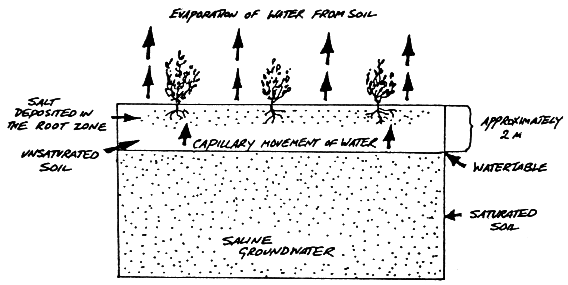
      • These soils have developed in areas with dry climatic conditions (in areas having a little more rainfall than the areas of desert soils) accompanied by lack of proper drainage. In this situation, salts of sodium, calcium and magnesium are deposited on the upper layer of the soil by capillary action.

        Source

      • In the Rann of Kuchchh, the Southwest Monsoon brings salt particles and deposits there as a crust.
      • These soils are also formed when saline water spreads on the land at the time of high tide in coastal areas. Also, seawater intrusions in the deltas promote the occurrence of saline soils.
      • Salinization also occurs because of over-irrigation (canal irrigation/groundwater use) and in areas of the high water table (as in the coastal areas of Maharashtra and Tamil Nadu). Salinity from irrigation can occur over time wherever irrigation occurs. This is because almost all water (even natural rainfall) contains some dissolved salts. When the plants use the water, the salts are left behind in the soil and eventually begin to accumulate. Also, excessive irrigation with dry climatic conditions promotes capillary action, which results in the deposition of salt on the top layer of the soil (See the following figure).

        Source

      • These are thus, intrazonal soils.
    • Areas: They occur in arid and semi-arid regions, and in waterlogged and swampy areas. These are more widespread in western Gujarat, deltas of the eastern coast and in Sunderban areas of West Bengal.
    • Soil Texture: Their texture ranges from sandy to loamy.
    • Other characteristic features:
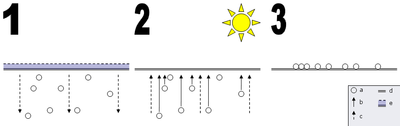
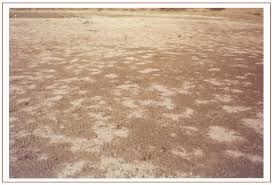
      • Because of capillary action, the salts are sucked up in solution to the surface and form white encrustations on the surface (See the picture below).

        Source

      • The salt efflorescence of calcium, magnesium and sodium makes these soils infertile.
      • Saline soils contain an excess of neutral soluble salts of chlorides and sulphates whereas sodic or alkali soils contain sodium carbonates/ sodium bicarbonates.
      • They lack in nitrogen and calcium and have low water-bearing capacity.
      • These soils can be reclaimed by improving drainage, by applying gypsum and/or lime, and by cultivating salt-resistant crops like barseem, dhaincha and other leguminous crops.
      • The saline and alkaline soils may occur in any group of soils.
    • Crops grown: In coastal areas, coconut trees are found in plenty in these soils. As discussed above, cultivating salt-resistant crops like bar seem, dhaincha and other leguminous crops can help in reclaiming these soils.
    • Note: In the areas of intensive cultivation with excessive use of irrigation, especially in areas of green revolution, the fertile alluvial soils are becoming saline. In such areas, especially in Punjab and Haryana, farmers are advised to add gypsum to solve the problem of salinity in the soil.

    7. Peaty Soils

    • These soils are locally called Kari in Kottayam and Alleppey districts of Kerala.
    • Formation: These are marshy soils and are a result of waterlogging and anaerobic conditions (which leads to partial decomposition of organic matter).
    • Areas: They are found in the areas of heavy rainfall and high humidity, where there is a good growth of vegetation. It occurs widely in the northern part of Bihar, the southern part of Uttaranchal and the coastal areas of West Bengal, Orissa and Tamil Nadu.
    • Soil Colour and Texture: These soils are normally heavy and black in colour
    • Other characteristic features:
      • These soils are characterised by a rich humus and organic content.
      • There is a presence of iron and varying amounts of organic matter (10-40%). The organic matter in these soils may go even up to 40-50 per cent.
      • These soils are generally acidic in nature. But at many places, they are alkaline also.
    • Suitable crops: These are generally submerged during the rainy season and utilised for the cultivation of rice.

    8. Forest Soils

    • Formation: As the name suggests, forest soils are formed in the forest areas where sufficient rainfall is available.
    • Areas: These are found in the forest areas of Himalayas, Sahyadris, Eastern Ghats and terai region.
    • Soil colour and texture: The soils vary in structure and texture depending on the mountain environment where they are formed. They are loamy and silty on valley sides and coarse-grained in the upper slopes. Their colour is dark brown.
    • Other Characteristics:
      • In the snow-bound areas of the Himalayas, they are acidic with low humus content. This is because humus is rawer at higher levels. Also, these soils are subjected to denudation due to landslides and snowfall.
      • The soils found in the lower valleys are fertile and rich in organic content.
      • Owing to sharp differences of hill slopes and climates, these soils may differ greatly even when in proximity. [Recall here the discussion on the impact of topography on soils!]
      • Also, these soils exist in thin layers because of their development on the mountain slopes.
      • These soils are poor in potash, phosphorus and lime.
      • Soil erosion is a major problem in these areas.
    • Crops grown: The slopes are used for horticulture and plantations crops like tea, coffee, spices, apple, peach etc. Rice and wheat are grown in valleys. Potatoes are grown in mostly all areas.

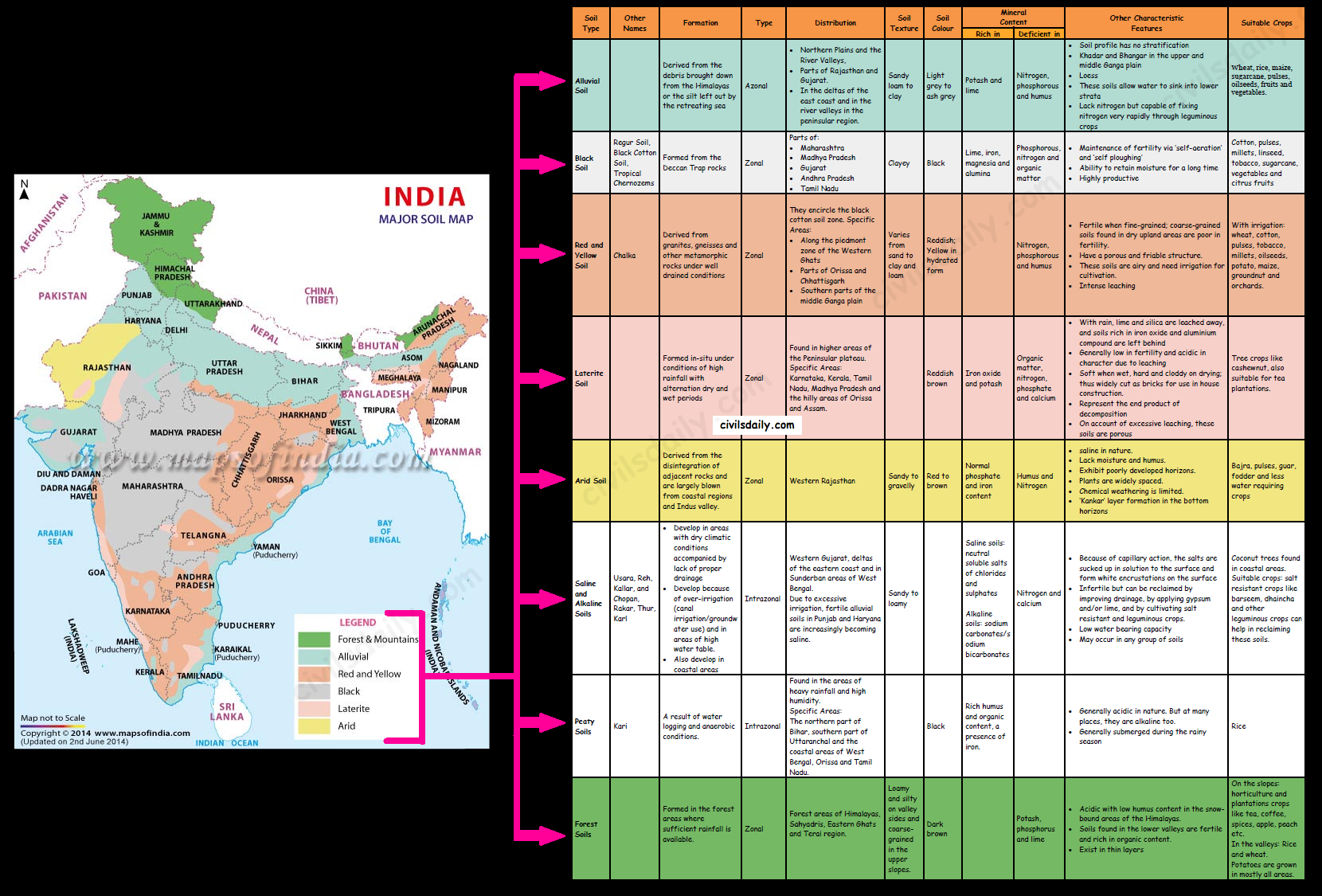
    Now that we are done with all the soil types, expand the following image for a quick revision!

    Major Soil Types of India (Classification by ICAR)


  • [Prelims Spotlight] Environment Related Acts


    Prelims Spotlight is a part of “Nikaalo Prelims 2020” module. This open crash course for Prelims 2020 has a private telegram group where PDFs and DDS (Daily Doubt Sessions) are being held. Please click here to register.


    30 March 2020

    Air (Prevention and Control of Pollution) Act of 1981

    The Air (Prevention and Control of Pollution) Act, 1981 an Act of the Parliament of India to control and prevent air pollution in India

    It was amended in 1987

    The Government passed this Act in 1981 to clean up our air by controlling pollution.

    It states that sources of air pollution such as industry, vehicles, power plants, etc., are not permitted to release particulate matter, lead, carbon monoxide, sulfur dioxide, nitrogen oxide, volatile organic compounds (VOCs) or other toxic substances beyond a prescribed level

    Key Features

    The Act specifically empowers State Government to designate air pollution areas and to prescribe the type of fuel to be used in these designated areas.

    According to this Act, no person can operate certain types of industries including the asbestos, cement, fertilizer and petroleum industries without consent of the State Board.

    The main objectives of the Act are as follows:

    (a) To provide for the prevention, control and abatement of air pollution

    (b) To provide for the establishment of central and State Boards with a view to implement the Act(Central Pollution Control Board and State Pollution Control Board)

    (c) To confer on the Boards the powers to implement the provisions of the Act and assign to the Boards functions relating to pollution


    Environmental (Protection) Act of 1986

    Environment Protection Act, 1986 is an Act of the Parliament of India

    In the wake of the Bhopal Tragedy, the Government of India enacted the Environment Protection Act of 1986 under Article 253 of the Constitution

    Passed in March 1986, it came into force on 19 November 1986

    The Act is an “umbrella” for legislations designed to provide a framework for Central Government, coordination of the activities of various central and state authorities established under previous Acts, such as the Water Act and the Air Act.

    In this Act, the main emphasis is given to “Environment”, defined to include water, air and land and the inter-relationships which exist among water, air and land and human beings and other

    The objective of the Act

    The purpose of the Act is to implement the decisions of the United Nations Conference on the Human Environment of 1972, in so far as they relate to the protection and improvement of the human environment and the prevention of hazards to human beings, other living creatures, plants and property.


    The Ozone Depleting Substances (Regulation and Control) Rules, 17 July 2000

    The rules are framed under the jurisdiction of the Environment (Protection) Act.

    Objectives and Key Features

    • These Rules set the deadlines for phasing out of various ODSs, besides regulating production, trade import and export of ODSs and the product containing ODS.
    • These Rules prohibit the use of CFCs in manufacturing various products beyond 1st January 2003 except in metered-dose inhaler and for other medical purposes.
    • Similarly, the use of halons is prohibited after 1st January 2001 except for essential use.
    • Other ODSs such as carbon tetrachloride and methyl chloroform and CFC for metered-dose inhalers can be used up to 1st January 2010.
    • Since HCFCs are used as interim substitute to replace CFC, these are allowed up to 1st January 2040.


    The Energy Conservation Act of 2001

    As a step towards improving energy efficiency, the Government of India has enacted the Energy Conservation Act in 2001.

    Objective

    The Energy Conservation Act, 2001 is the most important multi-sectoral legislation in India and is intended to promote efficient use of energy in India.

    Key Features

    The Act specifies energy consumption standards for equipment and appliances, prescribes energy consumption norms and standards for consumers, prescribes energy conservation building codes for commercial buildings and establishes a compliance mechanism for energy consumption norms and standards.

    Bureau of Energy Efficiency (BEE)

    In order to implement the various provisions of the EC Act, Bureau of Energy Efficiency (BEE) was operationalised with effect from 1st March 2002. The EC Act provides a legal framework for energy efficiency initiatives in the country. The Act has mandatory as well as promotional initiatives.

    The Bureau is spearheading the task of improving energy efficiency in various sectors of the economy through the regulatory and promotional mechanism. The primary objective of BEE is to reduce energy intensity in the Indian economy.

    This is to be demonstrated by providing a policy framework as well as through public-private partnership.


    Forest Conservation Act of 1980

    Background

    First Forest Act was enacted in 1927.

    Alarmed at India’s rapid deforestation and resulting environmental degradation, the Centre Government enacted the Forest (Conservation) Act in1980.

    Objective

    It was enacted to consolidate the law related to forest, the transit of forest produce and the duty livable on timber and other forest produce.

    Key Features

    • Under the provisions of this Act, prior approval of the Central Government is required for diversion of forestlands for non-forest purposes.
    • Forest officers and their staff administer the Forest Act.
    • An Advisory Committee constituted under the Act advises the Centre on these approvals.
    • The Act deals with the four categories of the forests, namely reserved forests, village forests, protected forests and private forests.


    The National Green Tribunal Act, 2010

    Background

    During the Rio de Janeiro summit of United Nations Conference on Environment and Development in June 1992, India vowed the participating states to provide judicial and administrative remedies for the victims of the pollutants and other environmental damage.

    Key Features

    It was enacted under India’s constitutional provision of Article 21, which assures the citizens of India the right to a healthy environment.

    The specialized architecture of the NGT will facilitate fast track resolution of environmental cases and provide a boost to the implementation of many sustainable development measures.

    NGT is mandated to dispose of the cases within six months of their respective appeals.

    Enabling Provision

    It is an Act of the Parliament of India which enable the creation of NGT to handle the expeditious disposal of the cases pertaining to environmental issues.

    Members

    The sanctioned strength of the tribunal is currently 10 expert members and 10 judicial members although the act allows for up to 20 of each.

    The Chairman of the tribunal who is the administrative head of the tribunal also serves as a judicial member.

    Every bench of the tribunal must consist of at least one expert member and one judicial member.

    The Chairman of the tribunal is required to be a serving or retired Chief Justice of a High Court or a judge of the Supreme Court of India.

    Jurisdiction

    The Tribunal has Original Jurisdiction on matters of “substantial question relating to environment” (i.e. a community at large is affected, damage to public health at broader level) & “damage to the environment due to specific activity” (such as pollution).

    The term “substantial” is not clearly defined in the act.


    The Coastal Regulation Zone Notifications

    Background

    The coastal stretches of seas, bays, estuaries, creeks, rivers and backwaters which are influenced by tidal action are declared “Coastal Regulation Zone” (CRZ) in 1991.

    CRZ notifications

    India has created institutional mechanisms such as the National Coastal Zone Management Authority (NCZMA) and State Coastal Zone Management Authority (SCZMA) for enforcement and monitoring of the CRZ Notification.

    These authorities have been delegated powers under Section 5 of the Environmental (Protection) Act, 1986 to take various measures for protecting and improving the quality of the coastal environment and preventing, abating and controlling environmental pollution in coastal areas.

    Key Features

    Under these coastal areas have been classified as CRZ-1, CRZ-2, CRZ-3, CRZ-4. And the same they retained for CRZ in 2003 notifications as well.

    CRZ-1: these are ecologically sensitive areas these are essential in maintaining the ecosystem of the coast. They lie between low and high tide line. Exploration of natural gas and extraction of salt are permitted

    CRZ-2: these areas form up to the shoreline of the coast. Unauthorised structures are not allowed to construct in this zone.

    CRZ-3: rural and urban localities which fall outside the 1 and 2. Only certain activities related to agriculture even some public facilities are allowed in this zone

    CRZ-4: this lies in the aquatic area up to territorial limits. Fishing and allied activities are permitted in this zone. Solid waste should be let off in this zone.

    Wildlife Protection Act, 1972

    Background

    In 1972, Parliament enacted the Wild Life Act (Protection) Act.

    Objective

    The Wild Life Act provides for

    1. state wildlife advisory boards,
    2. regulations for hunting wild animals and birds,
    3. establishment of sanctuaries and national parks, tiger reserves
    4. regulations for trade in wild animals, animal products and trophies, and
    5. judicially imposed penalties for violating the Act.

    Key Features

    • Harming endangered species listed in Schedule 1 of the Act is prohibited throughout India.
    • Hunting species, like those requiring special protection (Schedule II), big game (Schedule III), and small game (Schedule IV), is regulated through licensing.
    • A few species classified as vermin (Schedule V), may be hunted without restrictions.
    • Wildlife wardens and their staff administer the act.
    • An amendment to the Act in 1982, introduced a provision permitting the capture and transportation of wild animals for the scientific management of the animal population.


    Biological Diversity Act, 2002

    Background

    The Biological Diversity Bill was introduced in the Parliament in 2000 and was passed in 2002.

    Objective:

    India’s richness in biological resources and indigenous knowledge relating to them is well recognized

    The legislation aims at regulating access to biological resources so as to ensure equitable sharing of benefits arising from their use

    Key Features

    • The main intent of this legislation is to protect India’s rich biodiversity and associated knowledge against their use by foreign individuals and organizations without sharing the benefits arising out of such use and to check biopiracy.
    • This bill seeks to check biopiracy, protect biological diversity and local growers through a three-tier structure of central and state boards and local committees.
    • The Act provides for setting up of a National Biodiversity Authority (NBA), State Biodiversity Boards (SBBs) and Biodiversity Management Committees (BMCs) in local bodies. The NBA will enjoy the power of a civil court.
    • BMCs promote conservation, sustainable use and documentation of biodiversity.
    • NBA and SBB are required to consult BMCs in decisions relating to the use of biological resources.
    • All foreign nationals or organizations require prior approval of the NBA for obtaining biological resources and associated knowledge for any use.
    • Indian individuals/entities require the approval of NBA for transferring results of research with respect to any biological resources to foreign nationals/organizations.

    Recycled Plastics Manufacture and Usage Rules, 1999

    Objective

    A rule notified in exercise of the powers conferred by clause (viii) of Sub Section (2) of Section 3 read with Section 25 of the Environment (Protection) Act, 1986 (29 of 1986) with the objective to regulate the manufacture and use of recycled plastics, carry bags and containers;

    Key Features

    1. The thickness of the carry bags made of virgin plastics or recycled plastics shall not be less than 20 microns.
    2. Carry bags and containers made of virgin plastic shall be in natural shade or white.
    3. Carry bags and containers made of recycled plastic and used for purposes other than storing and packaging foodstuffs shall be manufactured using pigments and colourants as per IS:9833:1981 entitled “List of Pigments and Colorants” for use in Plastics in contact with foodstuffs, pharmaceuticals and drinking water.
    4. Recycling of plastics shall be undertaken strictly in accordance with the Bureau of Indian Standards specifications IS:14534:1988 entitled “The Guidelines for Recycling of Plastics”.
  • [Prelims Spotlight] Constitutional and Quasi-judicial bodies.


    Prelims Spotlight is a part of “Nikaalo Prelims 2020” module. This open crash course for Prelims 2020 has a private telegram group where PDFs and DDS (Daily Doubt Sessions) are being held. Please click here to register.


    28 March 2020

    Constitutional bodies

    Appointment Tenure Removal Process of removal Eligibility for reappointment w/i govt
    Attorney general (Advocate general) President (governor) Pleasure of President (governor) President (governor) No reason needs to be mentioned Yes
    Election Commission (SEC) President (governor) 6 years/ 65 President CEC and SEC by a special majority

    Other ECs on the recommendation of CEC

    Yes
    Finance commission (SFC) President (governor) Specified by president NA NA Yes
    UPSC (SPSC) President (governor) 6 years/ 65 President After enquiry by supreme court Members can become Chair, state members can become chair or member or chair of UPSC
    CAG President 6 years/ 65 President Special majority No


    Statutory bodies

    Appointment Committee members Other members Tenure Removal
    NHRC (SHRC) President (Governor) 6 (PM + LOP Lok Sabha) Speaker, Deputy CP RS, LOP RS, home minister 3 years*/ 70 President after Supreme Court inquiry
    CIC (SIC) President (Governor) 3 ((PM + LOP Lok Sabha) Cabinet Minister nominated by PM As prescribed by the Central Govt*./ 65 President (governor for SIC) after supreme court inquiry
    CVC President (governor) 3 ((PM + LOP lok sabha) Home minister 4 years/ 65 President after Supreme court inquiry
    Lokpal President 5 (PM + LOP lok sabha Speaker, CJI, eminent jurist 5 years/ 70 Like a Supreme Court judge

    *  After amendments in the respective acts in 2019.

    In the news: 

    1. Amendment to the RTI Act (July 2019)

    • Section 13 of the original Act sets the term of the central Chief Information Commissioner and Information Commissioners at five years (or until the age of 65, whichever is earlier). The amendment proposes that the appointment will be “for such term as may be prescribed by the Central Government”.
    • The amendment proposes that the salaries, allowances and other terms of service of the Chief Information Commissioner and the Information Commissioners “shall be such as may be prescribed by the Central Government” which was earlier at par with Chief Election Commissioner.

    2. Amendment to Protection of Human Rights Act (July 2019)

    • It reduced the term of the Chairperson and Members of the Commission and the State Commissions from five to three years and shall be eligible for re-appointment.
    • Provision was added which says a person who has been a Judge of the Supreme Court is also eligible to be appointed as Chairperson of the Commission in addition to the person who has been the Chief Justice of India.
    • The amendment made provision that a person who has been a Judge of a High Court is also made eligible to be appointed as Chairperson of the State Commission in addition to the person who has been the Chief Justice of the High Court.
    • It conferred upon State Commissions, the functions relating to human rights being discharged by the Union territories, other than the Union territory of Delhi, which will be dealt with by the Commission.
  • [Prelims Spotlight] Important Rebellions- Part 1


    Prelims Spotlight is a part of “Nikaalo Prelims 2020” module. This open crash course for Prelims 2020 has a private telegram group where PDFs and DDS (Daily Doubt Sessions) are being held. Please click here to register.


    27 March 2020

    Important Rebellions- Part 1

    Causes of the rebellions

    • After seizing the power and starting their rule the British caused dislocation in ways Indian were used to. The areas in which the change was felt the most were viz. economy, administration and land revenue system.
    • The British rule which adversely affected the interests of all sections of society had intensified the land revenue. The only interest of the company was the realization of maximum revenue with minimum effort. Consequently, settlements were hurriedly undertaken, often without any regard for the resources of the land.
    • Traditional landed aristocracy suffered no less. Their estates were confiscated and they suddenly found themselves without a source of income, unable to work, ashamed to beg, condemned to penury.
    • British rule also meant misery to artisans and handicraftsmen. The annexation of Indian states by the Company cut off their major source of patronage. Also, the British policy discouraged Indian handicraft and promoted British goods.
    • The new courts and legal system gave a further fillip to the dispossessors of land and encouraged the rich to oppress the poor. Flogging, torture and jailing of the cultivators for arrears of rent or land revenue or interest on debt were quite common. The ordinary people were also hard hit by the prevalence of corruption at the lower levels of the police, judiciary and general administration.

    Sanyasi Uprising, Bengal- (1770-1820s)

    • At least three separate events are called the Sannyasi Rebellion. One refers to a large body of Hindu sannyasis who travelled from North India to different parts of Bengal to visit shrines. En route to the shrines, it was customary for many of these ascetics to exact a religious tax from the headmen and zamindars or regional landlords
    • However, since the East India Company had received the Diwani or right to collect the tax, many of the tax demands increased and the local landlords and headmen were unable to pay both the ascetics and the English.
    • The other two movements involved a sect of Hindu ascetics, the Dasnami naga sannyasis who likewise visited Bengal on pilgrimage mixed with moneylending opportunities.
    • To the British, these ascetics were looters and must be stopped from collecting money that belonged to the Company and possibly from even entering the province. It was felt that a large body of people on the move was a possible threat.
    • The sanyasis retaliated by organising raids on the Company’s factories and state treasuries. Only after prolonged military action could Warren Hastings contain the raids by the sanyasis.

    Chuar uprising

    • Towards the end of the 18th century, certain portions of the district around Raipur was affected by the Chuar rebellion.
    • The leader of the rebels was Durjan Singha, a former zamindar of Raipur. He had a following of about 1,500 men and created havoc in certain areas.
    • The uprising lasted from 1766 to 1772 and then, again surfaced between 1795 and 1816.

    Moplah Rebellions, Malabar (1835-1921)

    • The Moplah rebellions of Malabar, South India, were not only directed against British but also the Hindu Landlords.
    • The relations of the Arabs traders with the Malayali society can be traced back to the ninth century. The traders helped the local Hindu chieftains and were granted concessions.
    • Many of the Arab traders settled in Malabar marrying mostly Nayar and Tiyar women, and the subsequent descendants came to be known as Moplahs.
    • In the traditional Malabar land system, the Jenmi held land by birthright and were mostly highcaste Hindus, and let it out to others for cultivation.
    • The other main sections of the Malabar society were the Kanamdar, who were mostly Moplahs, the verumpattamdar (cultivators) and agricultural labourers. The peasants were mostly the Muslim Moplahs.
    • The land was given by the ruling raja to Namboodiri Brahmins whose obligation was to look after the temple and related institutions, and to the chieftains (mostly Nayars), who provided martial aid when needed.
    • Traditionally, the net produce of the land was shared equally between the three.
    • But during the reign of Haider Ali and Tipu Sultan, Namboodiri Brahmins and Nayar Chiefs fled and the subsequent vacuum was filled by the Moplahs.
    • The conflict arose when after Malabar’s cession to the British in 1792 and the return of the exiled Namboodiri Brahmins and Nayars, the government re-established and acknowledged their landlord rights.
    • The British by recognizing the Jenmis as the absolute owners of the land gave them the right to evict the tenants at will.
    • This reduced the other two to the status of tenants and leaseholders.
    • The courts and the law officers sided with the Jenmis. Once the Jenmi landlords, who had the backing of the revenue officials, the law court and the police started tightening their hold and demands on the subordinate classes, the Moplah peasantry rose up in revolt.
    • The first outbreak occurred in 1836 and during the period of 1834-54, there were 22 uprisings, with the ones in 1841 and 1849 being quite serious.
    • The second phase of the revolt was recorded in 1882-85, while another spate of outburst in 1876 was also there.

    Poligar Rebellions, Kurnool (1799-1805)

    • The Poligars of Dindigal and Malabar rose up against the oppressive land revenue system under the British during 1801-06.
    • The sporadic rising of the Poligars in Madras Presidency continued till 1856.
    • In September 1799, in the first Polygar War, the poligars of Tirunelveli District rose up in open rebellion.
    • Kattabomma Nayak of Panchalamkurichi was considered as the main leader of the rebellion. Though he managed to escape initially, he was later captured in Pudukottai, and publicly hanged in front of other Polygars as a warning.
    • The Second Polygar war of 1800-01, given the magnitude of participation, is also known as the “South Indian Rebellion”.
    • The rebellion broke out when a band of Polygar armies bombed the British barracks in Coimbatore.
    • The suppression was followed by signing of the Carnatic Treaty on July 31, 1801, whereby the British assumed direct control over Tamil Nadu.
    • The Polygar system, which had flourished for two and half centuries, came to a violent end and the company introduced the Zamindari settlement in its place.

    Ramosi Risings (1822, 1825-26)

    • The Ramosis, the hill tribes of the Western Ghats, had not reconciled to British rule and the British pattern of administration.
    • They rose under Chittur Singh in 1822 and plundered the country around Satara. Again, there were eruptions in 1825-26 and the disturbances continued till 1829.
    • The disturbance occurred again in 1839 over deposition and banishment of Raja Pratap Singh of Satara, and disturbances erupted in 1840-41 also. Finally, a superior British force restored order in the area.

    Kolhapur and Savantvadi Revolts (1844)

    • The Gadkaris were a hereditary military class which was garrisoned in the Maratha forts.
    • These garrisons were disbanded during an administrative reorganisation in Kolhapur state after 1844. Facing the spectre of unemployment, the Gadkaris rose in revolt and occupied the Samangarh and Bhudargarh forts.
    • Similarly, the simmering discontent caused a revolt in Savantvadi areas.
    • A number of Sawantwadi rebels were tried for treason and sentenced to various terms of imprisonment.
    • Ultimately, after the imposition of martial law and meting out brutal punishment to the rebels, the order could be restored in Sawantwadi region.

    Santhal Rebellion

    • The Santhals of Rajmahal Hills resented the oppression by revenue officials, police, money-lenders, landlords—in general, by the “outsiders’ (whom they called diku).
    • The Santhals under Sido and Kanhu rose up against their oppressors, declared the end of the Company’s rule and asserted themselves independent in 1854.
    • It was only in 1856 after extensive military operations that the situation was brought under control. Sido died in 1855, while Kanhu was arrested in 1866.
    • A separate district of Santhal Parganas was created by the Government to pacify the Santhals.

    Khond Uprising

    • The Khonds lived in vast hill tracts stretching from Tamil-nadu to Bengal, covering central provinces, and in virtual independence due to the inaccessible mountainous terrain.
    • Their uprisings from 1837 to 1856 were directed against the British, in which the tribals of Ghumsar, china-ki-medi, Kalahandi and Patna actively participated.
    • The movement was led by Chakra Bisoi in the name of the young Raja.
    • The main issue was the attempt by the government to suppress human sacrifice (Mariah), the introduction of new taxes by the British and the influx of Zamindars and sahookars (money-lenders) into their areas which was causing the tribals untold misery.
    • The British formed a Maria agency, against which the Khonds fought with Tangi, a king of battle-axe, bows-arrows and even swords.
    • Latter Savaras and some local militia clans also joined in, led by Radha Krishna Dand Sena. Chakra Bisoi disappeared in 1855 after which the movement petered out.

    Early Munda Uprising (1789-1832)

    • In the period of 1789-1832, the Munda rose up in rebellion seven times against the landlords, dikhus, money-lenders and the British, who instead of protesting them sided with the oppressors.
    • In the post-1857 period with a hope of a better future, many Mundas turned to the Evangelical Lutheran mission, which was overseeing mission work in Chhotanagpur.
    • However, many apostates became more militant and broke away, spearheading the cause of seeking redressal of their grievances once they realized that the missionaries could not provide the solution to them.
    • Their movement identified as ‘sardariladai’ or ‘war of the leaders’ was fought with the aim of expelling dikhus; and restoration of the Munda domination over their homeland.
    • The tribal chiefs rose up against the erosion of Khuntkatti System or Joint tenures.
    • While it failed it did not peter out but remained dormant and in need of a charismatic leader. It was given a new life by Birsa Munda in 1899.

    Bhils and Kolis Uprisings:

    • The Bhils were concentrated in the hill ranges of Khandesh in the previous Maratha territory. The British occupation of this region in 1818 brought in the outsiders and accompanying dislocations in their community life.
    • A general Bhil insurrection in 1817-19 was crushed by the British Military forces and though some conciliatory measures were taken to pacify them, they again revolted under the leadership of Seva Ram in 1825 and the situation remained unsettled until 1831 when the Ramosi Leader Umaji Raje of Purandhar was finally captured and executed.
    • Minor revolts again took place in 1836 and 1846 as well.
    • The Bhils’ local rivals for power, the Kolis of Ahmednagar district, also challenged the British in 1829 but were quickly subdued by a large army contingent.
    • The seeds of rebellion, however, persisted, to erupt again in 1844-46, when a local Koli leader successfully defied the British government for two years.


  • [Prelims Spotlight] Important reports and Indices ( Part 1 )


    Prelims Spotlight is a part of “Nikaalo Prelims 2020” module. This open crash course for Prelims 2020 has a private telegram group where PDFs and DDS (Daily Doubt Sessions) are being held. Please click here to register.


    26 March 2020

    1.Economics

    Global Economy

    1.Report name – Asian Development Outlook

    Issuing agency – Asian Development Bank


    2.Report name – World Economic Outlook

    Issuing agency – International Monetary Fund


    3.Report name – Global Economic Prospects

    Issuing agency – World Bank


     2.Development

    1.Report name – World Development Report

    Issuing agency – IBRD (World Bank)


     2.Report name – Ease of Doing Business

    Issuing agency – IBRD (World Bank)

    Latest in news –India climbed 14 places in the World Bank’s Ease of Doing Business 2020 survey to stand at 63, among 190 countries, making it one of world’s top 10 most improved countries for the third consecutive time.

    To read in detail about the Ease of Business ranking, click here.


    3.Report name – Industrial Development Report

    Issuing agency – UNIDO (United Nations Industrial Development Organization)


    4.Report name – World Investment Report

    Issuing agency – UNCTAD (United Nations Conference on Trade and Development)


    5.Report name – Travel and Tourism Competitiveness Report

    Issuing agency – WEF (World Economic Forum)


     6.Report Name – World Cities Report

    Issuing Agency – UN-Habitat


    7.Index name – Logistics Performance Index

    Issuing agency – World Bank


    3.Global Financial System

    1.Report name – Global Financial Stability Report

    Issuing agency – International Monetary Fund


    2.Report name – Global Financial System Report

    Issuing agency – BIS (Bank for International Settlements)


    3.Report name – Global Money Laundering Report

    Issuing agency – FATF (Financial Action Task Force)

    2. Environment

    1.Report name – India State of Forest Report

    Issuing agency – Forest Survey of India

    Latest in news –  Click here to read more.


    2.Report name – Actions on Air Quality

    Issuing agency – UNEP (United Nations Environment Programme)


    3.Report name – Global Environment Outlook

    Issuing agency – UNEP (United Nations Environment Programme)


     4.Report name – The Rise of Environmental Crime

    Issuing agency – UNEP & INTERPOL


    5.Report name – Global Assessment Report

    Issuing agency – UNISDR (United Nations Office for Disaster Risk Reduction)


    6.Report name – The Living Planet Report

    Issuing agency – WWF (World Wildlife Fund)

    Latest in News – With wildlife disappearing at an “unprecedented” pace across the world, the Living Planet Report identifies India as an ecological black spot where around half of the wildlife lives in the danger of being wiped out. The report highlights the pressure on water and lands India faces because of unsustainable human activities. Around 70% of surface water is polluted and 60% of groundwater will reach a critical stage — where it cannot be replenished — in the next decade,

  • [Prelims Spotlight] Environment related Government bodies in India, Important Declarations,


    Prelims Spotlight is a part of “Nikaalo Prelims 2020” module. This open crash course for Prelims 2020 has a private telegram group where PDFs and DDS (Daily Doubt Sessions) are being held. Please click here to register.


    25 March 2020

    Government Bodies Related To Environment

    Central Pollution Control Board

    Established: It was established in 1974 under the Water (Prevention and Control of Pollution) Act, 1974.

    Objective: To provide technical services to the Ministry of Environment and Forests under the provisions of the Environment (Protection) Act, 1986.

    Key Functions:

    • Advise the Central Government on any matter concerning prevention and control of water and air pollution and improvement of the quality of air.
    • Plan and cause to be executed a nation-wide programme for the prevention, control or abatement of water and air pollution
    • Coordinate the activities of the State Board and resolve disputes among them
    • Provide technical assistance and guidance to the State Boards, carry out and sponsor investigation and research relating to problems of water and air pollution, and for their prevention, control or abatement
    • Plan and organise training of persons engaged in the programme on the prevention, control or abatement of water and air pollution
    • Organise through mass media, a comprehensive mass awareness programme on the prevention, control or abatement of water and air pollution
    • Collect, compile and publish technical and statistical data relating to water and air pollution and the measures devised for their effective prevention, control or abatement;
    • Prepare manuals, codes and guidelines relating to treatment and disposal of sewage and trade effluents as well as for stack gas cleaning devices, stacks and ducts;
    • Disseminate information in respect of matters relating to water and air pollution and their prevention and control
    • Lay down, modify or annul, in consultation with the State Governments concerned, the standards for stream or well, and lay down standards for the quality of air.
    • Perform such other functions as may be prescribed by the Government of India.


    National Biodiversity Authority

    Established When: It is a statutory autonomous body under the Ministry of Environment and Forests, Government of India established in 2003, after India signed Convention on Biological Diversity (CBD) in 1992

    Headquarter: Chennai

    The objective of the body: Implementation of Biological Diversity Act, 2002

    Key Functions:

    It acts as a facilitating, regulating and advisory body to the Government of India “on issues of conservation, sustainable use of biological resources and fair and equitable sharing of benefits arising out of the use of biological resources.”

    Additionally, it advises State Governments in identifying the areas of biodiversity importance (biodiversity hotspots) as heritage sites.


    National Tiger conservation authority

    Established: It was established in December 2005 following a recommendation of the Tiger Task Force, constituted by the Prime Minister of India for reorganised management of Project Tiger and the many Tiger Reserves in India.

    Headquarter: Delhi

    Objective:

    • Providing statutory authority to Project Tiger so that compliance of its directives become legal.
    • Fostering accountability of Center-State in management of Tiger Reserves, by providing a basis for MoU with States within our federal structure.
    • Providing for oversight by Parliament.
    • Addressing livelihood interests of local people in areas surrounding Tiger Reserves.

    Key Functions:

    • to approve the tiger conservation plan prepared by the State Government under sub-section (3) of section 38V of this Act
    • evaluate and assess various aspects of sustainable ecology and disallow any ecologically unsustainable land use such as mining, industry and other projects within the tiger reserves;
    • provide for management focus and measures for addressing conflicts of  men and wild animal and to emphasize on co-existence in forest areas outside the National Parks, sanctuaries or tiger reserve, in the working plan code
    • provide information on protection measures including future conservation plan, estimation of population of tiger and its natural prey species, the status of habitats, disease surveillance, mortality survey, patrolling, reports on untoward happenings and such other management aspects as it may deem fit including future plan conservation
    • ensure critical support including scientific, information technology and legal support for better implementation of the tiger conservation plan
    • facilitate ongoing capacity building programme for skill development of officers and staff of tiger reserves.


    Animal Welfare Board of India

    Established When: It was established in 1962 under Section 4 of The Prevention of Cruelty to Animals Act,1960.

    Headquarter: Ballabhgarh

    Objective: To advise Government on Animal Welfare Laws and promotes animal welfare in the country.

    Key Functions:

    • Recognition of Animal Welfare Organisations: The Board oversees Animal Welfare Organisations (AWOs) by granting recognition to them if they meet its guidelines. The organisation must submit paperwork; agree to nominate a representative of the Animal Welfare Board of India on its Executive Committee, and to submit to regular inspections. After meeting the requirements and inspection, the organisation is considered for grant of recognition.
    • The AWBI also appoints key people to the positions of (Hon) Animal Welfare Officers, who serve as the key point of contact between the people, the government and law enforcement agencies.
    • Financial assistance: The Board provides financial assistance to recognised Animal Welfare Organisations (AWOs), who submit applications to the Board. Categories of grants include Regular Grant, Cattle Rescue Grant, Provision of Shelter House for looking after the Animals, Animal Birth Control (ABC) Programme, Provision of Ambulance for the animals in distress and Natural Calamity grant.
    • Animal welfare laws and Rules: The Board suggests changes to laws and rules about animal welfare issues. In 2011, a new draft Animal Welfare Act was published for comment. Guidance is also offered to organisations and officials such as the police to help them interpret and apply the laws.
    • Raising awareness: The Board issues publications to raise awareness of various animal welfare issues. The Board’s Education Team gives talks on animal welfare subjects, and trains members of the community to be Board Certified Animal Welfare Educators.


    Forest Survey of India

    Established When:  It is a government organization in India under the Union Ministry of Environment, Forest and Climate Change for conducting forest surveys and studies. The organization came into being in, 1981.

    Headquarter: Dehradun, Uttarakhand

    Objective

    The objective of the organization is monitoring periodically the changing situation of land and forest resources and present the data for national planning; conservation and management of environmental preservation and implementation of social forestry projects.

    Key Functions

    • The Functions of the Forest Survey of India are:
    • To prepare State of Forest Report biennially, providing an assessment of the latest forest cover in the country and monitoring changes in these.
    • To conduct an inventory in forest and non-forest areas and develop a database on forest tree resources.
    • To prepare thematic maps on 1:50,000 scale, using aerial photographs.
    • To function as a nodal agency for collection, compilation, storage and dissemination of spatial database on forest resources.
    • To conduct training of forestry personnel in the application of technologies related to resources survey, remote sensing, GIS, etc.
    • To strengthen research & development infrastructure in FSI and to conduct research on applied forest survey techniques.
    • To support State/UT Forest Departments (SFD) in forest resources survey, mapping and inventory.
    • To undertake forestry-related special studies/consultancies and custom made training courses for SFD’s and other organizations on a project basis.

    Forest Survey of India assesses forest cover of the country every 2 years by digital interpretation of remote sensing satellite data and publishes the results in a biennial report called ‘State of Forest Report'(SFR).

    Central Zoo Authority of India

    Established: It was established in 1992 and constituted under the Wild Life (Protection) Act.

    Headquarter: Delhi

    Objective 

    The main objective of the authority is to complement the national effort in the conservation of wildlife.

    Standards and norms for housing, upkeep, health care and overall management of animals in zoos have been laid down under the Recognition of Zoo Rules, 1992.   

    Key Functions

    • Since its inception in 1992, the Authority has evaluated 513 zoos, out of which 167 have been recognized and 346 refused recognition.
    • The Authority’s role is more of a facilitator than a regulator.  It, therefore, provides technical and financial assistance to such zoos which have the potential to attain the desired standard in animal management. Only such captive facilities which have neither the managerial skills nor the requisite resources are asked to close down.
    • Apart from the primary function of the grant of recognition and release of financial assistance, the Central Zoo Authority also regulates the exchange of animals of the endangered category listed under Schedule-I and II of the Wildlife (Protection Act) among zoos.  
    • Exchange of animals between Indian and foreign zoos is also approved by the Authority before the requisite clearances under EXIM Policy and the CITES permits are issued by the competent authority.  
    • The Authority also coordinates and implements programmes on capacity building of zoo personnel, planned conservation breeding programmes and ex-situ research including biotechnological intervention for the conservation of species for complementing in-situ conservation efforts in the country.


    Major UN climate negotiations under UNFCCC- Timeline

    1992—

    The UN Framework Convention on Climate Change (UNFCCC) was adopted and opened for signatures in Rio de Janeiro, Brazil, at the UN Conference on Environment and Development, also known as the Earth Summit.

    154 signatories to the UNFCCC agreed to stabilize “greenhouse gas concentrations in the atmosphere at a level that would prevent dangerous interference with the climate system.”

    The treaty is not legally binding because it sets no mandatory limits on GHG emissions. Instead, the treaty provides for future negotiations to set emissions limits. The first principal revision is the Kyoto Protocol.

    1994—

    The UNFCCC Treaty entered into force after receiving 50 ratifications.

    1997—

    KYOTO PROTOCOL

    COP 3 was held in Kyoto, Japan. On December 11, the Kyoto Protocol was adopted by consensus with more than 150 signatories.

    The Protocol included legally binding emissions targets for developed country Parties for the six major GHGs, which are-

    • Carbon dioxide.
    • Methane.
    • Nitrous oxide.
    • Hydrofluorocarbons.
    • Perfluorocarbons, and
    • Sulfur hexafluoride.

    Annex of the Kyoto Protocol

    • Annex 1 – Industrialised Countries (mainly OECD) plus economies in transition (mainly former soviet block countries) – They would mandatorily reduce GHGs, base year – 1990
    • Annex 2 – Subset of Annex 1,  Industrialised Countries (mainly OECD), would also provide finances and technology to non annex countries
    • Non annex – not included in annex, all other countries, no binding targets
    • Annex A – gases covered under Kyoto <name those 7 gases>
    • Annex B – Binding targets for each Annex 1 country i.e Japan will reduce emission by X%, Australia by Y% 

    The Protocol offered additional means of meeting targets by way of three market-based mechanisms:

    • Emissions trading.
    • Clean Development Mechanism (CDM).
    • Joint Implementation (JI).

    Under the Protocol, industrialized countries’ actual emissions have to be monitored and precise records have to be kept of the trades carried out.

    India ratified the Kyoto Protocol in 2002.


    2000—

    COP 6 part I was held in The Hague, Netherlands. Negotiations faltered, and parties agreed to meet again.

    COP 6part II was held in Bonn, Germany. The consensus was reached on what was called the Bonn Agreements.

    All nations except the United States agreed on the mechanisms for implementation of the Kyoto Protocol.

    The U.S. participated in observatory status only.

    2001—

    COP 7 was held in Marrakesh, Morocco. The detailed rules for the implementation of the Kyoto Protocol were adopted and called the Marrakesh Accords.

    The Special Climate Change Fund (SCCF) was established to “finance projects relating to: adaptation; technology transfer and capacity building; energy transport, industry, agriculture, forestry and waste management; and economic diversification.”

    The Least Developed Countries Fund was also “established to support a work programme to assist Least Developed Country Parties (LDCs) carry out, inter alia [among other things], the preparation and implementation of national adaptation programmes of action (NAPAs).”

    2005—

    COP 11/CMP 1 were held in Montreal, Canada. This conference was the first to take place after the Kyoto Protocol took force. The annual meeting between the parties (COP) was supplemented by the first annual Meeting of the Parties to the Kyoto Protocol (CMP).

    The countries that had ratified the UNFCCC, but not accepted the Kyoto Protocol, had observer status at the latter conference.

    The parties addressed issues such as “capacity building, development and transfer of technologies, the adverse effects of climate change on developing and least developed countries, and several financial and budget-related issues, including guidelines to the Global Environment Facility (GEF).” (UNFCCC)

    2007—

    COP 13/CMP 3 were held in Bali. COP parties agreed to a Bali Action Plan to negotiate GHG mitigation actions after the Kyoto Protocol expires in 2012. The Bali Action Plan did not require binding GHG targets for developing countries.

    2009—

    June – As part of the UN Framework Convention on Climate Change (UNFCCC) process, governments met in Bonn, Germany, to begin discussions on draft negotiations that would form the basis of an agreement at Copenhagen.

    December – COP 15 was held in Copenhagen, Denmark.

    It failed to reach agreement on binding commitments after the Kyoto Protocol commitment period ends in 2012.

    During the summit, leaders from the United States, Brazil, China, Indonesia, India and South Africa agreed to what would be called the Copenhagen Accord which recognized the need to limit the global temperature rise to 2°C based on the science of climate change.

    While no legally binding commitments were required by the deal, countries were asked to pledge voluntary GHG reduction targets. $100 billion was pledged in climate aid to developing countries.

    2012—

    COP 18 was held in Doha, Qatar.

    Parties agreed to extend the expiring Kyoto Protocol, creating a second commitment phase that would begin on January 1, 2013 and end December 31, 2020. India ratified the second commitment period in 2017.

    Parties failed to set a pathway to provide $100 billion per year by 2020 for developing countries to finance climate change adaptation, as agreed upon at COP 15 in Copenhagen.

    The concept of “loss and damage” was introduced as developed countries pledged to help developing countries and small island nations pay for the losses and damages from climate change that they are already experiencing.

    2013—

    COP 19 was held in Warsaw, Poland.

    Parties were expected to create a roadmap for the 2015 COP in Paris where a legally binding treaty to reduce greenhouse gas (GHG) emissions is expected to be finalized (in order to come into effect in 2020).

    Differences of opinion on responsibility of GHG emissions between developing and developed countries led to a flexible ruling on the wording and a plan to discuss further at the COP 20 in Peru.

    A non-binding agreement was reached among countries to set up a system tackling the “loss and damage” issue, although details of how to set up the mechanism were not discussed.

    Concerning climate finance, the United Nations’ Reducing Emissions from Deforestation and Forest Degradation (REDD+) Program, aimed at preserving the world’s forests, was formally adopted.

    Little progress was made on developed countries committing to the agreed upon plan of providing $100 billion per year by 2020 to developing countries.


    2015—

    PARIS AGREEMENT

    COP 21 or CMP 11 was held in Paris.

    Aims of the Paris Agreement-

    1.Keep the global temperature rise this century well below 2 degrees Celsius above the pre-industrial level.

    2.Pursue efforts to limit the temperature increase even further to 1.5 degrees Celsius.

    3.Strengthen the ability of countries to deal with the impacts of climate change.

    Nationally Determined Contributions (NDC)

    • The national pledges by countries to cut emissions are voluntary.
    • The Paris Agreement requires all Parties to put forward their best efforts through “nationally determined contributions” (NDCs) and to strengthen these efforts in the years ahead.
    • This includes requirements that all Parties report regularly on their emissions and on their implementation efforts.
    • In 2018, Parties will take stock of the collective efforts in relation to progress towards the goal set in the Paris Agreement.
    • There will also be a global stock take every 5 years to assess the collective progress towards achieving the purpose of the Agreement and to inform further individual actions by Parties.

    Some facts-

    • It entered into force in November 2016 after (ratification by 55 countries that account for at least 55% of global emissions) had been met.
    • The agreement calls for zero net anthropogenic greenhouse gas emissions to be reached during the second half of the 21st century.
    • In the adopted version of the Paris Agreement, the parties will also “pursue efforts to limit the temperature increase to 1.5 °C.”
    • The 1.5 °C goal will require zero-emissions sometime between 2030 and 2050, according to some scientists.
    • The developed countries reaffirmed the commitment to mobilize $100 billion a year in climate finance by 2020 and agreed to continue mobilizing finance at the level of $100 billion a year until 2025.
    • In 2017, United States announced that the U.S. would cease all participation in the 2015 Paris Agreement on climate change mitigation.
    • In accordance with Article 28 of the Paris Agreement, the earliest possible effective withdrawal date by the United States cannot be before November 2020. Thus, The U.S. will remain a signatory till November 2020.